
Download to read offline
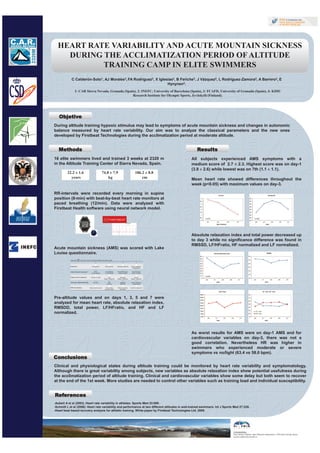
1) Sixteen elite swimmers lived and trained for 3 weeks at an altitude of 2320 meters. All subjects experienced symptoms of acute mountain sickness (AMS) with the highest scores on the first day and lowest on the seventh day. 2) Heart rate and some heart rate variability measures showed differences throughout the first week, with maximum heart rate values on the third day and decreases in relaxation index and total power up to the third day. 3) While the worst results for AMS were on the first day and for cardiovascular variables on the third day, there was not a strong correlation between AMS symptoms and heart rate variability measures. However, heart rate was higher in swimmers experiencing moderate to severe AMS symptoms.


