REDUCING EXERCISE-
ASSOCIATED MUSCLE
     CRAMPS

    By Corinne Casey
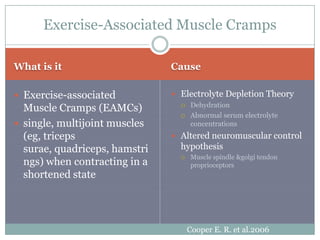
Exercise-Associated Muscle Cramps

What is it                     Cause

 Exercise-associated           Electrolyte Depletion Theory
                                     Dehydration
  Muscle Cramps (EAMCs)          

                                    Abnormal serum electrolyte
 single, multijoint muscles         concentrations
  (eg, triceps                  Altered neuromuscular control
  surae, quadriceps, hamstri     hypothesis
                                    Muscle spindle &golgi tendon
  ngs) when contracting in a         proprioceptors
  shortened state


                                     Cooper E. R. et al.2006
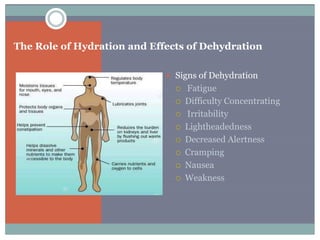
The Role of Hydration and Effects of Dehydration

                              Signs of Dehydration
                                  Fatigue
                                  Difficulty Concentrating
                                  Irritability
                                  Lightheadedness
                                  Decreased Alertness
                                  Cramping
                                  Nausea
                                  Weakness
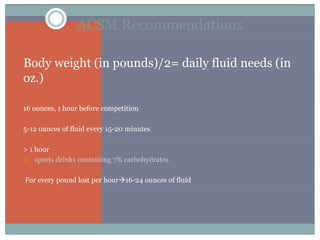
ACSM Recommendations

 Body weight (in pounds)/2= daily fluid needs (in
    oz.)

   16 ounces, 1 hour before competition

   5-12 ounces of fluid every 15-20 minutes

   > 1 hour
     sports drinks containing 7% carbohydrates


   For every pound lost per hour16-24 ounces of fluid
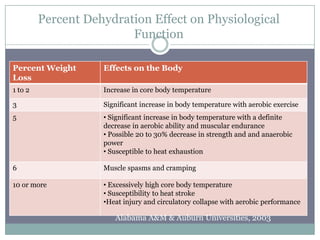
Percent Dehydration Effect on Physiological
                         Function

Percent Weight      Effects on the Body
Loss
1 to 2              Increase in core body temperature

3                   Significant increase in body temperature with aerobic exercise
5                   • Significant increase in body temperature with a definite
                    decrease in aerobic ability and muscular endurance
                    • Possible 20 to 30% decrease in strength and and anaerobic
                    power
                    • Susceptible to heat exhaustion

6                   Muscle spasms and cramping

10 or more          • Excessively high core body temperature
                    • Susceptibility to heat stroke
                    •Heat injury and circulatory collapse with aerobic performance

                       Alabama A&M & Auburn Universities, 2003
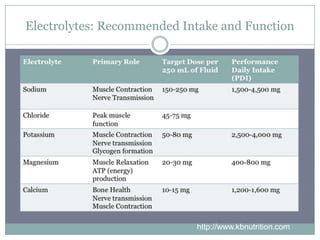
Electrolytes: Recommended Intake and Function


                            http://www.kbnutrition.com
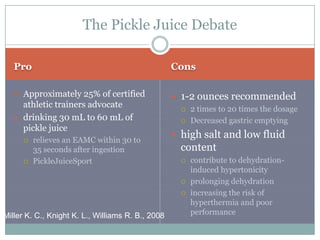
The Pickle Juice Debate

   Pro                                             Cons

    Approximately 25% of certified                 1-2 ounces recommended
     athletic trainers advocate                         2 times to 20 times the dosage
    drinking 30 mL to 60 mL of                         Decreased gastric emptying
     pickle juice
                                                    high salt and low fluid
        relieves an EAMC within 30 to
         35 seconds after ingestion                  content
        PickleJuiceSport                               contribute to dehydration-
                                                         induced hypertonicity
                                                        prolonging dehydration
                                                        increasing the risk of
                                                         hyperthermia and poor
Miller K. C., Knight K. L., Williams R. B., 2008         performance
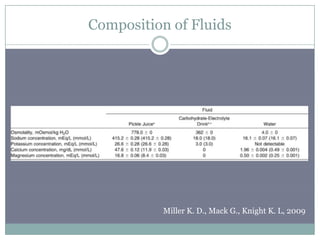
Composition of Fluids


          Miller K. D., Mack G., Knight K. L, 2009
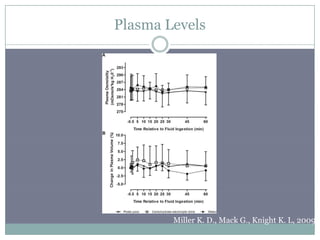
Plasma Levels


        Miller K. D., Mack G., Knight K. L, 2009
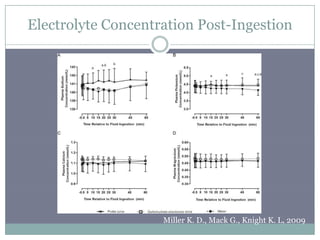
Electrolyte Concentration Post-Ingestion


                    Miller K. D., Mack G., Knight K. L, 2009
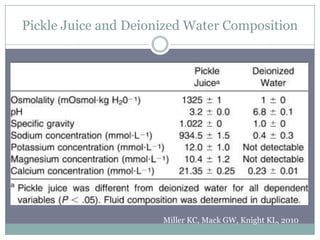
Pickle Juice and Deionized Water Composition


                      Miller KC, Mack GW, Knight KL, 2010
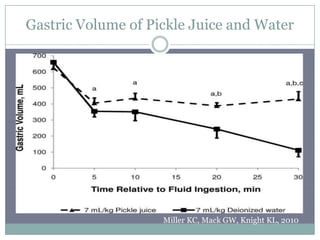
Gastric Volume of Pickle Juice and Water


                    Miller KC, Mack GW, Knight KL, 2010
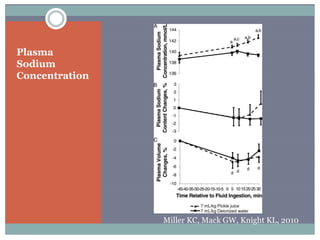
Plasma
Sodium
Concentration


                Miller KC, Mack GW, Knight KL, 2010
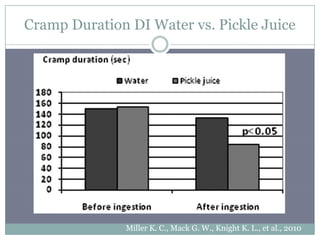
Cramp Duration DI Water vs. Pickle Juice


              Miller K. C., Mack G. W., Knight K. L., et al., 2010
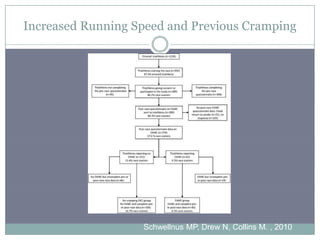
Increased Running Speed and Previous Cramping


                   Schwellnus MP, Drew N, Collins M. , 2010
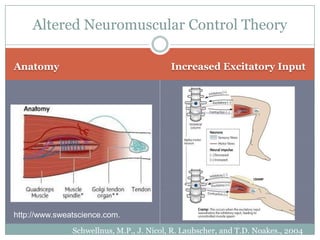
Altered Neuromuscular Control Theory

Anatomy                                   Increased Excitatory Input


http://www.sweatscience.com.
               Schwellnus, M.P., J. Nicol, R. Laubscher, and T.D. Noakes., 2004
Practical Implications

   There is no one cure for EAMCs
       Find a method that works for you

 Pickle juice needs to be further investigated to determine
    optimal quantities and timing.
       Should not be used for the first time during competition

 Fluid, electrolyte and energy supplementation is desirable to
    support circulatory, metabolic and thermoregulatory functions.

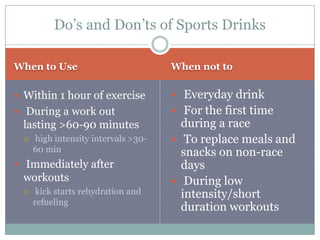
   Sports drinks should not be used in exercise less than 60-90
    minutes

 Stretching and strengthening of musculature is possibly
    important for avoiding EAMCs.
Future Research

 Only 18 studies on pickle juice and carbohydrate
 solutions
    All but three are anecdotal
 Mechanism of pickle juice’s role in EAMC alleviation
   Optimal treatment parameters

 More case studies rather than anecdotal findings
 Research into the oropharyngealregion
 Increased focus on the environmental factors
 influence on dehydration
References

   Cooper E. R., Ferrara M. S., Broglio S. P. Exertional heat illness and environmental conditions during a single
    football season in the Southeast. J Athl Train. 2006;41(3):332–336.
   Jung, A.P., P.A. Bishop, A. Al-Nawwas, and R.B. Dale. Influence of hydration and electrolyte supplementation
    on incidence and time to onset of exercise-associated muscle cramps. J. Athl. Training. 40:71-75, 2005.
   Levin, S. Investigating the cause of muscle cramps. Phys. Sportsmed. 21:111-113, 1993.
   Maughan, R.J., J.B. Leiper, and S.M. Shirreffs. Restoration of fluid balance after exercise-induced
    dehydration: effects of food and fluid intake. Eur. J. Appl. Physiol. Occup. Physiol. 73:317-325, 1996.
   Maughan, R.J., S.J. Merson, N.P. Broad, and S.M. Shirreffs. Fluid and electrolyte intake and loss in elite soccer
    players during training. Int. J. Sport Nutr. Exerc. Metab. 14:333-346, 2004.
   MaughanR. J., Leiper J. B. Limitations to fluid replacement during exercise. Can J Appl Physiol.
    1999;24(2):173–187.
   Miller K. C., Knight K. L., Williams R. B. Athletic trainers' perceptions of pickle juice's effects on exercise
    associated muscle cramps. AthlTher Today. 2008;13(5):31–34.
   Miller K. D., Mack G., Knight K. L. Electrolyte and plasma changes after ingestion of pickle juice, water, and a
    common carbohydrate-electrolyte solution. J Athl Train. 2009;44(5):454–461.
   Miller K. C., Mack G. W., Knight K. L., et al. Reflex inhibition of electrically-induced muscle cramps in
    hypohydrated humans. Med Sci Sports Exerc. 2010;42(5):953–961.
   Roeleveld, K., B.G. van Engelen, and D.F. Stegeman. Possible mechanisms of muscle cramp from temporal
    and spatial surface EMG characteristics. J. Appl. Physiol. 88:1698-1706, 2000.
   Schwellnus, M.P., J. Nicol, R. Laubscher, and T.D. Noakes. Serum electrolyte concentrations and hydration
    status are not associated with exercise associated muscle cramping (EAMC) in distance runners. Br. J. Sports
    Med. 38:488-492, 2004.
   Schwellnus MP, Drew N, Collins M. Increased running speed and previous cramping rather than dehydration
    or serum sodium changes predict exercise-associated muscle cramping: a prospective cohort study in 210
    Ironmantriathletes. Br J Sports Med 2011;45:650-656
Pre-Ingestion Urine Levels


             Miller K. D., Mack G., Knight K. L, 2009
Pre-ingestion Plasma Levels


               Miller K. D., Mack G., Knight K. L, 2009
Do’s and Don’ts of Sports Drinks

When to Use                          When not to

 Within 1 hour of exercise           Everyday drink
 During a work out                   For the first time
 lasting >60-90 minutes                during a race
    high intensity intervals >30-    To replace meals and
     60 min                            snacks on non-race
 Immediately after                    days
 workouts                             During low
     kick starts rehydration and      intensity/short
     refueling
                                       duration workouts

Exercise Associated Muscle Cramps

  • 1.
  • 2.
    Exercise-Associated Muscle Cramps Whatis it Cause  Exercise-associated  Electrolyte Depletion Theory Dehydration Muscle Cramps (EAMCs)   Abnormal serum electrolyte  single, multijoint muscles concentrations (eg, triceps  Altered neuromuscular control surae, quadriceps, hamstri hypothesis  Muscle spindle &golgi tendon ngs) when contracting in a proprioceptors shortened state Cooper E. R. et al.2006
  • 3.
    The Role ofHydration and Effects of Dehydration  Signs of Dehydration  Fatigue  Difficulty Concentrating  Irritability  Lightheadedness  Decreased Alertness  Cramping  Nausea  Weakness
  • 4.
    ACSM Recommendations  Bodyweight (in pounds)/2= daily fluid needs (in oz.)  16 ounces, 1 hour before competition  5-12 ounces of fluid every 15-20 minutes  > 1 hour  sports drinks containing 7% carbohydrates  For every pound lost per hour16-24 ounces of fluid
  • 5.
    Percent Dehydration Effecton Physiological Function Percent Weight Effects on the Body Loss 1 to 2 Increase in core body temperature 3 Significant increase in body temperature with aerobic exercise 5 • Significant increase in body temperature with a definite decrease in aerobic ability and muscular endurance • Possible 20 to 30% decrease in strength and and anaerobic power • Susceptible to heat exhaustion 6 Muscle spasms and cramping 10 or more • Excessively high core body temperature • Susceptibility to heat stroke •Heat injury and circulatory collapse with aerobic performance Alabama A&M & Auburn Universities, 2003
  • 6.
    Electrolytes: Recommended Intakeand Function http://www.kbnutrition.com
  • 7.
    The Pickle JuiceDebate Pro Cons  Approximately 25% of certified  1-2 ounces recommended athletic trainers advocate  2 times to 20 times the dosage  drinking 30 mL to 60 mL of  Decreased gastric emptying pickle juice  high salt and low fluid  relieves an EAMC within 30 to 35 seconds after ingestion content  PickleJuiceSport  contribute to dehydration- induced hypertonicity  prolonging dehydration  increasing the risk of hyperthermia and poor Miller K. C., Knight K. L., Williams R. B., 2008 performance
  • 8.
    Composition of Fluids Miller K. D., Mack G., Knight K. L, 2009
  • 9.
    Plasma Levels Miller K. D., Mack G., Knight K. L, 2009
  • 10.
    Electrolyte Concentration Post-Ingestion Miller K. D., Mack G., Knight K. L, 2009
  • 11.
    Pickle Juice andDeionized Water Composition Miller KC, Mack GW, Knight KL, 2010
  • 12.
    Gastric Volume ofPickle Juice and Water Miller KC, Mack GW, Knight KL, 2010
  • 13.
    Plasma Sodium Concentration Miller KC, Mack GW, Knight KL, 2010
  • 14.
    Cramp Duration DIWater vs. Pickle Juice Miller K. C., Mack G. W., Knight K. L., et al., 2010
  • 15.
    Increased Running Speedand Previous Cramping Schwellnus MP, Drew N, Collins M. , 2010
  • 16.
    Altered Neuromuscular ControlTheory Anatomy Increased Excitatory Input http://www.sweatscience.com. Schwellnus, M.P., J. Nicol, R. Laubscher, and T.D. Noakes., 2004
  • 17.
    Practical Implications  There is no one cure for EAMCs  Find a method that works for you  Pickle juice needs to be further investigated to determine optimal quantities and timing.  Should not be used for the first time during competition  Fluid, electrolyte and energy supplementation is desirable to support circulatory, metabolic and thermoregulatory functions.  Sports drinks should not be used in exercise less than 60-90 minutes  Stretching and strengthening of musculature is possibly important for avoiding EAMCs.
  • 18.
    Future Research  Only18 studies on pickle juice and carbohydrate solutions  All but three are anecdotal  Mechanism of pickle juice’s role in EAMC alleviation  Optimal treatment parameters  More case studies rather than anecdotal findings  Research into the oropharyngealregion  Increased focus on the environmental factors influence on dehydration
  • 19.
    References  Cooper E. R., Ferrara M. S., Broglio S. P. Exertional heat illness and environmental conditions during a single football season in the Southeast. J Athl Train. 2006;41(3):332–336.  Jung, A.P., P.A. Bishop, A. Al-Nawwas, and R.B. Dale. Influence of hydration and electrolyte supplementation on incidence and time to onset of exercise-associated muscle cramps. J. Athl. Training. 40:71-75, 2005.  Levin, S. Investigating the cause of muscle cramps. Phys. Sportsmed. 21:111-113, 1993.  Maughan, R.J., J.B. Leiper, and S.M. Shirreffs. Restoration of fluid balance after exercise-induced dehydration: effects of food and fluid intake. Eur. J. Appl. Physiol. Occup. Physiol. 73:317-325, 1996.  Maughan, R.J., S.J. Merson, N.P. Broad, and S.M. Shirreffs. Fluid and electrolyte intake and loss in elite soccer players during training. Int. J. Sport Nutr. Exerc. Metab. 14:333-346, 2004.  MaughanR. J., Leiper J. B. Limitations to fluid replacement during exercise. Can J Appl Physiol. 1999;24(2):173–187.  Miller K. C., Knight K. L., Williams R. B. Athletic trainers' perceptions of pickle juice's effects on exercise associated muscle cramps. AthlTher Today. 2008;13(5):31–34.  Miller K. D., Mack G., Knight K. L. Electrolyte and plasma changes after ingestion of pickle juice, water, and a common carbohydrate-electrolyte solution. J Athl Train. 2009;44(5):454–461.  Miller K. C., Mack G. W., Knight K. L., et al. Reflex inhibition of electrically-induced muscle cramps in hypohydrated humans. Med Sci Sports Exerc. 2010;42(5):953–961.  Roeleveld, K., B.G. van Engelen, and D.F. Stegeman. Possible mechanisms of muscle cramp from temporal and spatial surface EMG characteristics. J. Appl. Physiol. 88:1698-1706, 2000.  Schwellnus, M.P., J. Nicol, R. Laubscher, and T.D. Noakes. Serum electrolyte concentrations and hydration status are not associated with exercise associated muscle cramping (EAMC) in distance runners. Br. J. Sports Med. 38:488-492, 2004.  Schwellnus MP, Drew N, Collins M. Increased running speed and previous cramping rather than dehydration or serum sodium changes predict exercise-associated muscle cramping: a prospective cohort study in 210 Ironmantriathletes. Br J Sports Med 2011;45:650-656
  • 20.
    Pre-Ingestion Urine Levels Miller K. D., Mack G., Knight K. L, 2009
  • 21.
    Pre-ingestion Plasma Levels Miller K. D., Mack G., Knight K. L, 2009
  • 22.
    Do’s and Don’tsof Sports Drinks When to Use When not to  Within 1 hour of exercise  Everyday drink  During a work out  For the first time lasting >60-90 minutes during a race  high intensity intervals >30-  To replace meals and 60 min snacks on non-race  Immediately after days workouts  During low  kick starts rehydration and intensity/short refueling duration workouts

Editor's Notes

  • #3 EAMCS Athletes commonly develop exercise-associated muscle cramps (EAMCs),1–,3 and researchers4–,6 think that fluid and electrolyte disturbances often are the cause. This theory is based on the observation that many athletes who develop EAMCs during exercise have large fluid and electrolyte losses at the time of cramping.5 Although the exact cause of EAMCs remains unknown, athletes prone to cramping ingest fluidsadd modest amounts of sodium (0.3–0.7 g/L) to their drinks
  • #4 Dehydration is a process by which the body fluid loss (sweat) exceeds replacement and leads to a deficit in body fluidsDecreased blood volume Increased heart rate with equal workload Decrease blood flow Increased body temperature Greater perceived exertion
  • #6 With a 5% decrease an athlete will need at least 5 hours to recover
  • #7  a substance that conducts an electric current when dissolved in water Major ElectrolytesSodiumChloridePotassium Necessary for fluid balance, conduction of nerve impulses, muscle contractions
  • #9 Descriptive statistics of each solution's composition are shown in Table 1. Participants ingested 86.1 ± 16.9 mL of pickle juice, 86.5 ± 16.7 mL of CHO-e drink, and 86.4 ± 16.6 mL of tap water. Participants ingested, on average, 35.7 mmol, 1.6 mmol, and 1.4 mmol sodium with pickle juice, CHO-e drink, and water, respectively.
  • #10 A, Plasma osmolality and B, percent change in plasma volume 60 minutes after ingestion of pickle juice, carbohydrate-electrolyte drink, and water. Error bars denote SDs.Plasma osmolality did not differ over time among fluids (F20,160 = 0.72, P = .80) (Figure 1). Despite ingesting 35.7 mmol sodium with pickle juice, average plasma osmolality never exceeded 284.1 mOsmol/kg H2O for the duration of testing.Changes in plasma volume after ingestion of each fluid are shown in Figure 1 and Table 2. Plasma volume did not differ over time among pickle juice, CHO-e drink, and water (F20,160 = 0.54, P = .95).
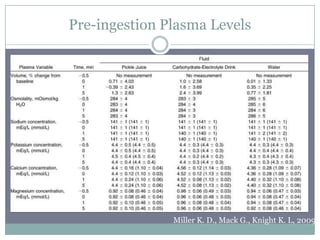
  • #11 Plasma sodium concentration differed over time among pickle juice, CHO-e drink, and water ingestion (F20,160 = 1.84, P = .02). Plasma sodium concentration was higher after pickle juice ingestion than after water ingestion at 15 and 25 minutes postingestion and was also higher than after CHO-e drink ingestion at 25 and 30 minutes (P ≤ .05) (Figure 2). Compared with baseline, none of the drinks altered plasma sodium concentration over the 60-minute postingestion period (P ≥ .05).Plasma potassium, magnesium, and calcium concentrations over time are shown in Figure 2. Plasma potassium concentration was different over time among fluids (F20,160 = 1.78, P = .03). It was higher after pickle juice ingestion than after water ingestion at 15, 30, and 60 minutes postingestion. The CHO-e drink ingestion elicited a higher plasma potassium concentration than water elicited at 45 and 60 minutes postingestion. Pickle juice and CHO-e drink ingestion had no effect on plasma potassium concentration over 60 minutes (P ≥ .05). Water ingestion decreased plasma potassium concentration at 60 minutes compared with baseline (P ≤ .05). Plasma magnesium (F20,160 = 0.91, P = .58) and calcium (F20,160 = 1.02, P = .44) concentrations were not measurably influenced by fluid ingestion.
  • #12 The GV was determined by the double-sampling technique described by George11 and modified by Beckers et al.10 Participants were given 90 seconds to drink a single bolus (7 mL·kg−1 body mass) of chilled (3°C) PJ or DIW. Descriptive statistics of each drink's composition are found in the Table. These drinks were premixed with approximately 25 ppm phenol red (Sigma-Aldrich Corporation, St Louis, MO), a poorly absorbed indicator dye,12 and chilled to facilitate quick ingestion. Using a large bolus of fluid is often a delimitation in gastric-emptying research.14–,17 We are unaware of any gastric-emptying researchers who have attempted to validate or ascertain the gastric emptying of a single, small bolus of fluid (eg, <150 mL). Whether a smaller bolus would provide valid gastric emptying information was unknown, so we provided a standard volume of fluid (7 mL·kg−1 body weight) that is used in gastric-emptying research. Therefore, our participants ingested a larger volume of PJ than is typically given to athletes experiencing EAMC.4 The containers holding the treatment drinks were weighed before and after ingestion to determine how much of the fluid was actually ingested.
  • #13 Gastric volumes (mean ± SE) after ingestion of 7 mL·kg−1 body mass of pickle juice and deionized water (n = 10). aIndicates gastric volume after ingestion of either pickle juice or deionized water was less than at 0 minutes. bIndicates that gastric volume after ingestion of pickle juice was greater than after ingestion of deionized water. cIndicates that gastric volume after ingestion of deionized water was less at 30 minutes than at 5 minutes. The α level was set at <.05.Ingesting large volumes of PJ resulted in increases in [Na+]p over the course of the study. Health care professionals have warned that ingesting PJ without concurrent hypotonic fluids could contribute to dehydration-induced hypertonicity and delay rehydration.27 Although ingesting large volumes of PJ did cause substantial increases in [Na+]p, these increases were due to rapid decreases in PV rather than an increase in actual plasma sodium content. Thus, despite a large bolus of hypertonic fluid being delivered to the small intestine (approximately 219 mL within the first 5 minutes postingestion), little of the sodium in PJ was actually absorbed and assimilated into the extracellular-fluid compartment. Because these changes occurred after ingestion of both fluids, it appears that gastric distension, rather than fluid composition, triggered cardiovascular reflexes that resulted in transient PV decreases. Some cardiovascular reflexes have been shown to be drinking-mediated responses to large boluses of fluid rather than a response to fluid composition
  • #14 J Athl Train. 2010 Nov-Dec;45(6):601-8.Gastric emptying after pickle-juice ingestion in rested, euhydrated humans.Miller KC, Mack GW, Knight KL.SourceDepartment of Health, Nutrition, and Exercise Sciences, North Dakota State University, Fargo, ND 58108- 6050, USA. kevin.c.miller@ndsu.eduA, Plasma sodium concentration, B, plasma sodium content, and C, plasma volume (mean ± SE) after ingestion of 7 mL·kg−1 body mass of pickle juice and deionized water and changes from baseline (n = 10). aIndicates that plasma sodium concentration was greater at 5, 10, 20, and 30 minutes after ingestion of pickle juice than at −45 minutes. bIndicates that plasma sodium concentration was greater after ingestion of pickle juice than after ingestion of deionized water at 20 and 30 minutes. cIndicates that plasma sodium concentration was greater at 10 minutes after ingestion of deionized water than at −45 minutes. dIndicates that plasma volume was less at 5, 10, 20, and 30 minutes after ingestion of pickle juice than at −45 minutes. The α level was set at <.05.
  • #15 A, Plasma sodium concentration, B, plasma sodium content, and C, plasma volume (mean ± SE) after ingestion of 7 mL·kg−1 body mass of pickle juice and deionized water and changes from baseline (n = 10). aIndicates that plasma sodium concentration was greater at 5, 10, 20, and 30 minutes after ingestion of pickle juice than at −45 minutes. bIndicates that plasma sodium concentration was greater after ingestion of pickle juice than after ingestion of deionized water at 20 and 30 minutes. cIndicates that plasma sodium concentration was greater at 10 minutes after ingestion of deionized water than at −45 minutes. dIndicates that plasma volume was less at 5, 10, 20, and 30 minutes after ingestion of pickle juice than at −45 minutes. The α level was set at <.05.
  • #18 Recent research suggests the following to help reduce or delay the onset of a full blown muscle cramp when the signs of muscle cramps and muscle spasms start:With “altered neuromuscular control” it has been suggested that muscle stretching is the best way to treat muscle cramps and muscle spasms. I’m yet to find what they mean by this and if post stretching or stretching during exercise is the best method. In my experience stretching during your cycle training ride and cycle racing is the best method to release a cramp.Also, “altered neuromuscular control” recommends the ongoing conditioning of the muscles to avoid them fatiguing too soon during your cycle training rides and cycle racingReducing the intensity or stopping cycling also helpsOn-going regular massageProper warm-up before going out on your cycle training ride and cycle racingPost exercise stretching after your cycle training ride and cycle racingBeing well hydrated with a good quality electrolyte sports drink during your cycle training ride and cycle racing
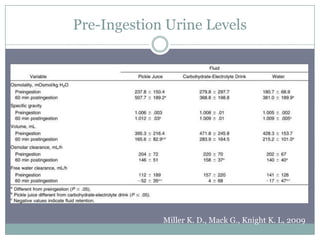
  • #21 Descriptive statistics for urine osmolality, specific gravity, volume, osmolar clearance, and free water clearance at preingestion and 60 minutes postingestion of fluid are shown in Table 3. Urine volume (F2,16 = 0.47, P = .63), osmolality (F2,16 = 3.05, P = .08), specific gravity (F2,16 = 2.77, P = .09), and osmolar clearance (F2,16 = 0.01, P = .98) were not different over time among fluids. However, a trend was observed for differences in free water clearance among fluids at 60 minutes (P ≈ .08).Time effects were observed for all urine variables (P ≤ .02). Urine osmolality,a specific gravity,b volume,c and free water clearanced at 60 minutes postingestion of pickle juice and water were different from these urine variables at preingestion. Urine osmolality (F1,16 = 0.56, P = .47), specific gravity (F1,16 = 0.07, P = .79), volume (F1,16 = 3.63, P = .07), and free water clearance (F1,16 = 3.9, P = .06) did not differ at 60 minutes postingestion of the CHO-e drink. All urine variables indicated participants were euhydrated at 60 minutes postingestion of all fluids.
  • #22 No plasma (P ≥ .07) or urine variables (P ≥ .51) were different among fluids before fluid ingestion, and the values indicated that participants were euhydrated before ingesting each fluid (Tables 2 and ​and3).3). Plasma electrolyte concentrations and osmolality during the first 5 minutes of testing are highlighted in Table 2, with the entire duration of testing represented in Figures 1 and ​and22.