The anatomy of UK labour productivity: lessons from
new and existing data sources
Philip Wales
Head of Productivity
Royal Economic Society Annual Conference
27 March 2018
1
Outline
1. Motivation
2. New aggregates from old data
3. New findings with blends of old data
4. New understanding with new data?
2
Outline
1. Motivation
2. New aggregates from old data
3. New findings with blends of old data
4. New understanding with new data?
3
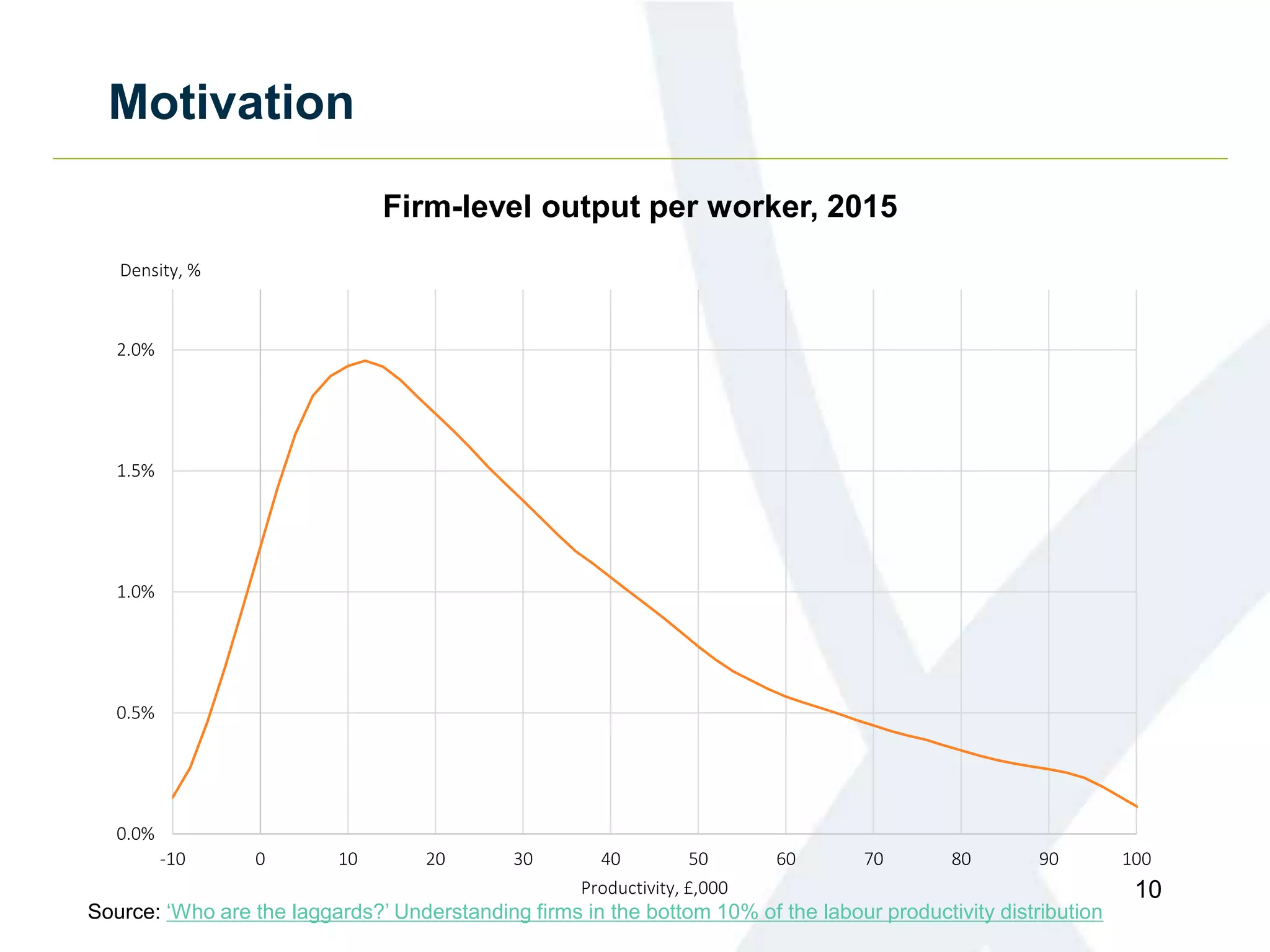
Motivation
• The UK’s recent labour productivity performance has
been strikingly weak…
4
Motivation
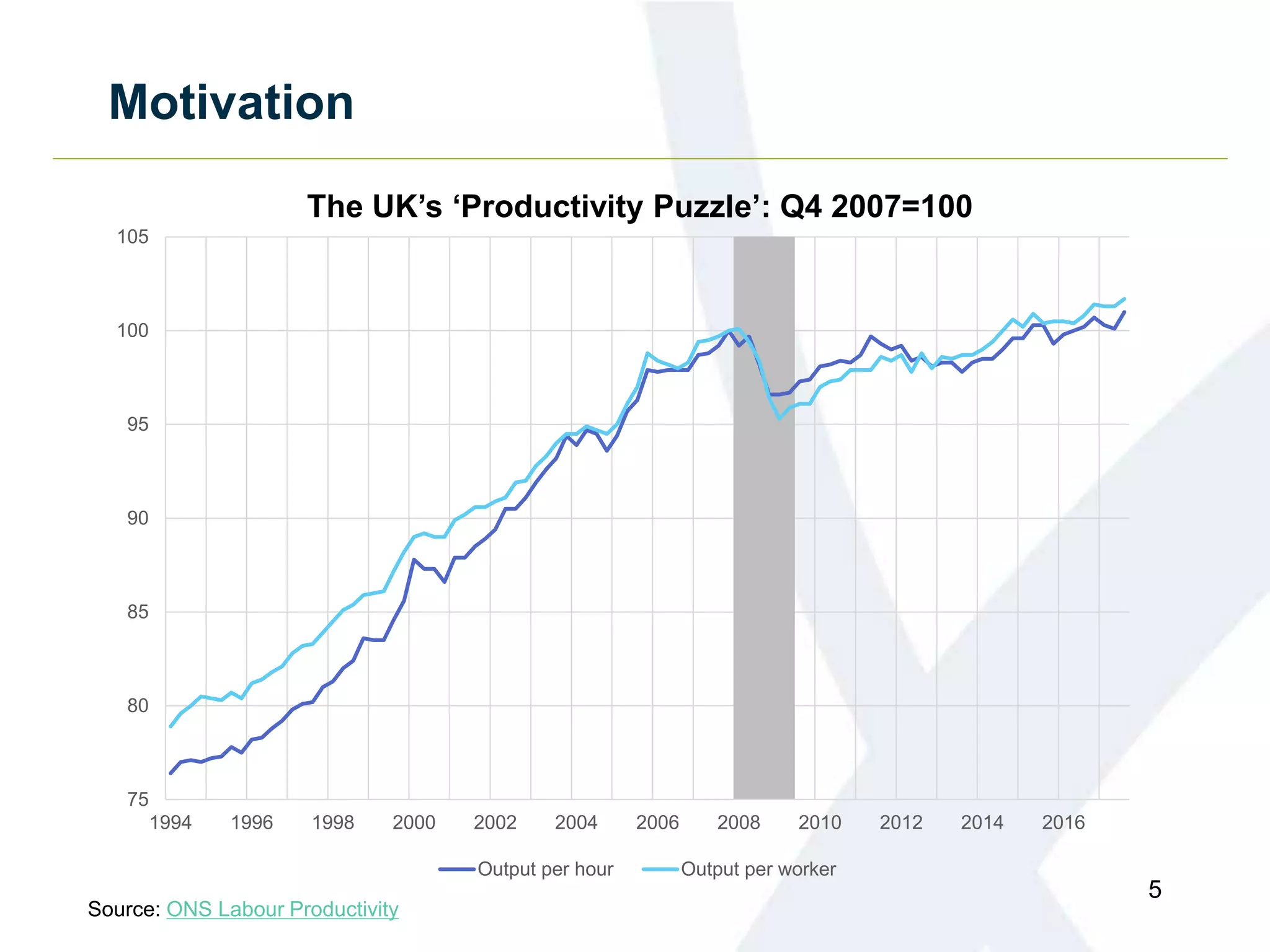
5
75
80
85
90
95
100
105
1994 1996 1998 2000 2002 2004 2006 2008 2010 2012 2014 2016
Output per hour Output per worker
The UK’s ‘Productivity Puzzle’: Q4 2007=100
Source: ONS Labour Productivity
Motivation
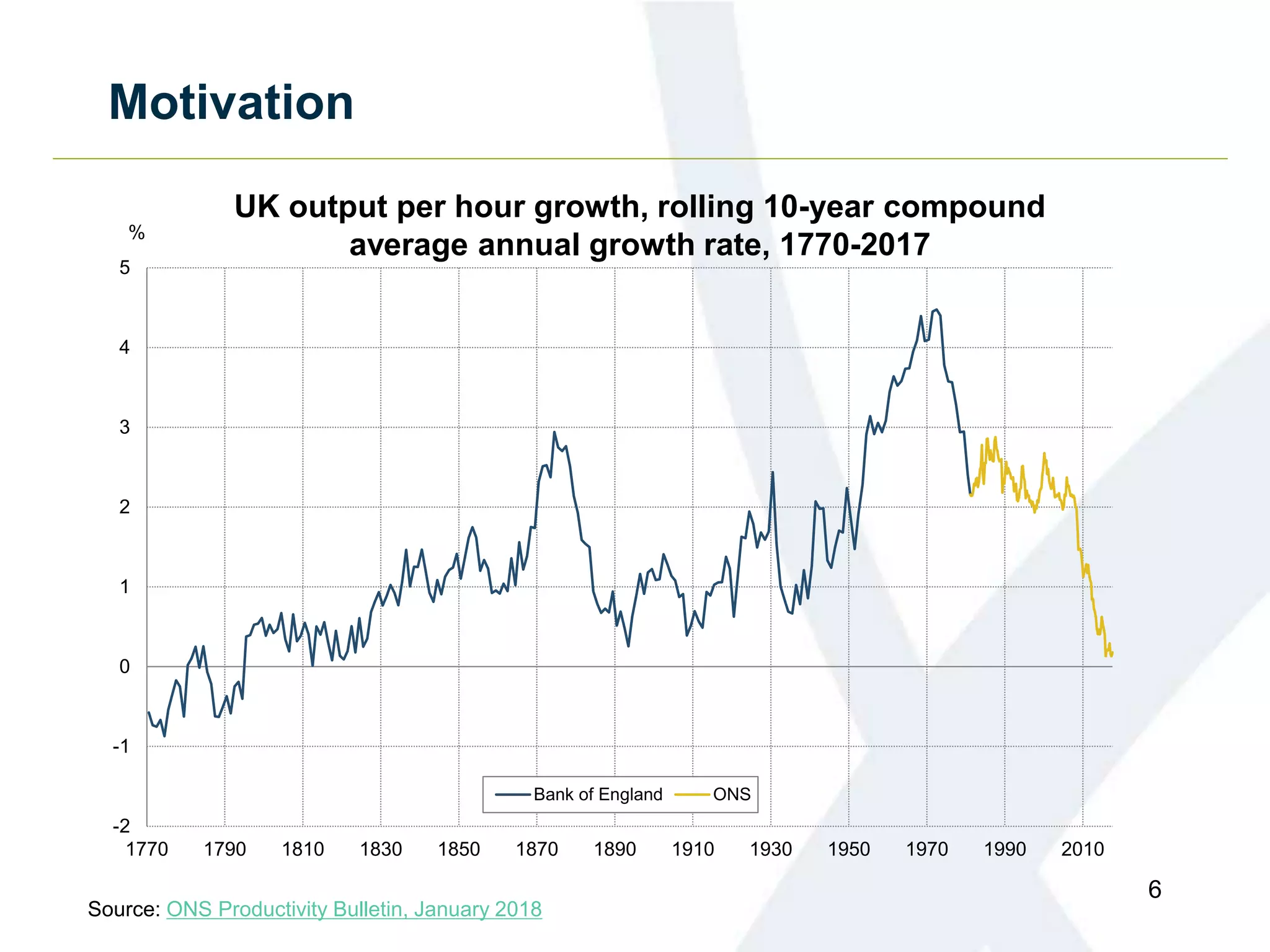
6
UK output per hour growth, rolling 10-year compound
average annual growth rate, 1770-2017
-2
-1
0
1
2
3
4
5
1770 1790 1810 1830 1850 1870 1890 1910 1930 1950 1970 1990 2010
Bank of England ONS
%
Source: ONS Productivity Bulletin, January 2018
Motivation
• The UK’s recent labour productivity performance has
been strikingly weak…
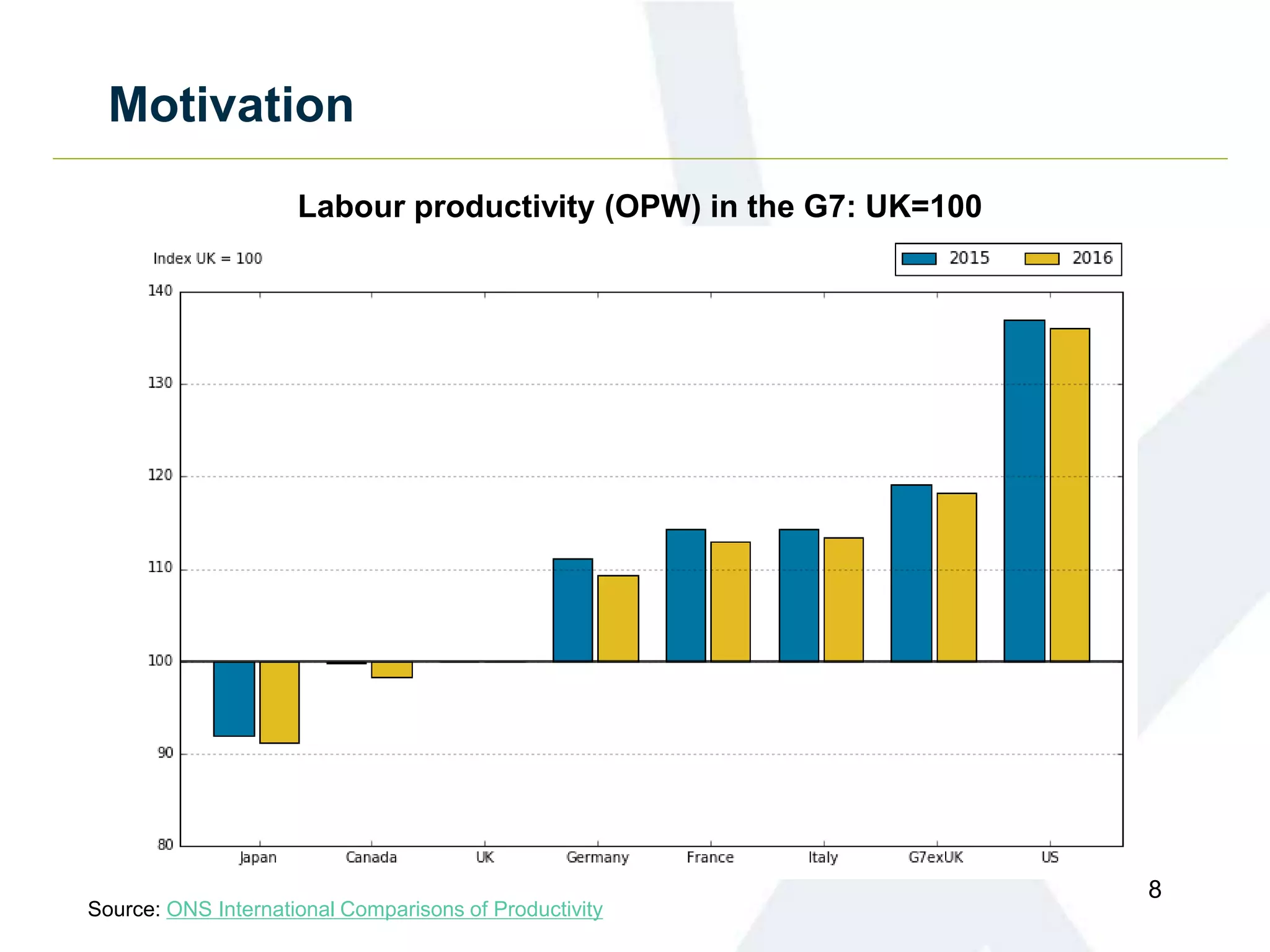
• …the UK’s ‘productivity gap’ remains stubbornly
wide…
7
Motivation
8
Labour productivity (OPW) in the G7: UK=100
Source: ONS International Comparisons of Productivity
Motivation
• The UK’s recent labour productivity performance has
been strikingly weak…
• …the UK’s ‘productivity gap’ remains stubbornly
wide…
• …while the ‘gaps’ between businesses are equally
striking…
9
Motivation
10
0.0%
0.5%
1.0%
1.5%
2.0%
-10 0 10 20 30 40 50 60 70 80 90 100
Density, %
Productivity, £,000
Firm-level output per worker, 2015
Source: ‘Who are the laggards?’ Understanding firms in the bottom 10% of the labour productivity distribution
Outline
1. Motivation
2. New aggregates from old data
3. New findings with blends of old data
4. New understanding with new data?
11
New aggregates from old data
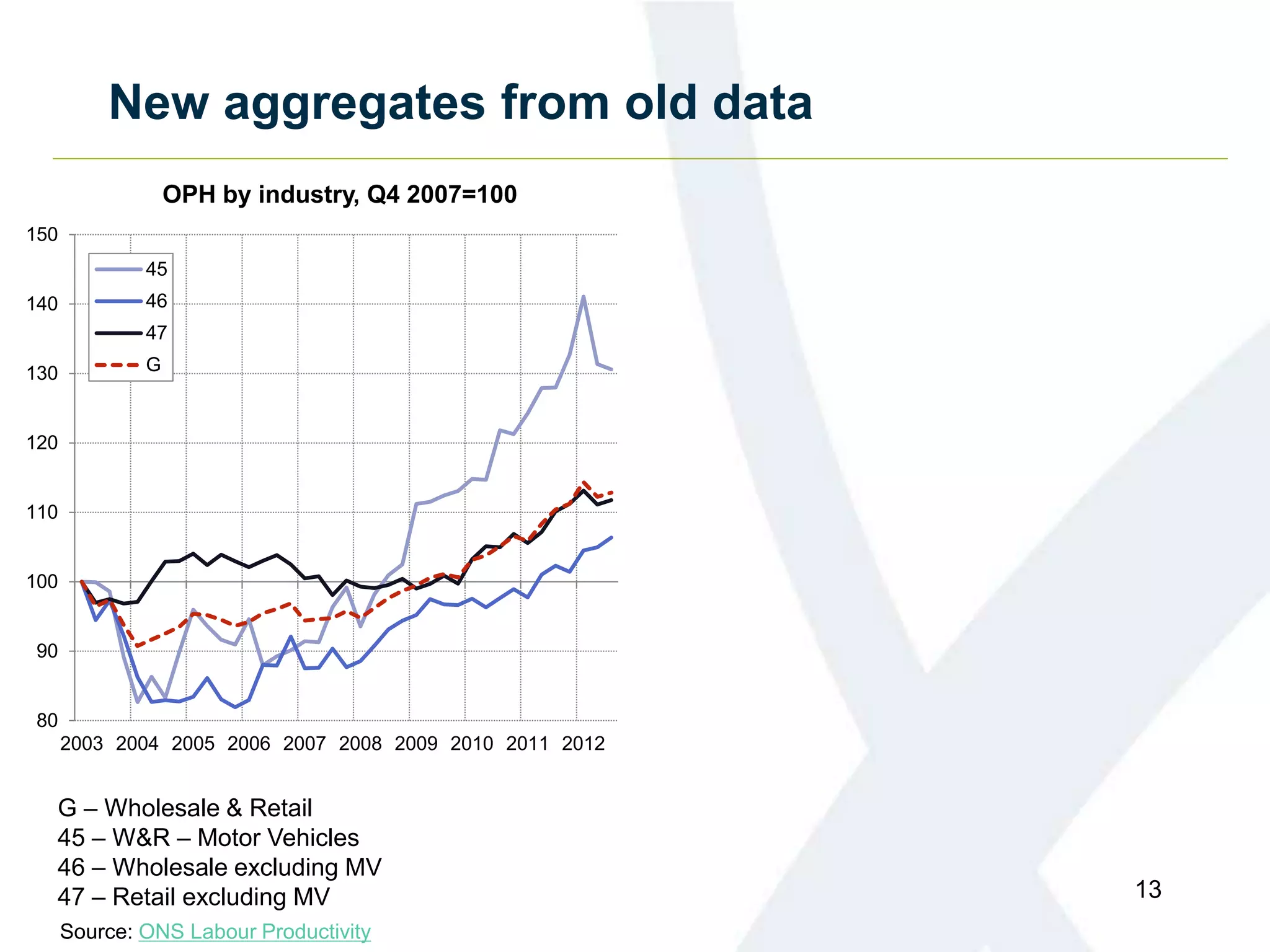
• More labour productivity industry granularity…

12
New aggregates from old data
13
OPH by industry, Q4 2007=100
G – Wholesale & Retail
45 – W&R – Motor Vehicles
46 – Wholesale excluding MV
47 – Retail excluding MV
80
90
100
110
120
130
140
150
2003 2004 2005 2006 2007 2008 2009 2010 2011 2012
45
46
47
G
Source: ONS Labour Productivity
New aggregates from old data
• More labour productivity industry granularity…
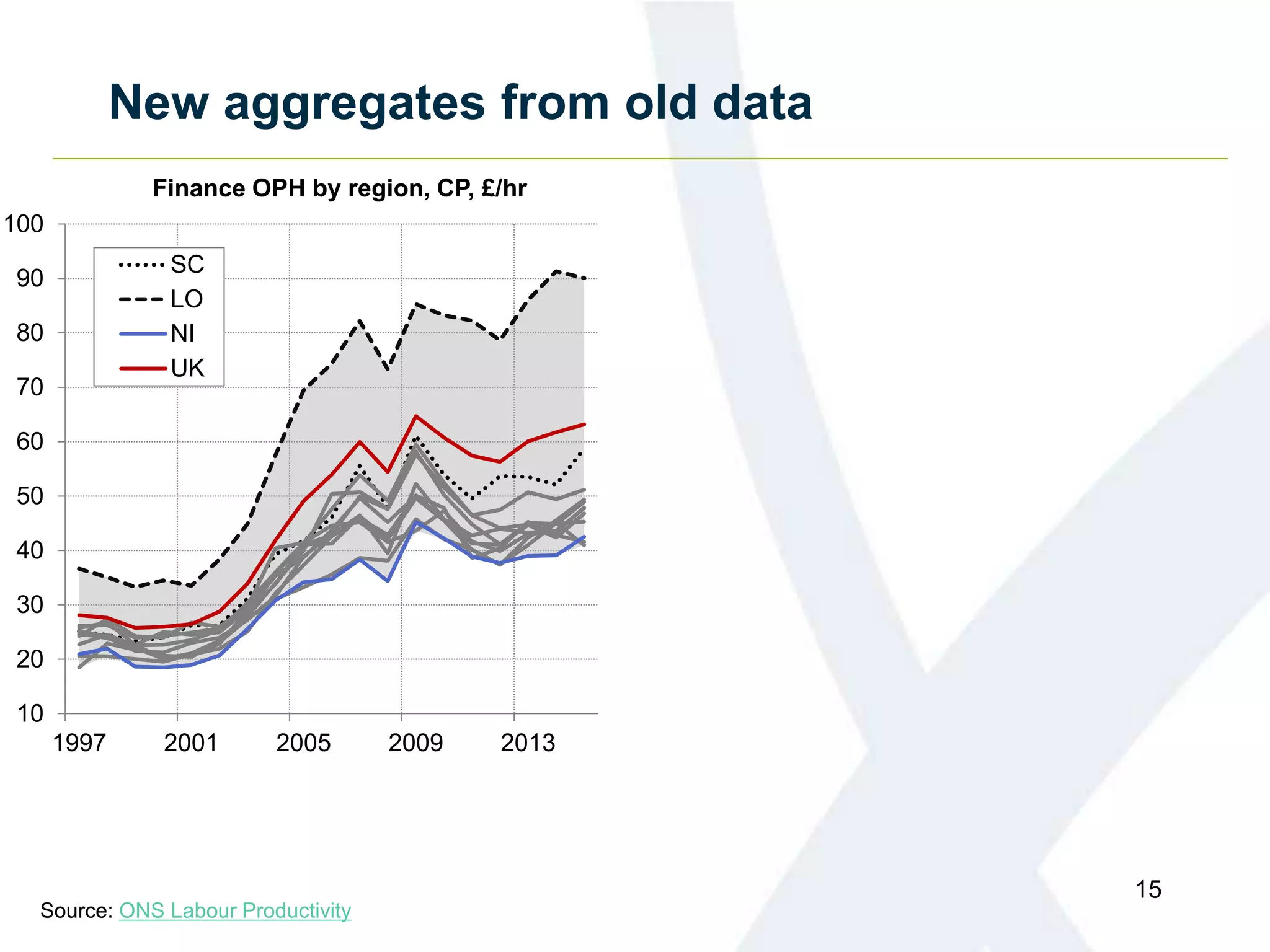
• …as well as industry by region estimates…
14
New aggregates from old data
15
Finance OPH by region, CP, £/hr
10
20
30
40
50
60
70
80
90
100
1997 2001 2005 2009 2013
SC
LO
NI
UK
Source: ONS Labour Productivity
New aggregates from old data
16
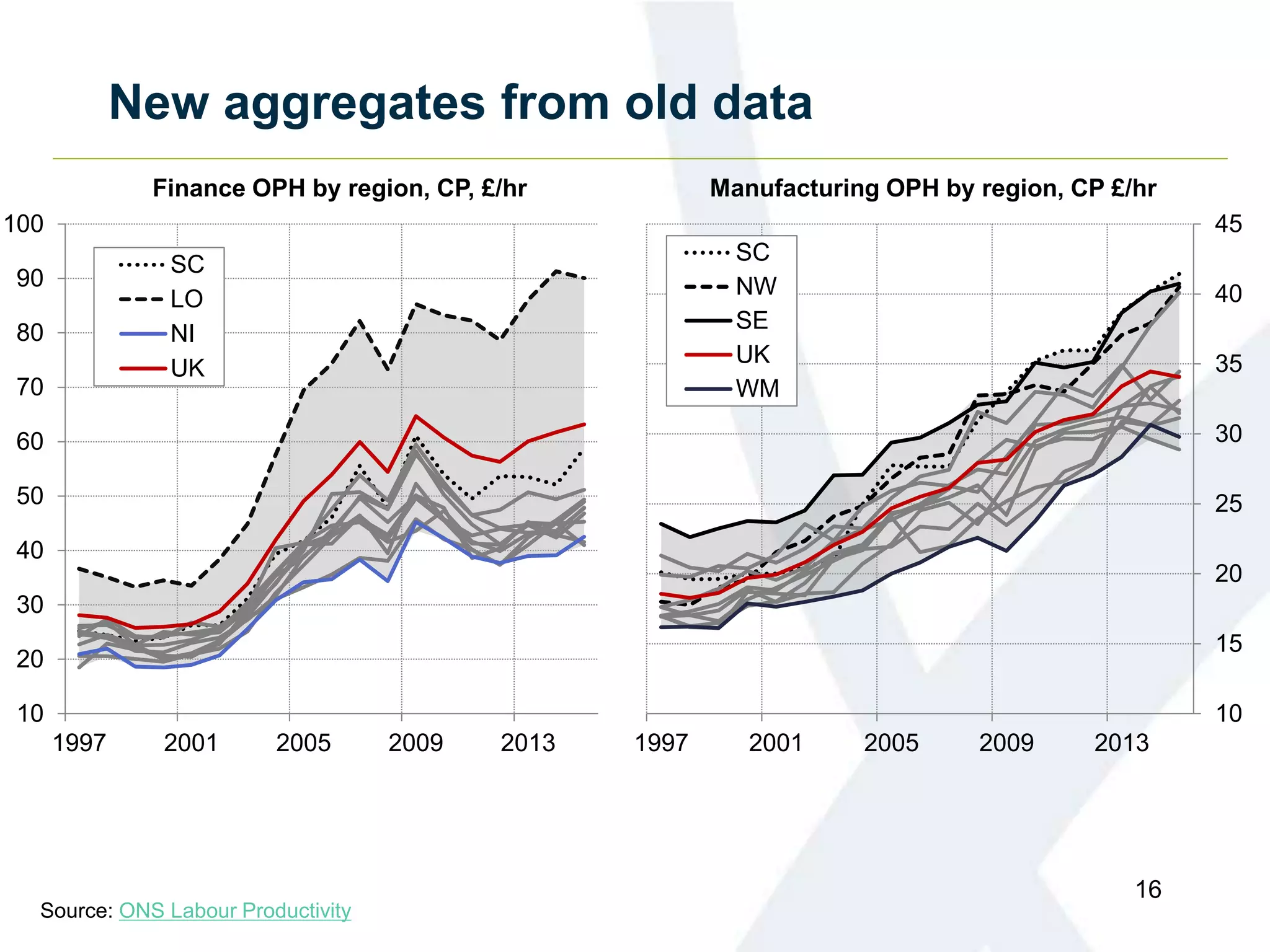
Finance OPH by region, CP, £/hr
10
15
20
25
30
35
40
45
1997 2001 2005 2009 2013
SC
NW
SE
UK
WM
Manufacturing OPH by region, CP £/hr
10
20
30
40
50
60
70
80
90
100
1997 2001 2005 2009 2013
SC
LO
NI
UK
Source: ONS Labour Productivity
New aggregates from old data
• More labour productivity industry granularity…
• …as well as industry by region estimates…
• …to support more detailed analysis
17
Outline
1. Motivation
2. New aggregates from old data
3. New findings with blends of old data
4. New understanding with new data?
18
New findings with blends of old data
19
0.0%
0.5%
1.0%
1.5%
2.0%
-10 0 10 20 30 40 50 60 70 80 90 100
Density, %
Productivity, £,000
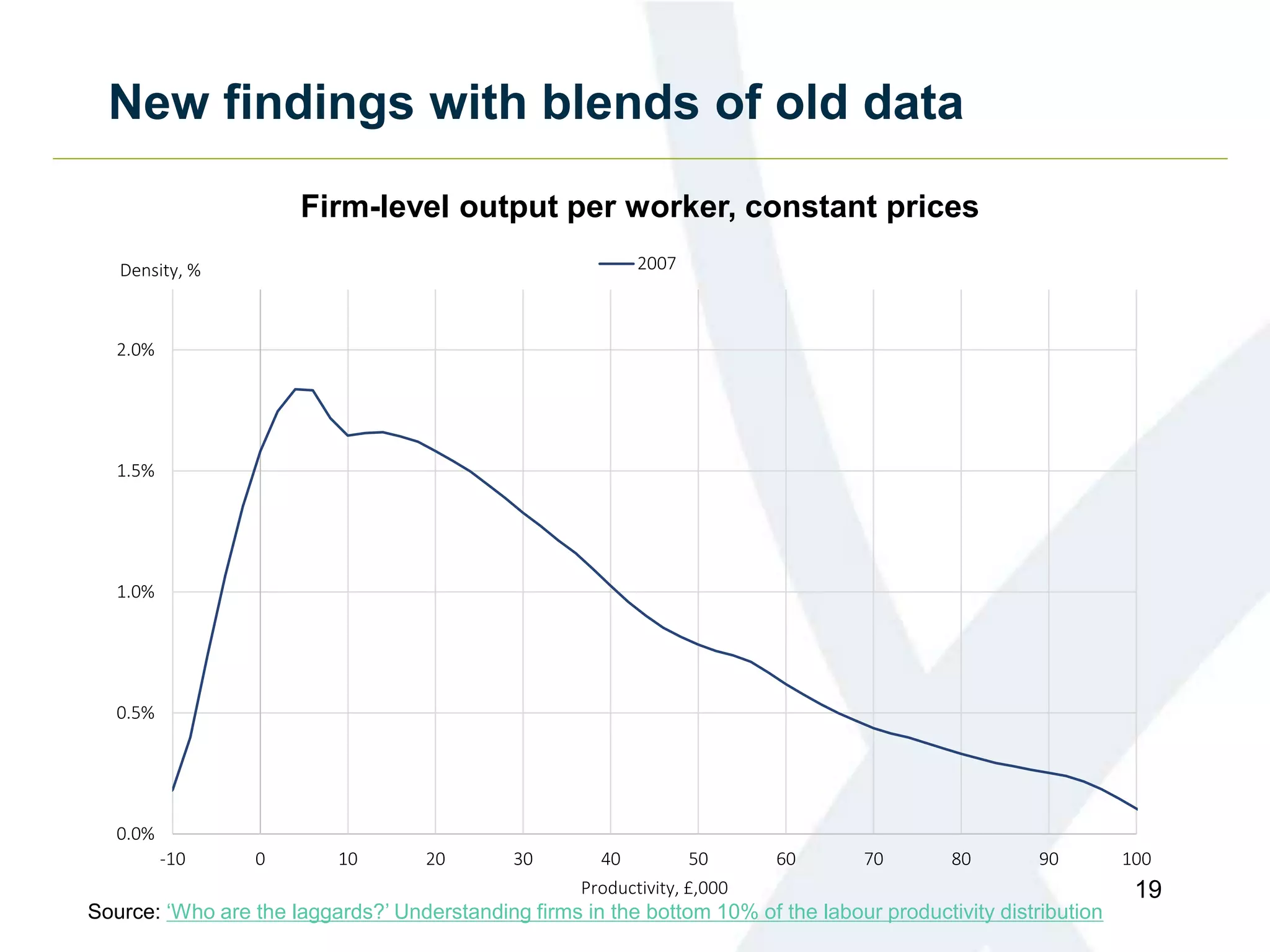
2007
Firm-level output per worker, constant prices
Source: ‘Who are the laggards?’ Understanding firms in the bottom 10% of the labour productivity distribution
New findings with blends of old data
20
0.0%
0.5%
1.0%
1.5%
2.0%
-10 0 10 20 30 40 50 60 70 80 90 100
Density, %
Productivity, £,000
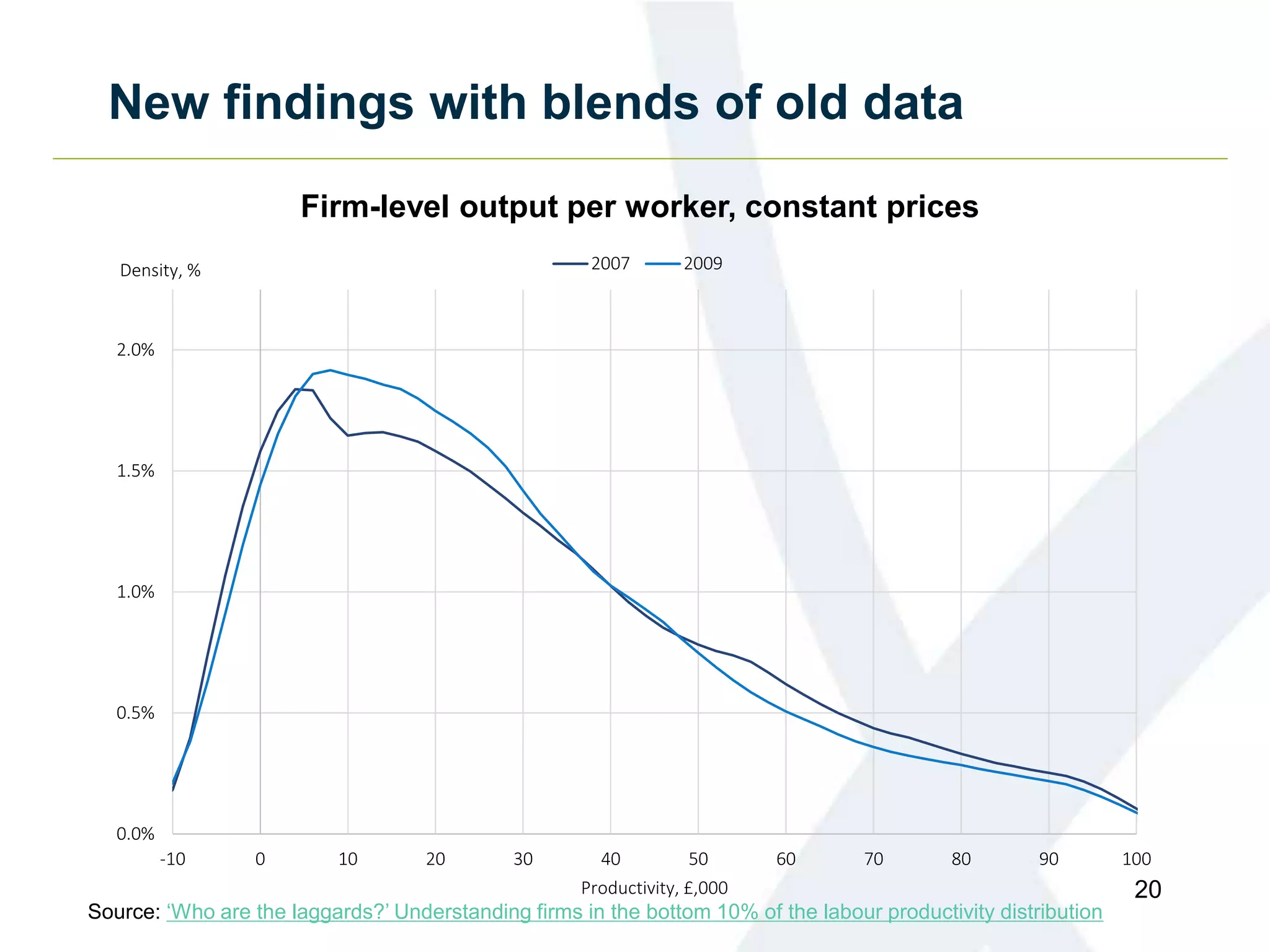
2007 2009
Firm-level output per worker, constant prices
Source: ‘Who are the laggards?’ Understanding firms in the bottom 10% of the labour productivity distribution
New findings with blends of old data
21
0.0%
0.5%
1.0%
1.5%
2.0%
-10 0 10 20 30 40 50 60 70 80 90 100
Density, %
Productivity, £,000
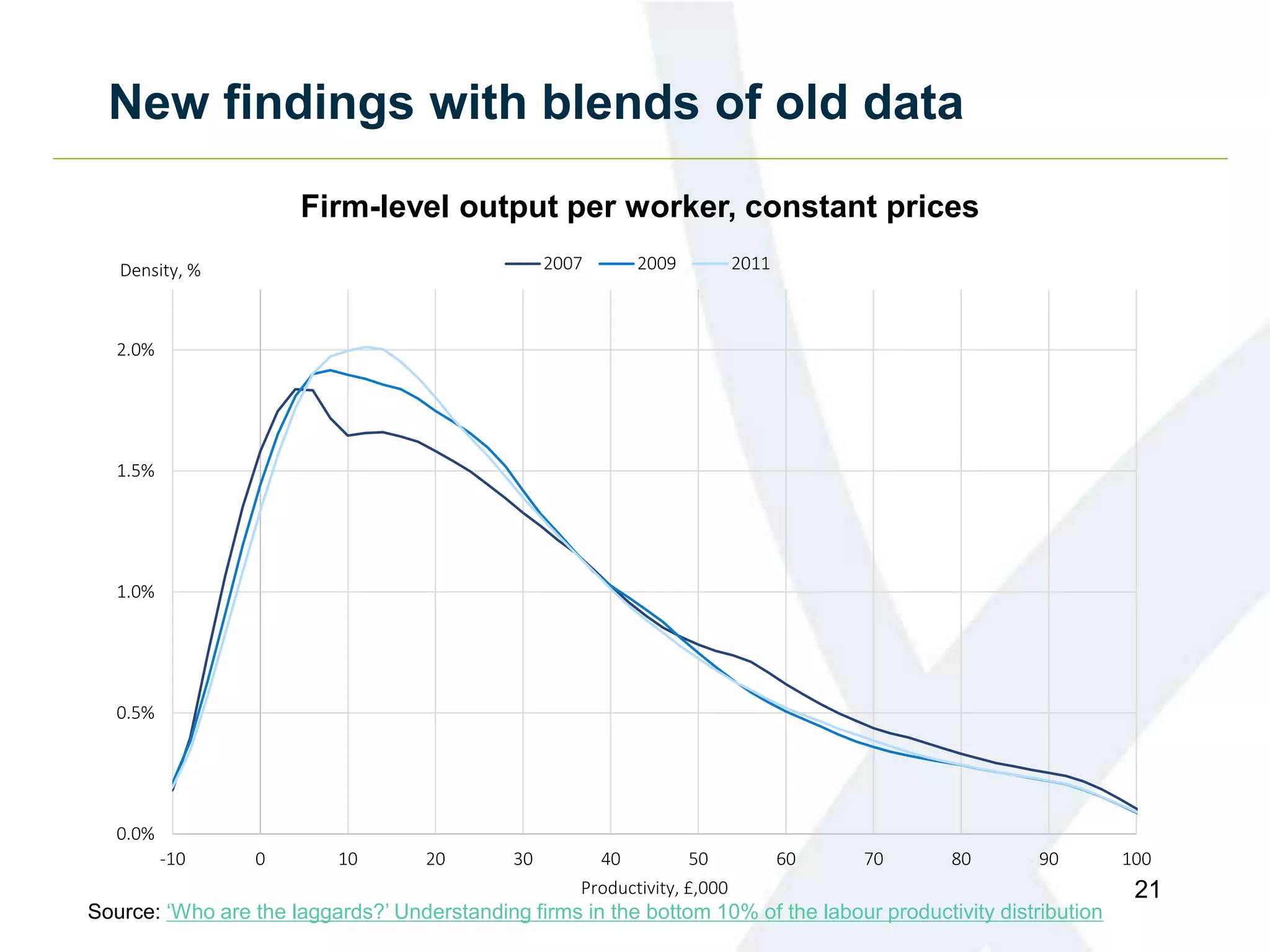
2007 2009 2011
Firm-level output per worker, constant prices
Source: ‘Who are the laggards?’ Understanding firms in the bottom 10% of the labour productivity distribution
New findings with blends of old data
22
0.0%
0.5%
1.0%
1.5%
2.0%
-10 0 10 20 30 40 50 60 70 80 90 100
Density, %
Productivity, £,000
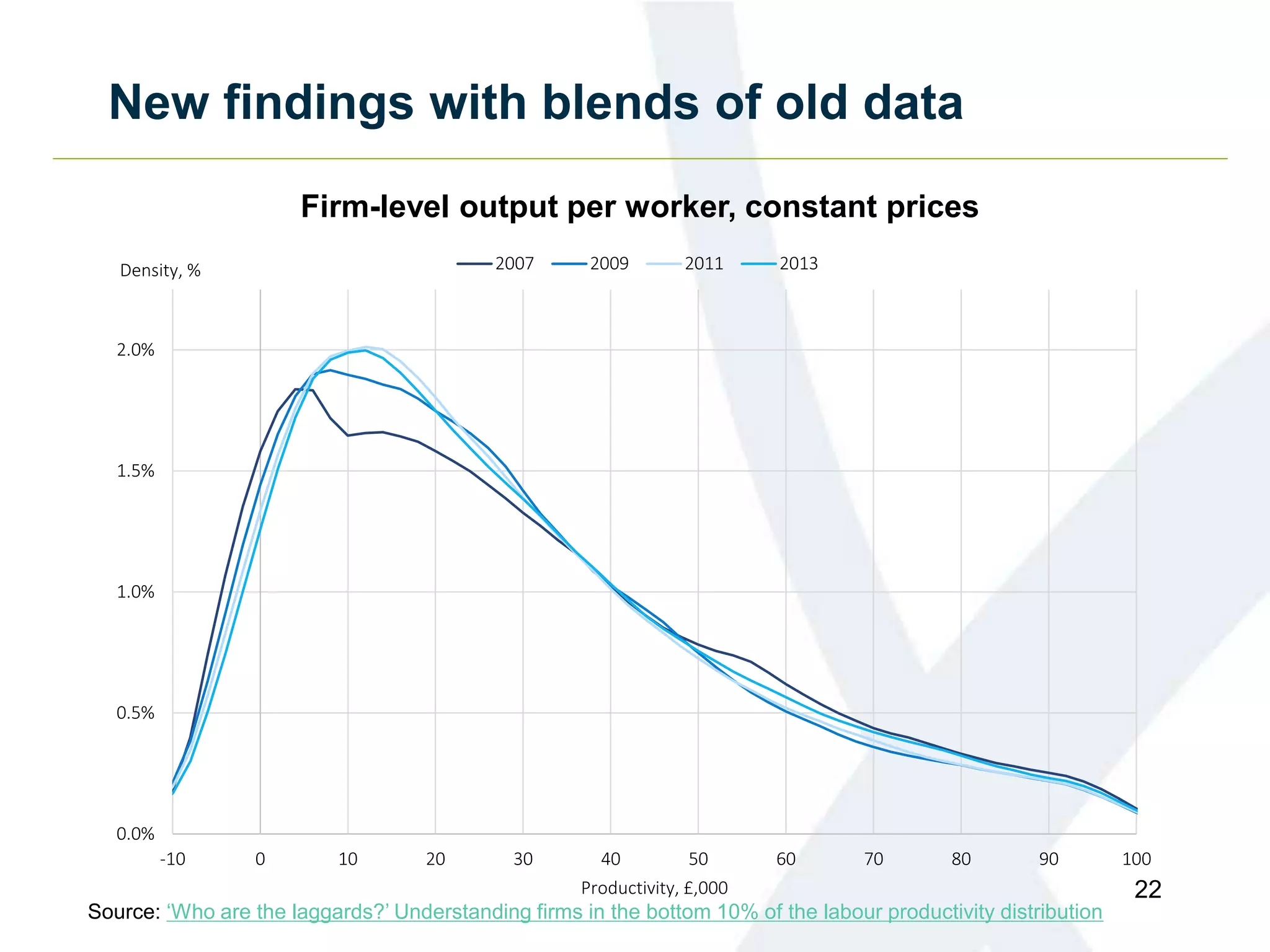
2007 2009 2011 2013
Firm-level output per worker, constant prices
Source: ‘Who are the laggards?’ Understanding firms in the bottom 10% of the labour productivity distribution
New findings with blends of old data
23
0.0%
0.5%
1.0%
1.5%
2.0%
-10 0 10 20 30 40 50 60 70 80 90 100
Density, %
Productivity, £,000
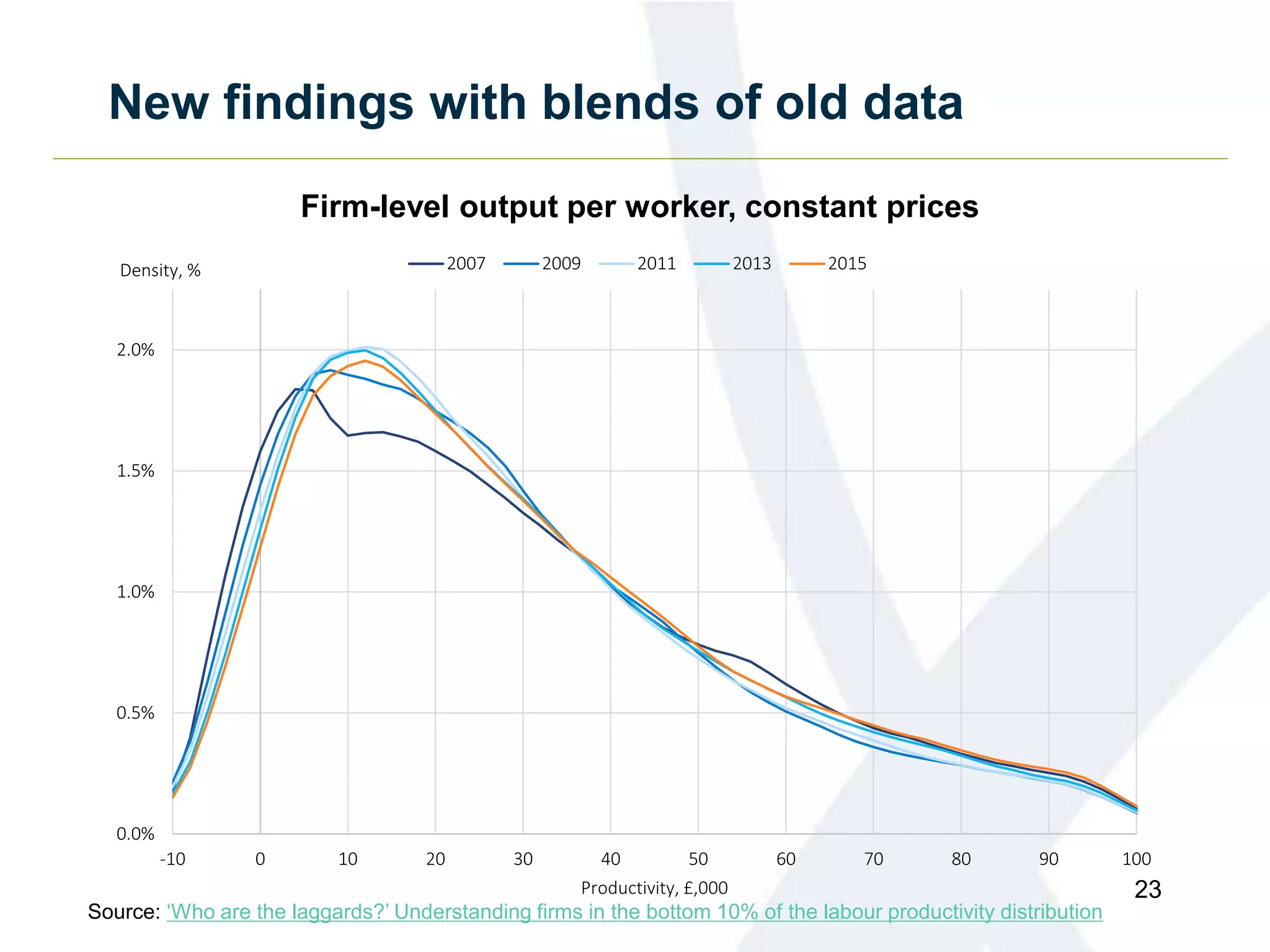
2007 2009 2011 2013 2015
Firm-level output per worker, constant prices
Source: ‘Who are the laggards?’ Understanding firms in the bottom 10% of the labour productivity distribution
New findings with blends of old data
24
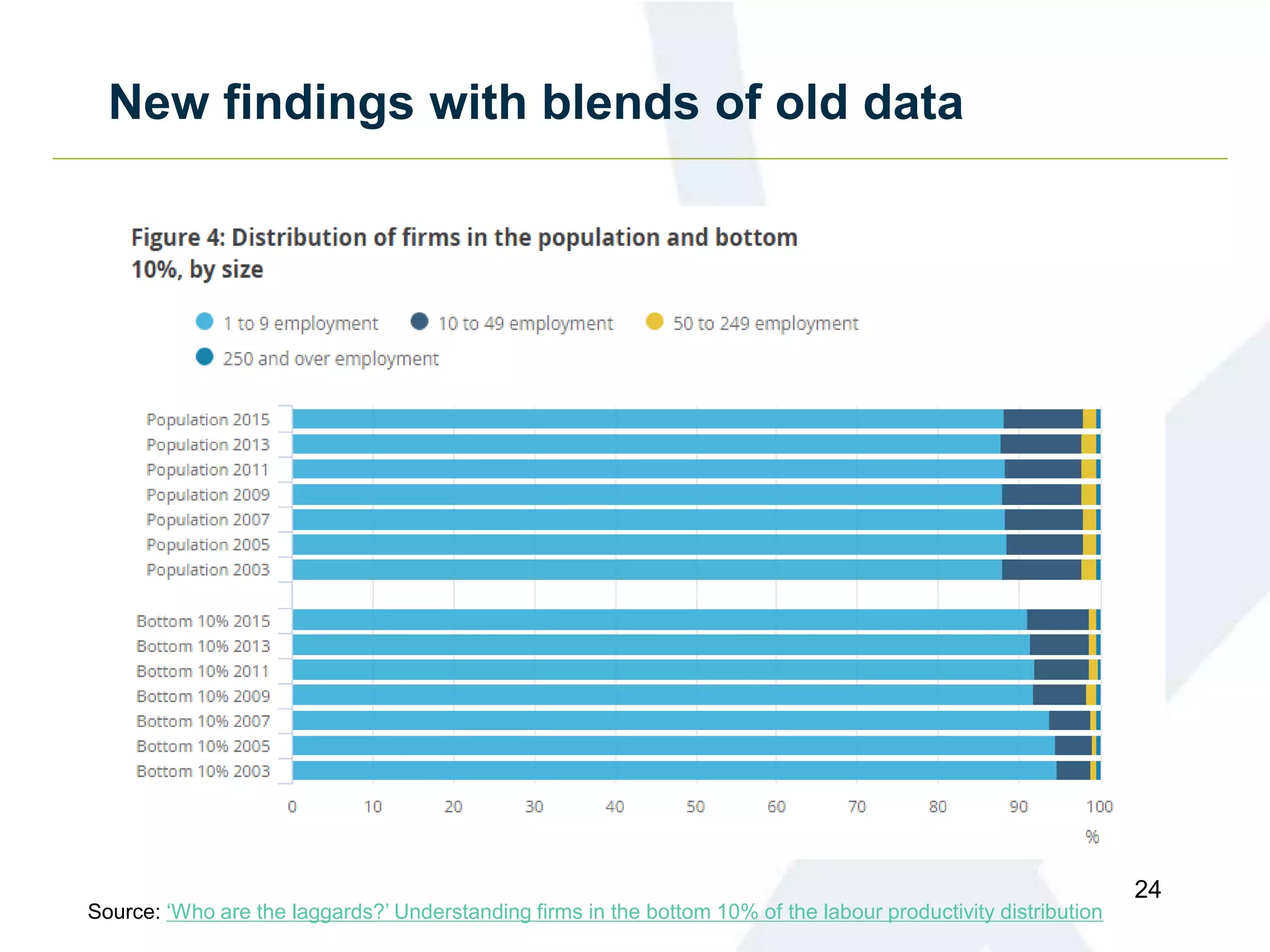
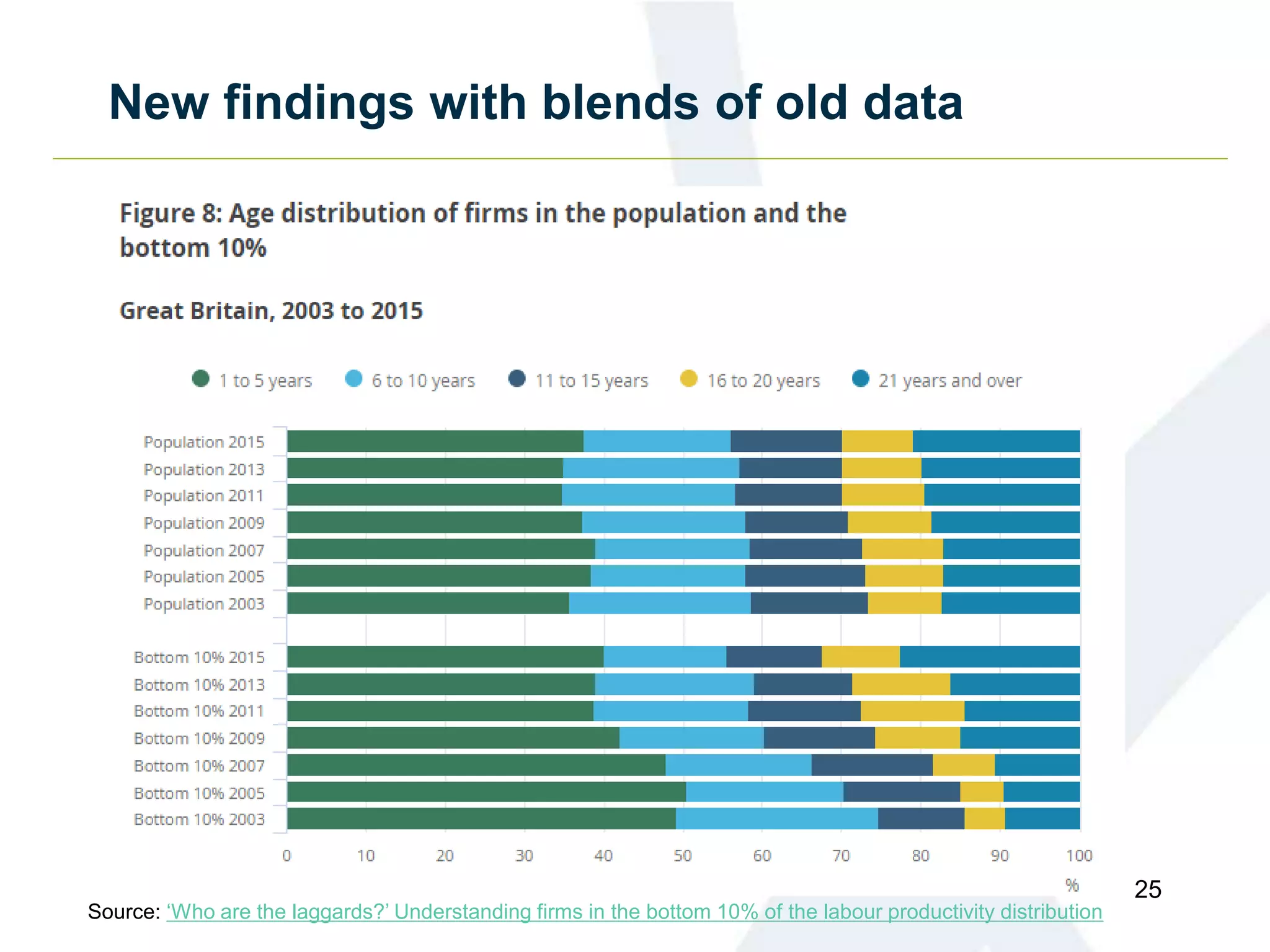
Source: ‘Who are the laggards?’ Understanding firms in the bottom 10% of the labour productivity distribution
New findings with blends of old data
25
Source: ‘Who are the laggards?’ Understanding firms in the bottom 10% of the labour productivity distribution
New findings with blends of old data
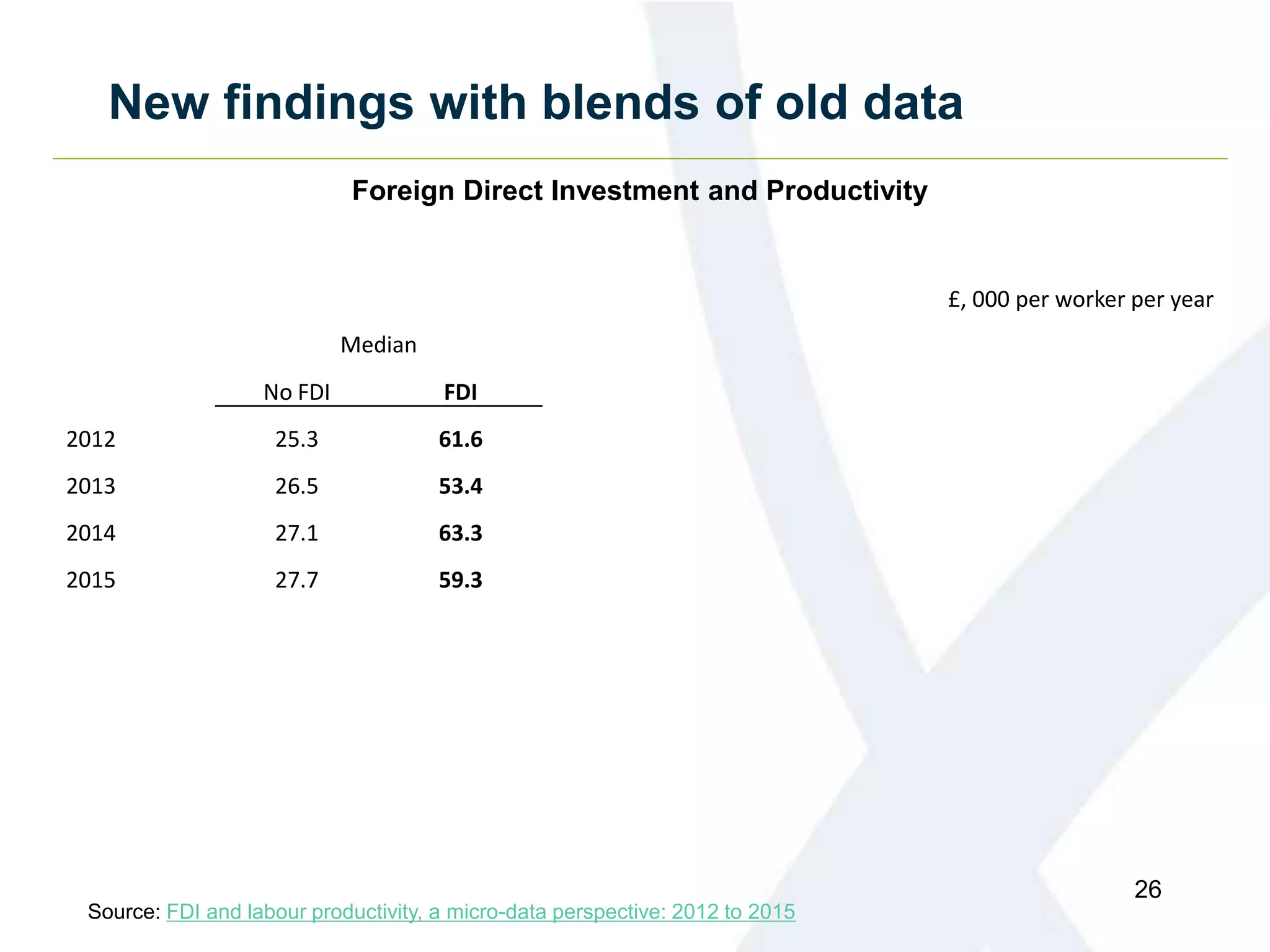
26
£, 000 per worker per year
Median
No FDI FDI
2012 25.3 61.6
2013 26.5 53.4
2014 27.1 63.3
2015 27.7 59.3
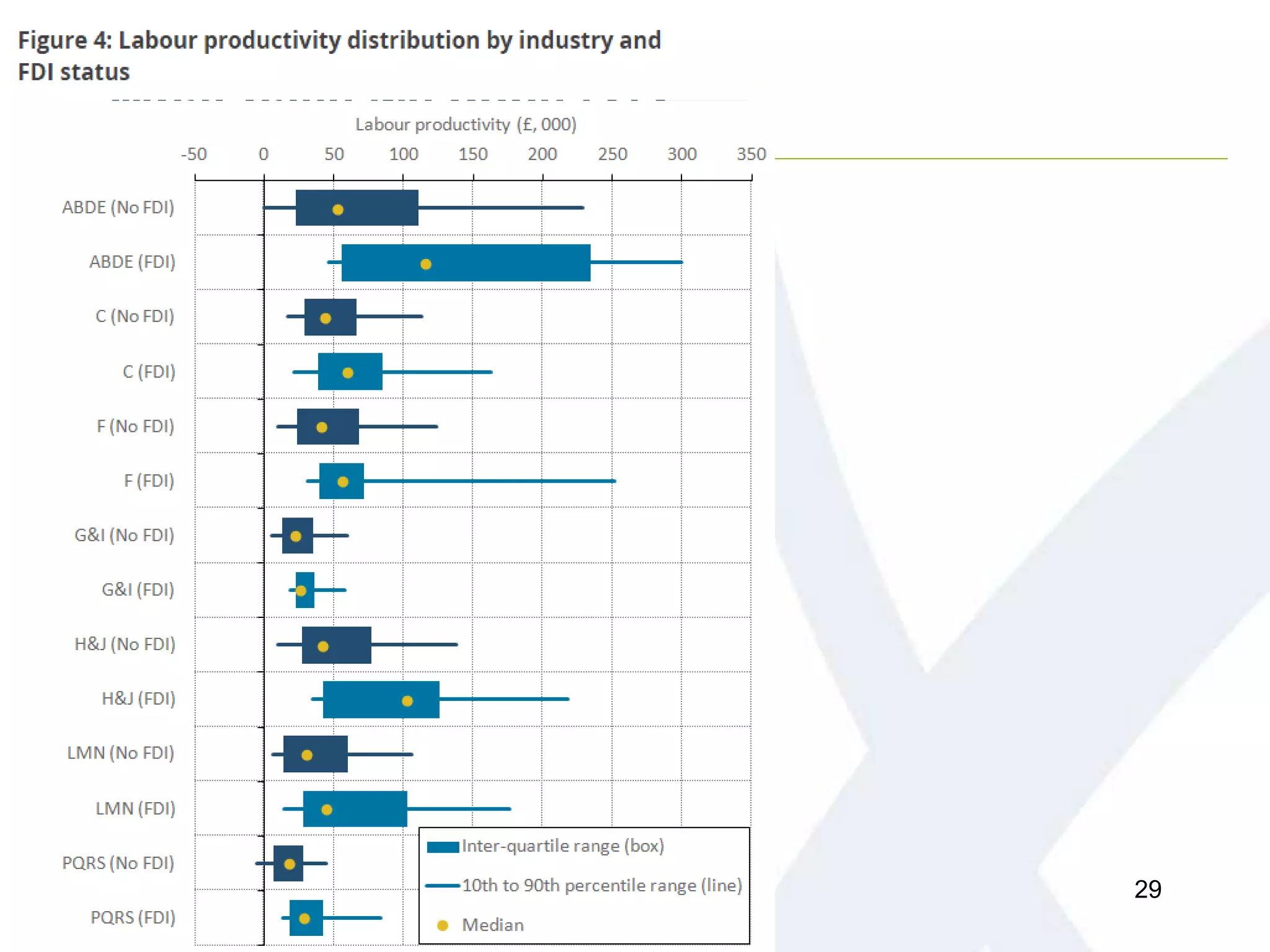
Foreign Direct Investment and Productivity
Source: FDI and labour productivity, a micro-data perspective: 2012 to 2015
New findings with blends of old data
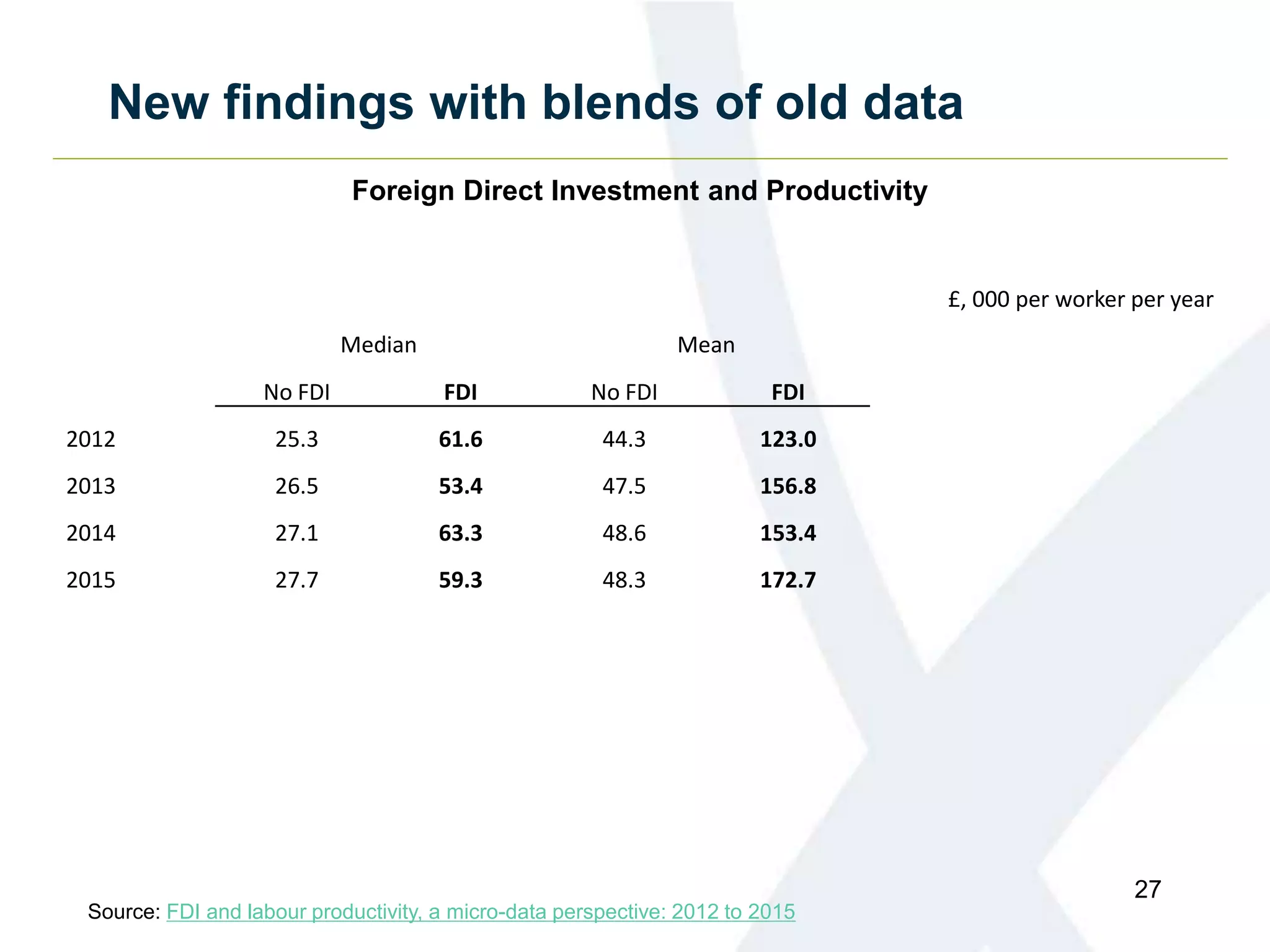
27
£, 000 per worker per year
Median Mean
No FDI FDI No FDI FDI
2012 25.3 61.6 44.3 123.0
2013 26.5 53.4 47.5 156.8
2014 27.1 63.3 48.6 153.4
2015 27.7 59.3 48.3 172.7
Foreign Direct Investment and Productivity
Source: FDI and labour productivity, a micro-data perspective: 2012 to 2015
New findings with blends of old data
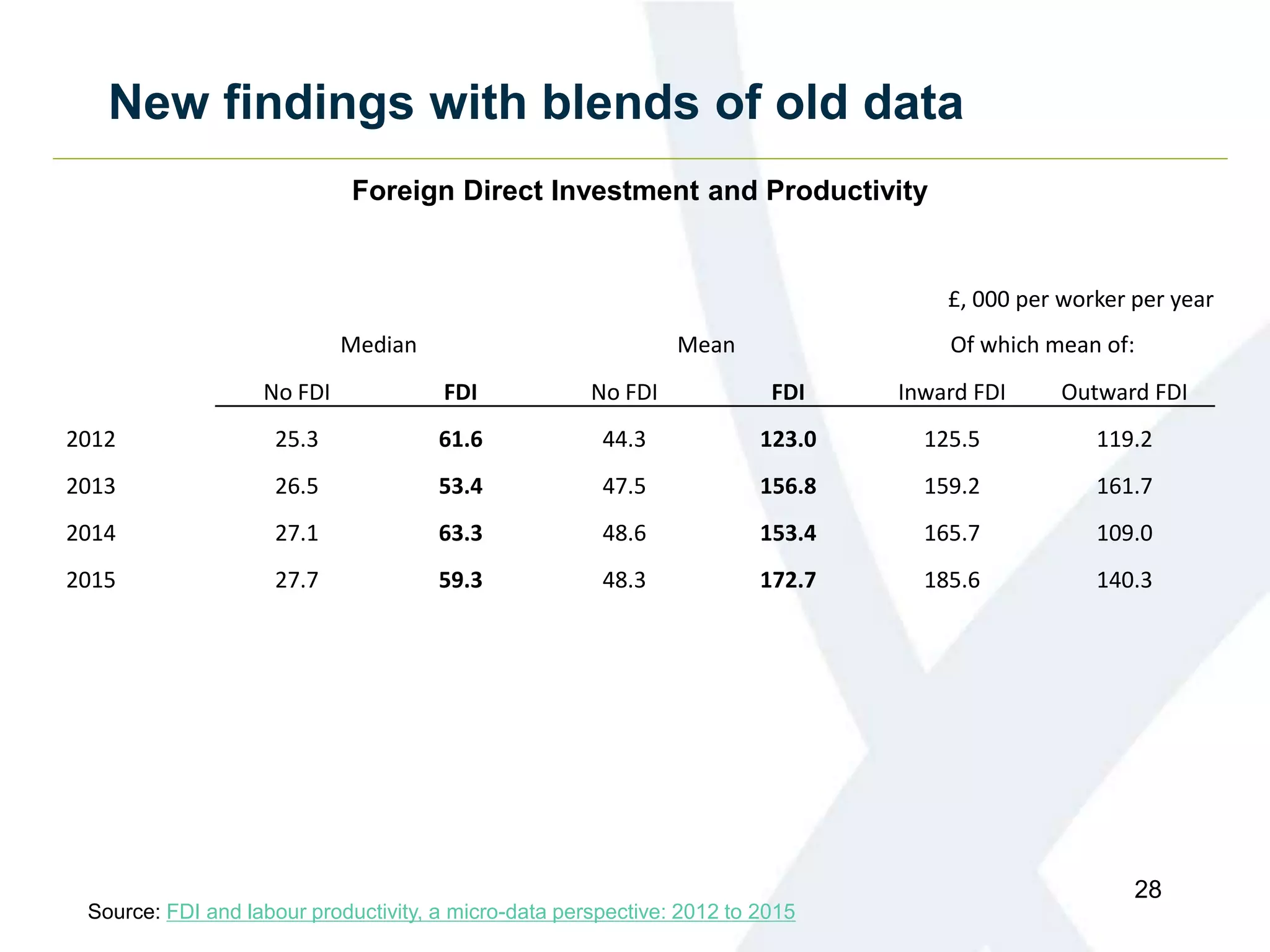
28
£, 000 per worker per year
Median Mean Of which mean of:
No FDI FDI No FDI FDI Inward FDI Outward FDI
2012 25.3 61.6 44.3 123.0 125.5 119.2
2013 26.5 53.4 47.5 156.8 159.2 161.7
2014 27.1 63.3 48.6 153.4 165.7 109.0
2015 27.7 59.3 48.3 172.7 185.6 140.3
Foreign Direct Investment and Productivity
Source: FDI and labour productivity, a micro-data perspective: 2012 to 2015
What have we done (3)?
29
Outline
1. Motivation
2. New aggregates from old data
3. New findings with blends of old data
4. New understanding with new data?
30
New understanding with new data?
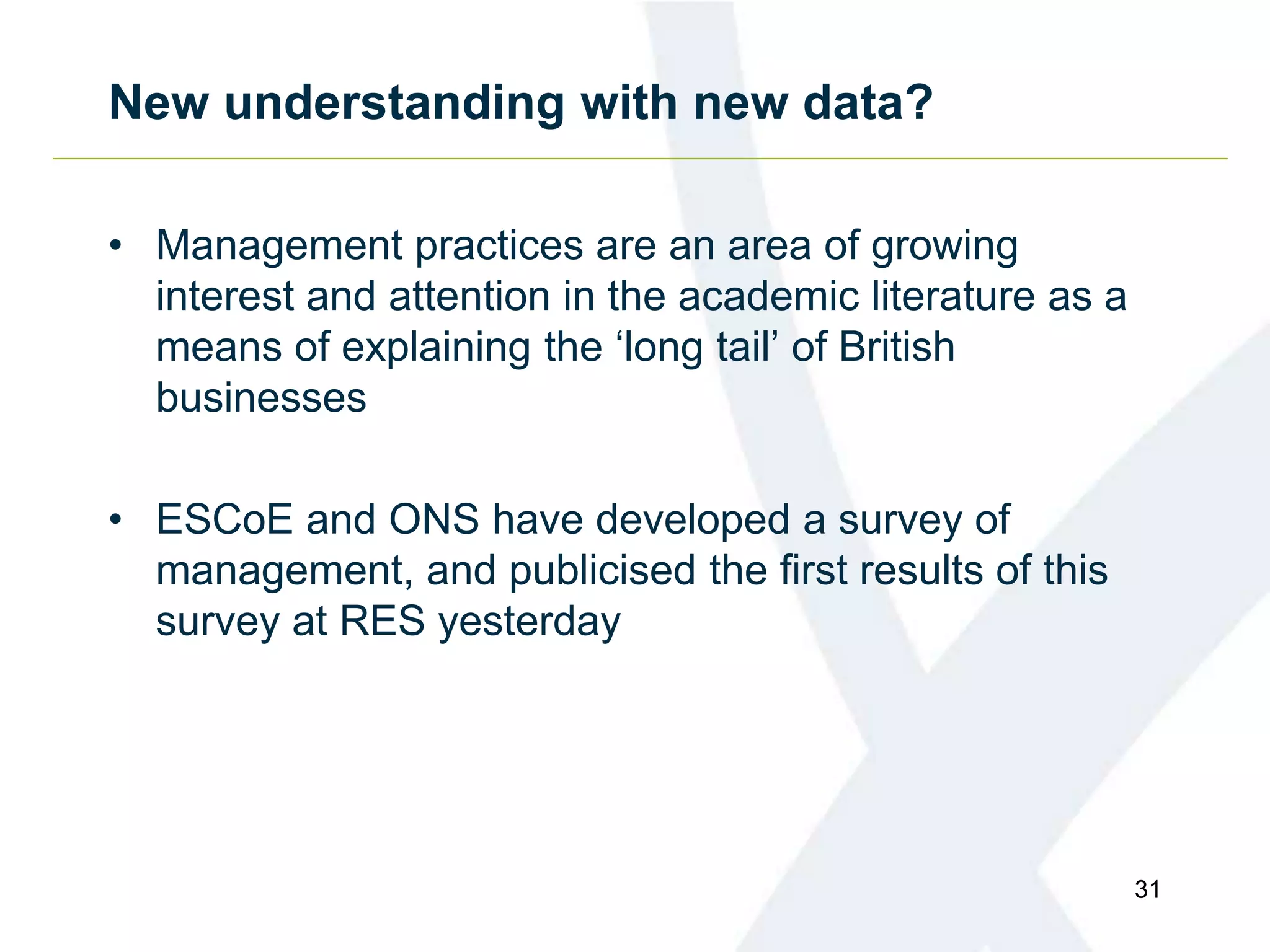
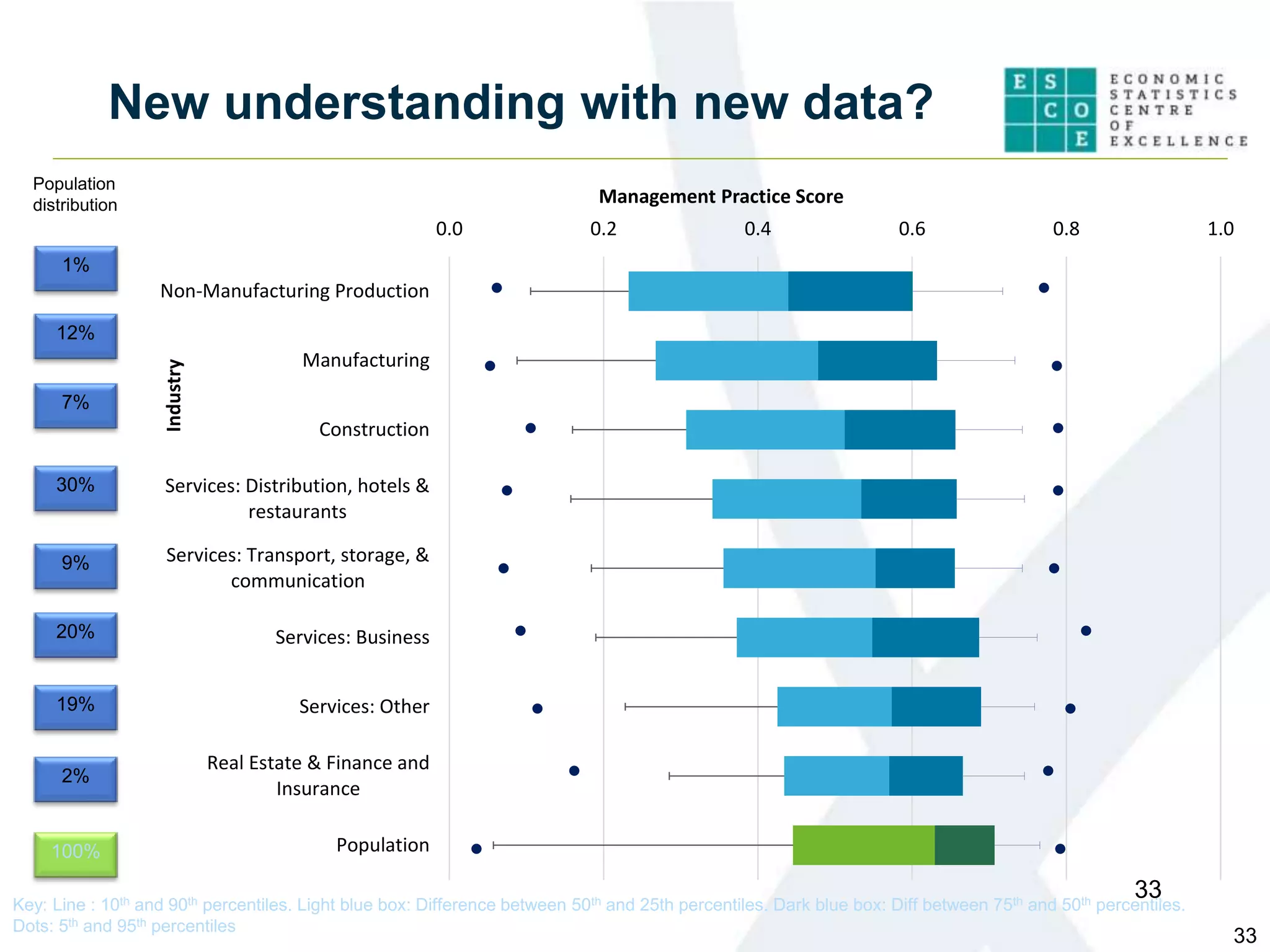
• Management practices are an area of growing
interest and attention in the academic literature as a
means of explaining the ‘long tail’ of British
businesses
• ESCoE and ONS have developed a survey of
management, and publicised the first results of this
survey at RES yesterday
31
32
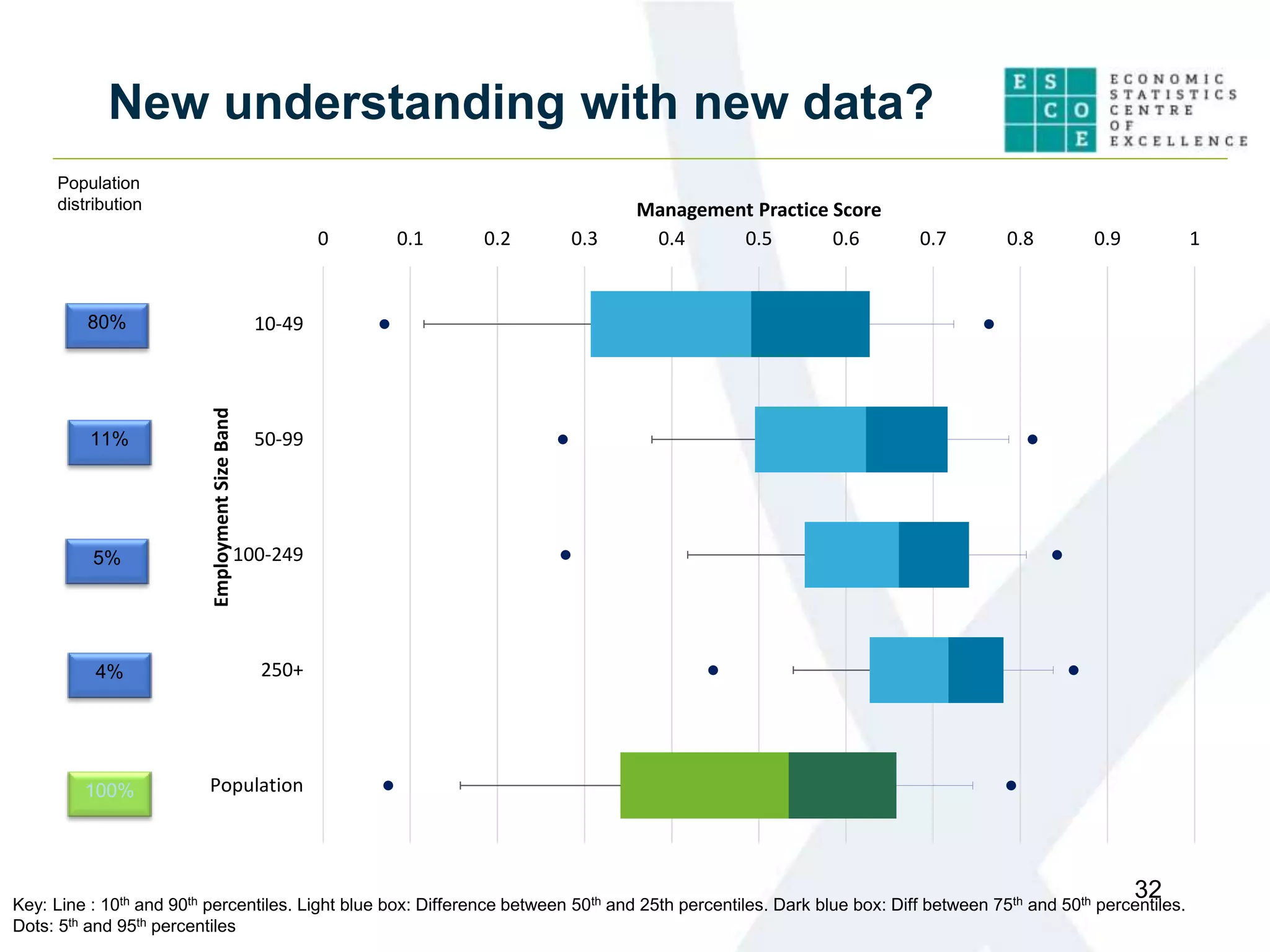
0 0.1 0.2 0.3 0.4 0.5 0.6 0.7 0.8 0.9 1
10-49
50-99
100-249
250+
Population
Management Practice Score
EmploymentSizeBand
Population
distribution
80%
100%
11%
5%
4%
Key: Line : 10th and 90th percentiles. Light blue box: Difference between 50th and 25th percentiles. Dark blue box: Diff between 75th and 50th percentiles.
Dots: 5th and 95th percentiles
New understanding with new data?
33
33
0.0 0.2 0.4 0.6 0.8 1.0
Non-Manufacturing Production
Manufacturing
Construction
Services: Distribution, hotels &
restaurants
Services: Transport, storage, &
communication
Services: Business
Services: Other
Real Estate & Finance and
Insurance
Population
Management Practice Score
Industry
Key: Line : 10th and 90th percentiles. Light blue box: Difference between 50th and 25th percentiles. Dark blue box: Diff between 75th and 50th percentiles.
Dots: 5th and 95th percentiles
1%
100%
30%
9%
7%
Population
distribution
12%
20%
19%
2%
New understanding with new data?
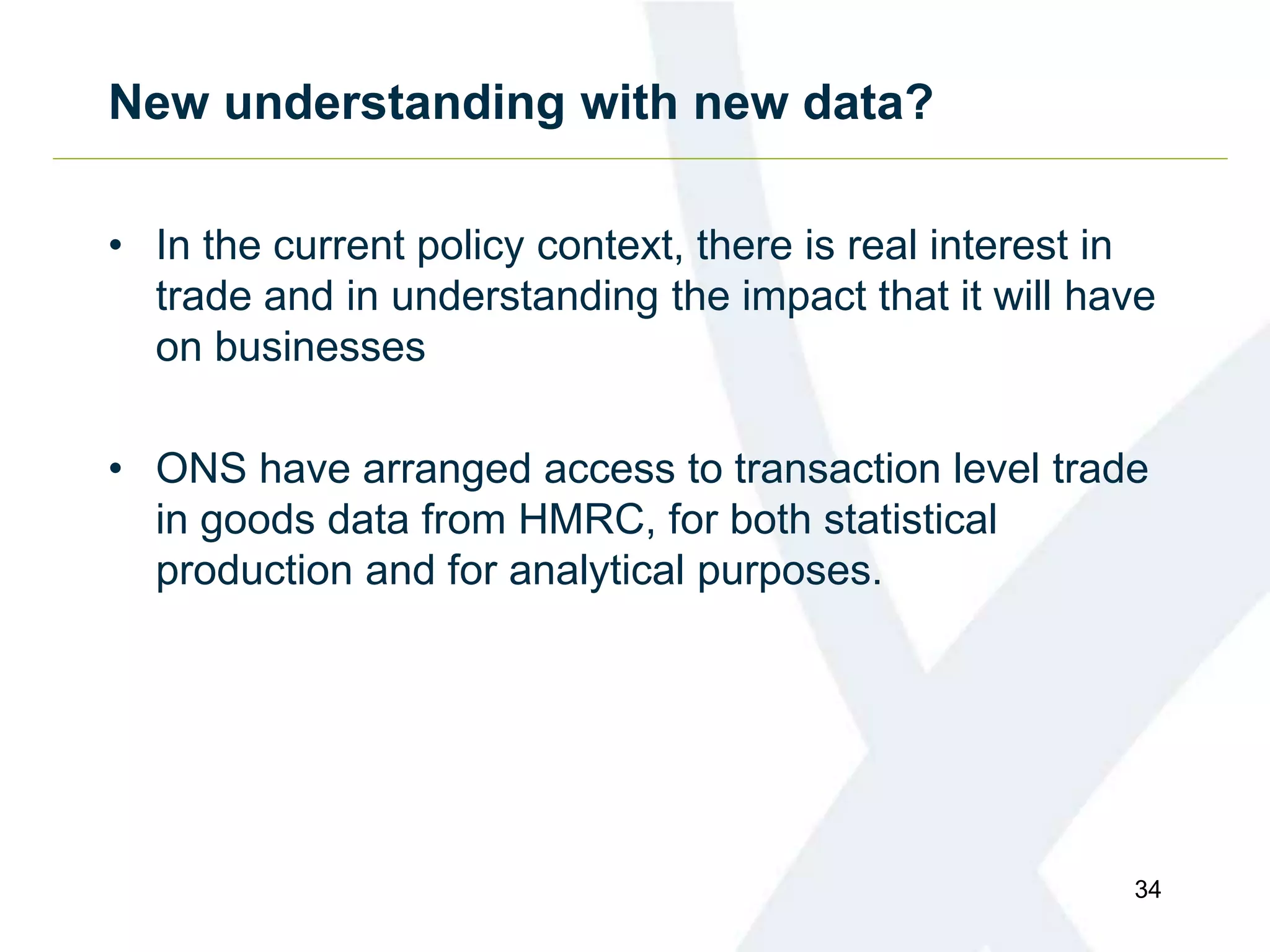
• In the current policy context, there is real interest in
trade and in understanding the impact that it will have
on businesses
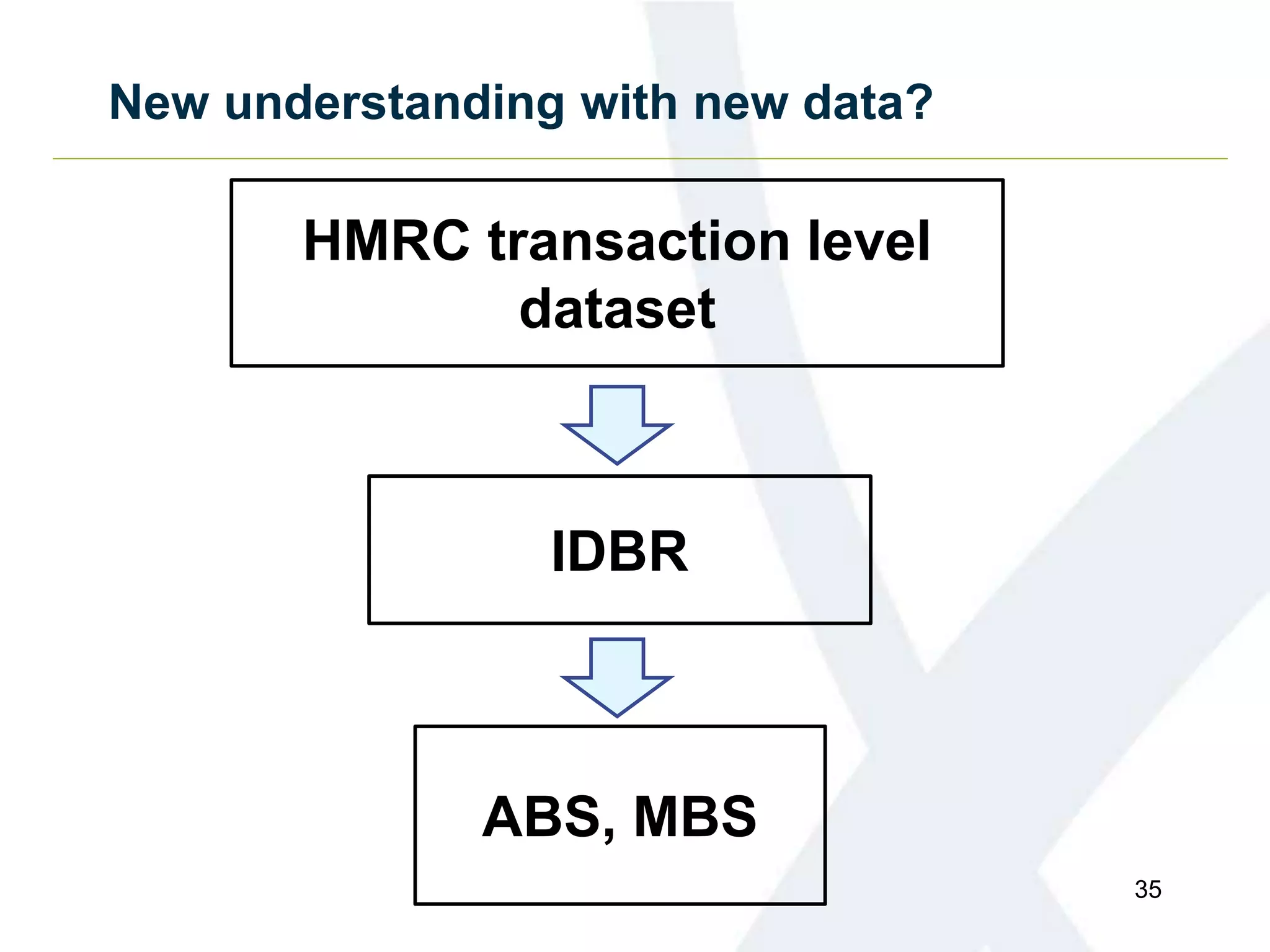
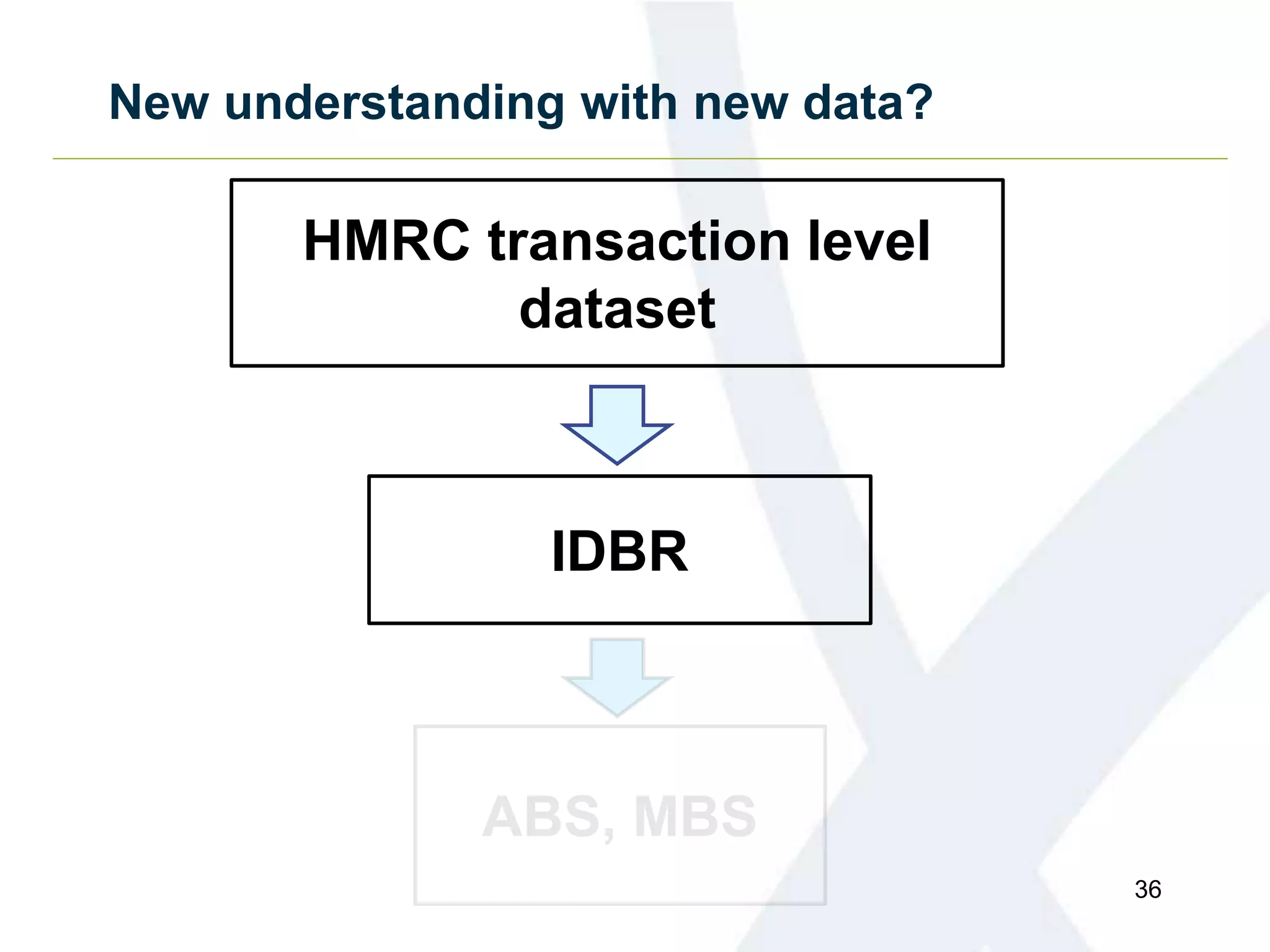
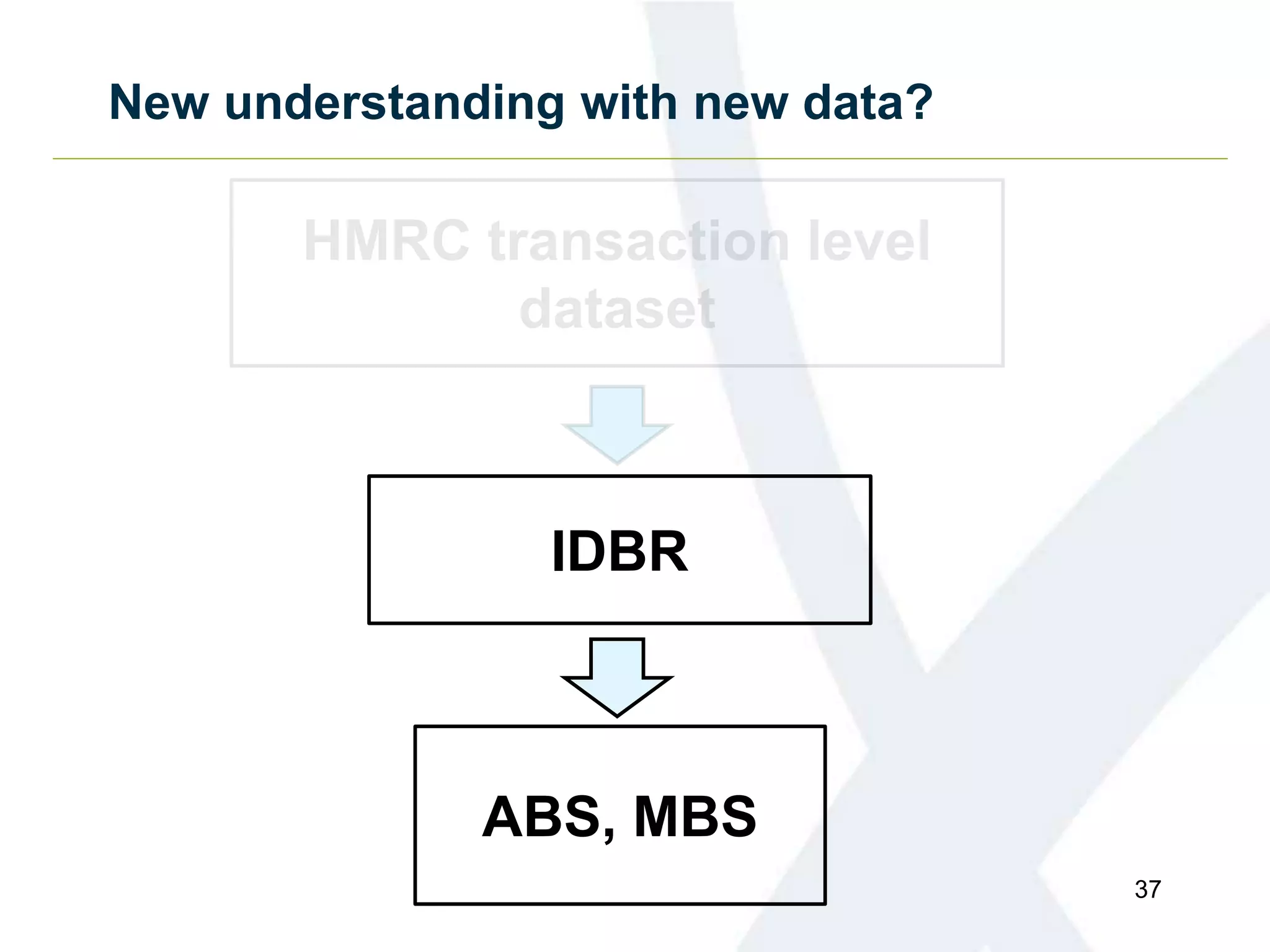
• ONS have arranged access to transaction level trade
in goods data from HMRC, for both statistical
production and for analytical purposes.
34
New understanding with new data?
35
IDBR
HMRC transaction level
dataset
ABS, MBS
New understanding with new data?
36
IDBR
HMRC transaction level
dataset
New understanding with new data?
37
IDBR
ABS, MBS
Outline
1. Motivation
2. New aggregates from old data
3. New findings with blends of old data
4. New understanding with new data?
38
Questions
39

The anatomy of UK labour productivity: lessons from new and existing data sources

  • 1.
    The anatomy ofUK labour productivity: lessons from new and existing data sources Philip Wales Head of Productivity Royal Economic Society Annual Conference 27 March 2018 1
  • 2.
    Outline 1. Motivation 2. Newaggregates from old data 3. New findings with blends of old data 4. New understanding with new data? 2
  • 3.
    Outline 1. Motivation 2. Newaggregates from old data 3. New findings with blends of old data 4. New understanding with new data? 3
  • 4.
    Motivation • The UK’srecent labour productivity performance has been strikingly weak… 4
  • 5.
    Motivation 5 75 80 85 90 95 100 105 1994 1996 19982000 2002 2004 2006 2008 2010 2012 2014 2016 Output per hour Output per worker The UK’s ‘Productivity Puzzle’: Q4 2007=100 Source: ONS Labour Productivity
  • 6.
    Motivation 6 UK output perhour growth, rolling 10-year compound average annual growth rate, 1770-2017 -2 -1 0 1 2 3 4 5 1770 1790 1810 1830 1850 1870 1890 1910 1930 1950 1970 1990 2010 Bank of England ONS % Source: ONS Productivity Bulletin, January 2018
  • 7.
    Motivation • The UK’srecent labour productivity performance has been strikingly weak… • …the UK’s ‘productivity gap’ remains stubbornly wide… 7
  • 8.
    Motivation 8 Labour productivity (OPW)in the G7: UK=100 Source: ONS International Comparisons of Productivity
  • 9.
    Motivation • The UK’srecent labour productivity performance has been strikingly weak… • …the UK’s ‘productivity gap’ remains stubbornly wide… • …while the ‘gaps’ between businesses are equally striking… 9
  • 10.
    Motivation 10 0.0% 0.5% 1.0% 1.5% 2.0% -10 0 1020 30 40 50 60 70 80 90 100 Density, % Productivity, £,000 Firm-level output per worker, 2015 Source: ‘Who are the laggards?’ Understanding firms in the bottom 10% of the labour productivity distribution
  • 11.
    Outline 1. Motivation 2. Newaggregates from old data 3. New findings with blends of old data 4. New understanding with new data? 11
  • 12.
    New aggregates fromold data • More labour productivity industry granularity… 12
  • 13.
    New aggregates fromold data 13 OPH by industry, Q4 2007=100 G – Wholesale & Retail 45 – W&R – Motor Vehicles 46 – Wholesale excluding MV 47 – Retail excluding MV 80 90 100 110 120 130 140 150 2003 2004 2005 2006 2007 2008 2009 2010 2011 2012 45 46 47 G Source: ONS Labour Productivity
  • 14.
    New aggregates fromold data • More labour productivity industry granularity… • …as well as industry by region estimates… 14
  • 15.
    New aggregates fromold data 15 Finance OPH by region, CP, £/hr 10 20 30 40 50 60 70 80 90 100 1997 2001 2005 2009 2013 SC LO NI UK Source: ONS Labour Productivity
  • 16.
    New aggregates fromold data 16 Finance OPH by region, CP, £/hr 10 15 20 25 30 35 40 45 1997 2001 2005 2009 2013 SC NW SE UK WM Manufacturing OPH by region, CP £/hr 10 20 30 40 50 60 70 80 90 100 1997 2001 2005 2009 2013 SC LO NI UK Source: ONS Labour Productivity
  • 17.
    New aggregates fromold data • More labour productivity industry granularity… • …as well as industry by region estimates… • …to support more detailed analysis 17
  • 18.
    Outline 1. Motivation 2. Newaggregates from old data 3. New findings with blends of old data 4. New understanding with new data? 18
  • 19.
    New findings withblends of old data 19 0.0% 0.5% 1.0% 1.5% 2.0% -10 0 10 20 30 40 50 60 70 80 90 100 Density, % Productivity, £,000 2007 Firm-level output per worker, constant prices Source: ‘Who are the laggards?’ Understanding firms in the bottom 10% of the labour productivity distribution
  • 20.
    New findings withblends of old data 20 0.0% 0.5% 1.0% 1.5% 2.0% -10 0 10 20 30 40 50 60 70 80 90 100 Density, % Productivity, £,000 2007 2009 Firm-level output per worker, constant prices Source: ‘Who are the laggards?’ Understanding firms in the bottom 10% of the labour productivity distribution
  • 21.
    New findings withblends of old data 21 0.0% 0.5% 1.0% 1.5% 2.0% -10 0 10 20 30 40 50 60 70 80 90 100 Density, % Productivity, £,000 2007 2009 2011 Firm-level output per worker, constant prices Source: ‘Who are the laggards?’ Understanding firms in the bottom 10% of the labour productivity distribution
  • 22.
    New findings withblends of old data 22 0.0% 0.5% 1.0% 1.5% 2.0% -10 0 10 20 30 40 50 60 70 80 90 100 Density, % Productivity, £,000 2007 2009 2011 2013 Firm-level output per worker, constant prices Source: ‘Who are the laggards?’ Understanding firms in the bottom 10% of the labour productivity distribution
  • 23.
    New findings withblends of old data 23 0.0% 0.5% 1.0% 1.5% 2.0% -10 0 10 20 30 40 50 60 70 80 90 100 Density, % Productivity, £,000 2007 2009 2011 2013 2015 Firm-level output per worker, constant prices Source: ‘Who are the laggards?’ Understanding firms in the bottom 10% of the labour productivity distribution
  • 24.
    New findings withblends of old data 24 Source: ‘Who are the laggards?’ Understanding firms in the bottom 10% of the labour productivity distribution
  • 25.
    New findings withblends of old data 25 Source: ‘Who are the laggards?’ Understanding firms in the bottom 10% of the labour productivity distribution
  • 26.
    New findings withblends of old data 26 £, 000 per worker per year Median No FDI FDI 2012 25.3 61.6 2013 26.5 53.4 2014 27.1 63.3 2015 27.7 59.3 Foreign Direct Investment and Productivity Source: FDI and labour productivity, a micro-data perspective: 2012 to 2015
  • 27.
    New findings withblends of old data 27 £, 000 per worker per year Median Mean No FDI FDI No FDI FDI 2012 25.3 61.6 44.3 123.0 2013 26.5 53.4 47.5 156.8 2014 27.1 63.3 48.6 153.4 2015 27.7 59.3 48.3 172.7 Foreign Direct Investment and Productivity Source: FDI and labour productivity, a micro-data perspective: 2012 to 2015
  • 28.
    New findings withblends of old data 28 £, 000 per worker per year Median Mean Of which mean of: No FDI FDI No FDI FDI Inward FDI Outward FDI 2012 25.3 61.6 44.3 123.0 125.5 119.2 2013 26.5 53.4 47.5 156.8 159.2 161.7 2014 27.1 63.3 48.6 153.4 165.7 109.0 2015 27.7 59.3 48.3 172.7 185.6 140.3 Foreign Direct Investment and Productivity Source: FDI and labour productivity, a micro-data perspective: 2012 to 2015
  • 29.
    What have wedone (3)? 29
  • 30.
    Outline 1. Motivation 2. Newaggregates from old data 3. New findings with blends of old data 4. New understanding with new data? 30
  • 31.
    New understanding withnew data? • Management practices are an area of growing interest and attention in the academic literature as a means of explaining the ‘long tail’ of British businesses • ESCoE and ONS have developed a survey of management, and publicised the first results of this survey at RES yesterday 31
  • 32.
    32 0 0.1 0.20.3 0.4 0.5 0.6 0.7 0.8 0.9 1 10-49 50-99 100-249 250+ Population Management Practice Score EmploymentSizeBand Population distribution 80% 100% 11% 5% 4% Key: Line : 10th and 90th percentiles. Light blue box: Difference between 50th and 25th percentiles. Dark blue box: Diff between 75th and 50th percentiles. Dots: 5th and 95th percentiles New understanding with new data?
  • 33.
    New understanding withnew data? 33 33 0.0 0.2 0.4 0.6 0.8 1.0 Non-Manufacturing Production Manufacturing Construction Services: Distribution, hotels & restaurants Services: Transport, storage, & communication Services: Business Services: Other Real Estate & Finance and Insurance Population Management Practice Score Industry Key: Line : 10th and 90th percentiles. Light blue box: Difference between 50th and 25th percentiles. Dark blue box: Diff between 75th and 50th percentiles. Dots: 5th and 95th percentiles 1% 100% 30% 9% 7% Population distribution 12% 20% 19% 2%
  • 34.
    New understanding withnew data? • In the current policy context, there is real interest in trade and in understanding the impact that it will have on businesses • ONS have arranged access to transaction level trade in goods data from HMRC, for both statistical production and for analytical purposes. 34
  • 35.
    New understanding withnew data? 35 IDBR HMRC transaction level dataset ABS, MBS
  • 36.
    New understanding withnew data? 36 IDBR HMRC transaction level dataset
  • 37.
    New understanding withnew data? 37 IDBR ABS, MBS
  • 38.
    Outline 1. Motivation 2. Newaggregates from old data 3. New findings with blends of old data 4. New understanding with new data? 38
  • 39.