(Original PDF) Information Technology Project Management, Revised 7th Edition
1.
(Original PDF) InformationTechnology Project
Management, Revised 7th Edition pdf download
https://ebooksecure.com/product/original-pdf-information-
technology-project-management-revised-7th-edition/
Download more ebook from https://ebooksecure.com
2.
We believe theseproducts will be a great fit for you. Click
the link to download now, or visit ebooksecure.com
to discover even more!
Information Technology Project Management 7th edition
(eBook PDF)
http://ebooksecure.com/product/information-technology-project-
management-7th-edition-ebook-pdf-2/
Information Technology Project Management 7th edition
(eBook PDF)
http://ebooksecure.com/product/information-technology-project-
management-7th-edition-ebook-pdf/
(eBook PDF) Information Technology Project Management
8th Edition
http://ebooksecure.com/product/ebook-pdf-information-technology-
project-management-8th-edition/
(eBook PDF) Information Technology Project Management,
5th Edition
http://ebooksecure.com/product/ebook-pdf-information-technology-
project-management-5th-edition/
3.
Information Technology ProjectManagement 9th Edition
Kathy Schwalbe - eBook PDF
https://ebooksecure.com/download/information-technology-project-
management-ebook-pdf/
(eBook PDF) Information Technology Project Management
9th Edition by Kathy Schwalbe
http://ebooksecure.com/product/ebook-pdf-information-technology-
project-management-9th-edition-by-kathy-schwalbe/
(Original PDF) Successful Project Management 7th
Edition
http://ebooksecure.com/product/original-pdf-successful-project-
management-7th-edition/
(eBook PDF) Information Technology for Management
Digital 10th
http://ebooksecure.com/product/ebook-pdf-information-technology-
for-management-digital-10th/
(eBook PDF) Information Systems Project Management, A
Process Approach, Edition 2.0
http://ebooksecure.com/product/ebook-pdf-information-systems-
project-management-a-process-approach-edition-2-0-2/
5.
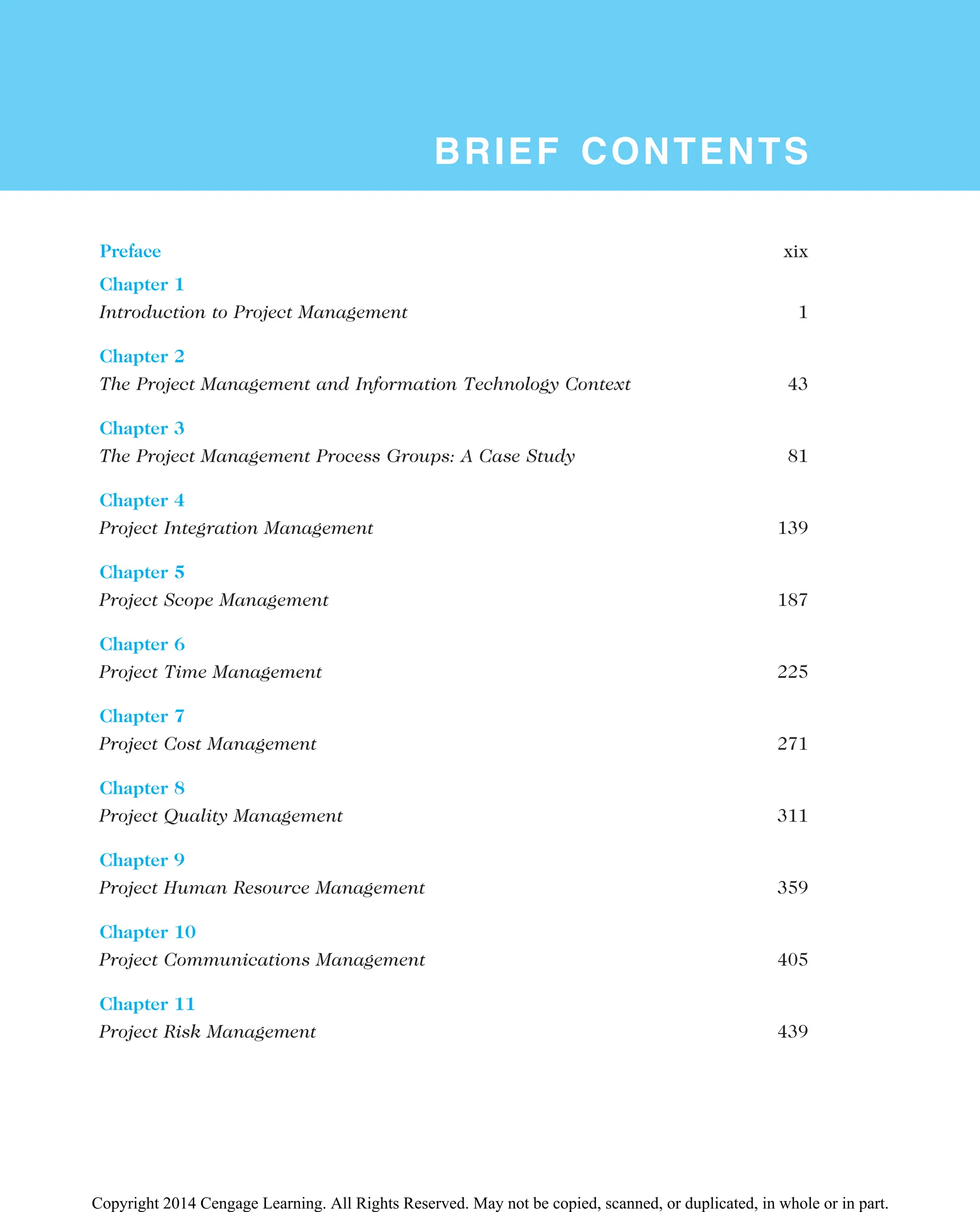
BRIEF CONTENTS
Preface xix
Chapter1
Introduction to Project Management 1
Chapter 2
The Project Management and Information Technology Context 43
Chapter 3
The Project Management Process Groups: A Case Study 81
Chapter 4
Project Integration Management 139
Chapter 5
Project Scope Management 187
Chapter 6
Project Time Management 225
Chapter 7
Project Cost Management 271
Chapter 8
Project Quality Management 311
Chapter 9
Project Human Resource Management 359
Chapter 10
Project Communications Management 405
Chapter 11
Project Risk Management 439
Copyright 2014 Cengage Learning. All Rights Reserved. May not be copied, scanned, or duplicated, in whole or in part.
6.
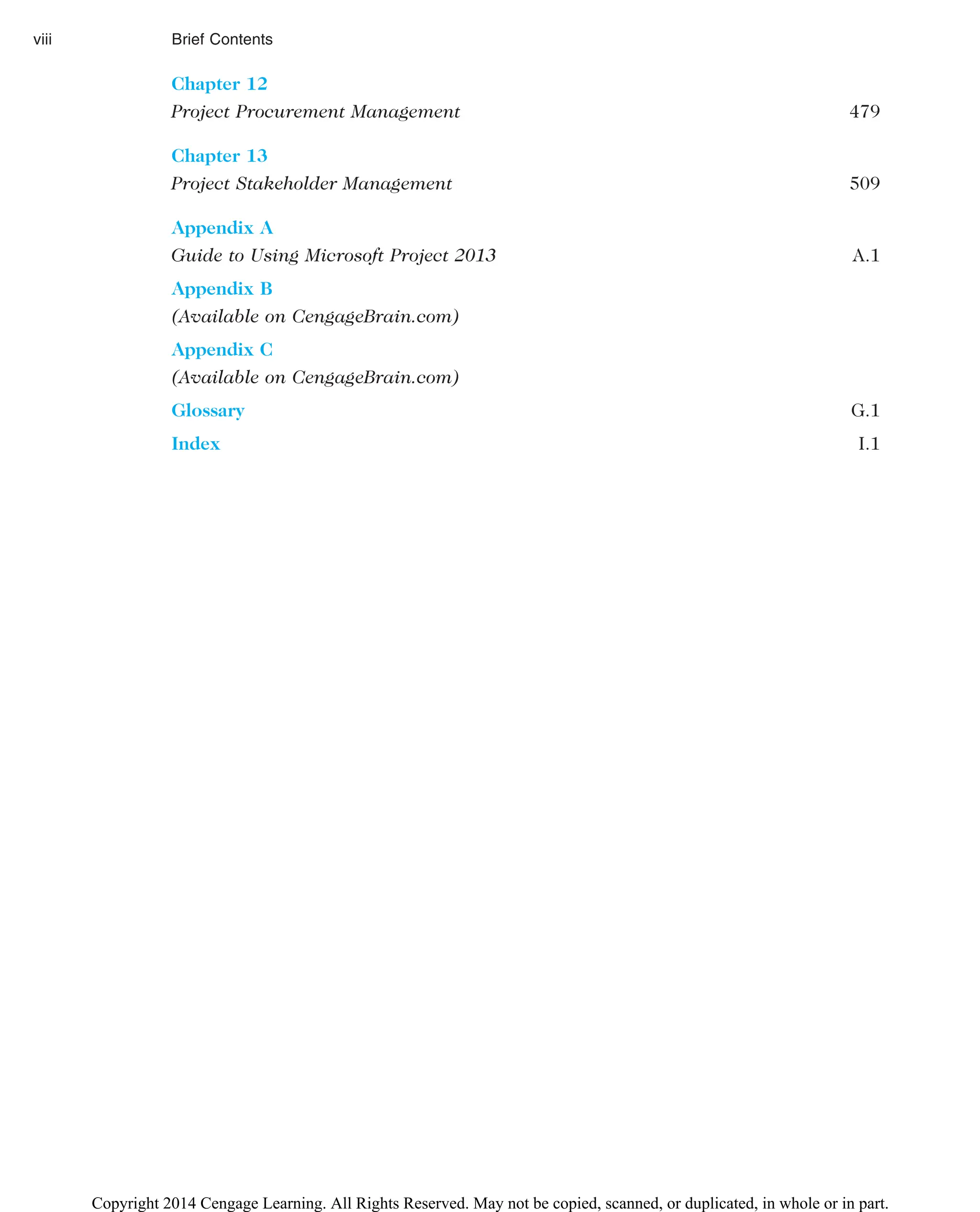
Chapter 12
Project ProcurementManagement 479
Chapter 13
Project Stakeholder Management 509
Appendix A
Guide to Using Microsoft Project 2013 A.1
Appendix B
(Available on CengageBrain.com)
Appendix C
(Available on CengageBrain.com)
Glossary G.1
Index I.1
viii Brief Contents
Copyright 2014 Cengage Learning. All Rights Reserved. May not be copied, scanned, or duplicated, in whole or in part.
7.
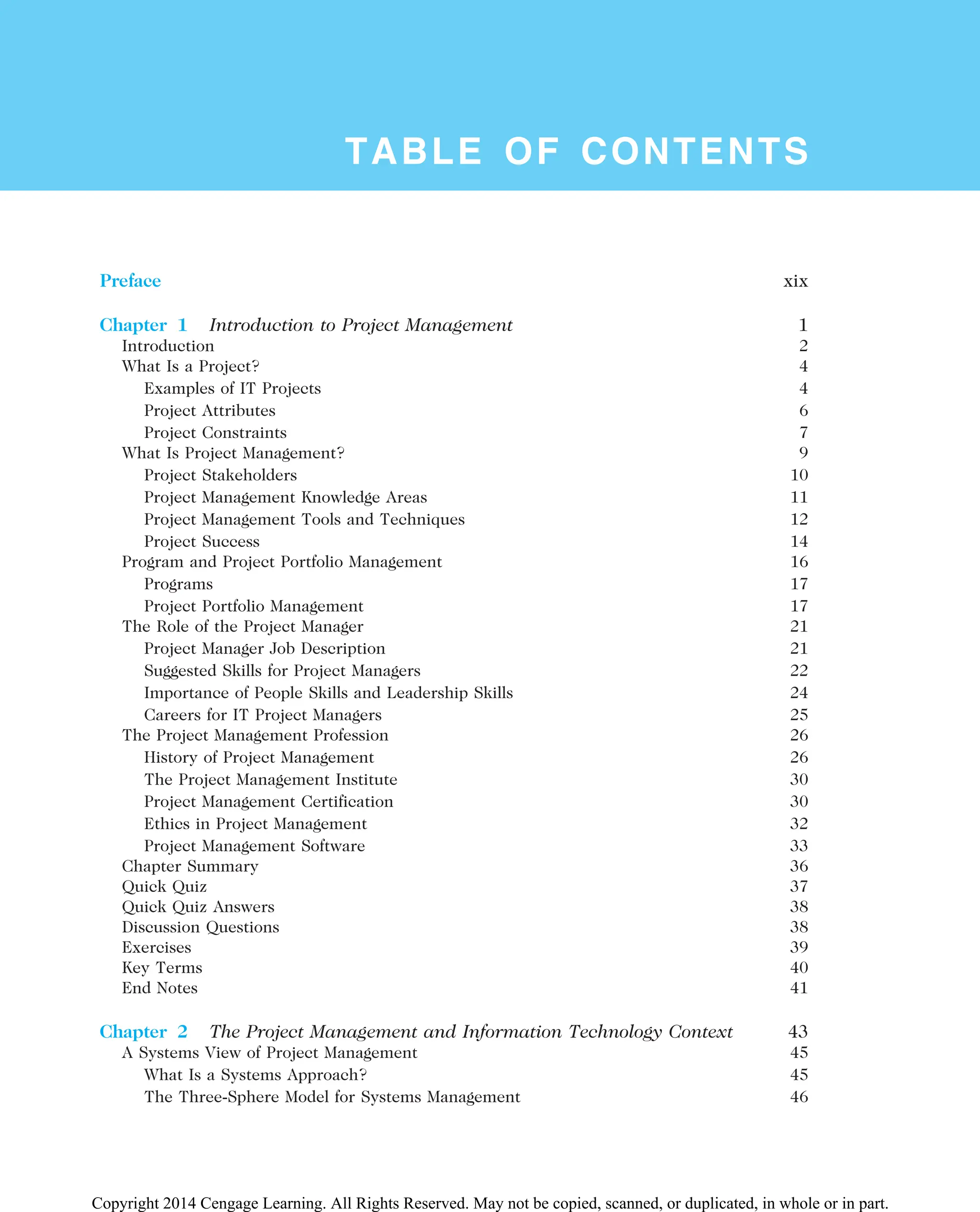
TABLE OF CONTENTS
Prefacexix
Chapter 1 Introduction to Project Management 1
Introduction 2
What Is a Project? 4
Examples of IT Projects 4
Project Attributes 6
Project Constraints 7
What Is Project Management? 9
Project Stakeholders 10
Project Management Knowledge Areas 11
Project Management Tools and Techniques 12
Project Success 14
Program and Project Portfolio Management 16
Programs 17
Project Portfolio Management 17
The Role of the Project Manager 21
Project Manager Job Description 21
Suggested Skills for Project Managers 22
Importance of People Skills and Leadership Skills 24
Careers for IT Project Managers 25
The Project Management Profession 26
History of Project Management 26
The Project Management Institute 30
Project Management Certification 30
Ethics in Project Management 32
Project Management Software 33
Chapter Summary 36
Quick Quiz 37
Quick Quiz Answers 38
Discussion Questions 38
Exercises 39
Key Terms 40
End Notes 41
Chapter 2 The Project Management and Information Technology Context 43
A Systems View of Project Management 45
What Is a Systems Approach? 45
The Three-Sphere Model for Systems Management 46
Copyright 2014 Cengage Learning. All Rights Reserved. May not be copied, scanned, or duplicated, in whole or in part.
8.
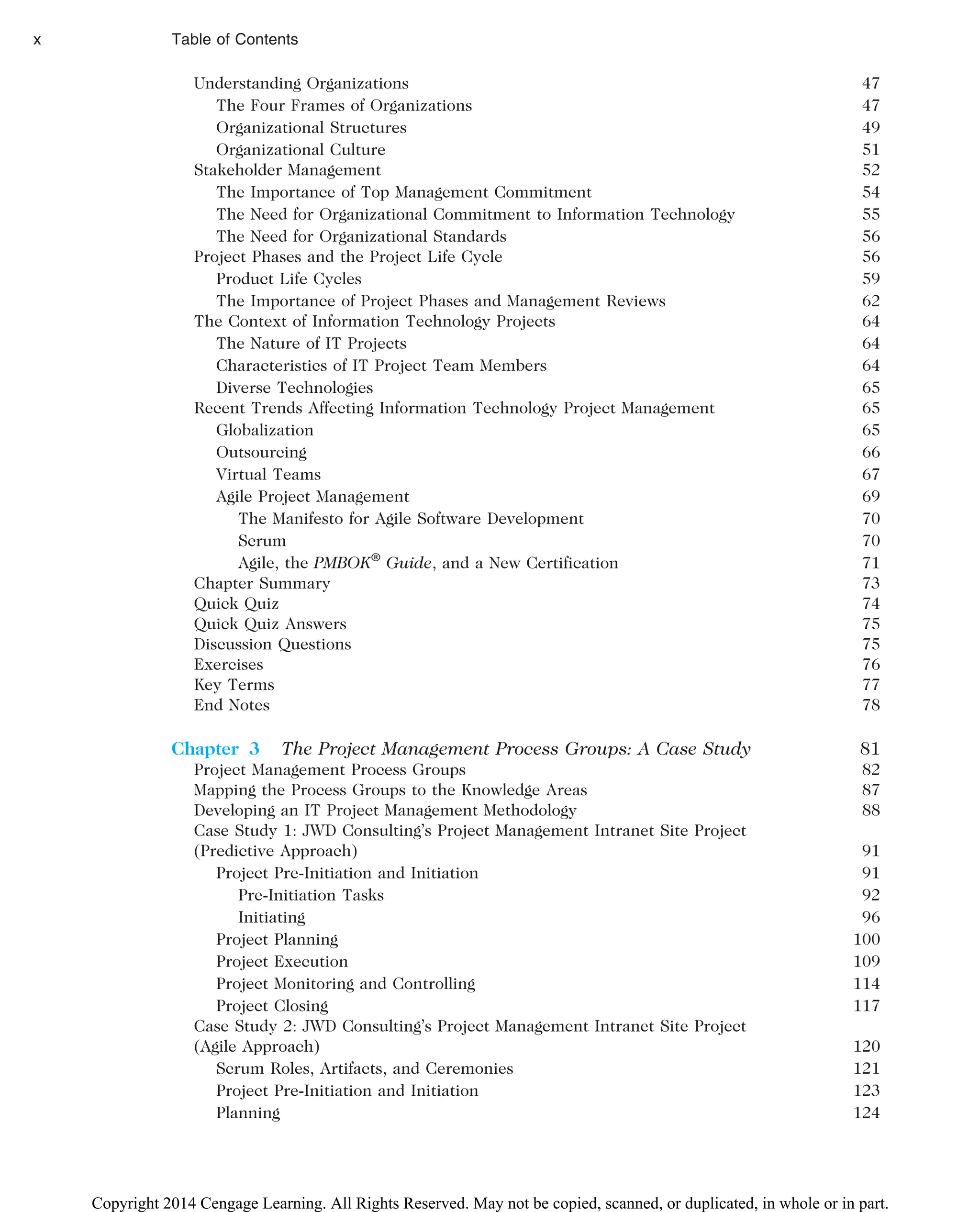
Understanding Organizations 47
TheFour Frames of Organizations 47
Organizational Structures 49
Organizational Culture 51
Stakeholder Management 52
The Importance of Top Management Commitment 54
The Need for Organizational Commitment to Information Technology 55
The Need for Organizational Standards 56
Project Phases and the Project Life Cycle 56
Product Life Cycles 59
The Importance of Project Phases and Management Reviews 62
The Context of Information Technology Projects 64
The Nature of IT Projects 64
Characteristics of IT Project Team Members 64
Diverse Technologies 65
Recent Trends Affecting Information Technology Project Management 65
Globalization 65
Outsourcing 66
Virtual Teams 67
Agile Project Management 69
The Manifesto for Agile Software Development 70
Scrum 70
Agile, the PMBOK®
Guide, and a New Certification 71
Chapter Summary 73
Quick Quiz 74
Quick Quiz Answers 75
Discussion Questions 75
Exercises 76
Key Terms 77
End Notes 78
Chapter 3 The Project Management Process Groups: A Case Study 81
Project Management Process Groups 82
Mapping the Process Groups to the Knowledge Areas 87
Developing an IT Project Management Methodology 88
Case Study 1: JWD Consulting’s Project Management Intranet Site Project
(Predictive Approach) 91
Project Pre-Initiation and Initiation 91
Pre-Initiation Tasks 92
Initiating 96
Project Planning 100
Project Execution 109
Project Monitoring and Controlling 114
Project Closing 117
Case Study 2: JWD Consulting’s Project Management Intranet Site Project
(Agile Approach) 120
Scrum Roles, Artifacts, and Ceremonies 121
Project Pre-Initiation and Initiation 123
Planning 124
x Table of Contents
Copyright 2014 Cengage Learning. All Rights Reserved. May not be copied, scanned, or duplicated, in whole or in part.
9.
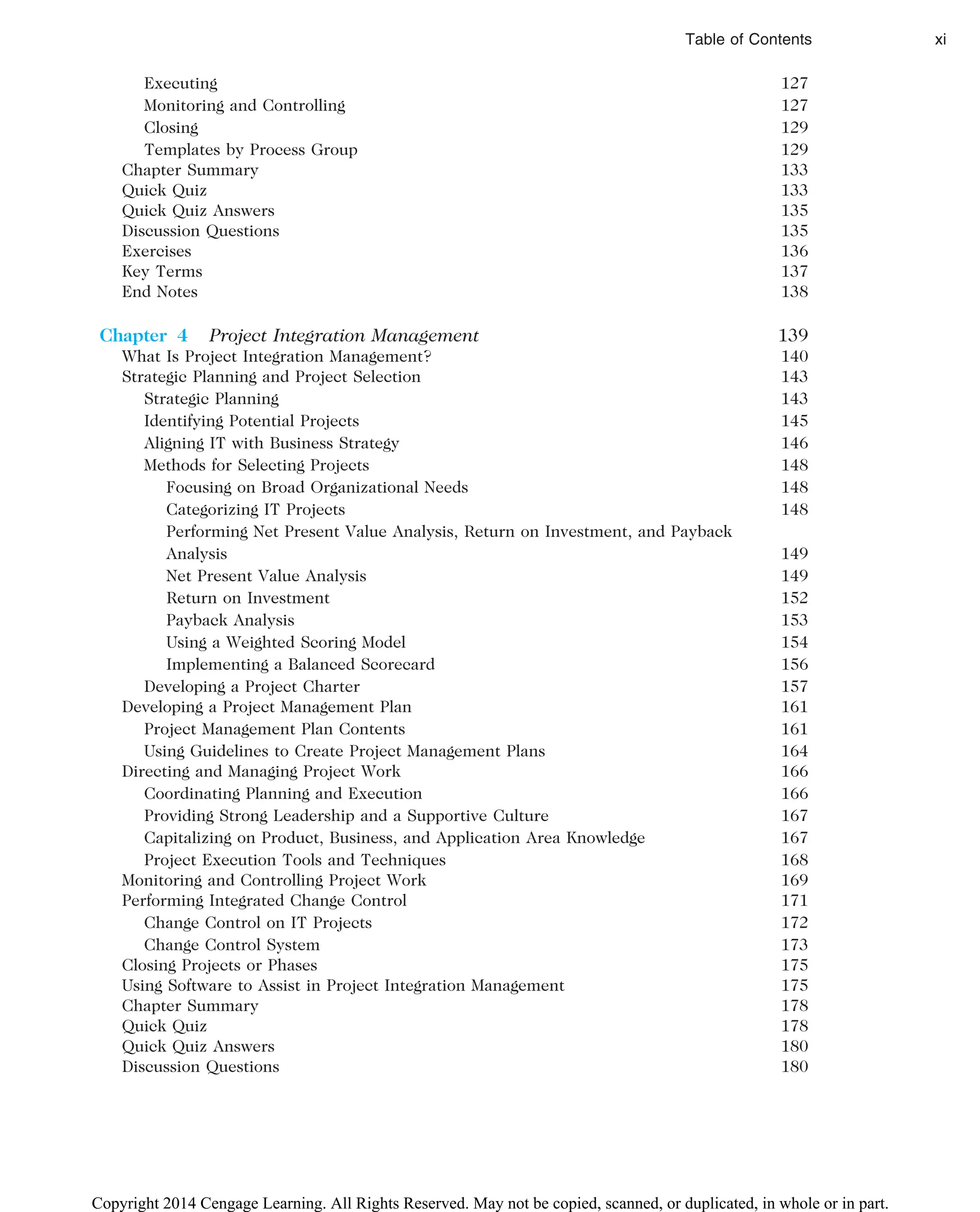
Executing 127
Monitoring andControlling 127
Closing 129
Templates by Process Group 129
Chapter Summary 133
Quick Quiz 133
Quick Quiz Answers 135
Discussion Questions 135
Exercises 136
Key Terms 137
End Notes 138
Chapter 4 Project Integration Management 139
What Is Project Integration Management? 140
Strategic Planning and Project Selection 143
Strategic Planning 143
Identifying Potential Projects 145
Aligning IT with Business Strategy 146
Methods for Selecting Projects 148
Focusing on Broad Organizational Needs 148
Categorizing IT Projects 148
Performing Net Present Value Analysis, Return on Investment, and Payback
Analysis 149
Net Present Value Analysis 149
Return on Investment 152
Payback Analysis 153
Using a Weighted Scoring Model 154
Implementing a Balanced Scorecard 156
Developing a Project Charter 157
Developing a Project Management Plan 161
Project Management Plan Contents 161
Using Guidelines to Create Project Management Plans 164
Directing and Managing Project Work 166
Coordinating Planning and Execution 166
Providing Strong Leadership and a Supportive Culture 167
Capitalizing on Product, Business, and Application Area Knowledge 167
Project Execution Tools and Techniques 168
Monitoring and Controlling Project Work 169
Performing Integrated Change Control 171
Change Control on IT Projects 172
Change Control System 173
Closing Projects or Phases 175
Using Software to Assist in Project Integration Management 175
Chapter Summary 178
Quick Quiz 178
Quick Quiz Answers 180
Discussion Questions 180
Table of Contents xi
Copyright 2014 Cengage Learning. All Rights Reserved. May not be copied, scanned, or duplicated, in whole or in part.
10.
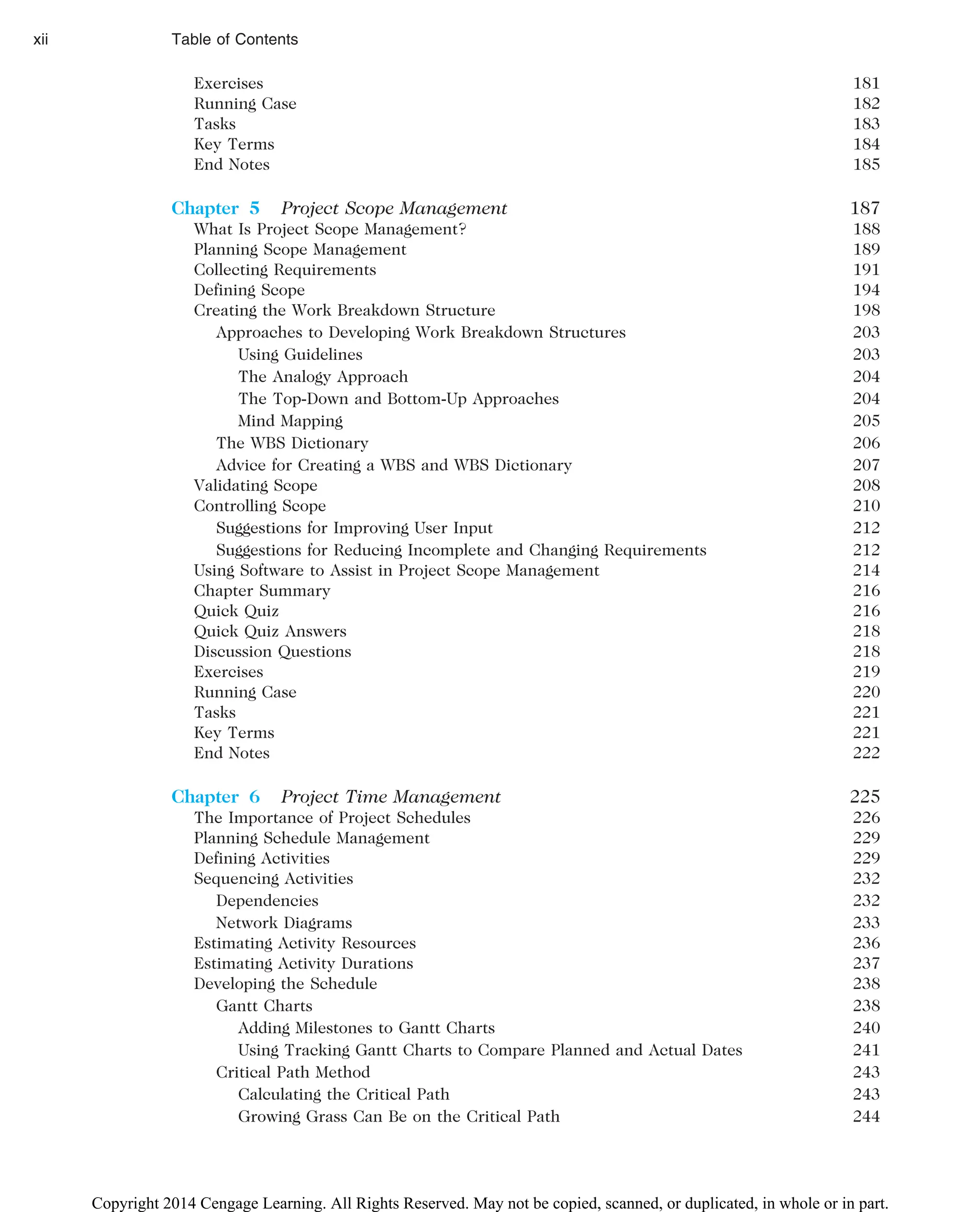
Exercises 181
Running Case182
Tasks 183
Key Terms 184
End Notes 185
Chapter 5 Project Scope Management 187
What Is Project Scope Management? 188
Planning Scope Management 189
Collecting Requirements 191
Defining Scope 194
Creating the Work Breakdown Structure 198
Approaches to Developing Work Breakdown Structures 203
Using Guidelines 203
The Analogy Approach 204
The Top-Down and Bottom-Up Approaches 204
Mind Mapping 205
The WBS Dictionary 206
Advice for Creating a WBS and WBS Dictionary 207
Validating Scope 208
Controlling Scope 210
Suggestions for Improving User Input 212
Suggestions for Reducing Incomplete and Changing Requirements 212
Using Software to Assist in Project Scope Management 214
Chapter Summary 216
Quick Quiz 216
Quick Quiz Answers 218
Discussion Questions 218
Exercises 219
Running Case 220
Tasks 221
Key Terms 221
End Notes 222
Chapter 6 Project Time Management 225
The Importance of Project Schedules 226
Planning Schedule Management 229
Defining Activities 229
Sequencing Activities 232
Dependencies 232
Network Diagrams 233
Estimating Activity Resources 236
Estimating Activity Durations 237
Developing the Schedule 238
Gantt Charts 238
Adding Milestones to Gantt Charts 240
Using Tracking Gantt Charts to Compare Planned and Actual Dates 241
Critical Path Method 243
Calculating the Critical Path 243
Growing Grass Can Be on the Critical Path 244
xii Table of Contents
Copyright 2014 Cengage Learning. All Rights Reserved. May not be copied, scanned, or duplicated, in whole or in part.
11.
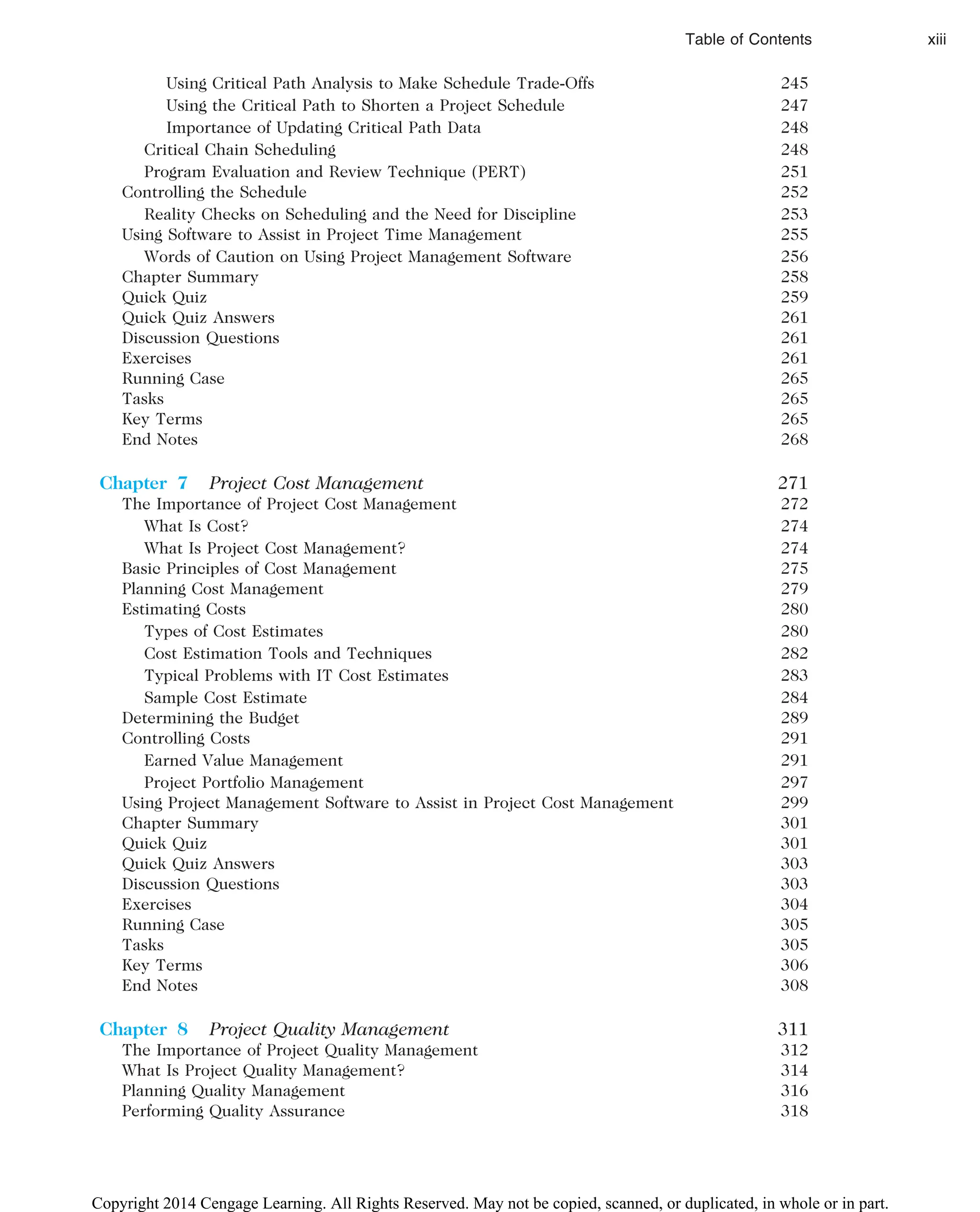
Using Critical PathAnalysis to Make Schedule Trade-Offs 245
Using the Critical Path to Shorten a Project Schedule 247
Importance of Updating Critical Path Data 248
Critical Chain Scheduling 248
Program Evaluation and Review Technique (PERT) 251
Controlling the Schedule 252
Reality Checks on Scheduling and the Need for Discipline 253
Using Software to Assist in Project Time Management 255
Words of Caution on Using Project Management Software 256
Chapter Summary 258
Quick Quiz 259
Quick Quiz Answers 261
Discussion Questions 261
Exercises 261
Running Case 265
Tasks 265
Key Terms 265
End Notes 268
Chapter 7 Project Cost Management 271
The Importance of Project Cost Management 272
What Is Cost? 274
What Is Project Cost Management? 274
Basic Principles of Cost Management 275
Planning Cost Management 279
Estimating Costs 280
Types of Cost Estimates 280
Cost Estimation Tools and Techniques 282
Typical Problems with IT Cost Estimates 283
Sample Cost Estimate 284
Determining the Budget 289
Controlling Costs 291
Earned Value Management 291
Project Portfolio Management 297
Using Project Management Software to Assist in Project Cost Management 299
Chapter Summary 301
Quick Quiz 301
Quick Quiz Answers 303
Discussion Questions 303
Exercises 304
Running Case 305
Tasks 305
Key Terms 306
End Notes 308
Chapter 8 Project Quality Management 311
The Importance of Project Quality Management 312
What Is Project Quality Management? 314
Planning Quality Management 316
Performing Quality Assurance 318
Table of Contents xiii
Copyright 2014 Cengage Learning. All Rights Reserved. May not be copied, scanned, or duplicated, in whole or in part.
12.
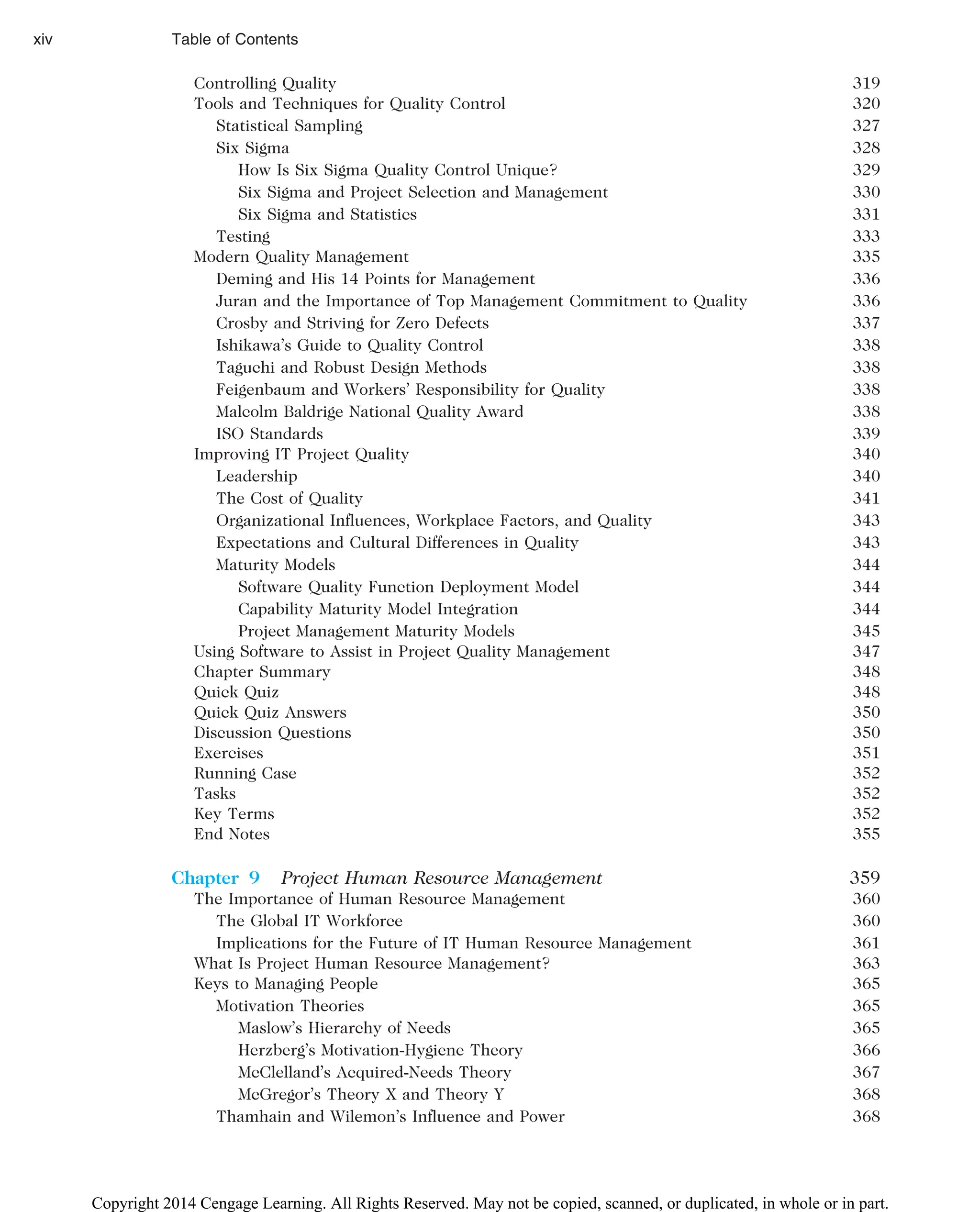
Controlling Quality 319
Toolsand Techniques for Quality Control 320
Statistical Sampling 327
Six Sigma 328
How Is Six Sigma Quality Control Unique? 329
Six Sigma and Project Selection and Management 330
Six Sigma and Statistics 331
Testing 333
Modern Quality Management 335
Deming and His 14 Points for Management 336
Juran and the Importance of Top Management Commitment to Quality 336
Crosby and Striving for Zero Defects 337
Ishikawa’s Guide to Quality Control 338
Taguchi and Robust Design Methods 338
Feigenbaum and Workers’ Responsibility for Quality 338
Malcolm Baldrige National Quality Award 338
ISO Standards 339
Improving IT Project Quality 340
Leadership 340
The Cost of Quality 341
Organizational Influences, Workplace Factors, and Quality 343
Expectations and Cultural Differences in Quality 343
Maturity Models 344
Software Quality Function Deployment Model 344
Capability Maturity Model Integration 344
Project Management Maturity Models 345
Using Software to Assist in Project Quality Management 347
Chapter Summary 348
Quick Quiz 348
Quick Quiz Answers 350
Discussion Questions 350
Exercises 351
Running Case 352
Tasks 352
Key Terms 352
End Notes 355
Chapter 9 Project Human Resource Management 359
The Importance of Human Resource Management 360
The Global IT Workforce 360
Implications for the Future of IT Human Resource Management 361
What Is Project Human Resource Management? 363
Keys to Managing People 365
Motivation Theories 365
Maslow’s Hierarchy of Needs 365
Herzberg’s Motivation-Hygiene Theory 366
McClelland’s Acquired-Needs Theory 367
McGregor’s Theory X and Theory Y 368
Thamhain and Wilemon’s Influence and Power 368
xiv Table of Contents
Copyright 2014 Cengage Learning. All Rights Reserved. May not be copied, scanned, or duplicated, in whole or in part.
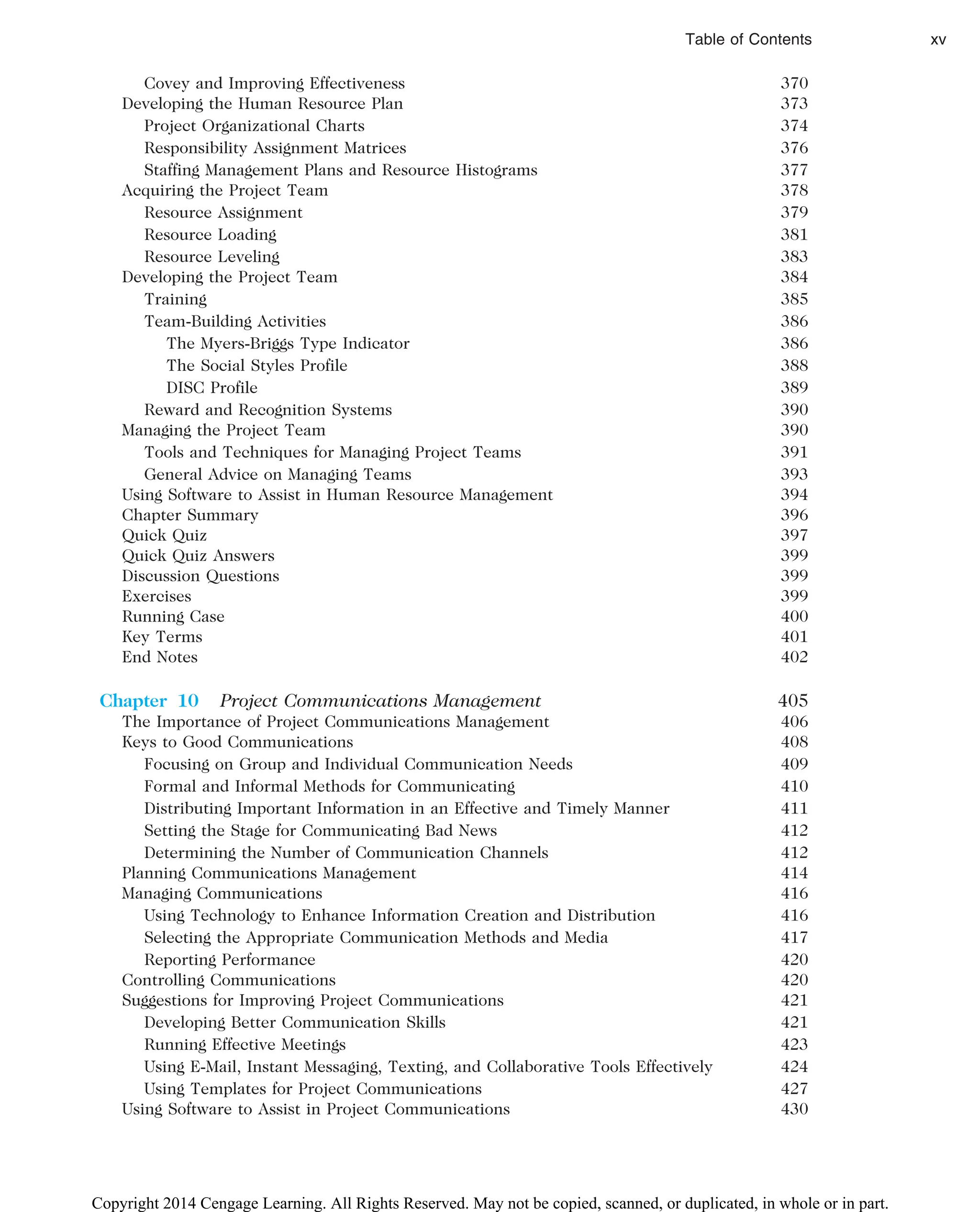
13.
Covey and ImprovingEffectiveness 370
Developing the Human Resource Plan 373
Project Organizational Charts 374
Responsibility Assignment Matrices 376
Staffing Management Plans and Resource Histograms 377
Acquiring the Project Team 378
Resource Assignment 379
Resource Loading 381
Resource Leveling 383
Developing the Project Team 384
Training 385
Team-Building Activities 386
The Myers-Briggs Type Indicator 386
The Social Styles Profile 388
DISC Profile 389
Reward and Recognition Systems 390
Managing the Project Team 390
Tools and Techniques for Managing Project Teams 391
General Advice on Managing Teams 393
Using Software to Assist in Human Resource Management 394
Chapter Summary 396
Quick Quiz 397
Quick Quiz Answers 399
Discussion Questions 399
Exercises 399
Running Case 400
Key Terms 401
End Notes 402
Chapter 10 Project Communications Management 405
The Importance of Project Communications Management 406
Keys to Good Communications 408
Focusing on Group and Individual Communication Needs 409
Formal and Informal Methods for Communicating 410
Distributing Important Information in an Effective and Timely Manner 411
Setting the Stage for Communicating Bad News 412
Determining the Number of Communication Channels 412
Planning Communications Management 414
Managing Communications 416
Using Technology to Enhance Information Creation and Distribution 416
Selecting the Appropriate Communication Methods and Media 417
Reporting Performance 420
Controlling Communications 420
Suggestions for Improving Project Communications 421
Developing Better Communication Skills 421
Running Effective Meetings 423
Using E-Mail, Instant Messaging, Texting, and Collaborative Tools Effectively 424
Using Templates for Project Communications 427
Using Software to Assist in Project Communications 430
Table of Contents xv
Copyright 2014 Cengage Learning. All Rights Reserved. May not be copied, scanned, or duplicated, in whole or in part.
14.
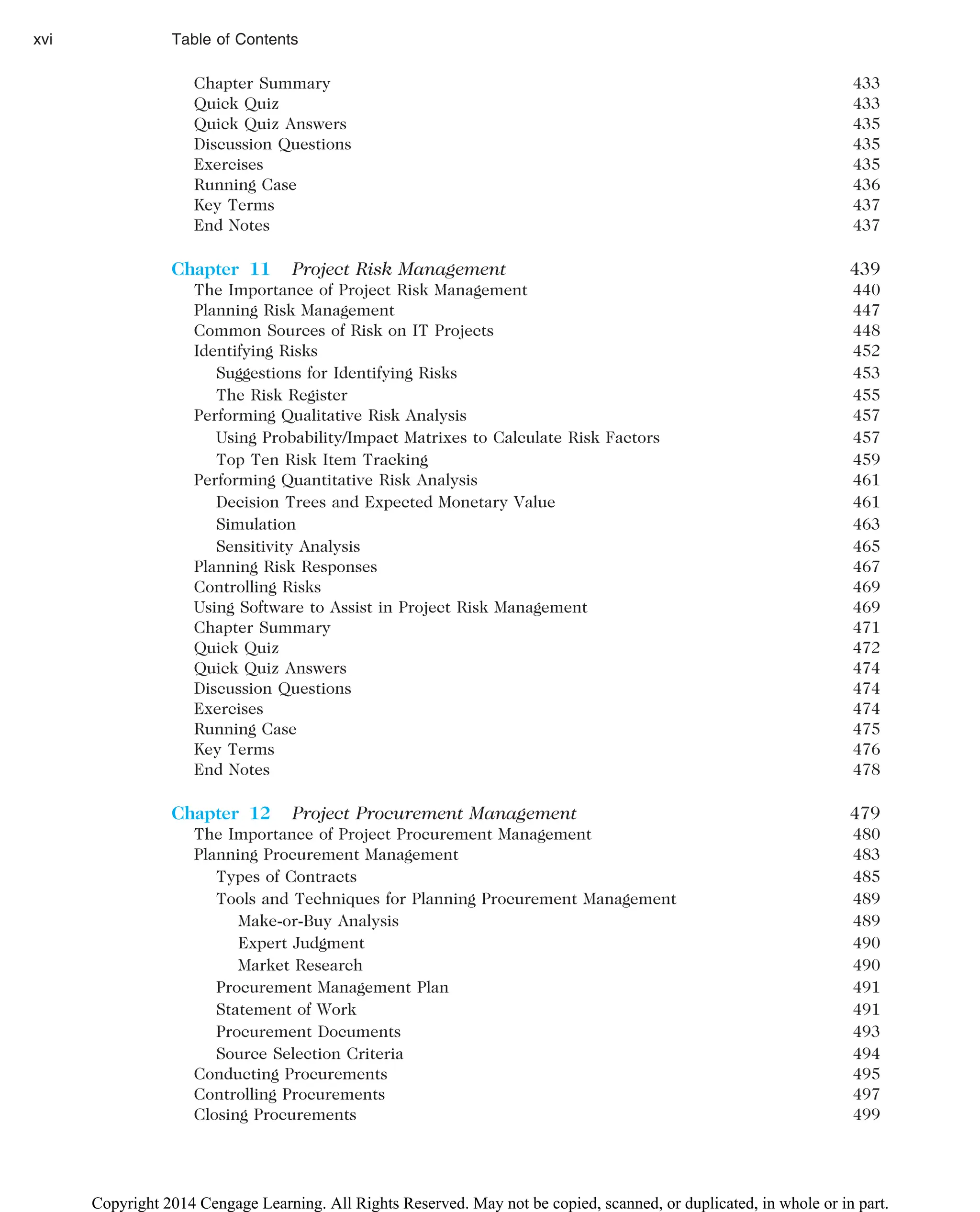
Chapter Summary 433
QuickQuiz 433
Quick Quiz Answers 435
Discussion Questions 435
Exercises 435
Running Case 436
Key Terms 437
End Notes 437
Chapter 11 Project Risk Management 439
The Importance of Project Risk Management 440
Planning Risk Management 447
Common Sources of Risk on IT Projects 448
Identifying Risks 452
Suggestions for Identifying Risks 453
The Risk Register 455
Performing Qualitative Risk Analysis 457
Using Probability/Impact Matrixes to Calculate Risk Factors 457
Top Ten Risk Item Tracking 459
Performing Quantitative Risk Analysis 461
Decision Trees and Expected Monetary Value 461
Simulation 463
Sensitivity Analysis 465
Planning Risk Responses 467
Controlling Risks 469
Using Software to Assist in Project Risk Management 469
Chapter Summary 471
Quick Quiz 472
Quick Quiz Answers 474
Discussion Questions 474
Exercises 474
Running Case 475
Key Terms 476
End Notes 478
Chapter 12 Project Procurement Management 479
The Importance of Project Procurement Management 480
Planning Procurement Management 483
Types of Contracts 485
Tools and Techniques for Planning Procurement Management 489
Make-or-Buy Analysis 489
Expert Judgment 490
Market Research 490
Procurement Management Plan 491
Statement of Work 491
Procurement Documents 493
Source Selection Criteria 494
Conducting Procurements 495
Controlling Procurements 497
Closing Procurements 499
xvi Table of Contents
Copyright 2014 Cengage Learning. All Rights Reserved. May not be copied, scanned, or duplicated, in whole or in part.
15.
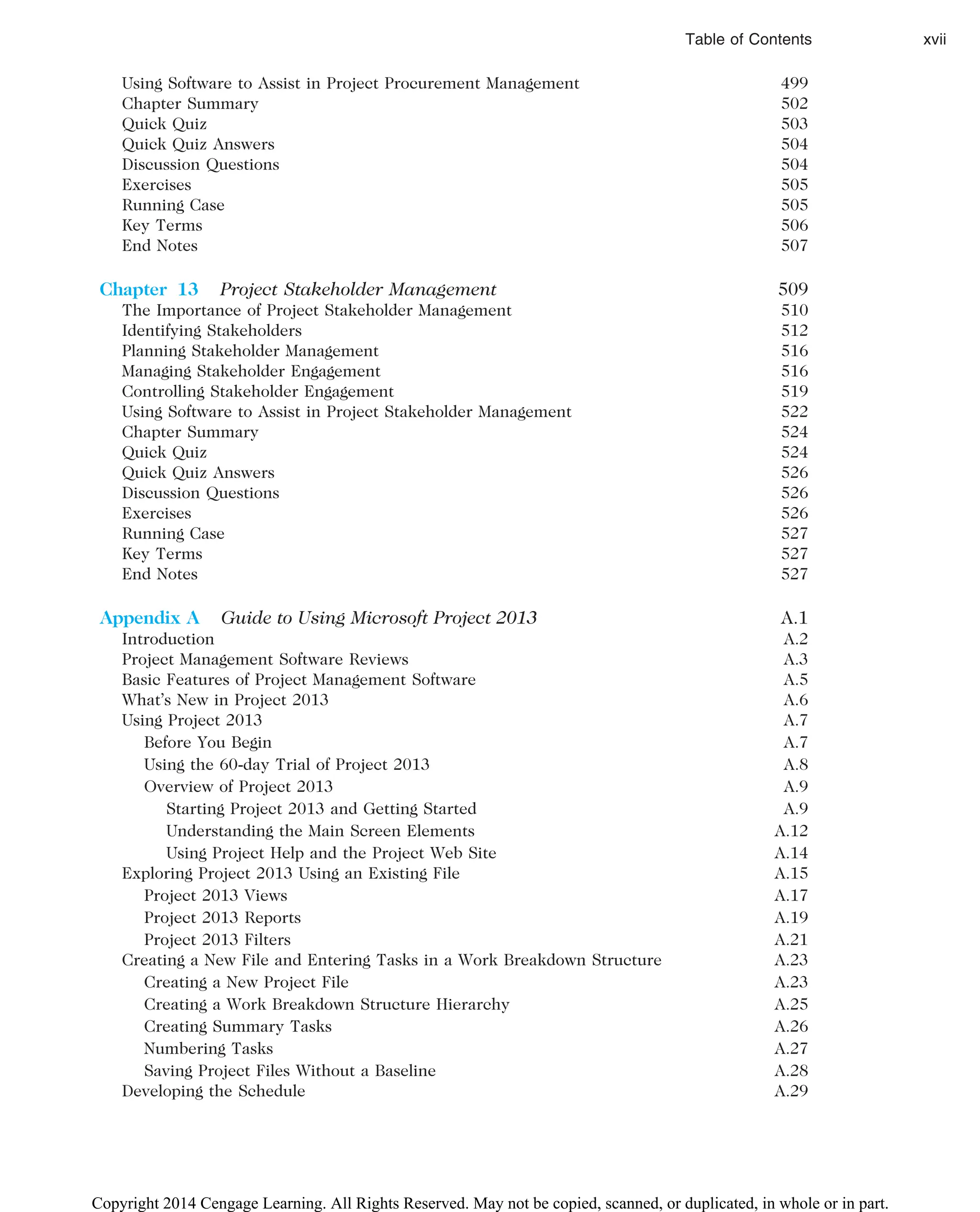
Using Software toAssist in Project Procurement Management 499
Chapter Summary 502
Quick Quiz 503
Quick Quiz Answers 504
Discussion Questions 504
Exercises 505
Running Case 505
Key Terms 506
End Notes 507
Chapter 13 Project Stakeholder Management 509
The Importance of Project Stakeholder Management 510
Identifying Stakeholders 512
Planning Stakeholder Management 516
Managing Stakeholder Engagement 516
Controlling Stakeholder Engagement 519
Using Software to Assist in Project Stakeholder Management 522
Chapter Summary 524
Quick Quiz 524
Quick Quiz Answers 526
Discussion Questions 526
Exercises 526
Running Case 527
Key Terms 527
End Notes 527
Appendix A Guide to Using Microsoft Project 2013 A.1
Introduction A.2
Project Management Software Reviews A.3
Basic Features of Project Management Software A.5
What’s New in Project 2013 A.6
Using Project 2013 A.7
Before You Begin A.7
Using the 60-day Trial of Project 2013 A.8
Overview of Project 2013 A.9
Starting Project 2013 and Getting Started A.9
Understanding the Main Screen Elements A.12
Using Project Help and the Project Web Site A.14
Exploring Project 2013 Using an Existing File A.15
Project 2013 Views A.17
Project 2013 Reports A.19
Project 2013 Filters A.21
Creating a New File and Entering Tasks in a Work Breakdown Structure A.23
Creating a New Project File A.23
Creating a Work Breakdown Structure Hierarchy A.25
Creating Summary Tasks A.26
Numbering Tasks A.27
Saving Project Files Without a Baseline A.28
Developing the Schedule A.29
Table of Contents xvii
Copyright 2014 Cengage Learning. All Rights Reserved. May not be copied, scanned, or duplicated, in whole or in part.
16.
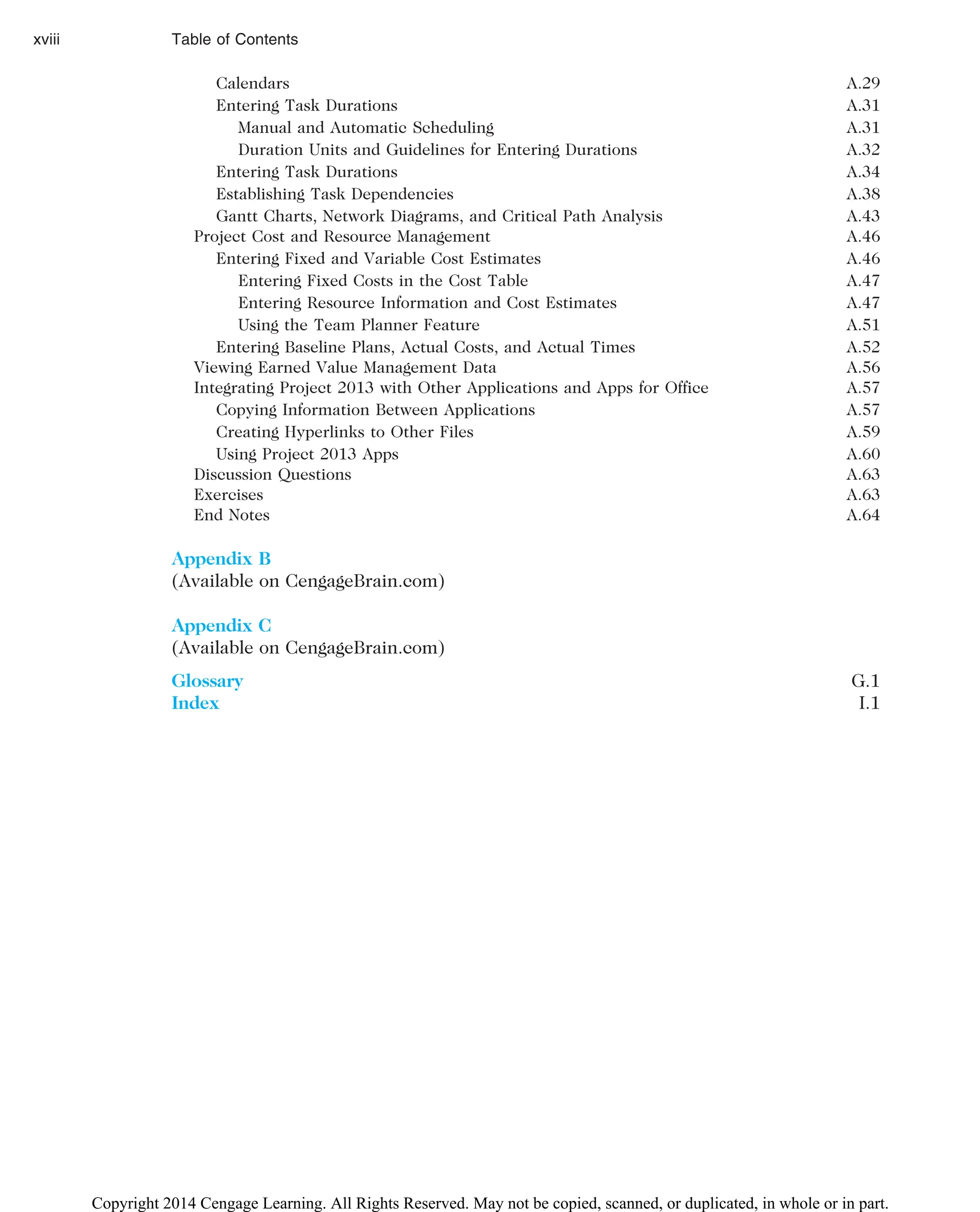
Calendars A.29
Entering TaskDurations A.31
Manual and Automatic Scheduling A.31
Duration Units and Guidelines for Entering Durations A.32
Entering Task Durations A.34
Establishing Task Dependencies A.38
Gantt Charts, Network Diagrams, and Critical Path Analysis A.43
Project Cost and Resource Management A.46
Entering Fixed and Variable Cost Estimates A.46
Entering Fixed Costs in the Cost Table A.47
Entering Resource Information and Cost Estimates A.47
Using the Team Planner Feature A.51
Entering Baseline Plans, Actual Costs, and Actual Times A.52
Viewing Earned Value Management Data A.56
Integrating Project 2013 with Other Applications and Apps for Office A.57
Copying Information Between Applications A.57
Creating Hyperlinks to Other Files A.59
Using Project 2013 Apps A.60
Discussion Questions A.63
Exercises A.63
End Notes A.64
Appendix B
(Available on CengageBrain.com)
Appendix C
(Available on CengageBrain.com)
Glossary G.1
Index I.1
xviii Table of Contents
Copyright 2014 Cengage Learning. All Rights Reserved. May not be copied, scanned, or duplicated, in whole or in part.
17.
PREFACE
The future ofmany organizations depends on their ability to harness the power of
information technology, and good project managers continue to be in high demand.
Colleges have responded to this need by establishing courses in project management
and making them part of the information technology, management, engineering, and
other curricula. Corporations are investing in continuing education to help develop
effective project managers and project teams. This text provides a much-needed
framework for teaching courses in project management, especially those that
emphasize managing information technology projects. The first six editions of this
text were extremely well received by people in academia and the workplace. The
Seventh Edition builds on the strengths of the previous editions and adds new,
important information and features.
It’s impossible to read a newspaper, magazine, or Web page without hearing about
the impact of information technology on our society. Information is traveling faster
and being shared by more people than ever before. You can buy just about anything
online, surf the Web on a mobile phone, or use a wireless Internet connection at your
local coffee shop. Companies have linked their systems together to help them fill
orders on time and better serve their customers. Software companies are continually
developing new products to help streamline our work and get better results. When
technology works well, it is almost invisible. But did it ever occur to you to ask,
“Who makes these complex technologies and systems happen?”
Because you’re reading this text, you must have an interest in the “behind-the-
scenes” aspects of technology. If I’ve done my job well, you’ll begin to see the many
innovations society is currently enjoying as the result of thousands of successful
information technology projects. In this text, you’ll read about IT projects around the
world that went well, including Mittal Steel Poland’s Implementation of SAP that uni-
fied IT systems to improve business and financial processes; Dell Earth and other
green computing projects that save energy and millions of dollars; Six Sigma projects
such as the project to improve case load management at Baptist St. Anthony’s
Hospital in Amarillo, Texas; the systems infrastructure project at the Boots Company
in the United Kingdom that takes advantage of supplier competition to cut costs and
improve services; and many more. Of course, not all projects are successful. Factors
such as time, money, and unrealistic expectations, among many others, can sabotage
a promising effort if it is not properly managed. In this text, you’ll also learn from the
mistakes made on many projects that were not successful. I have written this book in
an effort to educate you, tomorrow’s project managers, about what will help make a
project succeed—and what can make it fail. You’ll also see how projects are used in
everyday media, such as television and film, and how companies use best practices in
project management. Many readers tell me how much they enjoy reading these real-
world examples in the What Went Right?, What Went Wrong?, Media Snapshot, and
Best Practice features. As practitioners know, there is no “one size fits all” solution to
Copyright 2014 Cengage Learning. All Rights Reserved. May not be copied, scanned, or duplicated, in whole or in part.
18.
managing projects. Byseeing how different organizations successfully implement
project management, you can help your organization do the same.
Although project management has been an established field for many years,
managing information technology projects requires ideas and information that go
beyond standard project management. For example, many information technology
projects fail because of a lack of user input, incomplete and changing requirements,
and a lack of executive support. This book includes suggestions for dealing with these
issues. New technologies can also aid in managing information technology projects,
and examples of using software to assist in project management are included
throughout the book.
Information Technology Project Management, REVISED Seventh Edition, is the
only textbook to apply all 10 project management knowledge areas and all five pro-
cess groups to information technology projects. As you will learn, the project man-
agement knowledge areas are project integration, scope, time, cost, quality, human
resource, communications, risk, procurement, and stakeholder management. The
five process groups are initiating, planning, executing, monitoring and controlling,
and closing.
This text builds on the PMBOK® Guide, Fifth Edition, an American National
Standard, to provide a solid framework and context for managing information tech-
nology projects. It also includes an appendix, Guide to Using Microsoft Project 2013,
that many readers find invaluable. A second appendix provides advice on earning and
maintaining Project Management Professional (PMP) certification from the Project
Management Institute (PMI) as well as information on other certification programs,
such as CompTIA’s Project certification. A third appendix provides additional case
studies and information on using simulation and mind-mapping software to help
readers apply their project management skills.
Information Technology Project Management, REVISED Seventh Edition, pro-
vides practical lessons in project management for students and practitioners alike. By
weaving together theory and practice, this text presents an understandable, integrated
view of the many concepts, skills, tools, and techniques of information technology
project management. The comprehensive design of the text provides a strong founda-
tion for students and practitioners in project management.
N E W T O T H E R E V I S E D S E V E N T H E D I T I O N
Building on the success of the previous editions, Information Technology Project
Management, REVISED Seventh Edition, introduces a uniquely effective combination
of features. The main changes in the Seventh Edition include the following:
• The key update for the REVISED Seventh Edition is that Appendix A has
been updated for Microsoft Project 2013.
• Several changes were made to synchronize the Seventh Edition with the
PMBOK® Guide, Fifth Edition. Changes were made based on the exposure
draft released in February 2012. The biggest change was the addition of a
tenth knowledge area, Project Stakeholder Management. This text includes a
new chapter to address this important topic.
• Includes additional information on agile project management. Chapter 2
includes general information on this popular concept, and Chapter 3 provides
a second case study illustrating the outputs produced for the JWD Consulting
xx Preface
Copyright 2014 Cengage Learning. All Rights Reserved. May not be copied, scanned, or duplicated, in whole or in part.
19.
project when usingan agile approach. For example, you can see a sample
product backlog, a sprint backlog, a burndown chart, and key artifacts or
outputs produced when using Scrum, the most popular agile method.
• Appendix C, Additional Cases and Software, provides information about using
several simulation software tools. Several suppliers offer discounts to users of this
text. A new section provides instructions for accessing a special 60-day trial of
MindView Business software. This software provides the capability to create mind
maps, a powerful tool for creating a SWOT analysis or work breakdown structure.
The software also allows users to convert a mind map into a Gantt chart.
• A new feature, Global Issues, provides examples of how project management
concepts and practices affect people around the globe.
• Updated examples are provided throughout the text. You’ll notice several new
examples in the Seventh Edition that explain recent events in managing real
information technology projects. Several of the What Went Right?, What
Went Wrong?, Media Snapshot, and Best Practice examples have been
updated to keep you current. Additional examples and results of new studies
are included throughout the text, with appropriate citations.
• User feedback is incorporated. Based on feedback from reviewers, students,
instructors, practitioners, and translators, you’ll see several additional
changes to help clarify information. (This book has been translated into
Chinese, Japanese, Russian, and Czech.)
• A new CourseMate site for the Seventh Edition (www.cengagebrain.com)
provides access to informative links from the end notes, lecture notes, inter-
active quizzes, templates, additional running cases, suggested readings, and
many other items to enhance your learning.
A C C E S S I N G T H E C O U R S E M A T E S I T E
To access the CourseMate site, open a Web browser and go to www.cengage
brain.com. Search by ISBN, author name, or title, and click Create My Account
to begin the registration process.
A P P R O A C H
Many people have been practicing some form of project management with little or no for-
mal study in this area. New books and articles are written each year as we discover more
about the field of project management, and project management software continues to
advance. Because the project management field and the technology industry change
rapidly, you cannot assume that what worked even a few years ago is still the best
approach today. This text provides up-to-date information on how good project manage-
ment and effective use of software can help you manage projects, especially information
technology projects. Six distinct features of this text include its relationship to the Project
Management Body of Knowledge, its detailed guide for using Microsoft Project 2013, its
value in preparing for Project Management Professional and other certification exams, its
inclusion of running case studies and online templates, its companion (premium) Web
site, and its inclusion of a 60-day trial of MindView Business software.
Preface xxi
Copyright 2014 Cengage Learning. All Rights Reserved. May not be copied, scanned, or duplicated, in whole or in part.
20.
Based on PMBOK®
Guide,Fifth Edition
The Project Management Institute (PMI) created the Guide to the Project
Management Body of Knowledge (the PMBOK®
Guide) as a framework and starting
point for understanding project management. It includes an introduction to project
management, brief descriptions of all 10 project management knowledge areas, and a
glossary of terms. The PMBOK®
Guide is, however, just that—a guide. This text uses
the PMBOK®
Guide, Fifth Edition exposure draft (2012) as a foundation, but goes
beyond it by providing more details, highlighting additional topics, and providing a
real-world context for project management. Information Technology Project
Management, Seventh Edition, explains project management specifically as it applies
to managing information technology projects in the 21st century. It includes several
unique features to bring you the excitement of this dynamic field. (For more infor-
mation on features, see the Pedagogical Features section.)
Detailed Guide for How to Use Microsoft Project 2013
Software has advanced tremendously in recent years, and it is important for project
managers and their teams to use software to help manage information technology
projects. Information Technology Project Management, REVISED Seventh Edition,
includes a detailed guide in Appendix A for using the leading project management
software on the market—Microsoft Project 2013. Examples that use Project and other
software tools are integrated throughout the text. Appendix A, Guide to Using Microsoft
Project 2013, teaches you in a systematic way to use this powerful software to help in
project scope, time, cost, human resource, and communications management.
Resource for PMP and Other Certification Exams
Professional certification is an important factor in recognizing and ensuring quality in
a profession. PMI provides certification as a Project Management Professional (PMP),
and this text is an excellent resource for studying for the certification exam as well as
the entry-level Certified Associate in Project Management (CAPM) exam. This text
will also help you pass other certification exams, such as CompTIA’s Project+ exam.
Having working experience on projects does not mean you can easily pass the PMP or
other certification exams.
I like to tell my students a story about taking a driver’s license test after moving to
Minnesota. I had been driving safely and without accidents for over 16 years, so I
thought I could just walk in and take the test. I was impressed by the sophisticated
computer system used to administer the test. The questions were displayed on a large
touch-screen monitor, often with an image or video to illustrate traffic signs or driving
situations. I became concerned when I had no idea how to answer several questions,
and I was perplexed when the test seemed to stop and a message appeared: “Please see
the person at the service counter.” This was a polite way of saying I had failed the test!
After controlling my embarrassment, I picked up one of the Minnesota driving test
brochures, studied it for an hour or two that night, and passed the test the next day.
The point of this story is to emphasize the importance of studying information
from the organization that creates the test and not to be overconfident that your
experience is enough. Because this text is based on PMI’s PMBOK®
Guide, Fifth
Edition, it provides a valuable reference for studying for PMP certification.
xxii Preface
Copyright 2014 Cengage Learning. All Rights Reserved. May not be copied, scanned, or duplicated, in whole or in part.
21.
It is alsoan excellent reference for CompTIA’s Project+ exam. I have earned both
of these certifications and kept them in mind when writing this text.
Exercises, Running Cases, Templates, Sample Documents,
and Optional Simulation Software
Based on feedback from readers, the REVISED Seventh Edition continues to provide
challenging exercises and running cases to help students apply concepts in each
chapter. The text includes more than 50 templates, examples of real project docu-
ments, and information on several simulation software tools that you can use to
practice your skills in managing a project. All of these features help the subject
matter come alive and have more meaning.
O R G A N I Z A T I O N A N D C O N T E N T
Information Technology Project Management, REVISED Seventh Edition, is organized
into three main sections to provide a framework for project management, a detailed
description of each project management knowledge area, and three appendices to
provide practical information for applying project management. The first three chap-
ters form the first section, which introduces the project management framework and
sets the stage for the remaining chapters.
Chapters 4 through 13 form the second section of the text, which describes
each of the project management knowledge areas—project integration, scope, time,
cost, quality, human resource, communications, risk, procurement, and stakeholder
management—in the context of information technology projects. An entire chapter
is dedicated to each knowledge area. Each of these chapters includes sections that
map to their major processes as described in the PMBOK®
Guide, Fifth Edition. For
example, the chapter on project quality management includes sections on planning
quality management, performing quality assurance, and controlling quality.
Additional sections highlight other important concepts related to each knowledge
area, such as Six Sigma, testing, maturity models, and using software to assist in
project quality management. Each chapter also includes detailed examples of key
project management tools and techniques as applied to information technology
projects. For example, the chapter on project integration management includes
samples of various project-selection documents, such as net present value analyses,
ROI calculations, payback analyses, and weighted scoring models. The project
scope management chapter includes a sample project charter, a project scope
statement, and several work breakdown structures for information technology
projects.
Appendices A through C form the third section of the text, which provides
practical information to help you apply project management skills to real or prac-
tice projects. By following the detailed, step-by-step guide in Appendix A, which
includes more than 60 screen illustrations, you will learn how to use Project 2013.
Appendix B summarizes what you need to know to earn PMP or other certifications
related to project management. Appendix C provides additional running cases and
information on using simulation and mind-mapping software to help you practice
your new skills.
Preface xxiii
Copyright 2014 Cengage Learning. All Rights Reserved. May not be copied, scanned, or duplicated, in whole or in part.
22.
P E DA G O G I C A L F E A T U R E S
Several pedagogical features are included in this text to enhance presentation of the
materials so that you can more easily understand the concepts and apply them.
Throughout the text, emphasis is placed on applying concepts to current, real-world
information technology project management.
CourseMate
Engagement Tracker
How do you assess your students’ engagement in your course? How do you know your
students have read the material or viewed the resources you’ve assigned? How can
you tell if your students are struggling with a concept? With CourseMate, you can use
the included Engagement Tracker to assess student preparation and engagement. Use
the tracking tools to see progress for the class as a whole or for individual students.
Identify students at risk early in the course. Uncover which concepts are most diffi-
cult for your class. Monitor time on task. Keep your students engaged.
Interactive Teaching and Learning Tools
CourseMate includes interactive teaching and learning tools:
• Quizzes
• Flashcards
• Games
• and more
These assets enable students to review for tests and prepare for class, and they
address the needs of students’ varied learning styles.
Interactive eBook
In addition to interactive teaching and learning tools, CourseMate includes an inter-
active eBook. Students can take notes as well as highlight, search, and interact with
embedded media specific to their book. Use it as a supplement to the printed text or
as a substitute—the choice is your students’ with CourseMate.
Opening Case and Case Wrap-Up
To set the stage, each chapter begins with an opening case related to the material
presented in that chapter. These real-life case scenarios, most of which are based on
the author’s experiences, spark student interest and introduce important concepts in
a real-world context. As project management concepts and techniques are discussed,
they are applied to the opening case and other similar scenarios. Each chapter then
closes with a case wrap-up—with some ending successfully and some failing—to
further illustrate the real world of project management.
What Went Right? and What Went Wrong?
Failures, as much as successes, can be valuable learning experiences. Each chapter of
the text includes one or more examples of real information technology projects that
went right, as well as examples of projects that went wrong. These examples further
illustrate the importance of mastering key concepts in each chapter.
xxiv Preface
Copyright 2014 Cengage Learning. All Rights Reserved. May not be copied, scanned, or duplicated, in whole or in part.
section then, whencomplete, consisted of twenty ambulances, one
Ford camionnette or truck, which went for food and carried spare
parts and often baggage, one French camionnette, a one-ton truck,
which carried tools, French mechanics, and other spare parts, one
large White truck with kitchen trailer, one Ford touring-car for the
chef, and a more or less high-powered touring car for the lieutenant.
The personnel was one French lieutenant, who was the connecting
link between the organization and the government, and was
responsible to the latter for the actions of the section; one chef, who
was an American chosen by the organization from the sous-chefs of
one of the sections in the field; one or two sous-chefs, chosen by
the chef from the members of his or some other section; twenty
drivers, often an odd number of assistant drivers, an American paid
mechanic, and an odd number of French mechanics, cooks, and
clerks.
The lieutenant received the orders and was responsible to the
army for their execution. The lieutenant gave the chef his orders,
and the chef was responsible to him for their execution by the
section. The sous-chefs were the chef’s assistants.
The routine when at work is for a certain number of cars to be on
duty at one time, the number depending on the work. The section is
divided into shifts of the number of cars required. When on duty a
man must always have his car and himself ready to “roll,” and when
off duty, after putting his car in condition, must rest so as to be in
shape for his next turn. When the work is heavy, the cars on duty
are rolling all the time with very little opportunity for food or rest for
the driver; consequently, for a man not to get himself and his car
ready in this period of rest means that the service is weakened; and
that, if other cars go en panne unavoidably, it is possibly crippled—
and lives may be lost. When the work is light, men are usually
twenty-four hours on and forty-eight off; when moderate, twenty-
four on and twenty-four off; when stiff, forty-eight on and twenty-
four off, and during an attack almost steadily on. The longest stretch
that my section kept its men continuously at work was seven days
and nights in the Verdun sector during an attack, and we were
25.
compelled to ceasethen only because too few of our cars were left
able to roll to carry the wounded.
From headquarters the day’s shift is sent to the relay station, and
from there cars go as needed to the postes de secours. The postes
are as near the trenches as it is possible for the cars to go, and
some can be visited only at night. The wounded are brought to
these by the brancardiers through the boyaux, or communication
trenches, and usually have their first attention here. After first aid
has been administered, and when there are enough for a load, or
there is a serious case, the car goes to the triage, stopping at the
relay station, from which a car is sent to the poste to replace the
first, which returns to the relay station directly from the hospital.
The hospitals also are divided into two main classes, the triages,
or front hospitals in the zone of fire, and the H.O.E.’s, hospitals of
evacuation, anywhere back of the fines. The hospital of evacuation is
the third of the four stages through which a wounded man passes.
The first is the front-line dressing station, the abri; the second, if the
wound is at all serious, is the triage; the third, if serious enough, is
the hospital of evacuation; and the fourth, if the soldier has been
confined to the hospital for ten or more days, is the ten-day
permission to Paris, Nice, or some other place of his choice. Then
these classes, in some cases, are subdivided into separate hospitals
for couchés, assis, and malades.
These subdivisions sometimes make complications, as in the case
of one driver who was given what appeared to be a serious case to
take to the couché hospital. While on the way, however, the serious
case revived sufficiently to find his canteen. After a few swallows he
felt a pleasant warmth within, for French canteens are not filled with
water, and sat up better to observe his surroundings and to make
uncomplimentary remarks to the driver. Arrived at the hospital, the
brancardiers lifted the curtain at the rear of the car, and seeing the
patient sitting up and smoking a cigarette, apparently in good
health, they refused to take him, and sent the car on to the assis
hospital. Overcome by his undue exertion, the wounded man lay
26.
down again, andby the time the ambulance had reached the other
hospital was peacefully dozing on the floor. The brancardiers shook
their heads, and sent the car back to the couché hospital. Somewhat
annoyed by this time, the ambulancier did not drive with the same
care, and the jolts aroused the incensed poilu, who sat up and
began to ask personal questions. The driver, not wishing to continue
his trips between the two hospitals for the duration of the war,
stopped the car outside the couché hospital, and, seeing his patient
sitting up, put him definitely to sleep with a tire tool, and sent him in
by the uncomplaining brancardiers.
WE spend a good part of our time in the abri. Just now the Boche
appears to have taken a particular dislike to this part of the sector,
for he is strafing it most unmercifully. We do not doubt at all that it
is because we are here. The fact that there are six thousand French
guns massed in the woods, so near together that you cannot walk a
dozen feet without tripping over one, may, of course, have
something to do with the enemy’s vindictiveness, but that does not
occur to us.
After taking an hour or two of interrupted sleep in the abri, we
step out in the early morning to get a breath of fresh air and to
untangle our cramped muscles. A shell or two whines in
uncomfortably near, and we are convinced that the enemy knows
our every move by instinct. When we sit in the abri during the day,
and there is never a second that we do not hear the whine of at
least one shell overhead, and the intervals between shells striking
near enough to shake the abri and rattle éclats on its steel roof grow
less, we are convinced the Boche is searching for our dugout. When
I am making a run to P 2, and, rounding Dead Horse Corner, start on
the last stretch, and a shell knocks a tree across the road a hundred
feet ahead, blocking us completely, and two more shells drop on the
road by the tree, two more strike ten yards on our right, and another
lands within fifteen feet on our left, there is no doubt in my mind
that the enemy is after me.
27.
In reality, ofcourse, the enemy has no idea where the abris are
located, and just now is simply taking a few chance shots at a likely
corner—but every man knows that every shell he hears is meant for
him personally,—all of which goes to prove how egotistical we really
are.
AS one man remarked, “Our life out here is just one d—
brancardier after another.” The brancardiers, or stretcher-bearers,
include the musicians—for the band does not play at the front,—the
exchanged prisoners who are pledged to do no combatant work, and
others who volunteer for or are assigned to this work. These men
are in the front-line trenches, where they bandage wounded men as
they are hit, and carry them to the front abri, where the major, army
doctor, gives them more careful attention. At the front abri are other
brancardiers, who then take charge of these men and load them into
our cars. We arrive at the hospital, and brancardiers there unload
the ambulances and carry in the wounded. Inside the hospital other
brancardiers nurse the wounded, as no women nurses are allowed in
the triage hospitals.
28.
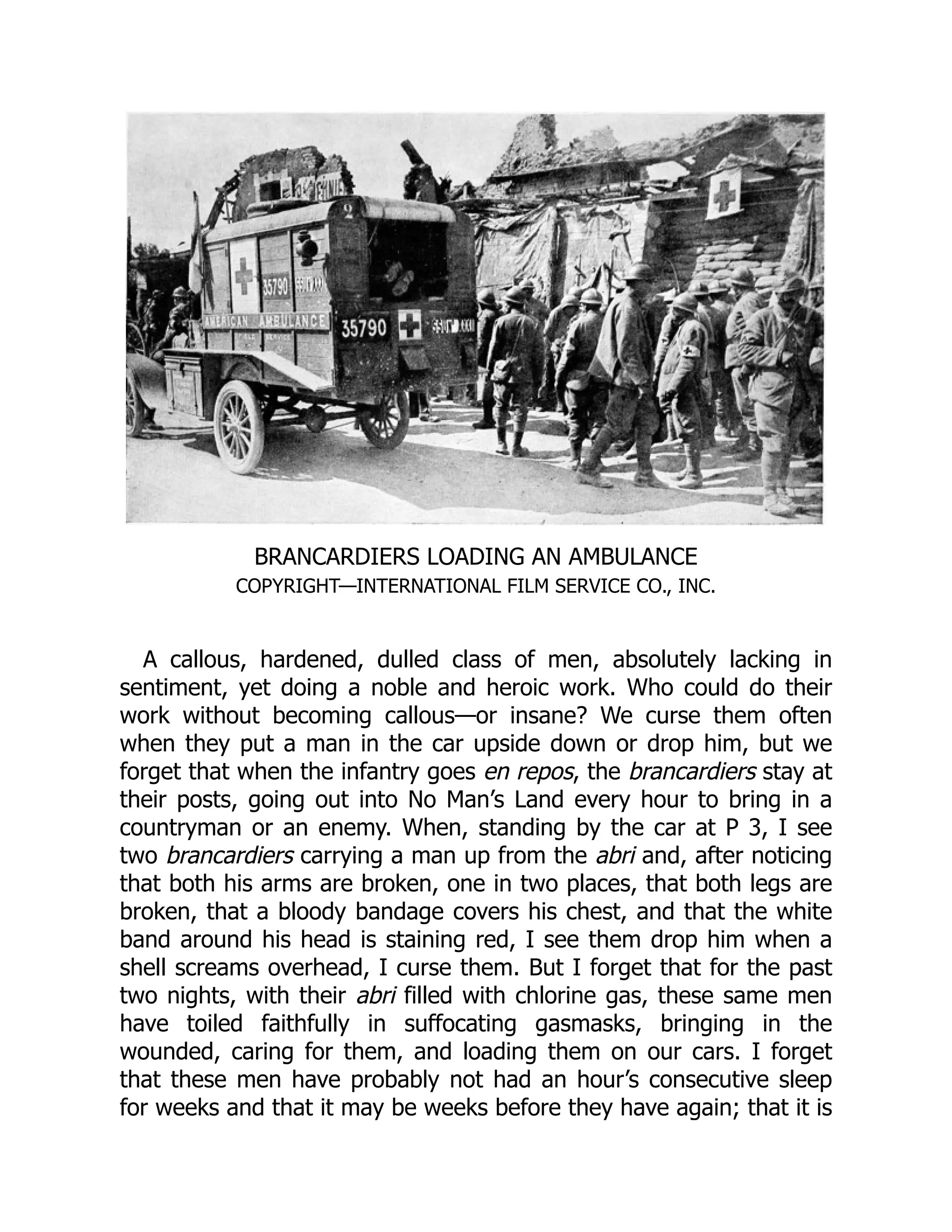
BRANCARDIERS LOADING ANAMBULANCE
COPYRIGHT—INTERNATIONAL FILM SERVICE CO., INC.
A callous, hardened, dulled class of men, absolutely lacking in
sentiment, yet doing a noble and heroic work. Who could do their
work without becoming callous—or insane? We curse them often
when they put a man in the car upside down or drop him, but we
forget that when the infantry goes en repos, the brancardiers stay at
their posts, going out into No Man’s Land every hour to bring in a
countryman or an enemy. When, standing by the car at P 3, I see
two brancardiers carrying a man up from the abri and, after noticing
that both his arms are broken, one in two places, that both legs are
broken, that a bloody bandage covers his chest, and that the white
band around his head is staining red, I see them drop him when a
shell screams overhead, I curse them. But I forget that for the past
two nights, with their abri filled with chlorine gas, these same men
have toiled faithfully in suffocating gasmasks, bringing in the
wounded, caring for them, and loading them on our cars. I forget
that these men have probably not had an hour’s consecutive sleep
for weeks and that it may be weeks before they have again; that it is
29.
months since theylast saw a dry foot of ground, or felt that for a
moment they were free of the ever present expectation of sudden
death. It is something to remember, and it is to wonder rather how
they do these things at all than why they seem at times a little
careless or a bit tired.
Would the brancardier tell you this? When he sees you he asks
after your comrades. He takes you in and gives you a cigarette and
some Pinard in a battered cup, and tries to find you a place to rest,
all the time telling you cheerful stories and amusing incidents.
The Staff is the brains of the army; Aviation, the eyes; the
Artillery, the voice; the Infantry and Cavalry, the arms; the
Engineers, the hands; the Transportation, the legs; the People
behind it, the body; but the Brancardier is the soul.
THERE are sounds outside of a klaxon being worked vigorously.
However, we have several dozing Frenchmen inside the abri who are
making similar noises, so nothing dawns upon our sleepy senses for
some minutes while the owner of the klaxon searches for the abri.
This is dangerous business, because on all sides are barbed wire,
shell-holes, and other abris. Also, as this one is located in the corner
of a graveyard, there is danger that the searcher will wander on and
uproot a dozen or more wooden crosses in the search. At last he
discovers the right one by falling down the pit we called stairs before
the rain set in. A violent monologue arouses us from our dozing
comfortlessness, and we learn that a car is wanted at P 2. I am next
on call, so I slowly and painfully unwind myself from a support and
two pairs of legs, and, with the man who rides with me, make my
way into the outer darkness.
We get the car and start off down the road with no lights
anywhere, and pray that everything coming the other way keeps to
its side of the road and goes slowly. There is always something
coming the other way—and your way, a steady succession of
camions in the centre of the road, and of artillery trains on the side.
30.
The camions aremostly very heavy and very powerful, and have no
compunction at all about what they run into, as they know that it
cannot harm them. The ammunition trains consist of batteries of
75’s, little framework teams with torpilles fitting in small
compartments like eggs, and other such vehicles in tow of a number
of mules, with the driver invariably asleep. The traffic, however, in
spite of the pitch darkness, would be endurable if it were not for the
mud which often comes up to the hubs. It is a slimy mud, and if
spread thinly is extremely slippery. On the roads it is rarely spread
thinly, and when one gets out to push he often sinks in up to the
knee. Then of course there is always the whine of arrivées and
départs passing overhead, and the occasional crump of a German 77
or 150 landing near at hand.
The French and the German gunners play a little game every night
with supply trains and shells. The shells are trumps. The object is to
see who can play the more “cards” without being trumped. An
artillery train counts one, a camionnette two, a camion five—
because it blocks the road for some time when hit, and gives the
enemy time to trump more cards—two ambulances give a win, and if
a gun is hit the enemy is disqualified. The game is very interesting—
for the artillery.
This modernized blindman’s buff is carried on at its best in the
early hours of the morning before the game becomes too free-for-all
to score carefully, and most of the cars are returned to the “pack”—
out of the zone of fire—to wait for the next evening’s fun. At this
time the roads are crowded, and the game is at its height. As the
fun increases for the judges, however, it decreases for the players,—
that is to say the “cards.” The prospect of being trumped is not a
pleasant anticipation, although it keeps up the interest and prevents
ennui. After an hour or so of sport the going becomes very bad, as
there are always many horses killed, and when the fighting is at all
severe there is no time to bury them. Then, too, the narrow gauge
railway crossing the road every few rods is often hit, and left, like a
steel octopus, with its twisted tentacles stretching out in all
directions. These add to the sport hugely, and our chief consolation
31.
is to imaginethe Boche over on his side having fully as bad if not a
worse time than we.
“This or the next?” inquires my companion in reference to a cross-
road which appears on our right.
Having no idea I answer, “This one,” and we turn. An
unaccountable number of jounces greets us as we continue.
“They must have strafed this road a good bit since our last roll,”
my friend comments.
The going is worse, and we stop to get our bearings. We shout
and presently a form rises from the darkness. At any hour of the day
or night it is possible to rouse by one or more shouts any number of
men anywhere. You can see no one, as the world, for obvious
reasons, lives underground in the rabbit burrows of abris, but when
needed comes forth in force. This is very convenient, as often when
driving at night one finds his car stuck in the middle of a new and
large shell-hole, and help is necessary. We ask our location.
“Ah, oui, M’sieu, P-trois!”
We have come by error to the artillery poste and must retrace our
way. We exchange cigarettes with the friendly brancardier and set
off again. At last we get back on the right road, and after making
another turn are nearing the poste. In the last gleams from a star-
shell ahead we see something grey by the side of the road. As we
are in the woods I take a quick look with my flash. It is one of our
ambulances. My friend and I look at each other, and are mutually
glad that it is too dark to see each other’s face. A careful survey of
the surroundings yields nothing, and we press on—in silence. We jolt
into the poste with racing motor and wheels clogged with mud, and
go down into the very welcome abri. Our friends there know nothing
about the ambulance, so we hope for the best.
Friendships at the front are for the most part sincere—but
sometimes short.
32.
IT is aboutten o’clock in the evening. We have been given a load at
P 2 and are returning to the hospital. We turn from the battered Bois
d’Avocourt into the Bois de Récicourt, and passing through the Bois
de Pommiers roll into the valley. We cross through the town, and
when the sentry lifts the gate pull slowly up the hill towards
Brocourt. Punctually at five-thirty this evening twelve shells whistled
over Récicourt and struck the hill, but fortunately not the road.
This hill makes a perfect target for the Boche, for if he falls short
he hits the town, if he overshoots he will probably hit the hospital,
and if he hits what he aims at he may get the road. Consequently
there are intermittent bombardments at all hours of the day and
night—preferably at night as there is more traffic on the roads.
There is one time that the Boche never fails to greet us. That is five-
thirty. Every day while I was there, as the hour struck, or would
have struck had the clock been left to strike it, twelve shells whistled
over Récicourt and knocked fruit from the orchard on the hill. If the
Boche were sentimental, we would say it was the early twilight that
made him do this, but as we remember Belgium we call it habit.
There are several big rôtis set up by the roadside like kilo-stones to
remind us that to roll at five-thirty is verboten.
For some unexplained and mysterious reason many of the German
shells do not explode. Whether this is from faulty workmanship or
defective fuses or materials we do not know, but it causes the poilus
much amusement. There will be the whine of an arrivée and a dull
thud as it strikes the ground, but no explosion. Every Frenchman
present immediately roars with laughter and shouts, “Rôti! Rôti!”
We crawl up the hill, the road luckily having escaped injury during
the afternoon, and at length reach the hospital. Then, much
lightened, we start back. Coasting slowly down the hill we have a
perfect opportunity to observe the horizon.
The sky tonight is softly radiant, a velvety black with myriads of
brilliant stars in the upper heavens. Opposite us is another hill,
crowned with trees which break gently into the skyline. Above these
33.
the sky flashesand sparkles in iridescent glory. The thundering
batteries light up everything with brilliant flashes, and the star-shells
springing up over No Man’s Land hang for an instant high in the air
with dazzling brilliancy, and then fading, drift slowly earthward. The
artillery signals (Verrey Lights, rockets carrying on their sticks one,
two, three, and four lights) dart up everywhere. A raider purrs
overhead, and golden bursts of shrapnel crack in the sky. All merge
together, first one, then another standing forth to catch the eye for a
brief second, the kaleidoscopic brilliancy lifting one up out of the
depths of the mire to forget for a moment why these lights flare—
treacherous will o’ the wisps leading men on to death—and one sees
only the wonderful beauty of the scene: a picture impressed on the
memory which makes all seem worth while. One sight of these
causes the discomforts and dangers of the day’s work to fade, and
they become a symbol—a pillar of fire leading on to the victory that
is coming when Right shall have conquered Might, and the tortured
world can again breathe freely.
IT is night, and the chill mist has settled close to the ground. It is
cold and damp, but the front is always cold and damp so no one
comments on it. We are several feet underground and that
augments the chill somewhat, but as here one lives underground he
does not think of that. There is a little breeze outside, for the burlap
that hangs at the foot of the stairs leading to the outer world
quivers, and the lone candle flickers uncertainly, casting weird
shadows from the black steel roof on the sleeping forms. The sides
of the abri are lined with bunks, wooden frames covered with wire
netting, upon which lie sprawled brancardiers, poilus, and in one an
American has managed to locate himself quite comfortably. The abri
is short, and the few bunks are at a premium.
Two of our men are asleep,—one on the floor, another in a bunk.
The rest of us wrap our coats around us and smoke pensively. We
think of home, and wonder what our friends there are doing just
now. It is August and slightly after midnight. The time difference
34.
makes it afew minutes past six in the States. At the seashore they
are coming in from canoeing and swimming, sitting around before
dinner, discussing the plans for the evening and the happenings of
the day. At the mountains they are finishing rounds of golf or sets of
tennis, and the pink and gold of the sunset is crowning the peaks
with a fading burst of glory. Soon the fights of the hotel will shine
brightly forth into the gathering gloom, and the dance music will
strike up.
Each tells the others just what he would be doing at the moment
were he in the States, and comments. It is all done in an absolutely
detached manner, just as one describes incidents and chapters in
books. We think we would like to be home now, but we know that
we would rather not. We are perfectly contented to be doing what
we are doing, and do not envy those at home. Nor do we begrudge
any of them the pleasant times they may be having. In fact, if we
thought they were giving them up we would be miserable. One
cannot think about this war for long at a time, and when one
meditates it is to speculate on what is happening at home. One
gloats over imaginary dances, theatres, and all varieties of good
times. I have often enjoyed monologue discussions with my friends,
or imagined myself doing any one of the many things I might have
been doing. It is the lonesome man’s chief standby to five by proxy.
Outside there is continually the dull thunder of the guns. They are
evidently firing tir de barrage, for there is a certain regularity in the
wave of sound that rumbles in on us. Perhaps the barrage is falling
on the roads behind the enemy lines, cutting off and destroying his
supply trains. Perhaps it is trying to sweep some of his batteries out
of existence, or perhaps it is falling on his trenches, taking its toll of
nerve and life. Again we can only conjecture. There is the continual
whine of his shells rushing overhead, and the crump-crump of their
breaking in the near distance. Then the enemy starts a little
sweeping of his own, and the arrivées begin to fall in an arc which
draws steadily nearer, until a thunder clap just outside and the
rattling of éclats, dirt, and tree fragments on the roof, make you
rejoice in your cover, and you chuckle as a brancardier sleepily
35.
remarks, “Entrez!” Youwonder curiously, and listen expectantly to
see if the next will fall on you; then you doze again or say something
to the man beside you.
Inside there is an equal variety of sounds. There are poilus snoring
in seven different octaves, there is the splutter of the candle
overhead, and from one corner an occasional moan from some
wounded man, growing more frequent as the night wears on. We
may not take him in until we have enough for a load. Soon there is
the sound of feet on the stairs, and a brancardier stumbles in
leading a man raving wildly, with his head swathed in fresh
bandages rapidly staining with the oozing blood. Some one moves,
and he is seated and given a cup of Pinard and a cigarette, which he
accepts gratefully. We get ready to go out to the ambulance, but the
doctor shakes his head—we have not a load yet. Some of the
regulations perplex us; but it is not our business, so we light up our
pipes again and snuggle down into our fur coats, dozing and
listening to the whine of the shells outside and the moans inside.
Then, after a while, another blessé is brought to the door and the
doctor nods. Two of us jump up, snatch our musettes, run to the car,
and assist the brancardiers in shoving in the third man, who is
unconscious. Then we crank up, and after some minutes of
manœuvring in the deep mud reach the road and start for the
hospital.
THE black of the night, split by the star-shells and the batteries,
has given place to the grey of the dawn. All is still and quiet, with
the rare crash of a battery or an arrivée alone breaking the silence.
There is no sign of the sun, and it will be some hours before it
breaks through the early mist to smile upon us for a few brief
moments before the never-ending rain envelops us again,—for it is
the mauvais temps.
After lying for two hours in one of the bunks in the abri, and vainly
endeavoring to keep warm with two blessé blankets, I arise stiffly
36.
and crawl outinto the fresh air. The blessé blankets are single
blankets quartered and, as they are assigned for use in the
ambulances and abris for the wounded, often bring little visitors.
AN ABRI
37.
The air isclear and damp, and remarkably invigorating. A few
deep breaths start the blood slowly moving through my veins, and I
walk around in the mud, stretching my cramped limbs. There are the
usual new shell-holes scattered about to make us first rejoice in our
shelter and then look doubtfully at the all-too-thin layer of dirt on
the roof between us and a direct hit. The Germans, when they take
up a position, seem to think of it as permanent, dig their abris often
as deep as a hundred feet underground, and are absolutely safe in
them except when a raiding party tosses a grenade down the stairs.
Their officers’ quarters are particularly spacious, lined with cement,
with the walls often papered, holding brass beds and other quite
civilized comforts. A piano was found in one. It had been put in
before the cement was laid, and they were unable to remove it when
they retreated—even if they had had the time. The French, whether
from laziness or because they expect soon again to be moving
forward, waste little time on the dug-outs. The standard is a pit lined
with sandbags, and covered by a conventional form of corrugated
steel roof, with more sandbags and a little dirt on top of this. These
protect from the éclats, or shell fragments, but form a death trap for
all inside if there is a direct hit. If the side of a hill or a hollow is
available it affords more protection. The one direct hit on our abri at
P 2 was luckily a “dud,” and caused no damage.
I walk over to the pile of discarded equipment to see if anything
interesting has been added during the night. This and the hospital
are the two favorite places for souvenir hunters. At all the postes
and in the hospitals the rifles, bayonets, packs, belts, cartridges,
knives, grenades, revolvers, shoes, and other equipment of the
wounded and dead are put in a large pile, and the first to recover
get the pick—after our selection. At the postes these things are piled
in the open, with no protection from the elements, and many are
slowly disintegrating. This morning, of the new things there is of
interest only one of the large wire-clippers, used by the pionniers
and scouts for passing through the enemy wire. But my friend has
seen them first, so I waive all claims, and he tucks them carefully
38.
away in oneof the several side-boxes with which the cars are
equipped.
The trees are twice decimated, but the birds have stayed, and
now they are waking and, overflowing with high spirits, sing their
message of good cheer. They answer each other from different parts
of the wood, and by closing one’s eyes one seems to be in the
country at home. Never has the song of birds seemed more beautiful
or more welcome, and, gladdened, we listen while we may, before
the slowly swelling thunder of the guns, beginning their early
morning bombardment, drowns out all other sound. We go down
again into the abri and pray for a load soon to take us down to the
hospital and breakfast at headquarters.
WE have been ordered en repos, and after turning in our extra gas
masks—we carry ten in the car for the wounded in addition to the
two on our person—our blessé blankets, and stretchers, we start in
to load the cars with our friends, and our own baggage. As for some
time our baggage has been lying en masse in the “drawing-room” of
Tucker Inn, as some humorous conducteur styled the roofless pen in
Récicourt, where our belongings were left while we were rolling, or
in the surrounding abris, one could not be at all certain that he was
putting the right things in the right duffles, and it was not surprising
if a stray jar or two of confiture most unaccountably found its way
into one’s own duffle.
The section in formation, we roll off with the sun shining brightly
on grimy cars and drivers, down the roads, passing ruin after ruin,
with a burst of speed past a corner in view of the German trenches,
and we again begin to see familiar ground. The green hill back of
Erize, with shadows of the woods and the scars of the old trenches,
appears in the distance, and my friend looks at me and chuckles.
Back in the same little town, parked in the same ruins with the
same quietness, peace, and relaxation from the tenseness of the
past days, which is so welcome this time, my friend and I walk into a
39.
little estaminet, pledgeeach other in glasses of French beer, and
taking off our helmets for almost the first time in what seems an
age, survey them and each other in placid contentment.
41.
III
EN REPOS
A BATCHof mail was given out the morning after our return. When
we moved, our address seemed to have been lost, for only a few
letters, of no interest to any one, managed to find us. We have been
too busy to miss them, and when they arrived in a bunch there were
no complaints.
It is a wonderful thrill to get a letter from home, to read what
those who mean all to one are doing, and to feel their personalities
throbbing “between the lines.” We bridge for a brief moment the
chasm of three thousand miles, and in revery gaze upon those
persons, those places, and those things we have known. Our
thoughts here are always in the past. We cannot think of the
present, and we dare not think of the future, but there is always the
past to live in,—the past of events and memories.
We settle down to the same dull monotony as before. For a few
days this is bliss, but it soon becomes tiring again. All work here is
contrast. When we are at work, we work intensively, taking less rest
than seems physically possible, and when en repos we are plunged
into the dullest monotony imaginable, with nothing to amuse or
occupy us. This is true of every branch of active service.
The few air raids are rather an anticlimax after the days that have
just passed, especially as nothing falls near enough to cause us any
annoyance. At Bar-le-Duc the Boche playfully drops a dozen bombs
42.
into the Germanprison camp, much to every one’s amusement; a
mile from us he destroys a camp of Bulgarian prisoners, and we
wonder at his hard-headedness and laugh. But the next night we
hear bombs crashing in the distance, and in the morning learn from
some men in another section passing through that it was
Vadlaincourt, where the Huns flew so near the ground that soldiers
in the streets shot at them with rifles. At that height the aeroplanes
could not mistake their targets, and they retired only when the
hospital was a mass of flaming ruins. There are no smiles at this.
Another night the purring motors reveal outlined high against the
stars a fleet of Zeppelins, bound we know not where, but, we do
know, on a mission of death to the innocent.
THE enemy aeroplane comes over us often. We have wondered
why, but we now realize that while the Allies can get control of the
air when they want it, to keep continual control would be too
expensive in both men and machines. The anti-aircraft gun
theoretically solves the problem. When an enemy machine appears,
a battery of contre-avions is notified and essays the destruction of
the adventurer.
It is pretty sport. A little white machine, sometimes catching the
glint of the sun, dashes towards us at a great height. It is sighted,
and then the high-pitched boom-booms of the contre-avions start in,
and the shrapnel breaks at varying distances around the machine
like powder-puffs, which float along for some minutes. After a little
of this harmless sport the Boche gets out of range, the guns cease,
and the machine, having in the meanwhile disposed of some bombs
or taken some photographs, dashes off, to be followed shortly by
one or two Frenchmen.
The practical value of the anti-aircraft guns is to keep the
machines so high in the air that they can accomplish little, as the
guns rarely score. At M——, where every day they have been
shooting two or three hundred rounds at the machines which fly
43.
over the city,they are quite proud of their record, for once in one
day they shot down three machines—two of their own and one
German. They have been resting on their laurels ever since. It was a
few examples like this which taught the French airmen to keep out
of the sky while the contre-avions were busy.
“NAPOLEON” was so christened by us because, despite his
sparrow-like form and manner, he considers himself the moving spirit
of the army in general and of our section in particular. Because he
knows nothing about automobiles, he styles himself an expert,—the
mere fact that he is assigned as clerk to an ambulance section
proves his claim. The one time he had the indiscretion to touch a
car, he drove the lieutenant’s around the compound with the
emergency brake set—after telling the sous-chef that he had driven
cars for twenty years! One of the ambulances goes for ravitaillement
every day, carrying “Napoleon,” who disappears into mysterious
buildings and returns with still more mysterious edibles, presumably
for our delectation.
On one trip the carburetor gave trouble and we stopped and
cleaned it. While we were working we noticed “Napoleon”
industriously turning the lights on and off, pumping the button on
the dash. We said nothing, and when we had finished and started
the car again he tapped his chest proudly, cocked his head, and said,
“Moi!”
In circumnavigating a large team in the centre of the road later
that day I rubbed “Napoleon” off against a horse, and after that he
snubbed me on every occasion.
BEING at the cross-roads, all manner of men and things come
through Erize. The never-ending stream of camions passing each
other as they go, layers deep with dust and grime, winds on steadily.
There is great rivalry between the camion pelotons, and each has
44.
adopted an insigniapainted on the sides of the cars to distinguish it
from the others. As there are several hundred pelotons the designs
are many, interesting, and reveal much of the inner nature of the
poilu. Every species of beast and fowl is depicted,—greyhound,
stork, swallow, and other types,—as a monkey riding on a shell, a
demon with trident pursuing a German, and then perhaps a child’s
face, copied no doubt from the locket of one of the men.
Soldiers go up cheering wildly, singing and shouting. They return
silent, tired, covered with mud, and reduced in numbers. German
rifles, bayonets, caps, buttons, cartridges, and other odds and ends
are then offered for sale. In August a poilu offered me a German
rifle. I was examining it, and admiring the design, when I noticed
the maker’s name,—the latest type German rifle had been made in
New Jersey, U.S.A.
In addition to these things, the poilus have for sale many articles
they have made themselves. The favorite is the briquet, or pocket
lighter. This is made in all conceivable sizes and shapes, and
operates by a flint and steel lighting a gasoline wick. This is why we
use more gasoline en repos than when rolling! The soldiers also take
the soixante-quinze shell-cases and carve and hammer them into
vases. As many of the men were experts at work of this type “avant
la guerre,” and as much local talent has appeared since, some of the
specimens are very fine indeed, and command high prices in the
cities.
45.
A DIVISION ENREPOS
INTERNATIONAL FILM SERVICE CO., INC.
It is these laughing, playing, seemingly care-free soldiers who are
the spirit of the war. Relieved from the tense struggle of life and
death for a brief rest, their joyous nature blossoms forth in reaction
from the serious affairs of their day’s work.
THERE is nothing that so brings out the best in a man as to fight
against terrific odds, to struggle in a losing fight with the knowledge
that only by superhuman effort can the odds be equaled or turned.
To work for an ideal is a wonderfully inspiring thing, but when the
battle necessitates the risking or the sacrificing of home, happiness,
and life it brings to the surface in those who persevere
characteristics which lie dormant or concealed.
An ideal must be worth while when millions of men gladly risk
their all for its attainment, and those men who risk and sacrifice
must have returned to them something for what they give. Whatever
sort of creature he is on the surface, the fire test, if a man passes it