Information Technology Project Management 7th
edition (eBook PDF) download
https://ebooksecure.com/product/information-technology-project-
management-7th-edition-ebook-pdf/
Download full version ebook from https://ebooksecure.com
We believe these products will be a great fit for you. Click
the link to download now, or visit ebooksecure.com
to discover even more!
Information Technology Project Management 7th edition
(eBook PDF)
http://ebooksecure.com/product/information-technology-project-
management-7th-edition-ebook-pdf/
(Original PDF) Information Technology Project
Management, Revised 7th Edition
http://ebooksecure.com/product/original-pdf-information-
technology-project-management-revised-7th-edition/
(eBook PDF) Information Technology Project Management
8th Edition
http://ebooksecure.com/product/ebook-pdf-information-technology-
project-management-8th-edition/
(eBook PDF) Information Technology Project Management,
5th Edition
http://ebooksecure.com/product/ebook-pdf-information-technology-
project-management-5th-edition/
Information Technology Project Management 9th Edition
Kathy Schwalbe - eBook PDF
https://ebooksecure.com/download/information-technology-project-
management-ebook-pdf/
(eBook PDF) Information Technology Project Management
9th Edition by Kathy Schwalbe
http://ebooksecure.com/product/ebook-pdf-information-technology-
project-management-9th-edition-by-kathy-schwalbe/
(Original PDF) Successful Project Management 7th
Edition
http://ebooksecure.com/product/original-pdf-successful-project-
management-7th-edition/
(eBook PDF) Information Technology for Management
Digital 10th
http://ebooksecure.com/product/ebook-pdf-information-technology-
for-management-digital-10th/
(eBook PDF) Information Systems Project Management, A
Process Approach, Edition 2.0
http://ebooksecure.com/product/ebook-pdf-information-systems-
project-management-a-process-approach-edition-2-0-2/
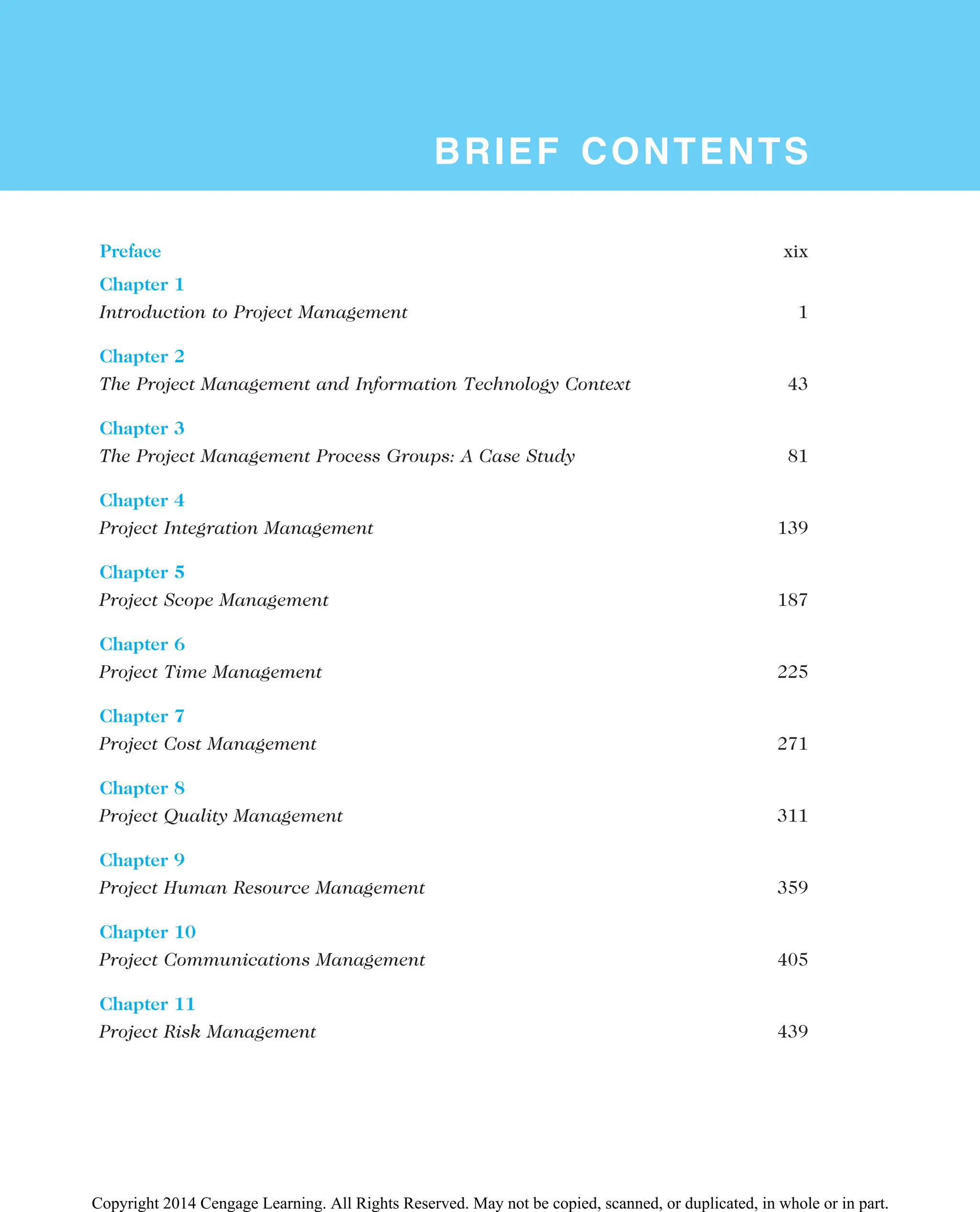
BRIEF CONTENTS
Preface xix
Chapter 1
Introduction to Project Management 1
Chapter 2
The Project Management and Information Technology Context 43
Chapter 3
The Project Management Process Groups: A Case Study 81
Chapter 4
Project Integration Management 139
Chapter 5
Project Scope Management 187
Chapter 6
Project Time Management 225
Chapter 7
Project Cost Management 271
Chapter 8
Project Quality Management 311
Chapter 9
Project Human Resource Management 359
Chapter 10
Project Communications Management 405
Chapter 11
Project Risk Management 439
Copyright 2014 Cengage Learning. All Rights Reserved. May not be copied, scanned, or duplicated, in whole or in part.
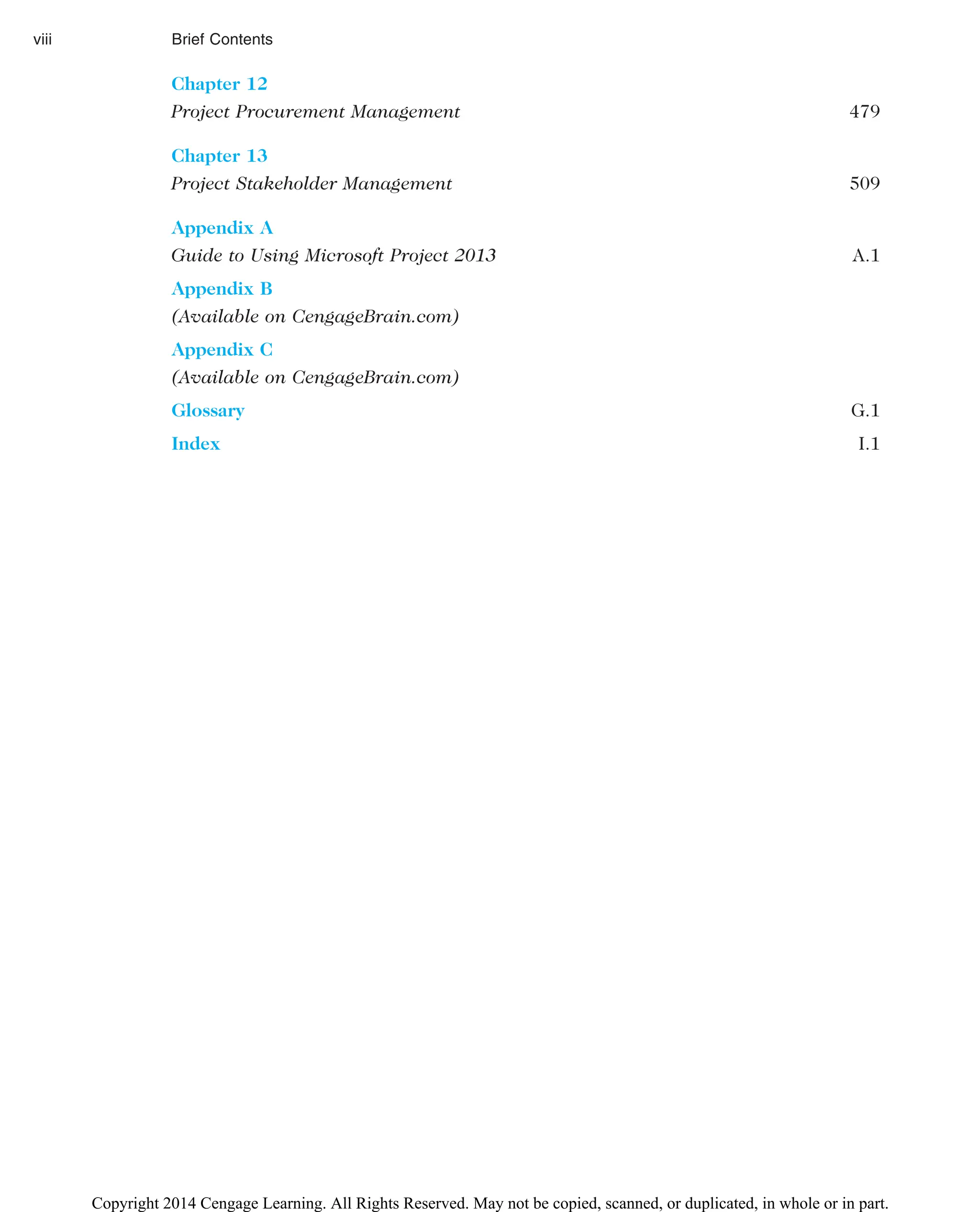
Chapter 12
Project Procurement Management 479
Chapter 13
Project Stakeholder Management 509
Appendix A
Guide to Using Microsoft Project 2013 A.1
Appendix B
(Available on CengageBrain.com)
Appendix C
(Available on CengageBrain.com)
Glossary G.1
Index I.1
viii Brief Contents
Copyright 2014 Cengage Learning. All Rights Reserved. May not be copied, scanned, or duplicated, in whole or in part.
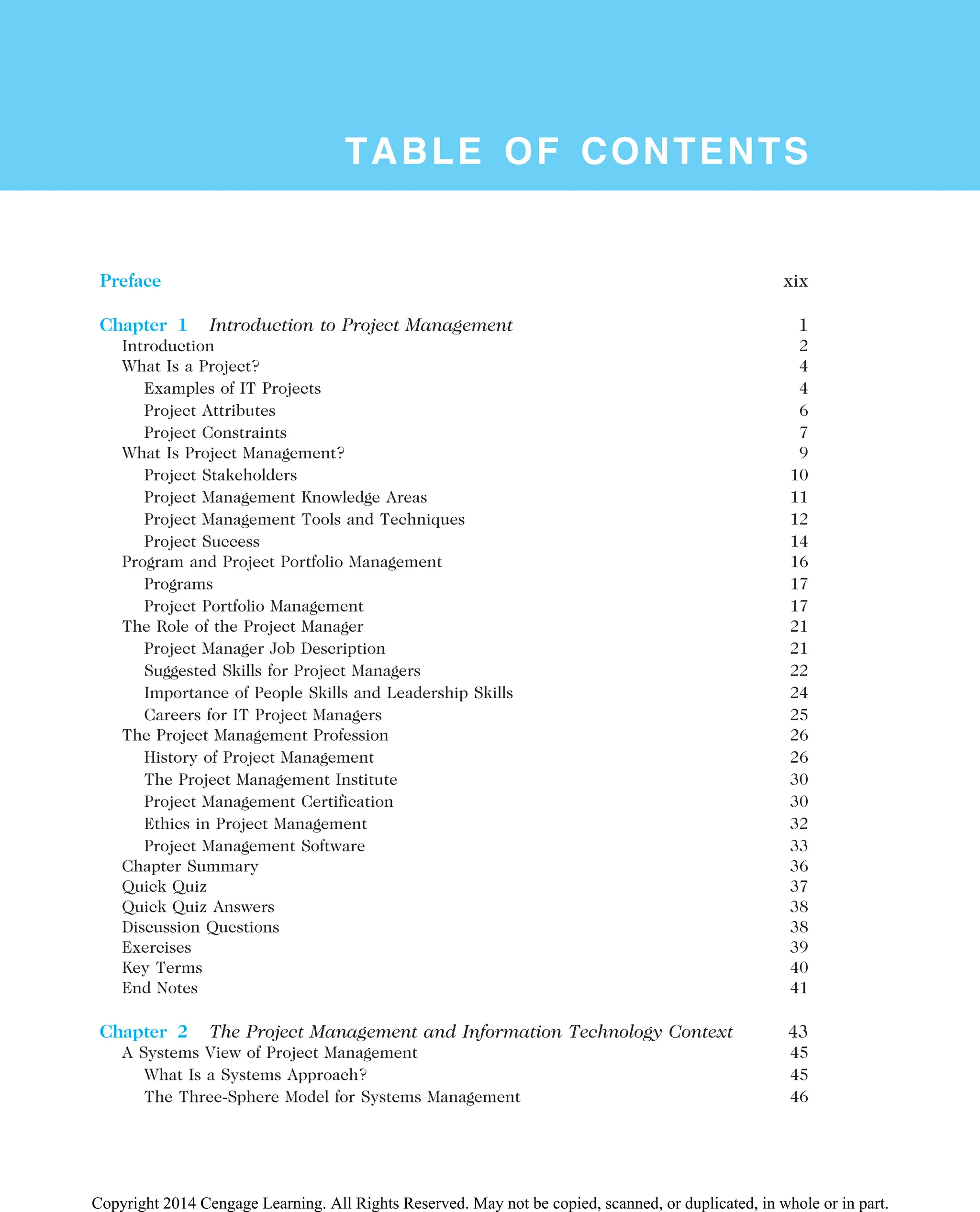
TABLE OF CONTENTS
Preface xix
Chapter 1 Introduction to Project Management 1
Introduction 2
What Is a Project? 4
Examples of IT Projects 4
Project Attributes 6
Project Constraints 7
What Is Project Management? 9
Project Stakeholders 10
Project Management Knowledge Areas 11
Project Management Tools and Techniques 12
Project Success 14
Program and Project Portfolio Management 16
Programs 17
Project Portfolio Management 17
The Role of the Project Manager 21
Project Manager Job Description 21
Suggested Skills for Project Managers 22
Importance of People Skills and Leadership Skills 24
Careers for IT Project Managers 25
The Project Management Profession 26
History of Project Management 26
The Project Management Institute 30
Project Management Certification 30
Ethics in Project Management 32
Project Management Software 33
Chapter Summary 36
Quick Quiz 37
Quick Quiz Answers 38
Discussion Questions 38
Exercises 39
Key Terms 40
End Notes 41
Chapter 2 The Project Management and Information Technology Context 43
A Systems View of Project Management 45
What Is a Systems Approach? 45
The Three-Sphere Model for Systems Management 46
Copyright 2014 Cengage Learning. All Rights Reserved. May not be copied, scanned, or duplicated, in whole or in part.
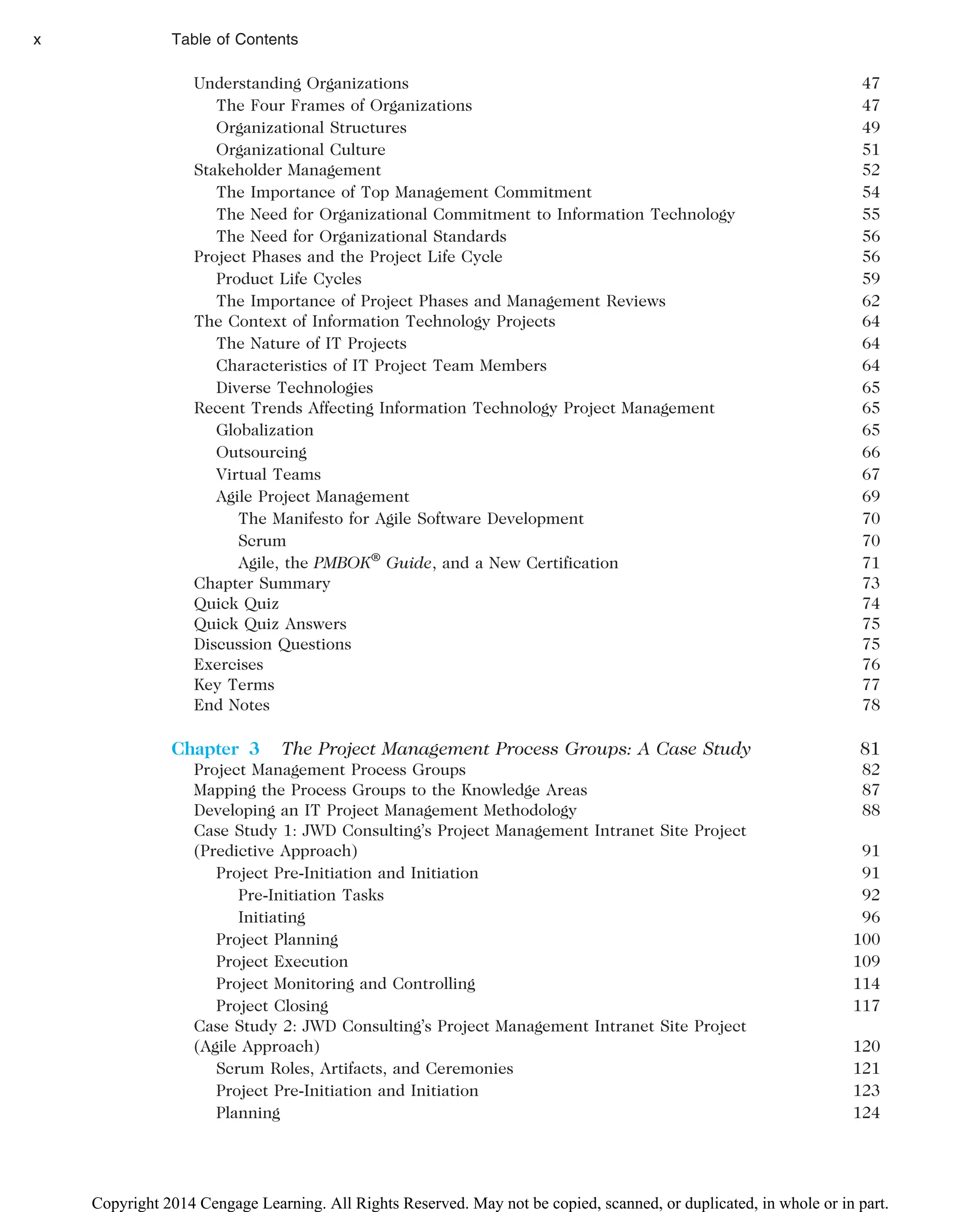
Understanding Organizations 47
The Four Frames of Organizations 47
Organizational Structures 49
Organizational Culture 51
Stakeholder Management 52
The Importance of Top Management Commitment 54
The Need for Organizational Commitment to Information Technology 55
The Need for Organizational Standards 56
Project Phases and the Project Life Cycle 56
Product Life Cycles 59
The Importance of Project Phases and Management Reviews 62
The Context of Information Technology Projects 64
The Nature of IT Projects 64
Characteristics of IT Project Team Members 64
Diverse Technologies 65
Recent Trends Affecting Information Technology Project Management 65
Globalization 65
Outsourcing 66
Virtual Teams 67
Agile Project Management 69
The Manifesto for Agile Software Development 70
Scrum 70
Agile, the PMBOK®
Guide, and a New Certification 71
Chapter Summary 73
Quick Quiz 74
Quick Quiz Answers 75
Discussion Questions 75
Exercises 76
Key Terms 77
End Notes 78
Chapter 3 The Project Management Process Groups: A Case Study 81
Project Management Process Groups 82
Mapping the Process Groups to the Knowledge Areas 87
Developing an IT Project Management Methodology 88
Case Study 1: JWD Consulting’s Project Management Intranet Site Project
(Predictive Approach) 91
Project Pre-Initiation and Initiation 91
Pre-Initiation Tasks 92
Initiating 96
Project Planning 100
Project Execution 109
Project Monitoring and Controlling 114
Project Closing 117
Case Study 2: JWD Consulting’s Project Management Intranet Site Project
(Agile Approach) 120
Scrum Roles, Artifacts, and Ceremonies 121
Project Pre-Initiation and Initiation 123
Planning 124
x Table of Contents
Copyright 2014 Cengage Learning. All Rights Reserved. May not be copied, scanned, or duplicated, in whole or in part.
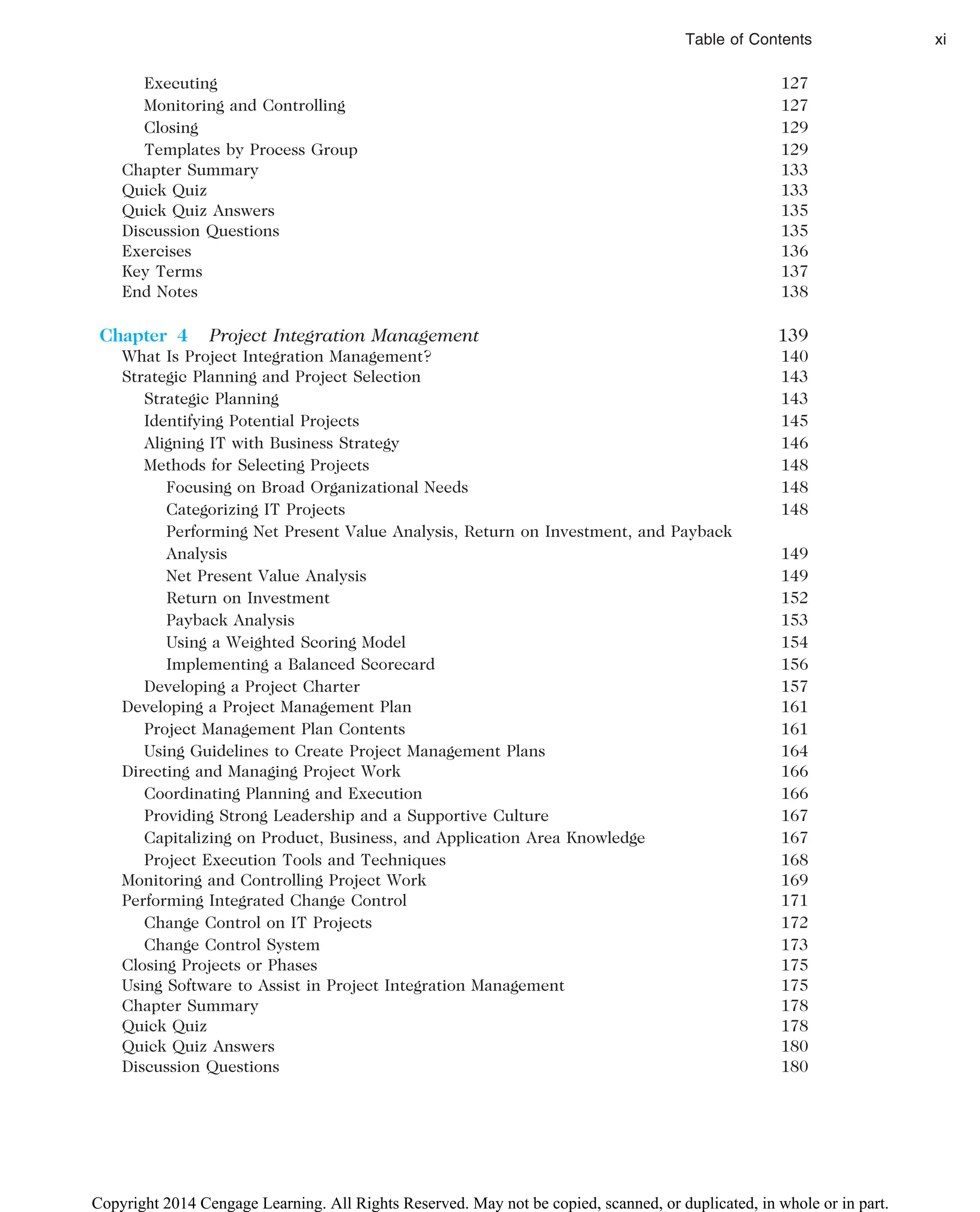
Executing 127
Monitoring and Controlling 127
Closing 129
Templates by Process Group 129
Chapter Summary 133
Quick Quiz 133
Quick Quiz Answers 135
Discussion Questions 135
Exercises 136
Key Terms 137
End Notes 138
Chapter 4 Project Integration Management 139
What Is Project Integration Management? 140
Strategic Planning and Project Selection 143
Strategic Planning 143
Identifying Potential Projects 145
Aligning IT with Business Strategy 146
Methods for Selecting Projects 148
Focusing on Broad Organizational Needs 148
Categorizing IT Projects 148
Performing Net Present Value Analysis, Return on Investment, and Payback
Analysis 149
Net Present Value Analysis 149
Return on Investment 152
Payback Analysis 153
Using a Weighted Scoring Model 154
Implementing a Balanced Scorecard 156
Developing a Project Charter 157
Developing a Project Management Plan 161
Project Management Plan Contents 161
Using Guidelines to Create Project Management Plans 164
Directing and Managing Project Work 166
Coordinating Planning and Execution 166
Providing Strong Leadership and a Supportive Culture 167
Capitalizing on Product, Business, and Application Area Knowledge 167
Project Execution Tools and Techniques 168
Monitoring and Controlling Project Work 169
Performing Integrated Change Control 171
Change Control on IT Projects 172
Change Control System 173
Closing Projects or Phases 175
Using Software to Assist in Project Integration Management 175
Chapter Summary 178
Quick Quiz 178
Quick Quiz Answers 180
Discussion Questions 180
Table of Contents xi
Copyright 2014 Cengage Learning. All Rights Reserved. May not be copied, scanned, or duplicated, in whole or in part.
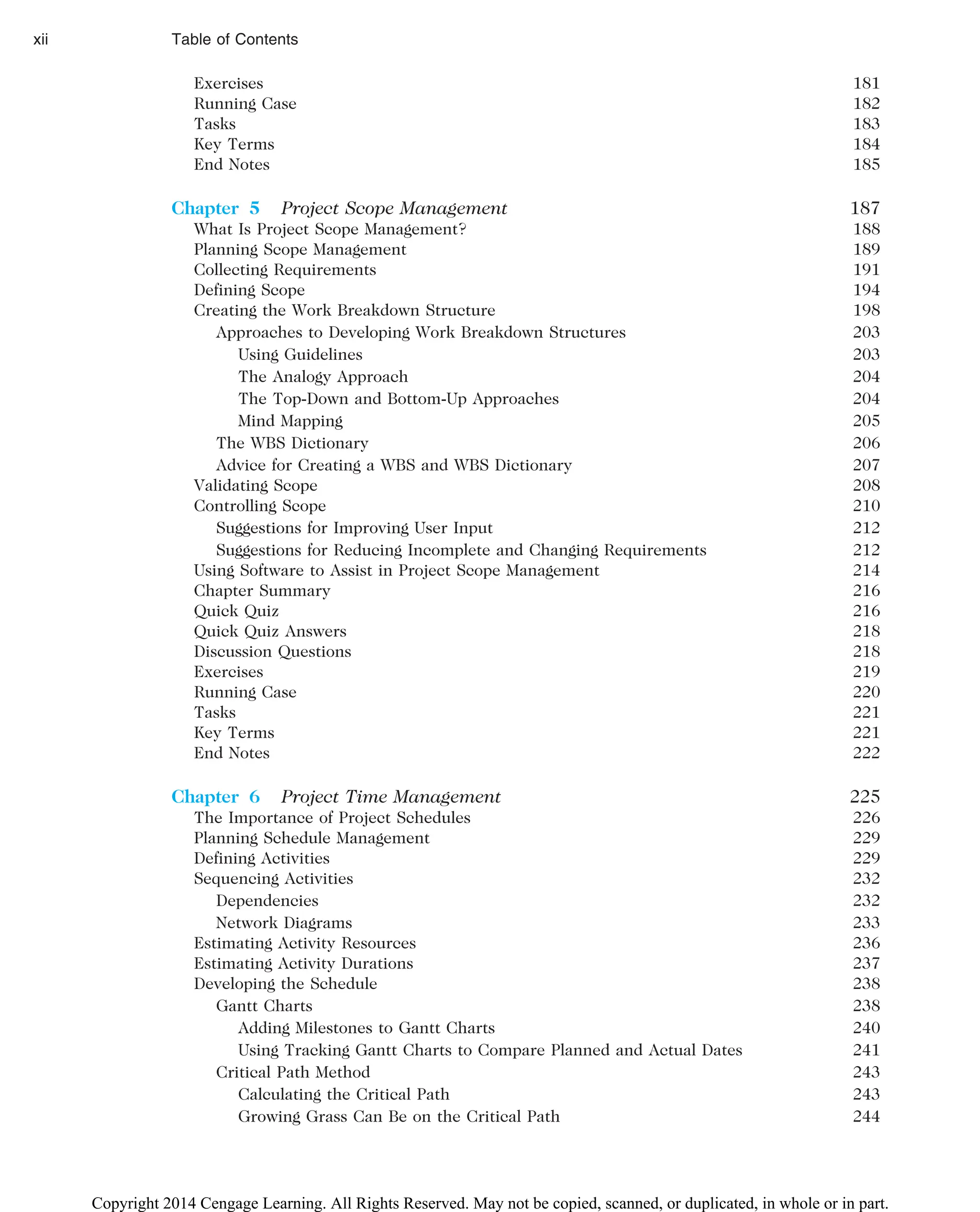
Exercises 181
Running Case 182
Tasks 183
Key Terms 184
End Notes 185
Chapter 5 Project Scope Management 187
What Is Project Scope Management? 188
Planning Scope Management 189
Collecting Requirements 191
Defining Scope 194
Creating the Work Breakdown Structure 198
Approaches to Developing Work Breakdown Structures 203
Using Guidelines 203
The Analogy Approach 204
The Top-Down and Bottom-Up Approaches 204
Mind Mapping 205
The WBS Dictionary 206
Advice for Creating a WBS and WBS Dictionary 207
Validating Scope 208
Controlling Scope 210
Suggestions for Improving User Input 212
Suggestions for Reducing Incomplete and Changing Requirements 212
Using Software to Assist in Project Scope Management 214
Chapter Summary 216
Quick Quiz 216
Quick Quiz Answers 218
Discussion Questions 218
Exercises 219
Running Case 220
Tasks 221
Key Terms 221
End Notes 222
Chapter 6 Project Time Management 225
The Importance of Project Schedules 226
Planning Schedule Management 229
Defining Activities 229
Sequencing Activities 232
Dependencies 232
Network Diagrams 233
Estimating Activity Resources 236
Estimating Activity Durations 237
Developing the Schedule 238
Gantt Charts 238
Adding Milestones to Gantt Charts 240
Using Tracking Gantt Charts to Compare Planned and Actual Dates 241
Critical Path Method 243
Calculating the Critical Path 243
Growing Grass Can Be on the Critical Path 244
xii Table of Contents
Copyright 2014 Cengage Learning. All Rights Reserved. May not be copied, scanned, or duplicated, in whole or in part.
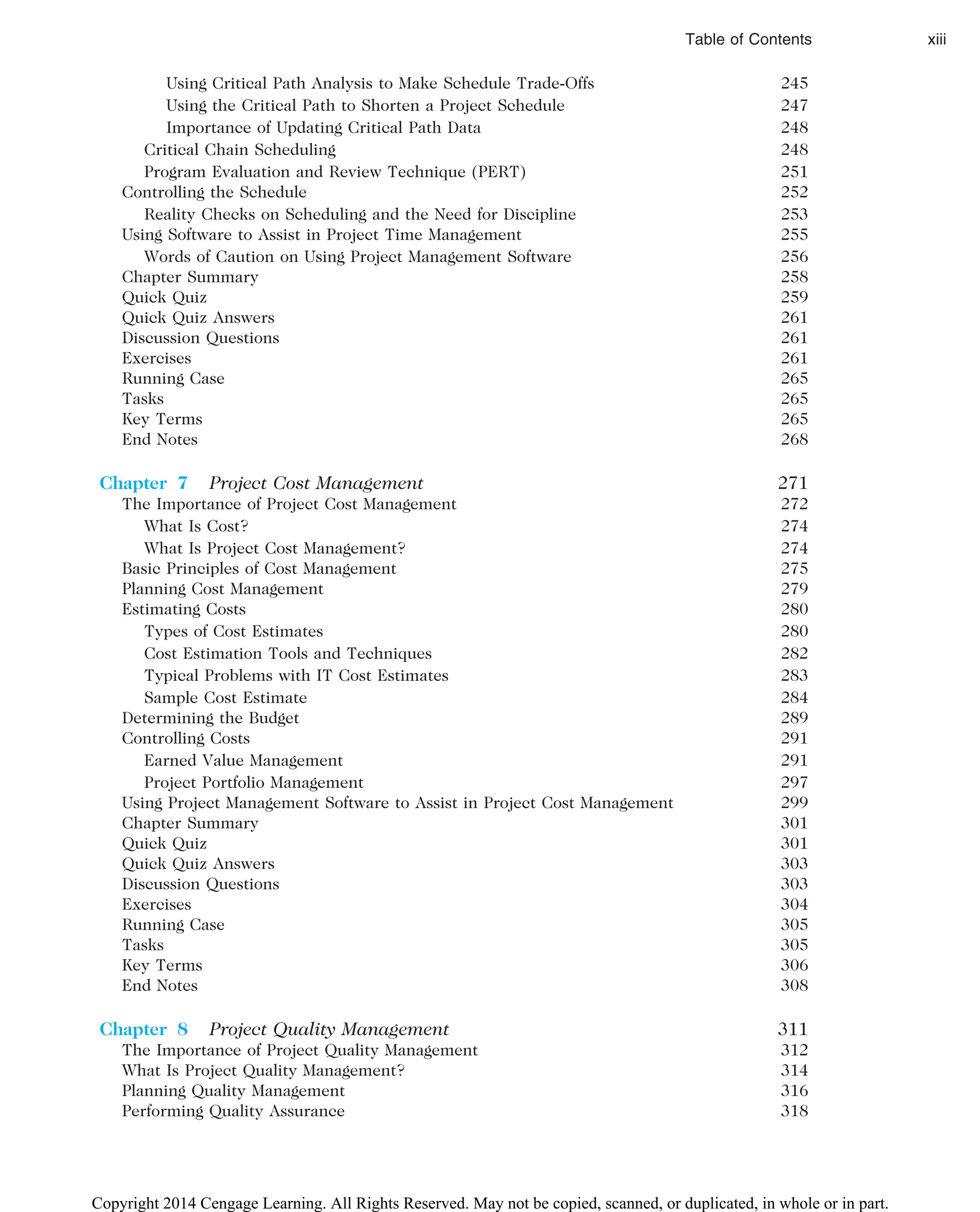
Using Critical Path Analysis to Make Schedule Trade-Offs 245
Using the Critical Path to Shorten a Project Schedule 247
Importance of Updating Critical Path Data 248
Critical Chain Scheduling 248
Program Evaluation and Review Technique (PERT) 251
Controlling the Schedule 252
Reality Checks on Scheduling and the Need for Discipline 253
Using Software to Assist in Project Time Management 255
Words of Caution on Using Project Management Software 256
Chapter Summary 258
Quick Quiz 259
Quick Quiz Answers 261
Discussion Questions 261
Exercises 261
Running Case 265
Tasks 265
Key Terms 265
End Notes 268
Chapter 7 Project Cost Management 271
The Importance of Project Cost Management 272
What Is Cost? 274
What Is Project Cost Management? 274
Basic Principles of Cost Management 275
Planning Cost Management 279
Estimating Costs 280
Types of Cost Estimates 280
Cost Estimation Tools and Techniques 282
Typical Problems with IT Cost Estimates 283
Sample Cost Estimate 284
Determining the Budget 289
Controlling Costs 291
Earned Value Management 291
Project Portfolio Management 297
Using Project Management Software to Assist in Project Cost Management 299
Chapter Summary 301
Quick Quiz 301
Quick Quiz Answers 303
Discussion Questions 303
Exercises 304
Running Case 305
Tasks 305
Key Terms 306
End Notes 308
Chapter 8 Project Quality Management 311
The Importance of Project Quality Management 312
What Is Project Quality Management? 314
Planning Quality Management 316
Performing Quality Assurance 318
Table of Contents xiii
Copyright 2014 Cengage Learning. All Rights Reserved. May not be copied, scanned, or duplicated, in whole or in part.
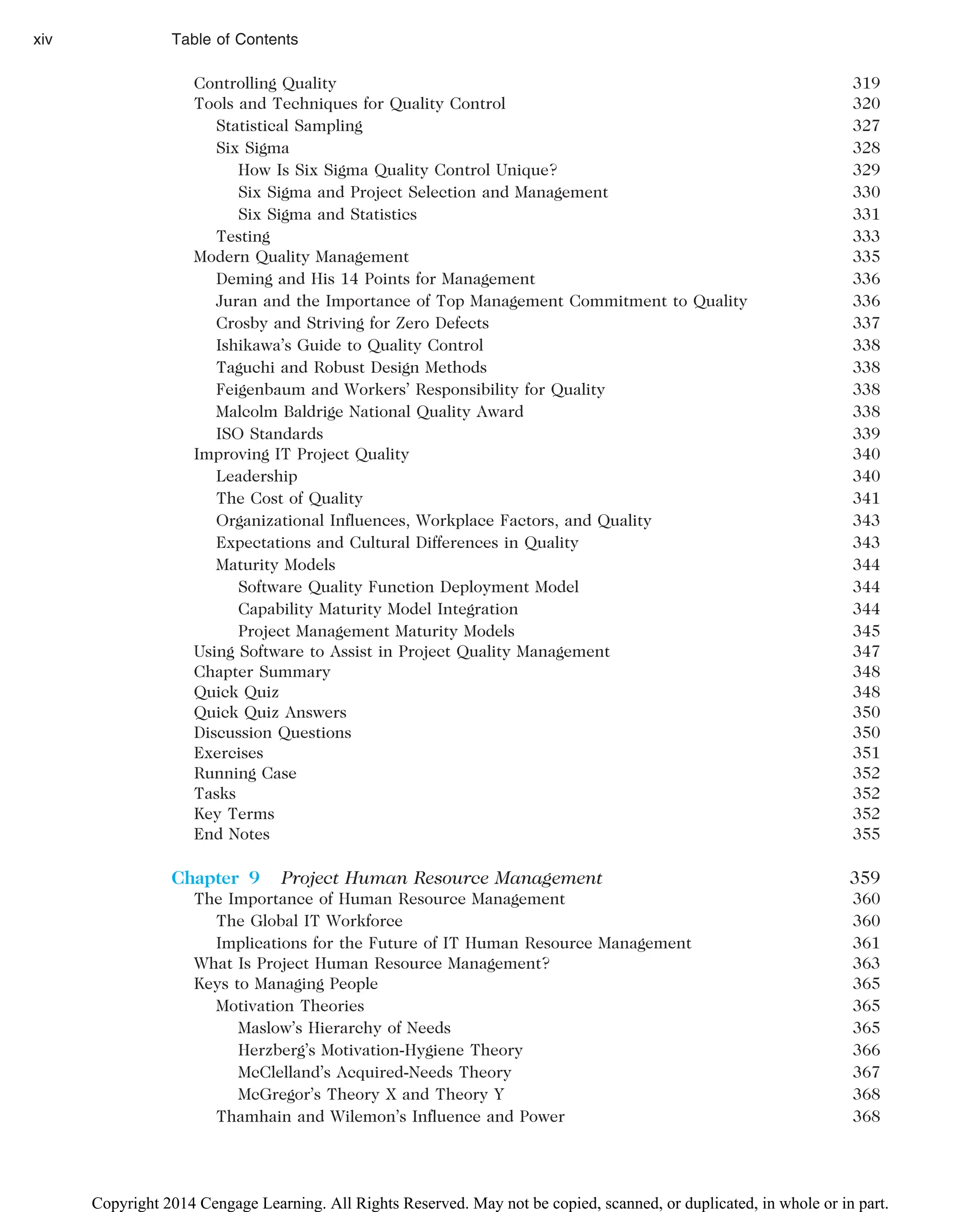
Controlling Quality 319
Tools and Techniques for Quality Control 320
Statistical Sampling 327
Six Sigma 328
How Is Six Sigma Quality Control Unique? 329
Six Sigma and Project Selection and Management 330
Six Sigma and Statistics 331
Testing 333
Modern Quality Management 335
Deming and His 14 Points for Management 336
Juran and the Importance of Top Management Commitment to Quality 336
Crosby and Striving for Zero Defects 337
Ishikawa’s Guide to Quality Control 338
Taguchi and Robust Design Methods 338
Feigenbaum and Workers’ Responsibility for Quality 338
Malcolm Baldrige National Quality Award 338
ISO Standards 339
Improving IT Project Quality 340
Leadership 340
The Cost of Quality 341
Organizational Influences, Workplace Factors, and Quality 343
Expectations and Cultural Differences in Quality 343
Maturity Models 344
Software Quality Function Deployment Model 344
Capability Maturity Model Integration 344
Project Management Maturity Models 345
Using Software to Assist in Project Quality Management 347
Chapter Summary 348
Quick Quiz 348
Quick Quiz Answers 350
Discussion Questions 350
Exercises 351
Running Case 352
Tasks 352
Key Terms 352
End Notes 355
Chapter 9 Project Human Resource Management 359
The Importance of Human Resource Management 360
The Global IT Workforce 360
Implications for the Future of IT Human Resource Management 361
What Is Project Human Resource Management? 363
Keys to Managing People 365
Motivation Theories 365
Maslow’s Hierarchy of Needs 365
Herzberg’s Motivation-Hygiene Theory 366
McClelland’s Acquired-Needs Theory 367
McGregor’s Theory X and Theory Y 368
Thamhain and Wilemon’s Influence and Power 368
xiv Table of Contents
Copyright 2014 Cengage Learning. All Rights Reserved. May not be copied, scanned, or duplicated, in whole or in part.
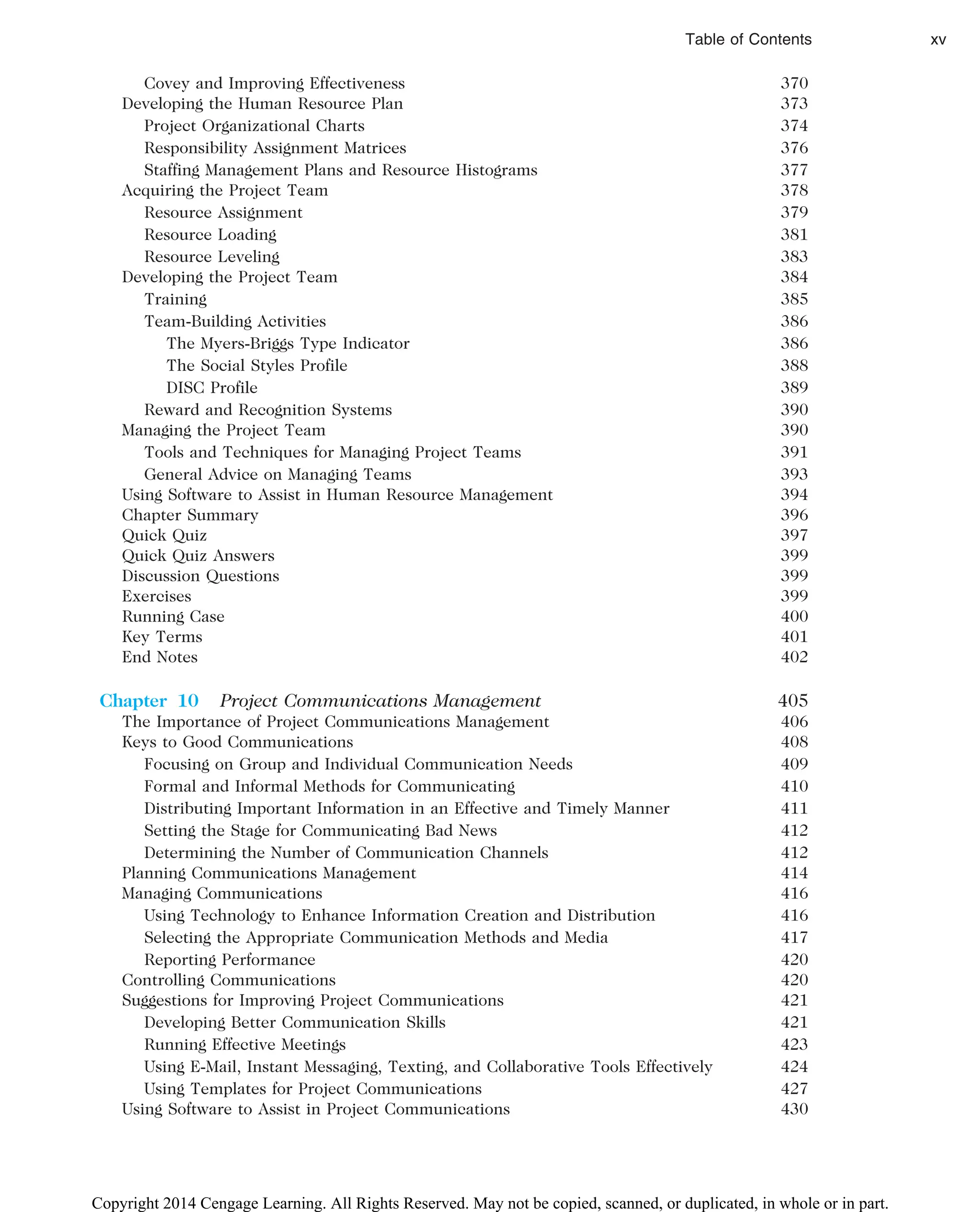
Covey and Improving Effectiveness 370
Developing the Human Resource Plan 373
Project Organizational Charts 374
Responsibility Assignment Matrices 376
Staffing Management Plans and Resource Histograms 377
Acquiring the Project Team 378
Resource Assignment 379
Resource Loading 381
Resource Leveling 383
Developing the Project Team 384
Training 385
Team-Building Activities 386
The Myers-Briggs Type Indicator 386
The Social Styles Profile 388
DISC Profile 389
Reward and Recognition Systems 390
Managing the Project Team 390
Tools and Techniques for Managing Project Teams 391
General Advice on Managing Teams 393
Using Software to Assist in Human Resource Management 394
Chapter Summary 396
Quick Quiz 397
Quick Quiz Answers 399
Discussion Questions 399
Exercises 399
Running Case 400
Key Terms 401
End Notes 402
Chapter 10 Project Communications Management 405
The Importance of Project Communications Management 406
Keys to Good Communications 408
Focusing on Group and Individual Communication Needs 409
Formal and Informal Methods for Communicating 410
Distributing Important Information in an Effective and Timely Manner 411
Setting the Stage for Communicating Bad News 412
Determining the Number of Communication Channels 412
Planning Communications Management 414
Managing Communications 416
Using Technology to Enhance Information Creation and Distribution 416
Selecting the Appropriate Communication Methods and Media 417
Reporting Performance 420
Controlling Communications 420
Suggestions for Improving Project Communications 421
Developing Better Communication Skills 421
Running Effective Meetings 423
Using E-Mail, Instant Messaging, Texting, and Collaborative Tools Effectively 424
Using Templates for Project Communications 427
Using Software to Assist in Project Communications 430
Table of Contents xv
Copyright 2014 Cengage Learning. All Rights Reserved. May not be copied, scanned, or duplicated, in whole or in part.
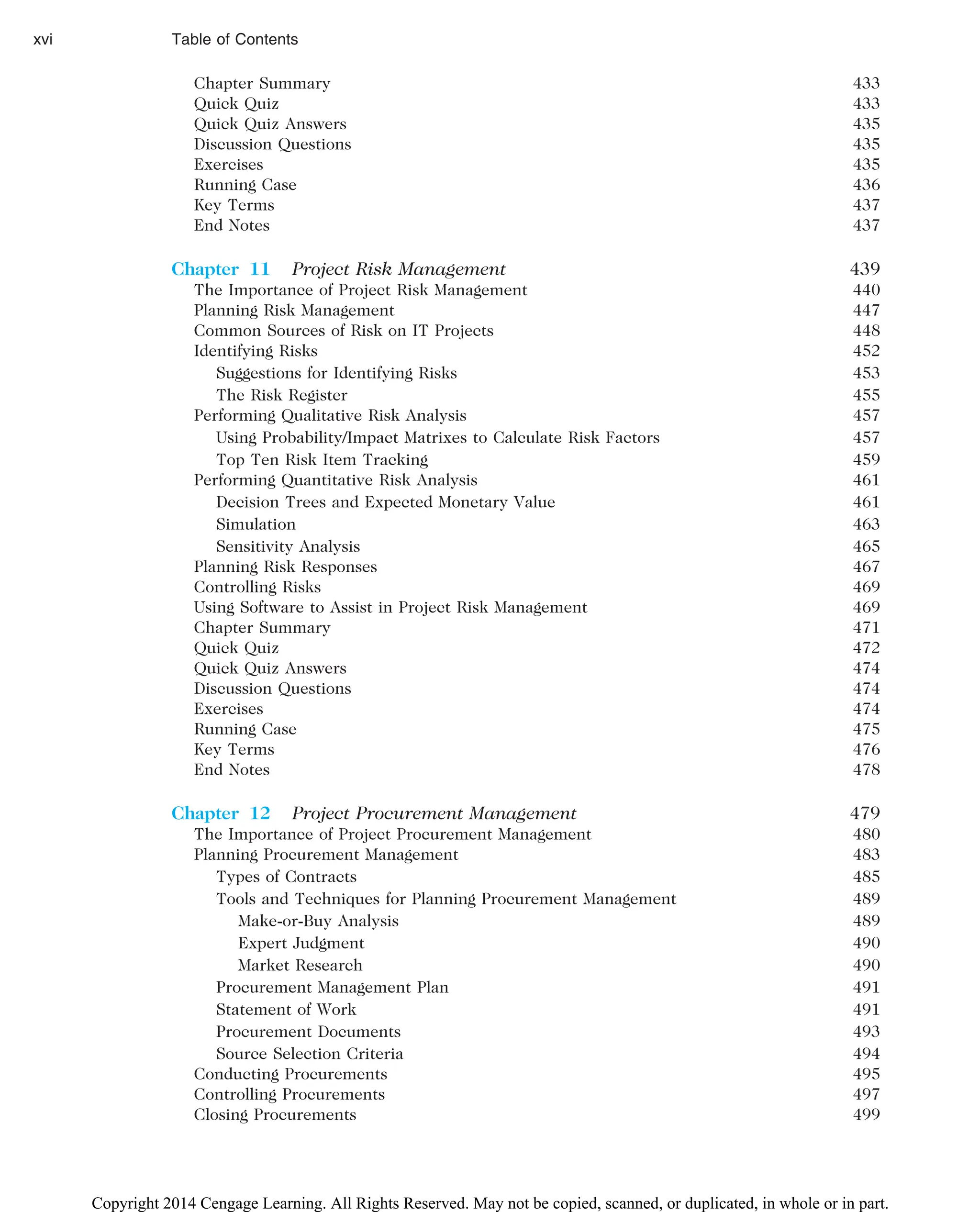
Chapter Summary 433
Quick Quiz 433
Quick Quiz Answers 435
Discussion Questions 435
Exercises 435
Running Case 436
Key Terms 437
End Notes 437
Chapter 11 Project Risk Management 439
The Importance of Project Risk Management 440
Planning Risk Management 447
Common Sources of Risk on IT Projects 448
Identifying Risks 452
Suggestions for Identifying Risks 453
The Risk Register 455
Performing Qualitative Risk Analysis 457
Using Probability/Impact Matrixes to Calculate Risk Factors 457
Top Ten Risk Item Tracking 459
Performing Quantitative Risk Analysis 461
Decision Trees and Expected Monetary Value 461
Simulation 463
Sensitivity Analysis 465
Planning Risk Responses 467
Controlling Risks 469
Using Software to Assist in Project Risk Management 469
Chapter Summary 471
Quick Quiz 472
Quick Quiz Answers 474
Discussion Questions 474
Exercises 474
Running Case 475
Key Terms 476
End Notes 478
Chapter 12 Project Procurement Management 479
The Importance of Project Procurement Management 480
Planning Procurement Management 483
Types of Contracts 485
Tools and Techniques for Planning Procurement Management 489
Make-or-Buy Analysis 489
Expert Judgment 490
Market Research 490
Procurement Management Plan 491
Statement of Work 491
Procurement Documents 493
Source Selection Criteria 494
Conducting Procurements 495
Controlling Procurements 497
Closing Procurements 499
xvi Table of Contents
Copyright 2014 Cengage Learning. All Rights Reserved. May not be copied, scanned, or duplicated, in whole or in part.
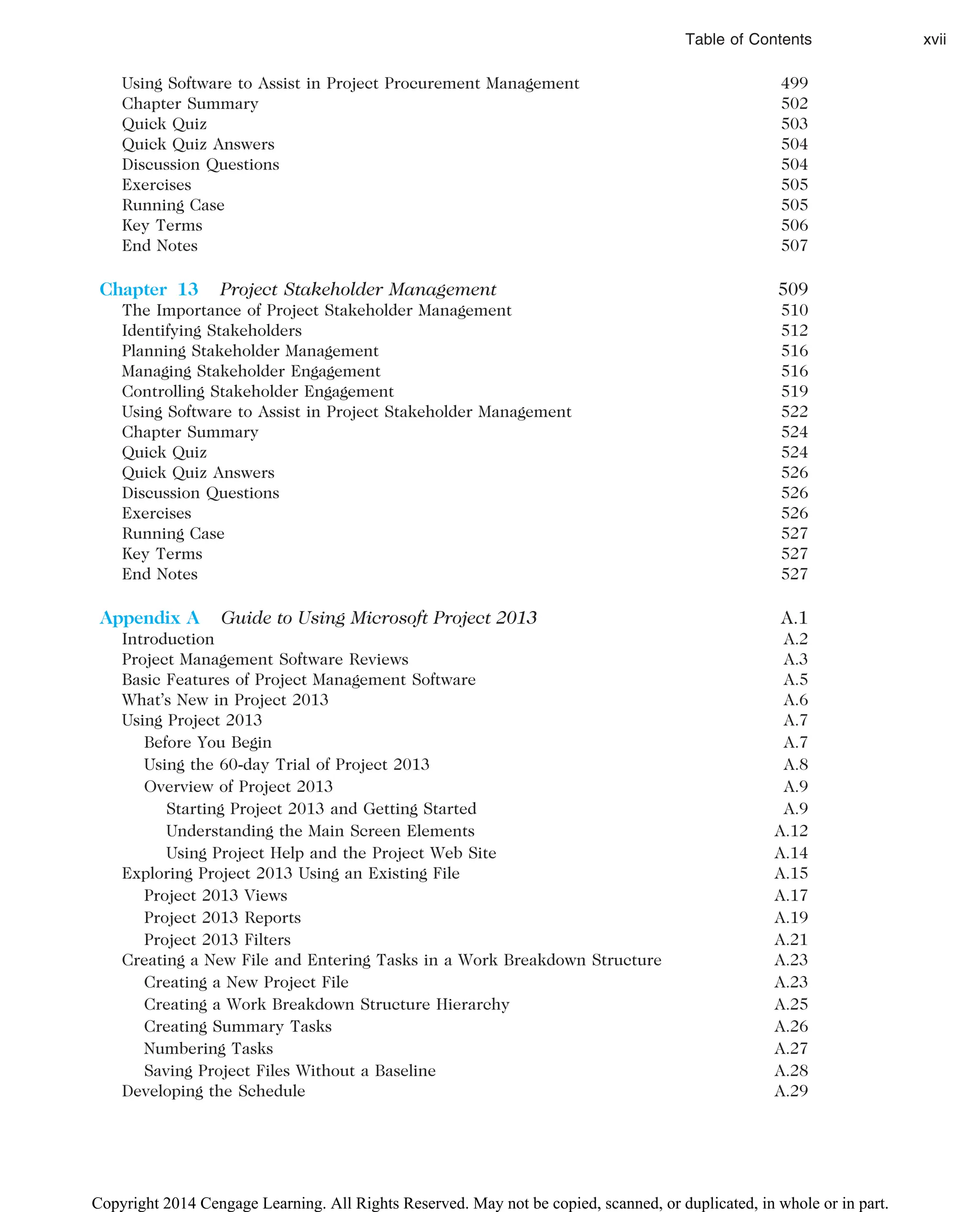
Using Software to Assist in Project Procurement Management 499
Chapter Summary 502
Quick Quiz 503
Quick Quiz Answers 504
Discussion Questions 504
Exercises 505
Running Case 505
Key Terms 506
End Notes 507
Chapter 13 Project Stakeholder Management 509
The Importance of Project Stakeholder Management 510
Identifying Stakeholders 512
Planning Stakeholder Management 516
Managing Stakeholder Engagement 516
Controlling Stakeholder Engagement 519
Using Software to Assist in Project Stakeholder Management 522
Chapter Summary 524
Quick Quiz 524
Quick Quiz Answers 526
Discussion Questions 526
Exercises 526
Running Case 527
Key Terms 527
End Notes 527
Appendix A Guide to Using Microsoft Project 2013 A.1
Introduction A.2
Project Management Software Reviews A.3
Basic Features of Project Management Software A.5
What’s New in Project 2013 A.6
Using Project 2013 A.7
Before You Begin A.7
Using the 60-day Trial of Project 2013 A.8
Overview of Project 2013 A.9
Starting Project 2013 and Getting Started A.9
Understanding the Main Screen Elements A.12
Using Project Help and the Project Web Site A.14
Exploring Project 2013 Using an Existing File A.15
Project 2013 Views A.17
Project 2013 Reports A.19
Project 2013 Filters A.21
Creating a New File and Entering Tasks in a Work Breakdown Structure A.23
Creating a New Project File A.23
Creating a Work Breakdown Structure Hierarchy A.25
Creating Summary Tasks A.26
Numbering Tasks A.27
Saving Project Files Without a Baseline A.28
Developing the Schedule A.29
Table of Contents xvii
Copyright 2014 Cengage Learning. All Rights Reserved. May not be copied, scanned, or duplicated, in whole or in part.
Calendars A.29
Entering Task Durations A.31
Manual and Automatic Scheduling A.31
Duration Units and Guidelines for Entering Durations A.32
Entering Task Durations A.34
Establishing Task Dependencies A.38
Gantt Charts, Network Diagrams, and Critical Path Analysis A.43
Project Cost and Resource Management A.46
Entering Fixed and Variable Cost Estimates A.46
Entering Fixed Costs in the Cost Table A.47
Entering Resource Information and Cost Estimates A.47
Using the Team Planner Feature A.51
Entering Baseline Plans, Actual Costs, and Actual Times A.52
Viewing Earned Value Management Data A.56
Integrating Project 2013 with Other Applications and Apps for Office A.57
Copying Information Between Applications A.57
Creating Hyperlinks to Other Files A.59
Using Project 2013 Apps A.60
Discussion Questions A.63
Exercises A.63
End Notes A.64
Appendix B
(Available on CengageBrain.com)
Appendix C
(Available on CengageBrain.com)
Glossary G.1
Index I.1
xviii Table of Contents
Copyright 2014 Cengage Learning. All Rights Reserved. May not be copied, scanned, or duplicated, in whole or in part.
PREFACE
The future of many organizations depends on their ability to harness the power of
information technology, and good project managers continue to be in high demand.
Colleges have responded to this need by establishing courses in project management
and making them part of the information technology, management, engineering, and
other curricula. Corporations are investing in continuing education to help develop
effective project managers and project teams. This text provides a much-needed
framework for teaching courses in project management, especially those that
emphasize managing information technology projects. The first six editions of this
text were extremely well received by people in academia and the workplace. The
Seventh Edition builds on the strengths of the previous editions and adds new,
important information and features.
It’s impossible to read a newspaper, magazine, or Web page without hearing about
the impact of information technology on our society. Information is traveling faster
and being shared by more people than ever before. You can buy just about anything
online, surf the Web on a mobile phone, or use a wireless Internet connection at your
local coffee shop. Companies have linked their systems together to help them fill
orders on time and better serve their customers. Software companies are continually
developing new products to help streamline our work and get better results. When
technology works well, it is almost invisible. But did it ever occur to you to ask,
“Who makes these complex technologies and systems happen?”
Because you’re reading this text, you must have an interest in the “behind-the-
scenes” aspects of technology. If I’ve done my job well, you’ll begin to see the many
innovations society is currently enjoying as the result of thousands of successful
information technology projects. In this text, you’ll read about IT projects around the
world that went well, including Mittal Steel Poland’s Implementation of SAP that uni-
fied IT systems to improve business and financial processes; Dell Earth and other
green computing projects that save energy and millions of dollars; Six Sigma projects
such as the project to improve case load management at Baptist St. Anthony’s
Hospital in Amarillo, Texas; the systems infrastructure project at the Boots Company
in the United Kingdom that takes advantage of supplier competition to cut costs and
improve services; and many more. Of course, not all projects are successful. Factors
such as time, money, and unrealistic expectations, among many others, can sabotage
a promising effort if it is not properly managed. In this text, you’ll also learn from the
mistakes made on many projects that were not successful. I have written this book in
an effort to educate you, tomorrow’s project managers, about what will help make a
project succeed—and what can make it fail. You’ll also see how projects are used in
everyday media, such as television and film, and how companies use best practices in
project management. Many readers tell me how much they enjoy reading these real-
world examples in the What Went Right?, What Went Wrong?, Media Snapshot, and
Best Practice features. As practitioners know, there is no “one size fits all” solution to
Copyright 2014 Cengage Learning. All Rights Reserved. May not be copied, scanned, or duplicated, in whole or in part.
managing projects. By seeing how different organizations successfully implement
project management, you can help your organization do the same.
Although project management has been an established field for many years,
managing information technology projects requires ideas and information that go
beyond standard project management. For example, many information technology
projects fail because of a lack of user input, incomplete and changing requirements,
and a lack of executive support. This book includes suggestions for dealing with these
issues. New technologies can also aid in managing information technology projects,
and examples of using software to assist in project management are included
throughout the book.
Information Technology Project Management, REVISED Seventh Edition, is the
only textbook to apply all 10 project management knowledge areas and all five pro-
cess groups to information technology projects. As you will learn, the project man-
agement knowledge areas are project integration, scope, time, cost, quality, human
resource, communications, risk, procurement, and stakeholder management. The
five process groups are initiating, planning, executing, monitoring and controlling,
and closing.
This text builds on the PMBOK® Guide, Fifth Edition, an American National
Standard, to provide a solid framework and context for managing information tech-
nology projects. It also includes an appendix, Guide to Using Microsoft Project 2013,
that many readers find invaluable. A second appendix provides advice on earning and
maintaining Project Management Professional (PMP) certification from the Project
Management Institute (PMI) as well as information on other certification programs,
such as CompTIA’s Project certification. A third appendix provides additional case
studies and information on using simulation and mind-mapping software to help
readers apply their project management skills.
Information Technology Project Management, REVISED Seventh Edition, pro-
vides practical lessons in project management for students and practitioners alike. By
weaving together theory and practice, this text presents an understandable, integrated
view of the many concepts, skills, tools, and techniques of information technology
project management. The comprehensive design of the text provides a strong founda-
tion for students and practitioners in project management.
N E W T O T H E R E V I S E D S E V E N T H E D I T I O N
Building on the success of the previous editions, Information Technology Project
Management, REVISED Seventh Edition, introduces a uniquely effective combination
of features. The main changes in the Seventh Edition include the following:
• The key update for the REVISED Seventh Edition is that Appendix A has
been updated for Microsoft Project 2013.
• Several changes were made to synchronize the Seventh Edition with the
PMBOK® Guide, Fifth Edition. Changes were made based on the exposure
draft released in February 2012. The biggest change was the addition of a
tenth knowledge area, Project Stakeholder Management. This text includes a
new chapter to address this important topic.
• Includes additional information on agile project management. Chapter 2
includes general information on this popular concept, and Chapter 3 provides
a second case study illustrating the outputs produced for the JWD Consulting
xx Preface
Copyright 2014 Cengage Learning. All Rights Reserved. May not be copied, scanned, or duplicated, in whole or in part.
project when using an agile approach. For example, you can see a sample
product backlog, a sprint backlog, a burndown chart, and key artifacts or
outputs produced when using Scrum, the most popular agile method.
• Appendix C, Additional Cases and Software, provides information about using
several simulation software tools. Several suppliers offer discounts to users of this
text. A new section provides instructions for accessing a special 60-day trial of
MindView Business software. This software provides the capability to create mind
maps, a powerful tool for creating a SWOT analysis or work breakdown structure.
The software also allows users to convert a mind map into a Gantt chart.
• A new feature, Global Issues, provides examples of how project management
concepts and practices affect people around the globe.
• Updated examples are provided throughout the text. You’ll notice several new
examples in the Seventh Edition that explain recent events in managing real
information technology projects. Several of the What Went Right?, What
Went Wrong?, Media Snapshot, and Best Practice examples have been
updated to keep you current. Additional examples and results of new studies
are included throughout the text, with appropriate citations.
• User feedback is incorporated. Based on feedback from reviewers, students,
instructors, practitioners, and translators, you’ll see several additional
changes to help clarify information. (This book has been translated into
Chinese, Japanese, Russian, and Czech.)
• A new CourseMate site for the Seventh Edition (www.cengagebrain.com)
provides access to informative links from the end notes, lecture notes, inter-
active quizzes, templates, additional running cases, suggested readings, and
many other items to enhance your learning.
A C C E S S I N G T H E C O U R S E M A T E S I T E
To access the CourseMate site, open a Web browser and go to www.cengage
brain.com. Search by ISBN, author name, or title, and click Create My Account
to begin the registration process.
A P P R O A C H
Many people have been practicing some form of project management with little or no for-
mal study in this area. New books and articles are written each year as we discover more
about the field of project management, and project management software continues to
advance. Because the project management field and the technology industry change
rapidly, you cannot assume that what worked even a few years ago is still the best
approach today. This text provides up-to-date information on how good project manage-
ment and effective use of software can help you manage projects, especially information
technology projects. Six distinct features of this text include its relationship to the Project
Management Body of Knowledge, its detailed guide for using Microsoft Project 2013, its
value in preparing for Project Management Professional and other certification exams, its
inclusion of running case studies and online templates, its companion (premium) Web
site, and its inclusion of a 60-day trial of MindView Business software.
Preface xxi
Copyright 2014 Cengage Learning. All Rights Reserved. May not be copied, scanned, or duplicated, in whole or in part.
Based on PMBOK®
Guide, Fifth Edition
The Project Management Institute (PMI) created the Guide to the Project
Management Body of Knowledge (the PMBOK®
Guide) as a framework and starting
point for understanding project management. It includes an introduction to project
management, brief descriptions of all 10 project management knowledge areas, and a
glossary of terms. The PMBOK®
Guide is, however, just that—a guide. This text uses
the PMBOK®
Guide, Fifth Edition exposure draft (2012) as a foundation, but goes
beyond it by providing more details, highlighting additional topics, and providing a
real-world context for project management. Information Technology Project
Management, Seventh Edition, explains project management specifically as it applies
to managing information technology projects in the 21st century. It includes several
unique features to bring you the excitement of this dynamic field. (For more infor-
mation on features, see the Pedagogical Features section.)
Detailed Guide for How to Use Microsoft Project 2013
Software has advanced tremendously in recent years, and it is important for project
managers and their teams to use software to help manage information technology
projects. Information Technology Project Management, REVISED Seventh Edition,
includes a detailed guide in Appendix A for using the leading project management
software on the market—Microsoft Project 2013. Examples that use Project and other
software tools are integrated throughout the text. Appendix A, Guide to Using Microsoft
Project 2013, teaches you in a systematic way to use this powerful software to help in
project scope, time, cost, human resource, and communications management.
Resource for PMP and Other Certification Exams
Professional certification is an important factor in recognizing and ensuring quality in
a profession. PMI provides certification as a Project Management Professional (PMP),
and this text is an excellent resource for studying for the certification exam as well as
the entry-level Certified Associate in Project Management (CAPM) exam. This text
will also help you pass other certification exams, such as CompTIA’s Project+ exam.
Having working experience on projects does not mean you can easily pass the PMP or
other certification exams.
I like to tell my students a story about taking a driver’s license test after moving to
Minnesota. I had been driving safely and without accidents for over 16 years, so I
thought I could just walk in and take the test. I was impressed by the sophisticated
computer system used to administer the test. The questions were displayed on a large
touch-screen monitor, often with an image or video to illustrate traffic signs or driving
situations. I became concerned when I had no idea how to answer several questions,
and I was perplexed when the test seemed to stop and a message appeared: “Please see
the person at the service counter.” This was a polite way of saying I had failed the test!
After controlling my embarrassment, I picked up one of the Minnesota driving test
brochures, studied it for an hour or two that night, and passed the test the next day.
The point of this story is to emphasize the importance of studying information
from the organization that creates the test and not to be overconfident that your
experience is enough. Because this text is based on PMI’s PMBOK®
Guide, Fifth
Edition, it provides a valuable reference for studying for PMP certification.
xxii Preface
Copyright 2014 Cengage Learning. All Rights Reserved. May not be copied, scanned, or duplicated, in whole or in part.
It is also an excellent reference for CompTIA’s Project+ exam. I have earned both
of these certifications and kept them in mind when writing this text.
Exercises, Running Cases, Templates, Sample Documents,
and Optional Simulation Software
Based on feedback from readers, the REVISED Seventh Edition continues to provide
challenging exercises and running cases to help students apply concepts in each
chapter. The text includes more than 50 templates, examples of real project docu-
ments, and information on several simulation software tools that you can use to
practice your skills in managing a project. All of these features help the subject
matter come alive and have more meaning.
O R G A N I Z A T I O N A N D C O N T E N T
Information Technology Project Management, REVISED Seventh Edition, is organized
into three main sections to provide a framework for project management, a detailed
description of each project management knowledge area, and three appendices to
provide practical information for applying project management. The first three chap-
ters form the first section, which introduces the project management framework and
sets the stage for the remaining chapters.
Chapters 4 through 13 form the second section of the text, which describes
each of the project management knowledge areas—project integration, scope, time,
cost, quality, human resource, communications, risk, procurement, and stakeholder
management—in the context of information technology projects. An entire chapter
is dedicated to each knowledge area. Each of these chapters includes sections that
map to their major processes as described in the PMBOK®
Guide, Fifth Edition. For
example, the chapter on project quality management includes sections on planning
quality management, performing quality assurance, and controlling quality.
Additional sections highlight other important concepts related to each knowledge
area, such as Six Sigma, testing, maturity models, and using software to assist in
project quality management. Each chapter also includes detailed examples of key
project management tools and techniques as applied to information technology
projects. For example, the chapter on project integration management includes
samples of various project-selection documents, such as net present value analyses,
ROI calculations, payback analyses, and weighted scoring models. The project
scope management chapter includes a sample project charter, a project scope
statement, and several work breakdown structures for information technology
projects.
Appendices A through C form the third section of the text, which provides
practical information to help you apply project management skills to real or prac-
tice projects. By following the detailed, step-by-step guide in Appendix A, which
includes more than 60 screen illustrations, you will learn how to use Project 2013.
Appendix B summarizes what you need to know to earn PMP or other certifications
related to project management. Appendix C provides additional running cases and
information on using simulation and mind-mapping software to help you practice
your new skills.
Preface xxiii
Copyright 2014 Cengage Learning. All Rights Reserved. May not be copied, scanned, or duplicated, in whole or in part.
P E D A G O G I C A L F E A T U R E S
Several pedagogical features are included in this text to enhance presentation of the
materials so that you can more easily understand the concepts and apply them.
Throughout the text, emphasis is placed on applying concepts to current, real-world
information technology project management.
CourseMate
Engagement Tracker
How do you assess your students’ engagement in your course? How do you know your
students have read the material or viewed the resources you’ve assigned? How can
you tell if your students are struggling with a concept? With CourseMate, you can use
the included Engagement Tracker to assess student preparation and engagement. Use
the tracking tools to see progress for the class as a whole or for individual students.
Identify students at risk early in the course. Uncover which concepts are most diffi-
cult for your class. Monitor time on task. Keep your students engaged.
Interactive Teaching and Learning Tools
CourseMate includes interactive teaching and learning tools:
• Quizzes
• Flashcards
• Games
• and more
These assets enable students to review for tests and prepare for class, and they
address the needs of students’ varied learning styles.
Interactive eBook
In addition to interactive teaching and learning tools, CourseMate includes an inter-
active eBook. Students can take notes as well as highlight, search, and interact with
embedded media specific to their book. Use it as a supplement to the printed text or
as a substitute—the choice is your students’ with CourseMate.
Opening Case and Case Wrap-Up
To set the stage, each chapter begins with an opening case related to the material
presented in that chapter. These real-life case scenarios, most of which are based on
the author’s experiences, spark student interest and introduce important concepts in
a real-world context. As project management concepts and techniques are discussed,
they are applied to the opening case and other similar scenarios. Each chapter then
closes with a case wrap-up—with some ending successfully and some failing—to
further illustrate the real world of project management.
What Went Right? and What Went Wrong?
Failures, as much as successes, can be valuable learning experiences. Each chapter of
the text includes one or more examples of real information technology projects that
went right, as well as examples of projects that went wrong. These examples further
illustrate the importance of mastering key concepts in each chapter.
xxiv Preface
Copyright 2014 Cengage Learning. All Rights Reserved. May not be copied, scanned, or duplicated, in whole or in part.
Another Random Scribd Document
with Unrelated Content
Syphilis.—The primary sore frequently dries under adjustment
without the development of any secondary or tertiary stage. If first
adjusted during the secondary manifestations symptoms may readily
disappear and no tertiary stage ever appear. There are some
authenticated cures eight and ten years past without recurrence of
any sign. In the tertiary stage the organic lesions do not respond.
Prognosis is so hopeless in this stage that it seems useless to apply
Chiropractic at all.
Tabes Dorsalis.—Posterior spinal sclerosis, commonly called
from its chief symptom “locomotor ataxia,” recovers in 40 to 50 per
cent of cases adjusted. No accurate pre-judgment can be formed as
to the probabilities in any particular case without experiment, nor
has any adequate explanation been offered as to why some cases
recover and others do not. Those cases which improve at all are
likely to recover fully. In any instance, time is required for the
regeneration of the dorsal column axons, and while this is going on
no improvement may be apparent at all.
Tachycardia.—If symptomatic, as of exophthalmic goitre,
tachycardia yields as the disease does. If primary, a few adjustments
usually establish a proper pulse rate.
Tetanus.—Only one undoubted case has been brought to the
writer’s attention and this one a marvellous cure. Adjustments were
given as often as every ten minutes for a time.
Thoracic Aneurism.—Cure exceedingly doubtful, and fatal
termination possible at any time. Little information is at hand.
Tonsilitis—Quinsy.—Simple or follicular tonsilitis aborts under
adjustment in from a few hours to two or three days. Quinsy, or
suppurative tonsilitis, runs its regular course as to duration, but is
frequently a febrile after the first day. Spontaneous rupture of the
tonsil will usually occur and sometimes two or three such ruptures
will lengthen the case slightly. Sequalae are wanting, but all forms of
tonsilar inflammation tend to recur unless a long course of corrective
adjustments is applied to the cervical region.
Torticollis.—Acute spastic or rheumatic torticollis in which
permanent contractures have not yet set in may be cured almost
invariably in a period varying from a few days to several weeks.
Chronic cases with permanent contractures yield very slowly, but
prognosis is good for a fairly accurate straightening of the neck.
Such cases often leave slight abnormalities even in the most
competent hands.
Tuberculosis, Pulmonary.—See Pulmonary Tuberculosis.
Tumors, Benign.—Unlike malignant growths, benign tumors,
fatty, fibroid, etc., tend to gradual absorption under adjustment.
Perhaps 75 per cent or more may be completely cured. Age is a
factor, tumors in young subjects being more readily curable than in
the aged or infirm.
Tumors, Malignant.—Prognosis bad. If cancer in any form can
be cured proof has escaped the author’s diligent search. It is wisest
to refuse all cancerous cases.
Typhoid Fever.—Prognosis excellent if adjustments are
commenced during first week of fever, in which case the fever
should be aborted at once, followed by one or two mild
exacerbations, then permanently checked. Doubtful prognosis after
first week, because of liability to perforation during adjustment. After
second week of fever very grave prognosis under adjustment, and
better with nursing alone.
Uteroversion—Prolapsus.—Uteroversions and prolapses are
corrected, sometimes rapidly but more often slowly and gradually.
Favoring circumstances are freedom from overwork or overlifting.
Some extreme cases result in failure.
Valvular Diseases.—These may be grouped for prognosis. No
percentages have been compiled, but it may be said that the
prognosis is generally good as to relief and restoration of
compensation, but poor as to rebuilding of the valves. Many cases of
apparent permanent and complete recovery are probably simply
cases of excellent compensation. Death occasionally occurs despite
adjustments.
Varicocele.—Outlook good for a slow, certain recovery.
Varicose Veins.—Probability favors cure in subjects not beyond
middle life, providing they are not greatly overweight or too much on
their feet. Cure always slow.
INDEX
A
Abdominal muscles, 248
Abscesses, 323
Acne, 323
Adenoids of pharynx, 323
Addison’s disease, 323
Adiposis dolorosa, 323
Adjuncts, 215
Adjuncts, use of, 315
Adjusting, contact in, 94
definition of, 89
general, 303
how to learn, 164
principles of, 89
rapid movement in, 93
specific, 303
special technic of, 99
speed in, 131
technic of, 89
Adjusting position, rules for, 127
Adjusting tables, 284
Adjustment, effect of, 186, 189
object of, 90
specific, 230
vertebral, 89
Adjustment of curvatures, 153
Adjustments, coccygeal, 152
frequency of, 302
iliac, 150
sacral, 150
table of for any subluxation, 156
Advertising, 290
Age of subluxations, 84
Alcoholism, 323
Amenorrhoea, 324
Anatomy, comparative, 226
nervous, 234
Anchor move, 116, 118
Angina pectoris, 324
Anidroses, 324
Ankylosis, 58, 88, 324
Anosmia, 324
Anterior cervical move, 102, 103
pisiform, 100
Anterior fifth lumbar, 150
Anterior poliomyelitis, 324
Anterior subluxations, 84
Aorta, abdominal, 250
thoracic, 250
Aphonia, 325
Apoplexy, 325
Appendicitis, 325
Appendix, vermiform, 253
Approximation, vertebral, 82
Arm, anterior muscles of, 255
posterior muscles of, 255
Arteria centralis retinae, 243
Arthritis deformans, 325
Ascites, 326
Asthma, 326
Atlanto-occipital move, 106
Atlas, 18
Atlas move, 106
Atlas palpation, 35
Axis, 19
Axis of body, 223
B
Back, muscles of, 247
Bag punching, 97
Bent process, 59
Blindness, 326
Bodily excesses, 200
Body axis, 223
Brachial plexus, 225, 236
Bradycardia, 326
Brain, 242
Break move, the 107, 109, 110
Bright’s disease, 326
Bronchi, 249
Bronchitis, 327
Bladder, 253
C
Caecum, 253
Caked Breast, 327
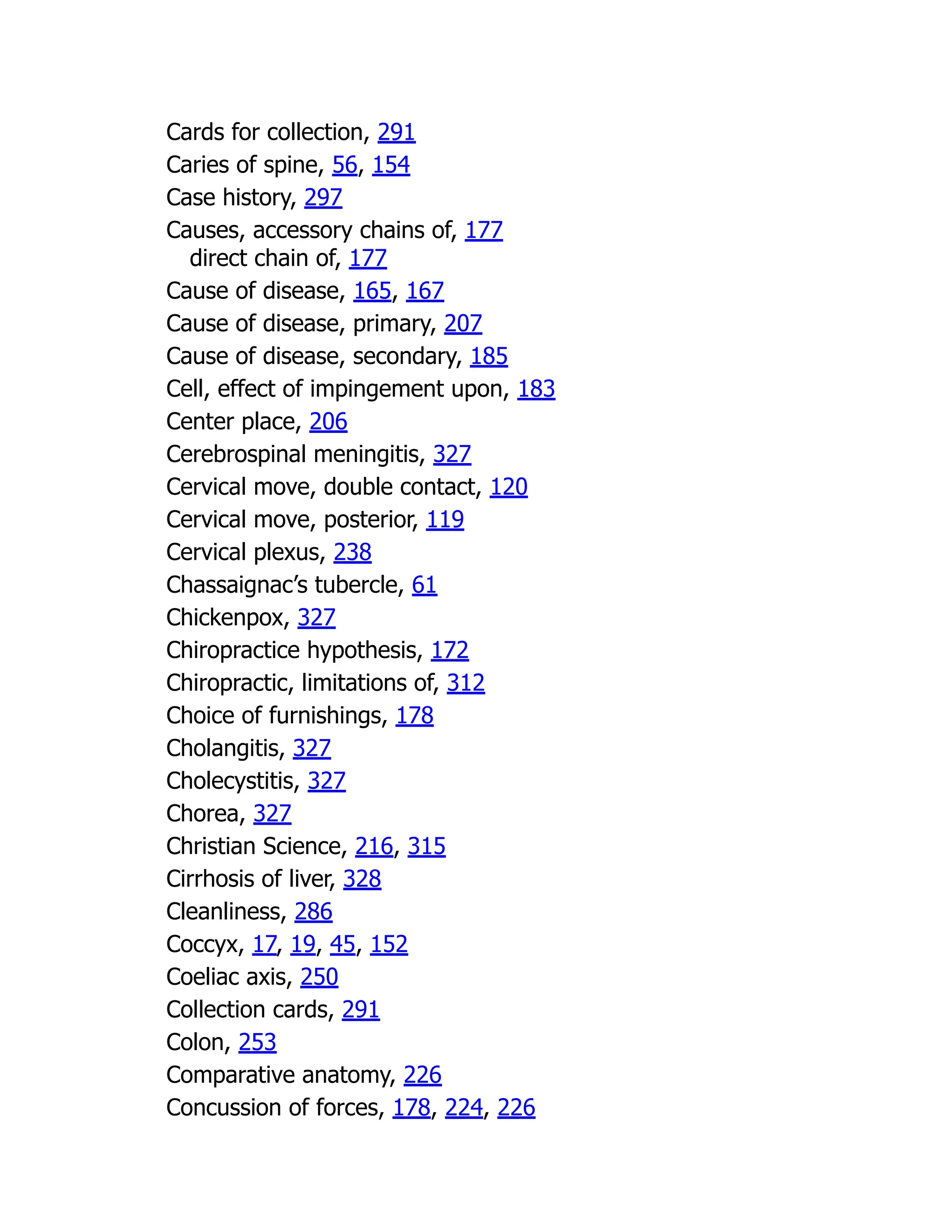
Cards for collection, 291
Caries of spine, 56, 154
Case history, 297
Causes, accessory chains of, 177
direct chain of, 177
Cause of disease, 165, 167
Cause of disease, primary, 207
Cause of disease, secondary, 185
Cell, effect of impingement upon, 183
Center place, 206
Cerebrospinal meningitis, 327
Cervical move, double contact, 120
Cervical move, posterior, 119
Cervical plexus, 238
Chassaignac’s tubercle, 61
Chickenpox, 327
Chiropractice hypothesis, 172
Chiropractic, limitations of, 312
Choice of furnishings, 178
Cholangitis, 327
Cholecystitis, 327
Chorea, 327
Christian Science, 216, 315
Cirrhosis of liver, 328
Cleanliness, 286
Coccyx, 17, 19, 45, 152
Coeliac axis, 250
Collection cards, 291
Colon, 253
Comparative anatomy, 226
Concussion of forces, 178, 224, 226
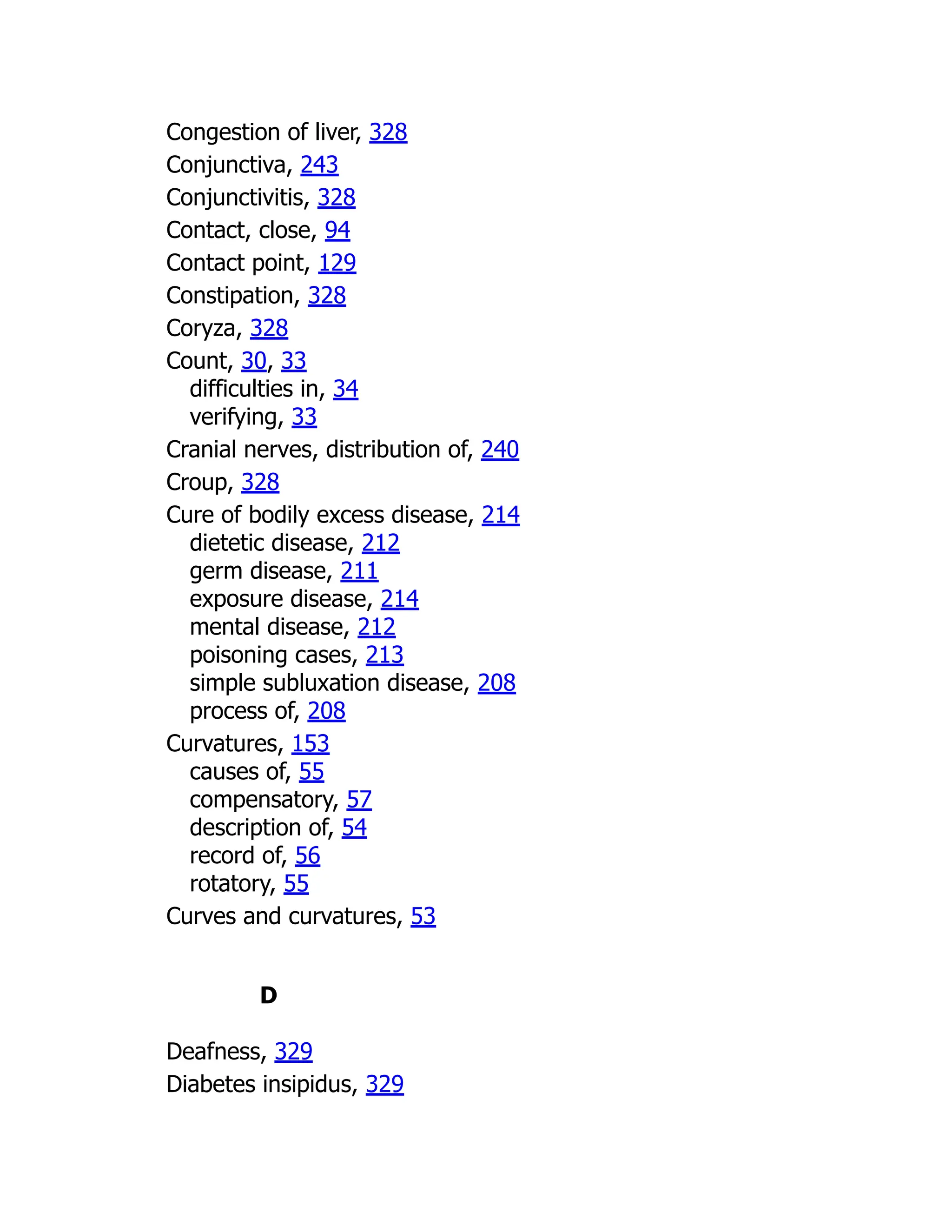
Congestion of liver, 328
Conjunctiva, 243
Conjunctivitis, 328
Contact, close, 94
Contact point, 129
Constipation, 328
Coryza, 328
Count, 30, 33
difficulties in, 34
verifying, 33
Cranial nerves, distribution of, 240
Croup, 328
Cure of bodily excess disease, 214
dietetic disease, 212
germ disease, 211
exposure disease, 214
mental disease, 212
poisoning cases, 213
simple subluxation disease, 208
process of, 208
Curvatures, 153
causes of, 55
compensatory, 57
description of, 54
record of, 56
rotatory, 55
Curves and curvatures, 53
D
Deafness, 329
Diabetes insipidus, 329
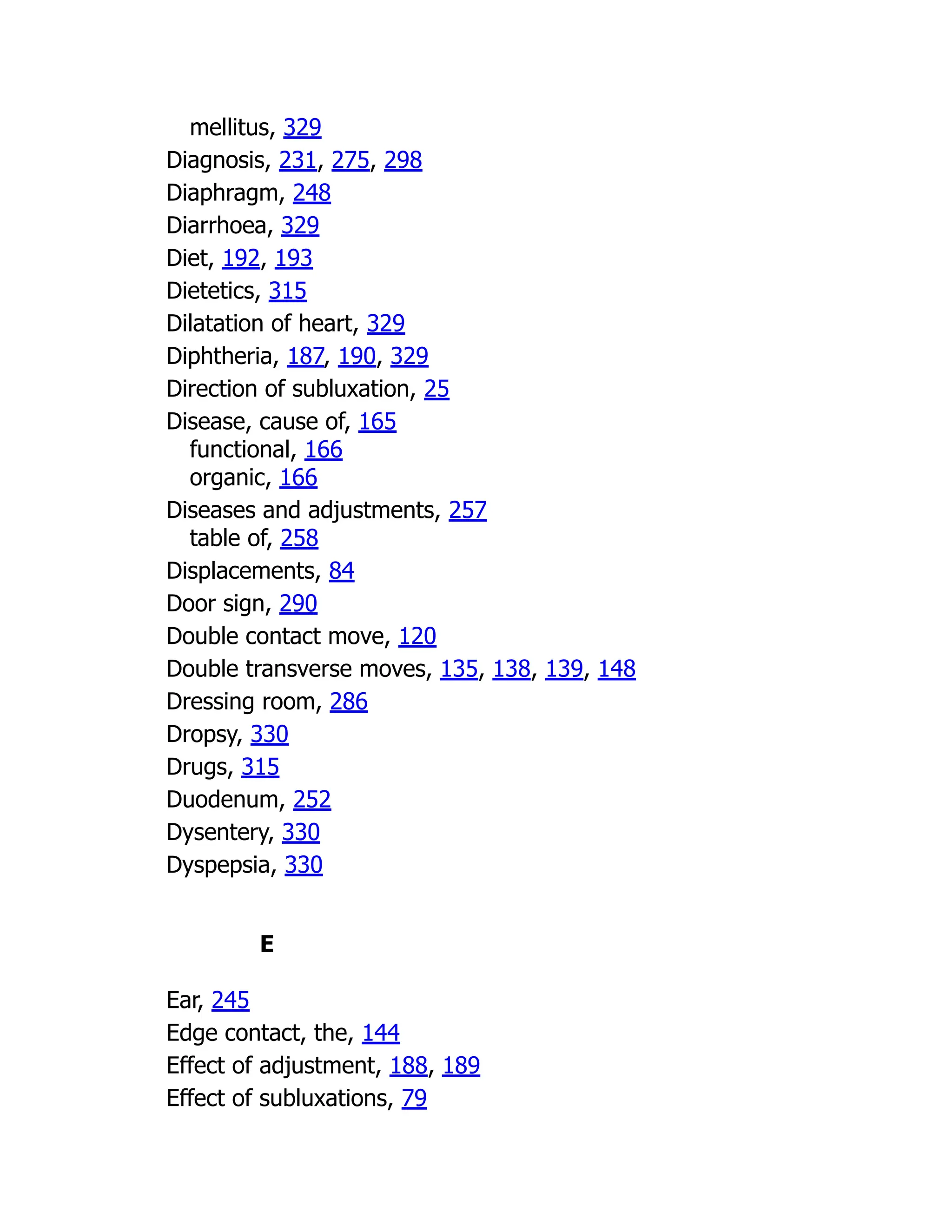
mellitus, 329
Diagnosis, 231, 275, 298
Diaphragm, 248
Diarrhoea, 329
Diet, 192, 193
Dietetics, 315
Dilatation of heart, 329
Diphtheria, 187, 190, 329
Direction of subluxation, 25
Disease, cause of, 165
functional, 166
organic, 166
Diseases and adjustments, 257
table of, 258
Displacements, 84
Door sign, 290
Double contact move, 120
Double transverse moves, 135, 138, 139, 148
Dressing room, 286
Dropsy, 330
Drugs, 315
Duodenum, 252
Dysentery, 330
Dyspepsia, 330
E
Ear, 245
Edge contact, the, 144
Effect of adjustment, 188, 189
Effect of subluxations, 79
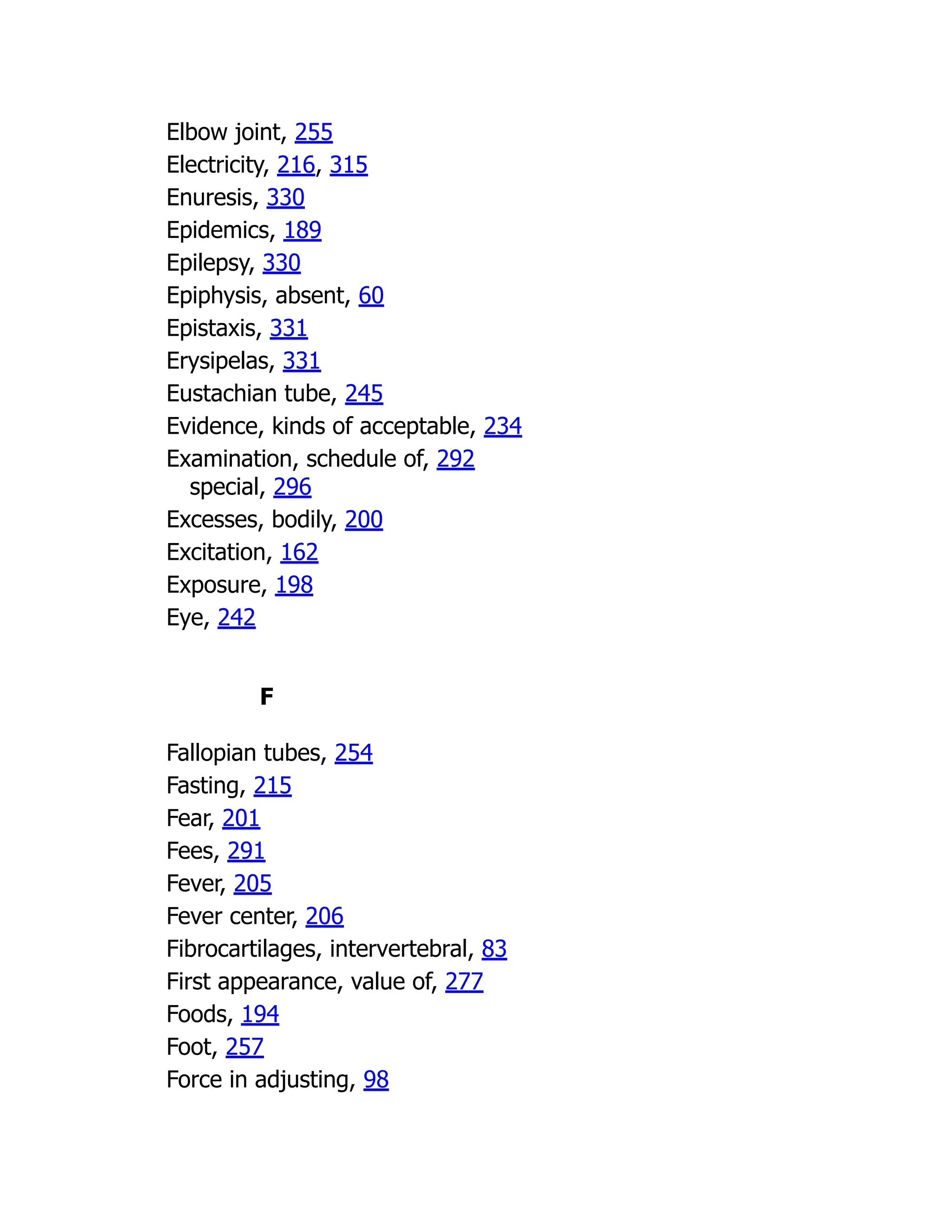
Elbow joint, 255
Electricity, 216, 315
Enuresis, 330
Epidemics, 189
Epilepsy, 330
Epiphysis, absent, 60
Epistaxis, 331
Erysipelas, 331
Eustachian tube, 245
Evidence, kinds of acceptable, 234
Examination, schedule of, 292
special, 296
Excesses, bodily, 200
Excitation, 162
Exposure, 198
Eye, 242
F
Fallopian tubes, 254
Fasting, 215
Fear, 201
Fees, 291
Fever, 205
Fever center, 206
Fibrocartilages, intervertebral, 83
First appearance, value of, 277
Foods, 194
Foot, 257
Force in adjusting, 98
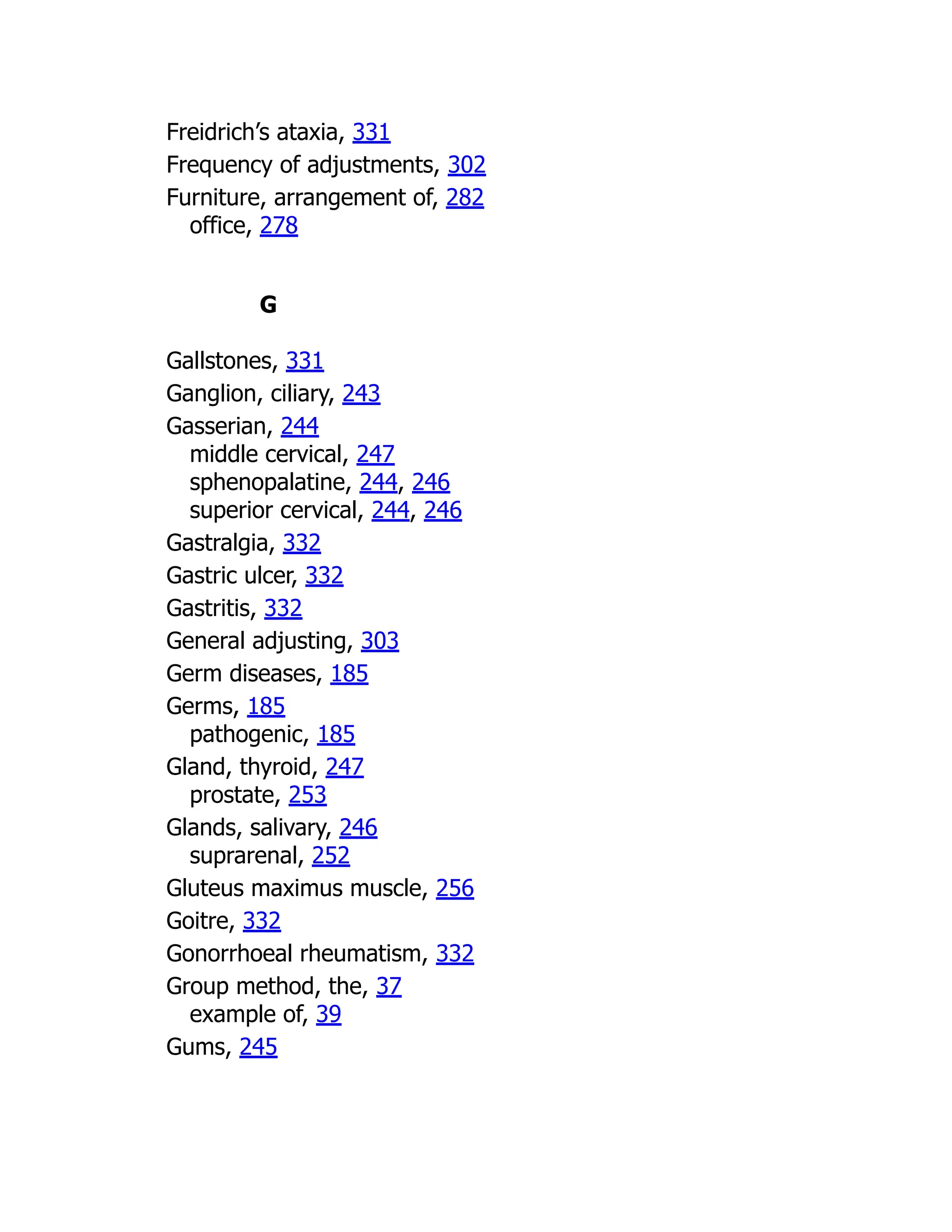
Freidrich’s ataxia, 331
Frequency of adjustments, 302
Furniture, arrangement of, 282
office, 278
G
Gallstones, 331
Ganglion, ciliary, 243
Gasserian, 244
middle cervical, 247
sphenopalatine, 244, 246
superior cervical, 244, 246
Gastralgia, 332
Gastric ulcer, 332
Gastritis, 332
General adjusting, 303
Germ diseases, 185
Germs, 185
pathogenic, 185
Gland, thyroid, 247
prostate, 253
Glands, salivary, 246
suprarenal, 252
Gluteus maximus muscle, 256
Goitre, 332
Gonorrhoeal rheumatism, 332
Group method, the, 37
example of, 39
Gums, 245
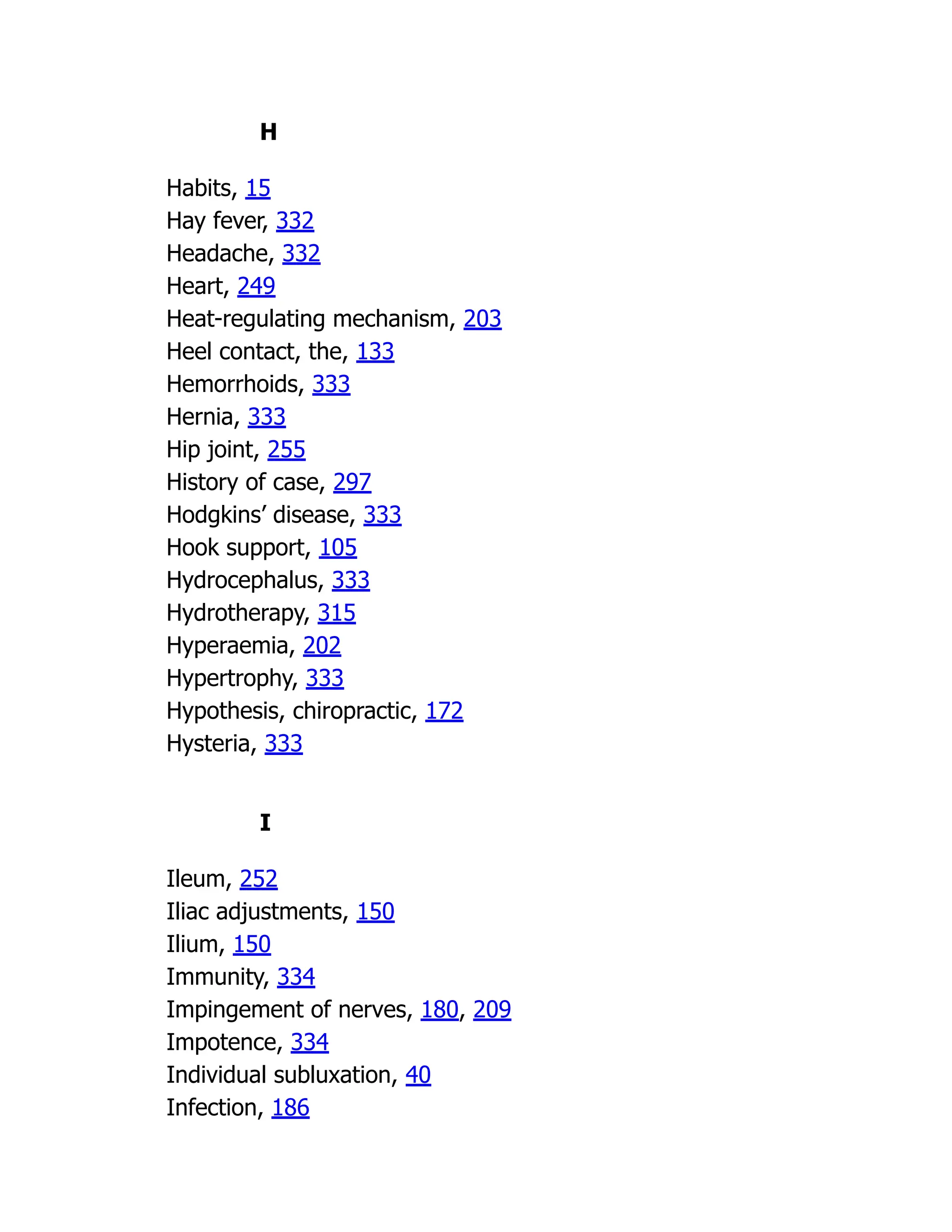
H
Habits, 15
Hay fever, 332
Headache, 332
Heart, 249
Heat-regulating mechanism, 203
Heel contact, the, 133
Hemorrhoids, 333
Hernia, 333
Hip joint, 255
History of case, 297
Hodgkins’ disease, 333
Hook support, 105
Hydrocephalus, 333
Hydrotherapy, 315
Hyperaemia, 202
Hypertrophy, 333
Hypothesis, chiropractic, 172
Hysteria, 333
I
Ileum, 252
Iliac adjustments, 150
Ilium, 150
Immunity, 334
Impingement of nerves, 180, 209
Impotence, 334
Individual subluxation, 40
Infection, 186
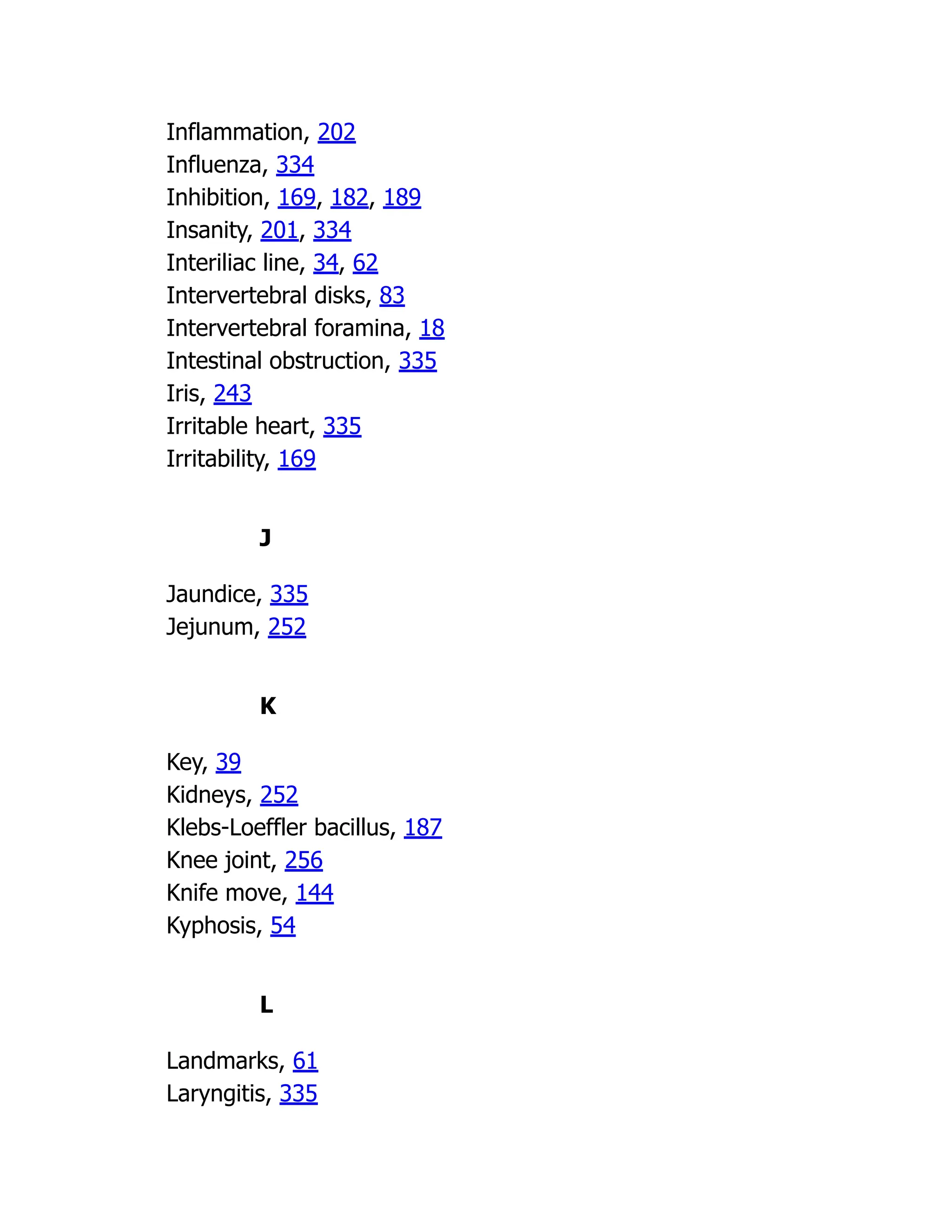
Inflammation, 202
Influenza, 334
Inhibition, 169, 182, 189
Insanity, 201, 334
Interiliac line, 34, 62
Intervertebral disks, 83
Intervertebral foramina, 18
Intestinal obstruction, 335
Iris, 243
Irritable heart, 335
Irritability, 169
J
Jaundice, 335
Jejunum, 252
K
Key, 39
Kidneys, 252
Klebs-Loeffler bacillus, 187
Knee joint, 256
Knife move, 144
Kyphosis, 54
L
Landmarks, 61
Laryngitis, 335
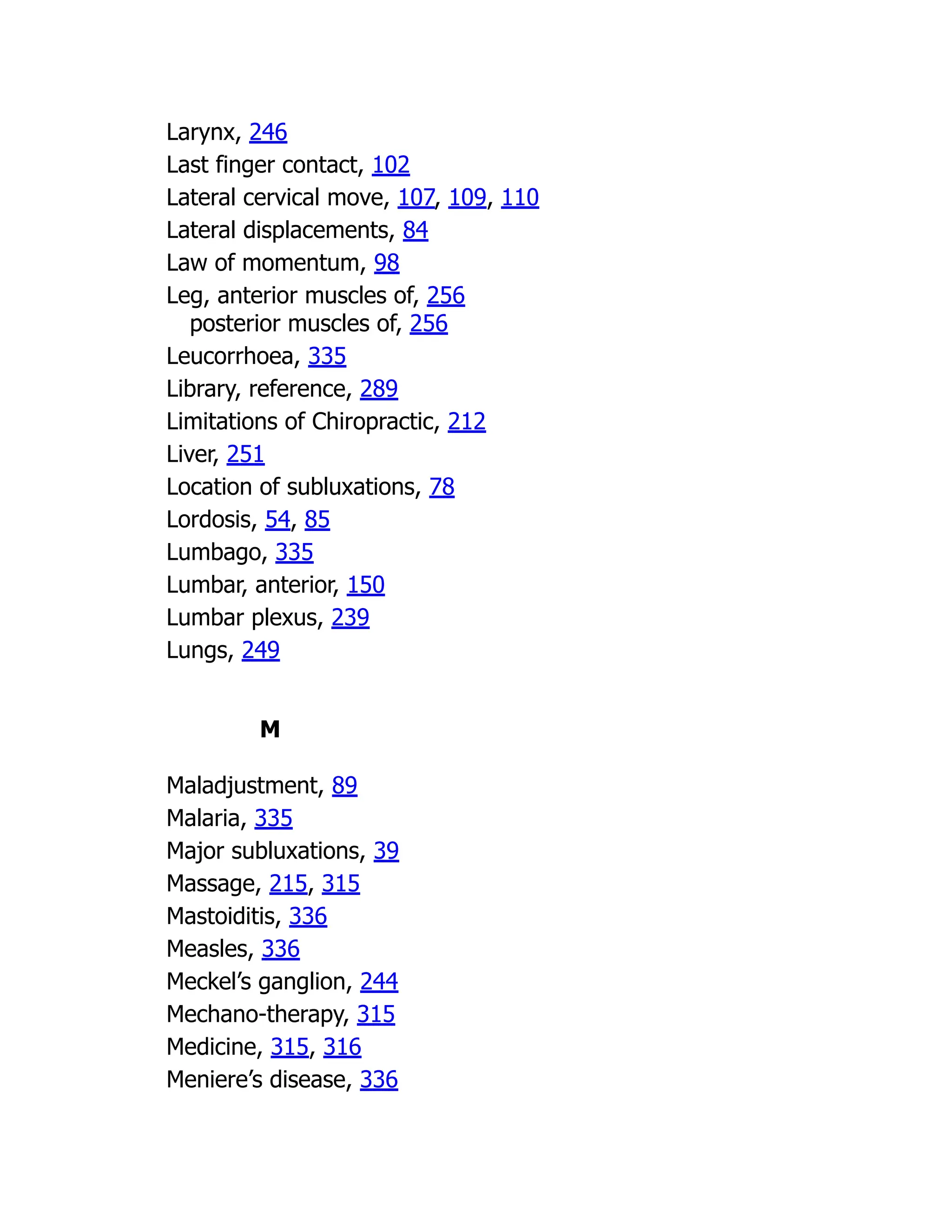
Larynx, 246
Last finger contact, 102
Lateral cervical move, 107, 109, 110
Lateral displacements, 84
Law of momentum, 98
Leg, anterior muscles of, 256
posterior muscles of, 256
Leucorrhoea, 335
Library, reference, 289
Limitations of Chiropractic, 212
Liver, 251
Location of subluxations, 78
Lordosis, 54, 85
Lumbago, 335
Lumbar, anterior, 150
Lumbar plexus, 239
Lungs, 249
M
Maladjustment, 89
Malaria, 335
Major subluxations, 39
Massage, 215, 315
Mastoiditis, 336
Measles, 336
Meckel’s ganglion, 244
Mechano-therapy, 315
Medicine, 315, 316
Meniere’s disease, 336
Meninges, 242
Menorrhagia, 336
Mental attitude, 63
Mental states, abnormal, 201
Metrorrhagia, 336
Migraine, 336
Minor subluxations, 39
Mixing, 315
Morikubo move, 99
Motor reaction, 193, 196, 199
Movable kidney, 336
Movement for correction, 27
Muscles of abdomen, 244
of back, 247
of neck, 247
of perineum, 249
Muscular control, 97
Muscular suggestion, 96
Myelitis, 336
Myocarditis, 336
Myxoedema, 337
N
Naprapathy, 313
Napravit, 313
Neck, muscles of, 247
Nephritis, 337
Nerve, auditory, 245
chorda tympani, 246
great sciatic, 256
hypoglossal, 245
inferior maxillary, 244
internal carotid, 242
olfactory, 243
phrenic, 248
recurrent laryngeal, 246
trigeminal (trifacial), 244
Vidian, 244
Nerve connections, special, 235
Nerve impingement, 180, 182, 209
Nerve paths, 70
Nerve pathways, important, 242
structure of, 241
Nerves, cranial, 240
optic, 242
spinal, 237
splanchnic, 250
sympathetic, 240
traceable, 64
Nerve system, 171, 222
development of, 219, 220
outline of, 235
sympathetic, 171
Nerve-tracing, 64, 296
errors in, 73
place of in diagnosis, 67
suggestion in, 67
technic of, 68
Neuralgia, 337
Neurasthenia, 337
Neuritis, 337
Neurology, 234
Neuron, 220
O
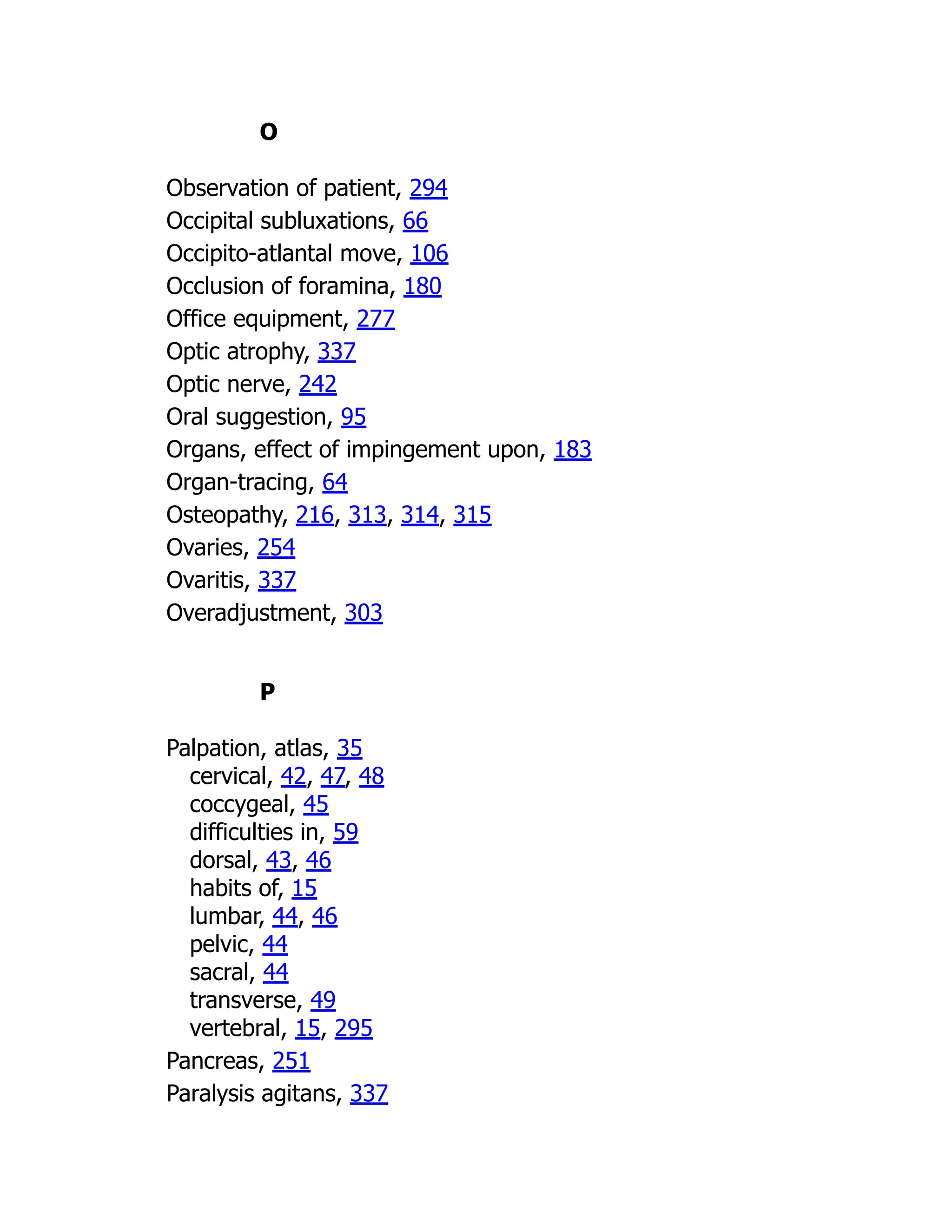
Observation of patient, 294
Occipital subluxations, 66
Occipito-atlantal move, 106
Occlusion of foramina, 180
Office equipment, 277
Optic atrophy, 337
Optic nerve, 242
Oral suggestion, 95
Organs, effect of impingement upon, 183
Organ-tracing, 64
Osteopathy, 216, 313, 314, 315
Ovaries, 254
Ovaritis, 337
Overadjustment, 303
P
Palpation, atlas, 35
cervical, 42, 47, 48
coccygeal, 45
difficulties in, 59
dorsal, 43, 46
habits of, 15
lumbar, 44, 46
pelvic, 44
sacral, 44
transverse, 49
vertebral, 15, 295
Pancreas, 251
Paralysis agitans, 337
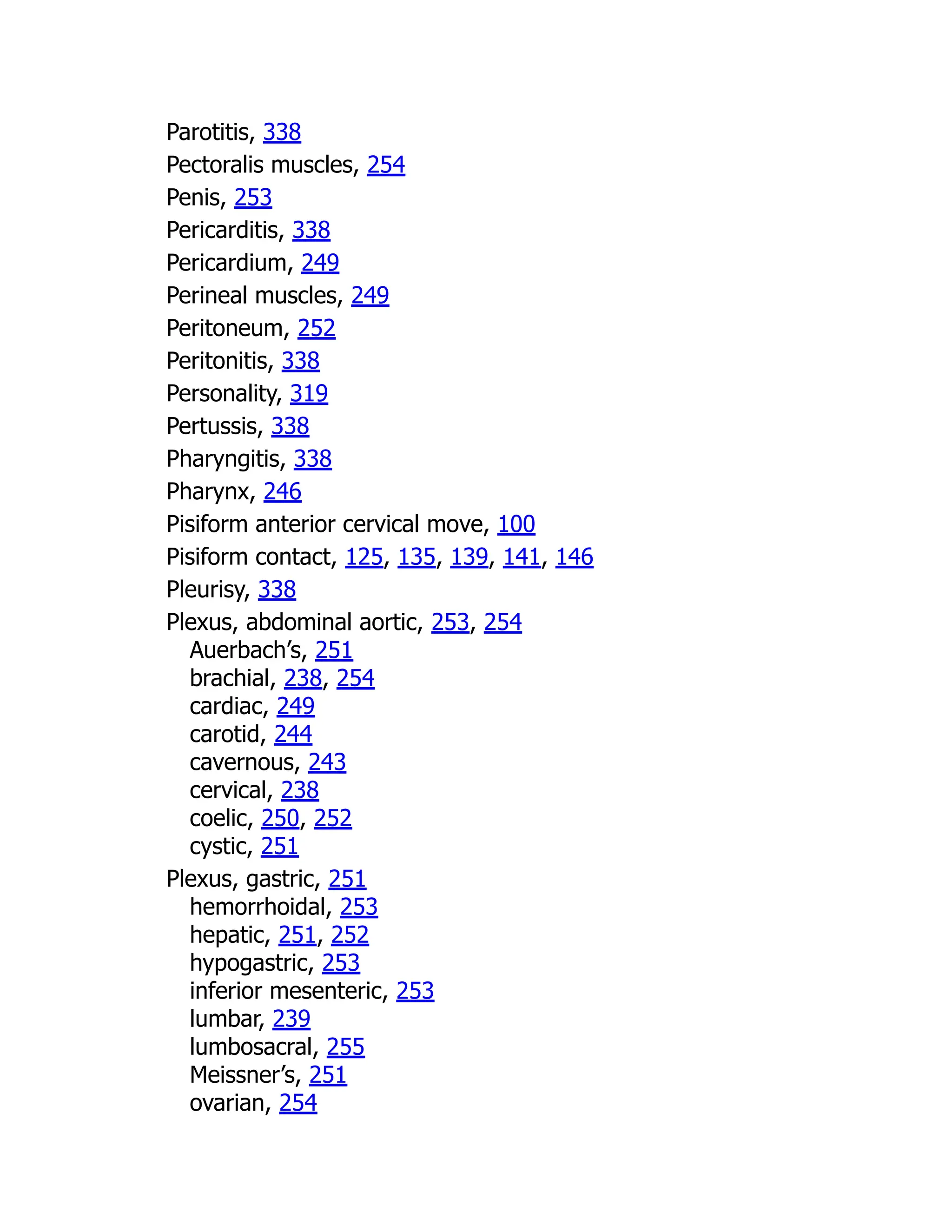
Parotitis, 338
Pectoralis muscles, 254
Penis, 253
Pericarditis, 338
Pericardium, 249
Perineal muscles, 249
Peritoneum, 252
Peritonitis, 338
Personality, 319
Pertussis, 338
Pharyngitis, 338
Pharynx, 246
Pisiform anterior cervical move, 100
Pisiform contact, 125, 135, 139, 141, 146
Pleurisy, 338
Plexus, abdominal aortic, 253, 254
Auerbach’s, 251
brachial, 238, 254
cardiac, 249
carotid, 244
cavernous, 243
cervical, 238
coelic, 250, 252
cystic, 251
Plexus, gastric, 251
hemorrhoidal, 253
hepatic, 251, 252
hypogastric, 253
inferior mesenteric, 253
lumbar, 239
lumbosacral, 255
Meissner’s, 251
ovarian, 254
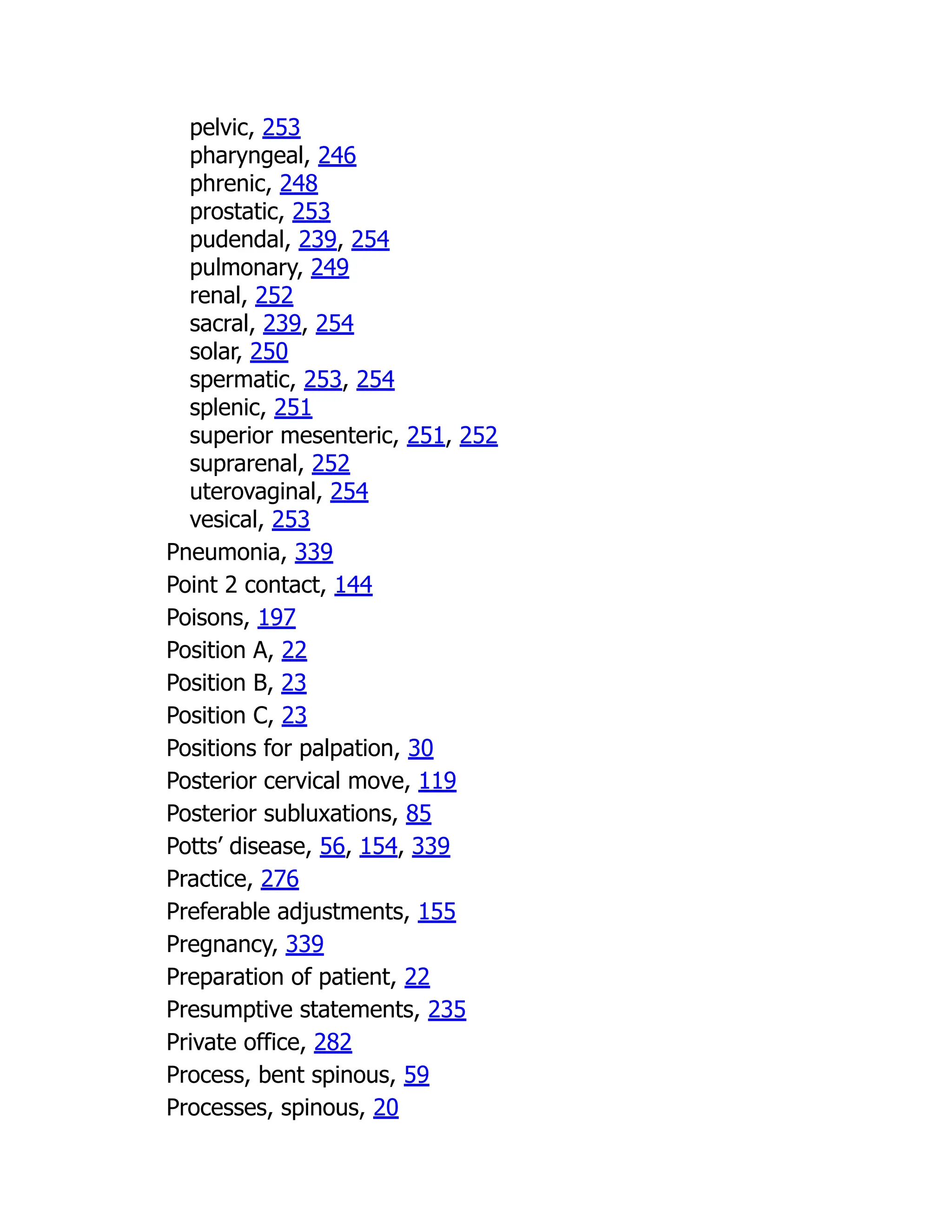
pelvic, 253
pharyngeal, 246
phrenic, 248
prostatic, 253
pudendal, 239, 254
pulmonary, 249
renal, 252
sacral, 239, 254
solar, 250
spermatic, 253, 254
splenic, 251
superior mesenteric, 251, 252
suprarenal, 252
uterovaginal, 254
vesical, 253
Pneumonia, 339
Point 2 contact, 144
Poisons, 197
Position A, 22
Position B, 23
Position C, 23
Positions for palpation, 30
Posterior cervical move, 119
Posterior subluxations, 85
Potts’ disease, 56, 154, 339
Practice, 276
Preferable adjustments, 155
Pregnancy, 339
Preparation of patient, 22
Presumptive statements, 235
Private office, 282
Process, bent spinous, 59
Processes, spinous, 20
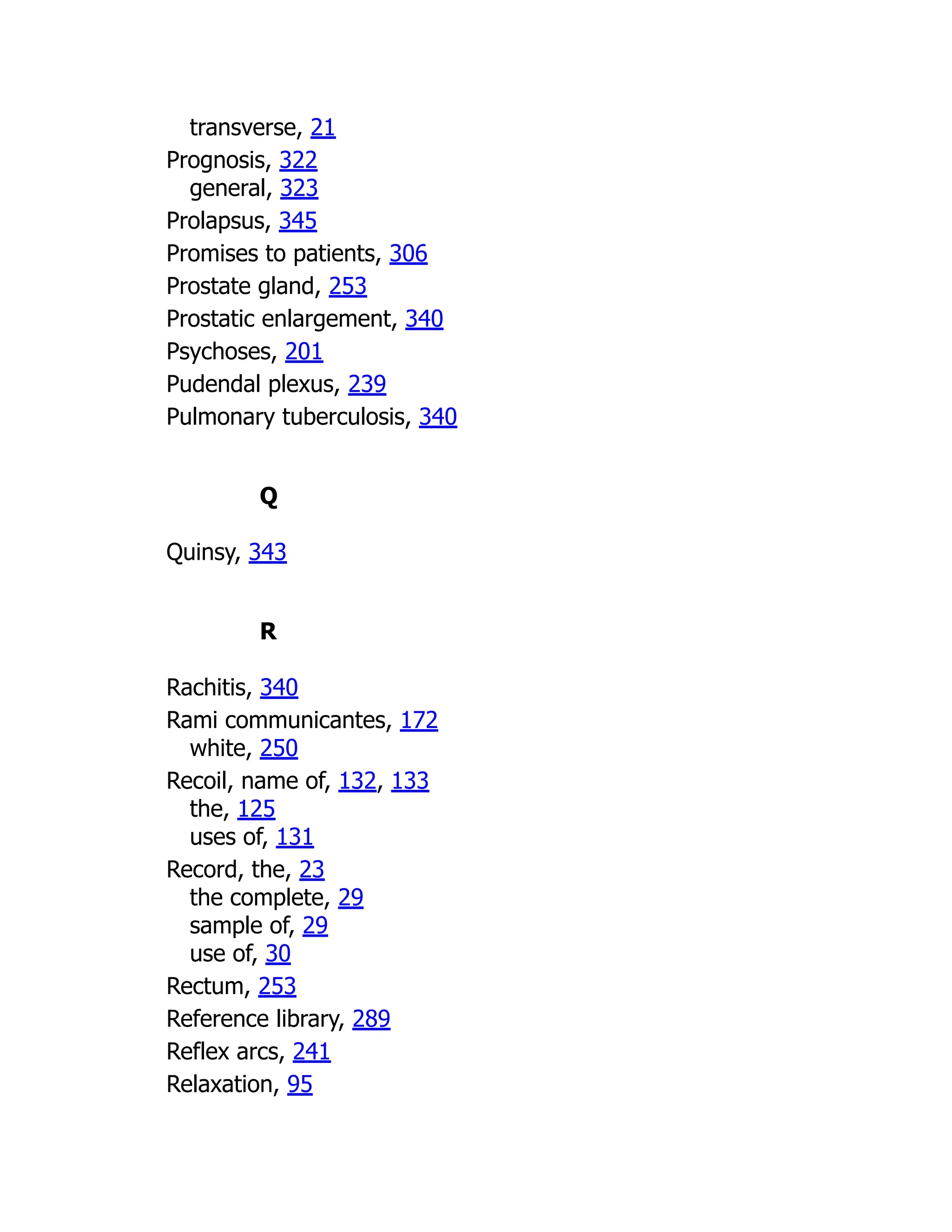
transverse, 21
Prognosis, 322
general, 323
Prolapsus, 345
Promises to patients, 306
Prostate gland, 253
Prostatic enlargement, 340
Psychoses, 201
Pudendal plexus, 239
Pulmonary tuberculosis, 340
Q
Quinsy, 343
R
Rachitis, 340
Rami communicantes, 172
white, 250
Recoil, name of, 132, 133
the, 125
uses of, 131
Record, the, 23
the complete, 29
sample of, 29
use of, 30
Rectum, 253
Reference library, 289
Reflex arcs, 241
Relaxation, 95
Rest room, 287
Retina, 242
central artery of, 243
Retinal hemorrhage, 340
Retracing of disease, 211, 309
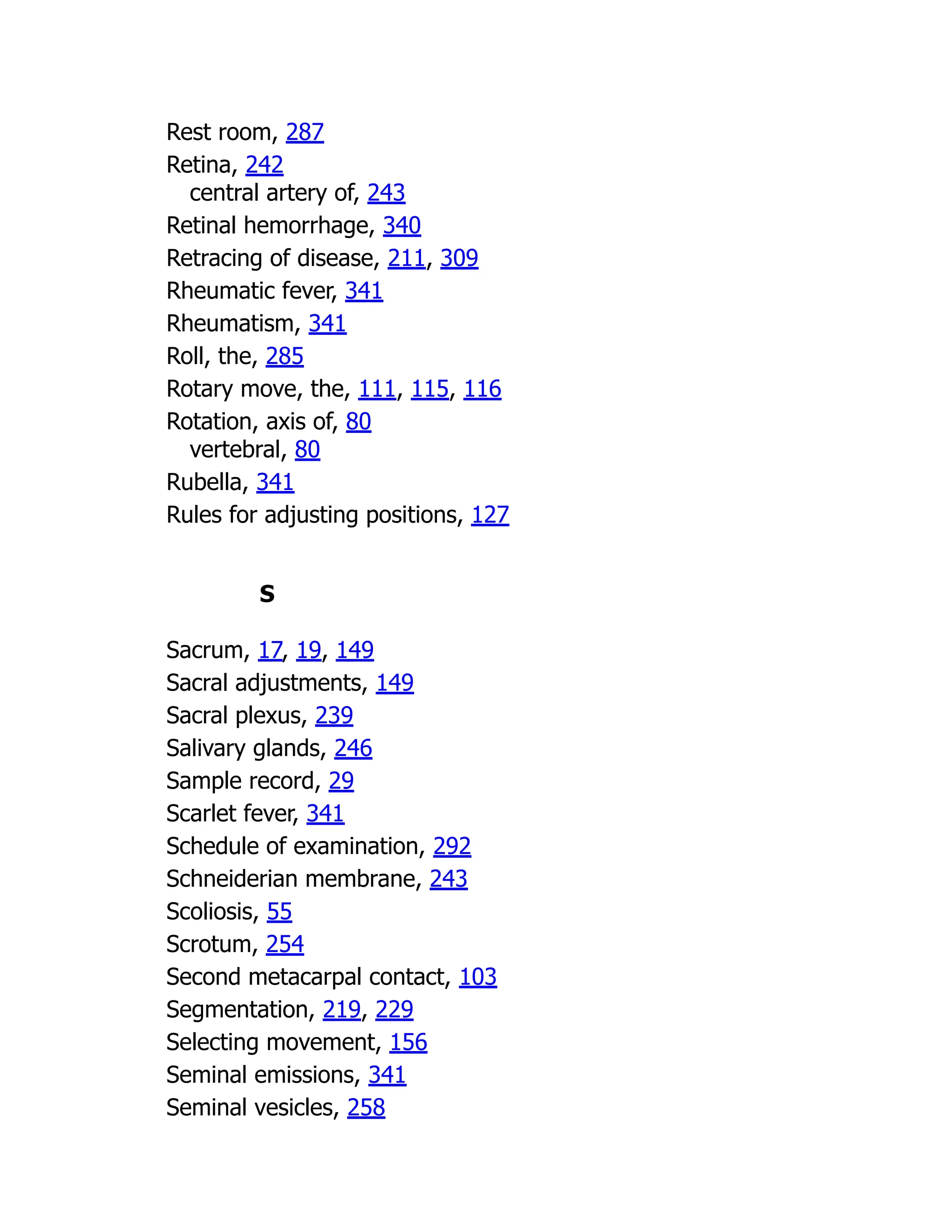
Rheumatic fever, 341
Rheumatism, 341
Roll, the, 285
Rotary move, the, 111, 115, 116
Rotation, axis of, 80
vertebral, 80
Rubella, 341
Rules for adjusting positions, 127
S
Sacrum, 17, 19, 149
Sacral adjustments, 149
Sacral plexus, 239
Salivary glands, 246
Sample record, 29
Scarlet fever, 341
Schedule of examination, 292
Schneiderian membrane, 243
Scoliosis, 55
Scrotum, 254
Second metacarpal contact, 103
Segmentation, 219, 229
Selecting movement, 156
Seminal emissions, 341
Seminal vesicles, 258
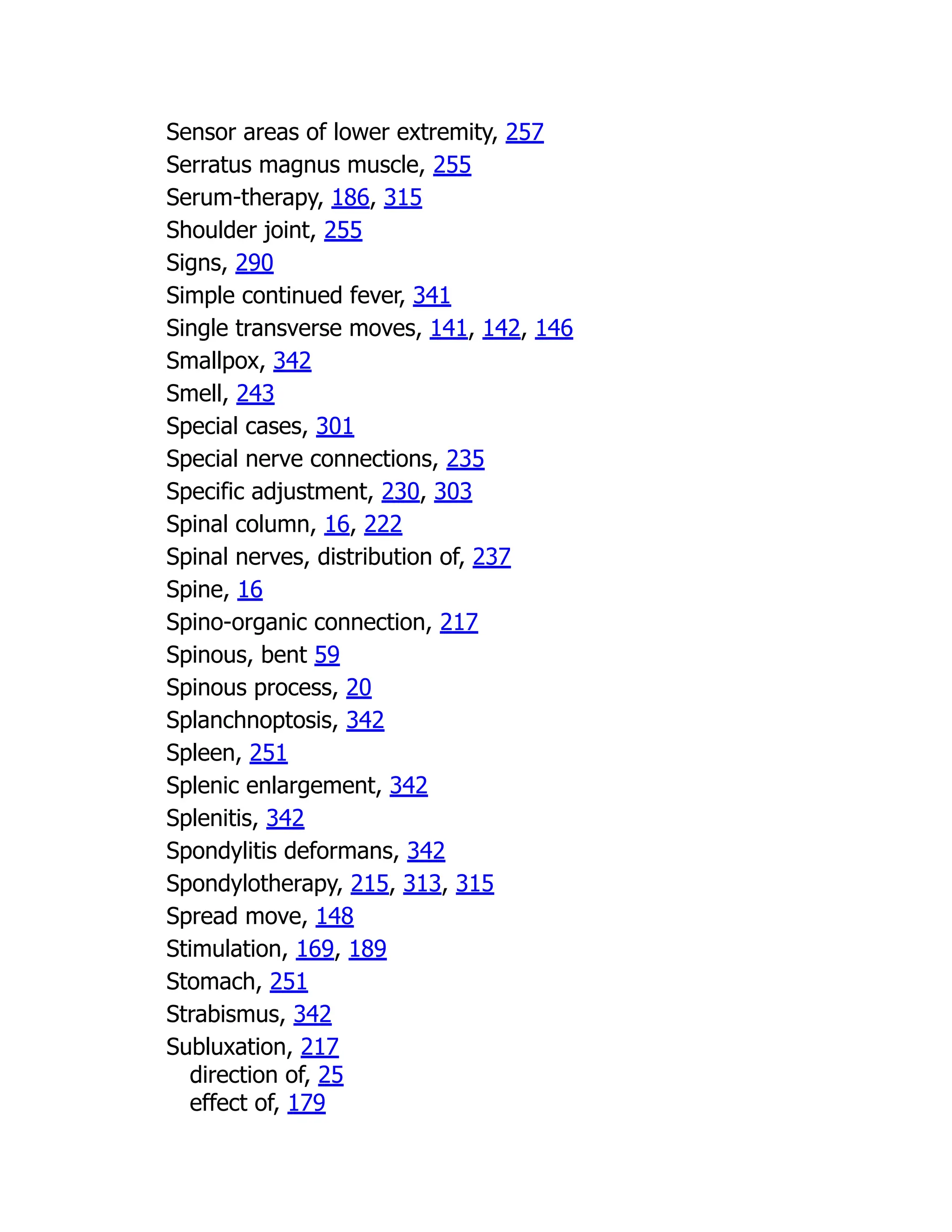
Sensor areas of lower extremity, 257
Serratus magnus muscle, 255
Serum-therapy, 186, 315
Shoulder joint, 255
Signs, 290
Simple continued fever, 341
Single transverse moves, 141, 142, 146
Smallpox, 342
Smell, 243
Special cases, 301
Special nerve connections, 235
Specific adjustment, 230, 303
Spinal column, 16, 222
Spinal nerves, distribution of, 237
Spine, 16
Spino-organic connection, 217
Spinous, bent 59
Spinous process, 20
Splanchnoptosis, 342
Spleen, 251
Splenic enlargement, 342
Splenitis, 342
Spondylitis deformans, 342
Spondylotherapy, 215, 313, 315
Spread move, 148
Stimulation, 169, 189
Stomach, 251
Strabismus, 342
Subluxation, 217
direction of, 25
effect of, 179
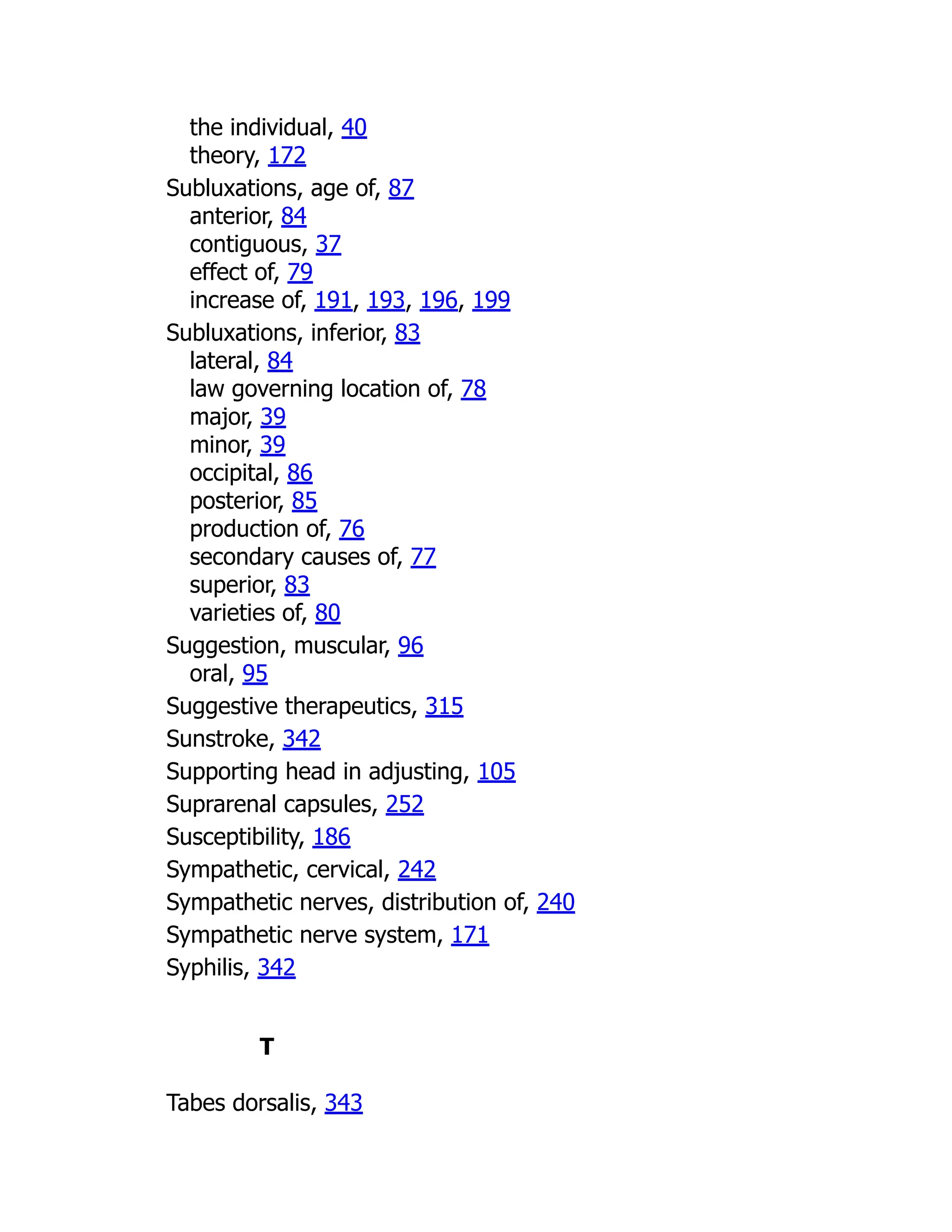
the individual, 40
theory, 172
Subluxations, age of, 87
anterior, 84
contiguous, 37
effect of, 79
increase of, 191, 193, 196, 199
Subluxations, inferior, 83
lateral, 84
law governing location of, 78
major, 39
minor, 39
occipital, 86
posterior, 85
production of, 76
secondary causes of, 77
superior, 83
varieties of, 80
Suggestion, muscular, 96
oral, 95
Suggestive therapeutics, 315
Sunstroke, 342
Supporting head in adjusting, 105
Suprarenal capsules, 252
Susceptibility, 186
Sympathetic, cervical, 242
Sympathetic nerves, distribution of, 240
Sympathetic nerve system, 171
Syphilis, 342
T
Tabes dorsalis, 343
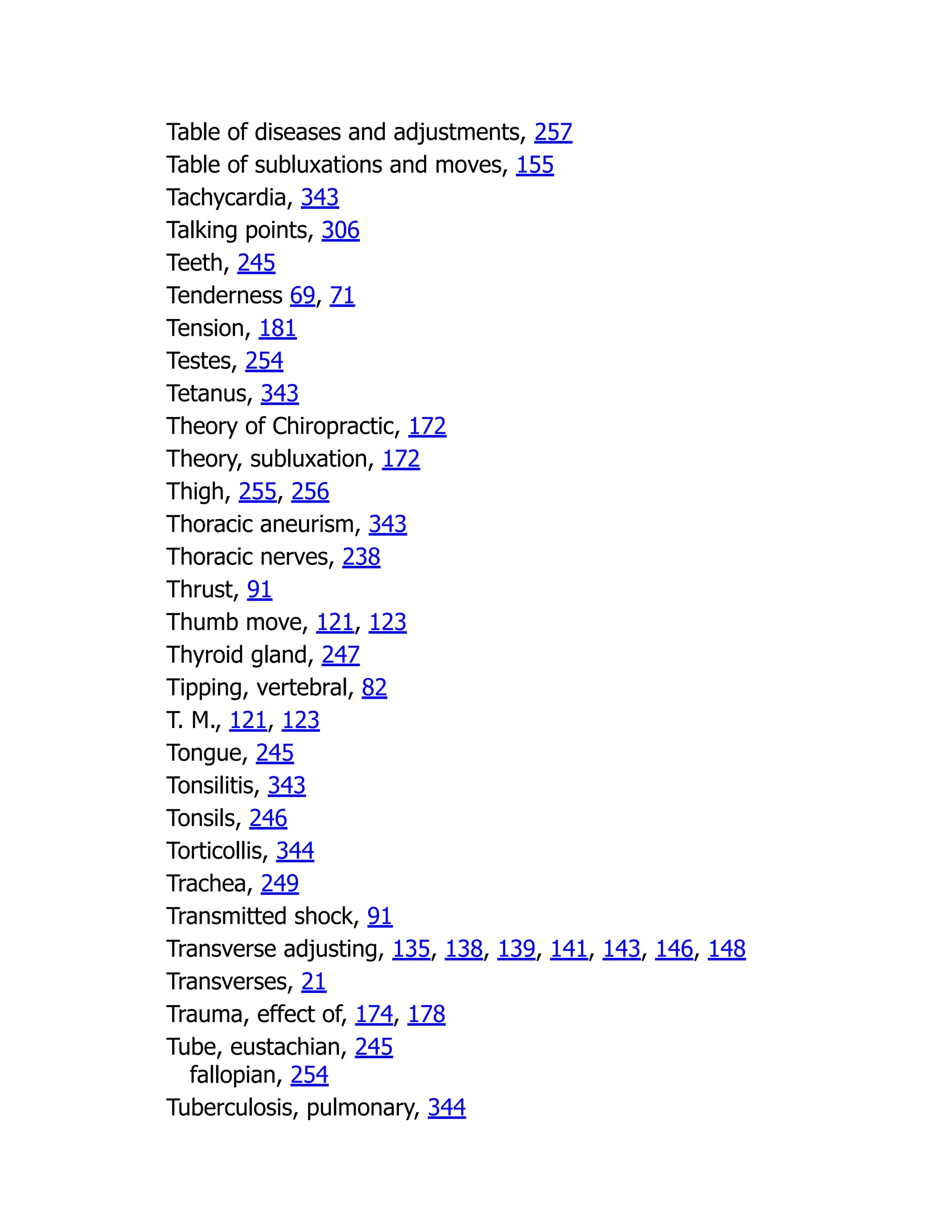
Table of diseases and adjustments, 257
Table of subluxations and moves, 155
Tachycardia, 343
Talking points, 306
Teeth, 245
Tenderness 69, 71
Tension, 181
Testes, 254
Tetanus, 343
Theory of Chiropractic, 172
Theory, subluxation, 172
Thigh, 255, 256
Thoracic aneurism, 343
Thoracic nerves, 238
Thrust, 91
Thumb move, 121, 123
Thyroid gland, 247
Tipping, vertebral, 82
T. M., 121, 123
Tongue, 245
Tonsilitis, 343
Tonsils, 246
Torticollis, 344
Trachea, 249
Transmitted shock, 91
Transverse adjusting, 135, 138, 139, 141, 143, 146, 148
Transverses, 21
Trauma, effect of, 174, 178
Tube, eustachian, 245
fallopian, 254
Tuberculosis, pulmonary, 344
Tumors, benign, 344
malignant, 344
Typhoid fever, 189, 344
U
Underscoring, 26
Ureters, 253
Urethra, 253
Use of adjuncts, 315
Uterus, 254
Uteroversion, 345
V
Vagina, 254
Valvular disease, 345
Variations in number of vertebrae, 60
Varieties of subluxation, 80
Varicocele, 345
Varicose veins, 345
Vermiform appendix, 253
Vertebrae, 16
cervical, 16
dorsal, 16
lumbar, 16
variations in number of, 16, 60
Vertebral palpation, 15, 295
Vertebra prominens, 17, 19
Vital energy, 169
Visceral nerves, 239, 253
W
Waiting room, 280
Worry, 201
Transcriber’s Notes
Punctuation, hyphenation, and spelling were made
consistent when a predominant preference was found in
this book; otherwise they were not changed.
Simple typographical errors were corrected;
occasional unbalanced quotation marks retained.
Ambiguous hyphens at the ends of lines were
retained.
The hierarchy of the Table of Contents has been
used as the guide to the rest of the book, even though
the two sometimes differ.
Index not checked for proper alphabetization or
correct page references.
Page 26: “P R S” has an underline below “P” and a
double-underline below “R”.
Page 34: “flexed far toward” perhaps should be
“forward”.
Page 79: “as well all the details” may be missing “as”
after “well”.
Page 117: “all vertebra above, so to speak” perhaps
should be “vertebrae”.
Page 147: “this move is predicated” was printed as
“this more was predicated”; changed here.
Welcome to Our Bookstore - The Ultimate Destination for Book Lovers
Are you passionate about testbank and eager to explore new worlds of
knowledge? At our website, we offer a vast collection of books that
cater to every interest and age group. From classic literature to
specialized publications, self-help books, and children’s stories, we
have it all! Each book is a gateway to new adventures, helping you
expand your knowledge and nourish your soul
Experience Convenient and Enjoyable Book Shopping Our website is more
than just an online bookstore—it’s a bridge connecting readers to the
timeless values of culture and wisdom. With a sleek and user-friendly
interface and a smart search system, you can find your favorite books
quickly and easily. Enjoy special promotions, fast home delivery, and
a seamless shopping experience that saves you time and enhances your
love for reading.
Let us accompany you on the journey of exploring knowledge and
personal growth!
ebooksecure.com

Information Technology Project Management 7th edition (eBook PDF)

  • 1.
    Information Technology ProjectManagement 7th edition (eBook PDF) download https://ebooksecure.com/product/information-technology-project- management-7th-edition-ebook-pdf/ Download full version ebook from https://ebooksecure.com
  • 2.
    We believe theseproducts will be a great fit for you. Click the link to download now, or visit ebooksecure.com to discover even more! Information Technology Project Management 7th edition (eBook PDF) http://ebooksecure.com/product/information-technology-project- management-7th-edition-ebook-pdf/ (Original PDF) Information Technology Project Management, Revised 7th Edition http://ebooksecure.com/product/original-pdf-information- technology-project-management-revised-7th-edition/ (eBook PDF) Information Technology Project Management 8th Edition http://ebooksecure.com/product/ebook-pdf-information-technology- project-management-8th-edition/ (eBook PDF) Information Technology Project Management, 5th Edition http://ebooksecure.com/product/ebook-pdf-information-technology- project-management-5th-edition/
  • 3.
    Information Technology ProjectManagement 9th Edition Kathy Schwalbe - eBook PDF https://ebooksecure.com/download/information-technology-project- management-ebook-pdf/ (eBook PDF) Information Technology Project Management 9th Edition by Kathy Schwalbe http://ebooksecure.com/product/ebook-pdf-information-technology- project-management-9th-edition-by-kathy-schwalbe/ (Original PDF) Successful Project Management 7th Edition http://ebooksecure.com/product/original-pdf-successful-project- management-7th-edition/ (eBook PDF) Information Technology for Management Digital 10th http://ebooksecure.com/product/ebook-pdf-information-technology- for-management-digital-10th/ (eBook PDF) Information Systems Project Management, A Process Approach, Edition 2.0 http://ebooksecure.com/product/ebook-pdf-information-systems- project-management-a-process-approach-edition-2-0-2/
  • 5.
    BRIEF CONTENTS Preface xix Chapter1 Introduction to Project Management 1 Chapter 2 The Project Management and Information Technology Context 43 Chapter 3 The Project Management Process Groups: A Case Study 81 Chapter 4 Project Integration Management 139 Chapter 5 Project Scope Management 187 Chapter 6 Project Time Management 225 Chapter 7 Project Cost Management 271 Chapter 8 Project Quality Management 311 Chapter 9 Project Human Resource Management 359 Chapter 10 Project Communications Management 405 Chapter 11 Project Risk Management 439 Copyright 2014 Cengage Learning. All Rights Reserved. May not be copied, scanned, or duplicated, in whole or in part.
  • 6.
    Chapter 12 Project ProcurementManagement 479 Chapter 13 Project Stakeholder Management 509 Appendix A Guide to Using Microsoft Project 2013 A.1 Appendix B (Available on CengageBrain.com) Appendix C (Available on CengageBrain.com) Glossary G.1 Index I.1 viii Brief Contents Copyright 2014 Cengage Learning. All Rights Reserved. May not be copied, scanned, or duplicated, in whole or in part.
  • 7.
    TABLE OF CONTENTS Prefacexix Chapter 1 Introduction to Project Management 1 Introduction 2 What Is a Project? 4 Examples of IT Projects 4 Project Attributes 6 Project Constraints 7 What Is Project Management? 9 Project Stakeholders 10 Project Management Knowledge Areas 11 Project Management Tools and Techniques 12 Project Success 14 Program and Project Portfolio Management 16 Programs 17 Project Portfolio Management 17 The Role of the Project Manager 21 Project Manager Job Description 21 Suggested Skills for Project Managers 22 Importance of People Skills and Leadership Skills 24 Careers for IT Project Managers 25 The Project Management Profession 26 History of Project Management 26 The Project Management Institute 30 Project Management Certification 30 Ethics in Project Management 32 Project Management Software 33 Chapter Summary 36 Quick Quiz 37 Quick Quiz Answers 38 Discussion Questions 38 Exercises 39 Key Terms 40 End Notes 41 Chapter 2 The Project Management and Information Technology Context 43 A Systems View of Project Management 45 What Is a Systems Approach? 45 The Three-Sphere Model for Systems Management 46 Copyright 2014 Cengage Learning. All Rights Reserved. May not be copied, scanned, or duplicated, in whole or in part.
  • 8.
    Understanding Organizations 47 TheFour Frames of Organizations 47 Organizational Structures 49 Organizational Culture 51 Stakeholder Management 52 The Importance of Top Management Commitment 54 The Need for Organizational Commitment to Information Technology 55 The Need for Organizational Standards 56 Project Phases and the Project Life Cycle 56 Product Life Cycles 59 The Importance of Project Phases and Management Reviews 62 The Context of Information Technology Projects 64 The Nature of IT Projects 64 Characteristics of IT Project Team Members 64 Diverse Technologies 65 Recent Trends Affecting Information Technology Project Management 65 Globalization 65 Outsourcing 66 Virtual Teams 67 Agile Project Management 69 The Manifesto for Agile Software Development 70 Scrum 70 Agile, the PMBOK® Guide, and a New Certification 71 Chapter Summary 73 Quick Quiz 74 Quick Quiz Answers 75 Discussion Questions 75 Exercises 76 Key Terms 77 End Notes 78 Chapter 3 The Project Management Process Groups: A Case Study 81 Project Management Process Groups 82 Mapping the Process Groups to the Knowledge Areas 87 Developing an IT Project Management Methodology 88 Case Study 1: JWD Consulting’s Project Management Intranet Site Project (Predictive Approach) 91 Project Pre-Initiation and Initiation 91 Pre-Initiation Tasks 92 Initiating 96 Project Planning 100 Project Execution 109 Project Monitoring and Controlling 114 Project Closing 117 Case Study 2: JWD Consulting’s Project Management Intranet Site Project (Agile Approach) 120 Scrum Roles, Artifacts, and Ceremonies 121 Project Pre-Initiation and Initiation 123 Planning 124 x Table of Contents Copyright 2014 Cengage Learning. All Rights Reserved. May not be copied, scanned, or duplicated, in whole or in part.
  • 9.
    Executing 127 Monitoring andControlling 127 Closing 129 Templates by Process Group 129 Chapter Summary 133 Quick Quiz 133 Quick Quiz Answers 135 Discussion Questions 135 Exercises 136 Key Terms 137 End Notes 138 Chapter 4 Project Integration Management 139 What Is Project Integration Management? 140 Strategic Planning and Project Selection 143 Strategic Planning 143 Identifying Potential Projects 145 Aligning IT with Business Strategy 146 Methods for Selecting Projects 148 Focusing on Broad Organizational Needs 148 Categorizing IT Projects 148 Performing Net Present Value Analysis, Return on Investment, and Payback Analysis 149 Net Present Value Analysis 149 Return on Investment 152 Payback Analysis 153 Using a Weighted Scoring Model 154 Implementing a Balanced Scorecard 156 Developing a Project Charter 157 Developing a Project Management Plan 161 Project Management Plan Contents 161 Using Guidelines to Create Project Management Plans 164 Directing and Managing Project Work 166 Coordinating Planning and Execution 166 Providing Strong Leadership and a Supportive Culture 167 Capitalizing on Product, Business, and Application Area Knowledge 167 Project Execution Tools and Techniques 168 Monitoring and Controlling Project Work 169 Performing Integrated Change Control 171 Change Control on IT Projects 172 Change Control System 173 Closing Projects or Phases 175 Using Software to Assist in Project Integration Management 175 Chapter Summary 178 Quick Quiz 178 Quick Quiz Answers 180 Discussion Questions 180 Table of Contents xi Copyright 2014 Cengage Learning. All Rights Reserved. May not be copied, scanned, or duplicated, in whole or in part.
  • 10.
    Exercises 181 Running Case182 Tasks 183 Key Terms 184 End Notes 185 Chapter 5 Project Scope Management 187 What Is Project Scope Management? 188 Planning Scope Management 189 Collecting Requirements 191 Defining Scope 194 Creating the Work Breakdown Structure 198 Approaches to Developing Work Breakdown Structures 203 Using Guidelines 203 The Analogy Approach 204 The Top-Down and Bottom-Up Approaches 204 Mind Mapping 205 The WBS Dictionary 206 Advice for Creating a WBS and WBS Dictionary 207 Validating Scope 208 Controlling Scope 210 Suggestions for Improving User Input 212 Suggestions for Reducing Incomplete and Changing Requirements 212 Using Software to Assist in Project Scope Management 214 Chapter Summary 216 Quick Quiz 216 Quick Quiz Answers 218 Discussion Questions 218 Exercises 219 Running Case 220 Tasks 221 Key Terms 221 End Notes 222 Chapter 6 Project Time Management 225 The Importance of Project Schedules 226 Planning Schedule Management 229 Defining Activities 229 Sequencing Activities 232 Dependencies 232 Network Diagrams 233 Estimating Activity Resources 236 Estimating Activity Durations 237 Developing the Schedule 238 Gantt Charts 238 Adding Milestones to Gantt Charts 240 Using Tracking Gantt Charts to Compare Planned and Actual Dates 241 Critical Path Method 243 Calculating the Critical Path 243 Growing Grass Can Be on the Critical Path 244 xii Table of Contents Copyright 2014 Cengage Learning. All Rights Reserved. May not be copied, scanned, or duplicated, in whole or in part.
  • 11.
    Using Critical PathAnalysis to Make Schedule Trade-Offs 245 Using the Critical Path to Shorten a Project Schedule 247 Importance of Updating Critical Path Data 248 Critical Chain Scheduling 248 Program Evaluation and Review Technique (PERT) 251 Controlling the Schedule 252 Reality Checks on Scheduling and the Need for Discipline 253 Using Software to Assist in Project Time Management 255 Words of Caution on Using Project Management Software 256 Chapter Summary 258 Quick Quiz 259 Quick Quiz Answers 261 Discussion Questions 261 Exercises 261 Running Case 265 Tasks 265 Key Terms 265 End Notes 268 Chapter 7 Project Cost Management 271 The Importance of Project Cost Management 272 What Is Cost? 274 What Is Project Cost Management? 274 Basic Principles of Cost Management 275 Planning Cost Management 279 Estimating Costs 280 Types of Cost Estimates 280 Cost Estimation Tools and Techniques 282 Typical Problems with IT Cost Estimates 283 Sample Cost Estimate 284 Determining the Budget 289 Controlling Costs 291 Earned Value Management 291 Project Portfolio Management 297 Using Project Management Software to Assist in Project Cost Management 299 Chapter Summary 301 Quick Quiz 301 Quick Quiz Answers 303 Discussion Questions 303 Exercises 304 Running Case 305 Tasks 305 Key Terms 306 End Notes 308 Chapter 8 Project Quality Management 311 The Importance of Project Quality Management 312 What Is Project Quality Management? 314 Planning Quality Management 316 Performing Quality Assurance 318 Table of Contents xiii Copyright 2014 Cengage Learning. All Rights Reserved. May not be copied, scanned, or duplicated, in whole or in part.
  • 12.
    Controlling Quality 319 Toolsand Techniques for Quality Control 320 Statistical Sampling 327 Six Sigma 328 How Is Six Sigma Quality Control Unique? 329 Six Sigma and Project Selection and Management 330 Six Sigma and Statistics 331 Testing 333 Modern Quality Management 335 Deming and His 14 Points for Management 336 Juran and the Importance of Top Management Commitment to Quality 336 Crosby and Striving for Zero Defects 337 Ishikawa’s Guide to Quality Control 338 Taguchi and Robust Design Methods 338 Feigenbaum and Workers’ Responsibility for Quality 338 Malcolm Baldrige National Quality Award 338 ISO Standards 339 Improving IT Project Quality 340 Leadership 340 The Cost of Quality 341 Organizational Influences, Workplace Factors, and Quality 343 Expectations and Cultural Differences in Quality 343 Maturity Models 344 Software Quality Function Deployment Model 344 Capability Maturity Model Integration 344 Project Management Maturity Models 345 Using Software to Assist in Project Quality Management 347 Chapter Summary 348 Quick Quiz 348 Quick Quiz Answers 350 Discussion Questions 350 Exercises 351 Running Case 352 Tasks 352 Key Terms 352 End Notes 355 Chapter 9 Project Human Resource Management 359 The Importance of Human Resource Management 360 The Global IT Workforce 360 Implications for the Future of IT Human Resource Management 361 What Is Project Human Resource Management? 363 Keys to Managing People 365 Motivation Theories 365 Maslow’s Hierarchy of Needs 365 Herzberg’s Motivation-Hygiene Theory 366 McClelland’s Acquired-Needs Theory 367 McGregor’s Theory X and Theory Y 368 Thamhain and Wilemon’s Influence and Power 368 xiv Table of Contents Copyright 2014 Cengage Learning. All Rights Reserved. May not be copied, scanned, or duplicated, in whole or in part.
  • 13.
    Covey and ImprovingEffectiveness 370 Developing the Human Resource Plan 373 Project Organizational Charts 374 Responsibility Assignment Matrices 376 Staffing Management Plans and Resource Histograms 377 Acquiring the Project Team 378 Resource Assignment 379 Resource Loading 381 Resource Leveling 383 Developing the Project Team 384 Training 385 Team-Building Activities 386 The Myers-Briggs Type Indicator 386 The Social Styles Profile 388 DISC Profile 389 Reward and Recognition Systems 390 Managing the Project Team 390 Tools and Techniques for Managing Project Teams 391 General Advice on Managing Teams 393 Using Software to Assist in Human Resource Management 394 Chapter Summary 396 Quick Quiz 397 Quick Quiz Answers 399 Discussion Questions 399 Exercises 399 Running Case 400 Key Terms 401 End Notes 402 Chapter 10 Project Communications Management 405 The Importance of Project Communications Management 406 Keys to Good Communications 408 Focusing on Group and Individual Communication Needs 409 Formal and Informal Methods for Communicating 410 Distributing Important Information in an Effective and Timely Manner 411 Setting the Stage for Communicating Bad News 412 Determining the Number of Communication Channels 412 Planning Communications Management 414 Managing Communications 416 Using Technology to Enhance Information Creation and Distribution 416 Selecting the Appropriate Communication Methods and Media 417 Reporting Performance 420 Controlling Communications 420 Suggestions for Improving Project Communications 421 Developing Better Communication Skills 421 Running Effective Meetings 423 Using E-Mail, Instant Messaging, Texting, and Collaborative Tools Effectively 424 Using Templates for Project Communications 427 Using Software to Assist in Project Communications 430 Table of Contents xv Copyright 2014 Cengage Learning. All Rights Reserved. May not be copied, scanned, or duplicated, in whole or in part.
  • 14.
    Chapter Summary 433 QuickQuiz 433 Quick Quiz Answers 435 Discussion Questions 435 Exercises 435 Running Case 436 Key Terms 437 End Notes 437 Chapter 11 Project Risk Management 439 The Importance of Project Risk Management 440 Planning Risk Management 447 Common Sources of Risk on IT Projects 448 Identifying Risks 452 Suggestions for Identifying Risks 453 The Risk Register 455 Performing Qualitative Risk Analysis 457 Using Probability/Impact Matrixes to Calculate Risk Factors 457 Top Ten Risk Item Tracking 459 Performing Quantitative Risk Analysis 461 Decision Trees and Expected Monetary Value 461 Simulation 463 Sensitivity Analysis 465 Planning Risk Responses 467 Controlling Risks 469 Using Software to Assist in Project Risk Management 469 Chapter Summary 471 Quick Quiz 472 Quick Quiz Answers 474 Discussion Questions 474 Exercises 474 Running Case 475 Key Terms 476 End Notes 478 Chapter 12 Project Procurement Management 479 The Importance of Project Procurement Management 480 Planning Procurement Management 483 Types of Contracts 485 Tools and Techniques for Planning Procurement Management 489 Make-or-Buy Analysis 489 Expert Judgment 490 Market Research 490 Procurement Management Plan 491 Statement of Work 491 Procurement Documents 493 Source Selection Criteria 494 Conducting Procurements 495 Controlling Procurements 497 Closing Procurements 499 xvi Table of Contents Copyright 2014 Cengage Learning. All Rights Reserved. May not be copied, scanned, or duplicated, in whole or in part.
  • 15.
    Using Software toAssist in Project Procurement Management 499 Chapter Summary 502 Quick Quiz 503 Quick Quiz Answers 504 Discussion Questions 504 Exercises 505 Running Case 505 Key Terms 506 End Notes 507 Chapter 13 Project Stakeholder Management 509 The Importance of Project Stakeholder Management 510 Identifying Stakeholders 512 Planning Stakeholder Management 516 Managing Stakeholder Engagement 516 Controlling Stakeholder Engagement 519 Using Software to Assist in Project Stakeholder Management 522 Chapter Summary 524 Quick Quiz 524 Quick Quiz Answers 526 Discussion Questions 526 Exercises 526 Running Case 527 Key Terms 527 End Notes 527 Appendix A Guide to Using Microsoft Project 2013 A.1 Introduction A.2 Project Management Software Reviews A.3 Basic Features of Project Management Software A.5 What’s New in Project 2013 A.6 Using Project 2013 A.7 Before You Begin A.7 Using the 60-day Trial of Project 2013 A.8 Overview of Project 2013 A.9 Starting Project 2013 and Getting Started A.9 Understanding the Main Screen Elements A.12 Using Project Help and the Project Web Site A.14 Exploring Project 2013 Using an Existing File A.15 Project 2013 Views A.17 Project 2013 Reports A.19 Project 2013 Filters A.21 Creating a New File and Entering Tasks in a Work Breakdown Structure A.23 Creating a New Project File A.23 Creating a Work Breakdown Structure Hierarchy A.25 Creating Summary Tasks A.26 Numbering Tasks A.27 Saving Project Files Without a Baseline A.28 Developing the Schedule A.29 Table of Contents xvii Copyright 2014 Cengage Learning. All Rights Reserved. May not be copied, scanned, or duplicated, in whole or in part.
  • 16.
    Calendars A.29 Entering TaskDurations A.31 Manual and Automatic Scheduling A.31 Duration Units and Guidelines for Entering Durations A.32 Entering Task Durations A.34 Establishing Task Dependencies A.38 Gantt Charts, Network Diagrams, and Critical Path Analysis A.43 Project Cost and Resource Management A.46 Entering Fixed and Variable Cost Estimates A.46 Entering Fixed Costs in the Cost Table A.47 Entering Resource Information and Cost Estimates A.47 Using the Team Planner Feature A.51 Entering Baseline Plans, Actual Costs, and Actual Times A.52 Viewing Earned Value Management Data A.56 Integrating Project 2013 with Other Applications and Apps for Office A.57 Copying Information Between Applications A.57 Creating Hyperlinks to Other Files A.59 Using Project 2013 Apps A.60 Discussion Questions A.63 Exercises A.63 End Notes A.64 Appendix B (Available on CengageBrain.com) Appendix C (Available on CengageBrain.com) Glossary G.1 Index I.1 xviii Table of Contents Copyright 2014 Cengage Learning. All Rights Reserved. May not be copied, scanned, or duplicated, in whole or in part.
  • 17.
    PREFACE The future ofmany organizations depends on their ability to harness the power of information technology, and good project managers continue to be in high demand. Colleges have responded to this need by establishing courses in project management and making them part of the information technology, management, engineering, and other curricula. Corporations are investing in continuing education to help develop effective project managers and project teams. This text provides a much-needed framework for teaching courses in project management, especially those that emphasize managing information technology projects. The first six editions of this text were extremely well received by people in academia and the workplace. The Seventh Edition builds on the strengths of the previous editions and adds new, important information and features. It’s impossible to read a newspaper, magazine, or Web page without hearing about the impact of information technology on our society. Information is traveling faster and being shared by more people than ever before. You can buy just about anything online, surf the Web on a mobile phone, or use a wireless Internet connection at your local coffee shop. Companies have linked their systems together to help them fill orders on time and better serve their customers. Software companies are continually developing new products to help streamline our work and get better results. When technology works well, it is almost invisible. But did it ever occur to you to ask, “Who makes these complex technologies and systems happen?” Because you’re reading this text, you must have an interest in the “behind-the- scenes” aspects of technology. If I’ve done my job well, you’ll begin to see the many innovations society is currently enjoying as the result of thousands of successful information technology projects. In this text, you’ll read about IT projects around the world that went well, including Mittal Steel Poland’s Implementation of SAP that uni- fied IT systems to improve business and financial processes; Dell Earth and other green computing projects that save energy and millions of dollars; Six Sigma projects such as the project to improve case load management at Baptist St. Anthony’s Hospital in Amarillo, Texas; the systems infrastructure project at the Boots Company in the United Kingdom that takes advantage of supplier competition to cut costs and improve services; and many more. Of course, not all projects are successful. Factors such as time, money, and unrealistic expectations, among many others, can sabotage a promising effort if it is not properly managed. In this text, you’ll also learn from the mistakes made on many projects that were not successful. I have written this book in an effort to educate you, tomorrow’s project managers, about what will help make a project succeed—and what can make it fail. You’ll also see how projects are used in everyday media, such as television and film, and how companies use best practices in project management. Many readers tell me how much they enjoy reading these real- world examples in the What Went Right?, What Went Wrong?, Media Snapshot, and Best Practice features. As practitioners know, there is no “one size fits all” solution to Copyright 2014 Cengage Learning. All Rights Reserved. May not be copied, scanned, or duplicated, in whole or in part.
  • 18.
    managing projects. Byseeing how different organizations successfully implement project management, you can help your organization do the same. Although project management has been an established field for many years, managing information technology projects requires ideas and information that go beyond standard project management. For example, many information technology projects fail because of a lack of user input, incomplete and changing requirements, and a lack of executive support. This book includes suggestions for dealing with these issues. New technologies can also aid in managing information technology projects, and examples of using software to assist in project management are included throughout the book. Information Technology Project Management, REVISED Seventh Edition, is the only textbook to apply all 10 project management knowledge areas and all five pro- cess groups to information technology projects. As you will learn, the project man- agement knowledge areas are project integration, scope, time, cost, quality, human resource, communications, risk, procurement, and stakeholder management. The five process groups are initiating, planning, executing, monitoring and controlling, and closing. This text builds on the PMBOK® Guide, Fifth Edition, an American National Standard, to provide a solid framework and context for managing information tech- nology projects. It also includes an appendix, Guide to Using Microsoft Project 2013, that many readers find invaluable. A second appendix provides advice on earning and maintaining Project Management Professional (PMP) certification from the Project Management Institute (PMI) as well as information on other certification programs, such as CompTIA’s Project certification. A third appendix provides additional case studies and information on using simulation and mind-mapping software to help readers apply their project management skills. Information Technology Project Management, REVISED Seventh Edition, pro- vides practical lessons in project management for students and practitioners alike. By weaving together theory and practice, this text presents an understandable, integrated view of the many concepts, skills, tools, and techniques of information technology project management. The comprehensive design of the text provides a strong founda- tion for students and practitioners in project management. N E W T O T H E R E V I S E D S E V E N T H E D I T I O N Building on the success of the previous editions, Information Technology Project Management, REVISED Seventh Edition, introduces a uniquely effective combination of features. The main changes in the Seventh Edition include the following: • The key update for the REVISED Seventh Edition is that Appendix A has been updated for Microsoft Project 2013. • Several changes were made to synchronize the Seventh Edition with the PMBOK® Guide, Fifth Edition. Changes were made based on the exposure draft released in February 2012. The biggest change was the addition of a tenth knowledge area, Project Stakeholder Management. This text includes a new chapter to address this important topic. • Includes additional information on agile project management. Chapter 2 includes general information on this popular concept, and Chapter 3 provides a second case study illustrating the outputs produced for the JWD Consulting xx Preface Copyright 2014 Cengage Learning. All Rights Reserved. May not be copied, scanned, or duplicated, in whole or in part.
  • 19.
    project when usingan agile approach. For example, you can see a sample product backlog, a sprint backlog, a burndown chart, and key artifacts or outputs produced when using Scrum, the most popular agile method. • Appendix C, Additional Cases and Software, provides information about using several simulation software tools. Several suppliers offer discounts to users of this text. A new section provides instructions for accessing a special 60-day trial of MindView Business software. This software provides the capability to create mind maps, a powerful tool for creating a SWOT analysis or work breakdown structure. The software also allows users to convert a mind map into a Gantt chart. • A new feature, Global Issues, provides examples of how project management concepts and practices affect people around the globe. • Updated examples are provided throughout the text. You’ll notice several new examples in the Seventh Edition that explain recent events in managing real information technology projects. Several of the What Went Right?, What Went Wrong?, Media Snapshot, and Best Practice examples have been updated to keep you current. Additional examples and results of new studies are included throughout the text, with appropriate citations. • User feedback is incorporated. Based on feedback from reviewers, students, instructors, practitioners, and translators, you’ll see several additional changes to help clarify information. (This book has been translated into Chinese, Japanese, Russian, and Czech.) • A new CourseMate site for the Seventh Edition (www.cengagebrain.com) provides access to informative links from the end notes, lecture notes, inter- active quizzes, templates, additional running cases, suggested readings, and many other items to enhance your learning. A C C E S S I N G T H E C O U R S E M A T E S I T E To access the CourseMate site, open a Web browser and go to www.cengage brain.com. Search by ISBN, author name, or title, and click Create My Account to begin the registration process. A P P R O A C H Many people have been practicing some form of project management with little or no for- mal study in this area. New books and articles are written each year as we discover more about the field of project management, and project management software continues to advance. Because the project management field and the technology industry change rapidly, you cannot assume that what worked even a few years ago is still the best approach today. This text provides up-to-date information on how good project manage- ment and effective use of software can help you manage projects, especially information technology projects. Six distinct features of this text include its relationship to the Project Management Body of Knowledge, its detailed guide for using Microsoft Project 2013, its value in preparing for Project Management Professional and other certification exams, its inclusion of running case studies and online templates, its companion (premium) Web site, and its inclusion of a 60-day trial of MindView Business software. Preface xxi Copyright 2014 Cengage Learning. All Rights Reserved. May not be copied, scanned, or duplicated, in whole or in part.
  • 20.
    Based on PMBOK® Guide,Fifth Edition The Project Management Institute (PMI) created the Guide to the Project Management Body of Knowledge (the PMBOK® Guide) as a framework and starting point for understanding project management. It includes an introduction to project management, brief descriptions of all 10 project management knowledge areas, and a glossary of terms. The PMBOK® Guide is, however, just that—a guide. This text uses the PMBOK® Guide, Fifth Edition exposure draft (2012) as a foundation, but goes beyond it by providing more details, highlighting additional topics, and providing a real-world context for project management. Information Technology Project Management, Seventh Edition, explains project management specifically as it applies to managing information technology projects in the 21st century. It includes several unique features to bring you the excitement of this dynamic field. (For more infor- mation on features, see the Pedagogical Features section.) Detailed Guide for How to Use Microsoft Project 2013 Software has advanced tremendously in recent years, and it is important for project managers and their teams to use software to help manage information technology projects. Information Technology Project Management, REVISED Seventh Edition, includes a detailed guide in Appendix A for using the leading project management software on the market—Microsoft Project 2013. Examples that use Project and other software tools are integrated throughout the text. Appendix A, Guide to Using Microsoft Project 2013, teaches you in a systematic way to use this powerful software to help in project scope, time, cost, human resource, and communications management. Resource for PMP and Other Certification Exams Professional certification is an important factor in recognizing and ensuring quality in a profession. PMI provides certification as a Project Management Professional (PMP), and this text is an excellent resource for studying for the certification exam as well as the entry-level Certified Associate in Project Management (CAPM) exam. This text will also help you pass other certification exams, such as CompTIA’s Project+ exam. Having working experience on projects does not mean you can easily pass the PMP or other certification exams. I like to tell my students a story about taking a driver’s license test after moving to Minnesota. I had been driving safely and without accidents for over 16 years, so I thought I could just walk in and take the test. I was impressed by the sophisticated computer system used to administer the test. The questions were displayed on a large touch-screen monitor, often with an image or video to illustrate traffic signs or driving situations. I became concerned when I had no idea how to answer several questions, and I was perplexed when the test seemed to stop and a message appeared: “Please see the person at the service counter.” This was a polite way of saying I had failed the test! After controlling my embarrassment, I picked up one of the Minnesota driving test brochures, studied it for an hour or two that night, and passed the test the next day. The point of this story is to emphasize the importance of studying information from the organization that creates the test and not to be overconfident that your experience is enough. Because this text is based on PMI’s PMBOK® Guide, Fifth Edition, it provides a valuable reference for studying for PMP certification. xxii Preface Copyright 2014 Cengage Learning. All Rights Reserved. May not be copied, scanned, or duplicated, in whole or in part.
  • 21.
    It is alsoan excellent reference for CompTIA’s Project+ exam. I have earned both of these certifications and kept them in mind when writing this text. Exercises, Running Cases, Templates, Sample Documents, and Optional Simulation Software Based on feedback from readers, the REVISED Seventh Edition continues to provide challenging exercises and running cases to help students apply concepts in each chapter. The text includes more than 50 templates, examples of real project docu- ments, and information on several simulation software tools that you can use to practice your skills in managing a project. All of these features help the subject matter come alive and have more meaning. O R G A N I Z A T I O N A N D C O N T E N T Information Technology Project Management, REVISED Seventh Edition, is organized into three main sections to provide a framework for project management, a detailed description of each project management knowledge area, and three appendices to provide practical information for applying project management. The first three chap- ters form the first section, which introduces the project management framework and sets the stage for the remaining chapters. Chapters 4 through 13 form the second section of the text, which describes each of the project management knowledge areas—project integration, scope, time, cost, quality, human resource, communications, risk, procurement, and stakeholder management—in the context of information technology projects. An entire chapter is dedicated to each knowledge area. Each of these chapters includes sections that map to their major processes as described in the PMBOK® Guide, Fifth Edition. For example, the chapter on project quality management includes sections on planning quality management, performing quality assurance, and controlling quality. Additional sections highlight other important concepts related to each knowledge area, such as Six Sigma, testing, maturity models, and using software to assist in project quality management. Each chapter also includes detailed examples of key project management tools and techniques as applied to information technology projects. For example, the chapter on project integration management includes samples of various project-selection documents, such as net present value analyses, ROI calculations, payback analyses, and weighted scoring models. The project scope management chapter includes a sample project charter, a project scope statement, and several work breakdown structures for information technology projects. Appendices A through C form the third section of the text, which provides practical information to help you apply project management skills to real or prac- tice projects. By following the detailed, step-by-step guide in Appendix A, which includes more than 60 screen illustrations, you will learn how to use Project 2013. Appendix B summarizes what you need to know to earn PMP or other certifications related to project management. Appendix C provides additional running cases and information on using simulation and mind-mapping software to help you practice your new skills. Preface xxiii Copyright 2014 Cengage Learning. All Rights Reserved. May not be copied, scanned, or duplicated, in whole or in part.
  • 22.
    P E DA G O G I C A L F E A T U R E S Several pedagogical features are included in this text to enhance presentation of the materials so that you can more easily understand the concepts and apply them. Throughout the text, emphasis is placed on applying concepts to current, real-world information technology project management. CourseMate Engagement Tracker How do you assess your students’ engagement in your course? How do you know your students have read the material or viewed the resources you’ve assigned? How can you tell if your students are struggling with a concept? With CourseMate, you can use the included Engagement Tracker to assess student preparation and engagement. Use the tracking tools to see progress for the class as a whole or for individual students. Identify students at risk early in the course. Uncover which concepts are most diffi- cult for your class. Monitor time on task. Keep your students engaged. Interactive Teaching and Learning Tools CourseMate includes interactive teaching and learning tools: • Quizzes • Flashcards • Games • and more These assets enable students to review for tests and prepare for class, and they address the needs of students’ varied learning styles. Interactive eBook In addition to interactive teaching and learning tools, CourseMate includes an inter- active eBook. Students can take notes as well as highlight, search, and interact with embedded media specific to their book. Use it as a supplement to the printed text or as a substitute—the choice is your students’ with CourseMate. Opening Case and Case Wrap-Up To set the stage, each chapter begins with an opening case related to the material presented in that chapter. These real-life case scenarios, most of which are based on the author’s experiences, spark student interest and introduce important concepts in a real-world context. As project management concepts and techniques are discussed, they are applied to the opening case and other similar scenarios. Each chapter then closes with a case wrap-up—with some ending successfully and some failing—to further illustrate the real world of project management. What Went Right? and What Went Wrong? Failures, as much as successes, can be valuable learning experiences. Each chapter of the text includes one or more examples of real information technology projects that went right, as well as examples of projects that went wrong. These examples further illustrate the importance of mastering key concepts in each chapter. xxiv Preface Copyright 2014 Cengage Learning. All Rights Reserved. May not be copied, scanned, or duplicated, in whole or in part.
  • 23.
    Another Random ScribdDocument with Unrelated Content
  • 24.
    Syphilis.—The primary sorefrequently dries under adjustment without the development of any secondary or tertiary stage. If first adjusted during the secondary manifestations symptoms may readily disappear and no tertiary stage ever appear. There are some authenticated cures eight and ten years past without recurrence of any sign. In the tertiary stage the organic lesions do not respond. Prognosis is so hopeless in this stage that it seems useless to apply Chiropractic at all. Tabes Dorsalis.—Posterior spinal sclerosis, commonly called from its chief symptom “locomotor ataxia,” recovers in 40 to 50 per cent of cases adjusted. No accurate pre-judgment can be formed as to the probabilities in any particular case without experiment, nor has any adequate explanation been offered as to why some cases recover and others do not. Those cases which improve at all are likely to recover fully. In any instance, time is required for the regeneration of the dorsal column axons, and while this is going on no improvement may be apparent at all. Tachycardia.—If symptomatic, as of exophthalmic goitre, tachycardia yields as the disease does. If primary, a few adjustments usually establish a proper pulse rate. Tetanus.—Only one undoubted case has been brought to the writer’s attention and this one a marvellous cure. Adjustments were given as often as every ten minutes for a time. Thoracic Aneurism.—Cure exceedingly doubtful, and fatal termination possible at any time. Little information is at hand. Tonsilitis—Quinsy.—Simple or follicular tonsilitis aborts under adjustment in from a few hours to two or three days. Quinsy, or suppurative tonsilitis, runs its regular course as to duration, but is frequently a febrile after the first day. Spontaneous rupture of the tonsil will usually occur and sometimes two or three such ruptures will lengthen the case slightly. Sequalae are wanting, but all forms of tonsilar inflammation tend to recur unless a long course of corrective adjustments is applied to the cervical region.
  • 25.
    Torticollis.—Acute spastic orrheumatic torticollis in which permanent contractures have not yet set in may be cured almost invariably in a period varying from a few days to several weeks. Chronic cases with permanent contractures yield very slowly, but prognosis is good for a fairly accurate straightening of the neck. Such cases often leave slight abnormalities even in the most competent hands. Tuberculosis, Pulmonary.—See Pulmonary Tuberculosis. Tumors, Benign.—Unlike malignant growths, benign tumors, fatty, fibroid, etc., tend to gradual absorption under adjustment. Perhaps 75 per cent or more may be completely cured. Age is a factor, tumors in young subjects being more readily curable than in the aged or infirm. Tumors, Malignant.—Prognosis bad. If cancer in any form can be cured proof has escaped the author’s diligent search. It is wisest to refuse all cancerous cases. Typhoid Fever.—Prognosis excellent if adjustments are commenced during first week of fever, in which case the fever should be aborted at once, followed by one or two mild exacerbations, then permanently checked. Doubtful prognosis after first week, because of liability to perforation during adjustment. After second week of fever very grave prognosis under adjustment, and better with nursing alone. Uteroversion—Prolapsus.—Uteroversions and prolapses are corrected, sometimes rapidly but more often slowly and gradually. Favoring circumstances are freedom from overwork or overlifting. Some extreme cases result in failure. Valvular Diseases.—These may be grouped for prognosis. No percentages have been compiled, but it may be said that the prognosis is generally good as to relief and restoration of compensation, but poor as to rebuilding of the valves. Many cases of apparent permanent and complete recovery are probably simply
  • 26.
    cases of excellentcompensation. Death occasionally occurs despite adjustments. Varicocele.—Outlook good for a slow, certain recovery. Varicose Veins.—Probability favors cure in subjects not beyond middle life, providing they are not greatly overweight or too much on their feet. Cure always slow.
  • 27.
    INDEX A Abdominal muscles, 248 Abscesses,323 Acne, 323 Adenoids of pharynx, 323 Addison’s disease, 323 Adiposis dolorosa, 323 Adjuncts, 215 Adjuncts, use of, 315 Adjusting, contact in, 94 definition of, 89 general, 303 how to learn, 164 principles of, 89 rapid movement in, 93 specific, 303 special technic of, 99 speed in, 131 technic of, 89 Adjusting position, rules for, 127 Adjusting tables, 284 Adjustment, effect of, 186, 189 object of, 90 specific, 230 vertebral, 89 Adjustment of curvatures, 153
  • 28.
    Adjustments, coccygeal, 152 frequencyof, 302 iliac, 150 sacral, 150 table of for any subluxation, 156 Advertising, 290 Age of subluxations, 84 Alcoholism, 323 Amenorrhoea, 324 Anatomy, comparative, 226 nervous, 234 Anchor move, 116, 118 Angina pectoris, 324 Anidroses, 324 Ankylosis, 58, 88, 324 Anosmia, 324 Anterior cervical move, 102, 103 pisiform, 100 Anterior fifth lumbar, 150 Anterior poliomyelitis, 324 Anterior subluxations, 84 Aorta, abdominal, 250 thoracic, 250 Aphonia, 325 Apoplexy, 325 Appendicitis, 325 Appendix, vermiform, 253 Approximation, vertebral, 82 Arm, anterior muscles of, 255 posterior muscles of, 255 Arteria centralis retinae, 243 Arthritis deformans, 325
  • 29.
    Ascites, 326 Asthma, 326 Atlanto-occipitalmove, 106 Atlas, 18 Atlas move, 106 Atlas palpation, 35 Axis, 19 Axis of body, 223 B Back, muscles of, 247 Bag punching, 97 Bent process, 59 Blindness, 326 Bodily excesses, 200 Body axis, 223 Brachial plexus, 225, 236 Bradycardia, 326 Brain, 242 Break move, the 107, 109, 110 Bright’s disease, 326 Bronchi, 249 Bronchitis, 327 Bladder, 253 C Caecum, 253 Caked Breast, 327
  • 30.
    Cards for collection,291 Caries of spine, 56, 154 Case history, 297 Causes, accessory chains of, 177 direct chain of, 177 Cause of disease, 165, 167 Cause of disease, primary, 207 Cause of disease, secondary, 185 Cell, effect of impingement upon, 183 Center place, 206 Cerebrospinal meningitis, 327 Cervical move, double contact, 120 Cervical move, posterior, 119 Cervical plexus, 238 Chassaignac’s tubercle, 61 Chickenpox, 327 Chiropractice hypothesis, 172 Chiropractic, limitations of, 312 Choice of furnishings, 178 Cholangitis, 327 Cholecystitis, 327 Chorea, 327 Christian Science, 216, 315 Cirrhosis of liver, 328 Cleanliness, 286 Coccyx, 17, 19, 45, 152 Coeliac axis, 250 Collection cards, 291 Colon, 253 Comparative anatomy, 226 Concussion of forces, 178, 224, 226
  • 31.
    Congestion of liver,328 Conjunctiva, 243 Conjunctivitis, 328 Contact, close, 94 Contact point, 129 Constipation, 328 Coryza, 328 Count, 30, 33 difficulties in, 34 verifying, 33 Cranial nerves, distribution of, 240 Croup, 328 Cure of bodily excess disease, 214 dietetic disease, 212 germ disease, 211 exposure disease, 214 mental disease, 212 poisoning cases, 213 simple subluxation disease, 208 process of, 208 Curvatures, 153 causes of, 55 compensatory, 57 description of, 54 record of, 56 rotatory, 55 Curves and curvatures, 53 D Deafness, 329 Diabetes insipidus, 329
  • 32.
    mellitus, 329 Diagnosis, 231,275, 298 Diaphragm, 248 Diarrhoea, 329 Diet, 192, 193 Dietetics, 315 Dilatation of heart, 329 Diphtheria, 187, 190, 329 Direction of subluxation, 25 Disease, cause of, 165 functional, 166 organic, 166 Diseases and adjustments, 257 table of, 258 Displacements, 84 Door sign, 290 Double contact move, 120 Double transverse moves, 135, 138, 139, 148 Dressing room, 286 Dropsy, 330 Drugs, 315 Duodenum, 252 Dysentery, 330 Dyspepsia, 330 E Ear, 245 Edge contact, the, 144 Effect of adjustment, 188, 189 Effect of subluxations, 79
  • 33.
    Elbow joint, 255 Electricity,216, 315 Enuresis, 330 Epidemics, 189 Epilepsy, 330 Epiphysis, absent, 60 Epistaxis, 331 Erysipelas, 331 Eustachian tube, 245 Evidence, kinds of acceptable, 234 Examination, schedule of, 292 special, 296 Excesses, bodily, 200 Excitation, 162 Exposure, 198 Eye, 242 F Fallopian tubes, 254 Fasting, 215 Fear, 201 Fees, 291 Fever, 205 Fever center, 206 Fibrocartilages, intervertebral, 83 First appearance, value of, 277 Foods, 194 Foot, 257 Force in adjusting, 98
  • 34.
    Freidrich’s ataxia, 331 Frequencyof adjustments, 302 Furniture, arrangement of, 282 office, 278 G Gallstones, 331 Ganglion, ciliary, 243 Gasserian, 244 middle cervical, 247 sphenopalatine, 244, 246 superior cervical, 244, 246 Gastralgia, 332 Gastric ulcer, 332 Gastritis, 332 General adjusting, 303 Germ diseases, 185 Germs, 185 pathogenic, 185 Gland, thyroid, 247 prostate, 253 Glands, salivary, 246 suprarenal, 252 Gluteus maximus muscle, 256 Goitre, 332 Gonorrhoeal rheumatism, 332 Group method, the, 37 example of, 39 Gums, 245
  • 35.
    H Habits, 15 Hay fever,332 Headache, 332 Heart, 249 Heat-regulating mechanism, 203 Heel contact, the, 133 Hemorrhoids, 333 Hernia, 333 Hip joint, 255 History of case, 297 Hodgkins’ disease, 333 Hook support, 105 Hydrocephalus, 333 Hydrotherapy, 315 Hyperaemia, 202 Hypertrophy, 333 Hypothesis, chiropractic, 172 Hysteria, 333 I Ileum, 252 Iliac adjustments, 150 Ilium, 150 Immunity, 334 Impingement of nerves, 180, 209 Impotence, 334 Individual subluxation, 40 Infection, 186
  • 36.
    Inflammation, 202 Influenza, 334 Inhibition,169, 182, 189 Insanity, 201, 334 Interiliac line, 34, 62 Intervertebral disks, 83 Intervertebral foramina, 18 Intestinal obstruction, 335 Iris, 243 Irritable heart, 335 Irritability, 169 J Jaundice, 335 Jejunum, 252 K Key, 39 Kidneys, 252 Klebs-Loeffler bacillus, 187 Knee joint, 256 Knife move, 144 Kyphosis, 54 L Landmarks, 61 Laryngitis, 335
  • 37.
    Larynx, 246 Last fingercontact, 102 Lateral cervical move, 107, 109, 110 Lateral displacements, 84 Law of momentum, 98 Leg, anterior muscles of, 256 posterior muscles of, 256 Leucorrhoea, 335 Library, reference, 289 Limitations of Chiropractic, 212 Liver, 251 Location of subluxations, 78 Lordosis, 54, 85 Lumbago, 335 Lumbar, anterior, 150 Lumbar plexus, 239 Lungs, 249 M Maladjustment, 89 Malaria, 335 Major subluxations, 39 Massage, 215, 315 Mastoiditis, 336 Measles, 336 Meckel’s ganglion, 244 Mechano-therapy, 315 Medicine, 315, 316 Meniere’s disease, 336
  • 38.
    Meninges, 242 Menorrhagia, 336 Mentalattitude, 63 Mental states, abnormal, 201 Metrorrhagia, 336 Migraine, 336 Minor subluxations, 39 Mixing, 315 Morikubo move, 99 Motor reaction, 193, 196, 199 Movable kidney, 336 Movement for correction, 27 Muscles of abdomen, 244 of back, 247 of neck, 247 of perineum, 249 Muscular control, 97 Muscular suggestion, 96 Myelitis, 336 Myocarditis, 336 Myxoedema, 337 N Naprapathy, 313 Napravit, 313 Neck, muscles of, 247 Nephritis, 337 Nerve, auditory, 245 chorda tympani, 246 great sciatic, 256
  • 39.
    hypoglossal, 245 inferior maxillary,244 internal carotid, 242 olfactory, 243 phrenic, 248 recurrent laryngeal, 246 trigeminal (trifacial), 244 Vidian, 244 Nerve connections, special, 235 Nerve impingement, 180, 182, 209 Nerve paths, 70 Nerve pathways, important, 242 structure of, 241 Nerves, cranial, 240 optic, 242 spinal, 237 splanchnic, 250 sympathetic, 240 traceable, 64 Nerve system, 171, 222 development of, 219, 220 outline of, 235 sympathetic, 171 Nerve-tracing, 64, 296 errors in, 73 place of in diagnosis, 67 suggestion in, 67 technic of, 68 Neuralgia, 337 Neurasthenia, 337 Neuritis, 337 Neurology, 234 Neuron, 220
  • 40.
    O Observation of patient,294 Occipital subluxations, 66 Occipito-atlantal move, 106 Occlusion of foramina, 180 Office equipment, 277 Optic atrophy, 337 Optic nerve, 242 Oral suggestion, 95 Organs, effect of impingement upon, 183 Organ-tracing, 64 Osteopathy, 216, 313, 314, 315 Ovaries, 254 Ovaritis, 337 Overadjustment, 303 P Palpation, atlas, 35 cervical, 42, 47, 48 coccygeal, 45 difficulties in, 59 dorsal, 43, 46 habits of, 15 lumbar, 44, 46 pelvic, 44 sacral, 44 transverse, 49 vertebral, 15, 295 Pancreas, 251 Paralysis agitans, 337
  • 41.
    Parotitis, 338 Pectoralis muscles,254 Penis, 253 Pericarditis, 338 Pericardium, 249 Perineal muscles, 249 Peritoneum, 252 Peritonitis, 338 Personality, 319 Pertussis, 338 Pharyngitis, 338 Pharynx, 246 Pisiform anterior cervical move, 100 Pisiform contact, 125, 135, 139, 141, 146 Pleurisy, 338 Plexus, abdominal aortic, 253, 254 Auerbach’s, 251 brachial, 238, 254 cardiac, 249 carotid, 244 cavernous, 243 cervical, 238 coelic, 250, 252 cystic, 251 Plexus, gastric, 251 hemorrhoidal, 253 hepatic, 251, 252 hypogastric, 253 inferior mesenteric, 253 lumbar, 239 lumbosacral, 255 Meissner’s, 251 ovarian, 254
  • 42.
    pelvic, 253 pharyngeal, 246 phrenic,248 prostatic, 253 pudendal, 239, 254 pulmonary, 249 renal, 252 sacral, 239, 254 solar, 250 spermatic, 253, 254 splenic, 251 superior mesenteric, 251, 252 suprarenal, 252 uterovaginal, 254 vesical, 253 Pneumonia, 339 Point 2 contact, 144 Poisons, 197 Position A, 22 Position B, 23 Position C, 23 Positions for palpation, 30 Posterior cervical move, 119 Posterior subluxations, 85 Potts’ disease, 56, 154, 339 Practice, 276 Preferable adjustments, 155 Pregnancy, 339 Preparation of patient, 22 Presumptive statements, 235 Private office, 282 Process, bent spinous, 59 Processes, spinous, 20
  • 43.
    transverse, 21 Prognosis, 322 general,323 Prolapsus, 345 Promises to patients, 306 Prostate gland, 253 Prostatic enlargement, 340 Psychoses, 201 Pudendal plexus, 239 Pulmonary tuberculosis, 340 Q Quinsy, 343 R Rachitis, 340 Rami communicantes, 172 white, 250 Recoil, name of, 132, 133 the, 125 uses of, 131 Record, the, 23 the complete, 29 sample of, 29 use of, 30 Rectum, 253 Reference library, 289 Reflex arcs, 241 Relaxation, 95
  • 44.
    Rest room, 287 Retina,242 central artery of, 243 Retinal hemorrhage, 340 Retracing of disease, 211, 309 Rheumatic fever, 341 Rheumatism, 341 Roll, the, 285 Rotary move, the, 111, 115, 116 Rotation, axis of, 80 vertebral, 80 Rubella, 341 Rules for adjusting positions, 127 S Sacrum, 17, 19, 149 Sacral adjustments, 149 Sacral plexus, 239 Salivary glands, 246 Sample record, 29 Scarlet fever, 341 Schedule of examination, 292 Schneiderian membrane, 243 Scoliosis, 55 Scrotum, 254 Second metacarpal contact, 103 Segmentation, 219, 229 Selecting movement, 156 Seminal emissions, 341 Seminal vesicles, 258
  • 45.
    Sensor areas oflower extremity, 257 Serratus magnus muscle, 255 Serum-therapy, 186, 315 Shoulder joint, 255 Signs, 290 Simple continued fever, 341 Single transverse moves, 141, 142, 146 Smallpox, 342 Smell, 243 Special cases, 301 Special nerve connections, 235 Specific adjustment, 230, 303 Spinal column, 16, 222 Spinal nerves, distribution of, 237 Spine, 16 Spino-organic connection, 217 Spinous, bent 59 Spinous process, 20 Splanchnoptosis, 342 Spleen, 251 Splenic enlargement, 342 Splenitis, 342 Spondylitis deformans, 342 Spondylotherapy, 215, 313, 315 Spread move, 148 Stimulation, 169, 189 Stomach, 251 Strabismus, 342 Subluxation, 217 direction of, 25 effect of, 179
  • 46.
    the individual, 40 theory,172 Subluxations, age of, 87 anterior, 84 contiguous, 37 effect of, 79 increase of, 191, 193, 196, 199 Subluxations, inferior, 83 lateral, 84 law governing location of, 78 major, 39 minor, 39 occipital, 86 posterior, 85 production of, 76 secondary causes of, 77 superior, 83 varieties of, 80 Suggestion, muscular, 96 oral, 95 Suggestive therapeutics, 315 Sunstroke, 342 Supporting head in adjusting, 105 Suprarenal capsules, 252 Susceptibility, 186 Sympathetic, cervical, 242 Sympathetic nerves, distribution of, 240 Sympathetic nerve system, 171 Syphilis, 342 T Tabes dorsalis, 343
  • 47.
    Table of diseasesand adjustments, 257 Table of subluxations and moves, 155 Tachycardia, 343 Talking points, 306 Teeth, 245 Tenderness 69, 71 Tension, 181 Testes, 254 Tetanus, 343 Theory of Chiropractic, 172 Theory, subluxation, 172 Thigh, 255, 256 Thoracic aneurism, 343 Thoracic nerves, 238 Thrust, 91 Thumb move, 121, 123 Thyroid gland, 247 Tipping, vertebral, 82 T. M., 121, 123 Tongue, 245 Tonsilitis, 343 Tonsils, 246 Torticollis, 344 Trachea, 249 Transmitted shock, 91 Transverse adjusting, 135, 138, 139, 141, 143, 146, 148 Transverses, 21 Trauma, effect of, 174, 178 Tube, eustachian, 245 fallopian, 254 Tuberculosis, pulmonary, 344
  • 48.
    Tumors, benign, 344 malignant,344 Typhoid fever, 189, 344 U Underscoring, 26 Ureters, 253 Urethra, 253 Use of adjuncts, 315 Uterus, 254 Uteroversion, 345 V Vagina, 254 Valvular disease, 345 Variations in number of vertebrae, 60 Varieties of subluxation, 80 Varicocele, 345 Varicose veins, 345 Vermiform appendix, 253 Vertebrae, 16 cervical, 16 dorsal, 16 lumbar, 16 variations in number of, 16, 60 Vertebral palpation, 15, 295 Vertebra prominens, 17, 19 Vital energy, 169 Visceral nerves, 239, 253
  • 49.
  • 50.
    Transcriber’s Notes Punctuation, hyphenation,and spelling were made consistent when a predominant preference was found in this book; otherwise they were not changed. Simple typographical errors were corrected; occasional unbalanced quotation marks retained. Ambiguous hyphens at the ends of lines were retained. The hierarchy of the Table of Contents has been used as the guide to the rest of the book, even though the two sometimes differ. Index not checked for proper alphabetization or correct page references. Page 26: “P R S” has an underline below “P” and a double-underline below “R”. Page 34: “flexed far toward” perhaps should be “forward”. Page 79: “as well all the details” may be missing “as” after “well”. Page 117: “all vertebra above, so to speak” perhaps should be “vertebrae”. Page 147: “this move is predicated” was printed as “this more was predicated”; changed here.
  • 51.
    Welcome to OurBookstore - The Ultimate Destination for Book Lovers Are you passionate about testbank and eager to explore new worlds of knowledge? At our website, we offer a vast collection of books that cater to every interest and age group. From classic literature to specialized publications, self-help books, and children’s stories, we have it all! Each book is a gateway to new adventures, helping you expand your knowledge and nourish your soul Experience Convenient and Enjoyable Book Shopping Our website is more than just an online bookstore—it’s a bridge connecting readers to the timeless values of culture and wisdom. With a sleek and user-friendly interface and a smart search system, you can find your favorite books quickly and easily. Enjoy special promotions, fast home delivery, and a seamless shopping experience that saves you time and enhances your love for reading. Let us accompany you on the journey of exploring knowledge and personal growth! ebooksecure.com