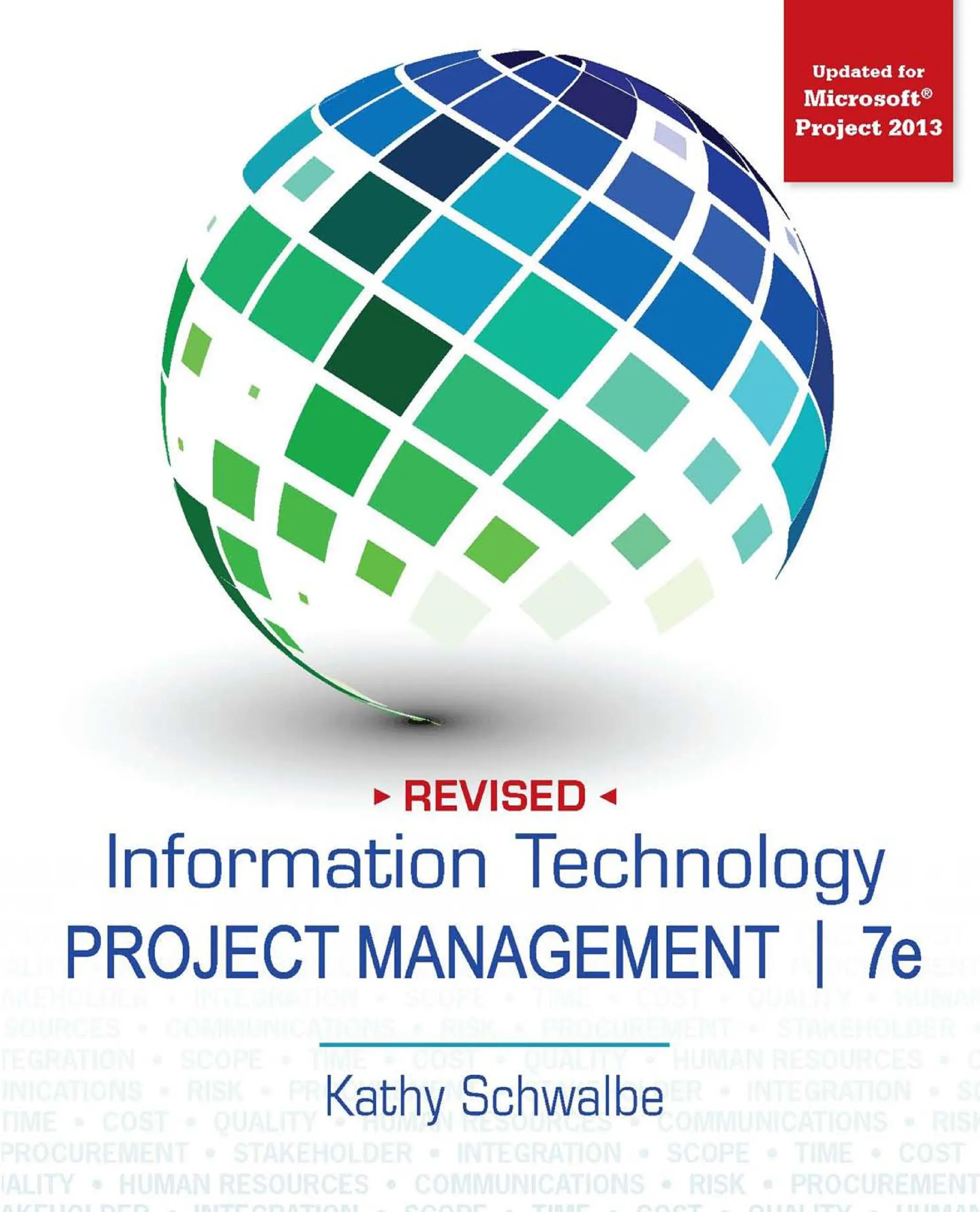
Information Technology Project Management 7th edition (eBook PDF)
1.
Information Technology ProjectManagement 7th
edition (eBook PDF) install download
https://ebookluna.com/product/information-technology-project-
management-7th-edition-ebook-pdf/
Download more ebook from https://ebookluna.com
2.
Instant digital products(PDF, ePub, MOBI) ready for you
Download now and discover formats that fit your needs...
Information Technology Project Management 7th edition
(eBook PDF)
https://ebookluna.com/product/information-technology-project-
management-7th-edition-ebook-pdf/
ebookluna.com
(Original PDF) Information Technology Project Management,
Revised 7th Edition
https://ebookluna.com/product/original-pdf-information-technology-
project-management-revised-7th-edition/
ebookluna.com
(eBook PDF) Information Technology Project Management 8th
Edition
https://ebookluna.com/product/ebook-pdf-information-technology-
project-management-8th-edition/
ebookluna.com
(eBook PDF) Information Technology Project Management, 5th
Edition
https://ebookluna.com/product/ebook-pdf-information-technology-
project-management-5th-edition/
ebookluna.com
3.
Information Technology ProjectManagement 9th Edition
Kathy Schwalbe - eBook PDF
https://ebookluna.com/download/information-technology-project-
management-ebook-pdf/
ebookluna.com
(eBook PDF) Information Technology Project Management 9th
Edition by Kathy Schwalbe
https://ebookluna.com/product/ebook-pdf-information-technology-
project-management-9th-edition-by-kathy-schwalbe/
ebookluna.com
(Original PDF) Successful Project Management 7th Edition
https://ebookluna.com/product/original-pdf-successful-project-
management-7th-edition/
ebookluna.com
(eBook PDF) Information Technology for Management Digital
10th
https://ebookluna.com/product/ebook-pdf-information-technology-for-
management-digital-10th/
ebookluna.com
(eBook PDF) Information Systems Project Management, A
Process Approach, Edition 2.0
https://ebookluna.com/product/ebook-pdf-information-systems-project-
management-a-process-approach-edition-2-0-2/
ebookluna.com
6.
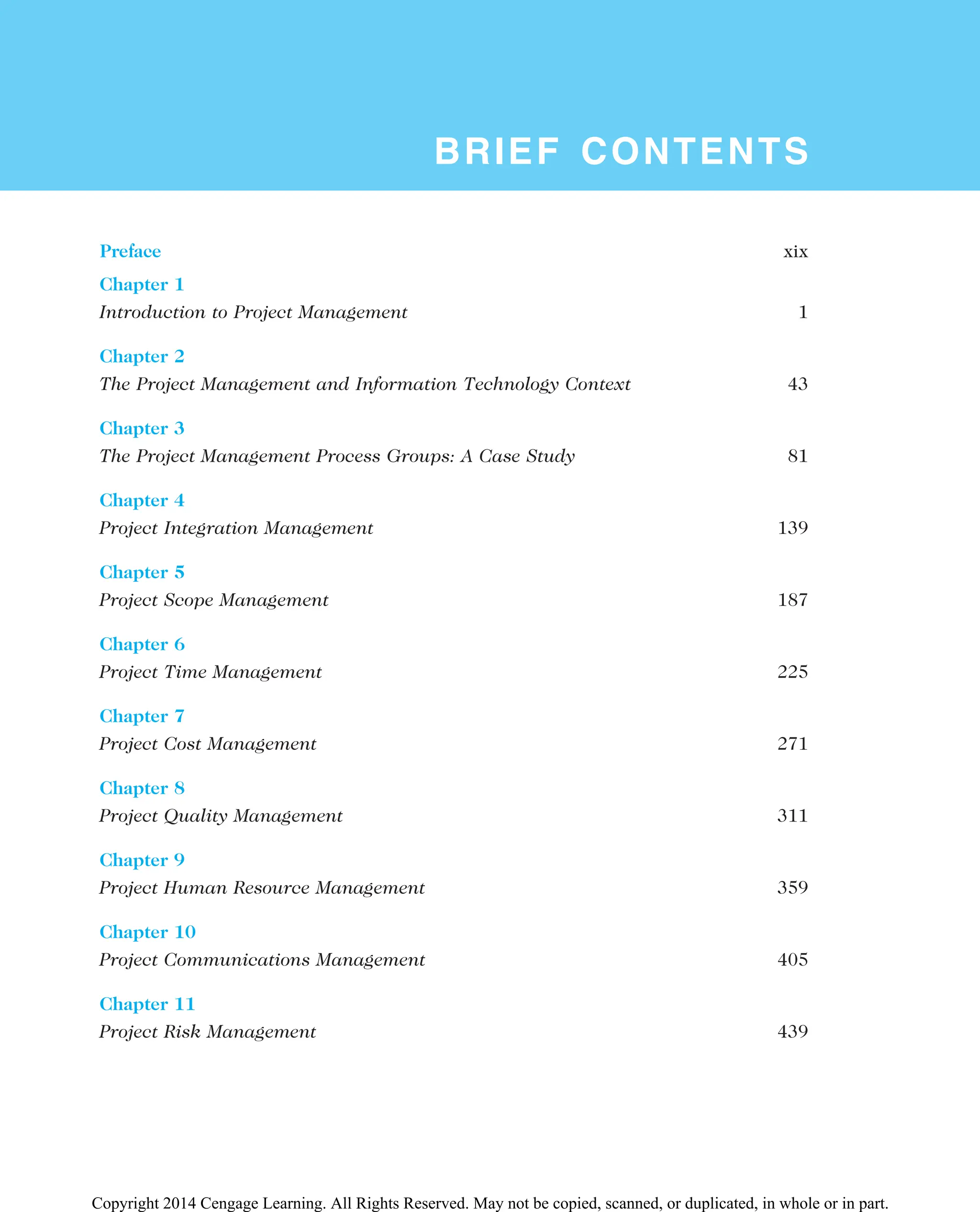
BRIEF CONTENTS
Preface xix
Chapter1
Introduction to Project Management 1
Chapter 2
The Project Management and Information Technology Context 43
Chapter 3
The Project Management Process Groups: A Case Study 81
Chapter 4
Project Integration Management 139
Chapter 5
Project Scope Management 187
Chapter 6
Project Time Management 225
Chapter 7
Project Cost Management 271
Chapter 8
Project Quality Management 311
Chapter 9
Project Human Resource Management 359
Chapter 10
Project Communications Management 405
Chapter 11
Project Risk Management 439
Copyright 2014 Cengage Learning. All Rights Reserved. May not be copied, scanned, or duplicated, in whole or in part.
7.
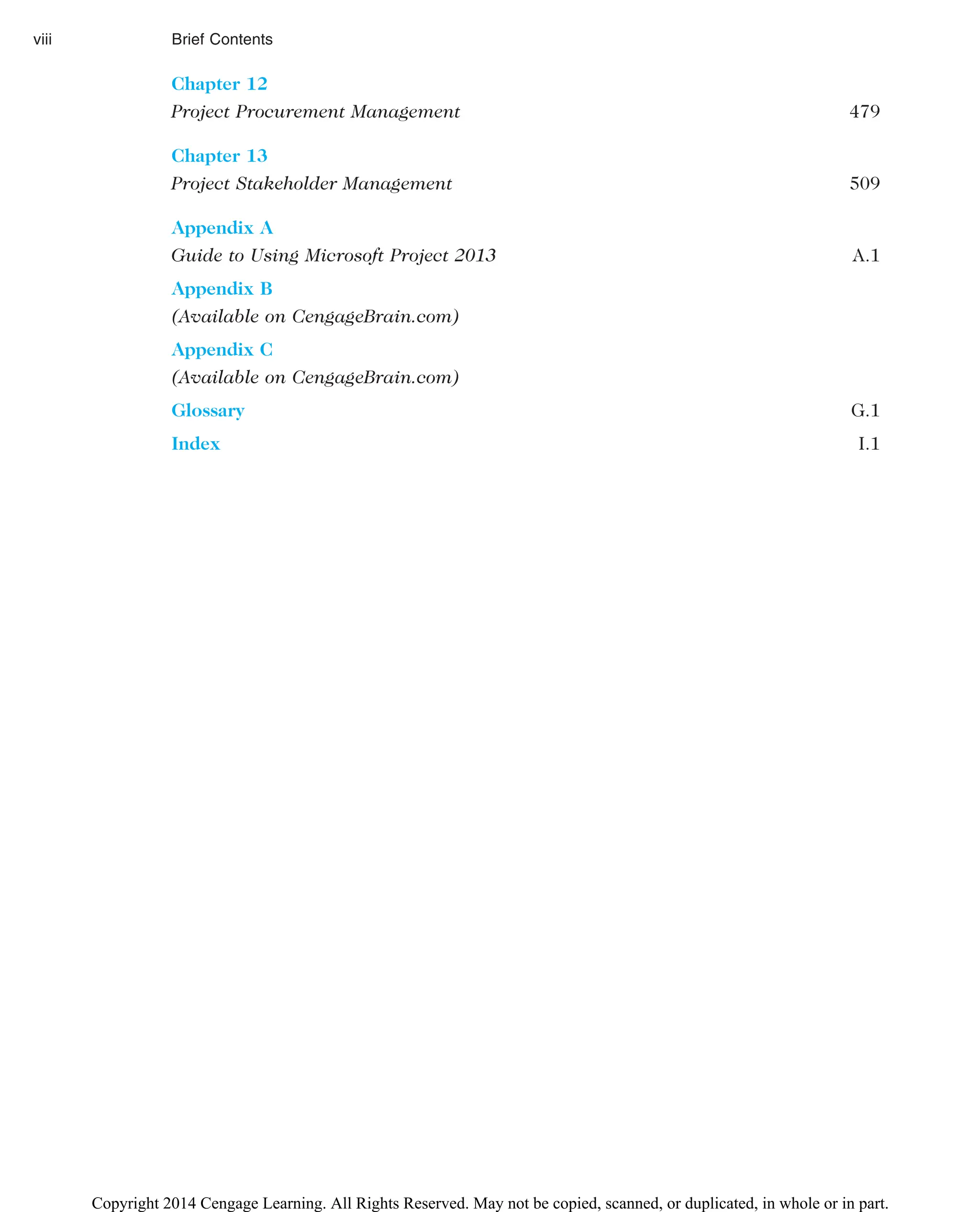
Chapter 12
Project ProcurementManagement 479
Chapter 13
Project Stakeholder Management 509
Appendix A
Guide to Using Microsoft Project 2013 A.1
Appendix B
(Available on CengageBrain.com)
Appendix C
(Available on CengageBrain.com)
Glossary G.1
Index I.1
viii Brief Contents
Copyright 2014 Cengage Learning. All Rights Reserved. May not be copied, scanned, or duplicated, in whole or in part.
8.
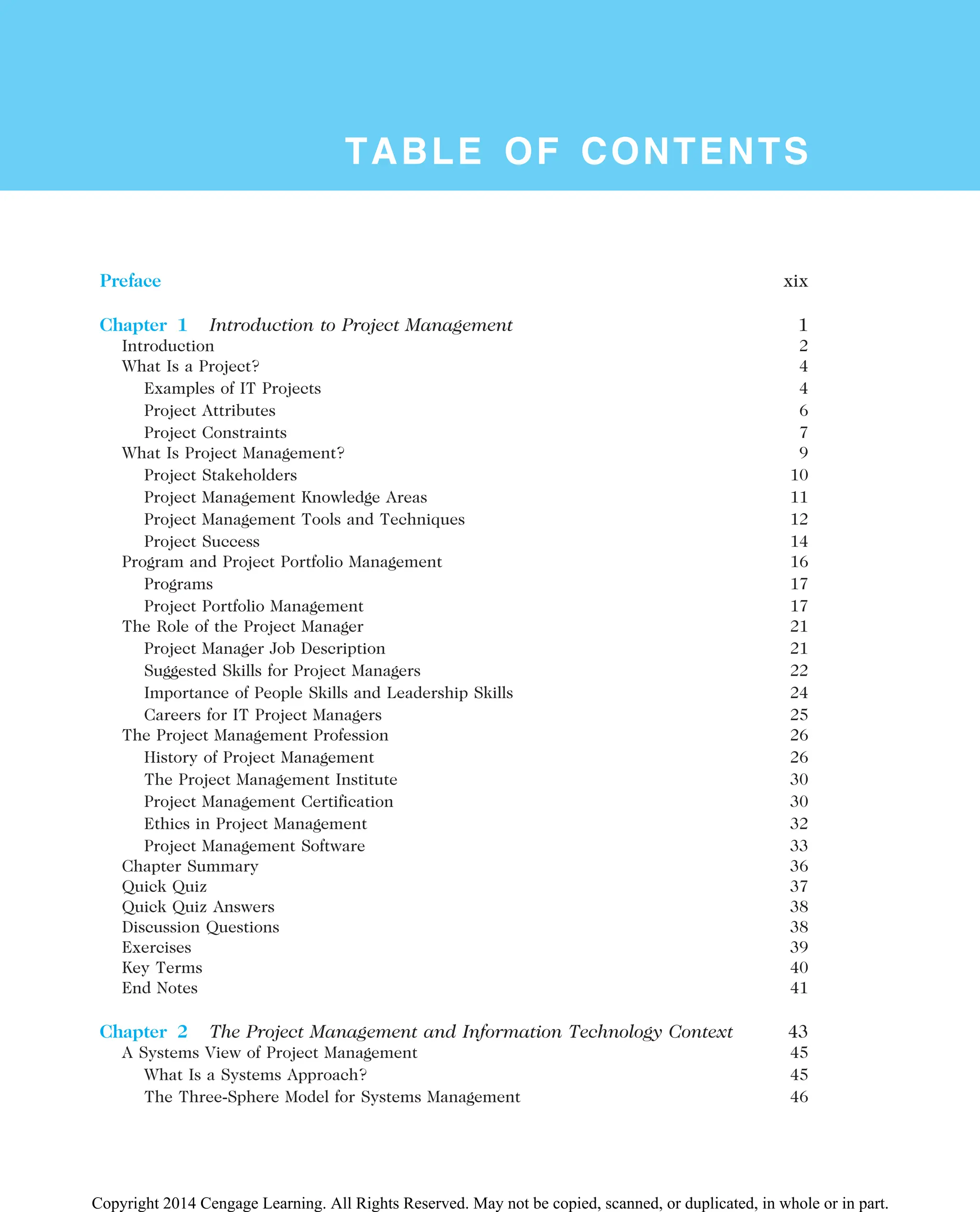
TABLE OF CONTENTS
Prefacexix
Chapter 1 Introduction to Project Management 1
Introduction 2
What Is a Project? 4
Examples of IT Projects 4
Project Attributes 6
Project Constraints 7
What Is Project Management? 9
Project Stakeholders 10
Project Management Knowledge Areas 11
Project Management Tools and Techniques 12
Project Success 14
Program and Project Portfolio Management 16
Programs 17
Project Portfolio Management 17
The Role of the Project Manager 21
Project Manager Job Description 21
Suggested Skills for Project Managers 22
Importance of People Skills and Leadership Skills 24
Careers for IT Project Managers 25
The Project Management Profession 26
History of Project Management 26
The Project Management Institute 30
Project Management Certification 30
Ethics in Project Management 32
Project Management Software 33
Chapter Summary 36
Quick Quiz 37
Quick Quiz Answers 38
Discussion Questions 38
Exercises 39
Key Terms 40
End Notes 41
Chapter 2 The Project Management and Information Technology Context 43
A Systems View of Project Management 45
What Is a Systems Approach? 45
The Three-Sphere Model for Systems Management 46
Copyright 2014 Cengage Learning. All Rights Reserved. May not be copied, scanned, or duplicated, in whole or in part.
9.
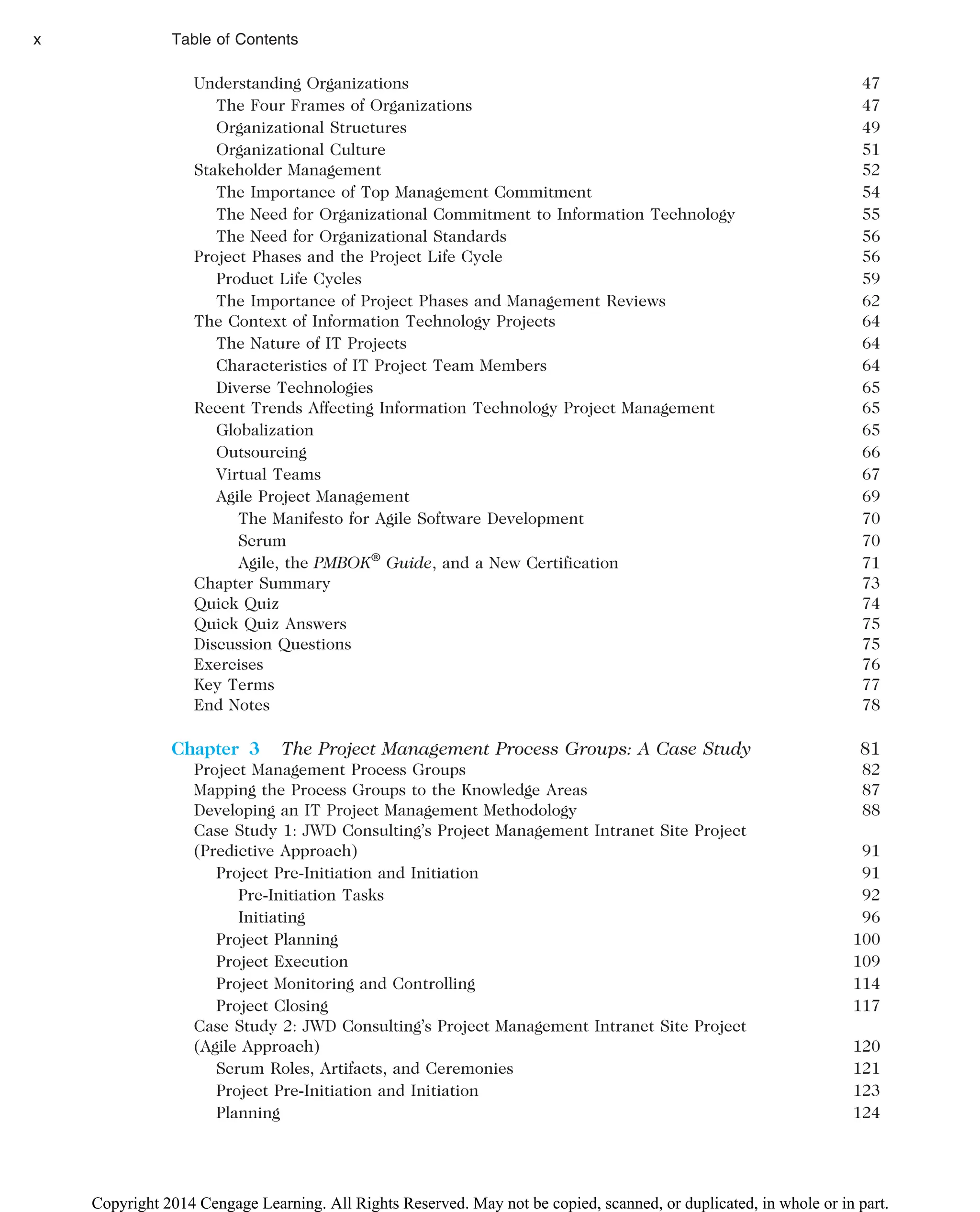
Understanding Organizations 47
TheFour Frames of Organizations 47
Organizational Structures 49
Organizational Culture 51
Stakeholder Management 52
The Importance of Top Management Commitment 54
The Need for Organizational Commitment to Information Technology 55
The Need for Organizational Standards 56
Project Phases and the Project Life Cycle 56
Product Life Cycles 59
The Importance of Project Phases and Management Reviews 62
The Context of Information Technology Projects 64
The Nature of IT Projects 64
Characteristics of IT Project Team Members 64
Diverse Technologies 65
Recent Trends Affecting Information Technology Project Management 65
Globalization 65
Outsourcing 66
Virtual Teams 67
Agile Project Management 69
The Manifesto for Agile Software Development 70
Scrum 70
Agile, the PMBOK®
Guide, and a New Certification 71
Chapter Summary 73
Quick Quiz 74
Quick Quiz Answers 75
Discussion Questions 75
Exercises 76
Key Terms 77
End Notes 78
Chapter 3 The Project Management Process Groups: A Case Study 81
Project Management Process Groups 82
Mapping the Process Groups to the Knowledge Areas 87
Developing an IT Project Management Methodology 88
Case Study 1: JWD Consulting’s Project Management Intranet Site Project
(Predictive Approach) 91
Project Pre-Initiation and Initiation 91
Pre-Initiation Tasks 92
Initiating 96
Project Planning 100
Project Execution 109
Project Monitoring and Controlling 114
Project Closing 117
Case Study 2: JWD Consulting’s Project Management Intranet Site Project
(Agile Approach) 120
Scrum Roles, Artifacts, and Ceremonies 121
Project Pre-Initiation and Initiation 123
Planning 124
x Table of Contents
Copyright 2014 Cengage Learning. All Rights Reserved. May not be copied, scanned, or duplicated, in whole or in part.
10.
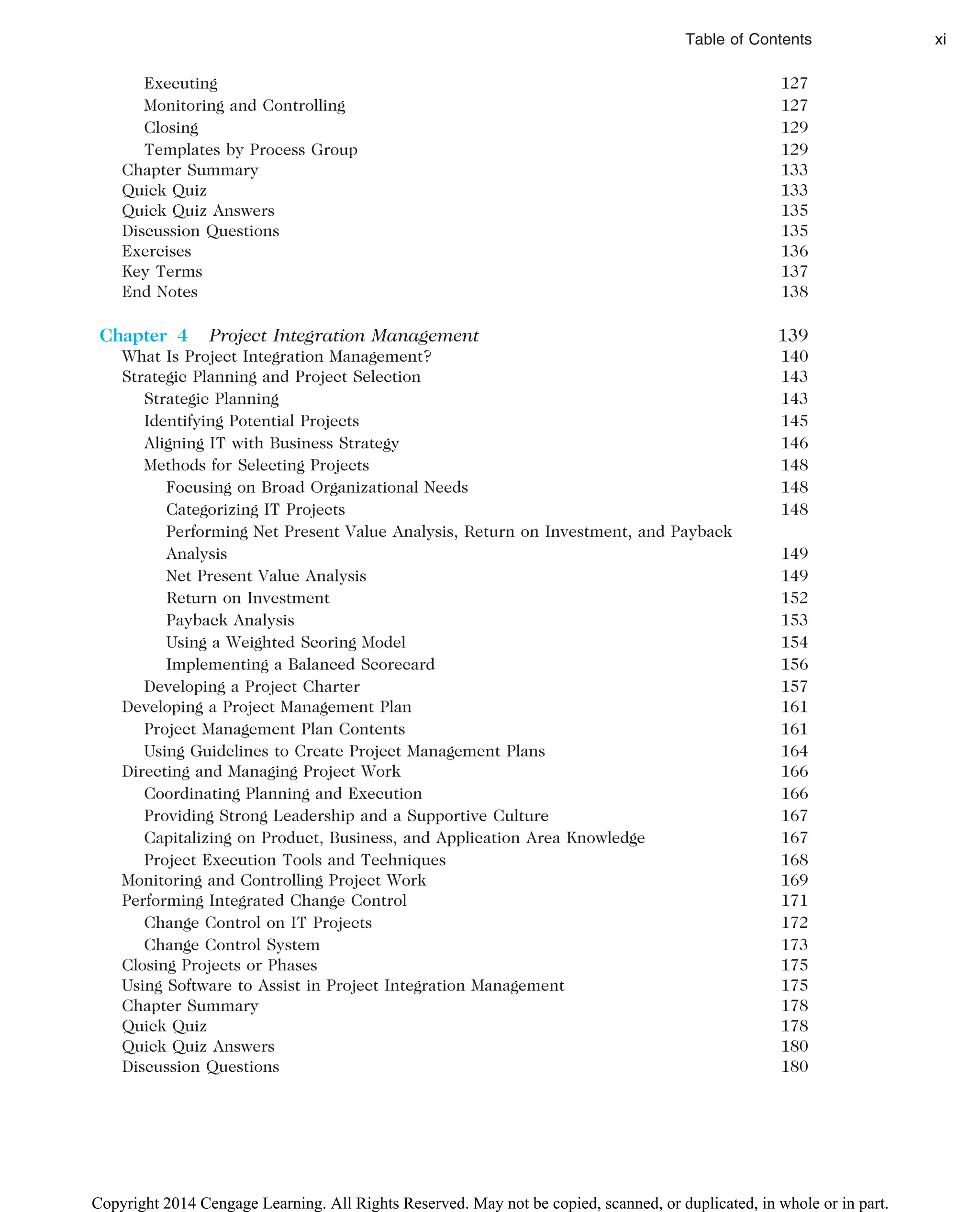
Executing 127
Monitoring andControlling 127
Closing 129
Templates by Process Group 129
Chapter Summary 133
Quick Quiz 133
Quick Quiz Answers 135
Discussion Questions 135
Exercises 136
Key Terms 137
End Notes 138
Chapter 4 Project Integration Management 139
What Is Project Integration Management? 140
Strategic Planning and Project Selection 143
Strategic Planning 143
Identifying Potential Projects 145
Aligning IT with Business Strategy 146
Methods for Selecting Projects 148
Focusing on Broad Organizational Needs 148
Categorizing IT Projects 148
Performing Net Present Value Analysis, Return on Investment, and Payback
Analysis 149
Net Present Value Analysis 149
Return on Investment 152
Payback Analysis 153
Using a Weighted Scoring Model 154
Implementing a Balanced Scorecard 156
Developing a Project Charter 157
Developing a Project Management Plan 161
Project Management Plan Contents 161
Using Guidelines to Create Project Management Plans 164
Directing and Managing Project Work 166
Coordinating Planning and Execution 166
Providing Strong Leadership and a Supportive Culture 167
Capitalizing on Product, Business, and Application Area Knowledge 167
Project Execution Tools and Techniques 168
Monitoring and Controlling Project Work 169
Performing Integrated Change Control 171
Change Control on IT Projects 172
Change Control System 173
Closing Projects or Phases 175
Using Software to Assist in Project Integration Management 175
Chapter Summary 178
Quick Quiz 178
Quick Quiz Answers 180
Discussion Questions 180
Table of Contents xi
Copyright 2014 Cengage Learning. All Rights Reserved. May not be copied, scanned, or duplicated, in whole or in part.
11.
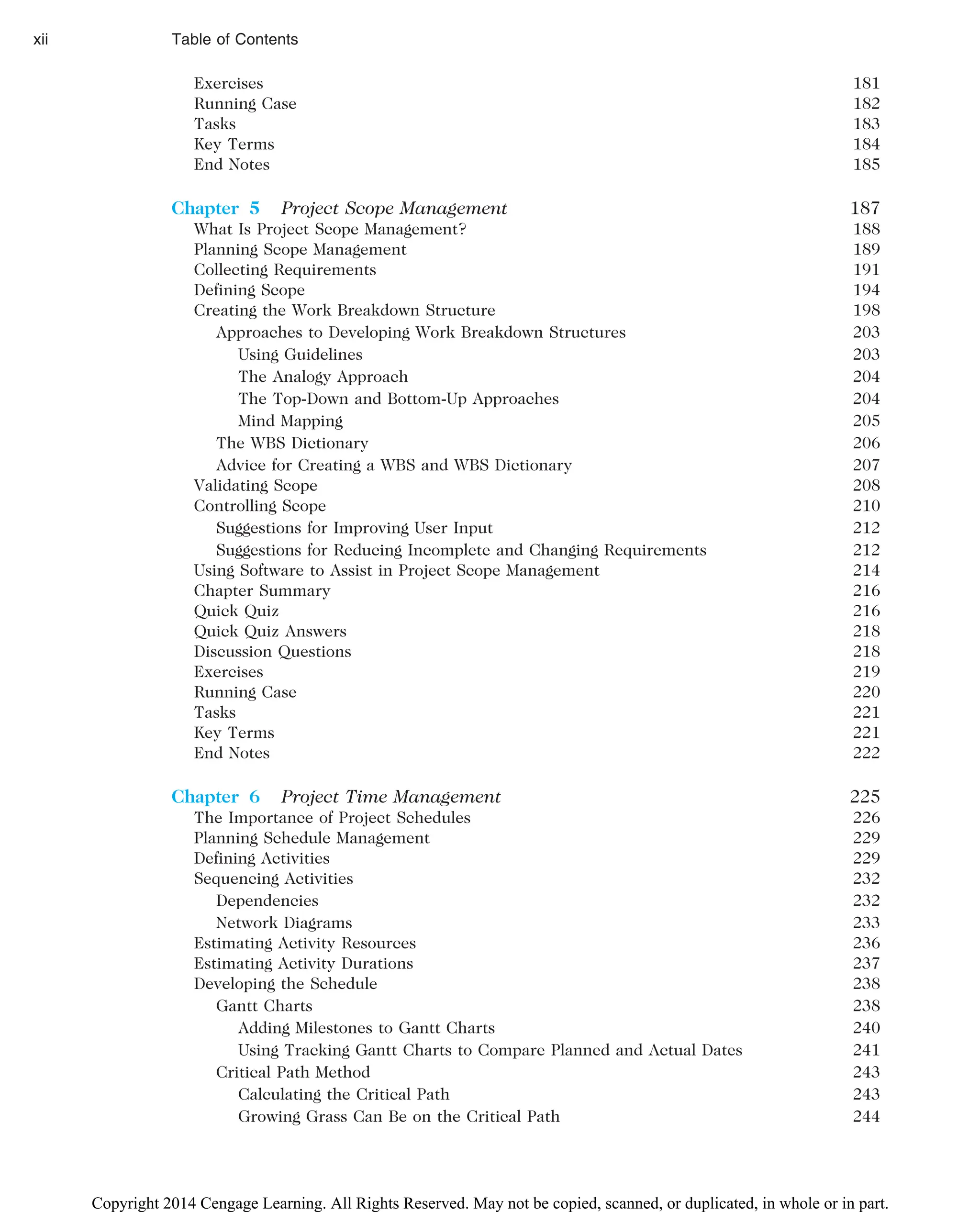
Exercises 181
Running Case182
Tasks 183
Key Terms 184
End Notes 185
Chapter 5 Project Scope Management 187
What Is Project Scope Management? 188
Planning Scope Management 189
Collecting Requirements 191
Defining Scope 194
Creating the Work Breakdown Structure 198
Approaches to Developing Work Breakdown Structures 203
Using Guidelines 203
The Analogy Approach 204
The Top-Down and Bottom-Up Approaches 204
Mind Mapping 205
The WBS Dictionary 206
Advice for Creating a WBS and WBS Dictionary 207
Validating Scope 208
Controlling Scope 210
Suggestions for Improving User Input 212
Suggestions for Reducing Incomplete and Changing Requirements 212
Using Software to Assist in Project Scope Management 214
Chapter Summary 216
Quick Quiz 216
Quick Quiz Answers 218
Discussion Questions 218
Exercises 219
Running Case 220
Tasks 221
Key Terms 221
End Notes 222
Chapter 6 Project Time Management 225
The Importance of Project Schedules 226
Planning Schedule Management 229
Defining Activities 229
Sequencing Activities 232
Dependencies 232
Network Diagrams 233
Estimating Activity Resources 236
Estimating Activity Durations 237
Developing the Schedule 238
Gantt Charts 238
Adding Milestones to Gantt Charts 240
Using Tracking Gantt Charts to Compare Planned and Actual Dates 241
Critical Path Method 243
Calculating the Critical Path 243
Growing Grass Can Be on the Critical Path 244
xii Table of Contents
Copyright 2014 Cengage Learning. All Rights Reserved. May not be copied, scanned, or duplicated, in whole or in part.
12.
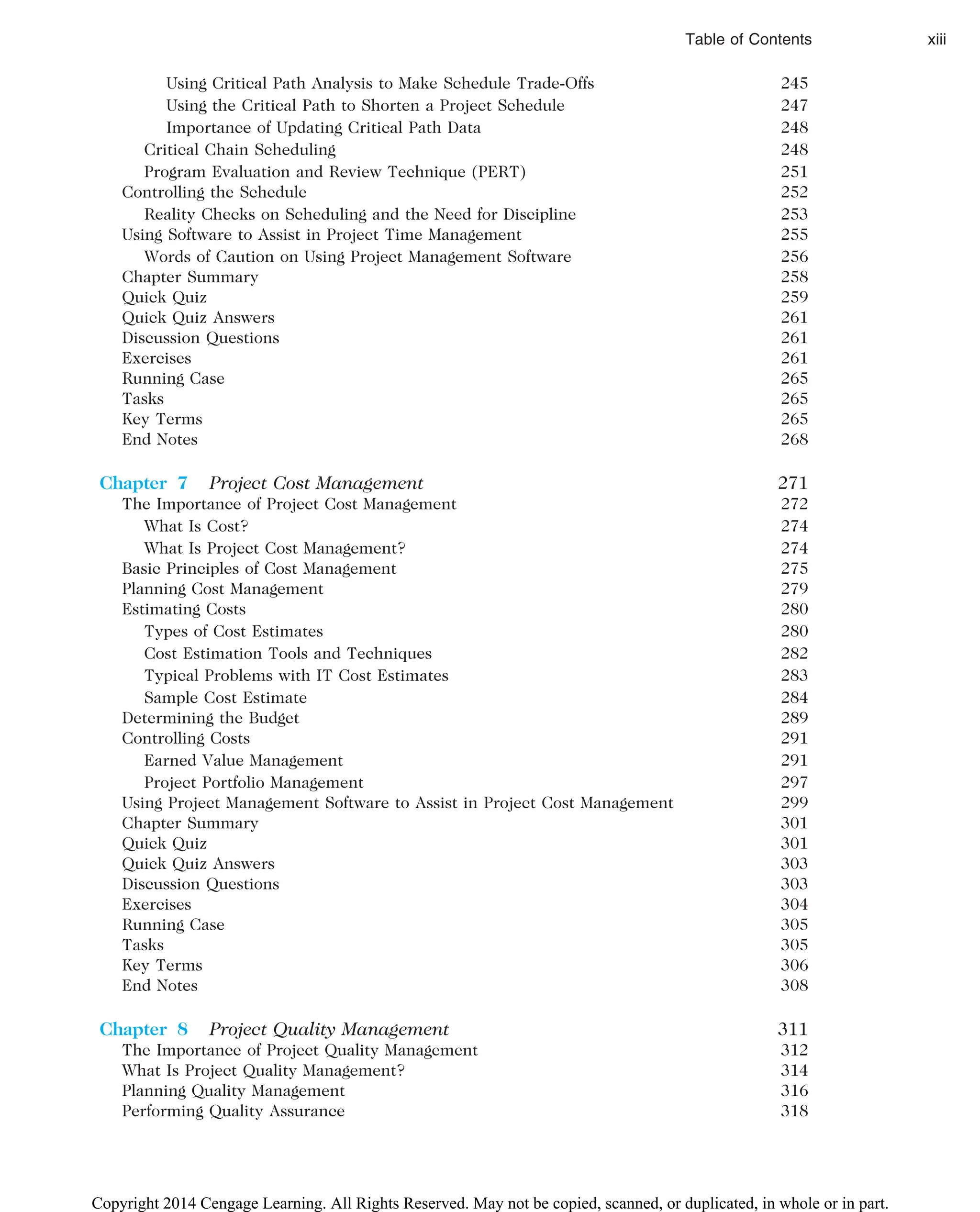
Using Critical PathAnalysis to Make Schedule Trade-Offs 245
Using the Critical Path to Shorten a Project Schedule 247
Importance of Updating Critical Path Data 248
Critical Chain Scheduling 248
Program Evaluation and Review Technique (PERT) 251
Controlling the Schedule 252
Reality Checks on Scheduling and the Need for Discipline 253
Using Software to Assist in Project Time Management 255
Words of Caution on Using Project Management Software 256
Chapter Summary 258
Quick Quiz 259
Quick Quiz Answers 261
Discussion Questions 261
Exercises 261
Running Case 265
Tasks 265
Key Terms 265
End Notes 268
Chapter 7 Project Cost Management 271
The Importance of Project Cost Management 272
What Is Cost? 274
What Is Project Cost Management? 274
Basic Principles of Cost Management 275
Planning Cost Management 279
Estimating Costs 280
Types of Cost Estimates 280
Cost Estimation Tools and Techniques 282
Typical Problems with IT Cost Estimates 283
Sample Cost Estimate 284
Determining the Budget 289
Controlling Costs 291
Earned Value Management 291
Project Portfolio Management 297
Using Project Management Software to Assist in Project Cost Management 299
Chapter Summary 301
Quick Quiz 301
Quick Quiz Answers 303
Discussion Questions 303
Exercises 304
Running Case 305
Tasks 305
Key Terms 306
End Notes 308
Chapter 8 Project Quality Management 311
The Importance of Project Quality Management 312
What Is Project Quality Management? 314
Planning Quality Management 316
Performing Quality Assurance 318
Table of Contents xiii
Copyright 2014 Cengage Learning. All Rights Reserved. May not be copied, scanned, or duplicated, in whole or in part.
13.
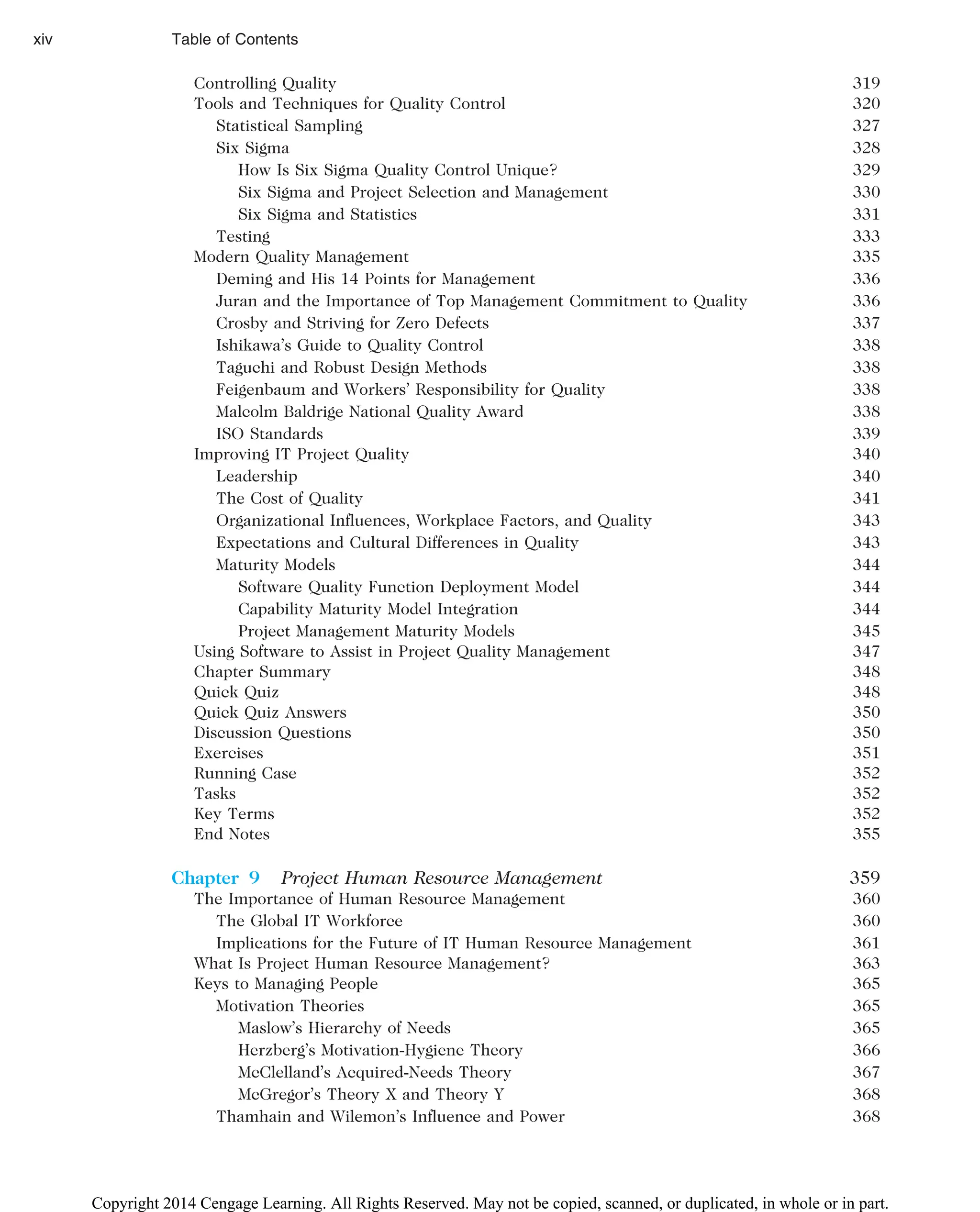
Controlling Quality 319
Toolsand Techniques for Quality Control 320
Statistical Sampling 327
Six Sigma 328
How Is Six Sigma Quality Control Unique? 329
Six Sigma and Project Selection and Management 330
Six Sigma and Statistics 331
Testing 333
Modern Quality Management 335
Deming and His 14 Points for Management 336
Juran and the Importance of Top Management Commitment to Quality 336
Crosby and Striving for Zero Defects 337
Ishikawa’s Guide to Quality Control 338
Taguchi and Robust Design Methods 338
Feigenbaum and Workers’ Responsibility for Quality 338
Malcolm Baldrige National Quality Award 338
ISO Standards 339
Improving IT Project Quality 340
Leadership 340
The Cost of Quality 341
Organizational Influences, Workplace Factors, and Quality 343
Expectations and Cultural Differences in Quality 343
Maturity Models 344
Software Quality Function Deployment Model 344
Capability Maturity Model Integration 344
Project Management Maturity Models 345
Using Software to Assist in Project Quality Management 347
Chapter Summary 348
Quick Quiz 348
Quick Quiz Answers 350
Discussion Questions 350
Exercises 351
Running Case 352
Tasks 352
Key Terms 352
End Notes 355
Chapter 9 Project Human Resource Management 359
The Importance of Human Resource Management 360
The Global IT Workforce 360
Implications for the Future of IT Human Resource Management 361
What Is Project Human Resource Management? 363
Keys to Managing People 365
Motivation Theories 365
Maslow’s Hierarchy of Needs 365
Herzberg’s Motivation-Hygiene Theory 366
McClelland’s Acquired-Needs Theory 367
McGregor’s Theory X and Theory Y 368
Thamhain and Wilemon’s Influence and Power 368
xiv Table of Contents
Copyright 2014 Cengage Learning. All Rights Reserved. May not be copied, scanned, or duplicated, in whole or in part.
14.
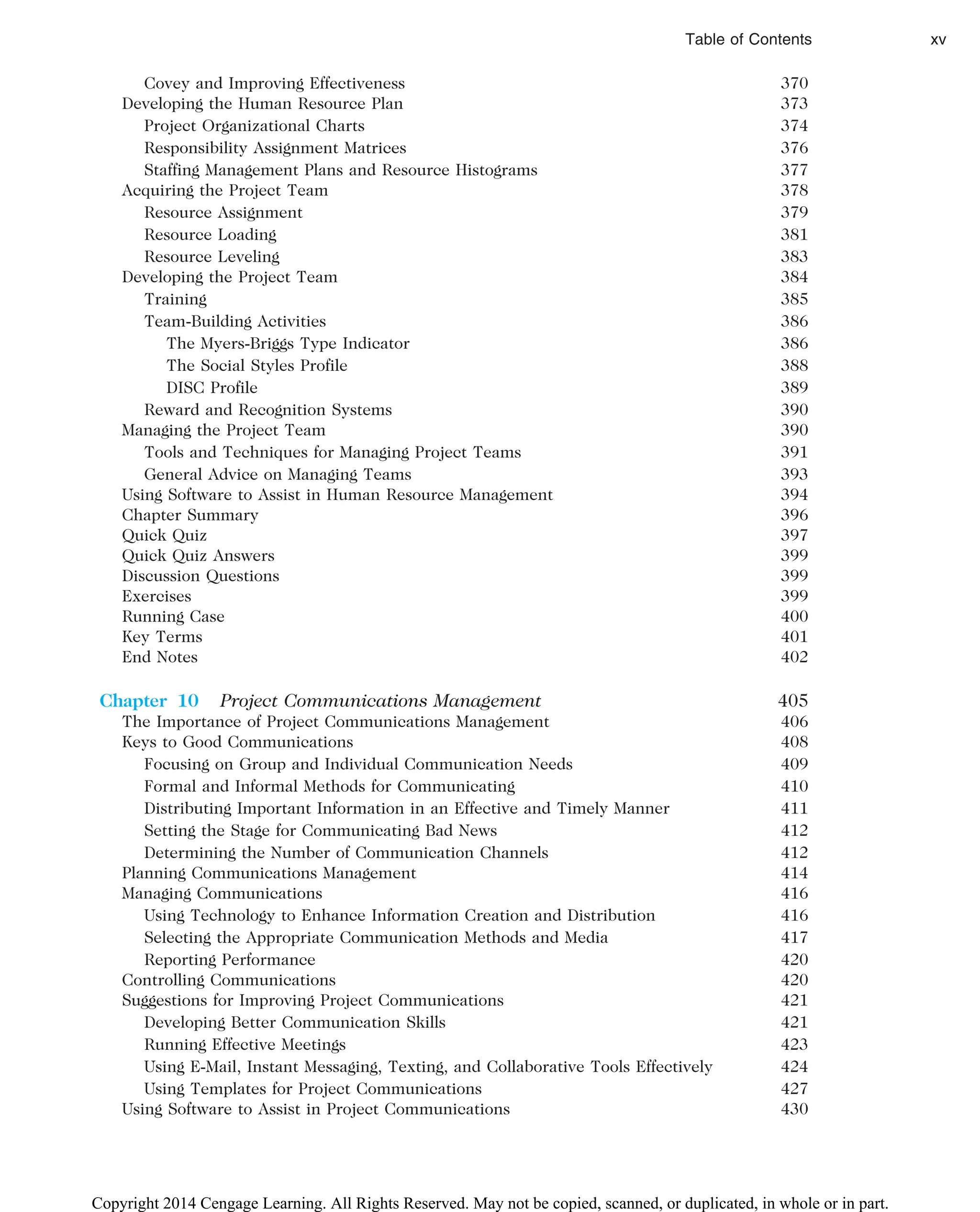
Covey and ImprovingEffectiveness 370
Developing the Human Resource Plan 373
Project Organizational Charts 374
Responsibility Assignment Matrices 376
Staffing Management Plans and Resource Histograms 377
Acquiring the Project Team 378
Resource Assignment 379
Resource Loading 381
Resource Leveling 383
Developing the Project Team 384
Training 385
Team-Building Activities 386
The Myers-Briggs Type Indicator 386
The Social Styles Profile 388
DISC Profile 389
Reward and Recognition Systems 390
Managing the Project Team 390
Tools and Techniques for Managing Project Teams 391
General Advice on Managing Teams 393
Using Software to Assist in Human Resource Management 394
Chapter Summary 396
Quick Quiz 397
Quick Quiz Answers 399
Discussion Questions 399
Exercises 399
Running Case 400
Key Terms 401
End Notes 402
Chapter 10 Project Communications Management 405
The Importance of Project Communications Management 406
Keys to Good Communications 408
Focusing on Group and Individual Communication Needs 409
Formal and Informal Methods for Communicating 410
Distributing Important Information in an Effective and Timely Manner 411
Setting the Stage for Communicating Bad News 412
Determining the Number of Communication Channels 412
Planning Communications Management 414
Managing Communications 416
Using Technology to Enhance Information Creation and Distribution 416
Selecting the Appropriate Communication Methods and Media 417
Reporting Performance 420
Controlling Communications 420
Suggestions for Improving Project Communications 421
Developing Better Communication Skills 421
Running Effective Meetings 423
Using E-Mail, Instant Messaging, Texting, and Collaborative Tools Effectively 424
Using Templates for Project Communications 427
Using Software to Assist in Project Communications 430
Table of Contents xv
Copyright 2014 Cengage Learning. All Rights Reserved. May not be copied, scanned, or duplicated, in whole or in part.
15.
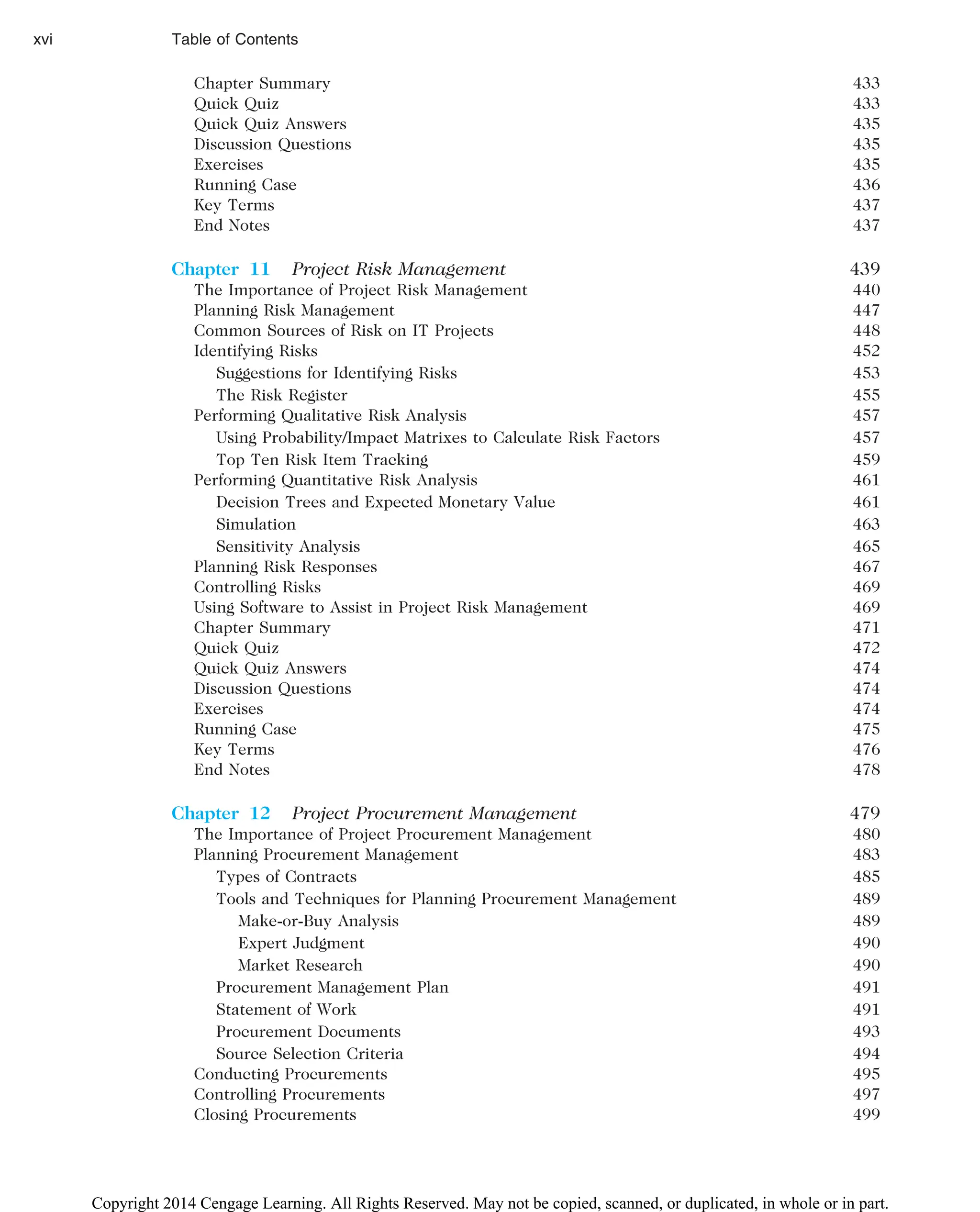
Chapter Summary 433
QuickQuiz 433
Quick Quiz Answers 435
Discussion Questions 435
Exercises 435
Running Case 436
Key Terms 437
End Notes 437
Chapter 11 Project Risk Management 439
The Importance of Project Risk Management 440
Planning Risk Management 447
Common Sources of Risk on IT Projects 448
Identifying Risks 452
Suggestions for Identifying Risks 453
The Risk Register 455
Performing Qualitative Risk Analysis 457
Using Probability/Impact Matrixes to Calculate Risk Factors 457
Top Ten Risk Item Tracking 459
Performing Quantitative Risk Analysis 461
Decision Trees and Expected Monetary Value 461
Simulation 463
Sensitivity Analysis 465
Planning Risk Responses 467
Controlling Risks 469
Using Software to Assist in Project Risk Management 469
Chapter Summary 471
Quick Quiz 472
Quick Quiz Answers 474
Discussion Questions 474
Exercises 474
Running Case 475
Key Terms 476
End Notes 478
Chapter 12 Project Procurement Management 479
The Importance of Project Procurement Management 480
Planning Procurement Management 483
Types of Contracts 485
Tools and Techniques for Planning Procurement Management 489
Make-or-Buy Analysis 489
Expert Judgment 490
Market Research 490
Procurement Management Plan 491
Statement of Work 491
Procurement Documents 493
Source Selection Criteria 494
Conducting Procurements 495
Controlling Procurements 497
Closing Procurements 499
xvi Table of Contents
Copyright 2014 Cengage Learning. All Rights Reserved. May not be copied, scanned, or duplicated, in whole or in part.
16.
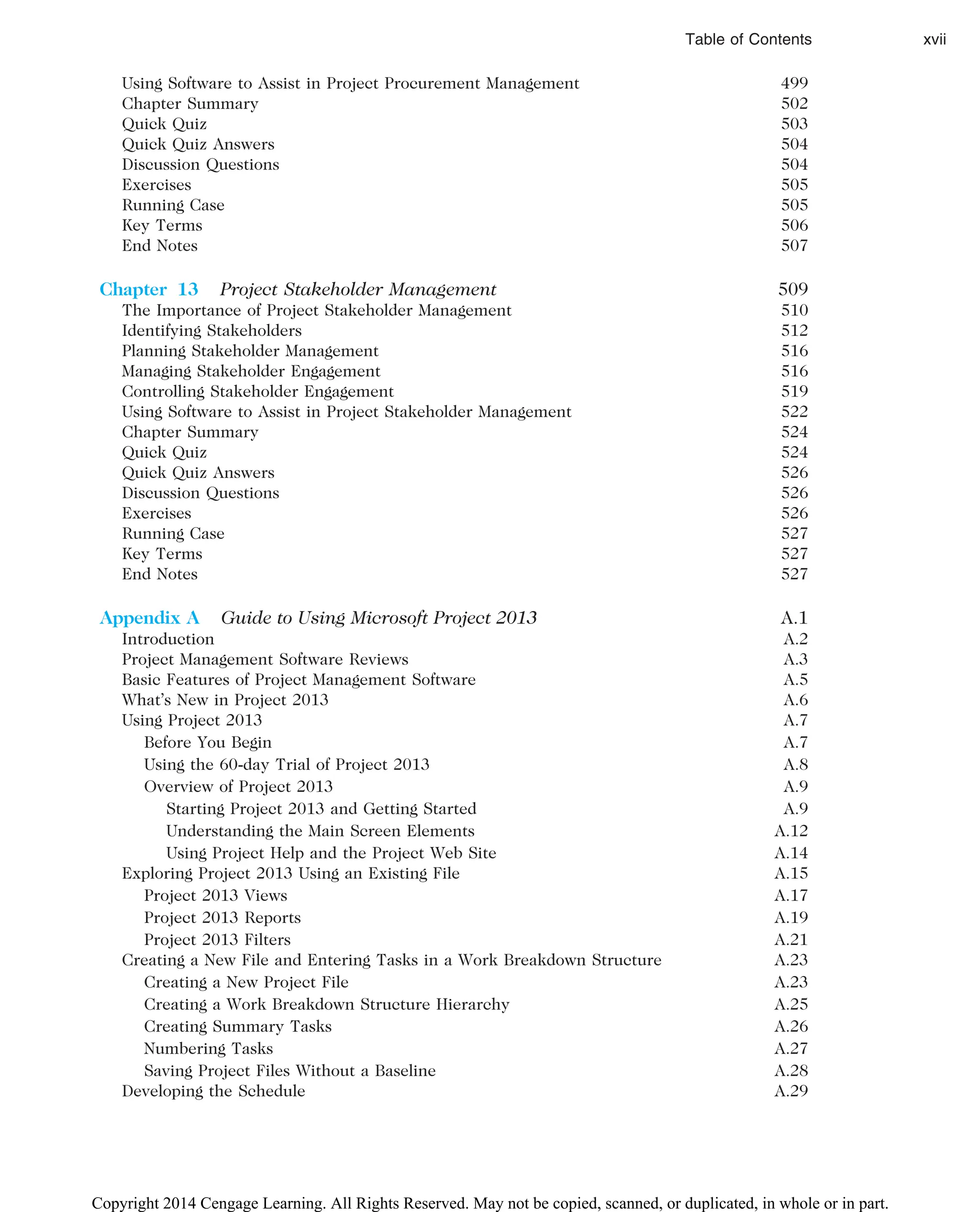
Using Software toAssist in Project Procurement Management 499
Chapter Summary 502
Quick Quiz 503
Quick Quiz Answers 504
Discussion Questions 504
Exercises 505
Running Case 505
Key Terms 506
End Notes 507
Chapter 13 Project Stakeholder Management 509
The Importance of Project Stakeholder Management 510
Identifying Stakeholders 512
Planning Stakeholder Management 516
Managing Stakeholder Engagement 516
Controlling Stakeholder Engagement 519
Using Software to Assist in Project Stakeholder Management 522
Chapter Summary 524
Quick Quiz 524
Quick Quiz Answers 526
Discussion Questions 526
Exercises 526
Running Case 527
Key Terms 527
End Notes 527
Appendix A Guide to Using Microsoft Project 2013 A.1
Introduction A.2
Project Management Software Reviews A.3
Basic Features of Project Management Software A.5
What’s New in Project 2013 A.6
Using Project 2013 A.7
Before You Begin A.7
Using the 60-day Trial of Project 2013 A.8
Overview of Project 2013 A.9
Starting Project 2013 and Getting Started A.9
Understanding the Main Screen Elements A.12
Using Project Help and the Project Web Site A.14
Exploring Project 2013 Using an Existing File A.15
Project 2013 Views A.17
Project 2013 Reports A.19
Project 2013 Filters A.21
Creating a New File and Entering Tasks in a Work Breakdown Structure A.23
Creating a New Project File A.23
Creating a Work Breakdown Structure Hierarchy A.25
Creating Summary Tasks A.26
Numbering Tasks A.27
Saving Project Files Without a Baseline A.28
Developing the Schedule A.29
Table of Contents xvii
Copyright 2014 Cengage Learning. All Rights Reserved. May not be copied, scanned, or duplicated, in whole or in part.
17.
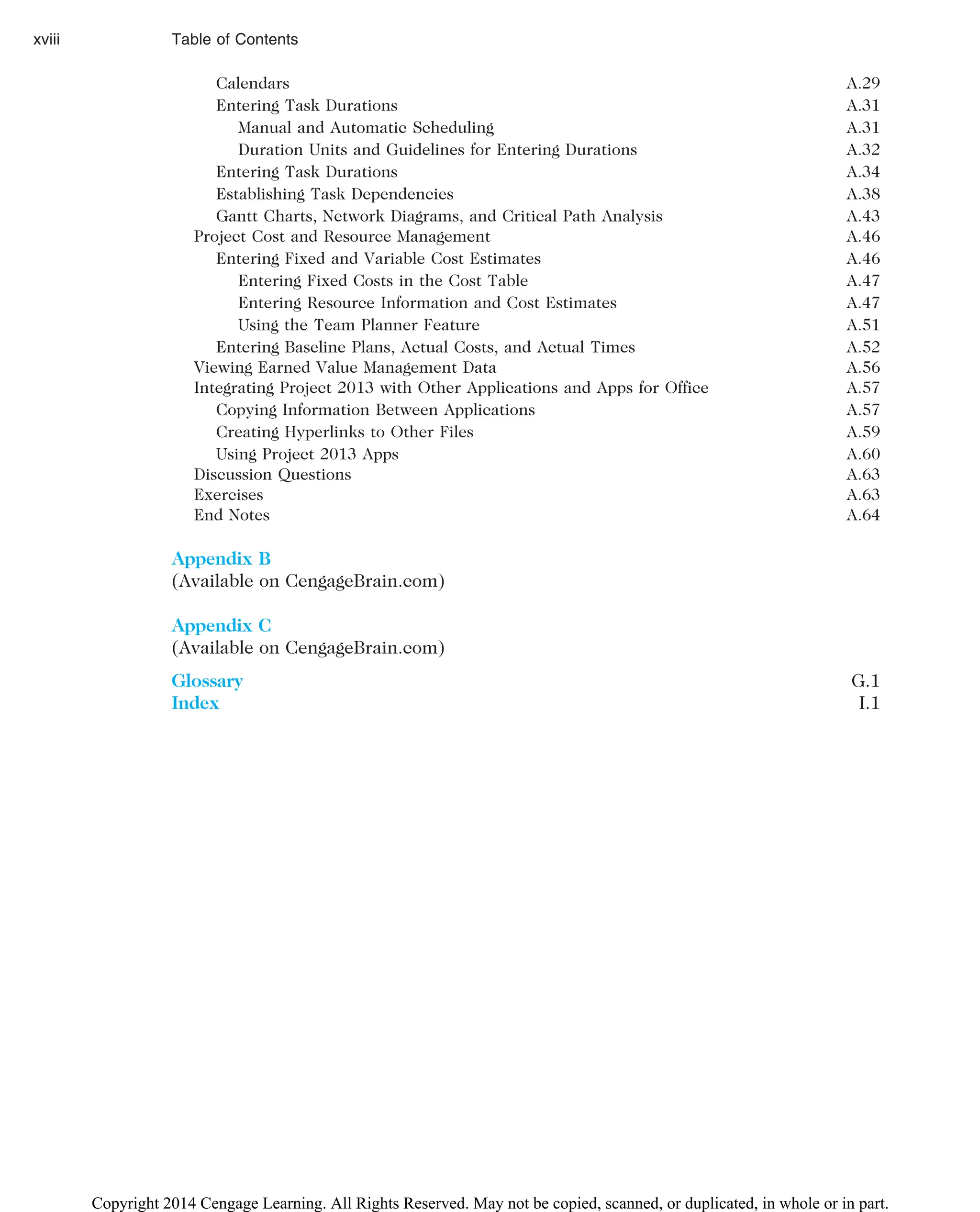
Calendars A.29
Entering TaskDurations A.31
Manual and Automatic Scheduling A.31
Duration Units and Guidelines for Entering Durations A.32
Entering Task Durations A.34
Establishing Task Dependencies A.38
Gantt Charts, Network Diagrams, and Critical Path Analysis A.43
Project Cost and Resource Management A.46
Entering Fixed and Variable Cost Estimates A.46
Entering Fixed Costs in the Cost Table A.47
Entering Resource Information and Cost Estimates A.47
Using the Team Planner Feature A.51
Entering Baseline Plans, Actual Costs, and Actual Times A.52
Viewing Earned Value Management Data A.56
Integrating Project 2013 with Other Applications and Apps for Office A.57
Copying Information Between Applications A.57
Creating Hyperlinks to Other Files A.59
Using Project 2013 Apps A.60
Discussion Questions A.63
Exercises A.63
End Notes A.64
Appendix B
(Available on CengageBrain.com)
Appendix C
(Available on CengageBrain.com)
Glossary G.1
Index I.1
xviii Table of Contents
Copyright 2014 Cengage Learning. All Rights Reserved. May not be copied, scanned, or duplicated, in whole or in part.
18.
PREFACE
The future ofmany organizations depends on their ability to harness the power of
information technology, and good project managers continue to be in high demand.
Colleges have responded to this need by establishing courses in project management
and making them part of the information technology, management, engineering, and
other curricula. Corporations are investing in continuing education to help develop
effective project managers and project teams. This text provides a much-needed
framework for teaching courses in project management, especially those that
emphasize managing information technology projects. The first six editions of this
text were extremely well received by people in academia and the workplace. The
Seventh Edition builds on the strengths of the previous editions and adds new,
important information and features.
It’s impossible to read a newspaper, magazine, or Web page without hearing about
the impact of information technology on our society. Information is traveling faster
and being shared by more people than ever before. You can buy just about anything
online, surf the Web on a mobile phone, or use a wireless Internet connection at your
local coffee shop. Companies have linked their systems together to help them fill
orders on time and better serve their customers. Software companies are continually
developing new products to help streamline our work and get better results. When
technology works well, it is almost invisible. But did it ever occur to you to ask,
“Who makes these complex technologies and systems happen?”
Because you’re reading this text, you must have an interest in the “behind-the-
scenes” aspects of technology. If I’ve done my job well, you’ll begin to see the many
innovations society is currently enjoying as the result of thousands of successful
information technology projects. In this text, you’ll read about IT projects around the
world that went well, including Mittal Steel Poland’s Implementation of SAP that uni-
fied IT systems to improve business and financial processes; Dell Earth and other
green computing projects that save energy and millions of dollars; Six Sigma projects
such as the project to improve case load management at Baptist St. Anthony’s
Hospital in Amarillo, Texas; the systems infrastructure project at the Boots Company
in the United Kingdom that takes advantage of supplier competition to cut costs and
improve services; and many more. Of course, not all projects are successful. Factors
such as time, money, and unrealistic expectations, among many others, can sabotage
a promising effort if it is not properly managed. In this text, you’ll also learn from the
mistakes made on many projects that were not successful. I have written this book in
an effort to educate you, tomorrow’s project managers, about what will help make a
project succeed—and what can make it fail. You’ll also see how projects are used in
everyday media, such as television and film, and how companies use best practices in
project management. Many readers tell me how much they enjoy reading these real-
world examples in the What Went Right?, What Went Wrong?, Media Snapshot, and
Best Practice features. As practitioners know, there is no “one size fits all” solution to
Copyright 2014 Cengage Learning. All Rights Reserved. May not be copied, scanned, or duplicated, in whole or in part.
19.
managing projects. Byseeing how different organizations successfully implement
project management, you can help your organization do the same.
Although project management has been an established field for many years,
managing information technology projects requires ideas and information that go
beyond standard project management. For example, many information technology
projects fail because of a lack of user input, incomplete and changing requirements,
and a lack of executive support. This book includes suggestions for dealing with these
issues. New technologies can also aid in managing information technology projects,
and examples of using software to assist in project management are included
throughout the book.
Information Technology Project Management, REVISED Seventh Edition, is the
only textbook to apply all 10 project management knowledge areas and all five pro-
cess groups to information technology projects. As you will learn, the project man-
agement knowledge areas are project integration, scope, time, cost, quality, human
resource, communications, risk, procurement, and stakeholder management. The
five process groups are initiating, planning, executing, monitoring and controlling,
and closing.
This text builds on the PMBOK® Guide, Fifth Edition, an American National
Standard, to provide a solid framework and context for managing information tech-
nology projects. It also includes an appendix, Guide to Using Microsoft Project 2013,
that many readers find invaluable. A second appendix provides advice on earning and
maintaining Project Management Professional (PMP) certification from the Project
Management Institute (PMI) as well as information on other certification programs,
such as CompTIA’s Project certification. A third appendix provides additional case
studies and information on using simulation and mind-mapping software to help
readers apply their project management skills.
Information Technology Project Management, REVISED Seventh Edition, pro-
vides practical lessons in project management for students and practitioners alike. By
weaving together theory and practice, this text presents an understandable, integrated
view of the many concepts, skills, tools, and techniques of information technology
project management. The comprehensive design of the text provides a strong founda-
tion for students and practitioners in project management.
N E W T O T H E R E V I S E D S E V E N T H E D I T I O N
Building on the success of the previous editions, Information Technology Project
Management, REVISED Seventh Edition, introduces a uniquely effective combination
of features. The main changes in the Seventh Edition include the following:
• The key update for the REVISED Seventh Edition is that Appendix A has
been updated for Microsoft Project 2013.
• Several changes were made to synchronize the Seventh Edition with the
PMBOK® Guide, Fifth Edition. Changes were made based on the exposure
draft released in February 2012. The biggest change was the addition of a
tenth knowledge area, Project Stakeholder Management. This text includes a
new chapter to address this important topic.
• Includes additional information on agile project management. Chapter 2
includes general information on this popular concept, and Chapter 3 provides
a second case study illustrating the outputs produced for the JWD Consulting
xx Preface
Copyright 2014 Cengage Learning. All Rights Reserved. May not be copied, scanned, or duplicated, in whole or in part.
20.
project when usingan agile approach. For example, you can see a sample
product backlog, a sprint backlog, a burndown chart, and key artifacts or
outputs produced when using Scrum, the most popular agile method.
• Appendix C, Additional Cases and Software, provides information about using
several simulation software tools. Several suppliers offer discounts to users of this
text. A new section provides instructions for accessing a special 60-day trial of
MindView Business software. This software provides the capability to create mind
maps, a powerful tool for creating a SWOT analysis or work breakdown structure.
The software also allows users to convert a mind map into a Gantt chart.
• A new feature, Global Issues, provides examples of how project management
concepts and practices affect people around the globe.
• Updated examples are provided throughout the text. You’ll notice several new
examples in the Seventh Edition that explain recent events in managing real
information technology projects. Several of the What Went Right?, What
Went Wrong?, Media Snapshot, and Best Practice examples have been
updated to keep you current. Additional examples and results of new studies
are included throughout the text, with appropriate citations.
• User feedback is incorporated. Based on feedback from reviewers, students,
instructors, practitioners, and translators, you’ll see several additional
changes to help clarify information. (This book has been translated into
Chinese, Japanese, Russian, and Czech.)
• A new CourseMate site for the Seventh Edition (www.cengagebrain.com)
provides access to informative links from the end notes, lecture notes, inter-
active quizzes, templates, additional running cases, suggested readings, and
many other items to enhance your learning.
A C C E S S I N G T H E C O U R S E M A T E S I T E
To access the CourseMate site, open a Web browser and go to www.cengage
brain.com. Search by ISBN, author name, or title, and click Create My Account
to begin the registration process.
A P P R O A C H
Many people have been practicing some form of project management with little or no for-
mal study in this area. New books and articles are written each year as we discover more
about the field of project management, and project management software continues to
advance. Because the project management field and the technology industry change
rapidly, you cannot assume that what worked even a few years ago is still the best
approach today. This text provides up-to-date information on how good project manage-
ment and effective use of software can help you manage projects, especially information
technology projects. Six distinct features of this text include its relationship to the Project
Management Body of Knowledge, its detailed guide for using Microsoft Project 2013, its
value in preparing for Project Management Professional and other certification exams, its
inclusion of running case studies and online templates, its companion (premium) Web
site, and its inclusion of a 60-day trial of MindView Business software.
Preface xxi
Copyright 2014 Cengage Learning. All Rights Reserved. May not be copied, scanned, or duplicated, in whole or in part.
21.
Based on PMBOK®
Guide,Fifth Edition
The Project Management Institute (PMI) created the Guide to the Project
Management Body of Knowledge (the PMBOK®
Guide) as a framework and starting
point for understanding project management. It includes an introduction to project
management, brief descriptions of all 10 project management knowledge areas, and a
glossary of terms. The PMBOK®
Guide is, however, just that—a guide. This text uses
the PMBOK®
Guide, Fifth Edition exposure draft (2012) as a foundation, but goes
beyond it by providing more details, highlighting additional topics, and providing a
real-world context for project management. Information Technology Project
Management, Seventh Edition, explains project management specifically as it applies
to managing information technology projects in the 21st century. It includes several
unique features to bring you the excitement of this dynamic field. (For more infor-
mation on features, see the Pedagogical Features section.)
Detailed Guide for How to Use Microsoft Project 2013
Software has advanced tremendously in recent years, and it is important for project
managers and their teams to use software to help manage information technology
projects. Information Technology Project Management, REVISED Seventh Edition,
includes a detailed guide in Appendix A for using the leading project management
software on the market—Microsoft Project 2013. Examples that use Project and other
software tools are integrated throughout the text. Appendix A, Guide to Using Microsoft
Project 2013, teaches you in a systematic way to use this powerful software to help in
project scope, time, cost, human resource, and communications management.
Resource for PMP and Other Certification Exams
Professional certification is an important factor in recognizing and ensuring quality in
a profession. PMI provides certification as a Project Management Professional (PMP),
and this text is an excellent resource for studying for the certification exam as well as
the entry-level Certified Associate in Project Management (CAPM) exam. This text
will also help you pass other certification exams, such as CompTIA’s Project+ exam.
Having working experience on projects does not mean you can easily pass the PMP or
other certification exams.
I like to tell my students a story about taking a driver’s license test after moving to
Minnesota. I had been driving safely and without accidents for over 16 years, so I
thought I could just walk in and take the test. I was impressed by the sophisticated
computer system used to administer the test. The questions were displayed on a large
touch-screen monitor, often with an image or video to illustrate traffic signs or driving
situations. I became concerned when I had no idea how to answer several questions,
and I was perplexed when the test seemed to stop and a message appeared: “Please see
the person at the service counter.” This was a polite way of saying I had failed the test!
After controlling my embarrassment, I picked up one of the Minnesota driving test
brochures, studied it for an hour or two that night, and passed the test the next day.
The point of this story is to emphasize the importance of studying information
from the organization that creates the test and not to be overconfident that your
experience is enough. Because this text is based on PMI’s PMBOK®
Guide, Fifth
Edition, it provides a valuable reference for studying for PMP certification.
xxii Preface
Copyright 2014 Cengage Learning. All Rights Reserved. May not be copied, scanned, or duplicated, in whole or in part.
22.
It is alsoan excellent reference for CompTIA’s Project+ exam. I have earned both
of these certifications and kept them in mind when writing this text.
Exercises, Running Cases, Templates, Sample Documents,
and Optional Simulation Software
Based on feedback from readers, the REVISED Seventh Edition continues to provide
challenging exercises and running cases to help students apply concepts in each
chapter. The text includes more than 50 templates, examples of real project docu-
ments, and information on several simulation software tools that you can use to
practice your skills in managing a project. All of these features help the subject
matter come alive and have more meaning.
O R G A N I Z A T I O N A N D C O N T E N T
Information Technology Project Management, REVISED Seventh Edition, is organized
into three main sections to provide a framework for project management, a detailed
description of each project management knowledge area, and three appendices to
provide practical information for applying project management. The first three chap-
ters form the first section, which introduces the project management framework and
sets the stage for the remaining chapters.
Chapters 4 through 13 form the second section of the text, which describes
each of the project management knowledge areas—project integration, scope, time,
cost, quality, human resource, communications, risk, procurement, and stakeholder
management—in the context of information technology projects. An entire chapter
is dedicated to each knowledge area. Each of these chapters includes sections that
map to their major processes as described in the PMBOK®
Guide, Fifth Edition. For
example, the chapter on project quality management includes sections on planning
quality management, performing quality assurance, and controlling quality.
Additional sections highlight other important concepts related to each knowledge
area, such as Six Sigma, testing, maturity models, and using software to assist in
project quality management. Each chapter also includes detailed examples of key
project management tools and techniques as applied to information technology
projects. For example, the chapter on project integration management includes
samples of various project-selection documents, such as net present value analyses,
ROI calculations, payback analyses, and weighted scoring models. The project
scope management chapter includes a sample project charter, a project scope
statement, and several work breakdown structures for information technology
projects.
Appendices A through C form the third section of the text, which provides
practical information to help you apply project management skills to real or prac-
tice projects. By following the detailed, step-by-step guide in Appendix A, which
includes more than 60 screen illustrations, you will learn how to use Project 2013.
Appendix B summarizes what you need to know to earn PMP or other certifications
related to project management. Appendix C provides additional running cases and
information on using simulation and mind-mapping software to help you practice
your new skills.
Preface xxiii
Copyright 2014 Cengage Learning. All Rights Reserved. May not be copied, scanned, or duplicated, in whole or in part.
23.
P E DA G O G I C A L F E A T U R E S
Several pedagogical features are included in this text to enhance presentation of the
materials so that you can more easily understand the concepts and apply them.
Throughout the text, emphasis is placed on applying concepts to current, real-world
information technology project management.
CourseMate
Engagement Tracker
How do you assess your students’ engagement in your course? How do you know your
students have read the material or viewed the resources you’ve assigned? How can
you tell if your students are struggling with a concept? With CourseMate, you can use
the included Engagement Tracker to assess student preparation and engagement. Use
the tracking tools to see progress for the class as a whole or for individual students.
Identify students at risk early in the course. Uncover which concepts are most diffi-
cult for your class. Monitor time on task. Keep your students engaged.
Interactive Teaching and Learning Tools
CourseMate includes interactive teaching and learning tools:
• Quizzes
• Flashcards
• Games
• and more
These assets enable students to review for tests and prepare for class, and they
address the needs of students’ varied learning styles.
Interactive eBook
In addition to interactive teaching and learning tools, CourseMate includes an inter-
active eBook. Students can take notes as well as highlight, search, and interact with
embedded media specific to their book. Use it as a supplement to the printed text or
as a substitute—the choice is your students’ with CourseMate.
Opening Case and Case Wrap-Up
To set the stage, each chapter begins with an opening case related to the material
presented in that chapter. These real-life case scenarios, most of which are based on
the author’s experiences, spark student interest and introduce important concepts in
a real-world context. As project management concepts and techniques are discussed,
they are applied to the opening case and other similar scenarios. Each chapter then
closes with a case wrap-up—with some ending successfully and some failing—to
further illustrate the real world of project management.
What Went Right? and What Went Wrong?
Failures, as much as successes, can be valuable learning experiences. Each chapter of
the text includes one or more examples of real information technology projects that
went right, as well as examples of projects that went wrong. These examples further
illustrate the importance of mastering key concepts in each chapter.
xxiv Preface
Copyright 2014 Cengage Learning. All Rights Reserved. May not be copied, scanned, or duplicated, in whole or in part.
Another version ofthe story seems to have been current, which represented
the bogie as in no wise to blame43: but I attach some importance to the
foregoing tale as forming a link of connexion between the Rumpelstiltzchen
group of fairies, always trying to get hold of children; the brownie kind,
ever willing to serve in return for their simple keep; and the troublesome
bogie, that used to haunt Welsh farm houses and delight in breaking
crockery and frightening the inmates out of their wits. In fact, the brownie
and the bogie reduce themselves here into different humours of the same
uncanny being. Their appearance may be said to have differed also: the
bogie had a very long nose, while the brownie of Blednoch had only ‘a hole
where a nose should have been.’ But one of the most remarkable points
about the brownie species is that the Lincolnshire specimen was a small
creature, ‘a weeny bit of a fellow’—which suggests a possible community
of origin with the banshee of the Irish, and also of the Welsh: witness the
wee little woman in the story of the Curse of Pantannas (pp. 188–9), who
seems to come up out of the river. All alike may perhaps be said to suggest
various aspects of the dead ancestor or ancestress; but Bwca’r Trwyn is not
to be severed from the fairy woman in the Pennant Valley, who undertakes
some of the duties, not of a dairymaid, as in other cases mentioned, but
those of a nurse. Her conduct on being offered a gown is exactly that of the
brownie similarly placed: see p. 109 above. But she and Bwca’r Trwyn are
unmistakably fairies who take to domestic service, and work for a time
willingly and well in return for their food, which, as in the case of other
fairies, appears to have been mostly milk.
After this digression I wish only to point out that the Welsh bogie’s name,
Gwarwyn-a-throt, treated as Welsh, could only mean white-necked and (or
with) a trot; for a throt could only mean ‘and (or with) a trot.’ So it is clear
that a throt is simply the equivalent of a-Trot, borrowed from such an
English combination as Trit-a-Trot, and that it is idle to translate Gwarwyn-
a-throt. Now trot and twt are not native Welsh words; and the same remark
applies to Trwtyn Tratyn, and of course to Sìli ffrit and Sìli go Dwt. Hence it
is natural to infer that either these names have in the Welsh stories merely
superseded older ones of Welsh origin, or else that there was no question of
name in the Welsh stories till they had come under English influence. The
former conjecture seems the more probable of the two, unless one should
26.
rather suppose thewhole story borrowed from English sources. But it is of
no consequence here as regards the reluctance of fairies to disclose their
names; for we have other instances to which the reader may turn, on pp. 45,
87–8, 97 above. One of them, in particular, is in point here: see pp. 54, 61.
It attaches itself to the Pool of Corwrion in the neighbourhood of Bangor;
and it relates how a man married a fairy on the express condition that he
was neither to know her name nor to touch her with iron, on pain of her
instantly leaving him. Of course in the lapse of years the conditions are
accidentally violated by the luckless husband, and the wife flies instantly
away into the waters of the pool: her name turned out to be Belene.
Thus far of the unwillingness of the fairies to tell their names: I must now
come to the question, why that was so. Here the anthropologist or the
student of comparative folklore comes to our aid; for it is an important part
of his business to compare the superstitions of one people with those of
another; and in the case of superstitions which have lost their meaning
among us, for instance, he searches for a parallel among other nations,
where that parallel forms part of living institutions. In this way he hopes to
discover the key to his difficulties. In the present case he finds savages who
habitually look at the name as part and parcel of the person44. These
savages further believe that any part of the person, such as a hair off one’s
head or the parings of one’s nails, if they chanced to be found by an enemy,
would give that enemy magical power over their lives, and enable him to
injure them. Hence the savage tendency to conceal one’s name. I have here,
as the reader will perceive, crowded together several important steps in the
savage logic; so I must try to illustrate them, somewhat more in detail, by
reference to some of the survivals of them after the savage has long been
civilized. To return to Wales, and to illustrate the belief that possession of a
part of one’s person, or of anything closely identified with one’s person,
gives the possessor of it power over that person, I need only recall the
Welsh notion, that if one wished to sell one’s self to the devil one had
merely to give him a hair of one’s head or the tiniest drop of one’s blood,
then one would be for ever his for a temporary consideration. Again, if you
only had your hair cut, it must be carefully gathered and hidden away: by
no means must it be burnt, as that might prove prejudicial to your health.
Similarly, you should never throw feathers into the fire; for that was once
27.
held, as Iinfer, to bring about death among one’s poultry: and an old
relative of mine, Modryb Mari, ‘Aunt Mary,’ set her face against my taste
for toasted cheese. She used to tell me that if I toasted my cheese, my sheep
would waste away and die: strictly speaking, I fancy this originally meant
only the sheep from whose milk the cheese had been made. But I was not
well versed enough in the doctrines of sympathetic magic to reply, that it
did not apply to our cheese, which was not made from sheep’s milk. So her
warning used to frighten me and check my fondness for toasted cheese, a
fondness which I had doubtless quite innocently inherited, as anybody will
see who will glance at one of the Hundred Mery Talys, printed by John
Rastell in the sixteenth century, as follows:—‘I fynde wrytten amonge olde
gestes, howe God mayde Saynt Peter porter of heuen, and that God of hys
goodnes, sone after his passyon, suffered many men to come to the
kyngdome of Heuen with small deseruynge; at whyche tyme there was in
heuen a great companye of Welchemen, whyche with their crakynge and
babelynge troubled all the other. Wherfore God sayde to Saynte Peter that
he was wery of them, and that he wolde fayne haue them out of heuen. To
whome Saynte Peter sayd: Good Lorde, I warrente you, that shall be done.
Wherfore Saynt Peter wente out of heuen gates and cryed wyth a loud
voyce Cause bobe45, that is as moche to saye as rosted chese, whiche
thynge the Welchemen herynge, ranne out of Heuen a great pace. And when
Saynt Peter sawe them all out, he sodenly wente into Heuen, and locked the
dore, and so sparred all the Welchemen out. By this ye may se, that it is no
wysdome for a man to loue or to set his mynde to moche upon any delycate
or worldely pleasure, wherby he shall lose the celestyall and eternall ioye.’
To leave the Mery Talys and come back to the instances mentioned, all of
them may be said to illustrate the way in which a part, or an adjunct,
answered for the whole of a person or thing. In fact, having due regard to
magic as an exact science, an exceedingly exact science, one may say that
according to the wisdom of our ancestors the leading axiom of that science
practically amounted to this: the part is quite equal to the whole. Now the
name, as a part of the man, was once probably identified with the breath of
life or with the soul, as we shall see later; and the latter must have been
regarded as a kind of matter; for I well remember that when a person was
dying in a house, it was the custom about Ponterwyd, in North
28.
Cardiganshire, to openthe windows. And a farmer near Ystrad Meurig,
more towards the south of the county, told me some years ago that he
remembered his mother dying when he was a boy: a neighbour’s wife who
had been acting as nurse tried to open the window of the room, and as it
would not open she deliberately smashed a pane of it. This was doubtless
originally meant to facilitate the escape of the soul; and the same idea has
been attested for Gloucestershire, Devon, and other parts of the country46.
This way of looking at the soul reminds one of Professor Tylor’s words
when he wrote in his work on Primitive Culture, i. 440: ‘and he who says
that his spirit goes forth to meet a friend, can still realize in the phrase a
meaning deeper than metaphor.’
Then if the soul was material, you may ask what its shape was; and even
this I have a story which will answer: it comes from the same Modryb Mari
who set her face against caws pobi, and cherished a good many
superstitions. Therein she differed greatly from her sister, my mother, who
had a far more logical mind and a clearer conception of things. Well, my
aunt’s story was to the following effect:—A party of reapers on a farm not
far from Ponterwyd—I have forgotten the name—sat down in the field to
their midday meal. Afterwards they rested awhile, when one of their
number fell fast asleep. The others got up and began reaping again, glancing
every now and then at the sleeping man, who had his mouth wide open and
breathed very loudly. Presently they saw a little black man, or something
like a monkey, coming out of his mouth and starting on a walk round the
field: they watched this little fellow walking on and on till he came to a spot
near a stream. There he stopped and turned back: then he disappeared into
the open mouth of the sleeper, who at once woke up. He told his comrades
that he had just been dreaming of his walking round the field as far as the
very spot where they had seen the little black fellow stop. I am sorry to say
that Modryb Mari had wholly forgotten this story when, years afterwards, I
asked her to repeat it to me; but the other day I found a Welshman who still
remembers it. I happened to complain, at a meeting of kindred spirits, how I
had neglected making careful notes of bits of folklore which I had heard
years ago from informants whom I had since been unable to cross-examine:
I instanced the story of the sleeping reaper, when my friend Professor Sayce
at once said that he had heard it. He spent part of his childhood near
29.
Ỻanover in Monmouthshire;and in those days he spoke Welsh, which he
learned from his nurse. He added that he well remembered the late Lady
Ỻanover rebuking his father for having his child, a Welsh boy, dressed like
a little Highlander; and he remembered also hearing the story here in
question told him by his nurse. So far as he could recall it, the version was
the same as my aunt’s, except that he does not recollect hearing anything
about the stream of water.
Several points in the story call for notice: among others, one naturally asks
at the outset why the other reapers did not wake the sleeping man. The
answer is that the Welsh seem to have agreed with other peoples, such as
the Irish47, in thinking it dangerous to wake a man when dreaming, that is,
when his soul might be wandering outside his body; for it might result in
the soul failing to find the way back into the body which it had temporarily
left. To illustrate this from Wales I produce the following story, which has
been written out for me by Mr. J. G. Evans. The scene of it was a field on
the farm of Cadabowen, near Ỻan y Byđair, in the Vale of the Teifi:—‘The
chief point of the madfaỻ incident, which happened in the early sixties, was
this. During one mid-morning hoe hogi, that is to say, the usual rest for
sharpening the reaping-hooks, I was playing among the thirty or forty
reapers sitting together: my movements were probably a disturbing element
to the reapers, as well as a source of danger to my own limbs. In order,
therefore, to quiet me, as seems probable, one of the men directed my
attention to our old farm labourer, who was asleep on his back close to the
uncut corn, a little apart from the others. I was told that his soul (ened) had
gone out of his mouth in the form of a black lizard (madfaỻ đu), and was at
that moment wandering among the standing corn. If I woke the sleeper, the
soul would be unable to return; and old Thomas would die, or go crazy; or
something serious would happen. I will not trust my memory to fill in
details, especially as this incident once formed the basis of what proved an
exciting story told to my children in their childhood. A generation hence
they may be able to give an astonishing instance of “genuine” Welsh
folklore. In the meanwhile, I can bear testimony to that “black lizard” being
about the most living impression in my “memory.” I see it, even now,
wriggling at the edge of the uncut corn. But as to its return, and the waking
of the sleeper, my memory is a blank. Such are the tricks of “memory”; and
30.
we should becharitable when, with bated breath, the educated no less than
the uneducated tell us about the uncanny things they have “seen with their
own eyes.” They believe what they say, because they trust their memory: I
do not. I feel practically certain I never saw a lizard in my life, in that
particular field in which the reapers were.’ Mr. Evans’ story differs, as it has
been seen, from my aunt’s version in giving the soul the shape of a lizard;
but the little black fellow in the one and the black lizard in the other agree
not only in representing the soul as material, but also as forming a complete
organism within a larger one. In a word, both pictures must be regarded as
the outcome of attempts to depict the sleeper’s inner man.
If names and souls could be regarded as material substances, so could
diseases; and I wish to say a word or two now on that subject, which a short
story of my wife’s will serve to introduce. She is a native of the Ỻanberis
side of Snowdon; and she remembers going one morning, when a small
child, across to the neighbourhood of Rhyd-đu with a servant girl called
Cadi, whose parents lived there. Now Cadi was a very good servant, but she
had little regard for the more civilized manners of the Ỻanberis folk; and
when she returned with the child in the evening from her mother’s cottage,
she admitted that the little girl was amazed at the language of Cadi’s
brothers and sisters; for she confessed that, as she said, they swore like
colliers, whereas the little girl had never before heard any swearing worth
speaking of. Well, among other things which the little girl saw there was
one of Cadi’s sisters having a bad leg dressed: when the rag which had been
on the wound was removed, the mother made one of her other children take
it out and fix it on the thorn growing near the door. The little girl being
inquisitive asked why that was done, and she was told that it was in order
that the wound might heal all the faster. She was not very satisfied with the
answer, but she afterwards noticed the same sort of thing done in her own
neighbourhood. Now the original idea was doubtless that the disease, or at
any rate a part of it—and in such matters it will be remembered that a part
is quite equal to the whole—was attached to the rag; so that putting the rag
out, with a part of the disease attached to it, to rot on the bush, would bring
with it the disappearance of the whole disease.
31.
Another and awider aspect of this practice was the subject of notice in the
chapter on the Folklore of the Wells, pp. 359–60, where Mr. Hartland’s
hypothesis was mentioned. This was to the effect that if any clothing, or
anything else which had been identified with your person, were to be placed
in contact with a sacred tree, sacred well, or sacred edifice, it would be
involved in the effluence of the divinity that imparts its sacred character to
the tree, well, or temple; and that your person, identified with the clothing
or other article, would also be involved or soaked in the same divine
effluence, and made to benefit thereby. We have since had this kind of
reasoning illustrated, pp. 405–7 above, by the modern legend of Crymlyn,
and the old one of Ỻyn Ỻiwan; but the difficulty which it involves is a very
considerable one: it is the difficulty of taking seriously the infantile order of
reasoning which underlies so much of the philosophy of folklore. I cannot
readily forget one of the first occasions of my coming, so to say, into living
contact with it. It was at Tuam in Connaught, whither I had gone to learn
modern Irish from the late Canon Ulick J. Bourke. There one day in 1871
he presented me with a copy of The Bull ‘Ineffabilis’in Four Languages
(Dublin, 1868), containing the Irish version which he had himself
contributed. On the blue cover was a gilt picture of the Virgin, inscribed
Sine Labe Concepta. No sooner had I brought it to my lodgings than the
woman who looked after the house caught sight of it. She was at once
struck with awe and admiration; so I tried to explain to her the nature of the
contents of the volume. ‘So the Father has given you that holy book!’ she
exclaimed; ‘and you are now a holy man!’ I was astonished at the simple
and easy way in which she believed holiness could be transferred from one
person or thing to another; and it has always helped me to realize the fact
that folklorists have no occasion to invent their people, or to exaggerate the
childish features of their minds. They are still with us as real men and real
women, and at one time the whole world belonged to them; not to mention
that those who may, by a straining of courtesy, be called their leaders of
thought, hope speedily to reannex the daring few who are trying to tear
asunder the bonds forged for mankind in the obscurity of a distant past. I
shall never forget the impression made on my mind by a sermon I heard
preached some years later in the cathedral of St. Stephen in Vienna. That
magnificent edifice in a great centre of German culture was crowded with
listeners, who seemed thoroughly to enjoy what they heard, though the
32.
1
2
3
4
5
6
7
8
9
chief idea whichthey were asked to entertain could not possibly be said to
rise above the level of the philosophy of the Stone Age.
The Oxford Mabinogion, p. 147; Guest’s Mabinogion, ii. 398. ↑
This may have meant the ‘Blue Slate or Flagstone’; but there is no telling so long as
the place is not identified. It may have been in the Pictish district of Galloway, or else
somewhere beyond the Forth. Query whether it was the same place as Ỻech Gelyđon in
Prydyn, mentioned in Boneđ y Saint: see the Myvyrian Archaiology, ii. 49. ↑
The story of Kulhwch and Olwen has a different legend which represents Nynio and
Peibio changed by the Almighty into two oxen called Ychen Bannaỽc: see the Oxford
Mabinogion, p. 121, also my Arthurian Legend, p. 304, and the remarks which are to
follow in this chapter with respect to those oxen. ↑
For the story in Welsh see the Iolo MSS., pp. 193–4, where a footnote tells the reader
that it was copied from the book of ‘Iaco ab Dewi.’ From his father’s manuscript, Taliesin
Williams printed an abstract in English in his notes to his poem entitled the Doom of Colyn
Dolphyn (London, 1837), pp. 119–20, from which it will be found translated into German
in the notes to San-Marte’s Geoffrey of Monmouth’s Historia Regum Britanniæ, pp. 402–
3. ↑
Oxford Bruts, p. 213: compare p. 146, together with Geoffrey’s Latin, vii. 3, x. 3. ↑
See Kölbing’s Altenglische Bibliothek, the fifth volume of which consists of Libeaus
Desconus, edited by Max Kaluza (Leipsic, 1890), lines 163, 591, and Introduction, p.
cxxxxiv. For calling my attention to this, I have to thank my friend, Mr. Henry Bradley. ↑
Malory’s Morte Darthur, i. 27: see also i. 17–8, 28; ii. 6, 8–9. ↑
See Evans’Autotype Facsimile, fo. 33a: could the spot so called (in the Welsh text
argel Ardudwy) be somewhere in the neighbourhood of Ỻyn Irđyn (p. 148), a district said
to be rich in the remains of a prehistoric antiquity? J. Evans, author of the North Wales
volume of the Beauties of England and Wales, says, after hurriedly enumerating such
antiquities, p. 909: ‘Perhaps in no part of Britain is there still remaining such an
assemblage of relicks belonging to druidical rites and customs as are found in this place,
and the adjacent parts.’ ↑
As to Rion, see Gaston Paris and Ulrich’s Merlin (Paris, 1886), i. 202, 239–46. Other
instances will readily occur to the reader, such as the Domesday Roelend or Roelent for
33.
10
11
12
13
14
15
16
17
18
19
Rothelan, in ModernWelsh Rhuđlan; but for more instances of this elision by French and
Anglo-Norman scribes of vowel-flanked đ and th, see Notes and Queries for Oct. 28, 1899,
pp. 351–2, and Nov. 18, p. 415; also Vising’s Étude sur le Dialecte anglo-normand du xije
Siècle (Upsala, 1882), p. 88; and F. Hildebrand’s article on Domesday, in the Zeitschrift für
romanische Philologie, 1884, p. 360. According to Suchier in Gröber’s Grundriss der rom.
Philologie, i. 581, this process of elision became complete in the twelfth century: see also
Schwan’s Grammatik des Altfranzösischen (Leipsic, 1888), p. 65. For most of these
references, I have to thank my friend and neighbour, Mr. Stevenson of Exeter College. ↑
It comes from the same Ỻwyd MS. which has already been cited at pp. 233–4: see the
Cambrian Journal for 1859, pp. 209–10. ↑
I notice in the maps a spot called Panylau, which is nearer to Ỻyn Gwynain than to
Ỻyn y Dinas. ↑
See Morris’ Celtic Remains, s. v. Serigi, and the Iolo MSS., p. 81. ↑
The Iolo MSS., p. 81, have Syrigi Wyđel son of Mwrchan son of Eurnach Hen. ↑
See Triads, ii. 12, and the Mabinogion, p. 301: in Triads, i. 72, iii. 86, instead of Solor
we have Doler and Dolor. ↑
See the Oxford Mabinogion, pp. 125–8. ↑
Evans’Autotype Facsimile, fo. 48a; see also my preface to Dent’s Malory, p. xxvii;
likewise p. 457 above. ↑
See my Lectures on Welsh Philology, pp. 377–9; and, as to the Caer Gai tradition, the
Arch. Camb. for 1850, p. 204, and Morris’ Celtic Remains, p. 63. I may add as to
Ỻanuwchỻyn, that the oldest inhabitants pronounce that name Ỻanuwỻyn. ↑
I cannot discover that it has ever been investigated by the Cambrian Archæological
Association or any other antiquaries. Compare the case of the neighbouring site with the
traces of the copper smeltings mentioned in the note on p. 532 above. To my knowledge
the Cambrians have twice failed to make their way nearer to the ruins than Ỻanberis, or at
most Ỻanberis Pass, significantly called in Welsh Pen Gorffwysfa for the older name
Gorffwysfa Beris, ‘Peris’ Resting-place’: thus we loyally follow the example of resting set
by the saint, and leave alone the archæology of the district. ↑
The subject has been discussed at length by Mr. Jacobs, in a note to the legend, in his
Celtic Fairy Tales, pp. 259–64; and quite recently by Mr. D. E. Jenkins in his Beđ Gelert
(Portmadoc, 1899), pp. 56–74. ↑
34.
20
21
22
23
24
Professor J. MorrisJones, to whom I am indebted for the particulars connected with
these names, informs me that the local pronunciation is Drónwy; but Mrs. Rhys remembers
that, years ago, at Amlwch, it was always sounded Darónwy. The Professor also tells me
that Dernog is never made into Dyrnog: the Kuwgh of the Record is doubtless to be
corrected into Knwgh, and probably also Dornok into Dernok, which is the reading in the
margin. Cornewe is doubtless the district name which we have still in Ỻanfair
y’Nghornwy, ‘St. Mary’s in Cornwy’: the mill is supposed to be that of Bodronyn. ↑
The Book of Ỻan Dáv has an old form Cinust for an earlier Cingust or Congust. The
early Brythonic nominative must have been Cunogústu-s and the early Goidelic Cúnagusu-
s, and from the difference of accentuation come the o of Conghus, Connws, and the y of the
Welsh Cynwst: compare Irish Fergus and Welsh Gurgúst, later Gu̯ rúst (one syllable),
whence Grwst, finally the accented rwst of Ỻanrwst, the name of a small town on the river
Conwy. Moreover the accentuation Cúnogusi is the reason why it was not written
Cunogussi: compare Bárrivendi and Véndubari in one and the same inscription from
Carmarthenshire. ↑
Such as that of a holding called Wele Dauid ap Gwelsantfrait, the latter part of which
is perversely written or wrongly read so for Gwas Sant Freit, a rendering into Welsh of the
very Goidelic name, Mael-Brigte, ‘Servant of St. Bridget.’ This Wele, with Wele Conus and
Wele More, is contained in the Extent marginally headed Darronwy cum Hameletta de
Kuwghdernok. ↑
This comes in Triad i. 49 = ii. 40; as to which it is to be noted that the name is
Catwaỻawn in i and ii, but Caswaỻawn in iii. 27, as in the Oxford Mabinogion. ↑
Serrigi, Serigi, or Syrigi looks like a Latin genitive torn out of its context, but derived
in the last resort from the Norse name Sigtrygg-r, which the Four Masters give as Sitriucc
or Sitriug: see their entries from 891 to 1091. The Scandinavians of Dublin and its
neighbourhood were addicted to descents on the shores of North Wales; and we have
possibly a trace of occupation by them in Gaueỻ Seirith, ‘Seirith’s holding,’ in the Record
of Carnarvon, p. 63, where the place in question is represented as being in the manor of
Cemmaes, in Anglesey. The name Seirith was probably that written by the Four Masters as
Sichfraith Sichraidh (also Serridh, A. D. 971), that is to say the Norse Sigræđ-r before it
lost the f retained in its German equivalent Siegfried. We seem to detect Seirith later as Seri
in place-names in Anglesey—as for example in the name of the farms called Seri Fawr and
Seri Bach between Ỻandrygarn and Ỻannerch y Međ, also in a Pen Seri, ‘Seri’s Knoll or
Hill,’ at Bryn Du, near Ty Croes station, and in another Pen Seri on Holyhead Island,
35.
25
26
27
28
29
30
31
32
33
34
between Holyhead andỺain Goch, on the way to the South Stack. Lastly Dugdale, v. 672b
mentions a Claud Seri, ‘Seri’s Dyke or Ditch,’ as being somewhere in the neighbourhood
of Ỻanwnda, in Carnarvonshire—not very far perhaps from the Gwyrfai and the spot
where the Iolo MSS. (pp. 81–2) represent Serrigi repulsed by Caswaỻon and driven back to
Anglesey, previous to his being crushed at Cerrig y Gwyđyl. The reader must, however, be
warned that the modern Seri is sometimes pronounced Si̯ eri or Sheri, which suggests the
possibility of some of the instances involving rather a form of the English word sheriff. ↑
See my Hibbert Lectures, pp. 546–8. ↑
The case with regard to the extreme south of the Principality is somewhat similar; for
inscriptions in Glamorgan seem to bring the last echoes there of Goidelic speech down to
the seventh century: see the Archæologia Cambrensis for 1899, pp. 160–6. ↑
See Evans’ Report on MSS. in the Welsh Language, p. 837, where the Welsh is quoted
from p. 131 of the Peniarth MS. 134. ↑
See my Arthurian Legend, p. 70. ↑
See the Revue Celtique, ii. 197–9, where Dr. Stokes has published the original with a
translation and notes; also p. 435 above. ↑
The gentlemen to whom I am chiefly indebted for the information embodied in the
foregoing notes are the following four: the Rev. John Jones of Ystad Meurig, Professor
Robert Williams of St. David’s College, the Vicar of Ỻanđewi Brefi, Mr. J. H. Davies of
Cwrt Mawr and Lincoln’s Inn (p. 354); and as to the ‘wild cattle’ story of Ỻyn Eiđwen, Mr.
J. E. Rogers of Aber Meurig is my authority. ↑
So I had it many years ago from an old woman from Ỻangeitho, and so Mr. J. G.
Evans remembers his mother repeating it; but now it is made into Ỻan Đewi Brefi braith,
with the mutations disregarded. ↑
See the Archæologia Cambrensis for 1868, p. 88. ↑
See ib. p. 87. I have ascertained on the best authority the identity of the present owner
of the horn, though I have not succeeded in eliciting from him any reply to my inquiries. I
conclude that there is something wrong with the postal service in my native county. ↑
Several passages bearing on the word bannog have been brought together in Silvan
Evans’ Geiriadur. He gives the meaning as ‘high, lofty, prominent, conspicuous.’ The word
is derived from ban, ‘a summit or peak,’ plural bannau, so common in the names of hills
and mountains in South Wales—as in y Fan in Carmarthenshire, Bannwchdeni (p. 22) in
36.
35
36
Breconshire, Pen yBannau near Pont Rhyd Fendigaid in Cardiganshire, Bannau
Brycheiniog and Bannau Sir Gaer, the mountains called in English the Beacons of
Breconshire and Carmarthenshire respectively. In North Wales we have it possibly in the
compound Tryfan, which the mapsters will have us call Tryfaen; and the corresponding
word in Scotch Gaelic appears in such names as Ben Nevis and the like, while in Irish the
word benn meant a horn or peak. I am, nevertheless, not at all sure that Ychen Bannog
meant horned oxen or even tall and conspicuous oxen; for there is a Welsh word man,
meaning a spot or mark (Latin menda), and the adjective was mannawc, mannog, ‘spotted,
marked, particoloured.’ Now in the soft mutation all four words—ban, bannog, and man,
mannog—would begin with f = v, which might help to confusion between them. This may
be illustrated in a way from Williams’ Seint Greal (pp. 88–92), where Gwalchmai has a
dream in which he sees 150 bulls with spots or patches of colour on them, except three
only which were ‘without any spot in the world’ (neb ryw vann or byt), or as it is also put
‘without spot’ (heb vann). This word vann, applied to the colour of the bulls, comes from
the radical form mann; and the adjective was mannawc or mannog, which would mean
spotted, particoloured, or having patches of colour. Now the oxen of Welsh legends are also
sometimes called Ychen Mannog (pp. 131–2), and it is possible, that, whichever way the
term is written, it should be interpreted to mean spotted, marked, or particoloured oxen. I
take it also that Ỻan Đewi Frefi fraith was meant as synonymous with Ỻan Đewi Frefi
fannog, which did not fit the rhyme. Lastly, the Dyfed use of the saying Fel dau ych
bannog, ‘Like two Bannog oxen,’ in the sense of ‘equal and inseparable companions’ (as
instanced in the Geiriadur), sounds like the antithesis of the passage in the Kulhwch
(Mabinogion, p. 121). For there we have words to the following effect: ‘Though thou
shouldst get that, there is something which thou wilt not get, namely the two oxen of
Bannog, the one on the other side of the Bannog mountain and the other on this side, and to
bring them together to draw the same plough. They are, to wit, Nynio and Peibio, whom
God fashioned into oxen for their sins.’ Here the difficulty contemplated was not to
separate the two, but to bring them together to work under the same yoke. This is more in
harmony with the story of the mad quarrel between the two brother kings bearing those
names as mentioned above. ↑
See the Revue Celtique, iii. 310, after Gruter, 570, 6. ↑
An important paper on the Tarvos Trigaranus, from the pen of M. Salomon Reinach,
will be found in the Revue Celtique, xviii. 253–66; and M. d’A. de Jubainville’s
remarkable equations are to be read in the same periodical, xix. 245–50: see also xx. 374–
5. ↑
37.
37
38
39
40
41
42
43
44
45
This, we aretold, was a stone with a hollow in it for pounding corn, so as to separate
the husks from the grain; and such a stone stood formerly somewhere near the door of
every farm house in Scotland. ↑
The editor here explains in a note that ‘this was a common saying formerly, when
people were heard to regret trifles.’ ↑
I have heard of this belief in Wales late in the sixties; but the presence was assumed to
be that of a witch, not of a fairy. ↑
The word twt, ‘tidy,’ is another vocable which has found its way into Wales from the
western counties of England; and though its meaning is more universally that of ‘tidy or
natty,’ the term gwas twt, which in North Cardiganshire means a youth who is ready to run
on all kinds of errands, would seem to bring us to its earlier meaning of the French tout—
as if gwas twt might be rendered a ‘garçon à tout’—which survives as tote in the counties
of Gloucester and Hereford, as I am informed by Professor Wright. Possibly, however, one
may prefer to connect twt with the nautical English word taut; but we want more light. In
any case one may venture to say that colloquial Welsh swarms with words whose origin is
to be sought outside the Principality. ↑
See Folk-Lore for 1889, pp. 144–52. ↑
Ibid. for 1891, p. 246, where one will find this rhyme the subject of a note—rendered
useless by a false reference—by Köhler; see also the same volume, p. 132, where Mr.
Kirby gives more lines of the rhyme. ↑
See Choice Notes from ‘Notes and Queries,’ p. 35. ↑
A number of instructive instances will be found mentioned, and discussed in his
wonted and lucid fashion, by Mr. Clodd in his Tom Tit Tot, pp. 80–105. ↑
The Welsh spelling is caws pob, ‘baked (or roasted) cheese,’ so called in parts of
South Wales, such as Carmarthenshire, whereas in North Wales it is caws pobi. It is best
known to Englishmen as ‘Welsh rabbit,’ which superior persons ‘ruling the roast’ in our
kitchens choose to make into rarebit: how they would deal with ‘Scotch woodcock’ and
‘Oxford hare,’ I do not know. I should have mentioned that copies of the Hundred Mery
Talys are exceedingly scarce, and that the above, which is the seventy-sixth in the
collection, has here been copied from the Cymmrodor, iii. 115–6, where we have the
following sapient note:—‘Cause bobe, it will be observed, is St. Peter’s rendering of the
phrase Caws wedi ei bobi. The chief of the Apostles apparently had only a rather imperfect
knowledge of Welsh, which is not to be wondered at, as we know that even his Hebrew
38.
46
47
was far fromgiving satisfaction to the priests of the capital.’ From these words one can
only say that St. Peter would seem to have known Welsh far better than the author of that
note, and that he had acquired it from natives of South Wales, perhaps from the
neighbourhood of Kidwelly. I have to thank my friend Mr. James Cotton for a version of
the cheese story in the Bodleian Library, namely in Malone MS. 19 (p. 144), where a
certain master at Winchester School has put it into elegiacs which make St. Peter cry out
with the desired effect: Tostus io Walli, tostus modo caseus. ↑
See Choice Notes from ‘Notes and Queries,’ pp. 117–8. ↑
For instance, when Cúchulainn had fallen asleep under the effect of fairy music,
Fergus warned his friends that he was not to be disturbed, as he seemed to be dreaming and
seeing a vision: see Windisch’s Irische Texte, p. 208; also the Revue Celtique, v. 231. For
parallels to the two stories in this paragraph, see Tylor’s first chapter on Animism in his
Primitive Culture, and especially the legend of King Gunthram, i. 442. ↑
Folklore Philosophy
To lookfor consistency in barbaric philosophy is to
disqualify ourselves for understanding it, and the
theories of it which aim at symmetry are their own
condemnation. Yet that philosophy, within its own
irregular confines, works not illogically.—Edward
Clodd.
It will be remembered that in the last chapter a story was given, p. 602,
which represented the soul as a little fellow somewhat resembling a
monkey; and it will probably have struck the reader how near this
approaches the idea prevalent in medieval theology and Christian art, which
pictured the soul as a pigmy or diminutive human being. I revert to this in
order to point out that the Christian fancy may possibly have given rise to
the form of the soul as represented in the Welsh story which I heard in
Cardiganshire and Professor Sayce in Monmouthshire; but this could hardly
be regarded as touching the other Cardiganshire story, in which the soul is
likened to a madfaỻ or lizard. Moreover I would point out that a belief
incompatible with both kinds of story is suggested by one of the uses of the
Welsh word for soul, namely, enaid. I heard my father, a native of the
neighbourhood of Eglwys Fach, near the estuary of the Dyfi, use the word
of some portion of the inside of a goose, but I have forgotten what part it
was exactly. Professor Anwyl of Aberystwyth, however, has sent me the
following communication on the subject:—‘I am quite familiar with the
expression yr enaid, “the soul,” as applied to the soft flesh sticking to the
ribs inside a goose. The flesh in question has somewhat the same
appearance and structure as the liver. I have no recollection of ever hearing
the term yr enaid used in the case of any bird other than a goose; but this
may be a mere accident, inasmuch as no one ever uses the term now except
to mention it as an interesting curiosity.’ This application of the word enaid
recalls the use of the English word ‘soul’ in the same way, and points to a
very crude idea of the soul as material and only forming an internal portion
of the body: it is on the low level of the notion of an English pagan of the
41.
seventeenth century whothought his soul was ‘a great bone in his body1.’ It
is, however, not quite so foolish, perhaps, as it looks at first sight; and it
reminds one of the Mohammedan belief that the os coccygis is the first
formed in the human body, and that it will remain uncorrupted till the last
day as a seed from which the whole is to be renewed in the resurrection2.
On either savage theory, that the soul is a material organism inside a bulkier
organism, or the still lower one that it is an internal portion of the larger
organism itself, the idea of death would be naturally much the same,
namely, that it was what occurred when the body and the soul became
permanently severed. I call attention to this because we have traces in
Welsh literature of a very different notion of death, which must now be
briefly explained. The Mabinogi of Math ab Mathonwy relates how Math
and Gwydion made out of various flowers a most beautiful woman whom
they named Blodeuweđ3, that is to say ἀνθώδης, or flowerlike, and gave to
wife to Ỻew Ỻawgyffes; how she, as it were to prove what consummate
artists they had been, behaved forthwith like a woman of the ordinary
origin, in that she fell in love with another man named Gronw Pebyr of
Penỻyn; and how she plotted with Gronw as to the easiest way to put her
husband to death. Pretending to be greatly concerned about the welfare of
Ỻew and very anxious to take measures against his death (angheu), she
succeeded in finding from him in what manner one could kill (ỻađ) him.
His reply was, ‘Unless God kill me … it is not easy to kill me’; and he went
on to describe the strange attitude in which he might be killed, namely, in a
certain position when dressing after a bath: then, he said, if one cast a spear
at him it would effect his death (angheu), but that spear must have been a
whole year in the making, during the hour only when the sacrifice was
proceeding on Sunday. Blodeuweđ thanked heaven, she said, to find that all
this was easy to avoid. But still her curiosity was not satisfied; so one day
she induced Ỻew to go into the bath and show exactly what he meant. Of
course she had Gronw with his enchanted spear in readiness, and at the
proper moment, when Ỻew was dressing after the bath, the paramour cast
his spear at him. He hit him in the side, so that the head of the spear
remained in Ỻew, whilst the shaft fell off: Ỻew flew away in the form of an
eagle, uttering an unearthly cry. He was no more seen until Gwydion,
42.
searching for himfar and wide in Powys and Gwyneđ, came to Arfon,
where one day he followed the lead of a mysterious sow, until the beast
stopped under an oak at Nantỻe. There Gwydion found the sow devouring
rotten flesh and maggots, which fell from an eagle whenever the bird shook
himself at the top of the tree. He suspected this was Ỻew, and on singing
three englyns to him the eagle came lower and lower, till at last he
descended on Gwydion’s lap. Then Gwydion struck him with his wand, so
that he assumed his own shape of Ỻew Ỻawgyffes, and nobody ever saw a
more wretched looking man, we are told: he was nothing but skin and
bones. But the best medical aid that could be found in Gwyneđ was
procured, and before the end of the year he was quite well again.
Here it will be noticed, that though the fatal wounding of Ỻew, at any rate
visibly, means his being changed into the form of an eagle, it is treated as
his death. When the Mabinogion were edited in their present form in a later
atmosphere, this sort of phraseology was not natural to the editor, and he
shows it when he comes to relate how Gwydion punished Blodeuweđ, as
follows:—Gwydion, having overtaken her in her flight, is made to say, ‘I
shall not kill thee (Ny lađaf i di): I shall do what is worse for thee, and that
is to let thee go in the form of a bird.’ He let her go in fact in the form of an
owl. According to the analogy of the other part of the story this meant his
having killed her: it was her death, and the words ‘I shall not kill thee’ are
presumably not to be regarded as belonging to the original story. To come
back to the eagle, later Welsh literature, re-echoing probably an ancient
notion, speaks of a nephew of Arthur, called Eliwlod, appearing to Arthur as
an eagle seated likewise among the branches of an oak. He claims
acquaintance and kinship with Arthur, but he has to explain to him that he
has died: they have a dialogue4 in the course of which the eagle gives
Arthur some serious Christian advice. But we have in this sort of idea
doubtless the kind of origin to which one might expect to trace the
prophesying eagle, such as Geoffrey mentions more than once: see his
Historia, ii. 9 and xii. 185. Add to these instances of transformation the
belief prevalent in Cornwall almost to our own day, that Arthur himself,
instead of dying, was merely changed by magic into a raven, a form in
which he still goes about; so that a Cornishman will not wittingly fire at a
43.
raven6. This sortof transformation is not to be severed from instances
supplied by Irish literature, such as the story of Tuan mac Cairill, related in
the Book of the Dun Cow, fo. 15a
–16b
. Tuan relates to St. Finnen of
Magbile, in the sixth century, the early history of Ireland from the time of
Partholan down, which he was enabled to do because he had lived through
it all, passing from one form to another without losing his memory. First of
all he was a man, and when old age had come upon him he was transformed
into a stag of the forest. For a while he was youthful and vigorous; but
again old age overtook him, and he next became a wild boar. When old age
and decrepitude overcame him next he was renewed in the form of a
powerful bird, called in the original seig. The next renewal was in the form
of a salmon: here the manuscript fails us. The form of a salmon was also the
one taken by the woman Liban when she was overwhelmed by the flood,
which became the body of water known as Lough Neagh: her handmaid at
the same time became an otter (fo. 40b
). There was an ancient belief that the
soul leaves the body like a bird flying out of the mouth of the man or
woman dying, and this maybe said to approach the favourite Celtic notion
illustrated by the transformations here instanced, to which may be added the
case of the Children of Lir, pp. 93, 549, changed by the stroke of their
wicked stepmother’s wand into swans, on Lough Erne. The story has, in the
course of ages, modified itself into a belief that the swans haunting that
beautiful water at all seasons of the year, are the souls of holy women who
fell victims to the repeated visitations of the pagan Norsemen, when Ireland
was at their cruel mercy7. The Christian form which the Irish peasant has
given the legend does not touch its relevancy here. Perhaps one might
venture to generalize, that in these islands great men and women were
believed to continue their existence in the form of eagles, hawks or ravens,
swans or owls. But what became of the souls of the obscurer majority of the
people? For an answer to this perhaps we can only fall back on the Psyche
butterfly, which may here be illustrated by the fact that Cornish tradition
applies the term ‘pisky’ both to the fairies and to moths, believed in
Cornwall by many to be departed souls8. So in Ireland: a certain reverend
gentleman named Joseph Ferguson, writing in 1810 a statistical account of
the parish of Ballymoyer, in the county of Armagh, states that one day a girl
chasing a butterfly was chid by her companions, who said to her: ‘That may
44.
be the soulof your grandmother9.’ This idea, to survive, has modified itself
into a belief less objectionably pagan, that a butterfly hovering near a
corpse is a sign of its everlasting happiness.
The shape-shifting is sometimes complicated by taking place on the lines of
rebirth: as cases in point may be mentioned Lug, reborn as Cúchulainn10,
and the repeated births of Étáin. This was rendered possible in the case of
Cúchulainn, for instance, by Lug taking the form of an insect which was
unwittingly swallowed by Dechtere, who thereby became Cúchulainn’s
mother; and so in the case of Étáin11 and her last recorded mother, the
queen of Etar king of Eochraidhe. On Welsh ground we have a combination
of transformations and rebirth in the history of Gwion Bach in the story of
Taliessin. Gwion was in the service of the witch Ceridwen; but having
learned too much of her arts, he became the object of her lasting hatred; and
the incident is translated as follows in Lady Charlotte Guest’s Mabinogion,
iii. 358–9:—‘And she went forth after him, running. And he saw her, and
changed himself into a hare and fled. But she changed herself into a
greyhound and turned him. And he ran towards a river, and became a fish.
And she in the form of an otter-bitch chased him under the water, until he
was fain to turn himself into a bird of the air. Then she, as a hawk, followed
him and gave him no rest in the sky. And just as she was about to swoop
upon him, and he was in fear of death, he espied a heap of winnowed wheat
on the floor of a barn, and he dropped amongst the wheat, and turned
himself into one of the grains. Then she transformed herself into a high-
crested black hen, and went to the wheat and scratched it with her feet, and
found him out and swallowed him. And, as the story says, she bore him nine
months, and when she was delivered of him, she could not find it in her
heart to kill him, by reason of his beauty. So she wrapped him in a leathern
bag, and cast him into the sea to the mercy of God on the twenty-ninth day
of April. And at that time the weir of Gwyđno was on the strand between
Dyvi and Aberystwyth, near to his own castle, and the value of an hundred
pounds was taken in that weir every May eve.’ The story goes on to relate
how Gwyđno’s son, Elphin, found in the weir the leathern bag containing
the baby, who grew up to be the bard Taliessin. But the fourteenth century
manuscript called after the name of Taliessin teems with such
45.
transformations as theabove, except that they are by no means confined to
the range of the animal and vegetable kingdoms. I heard an amusing
suggestion of metempsychosis the other day: it is related of a learned
German, who was sitting at table, let us say, in an Oxford hotel, with most
of his dinner in front of him. Being, however, a man of immediate foresight,
and anxious to accustom himself to fine English, he was not to be restrained
by scruples as to any possible discrepancy between words like bekommen
and become. So to the astonishment of everybody he gravely called out to
the waiter, ‘Hereafter I vish to become a Velsh rabbit.’ This would have
done admirably for the author of certain poems in the Book of Taliessin,
where the bard’s changes are dwelt upon. From them it appears that the
transformation might be into anything that the mind of man could in any
way individualize. Thus Taliessin claims to have been, some time or other,
not only a stag or a salmon, but also an axe, a sword, and even a book in a
priest’s hand, or a word in writing. On the whole, however, his history as a
grain of corn has most interest here, as it differs from that which has just
been given: the passage12 is sadly obscure, but I understand it to say that
the grain was duly sown on a hill, that it was reaped and finally brought on
the hearth, where the ears of corn were emptied of their grains by the
ancient method of dexterously applying a flame to them13. But while the
light was being applied the grain which was Taliessin, falling from the
operator’s hand, was quickly received and swallowed by a hostile hen, in
whose interior it remained nine nights; but though this seemingly makes
Taliessin’s mother a bird, he speaks of himself, without mentioning any
intervening transformation, as a gwas or young man. Such an origin was
perhaps never meant to be other than incomprehensible. Lastly as to rebirth,
I may say that it has often struck me that the Welsh habit, especially
common in Carnarvonshire and Anglesey, of one child in a family being
named, partially or wholly, after a grandparent, is to be regarded as a trace
of the survival from early times of a belief in such atavism as has been
suggested above14.
The belief in transformations or transmigrations, such as have been
mentioned, must have lent itself to various developments, and two at least
of them are deserving of some notice here. First may be mentioned one
46.
which connects itselfintimately with the druid or magician: he is master of
his own transformations, as in the case of Ceridwen and Gwion, for he had
acquired his magic by tasting of the contents of Ceridwen’s Cauldron of
Sciences, and he retained his memory continuously through his shape-
shiftings, as is best illustrated, perhaps, by the case of Tuan mac Cairill. The
next step was for him to realize his changes, not as matters of the past but as
present and possible; in fact, to lay claim to being anybody or anything he
likes at any moment. Of this we have a remarkable instance in the case of
Amairgen, seer and judge of the Milesians or Sons of Míl, in the story of
their conquest of Ireland, as told in the Book of Leinster, fo. 12b
. As he first
sets his right foot on the land of Erin he sings a lay in which he says, that he
is a boar, a bull, and a salmon, together with other things also, such as the
sea-breeze, the rolling wave, the roar of the billows, and a lake on the plain.
Nor does he forget to pretend to wisdom and science beyond other men, and
to hint that he is the divinity that gives them knowledge and sense. The
similarity between this passage and others in the Book of Taliessin has
attracted the attention of scholars: see M. d’Arbois de Jubainville’s Cycle
mythologique irlandais, pp. 242 et seq. On the whole, Taliessin revels most
in the side of the picture devoted to his knowledge and science: he has
passed through so many scenes and changes that he has been an eye-witness
to all kinds of events in Celtic story. Thus he was with Brân on his
expedition to Ireland, and saw when Morđwyt Tyỻion was slain in the great
slaughter of the Meal-bag Pavilion. This, however, was not all; he
represents himself as also a sywedyđ15, ‘vates or prophet, astrologer and
astronomer,’ a sage who boasts his knowledge of the physical world and
propounds questions which he challenges his rivals to answer concerning
earth and sea, day and night, sun and moon. He is not only Taliessin, but
also Gwion, and hence one infers his magical powers to have been derived.
If he regards anybody as his equal or superior, that seems to have been
Talhaiarn, to whom he ascribes the greatest science. Talhaiarn is usually
thought of only as a great bard by Welsh writers, but it is his science and
wisdom that Taliessin admires16, whereby one is to understand, doubtless,
that Talhaiarn, like Taliessin, was a great magician. To this day Welsh bards
and bardism have not been quite dissociated from magic, in so far as the
witch Ceridwen is regarded as their patroness.
47.
The boasts ofAmairgen are characterized by M. d’Arbois de Jubainville as
a sort of pantheism, and he detects traces of the same doctrine, among other
places, in the teaching of the Irishman, known as Scotus Erigena, at the
court of Charles the Bald in the ninth century: see the Cycle mythologique,
p. 248. In any case, one is prepared by such utterances as those of Amairgen
to understand the charge recorded in the Senchus Mór, i. 23, as made
against the Irish druids or magicians of his time by a certain Connla
Cainbhrethach, one of the remarkable judges of Erin, conjectured by
O’Curry—on what grounds I do not know—to have lived in the first
century of our era. The statement there made is to the following effect:
—‘After her came Connla Cainbhrethach, chief doctor of Connaught; he
excelled the men of Erin in wisdom, for he was filled with the grace of the
Holy Ghost; he used to contend with the druids, who said that it was they
that made heaven and earth, and the sea, &c., and the sun and moon, &c.’
This view of the pretensions of the druids is corroborated by the fact that
magic, especially the power of shape-shifting at will, was regarded as
power par excellence17, and by the old formula of wishing one well, which
ran thus: Bendacht dee ocus andee fort, ‘the blessing of gods and not-gods
upon thee!’ The term ‘gods’ in this context is explained to have meant
persons of power18, and the term ‘not-gods’ farmers or those connected
with the land, probably all those whose lives were directly dependent on
farming and the cultivation of the soil, as distinguished from professional
men such as druids and smiths. This may be further illustrated by a passage
from the account of the second battle of Moytura, published by Stokes with
a translation, in the Revue Celtique, xii. 52–130. See more especially pp.
74–6, where we find Lug offering his services to the king, Nuada of the
Silver Hand. Among other qualifications which Lug possessed, he named
that of being a sorcerer, to which the porter at once replied: ‘We need thee
not; we have sorcerers already. Many are our wizards and our folk of
might’—that is, those of our people who possess power—ar lucht
cumachtai. Wizards (druith) and lucht cumachtai came, it is observed, alike
under the more general designation of sorcerers (corrguinigh).
One seems to come upon traces of the same classification of a community
into professionals and non-professionals, for that is what it comes to, in an
48.
obscure Welsh term,Teulu Oeth ac Anoeth, which may be conjectured to
have meant ‘the Household of Oeth and Anoeth’ in the sense of Power and
Not-power19. However that may be, the professional class of men who were
treated as persons of power and gods seem to have attained to their position
by virtue of the magic of which they claimed to be masters, and especially
of their supposed faculty of shape-shifting at will. In other words, the
druidic pantheism20 which Erigena was able to dress in the garb of a fairly
respectable philosophy proves to have been, in point of genesis, but a few
removes from a primitive kind of savage folklore.
None of these stories of shape-shifting, and of being born again, make any
allusion to a soul. To revert, for instance, to Ỻew Ỻawgyffes, it is evident
that the eagle cannot be regarded as his soul. The decayed state of the
eagle’s body seems to imply that it was somehow the same body as that of
Ỻew at the time when he was wounded by Gronw’s poisoned spear: the
festering of the eagle’s flesh looks as if considered a continuation of the
wound. It is above all things, however, to be noted that none of the stories
in point, whether Irish or Welsh, contain any suggestion of the hero’s life
coming to an end, or in any way perishing; Ỻew lives on to be transformed,
under the stroke of Gwydion’s wand, from being an eagle to be a man
again; and Tuan mac Cairill persists in various forms till he meets St.
Finnen in the sixth century. Then in the case of Étáin, we are told in the
Book of the Dun Cow, fo. 129a
, that her first-mentioned birth and the next
one were separated by more than a thousand years. So practically we may
say that these stories implied that men and women were imperishable, that
they had no end necessarily to their existence. This sort of notion may be
detected in Ỻew’s words when he says, ‘Unless God kill me … it is not
easy to kill me.’ The reference to the Almighty may probably be regarded as
a comparatively late interpolation due to Christian teaching. A similar
instance seems to occur in a poem in the Black Book of Carmarthen, fos.
47b
–8b
, where Arthur loudly sings the praises of his friend Cai. The couplet
in point runs thus:—
Nẏ bei duv ae digonhei.
Oet diheit aghev kei.
49.
Unless it wereGod that wrought it,
Hard to effect were the death of Cai.
I am not sure, however, of the meaning; for, among other things, diheit,
which I am inclined to interpret as ‘hard to reach’ or ‘not easy to effect,’ has
been rendered otherwise by others21. In any case, the other instance seems
to imply that at one time the heroes of Ỻew’s world were not necessarily
expected to die at all; and when they happened to do so, it was probably
regarded, as among savages at the present day, as a result brought about by
magic. Any reader who may feel astonished at such a crudeness of belief,
will find something to contrast and compare in the familiar doctrine, that
but for the fall of Adam and Eve we should have never heard of death,
whether of man or of beast. But if he proceeds to ask questions about the
economy of our world in case nobody died, he must be satisfied to be told
that to ask any such question is here not only useless but also irrelevant.
Now, suppose that in a society permeated by the crude kind of notions of
which one finds traces in the Mabinogion and other old Welsh literature, a
man arose who had a turn for philosophizing and trying to think things out:
how would he reason? It seems probable that he would argue, that
underneath all the change there must be some substratum which is
permanent. If Tuan, he would say, changed from one form to another and
remembered all that he had gone through, there must have been something
which lasted, otherwise Tuan would have come to an end early in the story,
and the later individual would not be Tuan at all. Probably one thing which,
according to our folklore philosopher’s way of thinking, lasted through the
transformations, was the material of Tuan’s body, just as one is induced to
suppose that Ỻew’s body, and that of the eagle into which he was
transformed, were considered to be one and the same body labouring under
the mortifying influence of the wound inflicted on Ỻew by Gronw’s
enchanted spear. Further, we have already found reasons to regard the
existence of the soul as forming a part of the creed of some at any rate of
the early inhabitants of this country, though we have no means of gathering
what precise attributes our philosopher might ascribe to it besides the single
one, perhaps, of continuing to exist. In that case he might otherwise
50.
describe Tuan’s shape-shiftingas the entrance of Tuan’s soul into a series of
different bodies. Now the philosopher here sketched agrees pretty closely
with the little that is known of the Gaulish druid, such as he is described by
ancient authors22. The latter seem to have been agreed in regarding him as
believing in the immortality of the soul, and several of them appear to have
thought his views similar to those of Pythagoras and his school. So we may
perhaps venture to suppose that the druids, like Pythagoras, believed in the
transmigration of souls, including that from the human to an animal form
and the reverse. If, in the absence of an explicit statement, one may ascribe
this latter form of that belief to the druids, the identity of their creed
becomes almost complete with that of our conjectured folklore philosopher.
At one time I was inclined to fancy that the druids of Gaul had received no
unimportant part of their teaching from Greek philosophy by way of
Massilia, but I am now more disposed to believe their doctrines to have
been gradually developed, in the way above suggested, from the unfailing
resources of that folklore which revelled in scenes of shape-shifting and
rebirth. Possibly the doctrines of Pythagoras may have themselves had a
like origin and a somewhat parallel development, or let us say rather that
the Orphic notions had, which preceded Pythagoreanism.
But as to Gaul generally, it is not to be assumed that the Gaulish druids and
all the other Gauls held the same opinion on these questions: we have some
evidence that they did not. Thus the Gauls in the neighbourhood of
Massilia23, who would accept a creditor’s promise to pay up in the next
world, can hardly have contemplated the possibility of any such creditor
being then a bird or a moth. Should it be objected that the transformations,
instanced above as Brythonic and Goidelic, were assumed only in the case
of magicians and other professional or privileged persons, and that we are
not told what was held to happen in the case of the rank and file of
humanity, it is enough to answer that neither do we know what the druids of
Gaul held to be the fate of the common people of their communities. No
lever can be applied in that direction to disturb the lines of the parallel.
In previous chapters, pp. 45, 54, 61, 88, 97, 229, instances from Welsh
sources have been given of the fairies concealing their names. But Wales is
not the only Celtic land where we find traces of this treatment of one’s
51.
name: it isto be detected also on Irish ground. Thus, when a herald from an
enemy’s camp comes to parley with Cúchulainn and his charioteer, the
latter, being first approached, describes himself as the ‘man of the man
down there,’ meaning Cúchulainn, to whom he pointed; and when the
herald comes to Cúchulainn himself, he asks him whose man he is:
Cúchulainn describes himself as the ‘man of Conchobar mac Nessa.’ The
herald then inquires if he has no more definite designation, and Cúchulainn
replies that what he has given will suffice24: neither of the men gives his
name. Thus Celts of both groups, Brythons and Goidels, are at one in
yielding evidence to the same sort of cryptic treatment of personal names, at
some stage or other in their past history.
The student of man tells us, as already pointed out, that the reason for the
reluctance to disclose one’s name was of the same nature as that which
makes savages, and some men belonging to nations above the savage state
feel anxious that an enemy should not get possession of anything identified
with their persons, such as a lock of one’s hair, a drop of one’s blood, or
anything closely connected with one’s person, lest it should give the enemy
power over one’s person as a whole, especially if such enemy is suspected
of possessing any skill in handling the terrors of magic. In other words, the
anthropologist would say that the name was regarded as identified with the
person; and, having said this, he has mostly felt satisfied that he has
definitively disposed of the matter. Therein, however, he is possibly wrong;
for when he says that the name was probably treated as a part of the man,
that only leads one to ask the question, What part of the man? At any rate, I
can see nothing very unreasonable in such a question, though I am quite
willing to word it differently, and to ask: Is there any evidence to show with
what part of a man his name was associated?
As regards the Aryan nations, we seem to have a clue to an answer in the
interesting group of Aryan words in point, from which I select the
following:—Irish ainm, ‘a name,’ plural anmann; Old Welsh anu, now enw,
also ‘a name’; Old Bulgarian imen (for *i̯ enmen, *anman); Old Prussian
emnes, emmens, accusative emnan; and Armenian anwan (for a stem
*anman)—all meaning a name. To these some scholars25 would add, and it
may be rightly, the English word name itself, the Latin nomen, the Sanskrit
52.
nāman, and theGreek ὔνομα; but, as some others find a difficulty in thus
grouping these words, I abstain from laying any stress on them. In fact, I
have every reason to be satisfied with the wide extent of the Aryan world
covered by the other instances enumerated as Celtic, Prussian, Bulgarian,
and Armenian.
Now, such is the similarity between Welsh enw, ‘name,’ and enaid, ‘soul,’
that I cannot help referring the two words to one and the same origin,
especially when I see the same or rather greater similarity illustrated by the
Irish words, ainm, ‘name,’ and anim, ‘soul.’ This similarity between the
Irish words so pervades the declension of them, that a beginner frequently
falls into the error of confounding them in medieval texts. Take, for
instance, the genitive singular, anma, which may mean either animæ or
nominis; the nominative plural, anmand, which may be either animæ or
nomina; and the gen. anmand, either animarum or nominum, as the dative
anmannaib may likewise be either animabus or nominibus. In fact, one is at
first sight almost tempted to suppose that the partial differentiation of the
Irish forms was only brought about under the influence of Latin, with its
distinct forms of anima and nomen. That would be pressing the point too
far; but the direct teaching of the Celtic vocables is that they are all to be
referred to the same origin in the Aryan word for ‘breath or breathing,’
which is represented by such words as Latin anima, Welsh anadl, ‘breath,’
and a Gothic anan, ‘blow or breathe,’ whence the compound preterite uz-on,
twice used by Ulfilas in the fifteenth chapter of St. Mark’s Gospel to render
ἐξέπνευσε, ‘gave up the ghost.’
Now the lessons which the words here grouped together contain for the
student of man is, that the Celts, and certain other widely separated Aryans,
unless we should rather say the whole of the Aryan family, were once in the
habit of closely associating both the soul and one’s name with the breath of
life. The evidence is satisfactory so far as it goes; but let us go a little more
into detail, and see as exactly as we can to what it commits us.
Commencing at the beginning, we may set out with the axiom that
breathing is a physical action, and that in the temperate zone one’s breath is
not unfrequently visible. Then one may say that the men who made the
words—Welsh, enaid (for an earlier anatio-s), ‘soul’; Irish, anim (from an
53.
earlier stem, animon);Latin, anima, also animus, ‘feeling, mind, soul’; and
Greek, ἄνεμος, ‘air, wind’—must have in some way likened the soul to
one’s breath, which perhaps first suggested the idea. At all events they
showed not only that they did not contemplate the soul as a bone, or any
solid portion of a man’s frame, or even as a manikin residing inside it: in
fact they had made a great advance in the direction of the abstract notion of
a spirit, in which some of them may have been helped by another
association of ideas, namely, that indicated by speaking of the dead as
shades or shadows, umbræ, σκιαί. Similarly, the words in point for ‘name’
seem to prove that some of the ancient Aryans must have, in some way,
associated one’s name with the breath of life. On the other hand, we find
nothing to show that the name and the soul were directly compared or
associated with one another, while the association of the name with the
breath represents, probably, a process as much earlier as it is cruder, than
likening the soul to the breath and naming it accordingly. This is
countenanced to some extent by the general physiognomy, so to say, of
words like enaid, anima, as contrasted with enw, ainm, nomen, name.
Speaking relatively, the former might be of almost any date in point of
comparative lateness, while the latter could not, belonging as they do to a
small declension which was not wont to receive accessions to its numbers.
In what way, then, or in what respect did early folklore identify the name
with the breath? Before one could expect to answer this question in
anything like a convincing fashion, one would have to examine the
collector of the folklore of savages, or rather to induce him to cross-
examine them on the point. For instance, among the Singhalese26, when in
the ceremony of name-giving the father utters the baby’s name in a low
whisper in the baby’s ear, is that called breathing the name? and is the name
so whispered called a breath or a breathing? In the case of the savages who
name their children at their birth, is the reason ever advanced that a name
must be given to the child in order to make it breathe, or, at least, in order to
facilitate its breathing? Some such a notion of reinforcing the child’s vitality
and safety would harmonize well enough with the fact that, as Mr. Clodd27
puts it, ‘Barbaric, Pagan, and Christian folklore is full of examples of the
importance of naming and other birth-ceremonies, in the belief that the
54.
child’s life isat the mercy of evil spirits watching the chance of casting
spells upon it, of demons covetous to possess it, and of fairies eager to steal
it and leave a “changeling” in its place.’ Provisionally, one must perhaps
rest content to suppose the association of the name to have taken place with
the breath regarded as an accompaniment of life. Looked at in that sense,
the name becomes associated with one’s life, and, speaking roughly, with
one’s person; and it is interesting to notice that one seems to detect traces in
Welsh literature of some confusion of the kind. Thus, when the hero of the
story of Kulhwch and Olwen was christened he was named Kulhwch,
which is expressed in Welsh as ‘forcing or driving Kulhwch on him’ (gyrru
kulhỽch arnaỽ28); Kulhỽch, be it noticed, not the name Kulhwch. Similarly
when Brân, on the eve of his expedition to Ireland, left seven princes, or
knights as they are also called, to take charge of his dominions, we have an
instance of the kind. The stead or town was named after the seven knights,
and it is a place which is now known as Bryn y Saith Marchog, ‘the Hill of
the Seven Knights,’ near Gwyđelwern, in Merionethshire. But the wording
of the Mabinogi of Branwen is o achaỽs hynny y dodet seith marchaỽc ar y
dref29, meaning ‘for that reason the stead was called Seven Knights,’
literally ‘for that reason one put Seven Knights on the stead.’ In Guest’s
Mabinogion, iii. 116, this will be found rendered wrongly, though not
wholly without excuse—‘for this reason were the seven knights placed in
the town.’ It is probable that the redactor of the stories from which the two
foregoing instances come—and more might be cited—was not so much
courting ambiguities as adhering to an old form of expression which
neglected from the first to distinguish, in any formal way, between names
and the persons or things which they would, in modern phraseology, be said
to represent30.
An instance has been already mentioned of a man’s name being put or set
on him, or rather forced on him: at any rate, his name is on him both in
Welsh and Irish, and the latter language also speaks of it as cleaving or
adhering to him. Neither language contemplates the name, however closely
identified with him, as having become an inseparable part of him, or else as
something he has secured for himself. In the neo-Celtic tongues, both Welsh
and Irish, all things which a man owns, and all things for which he takes