IMMIGRATION OPTIONS FOR
  STARTUP COMPANIES
        www.rroyselaw.com
BASIC TERMINOLOGY
 NON-IMMIGRANT    – temporary purpose

 IMMIGRANT   – live in the U.S. permanently

 NON-IMMIGRANT    INTENT – important at border

 LAWFUL   PERMANENT RESIDENT – GC holder

 NON-IMMIGRANT    VISA – obtained abroad

 ARRIVAL/DEPARTURE    CARD I-94 – status
Specific issues for startups
 Dueto newness of company hard to file/sponsor employees for visas
 because the company generally doesn’t have
    Quarterly statements
    Proven revenue
    Track record
    Public records
    Information on the web
NON-IMMIGRANT VISAS:
   F-1 : Student

   B1: Business Visitors

   H-1B: Specialty occupation

   H-1B1: Chileans , Singaporeans

   E-3: Australians

   E2: Treaty investors

   O-1: Extraordinary ability

   TN: Canadians/Mexicans
F-1: STUDENT VISA
   2 ways to work:

1. OPT (Optional Practical Training)
         12 months – usually post completion (if used while in school (summers, holidays) time is
          deducted.
         Must be related to your degree program
         No more than 90 days of unemployment
         Must report to school where you are working (can be self employed but must be in your field)
         Only Extension available: STEM (Science, Technology, Engineering, Math) graduate: 1) just
          graduated and 2) have a job in STEM filed and 3) employer is enrolled in E-verify = can extend
          for 17 months
              Helpful for entrepreneurs with their own business
              H-1B cap met for fiscal year
              Salary not required, can work for equity
F-1 Visa
  2. Curriculum Practical Training
  -Internship    program
  -Must    be part of the curriculum
  -Has    to be approved by the school (Form I-20)
  -If   you work for 1 yr. (365 days) full time you forfeit OPT or 2 years part-time
H-1B: SPECIALTY OCCUPATIONS
   Most common work authorized non-immigrant visa

   Available for workers in specialty occupations
       Position Requires a BA or higher in a specific field, or a BA equivalent (i.e. work experience)
       The Foreign national has the required BA or work experience in the particular field.
         (i.e. software engineer needs a degree in engineering or EE but not English)


   Dual intent visa

   Initially issued for 3 years; 6 years max. (few exceptions)
       Exception is VERY helpful to those nationals of China/India where it can take up to 10yrs.

   H-1B employee can port from one employer to another (begin as soon as filed- NOT RECOMMENDED)

   Annual cap of 65,000 every fiscal year which begins Oct. 1, but can file in April.
       20K additional allocated for US graduates holding MA or higher
CAP GAP: Switching from F-1 to H-1B
   Due to H-1B annual quota there is usually a limited filing season (usually first
    few weeks of April)

   Approved H-1B employee can’t begin work until the start of the Fiscal Year,
    October 1st.

   Generally students are given 12 months of OPT (usually expires in June) –
    leaving the foreign national out of status if they don’t return home = GAP
    between when status expires and when they can work

   Regulations fixed this problem: As long as H-1B is filed before the expiration of
    OPT – work authorization and status is extended till the end of the Fiscal year.
H-1B Cap Exempt
   If you had an H-1B in the past 6 years
   Universities
   Research organizations
   Non-Profit organizations
   Affiliated with research organization or university
       If you can get a Cap Exempt H-1B, you can get an H-1B with a company that is Cap
        subject
         Get a job at a university for a few hours a week and then get a job with a private
            company (but try to get the private company to also sponsor you for a cap subject
            H-1B)
H-1B Challenges for startups
   Size of company
   Funding issues (prevailing wage must be paid)
   Manager/executive positions harder to obtain (educational issues/ and need)
       Consider: Why would a small company need that? (director of marketing)

   Relatively expensive ($325 to file, $500 fraud fee, $750/$1500 ACWIA fee,
    $1225 Premium processing) – recommend employer pays all fees
   Time Sensitive: Must meet qualifications at time of filing
       possible to get letter from university stating all requirements for the degree have
        been completed but it can’t be conferred until June.
H-1B challenges
   Employer Restrictions:
       Must pay prevailing wage: can be high (entry level software engineer $75,000)
         Try to get a letter from a VC saying they will fund with a letter of intent
         May have contracts with clients to prove income
       Restrictions of off site placements
       Record keeping requirement
       No spousal work authorization
       Employer-Employee relationship: “control” – is there someone that is controlling the employee’s work?
         Try to prove that you don’t own 50% or more of the company
         If you own more than 50%: Convey the stock to a friend; or make sure you don’t have more than 50%
           of the voting rights; have a separate board of directors that handles the hiring/firing of employees
            Have an employment contract (even if owner)
            Sign NDA; Covenant not to compete
H-1B
 Pros:

     Can have several H-1B’s at one time
         Each employer must apply separately – and must prove all requirements
         If you have H-1B and have been counted against an annual cap – not subject to
          cap and Company B can sponsor you at anytime

 Dual    intent- so you can travel and have a green card petition pending
CONCERNS FOR STARTUPS
 “FRAUD   PROFILE” TARGETS SMALL AND NEWLY FORMED COMPANIES
 BEFORE   FILING HAVE:
    A physical office space (a commercial lease is best)
    Money to pay salaries
    Comply with local ordinance (obtain a business license, taxes)
    Website
    Payroll records of employees (don’t just give equity)
    The Dun & Bradstreet data is used by USCIS to determine the legitimacy of
     company
      Try to get company on the Dun Bradstreet
E-2 TREATY INVESTOR
   Nationals of Countries that have a Treaty with the US (no treaty with Russia/China/India)

   Substantial Investment: no set amount
       If total cost to run your company is under $500,000 a significant investment would be 80-85% of total cost
       $ Must come from investor
       IP counts (need to get an objective valuation); equipment, property, etc…

   Majority of stock must be held by nationals of treaty country (USC and LPR’s don’t count)
       Important: VC funding/ co-ownership might reduce your shares below 50%

   You can work for a company where nationals of your country have done the investment and
    you are a key employee: (Executive/manager/essential employee)

   No employment requirement abroad

   Spouse can work
B-1 VISITOR
 Foreign   national coming to the U.S. to conduct business activities
 Gainful   employment NOT permitted
 Permissible    business activities:
     Negotiating contracts, attend meetings, develop business relationships, attend
      conferences and seminars
     MUST intend to go back to home country
     Cannot receive salary from U.S. source
     Entrepreneurs can use this to: set up an office in the U.S., meet investors, look for
      office space, meet potential customers, open bank accounts, startup
      incubator/accelerator programs.
TN: CANADIAN/MEXICAN NATIONALS
 Professional   activities (limited class of occupations)

 Less   restrictive than H-1B on educational requirements

 No   prevailing wage issues

 Can’t
      be self-employed (need a job offer from someone); Can’t be for a
  company where you have a substantial ownership interest

 Entry   for 3 years at a time
L-1: MULTINATIONAL TRANSFEREE
   Foreign Company abroad
   Qualifying relationship with a company in the U.S. (Parent, branch, subsidiary, or
    affiliate)
   Must have worked abroad for the company for 1 full year (in the past 3 years)
   Manager, executive, or specialized skill employee
   L-1: 7 years max, L-B: 5 years, New office in U.S.: 1year
   Spouse can obtain work authorization
   Difficult for startups unless willing to work abroad for a year
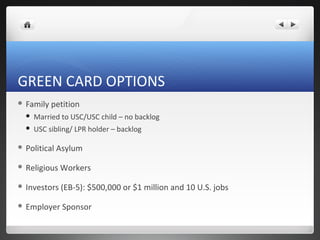
GREEN CARD OPTIONS
 Family   petition
     Married to USC/USC child – no backlog
     USC sibling/ LPR holder – backlog

 Political   Asylum

 Religious   Workers

 Investors    (EB-5): $500,000 or $1 million and 10 U.S. jobs

 Employer     Sponsor
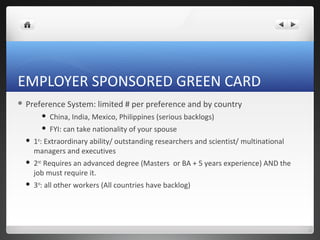
EMPLOYER SPONSORED GREEN CARD
 Preference     System: limited # per preference and by country
           China, India, Mexico, Philippines (serious backlogs)
           FYI: can take nationality of your spouse
     1st: Extraordinary ability/ outstanding researchers and scientist/ multinational
      managers and executives
     2nd: Requires an advanced degree (Masters or BA + 5 years experience) AND the
      job must require it.
     3rd: all other workers (All countries have backlog)
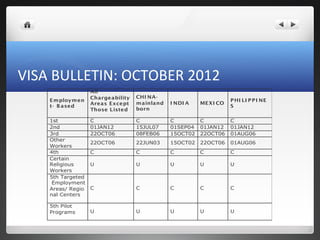
VISA BULLETIN: OCTOBER 2012
                   All
                   Chargeability   CHI NA-
    Em ploymen                                                     P HI LI P P I NE
                   Areas Except    mainland   I NDI A   MEX I CO
    t- B ased                                                      S
                   Those Listed    born

    1st            C               C          C         C          C
    2nd            01JAN12         15JUL07    01SEP04   01JAN12    01JAN12
    3rd            22OCT06         08FEB06    15OCT02   22OCT06    01AUG06
    Other
                   22OCT06         22JUN03    15OCT02   22OCT06    01AUG06
    Workers
    4th            C               C          C         C          C
    Certain
    Religious      U               U          U         U          U
    Workers
    5th Targeted
     Employment
    Areas/ Regio   C               C          C         C          C
    nal Centers

    5th Pilot
    Programs       U               U          U         U          U
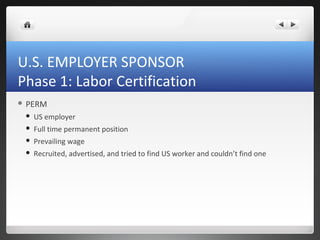
U.S. EMPLOYER SPONSOR
Phase 1: Labor Certification
 PERM

    US employer
    Full time permanent position
    Prevailing wage
    Recruited, advertised, and tried to find US worker and couldn’t find one
PHASE 2: I-140 Visa Petition
 Prove   that the company can pay the prevailing wage

 Must   prove the Alien meets the requirements
PHASE 3: I-485 ADJUSTMENT OF STATUS
 You    have an approved I-140

 Visa   is available (your turn in line is up): Visa Bulletin

 Medical    Exam

 No   Admissibility issues

 Need    to show you are in legal status
     If fallen out of status, must consular process abroad.
4 categories to skip Labor Certification
1. Extraordinary Ability: very top of your field in the world.
      Regulations list 10 examples, must meet at least 3
      Sustained national/international acclaim

2. Outstanding Researcher:
      Need to prove 2 out of 7 criteria
      Need to prove you are outstanding (impact in your field)

3. National Interest Waiver: reserved for those doing work in the interest of the US
      No employer or labor certification needed
      3 criteria
        Must be working in an area of substantial intrinsic value to the US

        The impact of the work is national in scope as opposed to local in scope

        You have already made an impact in your field that is greater than your peers

        when they balance the purpose of PERM versus what you bring, do you win?
SKIP LABOR CERTIFICATION
4. Multinational Manager or Executive
     You worked outside the US for 1 year out of the last 3 years for a company
     the foreign company has a qualifying relationship with a Company in US:
         Parent-Child: one owns majority of other;
         Branch
         Affiliate: joint venture, one person owns majority of both
EMPLOYER SPONSORED GREEN CARD
 Don’thave to be sponsored for the job that you are in – employer can say
 they have the intention to put you in the position when you get the green
 card. Could be 4-5 years away.

 Usea company you don’t work for: You work for Company A; Company B
 can sponsor you (maybe you have a good friend) – at the end of the day, if
 intention changes, you get green card and they don’t have to hire you.

 EmployerMUST pay for the process. It’s expensive! Can’t be reimbursed
 under the table. Highly illegal!
QUESTIONS?????
                 MOMAL IQBAL
             Miqbal@rroyselaw.com
             Office: (415) 421-9700
             Direct: (213) 290-4529


                  www.rroyselaw.com
          Follow us on Facebook and Twitter!!

Immigration Basics For Startups

  • 1.
    IMMIGRATION OPTIONS FOR STARTUP COMPANIES www.rroyselaw.com
  • 2.
    BASIC TERMINOLOGY  NON-IMMIGRANT – temporary purpose  IMMIGRANT – live in the U.S. permanently  NON-IMMIGRANT INTENT – important at border  LAWFUL PERMANENT RESIDENT – GC holder  NON-IMMIGRANT VISA – obtained abroad  ARRIVAL/DEPARTURE CARD I-94 – status
  • 3.
    Specific issues forstartups  Dueto newness of company hard to file/sponsor employees for visas because the company generally doesn’t have  Quarterly statements  Proven revenue  Track record  Public records  Information on the web
  • 4.
    NON-IMMIGRANT VISAS:  F-1 : Student  B1: Business Visitors  H-1B: Specialty occupation  H-1B1: Chileans , Singaporeans  E-3: Australians  E2: Treaty investors  O-1: Extraordinary ability  TN: Canadians/Mexicans
  • 5.
    F-1: STUDENT VISA  2 ways to work: 1. OPT (Optional Practical Training)  12 months – usually post completion (if used while in school (summers, holidays) time is deducted.  Must be related to your degree program  No more than 90 days of unemployment  Must report to school where you are working (can be self employed but must be in your field)  Only Extension available: STEM (Science, Technology, Engineering, Math) graduate: 1) just graduated and 2) have a job in STEM filed and 3) employer is enrolled in E-verify = can extend for 17 months  Helpful for entrepreneurs with their own business  H-1B cap met for fiscal year  Salary not required, can work for equity
  • 6.
    F-1 Visa 2. Curriculum Practical Training -Internship program -Must be part of the curriculum -Has to be approved by the school (Form I-20) -If you work for 1 yr. (365 days) full time you forfeit OPT or 2 years part-time
  • 7.
    H-1B: SPECIALTY OCCUPATIONS  Most common work authorized non-immigrant visa  Available for workers in specialty occupations  Position Requires a BA or higher in a specific field, or a BA equivalent (i.e. work experience)  The Foreign national has the required BA or work experience in the particular field.  (i.e. software engineer needs a degree in engineering or EE but not English)  Dual intent visa  Initially issued for 3 years; 6 years max. (few exceptions)  Exception is VERY helpful to those nationals of China/India where it can take up to 10yrs.  H-1B employee can port from one employer to another (begin as soon as filed- NOT RECOMMENDED)  Annual cap of 65,000 every fiscal year which begins Oct. 1, but can file in April.  20K additional allocated for US graduates holding MA or higher
  • 8.
    CAP GAP: Switchingfrom F-1 to H-1B  Due to H-1B annual quota there is usually a limited filing season (usually first few weeks of April)  Approved H-1B employee can’t begin work until the start of the Fiscal Year, October 1st.  Generally students are given 12 months of OPT (usually expires in June) – leaving the foreign national out of status if they don’t return home = GAP between when status expires and when they can work  Regulations fixed this problem: As long as H-1B is filed before the expiration of OPT – work authorization and status is extended till the end of the Fiscal year.
  • 9.
    H-1B Cap Exempt  If you had an H-1B in the past 6 years  Universities  Research organizations  Non-Profit organizations  Affiliated with research organization or university  If you can get a Cap Exempt H-1B, you can get an H-1B with a company that is Cap subject  Get a job at a university for a few hours a week and then get a job with a private company (but try to get the private company to also sponsor you for a cap subject H-1B)
  • 10.
    H-1B Challenges forstartups  Size of company  Funding issues (prevailing wage must be paid)  Manager/executive positions harder to obtain (educational issues/ and need)  Consider: Why would a small company need that? (director of marketing)  Relatively expensive ($325 to file, $500 fraud fee, $750/$1500 ACWIA fee, $1225 Premium processing) – recommend employer pays all fees  Time Sensitive: Must meet qualifications at time of filing  possible to get letter from university stating all requirements for the degree have been completed but it can’t be conferred until June.
  • 11.
    H-1B challenges  Employer Restrictions:  Must pay prevailing wage: can be high (entry level software engineer $75,000)  Try to get a letter from a VC saying they will fund with a letter of intent  May have contracts with clients to prove income  Restrictions of off site placements  Record keeping requirement  No spousal work authorization  Employer-Employee relationship: “control” – is there someone that is controlling the employee’s work?  Try to prove that you don’t own 50% or more of the company  If you own more than 50%: Convey the stock to a friend; or make sure you don’t have more than 50% of the voting rights; have a separate board of directors that handles the hiring/firing of employees  Have an employment contract (even if owner)  Sign NDA; Covenant not to compete
  • 12.
    H-1B  Pros:  Can have several H-1B’s at one time  Each employer must apply separately – and must prove all requirements  If you have H-1B and have been counted against an annual cap – not subject to cap and Company B can sponsor you at anytime  Dual intent- so you can travel and have a green card petition pending
  • 13.
    CONCERNS FOR STARTUPS “FRAUD PROFILE” TARGETS SMALL AND NEWLY FORMED COMPANIES  BEFORE FILING HAVE:  A physical office space (a commercial lease is best)  Money to pay salaries  Comply with local ordinance (obtain a business license, taxes)  Website  Payroll records of employees (don’t just give equity)  The Dun & Bradstreet data is used by USCIS to determine the legitimacy of company  Try to get company on the Dun Bradstreet
  • 14.
    E-2 TREATY INVESTOR  Nationals of Countries that have a Treaty with the US (no treaty with Russia/China/India)  Substantial Investment: no set amount  If total cost to run your company is under $500,000 a significant investment would be 80-85% of total cost  $ Must come from investor  IP counts (need to get an objective valuation); equipment, property, etc…  Majority of stock must be held by nationals of treaty country (USC and LPR’s don’t count)  Important: VC funding/ co-ownership might reduce your shares below 50%  You can work for a company where nationals of your country have done the investment and you are a key employee: (Executive/manager/essential employee)  No employment requirement abroad  Spouse can work
  • 15.
    B-1 VISITOR  Foreign national coming to the U.S. to conduct business activities  Gainful employment NOT permitted  Permissible business activities:  Negotiating contracts, attend meetings, develop business relationships, attend conferences and seminars  MUST intend to go back to home country  Cannot receive salary from U.S. source  Entrepreneurs can use this to: set up an office in the U.S., meet investors, look for office space, meet potential customers, open bank accounts, startup incubator/accelerator programs.
  • 16.
    TN: CANADIAN/MEXICAN NATIONALS Professional activities (limited class of occupations)  Less restrictive than H-1B on educational requirements  No prevailing wage issues  Can’t be self-employed (need a job offer from someone); Can’t be for a company where you have a substantial ownership interest  Entry for 3 years at a time
  • 17.
    L-1: MULTINATIONAL TRANSFEREE  Foreign Company abroad  Qualifying relationship with a company in the U.S. (Parent, branch, subsidiary, or affiliate)  Must have worked abroad for the company for 1 full year (in the past 3 years)  Manager, executive, or specialized skill employee  L-1: 7 years max, L-B: 5 years, New office in U.S.: 1year  Spouse can obtain work authorization  Difficult for startups unless willing to work abroad for a year
  • 18.
    GREEN CARD OPTIONS Family petition  Married to USC/USC child – no backlog  USC sibling/ LPR holder – backlog  Political Asylum  Religious Workers  Investors (EB-5): $500,000 or $1 million and 10 U.S. jobs  Employer Sponsor
  • 19.
    EMPLOYER SPONSORED GREENCARD  Preference System: limited # per preference and by country  China, India, Mexico, Philippines (serious backlogs)  FYI: can take nationality of your spouse  1st: Extraordinary ability/ outstanding researchers and scientist/ multinational managers and executives  2nd: Requires an advanced degree (Masters or BA + 5 years experience) AND the job must require it.  3rd: all other workers (All countries have backlog)
  • 20.
    VISA BULLETIN: OCTOBER2012 All Chargeability CHI NA- Em ploymen P HI LI P P I NE Areas Except mainland I NDI A MEX I CO t- B ased S Those Listed born 1st C C C C C 2nd 01JAN12 15JUL07 01SEP04 01JAN12 01JAN12 3rd 22OCT06 08FEB06 15OCT02 22OCT06 01AUG06 Other 22OCT06 22JUN03 15OCT02 22OCT06 01AUG06 Workers 4th C C C C C Certain Religious U U U U U Workers 5th Targeted Employment Areas/ Regio C C C C C nal Centers 5th Pilot Programs U U U U U
  • 21.
    U.S. EMPLOYER SPONSOR Phase1: Labor Certification  PERM  US employer  Full time permanent position  Prevailing wage  Recruited, advertised, and tried to find US worker and couldn’t find one
  • 22.
    PHASE 2: I-140Visa Petition  Prove that the company can pay the prevailing wage  Must prove the Alien meets the requirements
  • 23.
    PHASE 3: I-485ADJUSTMENT OF STATUS  You have an approved I-140  Visa is available (your turn in line is up): Visa Bulletin  Medical Exam  No Admissibility issues  Need to show you are in legal status  If fallen out of status, must consular process abroad.
  • 24.
    4 categories toskip Labor Certification 1. Extraordinary Ability: very top of your field in the world.  Regulations list 10 examples, must meet at least 3  Sustained national/international acclaim 2. Outstanding Researcher:  Need to prove 2 out of 7 criteria  Need to prove you are outstanding (impact in your field) 3. National Interest Waiver: reserved for those doing work in the interest of the US  No employer or labor certification needed  3 criteria  Must be working in an area of substantial intrinsic value to the US  The impact of the work is national in scope as opposed to local in scope  You have already made an impact in your field that is greater than your peers  when they balance the purpose of PERM versus what you bring, do you win?
  • 25.
    SKIP LABOR CERTIFICATION 4.Multinational Manager or Executive  You worked outside the US for 1 year out of the last 3 years for a company  the foreign company has a qualifying relationship with a Company in US:  Parent-Child: one owns majority of other;  Branch  Affiliate: joint venture, one person owns majority of both
  • 26.
    EMPLOYER SPONSORED GREENCARD  Don’thave to be sponsored for the job that you are in – employer can say they have the intention to put you in the position when you get the green card. Could be 4-5 years away.  Usea company you don’t work for: You work for Company A; Company B can sponsor you (maybe you have a good friend) – at the end of the day, if intention changes, you get green card and they don’t have to hire you.  EmployerMUST pay for the process. It’s expensive! Can’t be reimbursed under the table. Highly illegal!
  • 27.
    QUESTIONS????? MOMAL IQBAL Miqbal@rroyselaw.com Office: (415) 421-9700 Direct: (213) 290-4529 www.rroyselaw.com Follow us on Facebook and Twitter!!

Editor's Notes

  • #3 F1: OPT (OPTIONAL PRACTICAL TRAINING): 12 MONTHS AFTER GRADUATION
  • #8 Initially issued for 3 years; 6 years max. (except when employer sponsors individual for green card, 1 yr. prior to expiration – can extend until visa becomes available) OR you leave the country for a full year and then apply for an H-1b again – you get 6 years again. (can start filing 6 months before April 1 st - sometimes they run out in one day)
  • #14 THINK OF WHAT A LARGER COMPANY MIGHT HAVE AND NOT SOMETHING RUNNING OUT OF A HOME OFFICE OR GARAGE.