Air pollution in hong kong
Group name: EASY PEASY :)
Group member: Kelly, Venus, Stephanie
Introduction
Air pollution in Hong Kong is considered a serious problem. It mainly contributed by motor vehicles,
marine vessels and power plants. Visibility is less than eight kilometers for 30% of the year. Cases of
asthma and bronchial infections have soared in recent years due to reduced air quality. Air pollution is
the contamination of the atmosphere by any toxic or radioactive gases and particulate matter as a
result of human activity.There are 5 major air pollutants such as carbon monoxide (CO), sulphur
oxides (SO, SO2, SO3),particulates, hydrocarbons, and photochemical oxidants.
**Hong Kong’s air-quality objective for particulates is 180, but the World Health Organization guideline
is 50.
Air containing
The composition of air The average percentage of its components
by volume
Nitrogen 78%
Oxygen 21%
Inert Gases & Others 0.97%
Carbon Dioxide 0.03%
1. Poor visibility
In 2004, low visibility occurred 18% of the time – the highest on record, according to the Hong Kong
Observatory . The number of days in which visibility was less than eight kilometres rise to 102 in 2005
from 40 in 1997. Hong Kong is approaching the record of being the darkest capital city in the world
with the least amount of sunlight hours, just after Edinburgh, Scotland.
2. Economic impact
Even as early as 2000, the total negative impact to the Hong Kong Economy, including
cardiorespiratory disease was in excess of HK$11.1 billion. Research by three universities and a think-
tank estimates that the pollution is costing Hong Kong about HK$21.2 billion a year in hospital
admissions and lost productivity.
Effects
3. Health implications
The Hong Kong Medical Association estimates that air pollution can exacerbate asthma, impaired lung
function and raise the risk of cardio-respiratory death by 2 to 3 percent for every increase of 10
micrograms per cubic metre of pollutants. Studies by local public health experts have found that these
roadside pollution levels are responsible for 90,000 hospital admissions and 2,800 premature deaths
every year.
Carbon monoxide
● Carbon monoxide is produced primarily by incomplete combustion of fossil fuels. In Hong Kong,
the majority of ambient carbon monoxide comes from vehicular emissions.
● Carbon monoxide reduces the oxygen carrying capacity of red blood cells. The health effects
depend on the duration of exposure and the concentration of carbon monoxide inhaled. Typical
symptoms of exposure to low levels of carbon monoxide include headache, dizziness and
tiredness. Higher concentration of carbon monoxide can lead to impaired vision, disturbed
coordination and eventually death.
Nitrogen Dioxide
● High temperature combustion process results in nitrogen oxides emissions (including nitrogen
dioxide), which may come from stationary sources such as power stations, and mobile sources
such as motor vehicles.
● Nitrogen dioxide irritates the mucosa of the eyes, nose, throat and the lower respiratory tract.
Exposure to low level of nitrogen dioxide may cause increased bronchial reactivity and in those
with asthma increased response to allergens. Nitrogen dioxide also aggravates existing chronic
respiratory diseases. Long-term exposure to nitrogen dioxide can lower a person's lung function
and resistance to respiratory infections.
Ozone
● Ozone is formed from photochemical reaction between nitrogen oxides and volatile organic
compounds, which are predominantly pollutants from motor vehicles and industries.
● In the upper atmosphere, ozone shields the earth from the harmful ultraviolet radiation. In ground
level, ozone is a highly reactive gas which can irritate the eyes and bring upper and lower
respiratory symptoms to healthy people. It may also provoke asthmatic attacks in people having
asthma. Ozone can also increase a person's susceptibility to respiratory infection and aggravate
pre-existing respiratory illnesses.
Lead
● Lead occurs naturally in the earth's crust but the natural sources
contribute only a small fraction of the amount of lead found in air,
food, water and dust. The majority of lead in these media arises
from automobile and industrial emissions and from the use of lead-
containing solder and paints. The lead content in vehicular exhaust
is the result of using organolead compound as fuel additives.
However, a ban on the use of leaded petrol in Hong Kong in 1999
has completely eliminated the emissions of lead from motor
vehicles.
● Lead is a highly toxic and is known to damage the nervous system
and kidney, and interfere with the synthesis of haemoglobin.
Children are more vulnerable to the effects of lead, which can result
in learning disabilities and impaired neurobehavioural functioning.
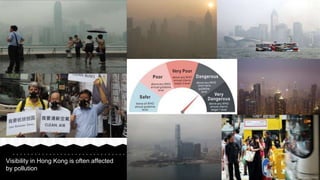
Visibility in Hong Kong is often affected
by pollution
On two cloud-free days, the haze situation
can differ dramatically depending on the
season and therefore on the direction of
the wind.
The weather is not good and the visibility
is not clear enough. People in charge use
the board to replace the view of the
harbour.
1. Write a blog to propaganda more about air
pollution.
2. Write a website to take action.
3. Write a open letter to the Hong Kong SAR
Government.
4. Make some poster as a reminder.
5. Use everything less. For example, light, energy,
air conditioner
6. Use more public transport, such as, mtr, bus,
minibus, tram, ferry or taxi.
7. Don't use so much private car because
nowadays Hong Kong Vehicle Registration
number more than 680,000
Things that we can do
1. Encourage people to have public transport.
2. Have a smoking corner or room that smoker can only go in to smoke. Otherwise, they will be
charged.
3. Switch to cleaner motor fuels - all the taxis and PLBS are now using LPG(Liquefied petroleum
gas).
4. Events & Education – Participating in and/or driving various territory wide environmental events
and educational programs on clean air.
5. Tobacco – Clear The Air is advocating the Government to license all tobacco retailers.
Things that the government can
do
Hong Kong is facing a serious problem which is air pollution, we need to solve this problem as
fast as we can. Everyday we pollute the air we breathe with the cars we drive, the airplanes we fly, our
factories, our lawn mowers and more. The Exhaust and emissions from these sources collect in the
atmosphere, wreaking havoc on the environment and on our health. In order to reduce air pollution,
governments around the world must take responsibility and enforce strict emissions standards. In
addition,individuals must take steps in their own lives to reduce air pollution. For example, we can buy
more fuel-efficient cars and participate in carpools.
Conclusion
We create a facebook page and it talks about air pollution. In now, we are attracting people's attention
and collecting more likes.
https://www.facebook.com/pages/Air-polution/860574054014973?__mref=message_bubble
Extra: Facebook page
1. http://en.wikipedia.org/wiki/Air_pollution_in_Hong_Kong
2. http://www.gov.hk/en/residents/environment/air/airquality.htm
3. http://www.cleartheair.org.hk/
4. http://www.enb.gov.hk/en/files/New_Air_Plan_en.pdf
5. http://www.chp.gov.hk/en/content/9/460/3557.html
6. http://www.bbc.com/news/business-14042293
7. http://www.scmp.com/news/hong-kong/article/1710649/very-high-hong-kong-air-pollution-levels-
set-continue-until-weekend
References
1. http://goo.gl/3CxK9q
2. http://goo.gl/cX7xxo
3. http://goo.gl/pFmIPB
4. http://goo.gl/PZCdAq
5. http://goo.gl/3atwmB
6. http://goo.gl/Lr9UcW
7. http://goo.gl/mrK1a2
8. http://goo.gl/AwXmwn
9. http://goo.gl/PiZV92
10. http://goo.gl/WoS4mx
11. http://goo.gl/wD3z9L
12. http://goo.gl/Z2434C
13. http://goo.gl/AD0U29
14. http://goo.gl/9OE1pC
15. https://goo.gl/0jYbE6
Photo references
THE
END!!!

Easy Peasy Air pollution

  • 1.
    Air pollution inhong kong Group name: EASY PEASY :) Group member: Kelly, Venus, Stephanie
  • 2.
    Introduction Air pollution inHong Kong is considered a serious problem. It mainly contributed by motor vehicles, marine vessels and power plants. Visibility is less than eight kilometers for 30% of the year. Cases of asthma and bronchial infections have soared in recent years due to reduced air quality. Air pollution is the contamination of the atmosphere by any toxic or radioactive gases and particulate matter as a result of human activity.There are 5 major air pollutants such as carbon monoxide (CO), sulphur oxides (SO, SO2, SO3),particulates, hydrocarbons, and photochemical oxidants. **Hong Kong’s air-quality objective for particulates is 180, but the World Health Organization guideline is 50.
  • 3.
    Air containing The compositionof air The average percentage of its components by volume Nitrogen 78% Oxygen 21% Inert Gases & Others 0.97% Carbon Dioxide 0.03%
  • 4.
    1. Poor visibility In2004, low visibility occurred 18% of the time – the highest on record, according to the Hong Kong Observatory . The number of days in which visibility was less than eight kilometres rise to 102 in 2005 from 40 in 1997. Hong Kong is approaching the record of being the darkest capital city in the world with the least amount of sunlight hours, just after Edinburgh, Scotland. 2. Economic impact Even as early as 2000, the total negative impact to the Hong Kong Economy, including cardiorespiratory disease was in excess of HK$11.1 billion. Research by three universities and a think- tank estimates that the pollution is costing Hong Kong about HK$21.2 billion a year in hospital admissions and lost productivity. Effects
  • 5.
    3. Health implications TheHong Kong Medical Association estimates that air pollution can exacerbate asthma, impaired lung function and raise the risk of cardio-respiratory death by 2 to 3 percent for every increase of 10 micrograms per cubic metre of pollutants. Studies by local public health experts have found that these roadside pollution levels are responsible for 90,000 hospital admissions and 2,800 premature deaths every year. Carbon monoxide ● Carbon monoxide is produced primarily by incomplete combustion of fossil fuels. In Hong Kong, the majority of ambient carbon monoxide comes from vehicular emissions. ● Carbon monoxide reduces the oxygen carrying capacity of red blood cells. The health effects depend on the duration of exposure and the concentration of carbon monoxide inhaled. Typical symptoms of exposure to low levels of carbon monoxide include headache, dizziness and tiredness. Higher concentration of carbon monoxide can lead to impaired vision, disturbed coordination and eventually death.
  • 6.
    Nitrogen Dioxide ● Hightemperature combustion process results in nitrogen oxides emissions (including nitrogen dioxide), which may come from stationary sources such as power stations, and mobile sources such as motor vehicles. ● Nitrogen dioxide irritates the mucosa of the eyes, nose, throat and the lower respiratory tract. Exposure to low level of nitrogen dioxide may cause increased bronchial reactivity and in those with asthma increased response to allergens. Nitrogen dioxide also aggravates existing chronic respiratory diseases. Long-term exposure to nitrogen dioxide can lower a person's lung function and resistance to respiratory infections. Ozone ● Ozone is formed from photochemical reaction between nitrogen oxides and volatile organic compounds, which are predominantly pollutants from motor vehicles and industries. ● In the upper atmosphere, ozone shields the earth from the harmful ultraviolet radiation. In ground level, ozone is a highly reactive gas which can irritate the eyes and bring upper and lower respiratory symptoms to healthy people. It may also provoke asthmatic attacks in people having asthma. Ozone can also increase a person's susceptibility to respiratory infection and aggravate pre-existing respiratory illnesses.
  • 7.
    Lead ● Lead occursnaturally in the earth's crust but the natural sources contribute only a small fraction of the amount of lead found in air, food, water and dust. The majority of lead in these media arises from automobile and industrial emissions and from the use of lead- containing solder and paints. The lead content in vehicular exhaust is the result of using organolead compound as fuel additives. However, a ban on the use of leaded petrol in Hong Kong in 1999 has completely eliminated the emissions of lead from motor vehicles. ● Lead is a highly toxic and is known to damage the nervous system and kidney, and interfere with the synthesis of haemoglobin. Children are more vulnerable to the effects of lead, which can result in learning disabilities and impaired neurobehavioural functioning.
  • 8.
    Visibility in HongKong is often affected by pollution
  • 9.
    On two cloud-freedays, the haze situation can differ dramatically depending on the season and therefore on the direction of the wind. The weather is not good and the visibility is not clear enough. People in charge use the board to replace the view of the harbour.
  • 10.
    1. Write ablog to propaganda more about air pollution. 2. Write a website to take action. 3. Write a open letter to the Hong Kong SAR Government. 4. Make some poster as a reminder. 5. Use everything less. For example, light, energy, air conditioner 6. Use more public transport, such as, mtr, bus, minibus, tram, ferry or taxi. 7. Don't use so much private car because nowadays Hong Kong Vehicle Registration number more than 680,000 Things that we can do
  • 11.
    1. Encourage peopleto have public transport. 2. Have a smoking corner or room that smoker can only go in to smoke. Otherwise, they will be charged. 3. Switch to cleaner motor fuels - all the taxis and PLBS are now using LPG(Liquefied petroleum gas). 4. Events & Education – Participating in and/or driving various territory wide environmental events and educational programs on clean air. 5. Tobacco – Clear The Air is advocating the Government to license all tobacco retailers. Things that the government can do
  • 12.
    Hong Kong isfacing a serious problem which is air pollution, we need to solve this problem as fast as we can. Everyday we pollute the air we breathe with the cars we drive, the airplanes we fly, our factories, our lawn mowers and more. The Exhaust and emissions from these sources collect in the atmosphere, wreaking havoc on the environment and on our health. In order to reduce air pollution, governments around the world must take responsibility and enforce strict emissions standards. In addition,individuals must take steps in their own lives to reduce air pollution. For example, we can buy more fuel-efficient cars and participate in carpools. Conclusion
  • 13.
    We create afacebook page and it talks about air pollution. In now, we are attracting people's attention and collecting more likes. https://www.facebook.com/pages/Air-polution/860574054014973?__mref=message_bubble Extra: Facebook page
  • 14.
    1. http://en.wikipedia.org/wiki/Air_pollution_in_Hong_Kong 2. http://www.gov.hk/en/residents/environment/air/airquality.htm 3.http://www.cleartheair.org.hk/ 4. http://www.enb.gov.hk/en/files/New_Air_Plan_en.pdf 5. http://www.chp.gov.hk/en/content/9/460/3557.html 6. http://www.bbc.com/news/business-14042293 7. http://www.scmp.com/news/hong-kong/article/1710649/very-high-hong-kong-air-pollution-levels- set-continue-until-weekend References
  • 15.
    1. http://goo.gl/3CxK9q 2. http://goo.gl/cX7xxo 3.http://goo.gl/pFmIPB 4. http://goo.gl/PZCdAq 5. http://goo.gl/3atwmB 6. http://goo.gl/Lr9UcW 7. http://goo.gl/mrK1a2 8. http://goo.gl/AwXmwn 9. http://goo.gl/PiZV92 10. http://goo.gl/WoS4mx 11. http://goo.gl/wD3z9L 12. http://goo.gl/Z2434C 13. http://goo.gl/AD0U29 14. http://goo.gl/9OE1pC 15. https://goo.gl/0jYbE6 Photo references
  • 16.