Lesson 1.1
Big Bang Theory
explain the origin of the
universe according to
the big bang theory;
identify different
proponents and evidences
that support the big bang
theory; and
enumerate the negative
implications of the big
bang theory.
1
At the end of the
lesson, you should
be able to:
2
3
Objectives:
• The big bang theory is cosmological model that
explains how the universe began.
• It suggests that the universe started its expansion about
13.8 billion years ago.
• The concept of big bang as not a literal explosion of
something leading to the creation of the universe.
Big Bang Theory
• The bread represents
the universe; while
raisins are galaxies.
• The galaxies,
represented by dots, are
not expanding.
Big Bang Theory and the Bread-Raisin Model
The raisin-bread model of expanding universe
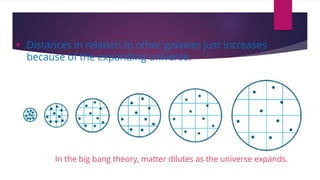
• Distances in relation to other galaxies just increases
because of the expanding universe.
In the big bang theory, matter dilutes as the universe expands.
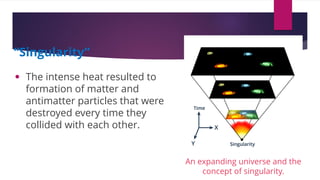
• The universe started as a
“​singularity​” - an area
predicted to be in the core of
a black hole with very high
temperature and density.
“Singularity”
An expanding universe and the
concept of singularity.
• The intense heat resulted to
formation of matter and
antimatter particles that were
destroyed every time they
collided with each other.
“Singularity”
An expanding universe and the
concept of singularity.
“Nucleosynthesis”
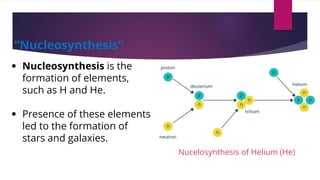
• Nucleosynthesis​ is the
formation of elements,
such as H and He.
• Presence of these elements
led to the formation of
stars and galaxies.
Nucelosynthesis of Helium (He)
“Nucleosynthesis”
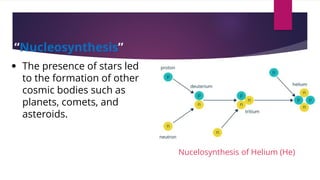
• The presence of stars led
to the formation of other
cosmic bodies such as
planets, comets, and
asteroids.
Nucelosynthesis of Helium (He)
Evidences that Support the Big Bang Theory
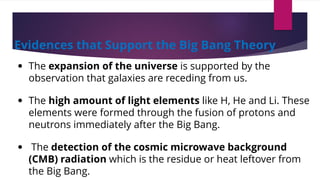
• The expansion of the universe is supported by the
observation that galaxies are receding from us.
• The high amount of light elements like H, He and Li. These
elements were formed through the fusion of protons and
neutrons immediately after the Big Bang.
• The detection of the cosmic microwave background
(CMB) radiation which is the residue or heat leftover from
the Big Bang.
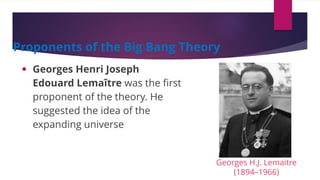
• Georges Henri Joseph
Edouard Lemaître was the first
proponent of the theory. He
suggested the idea of the
expanding universe
Proponents of the Big Bang Theory
Georges H.J. Lemaitre
(1894–1966)
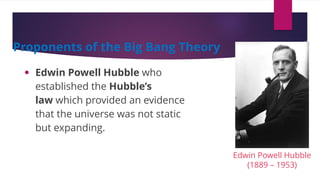
• Edwin Powell Hubble who
established the ​Hubble’s
law ​which provided an evidence
that the universe was not static
but expanding.
Proponents of the Big Bang Theory
Edwin Powell Hubble
(1889 – 1953)
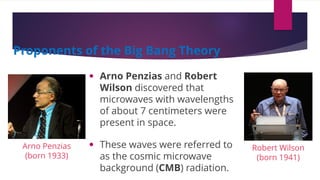
• Arno Penzias and Robert
Wilson discovered that
microwaves with wavelengths
of about 7 centimeters were
present in space.
• These waves were referred to
as the cosmic microwave
background (CMB) radiation.
Proponents of the Big Bang Theory
Arno Penzias
(born 1933)
Robert Wilson
(born 1941)
1
2
2
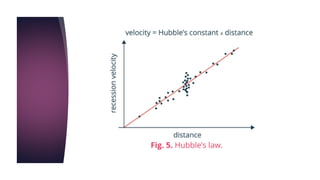
Hubble’s law states that the relationship of the
velocities of distant objects in the universe is
directly proportional to their distance from Earth.
3
4 The big bang theory failed to explain how the
universe was created.
Rodney Holder and Simon Mitton. 2013. Georges Lemaître: Life, Science and Legacy, Germany: Springer
Science & Business Media.
John Chambers and Jacqueline Mitton. 2013. From Dust to Life: The Origin and Evolution of Our Solar
System, New Jersey: Princeton University Press.
Michael Mark Woolfson. 2012. Time, Space, Stars and Man: The Story of the Big Bang, Singapore: World
Scientific.
J. Schombert. 2012. Origin of the Solar System. Accessed March 16, 2017
http://abyss.uoregon.edu/~js/ast121/lectures/lec24.html
D. Darling. 2016. Chamberlin-Moulton planetesimal hypothesis. Accessed March 16,
2017http://www.daviddarling.info/encyclopedia/C/CMplanhypoth.html
● Slide 6: This file, Universe expansion.png by Fredrik, is licensed under CC-BY-SA-4.0 via Wikimedia
Commons.
● Slide 9: This file, Georges Lemaître by Tonynetone, is licensed under CC-BY-SA-2.0 via Flickr
● Slide 9: This file, Studio_portrait_photograph_of_Edwin_Powell_Hubble_(cropped).JPG by Johan
Hagemeyer, is in the public domain via Wikimedia Commons.
● Slide 10: This file, Arno Penzias by Kartik J, is licensed under Creative Commons Attribution-Share
Alike 2.5 Generic via Wikimedia Commons.
● Slide 10: This file, Robert Wilson (28215880301) (cropped).jpgby Victor R. Ruiz, is licensed under CC-
SA 2.0 via Flickr2Commons

Earth-Science-SHS-1.1-Big-Bang-Theory.pdf

  • 1.
  • 2.
    explain the originof the universe according to the big bang theory; identify different proponents and evidences that support the big bang theory; and enumerate the negative implications of the big bang theory. 1 At the end of the lesson, you should be able to: 2 3 Objectives:
  • 3.
    • The bigbang theory is cosmological model that explains how the universe began. • It suggests that the universe started its expansion about 13.8 billion years ago. • The concept of big bang as not a literal explosion of something leading to the creation of the universe. Big Bang Theory
  • 4.
    • The breadrepresents the universe; while raisins are galaxies. • The galaxies, represented by dots, are not expanding. Big Bang Theory and the Bread-Raisin Model The raisin-bread model of expanding universe
  • 5.
    • Distances inrelation to other galaxies just increases because of the expanding universe. In the big bang theory, matter dilutes as the universe expands.
  • 7.
    • The universestarted as a “​singularity​” - an area predicted to be in the core of a black hole with very high temperature and density. “Singularity” An expanding universe and the concept of singularity.
  • 8.
    • The intenseheat resulted to formation of matter and antimatter particles that were destroyed every time they collided with each other. “Singularity” An expanding universe and the concept of singularity.
  • 9.
    “Nucleosynthesis” • Nucleosynthesis​ isthe formation of elements, such as H and He. • Presence of these elements led to the formation of stars and galaxies. Nucelosynthesis of Helium (He)
  • 10.
    “Nucleosynthesis” • The presenceof stars led to the formation of other cosmic bodies such as planets, comets, and asteroids. Nucelosynthesis of Helium (He)
  • 11.
    Evidences that Supportthe Big Bang Theory • The expansion of the universe is supported by the observation that galaxies are receding from us. • The high amount of light elements like H, He and Li. These elements were formed through the fusion of protons and neutrons immediately after the Big Bang. • The detection of the cosmic microwave background (CMB) radiation which is the residue or heat leftover from the Big Bang.
  • 12.
    • Georges HenriJoseph Edouard Lemaître was the first proponent of the theory. He suggested the idea of the expanding universe Proponents of the Big Bang Theory Georges H.J. Lemaitre (1894–1966)
  • 13.
    • Edwin PowellHubble who established the ​Hubble’s law ​which provided an evidence that the universe was not static but expanding. Proponents of the Big Bang Theory Edwin Powell Hubble (1889 – 1953)
  • 15.
    • Arno Penziasand Robert Wilson discovered that microwaves with wavelengths of about 7 centimeters were present in space. • These waves were referred to as the cosmic microwave background (CMB) radiation. Proponents of the Big Bang Theory Arno Penzias (born 1933) Robert Wilson (born 1941)
  • 16.
    1 2 2 Hubble’s law statesthat the relationship of the velocities of distant objects in the universe is directly proportional to their distance from Earth. 3 4 The big bang theory failed to explain how the universe was created.
  • 17.
    Rodney Holder andSimon Mitton. 2013. Georges Lemaître: Life, Science and Legacy, Germany: Springer Science & Business Media. John Chambers and Jacqueline Mitton. 2013. From Dust to Life: The Origin and Evolution of Our Solar System, New Jersey: Princeton University Press. Michael Mark Woolfson. 2012. Time, Space, Stars and Man: The Story of the Big Bang, Singapore: World Scientific. J. Schombert. 2012. Origin of the Solar System. Accessed March 16, 2017 http://abyss.uoregon.edu/~js/ast121/lectures/lec24.html D. Darling. 2016. Chamberlin-Moulton planetesimal hypothesis. Accessed March 16, 2017http://www.daviddarling.info/encyclopedia/C/CMplanhypoth.html
  • 18.
    ● Slide 6:This file, Universe expansion.png by Fredrik, is licensed under CC-BY-SA-4.0 via Wikimedia Commons. ● Slide 9: This file, Georges Lemaître by Tonynetone, is licensed under CC-BY-SA-2.0 via Flickr ● Slide 9: This file, Studio_portrait_photograph_of_Edwin_Powell_Hubble_(cropped).JPG by Johan Hagemeyer, is in the public domain via Wikimedia Commons. ● Slide 10: This file, Arno Penzias by Kartik J, is licensed under Creative Commons Attribution-Share Alike 2.5 Generic via Wikimedia Commons. ● Slide 10: This file, Robert Wilson (28215880301) (cropped).jpgby Victor R. Ruiz, is licensed under CC- SA 2.0 via Flickr2Commons