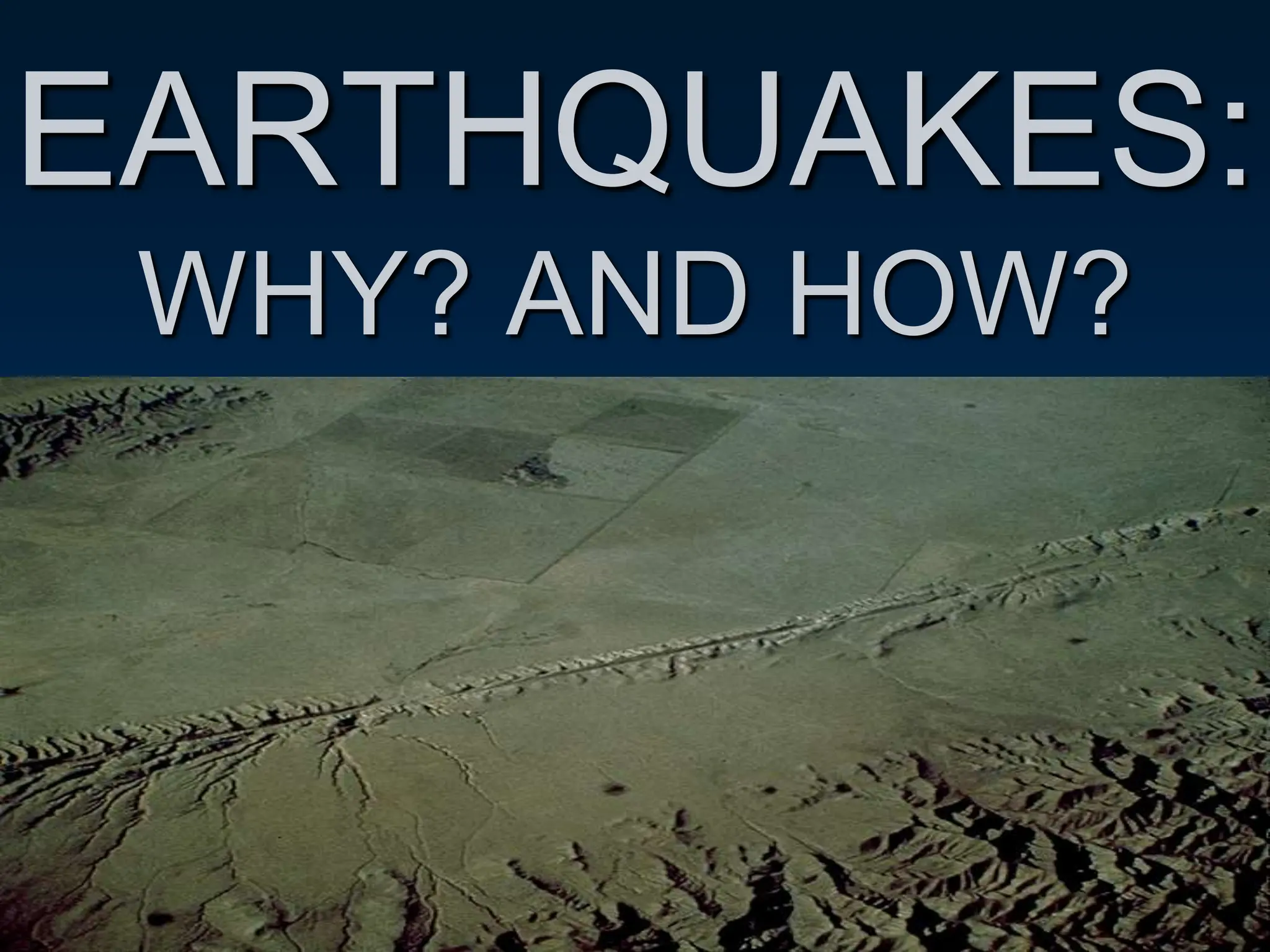
EARTHQUAKES:
WHY? AND HOW?
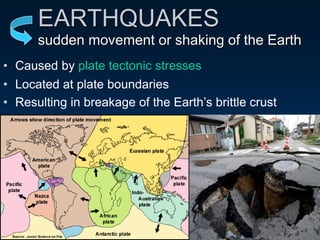
EARTHQUAKES
• Caused by plate tectonic stresses
sudden movement or shaking of the Earth
• Located at plate boundaries
• Resulting in breakage of the Earth’s brittle crust
PLATE TECTONIC STRESSES
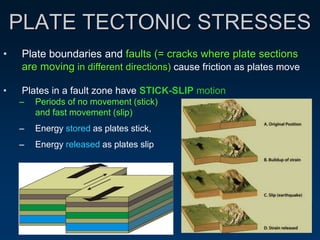
• Plate boundaries and faults (= cracks where plate sections
are moving in different directions) cause friction as plates move
• Plates in a fault zone have STICK-SLIP motion
– Periods of no movement (stick)
and fast movement (slip)
– Energy stored as plates stick,
– Energy released as plates slip
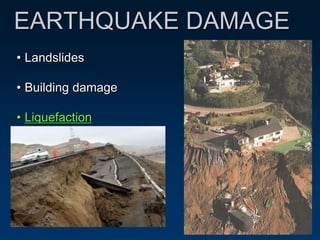
EARTHQUAKE DAMAGE
• Landslides
• Building damage
• Liquefaction
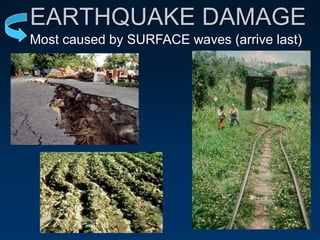
EARTHQUAKE DAMAGE
Most caused by SURFACE waves (arrive last)
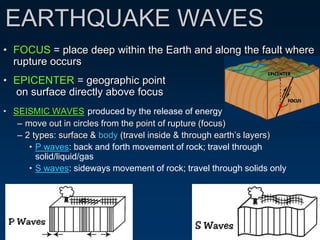
EARTHQUAKE WAVES
• FOCUS = place deep within the Earth and along the fault where
rupture occurs
• EPICENTER = geographic point
on surface directly above focus
• SEISMIC WAVES produced by the release of energy
– move out in circles from the point of rupture (focus)
– 2 types: surface & body (travel inside & through earth’s layers)
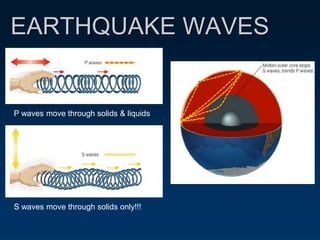
• P waves: back and forth movement of rock; travel through
solid/liquid/gas
• S waves: sideways movement of rock; travel through solids only
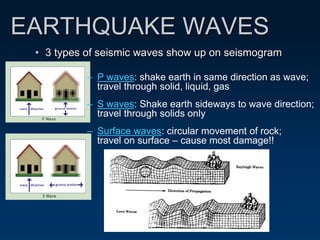
EARTHQUAKE WAVES
• 3 types of seismic waves show up on seismogram
– P waves: shake earth in same direction as wave;
travel through solid, liquid, gas
– S waves: Shake earth sideways to wave direction;
travel through solids only
– Surface waves: circular movement of rock;
travel on surface – cause most damage!!
EARTHQUAKE WAVES
P waves move through solids & liquids
S waves move through solids only!!!
EARTHQUAKE WAVES
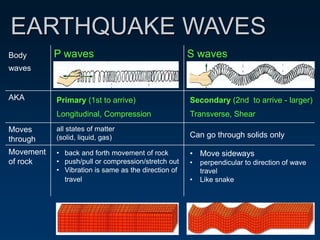
Body P waves S waves
waves
AKA
Moves
through
Movement
of rock
Primary (1st to arrive)
Longitudinal, Compression
all states of matter
(solid, liquid, gas)
• back and forth movement of rock
• push/pull or compression/stretch out
• Vibration is same as the direction of
travel
Secondary (2nd to arrive - larger)
Transverse, Shear
Can go through solids only
• Move sideways
• perpendicular to direction of wave
travel
• Like snake
EARTHQUAKE WAVES
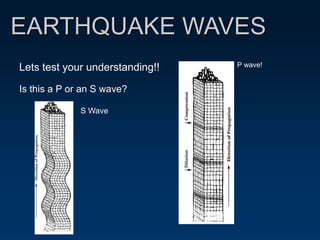
Lets test your understanding!!
Is this a P or an S wave?
P wave!
S Wave
EARTHQUAKE WAVES
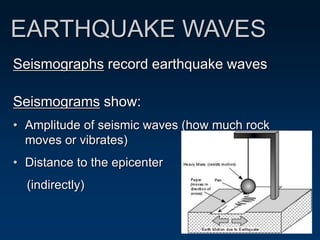
Seismographs record earthquake waves
Seismograms show:
• Amplitude of seismic waves (how much rock
moves or vibrates)
• Distance to the epicenter
(indirectly)
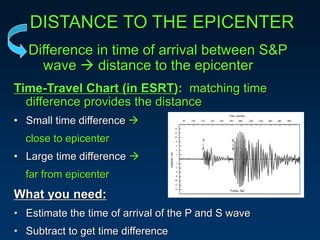
DISTANCE TO THE EPICENTER
Difference in time of arrival between S&P
wave  distance to the epicenter
Time-Travel Chart (in ESRT): matching time
difference provides the distance
• Small time difference 
close to epicenter
• Large time difference 
far from epicenter
What you need:
• Estimate the time of arrival of the P and S wave
• Subtract to get time difference
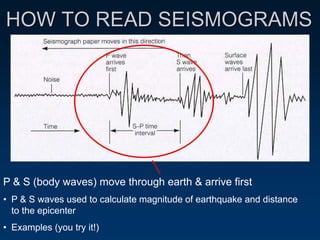
HOW TO READ SEISMOGRAMS
P & S (body waves) move through earth & arrive first
• P & S waves used to calculate magnitude of earthquake and distance
to the epicenter
• Examples (you try it!)

Earthquake Grade 8 Science and techn ppt

  • 1.
  • 2.
    EARTHQUAKES • Caused byplate tectonic stresses sudden movement or shaking of the Earth • Located at plate boundaries • Resulting in breakage of the Earth’s brittle crust
  • 3.
    PLATE TECTONIC STRESSES •Plate boundaries and faults (= cracks where plate sections are moving in different directions) cause friction as plates move • Plates in a fault zone have STICK-SLIP motion – Periods of no movement (stick) and fast movement (slip) – Energy stored as plates stick, – Energy released as plates slip
  • 4.
    EARTHQUAKE DAMAGE • Landslides •Building damage • Liquefaction
  • 5.
    EARTHQUAKE DAMAGE Most causedby SURFACE waves (arrive last)
  • 6.
    EARTHQUAKE WAVES • FOCUS= place deep within the Earth and along the fault where rupture occurs • EPICENTER = geographic point on surface directly above focus • SEISMIC WAVES produced by the release of energy – move out in circles from the point of rupture (focus) – 2 types: surface & body (travel inside & through earth’s layers) • P waves: back and forth movement of rock; travel through solid/liquid/gas • S waves: sideways movement of rock; travel through solids only
  • 7.
    EARTHQUAKE WAVES • 3types of seismic waves show up on seismogram – P waves: shake earth in same direction as wave; travel through solid, liquid, gas – S waves: Shake earth sideways to wave direction; travel through solids only – Surface waves: circular movement of rock; travel on surface – cause most damage!!
  • 8.
    EARTHQUAKE WAVES P wavesmove through solids & liquids S waves move through solids only!!!
  • 9.
    EARTHQUAKE WAVES Body Pwaves S waves waves AKA Moves through Movement of rock Primary (1st to arrive) Longitudinal, Compression all states of matter (solid, liquid, gas) • back and forth movement of rock • push/pull or compression/stretch out • Vibration is same as the direction of travel Secondary (2nd to arrive - larger) Transverse, Shear Can go through solids only • Move sideways • perpendicular to direction of wave travel • Like snake
  • 10.
    EARTHQUAKE WAVES Lets testyour understanding!! Is this a P or an S wave? P wave! S Wave
  • 11.
    EARTHQUAKE WAVES Seismographs recordearthquake waves Seismograms show: • Amplitude of seismic waves (how much rock moves or vibrates) • Distance to the epicenter (indirectly)
  • 12.
    DISTANCE TO THEEPICENTER Difference in time of arrival between S&P wave  distance to the epicenter Time-Travel Chart (in ESRT): matching time difference provides the distance • Small time difference  close to epicenter • Large time difference  far from epicenter What you need: • Estimate the time of arrival of the P and S wave • Subtract to get time difference
  • 13.
    HOW TO READSEISMOGRAMS P & S (body waves) move through earth & arrive first • P & S waves used to calculate magnitude of earthquake and distance to the epicenter • Examples (you try it!)