Foundation Insights:
Trends, Misconceptions, and Successful Partnerships


Presented by Devon Hurvid, Steven Ayer, and Diane Ellison
Devon Hurvid
Manager, Canadian Directory to Foundations & Corporations

Steven Ayer
Senior Research Associate

Diane Ellison
Special Advisor to the President and CEO - Quebec
Agenda

 •   Introduction to Imagine Canada
 •   The significance of foundations
 •   Partnership examples
 •   Defining a foundation
 •   Steps to success
 •   Trends
 •   Summary of insights
 •   Resources
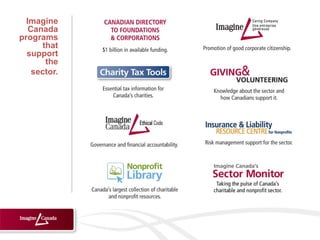
Imagine
   Canada
programs
      that
  support
       the
    sector.
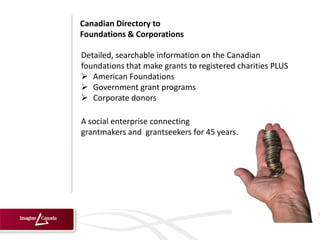
Canadian Directory to
Foundations & Corporations

Detailed, searchable information on the Canadian
foundations that make grants to registered charities PLUS
 American Foundations
 Government grant programs
 Corporate donors

A social enterprise connecting
grantmakers and grantseekers for 45 years.
Why should foundation partnerships matter to
community organizations?

 Foundations are one of the fastest growing types of
  charities; there are more now than ever before.
 Foundation funding is one of the fastest growing sources
  of revenues for charities
 Foundations can be a knowledge-base of community
  organizations
 Foundations are experiencing enormous growth
The benefit of foundation partnerships!
 Diversify funding
 Partnerships are often continuous sources of funding
 More than just a donor – a community partner
Partnerships in Action

The Counselling Foundation of Canada
Pathways to Education Canada
In the 1990’s the nearly 11,000 people that called Regent Park home faced
alarmingly high crime rates, chronic unemployment, low family income and
poor educational success rates

Regent Park Community Health Centre (RPCHC) decided that a key to
breaking the cycle of under-achievement and poverty was to support young
people to succeed in school and adults to find rewarding employment

The Counselling Foundation of Canada, a family foundation, was
established in Toronto by Frank Lawson in 1959 with the aim of creating and
enriching counselling programs and improve the technical skills of
counsellors.


Source: Great Grant Stories, Philanthropic Foundations Canada, www.pfc.ca
Partnerships in Action

The Counselling Foundation of Canada
Pathways to Education Canada

RPCHC contacted The Counselling Foundation of Canada to discuss how to
put its Community Succession Vision into practice. The Foundation provided
a seed grant and two facilitators to undertake community consultations with
local agencies to enhance the project design and to develop a long-term
sustainability funding model.

In the first year of the pilot, the RPCHC recognized that focusing its efforts
solely on education provided the greatest potential to promote community
change. The decision was made to drop the Pathways to Employment
program, and focus on the Pathways to Education program. With that
adjustment, the foundation’s grant was renewed in 2000 to support the
RPCHC’s development of Pathways to Education, and sustained with several
successive grants.


Source: Great Grant Stories, Philanthropic Foundations Canada, www.pfc.ca
Partnerships in Action

The Counselling Foundation of Canada
Pathways to Education Canada
   The impacts of the Program in Regent Park were nothing short of
    remarkable.

   The Pathways funding model has generated over $40 million in grants
    and donations since 2001.

   Carolyn Acker, former RPCHC Executive Director and founding Executive
    Director of Pathways to Education Canada, notes that The Counselling
    Foundation of Canada was “instrumental in embracing and nurturing
    the Community Succession Vision from a set of ideas to tangible
    outcomes”.

   The influence of the foundation’s grant was not solely felt in Regent
    Park. The success of the Pathways to Education Program prompted the
    creation of a new agency, Pathways to Education Canada, to replicate
    the model in other communities.

Source: Great Grant Stories, Philanthropic Foundations Canada, www.pfc.ca
Partnerships in Action

Nickle Family Foundation –
Servants Anonymous Society
With no established track record, oft-times donors won’t consider funding new nonprofit
organizations. And without donors, how do they deliver their services and so establish a track
record?

Servants Anonymous was formed in 1989 to help adolescent girls, particularly those with
children of their own, who were enmeshed in street life, drugs and prostitution. Their plan
called for establishing a “safe house,” second stage housing, as well as life skills and vocational
training.

In the absence of a track record, the due diligence review focussed unusually heavily on the
business plan and on the people behind the organization.


Source: Great Grant Stories, Philanthropic Foundations Canada, www.pfc.ca
Partnerships in Action

Nickle Family Foundation –
Servants Anonymous Society

The first grant was $5,000 toward furnishings for the safe house. As Servants Anonymous
proved themselves, Nickle Family Foundation made more grants.

“Your support, as S.A.S. Calgary’s first funder during its humble beginnings in 1989, was the
catalyst to establish the organization’s credibility among the Calgary funding community. In
fact, your financial support not only invited others to donate as programs developed, but also
encouraged us, the founding team, as we set ourselves up to pioneer the S.A. program model.”
– Servants Anonymous Society


Source: Great Grant Stories, Philanthropic Foundations Canada, www.pfc.ca
What is a foundation?

Type of charitable organization, further categorized as
public or private
Nearly 10,000 foundations registered with the Canada
Revenue Agency
Can operate their own programs or can give gifts to
qualified donees
Often very similar to operating charities
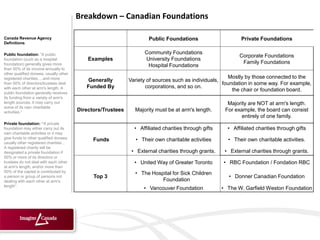
Breakdown – Canadian Foundations

Canada Revenue Agency                                                Public Foundations                       Private Foundations
Definitions

Public foundation: “A public                                       Community Foundations
                                                                                                             Corporate Foundations
foundation (such as a hospital              Examples               University Foundations
foundation) generally gives more                                                                              Family Foundations
                                                                    Hospital Foundations
than 50% of its income annually to
other qualified donees, usually other
registered charities….and more                                                                         Mostly by those connected to the
                                           Generally         Variety of sources such as individuals,
than 50% of directors/trustees deal                                                                  foundation in some way. For example,
with each other at arm's length. A         Funded By                corporations, and so on.
                                                                                                         the chair or foundation board.
public foundation generally receives
its funding from a variety of arm's
length sources. It may carry out                                                                        Majority are NOT at arm's length.
some of its own charitable
activities.”                            Directors/Trustees     Majority must be at arm's length.       For example, the board can consist
                                                                                                              entirely of one family.
Private foundation: “A private
foundation may either carry out its                            • Affiliated charities through gifts     • Affiliated charities through gifts
own charitable activities or it may
give funds to other qualified donees,         Funds            • Their own charitable activities        • Their own charitable activities.
usually other registered charities…
A registered charity will be
designated a private foundation if                            • External charities through grants.     • External charities through grants.
50% or more of its directors or
trustees do not deal with each other                           • United Way of Greater Toronto        • RBC Foundation / Fondation RBC
at arm's length, and/or more than
50% of the capital is contributed by                           • The Hospital for Sick Children
a person or group of persons not              Top 3                                                     • Donner Canadian Foundation
dealing with each other at arm's                                         Foundation
length”.
                                                                   • Vancouver Foundation             • The W. Garfield Weston Foundation
When we discuss foundations that provide grants we
are discussing a specific category of foundations–
Grantmaking Foundations

Foundations disburse their funds in many ways:
Fund their own charitable activities
Provide gifts to associated charities (e.g., Hospital Foundations)
Provide grants to other charities at their discretion

Fundraisers are only interested in the foundations that give grants to
other charities…
The grantmakers!
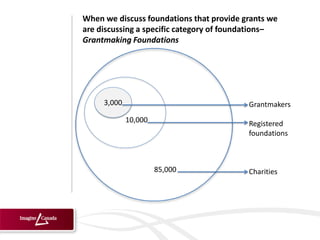
When we discuss foundations that provide grants we
are discussing a specific category of foundations–
Grantmaking Foundations


     3,000                                Grantmakers
             10,000                       Registered
                                          foundations


                      85,000              Charities
How does the partnership start?


Similar principles (and pitfalls) exist in finding a job!
 Prepare yourself for the hunt
 Research to find a handful of great prospects
 Take the time to write a winning application
Steps to Success: Getting the Job or Getting the Grant

Step 1: Know your skills, Prepare your resume
Have your materials ready before you go on the hunt!

Determine your need, your case for support, and budget
before you look for partners
Do you have a funding plan?
Avoid “mission creep”
Steps to Success: Getting the Job or Getting the Grant

Step 2: Who is hiring?
Who is accepting applications?
Do you have friends or family that have connections?

Use available resources to identify which grantmaking
foundations are currently accepting applications
Many grantmaking foundations are not open to receiving
unsolicited requests for funding
Does your board/volunteers/staff have any connections?
Steps to Success: Getting the Job or Getting the Grant

Step 3: Are you a good candidate for the position?
Do your skills match those listed on the job posting?

Does your organization/project serve the population and the
cause that the foundation shows interest in?
Do you meet all requirements that the foundation has? –
funding requests are plentiful so exceptions are rarely made
Is it serving a similar need as previous grantees?

“We say on our website that we will only give grants to Canadian charities. Society’s will
contact us and say ‘well, you’ll make an exception for me.’ These are policies that … are put
in place by our board of directors and they are there for a reason and we can’t make
exceptions to things like that.” -Gayle Longley, RBC Foundation

“Eighty percent of the grant applications that cross Debbie Rey's desk are immediately
rejected. The reason so many don't pass muster: The applicants didn't do their legwork.
They may have glanced at the grant maker's Web site, she says, but they didn't dig deeper
to learn (the Kellogg Foundation’s) specific grant-making priorities.”
Source: Grant Makers Reveal the Most Common Reasons Grant Proposals Get Rejected,
The Chronicle of Philanthropy
Steps to Success: Getting the Job or Getting the Grant

Step 4: Is the salary/position appropriate for you?
If you are hoping to be a marketing executive earning $100k,
maybe applying to be a barista at Starbucks isn’t a great idea.

Ensure what the foundation can offer is in line with your ask
Identify the type of support they will be willing to provide
Consider the ROI
Steps to Success: Getting the Job or Getting the Grant

Step 5: Did you follow company protocol to apply for the job?
Did you simply forward a cover letter and resume to the HR
representative as asked?

Application guidelines and procedures vary extremely
amongst grantmaking foundations to suit their capacity
Most will not review an application that was submitted
following incorrect procedure
Avoid unnecessary supplementary information and
documents
Be outcome specific – do not discuss the one legged hamster
Steps to Success: Getting the Job or Getting the Grant

Step 6: Are you prepared for several rounds of interviews and
negotiation?

Several steps may be involved in the application process
Are you prepared to collaborate with the foundation?
A back and forth between grantmaker and grantee is common
The foundation may use their expertise to suggest changes to
your proposal that will help guide your plans to community
sustainability
Steps to Success: Getting the Job or Getting the Grant

Step 7: Congratulations. Succeed in your new position and
move to higher levels!

The partnership can continue to provide you with funds
The foundation can be continual source of non-financial
support, providing new connections within your community

Turned down?
Larger foundations may offer to provide you valuable
feedback.
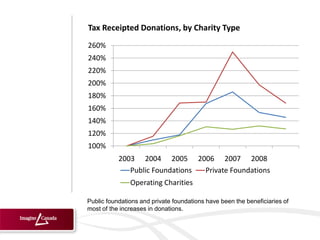
Tax Receipted Donations, by Charity Type
260%
240%
220%
200%
180%
160%
140%
120%
100%
           2003 2004 2005 2006 2007 2008
              Public Foundations Private Foundations
               Operating Charities

Public foundations and private foundations have been the beneficiaries of
most of the increases in donations.
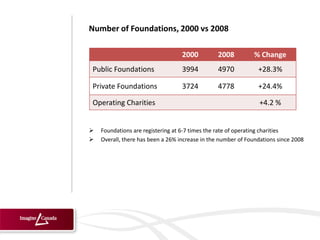
Number of Foundations, 2000 vs 2008

                                   2000          2008         % Change
Public Foundations                 3994          4970           +28.3%

Private Foundations                3724          4778           +24.4%

Operating Charities                                             +4.2 %


   Foundations are registering at 6-7 times the rate of operating charities
   Overall, there has been a 26% increase in the number of Foundations since 2008
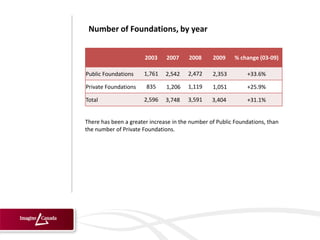
Number of Foundations, by year


                       2003    2007     2008     2009    % change (03-09)

Public Foundations    1,761    2,542   2,472     2,353        +33.6%

Private Foundations    835     1,206   1,119     1,051        +25.9%

Total                 2,596    3,748   3,591     3,404        +31.1%


There has been a greater increase in the number of Public Foundations, than
the number of Private Foundations.
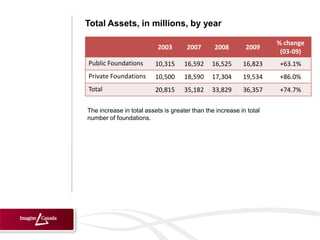
Total Assets, in millions, by year

                                                                     % change
                           2003       2007      2008        2009
                                                                      (03-09)
Public Foundations       10,315      16,592    16,525      16,823    +63.1%
Private Foundations      10,500      18,590    17,304      19,534    +86.0%
Total                    20,815      35,182    33,829      36,357    +74.7%

The increase in total assets is greater than the increase in total
number of foundations.
Imagine Canada’s Sector Monitor

 Survey of charities and foundations to determine
  trends in the sector
 Currently in the field for its 4th iteration
    Please fill it out if you’ve received it!
 About 1500 responses per iteration
 Around 250 foundations per iteration


    For more information:
    http://www.imaginecanada.ca/sector_monitor
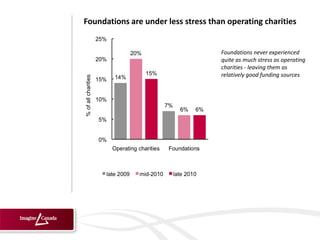
Foundations are under less stress than operating charities


                                     Foundations never experienced
                                     quite as much stress as operating
                                     charities - leaving them as
                                     relatively good funding sources
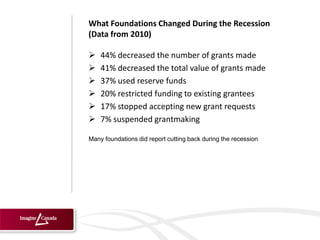
What Foundations Changed During the Recession
(Data from 2010)

   44% decreased the number of grants made
   41% decreased the total value of grants made
   37% used reserve funds
   20% restricted funding to existing grantees
   17% stopped accepting new grant requests
   7% suspended grantmaking

Many foundations did report cutting back during the recession
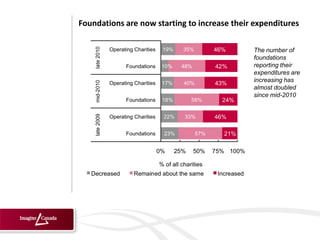
Foundations are now starting to increase their expenditures

                                              The number of
                                              foundations
                                              reporting their
                                              expenditures are
                                              increasing has
                                              almost doubled
                                              since mid-2010
Insights Summary

Foundation Partnerships
 Diversify funding
 Foundations are often continuous sources of funding
 More than just a donor – can be a community partner

Canadian Foundations Versus Grantmaking Foundations
 Foundations can give gifts to qualified donees or operate their own
   charitable programs
 Not all 10,000 foundations are “funders”

Steps to Success
 Preparation is key
 Careful research has a high return on investment
 Follow guidelines - do not assume your organization is unique

Trends
 Foundations are the fastest growing and the strongest form of Canadian
   charities
 The assets of private foundations have nearly doubled in 6 years
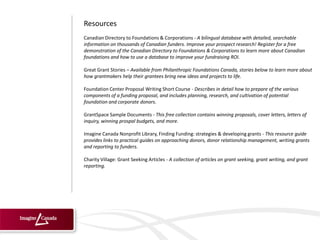
Resources
Canadian Directory to Foundations & Corporations - A bilingual database with detailed, searchable
information on thousands of Canadian funders. Improve your prospect research! Register for a free
demonstration of the Canadian Directory to Foundations & Corporations to learn more about Canadian
foundations and how to use a database to improve your fundraising ROI.

Great Grant Stories – Available from Philanthropic Foundations Canada, stories below to learn more about
how grantmakers help their grantees bring new ideas and projects to life.

Foundation Center Proposal Writing Short Course - Describes in detail how to prepare of the various
components of a funding proposal, and includes planning, research, and cultivation of potential
foundation and corporate donors.

GrantSpace Sample Documents - This free collection contains winning proposals, cover letters, letters of
inquiry, winning prospal budgets, and more.

Imagine Canada Nonprofit Library, Finding Funding: strategies & developing grants - This resource guide
provides links to practical guides on approaching donors, donor relationship management, writing grants
and reporting to funders.

Charity Village: Grant Seeking Articles - A collection of articles on grant seeking, grant writing, and grant
reporting.

Early bird foundation insights.ic.devon diane steve

  • 1.
    Foundation Insights: Trends, Misconceptions,and Successful Partnerships Presented by Devon Hurvid, Steven Ayer, and Diane Ellison
  • 2.
    Devon Hurvid Manager, CanadianDirectory to Foundations & Corporations Steven Ayer Senior Research Associate Diane Ellison Special Advisor to the President and CEO - Quebec
  • 3.
    Agenda • Introduction to Imagine Canada • The significance of foundations • Partnership examples • Defining a foundation • Steps to success • Trends • Summary of insights • Resources
  • 4.
    Imagine Canada programs that support the sector.
  • 5.
    Canadian Directory to Foundations& Corporations Detailed, searchable information on the Canadian foundations that make grants to registered charities PLUS  American Foundations  Government grant programs  Corporate donors A social enterprise connecting grantmakers and grantseekers for 45 years.
  • 6.
    Why should foundationpartnerships matter to community organizations?  Foundations are one of the fastest growing types of charities; there are more now than ever before.  Foundation funding is one of the fastest growing sources of revenues for charities  Foundations can be a knowledge-base of community organizations  Foundations are experiencing enormous growth
  • 7.
    The benefit offoundation partnerships!  Diversify funding  Partnerships are often continuous sources of funding  More than just a donor – a community partner
  • 8.
    Partnerships in Action TheCounselling Foundation of Canada Pathways to Education Canada In the 1990’s the nearly 11,000 people that called Regent Park home faced alarmingly high crime rates, chronic unemployment, low family income and poor educational success rates Regent Park Community Health Centre (RPCHC) decided that a key to breaking the cycle of under-achievement and poverty was to support young people to succeed in school and adults to find rewarding employment The Counselling Foundation of Canada, a family foundation, was established in Toronto by Frank Lawson in 1959 with the aim of creating and enriching counselling programs and improve the technical skills of counsellors. Source: Great Grant Stories, Philanthropic Foundations Canada, www.pfc.ca
  • 9.
    Partnerships in Action TheCounselling Foundation of Canada Pathways to Education Canada RPCHC contacted The Counselling Foundation of Canada to discuss how to put its Community Succession Vision into practice. The Foundation provided a seed grant and two facilitators to undertake community consultations with local agencies to enhance the project design and to develop a long-term sustainability funding model. In the first year of the pilot, the RPCHC recognized that focusing its efforts solely on education provided the greatest potential to promote community change. The decision was made to drop the Pathways to Employment program, and focus on the Pathways to Education program. With that adjustment, the foundation’s grant was renewed in 2000 to support the RPCHC’s development of Pathways to Education, and sustained with several successive grants. Source: Great Grant Stories, Philanthropic Foundations Canada, www.pfc.ca
  • 10.
    Partnerships in Action TheCounselling Foundation of Canada Pathways to Education Canada  The impacts of the Program in Regent Park were nothing short of remarkable.  The Pathways funding model has generated over $40 million in grants and donations since 2001.  Carolyn Acker, former RPCHC Executive Director and founding Executive Director of Pathways to Education Canada, notes that The Counselling Foundation of Canada was “instrumental in embracing and nurturing the Community Succession Vision from a set of ideas to tangible outcomes”.  The influence of the foundation’s grant was not solely felt in Regent Park. The success of the Pathways to Education Program prompted the creation of a new agency, Pathways to Education Canada, to replicate the model in other communities. Source: Great Grant Stories, Philanthropic Foundations Canada, www.pfc.ca
  • 11.
    Partnerships in Action NickleFamily Foundation – Servants Anonymous Society With no established track record, oft-times donors won’t consider funding new nonprofit organizations. And without donors, how do they deliver their services and so establish a track record? Servants Anonymous was formed in 1989 to help adolescent girls, particularly those with children of their own, who were enmeshed in street life, drugs and prostitution. Their plan called for establishing a “safe house,” second stage housing, as well as life skills and vocational training. In the absence of a track record, the due diligence review focussed unusually heavily on the business plan and on the people behind the organization. Source: Great Grant Stories, Philanthropic Foundations Canada, www.pfc.ca
  • 12.
    Partnerships in Action NickleFamily Foundation – Servants Anonymous Society The first grant was $5,000 toward furnishings for the safe house. As Servants Anonymous proved themselves, Nickle Family Foundation made more grants. “Your support, as S.A.S. Calgary’s first funder during its humble beginnings in 1989, was the catalyst to establish the organization’s credibility among the Calgary funding community. In fact, your financial support not only invited others to donate as programs developed, but also encouraged us, the founding team, as we set ourselves up to pioneer the S.A. program model.” – Servants Anonymous Society Source: Great Grant Stories, Philanthropic Foundations Canada, www.pfc.ca
  • 13.
    What is afoundation? Type of charitable organization, further categorized as public or private Nearly 10,000 foundations registered with the Canada Revenue Agency Can operate their own programs or can give gifts to qualified donees Often very similar to operating charities
  • 14.
    Breakdown – CanadianFoundations Canada Revenue Agency Public Foundations Private Foundations Definitions Public foundation: “A public Community Foundations Corporate Foundations foundation (such as a hospital Examples University Foundations foundation) generally gives more Family Foundations Hospital Foundations than 50% of its income annually to other qualified donees, usually other registered charities….and more Mostly by those connected to the Generally Variety of sources such as individuals, than 50% of directors/trustees deal foundation in some way. For example, with each other at arm's length. A Funded By corporations, and so on. the chair or foundation board. public foundation generally receives its funding from a variety of arm's length sources. It may carry out Majority are NOT at arm's length. some of its own charitable activities.” Directors/Trustees Majority must be at arm's length. For example, the board can consist entirely of one family. Private foundation: “A private foundation may either carry out its • Affiliated charities through gifts • Affiliated charities through gifts own charitable activities or it may give funds to other qualified donees, Funds • Their own charitable activities • Their own charitable activities. usually other registered charities… A registered charity will be designated a private foundation if • External charities through grants. • External charities through grants. 50% or more of its directors or trustees do not deal with each other • United Way of Greater Toronto • RBC Foundation / Fondation RBC at arm's length, and/or more than 50% of the capital is contributed by • The Hospital for Sick Children a person or group of persons not Top 3 • Donner Canadian Foundation dealing with each other at arm's Foundation length”. • Vancouver Foundation • The W. Garfield Weston Foundation
  • 15.
    When we discussfoundations that provide grants we are discussing a specific category of foundations– Grantmaking Foundations Foundations disburse their funds in many ways: Fund their own charitable activities Provide gifts to associated charities (e.g., Hospital Foundations) Provide grants to other charities at their discretion Fundraisers are only interested in the foundations that give grants to other charities… The grantmakers!
  • 16.
    When we discussfoundations that provide grants we are discussing a specific category of foundations– Grantmaking Foundations 3,000 Grantmakers 10,000 Registered foundations 85,000 Charities
  • 17.
    How does thepartnership start? Similar principles (and pitfalls) exist in finding a job!  Prepare yourself for the hunt  Research to find a handful of great prospects  Take the time to write a winning application
  • 18.
    Steps to Success:Getting the Job or Getting the Grant Step 1: Know your skills, Prepare your resume Have your materials ready before you go on the hunt! Determine your need, your case for support, and budget before you look for partners Do you have a funding plan? Avoid “mission creep”
  • 19.
    Steps to Success:Getting the Job or Getting the Grant Step 2: Who is hiring? Who is accepting applications? Do you have friends or family that have connections? Use available resources to identify which grantmaking foundations are currently accepting applications Many grantmaking foundations are not open to receiving unsolicited requests for funding Does your board/volunteers/staff have any connections?
  • 20.
    Steps to Success:Getting the Job or Getting the Grant Step 3: Are you a good candidate for the position? Do your skills match those listed on the job posting? Does your organization/project serve the population and the cause that the foundation shows interest in? Do you meet all requirements that the foundation has? – funding requests are plentiful so exceptions are rarely made Is it serving a similar need as previous grantees? “We say on our website that we will only give grants to Canadian charities. Society’s will contact us and say ‘well, you’ll make an exception for me.’ These are policies that … are put in place by our board of directors and they are there for a reason and we can’t make exceptions to things like that.” -Gayle Longley, RBC Foundation “Eighty percent of the grant applications that cross Debbie Rey's desk are immediately rejected. The reason so many don't pass muster: The applicants didn't do their legwork. They may have glanced at the grant maker's Web site, she says, but they didn't dig deeper to learn (the Kellogg Foundation’s) specific grant-making priorities.” Source: Grant Makers Reveal the Most Common Reasons Grant Proposals Get Rejected, The Chronicle of Philanthropy
  • 21.
    Steps to Success:Getting the Job or Getting the Grant Step 4: Is the salary/position appropriate for you? If you are hoping to be a marketing executive earning $100k, maybe applying to be a barista at Starbucks isn’t a great idea. Ensure what the foundation can offer is in line with your ask Identify the type of support they will be willing to provide Consider the ROI
  • 22.
    Steps to Success:Getting the Job or Getting the Grant Step 5: Did you follow company protocol to apply for the job? Did you simply forward a cover letter and resume to the HR representative as asked? Application guidelines and procedures vary extremely amongst grantmaking foundations to suit their capacity Most will not review an application that was submitted following incorrect procedure Avoid unnecessary supplementary information and documents Be outcome specific – do not discuss the one legged hamster
  • 23.
    Steps to Success:Getting the Job or Getting the Grant Step 6: Are you prepared for several rounds of interviews and negotiation? Several steps may be involved in the application process Are you prepared to collaborate with the foundation? A back and forth between grantmaker and grantee is common The foundation may use their expertise to suggest changes to your proposal that will help guide your plans to community sustainability
  • 24.
    Steps to Success:Getting the Job or Getting the Grant Step 7: Congratulations. Succeed in your new position and move to higher levels! The partnership can continue to provide you with funds The foundation can be continual source of non-financial support, providing new connections within your community Turned down? Larger foundations may offer to provide you valuable feedback.
  • 25.
    Tax Receipted Donations,by Charity Type 260% 240% 220% 200% 180% 160% 140% 120% 100% 2003 2004 2005 2006 2007 2008 Public Foundations Private Foundations Operating Charities Public foundations and private foundations have been the beneficiaries of most of the increases in donations.
  • 26.
    Number of Foundations,2000 vs 2008 2000 2008 % Change Public Foundations 3994 4970 +28.3% Private Foundations 3724 4778 +24.4% Operating Charities +4.2 %  Foundations are registering at 6-7 times the rate of operating charities  Overall, there has been a 26% increase in the number of Foundations since 2008
  • 27.
    Number of Foundations,by year 2003 2007 2008 2009 % change (03-09) Public Foundations 1,761 2,542 2,472 2,353 +33.6% Private Foundations 835 1,206 1,119 1,051 +25.9% Total 2,596 3,748 3,591 3,404 +31.1% There has been a greater increase in the number of Public Foundations, than the number of Private Foundations.
  • 28.
    Total Assets, inmillions, by year % change 2003 2007 2008 2009 (03-09) Public Foundations 10,315 16,592 16,525 16,823 +63.1% Private Foundations 10,500 18,590 17,304 19,534 +86.0% Total 20,815 35,182 33,829 36,357 +74.7% The increase in total assets is greater than the increase in total number of foundations.
  • 29.
    Imagine Canada’s SectorMonitor  Survey of charities and foundations to determine trends in the sector  Currently in the field for its 4th iteration  Please fill it out if you’ve received it!  About 1500 responses per iteration  Around 250 foundations per iteration For more information: http://www.imaginecanada.ca/sector_monitor
  • 30.
    Foundations are underless stress than operating charities Foundations never experienced quite as much stress as operating charities - leaving them as relatively good funding sources
  • 31.
    What Foundations ChangedDuring the Recession (Data from 2010)  44% decreased the number of grants made  41% decreased the total value of grants made  37% used reserve funds  20% restricted funding to existing grantees  17% stopped accepting new grant requests  7% suspended grantmaking Many foundations did report cutting back during the recession
  • 32.
    Foundations are nowstarting to increase their expenditures The number of foundations reporting their expenditures are increasing has almost doubled since mid-2010
  • 33.
    Insights Summary Foundation Partnerships Diversify funding  Foundations are often continuous sources of funding  More than just a donor – can be a community partner Canadian Foundations Versus Grantmaking Foundations  Foundations can give gifts to qualified donees or operate their own charitable programs  Not all 10,000 foundations are “funders” Steps to Success  Preparation is key  Careful research has a high return on investment  Follow guidelines - do not assume your organization is unique Trends  Foundations are the fastest growing and the strongest form of Canadian charities  The assets of private foundations have nearly doubled in 6 years
  • 34.
    Resources Canadian Directory toFoundations & Corporations - A bilingual database with detailed, searchable information on thousands of Canadian funders. Improve your prospect research! Register for a free demonstration of the Canadian Directory to Foundations & Corporations to learn more about Canadian foundations and how to use a database to improve your fundraising ROI. Great Grant Stories – Available from Philanthropic Foundations Canada, stories below to learn more about how grantmakers help their grantees bring new ideas and projects to life. Foundation Center Proposal Writing Short Course - Describes in detail how to prepare of the various components of a funding proposal, and includes planning, research, and cultivation of potential foundation and corporate donors. GrantSpace Sample Documents - This free collection contains winning proposals, cover letters, letters of inquiry, winning prospal budgets, and more. Imagine Canada Nonprofit Library, Finding Funding: strategies & developing grants - This resource guide provides links to practical guides on approaching donors, donor relationship management, writing grants and reporting to funders. Charity Village: Grant Seeking Articles - A collection of articles on grant seeking, grant writing, and grant reporting.