MODALITIES OF
DISTRIBUTED TEACHING
PRESENCE IN
ASYNCHRONOUS
DISCUSSION GROUPS
http://www.psyed.edu.es/grintie
Bustos, Engel, Rochera, de
Gispert&Coll
UNIVERSITAT DE
BARCELONA
Theoretical background: Distributed
Teaching Presence (DTP)
 Teaching Presence (TP) is
dynamic and evolves in line
with the responsibility and
control that all the
participants in a community
can exercise (Garrison &
Anderson, 2003).
 The most significant aspect of
the notion of TP Is its potential
for distribution
 As a reinterpretation of the
concept of TP from both
theoretical and
methodological perspectives
(Shea, Li & Picket, 2006;
Morgan, 2011).
 Based on the assumption that
students' learning is mainly
related to the educational
influence of others (Coll,
Teaching Presence (CoI)
DTP from a socio-cultural
approach
Theoretical background: Modalities
of DTP
 All participants can
exercise TP in the three
constitutive dimensions
(Bustos 2011; Coll, Bustos& Engel,
2009; Engel, Coll&Bustos, 213):
 social participation,
 task, and
 shared meanings.
 Teaching presence may
take on different
modalities depending
on:
 the focus of
participants' activity:
 Who, how and when
each participant
contributes about each
dimension:
 reminders, requests,
reviews, questions,
contribution of
information, synthesis,
recaps, etc.
Aims of the study
 To analyze the contributions of participants to an
online forum in order to identify different
modalities in which teaching presence is exercised
inside the dimensions of the management of
social participation (MSP), management of the
academic task (MAT) and management of shared
meanings (MSM).
 Content analysis:
 To explore the focus and modalities of DTP,
transcripts of interactions between two groups of
postgraduate students in Educational Psychology and
their teachers (n = 23, n =16) were analyzed by two
independent coders
Methodology
Methodology
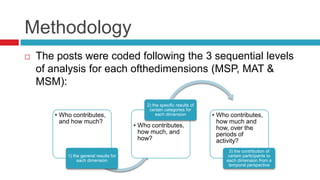
 The posts were coded following the 3 sequential levels
of analysis for each ofthedimensions (MSP, MAT &
MSM):
• Who contributes,
and how much?
1) the general results for
each dimension
• Who contributes,
how much, and
how?
2) the specific results of
certain categories for
each dimension • Who contributes,
how much and
how, over the
periods of
activity?
3) the contribution of
certain participants to
each dimension from a
temporal perspective
Results: Distribution of TP
 A total of 601 fragments were coded in Group 1 and 631
in Group 2 for the three dimensions: MSP, MAT and
MSM. (Cohen's kappa κ =.85 to .91)
 According to our first level of analysis (Who contributes and
how much?):
 We identified several participants as top contributors to
Teaching Presence: 15/23 in Group 1, and 11/16 in Group
2. (total of fragments coded per participant, in one or more
dimension, higher than average)
Results: Modalities of TP
 According to our second and third level of
analysis (Who contributes, how much, and how? &
over the periods of activity…):
 We identified several participants as relevant
contributors to Teaching Presence: (9/23 in Group
1, and 6/16 in Group 2). (their contributions included the
significant categories in one or more dimensions, and were more
or less constant throughout the all activity phases)
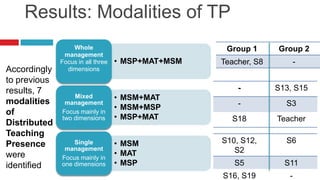
Results: Modalities of TP
Group 1 Group 2
Teacher, S8 -• MSP+MAT+MSM
Whole
management
Focus in all three
dimensions
• MSM+MAT
• MSM+MSP
• MSP+MAT
Mixed
management
Focus mainly in
two dimensions
• MSM
• MAT
• MSP
Single
management
Focus mainly in
one dimensions
- S13, S15
- S3
S18 Teacher
S10, S12,
S2
S6
S5 S11
S16, S19 -
Accordingly
to previous
results, 7
modalities
of
Distributed
Teaching
Presence
were
identified
Finals remarks and open
questions
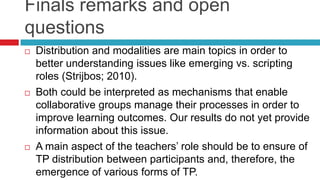
 Distribution and modalities are main topics in order to
better understanding issues like emerging vs. scripting
roles (Strijbos; 2010).
 Both could be interpreted as mechanisms that enable
collaborative groups manage their processes in order to
improve learning outcomes. Our results do not yet provide
information about this issue.
 A main aspect of the teachers’ role should be to ensure of
TP distribution between participants and, therefore, the
emergence of various forms of TP.
MODALITIES OF
DISTRIBUTED TEACHING
PRESENCE IN
ASYNCHRONOUS
DISCUSSION GROUPS
http://www.psyed.edu.es/grintie
abustos@ub.edu
alfonso.bustos@gmail.com
UNIVERSITAT DE
BARCELONA

Modalities of Teaching Presence

  • 1.
    MODALITIES OF DISTRIBUTED TEACHING PRESENCEIN ASYNCHRONOUS DISCUSSION GROUPS http://www.psyed.edu.es/grintie Bustos, Engel, Rochera, de Gispert&Coll UNIVERSITAT DE BARCELONA
  • 2.
    Theoretical background: Distributed TeachingPresence (DTP)  Teaching Presence (TP) is dynamic and evolves in line with the responsibility and control that all the participants in a community can exercise (Garrison & Anderson, 2003).  The most significant aspect of the notion of TP Is its potential for distribution  As a reinterpretation of the concept of TP from both theoretical and methodological perspectives (Shea, Li & Picket, 2006; Morgan, 2011).  Based on the assumption that students' learning is mainly related to the educational influence of others (Coll, Teaching Presence (CoI) DTP from a socio-cultural approach
  • 3.
    Theoretical background: Modalities ofDTP  All participants can exercise TP in the three constitutive dimensions (Bustos 2011; Coll, Bustos& Engel, 2009; Engel, Coll&Bustos, 213):  social participation,  task, and  shared meanings.  Teaching presence may take on different modalities depending on:  the focus of participants' activity:  Who, how and when each participant contributes about each dimension:  reminders, requests, reviews, questions, contribution of information, synthesis, recaps, etc.
  • 4.
    Aims of thestudy  To analyze the contributions of participants to an online forum in order to identify different modalities in which teaching presence is exercised inside the dimensions of the management of social participation (MSP), management of the academic task (MAT) and management of shared meanings (MSM).
  • 5.
     Content analysis: To explore the focus and modalities of DTP, transcripts of interactions between two groups of postgraduate students in Educational Psychology and their teachers (n = 23, n =16) were analyzed by two independent coders Methodology
  • 6.
    Methodology  The postswere coded following the 3 sequential levels of analysis for each ofthedimensions (MSP, MAT & MSM): • Who contributes, and how much? 1) the general results for each dimension • Who contributes, how much, and how? 2) the specific results of certain categories for each dimension • Who contributes, how much and how, over the periods of activity? 3) the contribution of certain participants to each dimension from a temporal perspective
  • 7.
    Results: Distribution ofTP  A total of 601 fragments were coded in Group 1 and 631 in Group 2 for the three dimensions: MSP, MAT and MSM. (Cohen's kappa κ =.85 to .91)  According to our first level of analysis (Who contributes and how much?):  We identified several participants as top contributors to Teaching Presence: 15/23 in Group 1, and 11/16 in Group 2. (total of fragments coded per participant, in one or more dimension, higher than average)
  • 8.
    Results: Modalities ofTP  According to our second and third level of analysis (Who contributes, how much, and how? & over the periods of activity…):  We identified several participants as relevant contributors to Teaching Presence: (9/23 in Group 1, and 6/16 in Group 2). (their contributions included the significant categories in one or more dimensions, and were more or less constant throughout the all activity phases)
  • 9.
    Results: Modalities ofTP Group 1 Group 2 Teacher, S8 -• MSP+MAT+MSM Whole management Focus in all three dimensions • MSM+MAT • MSM+MSP • MSP+MAT Mixed management Focus mainly in two dimensions • MSM • MAT • MSP Single management Focus mainly in one dimensions - S13, S15 - S3 S18 Teacher S10, S12, S2 S6 S5 S11 S16, S19 - Accordingly to previous results, 7 modalities of Distributed Teaching Presence were identified
  • 10.
    Finals remarks andopen questions  Distribution and modalities are main topics in order to better understanding issues like emerging vs. scripting roles (Strijbos; 2010).  Both could be interpreted as mechanisms that enable collaborative groups manage their processes in order to improve learning outcomes. Our results do not yet provide information about this issue.  A main aspect of the teachers’ role should be to ensure of TP distribution between participants and, therefore, the emergence of various forms of TP.
  • 11.
    MODALITIES OF DISTRIBUTED TEACHING PRESENCEIN ASYNCHRONOUS DISCUSSION GROUPS http://www.psyed.edu.es/grintie abustos@ub.edu alfonso.bustos@gmail.com UNIVERSITAT DE BARCELONA