THE IMPACT OF THE LEVEL OF COMMUNITY ENGAGEMENT PRESENT IN A SERVICE LEARNING
INTERVENTION
-Summer Griffin
Service Learning as an educational practice
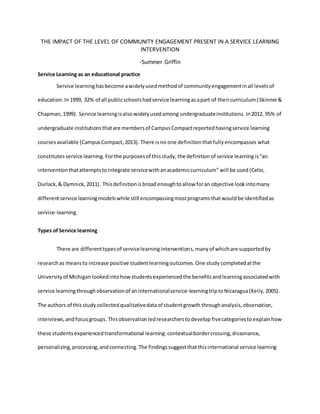
Service learninghasbecome awidelyusedmethodof communityengagementinall levelsof
education.In 1999, 32% of all publicschoolshadservice learningasapart of theircurriculum(Skinner&
Chapman,1999). Service learningisalsowidelyusedamong undergraduateinstitutions.In2012, 95% of
undergraduate institutionsthatare membersof CampusCompactreportedhavingservice learning
coursesavailable (CampusCompact,2013). There isno one definitionthatfullyencompasses what
constitutesservice learning. Forthe purposesof thisstudy, the definition of service learningis“an
interventionthatattemptstointegrate servicewithanacademiccurriculum” will be used (Celio,
Durlack,& Dymnick,2011). Thisdefinitionisbroadenoughtoallow foran objective lookintomany
differentservice learningmodelswhile still encompassingmostprogramsthatwouldbe identifiedas
service-learning.
Types of Service learning
There are differenttypesof servicelearninginterventions,manyof whichare supportedby
researchas meansto increase positive studentlearningoutcomes.One study completed atthe
Universityof Michigan lookedintohowstudentsexperiencedthe benefitsandlearningassociatedwith
service learningthroughobservationof aninternationalservice-learningtriptoNicaragua(Keily,2005).
The authors of thisstudycollectedqualitativedataof studentgrowth throughanalysis,observation,
interviews,andfocusgroups. Thisobservationledresearcherstodevelop fivecategoriestoexplainhow
these students experiencedtransformational learning:contextualbordercrossing,dissonance,
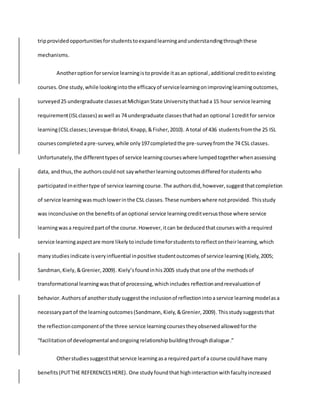
personalizing,processing,andconnecting.The findingssuggestthatthisinternational service learning
tripprovidedopportunitiesforstudentstoexpandlearningandunderstandingthroughthese
mechanisms.
Anotheroptionforservice learningistoprovide itasan optional, additional credittoexisting
courses.One study,while lookingintothe efficacyof servicelearningonimprovinglearningoutcomes,
surveyed 25 undergraduate classesatMichiganState Universitythathada 15 hour service learning
requirement(ISLclasses) aswell as 74 undergraduate classesthathadan optional 1creditfor service
learning(CSLclasses;Levesque-Bristol, Knapp,&Fisher,2010). A total of 436 studentsfromthe 25 ISL
coursescompletedapre-survey,while only197completedthe pre-surveyfromthe 74 CSL classes.
Unfortunately,the differenttypesof service learningcourseswhere lumpedtogether whenassessing
data, andthus, the authorscouldnot saywhetherlearningoutcomesdifferedforstudentswho
participatedineithertype of service learningcourse.The authors did,however,suggestthatcompletion
of service learningwasmuchlowerinthe CSL classes.These numberswhere notprovided. Thisstudy
was inconclusive onthe benefitsof anoptional service learningcreditversusthose where service
learningwasa requiredpartof the course. However, itcan be deducedthat courseswitha required
service learningaspectare more likelytoinclude timeforstudentstoreflectontheirlearning,which
manystudies indicate isveryinfluential inpositive studentoutcomesof service learning (Kiely,2005;
Sandman,Kiely,&Grenier,2009). Kiely’sfoundinhis 2005 study that one of the methodsof
transformational learningwasthatof processing,whichincludes reflectionandreevaluationof
behavior.Authorsof anotherstudysuggestthe inclusionof reflectionintoa service learningmodelasa
necessarypartof the learningoutcomes(Sandmann, Kiely, &Grenier, 2009). Thisstudysuggeststhat
the reflectioncomponentof the three service learningcoursestheyobservedallowedfor the
“facilitationof developmental andongoingrelationshipbuildingthroughdialogue.”
Otherstudiessuggestthat service learningasa requiredpartof a course couldhave many
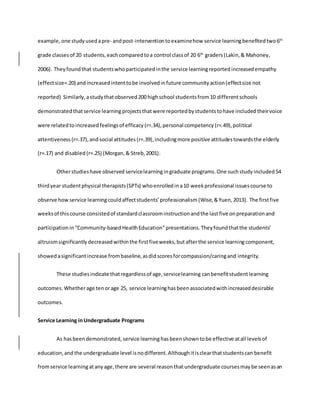
benefits (PUTTHE REFERENCESHERE). One study found that highinteractionwithfacultyincreased
student’s’opennesstodiversityandchallenge (effectsize =.065) as well astheirfeelingsof aninternal
locusof attributionforacademicsuccess (effectsize =.071) (REFERNCE??).Theyalsofoundthat
studentswhohadmore courseswhere theyinteractedregularlywiththeirpeershadanincrease
opennesstodiversityandchallenge(effectsize =.191), as well asa desire forlearningforself-
understanding(effectsize =.063).These resultssuggestthatincreasedinteractionwhile learninghasa
positive outcome,andthereforethatreflectionwithfacultyandfellowstudentsof service learning
activitiescouldbe aneffective wayof increasing service learningbenefits.
Basedon previousresearch, itappears thathavingservice learninghoursapart of course
requirementsismore effectiveatassuringparticipation,aswell asensuringopportunityforstudent
reflection.Thistype of service learningrequirementisalsomore accessible tostudentsthan
international service learningtrips asitdoesnot require the added costandtime neededfortravel.
Overall,servicelearningas a requiredpartof a course has beenassociatedwithnumerous
studentbenefits.In Celio’s (2011) meta-analysis,theyanalyzed62programs usedwithinprimary,
secondary,andpostsecondaryeducationand describedin61differentreportson service learning,all
fittingthe aforementioneddefinitionas “aninterventionthatattemptstointegrate service withan
academiccurriculum.”Thisstudy resultedin significant,positiveeffectsafterparticipation inservice
learninginall measuresincludingattitudestowardsself (.28),attitudestowardsschool andlearning
(.28),civic engagement(.27),social skills (.30),andacademicachievement (.43).These findingsindicate
that service learningusedwithineducationmayprovide manypositivelearning outcomesforstudents
of all ages.
Service-LearningInterventions amongstDifferentAge-Groups
Service learninginterventionsthatare a requiredpartof course curriculumtake place at all
levelsof education,andpositive learningoutcomeshave beenassociatedwithall age groups. For
example,one studyusedapre- andpost-interventiontoexaminehow service learningbenefitedtwo6th
grade classesof 20 students,eachcomparedtoa control classof 20 6th
graders (Lakin,& Mahoney,
2006). Theyfoundthat studentswhoparticipatedinthe service learningreported increasedempathy
(effectsize=.20) andincreasedintenttobe involvedinfuture communityaction(effectsize not
reported) Similarly,astudythatobserved 200 highschool studentsfrom10 differentschools
demonstrated thatservice learningprojectsthatwere reportedbystudentstohave included theirvoice
were relatedto increased feelingsof efficacy (r=.34),personal competency (r=.49),political
attentiveness (r=.37),andsocial attitudes (r=.39),includingmore positive attitudestowardsthe elderly
(r=.17) and disabled (r=.25) (Morgan,& Streb,2001).
Otherstudieshave observed servicelearningingraduate programs.One suchstudy included 54
thirdyear studentphysical therapists(SPTs) whoenrolledin a10 weekprofessional issuescourse to
observe how service learningcouldaffectstudents’professionalism (Wise,&Yuen,2013). The firstfive
weeksof thiscourse consistedof standardclassroominstructionandthe lastfive onpreparationand
participationin“Community-basedHealthEducation”presentations.Theyfoundthatthe students’
altruismsignificantly decreased withinthe firstfiveweeks,but afterthe service learningcomponent,
showedasignificantincrease frombaseline,asdidscoresforcompassion/caringand integrity.
These studiesindicate thatregardlessof age,servicelearning canbenefitstudentlearning
outcomes.Whetherage tenorage 25, service learninghas been associatedwithincreaseddesirable
outcomes.
Service Learning inUndergraduate Programs
As hasbeendemonstrated, service learninghasbeenshowntobe effective atall levelsof
education,and the undergraduate level isnodifferent.Althoughitisclearthatstudentscan benefit
fromservice learningatanyage,there are several reasonthatundergraduate coursesmaybe seenasan
ideal time forparticipationin service learning.First,moststudentsenterundergraduateprogramsator
nearthe age of 18, meaningtheyare justreachingvotingage.Thismeansitisan imperative time for
studentstobe encouragedtobe civicallyengaged.Itis alsoat thistime thatstudentsare beginningto
identifytheircareerinterestsandtodeveloptheirpersonal attitudestoward the new informationand
experiences towhich theyare beingintroduced incollege. Forthese reasons,itseemsthat
undergraduate coursesare anideal time toprovide studentswithservice learningopportunities.
As withotherage groups,studies,suchasCelio’s (YEAR) meta-analysis,have shownthatservice
learningiseffective inincreasingfeelingsof self-efficacy,engagement,anddesire tobe civicallyengaged
inundergraduate students. One study,usingdatafromthe National Surveyof StudentEngagement
(NSSE),foundthatundergraduate studentswhoparticipatedin“educationallypurposeful activities,”
includingservicelearning,showedasignificantincreaseinGPA theirfreshmenyear(logisticregression=
.107) and were significantlymore likelytoreturnfora secondyearof school (logisticregression=.154)
than studentswhodidnot participate insuchactivities (Kuh, Cruce, Shoup, Kinzie, &Gonyea, 2008). A
surveyof RiderUniversityalumni whohadparticipated inthe university’sMindingOurBusiness(MOB)
service learningcourse foundthat62.3%of these alumni hadparticipatedincommunityservice within
the previousyearand that 98.4% plannedtodocommunityservice inthe future (Newman, &
Hernandez, 2011).
It isclear throughthisresearchthat service learningmayhave positivestudentlearning
outcomesforundergraduate students.Asdiscussedpreviously,thereare several reasonswhythisisa
particularlyimportanttime tocomplete service learning.One of these reasons isthatitisan ideal time
for youngadultstoexpandtheirsocial awarenessanddesireforengagement. Forthisreason,itis
importantto determinehowtoenhance the service learningexperience toreallyimprove upon
engagementforundergraduatestudents.
Service Learning and CommunityEngagement
Althoughthese previous studiesandmanyothershave observedpositivelearningoutcomesfor
service learningingeneral,littleresearchhasattemptedtosee how these outcomesmightbe
influencedbythe type orgoal of the service learningproject.However,manystudieshave inadvertently
providedreasoningtoquestionthe effectof the type of projectonthe studentlearningoutcomes.
One study,lookingtonote the changesinattitude towardsolderadults aservice learning
interventioncouldprovide, pairedspeech-language pathologystudentswithanagingadultwith
dementiawhowas alsoa residentof acare-facility (Kaf,Barboa, Fisher, &Snavely, 2011).These
studentsparticipatedindailyactivitieswiththe residentsweekly, withatotal of 15 hoursof service
completed throughoutthe semester.The studyalsoassignedaudiologystudentsthe taskof conducting
otoscopyand air-conductionpure-toneaudiometryof eachof these olderadultsbefore andafterthe
semester.They comparedattitudechangesof all these studentsusingKogan’sAttitudetowardsOld
People Scale (Kogan,1961) to an equal numberof theircounterpartswhodidnotparticipate inthis
service learning.Ascouldbe expected,theyfoundthatthe speech-language pathologystudents andthe
audiologystudentswhoparticipatedinthe service learningshowedsignificant increasesonalmostall
itemsinthe scale (unfortunatelythe rvalue wasnotprovided,butgraphsshow increasesthatrange
froma score of 2.1 – 2.4 to 1.4 – 4.3; the graphshowsthat no decreaseswere found),andsignificantly
higherpost-ratingsthanthe speech-language pathologystudentsandthe audiologystudentswhodid
not participate inthe service learning(meanforSLaudiologypostscore =19, non-SLaudiology=14;
meanfor SL speechlanguage pathology=24, non-SLspeechlanguage pathology=18). However,the
studyalsoshowedsignificantlyhigherpostratingsamongstthe service learningspeech-language
pathologystudentsthanthose inthe service learningaudiologystudents. These resultssuggestthatthe
increasedamountof one-on-one timethatthe speech-languagepathologystudentsspentwiththe
agingadultswas more effective atincreasingtheirpositive attitudes towardsthe demographicthey
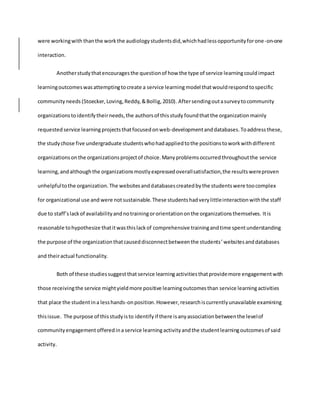
were workingwith thanthe workthe audiologystudentsdid,whichhadlessopportunityforone-on-one
interaction.
Anotherstudythatencouragesthe questionof how the type of service learningcouldimpact
learningoutcomeswas attemptingtocreate a service learningmodel thatwouldrespondtospecific
communityneeds (Stoecker, Loving, Reddy, &Bollig, 2010). Aftersendingoutasurveytocommunity
organizationstoidentifytheirneeds,the authorsof thisstudy foundthatthe organizationmainly
requested service learningprojectsthatfocusedonweb-developmentanddatabases.Toaddressthese,
the studychose five undergraduate studentswhohadappliedtothe positionstoworkwithdifferent
organizationsonthe organizationsprojectof choice.Manyproblemsoccurredthroughoutthe service
learning,andalthoughthe organizationsmostlyexpressedoverallsatisfaction,the resultswereproven
unhelpfultothe organization.The websitesanddatabasescreatedbythe studentswere toocomplex
for organizational use and were notsustainable.These studentshadverylittleinteractionwiththe staff
due to staff’slackof availabilityandnotrainingororientationonthe organizationsthemselves. Itis
reasonable tohypothesize thatitwasthislackof comprehensive trainingandtime spentunderstanding
the purpose of the organizationthatcauseddisconnectbetweenthe students’websitesanddatabases
and theiractual functionality.
Both of these studiessuggestthat service learningactivitiesthatprovidemore engagementwith
those receivingthe service mightyieldmore positive learningoutcomesthan service learningactivities
that place the studentina lesshands-onposition. However,researchiscurrentlyunavailable examining
thisissue. The purpose of thisstudyisto identifyif there isanyassociationbetweenthe levelof
communityengagementofferedina service learningactivityandthe studentlearningoutcomesof said
activity.
References:
CampusCompact.(2013). Creatinga Culture of Assessment:2012 CampusCompact Annual
MemberSurvey.Boston,MA:CampusCompact
Celio,C.I.,Durlak,J.,& Dymnicki,A.,(2011). A meta-analysisof the impactof service-learningon
students.Journalof ExperientialEducation,34, 164-181.
Cruce,T. M., Wilniak,G.C.,Seifert,T.A.,& Pascarella,E.T. (2006). Impactsof good practiceson
cognitive development, learningorientations,and graduate degree plansduringthe firstyearof college.
Journalof College StudentDevelopment,47, 364-383.
Kaf,W. A.,Barboa, L. S., Fisher,B.J.,& Snavely,L.A.(2011). Effectof interdisciplinary service
learningexperience foraudiologyand speech-languagepathology studentsworkingwithadultswith
dementia. American Journalof Audiology,20, S241-S249.
Kiely,R.(2005). A transformative learningmodel forservice-learning:alongitudinal case study.
Michigan Journalof CommunityServiceLearning, 5-22.
Kogan,N.(1961). Attitudestowardoldpeople:The developmentof ascale and examinationof
correlates. Journalof Abnormaland SocialPsychology,62, 44-54.
Kuh,G. D., Cruce,T. M., Shoup,R.,Kinzie,J.,&Gonyea,R.M. (2008). Unmaskingthe effectsof
studentengagementonfirst-yearcollegegradesand persistence. TheJournalof Higher Education,79,
5, 540-563.
Lakin,R., & Mahoney,A.,(2006). Empoweringyouthtochange theirworld:Identifyingkey
componentsof a communityservice programtopromote positive development. Journalof School
Psychology,44, 513-531.
Levesque-Bristol,C.,Knapp,T.D.,& Fisher,B.J. (2010). The effectivenessof service-learning:it’s
not alwayswhatyouthink. Journalof ExperientialEducation,33, 208-224.
Morgan, W., & Streb,M. (2001). Building citizenship:how studentvoice in service-learning
develops civicvalues. SocialScienceQuarterly,82, 154-169.
Newman,C.M., & Hernandez,S.A.(2011). Minding ourbusiness:longitudinal effectsof a
service-learningexperience onalumni. Journalof CollegeTeaching & Learning,8, 39-48.
Sandmann,R.L., Kiely,C.R.,& Grenier,S.R. (2009). Program planning:the neglecteddimension
of service-learning. Michigan Journalof Community ServiceLearning, 17-33.
Skinner,R.,& Chapman,C.(1999). Service-learningandcommunityservice inK-12public
schools.Retrievedfromthe National CenterforEducationStatisticswebsite:
http://nces.ed.gov/pubs99/1999043.pdf
Stoecker,R.,Loving,K.,Reddy,M.,& Bollig,N.(2010). Can community-basedresearchguide
service learning?Journalof CommunityPractice,18, 280-296.
Wise,H. H.,& Yuen,H. K.(2013). Effectof community-basedservicelearningon professionalism
instudentphysical therapist. Journalof PhysicalTherapy Education,27, 58-64.

Lit review (Recovered)

  • 1.
    THE IMPACT OFTHE LEVEL OF COMMUNITY ENGAGEMENT PRESENT IN A SERVICE LEARNING INTERVENTION -Summer Griffin Service Learning as an educational practice Service learninghasbecome awidelyusedmethodof communityengagementinall levelsof education.In 1999, 32% of all publicschoolshadservice learningasapart of theircurriculum(Skinner& Chapman,1999). Service learningisalsowidelyusedamong undergraduateinstitutions.In2012, 95% of undergraduate institutionsthatare membersof CampusCompactreportedhavingservice learning coursesavailable (CampusCompact,2013). There isno one definitionthatfullyencompasses what constitutesservice learning. Forthe purposesof thisstudy, the definition of service learningis“an interventionthatattemptstointegrate servicewithanacademiccurriculum” will be used (Celio, Durlack,& Dymnick,2011). Thisdefinitionisbroadenoughtoallow foran objective lookintomany differentservice learningmodelswhile still encompassingmostprogramsthatwouldbe identifiedas service-learning. Types of Service learning There are differenttypesof servicelearninginterventions,manyof whichare supportedby researchas meansto increase positive studentlearningoutcomes.One study completed atthe Universityof Michigan lookedintohowstudentsexperiencedthe benefitsandlearningassociatedwith service learningthroughobservationof aninternationalservice-learningtriptoNicaragua(Keily,2005). The authors of thisstudycollectedqualitativedataof studentgrowth throughanalysis,observation, interviews,andfocusgroups. Thisobservationledresearcherstodevelop fivecategoriestoexplainhow these students experiencedtransformational learning:contextualbordercrossing,dissonance, personalizing,processing,andconnecting.The findingssuggestthatthisinternational service learning
  • 2.
    tripprovidedopportunitiesforstudentstoexpandlearningandunderstandingthroughthese mechanisms. Anotheroptionforservice learningistoprovide itasanoptional, additional credittoexisting courses.One study,while lookingintothe efficacyof servicelearningonimprovinglearningoutcomes, surveyed 25 undergraduate classesatMichiganState Universitythathada 15 hour service learning requirement(ISLclasses) aswell as 74 undergraduate classesthathadan optional 1creditfor service learning(CSLclasses;Levesque-Bristol, Knapp,&Fisher,2010). A total of 436 studentsfromthe 25 ISL coursescompletedapre-survey,while only197completedthe pre-surveyfromthe 74 CSL classes. Unfortunately,the differenttypesof service learningcourseswhere lumpedtogether whenassessing data, andthus, the authorscouldnot saywhetherlearningoutcomesdifferedforstudentswho participatedineithertype of service learningcourse.The authors did,however,suggestthatcompletion of service learningwasmuchlowerinthe CSL classes.These numberswhere notprovided. Thisstudy was inconclusive onthe benefitsof anoptional service learningcreditversusthose where service learningwasa requiredpartof the course. However, itcan be deducedthat courseswitha required service learningaspectare more likelytoinclude timeforstudentstoreflectontheirlearning,which manystudies indicate isveryinfluential inpositive studentoutcomesof service learning (Kiely,2005; Sandman,Kiely,&Grenier,2009). Kiely’sfoundinhis 2005 study that one of the methodsof transformational learningwasthatof processing,whichincludes reflectionandreevaluationof behavior.Authorsof anotherstudysuggestthe inclusionof reflectionintoa service learningmodelasa necessarypartof the learningoutcomes(Sandmann, Kiely, &Grenier, 2009). Thisstudysuggeststhat the reflectioncomponentof the three service learningcoursestheyobservedallowedfor the “facilitationof developmental andongoingrelationshipbuildingthroughdialogue.” Otherstudiessuggestthat service learningasa requiredpartof a course couldhave many benefits (PUTTHE REFERENCESHERE). One study found that highinteractionwithfacultyincreased
  • 3.
    student’s’opennesstodiversityandchallenge (effectsize =.065)as well astheirfeelingsof aninternal locusof attributionforacademicsuccess (effectsize =.071) (REFERNCE??).Theyalsofoundthat studentswhohadmore courseswhere theyinteractedregularlywiththeirpeershadanincrease opennesstodiversityandchallenge(effectsize =.191), as well asa desire forlearningforself- understanding(effectsize =.063).These resultssuggestthatincreasedinteractionwhile learninghasa positive outcome,andthereforethatreflectionwithfacultyandfellowstudentsof service learning activitiescouldbe aneffective wayof increasing service learningbenefits. Basedon previousresearch, itappears thathavingservice learninghoursapart of course requirementsismore effectiveatassuringparticipation,aswell asensuringopportunityforstudent reflection.Thistype of service learningrequirementisalsomore accessible tostudentsthan international service learningtrips asitdoesnot require the added costandtime neededfortravel. Overall,servicelearningas a requiredpartof a course has beenassociatedwithnumerous studentbenefits.In Celio’s (2011) meta-analysis,theyanalyzed62programs usedwithinprimary, secondary,andpostsecondaryeducationand describedin61differentreportson service learning,all fittingthe aforementioneddefinitionas “aninterventionthatattemptstointegrate service withan academiccurriculum.”Thisstudy resultedin significant,positiveeffectsafterparticipation inservice learninginall measuresincludingattitudestowardsself (.28),attitudestowardsschool andlearning (.28),civic engagement(.27),social skills (.30),andacademicachievement (.43).These findingsindicate that service learningusedwithineducationmayprovide manypositivelearning outcomesforstudents of all ages. Service-LearningInterventions amongstDifferentAge-Groups Service learninginterventionsthatare a requiredpartof course curriculumtake place at all levelsof education,andpositive learningoutcomeshave beenassociatedwithall age groups. For
  • 4.
    example,one studyusedapre- andpost-interventiontoexaminehowservice learningbenefitedtwo6th grade classesof 20 students,eachcomparedtoa control classof 20 6th graders (Lakin,& Mahoney, 2006). Theyfoundthat studentswhoparticipatedinthe service learningreported increasedempathy (effectsize=.20) andincreasedintenttobe involvedinfuture communityaction(effectsize not reported) Similarly,astudythatobserved 200 highschool studentsfrom10 differentschools demonstrated thatservice learningprojectsthatwere reportedbystudentstohave included theirvoice were relatedto increased feelingsof efficacy (r=.34),personal competency (r=.49),political attentiveness (r=.37),andsocial attitudes (r=.39),includingmore positive attitudestowardsthe elderly (r=.17) and disabled (r=.25) (Morgan,& Streb,2001). Otherstudieshave observed servicelearningingraduate programs.One suchstudy included 54 thirdyear studentphysical therapists(SPTs) whoenrolledin a10 weekprofessional issuescourse to observe how service learningcouldaffectstudents’professionalism (Wise,&Yuen,2013). The firstfive weeksof thiscourse consistedof standardclassroominstructionandthe lastfive onpreparationand participationin“Community-basedHealthEducation”presentations.Theyfoundthatthe students’ altruismsignificantly decreased withinthe firstfiveweeks,but afterthe service learningcomponent, showedasignificantincrease frombaseline,asdidscoresforcompassion/caringand integrity. These studiesindicate thatregardlessof age,servicelearning canbenefitstudentlearning outcomes.Whetherage tenorage 25, service learninghas been associatedwithincreaseddesirable outcomes. Service Learning inUndergraduate Programs As hasbeendemonstrated, service learninghasbeenshowntobe effective atall levelsof education,and the undergraduate level isnodifferent.Althoughitisclearthatstudentscan benefit fromservice learningatanyage,there are several reasonthatundergraduate coursesmaybe seenasan
  • 5.
    ideal time forparticipationinservice learning.First,moststudentsenterundergraduateprogramsator nearthe age of 18, meaningtheyare justreachingvotingage.Thismeansitisan imperative time for studentstobe encouragedtobe civicallyengaged.Itis alsoat thistime thatstudentsare beginningto identifytheircareerinterestsandtodeveloptheirpersonal attitudestoward the new informationand experiences towhich theyare beingintroduced incollege. Forthese reasons,itseemsthat undergraduate coursesare anideal time toprovide studentswithservice learningopportunities. As withotherage groups,studies,suchasCelio’s (YEAR) meta-analysis,have shownthatservice learningiseffective inincreasingfeelingsof self-efficacy,engagement,anddesire tobe civicallyengaged inundergraduate students. One study,usingdatafromthe National Surveyof StudentEngagement (NSSE),foundthatundergraduate studentswhoparticipatedin“educationallypurposeful activities,” includingservicelearning,showedasignificantincreaseinGPA theirfreshmenyear(logisticregression= .107) and were significantlymore likelytoreturnfora secondyearof school (logisticregression=.154) than studentswhodidnot participate insuchactivities (Kuh, Cruce, Shoup, Kinzie, &Gonyea, 2008). A surveyof RiderUniversityalumni whohadparticipated inthe university’sMindingOurBusiness(MOB) service learningcourse foundthat62.3%of these alumni hadparticipatedincommunityservice within the previousyearand that 98.4% plannedtodocommunityservice inthe future (Newman, & Hernandez, 2011). It isclear throughthisresearchthat service learningmayhave positivestudentlearning outcomesforundergraduate students.Asdiscussedpreviously,thereare several reasonswhythisisa particularlyimportanttime tocomplete service learning.One of these reasons isthatitisan ideal time for youngadultstoexpandtheirsocial awarenessanddesireforengagement. Forthisreason,itis importantto determinehowtoenhance the service learningexperience toreallyimprove upon engagementforundergraduatestudents.
  • 6.
    Service Learning andCommunityEngagement Althoughthese previous studiesandmanyothershave observedpositivelearningoutcomesfor service learningingeneral,littleresearchhasattemptedtosee how these outcomesmightbe influencedbythe type orgoal of the service learningproject.However,manystudieshave inadvertently providedreasoningtoquestionthe effectof the type of projectonthe studentlearningoutcomes. One study,lookingtonote the changesinattitude towardsolderadults aservice learning interventioncouldprovide, pairedspeech-language pathologystudentswithanagingadultwith dementiawhowas alsoa residentof acare-facility (Kaf,Barboa, Fisher, &Snavely, 2011).These studentsparticipatedindailyactivitieswiththe residentsweekly, withatotal of 15 hoursof service completed throughoutthe semester.The studyalsoassignedaudiologystudentsthe taskof conducting otoscopyand air-conductionpure-toneaudiometryof eachof these olderadultsbefore andafterthe semester.They comparedattitudechangesof all these studentsusingKogan’sAttitudetowardsOld People Scale (Kogan,1961) to an equal numberof theircounterpartswhodidnotparticipate inthis service learning.Ascouldbe expected,theyfoundthatthe speech-language pathologystudents andthe audiologystudentswhoparticipatedinthe service learningshowedsignificant increasesonalmostall itemsinthe scale (unfortunatelythe rvalue wasnotprovided,butgraphsshow increasesthatrange froma score of 2.1 – 2.4 to 1.4 – 4.3; the graphshowsthat no decreaseswere found),andsignificantly higherpost-ratingsthanthe speech-language pathologystudentsandthe audiologystudentswhodid not participate inthe service learning(meanforSLaudiologypostscore =19, non-SLaudiology=14; meanfor SL speechlanguage pathology=24, non-SLspeechlanguage pathology=18). However,the studyalsoshowedsignificantlyhigherpostratingsamongstthe service learningspeech-language pathologystudentsthanthose inthe service learningaudiologystudents. These resultssuggestthatthe increasedamountof one-on-one timethatthe speech-languagepathologystudentsspentwiththe agingadultswas more effective atincreasingtheirpositive attitudes towardsthe demographicthey
  • 7.
    were workingwith thantheworkthe audiologystudentsdid,whichhadlessopportunityforone-on-one interaction. Anotherstudythatencouragesthe questionof how the type of service learningcouldimpact learningoutcomeswas attemptingtocreate a service learningmodel thatwouldrespondtospecific communityneeds (Stoecker, Loving, Reddy, &Bollig, 2010). Aftersendingoutasurveytocommunity organizationstoidentifytheirneeds,the authorsof thisstudy foundthatthe organizationmainly requested service learningprojectsthatfocusedonweb-developmentanddatabases.Toaddressthese, the studychose five undergraduate studentswhohadappliedtothe positionstoworkwithdifferent organizationsonthe organizationsprojectof choice.Manyproblemsoccurredthroughoutthe service learning,andalthoughthe organizationsmostlyexpressedoverallsatisfaction,the resultswereproven unhelpfultothe organization.The websitesanddatabasescreatedbythe studentswere toocomplex for organizational use and were notsustainable.These studentshadverylittleinteractionwiththe staff due to staff’slackof availabilityandnotrainingororientationonthe organizationsthemselves. Itis reasonable tohypothesize thatitwasthislackof comprehensive trainingandtime spentunderstanding the purpose of the organizationthatcauseddisconnectbetweenthe students’websitesanddatabases and theiractual functionality. Both of these studiessuggestthat service learningactivitiesthatprovidemore engagementwith those receivingthe service mightyieldmore positive learningoutcomesthan service learningactivities that place the studentina lesshands-onposition. However,researchiscurrentlyunavailable examining thisissue. The purpose of thisstudyisto identifyif there isanyassociationbetweenthe levelof communityengagementofferedina service learningactivityandthe studentlearningoutcomesof said activity.
  • 8.
    References: CampusCompact.(2013). Creatinga Cultureof Assessment:2012 CampusCompact Annual MemberSurvey.Boston,MA:CampusCompact Celio,C.I.,Durlak,J.,& Dymnicki,A.,(2011). A meta-analysisof the impactof service-learningon students.Journalof ExperientialEducation,34, 164-181. Cruce,T. M., Wilniak,G.C.,Seifert,T.A.,& Pascarella,E.T. (2006). Impactsof good practiceson cognitive development, learningorientations,and graduate degree plansduringthe firstyearof college. Journalof College StudentDevelopment,47, 364-383. Kaf,W. A.,Barboa, L. S., Fisher,B.J.,& Snavely,L.A.(2011). Effectof interdisciplinary service learningexperience foraudiologyand speech-languagepathology studentsworkingwithadultswith dementia. American Journalof Audiology,20, S241-S249.
  • 9.
    Kiely,R.(2005). A transformativelearningmodel forservice-learning:alongitudinal case study. Michigan Journalof CommunityServiceLearning, 5-22. Kogan,N.(1961). Attitudestowardoldpeople:The developmentof ascale and examinationof correlates. Journalof Abnormaland SocialPsychology,62, 44-54. Kuh,G. D., Cruce,T. M., Shoup,R.,Kinzie,J.,&Gonyea,R.M. (2008). Unmaskingthe effectsof studentengagementonfirst-yearcollegegradesand persistence. TheJournalof Higher Education,79, 5, 540-563. Lakin,R., & Mahoney,A.,(2006). Empoweringyouthtochange theirworld:Identifyingkey componentsof a communityservice programtopromote positive development. Journalof School Psychology,44, 513-531. Levesque-Bristol,C.,Knapp,T.D.,& Fisher,B.J. (2010). The effectivenessof service-learning:it’s not alwayswhatyouthink. Journalof ExperientialEducation,33, 208-224. Morgan, W., & Streb,M. (2001). Building citizenship:how studentvoice in service-learning develops civicvalues. SocialScienceQuarterly,82, 154-169. Newman,C.M., & Hernandez,S.A.(2011). Minding ourbusiness:longitudinal effectsof a service-learningexperience onalumni. Journalof CollegeTeaching & Learning,8, 39-48. Sandmann,R.L., Kiely,C.R.,& Grenier,S.R. (2009). Program planning:the neglecteddimension of service-learning. Michigan Journalof Community ServiceLearning, 17-33. Skinner,R.,& Chapman,C.(1999). Service-learningandcommunityservice inK-12public schools.Retrievedfromthe National CenterforEducationStatisticswebsite: http://nces.ed.gov/pubs99/1999043.pdf Stoecker,R.,Loving,K.,Reddy,M.,& Bollig,N.(2010). Can community-basedresearchguide service learning?Journalof CommunityPractice,18, 280-296. Wise,H. H.,& Yuen,H. K.(2013). Effectof community-basedservicelearningon professionalism instudentphysical therapist. Journalof PhysicalTherapy Education,27, 58-64.