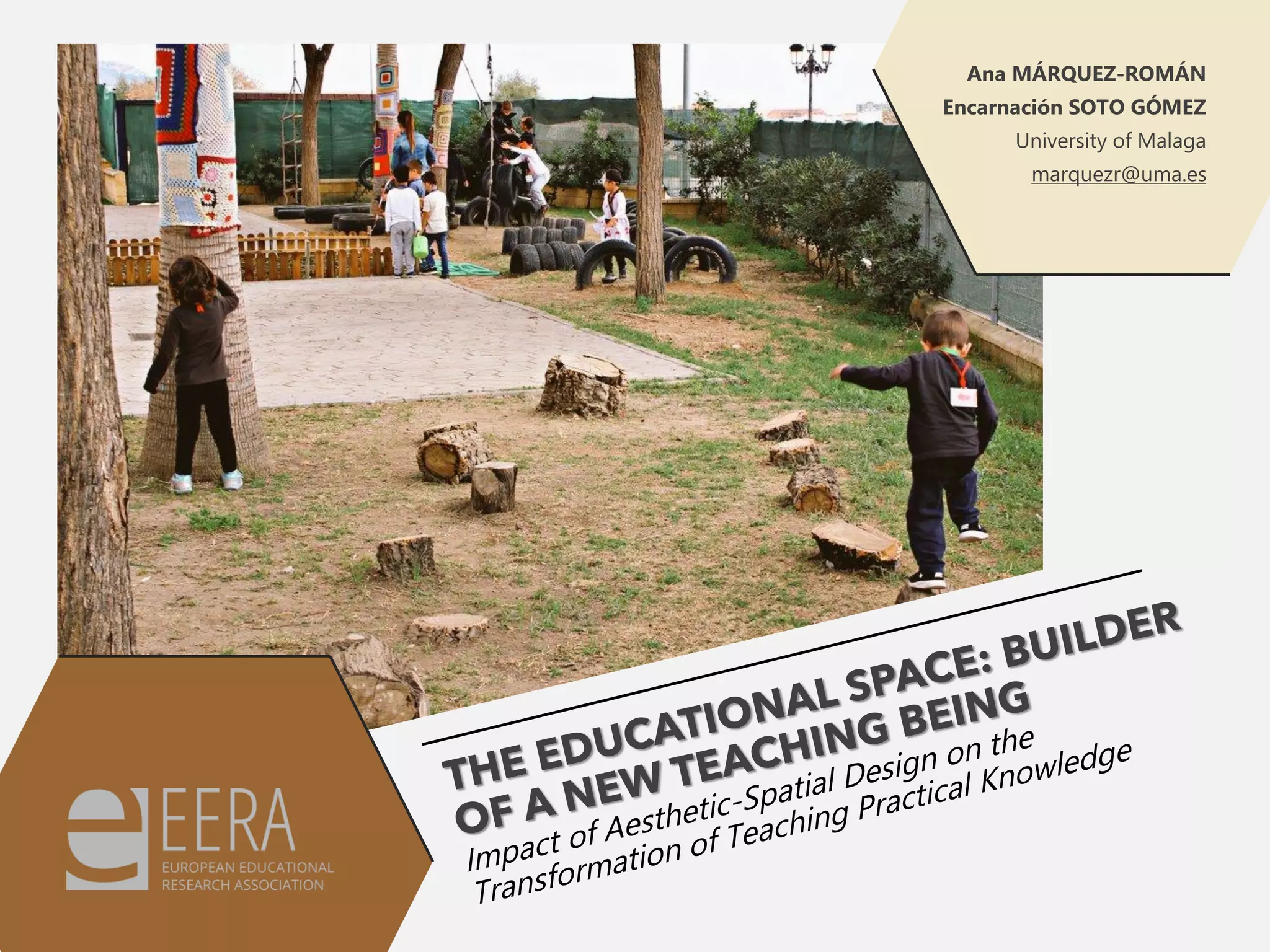
CEIP Frida Kahlo (Málaga, Spain)
Ana MÁRQUEZ-ROMÁN
Encarnación SOTO GÓMEZ
University of Malaga
marquezr@uma.es
Relationship between the aesthetics of the
educational space and the reconstruction
of practical teaching knowledge
Despite the fact that in recent decades there have been
great changes in the ideas explicitly maintained by
teachers in relation to the educational process, these
changes do not seem to have been transferred to the
practice of the classrooms, resulting in our schools not
being different today much of what they were years ago.
(set of knowledge, skills, values, attitudes and emotions that operate
automatically and that condition our perception and performance)
Distance between teacher’s proclaimed theories
(what they say) and theories in use (what they do)
Why is it
important to
analyze this
possible
relationship?
Context: Second Cycle of
Early Childhood Education of the
public school “Frida Kahlo”
(Málaga, Spain)
Participating population:
nine teachers (three from P3,
three from P4, two from P5 and
a support teacher), and the
management team formed by
the Head of Studies and the
Director of the center.
Case study
Information gathering:
-Observation and in-depth photographic analysis of
the physical reality of the eight learning environments;
-Observation and pedagogical documentation of the
performance of the nine teachers;
-Observation, recording and analysis of the cycle
meetings and explanatory talks about the project,
given by the teaching and management team;
-Semi-structured discussion group with the nine
teachers;
-And analysis of the institutional documents of the
center.
CEIP El Martinet (Barcelona, Spain)
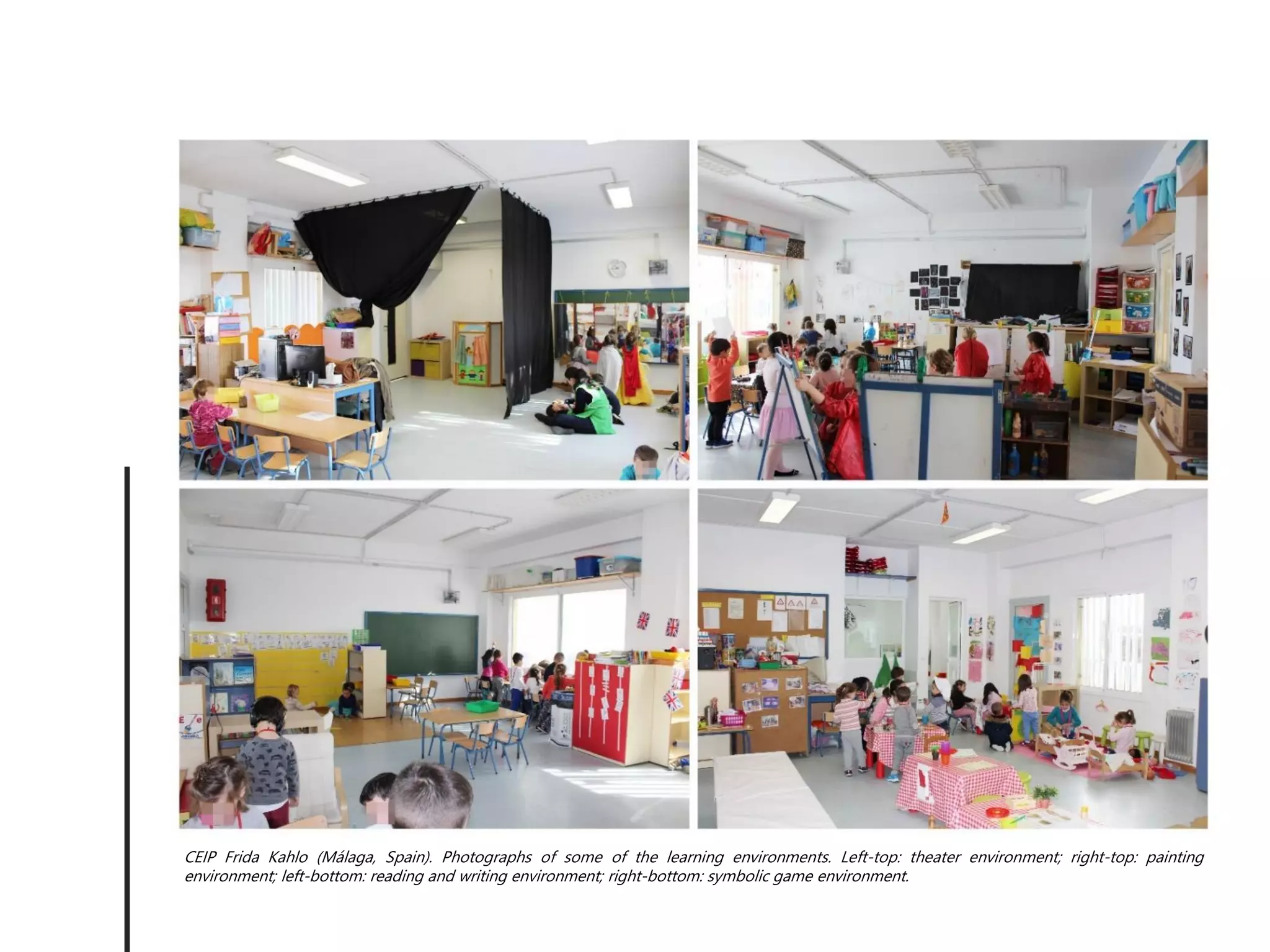
CEIP Frida Kahlo (Málaga, Spain). Photographs of some of the learning environments. Left-top: theater environment; right-top: painting
environment; left-bottom: reading and writing environment; right-bottom: symbolic game environment.
- existence of a balance in
the whole environment
- simplicity in spaces
- use of less strident
colors
- preference for those
natural and recycled
materials
- and order.
Aesthetic criteria
verbally defended
by the teachers
(PROCLAMED
THEORIES)
About the nature of resources
About the pedagogical coherence of resources
About the harmony of space and resources
The space:
privileged
showcase of
its practices
(THEORIES
IN USE)
About the stereotypical
image of childhood
"In school, especially in
Early Childhood
Education, everything
has always been
infantilized, everything
with very garish colors...
and it's the opposite"
(Laura, 4-year-old tutor.
Discussion group).
About the diffuse appearance
of a new childhood image
Transformation of the logical-mathematical environment. The photograph on the left corresponds to the image that the environment presented
before starting the process of spatial transformation. The second and third photographs correspond to the same classroom eight months later
“For example, in the mathematical environment,
when the rugs were placed and the tables were
removed, the atmosphere was more fluid, more
natural... I think it produced an interesting
change for them and for me” (Tania, Discussion
group, 05/30/2016)
New spatial changes:
rapprochement
between their
proclaimed theories
and theories in use
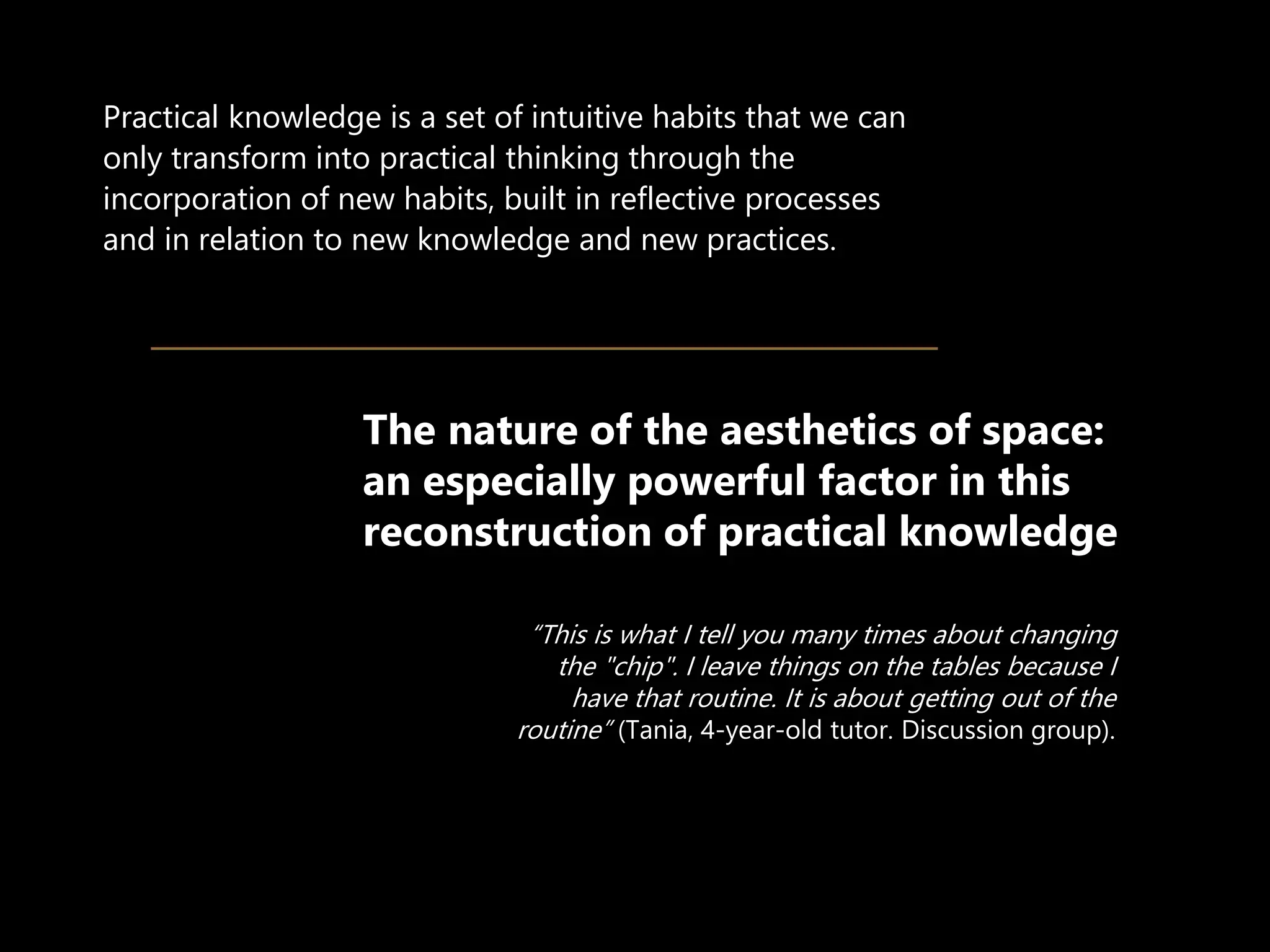
“This is what I tell you many times about changing
the "chip". I leave things on the tables because I
have that routine. It is about getting out of the
routine” (Tania, 4-year-old tutor. Discussion group).
Practical knowledge is a set of intuitive habits that we can
only transform into practical thinking through the
incorporation of new habits, built in reflective processes
and in relation to new knowledge and new practices.
The nature of the aesthetics of space:
an especially powerful factor in this
reconstruction of practical knowledge
Presentation included in the doctoral thesis “Spaces of life and beauty. The
aesthetic design of space as an educational variable in nursery school. Multi-
case study” (Doctorate in Education and Social Communication from the
University of Malaga).
What do school
spaces reveal
about our image
of childhood and
education?

ECER presentation

  • 1.
    CEIP Frida Kahlo(Málaga, Spain) Ana MÁRQUEZ-ROMÁN Encarnación SOTO GÓMEZ University of Malaga marquezr@uma.es
  • 2.
    Relationship between theaesthetics of the educational space and the reconstruction of practical teaching knowledge Despite the fact that in recent decades there have been great changes in the ideas explicitly maintained by teachers in relation to the educational process, these changes do not seem to have been transferred to the practice of the classrooms, resulting in our schools not being different today much of what they were years ago. (set of knowledge, skills, values, attitudes and emotions that operate automatically and that condition our perception and performance) Distance between teacher’s proclaimed theories (what they say) and theories in use (what they do) Why is it important to analyze this possible relationship?
  • 3.
    Context: Second Cycleof Early Childhood Education of the public school “Frida Kahlo” (Málaga, Spain) Participating population: nine teachers (three from P3, three from P4, two from P5 and a support teacher), and the management team formed by the Head of Studies and the Director of the center. Case study Information gathering: -Observation and in-depth photographic analysis of the physical reality of the eight learning environments; -Observation and pedagogical documentation of the performance of the nine teachers; -Observation, recording and analysis of the cycle meetings and explanatory talks about the project, given by the teaching and management team; -Semi-structured discussion group with the nine teachers; -And analysis of the institutional documents of the center.
  • 4.
    CEIP El Martinet(Barcelona, Spain)
  • 5.
    CEIP Frida Kahlo(Málaga, Spain). Photographs of some of the learning environments. Left-top: theater environment; right-top: painting environment; left-bottom: reading and writing environment; right-bottom: symbolic game environment.
  • 6.
    - existence ofa balance in the whole environment - simplicity in spaces - use of less strident colors - preference for those natural and recycled materials - and order. Aesthetic criteria verbally defended by the teachers (PROCLAMED THEORIES)
  • 7.
    About the natureof resources About the pedagogical coherence of resources About the harmony of space and resources The space: privileged showcase of its practices (THEORIES IN USE)
  • 8.
    About the stereotypical imageof childhood "In school, especially in Early Childhood Education, everything has always been infantilized, everything with very garish colors... and it's the opposite" (Laura, 4-year-old tutor. Discussion group). About the diffuse appearance of a new childhood image
  • 9.
    Transformation of thelogical-mathematical environment. The photograph on the left corresponds to the image that the environment presented before starting the process of spatial transformation. The second and third photographs correspond to the same classroom eight months later “For example, in the mathematical environment, when the rugs were placed and the tables were removed, the atmosphere was more fluid, more natural... I think it produced an interesting change for them and for me” (Tania, Discussion group, 05/30/2016) New spatial changes: rapprochement between their proclaimed theories and theories in use
  • 10.
    “This is whatI tell you many times about changing the "chip". I leave things on the tables because I have that routine. It is about getting out of the routine” (Tania, 4-year-old tutor. Discussion group). Practical knowledge is a set of intuitive habits that we can only transform into practical thinking through the incorporation of new habits, built in reflective processes and in relation to new knowledge and new practices. The nature of the aesthetics of space: an especially powerful factor in this reconstruction of practical knowledge
  • 11.
    Presentation included inthe doctoral thesis “Spaces of life and beauty. The aesthetic design of space as an educational variable in nursery school. Multi- case study” (Doctorate in Education and Social Communication from the University of Malaga). What do school spaces reveal about our image of childhood and education?