GROUP II
ENGLISH ACADEMIC PROFESSIONAL PURPOSES
Kimchell ArpaY Serge David Mainit
Orvy Jay Mainit Prancis Hario
BBY:
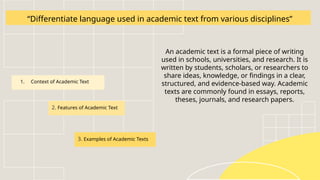
“Differentiate language used in academic text from various disciplines”
An academic text is a formal piece of writing
used in schools, universities, and research. It is
written by students, scholars, or researchers to
share ideas, knowledge, or findings in a clear,
structured, and evidence-based way. Academic
texts are commonly found in essays, reports,
theses, journals, and research papers.
1. Context of Academic Text
2. Features of Academic Text
3. Examples of Academic Texts
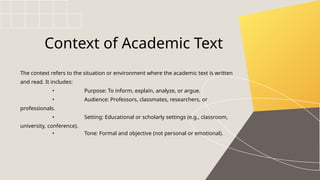
Context of Academic Text
The context refers to the situation or environment where the academic text is written
and read. It includes:
• Purpose: To inform, explain, analyze, or argue.
• Audience: Professors, classmates, researchers, or
professionals.
• Setting: Educational or scholarly settings (e.g., classroom,
university, conference).
• Tone: Formal and objective (not personal or emotional).
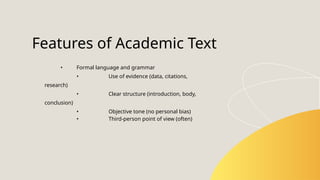
• Formal language and grammar
• Use of evidence (data, citations,
research)
• Clear structure (introduction, body,
conclusion)
• Objective tone (no personal bias)
• Third-person point of view (often)
Features of Academic Text
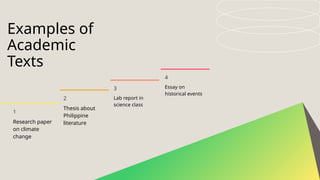
1
Research paper
on climate
change
4
Essay on
historical events
2
Thesis about
Philippine
literature
3
Lab report in
science class
Examples of
Academic
Texts
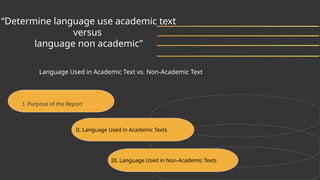
“Determine language use academic text
versus
language non academic”
Language Used in Academic Text vs. Non-Academic Text
I. Purpose of the Report
II. Language Used in Academic Texts
III. Language Used in Non-Academic Texts
I. Purpose of the Report
The purpose of this report is to identify
and explain the differences in
language used in academic texts
compared to non-academic texts.
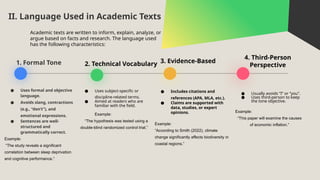
1. Formal Tone 2. Technical Vocabulary 3. Evidence-Based
4. Third-Person
Perspective
● Uses formal and objective
language.
● Avoids slang, contractions
(e.g., “don’t”), and
emotional expressions.
● Sentences are well-
structured and
grammatically correct.
Example:
“The study reveals a significant
correlation between sleep deprivation
and cognitive performance.”
II. Language Used in Academic Texts
● Includes citations and
references (APA, MLA, etc.).
● Claims are supported with
data, studies, or expert
opinions.
Example:
“According to Smith (2022), climate
change significantly affects biodiversity in
coastal regions.”
● Usually avoids “I” or “you”.
● Uses third-person to keep
the tone objective.
Example:
“This paper will examine the causes
of economic inflation.”
● Uses subject-specific or
discipline-related terms.
● Aimed at readers who are
familiar with the field.
Example:
“The hypothesis was tested using a
double-blind randomized control trial.”
Academic texts are written to inform, explain, analyze, or
argue based on facts and research. The language used
has the following characteristics:
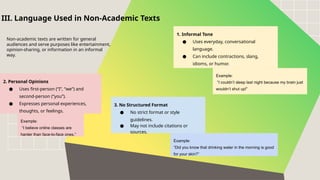
1. Informal Tone
● Uses everyday, conversational
language.
● Can include contractions, slang,
idioms, or humor.
2. Personal Opinions
● Uses first-person (“I”, “we”) and
second-person (“you”).
● Expresses personal experiences,
thoughts, or feelings.
III. Language Used in Non-Academic Texts
Non-academic texts are written for general
audiences and serve purposes like entertainment,
opinion-sharing, or information in an informal
way.
Example:
“I couldn’t sleep last night because my brain just
wouldn’t shut up!”
Example:
“I believe online classes are
harder than face-to-face ones.”
3. No Structured Format
● No strict format or style
guidelines.
● May not include citations or
sources.
Example:
“Did you know that drinking water in the morning is good
for your skin?”
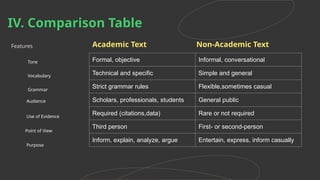
IV. Comparison Table
Academic Text
Formal, objective Informal, conversational
Technical and specific Simple and general
Strict grammar rules Flexible,sometimes casual
Scholars, professionals, students General public
Required (citations,data) Rare or not required
Third person First- or second-person
Inform, explain, analyze, argue Entertain, express, inform casually
Non-Academic Text
Features
Tone
Vocabulary
Audience
Use of Evidence
Point of View
Grammar
Purpose
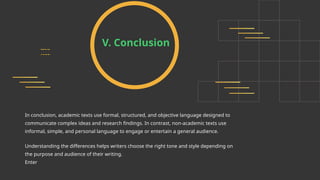
In conclusion, academic texts use formal, structured, and objective language designed to
communicate complex ideas and research findings. In contrast, non-academic texts use
informal, simple, and personal language to engage or entertain a general audience.
Understanding the differences helps writers choose the right tone and style depending on
the purpose and audience of their writing.
Enter
V. Conclusion
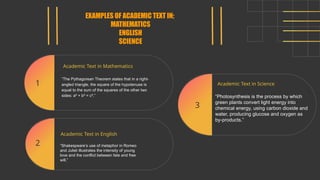
Academic Text in Science
EXAMPLES OF ACADEMIC TEXT IN;
MATHEMATICS
ENGLISH
SCIENCE
1
2
3
4
Academic Text in Mathematics
“The Pythagorean Theorem states that in a right-
angled triangle, the square of the hypotenuse is
equal to the sum of the squares of the other two
sides: a² + b² = c².”
Academic Text in English
“Shakespeare’s use of metaphor in Romeo
and Juliet illustrates the intensity of young
love and the conflict between fate and free
will.”
“Photosynthesis is the process by which
green plants convert light energy into
chemical energy, using carbon dioxide and
water, producing glucose and oxygen as
by-products.”
Any questions?
Ask away!
Let's discuss any doubts or concerns.
If something comes up later, kindly reach
out to any member of GROUP 2
Thank you

the difference between academic and non academic text

  • 1.
    GROUP II ENGLISH ACADEMICPROFESSIONAL PURPOSES Kimchell ArpaY Serge David Mainit Orvy Jay Mainit Prancis Hario BBY:
  • 2.
    “Differentiate language usedin academic text from various disciplines” An academic text is a formal piece of writing used in schools, universities, and research. It is written by students, scholars, or researchers to share ideas, knowledge, or findings in a clear, structured, and evidence-based way. Academic texts are commonly found in essays, reports, theses, journals, and research papers. 1. Context of Academic Text 2. Features of Academic Text 3. Examples of Academic Texts
  • 3.
    Context of AcademicText The context refers to the situation or environment where the academic text is written and read. It includes: • Purpose: To inform, explain, analyze, or argue. • Audience: Professors, classmates, researchers, or professionals. • Setting: Educational or scholarly settings (e.g., classroom, university, conference). • Tone: Formal and objective (not personal or emotional).
  • 4.
    • Formal languageand grammar • Use of evidence (data, citations, research) • Clear structure (introduction, body, conclusion) • Objective tone (no personal bias) • Third-person point of view (often) Features of Academic Text
  • 5.
    1 Research paper on climate change 4 Essayon historical events 2 Thesis about Philippine literature 3 Lab report in science class Examples of Academic Texts
  • 6.
    “Determine language useacademic text versus language non academic” Language Used in Academic Text vs. Non-Academic Text I. Purpose of the Report II. Language Used in Academic Texts III. Language Used in Non-Academic Texts
  • 7.
    I. Purpose ofthe Report The purpose of this report is to identify and explain the differences in language used in academic texts compared to non-academic texts.
  • 8.
    1. Formal Tone2. Technical Vocabulary 3. Evidence-Based 4. Third-Person Perspective ● Uses formal and objective language. ● Avoids slang, contractions (e.g., “don’t”), and emotional expressions. ● Sentences are well- structured and grammatically correct. Example: “The study reveals a significant correlation between sleep deprivation and cognitive performance.” II. Language Used in Academic Texts ● Includes citations and references (APA, MLA, etc.). ● Claims are supported with data, studies, or expert opinions. Example: “According to Smith (2022), climate change significantly affects biodiversity in coastal regions.” ● Usually avoids “I” or “you”. ● Uses third-person to keep the tone objective. Example: “This paper will examine the causes of economic inflation.” ● Uses subject-specific or discipline-related terms. ● Aimed at readers who are familiar with the field. Example: “The hypothesis was tested using a double-blind randomized control trial.” Academic texts are written to inform, explain, analyze, or argue based on facts and research. The language used has the following characteristics:
  • 9.
    1. Informal Tone ●Uses everyday, conversational language. ● Can include contractions, slang, idioms, or humor. 2. Personal Opinions ● Uses first-person (“I”, “we”) and second-person (“you”). ● Expresses personal experiences, thoughts, or feelings. III. Language Used in Non-Academic Texts Non-academic texts are written for general audiences and serve purposes like entertainment, opinion-sharing, or information in an informal way. Example: “I couldn’t sleep last night because my brain just wouldn’t shut up!” Example: “I believe online classes are harder than face-to-face ones.” 3. No Structured Format ● No strict format or style guidelines. ● May not include citations or sources. Example: “Did you know that drinking water in the morning is good for your skin?”
  • 10.
    IV. Comparison Table AcademicText Formal, objective Informal, conversational Technical and specific Simple and general Strict grammar rules Flexible,sometimes casual Scholars, professionals, students General public Required (citations,data) Rare or not required Third person First- or second-person Inform, explain, analyze, argue Entertain, express, inform casually Non-Academic Text Features Tone Vocabulary Audience Use of Evidence Point of View Grammar Purpose
  • 11.
    In conclusion, academictexts use formal, structured, and objective language designed to communicate complex ideas and research findings. In contrast, non-academic texts use informal, simple, and personal language to engage or entertain a general audience. Understanding the differences helps writers choose the right tone and style depending on the purpose and audience of their writing. Enter V. Conclusion
  • 12.
    Academic Text inScience EXAMPLES OF ACADEMIC TEXT IN; MATHEMATICS ENGLISH SCIENCE 1 2 3 4 Academic Text in Mathematics “The Pythagorean Theorem states that in a right- angled triangle, the square of the hypotenuse is equal to the sum of the squares of the other two sides: a² + b² = c².” Academic Text in English “Shakespeare’s use of metaphor in Romeo and Juliet illustrates the intensity of young love and the conflict between fate and free will.” “Photosynthesis is the process by which green plants convert light energy into chemical energy, using carbon dioxide and water, producing glucose and oxygen as by-products.”
  • 13.
    Any questions? Ask away! Let'sdiscuss any doubts or concerns. If something comes up later, kindly reach out to any member of GROUP 2
  • 14.