The IT Executive
Toolkit for Strategic
Planning
2
Follow Us on LinkedIn Become a Client
Gartner for CIOs
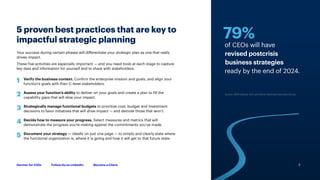
5 proven best practices that are key to
impactful strategic planning 79%
of CEOs will have
revised postcrisis
business strategies
ready by the end of 2024.
1 Verify the business context. Confirm the enterprise mission and goals, and align your
function’s goals with their C-level stakeholders.
2 Assess your function’s ability to deliver on your goals and create a plan to fill the
capability gaps that will slow your impact.
3 Strategically manage functional budgets to prioritize cost, budget and investment
decisions to favor initiatives that will drive impact — and demote those that won’t.
4 Decide how to measure your progress. Select measures and metrics that will
demonstrate the progress you’re making against the commitments you’ve made.
5 Document your strategy — ideally on just one page — to simply and clearly state where
the functional organization is, where it is going and how it will get to that future state.
Source: 2024 Gartner CEO and Senior Business Executive Survey
Your success during certain phases will differentiate your strategic plan as one that really
drives impact.
These five activities are especially important — and you need tools at each stage to capture
key data and information for yourself and to share with stakeholders:
3
The IT Executive Toolkit for Strategic Planning
Follow Us on LinkedIn Become a Client
Gartner for CIOs
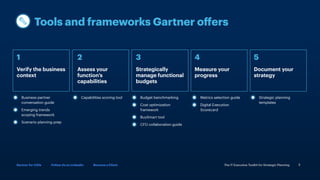
Tools and frameworks Gartner offers
Verify the business
context
1 2 3 4 5
Assess your
function’s
capabilities
Strategically
manage functional
budgets
Measure your
progress
Document your
strategy
Business-partner
conversation guide
Emerging trends
scoping framework
Scenario planning prep
Budget benchmarking
Cost optimization
framework
BuySmart tool
CFO collaboration guide
Metrics selection guide
Digital Execution
Scorecard
Strategic planning
templates
Capabilities scoring tool
The IT Executive Toolkit for Strategic Planning 4
Follow Us on LinkedIn Become a Client
Gartner for CIOs
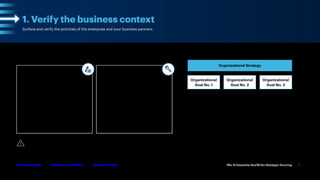
Key tools for this may include:
• A simple conversation guide to
focus your conversations with
business partners.
• Trendspotting frameworks to look
at drivers of change, including
those in the more distant future.
• Scenario planning activities to
align business partners around
your hypothetical futures.
Organizational Strategy
Organizational
Goal No. 1
Organizational
Goal No. 2
Organizational
Goal No. 3
Understanding the organization’s strategy and goals
Key questions to ask:
• What are the key business objectives for the next one, two
and five years?
• What are the organization’s core strategies to achieve these
goals?
• How does the organization plan to execute these strategies?
• What are current challenges facing the organization?
First make sure you understand enterprise business goals well enough to craft
a strategic plan for your function that will support enterprise ambitions.
• Within your function
• Internal to the enterprise
• External to clients, investors,
competitor advantage
Don’t forget: A productive relationship between function leaders and the CFO
will also be critical for effective strategic planning (see page 11 for more).
Document both the business
context and the likely impact on
your function of factors:
Surface and verify the priorities of the enterprise and your business partners.
1. Verify the business context
The IT Executive Toolkit for Strategic Planning 5
Follow Us on LinkedIn Become a Client
Gartner for CIOs
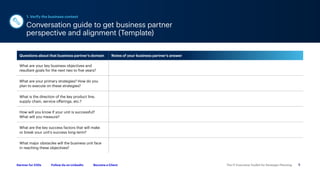
Questions about that business partner’s domain Notes of your business partner’s answer
What are your key business objectives and
resultant goals for the next two to five years?
What are your primary strategies? How do you
plan to execute on these strategies?
What is the direction of the key product line,
supply chain, service offerings, etc.?
How will you know if your unit is successful?
What will you measure?
What are the key success factors that will make
or break your unit’s success long-term?
What major obstacles will the business unit face
in reaching these objectives?
Conversation guide to get business partner
perspective and alignment (Template)
1. Verify the business context
The IT Executive Toolkit for Strategic Planning 6
Follow Us on LinkedIn Become a Client
Gartner for CIOs
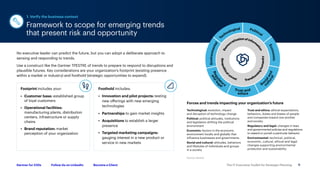
Foothold includes:
• Innovation and pilot projects: testing
new offerings with new emerging
technologies
• Partnerships to gain market insights
• Acquisitions to establish a larger
presence
• Targeted marketing campaigns:
gauging interest in a new product or
service in new markets
Forces and trends impacting your organization’s future
No executive leader can predict the future, but you can adopt a deliberate approach to
sensing and responding to trends.
Use a construct like the Gartner TPESTRE of trends to prepare to respond to disruptions and
plausible futures. Key considerations are your organization’s footprint (existing presence
within a market or industry) and foothold (strategic opportunities to expand).
Technological: evolution, impact
and disruption of technology change
Political: political attitudes, institutions
and legislation shifting the political
environment
Economic: factors in the economic
environment locally and globally that
influence businesses and governments
Social and cultural: attitudes, behaviors
and lifestyles of individuals and groups
in a society
Trust and ethics: ethical expectations,
behaviors, duties and biases of people
and companies toward one another
and society
Regulatory and legal: changes in laws
and governmental policies and regulations
to reward or punish a particular behavior
Environmental: technical, political,
economic, cultural, ethical and legal
changes supporting environmental
protection and sustainability
• Customer base: established group
of loyal customers
• Operational facilities:
manufacturing plants, distribution
centers, infrastructure or supply
chains
• Brand reputation: market
perception of your organization
Footprint includes your:
Source: Gartner
Framework to scope for emerging trends
that present risk and opportunity
1. Verify the business context
Political
E
c
o
n
o
m
i
c
So
c
i
a
l
a
n
d
c
u
l
t
u
r
a
l
Trust and
ethics
R
e
g
u
l
a
t
ory
a
n
d
l
e
gal
E
n
v
i
r
o
n
m
e
n
t
a
l
T
echnological
D
e
m
ocratizationofinform
a
t
i
o
n
Transform
i
n
g
h
u
m
a
n
i
t
y
G
e
o
p
o
l
i
t
i
c
a
l
unrest
The IT Executive Toolkit for Strategic Planning 7
Follow Us on LinkedIn Become a Client
Gartner for CIOs
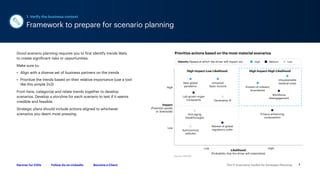
Prioritize actions based on the most material scenarios
Impact
(Potential upside
or downside)
High
High
Low
Low
Likelihood
(Probability that the driver will materialize)
High Impact-Low Likelihood High Impact-High Likelihood
Velocity (Speed at which the driver will impact us): High Medium Low
New global
pandemic
Universal
basic income Erosion of industry
boundaries
Unsustainable
medical costs
Lab-grown organ
transplants
Retreat of global
regulatory order
Privacy-enhancing
computation
Workforce
disengagement
Generative AI
Anti-aging
breakthroughs
Autonomous
vehicles
Source: Gartner
Good scenario planning requires you to first identify trends likely
to create significant risks or opportunities.
Make sure to:
• Align with a diverse set of business partners on the trends
• Prioritize the trends based on their relative importance (use a tool
like this simple 2x2)
From here, categorize and relate trends together to develop
scenarios. Develop a storyline for each scenario to test if it seems
credible and feasible.
Strategic plans should include actions aligned to whichever
scenarios you deem most pressing.
Framework to prepare for scenario planning
1. Verify the business context
The IT Executive Toolkit for Strategic Planning 8
Follow Us on LinkedIn Become a Client
Gartner for CIOs
Determine how well-positioned your function is to deliver on strategy.
To ensure optimal results from strategic efforts, it’s critical to assess the role of your
function in the enterprise and how well it performs that role. As the enterprise strategy
evolves, so will this assessment.
In your strategic planning cycle, make sure to undertake a capabilities assessment soon after
verifying the business strategy so you can build a roadmap to improve your effectiveness.
It’s important to assess both the availability and maturity of existing capabilities. Take a
rigorous approach using a methodology like that taken by the Gartner Score tool.
The objective of this assessment is to plot a path to maturity for each critical activity.
• Existing performance across key objectives and activities typically within scope for
your function
• Your maturity in different activities on a simple-to-understand scale so you can easily
compare maturity in different activities and against best-practice levels
• The criticality of activities on a simple scale so you can focus on requisites for your
function to deliver its contribution to enterprise strategy
Measure:
2. Assess your function’s capabilities
Did you know?
Gartner clients can customize Score
assessment tools for their function and
walk through their results and action
plans with their Executive Partner.
Connect with one of our specialists today
to learn more about this tool and how
Gartner can support your strategic efforts.
The IT Executive Toolkit for Strategic Planning 9
Follow Us on LinkedIn Become a Client
Gartner for CIOs
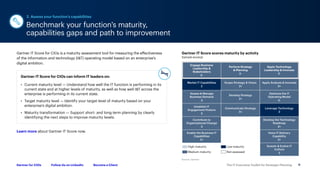
Benchmark your function’s maturity,
capabilities gaps and path to improvement
2. Assess your function’s capabilities
Gartner IT Score for CIOs is a maturity assessment tool for measuring the effectiveness
of the information and technology (I&T) operating model based on an enterprise’s
digital ambition.
Learn more about Gartner IT Score now.
• Current maturity level — Understand how well the IT function is performing in its
current state and at higher levels of maturity, as well as how well I&T across the
enterprise is performing in its current state.
• Target maturity level — Identify your target level of maturity based on your
enterprise’s digital ambition.
• Maturity transformation — Support short- and long-term planning by clearly
identifying the next steps to improve maturity levels.
Gartner IT Score for CIOs can inform IT leaders on:
Engage Business
Leadership &
Stakeholders
3-
Perform Strategy
& Planning
3-
Apply Technology
Leadership & Innovate
3-
Market IT Capabilities
2
Scope Strategy & Vision
2+
Apply Analysis & Innovate
3+
Assess & Manage
Business Demand
3
Develop Strategy
2+
Optimize the IT
Operating Model
3-
Establish IT
Engagement Posture
3
Communicate Strategy
3+
Leverage Technology
2
Contribute to
Organizational Change
3
Develop the Technology
Roadmap
2+
Enable the Business IT
Capabilities
3+
Hone IT Delivery
Capability
2+
Sustain & Evolve IT
Culture
3
High maturity
Medium maturity
Low maturity
Not assessed
Gartner IT Score scores maturity by activity
Sample excerpt
Source: Gartner
The IT Executive Toolkit for Strategic Planning 10
Follow Us on LinkedIn Become a Client
Gartner for CIOs
Function leaders face an era of doing more with less budget.
IT executives face new challenges in managing budgets — and appealing
for funding — as the focus at many organizations shifts to fueling growth with
productivity and efficiency.
Bottom line, function leaders are being asked to achieve growth at lower cost.
That means being as efficient as possible with headcount, technologies, workflows
and processes — deploying resources in the most productive way possible.
1. Reallocate funding from low- to high-potential investments.
2. Fund growth investments using costs saved in less important activities.
3. Use unallocated funds for as-needed growth investment support.
3. Strategically manage functional budgets
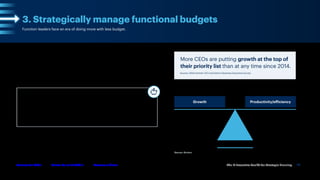
More CEOs are putting growth at the top of
their priority list than at any time since 2014.
Source: 2024 Gartner CEO and Senior Business Executive Survey
Constrained growth puts the focus on productivity/efficiency
Growth Productivity/efficiency
Spend less to create more value
Function leaders will need a strategic mindset and tools to apply
three best practices in cost management in this environment:
Source: Gartner
The IT Executive Toolkit for Strategic Planning 11
Follow Us on LinkedIn Become a Client
Gartner for CIOs
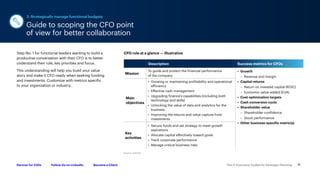
CFO role at a glance — illustrative
Step No. 1 for functional leaders wanting to build a
productive conversation with their CFO is to better
understand their role, key priorities and focus.
This understanding will help you build your value
story and make it CFO-ready when seeking funding
and investments. Customize with metrics specific
to your organization or industry.
Source: Gartner
Description Success metrics for CFOs
Mission
To guide and protect the financial performance
of the company
• Growth
– Revenue and margin
• Capital returns
– Return on invested capital (ROIC)
– Economic value-added (EVA)
• Cost optimization targets
• Cash conversion cycle
• Shareholder value
– Shareholder confidence
– Stock performance
• Other business-specific metric(s)
Main
objectives
• Growing or maintaining profitability and operational
efficiency
• Effective cash management
• Upgrading finance’s capabilities (including both
technology and skills)
• Unlocking the value of data and analytics for the
business
• Improving the returns and value capture from
investments
Key
activities
• Secure funds and set strategy to meet growth
aspirations
• Allocate capital effectively toward goals
• Track corporate performance
• Manage critical business risks
Guide to scoping the CFO point
of view for better collaboration
3. Strategically manage functional budgets
The IT Executive Toolkit for Strategic Planning 12
Follow Us on LinkedIn Become a Client
Gartner for CIOs
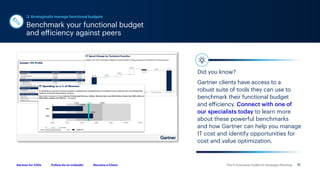
Benchmark your functional budget
and efficiency against peers
3. Strategically manage functional budgets
Did you know?
Gartner clients have access to a
robust suite of tools they can use to
benchmark their functional budget
and efficiency. Connect with one of
our specialists today to learn more
about these powerful benchmarks
and how Gartner can help you manage
IT cost and identify opportunities for
cost and value optimization.
The IT Executive Toolkit for Strategic Planning 13
Follow Us on LinkedIn Become a Client
Gartner for CIOs
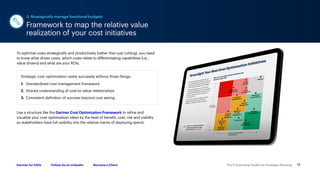
To optimize costs strategically and productively (rather than just cutting), you need
to know what drives costs, which costs relate to differentiating capabilities (i.e.,
value drivers) and what are your ROIs.
Use a structure like the Gartner Cost Optimization Framework to refine and
visualize your cost optimization ideas by the level of benefit, cost, risk and viability
so stakeholders have full visibility into the relative merits of deploying spend.
1. Standardized cost management framework
2. Shared understanding of cost-to-value relationships
3. Consistent definition of success beyond cost saving
Strategic cost optimization rarely succeeds without three things:
Framework to map the relative value
realization of your cost initiatives
3. Strategically manage functional budgets
The IT Executive Toolkit for Strategic Planning 14
Follow Us on LinkedIn Become a Client
Gartner for CIOs
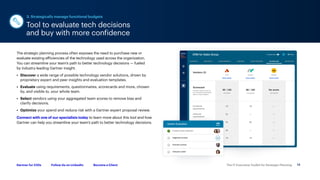
The strategic planning process often exposes the need to purchase new or
evaluate existing efficiencies of the technology used across the organization.
You can streamline your team’s path to better technology decisions — fueled
by industry‑leading Gartner insight.
• Discover a wide range of possible technology vendor solutions, driven by
proprietary expert and peer insights and evaluation templates.
• Evaluate using requirements, questionnaires, scorecards and more, chosen
by, and visible to, your whole team.
• Select vendors using your aggregated team scores to remove bias and
clarify decisions.
• Optimize your spend and reduce risk with a Gartner expert proposal review.
Connect with one of our specialists today to learn more about this tool and how
Gartner can help you streamline your team’s path to better technology decisions.
Tool to evaluate tech decisions
and buy with more confidence
3. Strategically manage functional budgets
The IT Executive Toolkit for Strategic Planning 15
Follow Us on LinkedIn Become a Client
Gartner for CIOs
Identify metrics that will show if your plan is working.
Use metrics to assess the function’s performance and its progress in delivering
on strategy.
It’s important to understand the difference between measures (observable business
outcomes that show whether your actions plans are working) and metrics (the data
that quantifies those measures).
To choose meaningful metrics:
• Focus on alignment with strategic priorities.
• Don’t over-engineer or over-populate your list of metrics; limit it to a few simple
SMART metrics.
• Mix metrics as needed for different dimensions of the business (e.g., customer,
operational, human capital).
• Identify which metrics will specifically trigger actions predetermined by your
strategic plan.
You will need to revisit your strategic plan as business conditions change; make
sure to realign your measures and metrics accordingly.
Specificity
The metric is sufficiently granular for the goal it measures.
Measurability
The metric can be measured with reasonable ease and accuracy.
Actionability
The metric can lead to action to improve performance.
Relevance
The metric is aligned to overall objectives.
Timeliness
The metric provides early warning signals of approaching risks
or gaps in performance.
4. Measure your progress
Whatever metrics you choose must be SMART:
The IT Executive Toolkit for Strategic Planning 16
Follow Us on LinkedIn Become a Client
Gartner for CIOs
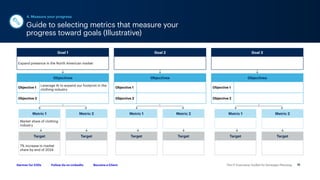
Goal 1
Expand presence in the North American market
Goal 2 Goal 3
Objectives
Objective 1
Leverage AI to expand our footprint in the
clothing industry
Objective 2
Objectives
Objective 1
Objective 2
Objectives
Objective 1
Objective 2
Metric 1
Market share of clothing
industry
Metric 1 Metric 1
Target
7% increase in market
share by end of 2024
Target Target
Target Target Target
Metric 2 Metric 2 Metric 2
Guide to selecting metrics that measure your
progress toward goals (Illustrative)
4. Measure your progress
The IT Executive Toolkit for Strategic Planning 17
Follow Us on LinkedIn Become a Client
Gartner for CIOs
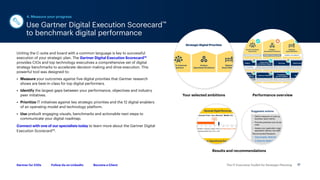
Use Gartner Digital Execution Scorecard™
to benchmark digital performance
4. Measure your progress
Uniting the C-suite and board with a common language is key to successful
execution of your strategic plan. The Gartner Digital Execution Scorecard™
provides CIOs and top technology executives a comprehensive set of digital
strategy benchmarks to accelerate decision making and drive execution. This
powerful tool was designed to:
• Measure your outcomes against five digital priorities that Gartner research
shows are best-in-class for top digital performers.
• Identify the largest gaps between your performance, objectives and industry
peer initiatives.
• Prioritize IT initiatives against key strategic priorities and the 12 digital enablers
of an operating model and technology platform.
• Use prebuilt engaging visuals, benchmarks and actionable next steps to
communicate your digital roadmap.
Connect with one of our specialists today to learn more about the Gartner Digital
Execution Scorecard™.
Strategic Digital Priorities
Your selected ambitions Performance overview
Results and recommendations
The IT Executive Toolkit for Strategic Planning 18
Follow Us on LinkedIn Become a Client
Gartner for CIOs
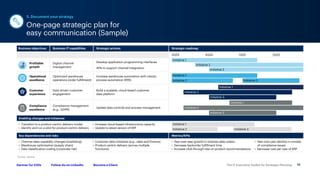
Provide a single-page overview to simply and clearly communicate your strategic plan.
Your strategic plan defines the roadmap of initiatives and portfolio of investments your
function intends to pursue to execute on its commitment to drive business strategy.
Putting that plan on a single page makes it easier for you to share, summarize and
communicate — and easier for business partners to visualize and understand.
One-page templates are meant to provide a summary of your strategic roadmap, not to
serve as the overall strategic plan.
Make sure yours contains the initiatives identified as a part of the overall strategic planning
process for your function.
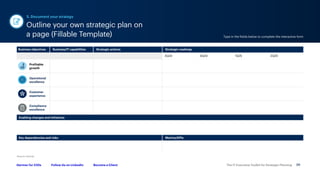
See the next page for a simplified view of a Gartner one-page plan (and use the fillable
template for your planning), but note that different functions and organizations will need to
customize their view, its component parts and level of detail.
5. Document your strategy
Did you know?
Gartner clients can submit documents
for review by experts who will assess
and provide feedback and input on their
strategy template.
Connect with one of our specialists today
to learn more about how we can help you.
The IT Executive Toolkit for Strategic Planning 19
Follow Us on LinkedIn Become a Client
Gartner for CIOs
One-page strategic plan for
easy communication (Sample)
5. Document your strategy
Business objectives Business-IT capabilities Strategic actions Strategic roadmap
3Q24 4Q24 1Q25 2Q25
Profitable
growth
Digital channel
management
Develop application programming interfaces
APIs to support channel integration
Operational
excellence
Optimized warehouse
operations (order fulfillment)
Increase warehouse automation with robotic
process automation (RPA)
Customer
experience
Data-driven customer
engagement
Build a scalable, cloud-based customer
data platform
Compliance
excellence
Compliance management
(e.g., GDPR)
Update data controls and process management
Enabling changes and initiatives
• Transition to a product-centric delivery model • Increase cloud-based infrastructure capacity
• Identify and run a pilot for product-centric delivery • Update to latest version of ERP
Key dependencies and risks Metrics/KPIs
• Channel sales capability changes (marketing) • Customer data initiatives (e.g., sales and finance)
• Warehouse optimization (supply chain) • Product-centric delivery (across multiple
• Data classification coding (corporate risk) functions)
• 
Year-over-year growth in channel sales orders • Year-over-year decline in number
• Decrease backorder fulfillment time of compliance issues
• 
Increase click-through rate on product recommendations • Decrease cost per user of ERP
Initiative 1
Initiative 2 Initiative 3
Initiative 1
Initiative 3
Initiative 3
Initiative 3
Initiative 2
Initiative 2
Initiative 2
Initiative 1
Initiative 1
Initiative 2 Initiative 3
Initiative 1
Source: Gartner
The IT Executive Toolkit for Strategic Planning 20
Follow Us on LinkedIn Become a Client
Gartner for CIOs
Outline your own strategic plan on
a page (Fillable Template) Type in the fields below to complete the interactive form
5. Document your strategy
Source: Gartner
Business objectives Business/IT capabilities Strategic actions Strategic roadmap
3Q24 4Q24 1Q25 2Q25
Profitable
growth
Operational
excellence
Customer
experience
Compliance
excellence
Enabling changes and initiatives
V
Key dependencies and risks Metrics/KPIs
The IT Executive Toolkit for Strategic Planning 21
Follow Us on LinkedIn Become a Client
Gartner for CIOs
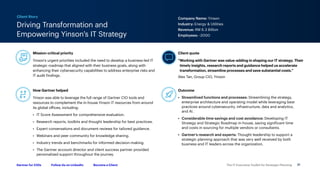
Driving Transformation and
Empowering Yinson’s IT Strategy
Company Name: Yinson
Industry: Energy  Utilities
Revenue: RM 6.3 Billion
Employees: ~2000
Client Story
Mission-critical priority
Yinson’s urgent priorities included the need to develop a business-led IT
strategic roadmap that aligned with their business goals, along with
enhancing their cybersecurity capabilities to address enterprise risks and
IT audit findings.
Client quote
“
Working with Gartner was value-adding in shaping our IT strategy. Their
timely insights, research reports and guidance helped us accelerate
transformation, streamline processes and save substantial costs.”
Alex Tan, Group CIO, Yinson
How Gartner helped
Yinson was able to leverage the full range of Gartner CIO tools and
resources to complement the in-house Yinson IT resources from around
its global offices, including:
• IT Score Assessment for comprehensive evaluation.
• Research reports, toolkits and thought leadership for best practices.
• Expert conversations and document reviews for tailored guidance.
• Webinars and peer community for knowledge sharing.
• Industry trends and benchmarks for informed decision-making.
• The Gartner account director and client success partner provided
personalized support throughout the journey.
Outcome
• Streamlined functions and processes: Streamlining the strategy,
enterprise architecture and operating model while leveraging best
practices around cybersecurity, infrastructure, data and analytics,
and AI.
• Considerable time savings and cost avoidance: Developing IT
Strategy and Strategic Roadmap in-house, saving significant time
and costs in sourcing for multiple vendors or consultants.
• Gartner’s research and experts: Thought leadership to support a
strategic planning approach that was very well received by both
business and IT leaders across the organization.
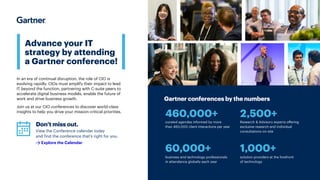
Advance your IT
strategy by attending
a Gartner conference!
In an era of continual disruption, the role of CIO is
evolving rapidly. CIOs must amplify their impact to lead
IT beyond the function, partnering with C-suite peers to
accelerate digital business models, enable the future of
work and drive business growth.
Join us at our CIO conferences to discover world-class
insights to help you drive your mission-critical priorities.
Don’t miss out.
View the Conference calendar today
and find the conference that’s right for you.
Explore the Calendar
Gartner conferences by the numbers
curated agendas informed by more
than 460,000 client interactions per year
Research  Advisory experts offering
exclusive research and individual
consultations on-site
business and technology professionals
in attendance globally each year
solution providers at the forefront
of technology
460,000+
60,000+ 1,000+
2,500+
Explore these additional complimentary resources and tools
for information technology executives:
Actionable, objective insight
Already a client?
Get access to even more resources in your client portal. Log In
Resource Hub
Build a Better IT Strategic Plan
Craft and communicate your IT strategy
plan with exclusive resources.
Learn More
Resource Hub
Build a Value-Driving
AI Strategy
Use our AI Strategy Planner to develop
a strategy that captures the value of AI
while managing risk.
Learn More
Benchmark
Technology Adoption Roadmap
Understand key trends affecting the
technology adoption decisions of
your peers.
Download Now
Tool
Gartner for Chief Information
Officers
Find out how we can help you measurably
impact the bottom line, demonstrate the
value of IT and drive organizational objectives.
Learn More
© 2024 Gartner, Inc. and/or its affiliates. All rights reserved. CM_GTS_ 3085882
Connect With Us
Get actionable, objective insight that drives smarter decisions and
stronger performance on your mission-critical priorities. Contact us
to become a client:
U.S.: 1 866 263 8917		
International: +44 (0) 3301 628 476
Become a Client
Learn more about Gartner for Chief Information Officers
gartner.com/en/chief-information-officer
Stay connected to the latest insights

2024-it-strategically-planning-ebook.pdf

  • 1.
    The IT Executive Toolkitfor Strategic Planning
  • 2.
    2 Follow Us onLinkedIn Become a Client Gartner for CIOs 5 proven best practices that are key to impactful strategic planning 79% of CEOs will have revised postcrisis business strategies ready by the end of 2024. 1 Verify the business context. Confirm the enterprise mission and goals, and align your function’s goals with their C-level stakeholders. 2 Assess your function’s ability to deliver on your goals and create a plan to fill the capability gaps that will slow your impact. 3 Strategically manage functional budgets to prioritize cost, budget and investment decisions to favor initiatives that will drive impact — and demote those that won’t. 4 Decide how to measure your progress. Select measures and metrics that will demonstrate the progress you’re making against the commitments you’ve made. 5 Document your strategy — ideally on just one page — to simply and clearly state where the functional organization is, where it is going and how it will get to that future state. Source: 2024 Gartner CEO and Senior Business Executive Survey Your success during certain phases will differentiate your strategic plan as one that really drives impact. These five activities are especially important — and you need tools at each stage to capture key data and information for yourself and to share with stakeholders:
  • 3.
    3 The IT ExecutiveToolkit for Strategic Planning Follow Us on LinkedIn Become a Client Gartner for CIOs Tools and frameworks Gartner offers Verify the business context 1 2 3 4 5 Assess your function’s capabilities Strategically manage functional budgets Measure your progress Document your strategy Business-partner conversation guide Emerging trends scoping framework Scenario planning prep Budget benchmarking Cost optimization framework BuySmart tool CFO collaboration guide Metrics selection guide Digital Execution Scorecard Strategic planning templates Capabilities scoring tool
  • 4.
    The IT ExecutiveToolkit for Strategic Planning 4 Follow Us on LinkedIn Become a Client Gartner for CIOs Key tools for this may include: • A simple conversation guide to focus your conversations with business partners. • Trendspotting frameworks to look at drivers of change, including those in the more distant future. • Scenario planning activities to align business partners around your hypothetical futures. Organizational Strategy Organizational Goal No. 1 Organizational Goal No. 2 Organizational Goal No. 3 Understanding the organization’s strategy and goals Key questions to ask: • What are the key business objectives for the next one, two and five years? • What are the organization’s core strategies to achieve these goals? • How does the organization plan to execute these strategies? • What are current challenges facing the organization? First make sure you understand enterprise business goals well enough to craft a strategic plan for your function that will support enterprise ambitions. • Within your function • Internal to the enterprise • External to clients, investors, competitor advantage Don’t forget: A productive relationship between function leaders and the CFO will also be critical for effective strategic planning (see page 11 for more). Document both the business context and the likely impact on your function of factors: Surface and verify the priorities of the enterprise and your business partners. 1. Verify the business context
  • 5.
    The IT ExecutiveToolkit for Strategic Planning 5 Follow Us on LinkedIn Become a Client Gartner for CIOs Questions about that business partner’s domain Notes of your business partner’s answer What are your key business objectives and resultant goals for the next two to five years? What are your primary strategies? How do you plan to execute on these strategies? What is the direction of the key product line, supply chain, service offerings, etc.? How will you know if your unit is successful? What will you measure? What are the key success factors that will make or break your unit’s success long-term? What major obstacles will the business unit face in reaching these objectives? Conversation guide to get business partner perspective and alignment (Template) 1. Verify the business context
  • 6.
    The IT ExecutiveToolkit for Strategic Planning 6 Follow Us on LinkedIn Become a Client Gartner for CIOs Foothold includes: • Innovation and pilot projects: testing new offerings with new emerging technologies • Partnerships to gain market insights • Acquisitions to establish a larger presence • Targeted marketing campaigns: gauging interest in a new product or service in new markets Forces and trends impacting your organization’s future No executive leader can predict the future, but you can adopt a deliberate approach to sensing and responding to trends. Use a construct like the Gartner TPESTRE of trends to prepare to respond to disruptions and plausible futures. Key considerations are your organization’s footprint (existing presence within a market or industry) and foothold (strategic opportunities to expand). Technological: evolution, impact and disruption of technology change Political: political attitudes, institutions and legislation shifting the political environment Economic: factors in the economic environment locally and globally that influence businesses and governments Social and cultural: attitudes, behaviors and lifestyles of individuals and groups in a society Trust and ethics: ethical expectations, behaviors, duties and biases of people and companies toward one another and society Regulatory and legal: changes in laws and governmental policies and regulations to reward or punish a particular behavior Environmental: technical, political, economic, cultural, ethical and legal changes supporting environmental protection and sustainability • Customer base: established group of loyal customers • Operational facilities: manufacturing plants, distribution centers, infrastructure or supply chains • Brand reputation: market perception of your organization Footprint includes your: Source: Gartner Framework to scope for emerging trends that present risk and opportunity 1. Verify the business context Political E c o n o m i c So c i a l a n d c u l t u r a l Trust and ethics R e g u l a t ory a n d l e gal E n v i r o n m e n t a l T echnological D e m ocratizationofinform a t i o n Transform i n g h u m a n i t y G e o p o l i t i c a l unrest
  • 7.
    The IT ExecutiveToolkit for Strategic Planning 7 Follow Us on LinkedIn Become a Client Gartner for CIOs Prioritize actions based on the most material scenarios Impact (Potential upside or downside) High High Low Low Likelihood (Probability that the driver will materialize) High Impact-Low Likelihood High Impact-High Likelihood Velocity (Speed at which the driver will impact us): High Medium Low New global pandemic Universal basic income Erosion of industry boundaries Unsustainable medical costs Lab-grown organ transplants Retreat of global regulatory order Privacy-enhancing computation Workforce disengagement Generative AI Anti-aging breakthroughs Autonomous vehicles Source: Gartner Good scenario planning requires you to first identify trends likely to create significant risks or opportunities. Make sure to: • Align with a diverse set of business partners on the trends • Prioritize the trends based on their relative importance (use a tool like this simple 2x2) From here, categorize and relate trends together to develop scenarios. Develop a storyline for each scenario to test if it seems credible and feasible. Strategic plans should include actions aligned to whichever scenarios you deem most pressing. Framework to prepare for scenario planning 1. Verify the business context
  • 8.
    The IT ExecutiveToolkit for Strategic Planning 8 Follow Us on LinkedIn Become a Client Gartner for CIOs Determine how well-positioned your function is to deliver on strategy. To ensure optimal results from strategic efforts, it’s critical to assess the role of your function in the enterprise and how well it performs that role. As the enterprise strategy evolves, so will this assessment. In your strategic planning cycle, make sure to undertake a capabilities assessment soon after verifying the business strategy so you can build a roadmap to improve your effectiveness. It’s important to assess both the availability and maturity of existing capabilities. Take a rigorous approach using a methodology like that taken by the Gartner Score tool. The objective of this assessment is to plot a path to maturity for each critical activity. • Existing performance across key objectives and activities typically within scope for your function • Your maturity in different activities on a simple-to-understand scale so you can easily compare maturity in different activities and against best-practice levels • The criticality of activities on a simple scale so you can focus on requisites for your function to deliver its contribution to enterprise strategy Measure: 2. Assess your function’s capabilities Did you know? Gartner clients can customize Score assessment tools for their function and walk through their results and action plans with their Executive Partner. Connect with one of our specialists today to learn more about this tool and how Gartner can support your strategic efforts.
  • 9.
    The IT ExecutiveToolkit for Strategic Planning 9 Follow Us on LinkedIn Become a Client Gartner for CIOs Benchmark your function’s maturity, capabilities gaps and path to improvement 2. Assess your function’s capabilities Gartner IT Score for CIOs is a maturity assessment tool for measuring the effectiveness of the information and technology (I&T) operating model based on an enterprise’s digital ambition. Learn more about Gartner IT Score now. • Current maturity level — Understand how well the IT function is performing in its current state and at higher levels of maturity, as well as how well I&T across the enterprise is performing in its current state. • Target maturity level — Identify your target level of maturity based on your enterprise’s digital ambition. • Maturity transformation — Support short- and long-term planning by clearly identifying the next steps to improve maturity levels. Gartner IT Score for CIOs can inform IT leaders on: Engage Business Leadership & Stakeholders 3- Perform Strategy & Planning 3- Apply Technology Leadership & Innovate 3- Market IT Capabilities 2 Scope Strategy & Vision 2+ Apply Analysis & Innovate 3+ Assess & Manage Business Demand 3 Develop Strategy 2+ Optimize the IT Operating Model 3- Establish IT Engagement Posture 3 Communicate Strategy 3+ Leverage Technology 2 Contribute to Organizational Change 3 Develop the Technology Roadmap 2+ Enable the Business IT Capabilities 3+ Hone IT Delivery Capability 2+ Sustain & Evolve IT Culture 3 High maturity Medium maturity Low maturity Not assessed Gartner IT Score scores maturity by activity Sample excerpt Source: Gartner
  • 10.
    The IT ExecutiveToolkit for Strategic Planning 10 Follow Us on LinkedIn Become a Client Gartner for CIOs Function leaders face an era of doing more with less budget. IT executives face new challenges in managing budgets — and appealing for funding — as the focus at many organizations shifts to fueling growth with productivity and efficiency. Bottom line, function leaders are being asked to achieve growth at lower cost. That means being as efficient as possible with headcount, technologies, workflows and processes — deploying resources in the most productive way possible. 1. Reallocate funding from low- to high-potential investments. 2. Fund growth investments using costs saved in less important activities. 3. Use unallocated funds for as-needed growth investment support. 3. Strategically manage functional budgets More CEOs are putting growth at the top of their priority list than at any time since 2014. Source: 2024 Gartner CEO and Senior Business Executive Survey Constrained growth puts the focus on productivity/efficiency Growth Productivity/efficiency Spend less to create more value Function leaders will need a strategic mindset and tools to apply three best practices in cost management in this environment: Source: Gartner
  • 11.
    The IT ExecutiveToolkit for Strategic Planning 11 Follow Us on LinkedIn Become a Client Gartner for CIOs CFO role at a glance — illustrative Step No. 1 for functional leaders wanting to build a productive conversation with their CFO is to better understand their role, key priorities and focus. This understanding will help you build your value story and make it CFO-ready when seeking funding and investments. Customize with metrics specific to your organization or industry. Source: Gartner Description Success metrics for CFOs Mission To guide and protect the financial performance of the company • Growth – Revenue and margin • Capital returns – Return on invested capital (ROIC) – Economic value-added (EVA) • Cost optimization targets • Cash conversion cycle • Shareholder value – Shareholder confidence – Stock performance • Other business-specific metric(s) Main objectives • Growing or maintaining profitability and operational efficiency • Effective cash management • Upgrading finance’s capabilities (including both technology and skills) • Unlocking the value of data and analytics for the business • Improving the returns and value capture from investments Key activities • Secure funds and set strategy to meet growth aspirations • Allocate capital effectively toward goals • Track corporate performance • Manage critical business risks Guide to scoping the CFO point of view for better collaboration 3. Strategically manage functional budgets
  • 12.
    The IT ExecutiveToolkit for Strategic Planning 12 Follow Us on LinkedIn Become a Client Gartner for CIOs Benchmark your functional budget and efficiency against peers 3. Strategically manage functional budgets Did you know? Gartner clients have access to a robust suite of tools they can use to benchmark their functional budget and efficiency. Connect with one of our specialists today to learn more about these powerful benchmarks and how Gartner can help you manage IT cost and identify opportunities for cost and value optimization.

  • 13.
    The IT ExecutiveToolkit for Strategic Planning 13 Follow Us on LinkedIn Become a Client Gartner for CIOs To optimize costs strategically and productively (rather than just cutting), you need to know what drives costs, which costs relate to differentiating capabilities (i.e., value drivers) and what are your ROIs. Use a structure like the Gartner Cost Optimization Framework to refine and visualize your cost optimization ideas by the level of benefit, cost, risk and viability so stakeholders have full visibility into the relative merits of deploying spend. 1. Standardized cost management framework 2. Shared understanding of cost-to-value relationships 3. Consistent definition of success beyond cost saving Strategic cost optimization rarely succeeds without three things: Framework to map the relative value realization of your cost initiatives 3. Strategically manage functional budgets
  • 14.
    The IT ExecutiveToolkit for Strategic Planning 14 Follow Us on LinkedIn Become a Client Gartner for CIOs The strategic planning process often exposes the need to purchase new or evaluate existing efficiencies of the technology used across the organization. You can streamline your team’s path to better technology decisions — fueled by industry‑leading Gartner insight. • Discover a wide range of possible technology vendor solutions, driven by proprietary expert and peer insights and evaluation templates. • Evaluate using requirements, questionnaires, scorecards and more, chosen by, and visible to, your whole team. • Select vendors using your aggregated team scores to remove bias and clarify decisions. • Optimize your spend and reduce risk with a Gartner expert proposal review. Connect with one of our specialists today to learn more about this tool and how Gartner can help you streamline your team’s path to better technology decisions. Tool to evaluate tech decisions and buy with more confidence 3. Strategically manage functional budgets
  • 15.
    The IT ExecutiveToolkit for Strategic Planning 15 Follow Us on LinkedIn Become a Client Gartner for CIOs Identify metrics that will show if your plan is working. Use metrics to assess the function’s performance and its progress in delivering on strategy. It’s important to understand the difference between measures (observable business outcomes that show whether your actions plans are working) and metrics (the data that quantifies those measures). To choose meaningful metrics: • Focus on alignment with strategic priorities. • Don’t over-engineer or over-populate your list of metrics; limit it to a few simple SMART metrics. • Mix metrics as needed for different dimensions of the business (e.g., customer, operational, human capital). • Identify which metrics will specifically trigger actions predetermined by your strategic plan. You will need to revisit your strategic plan as business conditions change; make sure to realign your measures and metrics accordingly. Specificity The metric is sufficiently granular for the goal it measures. Measurability The metric can be measured with reasonable ease and accuracy. Actionability The metric can lead to action to improve performance. Relevance The metric is aligned to overall objectives. Timeliness The metric provides early warning signals of approaching risks or gaps in performance. 4. Measure your progress Whatever metrics you choose must be SMART:
  • 16.
    The IT ExecutiveToolkit for Strategic Planning 16 Follow Us on LinkedIn Become a Client Gartner for CIOs Goal 1 Expand presence in the North American market Goal 2 Goal 3 Objectives Objective 1 Leverage AI to expand our footprint in the clothing industry Objective 2 Objectives Objective 1 Objective 2 Objectives Objective 1 Objective 2 Metric 1 Market share of clothing industry Metric 1 Metric 1 Target 7% increase in market share by end of 2024 Target Target Target Target Target Metric 2 Metric 2 Metric 2 Guide to selecting metrics that measure your progress toward goals (Illustrative) 4. Measure your progress
  • 17.
    The IT ExecutiveToolkit for Strategic Planning 17 Follow Us on LinkedIn Become a Client Gartner for CIOs Use Gartner Digital Execution Scorecard™ to benchmark digital performance 4. Measure your progress Uniting the C-suite and board with a common language is key to successful execution of your strategic plan. The Gartner Digital Execution Scorecard™ provides CIOs and top technology executives a comprehensive set of digital strategy benchmarks to accelerate decision making and drive execution. This powerful tool was designed to: • Measure your outcomes against five digital priorities that Gartner research shows are best-in-class for top digital performers. • Identify the largest gaps between your performance, objectives and industry peer initiatives. • Prioritize IT initiatives against key strategic priorities and the 12 digital enablers of an operating model and technology platform. • Use prebuilt engaging visuals, benchmarks and actionable next steps to communicate your digital roadmap. Connect with one of our specialists today to learn more about the Gartner Digital Execution Scorecard™. Strategic Digital Priorities Your selected ambitions Performance overview Results and recommendations
  • 18.
    The IT ExecutiveToolkit for Strategic Planning 18 Follow Us on LinkedIn Become a Client Gartner for CIOs Provide a single-page overview to simply and clearly communicate your strategic plan. Your strategic plan defines the roadmap of initiatives and portfolio of investments your function intends to pursue to execute on its commitment to drive business strategy. Putting that plan on a single page makes it easier for you to share, summarize and communicate — and easier for business partners to visualize and understand. One-page templates are meant to provide a summary of your strategic roadmap, not to serve as the overall strategic plan. Make sure yours contains the initiatives identified as a part of the overall strategic planning process for your function. See the next page for a simplified view of a Gartner one-page plan (and use the fillable template for your planning), but note that different functions and organizations will need to customize their view, its component parts and level of detail. 5. Document your strategy Did you know? Gartner clients can submit documents for review by experts who will assess and provide feedback and input on their strategy template. Connect with one of our specialists today to learn more about how we can help you.
  • 19.
    The IT ExecutiveToolkit for Strategic Planning 19 Follow Us on LinkedIn Become a Client Gartner for CIOs One-page strategic plan for easy communication (Sample) 5. Document your strategy Business objectives Business-IT capabilities Strategic actions Strategic roadmap 3Q24 4Q24 1Q25 2Q25 Profitable growth Digital channel management Develop application programming interfaces APIs to support channel integration Operational excellence Optimized warehouse operations (order fulfillment) Increase warehouse automation with robotic process automation (RPA) Customer experience Data-driven customer engagement Build a scalable, cloud-based customer data platform Compliance excellence Compliance management (e.g., GDPR) Update data controls and process management Enabling changes and initiatives • Transition to a product-centric delivery model • Increase cloud-based infrastructure capacity • Identify and run a pilot for product-centric delivery • Update to latest version of ERP Key dependencies and risks Metrics/KPIs • Channel sales capability changes (marketing) • Customer data initiatives (e.g., sales and finance) • Warehouse optimization (supply chain) • Product-centric delivery (across multiple • Data classification coding (corporate risk) functions) • Year-over-year growth in channel sales orders • Year-over-year decline in number • Decrease backorder fulfillment time of compliance issues • Increase click-through rate on product recommendations • Decrease cost per user of ERP Initiative 1 Initiative 2 Initiative 3 Initiative 1 Initiative 3 Initiative 3 Initiative 3 Initiative 2 Initiative 2 Initiative 2 Initiative 1 Initiative 1 Initiative 2 Initiative 3 Initiative 1 Source: Gartner
  • 20.
    The IT ExecutiveToolkit for Strategic Planning 20 Follow Us on LinkedIn Become a Client Gartner for CIOs Outline your own strategic plan on a page (Fillable Template) Type in the fields below to complete the interactive form 5. Document your strategy Source: Gartner Business objectives Business/IT capabilities Strategic actions Strategic roadmap 3Q24 4Q24 1Q25 2Q25 Profitable growth Operational excellence Customer experience Compliance excellence Enabling changes and initiatives V Key dependencies and risks Metrics/KPIs
  • 21.
    The IT ExecutiveToolkit for Strategic Planning 21 Follow Us on LinkedIn Become a Client Gartner for CIOs Driving Transformation and Empowering Yinson’s IT Strategy Company Name: Yinson Industry: Energy Utilities Revenue: RM 6.3 Billion Employees: ~2000 Client Story Mission-critical priority Yinson’s urgent priorities included the need to develop a business-led IT strategic roadmap that aligned with their business goals, along with enhancing their cybersecurity capabilities to address enterprise risks and IT audit findings. Client quote “ Working with Gartner was value-adding in shaping our IT strategy. Their timely insights, research reports and guidance helped us accelerate transformation, streamline processes and save substantial costs.” Alex Tan, Group CIO, Yinson How Gartner helped Yinson was able to leverage the full range of Gartner CIO tools and resources to complement the in-house Yinson IT resources from around its global offices, including: • IT Score Assessment for comprehensive evaluation. • Research reports, toolkits and thought leadership for best practices. • Expert conversations and document reviews for tailored guidance. • Webinars and peer community for knowledge sharing. • Industry trends and benchmarks for informed decision-making. • The Gartner account director and client success partner provided personalized support throughout the journey. Outcome • Streamlined functions and processes: Streamlining the strategy, enterprise architecture and operating model while leveraging best practices around cybersecurity, infrastructure, data and analytics, and AI. • Considerable time savings and cost avoidance: Developing IT Strategy and Strategic Roadmap in-house, saving significant time and costs in sourcing for multiple vendors or consultants. • Gartner’s research and experts: Thought leadership to support a strategic planning approach that was very well received by both business and IT leaders across the organization.
  • 22.
    Advance your IT strategyby attending a Gartner conference! In an era of continual disruption, the role of CIO is evolving rapidly. CIOs must amplify their impact to lead IT beyond the function, partnering with C-suite peers to accelerate digital business models, enable the future of work and drive business growth. Join us at our CIO conferences to discover world-class insights to help you drive your mission-critical priorities. Don’t miss out. View the Conference calendar today and find the conference that’s right for you. Explore the Calendar Gartner conferences by the numbers curated agendas informed by more than 460,000 client interactions per year Research Advisory experts offering exclusive research and individual consultations on-site business and technology professionals in attendance globally each year solution providers at the forefront of technology 460,000+ 60,000+ 1,000+ 2,500+
  • 23.
    Explore these additionalcomplimentary resources and tools for information technology executives: Actionable, objective insight Already a client? Get access to even more resources in your client portal. Log In Resource Hub Build a Better IT Strategic Plan Craft and communicate your IT strategy plan with exclusive resources. Learn More Resource Hub Build a Value-Driving AI Strategy Use our AI Strategy Planner to develop a strategy that captures the value of AI while managing risk. Learn More Benchmark Technology Adoption Roadmap Understand key trends affecting the technology adoption decisions of your peers. Download Now Tool Gartner for Chief Information Officers Find out how we can help you measurably impact the bottom line, demonstrate the value of IT and drive organizational objectives. Learn More
  • 24.
    © 2024 Gartner,Inc. and/or its affiliates. All rights reserved. CM_GTS_ 3085882 Connect With Us Get actionable, objective insight that drives smarter decisions and stronger performance on your mission-critical priorities. Contact us to become a client: U.S.: 1 866 263 8917 International: +44 (0) 3301 628 476 Become a Client Learn more about Gartner for Chief Information Officers gartner.com/en/chief-information-officer Stay connected to the latest insights