Tripti Mehta Int. Journal of Engineering Research and Applications www.ijera.com
ISSN: 2248-9622, Vol. 5, Issue 7, (Part - 2) July 2015, pp.30-33
www.ijera.com 30 | P a g e
A Comparative Study Of Low Power Consumption
Techniques In A VLSI Circuit
Tripti Mehta
Department of Electronics and Communication, FET, Manav Rachna International University, Faridabad.
ABSTRACT
Power optimization has become an important factor in designing a VLSI circuit. Earlier dynamic power was
single largest concern but as transistor size decreases static power dominates the dynamic power. A comparable
analysis of different low power, leakage current reduction techniques like sleep, stack, sleepy keeper and reverse
body bias with sleep and stack has been done. Based on simulations performed on a XNOR circuit, the reverse
body with sleep and stack achieves up to 60% less power consumption as compared to the base case which is
better than other conventional techniques. Simulations to estimate power consumption are done on a TANNER
EDA tool at 90 nm technology.
Keywords – Leakage current reduction, Power optimization, Sleep, Sleepy keeper, Stack.
I. INTRODUCTION
With advancement in VLSI we require devices
with less power consumption and short delay. But in
actual these both are contradictory to each other. As
supply voltage is scaled down to reduce power
dissipation, threshold voltage is also scaled down to
maintain performance. So from view point of
performance, it is essential to have smaller threshold
voltage but sub threshold current which is one of the
leakage current component increases linearly as we
reduce the threshold voltage.
Leakage power dissipation is becoming one of the
most challenging issue in designing low power VLSI
circuits. Overviews of various techniques like sleep,
stack, etc for leakage power reduction has been
discussed in paper. The need for designing low
power vlsi chips has become very important as we
know the device dimension is getting reduced so
more number of transistors are being packed onto a
chip Thus resulting in increased power dissipation.
So various techniques like Sleep, Stack, Sleepy
keeper etc. have been proposed to overcome this
problem of increased power dissipation.
II. LITERATURE SURVEY
M. Geetha Priya et al. have done
comprehensive study and analysis of various leakage
power minimization techniques in 2012. Their
research study is mainly focused on circuit
performance parameters. It has been implied from
the current literature that only an appropriate choice
of leakage power minimization technique for a
specific application can be effectively carried by a
VLSI circuit designer based on sequential analytical
approach. [1]
K. Ghana Deepika et al. presented Sleepy Keeper
Approach for Power Performance Tuning in VLSI
Design and various techniques like Sleep technique,
Stack technique etc. that are used to reduce leakage
power and talked about the disadvantages of each
technique which limit the applications of each
technique. Further, they have introduced sleepy
keeper approach which can be used to reduce the
power dissipation of the circuit in idle state while
maintaining logic. Multi threshold transistors are
used in order to reduce sub threshold leakage power
and also to increase the switching speed of the
circuit. [2]
III. METHODOLOGY
All the simulations are done on XNOR gate
circuit at 90nm technology. The proposed techniques
are discussed below:
3.1 SLEEP TRANSISTOR APPROACH
In this technique, high threshold voltage
PMOS transistor is connected between Vdd and pull
up network of the circuit and NMOS transistor is
connected between ground and pull down network.
As high threshold voltage transistor have lower sub
threshold current. Thus this technique reduces
leakage power effectively. It operates in two modes
Sleep and Active mode.[3] In case of sleep mode
sleep transistors are turned off thus gating the supply
voltage. By cutting off the power supply this can
reduce the leakage power. In active mode the sleep
transistors are on, this provides charging and
discharging path to output during any change in
input. Disadvantage of this technique is that it does
not hold state, it destructs the state and thus there is
problem of floating output voltage.
RESEARCH ARTICLE OPEN ACCESS
Tripti Mehta Int. Journal of Engineering Research and Applications www.ijera.com
ISSN: 2248-9622, Vol. 5, Issue 7, (Part - 2) July 2015, pp.30-33
www.ijera.com 31 | P a g e
Figure1. Sleep transistor technique
3.2 STACK APPROACH
This technique divides the transistor into two
half size transistors. When more than one transistor
in series is turned off, the leakage current has strong
dependence on number of turned off transistor. Due
to exponential dependence of sub threshold current
on gate source voltage, leakage current is reduced
because of negative gate to source voltage. However
there is degradation in performance.[4]
Figure2. Stack approach
3.3 SLEEPY KEEPER APPROACH
To overcome the disadvantage of sleep
approach of destructive output sleepy keeper
approach uses two additional transistors to maintain
logic state during sleep mode and the two transistors
are driven by the output of the circuit implemented.
In this additonal NMOS transistor is placed parallel
to PMOS sleep transistor between Vdd and pull up
network and an additional PMOS transistor is placed
parallel to NMOS sleep transistor between pull
down network and ground.[5][6] When sleep
transistors are turned off, in order to maintain the
output logic, suppose ‘1’, the additional NMOS
transistor placed in parallel to PMOS sleep transistor
will be only source to VDD. Thus, the output logic is
maintained when circuit switches from sleep mode
to active mode.
Figure3. Sleepy keeper approach
IV. PROPOSED TECHNIQUE (REVERSE
BODY BIAS WITH SLEEP AND
STACK)
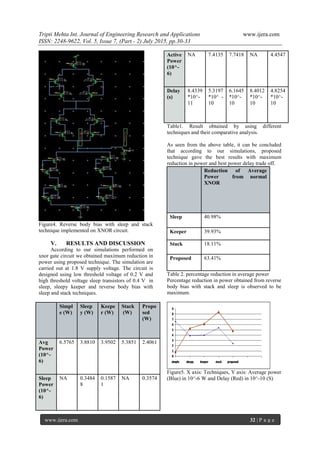
In this technique sleep approach and stack
approach, both are combined together with reverse
body biasing in pull down network. Reverse body
biasing increases the threshold voltage and thus sub
threshold current is reduced. As we know there is
tradeoff between power and delay we obtain
maximum reduction in power and delay as compared
to previosly discussed techniques. This technique is
the most efficient technique.
Tripti Mehta Int. Journal of Engineering Research and Applications www.ijera.com
ISSN: 2248-9622, Vol. 5, Issue 7, (Part - 2) July 2015, pp.30-33
www.ijera.com 32 | P a g e
Figure4. Reverse body bias with sleep and stack
technique implemented on XNOR circuit.
V. RESULTS AND DISCUSSION
According to our simulations performed on
xnor gate circuit we obtained maximum reduction in
power using proposed technique. The simulation are
carried out at 1.8 V supply voltage. The circuit is
designed using low threshold voltage of 0.2 V and
high threshold voltage sleep transistors of 0.4 V in
sleep, sleepy keeper and reverse body bias with
sleep and stack techniques.
Simpl
e (W)
Sleep
y (W)
Keepe
r (W)
Stack
(W)
Propo
sed
(W)
Avg
Power
(10^-
6)
6.5765 3.8810 3.9502 5.3851 2.4061
Sleep
Power
(10^-
6)
NA 0.3484
8
0.1587
1
NA 0.3574
Active
Power
(10^-
6)
NA 7.4135 7.7418 NA 4.4547
Delay
(s)
8.4339
*10^-
11
5.3197
*10^ -
10
6.1645
*10^-
10
8.4012
*10^-
10
4.8254
*10^-
10
Table1. Result obtained by using different
techniques and their comparative analysis.
As seen from the above table, it can be concluded
that according to our simulations, proposed
technique gave the best results with maximum
reduction in power and best power delay trade off.
Reduction of Average
Power from normal
XNOR
Sleep 40.98%
Keeper 39.93%
Stack 18.11%
Proposed 63.41%
Table 2. percentage reduction in average power
Percentage reduction in power obtained from reverse
body bias with stack and sleep is observed to be
maximum.
Figure5. X axis: Techniques, Y axis: Average power
(Blue) in 10^-6 W and Delay (Red) in 10^-10 (S)
Tripti Mehta Int. Journal of Engineering Research and Applications www.ijera.com
ISSN: 2248-9622, Vol. 5, Issue 7, (Part - 2) July 2015, pp.30-33
www.ijera.com 33 | P a g e
VI. CONCLUSION
The proposed XNOR gate circuit has been
designed and simulated on Tanner EDA tool
version 14.11 at 90 nm technology and 1.8 v supply
voltage. Though we obtained decrease in power in
sleep approach than base circuit but there is
destruction of state. In case of stack approach there
is large performance degradation as compared to
other techniques. As we know there is tradeoff
between power and delay, reverse body bias with
sleep and stack approach results in maximum
reduction with smallest delay while simultaneously
preserving precise logic state in sleep mode. Thus
proposed technique shows more than 60% power
reduction as compared to normal XNOR circuit. So,
good results were obtained from proposed technique.
The proposed technique provides efficient method to
reduce power. In future research can be done to
propose techniques to reduce power consumption
without compromise in performance.
REFERENCES
[1] M. Geetha Priya, K.Baskaran, D.krishnaveni,
Leakage Power Reduction Techniques in Deep
Submicron Technologies for VLSI
Applications, International Conference on
Communication Technology and System
Design ,volume 30, 2012,1163-1170.
[2] K. Gnana Deepika, K. Mariya Priyadarshini
and K. David Solomon Raj, Sleepy Keeper
Approach for Power Performance Tuning in
VLSI Design, International Journal of
Electronics and Communication Engineering,
volume 6, 2013, 17-18.
[3] Pankaj Kr. Pal, Rituraj S. Rathore, Ashwani
K.Rana, Gaurav Saini, New Low-Power
Techniques: Leakage Feedback with Stack &
Sleep Stack with Keeper, IEEE, 2010, 296-301
[4] P.S Aswale and S.S Chopade, A Low Power
90nm Technology based CMOS Digital Gates
with Dual Transistor Stacking Technique,
International Journal of Computer
Applications,volume 59, 2012, number 11.
[5] Se Hun Kim and Vincent Mooney, Sleepy
Keeper: a New Approach to Low Leakage
Power VLSI Design, International Journal of
Advances in Engineering and Technology,2011
[6] Ajay Kumar Dadoria and Kavita Khare, A
Novel Approach for Leakage Power Reduction
Techniques in 65nm Technologies, VLSICS,
volume 5,2014.

A Comparative Study Of Low Power Consumption Techniques In A VLSI Circuit

  • 1.
    Tripti Mehta Int.Journal of Engineering Research and Applications www.ijera.com ISSN: 2248-9622, Vol. 5, Issue 7, (Part - 2) July 2015, pp.30-33 www.ijera.com 30 | P a g e A Comparative Study Of Low Power Consumption Techniques In A VLSI Circuit Tripti Mehta Department of Electronics and Communication, FET, Manav Rachna International University, Faridabad. ABSTRACT Power optimization has become an important factor in designing a VLSI circuit. Earlier dynamic power was single largest concern but as transistor size decreases static power dominates the dynamic power. A comparable analysis of different low power, leakage current reduction techniques like sleep, stack, sleepy keeper and reverse body bias with sleep and stack has been done. Based on simulations performed on a XNOR circuit, the reverse body with sleep and stack achieves up to 60% less power consumption as compared to the base case which is better than other conventional techniques. Simulations to estimate power consumption are done on a TANNER EDA tool at 90 nm technology. Keywords – Leakage current reduction, Power optimization, Sleep, Sleepy keeper, Stack. I. INTRODUCTION With advancement in VLSI we require devices with less power consumption and short delay. But in actual these both are contradictory to each other. As supply voltage is scaled down to reduce power dissipation, threshold voltage is also scaled down to maintain performance. So from view point of performance, it is essential to have smaller threshold voltage but sub threshold current which is one of the leakage current component increases linearly as we reduce the threshold voltage. Leakage power dissipation is becoming one of the most challenging issue in designing low power VLSI circuits. Overviews of various techniques like sleep, stack, etc for leakage power reduction has been discussed in paper. The need for designing low power vlsi chips has become very important as we know the device dimension is getting reduced so more number of transistors are being packed onto a chip Thus resulting in increased power dissipation. So various techniques like Sleep, Stack, Sleepy keeper etc. have been proposed to overcome this problem of increased power dissipation. II. LITERATURE SURVEY M. Geetha Priya et al. have done comprehensive study and analysis of various leakage power minimization techniques in 2012. Their research study is mainly focused on circuit performance parameters. It has been implied from the current literature that only an appropriate choice of leakage power minimization technique for a specific application can be effectively carried by a VLSI circuit designer based on sequential analytical approach. [1] K. Ghana Deepika et al. presented Sleepy Keeper Approach for Power Performance Tuning in VLSI Design and various techniques like Sleep technique, Stack technique etc. that are used to reduce leakage power and talked about the disadvantages of each technique which limit the applications of each technique. Further, they have introduced sleepy keeper approach which can be used to reduce the power dissipation of the circuit in idle state while maintaining logic. Multi threshold transistors are used in order to reduce sub threshold leakage power and also to increase the switching speed of the circuit. [2] III. METHODOLOGY All the simulations are done on XNOR gate circuit at 90nm technology. The proposed techniques are discussed below: 3.1 SLEEP TRANSISTOR APPROACH In this technique, high threshold voltage PMOS transistor is connected between Vdd and pull up network of the circuit and NMOS transistor is connected between ground and pull down network. As high threshold voltage transistor have lower sub threshold current. Thus this technique reduces leakage power effectively. It operates in two modes Sleep and Active mode.[3] In case of sleep mode sleep transistors are turned off thus gating the supply voltage. By cutting off the power supply this can reduce the leakage power. In active mode the sleep transistors are on, this provides charging and discharging path to output during any change in input. Disadvantage of this technique is that it does not hold state, it destructs the state and thus there is problem of floating output voltage. RESEARCH ARTICLE OPEN ACCESS
  • 2.
    Tripti Mehta Int.Journal of Engineering Research and Applications www.ijera.com ISSN: 2248-9622, Vol. 5, Issue 7, (Part - 2) July 2015, pp.30-33 www.ijera.com 31 | P a g e Figure1. Sleep transistor technique 3.2 STACK APPROACH This technique divides the transistor into two half size transistors. When more than one transistor in series is turned off, the leakage current has strong dependence on number of turned off transistor. Due to exponential dependence of sub threshold current on gate source voltage, leakage current is reduced because of negative gate to source voltage. However there is degradation in performance.[4] Figure2. Stack approach 3.3 SLEEPY KEEPER APPROACH To overcome the disadvantage of sleep approach of destructive output sleepy keeper approach uses two additional transistors to maintain logic state during sleep mode and the two transistors are driven by the output of the circuit implemented. In this additonal NMOS transistor is placed parallel to PMOS sleep transistor between Vdd and pull up network and an additional PMOS transistor is placed parallel to NMOS sleep transistor between pull down network and ground.[5][6] When sleep transistors are turned off, in order to maintain the output logic, suppose ‘1’, the additional NMOS transistor placed in parallel to PMOS sleep transistor will be only source to VDD. Thus, the output logic is maintained when circuit switches from sleep mode to active mode. Figure3. Sleepy keeper approach IV. PROPOSED TECHNIQUE (REVERSE BODY BIAS WITH SLEEP AND STACK) In this technique sleep approach and stack approach, both are combined together with reverse body biasing in pull down network. Reverse body biasing increases the threshold voltage and thus sub threshold current is reduced. As we know there is tradeoff between power and delay we obtain maximum reduction in power and delay as compared to previosly discussed techniques. This technique is the most efficient technique.
  • 3.
    Tripti Mehta Int.Journal of Engineering Research and Applications www.ijera.com ISSN: 2248-9622, Vol. 5, Issue 7, (Part - 2) July 2015, pp.30-33 www.ijera.com 32 | P a g e Figure4. Reverse body bias with sleep and stack technique implemented on XNOR circuit. V. RESULTS AND DISCUSSION According to our simulations performed on xnor gate circuit we obtained maximum reduction in power using proposed technique. The simulation are carried out at 1.8 V supply voltage. The circuit is designed using low threshold voltage of 0.2 V and high threshold voltage sleep transistors of 0.4 V in sleep, sleepy keeper and reverse body bias with sleep and stack techniques. Simpl e (W) Sleep y (W) Keepe r (W) Stack (W) Propo sed (W) Avg Power (10^- 6) 6.5765 3.8810 3.9502 5.3851 2.4061 Sleep Power (10^- 6) NA 0.3484 8 0.1587 1 NA 0.3574 Active Power (10^- 6) NA 7.4135 7.7418 NA 4.4547 Delay (s) 8.4339 *10^- 11 5.3197 *10^ - 10 6.1645 *10^- 10 8.4012 *10^- 10 4.8254 *10^- 10 Table1. Result obtained by using different techniques and their comparative analysis. As seen from the above table, it can be concluded that according to our simulations, proposed technique gave the best results with maximum reduction in power and best power delay trade off. Reduction of Average Power from normal XNOR Sleep 40.98% Keeper 39.93% Stack 18.11% Proposed 63.41% Table 2. percentage reduction in average power Percentage reduction in power obtained from reverse body bias with stack and sleep is observed to be maximum. Figure5. X axis: Techniques, Y axis: Average power (Blue) in 10^-6 W and Delay (Red) in 10^-10 (S)
  • 4.
    Tripti Mehta Int.Journal of Engineering Research and Applications www.ijera.com ISSN: 2248-9622, Vol. 5, Issue 7, (Part - 2) July 2015, pp.30-33 www.ijera.com 33 | P a g e VI. CONCLUSION The proposed XNOR gate circuit has been designed and simulated on Tanner EDA tool version 14.11 at 90 nm technology and 1.8 v supply voltage. Though we obtained decrease in power in sleep approach than base circuit but there is destruction of state. In case of stack approach there is large performance degradation as compared to other techniques. As we know there is tradeoff between power and delay, reverse body bias with sleep and stack approach results in maximum reduction with smallest delay while simultaneously preserving precise logic state in sleep mode. Thus proposed technique shows more than 60% power reduction as compared to normal XNOR circuit. So, good results were obtained from proposed technique. The proposed technique provides efficient method to reduce power. In future research can be done to propose techniques to reduce power consumption without compromise in performance. REFERENCES [1] M. Geetha Priya, K.Baskaran, D.krishnaveni, Leakage Power Reduction Techniques in Deep Submicron Technologies for VLSI Applications, International Conference on Communication Technology and System Design ,volume 30, 2012,1163-1170. [2] K. Gnana Deepika, K. Mariya Priyadarshini and K. David Solomon Raj, Sleepy Keeper Approach for Power Performance Tuning in VLSI Design, International Journal of Electronics and Communication Engineering, volume 6, 2013, 17-18. [3] Pankaj Kr. Pal, Rituraj S. Rathore, Ashwani K.Rana, Gaurav Saini, New Low-Power Techniques: Leakage Feedback with Stack & Sleep Stack with Keeper, IEEE, 2010, 296-301 [4] P.S Aswale and S.S Chopade, A Low Power 90nm Technology based CMOS Digital Gates with Dual Transistor Stacking Technique, International Journal of Computer Applications,volume 59, 2012, number 11. [5] Se Hun Kim and Vincent Mooney, Sleepy Keeper: a New Approach to Low Leakage Power VLSI Design, International Journal of Advances in Engineering and Technology,2011 [6] Ajay Kumar Dadoria and Kavita Khare, A Novel Approach for Leakage Power Reduction Techniques in 65nm Technologies, VLSICS, volume 5,2014.