Automatic or Manual Path: a
Groupware application for Museum
Visit Planning using Interaction
with Situated Displays
Inna Belinky
February 3rd, 2016 UNINA 1
Novel technology at the fingertips of the visitors:
A living research lab
Alan J. Wecker
Tsvi Kuflik
EVA/Minerva 2016
Intelligent User Interfaces for
Cultural Heritage Exploration
Automatic or Manual Path: a
Groupware application for Museum
Visit Planning using Interaction
with Situated Displays
Inna Belinky
February 3rd, 2016 UNINA 2
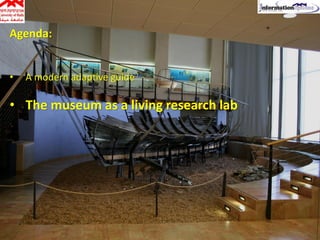
Agenda:
• A modern adaptive guide
• The museum as a living research lab
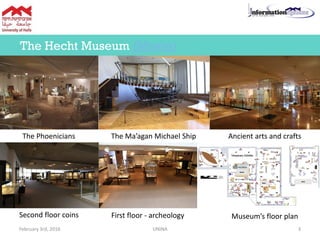
The Hecht Museum (Movie)
February 3rd, 2016 UNINA 3
The Phoenicians Ancient arts and craftsThe Ma’agan Michael Ship
Second floor coins First floor - archeology Museum’s floor plan
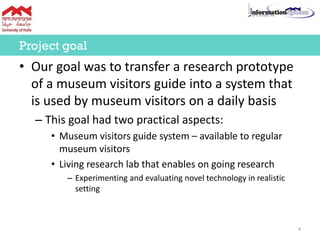
• Our goal was to transfer a research prototype
of a museum visitors guide into a system that
is used by museum visitors on a daily basis
– This goal had two practical aspects:
• Museum visitors guide system – available to regular
museum visitors
• Living research lab that enables on going research
– Experimenting and evaluating novel technology in realistic
setting
Project goal
4
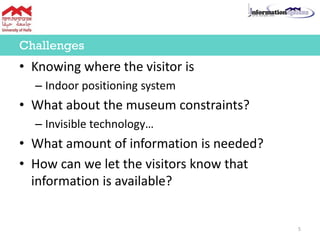
• Knowing where the visitor is
– Indoor positioning system
• What about the museum constraints?
– Invisible technology…
• What amount of information is needed?
• How can we let the visitors know that
information is available?
Challenges
5
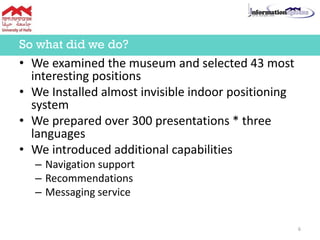
• We examined the museum and selected 43 most
interesting positions
• We Installed almost invisible indoor positioning
system
• We prepared over 300 presentations * three
languages
• We introduced additional capabilities
– Navigation support
– Recommendations
– Messaging service
So what did we do?
6
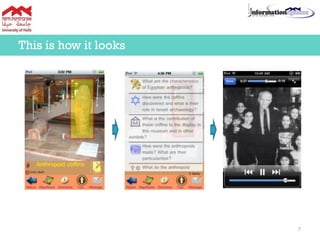
This is how it looks
7
Automatic or Manual Path: a
Groupware application for Museum
Visit Planning using Interaction
with Situated Displays
Inna Belinky
February 3rd, 2016 UNINA 8
Agenda:
• A modern adaptive guide
• The museum as a living research lab
• We can enable online visit planning
• We can enable onsite re-planning
• We can enable onsite interaction
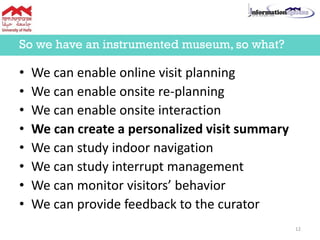
• We can create a personalized visit summary
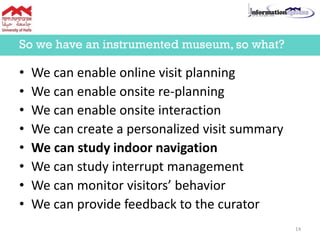
• We can study indoor navigation
• We can study interrupt management
• We can monitor visitors’ behavior
• We can provide feedback to the curator
So we have an instrumented museum, so what?
9
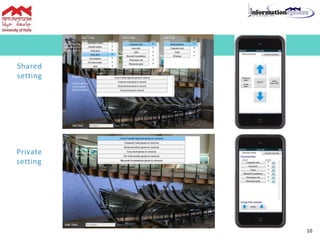
Shared
setting
Private
setting
10
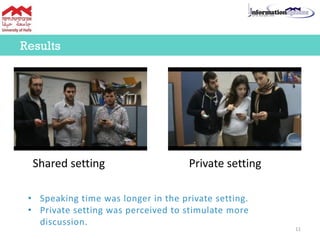
Results
Shared setting Private setting
• Speaking time was longer in the private setting.
• Private setting was perceived to stimulate more
discussion.
11
• We can enable online visit planning
• We can enable onsite re-planning
• We can enable onsite interaction
• We can create a personalized visit summary
• We can study indoor navigation
• We can study interrupt management
• We can monitor visitors’ behavior
• We can provide feedback to the curator
So we have an instrumented museum, so what?
12
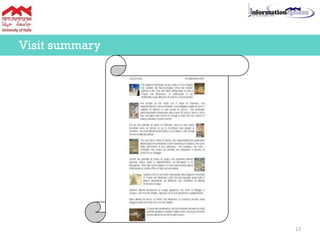
Visit summary
13
• We can enable online visit planning
• We can enable onsite re-planning
• We can enable onsite interaction
• We can create a personalized visit summary
• We can study indoor navigation
• We can study interrupt management
• We can monitor visitors’ behavior
• We can provide feedback to the curator
So we have an instrumented museum, so what?
14
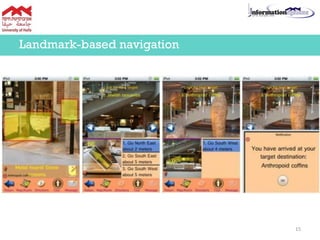
Landmark-based navigation
15
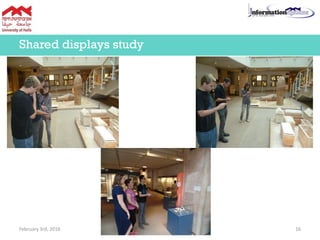
Shared displays study
February 3rd, 2016 UNINA 16
• We can enable online visit planning
• We can enable onsite re-planning
• We can enable onsite interaction
• We can create a personalized visit summary
• We can study indoor navigation
• We can study interrupt management
• We can monitor visitors’ behavior
• We can provide feedback to the curator
So we have an instrumented museum, so what?
17
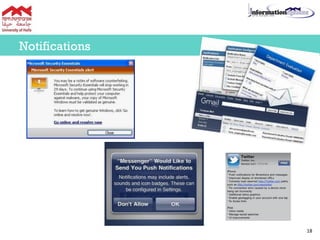
Notifications
18
Proactiveness allows systems to provide their users with
relevant information (or service) at the right time
• Proactive museum visitors guide is one example for
such system
• However, when considering proactiveness, two
questions pop up:
– When to provide information to the users?
• We do not want to interfere
– How to notify the users about the availability of a service ?
• We would like to make sure that the user will get the message
19
Motivation
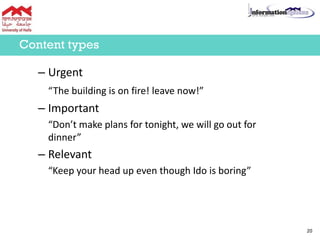
Content types
– Urgent
“The building is on fire! leave now!”
– Important
“Don’t make plans for tonight, we will go out for
dinner”
– Relevant
“Keep your head up even though Ido is boring”
20
• We can enable online visit planning
• We can enable onsite re-planning
• We can enable onsite interaction
• We can create a personalized visit summary
• We can study indoor navigation
• We can study interrupt management
• We can monitor visitors’ behavior
• We can provide feedback to the curator
So we have an instrumented museum, so what?
21
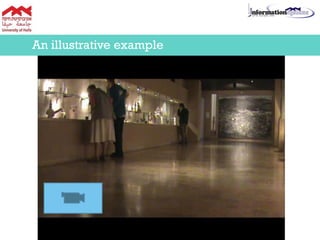
An illustrative example
22
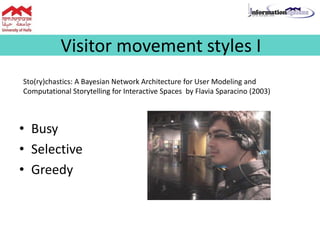
Visitor movement styles I
Sto(ry)chastics: A Bayesian Network Architecture for User Modeling and
Computational Storytelling for Interactive Spaces by Flavia Sparacino (2003)
• Busy
• Selective
• Greedy
Visitor movement styles II
Veron E. and Levasseur M. (Ethnographie de l'exposition, Paris, Bibliothèque Publique d'Information,
Centre Georges Pompidou (1983)
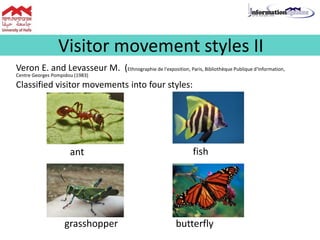
Classified visitor movements into four styles:
ant fish
grasshopper butterfly
Visitor Style Pairs
• Meekrats
• Doves
• Ducks
• Lone Wolves
February 3rd, 2016 UNINA 25
• Visualization of visitors’ behavior
Online access to accumulated data
26
• We compared visit logs
– Regular visitors that used a mobile guide
– Regular visitors that did not use it
The effects of a mobile visitors guide on visitors’ behavior
27
Results: Conclusions
• Using a mobile guide increased visit time
• The mobile guide monopolized visitor’s time
– Both holding power and attraction power increased
• The use of the guide disrupted the social interaction
of visitors coming in a group
28
Alan J. Wecker
U of Haifa,
U of Trento
Tsvi Kuflik
U of Haifa
Oliviero Stock
FBK-Irst
Dynamic personalization based on
Mobile Behavior:
from Personality to Personalization:
A Blueprint
Joint work with:
Rose Ginosar, Eynat Sharon
Tower of David Museum
• General
– Can we use personality data to help our users?
• In what ways?
• Cultural Heritage
– What does this mean in a museum context?
• How?
– Coerce > Persuade > Influence
– Present in a manner which is the most amenable to
the user for his benefit
Problem
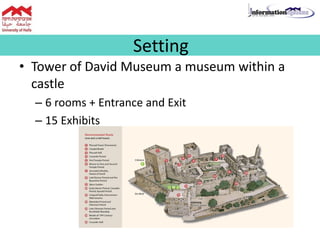
• Tower of David Museum a museum within a
castle
– 6 rooms + Entrance and Exit
– 15 Exhibits
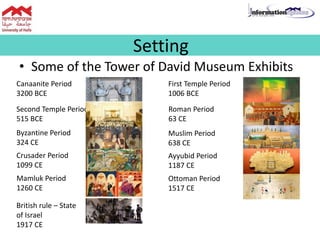
Setting
• Some of the Tower of David Museum Exhibits
Setting
Canaanite Period
3200 BCE
First Temple Period
1006 BCE
Second Temple Period
515 BCE
Byzantine Period
324 CE
Roman Period
63 CE
Muslim Period
638 CE
Crusader Period
1099 CE
Ayyubid Period
1187 CE
Mamluk Period
1260 CE
Ottoman Period
1517 CE
British rule – State
of Israel
1917 CE
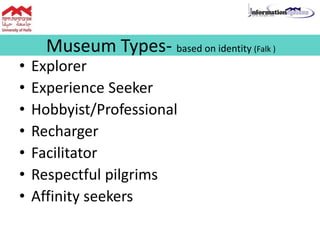
Museum Types- based on identity (Falk )
• Explorer
• Experience Seeker
• Hobbyist/Professional
• Recharger
• Facilitator
• Respectful pilgrims
• Affinity seekers
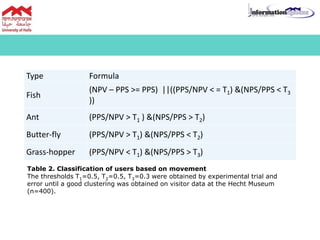
Type Formula
Fish
(NPV – PPS >= PPS) ||((PPS/NPV < = T1) &(NPS/PPS < T3
))
Ant (PPS/NPV > T1 ) &(NPS/PPS > T2)
Butter-fly (PPS/NPV > T1) &(NPS/PPS < T2)
Grass-hopper (PPS/NPV < T1) &(NPS/PPS > T3)
Table 2. Classification of users based on movement
The thresholds T1=0.5, T2=0.5, T3=0.3 were obtained by experimental trial and
error until a good clustering was obtained on visitor data at the Hecht Museum
(n=400).
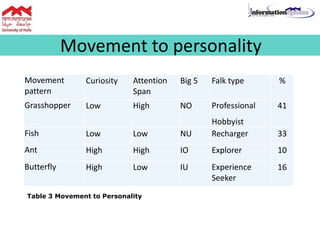
Movement
pattern
Curiosity Attention
Span
Big 5 Falk type %
Grasshopper Low High NO Professional
Hobbyist
41
Fish Low Low NU Recharger 33
Ant High High IO Explorer 10
Butterfly High Low IU Experience
Seeker
16
Movement to personality
Table 3 Movement to Personality
• What can you do with personality?
– Develop, Exploit, Manage opportunities
• How can use personality to do this?
– Increase Awareness
– Increase Commitment
– Manage the opportunity in an optimum way
(marketing sense)
What do you want to do with personality?
• When increasing Awareness use:
– Subtlety
– Frequency
– Length
– Marketing strategy (in the door, in your face…)
– Incentive type (different wordings)
– Context
• Location
• Temporal
– Social (not in this study)
How to do this using personality (Factors)
• Calibration of beacons
– Range & Frequency
• People follow a general path (not much chance to
express personality)
– Physical Constraints
• Stairs
• Side Rooms
• Natural Flow
– Time Constraints
• “Museum Fatigue” (rooms seen at end…)
• Developing Solution
– Examine the small variants
Initial insights
A Novel Image-Based Positioning Technique Using
Mobile Eye-Tracker
For Enhancing the Museum Visit
Moayad Mokatren, Tsvi Kuflik and Ilan Shimshoni
Department of Information Systems
The University of Haifa
Sep 2016 Mobile-CH 39
Research Question
How can we use mobile eye tracker to identify
location and object of interest?
Sep 2016
Mobile-CH
40
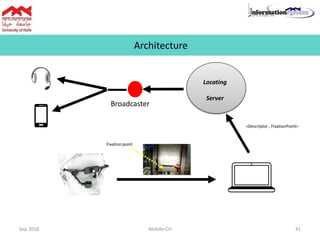
Architecture
Fixation point
<Descriptor , FixationPoint>
Sep 2016 Mobile-CH 41
Broadcaster
Locating
Server
Towards Using Mobile, Head-
Worn Displays in Cultural
Heritage: User Requirements
and a Research Agenda
NataliaVainstein
TheUniversityof Haifa
Haifa,Israel
nataliashtepa@gmail.com
TsviKuflik
TheUniversityof Haifa
Haifa,Israel
tsvikak@is.haifa.ac.il
Joel Lanir
TheUniversityof Haifa
Haifa,Israel
ylanir@is.haifa.ac.il
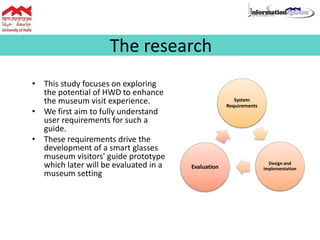
The research
• This study focuses on exploring
the potential of HWD to enhance
the museum visit experience.
• We first aim to fully understand
user requirements for such a
guide.
• These requirements drive the
development of a smart glasses
museum visitors' guide prototype
which later will be evaluated in a
museum setting
System
Requirements
Design and
implementationEvaluation
User Requirements for Glasses-Based
Guide
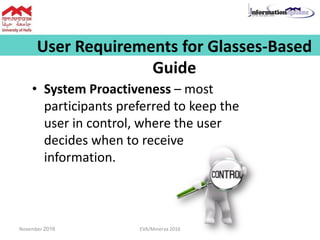
• System Proactiveness – most
participants preferred to keep the
user in control, where the user
decides when to receive
information.
November 2016 EVA/Minerva 2016
User Requirements for Glasses-Based
Guide
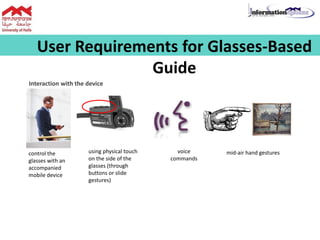
Interaction with the device
control the
glasses with an
accompanied
mobile device
using physical touch
on the side of the
glasses (through
buttons or slide
gestures)
voice
commands
mid-air hand gestures
User Requirements for Glasses-Based Guide
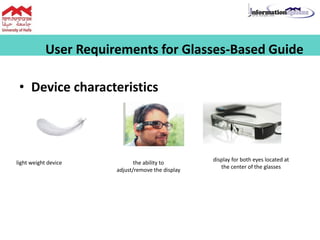
• Device characteristics
light weight device the ability to
adjust/remove the display
display for both eyes located at
the center of the glasses
User Requirements for Glasses-Based Guide
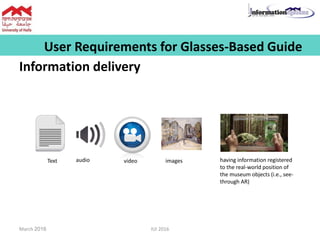
Information delivery
Text audio video images having information registered
to the real-world position of
the museum objects (i.e., see-
through AR)
March 2016 IUI 2016
User Requirements for Glasses-Based Guide
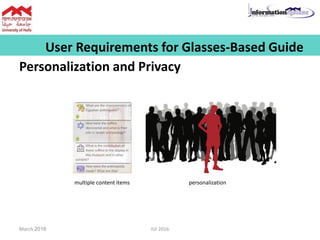
Personalization and Privacy
multiple content items personalization
March 2016 IUI 2016
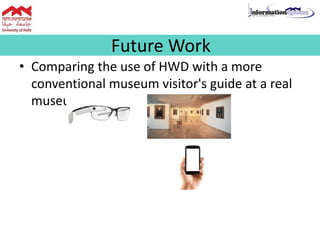
Future Work
• Comparing the use of HWD with a more
conventional museum visitor's guide at a real
museum.
Visualizing Proximity-Based Behavior of
Museum Visitors using Tangram
Diagrams
J. Lanir, P. Bak, & T. Kuflik: The
University of Haifa in cooperation with
IBM Research / Haifa Lab, Israel
50
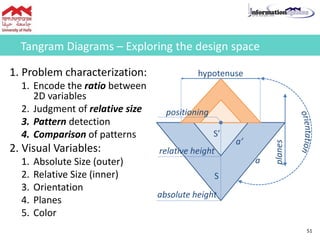
Tangram Diagrams – Exploring the design space
1. Problem characterization:
1. Encode the ratio between
2D variables
2. Judgment of relative size
3. Pattern detection
4. Comparison of patterns
2. Visual Variables:
1. Absolute Size (outer)
2. Relative Size (inner)
3. Orientation
4. Planes
5. Color
51
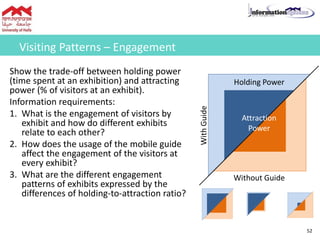
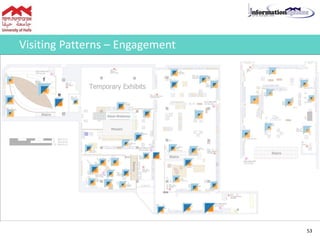
Visiting Patterns – Engagement
Show the trade-off between holding power
(time spent at an exhibition) and attracting
power (% of visitors at an exhibit).
Information requirements:
1. What is the engagement of visitors by
exhibit and how do different exhibits
relate to each other?
2. How does the usage of the mobile guide
affect the engagement of the visitors at
every exhibit?
3. What are the different engagement
patterns of exhibits expressed by the
differences of holding-to-attraction ratio?
52
Visiting Patterns – Engagement
53
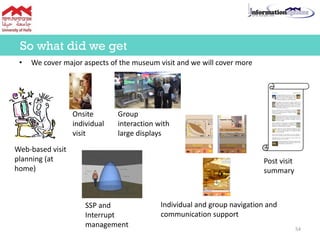
• We cover major aspects of the museum visit and we will cover more
So what did we get
Web-based visit
planning (at
home)
Onsite
individual
visit
Group
interaction with
large displays
SSP and
Interrupt
management
Individual and group navigation and
communication support
Post visit
summary
54
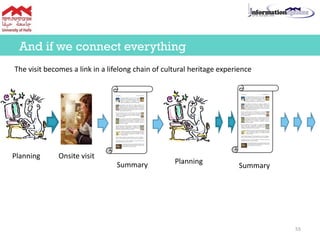
And if we connect everything
Planning
Summary
55
Onsite visit
Planning
Summary
The visit becomes a link in a lifelong chain of cultural heritage experience
Automatic or Manual Path: a
Groupware application for Museum
Visit Planning using Interaction
with Situated Displays
Inna Belinky
Questions?
February 3rd, 2016 UNINA 56
57February 3rd, 2016 UNINA

E3 wesker kuflik_novel_technologylivinglab

  • 1.
    Automatic or ManualPath: a Groupware application for Museum Visit Planning using Interaction with Situated Displays Inna Belinky February 3rd, 2016 UNINA 1 Novel technology at the fingertips of the visitors: A living research lab Alan J. Wecker Tsvi Kuflik EVA/Minerva 2016 Intelligent User Interfaces for Cultural Heritage Exploration
  • 2.
    Automatic or ManualPath: a Groupware application for Museum Visit Planning using Interaction with Situated Displays Inna Belinky February 3rd, 2016 UNINA 2 Agenda: • A modern adaptive guide • The museum as a living research lab
  • 3.
    The Hecht Museum(Movie) February 3rd, 2016 UNINA 3 The Phoenicians Ancient arts and craftsThe Ma’agan Michael Ship Second floor coins First floor - archeology Museum’s floor plan
  • 4.
    • Our goalwas to transfer a research prototype of a museum visitors guide into a system that is used by museum visitors on a daily basis – This goal had two practical aspects: • Museum visitors guide system – available to regular museum visitors • Living research lab that enables on going research – Experimenting and evaluating novel technology in realistic setting Project goal 4
  • 5.
    • Knowing wherethe visitor is – Indoor positioning system • What about the museum constraints? – Invisible technology… • What amount of information is needed? • How can we let the visitors know that information is available? Challenges 5
  • 6.
    • We examinedthe museum and selected 43 most interesting positions • We Installed almost invisible indoor positioning system • We prepared over 300 presentations * three languages • We introduced additional capabilities – Navigation support – Recommendations – Messaging service So what did we do? 6
  • 7.
    This is howit looks 7
  • 8.
    Automatic or ManualPath: a Groupware application for Museum Visit Planning using Interaction with Situated Displays Inna Belinky February 3rd, 2016 UNINA 8 Agenda: • A modern adaptive guide • The museum as a living research lab
  • 9.
    • We canenable online visit planning • We can enable onsite re-planning • We can enable onsite interaction • We can create a personalized visit summary • We can study indoor navigation • We can study interrupt management • We can monitor visitors’ behavior • We can provide feedback to the curator So we have an instrumented museum, so what? 9
  • 10.
  • 11.
    Results Shared setting Privatesetting • Speaking time was longer in the private setting. • Private setting was perceived to stimulate more discussion. 11
  • 12.
    • We canenable online visit planning • We can enable onsite re-planning • We can enable onsite interaction • We can create a personalized visit summary • We can study indoor navigation • We can study interrupt management • We can monitor visitors’ behavior • We can provide feedback to the curator So we have an instrumented museum, so what? 12
  • 13.
  • 14.
    • We canenable online visit planning • We can enable onsite re-planning • We can enable onsite interaction • We can create a personalized visit summary • We can study indoor navigation • We can study interrupt management • We can monitor visitors’ behavior • We can provide feedback to the curator So we have an instrumented museum, so what? 14
  • 15.
  • 16.
  • 17.
    • We canenable online visit planning • We can enable onsite re-planning • We can enable onsite interaction • We can create a personalized visit summary • We can study indoor navigation • We can study interrupt management • We can monitor visitors’ behavior • We can provide feedback to the curator So we have an instrumented museum, so what? 17
  • 18.
  • 19.
    Proactiveness allows systemsto provide their users with relevant information (or service) at the right time • Proactive museum visitors guide is one example for such system • However, when considering proactiveness, two questions pop up: – When to provide information to the users? • We do not want to interfere – How to notify the users about the availability of a service ? • We would like to make sure that the user will get the message 19 Motivation
  • 20.
    Content types – Urgent “Thebuilding is on fire! leave now!” – Important “Don’t make plans for tonight, we will go out for dinner” – Relevant “Keep your head up even though Ido is boring” 20
  • 21.
    • We canenable online visit planning • We can enable onsite re-planning • We can enable onsite interaction • We can create a personalized visit summary • We can study indoor navigation • We can study interrupt management • We can monitor visitors’ behavior • We can provide feedback to the curator So we have an instrumented museum, so what? 21
  • 22.
  • 23.
    Visitor movement stylesI Sto(ry)chastics: A Bayesian Network Architecture for User Modeling and Computational Storytelling for Interactive Spaces by Flavia Sparacino (2003) • Busy • Selective • Greedy
  • 24.
    Visitor movement stylesII Veron E. and Levasseur M. (Ethnographie de l'exposition, Paris, Bibliothèque Publique d'Information, Centre Georges Pompidou (1983) Classified visitor movements into four styles: ant fish grasshopper butterfly
  • 25.
    Visitor Style Pairs •Meekrats • Doves • Ducks • Lone Wolves February 3rd, 2016 UNINA 25
  • 26.
    • Visualization ofvisitors’ behavior Online access to accumulated data 26
  • 27.
    • We comparedvisit logs – Regular visitors that used a mobile guide – Regular visitors that did not use it The effects of a mobile visitors guide on visitors’ behavior 27
  • 28.
    Results: Conclusions • Usinga mobile guide increased visit time • The mobile guide monopolized visitor’s time – Both holding power and attraction power increased • The use of the guide disrupted the social interaction of visitors coming in a group 28
  • 29.
    Alan J. Wecker Uof Haifa, U of Trento Tsvi Kuflik U of Haifa Oliviero Stock FBK-Irst Dynamic personalization based on Mobile Behavior: from Personality to Personalization: A Blueprint Joint work with: Rose Ginosar, Eynat Sharon Tower of David Museum
  • 30.
    • General – Canwe use personality data to help our users? • In what ways? • Cultural Heritage – What does this mean in a museum context? • How? – Coerce > Persuade > Influence – Present in a manner which is the most amenable to the user for his benefit Problem
  • 31.
    • Tower ofDavid Museum a museum within a castle – 6 rooms + Entrance and Exit – 15 Exhibits Setting
  • 32.
    • Some ofthe Tower of David Museum Exhibits Setting Canaanite Period 3200 BCE First Temple Period 1006 BCE Second Temple Period 515 BCE Byzantine Period 324 CE Roman Period 63 CE Muslim Period 638 CE Crusader Period 1099 CE Ayyubid Period 1187 CE Mamluk Period 1260 CE Ottoman Period 1517 CE British rule – State of Israel 1917 CE
  • 33.
    Museum Types- basedon identity (Falk ) • Explorer • Experience Seeker • Hobbyist/Professional • Recharger • Facilitator • Respectful pilgrims • Affinity seekers
  • 34.
    Type Formula Fish (NPV –PPS >= PPS) ||((PPS/NPV < = T1) &(NPS/PPS < T3 )) Ant (PPS/NPV > T1 ) &(NPS/PPS > T2) Butter-fly (PPS/NPV > T1) &(NPS/PPS < T2) Grass-hopper (PPS/NPV < T1) &(NPS/PPS > T3) Table 2. Classification of users based on movement The thresholds T1=0.5, T2=0.5, T3=0.3 were obtained by experimental trial and error until a good clustering was obtained on visitor data at the Hecht Museum (n=400).
  • 35.
    Movement pattern Curiosity Attention Span Big 5Falk type % Grasshopper Low High NO Professional Hobbyist 41 Fish Low Low NU Recharger 33 Ant High High IO Explorer 10 Butterfly High Low IU Experience Seeker 16 Movement to personality Table 3 Movement to Personality
  • 36.
    • What canyou do with personality? – Develop, Exploit, Manage opportunities • How can use personality to do this? – Increase Awareness – Increase Commitment – Manage the opportunity in an optimum way (marketing sense) What do you want to do with personality?
  • 37.
    • When increasingAwareness use: – Subtlety – Frequency – Length – Marketing strategy (in the door, in your face…) – Incentive type (different wordings) – Context • Location • Temporal – Social (not in this study) How to do this using personality (Factors)
  • 38.
    • Calibration ofbeacons – Range & Frequency • People follow a general path (not much chance to express personality) – Physical Constraints • Stairs • Side Rooms • Natural Flow – Time Constraints • “Museum Fatigue” (rooms seen at end…) • Developing Solution – Examine the small variants Initial insights
  • 39.
    A Novel Image-BasedPositioning Technique Using Mobile Eye-Tracker For Enhancing the Museum Visit Moayad Mokatren, Tsvi Kuflik and Ilan Shimshoni Department of Information Systems The University of Haifa Sep 2016 Mobile-CH 39
  • 40.
    Research Question How canwe use mobile eye tracker to identify location and object of interest? Sep 2016 Mobile-CH 40
  • 41.
    Architecture Fixation point <Descriptor ,FixationPoint> Sep 2016 Mobile-CH 41 Broadcaster Locating Server
  • 42.
    Towards Using Mobile,Head- Worn Displays in Cultural Heritage: User Requirements and a Research Agenda NataliaVainstein TheUniversityof Haifa Haifa,Israel nataliashtepa@gmail.com TsviKuflik TheUniversityof Haifa Haifa,Israel tsvikak@is.haifa.ac.il Joel Lanir TheUniversityof Haifa Haifa,Israel ylanir@is.haifa.ac.il
  • 43.
    The research • Thisstudy focuses on exploring the potential of HWD to enhance the museum visit experience. • We first aim to fully understand user requirements for such a guide. • These requirements drive the development of a smart glasses museum visitors' guide prototype which later will be evaluated in a museum setting System Requirements Design and implementationEvaluation
  • 44.
    User Requirements forGlasses-Based Guide • System Proactiveness – most participants preferred to keep the user in control, where the user decides when to receive information. November 2016 EVA/Minerva 2016
  • 45.
    User Requirements forGlasses-Based Guide Interaction with the device control the glasses with an accompanied mobile device using physical touch on the side of the glasses (through buttons or slide gestures) voice commands mid-air hand gestures
  • 46.
    User Requirements forGlasses-Based Guide • Device characteristics light weight device the ability to adjust/remove the display display for both eyes located at the center of the glasses
  • 47.
    User Requirements forGlasses-Based Guide Information delivery Text audio video images having information registered to the real-world position of the museum objects (i.e., see- through AR) March 2016 IUI 2016
  • 48.
    User Requirements forGlasses-Based Guide Personalization and Privacy multiple content items personalization March 2016 IUI 2016
  • 49.
    Future Work • Comparingthe use of HWD with a more conventional museum visitor's guide at a real museum.
  • 50.
    Visualizing Proximity-Based Behaviorof Museum Visitors using Tangram Diagrams J. Lanir, P. Bak, & T. Kuflik: The University of Haifa in cooperation with IBM Research / Haifa Lab, Israel 50
  • 51.
    Tangram Diagrams –Exploring the design space 1. Problem characterization: 1. Encode the ratio between 2D variables 2. Judgment of relative size 3. Pattern detection 4. Comparison of patterns 2. Visual Variables: 1. Absolute Size (outer) 2. Relative Size (inner) 3. Orientation 4. Planes 5. Color 51
  • 52.
    Visiting Patterns –Engagement Show the trade-off between holding power (time spent at an exhibition) and attracting power (% of visitors at an exhibit). Information requirements: 1. What is the engagement of visitors by exhibit and how do different exhibits relate to each other? 2. How does the usage of the mobile guide affect the engagement of the visitors at every exhibit? 3. What are the different engagement patterns of exhibits expressed by the differences of holding-to-attraction ratio? 52
  • 53.
  • 54.
    • We covermajor aspects of the museum visit and we will cover more So what did we get Web-based visit planning (at home) Onsite individual visit Group interaction with large displays SSP and Interrupt management Individual and group navigation and communication support Post visit summary 54
  • 55.
    And if weconnect everything Planning Summary 55 Onsite visit Planning Summary The visit becomes a link in a lifelong chain of cultural heritage experience
  • 56.
    Automatic or ManualPath: a Groupware application for Museum Visit Planning using Interaction with Situated Displays Inna Belinky Questions? February 3rd, 2016 UNINA 56
  • 57.