February 17, 2010
Brainteaser				insult + injury What phrase do these words and symbols represent?
HousekeepingHand in your prewriting/outline for the topic “My proudest accomplishment.”Website – your accounts have been created and you should have received an e-mail telling you how to access the webpage.
“Traffic? What Traffic?” - Vocabularyhustles (v. to hustle)hurriescore (n.)centreoutlying (adj.)far from the centrecataclysmic (adj.)really destructive; disastrousexhortation  (n.)advice or strong encouragement(v. to exhort – to give advice)
“Traffic? What Traffic?” - Idioms“It all boils down to this” – it all leads to this; it all comes to this point VANOC – Vancouver Olympic Organizing Committee.
“Traffic? What Traffic?”Comprehension QuestionsPlease answer these questions in complete sentences.
Topic vs. MessageTopic =general subjectcan usually be expressed in a word or phraseEx:  commuting during the OlympicsMessage =theme or point of viewwhat the author believes about that topicA:  It might be easier to take the bus than drive during the Olympics
Answering Literature QuestionsPurpose  to show the teacher you have understood and thought about what you’ve read.  SoYour answer should be clear and contain enough detail that someone who is not familiar with the story could understand your points.
How to Answer Literature QuestionsBegin your answer with a complete sentence that clearly reflects or restates the question and your overall answer.Q:   What is the overall topic of this article?A:   The overall topic of this article is commuting in Vancouver during the Olympics.
How to Answer Literature QuestionsThe first time you refer to the story or article, the characters, or the writer, you should use the title or their name .  After that you can use “the story,” “the author,” “he,” “she,” etcetera.Q:  What are the reasons the author (Patrick Brethour) gives for driving?A:  Breathour gives several reasons that he likes to drive.  First, he states. . . .
How to Answer Literature QuestionsYou should answer the question using your own words, paraphrasing the events and details of the story.NOT:   He states that the train schedule doesn’t mesh with his work schedule.BUT:  He states that the West Coast Express schedule doesn’t match his schedule.  Copying the words from an article or story without using quotes or giving credit is considered plagiarism and is a serious cheating offence.
How to Answer Literature QuestionsYou should write in the present tense, as if the story is still going on, or the writer is still writing it.	Ex: The author saysthat . . . 	Ex:  Breathorstates . . .
How to Answer Literature QuestionsSupport your answer with specific details from the article or story.Ex:  Breathour gives several reasons that he likes to drive.  First, he states that the transit schedule doesn’t “mesh” with his.  He also feels he needs the vehicle to run errands during the day.  Overall he feels driving is “easier, more convenient and cheaper.”Once again, these details should be in your own words.  If you want to use some exact words from the story to support your answer, these must be in “quotation marks” to show they are the author’s words.
break
Fiction vs. Non-FictionThe most general way to categorize literature is as either fiction or non-fiction.Fiction is made-up stories. It includes short stories, novels, and plays.Non-fiction is writing based on facts, but can include some opinion.  It includes, news articles, essays, biographies, etc.
The Main IdeaWriters of both fiction and non-fiction, especially shorter works, are trying to communicate one main idea to their audienceIn fiction, we call this the “theme”In non-fiction, we call this the “thesis”Sometimes the main idea is stated directlyOther times the reader must “infer” it
The Main Idea (Cont’d.)“Clues” that will help you find the thesis arethe titlethe organizationtransition wordsexamples
Dealing with Unfamiliar WordsAll readers come across unfamiliar words when they readOn first reading, if you understand the “gist” of what is being said, then try to guess the meaning of unfamiliar words from the context (the words around them).On second reading, highlight important points, make notes, and look up unfamiliar words
Unfamiliar Words - ExamplesAs we passed the rotting garbage, we tried covering our noses to keep out the vilestench.Vile (adj.) = terrible, really bad  (evil)Stench (n.)= bad smellWhen his father asked, “And where do you think you’re going?” the teenager looked back at him sullenly.Sullen (adj.)= resentful, unsociable, sulkySullenly (adv.)
PracticeUse context and word form to help figure out the  meaning of the underlined word.It was serendipity (n.) that I came across that article.  I wasn’t even thinking of my research project when I found it, but it has just what I need.  good luck (chance), good fortune, lucky, serendipitous (adj.) - fortunate
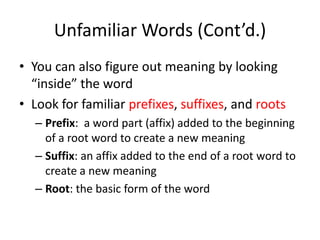
Unfamiliar Words (Cont’d.)You can also figure out meaning by looking “inside” the wordLook for familiar prefixes, suffixes, and rootsPrefix:  a word part (affix) added to the beginning of a root word to create a new meaningSuffix: an affix added to the end of a root word to create a new meaningRoot: the basic form of the word
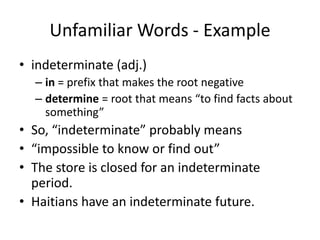
Unfamiliar Words - Exampleindeterminate (adj.)in = prefix that makes the root negativedetermine = root that means “to find facts about something”So, “indeterminate” probably means “impossible to know or find out”The store is closed for an indeterminate period.Haitians have an indeterminate future.
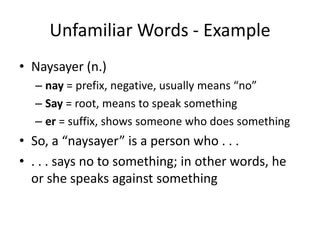
Unfamiliar Words - ExampleNaysayer (n.)nay = prefix, negative, usually means “no”Say = root, means to speak somethinger= suffix, shows someone who does somethingSo, a “naysayer” is a person who . . . . . . says no to something; in other words, he or she speaks against something
“All Grown Up and Still in Tow”This is a non-fiction article.Any questions about the words in the title?What does the title suggest the article might be about?
All Grown Up and Still in Tow On your own paper, without the use of a dictionary, do the brief vocabulary quiz. Refer back to the article to help you understand the meaning of the word.Put your name on the paper.
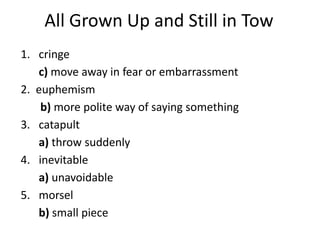
All Grown Up and Still in Tow cringe	c) move away in fear or embarrassment2.  euphemism   b) more polite way of saying somethingcatapult  a) throw suddenlyinevitable 	a) unavoidablemorsel 	b) small piece
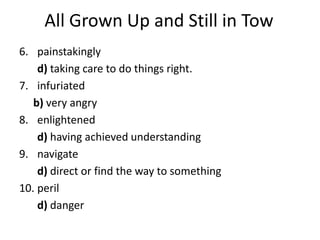
All Grown Up and Still in Tow painstakingly 	d) taking care to do things right.infuriated b) very angryenlightened 	d) having achieved understandingnavigate 	d) direct or find the way to somethingperil 	d) danger
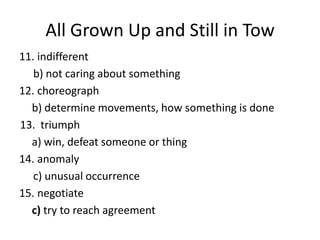
All Grown Up and Still in Tow indifferent b) not caring about somethingchoreograph	b) determine movements, how something is done13.  triumph a) win, defeat someone or thinganomalyc) unusual occurrencenegotiate 	c) try to reach agreement
All Grown Up and Still in Tow Add up the correct answers to get your total out of 15.Take a look at your mark.  Congratulate yourself for all the words you  were able to understand without looking at a dictionary!
All Grown Up and Still in Tow So, when reading stories try to guess the meaning from the context.  Only look up unfamiliar words on your second reading or when you are answering questions.On the other hand, always look up words in directions and questions .  Be sure you understand what the question is asking before you attempt to answer it!
HomeworkDo the following comprehension questions  on p. 264.  1, 2, 3, 6, 7.Review the slides about “Answering Literature Questions” before you write your answers.Due Monday10 marks

E10 Feb17 2010

  • 1.
  • 2.
    Brainteaser insult + injuryWhat phrase do these words and symbols represent?
  • 3.
    HousekeepingHand in yourprewriting/outline for the topic “My proudest accomplishment.”Website – your accounts have been created and you should have received an e-mail telling you how to access the webpage.
  • 4.
    “Traffic? What Traffic?”- Vocabularyhustles (v. to hustle)hurriescore (n.)centreoutlying (adj.)far from the centrecataclysmic (adj.)really destructive; disastrousexhortation (n.)advice or strong encouragement(v. to exhort – to give advice)
  • 5.
    “Traffic? What Traffic?”- Idioms“It all boils down to this” – it all leads to this; it all comes to this point VANOC – Vancouver Olympic Organizing Committee.
  • 6.
    “Traffic? What Traffic?”ComprehensionQuestionsPlease answer these questions in complete sentences.
  • 7.
    Topic vs. MessageTopic=general subjectcan usually be expressed in a word or phraseEx: commuting during the OlympicsMessage =theme or point of viewwhat the author believes about that topicA: It might be easier to take the bus than drive during the Olympics
  • 8.
    Answering Literature QuestionsPurpose to show the teacher you have understood and thought about what you’ve read. SoYour answer should be clear and contain enough detail that someone who is not familiar with the story could understand your points.
  • 9.
    How to AnswerLiterature QuestionsBegin your answer with a complete sentence that clearly reflects or restates the question and your overall answer.Q: What is the overall topic of this article?A: The overall topic of this article is commuting in Vancouver during the Olympics.
  • 10.
    How to AnswerLiterature QuestionsThe first time you refer to the story or article, the characters, or the writer, you should use the title or their name . After that you can use “the story,” “the author,” “he,” “she,” etcetera.Q: What are the reasons the author (Patrick Brethour) gives for driving?A: Breathour gives several reasons that he likes to drive. First, he states. . . .
  • 11.
    How to AnswerLiterature QuestionsYou should answer the question using your own words, paraphrasing the events and details of the story.NOT: He states that the train schedule doesn’t mesh with his work schedule.BUT: He states that the West Coast Express schedule doesn’t match his schedule. Copying the words from an article or story without using quotes or giving credit is considered plagiarism and is a serious cheating offence.
  • 12.
    How to AnswerLiterature QuestionsYou should write in the present tense, as if the story is still going on, or the writer is still writing it. Ex: The author saysthat . . . Ex: Breathorstates . . .
  • 13.
    How to AnswerLiterature QuestionsSupport your answer with specific details from the article or story.Ex: Breathour gives several reasons that he likes to drive. First, he states that the transit schedule doesn’t “mesh” with his. He also feels he needs the vehicle to run errands during the day. Overall he feels driving is “easier, more convenient and cheaper.”Once again, these details should be in your own words. If you want to use some exact words from the story to support your answer, these must be in “quotation marks” to show they are the author’s words.
  • 14.
  • 15.
    Fiction vs. Non-FictionThemost general way to categorize literature is as either fiction or non-fiction.Fiction is made-up stories. It includes short stories, novels, and plays.Non-fiction is writing based on facts, but can include some opinion. It includes, news articles, essays, biographies, etc.
  • 16.
    The Main IdeaWritersof both fiction and non-fiction, especially shorter works, are trying to communicate one main idea to their audienceIn fiction, we call this the “theme”In non-fiction, we call this the “thesis”Sometimes the main idea is stated directlyOther times the reader must “infer” it
  • 17.
    The Main Idea(Cont’d.)“Clues” that will help you find the thesis arethe titlethe organizationtransition wordsexamples
  • 18.
    Dealing with UnfamiliarWordsAll readers come across unfamiliar words when they readOn first reading, if you understand the “gist” of what is being said, then try to guess the meaning of unfamiliar words from the context (the words around them).On second reading, highlight important points, make notes, and look up unfamiliar words
  • 19.
    Unfamiliar Words -ExamplesAs we passed the rotting garbage, we tried covering our noses to keep out the vilestench.Vile (adj.) = terrible, really bad (evil)Stench (n.)= bad smellWhen his father asked, “And where do you think you’re going?” the teenager looked back at him sullenly.Sullen (adj.)= resentful, unsociable, sulkySullenly (adv.)
  • 20.
    PracticeUse context andword form to help figure out the meaning of the underlined word.It was serendipity (n.) that I came across that article. I wasn’t even thinking of my research project when I found it, but it has just what I need. good luck (chance), good fortune, lucky, serendipitous (adj.) - fortunate
  • 21.
    Unfamiliar Words (Cont’d.)Youcan also figure out meaning by looking “inside” the wordLook for familiar prefixes, suffixes, and rootsPrefix: a word part (affix) added to the beginning of a root word to create a new meaningSuffix: an affix added to the end of a root word to create a new meaningRoot: the basic form of the word
  • 22.
    Unfamiliar Words -Exampleindeterminate (adj.)in = prefix that makes the root negativedetermine = root that means “to find facts about something”So, “indeterminate” probably means “impossible to know or find out”The store is closed for an indeterminate period.Haitians have an indeterminate future.
  • 23.
    Unfamiliar Words -ExampleNaysayer (n.)nay = prefix, negative, usually means “no”Say = root, means to speak somethinger= suffix, shows someone who does somethingSo, a “naysayer” is a person who . . . . . . says no to something; in other words, he or she speaks against something
  • 24.
    “All Grown Upand Still in Tow”This is a non-fiction article.Any questions about the words in the title?What does the title suggest the article might be about?
  • 25.
    All Grown Upand Still in Tow On your own paper, without the use of a dictionary, do the brief vocabulary quiz. Refer back to the article to help you understand the meaning of the word.Put your name on the paper.
  • 26.
    All Grown Upand Still in Tow cringe c) move away in fear or embarrassment2. euphemism b) more polite way of saying somethingcatapult a) throw suddenlyinevitable a) unavoidablemorsel b) small piece
  • 27.
    All Grown Upand Still in Tow painstakingly d) taking care to do things right.infuriated b) very angryenlightened d) having achieved understandingnavigate d) direct or find the way to somethingperil d) danger
  • 28.
    All Grown Upand Still in Tow indifferent b) not caring about somethingchoreograph b) determine movements, how something is done13. triumph a) win, defeat someone or thinganomalyc) unusual occurrencenegotiate c) try to reach agreement
  • 29.
    All Grown Upand Still in Tow Add up the correct answers to get your total out of 15.Take a look at your mark. Congratulate yourself for all the words you were able to understand without looking at a dictionary!
  • 30.
    All Grown Upand Still in Tow So, when reading stories try to guess the meaning from the context. Only look up unfamiliar words on your second reading or when you are answering questions.On the other hand, always look up words in directions and questions . Be sure you understand what the question is asking before you attempt to answer it!
  • 31.
    HomeworkDo the followingcomprehension questions on p. 264. 1, 2, 3, 6, 7.Review the slides about “Answering Literature Questions” before you write your answers.Due Monday10 marks

Editor's Notes

  • #16 - Sometimes there is a blurring between fiction and non-fiction- Historical fiction, dramatized autobiographies, movies based on real eventsShort stories 500 to 5,000 words; novels 300-1000 pagesReference students reading materials here: who brought fiction? Who brought non-fiction?
  • #18 Title works esp for non-fiction. Not as useful for fiction. Take a look at text table of context and compare and discuss.Organization – news article starts with anecdote and then makes general statement about issue (does this bear out in H1N1 article?)Essay starts generally with thesis at end of intro paragraphTransition words may point or lead you to main idea, e.g. However, it is important to remember, When you read several examples that have something in common, they are probably all supporting the same idea.
  • #25 - Today we are going to focus on vocabulary related to the reading; next time we will do more discussion and writing related to the passage- Now we are going to have an opportunity to practice what we talked about last time; getting the meaning from context- You will have approx 10 minutes to work on this
  • #26 - Today we are going to focus on vocabulary related to the reading; next time we will do more discussion and writing related to the passage- Now we are going to have an opportunity to practice what we talked about last time; getting the meaning from context- You will have approx 10 minutes to work on this