IOSR Journal of Mechanical and Civil Engineering (IOSR-JMCE)
e-ISSN: 2278-1684,p-ISSN: 2320-334X, Volume 8, Issue 4 (Sep. - Oct. 2013), PP 33-38
www.iosrjournals.org
www.iosrjournals.org 33 | Page
An Experimental Study of the Effect of Control Parameters on
the Surface Roughness in Turning Operation of EN 353 Steel
Joseph Emmanuel1
, Rahul Davis2
1
(Department of Mechanical Engineering, S.S.E.T- S.H.I.A.T.S, Allahabad, India)
2
(Department of Mechanical Engineering, S.S.E.T- S.H.I.A.T.S, Allahabad, India)
Abstract: Surface quality is one of the specified manufacturer requirements for machined parts. There are
many parameters that have an effect on surface roughness, but those are difficult to quantify adequately in
finish turning operation such as cutting speed, feed rate, and depth of cut are known to have a large impact on
surface quality. The Taguchi method is one of the statistical tools, to investigate influence of surface roughness
by cutting parameters such as cutting speed, feed and depth of cut. The Taguchi process helps to select or to
determine the optimum cutting conditions for turning process. Many researchers developed many mathematical
models to optimize the cutting parameters to get lowest surface roughness by turning process. The Taguchi
design of experiments was used for optimizing quality and performance output of manufacturing processes.
Key words: turning operation, Taguchi Method, ANOVA, S/N Ratio
I. Introduction
A manufacturing engineer is often expected to utilize experience and published shop guidelines for
determining the proper machining parameters to achieve a specified level of surface roughness. This must be
done in a timely manner to avoid production delays, effectively to avoid defects, and the produced parts
monitored for quality. Therefore, in this situation, it is prudent for the engineer or technician to use past
experience to select parameters which will likely yield a surface roughness below that of the specified level, and
perhaps make some parameter adjustments as time allows or quality control requires. A more methodical, or
experimental, approach to setting parameters should be used to ensure that the operation meets the desired level
of quality with given noise conditions and without sacrificing production time. Rather than just setting a very
low feed rate to assure a low surface roughness, for example, an experimental method might determine that a
faster feed rate, in combination with other parameter settings, would produce the desired surface roughness.
II. Materials and Method
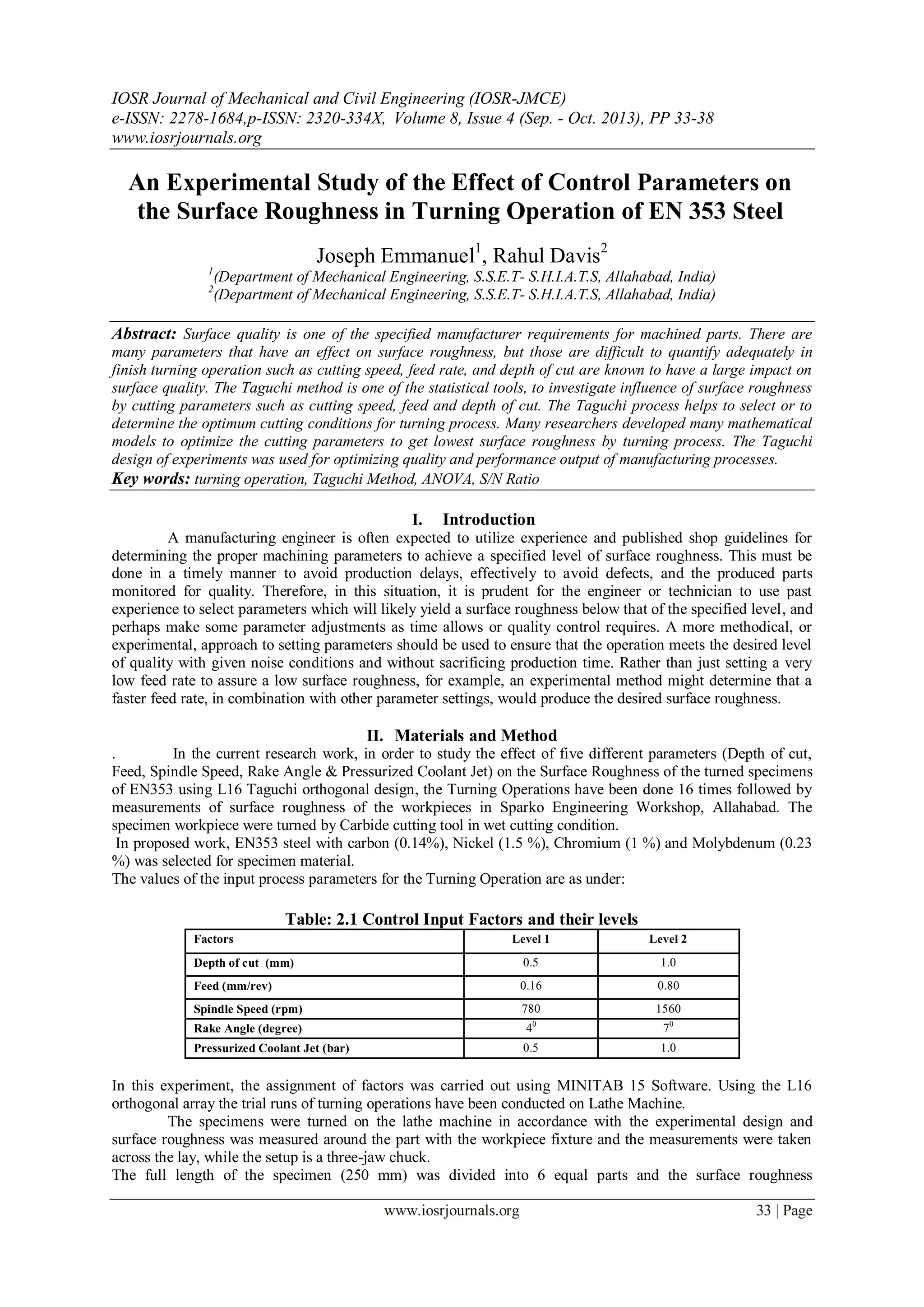
. In the current research work, in order to study the effect of five different parameters (Depth of cut,
Feed, Spindle Speed, Rake Angle & Pressurized Coolant Jet) on the Surface Roughness of the turned specimens
of EN353 using L16 Taguchi orthogonal design, the Turning Operations have been done 16 times followed by
measurements of surface roughness of the workpieces in Sparko Engineering Workshop, Allahabad. The
specimen workpiece were turned by Carbide cutting tool in wet cutting condition.
In proposed work, EN353 steel with carbon (0.14%), Nickel (1.5 %), Chromium (1 %) and Molybdenum (0.23
%) was selected for specimen material.
The values of the input process parameters for the Turning Operation are as under:
Table: 2.1 Control Input Factors and their levels
Factors Level 1 Level 2
Depth of cut (mm) 0.5 1.0
Feed (mm/rev) 0.16 0.80
Spindle Speed (rpm) 780 1560
Rake Angle (degree) 40
70
Pressurized Coolant Jet (bar) 0.5 1.0
In this experiment, the assignment of factors was carried out using MINITAB 15 Software. Using the L16
orthogonal array the trial runs of turning operations have been conducted on Lathe Machine.
The specimens were turned on the lathe machine in accordance with the experimental design and
surface roughness was measured around the part with the workpiece fixture and the measurements were taken
across the lay, while the setup is a three-jaw chuck.
The full length of the specimen (250 mm) was divided into 6 equal parts and the surface roughness
An Experimental Study of the Effect of Control Parameters on the Surface Roughness in Turning
www.iosrjournals.org 34 | Page
measurements were taken of each 41.6 mm around each workpiece.
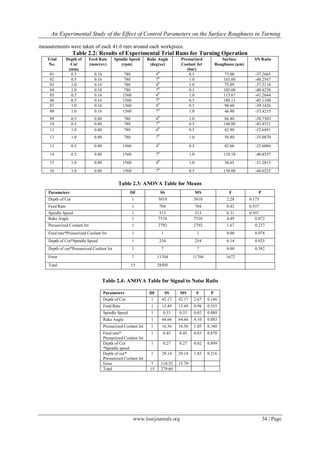
Table 2.2: Results of Experimental Trial Runs for Turning Operation
Trial
No.
Depth of
Cut
(mm)
Feed Rate
(mm/rev)
Spindle Speed
(rpm)
Rake Angle
(degree)
Pressurized
Coolant Jet
(bar)
Surface
Roughness (µm)
SN Ratio
01 0.5 0.16 780 40
0.5 73.00 -37.2665
02 0.5 0.16 780 70
1.0 103.00 -40.2567
03 1.0 0.16 780 40
1.0 75.09 -37.5116
04 1.0 0.16 780 70
0.5 105.00 -40.4238
05 0.5 0.16 1560 40
1.0 115.67 -41.2644
06 0.5 0.16 1560 70
0.5 180.11 -45.1108
07 1.0 0.16 1560 40
0.5 90.60 -39.1426
08 1.0 0.16 1560 70
1.0 46.90 -33.4235
09 0.5 0.80 780 40
1.0 86.40 -38.7303
10 0.5 0.80 780 70
0.5 148.80 -43.4521
11 1.0 0.80 780 40
0.5 42.90 -32.6491
12 1.0 0.80 780 70
1.0 56.80 -35.0870
13 0.5 0.80 1560 40
0.5 42.66 -32.6004
14 0.5 0.80 1560 70
1.0 110.10 -40.8357
15 1.0 0.80 1560 40
1.0 36.65 -31.2815
16 1.0 0.80 1560 70
0.5 158.00 -44.0225
Table 2.3: ANOVA Table for Means
Table 2.4: ANOVA Table for Signal to Noise Ratio
Parameters DF SS MS F P
Depth of Cut 1 42.17 42.17 2.67 0.146
Feed Rate 1 15.49 15.49 0.98 0.355
Spindle Speed 1 0.33 0.33 0.02 0.889
Rake Angle 1 64.66 64.66 4.10 0.083
Pressurized Coolant Jet 1 16.56 16.56 1.05 0.340
Feed rate*
Pressurized Coolant Jet
1 0.45 0.45 0.03 0.870
Depth of Cut
*Spindle speed
1 0.27 0.27 0.02 0.899
Depth of cut*
Pressurized Coolant Jet
1 29.14 29.14 1.85 0.216
Error 7 110.52 15.79
Total 15 279.60
Parameters DF SS MS F P
Depth of Cut 1 3810 3810 2.28 0.175
Feed Rate 1 704 704 0.42 0.537
Spindle Speed 1 513 513 0.31 0.597
Rake Angle 1 7510 7510 4.49 0.072
Pressurized Coolant Jet 1 2792 2792 1.67 0.237
Feed rate*Pressurized Coolant Jet 1 1 1 0.00 0.978
Depth of Cut*Spindle Speed 1 254 254 0.14 0.925
Depth of cut*Pressurized Coolant Jet 1 7 7 0.00 0.382
Error 7 11704 11704 1672
Total 15 28505
An Experimental Study of the Effect of Control Parameters on the Surface Roughness in Turning
www.iosrjournals.org 35 | Page
Table 2.5: Response Table for Signal-to-Noise ratio of Surface Roughness
Level Depth of Cut
(A)
Feed Rate
(B)
Spindle Speed
(C)
Rake Angle
(D)
Pressurized Coolant Jet
(E)
1 -39.94 -39.30 -38.17 -36.31 -39.33
2 -36.69 -37.33 -38.46 -40.33 -37.30
Delta
(∆max -∆min )
3.25 1.97 0.29 4.02 2.03
Rank 2 4 5 1 3
From Table 2.5, optimal levels of the Parameters for Turning Operation were A2, B2, C1, D2 & E2
Signal-to-noise ratio (SNR) is utilized to measure the deviation of quality characteristic from the target. In this
experiment, the response is the surface roughness which should be minimized, so the desired SNR characteristic
is in the category of smaller the better.
Table 2.5 shows the SNR of the surface roughness for each Level of the factors. The difference of SNR between
level 1 and 3 indicates that rake angle contributes the highest effect (Δmax-min = 4.07) on the surface roughness
followed by depth of cut (Δmax-min = 3.25), pressurized coolant jet (Δmax-min = 2.12), feed Rate (Δmax-min = 1.95)
and spindle speed (Δmax-min = 0.30).
Therefore the Predicted value of S/N Ratio for surface roughness
ηp (Surface Roughness)
= -38.305+ [(-37.33-(-38.305)] + [-36.68-(-38.305)] +
[-38.15-(-38.305)] + [-36.29-(-38.305)] + [-37.22-(-38.305)]
= -32.45
µp (Surface Roughness)
=91.95+ (85.24-91.95) + (76.56-91.95) + (86.04-91.95) + (70.14-91.95) + (78.14-91.95)
=28.32
III. Results and Discussion
Comparison of the F values of ANOVA Table 2.3 of Surface Roughness with the suitable F values of
the Factors (F0.05;1; 10 = 4.96) respectively shows that the all the factors except rake angle were found to be
insignificant.
0.800.16
110
100
90
80
70
1.00.5 1560780
74
110
100
90
80
70
1.00.5
Feed Rate(mm/rev)
MeanofMeans
Depth of Cut (mm) Spindle Speed(rpm)
Rake Angle (degree) Pressurized Coolant Jet (bar)
Main Effects Plot for Means
Data Means
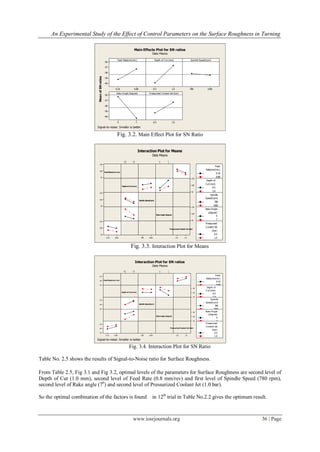
Fig. 3.1 Main Effect Plot for Means
An Experimental Study of the Effect of Control Parameters on the Surface Roughness in Turning
www.iosrjournals.org 36 | Page
0.800.16
-36
-37
-38
-39
-40
1.00.5 1560780
74
-36
-37
-38
-39
-40
1.00.5
Feed Rate(mm/rev)
MeanofSNratios
Depth of Cut (mm) Spindle Speed(rpm)
Rake Angle (degree) Pressurized Coolant Jet (bar)
Main Effects Plot for SN ratios
Data Means
Signal-to-noise: Smaller is better
Fig. 3.2. Main Effect Plot for SN Ratio
150
100
50
1.00.5 74
150
100
50
150
100
50
150
100
50
1560780 1.00.50.800.16
150
100
50
Feed Rate(mm/rev)
Depth of Cut (mm)
Spindle Speed(rpm)
Rake Angle (degree)
Pressurized Coolant Jet (bar)
0.16
0.80
Rate(mm/rev)
Feed
0.5
1.0
Cut (mm)
Depth of
780
1560
Speed(rpm)
Spindle
4
7
(degree)
Rake Angle
0.5
1.0
(bar)
Coolant Jet
Pressurized
Interaction Plot for Means
Data Means
Fig. 3.3. Interaction Plot for Means
-36
-40
-44
1.00.5 74
-36
-40
-44
-36
-40
-44
-36
-40
-44
1560780 1.00.50.800.16
-36
-40
-44
Feed Rate(mm/rev)
Depth of Cut (mm)
Spindle Speed(rpm)
Rake Angle (degree)
Pressurized Coolant Jet (bar)
0.16
0.80
Rate(mm/rev)
Feed
0.5
1.0
Cut (mm)
Depth of
780
1560
Speed(rpm)
Spindle
4
7
(degree)
Rake Angle
0.5
1.0
(bar)
Coolant Jet
Pressurized
Interaction Plot for SN ratios
Data Means
Signal-to-noise: Smaller is better
Fig. 3.4. Interaction Plot for SN Ratio
Table No. 2.5 shows the results of Signal-to-Noise ratio for Surface Roughness.
From Table 2.5, Fig 3.1 and Fig 3.2, optimal levels of the parameters for Surface Roughness are second level of
Depth of Cut (1.0 mm), second level of Feed Rate (0.8 mm/rev) and first level of Spindle Speed (780 rpm),
second level of Rake angle (70
) and second level of Pressurized Coolant Jet (1.0 bar).
So the optimal combination of the factors is found in 12th
trial in Table No.2.2 gives the optimum result.
An Experimental Study of the Effect of Control Parameters on the Surface Roughness in Turning
www.iosrjournals.org 37 | Page
Table 2.6: Results for Confirmation Test Trial Runs of Turning Operation for Surface Roughness for the
Combination of Optimal Levels of Factors
Specimen Depth of
Cut (mm)
Feed Rate
(mm/rev)
Spindle
Speed
(rpm)
Rake Angle
(degrees)
Pressurized Coolant
Jet(bar)
Surface
Roughness
(µm)
1 1.0 0.8 780 70
1.0 28.34.
1 1.0 0.8 780 70
1.0 28.31
1 1.0 0.8 780 70
1.0 28.29
 A parameter designs yielded the optimum condition of the controlled parameters, as well as a predictive
equation in each case and comparative study was done. A confirmation tests was then performed which
indicated that the selected parameters and predictive equation were accurate to within the limits of the
measurement instrument.
 Therefore the above results can be recommended to get the lowest surface roughness for further studies.
 In the current research work, the material used is EN353 with 0.14% carbon. The experimental work can
also be done for other materials having more hardness to see the effect of parameters on Surface
Roughness.
 In each case interactions of the different levels of the factors can be included and study can be extended.
 The experimental work and research can be extended by different tool geometry, different types of
coolants etc. as factors.
References
[1] Website: http://www.westyorkssteel.com/en353.html
[2] Website: www.kvsteel.co.uk/steel/EN353T.html
[3] Diwakar Reddy.V, Krishnaiah.G, A. Hemanth Kumar and Sushil Kumar Priya(2011), ANN Based Prediction of Surface Roughness in
Turning, International Conference on Trends in Mechanical and Industrial Engineering (ICTMIE'2011) Bangkok
[4] S.S.Mahapatra, Amar Patnaik, Prabina Ku. Patnaik (2006), Parametric Analysis and Optimization of Cutting Parameters for Turning
Operations based on Taguchi Method, Proceedings of the International Conference on Global Manufacturing and Innovation - July 27-29
[5] B. S. Raghuwanshi (2009), a course in Workshop Technology Vol.II (Machine Tools), Dhanpat Rai & Company Pvt. Ltd.
[6] Adeel H. Suhail, N. Ismail, S. V. Wong and N. A. Abdul Jalil(2010), Optimization of Cutting Parameters Based on Surface
Roughness and Assistance of Workpiece Surface Temperature in Turning Process, American J. of Engineering and Applied Sciences 3
(1): 102-108.
[7] C. A. van Luttervelt, T. H. C. Childs (1998), Present situation and future trends in modelling of machining operations, CIRP Ann.
[8] Daniel Kirby (2010), Optimizing the Turning Process toward an Ideal Surface Roughness Target.
[9] D. Philip Selvaraj, P. Chandramohan (2010), optimization of surface roughness of aisi 304 austenitic stainless steel in dry turning operation
using Taguchi design method Journal of Engineering Science and Technology,Vol. 5, no. 3 293 – 301, © school of engineering, Taylor’s
university college.
[10] E. Daniel Kirby (2006), Optimizing surface finish in a turning operation using the Taguchi parameter design method Int J Adv Manuf
Technol: 1021–1029.
[11] Guey-Jiuh Tzou, Ding-Yeng Chen (2006), Application of Taguchi method in the optimization of cutting parameters for turning operations.
Department of Mechanical Engineering, Lunghwa University of Science and Technology, Taiwan, (R.O.C.).
[12] Hari Singh (2008), Optimizing Tool Life of Carbide Inserts for Turned Parts using Taguchi’s design of Experiments Approach, Proceedings
of the International MultiConference of Engineers and Computer Scientists Vol II IMECS 2008, 19-21 March, , Hong Kong.
[13] Hasegawa. M, A. Seireg, R.A. Lindberg (1976), Surface roughness model for turning, Tribology International December 285-289.
[14] Karin Kandananond (2009), Characterization of FDB Sleeve Surface Roughness Using the Taguchi Approach, European Journal of
Scientific Research ISSN 1450-216X Vol.33 No.2 , pp.330-337 © Euro Journals Publishing, Inc.
[15] Madhav. S. Phadke (1989), Quality Engineering using Robust Design. Prentice Hall, Eaglewood Cliffs, New Jersey.
[16] Puertas. I. Arbizu, C.J. Luis Prez (2003), Surface roughness prediction by factorial design of experiments in turning processes, Journal of
Materials Processing Technology, 143- 144 390-396
[17] Palanikumar, L. Karunamoorthy, R. Krathikeyan (2006), Assessment of factors influencing surface roughness on the machining of glass –
reinforced polymer composites, Journal of Materials and Design.
[18] Sundaram. R.M., B.K. Lambert (1981), Mathematical models to predict surface finish in fine turning of steel, Part II, International Journal of
Production Research.
[19] S. Thamizhmanii, S. Saparudin, S. Hasan (2006), Analyses of roughness, forces and wear in turning gray cast iron, Journal of achievement in
Materials and Manufacturing Engineering, 17,.
[20] S. Thamizhmanii, S. Saparudin, S. Hasan (2006), Analyses of surface roughness by turning process using Taguchi method, journal of
Achievements in Materials and Manufacturing Engineering. Received 03.11.2006; accepted in revised form 15.11.2006.
[21] Philip j. Ross (2005), Taguchi Techniques for Quality Engineering, Tata McGraw-Hill Publishing Company Ltd.
First Author Profile: Er. Joseph Emmanuel having 1 year of teaching and research
experience and has
Published 1 International Journal. Presently Er. Emmanuel is teaching as an Assistant
Professor in the Department of Mechanical Engg. in Sam Higginbottom Institute of
Agriculture,
Technology & Sciences –Deemed University, Allahabad
Degree: M.Tech Industrial Engineering & Management
Institute: Sam Higginbottom Institute of Agriculture, Technology & Sciences
An Experimental Study of the Effect of Control Parameters on the Surface Roughness in Turning
www.iosrjournals.org 38 | Page
–Deemed University City: Allahabad State: Uttar Pradesh (India)
Year of Earning Degree: 2013 Major Field of Study: Industrial Engineering & Management
Second Author Profile: Er. Rahul Davis having 4 years of teaching and research experience
and have
published research papers in more than 12 International Journals. Presently Er. Davis is
teaching as an Assistant
Professor in the Department of Mechanical Engg. in Sam Higginbottom Institute of
Agriculture, Technology &
Sciences –Deemed University, Allahabad
Degree: M.Tech Production and Industrial Engineering
Institute: Sam Higginbottom Institute of Agriculture, Technology & Sciences –Deemed University
City: Allahabad State: Uttar Pradesh (India) Year of Earning Degree: 2011
Major Field of Study: Production and Industrial Engineering

An Experimental Study of the Effect of Control Parameters on the Surface Roughness in Turning Operation of EN 353 Steel

  • 1.
    IOSR Journal ofMechanical and Civil Engineering (IOSR-JMCE) e-ISSN: 2278-1684,p-ISSN: 2320-334X, Volume 8, Issue 4 (Sep. - Oct. 2013), PP 33-38 www.iosrjournals.org www.iosrjournals.org 33 | Page An Experimental Study of the Effect of Control Parameters on the Surface Roughness in Turning Operation of EN 353 Steel Joseph Emmanuel1 , Rahul Davis2 1 (Department of Mechanical Engineering, S.S.E.T- S.H.I.A.T.S, Allahabad, India) 2 (Department of Mechanical Engineering, S.S.E.T- S.H.I.A.T.S, Allahabad, India) Abstract: Surface quality is one of the specified manufacturer requirements for machined parts. There are many parameters that have an effect on surface roughness, but those are difficult to quantify adequately in finish turning operation such as cutting speed, feed rate, and depth of cut are known to have a large impact on surface quality. The Taguchi method is one of the statistical tools, to investigate influence of surface roughness by cutting parameters such as cutting speed, feed and depth of cut. The Taguchi process helps to select or to determine the optimum cutting conditions for turning process. Many researchers developed many mathematical models to optimize the cutting parameters to get lowest surface roughness by turning process. The Taguchi design of experiments was used for optimizing quality and performance output of manufacturing processes. Key words: turning operation, Taguchi Method, ANOVA, S/N Ratio I. Introduction A manufacturing engineer is often expected to utilize experience and published shop guidelines for determining the proper machining parameters to achieve a specified level of surface roughness. This must be done in a timely manner to avoid production delays, effectively to avoid defects, and the produced parts monitored for quality. Therefore, in this situation, it is prudent for the engineer or technician to use past experience to select parameters which will likely yield a surface roughness below that of the specified level, and perhaps make some parameter adjustments as time allows or quality control requires. A more methodical, or experimental, approach to setting parameters should be used to ensure that the operation meets the desired level of quality with given noise conditions and without sacrificing production time. Rather than just setting a very low feed rate to assure a low surface roughness, for example, an experimental method might determine that a faster feed rate, in combination with other parameter settings, would produce the desired surface roughness. II. Materials and Method . In the current research work, in order to study the effect of five different parameters (Depth of cut, Feed, Spindle Speed, Rake Angle & Pressurized Coolant Jet) on the Surface Roughness of the turned specimens of EN353 using L16 Taguchi orthogonal design, the Turning Operations have been done 16 times followed by measurements of surface roughness of the workpieces in Sparko Engineering Workshop, Allahabad. The specimen workpiece were turned by Carbide cutting tool in wet cutting condition. In proposed work, EN353 steel with carbon (0.14%), Nickel (1.5 %), Chromium (1 %) and Molybdenum (0.23 %) was selected for specimen material. The values of the input process parameters for the Turning Operation are as under: Table: 2.1 Control Input Factors and their levels Factors Level 1 Level 2 Depth of cut (mm) 0.5 1.0 Feed (mm/rev) 0.16 0.80 Spindle Speed (rpm) 780 1560 Rake Angle (degree) 40 70 Pressurized Coolant Jet (bar) 0.5 1.0 In this experiment, the assignment of factors was carried out using MINITAB 15 Software. Using the L16 orthogonal array the trial runs of turning operations have been conducted on Lathe Machine. The specimens were turned on the lathe machine in accordance with the experimental design and surface roughness was measured around the part with the workpiece fixture and the measurements were taken across the lay, while the setup is a three-jaw chuck. The full length of the specimen (250 mm) was divided into 6 equal parts and the surface roughness
  • 2.
    An Experimental Studyof the Effect of Control Parameters on the Surface Roughness in Turning www.iosrjournals.org 34 | Page measurements were taken of each 41.6 mm around each workpiece. Table 2.2: Results of Experimental Trial Runs for Turning Operation Trial No. Depth of Cut (mm) Feed Rate (mm/rev) Spindle Speed (rpm) Rake Angle (degree) Pressurized Coolant Jet (bar) Surface Roughness (µm) SN Ratio 01 0.5 0.16 780 40 0.5 73.00 -37.2665 02 0.5 0.16 780 70 1.0 103.00 -40.2567 03 1.0 0.16 780 40 1.0 75.09 -37.5116 04 1.0 0.16 780 70 0.5 105.00 -40.4238 05 0.5 0.16 1560 40 1.0 115.67 -41.2644 06 0.5 0.16 1560 70 0.5 180.11 -45.1108 07 1.0 0.16 1560 40 0.5 90.60 -39.1426 08 1.0 0.16 1560 70 1.0 46.90 -33.4235 09 0.5 0.80 780 40 1.0 86.40 -38.7303 10 0.5 0.80 780 70 0.5 148.80 -43.4521 11 1.0 0.80 780 40 0.5 42.90 -32.6491 12 1.0 0.80 780 70 1.0 56.80 -35.0870 13 0.5 0.80 1560 40 0.5 42.66 -32.6004 14 0.5 0.80 1560 70 1.0 110.10 -40.8357 15 1.0 0.80 1560 40 1.0 36.65 -31.2815 16 1.0 0.80 1560 70 0.5 158.00 -44.0225 Table 2.3: ANOVA Table for Means Table 2.4: ANOVA Table for Signal to Noise Ratio Parameters DF SS MS F P Depth of Cut 1 42.17 42.17 2.67 0.146 Feed Rate 1 15.49 15.49 0.98 0.355 Spindle Speed 1 0.33 0.33 0.02 0.889 Rake Angle 1 64.66 64.66 4.10 0.083 Pressurized Coolant Jet 1 16.56 16.56 1.05 0.340 Feed rate* Pressurized Coolant Jet 1 0.45 0.45 0.03 0.870 Depth of Cut *Spindle speed 1 0.27 0.27 0.02 0.899 Depth of cut* Pressurized Coolant Jet 1 29.14 29.14 1.85 0.216 Error 7 110.52 15.79 Total 15 279.60 Parameters DF SS MS F P Depth of Cut 1 3810 3810 2.28 0.175 Feed Rate 1 704 704 0.42 0.537 Spindle Speed 1 513 513 0.31 0.597 Rake Angle 1 7510 7510 4.49 0.072 Pressurized Coolant Jet 1 2792 2792 1.67 0.237 Feed rate*Pressurized Coolant Jet 1 1 1 0.00 0.978 Depth of Cut*Spindle Speed 1 254 254 0.14 0.925 Depth of cut*Pressurized Coolant Jet 1 7 7 0.00 0.382 Error 7 11704 11704 1672 Total 15 28505
  • 3.
    An Experimental Studyof the Effect of Control Parameters on the Surface Roughness in Turning www.iosrjournals.org 35 | Page Table 2.5: Response Table for Signal-to-Noise ratio of Surface Roughness Level Depth of Cut (A) Feed Rate (B) Spindle Speed (C) Rake Angle (D) Pressurized Coolant Jet (E) 1 -39.94 -39.30 -38.17 -36.31 -39.33 2 -36.69 -37.33 -38.46 -40.33 -37.30 Delta (∆max -∆min ) 3.25 1.97 0.29 4.02 2.03 Rank 2 4 5 1 3 From Table 2.5, optimal levels of the Parameters for Turning Operation were A2, B2, C1, D2 & E2 Signal-to-noise ratio (SNR) is utilized to measure the deviation of quality characteristic from the target. In this experiment, the response is the surface roughness which should be minimized, so the desired SNR characteristic is in the category of smaller the better. Table 2.5 shows the SNR of the surface roughness for each Level of the factors. The difference of SNR between level 1 and 3 indicates that rake angle contributes the highest effect (Δmax-min = 4.07) on the surface roughness followed by depth of cut (Δmax-min = 3.25), pressurized coolant jet (Δmax-min = 2.12), feed Rate (Δmax-min = 1.95) and spindle speed (Δmax-min = 0.30). Therefore the Predicted value of S/N Ratio for surface roughness ηp (Surface Roughness) = -38.305+ [(-37.33-(-38.305)] + [-36.68-(-38.305)] + [-38.15-(-38.305)] + [-36.29-(-38.305)] + [-37.22-(-38.305)] = -32.45 µp (Surface Roughness) =91.95+ (85.24-91.95) + (76.56-91.95) + (86.04-91.95) + (70.14-91.95) + (78.14-91.95) =28.32 III. Results and Discussion Comparison of the F values of ANOVA Table 2.3 of Surface Roughness with the suitable F values of the Factors (F0.05;1; 10 = 4.96) respectively shows that the all the factors except rake angle were found to be insignificant. 0.800.16 110 100 90 80 70 1.00.5 1560780 74 110 100 90 80 70 1.00.5 Feed Rate(mm/rev) MeanofMeans Depth of Cut (mm) Spindle Speed(rpm) Rake Angle (degree) Pressurized Coolant Jet (bar) Main Effects Plot for Means Data Means Fig. 3.1 Main Effect Plot for Means
  • 4.
    An Experimental Studyof the Effect of Control Parameters on the Surface Roughness in Turning www.iosrjournals.org 36 | Page 0.800.16 -36 -37 -38 -39 -40 1.00.5 1560780 74 -36 -37 -38 -39 -40 1.00.5 Feed Rate(mm/rev) MeanofSNratios Depth of Cut (mm) Spindle Speed(rpm) Rake Angle (degree) Pressurized Coolant Jet (bar) Main Effects Plot for SN ratios Data Means Signal-to-noise: Smaller is better Fig. 3.2. Main Effect Plot for SN Ratio 150 100 50 1.00.5 74 150 100 50 150 100 50 150 100 50 1560780 1.00.50.800.16 150 100 50 Feed Rate(mm/rev) Depth of Cut (mm) Spindle Speed(rpm) Rake Angle (degree) Pressurized Coolant Jet (bar) 0.16 0.80 Rate(mm/rev) Feed 0.5 1.0 Cut (mm) Depth of 780 1560 Speed(rpm) Spindle 4 7 (degree) Rake Angle 0.5 1.0 (bar) Coolant Jet Pressurized Interaction Plot for Means Data Means Fig. 3.3. Interaction Plot for Means -36 -40 -44 1.00.5 74 -36 -40 -44 -36 -40 -44 -36 -40 -44 1560780 1.00.50.800.16 -36 -40 -44 Feed Rate(mm/rev) Depth of Cut (mm) Spindle Speed(rpm) Rake Angle (degree) Pressurized Coolant Jet (bar) 0.16 0.80 Rate(mm/rev) Feed 0.5 1.0 Cut (mm) Depth of 780 1560 Speed(rpm) Spindle 4 7 (degree) Rake Angle 0.5 1.0 (bar) Coolant Jet Pressurized Interaction Plot for SN ratios Data Means Signal-to-noise: Smaller is better Fig. 3.4. Interaction Plot for SN Ratio Table No. 2.5 shows the results of Signal-to-Noise ratio for Surface Roughness. From Table 2.5, Fig 3.1 and Fig 3.2, optimal levels of the parameters for Surface Roughness are second level of Depth of Cut (1.0 mm), second level of Feed Rate (0.8 mm/rev) and first level of Spindle Speed (780 rpm), second level of Rake angle (70 ) and second level of Pressurized Coolant Jet (1.0 bar). So the optimal combination of the factors is found in 12th trial in Table No.2.2 gives the optimum result.
  • 5.
    An Experimental Studyof the Effect of Control Parameters on the Surface Roughness in Turning www.iosrjournals.org 37 | Page Table 2.6: Results for Confirmation Test Trial Runs of Turning Operation for Surface Roughness for the Combination of Optimal Levels of Factors Specimen Depth of Cut (mm) Feed Rate (mm/rev) Spindle Speed (rpm) Rake Angle (degrees) Pressurized Coolant Jet(bar) Surface Roughness (µm) 1 1.0 0.8 780 70 1.0 28.34. 1 1.0 0.8 780 70 1.0 28.31 1 1.0 0.8 780 70 1.0 28.29  A parameter designs yielded the optimum condition of the controlled parameters, as well as a predictive equation in each case and comparative study was done. A confirmation tests was then performed which indicated that the selected parameters and predictive equation were accurate to within the limits of the measurement instrument.  Therefore the above results can be recommended to get the lowest surface roughness for further studies.  In the current research work, the material used is EN353 with 0.14% carbon. The experimental work can also be done for other materials having more hardness to see the effect of parameters on Surface Roughness.  In each case interactions of the different levels of the factors can be included and study can be extended.  The experimental work and research can be extended by different tool geometry, different types of coolants etc. as factors. References [1] Website: http://www.westyorkssteel.com/en353.html [2] Website: www.kvsteel.co.uk/steel/EN353T.html [3] Diwakar Reddy.V, Krishnaiah.G, A. Hemanth Kumar and Sushil Kumar Priya(2011), ANN Based Prediction of Surface Roughness in Turning, International Conference on Trends in Mechanical and Industrial Engineering (ICTMIE'2011) Bangkok [4] S.S.Mahapatra, Amar Patnaik, Prabina Ku. Patnaik (2006), Parametric Analysis and Optimization of Cutting Parameters for Turning Operations based on Taguchi Method, Proceedings of the International Conference on Global Manufacturing and Innovation - July 27-29 [5] B. S. Raghuwanshi (2009), a course in Workshop Technology Vol.II (Machine Tools), Dhanpat Rai & Company Pvt. Ltd. [6] Adeel H. Suhail, N. Ismail, S. V. Wong and N. A. Abdul Jalil(2010), Optimization of Cutting Parameters Based on Surface Roughness and Assistance of Workpiece Surface Temperature in Turning Process, American J. of Engineering and Applied Sciences 3 (1): 102-108. [7] C. A. van Luttervelt, T. H. C. Childs (1998), Present situation and future trends in modelling of machining operations, CIRP Ann. [8] Daniel Kirby (2010), Optimizing the Turning Process toward an Ideal Surface Roughness Target. [9] D. Philip Selvaraj, P. Chandramohan (2010), optimization of surface roughness of aisi 304 austenitic stainless steel in dry turning operation using Taguchi design method Journal of Engineering Science and Technology,Vol. 5, no. 3 293 – 301, © school of engineering, Taylor’s university college. [10] E. Daniel Kirby (2006), Optimizing surface finish in a turning operation using the Taguchi parameter design method Int J Adv Manuf Technol: 1021–1029. [11] Guey-Jiuh Tzou, Ding-Yeng Chen (2006), Application of Taguchi method in the optimization of cutting parameters for turning operations. Department of Mechanical Engineering, Lunghwa University of Science and Technology, Taiwan, (R.O.C.). [12] Hari Singh (2008), Optimizing Tool Life of Carbide Inserts for Turned Parts using Taguchi’s design of Experiments Approach, Proceedings of the International MultiConference of Engineers and Computer Scientists Vol II IMECS 2008, 19-21 March, , Hong Kong. [13] Hasegawa. M, A. Seireg, R.A. Lindberg (1976), Surface roughness model for turning, Tribology International December 285-289. [14] Karin Kandananond (2009), Characterization of FDB Sleeve Surface Roughness Using the Taguchi Approach, European Journal of Scientific Research ISSN 1450-216X Vol.33 No.2 , pp.330-337 © Euro Journals Publishing, Inc. [15] Madhav. S. Phadke (1989), Quality Engineering using Robust Design. Prentice Hall, Eaglewood Cliffs, New Jersey. [16] Puertas. I. Arbizu, C.J. Luis Prez (2003), Surface roughness prediction by factorial design of experiments in turning processes, Journal of Materials Processing Technology, 143- 144 390-396 [17] Palanikumar, L. Karunamoorthy, R. Krathikeyan (2006), Assessment of factors influencing surface roughness on the machining of glass – reinforced polymer composites, Journal of Materials and Design. [18] Sundaram. R.M., B.K. Lambert (1981), Mathematical models to predict surface finish in fine turning of steel, Part II, International Journal of Production Research. [19] S. Thamizhmanii, S. Saparudin, S. Hasan (2006), Analyses of roughness, forces and wear in turning gray cast iron, Journal of achievement in Materials and Manufacturing Engineering, 17,. [20] S. Thamizhmanii, S. Saparudin, S. Hasan (2006), Analyses of surface roughness by turning process using Taguchi method, journal of Achievements in Materials and Manufacturing Engineering. Received 03.11.2006; accepted in revised form 15.11.2006. [21] Philip j. Ross (2005), Taguchi Techniques for Quality Engineering, Tata McGraw-Hill Publishing Company Ltd. First Author Profile: Er. Joseph Emmanuel having 1 year of teaching and research experience and has Published 1 International Journal. Presently Er. Emmanuel is teaching as an Assistant Professor in the Department of Mechanical Engg. in Sam Higginbottom Institute of Agriculture, Technology & Sciences –Deemed University, Allahabad Degree: M.Tech Industrial Engineering & Management Institute: Sam Higginbottom Institute of Agriculture, Technology & Sciences
  • 6.
    An Experimental Studyof the Effect of Control Parameters on the Surface Roughness in Turning www.iosrjournals.org 38 | Page –Deemed University City: Allahabad State: Uttar Pradesh (India) Year of Earning Degree: 2013 Major Field of Study: Industrial Engineering & Management Second Author Profile: Er. Rahul Davis having 4 years of teaching and research experience and have published research papers in more than 12 International Journals. Presently Er. Davis is teaching as an Assistant Professor in the Department of Mechanical Engg. in Sam Higginbottom Institute of Agriculture, Technology & Sciences –Deemed University, Allahabad Degree: M.Tech Production and Industrial Engineering Institute: Sam Higginbottom Institute of Agriculture, Technology & Sciences –Deemed University City: Allahabad State: Uttar Pradesh (India) Year of Earning Degree: 2011 Major Field of Study: Production and Industrial Engineering