ISSN (e): 2250 – 3005 || Vol, 04 || Issue, 7 || July – 2014 ||
International Journal of Computational Engineering Research (IJCER)
www.ijceronline.com Open Access Journal Page 56
Liquor Detection through Automatic Motor Locking System: In
Built (LDAMLS)
Phani Sridhar.A1,
Samuel Susan.V2,
G. Kalyan Chakravathi3
, Ravi Teja.G4
1. Assistant professor, Department of CSE, S.V.P.Engineering College, Affiliated to Andhra
University, Visakhapatnam, Andhra Pradesh ,India.
2. Assistant Professor, Department of CSE, S.V.P.Engineering College, Affiliated to Andhra University,
Visakhapatnam, Andhra Pradesh, India.
3. Assistant Professor, Department of CSE, S.V.P.Engineering College, Affiliated to Andhra University,
Visakhapatnam, Andhra Pradesh, India.
4. Student Associate, Department of CSE, S.V.P.Engineering College, Affiliated to Andhra University,
Visakhapatnam, Andhra Pradesh, India.
I. INTRODUCTION
Now-a-days we hear about lot of accidents due to drunken driving. Drunken drivers will not be in
stable condition and so the rash driving is the inconvenience for other road users and also question of life and
death for the drunken drivers, also for others. In this project, we are developing an Auto Lock System. The input
for the system is from Detection Sensors either from Alcohol Breath or any other mechanism. The controller
keeps looking for the output from these sensors. If there are any traces of Alcohol above the set limit, then the
system will lock the Engine. Here a simulating process is activated using a DC motor through the relay and the
complete process is under the supervision of an intelligent AT89c51 microcontroller.
Even though efficient set up of requirements have been adopted for the traditional methods it may not
be sufficient and that much protective for such a complex method, whereas here in this process this could be a
better idea of inserting the complete state of art design into the system. Most of the traditional systems are likely
to be more dependent on the operator and it may fail due to various factors like the battery life, power
consumption as well as the unavoidable external disturbances.
II. PROBLEM FORMULATION
In this paper a concept of conventional method instead of breath analyzers in which traffic accidents due to
drunken state of drivers could be reduced. This is implemented by the use of a simple alcohol sensor but with an
interruption of alcoholic breath. Here the possibility of detection could be only when the person enters the
vehicle and starts the engine. Also the delay in response is also characterized by turbulent flow of timing pulses
through the various special function registers in the microcontroller.
1. Literature Survey
The applications which are developed in terms of some electronic and individual existing components
will be independently executed even though there are some drawbacks and disadvantages for its existing criteria
of requirements. More precisely the extent in these sort of standalone applications were formed together to state
them as Embedded System applications.
Embedded system is a computerized or automated system with a dedicated functionality in which large
electrical, electronic and mechanical systems are inserted along with their constraints of execution.
ABSTRACT
Now a days it has been an accepted fact that major part of the accidents are due to the uneven
interruptions, inappropriate driving by the drivers. It’s a very undesirable situation which is true. So a
system has been proposed to automatically lock the motor of the vehicle with the use of AT89C51, if any
alcoholic person tries to drive the car/bus/any other. Also the potential of device will depend on the
availability of the functional components as well as the capacity of the motor used. This could be
implemented by comparing various factors along with the consumption of energy sources.
KEYWORDS: AT89C51, Energy sources, Interrupt latency, Interrupt, SFR, MQ3.
Liquor Detection through Automatic Motor Locking System: In Built (LDAMLS)
www.ijceronline.com Open Access Journal Page 57
An application in embedded system acquires specific characteristics of the system which are not
functional. These characteristics are listed as per its importance.
• Throughput – Our system may need to handle a lot of data in a short period of time.
• Response–Our system may need to react to events quickly.
• Testability–Setting up equipment to test embedded software can be difficult.
• Debugability–Without a screen or a keyboard, finding out what the software is doing wrong (other than not
working) is a troublesome problem.
• Reliability – embedded systems must be able to handle any situation without human intervention.
• Memory space – Memory is limited on embedded systems, and you must make the software and the data fit
into whatever memory exists.
• Program installation – you will need special tools to get your software into embedded systems.
• Power consumption – Portable systems must run on battery power, and the software in these systems must
conserve power.
• Processor hogs – computing that requires large amounts of CPU time can complicate the response problem.
• Cost – Reducing the cost of the hardware is a concern in many embedded system projects; software often
operates on hardware that is barely adequate for the job.
An application could be developed in embedded system by observing the life cycle ā€œHow a system
runs through specification of the requirements.ā€ Similarly here also the individual prototypes and its bugs are
identified as well as resolved accordingly with the combination of other proto types to make it an complete
system. Also the selection of architecture is a major criteria for achieving the efficiency of a system. Here comes
up with the Embedded software architecture in response to the effective usage of varaibles in a certain
application.
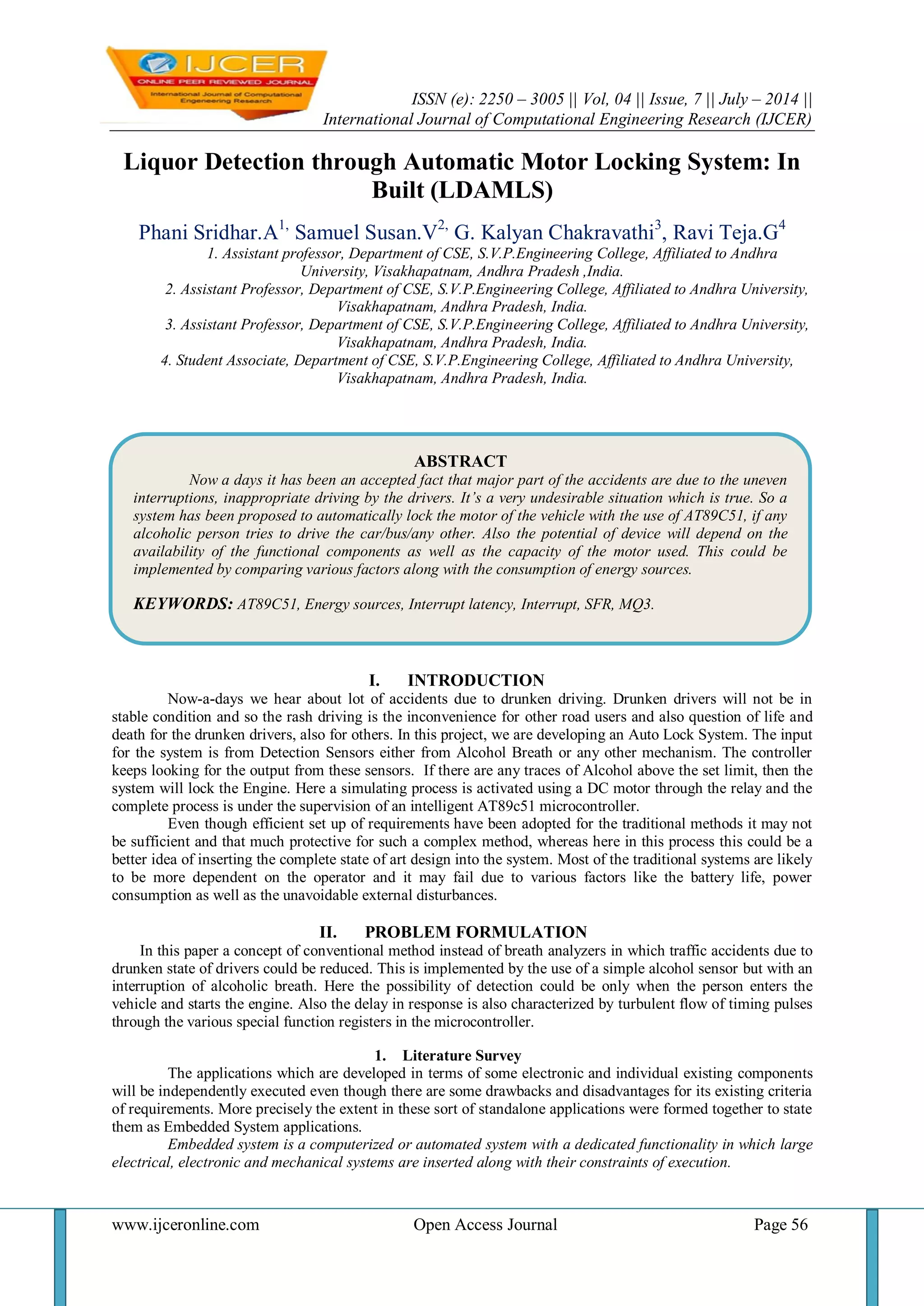
This system is designed with RTOS architecture where an RTS kernel will assure the system calls for
variety of varaibles(see Fig:3.2) which will be followed by the states of a life cycle(see Fig: 3.1).
Fig 3.1: ā€œVā€ Diagram (Embedded system Design Life Cycle)
Fig 3.2: Embedded system design calls
Liquor Detection through Automatic Motor Locking System: In Built (LDAMLS)
www.ijceronline.com Open Access Journal Page 58
In breathe analyzers a set point is maintained to measure the consumption of alcohol which is given as
30 mg per 100 ml of blood. If this point has been exceeded then the person is more alcoholic and he/she could
not be allowed to drive the vehicle. But this may not happen all the time to detect these types of people as it will
be dramatic many of the times. But they might be restricted for the entry of vehicles which will be a good
inception.
III. FUNCTIONAL DESIGN
As it is a well known fact that the microcontrollers/microprocessors will play a major role in showing
out the effective results in any of the global embedded systems and at the same time these will lead to the little
inefficient results due to some additional components. This system uses efficient AT89c51 microcontroller that
will operates, monitors and controls the other functional parts of the system. Instead of routine implementation
this will get use of the SFR’s which are intelligent in handling typical issues deliberately. Although there are
many varieties of microcontrollers this is more efficient and well suits the detection system.
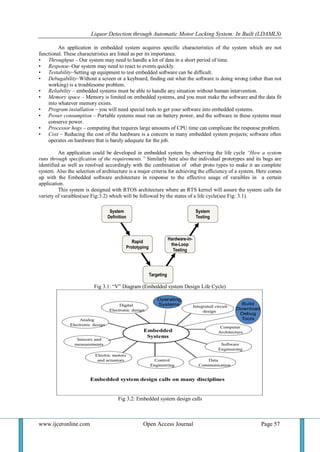
The system designed is for the sensing of alcohol using MQ3 alcohol sensor which in turn activates the
rectifier that initiates the relay through which a signal is transmitted in form of a delay. This delay will
activates/deactivates the DC motor. (In general a motor is the basic component in the engine vehicle system).
Fig 4.1: Functional Block Diagram
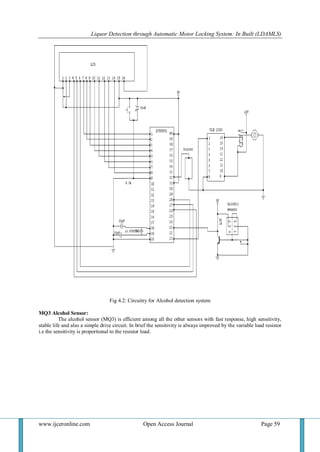
In the circuitry the connectivity issues have been shown with utmost reliability and negligible errors. A
rectifier along with the relay is given for an input signal from the sensor and it in turn regulates the motor
rotations for a specific amount of time. Other than the critical connectivity issues the programming part as well
as the logical issues were to be resolved in the effective use of the microcontroller we are using for the design of
the detection system. So for this purpose counter/timer circuits, special registers, interrupt handling circuits will
be very prominent.
Liquor Detection through Automatic Motor Locking System: In Built (LDAMLS)
www.ijceronline.com Open Access Journal Page 59
Fig 4.2: Circuitry for Alcohol detection system
MQ3 Alcohol Sensor:
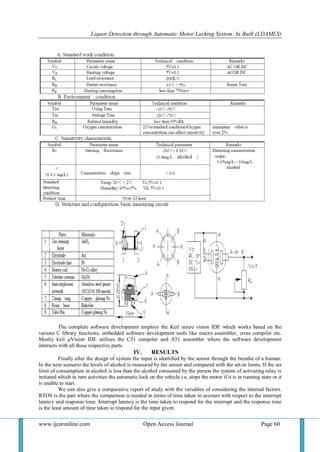
The alcohol sensor (MQ3) is efficient among all the other sensors with fast response, high sensitivity,
stable life and also a simple drive circuit. In brief the sensitivity is always improved by the variable load resistor
i.e the sensitivity is proportional to the resistor load.
Liquor Detection through Automatic Motor Locking System: In Built (LDAMLS)
www.ijceronline.com Open Access Journal Page 60
The complete software development employs the Keil micro vision IDE which works based on the
various C library functions, embedded software development tools like macro assembler, cross compiler etc.
Mostly keil µVision IDE utilizes the C51 compiler and A51 assembler where the software development
interacts with all these respective parts.
IV. RESULTS
Finally after the design of system the input is identified by the sensor through the breathe of a human.
In the next scenario the levels of alcohol is measured by the sensor and compared with the set-in limits. If the set
limit of consumption in alcohol is less than the alcohol consumed by the person the system of activating relay is
initiated which in turn activities the automatic lock on the vehicle i.e, stops the motor if it is in running state or it
is unable to start.
We can also give a comparative report of study with the variables of considering the internal factors.
RTOS is the part where the comparison is needed in terms of time taken to account with respect to the interrupt
latency and response time. Interrupt latency is the time taken to respond for the interrupt and the response time
is the least amount of time taken to respond for the input given.
Liquor Detection through Automatic Motor Locking System: In Built (LDAMLS)
www.ijceronline.com Open Access Journal Page 61
V. CONCLUSION AND FUTURE WORK
In this paper a realistic social technique has been proposed to eradicate the loss caused due to drunken
drivers. It has also been assured in a more technical way, so as to appreciate the use of RTOS which also gave
the importance in the occurrence of interrupts as well as its execution. This could also be extended to the heavy
vehicles, air bus, navigating vehicles, sense detection machines. These are also extended to bio medical fields,
software development industries.
REFERENCES
[1]. ā€œRTOS Kernelā€ http://rtos.com.
[2]. www.embedded software architectures.
[3]. ā€œAlcohol Detection Systems http://www.stopdwi.com.
[4]. Intelligent detection systems:ā€œhttp://scienceredirect.comā€
[5]. ā€œLabel free fully electronic nucleic acid detection system based on a field-effect transistor deviceā€ by F. Uslu ,S. Ingebrandt , D.
Mayer , S. Bƶcker-Meffert , M. Odenthal, A. OffenhƤusser.

E04702056061

  • 1.
    ISSN (e): 2250– 3005 || Vol, 04 || Issue, 7 || July – 2014 || International Journal of Computational Engineering Research (IJCER) www.ijceronline.com Open Access Journal Page 56 Liquor Detection through Automatic Motor Locking System: In Built (LDAMLS) Phani Sridhar.A1, Samuel Susan.V2, G. Kalyan Chakravathi3 , Ravi Teja.G4 1. Assistant professor, Department of CSE, S.V.P.Engineering College, Affiliated to Andhra University, Visakhapatnam, Andhra Pradesh ,India. 2. Assistant Professor, Department of CSE, S.V.P.Engineering College, Affiliated to Andhra University, Visakhapatnam, Andhra Pradesh, India. 3. Assistant Professor, Department of CSE, S.V.P.Engineering College, Affiliated to Andhra University, Visakhapatnam, Andhra Pradesh, India. 4. Student Associate, Department of CSE, S.V.P.Engineering College, Affiliated to Andhra University, Visakhapatnam, Andhra Pradesh, India. I. INTRODUCTION Now-a-days we hear about lot of accidents due to drunken driving. Drunken drivers will not be in stable condition and so the rash driving is the inconvenience for other road users and also question of life and death for the drunken drivers, also for others. In this project, we are developing an Auto Lock System. The input for the system is from Detection Sensors either from Alcohol Breath or any other mechanism. The controller keeps looking for the output from these sensors. If there are any traces of Alcohol above the set limit, then the system will lock the Engine. Here a simulating process is activated using a DC motor through the relay and the complete process is under the supervision of an intelligent AT89c51 microcontroller. Even though efficient set up of requirements have been adopted for the traditional methods it may not be sufficient and that much protective for such a complex method, whereas here in this process this could be a better idea of inserting the complete state of art design into the system. Most of the traditional systems are likely to be more dependent on the operator and it may fail due to various factors like the battery life, power consumption as well as the unavoidable external disturbances. II. PROBLEM FORMULATION In this paper a concept of conventional method instead of breath analyzers in which traffic accidents due to drunken state of drivers could be reduced. This is implemented by the use of a simple alcohol sensor but with an interruption of alcoholic breath. Here the possibility of detection could be only when the person enters the vehicle and starts the engine. Also the delay in response is also characterized by turbulent flow of timing pulses through the various special function registers in the microcontroller. 1. Literature Survey The applications which are developed in terms of some electronic and individual existing components will be independently executed even though there are some drawbacks and disadvantages for its existing criteria of requirements. More precisely the extent in these sort of standalone applications were formed together to state them as Embedded System applications. Embedded system is a computerized or automated system with a dedicated functionality in which large electrical, electronic and mechanical systems are inserted along with their constraints of execution. ABSTRACT Now a days it has been an accepted fact that major part of the accidents are due to the uneven interruptions, inappropriate driving by the drivers. It’s a very undesirable situation which is true. So a system has been proposed to automatically lock the motor of the vehicle with the use of AT89C51, if any alcoholic person tries to drive the car/bus/any other. Also the potential of device will depend on the availability of the functional components as well as the capacity of the motor used. This could be implemented by comparing various factors along with the consumption of energy sources. KEYWORDS: AT89C51, Energy sources, Interrupt latency, Interrupt, SFR, MQ3.
  • 2.
    Liquor Detection throughAutomatic Motor Locking System: In Built (LDAMLS) www.ijceronline.com Open Access Journal Page 57 An application in embedded system acquires specific characteristics of the system which are not functional. These characteristics are listed as per its importance. • Throughput – Our system may need to handle a lot of data in a short period of time. • Response–Our system may need to react to events quickly. • Testability–Setting up equipment to test embedded software can be difficult. • Debugability–Without a screen or a keyboard, finding out what the software is doing wrong (other than not working) is a troublesome problem. • Reliability – embedded systems must be able to handle any situation without human intervention. • Memory space – Memory is limited on embedded systems, and you must make the software and the data fit into whatever memory exists. • Program installation – you will need special tools to get your software into embedded systems. • Power consumption – Portable systems must run on battery power, and the software in these systems must conserve power. • Processor hogs – computing that requires large amounts of CPU time can complicate the response problem. • Cost – Reducing the cost of the hardware is a concern in many embedded system projects; software often operates on hardware that is barely adequate for the job. An application could be developed in embedded system by observing the life cycle ā€œHow a system runs through specification of the requirements.ā€ Similarly here also the individual prototypes and its bugs are identified as well as resolved accordingly with the combination of other proto types to make it an complete system. Also the selection of architecture is a major criteria for achieving the efficiency of a system. Here comes up with the Embedded software architecture in response to the effective usage of varaibles in a certain application. This system is designed with RTOS architecture where an RTS kernel will assure the system calls for variety of varaibles(see Fig:3.2) which will be followed by the states of a life cycle(see Fig: 3.1). Fig 3.1: ā€œVā€ Diagram (Embedded system Design Life Cycle) Fig 3.2: Embedded system design calls
  • 3.
    Liquor Detection throughAutomatic Motor Locking System: In Built (LDAMLS) www.ijceronline.com Open Access Journal Page 58 In breathe analyzers a set point is maintained to measure the consumption of alcohol which is given as 30 mg per 100 ml of blood. If this point has been exceeded then the person is more alcoholic and he/she could not be allowed to drive the vehicle. But this may not happen all the time to detect these types of people as it will be dramatic many of the times. But they might be restricted for the entry of vehicles which will be a good inception. III. FUNCTIONAL DESIGN As it is a well known fact that the microcontrollers/microprocessors will play a major role in showing out the effective results in any of the global embedded systems and at the same time these will lead to the little inefficient results due to some additional components. This system uses efficient AT89c51 microcontroller that will operates, monitors and controls the other functional parts of the system. Instead of routine implementation this will get use of the SFR’s which are intelligent in handling typical issues deliberately. Although there are many varieties of microcontrollers this is more efficient and well suits the detection system. The system designed is for the sensing of alcohol using MQ3 alcohol sensor which in turn activates the rectifier that initiates the relay through which a signal is transmitted in form of a delay. This delay will activates/deactivates the DC motor. (In general a motor is the basic component in the engine vehicle system). Fig 4.1: Functional Block Diagram In the circuitry the connectivity issues have been shown with utmost reliability and negligible errors. A rectifier along with the relay is given for an input signal from the sensor and it in turn regulates the motor rotations for a specific amount of time. Other than the critical connectivity issues the programming part as well as the logical issues were to be resolved in the effective use of the microcontroller we are using for the design of the detection system. So for this purpose counter/timer circuits, special registers, interrupt handling circuits will be very prominent.
  • 4.
    Liquor Detection throughAutomatic Motor Locking System: In Built (LDAMLS) www.ijceronline.com Open Access Journal Page 59 Fig 4.2: Circuitry for Alcohol detection system MQ3 Alcohol Sensor: The alcohol sensor (MQ3) is efficient among all the other sensors with fast response, high sensitivity, stable life and also a simple drive circuit. In brief the sensitivity is always improved by the variable load resistor i.e the sensitivity is proportional to the resistor load.
  • 5.
    Liquor Detection throughAutomatic Motor Locking System: In Built (LDAMLS) www.ijceronline.com Open Access Journal Page 60 The complete software development employs the Keil micro vision IDE which works based on the various C library functions, embedded software development tools like macro assembler, cross compiler etc. Mostly keil µVision IDE utilizes the C51 compiler and A51 assembler where the software development interacts with all these respective parts. IV. RESULTS Finally after the design of system the input is identified by the sensor through the breathe of a human. In the next scenario the levels of alcohol is measured by the sensor and compared with the set-in limits. If the set limit of consumption in alcohol is less than the alcohol consumed by the person the system of activating relay is initiated which in turn activities the automatic lock on the vehicle i.e, stops the motor if it is in running state or it is unable to start. We can also give a comparative report of study with the variables of considering the internal factors. RTOS is the part where the comparison is needed in terms of time taken to account with respect to the interrupt latency and response time. Interrupt latency is the time taken to respond for the interrupt and the response time is the least amount of time taken to respond for the input given.
  • 6.
    Liquor Detection throughAutomatic Motor Locking System: In Built (LDAMLS) www.ijceronline.com Open Access Journal Page 61 V. CONCLUSION AND FUTURE WORK In this paper a realistic social technique has been proposed to eradicate the loss caused due to drunken drivers. It has also been assured in a more technical way, so as to appreciate the use of RTOS which also gave the importance in the occurrence of interrupts as well as its execution. This could also be extended to the heavy vehicles, air bus, navigating vehicles, sense detection machines. These are also extended to bio medical fields, software development industries. REFERENCES [1]. ā€œRTOS Kernelā€ http://rtos.com. [2]. www.embedded software architectures. [3]. ā€œAlcohol Detection Systems http://www.stopdwi.com. [4]. Intelligent detection systems:ā€œhttp://scienceredirect.comā€ [5]. ā€œLabel free fully electronic nucleic acid detection system based on a field-effect transistor deviceā€ by F. Uslu ,S. Ingebrandt , D. Mayer , S. Bƶcker-Meffert , M. Odenthal, A. OffenhƤusser.