- Page -1
HESTIAHELPING STUDENTS IN ACCEPTANCE
“ Every big project needs a logo “
The first challenge of our alliance was to
“create a nice logo which represents the
meaning of our HESTIA project.
Without any doubt each country started
working very hard giving beautiful results.At
the end, the best logos from all countries were
put up for election where pupils, parents and
teachers voted.And the winner was: ….
“Portugal”
Greece -Athens
… We also had some nice workshops. How
are Greek schools dealing with the
refugees crisis? The headmaster Mr
Christos Tsiatsianas, shared his experience
and knowledge with us. The meeting with
the UN Communication Officer for Greece
and Cyprus, Mr Dimitri Fatouros, was very
interesting. It’s clear that all of us definitely
need to make work of the sustainable goals
of the United Nations. A mission we will
implement in our schools
Another workshop was about educational
drama.This was nice because the teachers
and us got to see examples of how to add
more “drama” in our daily lessons :)
During our meeting, we shaped our
manifesto.This was a successful 1st meeting
and the project promises to be an
incredible experience for all of us.
Double edition
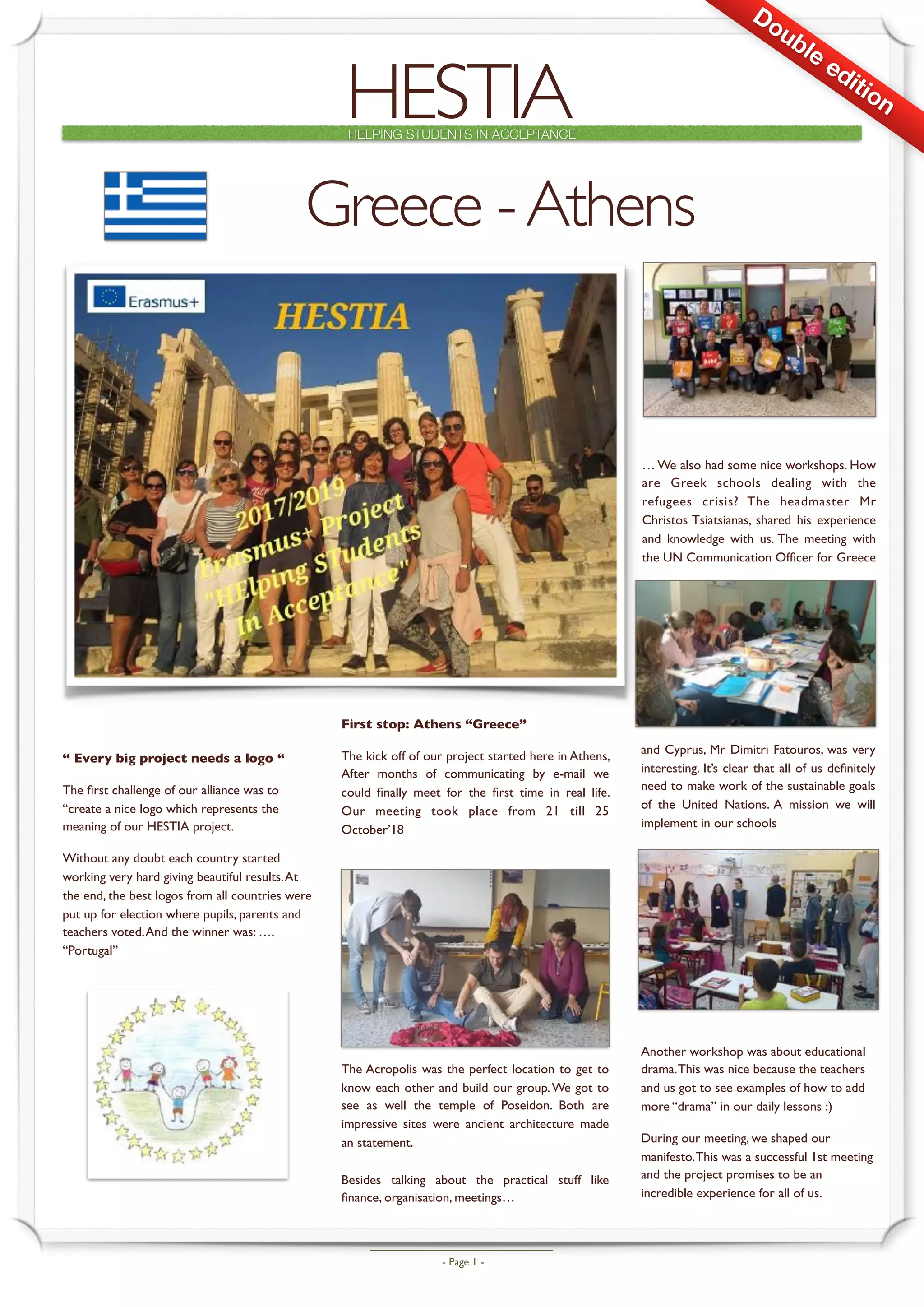
First stop: Athens “Greece”
The kick off of our project started here in Athens,
After months of communicating by e-mail we
could finally meet for the first time in real life.
Our meeting took place from 21 till 25
October’18
The Acropolis was the perfect location to get to
know each other and build our group.We got to
see as well the temple of Poseidon. Both are
impressive sites were ancient architecture made
an statement.
Besides talking about the practical stuff like
finance, organisation, meetings…
- Page -2
PROJECT MEETINGHELPING STUDENTS IN ACCEPTANCE
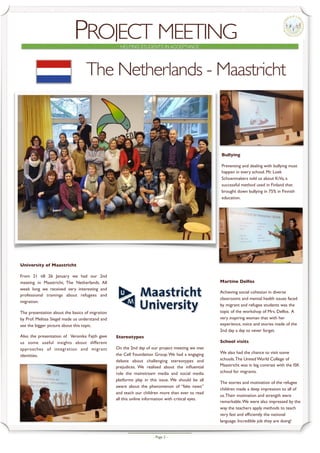
University of Maastricht
From 21 till 26 January we had our 2nd
meeting in Maastricht, The Netherlands. All
week long we received very interesting and
professional trainings about refugees and
migration.
The presentation about the basics of migration
by Prof. Melissa Siegel made us understand and
see the bigger picture about this topic.
Also the presentation of Veronika Fajth gave
us some useful insights about different
approaches of integration and migrant
identities.
The Netherlands - Maastricht
Bullying
Preventing and dealing with bullying must
happen in every school. Mr. Loek
Schoenmakers told us about KiVa, a
successful method used in Finland that
brought down bullying in 75% in Finnish
education.
Martine Delfos
Achieving social cohesion in diverse
classrooms and mental health issues faced
by migrant and refugee students was the
topic of the workshop of Mrs. Delfos. A
very inspiring woman that with her
experience, voice and stories made of the
2nd day a day to never forget.
School visits
We also had the chance to visit some
schools.The United World College of
Maastricht was in big contrast with the ISK
school for migrants.
The stories and motivation of the refugee
children made a deep impression to all of
us.Their motivation and strength were
remarkable.We were also impressed by the
way the teachers apply methods to teach
very fast and efficiently the national
language. Incredible job they are doing!
Stereotypes
On the 2nd day of our project meeting we met
the Cell Foundation Group.We had a engaging
debate about challenging stereotypes and
prejudices. We realised about the influential
role the mainstream media and social media
platforms play in this issue. We should be all
aware about the phenomenon of “fake news”
and teach our children more than ever to read
all this online information with critical eyes.
- Page -3
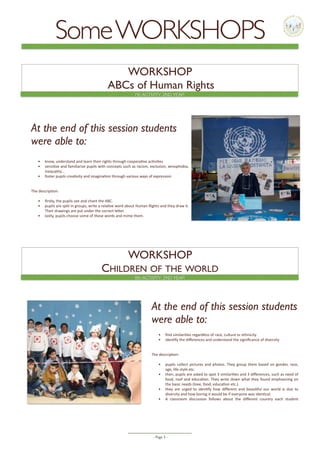
WORKSHOP
ABCs of Human Rights
WORKSHOP
CHILDREN OF THE WORLD
8th ACTIVITY, 2ND YEAR
7th ACTIVITY, 2ND YEAR
SomeWORKSHOPS
At the end of this session students
were able to:
• know,	understand	and	learn	their	rights	through	coopera5ve	ac5vi5es	
• sensi5ze	and	familiarize	pupils	with	concepts	such	as	racism,	exclusion,	xenophobia,	
inequality…	
• foster	pupils	crea5vity	and	imagina5on	through	various	ways	of	expression	
The	descrip5on:		
• firstly,	the	pupils	see	and	chant	the	ABC.	
• pupils	are	split	in	groups,	write	a	rela5ve	word	about	Human	Rights	and	they	draw	it.	
Their	drawings	are	put	under	the	correct	leHer.	
• lastly,	pupils	choose	some	of	these	words	and	mime	them.	
At the end of this session students
were able to:
• find	similari5es	regardless	of	race,	culture	or	ethnicity	
• iden5fy	the	differences	and	understand	the	significance	of	diversity	
The	descrip5on:	
• pupils	collect	pictures	and	photos.	They	group	them	based	on	gender,	race,	
age,	life-style	etc.	
• then,	pupils	are	asked	to	spot	3	similari5es	and	3	differences,	such	as	need	of	
food,	roof	and	educa5on.	They	write	down	what	they	found	emphasizing	on	
the	basic	needs	(love,	food,	educa5on	etc.).	
• they	 are	 urged	 to	 iden5fy	 how	 different	 and	 beau5ful	 our	 world	 is	 due	 to	
diversity	and	how	boring	it	would	be	if	everyone	was	iden5cal.	
• A	 classroom	 discussion	 follows	 about	 the	 different	 country	 each	 student
- Page -4
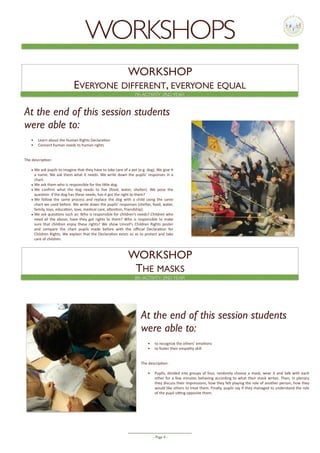
WORKSHOP
EVERYONE DIFFERENT, EVERYONE EQUAL
At the end of this session students
were able to:
• Learn	about	the	Human	Rights	Declara5on	
• Connect	human	needs	to	human	rights	
The	descrip5on:	
• We	ask	pupils	to	imagine	that	they	have	to	take	care	of	a	pet	(e.g.	dog).	We	give	it	
a	name.	We	ask	them	what	it	needs.	We	write	down	the	pupils’	responses	in	a	
chart.		
• We	ask	them	who	is	responsible	for	the	liHle	dog.	
• We	 confirm	 what	 the	 dog	 needs	 to	 live	 (food,	 water,	 shelter).	 We	 pose	 the	
ques5on:	if	the	dog	has	these	needs,	has	it	got	the	right	to	them?	
• We	 follow	 the	 same	 process	 and	 replace	 the	 dog	 with	 a	 child	 using	 the	 same	
chart	we	used	before.	We	write	down	the	pupils’	responses	(shelter,	food,	water,	
family,	toys,	educa5on,	love,	medical	care,	aHen5on,	friendship).	
• We	ask	ques5ons	such	as:	Who	is	responsible	for	children’s	needs?	Children	who	
need	all	the	above,	have	they	got	rights	to	them?	Who	is	responsible	to	make	
sure	that	children	enjoy	these	rights?	We	show	Unicef’s	Children	Rights	poster	
and	 compare	 the	 chart	 pupils	 made	 before	 with	 the	 official	 Declara5on	 for	
Children	Rights.	We	explain	that	the	Declara5on	exists	so	as	to	protect	and	take	
care	of	children.	
WORKSHOP
THE MASKS
At the end of this session students
were able to:
• to	recognize	the	others’	emo5ons	
• to	foster	their	empathy	skill		
The	descrip5on:	
• Pupils,	divided	into	groups	of	four,	randomly	choose	a	mask,	wear	it	and	talk	with	each	
other	for	a	few	minutes	behaving	according	to	what	their	mask	writes.	Then,	in	plenary	
they	discuss	their	impressions,	how	they	felt	playing	the	role	of	another	person,	how	they	
would	like	others	to	treat	them.	Finally,	pupils	say	if	they	managed	to	understand	the	role	
of	the	pupil	siXng	opposite	them.	
8th ACTIVITY, 2ND YEAR
7th ACTIVITY, 2ND YEAR
WORKSHOPS
- Page -5
Whats Next?
• 3rd project meeting in Italy, Brindisi, from 10 till 17 March 2018
• Activities: Making an identity card - Living in Flowerville - You and Me, We
are - We can make it all together
More information
HESTIA website
HESTIA Facebook
In collaboration with


E magazine holland 1st edition

  • 1.
    - Page -1 HESTIAHELPINGSTUDENTS IN ACCEPTANCE “ Every big project needs a logo “ The first challenge of our alliance was to “create a nice logo which represents the meaning of our HESTIA project. Without any doubt each country started working very hard giving beautiful results.At the end, the best logos from all countries were put up for election where pupils, parents and teachers voted.And the winner was: …. “Portugal” Greece -Athens … We also had some nice workshops. How are Greek schools dealing with the refugees crisis? The headmaster Mr Christos Tsiatsianas, shared his experience and knowledge with us. The meeting with the UN Communication Officer for Greece and Cyprus, Mr Dimitri Fatouros, was very interesting. It’s clear that all of us definitely need to make work of the sustainable goals of the United Nations. A mission we will implement in our schools Another workshop was about educational drama.This was nice because the teachers and us got to see examples of how to add more “drama” in our daily lessons :) During our meeting, we shaped our manifesto.This was a successful 1st meeting and the project promises to be an incredible experience for all of us. Double edition First stop: Athens “Greece” The kick off of our project started here in Athens, After months of communicating by e-mail we could finally meet for the first time in real life. Our meeting took place from 21 till 25 October’18 The Acropolis was the perfect location to get to know each other and build our group.We got to see as well the temple of Poseidon. Both are impressive sites were ancient architecture made an statement. Besides talking about the practical stuff like finance, organisation, meetings…
  • 2.
    - Page -2 PROJECTMEETINGHELPING STUDENTS IN ACCEPTANCE University of Maastricht From 21 till 26 January we had our 2nd meeting in Maastricht, The Netherlands. All week long we received very interesting and professional trainings about refugees and migration. The presentation about the basics of migration by Prof. Melissa Siegel made us understand and see the bigger picture about this topic. Also the presentation of Veronika Fajth gave us some useful insights about different approaches of integration and migrant identities. The Netherlands - Maastricht Bullying Preventing and dealing with bullying must happen in every school. Mr. Loek Schoenmakers told us about KiVa, a successful method used in Finland that brought down bullying in 75% in Finnish education. Martine Delfos Achieving social cohesion in diverse classrooms and mental health issues faced by migrant and refugee students was the topic of the workshop of Mrs. Delfos. A very inspiring woman that with her experience, voice and stories made of the 2nd day a day to never forget. School visits We also had the chance to visit some schools.The United World College of Maastricht was in big contrast with the ISK school for migrants. The stories and motivation of the refugee children made a deep impression to all of us.Their motivation and strength were remarkable.We were also impressed by the way the teachers apply methods to teach very fast and efficiently the national language. Incredible job they are doing! Stereotypes On the 2nd day of our project meeting we met the Cell Foundation Group.We had a engaging debate about challenging stereotypes and prejudices. We realised about the influential role the mainstream media and social media platforms play in this issue. We should be all aware about the phenomenon of “fake news” and teach our children more than ever to read all this online information with critical eyes.
  • 3.
    - Page -3 WORKSHOP ABCsof Human Rights WORKSHOP CHILDREN OF THE WORLD 8th ACTIVITY, 2ND YEAR 7th ACTIVITY, 2ND YEAR SomeWORKSHOPS At the end of this session students were able to: • know, understand and learn their rights through coopera5ve ac5vi5es • sensi5ze and familiarize pupils with concepts such as racism, exclusion, xenophobia, inequality… • foster pupils crea5vity and imagina5on through various ways of expression The descrip5on: • firstly, the pupils see and chant the ABC. • pupils are split in groups, write a rela5ve word about Human Rights and they draw it. Their drawings are put under the correct leHer. • lastly, pupils choose some of these words and mime them. At the end of this session students were able to: • find similari5es regardless of race, culture or ethnicity • iden5fy the differences and understand the significance of diversity The descrip5on: • pupils collect pictures and photos. They group them based on gender, race, age, life-style etc. • then, pupils are asked to spot 3 similari5es and 3 differences, such as need of food, roof and educa5on. They write down what they found emphasizing on the basic needs (love, food, educa5on etc.). • they are urged to iden5fy how different and beau5ful our world is due to diversity and how boring it would be if everyone was iden5cal. • A classroom discussion follows about the different country each student
  • 4.
    - Page -4 WORKSHOP EVERYONEDIFFERENT, EVERYONE EQUAL At the end of this session students were able to: • Learn about the Human Rights Declara5on • Connect human needs to human rights The descrip5on: • We ask pupils to imagine that they have to take care of a pet (e.g. dog). We give it a name. We ask them what it needs. We write down the pupils’ responses in a chart. • We ask them who is responsible for the liHle dog. • We confirm what the dog needs to live (food, water, shelter). We pose the ques5on: if the dog has these needs, has it got the right to them? • We follow the same process and replace the dog with a child using the same chart we used before. We write down the pupils’ responses (shelter, food, water, family, toys, educa5on, love, medical care, aHen5on, friendship). • We ask ques5ons such as: Who is responsible for children’s needs? Children who need all the above, have they got rights to them? Who is responsible to make sure that children enjoy these rights? We show Unicef’s Children Rights poster and compare the chart pupils made before with the official Declara5on for Children Rights. We explain that the Declara5on exists so as to protect and take care of children. WORKSHOP THE MASKS At the end of this session students were able to: • to recognize the others’ emo5ons • to foster their empathy skill The descrip5on: • Pupils, divided into groups of four, randomly choose a mask, wear it and talk with each other for a few minutes behaving according to what their mask writes. Then, in plenary they discuss their impressions, how they felt playing the role of another person, how they would like others to treat them. Finally, pupils say if they managed to understand the role of the pupil siXng opposite them. 8th ACTIVITY, 2ND YEAR 7th ACTIVITY, 2ND YEAR WORKSHOPS
  • 5.
    - Page -5 WhatsNext? • 3rd project meeting in Italy, Brindisi, from 10 till 17 March 2018 • Activities: Making an identity card - Living in Flowerville - You and Me, We are - We can make it all together More information HESTIA website HESTIA Facebook In collaboration with