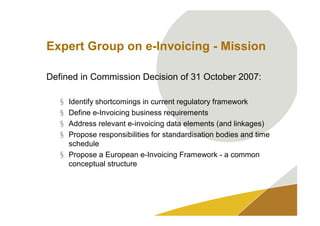
Expert Group on e-Invoicing - Mission

Defined in Commission Decision of 31 October 2007:

   § Identify shortcomings in current regulatory framework
   § Define e-Invoicing business requirements
   § Address relevant e-invoicing data elements (and linkages)
   § Propose responsibilities for standardisation bodies and time
     schedule
   § Propose a European e-Invoicing Framework - a common
     conceptual structure
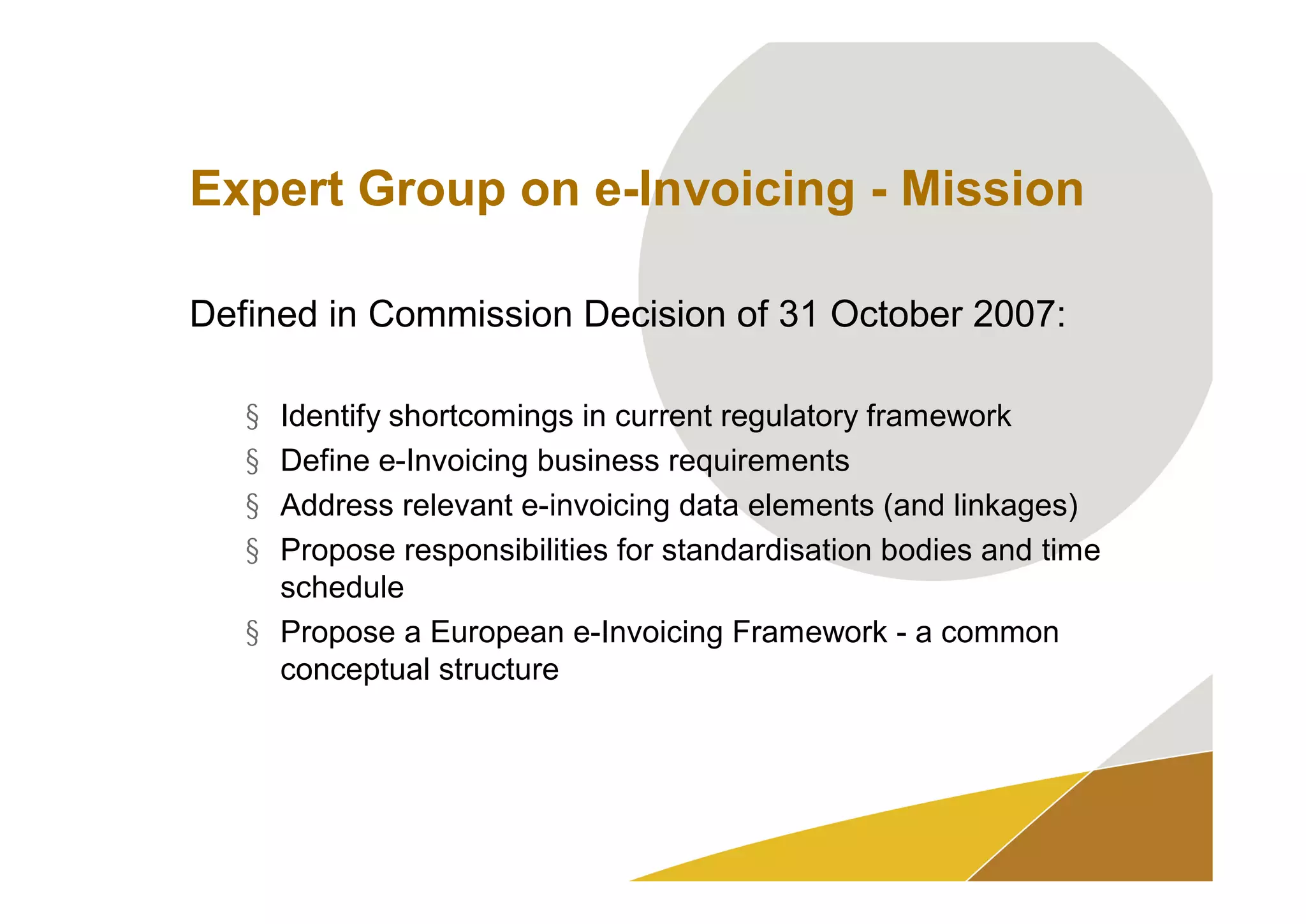
Definition and components
of the European e-Invoicing Framework
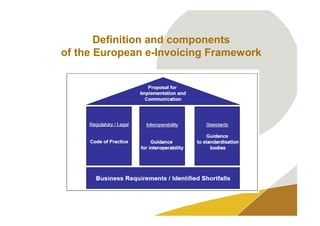
Vision and target picture

•   E-invoicing becomes predominant within 5-8 years, in some
    countries earlier.

•   Harmonised and clear legal environment will exist across the EU.

•   Trading parties have wide choice of convenient solutions and
    services- bilateral, 3-corner and 4-corner models in use.

•   Standards adopted based on single data model- UN/CEFACT CII.

•   Investments made in ERP and supply chain systems and in low
    cost and user friendly solutions. For SME’s no investment in IT
    solutions or IT skills needed.

•   Expected dematerialisation of other processes.
Expert Group Recommendations
The EG recommends the creation of an e-invoicing eco-
system that provides maximum interoperability and reach.
Detailed recommendations:
•   the use of consistent terminology to describe and clarify the roles and
    responsibilities;
•   content standards that support the basic cross-industry e-invoicing business
    requirements;
•   the use of common, non-proprietary European and international information
    technology standards;
•   minimum business and technical requirements for connectivity and messaging;
•   the development of an interoperable electronic addressing and routing process;
•   the development and deployment of a variety of accepted business and
    implementation models;
•   the use of good practice guidelines as self assessment tools on a voluntary basis;
•   establishing sound and enforceable agreements;
•   to provide interoperability within and between networks and network-based
    solutions.
Expert Group recommendations

Responsibility for
implementation:                 • Interoperability can only be created
                                  through an appropriate mix of
                                  collaboration and competition.
The proposed European level
multi-stakeholder e-Invoicing
                                • In the EG view, there is no generalised
Forum should take the lead,
                                  market failure and there are promising
supported by CEN, the             developments towards the required level
service and solution provider     of interoperability.
community, as well as
community projects,
                                • However, where required, further
associations and user groups.     support should be given for the
                                  development of a healthy and vibrant
                                  eco-system.
First analysis - consultation feedback
 Inter-operability
• Vast majority of respondents recognises inter-operability as one of the key requirements
which are critical for the success of EEIF

• Majority of replies agrees with the ‘eco-system’ proposed by EG, at least in principle

• The following key areas of improvement and open issues were identified by respondents:

     •   Current proposal rather vague and 'theoretical'. Concrete rules for inter-operability
         need to be developed. Clearer assignment of tasks and responsibilities required.
     •   Strong link between invoices and payments. Therefore, requirements in relation to
         payment messaging standard ISO 20022 should be included.
     •   Addressing and routing issues not sufficiently covered in proposal. Clear rules in
         this area are a crucial prerequisite for inter-operability.
     •   Definition of an eco-system should also include description of different business
         models for service providers

• As regards implementation of an eco-system, diverging opinions whether such a
framework should evolve through market forces or required intervention.

E invoicing, presentation from charles bryant

  • 1.
    Expert Group one-Invoicing - Mission Defined in Commission Decision of 31 October 2007: § Identify shortcomings in current regulatory framework § Define e-Invoicing business requirements § Address relevant e-invoicing data elements (and linkages) § Propose responsibilities for standardisation bodies and time schedule § Propose a European e-Invoicing Framework - a common conceptual structure
  • 2.
    Definition and components ofthe European e-Invoicing Framework
  • 3.
    Vision and targetpicture • E-invoicing becomes predominant within 5-8 years, in some countries earlier. • Harmonised and clear legal environment will exist across the EU. • Trading parties have wide choice of convenient solutions and services- bilateral, 3-corner and 4-corner models in use. • Standards adopted based on single data model- UN/CEFACT CII. • Investments made in ERP and supply chain systems and in low cost and user friendly solutions. For SME’s no investment in IT solutions or IT skills needed. • Expected dematerialisation of other processes.
  • 4.
    Expert Group Recommendations TheEG recommends the creation of an e-invoicing eco- system that provides maximum interoperability and reach. Detailed recommendations: • the use of consistent terminology to describe and clarify the roles and responsibilities; • content standards that support the basic cross-industry e-invoicing business requirements; • the use of common, non-proprietary European and international information technology standards; • minimum business and technical requirements for connectivity and messaging; • the development of an interoperable electronic addressing and routing process; • the development and deployment of a variety of accepted business and implementation models; • the use of good practice guidelines as self assessment tools on a voluntary basis; • establishing sound and enforceable agreements; • to provide interoperability within and between networks and network-based solutions.
  • 5.
    Expert Group recommendations Responsibilityfor implementation: • Interoperability can only be created through an appropriate mix of collaboration and competition. The proposed European level multi-stakeholder e-Invoicing • In the EG view, there is no generalised Forum should take the lead, market failure and there are promising supported by CEN, the developments towards the required level service and solution provider of interoperability. community, as well as community projects, • However, where required, further associations and user groups. support should be given for the development of a healthy and vibrant eco-system.
  • 6.
    First analysis -consultation feedback Inter-operability • Vast majority of respondents recognises inter-operability as one of the key requirements which are critical for the success of EEIF • Majority of replies agrees with the ‘eco-system’ proposed by EG, at least in principle • The following key areas of improvement and open issues were identified by respondents: • Current proposal rather vague and 'theoretical'. Concrete rules for inter-operability need to be developed. Clearer assignment of tasks and responsibilities required. • Strong link between invoices and payments. Therefore, requirements in relation to payment messaging standard ISO 20022 should be included. • Addressing and routing issues not sufficiently covered in proposal. Clear rules in this area are a crucial prerequisite for inter-operability. • Definition of an eco-system should also include description of different business models for service providers • As regards implementation of an eco-system, diverging opinions whether such a framework should evolve through market forces or required intervention.