E-invoicing Yearbook 2017 – Q1 1
2017 YEARBOOK Q1
With user generated content on the following topics:
 Featured providers
 Opinions
 Mandatory and compliant e-invoicing
 Interoperability and standardisation (in Europe):
 Case studies
 News in general
 Downloads, infographics and more
 Beyond e-invoicing: innovative and new services
 Acquisitions, mergers and funding
 Around the globe
E-invoicing Yearbook 2017 – Q1 2
E-invoicing Yearbook 2017 - Sponsors

Sponsors of the E-invoicing Platform are automatically added to the E-invoicing Yearbook.
Interested in a sponsorship? Download the 2017 E-invoicing Platform Value Proposition [PDF].
Not a sponsor but interested to participate in the E-invoicing Yearbook? E-mail us.
E-invoicing Yearbook 2017 – Q1 3
Introducing: The E-invoicing Yearbook 2017
We hereby introduce to you the E-invoicing Yearbook 2017. Our daily search for content regarding e-
invoicing, AP automation and e-procurement lead to over 2,000 posts, published the past eight years.
On average, the E-invoicing Platform publishes ten posts per week. These posts are both user
generated content from our sponsors, as well as content from other valuable sources.
This content is also published on Twitter, on LinkedIN and on Google (News). And every other week,
the posts get extra attention via our newsletter, with currently over 8,900 recipients in 100+
countries.
As each post is interesting and newsworthy by itself, this is increased when we sort these posts in the
sections underneath:
 Featured providers p. 7 - 11
 Opinions p. 12 - 16
 Mandatory and compliant e-invoicing: p. 17 - 28
 Interoperability and standardisation (in Europe): p. 29 - 44
 Case studies p. 45 - 51
 News in general p. 52 - 73
 Downloads, infographics and more p. 74 - 81
 Beyond e-invoicing: innovative and new services p. 82 - 98
 Acquisitions, mergers and funding p. 99 - 102
 Around the globe p. 102 - 112
After each quarter of the year ends the E-invoicing Yearbook will be updated, building a picture of
how the world of e-invoicing is progressing.
In the next chapter you will find the titles of the posts published in Q1 of 2017 as sorted in the
sections mentioned above.
E-invoicing Yearbook 2017 – Q1 4
Publications 2017, Title only
Featured providers
30/03 - UnifiedPost, from document exchange to single click payments - (link)
06/03 - Introducing our latest sponsor: B2B Router / Invinet Systems - (link)
27/02 - Buzon E: A full service e-invoicing provider - (link)
26/01 - SNI: ranked #12 on the Technology Fast 500™ EMEA - (link)
Opinions
31/03 - Expert opinion: proper e-invoicing improves supply chain finance - (link)
20/03 - E-invoicing: Why aren’t we there yet? - (link)
27/02 - 5 facts and myths about PDF invoices you should know about - (link)
16/02 - Data capture is a farming exercise; and this is why - (link)
27/01 - The Evolution of e-invoicing, and how they are promoting a sustainable economy - (link)
24/01 - How the ‘Scottish Approach’ can help the US e-invoicing adoption - (link)
16/01 - Richard Manson: “Why is paper still so prevalent in business today?” - (link)
Mandatory and compliant e-invoicing
14/03 - Philippines Joint Foreign Chambers propose mandatory e-invoicing before 2022 - (link)
10/03 - Compliance complexities abound in Argentina, Chile and Uruguay - (link)
03/03 - Mandatory e-invoicing on the horizon in Costa Rica - (link)
03/03 - Adapt your SAP landscape to Mexico’s new payment and invoicing regulations - (link)
28/02 - >100,000 suppliers -have to- use FACe, Spain’s B2G e-invoicing platform - (link)
27/02 - Top 10 e-invoicing compliance mistakes you should avoid in Latin America [download] - (link)
17/02 - First-ever live tax-free e-invoice transaction in Turkey - (link)
09/02 - Peru mandates e-invoicing adoption in 2018 [updated] - (link)
02/02 - REPORT: Latin America leads the way in mandatory e-invoicing and compliance - (link)
23/01 - Mandatory e-invoicing now a reality in Colombia; pilot program concludes - (link)
20/01 - 2017 Compliance Outlook: changes abound in Brazil, Colombia and Mexico - (link)
11/01 - SAT updates to CFDI 3.3 and introduces the ‘payment receipt complement’ - (link)
11/01 - Turkey postpones mandatory e-invoicing until 1 July 2017 - (link)
Interoperability and standardisation (in Europe)
21/03 - Show the world your “UBL Readiness’ with this FREE label: 94 providers already do - (link)
21/03 - Seminar: Introduction to Universal Business Language (UBL) - (link)
17/03 - EU E-invoicing Standard gets unanimous approval, with 4 BIG adoption barriers - (link)
03/03 - Update: PEPPOL implementations in EU Member States - (link)
23/02 - Australia’s first end-to-end UBL electronic invoicing experiment is a fact - (link)
09/02 - A common Franco-German e-invoice format is becoming a reality - (link)
02/02 - OASIS UBL-related announcements and public reviews: UBL 2.2 public review - (link)
02/02 - First EU member states connect their eIDAS nodes - (link)
02/02 - Govein E-invoice: implementing the new EU e-invoice standard in Public Health Care - (link)
E-invoicing Yearbook 2017 – Q1 5
23/01 - Poland becomes OpenPEPPOL Authority, 200th member - (link)
23/01 - Getting one step closer to paperless invoicing - (link)
12/01 - Recent B2G e-invoicing developments in 9 EU Member States - (link)
Around the globe
23/03 - EDICOM: Challenges of International E-invoicing - (link)
23/03 - EDICOM signs interoperability agreement in Australia and Brazil - (link)
21/03 - Top ten tips to choose your global e-invoicing service provider - (link)
03/03 - Sovos/Invoiceware streamlines VAT compliance for clients all over the world - (link)
28/02 - Swiss Post Solutions and TrustWeaver announce global compliance partnership - (link)
07/02 - TrustWeaver expands with e-invoicing compliance support in India - (link)
23/02 - TIE Kinetix and TrustWeaver team up for globally compliant e-invoicing and e-archiving - (link)
10/01 - Comarch joins forces with TrustWeaver for compliant and borderless e-invoicing - (link)
Case studies
20/03 - Vodafone: Unlocking Early Payment For All Suppliers – Case Study - (link)
27/02 - Case Study: All Star Association relies on CorConnect for unrivaled growth - (link)
17/02 - Mammut automates invoice processing to streamline workflows [Case Study] - (link)
10/02 - ABB Spain optimizes its (e-)invoice handling with Pagero (Case study) - (link)
09/02 - TrueCommerce helps Travis Perkins plc with a new EDI managed service - (link)
03/02 - Bolgers selected Data Interchange for an efficient & reliable EDI system - (link)
27/01 - Rentokil uses FLOW Partner Automation by TIE Kinetix - (link)
16/01 - Carcoustics saves 50% in costs with the EDI technology from Data Interchange - (link)
16/01 - Keys to working capital success featuring the Bavelos Group - (link)
16/01 - Gustaf Fagerberg: A more efficient invoicing process with a virtual printer - (link)
News in general
30/03 - UnifiedPost signs deal with Assuralia for a sectoral e-invoicing platform - (link)
28/03 - EDI ACADEMY – Integrating EDI with your ERP system - (link)
16/03 - CloudTrade becomes a UK Oracle Community Network member - (link)
14/03 - New CEF Telecom e-invoicing call for proposals opens at 28 June - (link)
06/03 - Four quotes from Jan Sundelin (CEO TIE Kinetix) on the Trustweaver deal - (link)
23/02 - CloudTrade and Capita help UK public sector organisations achieve 60% back office savings -
(link)
20/02 - Jordan adopts Korean e-procurement system - (link)
20/02 - Tunisie Telecom joins Tunisia TradeNet (TTN) e-invoicing network - (link)
16/02 - AcceptEmail opens for business in Germany, Austria and Switzerland - (link)
13/02 - Mastercard, Swipezoom to automate invoicing and e-payments - (link)
30/01 - EDICOM awarded a place on the Crown Commercial Service for PEPPOL services - (link)
27/01 - TrueCommerce Launches Sage 50 Accounts and Sage 200 EDI Integration in Europe - (link)
26/01 - Pagero and PEPPOL – more than just an PEPPOL access point - (link)
26/01 - India’s big banks plan interbank blockchain platform - (link)
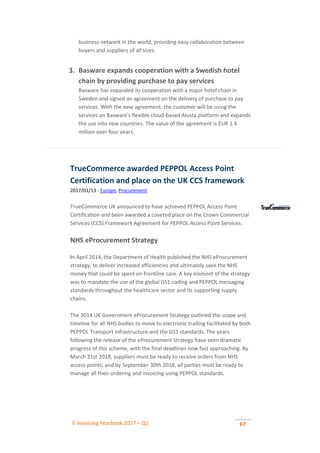
23/01 - Basware news update: open networks, working capital optimisation and SCF award - (link)
E-invoicing Yearbook 2017 – Q1 6
20/01 - FACe, the Spanish B2G e-invoicing Point of Entry, received 8 million e-invoices in 2016 - (link)
13/01 - TrueCommerce awarded PEPPOL Access Point Certification and place on CCS framework -
(link)
12/01 - Taiwanese operator Chunghwa wins USD 20 million e-invoicing contract! - (link)
12/01 - CloudTrade awarded US Patent for its Gramatica document data extraction. - (link)
10/01 - Pagero news update: Frence office, Primelog acquisition and Bouvet SAP integration - (link)
09/01 - EESPA annual general meeting well attended and achieved new goals for 2017 - (link)
09/01 - Data Interchange gains Government PEPPOL approval for CCS access - (link)
Downloads, infographics and more
30/03 - EDICOM Expert Analysis: The NHS E-procurement Strategy [download] - (link)
27/03 - Euro Retail Payments Board (ERPB) issues interim report on the EIPP/EBPP landscape - (link)
17/03 - Infographic: The velocity of global e-invoicing initiatives accelerates - (link)
06/03 - Movie: e-invoicing made easy with Pagero - (link)
10/03 - Integrated Payables: why holistic AP transformation is the best path [download] - (link)
07/02 - The Definitive Guide to AP Automation [ download] - (link)
16/01 - Research: 50% of LATAM businesses don’t understand new e-invoicing mandates - (link)
12/01 - Survey: Over 41% of UK companies at risk without EDI - (link)
09/01 - e-Transformation in Turkey by figures - (link)
Beyond e-invoicing: innovative and new services
[e-reporting, e-accounting, e-audit, payments, blockchain]
23/03 - AcceptEmail: Changing the way people pay their bills - (link)
16/03 - Mexico announces first resolution under new e-Audit Mediation Process - (link)
10/03 - Mexico cracks down on exports with “Complemento Comercio Exterior” requirement - (link)
28/02 - Two major SAF-T changes in Portugal come into force as from July 1, 2017 - (link)
23/02 - 8 questions on the Spanish SII system, mandatory as from July 2017 [SAP addon] - (link)
17/02 - EDICOM offers SAF-T services for companies in Norway (mandated as from 2017) - (link)
17/02 - Mexico moves beyond e-invoicing and is now tracking payments - (link)
07/02 - Turkey covers a substantial distance in the e-Transformation process - (link)
06/02 - SNI has a scalable SAP solution for companies in countries that implement SAF-T - (link)
03/02 - Mexico Announces E-Audit Revenue of 55.8 Million Pesos - (link)
23/01 - Overview of SAF-T Reporting Requirements in Europe - (link)
Acquisitions
10/03 - Tradeshift buys the IBX Platform from CapGemini - (link)
24/02 - HighJump TrueCommerce buys RedTail Solutions - (link)
24/01 - Three major e-invoicing investments you might have missed in 2016 - (link)
E-invoicing Yearbook 2017 – Q1 7
Featured providers
Introducing: UnifiedPost, from document
exchange to single click payments
2017/03/30 - Electronic Invoicing, Featured Articles, Payment
We are happy that UnifiedPost has once again become a sponsor of the E-
invoicing Platform. UnifiedPost was founded in 2000 and has grown very
swiftly over the last years.
UnifiedPost started as a platform for document management. Over the
years, UnifedPost has acquired several companies creating the group of
companies it is today. UnifiedPost employs over 200 people working across
Europe on a BPaaS platform based upon the basic components Document,
Payment, Identity, all available in their own community.
UnifiedPost is built on the belief that by focusing on smart Fintech
solutions, platforms and ecosystems, creates broad business opportunities
that matter.
The use of digital technologies transforms these conventional business
processes. However, research shows that over 70% of these digital
transformation initiatives fail, resulting in increased costs and unhappy
customers. UnifiedPost upgrades these critical businesses processes by
changing the way people work. Our solutions allow businesses to pay, sign
and view invoices, documents, contracts, payments and bills via one single
integrated, secure, cloud-based solution.
Unlike other companies, UnifiedPost has developed a unique portfolio of
technology-driven business optimisation solutions in a cloud-based SaaS
model for both (large) corporates and SMEs that optimise the entire
financial supply chain, with a special focus on e-identity, documents,
payments and apps. UnifiedPost has a double digit growth rate and
currently manages over 100 million documents per year.
Recently, UnifiedPost Group successfully completed a capital increase by a
group of Belgian investors to support the further European growth.
UnifiedPost simplifies critical business processes by fully exploiting digital
technology, giving businesses the freedom to focus on what they do best
while also enabling them to expand their business.
E-invoicing Yearbook 2017 – Q1 8
Products and solutions offered by UnifiedPost:
 Business processes optimization
 Multi-channel document processing & delivery,
 Payment processing solutions,
 E-invoicing
 E-archiving,
 Financial supply chain,
 Management of credits and accounts receivable,
 Electronic identity and document signing
Introducing our sponsor: B2B Router / Invinet
Systems
2017/03/06 - Electronic Invoicing, Europe, Featured
B2BRouter is a simple online solution provided by Invinet that enables
companies to send electronic documents through the Pan-European
PEPPOL network, recommended by public administrations in Europe and
mandated by the Department of Health in England.
SME suppliers can set up their clients on the B2BRouter portal, receive
notices of incoming PEPPOL orders by email, flip orders into outbound
PEPPOL invoices and send them through the PEPPOL network, at the touch
of a button, for a small annual fee.
Non-PEPPOL clients can create electronic invoices in several structured
formats such as Svefaktura, OIOUBL, Facturae, UBL, or GS1 and also non-
structured formats such as PDF and submit them by email for free.
B2BRouter also provides a platform to share your invoices and payment
information with your providers in a synchronized way. Companies can
simplify the overall invoicing process, provide easy access for your staff,
reduce handling costs, save on paper, print and postal costs. Integrate your
invoices in your accountant information system.
B2B Router key functionalities
 Convert B2B ROUTER has the capability to convert documents from any
format to any other format.
 Validate B2B ROUTER validates de required information and provides a
E-invoicing Yearbook 2017 – Q1 9
system to alert administrators about possible content errors in the
documents.
 Sign B2B ROUTER provides electronic signature capabilities that
guarantees the preservation of the integrity of documents being
exchanged.
 Connect B2B ROUTER is a multichannel business system that connects
to any company through any electronic channel.
 Real time B2B ROUTER is always updated with any new transformers,
channels, or formats that become standard in the market.
More information:
Oriol Bausà Peris – CEO
Phone: +34639465171
Mail: oriol@invinet.org
Introducing Buzon E: A full service e-invoicing
provider
2017/02/27 - Compliance, E-invoicing, Featured, Latin America
We are delighted to again welcome an e-invoicing service provider as
sponsor of the E-invoicing Platform. This time we give the floor to Buzon E,
from Mexico.
Buzón E is a Mexican subsidiary of Grupo Estafeta, focused on automating
and optimizing business processes (BPM) and processes which involve the
exchange of tax and non-tax electronic documents in order to help
companies improve their communication, productivity and become more
profitable by joining a world paperless community.
In Buzón E they are dedicated to providing valuable technological solutions
to help you optimize processes of generation, reception and delivery of
CFDI's or other electronic documents. With them, you are guaranteed that
your current processes are running optimal, once they have been
automated by the Buzon E technological platform.
Their services are focused on implementing processes for operational
efficiency of their customers through a flexible and reliable operating
platform. All their processes and services are carried out under a scheme of
high security, confidentiality, accessibility and reliability.
E-invoicing Yearbook 2017 – Q1 10
Security and integrity of information:
 Secure and encrypted data handling
 Solid technological mission-critical infrastructure (Firewall and
Perimeter security.
 Legal certainty
 Buzon E is PAC certified by the Mexican SAT
Technological innovation
 A constantly evolving Platform.
 Continuously developing technological solutions to meet our customer
and the market needs.
Ease and Availability
 Information accessibility for users
 No additional investment in hardware
 Easy to use. Simple and intuitive interface
Confidentiality and reliability
 Confidential data handling
 SSAE 16 (formerly SAS 70)
Environmental responsibility
 Enthusiastic about achieving a Paperless World with our customers
 Resource savings
More information
Elizabeth Enríquez Marketing Analyst
Phone (55) 59014800 Ext. 41232
Contact e-mailadres: elizabeth.enriquez@buzone.com
LinkedIN: https://www.linkedin.com/company/buz-n-e
Introducing SNI: ranked #12 on the Technology
Fast 500™ Europe, Middle East & Africa (EMEA)
2017/01/26 - Asia, E-invoicing, Europe, Featured
We are delighted to again welcome an e-invoicing service provider. This
time we give the floor to SNI, from Turkey SNI is a computer technology
corporation focused on e-invoice, e-ledger , e-archive and other interfaces
and technologies.
They provide solutions and services that reduce the risk and cost of
E-invoicing Yearbook 2017 – Q1 11
maintaining compliance. The world's largest companies are their clients,
including Adidas , Nike, Puma, Deloitte, Geberit, Alcatel-Lucent, Ferrero,
Osram, Hilti, MTU, Schneider, Merck, Tefal and another 300+ large scale
companies are running SNI e-invoice.
Established in 2004 and registered as SAP Global Application Development
Partner, SNI operates globally in many countries with 50 employees
through its offices in Poland, Turkey and the Netherlands.
Alongside software and e-products, SNI has executed challenging projects
and achieved effective growth accordingly by providing SAP
outsourcing/recruitment services in line with the needs of World's most
prestigious firms and carried out successful projects with the teams formed
worldwide in over 50 countries.
 SNI is listed on Technology Fast 500™ Europe, Middle East & Africa
(EMEA) and ranked #12.
 SNI ranked #2 on Deloitte Technology Fast 50 program as 2nd fastest
growing Technology Company in Turkey.
 SNI e-Ledger is certified by SAP
Get in touch with SNI
CEM YURDAKUL
Position: CEO
Phone: +905336271890
E-mail: cem.yurdakul@sni.net.tr
E-invoicing Yearbook 2017 – Q1 12
Opinions
Expert opinion: proper e-invoicing improves
supply chain finance
2017/03/31 - Adoption, Electronic Invoicing, Supply Chain Finance
This expert opinion was written by Andras Kelen, a veteran of the IT
industry. He graduated from the Technical University of Budapest Faculty of
Electronic Engineering (MSc) with strong mathematical and theoretical
foundations. Do you want to have your expert opinion published? Contact
us.
Business communication today is extensively relying on the so-called four
corner model: Partner A creates a document, passes it onto its service
provider, which makes certain operations, like conversion, finds the service
provider of the addressee and passes the document onto this organisation,
which again executes certain operations and ultimately passes the
document onto the (ERP) system of the receiver (Partner B). During this
journey, the content of the document is sealed from the outside world and
the issuer loses control, learning the outcomes in days, weeks and most
probably months. It is easy to recognise that the process resembles a lot
the old paper procedures, though it is much cheaper and faster by virtue of
the internet today.
Read the full post here
E-invoicing: Why aren’t we there yet?
2017/03/20 - Adoption, Electronic Invoicing, Europe
This article was first published here by Markus Hornburg, Vice President
Global Product Compliance at Coupa.
We believe that the article reflects an essential reflections on the
development of -the adoption of- e-invoicing. We also believe that the
article contains vital elements necessary for massive adoption that are
more often than not are overlooked.
The full article can be found here: http://www.coupa.com/blog/e-
invoicing-why-aren-t-we-there-yet?
E-invoicing Yearbook 2017 – Q1 13
5 facts and myths about PDF invoices you should
know about
2017/02/27 - Adoption, E-invoicing, UBL
PDF invoices… e-invoicing or something else altogether? This topic has
sparked many debates yet views are often misinformed. CloudTrade
separates the myths from the facts…
1. Myth: There are both digital and electronic invoices
In reality there is a difference between electronic and digital. But this
difference has often been misunderstood by many considering an e-
invoice solution. Whereas ‘Electronic ‘is a legal term, ‘Digital’ is a
manifestation of an electronic invoice.
See the quote below which describes the distinction in relation to
‘signatures’: . “The legal term is ‘electronic signature ‘. A manifestation
of an electronic signature is a digital signature…. A qualified digital
certificate provides an advanced electronic signature: a signature which
may be granted a great deal of legal guarantees…” . This distinction
was never made with regard to e-invoices, and this is still the case
today. In short: a digital invoice is an e-invoice and vice versa.
2. Fact: An invoice that is not carried by a paper medium is an
electronic invoice
A PDF invoice is not carried by a paper medium and therefore it is an
electronic invoice.
See as an example the recent European e-invoice directive which states
the following: ‘Electronic invoicing refers to the process of issuing,
transmission, and reception of invoices in a structured electronic format
which allows for their automatic and electronic processing.’
3. Fact: PDF and email are regarded as primary e-invoicing
methods
Statistically PDF and e-mail have long been regarded as the primary
means for e-invoicing throughout most of the business populations
across the world. . Just imagine saying to those companies that the way
they are e-invoicing isn’t really e-invoicing. Or that their method of e-
invoicing’ is in fact a fake version of the real thing? Providing evidence
to support this view is likely to be a struggle.
E-invoicing Yearbook 2017 – Q1 14
4. Fact: A PDF is created by a PDF printer
A printer can only generate output if the initial input has an existing
structure. A PDF is a visual reference of structured information. Despite
its clean, polished appearance, a PDF is built on top of structured data.
5. Myth: PDF invoices flag behind other e-invoicing technologies
Critics of PDF invoicing often argue that PDF invoices are less advanced
than data formats such as UBL 2.0 … this is a myth. As a PDF document
is a representation of structured data, it can therefore be used to
import structured data.
There are many examples of e-invoicing that offer the ability to
import/process PDF invoices directly into financial software. (Yes, it
requires a few more mouse clicks than straight through processing but
has anyone calculated the costs for SME’s yet?).
There is a distinct lack of cost effective, high performance products
(especially for SME’s) that can import PDFs directly into accounting
software.
Conclusion
PDF invoicing isn’t getting the recognition it deserves. E-Invoicing can get
far more technical, however the simplicity and ease of transition makes
PDF invoicing an excellent starting point for companies making the change.
Read even more here about PDF invoicing - Dispelling the Myths.
Could PDF invoicing be the solution for you? Request a demo now!
Data capture is a farming exercise; and this is why
2017/02/16 - Digitalisation, Research
This article is about the importance of data as enabler of that, and about
the fact that some data cannot be measured on their apparent value.
It will also touch on how the reduced data collection cost in some areas can
open up for reconsidering which data are actually valuable or potentially
could be.
Read the full post on the website of Pagero
E-invoicing Yearbook 2017 – Q1 15
The Evolution of E-invoicing: how digital invoices
are promoting a sustainable economy
2017/01/27 - Adoption, E-invoicing, Supply Chain Finance
This is a three-part blog by Magaly Charlier, Director of Global Product
Compliance at Taulia, on the evolution of electronic invoicing and its value-
added features including payables and receivables financing. For everyone
who wants to understand eInvoicing’s origin, evolution, and key
milestones.
"E-invoices have advanced from domestic tax documents to global trade
and supply chain financing instruments, and might even become tokenized
assets in the blockchain…" Magaly summarizes this evolution in three
sections:
1. The Past: eInvoicing’s Early Stages
2. The Current Environment
3. The Future: eInvoicing -What’s Next?
Each section of this three-part blog describes key events and drivers
associated with the evolution of eInvoicing.
Read the full blog post here
How the Scottish Approach can help the US e-
invoicing adoption
2017/01/24 - Adoption, E-invoicing, Government, North America
This article was written by Roger Hatfield, VP CloudTrade North America,
and first published on PaymentSource.com
The Office of Management and Budget (OMB) announced in a
memorandum the future mandating of electronic invoices by end of fiscal
year 2018.
The memorandum forms part of a larger drive to reduce inefficiencies
within the government, ultimately to reduce the taxpayer burden and
better utilize resource. By fiscal 2018 all-electronic invoicing will be
mandatory for all federal government agencies; the U.S. federal
government is the largest purchaser of goods and services in the country;
E-invoicing Yearbook 2017 – Q1 16
the government collectively processes over 19 million invoices per year;
and only 40% of these are processed as electronic invoices.
That leaves a whopping 60% of invoices – 11.4 million invoices – to start
processing as e-invoices in just over two years. Can it be done? It is
optimistic for sure. But the OMB is committed to mandatory e-invoicing to
improve government efficiency and reduce the cost to the tax payer.
As is often the case when we start talking about e-invoicing we think about
Europe. We hear so much about how Europe is adopting e-invoicing; how
Europe is leading the way. And the reality is that in many European
countries electronic invoicing has not yet been widely adopted. However,
there are some clear success stories and one that we can learn from with
our federal government dilemma is the Scottish government.
The Scottish government has made electronic invoicing available to all its
public bodies, and has encouraged this processing through a central shared
service. Now, Scotland is hardly huge but it is the 43rd largest economy in
the world with a nominal gross domestic product (GDP) of $240.975 billion
per annum.
In relation to the U.S., it is tiny, but it is still greater than most states. Even
in a country of such a small size, government bodies were operating using
more than 60 different finance packages, so for a shared service to be a
success it needed to be able to interface with these different systems.
A further complication for shared service processing, and for electronic
invoicing is the ability, and willingness, of vendors to send their invoices
electronically. Larger organizations may well have the infrastructure in
place to send cXML files, but the clear majority do not. And they equally do
not have the resource to put in place the necessary technology to enable
this. Nor do they want to spend time duplicating invoices, creating them
once in their own system and then again in an e-invoicing portal. Oh, and
no one wants to be charged for sending their invoices either.
The Scottish government understood these challenges and has adopted a
system which provides suppliers with the option to either send their e-
invoice as a cXML file OR to send an email with a PDF invoice attached.
PDF invoicing means that most suppliers can move to e-invoicing without
any changes to their own systems. They create their invoice in the system
they currently use, create a PDF (which most accounting packages can do as
standard), and email it over. By simplifying the process of electronic
invoicing, the Scottish government ensures the highest levels of on-
boarding of suppliers – a prerequisite of widespread e-invoicing adoption.
E-invoicing Yearbook 2017 – Q1 17
So, there are two simple lessons we can learn for the U.S. federal
government e-invoicing initiative. A shared service needs to be able to 1)
interface with multiple different systems in use, and 2) accept different
formats of e-invoices to ensure that all suppliers can move to electronic
invoicing.
For federal government to move to all-electronic invoices by fiscal 2018 it is
imperative that suppliers can come on board quickly and easily. PDF e-
invoicing will enable this. In fact, I would go so far as to say, it is essential.
So, we come back to our original question. In conclusion I would say, yes, it
can be done. But only if it’s done in the right way.
For mandatory federal government e-invoicing through a shared service,
that shared service needs PDF invoicing as an option, and the shared
service must be able to integrate with the multiple software packages in
use across federal government.
Richard Manson: “Why is paper still so prevalent in
business today?”
2017/01/16 - Digitalisation, E-invoicing
Using e-Invoicing to connect businesses to trade electronically is a modern,
innovative solution to the paper problem. It’s been estimated that paper
consumption per office worker ranges between 10,000 & 20,000 sheets a
year, with a higher figure likely for accounting and finance industries. The
business and environmental impact of paper invoicing also means its
unsustainable and hugely unproductive.
Organisations can save 1-2 per cent of turnover by replacing paper invoices
with electronic invoices and optimising their supply chain.
So why are so many businesses refusing to innovate to increase
productivity and increase their bottom line? (Post by IT Pro Portal)
E-invoicing Yearbook 2017 – Q1 18
Mandatory and compliant e-invoicing
Philippines Joint Foreign Chambers propose
mandatory e-invoicing before 2022
2017/03/14 - Asia, Compliance, E-invoicing, Government
The Philippines Joint Foreign Chambers (JFC) has backed the proposal now
forming part of the Comprehensive Tax Reform Package requiring the use of
e-invoices and e-receipts in commercial transactions between registered
companies, their customers and the Bureau of Internal Revenue (BIR).
The JFC is a coalition of the American, Australia-New Zealand, Canadian,
European, Japanese and Korean chambers. The group represents over 3,000
member -companies engaged in over $100 billion worth of trade and some
$30 billion worth of investments in the Philippines.
“While we do not know how much of the traffic involves moving paper invoices
and official receipts between businesses and their clients, we believe that
encouraging the maximum use of digital technology is an important policy
[tool] to easing traffic congestion. The [Duterte] administration has
determined that there is traffic emergency in Manila and Cebu, and requested
emergency powers to implement solutions.” the foreign chambers said.
The foreign chamber also asked the House of Representatives to consider the
proposal amending Section 113 of the National Internal Revenue Code by
adding a new paragraph:
“the use of e-invoice and e-receipt shall become mandatory within five years of
enactment of this law, regardless of whether or not they are part of a
computerized accounting system. Taxpayers are no longer required to submit
traditional hard copy [paper copy] of their invoice or official receipt with any
compliance requirements of the Bureau of Internal Revenue [BIR]. The BIR shall
simplify the invoicing and receipting data required of the taxpayer by only
requiring name and tax identification number. The BIR may exempt tax-payers
from this requirement if they can demonstrate sufficient reasons for
noncompliance”
E-invoicing Yearbook 2017 – Q1 19
Compliance complexities abound in Argentina,
Chile and Uruguay
2017/03/10 - Compliance, Latin America, Legal
When it comes to e-invoicing and tax reporting compliance in Latin
America, Mexico and Brazil often dominate the discussion as the earliest
and most comprehensive to enact such requirements.
However, complexities abound throughout Latin America – and Argentina,
Chile and Uruguay are no exception. In their September 29 webinar, they’ll
discuss the requirements in these three countries in-depth. Here’s a
preview:
Argentina
Argentina already requires some unique processes not frequently seen in
the rest of Latin America – most notably its dynamic sequencing, in which
invoices are processed in batches. If there is an issue with one single
invoice, all those following will not process until the issue is corrected.
Now, Argentina is introducing new proforma VAT initiatives, shipping
requirements and high volume invoicing processes that make compliance
in this country even more complex.
Chile
Chile introduced mandatory e-invoicing in 2014, and has quickly ramped up
its requirements to span across organizations. From finance to logistics to
IT, multinational teams doing business in Chile must ensure that they are
prepared to produce and submit 10 separate document types (collectively
called “Documentos Tributarios Electrónicos” or DTE), in addition to
monthly and annual accounting reports.
Uruguay
In the past year, Uruguay has developed a more formalized approach to e-
invoicing compliance. Previously sending letters to individual companies
alerting them to their required status, Uruguay announced new revenue-
based mandates that mean any company with revenues greater than
greater than $3.1 million USD must already be in compliance, and those
with revenues of ~$1.5M USD or greater must meet the December 1, 2016,
deadline.
Requirements distinct to Uruguay include its daily summary reports and
E-invoicing Yearbook 2017 – Q1 20
archiving process. Companies are required to file daily reports for all
transactions submitted, approved, rejected or cancelled, and must
maintain archives for 10 years – significantly longer than the six years most
Latin American countries require.
To learn more about the complexities and unique compliance requirements
in Argentina, Chile and Ecuador, contact Invoiceware International.
Mandatory E-Invoicing on the horizon in Costa Rica
2017/03/03 - Electronic Invoicing, Invoice Automation, Latin America
Currently running as a voluntary Costa Rica e-invoicing program, it is
working toward being implemented fully. The DGT, Costa Rica’s tax
authority, enlisted Servicios Publicos de Heredia (ESPH), a state-owned
company providing public services like telecommunications, to develop,
implement and operate its official electronic invoicing system.
The completion date has yet to be announced, but what’s certain is that
mandated e-invoicing is on the horizon in Costa Rica. Companies doing
business in Costa Rica can volunteer to implement e-invoicing now under
DGT-02-09. Then, once the DGT finishes its system, mandated companies
will have six months to comply (under DGT-R-48-2016).
Note that information on this new resolution cannot currently be found on
the DGT’s website, since it is not yet mandatory. Though e-invoicing isn’t
currently required in Costa Rica, the wheels are in motion for mandatory
compliance, and companies need to start preparing now. Here are three
key considerations:
 Build or buy? We’ve covered the pros and cons of building a solution
internally versus leveraging an existing solution extensively, but the
bottom line is this. Do you want to be in the business of compliance, or
concentrate in areas that drive core business value? E-invoicing
compliance takes up to 11 full-time personnel (or equivalent), and is
often replete with fire drills – taking your most critical resource – your
team – away from innovation. .
 How do you preserve a centralized system of record while maintaining
error-free compliance? Built-in solutions from ERPs are fraught with
holes and compliance gaps, yet third-party solutions often take critical
information and compliance processes outside of your system of record
– leaving you prone to errors, discrepancies and manipulation. The best
E-invoicing Yearbook 2017 – Q1 21
solution is one that keeps compliance within your ERP for complete
corporate visibility and automated validations. .
 Where can you create efficiencies through compliance? The
standardization that e-invoicing requires means proactive companies
that see beyond the requirements can create efficiencies in several key
process:
o Accounts payable can be automated so that personnel can
focus on discrepancies instead of simple verifications. .
o Inbound receiving can be streamlined into a scan-and-click
process, since invoices must be approved before goods arrive
and accompany shipments. .
o Traditional obstacles to supply chain finance are eliminated
since all vendors are required to participate in e-invoicing,
meaning that buyers can offer flexible payment options and
suppliers 21ob e21t for immediate payment, improving cash
flow.
As mandated e-invoicing is set 21to be announced in Costa Rica soon,
companies should act now so they are not caught off-guard.
Check out Invoiceware International’s customer success stories to see how
companies like Philips, Pfizer and Sun Chemical have approached
compliance in Latin America.
-
Adapt your SAP landscape to Mexico’s new
payment and invoicing regulations
2017/03/03 - Compliance, E-invoicing, Invoice Automation, Latin America
In December 2016, Mexico announced the largest update to its e-invoicing
schema in years. CFDI v3.3 is now a reality, and companies doing business in
Mexico have until July 1, 2017, to go live with these significant changes. To
meet this deadline, companies must begin preparing for these new
government standardizations now.
Are you prepared to meet the deadline and upgrade your solutions? In
addition, companies will need to validate the data in their ERP systems to
ensure accuracy and avoid being fined ? with electronic audits officially
under way in Mexico since September 2016, Mexico’s Tax Administration
Services (SAT) organization is well-prepared to automatically identify any
E-invoicing Yearbook 2017 – Q1 22
discrepancies in submitted information. So what does all this mean for
companies with SAP landscapes?
 Implement new payment receipt tracking requirements, which include
sending the SAT a payment receipt linked to the original CFDI once
payment is received.
 Apply the 46 different data validations and standardization codes used
for the SAT’s auditing process, including tax ID validations and codes for
products, services, and payment types.
 Navigate the complexity of new conditional fields, which can lead to
requirements for further details once information is submitted.
 Put into practice new standards for foreign transactions, which require
submitting for verification the tax identification number for customers
receiving exports.
 Understand the new rules for tax calculations ? for example, taxes will
be calculated for each individual line item as opposed to the overall
sum of an invoice.
Top 10 e-invoicing compliance mistakes you
should avoid in Latin America [download]
2017/02/27 - Compliance, E-invoicing, Latin America, Publications
With fines, penalties and operational disruptions as consequences of an
inadequate approach to managing e-invoicing and reporting mandates in
Latin America, multinational in this region should take note to avoid
common errors.
Not only does proactive compliance eliminated these risks, companies
can improve operational efficiencies, streamline processes and improve
cash flow through a strategic approach.
Download this tip sheet to understand the top 10 compliance mistakes
you should avoid.
E-invoicing Yearbook 2017 – Q1 23
First-ever live tax-free e-invoice transaction in
Turkey
2017/02/17 - Adoption, Compliance, E-invoicing, Europe, Government
The first ever live environment tax-free e-invoice has been successfully
issued via eFinans e-invoicing SaaS. The transaction was a live test with
the valuable participations of: eFinans's esteemed client Turkish retail
giant Eren Perakende, worldwide tax-free expert Global Blue, supported
by the Revenue Administration and the Ministry of Customs and Trade's
newly developed e-invoice infrastructure integrations.
This first-ever tax-free e-invoice in Turkey was issued at a Lacoste brand
store in Istanbul and has travelled from the cash register device
sequentially to eFinans e-invoice SaaS, Revenue Administration e-invoice
central, Customs single window and thus on to the screen of the customs
officer at the Istanbul Atatürk Airport. Approved by the customs officer,
the e-invoice's response message instantly travelled the same flow back
to the retail giant and simultaneously to the tax-free agency Global Blue
(also in integration with eFinans) which safely approved the tax payment
return to the happy traveller, leaving Turkey with hassle-free shopping
experience and a smile.
Tax-free invoices issued by e-invoice users are obliged to be issued as e-
Invoice as of 01/07/2017 and voluntarily between 01/01/2017 and
30/06/2017.
eFinans will be offering its 10-year 100% compliant storing service to all
Global Blue customers, as it has offered to all its customers with no
exception, since its establishment.
Peru mandates e-invoicing adoption in 2018
[updated]
2017/02/09 - Adoption, Compliance, E-invoicing, Latin America
Despite the fact that Peru is one of the last countries in the region to start
using the electronic invoice, it is one of the Latin American nations that
made the fastest progress in such sector, having issued over a million
documents through the Electronic Issuance System (SEE) so far, according
to the National Customs and Tax Administration (Sunat). Sunat’s boost to
the electronic proof of purchase was crucial for such progress.
E-invoicing Yearbook 2017 – Q1 24
Update 09-02-2017:
Legislative Decree 1314 has been issued by the Sunat, mandating -the
outsourcing of- e-invoicing in Peru. Issuing electronic invoices by third
parties will be a determining factor to ensure that in 2018 the entire
country issues its tax documents digitally. These operators will provide
the necessary services to the users, who will be able to choose who to
work with.
Carlos Velamazan, Director at Unidad de Negocio de América de Seres:
“Even though the electronic invoice in Peru is legal since 2000, its use is
mandatory since October 2014. Governments usually encourage its use to
improve fiscal control and reduce fraud. So far, the regulation has forced
a total of 5,970 Peruvian companies, in addition to other 20,000, that
voluntarily accepted to use the electronic format.”
The experience of countries that have been using e-invoicing for several
years prove that it offers a number of advantages to firms, such as cost
reduction, improved business, payment and collection management, and
the possibility to access new financing sources.
In January this year, Sunat gave new impetus to the use of electronic
invoice in order to integrate a group of firms under such duty. A change
in the decisions of firms has been observed as the mandatory electronic
invoice became operational across the country; at first, companies
believed it have merely a technological impact.
Carlos Velamazan, Director at Unidad de Negocio de América de Seres:
“But it actually requires maintenance and leads to a transformation
regarding companies and their partners. In this sense, the best solution is
to use a service able to resolve any kind of difficulty, comply with
regulations and laws, and even, operate mixed solutions requiring paper
invoices and electronic support.”
First published here
E-invoicing Yearbook 2017 – Q1 25
REPORT: Latin America continues to lead the way
in mandatory e-invoicing and compliance
2017/02/02 - Adoption, Compliance, Electronic Invoicing, Latin America
The Latin American region continues to be a global leader in terms of the
market adoption rate for e-Invoicing. The Mexican association AMEXIPAC
recently published the report “Estudio comparativo de Factura
Electrónica en Latinoamérica”, which includes a comparison of Latin
American countries and also takes a look at Portugal.
The report states:
"By the end of 2015, more than 26.5 million tax payers in the twelve
countries under analysis were affected by the requirement to issue
invoices and other related documents in an electronic format. In 2015,
more than 12.4 billion e-facturas were issued, the highest volumes being
in Mexico, followed by Brazil, Ecuador and Argentina."
In the majority of the countries studied, invoice data is validated in real
time by the tax authorities.
Meanwhile, Bruno Koch from Billentis concludes and predicts that:
 All tax related documents may only be exchanged electronically in the
future: invoices, simplified invoices (receipts issued at the point of
sale), credit/debit notes, monthly salary statements, etc.
 Once the system is up and running in the domestic context, import
and export transactions will also have to be reported electronically;
Latin American countries are losing no time in pushing for
negotiations with other relevant countries in order to collaborate on
this issue.
 Electronic reporting will, in the future, not only affect documents in
the financial supply chain. It will also consider documents of the
physical supply chain (inventory, transport of goods, etc.).
 VAT declaration/reclaim will, in the long run, no longer be necessary,
as the tax authorities will obtain all the information to settle this
automatically complete tax/VAT automation.
E-invoicing Yearbook 2017 – Q1 26
E-Invoicing now a reality in Colombia; pilot
program concludes
2017/01/23 – E-invoicing, Invoice Automation, Latin America
On October 26, 2016, Colombia’s DIAN (Dirección de Impuestos y
Aduanas Nacionales) announced the successful completion of its e-
invoicing pilot program, meaning that mandated participation will soon
begin to roll out. As the leader in Latin American electronic invoicing and
fiscal reporting, Invoiceware International participated in Colombia’s pilot
program with key customers.
The pilot program included 57 volunteer companies of diverse sizes and
industries. Taking place from April through October 2016, the DIAN used
the pilot to improve its procedures, address participant concerns and
determine if the electronic invoicing systems performed according to its
standards. After successful completion, the tax administration will first
enable taxpayers to voluntarily opt in to start electronic invoicing before
it starts mandating compliance, which is anticipated to begin in 2017.
Multinationals with operations in Colombia need to begin preparing now,
as the first wave of mandates are most likely to affect these large
enterprises. Following the models of Mexico, Chile and Brazil, the DIAN
has already declared that mandates will be based on the following
criteria:
 Volume of transactions
 Revenues
 Volume of assets
 IVA refunds
 Industry / sectors with the greatest risk of tax evasion
Colombia is anxious to finalize its e-invoicing program, citing social and
economic benefits that will boost the competitiveness and growth of the
economy. By 2018, it expects that the majority of taxpayers will have
implemented e-invoicing. Global enterprises, however, won’t be able to
wait that long to begin complying with the new legislation.
With the announcement of the end of the pilot, Invoiceware is now
opening up implementation slots based on the data schemas finalized in
the program: "How to Prepare for Compliance Changes in Mexico and
Colombia."
Contact Invoiceware to learn more about our current Colombian
implementation slots.
E-invoicing Yearbook 2017 – Q1 27
2017 Compliance Outlook: Changes Abound in
Brazil, Colombia and Mexico
2017/01/20 - Compliance, Latin America
If your company is currently doing business in Latin America, then you’re
no stranger to the complex and ever-changing fiscal compliance
regulatory environment. The compliance momentum won’t subside in
2017, with major initiatives planned in Brazil, Colombia and Mexico.
Invoiceware examines what’s in store: check out the full post here
SAT updates to CFDI 3.3 and introduces the
‘payment receipt complement’ + INFOGRAPHIC
2017/01/11 - Compliance, Electronic Invoicing, Latin America
On December 5, 2016, Mexico’s Tax Administration Service (SAT) brought
forward the release of two technical specifications that will result in
updates to the CFDI from 1 July 2017. As EDICOM reported previously,
these updates are designed to ensure a better experience of using e-
invoicing and to remedy incidents that are detected over time with the
application of this system.
Click here to download the infographic, which details all the changes
taking place in 2017 for online digital tax documents.
CFDI version 3.3
On one hand, the announcement features the technical specifications of
Annex 20 in its 3.3 version. This new version will coexist with the current
version 3.2 simultaneously in the first half of 2017 to facilitate adaptation.
This aim of this CFDI upgrade is to promote the quality of the information
contained in the CFDI to enable more effective exploitation, opening the
door to future simplifications of procedures or eliminating reports.
Payment receipt complement
On the other hand, payment receipt complement version 1.0 must be
included in the CFDI issued to confirm the receipt of payments in partial
instalments and in those cases where the amount due is received in a
single payment, but this is not covered when CFDI was issued, even in the
E-invoicing Yearbook 2017 – Q1 28
case of credit transactions which are fully paid at a later date than that of
issuance of the corresponding CFDI. This version also comes into force on
1 July 2017, but management or accounting systems will need to be
technologically adapted to link payments with their respective bills.
Read more here
Turkey postpones mandatory e-invoicing until 1
July 2017
2017/01/11 - Asia, Compliance, Electronic Invoicing
Turkey has postponed the requirement for e-invoice users to issue export
& tax-free e-Invoices. The requirement applies to e-invoice users which
export certain commodities or use tax-free VAT returns. Turkish resident
e-Invoice users who export certain commodities (stated under Article 11
of Value Added Tax Law numbered 3065) are entitled to issue e-Invoices
from 1 January 2017, if they choose to do so.
However, the requirement for such taxpayers to do so has been extended
until 1 July 2017. Therefore, until July 2017, these taxpayers can continue
to issue pre-prepared export invoices if they wish (or continue to use the
Turkish e-Archive invoice system if they are obliged to do so).
General Communiqué No. 475 on Tax Procedure Law (“Amendment
Communique“) was published in Official Gazette number 29919 on 15
December 2016, entering into effect the same date. The Amendment
Communique makes changes to General Communiqué No. 454 on Tax
Procedure Law Regarding e-Invoice Application Within the Scope of
Exportation of Goods and Properties to be Carried in the Personal Luggage
of Non-Residents, which was published in Official Gazette number 29392
on 10 June 2015.
Please see this link for full text of Communiqué (only available in
Turkish).
E-invoicing Yearbook 2017 – Q1 29
Interoperability and standardisation
Show the world your “UBL Readiness’ with this
FREE label: 94 providers already do
2017/03/21 - Adoption, Electronic Invoicing, Featured Articles, UBL
UBL is increasingly being considered as the successor of the PDF e-invoice
as it yields sizeable benefits for both supplier and customers. And its use is
expected to grow considerably the next few years as UBL e-invoicing is
getting mandated in Europe. Other continents, like Australia and the North
America’s are also considering UBL as the preferred successor of PDF and
online e-invoicing.
To promote the adoption of UBL and the benefits of UBL e-invoicing, a free
label has been developed that (1) allows organisations to communicate
their ‘UBL Readiness’ to their respective customers and supplier, called:
‘UBL Ready’, and (2) provides support for organisations that want to
implement UBL e-invoicing.
To become UBL Ready an organisation has to proof that it can either
import the validated demo files of other UBL Ready participants, or
produce a UBL+PDF e-invoice file that –after validation- can be imported
by other UBL Ready participants.
All in all, applicants only have to perform five or less steps to become UBL
Ready! This way UBL Ready promotes easy, free, flawless, seamless
exchange and processing of e-invoices!
94 UBL Ready participants in just six months!
UBL Ready aims at providers of ERP and accounting software, suppliers of
OCR solutions and (online) e-invoicing service providers, providers of
provide proprietary e-invoicing solutions. In addition, (large) billers,
accountants and public bodies are eligible to become 'UBL Ready '.
More information can be found on www.ublready.com . That UBL Ready
provides in a clear need is shown by the fact that within six months already
93 organisations have applied for and received the UBL Ready label,
including, but not limited to:
E-invoicing Yearbook 2017 – Q1 30
 Accounting/financial software: Visma Software, Twinfield, Unit4,
Reeleezee, AFAS Software, Asperion, Centric, Informer.
 E-invoicing service providers: Kofax (by BM Consultants), Basware (by
ICreative), TIE Kinetix, , Canon, InvoiceSharing, StoreCove, Go2UBL,
Dynatos, Palette (by Simac Document Solutions).
 AP automation and Purchase 2 pay providers: Scan Sys, Proquro,
NewViews, 20/20 vision Software, Basecone
The full list of UBL Ready participants* is available at:
http://ublready.com/ubl-ready-participants/
More information
More information on UBL Ready can be found on the website of UBL
Ready: http://ublready.com/, including:
 Getting Started Guide
 Frequently Asked Questions
 Demo UBL+PDF e-invoice files
 A comprehensive list of active participants .
 An overview of the benefits of UBL and UBL Ready
 An online application form
For more information, please contact:
E-Invoicing Platform Friso de Jong
W http://www.ublready.com / http://www.eeiplatform.com
E info@ublready.com / jong@eeiplatform.com
T 00316-19622947
Seminar: Introduction to Universal Business
Language (UBL)
2017/03/21 - Events, UBL
UBL is the product of an international effort to define a royalty-free library
of standard electronic XML business documents such as purchase orders
and invoices. Used for procurement, e-Invoicing and transportation
logistics, this open and free-to-use XML vocabulary can be embraced by
any organization to satisfy an electronic format for important business
E-invoicing Yearbook 2017 – Q1 31
documents.
Developed in an open and accountable OASIS Technical Committee with
participation from a variety of industry data standards organizations, UBL is
designed to plug directly into existing business, legal, auditing, and records
management practices, eliminating the re-keying of data in existing fax-
and paper-based supply chains and providing an entry point into electronic
commerce for small and medium-sized businesses.
Workshop objectives
This introductory workshop overviews the steps necessary to consider how
and where to use UBL in a solution for all parties in a business scenario.
Attendees of the Introduction to UBL workshop will learn the role of the
OASIS Universal Business Language, internationally standardized as ISO/IEC
19845 and adopted by countries and companies worldwide.
Target group and contents of the workshop
There are many artefacts found and methodologies described in the
Universal Business Language (UBL) deliverables. Without an awareness of
the roles played by these, UBL can be perceived more complex or
considered "too hard" to tackle successfully.
This technically-oriented workshop is written for both the user of UBL and
technical manager.
For the implementer and specifying authority it is important to understand
candidate opportunities to work with the artefacts and to gain hands-on
experience in their use and applicability in the context of the documented
methodologies and deployment strategies.
The following topics are covered through the workshop:
 Introduction to UBL
 Parties, document types and profiles - use case and business
documents
 Information items - data description spreadsheets
 Model conventions - naming and design rules
 Model semantics - data dictionary
 Documents and document models
 Reference to methodology for code list and value validation
 Customization and system design considerations
 Specification governance and committee procedures
E-invoicing Yearbook 2017 – Q1 32
Further information on the topic is available at:
www.CraneSoftwrights.com/links/esummit-publd.htm
Workshop Leader
Mr. G. Ken Holman is the chairman of the OASIS Universal Business
Language Technical Committee and editor of the OASIS UBL - ISO/IEC
19845 specifications.
He is the founding chairman of the OASIS Code List Representation
Technical Committee, the OASIS XML Conformance Technical Committee
and the OASIS XSLT/XPath Conformance Technical Committee.
He was on W3C working group that created XML from SGML. He has
traveled the world teaching and consulting in XML, XSLT, XSL-FO and UBL
with his own training materials. Further biographical information is
available at: www.CraneSoftwrights.com/links/esummit-bio.htm
Attend this seminar
If you planned to attend this seminar, contact Ken Holman here or take a
look here.
EU E-invoicing Standard gets unanimous approval,
with four BIG adoption barriers!
2017/03/17 - Adoption, E-invoicing, Europe, Featured , Standards
The European Commission announced that a decision has been taken on
the European eInvoicing standard (EN), pursuant to Directive 2014/55/EU
on eInvoicing in public procurement. The European Commission mandated
the European Committee for Standardisation (CEN) to define the European
E-invoicing standard.
Following intense deliberations, CEN announced that the invoice model
and its syntaxes received unanimous approval:
 The EN 16931-1 - Core semantic data (invoice) model approved with 25
positive votes, no negative votes (100%); .
 The EN 16931-2 - List of syntaxes Approved with 24 positive votes, no
negative votes (100%); .
E-invoicing Yearbook 2017 – Q1 33
 Still under approval
- CEN/TS 16931-3 Syntax bindings
- CEN/TS 16931-4 Guidelines at transmission level
- CEN/TS 16931-5 Extension methodology
- CEN/TS 16931-6 Test methodology and test results
In light of a successful vote, the Committee expects to be on track to
publish the final standard in the coming months. Once this has been
achieved, the European Commission believes the real work of supporting e-
invoicing, using the European standard, can begin.
Four barriers to adoption
However, there are some constraints that could hamper the somewhat
romantic view of the European Commission:
1. The Intellectual Property of the work done by CEN lies with CEN. As a
consequence not all documents regarding the new European E-
invoicing Standard will be freely available. And free access to this
information is quintessential for massive adoption of the new
standard. .
2. The exemptions within the Core Invoice Usage Specification.
Currently it is envisaged that national extensions of the EN16931
European Electronic Invoice Standard will not be legally binding. But
then there is CIUS, the Core Invoice Usage Specification. It is expected
that through CIUS restrictions will unfortunately proliferate due to too
open ended norm. Increasing complexity and insecurity. .
3. Over 99% of the businesses in Europe consists of SME's, most of
which are self-employed/sole proprietor.
They are standardisation no-no's and rely heavily on their
administrative software to produce e-invoices and on e-mail to send
them around. If administrative software providers are not facilitated to
embrace the new standard, the 'on-boarding' rate will be
disappointing. .
4. Adding complexity to the standardisation landscape.
The European Union is adding a new e-invoicing standard, with at least
two syntaxes (UBL and UN/CEFACT CII), to an existing landscape. And
even though a standard should reduce complexity (which was the aim),
this will only increase complexity in the European business landscape.
Why? Because the new standard only has a mandated monopoly in the
B2G environment. In the business to business environment current
standards will continue to proliferate.
E-invoicing Yearbook 2017 – Q1 34
And while the quote underneath from the European Commission might
theoretically be true. The practice of e-invoicing adoption is quite different.
"E-invoicing reduces costs for economic operators and the environmental
impact of paper-based invoices. The creation of a European standard for e-
invoicing in public procurement prevents the continued proliferation of e-
invoicing standards and syntaxes coexisting in the Member States, which
leads to increased complexity in term of cross-border interoperability."
Australia’s first end-to-end UBL electronic
invoicing experiment is a fact!
2017/02/23 - Australia, Cooperation, Electronic Invoicing, UBL
Commonwealth Bank, Telstra and MessageXchange have collaborated to
perform Australia’s first end-to-end electronic invoicing experiment with
leadership from the Digital Business Council.
The experiment:
 used of the ISO-approved OASIS universal business language (UBL)
XML specification for messaging and eBMS 3.0 standard for transport.
 tested the Australian Digital Business Council framework which
applies a 4-corner model where every business and its trading partner
communicate via an access point. Access points are built into business
software systems or outsourced to third parties.
 involved the movement of UBL e-invoices over three months between
Telstra as the supplier and Commonwealth Bank as the buyer through
technology provided by MessageXchange.
E-invoicing in Australia
Australia has lagged the world in whole-of-economy based e-invoicing
mainly due to the lack of a national framework of standards, a
disproportionate cost burden for small business to interact with multiple
systems, and a reluctance of software developers to invest without a clear
national framework.
The Digital Business Council estimates that Australian businesses could be
saving between $7–10 billion a year through reduced paper and postage
costs, processing errors and processing time on the estimated 1.2 billion
invoices issued each year.
E-invoicing Yearbook 2017 – Q1 35
E-invoicing is potentially 60-80 per cent more efficient than traditional
paper invoice processing and the implementation of a common
framework of standards will allow businesses of all sizes the ability to
transact seamlessly. It is expected that the national standard will be
adopted more broadly with these continued developments as has been
the overseas experience.
Further work will continue with other banks, technology providers and
industry to automate the exchange of information with emerging
platforms such as New Payments Platform and other fintech innovations
such as blockchain.
Peter Strong, CEO Council of Small Business Australia and Chair of the
Digital Business Council:
“E-invoicing is a transformational step to a streamlined, integrated and
productive economy, and an exciting step forward especially for the small
business community. The establishment of a national framework of
standards will provide a seamless system for all businesses to use and give
software developers the confidence to produce e-invoicing integrated
software.”
Michael Eidel, Executive General Manager of Commonwealth Bank’s
Cash-flow and Transaction Services:
“Existing paper invoice processes are well and truly ready for improved
efficiency. We are committed to helping businesses make their processes
easier and UBL e-invoicing is one way to help, especially for small to
medium sized businesses. It will reduce the pain points of processing errors
and cost and improve processing time and accounts reconciliation.”
MessageXchange Managing Director, John Delaney:
“The new UBL e-invoicing standard offers the potential for major
improvements in productivity and cash flow for businesses and
government agencies. If we look to Europe, which has had e-invoicing in
place for some time, the productivity and cost savings are so obvious to
business leaders that some countries have already achieved a 40 per cent
adoption rate, saving businesses and government billions of dollars every
year.” Sources:
 https://www.commbank.com.au/guidance/newsroom/australian-
businesses-could-be-saving-7-to-10-billion-with-e-invoicing-
201702.html
 https://www.itnews.com.au/news/australia-now-has-a-national-
standard-for-e-invoicing-431943
E-invoicing Yearbook 2017 – Q1 36
A common Franco-German e-invoice format is
becoming a reality
2017/02/09 - Accounting, Cooperation, E-invoicing, Europe, Featured,
Interoperability
Stefan Engel-Flechsig wrote a post announcing that France and Germany
are working on a common e-invoicing format. The co-operation mainly
focuses on two areas.
First, the question of a common Franco-German accounting form, which
can be used in the same way in both countries and takes into account the
requirements of the future EU accounting form. Second, both forums have
dealt with the legal requirements of electronic invoices and the audit by
the auditors in the two countries.
The common German-French standard is a hybrid calculation format
based on PDF A / 3 and XML UNCEFACT D16.B as ZUGFeRD. Five common
profiles are defined (M, Basix WL, Basic, Comfort, Extended). A joint
documentation in German, French and English is in preparation. This
documentation will also describe the use in the respective national
context.
The German-French standard will be given a common name and should be
completed by March 2017. It is planned to hold a workshop with
interested participants from other national forums.
The experts of both countries have also supported the development of the
European accounting standard within the framework of CEN TC 434 in
order to include the requirements and wishes of European stabilization in
the common German-French standard.
The German-French accounting standard is expected to be in line with the
data model and syntax usage with the future European standard to be
expected in the coming year.
Read the full post in German here and translated in English here
E-invoicing Yearbook 2017 – Q1 37
OASIS UBL-related announcements and public
reviews: UBL 2.2 public review
2017/02/02 - UBL
The OASIS Universal Business Language (UBL) Technical Committee
announced a finalized work product and two public reviews of three new
work products. As you most probably know UBL is used in transportation
and in procurement by governments and companies.
Start of UBL 2.2 public review
The first public review of UBL 2.2, the successor to UBL 2.1 - ISO/IEC
19845:2015, begins February 1, 2017 and closes March 17, 2017:
https://www.oasis-open.org/news/announcements/ubl-v2-2-begins-45-
day-public-review-ends-march-17th This specification defines the
Universal Business Language (UBL) version 2.2, an open library of standard
electronic XML business documents for procurement and transportation
such as purchase orders, invoices, transport logistics and waybills.
UBL 2.2 is completely backward-compatible with UBL 2.0. UBL 2.2 is
technically a minor release, however it does add 16 new document types
for eTendering, for transportation, and for business directories and
agreements. This brings the total number of UBL business documents to
81.
Finalized Business Document Naming and Design Rules
Version 1.0
The finalized Business Document Naming and Design Rules Version 1.0
OASIS Standard dated 18 January 2017 was made public today at:
http://docs.oasis-open.org/ubl/Business-Document-NDR/v1.0/Business-
Document-NDR-v1.0.html This is a specification for modeling the structure
of business documents with UN/CEFACT Core Component Technical
Specification (CCTS) Version 2.01 and then creating XSD validation
artefacts for XML documents
OASIS Business Document Naming and Design Rules
Version 1.1
The first public review of the OASIS Business Document Naming and
Design Rules Version 1.1 proposed OASIS Standard with new rules for
creating JSON validation artefacts for JSON documents, complete with the
E-invoicing Yearbook 2017 – Q1 38
OASIS Committee Note of all UBL 2.1 document types as JSON schemas
and all UBL 2.1 example documents as JSON documents, begins February
1, 2017 and closes April 1, 2017: https://www.oasis-
open.org/news/announcements/ubl-2-1-json-alternate-representation-
v1-0-and-business-document-naming-and-desig
The CCTS, XSD and XML rules are unchanged from the Version 1.0 that
was released today. Last week the committee also announced the
acceptance of new requirements for UBL 2.3. Comments may be
submitted to the TC by any person through the use of the OASIS TC
Comment Facility:
Govein E-invoice: implementing the new EU e-
invoice standard in Public Health Care
2017/02/02 - Cooperation, Electronic Invoicing, Europe, Interoperability
GOVeIN is a research project funded by Connecting Europe Facility
programme, with an aim to ease the adoption of the e-invoicing by public
and private entities in the health sector.
The project with duration of 13 months (1 Oct. 2016 – 31 Oct. 2017) and a
total budget of 1.1 Mill/€ brings together the main actors related to the
cross-border exchange of electronic invoice in the Public Health area,
including hospital trusts and laboratories.
To solve the whole complexity related to intercommunication and data
integration, the consortium is coordinated by EDICOM, as Certification
Authority and qualified trust service provider (according to EU Regulation
910/2014), and will employ the EDICOM B2B Cloud Platform, used by
more than 15.000 companies all over the world.
EDICOM will also implement a multi-syntax solution able to handle e-
invoicing in multiple standards, according to the needs of each participant
with their own ERP systems and the specifications detailed in the
European regulation, in order to achieve semantically interoperable
electronic documents in the EU scope.
The project is also based on the PEPPOL specifications considering that all
participants will use a Peppol Access Point to communicate with others to
exchange the electronic invoices. More information on the GoveIn
website
E-invoicing Yearbook 2017 – Q1 39
Poland becomes OpenPEPPOL Authority, 200th
member
2017/01/23 – E-invoicing, Europe, Interoperability, PEPPOL
At the end of 2016, the Polish Ministry of Economic Development joined
OpenPEPPOL as the Polish PEPPOL Authority and became member
number 200 of the OpenPEPPOL community.
Joining OpenPEPPOL is the first concrete step in three years after the first
steps were taken in 2013 of a Polish plan for building a new national e-
invoicing framework based on PEPPOL services and standards.
The Polish government has started building the national services platform
(PeF) supporting electronic invoicing for public procurement.
 PeF will be the single point of European e-invoice delivery to public
entities in Poland.
 The project aims at helping public entities in implementing the
Directive regulations.
 In order to simplify the invoicing process change management, the
PeF services will be offered free of charge.
 The services will be compliant with the upcoming EU e-invoicing
standard
Getting one step closer to paperless invoicing
2017/01/23 - Digitalisation, Electronic Invoicing, PDF
This article was first published by Roger Hatfield, VP of Sales, CloudTrade
North America, on the website of ebnonline.com
Why OCR when the data is in front of you? An interesting question, the
likely answer is that you didn’t know such data existed. Picture the
outdated accounting department of the 90s - stacks of invoices piled on
desks, the printer whirring continuously and huge filing cabinets at
bursting point. If we asked the workers what they wanted to change, what
would improve the problems within the department, what would they
say? “A bigger filing cabinet” or “a more efficient printer/scanner.” It’s
unlikely that anyone would have the foresight to suggest sending all
invoices electronically and processing without printing or scanning.
E-invoicing Yearbook 2017 – Q1 40
The paperless office has been promised for almost 20 years – but,
unfortunately, it is yet to become a reality. In fact, 80% of all invoicing in
the U.S. is still paper-based, so its clear something is wrong. It’s clear to
me that the biggest obstacle to e-invoicing and e-document processing is
getting suppliers to adopt. That is why I believe e-invoicing and e-
document processing technology should be free for suppliers, easy to use
and non-disruptive, as only then will suppliers move away from paper.
There is no doubt that the business and environmental impact of practices
such as paper invoicing and paper purchase orders have rendered them
unsustainable and hugely unproductive; and that e-invoicing and e-
documents are a modern, innovative solution to the paper problem.
Optical character recognition (OCR) offers one way of enabling a computer
to interpret a human-readable document and to extract data from it.
Originally, we had document scanning and archiving; then OCR technology
allowed us to extract data from scanned images of structured and semi-
structured documents. Capture evolved into intelligent capture with the
introduction of so called ‘learning algorithms’, while vendors started to
evaluate themselves and the competition in terms of recognition and
straight through processing rates.
But is OCR still relevant today? Do we really need to OCR – and incur the
mistakes that OCR makes - when the data is carried within most
documents received into an organisation? As I said, it is highly likely
answer is that you didn’t know such data existed. Even with various
technological advances and fierce competition among industry leaders,
scanning and OCR is – and will always be – a flawed approach to the
conversion of 'human readable documents' into 'machine readable
structures':
 Scanning:
First, paper needs to be converted into a format that can be processed
by an OCR platform. A manually intensive process: mail is received,
opened and sorted. Staples are removed and batches prepared. Paper
documents are scanned and original documents either archived or
destroyed.
 OCR:
The scanning function feeds the OCR platform which reads the
photographed image of the document, attempting to convert the
pixels on the photograph, into meaningful characters. OCR companies’
often boast about high recognition rates – but the variables impacting
success are often outside of their control: poor quality paper used by
E-invoicing Yearbook 2017 – Q1 41
the supplier; the way data is laid out on the document; the quality of
the scanner used and even the way the paper has been folded in the
envelope, can all impact on OCR results and make the most powerful
platforms close to useless.
 Quality control:
Irrespective of how good the image is, you still need an operator to
check OCR results and either correct what’s been captured or fill in
what’s missing.
So, where is the data? Most organizations now send and receive PDF
documents via email. It is the easiest and most efficient way to send
documents, such as invoices and orders, as the functionality is ‘out of the
box’ with modern billing and procurement applications.
There is no question that email and PDF is ubiquitous. However, what
many may not be aware of is that when an application generates a PDF, in
almost all instances, the data – such as invoice number, line quantity, and
amounts – will be embedded within the PDF, put there by the generating
application. This type of nethod guarantees data quality and removes the
manual activities and risks associated with scanning and OCR. Now, you
know where the data is stored, you can automatically map this data to an
e-document structure that’s compatible with your processing application.
As this approach is so simple and non-disruptive to any supply chain,
adoption rates are extremely high when an organization promotes this
method of e-invoicing. So again… why OCR? Of course, it would be fool
hardy to predict that there will ever be a truly paperless office. Some
paper will likely remain – at least in the short term. However, since most
billing applications can generate and send PDF invoices via email, it is the
easiest and quickest way to move closer to a paperless office.
Recent B2G e-invoicing developments in 9 EU
Member States
2017/01/12 - Adoption, Electronic Invoicing, Europe, Government
The EU Member States are obliged to implement European e-invoicing
between the public sector and its suppliers by November 27, 2018.
Directive 2014/55/EU is a ruling designed to facilitate cross-border trade
relations by the creation of a common standard that will be interoperable.
Once e-invoicing becomes widespread throughout the European Union, the
economic savings are reported to reach up to 2.3 billion euros.
E-invoicing Yearbook 2017 – Q1 42
Given the proximity of the regulation coming into force, some countries are
now gradually rolling out mandatory B2G e-invoicing with public
administration suppliers. Underneath is an update of active B2G e-invoicing
projects already up and running in nine European Union countries.
1. Spain
In Spain, a Royal Decree was announced in December 2016, whereby
some 62,000 businesses meeting certain requirements were required
to submit their VAT statements electronically as of July 1, 2017. The
system, designated Immediate Information Sharing , proposes
electronic VAT bookkeeping in order to encourage the electronic
exchange of tax documents and strengthen control of tax affairs. You
can download the White Paper on SII - Immediate Information
Sharing here to find out all the details.
2. Italy
Italy has updated its FatturaPA system to the new version 1.2. The
format used for exchanging e-invoices with government agencies has
been extended to also allow e-invoicing between private companies
from January 1, 2017. Starting next January 9th, the Exchange System
will only accept e-invoices in the new 1.2 format, under the updated
rules.
3. France
In France, January 1, 2017 is the starting date for mandatory e-
invoicing with public administrations for larger companies and the
former Chorus Portal tool will be replaced by Chorus Pro. French
legislation sets a timetable for progressive adaptation, with medium-
sized businesses due to join the scheme in 2018. Since September, 18
public institutions are working on the pilot project, with the
collaboration of Edicom to facilitate their incorporation to the system.
Download the White Paper on e-invoicing in France to find out all the
details of this ‘dematerialization’ project.
4. United Kingdom
In the United Kingdom, the National Health Service (NHS) is rolling out
an eProcurement initiative whereby all transactions, purchasing
processes and communications with the British public health sector are
carried out electronically. March 31 is the deadline for suppliers to
adapt to the receipt of orders from NHS access points, and by
September 30, 2017 they must be able to manage their billing with this
system. All these exchanges will take place within the PEPPOL network.
E-invoicing Yearbook 2017 – Q1 43
If you would like more detailed information on the aims of this
initiative and the deadlines for rollout in companies, download this
free white paper on the NHS eProcurement Strategy (available in
English and Spanish).
5. The Netherlands
In the Netherlands, from 1 January 2017, the central government will
only require e-billing from suppliers with contracts signed as of January
1, 2017, through its own platform, known as Digipoort. Suppliers with
contracts signed prior to this date are under no obligation, but may
voluntarily decide to submit their invoices electronically at any time
they see fit. To connect to the Digipoort platform, it is advisable to
obtain a solution integrated with your company’s ERP to make the
process transparent and agile.
6. Germany
Germany is currently working on a draft bill of the law scheduled to
regulate e-invoicing in public procurement at federal level and
currently pending its final approval. Aside from this, regional and
municipal authorities will also be launching their own rules on e-
invoicing. The standard planned in Germany would be a hybrid format
designated “ZUGFeRD”, designed to serve both large, small and
medium-sized businesses. This hybrid format would consist of a PDF A3
and an embedded XML, so that it can be viewed easily, while
simultaneously providing the option of integrating the necessary data
into the ERPs of businesses wishing to automate the process.
7. Poland
In Poland, as of January 2017, companies with fewer than 250
employees and a business turnover of more than 2 million euros must
submit their records to the Tax Authority electronically, in compliance
with the SAF-T standard. Specifically, they are required to send the tax
agency the file called VAT evidence or JPK_VAT. The obligation affects
all companies registered in Poland for tax purposes, even though they
may have no physical office in the country. Poland is pursuing a
progressive adaptation to this system. Larger companies have been
adapted since July 2016 and in January 2018 it will be the turn of SMEs
and micro businesses.
Belgium
In Belgium, the Flemish Government also steals a march on the
European directive and is asking its suppliers to send and receive their
bills electronically through its Mercurius platform as of January 1,
E-invoicing Yearbook 2017 – Q1 44
2017. Governments in Belgium have opted to use the PEPPOL
standard, which promotes the use of a single XML standard (UBL 2.1)
through the PEPPOL network. Edicom can connect to this network to
deliver e-invoices to any European public administration.
8. Portugal
Portugal has published Ordinance No. 302/2016, which regulates the
standard XML format and allows easy export of a predefined set of
accounting records in a readable and common format, designated SAF-
T. The ordinance came into force on January 1, 2017, except for the
data structure cited in Article 3, which takes effect on July 1, 2017.
EDICOM, certified PEPPOL platform Access Point
Accreditation as a PEPPOL Access Point or authorized third party enables
Edicom to link up with the PEPPOL platform, through which private
companies and governments in Europe can exchange any kind of e-
documents. Moreover, Edicom has a global Public Administrations HUB
that ensures connectivity with any public body, transparently for the user
and adapted to the legal and fiscal requirements of each country.
Communications with any public body are automated through this HUB.
Edicom also has a Permanent Observatory on e-Invoicing worldwide, to
ensure constant updating and knowledge of the regulations in each
country affected and adaptations of our platforms to the specifications of
the source and destination countries, thanks to our acknowledged
experience in international markets.
Contact EDICOM to find out more
E-invoicing Yearbook 2017 – Q1 45
Case Studies
Vodafone: Unlocking Early Payment For All
Suppliers [Case Study]
2017/03/20 - Case study, Supply Chain Finance
In recent years, Vodafone has made significant investments in innovative
technology to unlock working capital for their business needs and to
support their vast supplier ecosystem. By leveraging today’s best-in-class
working capital optimisation tools, Vodafone has aligned their commercial
objectives with the health of their suppliers to build strong, mutually
beneficial relationships, free up cash, and eliminate inefficiencies.
Graham Taylor - Treasury Manager, Commercial Treasury at Vodafone:
“Now we can offer our suppliers a complete end-to-end process, from when
they’re submitting their invoices, all the way through settlement. Because
Taulia is free for suppliers, and we like the technology so much, it has been
mandated in a lot of our markets and has been successful. The suppliers like
it as well.”
CHALLENGES:
 Previous bank-led SCF program did not address ALL suppliers in
network??
 Complicated onboarding process, not electronically based
 Suppliers lacked visibility into payments process
 Need for a solution with user-friendly interface, seamless integration
into existing workflow and NO supplier fees
RESULTS:
 Enrolled over 12,400 suppliers
 Extended $6.1 billion program to $10 billion within just 9 months of
program launch
 Accelerated payments by 51 days on average
 Successfully on-boarded Huawei, one of the largest suppliers
Contact Taulia on the Vodafone case Source
E-invoicing Yearbook 2017 – Q1 46
Case Study: All Star Association relies on CorConnect for
unrivalled growth
2017/02/27 - Case Study, E-invoicing, Invoice Automation, North America
When your membership and supplier list is growing, that’s a good thing
… until the subsequent growth in payment processing becomes
unwieldy. This case study shares the experience of All Star Association, a
purchasing organization serving more than 275 members in the dairy and
food industries, as they expanded beyond their traditional industry base.
CorConnect became the go-to solution for their accounts receivable and
accounts payable automation. Not long after All Star implemented the
CorConnect solution, 75% of their invoices were being sent
electronically. Our cloud-based technology also helped All Star:
 Avoid the expense of new hardware and software
 Increase the volume of daily invoice processing
 Maintain the staff dynamic while boosting efficiency
 Achieve a configurable solution that satisfies suppliers
All Star considers CorConnect “our technology employee…and one that
never calls in sick.”
Download the case study to see how you can achieve an all-star
business with CorConnect.
Mammut automates invoice processing to
streamline workflows [Case Study]
2017/02/17 - Case study, Invoice Automation
Mammut is one of the world’s best-known mountaineering companies.
They receive over 20,000 invoices each year. Their manual invoices
processing was very labour-intensive and invoices were not getting paid
on time.
Mammut implemented Basware Invoice and invoice matching. They
found that their processing time was cut almost in half, errors were
drastically reduced, and their employees’ job satisfaction increased.
E-invoicing Yearbook 2017 – Q1 47
ABB Spain optimizes its (e-)invoice handling with
Pagero (Case study)
2017/02/10 - Case study, E-invoicing
ABB is a global leader in power and automation technologies, and one of
the largest conglomerates in the world. ABB Spain have been using
Pagero’s services since 2011 to send and receive e-invoices, which has
helped them optimize their invoice handling.
Some advantages have been to raise efficiency and save time, decrease
environmental impact and lower costs. With Pagero’s services, ABB are
also able to send e-invoices to the Spanish Public Administration, which
was made mandatory in January 2015.
Ms. Ana Jiménez, Head of internal control processes, ABB:
“We started the project with Pagero in 2011, because we wanted to have
an optimal system for receiving invoices – given that the tax authorities in
Spain allowed electronic invoices. Electronic invoicing with Pagero is
secure, accurate and simple and has really helped us optimize invoice
handling.”
Read the full case study here
TrueCommerce helps Travis Perkins plc build on
success with new EDI managed service
2017/02/09 - Cooperation, EDI
TrueCommerce announced today that Travis Perkins, one of the UK's
leading distributors of building materials, has implemented the
TrueCommerce EDI solution, OneTime. TrueCommerce is a HighJump
company and a global provider of trading partner connectivity and
integration solutions.
Although experienced in electronic trading, Travis Perkins' previous
existing on-premise EDI solution was both complex and expensive to
maintain. Since moving to the TrueCommerce EDI managed service for
trading with its customers and suppliers, Travis Perkins has been able to
free up internal resources to focus on more strategic activities.
Mark Elvy, IT Development Manager at Travis Perkins:
“After a review of our electronic trading processes it was decided that an
E-invoicing Yearbook 2017 – Q1 48
outsourced solution was more appropriate to our requirements. It was felt
that the internal resources required to support and maintain an EDI
solution in-house could be redeployed to more value-added activities.”
As part of the transition process, the TrueCommerce managed service
team completed the onboarding of customers and suppliers for Travis
Perkins plc, including the end-to-end communications with its trading
partners, the mapping of all document types and the testing of all
messages.
Mark Elvy, IT Development Manager at Travis Perkins:
“The transition was smooth thanks to the thorough testing process
supported by TrueCommerce. Over 1,000 customers and suppliers were
moved seamlessly on to the TrueCommerce platform.”
Travis Perkins now benefits from TrueCommerce’s fully scalable EDI
managed service that harnesses the power of the TrueCommerce global
trading partner platform. As a fully outsourced solution, Travis Perkins no
longer requires internal software or hardware for EDI purposes and
instead the company benefits from TrueCommerce’s first-class
infrastructure.
Since moving to TrueCommerce, Travis Perkins plc has been able to
concentrate on managing the demand for EDI services across the
business, leaving TrueCommerce to manage the EDI platform, day-to-day
support and on-boarding of new trading partners.
Jerry Quinn, Senior Sales Manager at TrueCommerce Europe:
“As a result of switching to our managed solution, Travis Perkins plc no
longer needs to worry about the diverse range of technical standards,
data formats, and communication and security protocols that it previously
had to manage internally and can instead focus on more strategic
activities.”
To learn more about the TrueCommerce EDI managed service, visit
https://www.truecommerce.com/uk-en/solutions/edi-managed-service
E-invoicing Yearbook 2017 – Q1 49
Rentokil uses FLOW Partner Automation by TIE
Kinetix
2017/01/27 - Digitalisation, Case study, E-invoicing, AP Automation,
Rentokil is using the FLOW Partner Automation tool by TIE Kinetix. FLOW
Partner Automation from TIE Kinetix removes all boundaries and blockers
in marketing, sales and fulfillment through your partner community.
FLOW creates a seamless end user experience and buyers journey by
paving the partner-customer journey. It enables you and your
independent channel and trading partners to seamlessly work together
and lets you operate as if you are 1 company.
"Why would I recommend FLOW? Oh well, that’s easy. It gives me peace of
mind. It’s working in the background, it’s doing its job. I cannot remember
the last time I logged on to the support portal."
Rentokil’s trusted and regional brands have served pest control customers
in the United States for over 90 years. Operating in more than 50
countries worldwide, Rentokil is part of Rentokil Initial plc, one of the
world’s largest and most diverse business service companies.
Ehrlich Pest Control, Western Exterminator, Presto-X Pest Control
and Alpha Ecological are all part of the Rentokil family of pest control
companies in North America. Rentokil provides commercial and residential
pest control services from more than 200 local offices in the U.S., Canada
and Mexico.
Full case study: https://www.flowpartnerautomation.com/rentokil-initial
Carcoustics saves 50% in costs with the EDI
technology from Data Interchange
2017/01/16 - Case study, EDI, Europe
In the automotive industry, the timely delivery of the right products, at the
right time, to the right place, in the right order is often mandatory. To
improve communication with trading partners, Carcoustics now uses new
technology from Data Interchange and thus saves around half of its costs.
Just in Time (JiT) and Just in Sequence (JiS) are the magic words in
automobile production.
E-invoicing Yearbook 2017 – Q1 50
To meet the high demands of manufacturers, suppliers must ensure
smooth communication, in real time, with their their trading partners. This
was not guaranteed from Carcoustics prior to Data Interchange’s
involvement. "Our previous carrier was very expensive and couldn’t support
the new technology, OFTP2" says Frank Mueller-Boehm, CTO and Vice
President of Carcoustics Shared Services GmbH. "In addition, the response
times for our requests were far too long and the scalability and the
capacity no longer met our growing demand. We needed a new
communications solution."
Carcoustics, an innovative, medium-sized company, with headquarters in
Leverkusen, has approximately 1,500 employees at 11 locations. It
develops and manufactures acoustic and thermally-effective components
for the automotive industry, as well as other sectors. Thus, their
customised solutions can also be found in household appliances, plant and
mechanical engineering, agricultural machinery, heating technology and air
conditioning technology, as well as rail vehicles.
Read the full story by Data Interchange here
Webinar replay: keys to working capital success
featuring the Bavelos Group
2017/01/16 - Events, Supply Chain Finance
Launching a high ROI project like supplier financing can seem like a
daunting task--where do you start, and how do you prevent failure?
To start, every department needs to be involved in the entire process--
from Accounts Payable, to Sourcing and Treasury--and must be aligned
with the project’s goals and benchmarks. It’s called Procure-to-Pay for a
reason!
Tom Glassanos, President at Bavelos Group shows you how to develop a
working capital optimization plan that involves every stakeholder in your
company to ensure ongoing success and high ROI.
Watch the webinar replay here
E-invoicing Yearbook 2017 – Q1 51
Gustaf Fagerberg: A more efficient e-invoicing
process with a virtual printer [Case study]
2017/01/16 - Adoption, Case study, E-invoicing, Europe
Gustaf Fagerberg provides the manufacturing industry in Sweden with
technology for controlling, managing and measuring flows. Many of its
customers are large Swedish companies that have come a long way with the
use of e-invoicing. For that reason, some of its customers asked to receive e-
invoices and Gustaf Lagerberg decided to get on board the digitization train.
Lennart Svensson, Finance Manager at Gustaf Fagerberg:
”We switched to e-invoicing not only because of external demands; we
wanted to streamline our own business processes as well. We issue about 10
000 outbound invoices per year and wanted to escape the tedious work of
stuffing and stamping envelopes for example. There are three people at our
company that use Pagero Online and everyone thinks the invoicing process is
much easier now. The only thing we have to do is to print to a virtual printer
and then the whole invoice issuing process is completed. This is a huge
difference compared to how it used to be.”
View the full case study here
E-invoicing Yearbook 2017 – Q1 52
News in General
UnifiedPost signs deal with Assuralia for a
sectoral e-invoicing platform
2017/03/30 - Cooperation, Electronic Invoicing, Payment
Assuralia is the umbrella organization for Belgian insurance companies.
The last few years Assuralia has been looking closely into several e-
invoicing solutions. This is because in recent years, the adoption of
electronic invoicing, under pressure from customer demand, the advance
of new technologies and the availability of new portable devices
(smartphone and tablet) has grown significantly.
That is why in 2014 the Assuralia Productivity Committee established an
action plan considering the digitization of documents and procedures by
Belgian insurance companies.
One of the projects was realized at the end of 2016: a unique sector-wide
multi-channel portal for the digital transmission and payment of
premium advice notes. This portal serves as an interface for receiving
premium advice notes in a standardized electronic format, which are
then forwarded to the existing environments (PC Banking, BilltoBox ...) or
to an agreed solution (Secure Email , app ...). This particular insurance
portal also offers new digital solutions that take better account of the
needs of the insured.
The board of directors of Assuralia agreed on the proposal of UnifiedPost,
having developed a solution that meets the requirements listed in the
tendering. Late 2016, the exclusive Memorandum of Understanding was
signed between Assuralia and UnifiedPost.
Luc Caubergh, CEO of UnifiedPost:
“We are very pleased to be selected as the exclusive partner for Assuralia.
Due to our experience and so-called one-stop-shop approach we can
deliver a full range of products and services. From document to successful
payment in a click.”
"The platform offers many advantages for insurance companies, such as:
preferential rates, less need for additional IT-developments (the platform
provides a standardized transmission format), better accounting
reconciliation, an alternative to rising postage costs, lower storage and
E-invoicing Yearbook 2017 – Q1 53
handling costs and freedom in the choice of e-invoicing. Additionally this
portal offers a new commercial dimension in the sense that "e-invoicing"
can also be beneficial for the overall image of the industry."
About UnifiedPost
UnifiedPost was founded in 2000 and has grown very significantly over
the last years. UnifiedPost started as a platform for document
management. Over the years, UnifiedPost has acquired several
companies towards the group of companies. UnifiedPost employs over
200 people across Europe on a BPaaS platform based upon the basic
components Document, Payment, Identity, all available in their own
community.
The confidence in UnifiedPost is built on the belief that by focusing on
smart Fintech solutions, platforms and ecosystems, broad business
opportunities that really matter are created. Their technology changes
the way people work and allow them to fully exploit the forces of digital
technology to ultimately make the world a better place.
EDI ACADEMY – Integrating EDI with your ERP
system
2017/03/28 - EDI, Financial software, Research
On a daily basis, large companies process huge volumes of business and
administrative transactions: invoices, orders, delivery notes, despatch
advices… This task is usually carried out with an ERP or internal
management system. And when it comes to rolling out EDI, many
companies ask whether their staff will also have to manage a different
environment and, therefore, if it will be necessary to modify all the in-
house working procedures.
The answer is a resounding ‘no’. Electronic data interchange is specifically
designed to automate communications between businesses and make
them more efficient. This means that EDI transactions can be integrated
with any ERP by simply making some adaptations to the system.
What is achieved by integrating EDI and the ERP?
Speed and efficiency: by integrating EDI with the ERP, the entire
management system document flow is automated, along with forwarding
and recording of incoming files. This way, staff can maintain their working
E-invoicing Yearbook 2017 – Q1 54
procedures, but now without paper, boosting productivity and with tighter
security guarantees.
Using an electronic data interchange solution integrated with the ERP lets
you overcome two habitual obstacles:
 The difficulties involved in setting up the communication flow between
the partners in a business relationship, due to the lack of
interoperability between manufacturers of the different ERP models.
With EDI integration, this barrier disappears. Moreover, the solution
automatically translates the message created in the ERP into the
standard accepted by the recipient.
 The double workload involved in managing the ERP on the one hand
and the EDI platform on the other. Although EDI solutions in secure
web environments are a good option for small businesses due to their
low cost and quick start-up, they are insufficient for companies that
need to handle a large volume of transactions. This is because the
entire process is performed manually, unlike integrated EDI, which
operates unassisted.
Ediwin XML/EDI Server, integrated EDI from EDICOM
Some big international companies from different sectors, such as Grupo
Panalpina, Alcampo or Abbot, have already integrated EDI into the ERP
through the Ediwin XML/EDI Server solution developed by EDICOM. This
software functions in ASP-SaaS mode and maintains permanent
communication with the company’s ERP or internal management system.
The way it works is really simple. Every time the document is created in the
ERP, it is automatically transferred to Ediwin. The solution acknowledges
the recipient, transforms the message into the pertinent standard and
forwards it via the communications protocol required in each case. When
documents are received, the same process takes place, but in reverse.
Ediwin is a multi-sector, multi-standard and multi-protocol solution, which
integrates with any ERP on the market (SAP, Oracle, Baan, Navision, etc.). In
addition, it is ready to issue electronic invoicing according to the
requirements of more than 60 countries around the world, allowing
multinationals to centralize their transactions in a single platform.
Would you like to know more about electronic data interchange? Check
out the complete EDI Academy series here.
E-invoicing Yearbook 2017 – Q1 55
CloudTrade becomes a UK Oracle Community
Network (UK OCN) member
2017/03/16 - Cooperation, E-invoicing, Financial software
CloudTrade has become a member of the UK based Community Network
for Oracle Business and IT professionals, UKOCN. In partnership with
UKOCN, CloudTrade is going to provide its cloud based e-invoicing services
to deliver cost-effective, high adoption e-invoicing solution to the Oracle’s
enterprise network.
CloudTrade’s e-invoicing solution integrates seamlessly with Oracle’s
enterprise resource planning (ERP) platform and will ensure 100% accurate
data is uploaded within minutes of a supplier submitting an invoice.
Ensuring users see back office savings in the region of 60% and supplier
adoption rates of over 80-90%.
CloudTrade is one of the world’s fastest growing e-invoice and e-document
networks, connecting hundreds of global organisations to thousands of
their trading partners electronically across numerous sectors and regions.
Steve Britton, CloudTrade’s Client Director:
“When you’re doing business internationally and interacting with
thousands of suppliers every day, your P2P process and ERP systems rely on
accurate data to be highly efficient, easy to use and most importantly,
operate on a global scale. “Our solution encourages as many suppliers as
possible to move away from paper and onto electronic document
submission methods and because CloudTrade is incredibly cost effective and
easy to use, we enable Oracle users to maximise efficiencies and transform
their back-office functions.”
How the CloudTrade solution works
CloudTrade’s patent-protected software uses unique rules based
technology with backward tracking search, to interpret, validate, and
extrapolate semantic meaning from documents of any type. So whether its
invoices, sales and purchase orders and advanced shipping notices,
CloudTrade processes them automatically and cost effectively, with
unprecedented accuracy.
Although CloudTrade offers suppliers a number of ways to send their
electronic invoice (including direct XML / EDI), by far the most popular
approach is for a supplier to simply send an application generated PDF via
email.
E-invoicing Yearbook 2017 – Q1 56
When an application generates a PDF, in almost all instances it will be a
text PDF. CloudTrade reads the document text straight from the PDF
without the use of OCR – which guarantees 100% quality.
PDF invoicing is easy to use and out-of-the-box with most accounting
packages. As a result, typically >90% of suppliers (irrespective of shape or
size!) when asked will send PDF invoices.
See the CloudTrade UKOCN partner listing. Read more about how
CloudTrade delivers simple, effective, high adoption e-invoicing.
New CEF Telecom e-invoicing call for proposals
opens at 28 June
2017/03/14 - Adoption, E-invoicing, Europe, Featured
The Connecting Europe Facility (CEF) supports trans-European networks
and infrastructures which fill in the missing links of Europe’s energy,
transport and telecommunications sectors. A budget of €870 million is
earmarked for trans-European digital services for 2014-2020.
Supported projects facilitate cross-border interaction between public
administrations, businesses and citizens by deploying Digital Service
Infrastructures (DSIs). The overall objective is to create a European
ecosystem of interoperable digital services that make the Digital Single
Market work in practice.
The 2017 calls will award €77 million in the form of grants for generic
services. They will help European public administrations and businesses
to support Member States’ DSIs to operate with each other across
borders.
It is expected that on 28 June 2017 the 2017-3 CEF Telecom call will be
opened. Expected, because the time frame is set on 'indicative', meaning
that the opening can be rescheduled to a later date. That is also what
happened with the previous e-invoicing CFP. The e-invoicing CFP budget
is also set at an indicative €10 million. Indicative, but still: substantial. The
indicative deadline is 28 November.
More information:
 All the information about 2017 CEF Telecom general objectives and
actions planned this year can be found in the Work Programme
E-invoicing Yearbook 2017 – Q1 57
(Annex to the Commission Implementing Decision)
 CEF Telecom 2017 funding opportunities brochure
 2017-1 CEF Telecom Virtual Info Day - 28 February
 Frequently Asked Questions
CloudTrade and Capita help UK public sector
organisations achieve 60% back office savings
2017/02/23 - Cooperation, Electronic Invoicing, Europe, Government
CloudTrade announced that its e-invoicing solution is now part of Capita
Integrated Business Solutions’ (Capita) transformational partnership
programme to help drive efficiency savings across the public sector.
CloudTrade’s hosted e-invoicing solution working in partnership with
Capita will:
 reduce administration costs and time associated with printing,
postage, data entry and document handling by fully automating a
customer’s accounts payable (AP) processes.
 speed-up the processing of customer invoices;
 help organisations to go paper-free
 remain compliant with Government late payment legislation.
Richard Manson, CloudTrade’s co-founder and Commercial Director:
“CloudTrade offers organisations who rely on manual data entry for their
invoices a simple, cloud-based, cost-effective e-invoicing solution that
guarantees high adoption amongst suppliers. Our solution is easy to
integrate into an organisation’s existing financial systems and can
actually compliment their manual or automated workflow management
processes. CloudTrade’s customers typically see back office savings of
over 60% and supplier adoption rates of over 80-90%.”
Eamonn Morris, Managing Director at Capita Integrated business
solutions:
“We are pleased to collaborate with CloudTrade because of their
extensive public sector experience. We believe that our Financial
Management solution, Integra, together with CloudTrade’s e-invoicing
solution, will help public sector organisations to deliver more sustainable
services and effectively adapt to changing needs against a backdrop of
ongoing budgetary pressures, changing technology and customer needs.”
How CloudTrade’s solution works
E-invoicing Yearbook 2017 – Q1 58
CloudTrade’s patent-protected software uses unique rules based
technology with backward tracking search, to interpret, validate, and
extrapolate semantic meaning from documents of any type. So, whether
its invoices, sales and purchase orders and advanced shipping notices,
CloudTrade processes them automatically and cost effectively, with
unprecedented accuracy.
Although CloudTrade offers suppliers a number of ways to send their
electronic invoice (including direct XML / EDI), by far the most popular
approach is for a supplier to simply send an application generated PDF via
email. When an application generates a PDF, in almost all instances it will
be a text PDF. CloudTrade reads the document text straight from the PDF
without the use of OCR – which guarantees 100% quality.
PDF invoicing is easy to use and out-of-the-box with most accounting
packages. As a result, typically >90% of suppliers (irrespective of shape or
size!) when asked will send PDF invoices.
About CloudTrade
For further information go to: http://www.cloudtradenetwork.com/ or
contact Nick Jones; 07832 115362, nick.jones@cloud-trade.com.
Jordan adopts Korean e-procurement system
2017/02/20 - Asia, Europe, Procurement
The Korean Online E-procurement System (KONEPS), has been officially
adopted by Jordan for a pilot. Jordan is the first Middle Eastern country
to launch the KONEPS program. The new system was developed under
the direction of the Korea International Cooperation Agency (KOICA) and
the Public Procurement Service (PPS), with USD 8.5 million in funding
from Korea's official development assistance (ODA) program.
The system consolidates services that include an e-procurement web
portal, online bids for tender, electronic contracts, and online shopping
malls. Together, these make it possible to carry out procurement tasks,
like registering businesses and settling payments, all at one website.
The Korean Public Procurement Service (PPS) and the Jordanian General
Supplies Department signed a memorandum of understanding (MOU) to:
 cooperate on providing technical counsel for e-procurement
E-invoicing Yearbook 2017 – Q1 59
enhancement and management;
 share e-procurement systems through professional networks;
 offer workshops and training programs to expand best practices in e-
procurement;
 strengthen public e-procurement through joint exhibits.
The head of the PPS, Chung Yangho, said that the adoption of the online
e-procurement system in Jordan would bring about positive changes, like
increasing transparency and lowering transaction costs: "With Jordan as
our starting point, we hope to share our e-procurement system with more
countries in the Middle East."
Tunisie Telecom joins Tunisia TradeNet (TTN) e-
invoicing network
2017/02/20 - Adoption, Africa, E-invoicing
Tunisie Telecom has become the first company to join the Tunisia
TradeNet (TTN) network; an electronic billing system that will facilitate
customer transactions by providing them with a fast, zero-paper digital
billing service.
According to Mustapha Mezghani, CEO of TTN, the Tunesia TradeNet
system:
 reduces the use of paper copies,
 ensures the security of archiving operations
 works in accordance with legal and tax regulations and international
standards.
Several other companies (private and public) operating in the energy,
services and press sectors, such as OACA, STEG, SONEDE, Total and
SODEXO will join the e-invoicing. And since the introduction of TTN's
electronic invoice in November 2016, the payment period has been
significantly reduced from 60% of unpaid bills to 15% currently.
Mustapha Mezghani, CEO of TTN:
"With the introduction of the e-invoice, the cost of storage and the risk of
loss of documents are eliminated, since the member company is no longer
obliged to preserve its invoices for a period of 10 years, "
Nizar Bouguila, CEO of Tunisie Telecom:
“Tunisie Telecom's electronic invoices will be made available initially to
E-invoicing Yearbook 2017 – Q1 60
public companies and later to individuals. The company's adherence to
this system reflects its interest in digitising services and protecting the
environment by eliminating the use of paper copies."
AcceptEmail opens for business in Germany,
Austria and Switzerland
2017/02/16 - Europe, Payment
AcceptEmail is the creator of dynamic email and mobile billing solutions
that help people pay their household bills on the go in less than 30
seconds.
Companies that send AcceptEmails experience up to 50% quicker
payments, 70% lower billing and reminder costs, and 20% improved
customer satisfaction (net promoter scores).
The company is the market leader for consumer remittances in Western
Europe, with customers as T-Mobile, Vodafone, Telefónica Germany,
Santander, ING, OTTO, RWE, BMW, GFKL and many more. Johan
Zevenhuizen is responsible for driving strategic business deals and
partnerships across various industries in DACH.
Marc Schillinger, Chief Sales Officer of GFKL:
"With AcceptEmail we can now provide our customers a user-friendly
digital bill payment service. By taking away all known hurdles like
registering, logging, retyping bill data, archiving, payment status delay
and lack of proof of payment, we have simplified bill pay for our
customers. "
Johan Zevenhuizen, Country Manager AcceptEmail DACH:
"Pay your household bills on the go in less than 30 seconds. There are
many ways to pay your bills for home utilities, phone subscriptions or rent
but most of them are too much hassle for customers. Click-through rates
on notification mails are low and paper bills become less popular. One
click to initiate the payment and the bill is paid with real-time payment
updates right there in the email. AcceptEmail makes paying bills easier, so
companies get paid twice as fast.”
AcceptEmail supports various payment methods such as credit cards
(Visa, Mastercard, Amex), debit cards (V Pay, Maestro) and e-payment
systems, such as giropay, PayPal, SOFORT, etc.
E-invoicing Yearbook 2017 – Q1 61
The Software-as-a-Service has integrated with over 110 payment service
providers (PSPs) / payment gateways, including Wirecard, Worldline and
EVO. Source
Mastercard, Swipezoom to automate invoicing
and e-payments
2017/02/13 - Asia, Cooperation, Payment, Supply Chain Finance
Mastercard and Swipezoom have launched a cloud-based invoicing and
payment solution that streamlines traditional Accounts Payable (AP)
processes, delivering improved cash flow for both buyers and sellers.
With Mastercard’s innovative and secure commercial payments solution
integrated into Swipe2b, buyers are now able to place orders, receive
compliant e-invoices and pay suppliers earlier – all at the click of a button
and without impacting their own working capital.
Implementation of the platform is instant and seamless for both the
buyer and supplier, and dovetails with existing approval workflows, while
providing process transparency through a real-time dashboard, accessible
across any device 24/7.
Swipe2b's automation and workflow efficiency provides significant cost
savings with error-free streamlining of payments and receivables to the
buyer and supplier's mutual benefit; early payment allows for better
pricing and supports stronger relationships.
Amer Qavi, founder & CEO of Swipezoom:
“The vast majority of organizations’ invoice and payment processing
today is reliant on costly manual paper-based workflows; Swipe2b
transforms Accounts Payable (AP) from a traditional cost center into an
efficient profit center within an organization.”
“In the current economic climate, a tool that optimizes a business’ cash
flow is a paramount need. Our partnership with Mastercard allows
businesses to not only streamline their AP function, but also provide much
needed liquidity, with fast and secure payments directly into suppliers’
bank accounts. This is just another step in our ongoing commitment
towards bringing efficiencies to under-optimized areas of businesses
everywhere.”
E-invoicing Yearbook 2017 – Q1 62
Adam Jones, head of Commercial Products – Middle East & Africa,
Mastercard:
“Organizations are striving for liquidity in all elements of their business, in
addition to this their need for efficiency and security continues to gather
pace. This means innovators are looking to bring the next dimension to
the market.”
“At Mastercard, we are proud to have partnered with a fellow innovator
in Swipezoom to introduce an e-invoicing and e-payment solution that
delivers cash flow improvements to small & medium enterprises, large
corporates and government entities. This workflow driven approach to
supplier relations promises to benefit all in the value chain, while
satisfying those needs for efficiency, cash flow and cost savings,”
Source: TradeArabia News Service
EDICOM awarded a place on the Crown
Commercial Service for PEPPOL services
2017/01/30 - Europe, Government, Interoperability, Procurement
The aim of this Framework is to enable UK public sector bodies to
efficiently manage the procurement of PEPPOL Access Point Services.
These allow for electronic communication and document exchange
between the government institutions and their suppliers.
For public Hospitals in UK (Trusts), the Framework Agreement is the basis
for implementing the part of the NHS e-Procurement Strategy related to
the PEPPOL business document exchange. The adoption of PEPPOL
standards enhances interoperability and requires the use of a single
standard.
Source
E-invoicing Yearbook 2017 – Q1 63
TrueCommerce Launches Sage 50 Accounts and
Sage 200 EDI Integration in Europe
2017/01/27 - Cooperation, EDI, Electronic Invoicing
TrueCommerce has announced the availability of its EDI solution for Sage
50 Accounts and Sage 200 in the European market.
The new offering, delivered as a fully managed service, connects the
TrueCommerce global trading partner community with Sage 50 Accounts
and Sage 200, enabling businesses to automate the exchange of orders
and invoices. The Sage integration is seamlessly connected to the
TrueCommerce global trading partner community which includes over
23,000 retailers, distributors and logistic service providers.
The benefits of the TrueCommerce EDI integration for Sage solution
include:
 seamless access to the TrueCommerce global trading partner
community, including support for XML and global EDI data standards
through a single connection to Sage 50 Accounts and Sage 200;
 complete end-to-end solution offering key system elements
(integration, data translation, global trading partner network and
managed services) in one package, from one provider;
 built-in process controls ensuring accuracy of data and truly
automated EDI processing;
 delivery as a service, with all set up, configuration, and on-going
support carried out by TrueCommerce;
 the TrueCommerce-managed service-based approach, which shifts
ownership of customer connectivity and mapping, subsequently
reducing reliance on internal IT resources; and
 24×7 service desk, with a team of experts that monitor the delivery
and processing of messages and manage any issues.
The TrueCommerce Sage integration solution leverages common Sage
components and settings where appropriate, while extending Sage to
include added process controls that support EDI workflows.
TrueCommerce provides a robust, secure and highly scalable end-to-end
solution for Sage 50 Accounts and 200 businesses, enabling the fully
automated exchange of orders and invoices.
David Grosvenor, Senior Vice President and General Manager of
TrueCommerce Europe:
“The new Sage EDI integration solution enables companies to eliminate
manual entry, streamline the order to cash process and gain seamless
E-invoicing Yearbook 2017 – Q1 64
access to their trading partner community; without the need for multiple
platforms. The European introduction of Sage 50 Accounts and Sage 200
integration is part of our commitment to helping business streamline their
fulfilment process by integrating with the leading ERP systems,”
About TrueCommerce
TrueCommerce is a HighJump company and global provider of trading
partner connectivity and integration solutions. As a fully managed services
provider, TrueCommerce serves as a true extension to organisations’
internal operations.
TrueCommerce manages the onboarding of customers as well as the
ongoing management of day-to-day EDI requirements, ensuring continuity
of service and removing the need for internal specialist EDI knowledge.
Pagero and PEPPOL – more than just an PEPPOL
access point
2017/01/26 – E-invoicing, Europe
In more and more European countries, public sectors are introducing legal
requirements for e-invoicing. The driving force is EU directive 2014/55/EU
stating that by 2018, member states must ensure that contracting
authorities and bodies can receive and process electronic invoices.
Pagero is one of the few access points that not only supports the basic
PEPPOL services but is also able to handle the variations in formats and
legal requirements that exist in different countries.
Pagero handles a large number of other formats and has a long experience
in format conversion. Pagero’s services also fulfil local requirements for
archiving, timestamping, legal documents, tax reporting and VAT
administration.
E-invoicing Yearbook 2017 – Q1 65
Check out this video:
India’s big banks plan interbank blockchain
platform
2017/01/26 - Asia, Cooperation, Interoperability, Payment
India’s largest banks are building a consortium to test an interbank
blockchain platform, putting the country at the cutting edge of adoption of
the technology that forms the backbone of cryptocurrency Bitcoin.
The move comes after the central bank’s technology arm the Institute for
Development and Research in Banking Technology (IDRBT) released a white
paper earlier this month saying its pilot, for a blockchain platform to settle
trade finance transactions, had been successful. The banks involved in the
larger pilot, including State Bank of India are working with New York-based
startup MonetaGo, which will provide the platform.
“We are going to be starting a pilot with about 15 of India’s largest banks
to test out the platform. The banks have been working on their own
blockchain pilots. But this will create a platform that everyone will build on,”
Jesse Chenar d, CEO of MonetaGo, told ET.
He declined to name all the members in the consortium, saying there would
be a larger announcement when the pilot officially started. However, he
said that the banks involved were responsible for over 80% of all
transactions in the country.
Blockchain — which uses a distributed system for recording transactions
called hyperledger — would help allow the banks to settle transactions
more efficiently.
E-invoicing Yearbook 2017 – Q1 66
Read more at the website of the India Times
Basware news update: open networks, working
capital optimisation and SCF award
2017/01/23 - E-invoicing, Purchase-to-pay, Supply Chain Finance
The past few days we received some interesting news items from Basware.
Such as a video from Basware’s SVP Ad van der Poel explaning why an open
network really does matter; the news that Basware has been recognized for
best web-based supply chain financing solution, and that Basware has
expanded the cooperation with major hotel chain in Sweden by providing
purchase to pay services.
1. Ad van der Poel – thought leader video
The value of the network comes from leveraging the data processed in
the network when e.g. facilitating a payment. Watch how Basware’s Ad
van der Poel explains why an open network does matter.
2. Basware recognized for best web-based supply chain
financing solution
Basware has been recognized for providing the best web-based supply
chain financing solution by Global Finance magazine in its tenth annual
ranking of the World’s Best Supply Chain Finance Providers. The
company was selected for its working capital services portfolio, which
delivers multiple payment and financing options, enabling companies to
realize greater financial agility, flexibility and liquidity. Basware’s
financial services operate over the Basware Network, the largest open
E-invoicing Yearbook 2017 – Q1 67
business network in the world, providing easy collaboration between
buyers and suppliers of all sizes.
3. Basware expands cooperation with a Swedish hotel
chain by providing purchase to pay services
Basware has expanded its cooperation with a major hotel chain in
Sweden and signed an agreement on the delivery of purchase to pay
services. With the new agreement, the customer will be using the
services on Basware's flexible cloud-based Alusta platform and expands
the use into new countries. The value of the agreement is EUR 1.4
million over four years.
TrueCommerce awarded PEPPOL Access Point
Certification and place on the UK CCS framework
2017/01/13 - Europe, Procurement
TrueCommerce UK announced to have achieved PEPPOL Access Point
Certification and been awarded a coveted place on the Crown Commercial
Services (CCS) Framework Agreement for PEPPOL Access Point Services.
NHS eProcurement Strategy
In April 2014, the Department of Health published the NHS eProcurement
strategy, to deliver increased efficiencies and ultimately save the NHS
money that could be spent on frontline care. A key element of the strategy
was to mandate the use of the global GS1 coding and PEPPOL messaging
standards throughout the healthcare sector and its supporting supply
chains.
The 2014 UK Government eProcurement Strategy outlined the scope and
timeline for all NHS bodies to move to electronic trading facilitated by both
PEPPOL Transport infrastructure and the GS1 standards. The years
following the release of the eProcurement Strategy have seen dramatic
progress of this scheme, with the final deadlines now fast approaching. By
March 31st 2018, suppliers must be ready to receive orders from NHS
access points, and by September 30th 2018, all parties must be ready to
manage all their ordering and invoicing using PEPPOL standards.
E-invoicing Yearbook 2017 – Q1 68
TrueCommerce and PEPPOL Certification
TrueCommerce has built upon its existing PEPPOL health sector experience
in Denmark to provide a reliable and proficient electronic trading solution
for both NHS trusts and suppliers to enable them to meet the 2017 NHS
eProcurement strategy deadline. TrueCommerce’s place on the PEPPOL
Access Point Services Framework Agreement and its PEPPOL Access Point
Certification means TrueCommerce has the ability to electronically transfer
business-critical documents such as orders and invoices between NHS
trusts and their suppliers via an accredited and compliant solution.
TrueCommerce’s many years of experience will ensure the rollout of its
electronic trading solution to the UK healthcare sector will be completed
smoothly and efficiently, whilst the all-important and often overlooked
ongoing support of the solution will be in safe hands with the UK’s most
comprehensive managed service.
David Grosvenor, Senior Vice President and General Manager of
TrueCommerce Europe:
“TrueCommerce has spent many years perfecting our public sector offering
for the Danish Healthcare sector, and we are now pleased to have the
opportunity to offer that depth of experience to the NHS and their suppliers
in the UK.”
One of only 19 PEPPOL providers
TrueCommerce represents one of only nineteen companies awarded a
place on the PEPPOL Access Point Services Framework. TrueCommerce has
extensive experience of utilising PEPPOL standards within the public sector.
Our combination of UK knowhow and Danish experience allows us to help
the NHS deliver on its original promise of saving costs within procurement.
Whilst other public sector contracting bodies have not yet been mandated
to use the PEPPOL standard as the NHS have, the PEPPOL Access Point
Services Framework Agreement will provide them with a route to comply
with Directive 2014/55/EU of the European Parliament.
Taiwanese operator Chunghwa wins USD 20
million e-invoicing contract!
2017/01/12 - Asia, E-invoicing, Government
E-invoicing Yearbook 2017 – Q1 69
Telecompaper and StreetInsider both reported that Taiwanese
operator Chunghwa Telecom has won a bid for the 'Leaping Project of
e-Invoice' from the country's Fiscal Information Agency within the
Ministry of Finance. The contract is worth around TWD 621 million (tax
included) for the 2017 – 2020 period. That is similar to USD 20 million.
CloudTrade awarded US Patent for its Gramatica
document data extraction
2017/01/12 - Digitalisation, E-invoicing, Research
CloudTrade announced that its proprietary document data extraction
software ‘Gramatica’ has been awarded a patent by the U.S. Patent and
Trademark Office (U.S. Patent No. US 20130318110 A1).
CloudTrade’s Gramatica software uses unique artificial intelligence (AI)
rules with backward tracking search, to interpret, validate, and
extrapolate semantic meaning from documents of any type including
invoices, sales and purchase orders and advanced shipping notices.
CloudTrade’s Gramatica software is now protected by lasting patents in
Europe, the U.S. and Australia.
David Cocks, CEO of CloudTrade:
“CloudTrade is committed to developing innovative software solutions
and this patent demonstrates the novelty of our approach to document
data extraction. We have solved an old problem of how to get a
computer to interpret a human-readable document by matching
patterns using AI. That means we can automate document processing
saving time, money and paper.”
“80% of all invoicing in the U.S. is still paper-based, so we are extremely
excited to bring our unique approach to the U.S. At CloudTrade, we
recognize that the biggest obstacle to e-invoicing and e-document
processing is getting vendors to adopt, that is why CloudTrade, and our
technology, is built firmly on the premise that it should be free for
vendors, easy to use and non-disruptive - only then will vendors move
away from paper.”
One business which is already using CloudTrade's patented technology is
San Francisco-based Taulia. Andy Stinnes, Chief Product Officer from
Taulia, says: "Taulia's mission is to automate and optimize the financial
supply chain. CloudTrade is an important part of our e-invoicing offering,
E-invoicing Yearbook 2017 – Q1 70
and helps moves companies from a manual, paper-based approach to a
simple, electronic way of doing business."
More information
CloudTrade’s patent, “System for data extraction and processing” (U.S.
Patent No. US 20130318110 A1) is held exclusively by Keywordlogic
Limited, a wholly owned subsidiary of CloudTrade. CloudTrade’s
European Patent (EP2671190B1) has been live since 2014. The new
Australian Patent reference is 2012213242.
About CloudTrade
CloudTrade is one of the fastest growing e-invoice and e-document
networks, connecting over 120 organisations to thousands of their
trading partners electronically across numerous sectors and regions
across the globe. Founded in 2010 to offer a fresh approach to e-
invoicing, CloudTrade enables companies to evolve past their reliance
on paper and trade electronically with their suppliers, irrespective of
size or technical maturity. CloudTrade’s unique, patented technology,
delivers services not widely seen in the market, in a cost-effective way.
Find out more about CloudTrade by signing up for one of our webinars
at http://www.cloudtradenetwork.com/resources/webinars
For further information go to: http://www.cloudtradenetwork.com/ or
contact Nick Jones; 07832 115362, nick.jones@cloud-trade.com.
Pagero news update: French office, Primelog
acquisition and Bouvet SAP integration
2017/01/10 - Digitalisation, Electronic Invoicing, Europe
The future is bright for Pagero, when looking at these three news items
that appeared the last few weeks. First, Pagero has set up offices in Paris
to meet the increased market demand and provide improved support to
local customers. Pagero has made an integration towards CHORUS PRO
and all companies affected by the legal requirement will be able to
reach the French public sector through Pagero Online from the 1st of
January 2017.
Second, Pagero has acquires Primelog to enhance their services for
automating the control of direct, indirect and logistical spend. Primelog
is a leading supplier of software for global logistics solutions – Primelog
E-invoicing Yearbook 2017 – Q1 71
assist companies with worldwide operation to gain visibility and control
over the logistics flows, both financially and physically. Focus is to
automate the processes for transport planning, execution and spend
analysis based on accurate real-time data.
And finally, Pagero and Bouvet have entered a strategic partnership
where Pagero’s e-order- and e-invoice services will be integrated into
Bouvet’s services to SAP customers. Bouvet is a Scandinavian consulting
company that provides services within IT, digital communication and
management. Bouvet performs comprehensive implementations of
SAP’s ERP, BI and CE (Customer Engagement) software.
EESPA annual general meeting well attended
and achieved new goals for 2017
2017/01/09 - Adoption, Cooperation, Electronic Invoicing, Europe
In late November 2016 EESPA held its annual general meeting. 70
people attended from members, associate members and as guests.
EESPA now has 59 full members and 11 associate members and
continues to grow.
Some more deliverables from EESPA:
 Esa Tihilä as Chair reviewed a very active year in which EESPA had
strongly developed as the ‘voice of the community’. Charles Bryant
made his report as Secretary General after his first year in the office.
 A new Multilateral Interoperability Framework to complement the
existing Model Bilateral Agreement was extensively discussed and
with some finishing touches will soon be ready for piloting
 The meeting heard some valuable presentations from the European
Commission on e-Invoicing policy, the Connecting Europe Facility
and eIDAS
 The meeting celebrated the good news resulting from the 2016
Annual Volume Survey published by EESPA.
 Andre Hoddevik leading the OpenPEPPOL community made a
progress report and commented favourably on the increasing
cooperation with EESPA.
 In break-out groups members reviewed EESPA’s engagement with
CEN TC 434 and the new core invoice standard, public policy and
compliance areas impacting e-invoicing service providers, and
strategies to further broaden and deepen EESPA activities.
 At the meeting EESPA signed a Memorandum of Understanding with
E-invoicing Yearbook 2017 – Q1 72
the German e-Invoicing Alliance (VeR) to signal a programme of
cooperation.
 Four Executive Committee members were re-elected: Ahti Allikas of
OpusCapita, Mikael Ylijoki of Basware, Tim Cole of Causeway and
Patrick Schuller of Cegedim. Gary Benson of Tungsten-Network was
elected to fill an open position as a new member of the committee.
In summer 2017 EESPA will meet in Frankfurt and return to Brussels for
its meeting in November.
Data Interchange gains Government PEPPOL
approval for CCS access
2017/01/09 - Electronic Invoicing, Europe, Government, Purchase-to-pay
Data Interchange announced to have been awarded a place on the Crown
Commercial Service (CCS) PEPPOL (Pan-European Public Procurement
Online) access point framework.
Nigel Ransom, Business Development Manager at Data Interchange:
“CCS has created a framework to support government departments in
accessing PEPPOL services. To be appointed to the framework, they
examined our technical abilities, our PEPPOL access point and associated
infrastructure, as well as our testing, security, high availability and disaster
recovery policies. Our services were then tested through a rigorous,
structured two-week phase to ensure that the PEPPOL access point and
associated infrastructure and equipment were all working correctly. We are
delighted that we meet the requirements and are proud to be a PEPPOL
access point provider to the UK Government.”
About the Crown Commercial Service (CCS)
The Crown Commercial Service (CCS) works with both departments and
organisations across the whole of the public sector to ensure maximum
value is extracted from every commercial relationship and improve the
quality of service delivery. The CCS goal is to become the “go-to” place for
expert commercial and procurement services.
About Peppol
PEPPOL is a European-wide e-procurement protocol that simplifies the
purchase-to-pay process between government bodies and suppliers. It
E-invoicing Yearbook 2017 – Q1 73
offers a standardised messaging protocol for e-ordering, e-invoicing,
electronic credit notes and despatch advice. Combined with the adoption
of GS1 barcoding standards, PEPPOL’s standardised approach to e-
procurement messaging paves the way for the modernisation of material
planning and material flow processes within public bodies, helping to
reduce errors and to cut burdensome administration through automation.
Unlike traditional EDI, any PEPPOL access point can exchange messages
with any other PEPPOL access point without having to sign and set up an
interconnect agreement – opening the door to trade between public
services and suppliers across Europe. Data Interchange was one of seven
access points that successfully took part in the original demonstration of
technology, which was run by the Department of Health to demonstrate
that PEPPOL could support NHS requirements. The Department of Health
mandated the use of PEPPOL messaging standards with suppliers, as well as
GS1 labelling and identification standards to help achieve £1.5bn of
procurement efficiencies across the NHS.
To benefit from Data Interchange’s expertise and to hear more about the
solutions offered to Trusts and suppliers, please visit:
http://datainterchange.com/en/Solutions/PEPPOL
E-invoicing Yearbook 2017 – Q1 74
Downloads, infographics and more
EDICOM Expert Analysis: The NHS E-procurement
Strategy [download]
2017/03/30 - Electronic Invoicing, Government, Procurement
The e-Procurement Strategy regulates the use of mandatory e-
procurement for NHS trusts and their suppliers. Rollout of the new system
has already begun. The project seeks to automate the exchange of
documents generated in the supply chain through the application of EDI
technology and the PEPPOL and GDSN international standards.
This NHS E-procurement strategy guide covers the most important
technical and legal aspects of the new NHS e-Procurement system, and
the phases to be undertaken for optimum implementation.
Are you ready for the technological leap? Download this guide to verify
that you are.
Euro Retail Payments Board (ERPB) issues interim
report on the EIPP/EBPP landscape
2017/03/27 - Adoption, Electronic Invoicing, Europe, Payment
On 19 December 2013 the ECB launched the Euro Retail Payments Board
(ERPB). This new entity, which replaced the SEPA Council, aims to foster
the development of an integrated, innovative and competitive market for
retail payments in euro in the European Union. More details on the ERPB
can be found here.
A working group from the ERPB received a mandate to investigate how to
harmonise the EIPP/EBPP (Electronic Invoice/Bill Presentment and
Payment) services related to retail payments. This initial exploratory
mission set out the European context, identified the success factors, the
obstacles faced and the working group’s options for any future
developments that could foster the success of the EIPP solutions.
E-invoicing Yearbook 2017 – Q1 75
In November 2016 the working group issued their preliminary report. At
the ERPB meeting June 2017, the EIPP working group will release an
updated status report. And it is expected that during the November 2017
ERPB gathering, the working group will publish its minimum requirements
for business rules and technical standards.
The ERPB expects that with these proposals in place:
 EIPP will become a more convenient service with faster collection of
receivables and a reduction in errors and fraud
 EIPP solutions will be interoperable throughout Europe, making them
scale naturally and easily to appeal to both EIPP providers, businesses
and consumers.
The current working group brings together ERPB member associations
and e-invoicing service provider associations with representatives of
national central banks, a delegate from the European Central Bank and an
observer from the European Commission. The European Association of
Corporate Treasurers / Business Europe and EPC are co-chairs.
Editor’s note
The interim report acknowledges the work of CEN on the European Norm
16931 and the role of the EMSFEI (EU Multi Stakeholder Forum on E-
Invoicing). So it will be interesting to see how the ERPB will incorporate
the mandatory use of UBL and CII e-invoice syntaxes in the proposed
business rules and technical standards. Maybe this is an attempt to revive
the use of the ISO XML 20022 syntax? We just wait and see. Source
Infographic: The velocity of global e-invoicing
initiatives accelerates invoiceware logo
2017/03/17 - Compliance, Electronic Invoicing
In what is now a growing trend, e-invoicing and fiscal reporting mandates
are expanding worldwide in an effort by governments to minimize
corporate tax evasion.
Brazil launched the movement in 2008, marking the first time that a
government intervened in corporate financial processes in real-time. As
Brazil increased its tax revenue by billions of dollars once this requirement
went into effect, countries around the world began to take notice – and
follow suit.
E-invoicing Yearbook 2017 – Q1 76
Mexico was the first country to enact such invoicing and fiscal reporting
requirements, followed by Argentina, Guatemala, Portugal and Chile.
Meanwhile, the European Union took notice of the successful war on tax
fraud in Brazil, launching its own automated requirements for government
transactions.
In 2016, not even 20 years later, 69 countries around the world report
using electronic data extraction from tax statements to identify fraudulent
activities and conduct audits.
Click here to download our latest infographic to get a clear picture of the
current state of e-invoicing: Velocity of Global E-Invoicing Initiatives
Accelerates.
While tax authorities are increasingly turning to automated, electronic
detection of indirect tax errors, hidden within these requirements are
opportunities to streamline processes and reduce costs.
Contact Invoiceware Internation to learn how.
Integrated Payables: why holistic AP
transformation is the best path forward
[download]
2017/03/10 - Invoice Automation, Publications, Research
The big question for AP departments is no longer if AP should be
automated but rather when AP automation solutions can be deployed and
how quickly they can be mastered.
A holistic approach to mastering the payables function incorporates and
prioritizes the requirements of all AP stakeholders. Learn how to do it.
Discover the performance advantages of running a best-in-class AP
department, including:
 81% lower cost to process a single invoice
 77% faster time to process a single invoice
 92% lower cost to process a single supplier payment
 275% higher percentage of suppliers that submit invoices electronically
Download the white paper today and begin the holistic journey to taking
E-invoicing Yearbook 2017 – Q1 77
your AP from tactical to strategic.
Movie: e-invoicing made easy with Pagero
2017/03/06 - Cooperation, Electronic Invoicing
Do you process high volumes of electronic and paper invoices every
month? Then check out Pagero’s video to hear how they can help you to
streamline your invoice processes:
https://www.youtube.com/watch?v=KoI99d1nA3M&sns=em
The Definitive Guide to AP Automation [ download]
2017/02/07 - Invoice Automation, Publications
You want to gain tighter control over your AP activities, but your current
process is paper-based, manually intensive, and tedious. Between
answering vendor calls and responding to internal data requests, your staff
has no time to step back and look at the bigger picture. But what if it didn’t
have to be this way?
Get the Definitive Guide to AP Automation and learn how
you can…
 Eliminate paper tomorrow
 Free your staff to focus on high-value initiatives
 Prioritize your time on managing only exceptions
 Always have the right information at your fingertips
 Quickly address the reporting needs of key stakeholders
E-invoicing Yearbook 2017 – Q1 78
 Empower your end users with one-click invoice approval
 Process 4x the number of invoices without hiring more people
 Pay your suppliers on time, the way they want to be paid
Download your copy of the Definitive Guide to AP Automation here.
Research: 50% of LATAM businesses don’t understand
new e-invoicing mandates
2017/01/16 - Compliance, E-invoicing, Latin America, Publications, Research
Latin American countries offer multinationals affordable labor, low
infrastructure costs and incentives. Despite the rewards, this region is one
of the most complex environments for businesses to operate due to
governments’ mandated e-invoicing and tax reporting compliance
initiatives
To better understand the challenges faced by companies operating in Latin
America, Invoiceware teamed up with leading Latin American business
publication America Economia to survey 650 business executives.
In an effort to better understand the challenges faced by companies
operating in Latin America, Invoiceware teamed up with leading Latin
American business publication America Economia to survey 650 business
executives.
Survey results
Respondents representing a wide range of industries – from consulting and
banking to retail and manufacturing to telecommunications and logistics –
agreed that the compliance landscape is a significant factor in their
business outlooks.
Here are some of the findings that explain why:
 49.2% – of all respondents have little or no understanding of new
mandates in some of the most complex Latin American countries:
Brazil, Mexico, Colombia and Peru.
 38.5% have had a delay in operations resulting from an invoice error
 15.4% have faced penalties or temporary shutdowns as a result of a
government tax audit or compliance error
The first step to mitigating these risks is staying up to date on regulation
changes and requirement specifics. Yet that’s easier said than done.
E-invoicing Yearbook 2017 – Q1 79
Compliance updates are often complex, frequent and issued in local,
technical language – a challenge for multinationals to interpret. The survey
also revealed how companies are currently managing compliance:
1. The Internal Approach
Many multinationals, especially those with dedicated compliance
teams, initially strive to stay up to date on new compliance initiatives
themselves, ultimately risking missed deadlines, inaccurate reporting
formats and other errors. Since Latin American compliance initiatives
are among the most complex in the world, and are updated frequently,
companies managing updates internally often miss opportunities to
streamline processes by outsourcing these critical updates to a
knowledgeable compliance partner.
2. The Multiple (Local) Vendor Approach
According to our survey, a large portion of respondents (73.1%) are
handling e-invoicing and fiscal reporting requirements at the local level,
meaning they must work with a different compliance vendor in each
region in which they operate or create their own internal systems for
each market. The challenges with this approach include the
inefficiencies resulting from working with potentially several disparate
vendors, language barriers and varied cost structures.
3. The Centralized Compliance Approach
The most streamlined option, reliance on a regional compliance
partner that understands individual requirements on a local level for
multiple countries eliminates frustrations mentioned in the two
approaches above. By working with a compliance partner that
understands their needs on a global level, but also possesses localized
knowledge and support, multinationals safeguard against compliance
risks. Further, with automatic updates and the ability to dedicate
resources to the areas that matter most (business strategy, innovation
and performance), companies can be confident in their compliance
initiatives.
Click here to view the complete survey results and learn the key
challenges faced by companies operating Latin America, as well as how the
most proactive global enterprises are addressing these challenges head on.
E-invoicing Yearbook 2017 – Q1 80
Survey: Over 41% of UK companies at risk without
EDI
2017/01/12 - Digitalisation, EDI, Research
Having carried out a survey of 138 individual companies over the last year,
we were immediately struck by a key finding: over 41% of businesses have
no electronic data interchange (EDI) capability and 21% just use web
portals. The survey suggests that outsourcing is surprisingly low – over 30%
of EDI users do not use a value added network (VAN) and are, therefore,
failing to reap the benefits from outsourcing the management of EDI.
Check out the full survey here
e-Transformation in Turkey in figures
2017/01/09 - Asia, Compliance, Electronic Invoicing, Government
52,500 registered users are located in this e-platform where the Turkey
Revenue Administration is located in the centre and approximately 14
million e-Invoices are issued on a monthly basis and digitalized among only
the taxpayers within e-Invoice system. The number of registered users
transferred within e-Ledger application only in the year of 2016 is 9,550,
which is providing a substantial advantage and benefits to 51,000 registered
users. It is anticipated that another 7,000 new taxpayers shall arrive to e-
Invoice and e-Ledger applications as of January 1st
2017.
This platform, growing and gaining experience with the obligatory
transferring enterprises, shall proceed to expand through new regulations
and grow more through the advantages it provides in the following years.
E-invoicing Yearbook 2017 – Q1 81
In the e-Archive application, where the experiences in e-Invoice are
reflected positively and smooth transitions are performed, there are a total
of 4,650 registered users as one-third being volunteering. In the e-Ticket
application, where there is a total of 17 registered users in Maritime, Land
and Airline Transportation, 30 millions of tickets are processed on electronic
environment on a monthly basis.
A daily average of more than 300 applications are made to these tools
supported by the regulation of the Revenue Administration. Thus, this is a
clear indication how substantial the e-Transformation growth rate is in
Turkey.
E-invoicing Yearbook 2017 – Q1 82
Beyond e-invoicing: innovative and new services
[e-reporting, e-accounting, e-audit, payments, blockchain, etc]
AcceptEmail: Changing the way people pay their
bills
2017/03/23 - Electronic Billing, Events, Payment
AcceptEmail, one of Hollands brightest fintech companies, is changing the
way people pay their bills by creating a different bill payment experience.
They send out emails or text messages through a variety of channels: email,
SMS, WhatsApp, social and lately chatbots with a request to pay a bill. The
customer can then initiate the payment right away, straight from the inbox
on any device and without registration or log-in.
Written by Roger Peverelli and Reggy de Feniks and first published on the
website of the Digital Insurance Agenda 2017.
This means it only takes a couple of clicks to pay. After payment, its status
banner changes from blue to green in real-time, so both sender and
recipient know that payment was made. The convenience of being able to
pay anytime, anywhere, is highly compatible with the optimal billing
process.
There are far less late payments, the transparency is higher, and the
payment experience becomes better. AcceptEmail stands out because
there is no software download, their unparalleled integration skills result in
quick deployment and their platform is enhanced by several features like
instant reporting and scheduling, making it very powerful to use.
AcceptEmail service is great for both recipients and billers. Reducing
overhead and accelerating cash flow for businesses. AcceptEmail has a 95%
market share of the utilities, telecommunications, insurance, and consumer
finance industries in the Netherlands and is market leader in Western
Europe.
No major IT resource requirements necessary
Companies can start using AcceptEmail instantly without major IT resource
requirements or investments in building apps. The company’s email-based
Software-as-a-Service (SAAS) applies the latest principles of Cloud
E-invoicing Yearbook 2017 – Q1 83
computing.
The user-friendly email design contributes to fast and simple payment.
AcceptEmail has a profound knowledge of all aspects of email. Including
template creation, sending emails, deliverability, render ability, bounce
management and spam filter avoidance. They guarantee all emails always
reach their destination.
50% faster payments and reminder cost are reduced up to
70%
Customers pay their outstanding balances 50% faster, while billing and
reminder costs are reduced by up to 70%. Billing and collections processing
costs are reduced by up to € 2.50 (compared to paper bills) per item due to
lower production costs, less manual process handling, faster payments that
always match the AR system and a significant reduction in inbound calls.
Seven out of ten consumers prefer email over self-service portals to pay
bills.
AcceptEmail and the Insurance Industry
Insurance companies can use pay-per-email and pay-per-text to handle
communications about changes in coverage and payment reminders as well
as offers to intermediaries regarding mortgages, insurance, damage and
coverage continuation. The service can also be easily deployed in
conjunction with its call-center agents’ telephone outreach.
Digital bill presentment and payment helps to keep customers up-to-date
with their policy payments by making just a few clicks on their mobile
devices. The email communicates the latest status in real-time providing
offline proof of payment. Insurance companies obtain valuable insight into
customer’s payment behavior.
Apart from streamlining ongoing business in billing and collections,
digitalization can boost sales acquisition. Modern insurance companies
send out insurance proposals attached to a digital payment request. The
customer can accept the offer, pay and has immediate coverage without
having to register or log in.
An insurance company applying AcceptEmail managed to increase their
customer satisfaction rating by 20% while improving their results of
collecting payments by over 50%. Together with Allianz, Aegon, AON and
many other insurance companies and organizations AcceptEmail switched
paper-based customers to digital billing via email and text messaging with
minimal investment.
E-invoicing Yearbook 2017 – Q1 84
Why DIA selected AcceptEmail for DIA Amsterdam
AcceptEmail’s cloud-based platform has cracked the code for realizing
significantly higher payment conversion rates and improving customer
engagement without the need for IT integration resources, modifications to
billing systems or payment portal modification.
Last year at DIA Barcelona they showed how easy it is to pay a bill in an
email inbox using AcceptEmail. This year at DIA Amsterdam they will show a
conversation and a bill payment between a customer on his mobile and a
chatbot.
About AcceptEmail
AcceptEmail is growing fast and expanding internationally with offices in
Belgium, Germany, the UK and New York. They are headquartered in
Amsterdam.
Late last year AcceptEmail teamed up with Slimpay. With this partnership
AcceptEmail can be used to confirm or trigger future recurring payments
handled by SlimPay, including the retrial of failed payments.
In addition, AcceptEmail complements SlimPay’s electronic mandate
signature technology by offering billers a premium billing solution in case a
direct debit fails or if more billing options are provided.
Mexico announces first resolution under new
e-Audit Mediation Process
2017/03/16 - Accounting, Compliance, E-invoicing, Latin America
In September 2016, Mexico’s tax authority (the SAT) implemented
electronic audits to review discrepancies between taxpayers’ e-invoicing
and e-accounting reports and taxes paid. Just two months later, the SAT
touted the program’s initial successes, and now, it has announced the first
resolution under its new electronic audit mediation process.
These e-audits are the latest in an ongoing effort by Mexico to eliminate tax
fraud and maximize revenues. As a testament to how serious the SAT is
taking tax matters, Reuters reports that one Spanish multinational currently
has more than 20 open audits in Mexico.
E-invoicing Yearbook 2017 – Q1 85
The telecommunications giant was able to combat one $1.4 billion USD bill,
and is working through the mediation process on others; however, that
initial mediation took almost three years. Now, under the new e-audit
system, no errors or discrepancies will fall through the cracks, but the
government is set to remediate these instances quickly – for companies
that have the right data and audit defense trail.
Multinationals, even those still under amparo, need to be aware of
Mexico’s updated mediation processes to prepare for a defense in the case
of an audit. Though companies with an amparo may be excused from
certain electronic reporting requirements, they are not immune from
audits.
Accurate, accessible eContabilidad reporting is the only way to defend
against audits and avoid years of hassle and legal fees. The SAT’s first
resolution is the perfect example of how this remediation process can work
when companies have the right reports at their fingertips.
Unlike the 3+ year audit of the Spanish multinational mentioned above, the
e-audit resolution took only 33 days. To illustrate, let’s examine the
electronic mediation process this company went through, step-by-step:
 Step 1: On November 22, the business received a provisional
determination of debt via its electronic tax mailbox of $38,903 USD (797
million Pesos) due to discrepancies identified in its 2014 reported
income taxes.
 Step 2: The taxpayer immediately filed a request for a conclusive
agreement, at which time the audit was suspended and sent to
mediation.
 Step 3: The taxpayers’ defense attorney’s office, the PRODECON,
initiated the mediation. During the procedure, the taxpayer had the
opportunity to work with the tax authority in proving errors were
unintentional. Armed with detailed accounting data, the company was
able to quickly supply the necessary documents in support of its
defense for review.
 Step 4: The resolution (Acuerdos Conclusivos), which was reached in
just 33 days, found that the SAT should receive the tax payment that
was legally due – however, the taxpayer was only required to pay 20%
of the initial fine levied - $7,761 USD (159 million Pesos). Without the
electronic data needed to support its defense, the business could have
potentially spent a number of years and countless legal and accounting
E-invoicing Yearbook 2017 – Q1 86
fees to avoid the initial $39K determination of debt.
Mexico’s unique approach to resolving audits allows taxpayers to avoid long
and costly judgments, provides legal certainty in such matters and offers
transparency for all parties involved – if companies have the solutions and
processes in place to help them remediate quickly. The frequency of audits
is bound to increase now that Mexico has moved to electronic processes,
and the government is working with companies to resolve discrepancies
quickly.
Is your company equally prepared for swift audit defence and remediation?
See how electronic reporting allows multinationals to improve accuracy and
efficiently defend against audits within your existing ERP system.
Contact Invoiceware International to learn more about their Mexico
eFactura and eContabilidad solutions.
Mexico cracks down on exports with
“Complemento Comercio Exterior” requirement
2017/03/10 - Compliance, Electronic Invoicing, Latin America
Despite major initiatives to increase visibility into commercial transactions
within its borders, Mexico’s tax authority, the SAT, has been dealing with a
gap in information on exports. Current e-invoices and reporting
requirements are not enough to identify and link Mexican exporters with
foreign customers, but that will soon change.
Starting on July 1, 2017, companies exporting from Mexico will not only
have to comply with Mexico’s new e-invoicing schema – version 3.3 – but
also will have to implement a new foreign trade complemento requirement
(version 1.1).
Previously, the CFDI e-invoicing format was not used for foreign commercial
exports. Instead, multiple documents were required, including a proforma
invoice, proof of value (Comprobante de Valor Electrónico) and a customs
form. Ultimately, this led to discrepancies between the documents and the
potential for illegal activities and tax evasion. Now, these three submissions
will be eliminated in favor of a standard CFDI format.
Like other SAT initiatives, the goal of the Complemento Comercio Exterior is
to simplify processes and better track exported goods, ultimately
eliminating tax fraud. The new commercial export requirement must be
E-invoicing Yearbook 2017 – Q1 87
used when a taxpayer is permanently exporting goods to a foreign country,
and will require 29 validations, including:
 Tax ID of the buyer
 Destination country
 Brand name, part number, serial number or other key identifier of the
goods exported
 Value of the merchandise
Compliance with Complemento Comercio Exterior is timed in conjunction
with CFDI v3.3, the largest update to the CFDI schema in years. These
updates will combined require several new catalogues and processes, so
companies doing business in Mexico need to act fast to ensure they are
ready to comply with these new initiatives.
Watch Invoiceware International's recent webinar on CFDI v.3.3 to learn
more about these requirements and compliance best practices.
Two major SAF-T changes in Portugal come into
force as from July 1, 2017
2017/02/28 - Accounting, Compliance, Electronic Invoicing
The SAF-T standard in Portugal is to be updated with a new version
from July 1, 2017. The new version includes two changes.
First, it modifies the SAF-T file for invoices and delivery notes with
entry into force on July 1, 2017. The Tax Authority also recently issued
the XSD schema of the new file to be implemented by businesses, so
from EDICOM we can start migrating our clients to the new version.
This evolution of the file is designed to improve the quality of billing
information.
The second change adds a number of codes (taxonomies) for the
accounting file and came into force on January 1, 2017. These
taxonomies are equivalence tables that allow identification of the
accounts according to the accounting standards used by the different
taxpayers.
Read the full post here
E-invoicing Yearbook 2017 – Q1 88
8 questions on the Spanish SII system,
mandatory as from July 2017 [SAP addon]
2017/02/23 - Accounting, Compliance, Electronic Invoicing, Europe
SII -, the Immediate Information Sharing system will be mandatory as
of July 2017 in Spain involving more than 62,000 companies.
Underneath are eight important question and answered regarding the
implementation and use of SII.
1. What is the Immediate Supply of Information (SII)?
It is about changing the current VAT management system which
has been in place for 30 years, introducing a new bookkeeping
system for Value Added Tax on the AEAT online system, by
providing all billing records in almost real time. . Hence, the new
Immediate Supply of Information accelerates the gap between
recording or booking invoices and the actual realisation of the
underlying economic transaction. .
2. Why is the Immediate Supply of Information (SII) being
introduced? Because the current technological situation allows its
implementation at this time, to improve taxpayer assistance and
taxation controls.
.
3. When will the new SII come into effect? The mandatory
application phase for this system begins on 1 July 2017 for
taxpayers opting in obligatorily or voluntarily. A voluntary opt-in
phase began on 2 January 2017 for companies participating in a
pilot trial. . The taxpayers applying the SII from 1 July 2017 shall be
obliged to send invoicing records for the first six months of 2017
within the period from 1 July to 31 December 2017. .
4. Does the Immediate Supply of Information (SII) affect all VAT
taxpayers? The new SII will be mandatory for all taxpayers
required to self-assess for VAT on a monthly basis: Registered with
REDEME (Monthly VAT Return Registry), Large Businesses
(turnover of over €6,010,121.04) and VAT Groups . The new SII can
be applied to all other taxpayers who choose to opt in voluntarily. .
5. Do you have to send the invoices to the Tax Agency? What has to
be sent are the invoice record fields specified in the corresponding
Ministerial Order, concerning information referred to in Royal
Decree 596/2016 of 2 December. .
6. When do you have to send invoicing records to the Tax Agency?
E-invoicing Yearbook 2017 – Q1 89
A) Issued Invoices
Within four calendar days of invoice issuance, except in the case of
invoices issued by the recipient or by a third party, in which case
the period is eight calendar days. .
In any event, the supply of goods or services must be carried out
before the 16th of the month in which the Tax on the transaction
that is to be recorded accrues. This deadline coincides with the
end of the term to issue an invoice in accordance with article 11 of
the Royal Decree 1619/2012, thus if a business issues the invoice
on the 15th day of the month following the accrual, that same day
they should send the invoicing records through SII. .
Example:
Business A provides a service to another business on 2 August
2017, issuing the corresponding invoice on the same day. The term
to send the record of this invoice through SII finishes on 14 August.
.
Example:
Business A provides a service to another business on 2 August
2017, issuing the corresponding invoice on 13 September 2017
(the issuance term finishes on 15 September). The term to send
the record of this invoice through SII finishes on 15 September.
B) Received Invoices
Within four calendar days of the accounting of the invoiceand, in
any event, before the 16th of the month following the settlement
period in which the corresponding transactions are included. .
Example:
A business that receives an invoice on 9 August 2017 decides to
enter and deduct the amount borne in Form 303 of August, and
proceeds with accounting the invoice on 13 September. The term
to send the record of this invoice through SII finishes on 15
September..
In the case of imports, the four calendar days apply from when the
document stating the customs liability is recorded for accounting
purposes, and in any event, before the 16th of the month
following the settlement period in which the corresponding
transactions are included. .
E-invoicing Yearbook 2017 – Q1 90
C) Certain Intra-Community Transactions
Within the four calendar days of the date of dispatch or transport
or, if applicable, from the date of receipt of the goods in question.
.
D) Information on Investment Assets
Within the filing period of the last settlement of the year (up to 30
January). .
TERMS DURING THE SECOND HALF OF 2017 During the second half
of 2017 the four-day term is extended to eight calendar days.
TERM CALCULATIONS The calculation of the four and eight
calendar day terms referred to above exclude Saturdays, Sundays
and national holidays.
7. Do you have to send the same information that is actually
included in the VAT Record Books?
No, it's about sending to the Tax Agency's E-Office certain
information that is currently in: VAT Record Books, Invoices, plus
Forms 340 and 347 .
8. Does a taxpayer who has opted into SII from July 2017 have to
file form 347 for 2017?
No.
The SNI SII SAP add-on Solution
The SNI SII SAP add-on solution runs over SAP ECC as an end-to-end
solution.The solution is fully integrated in SAP without an external
interface or use of external software and SAP release and upgrade
independent. It is implemented without core modification and ABAP is
the programming language.
Installation is done simply by external transport file. It contains user-
friendly screens, own customised tables and own transaction codes
and menus. Credentials - all listed companies with strict IT policies -
are available. For a live demo and more details please contact the SNI
experts written Cem Yurdakul (CEO) and Richard Cornelisse (Tax
Perfomance Advisor) at contact@sni.net.tr
EDICOM offers SAF-T services for companies in
Norway (mandated as from 2017)
E-invoicing Yearbook 2017 – Q1 91
2017/02/17 - Accounting, Compliance, Europe
The Norwegian tax administration has implemented a new
requirement regarding the accounting systems of Norwegian
corporate taxpayers which proposes the electronic bookkeeping of
VAT ledgers.
As of 1 January 2017, it is required for companies either resident or
with physical presence in Norway to be able to provide their
accounting transactional data following the SAF-T schema. Those
entities with less than 5 million NOK in turnover (ex. VAT) or less than
600 vouchers per year are excluded from this requirement.
The SAF-T standard was defined by the OECD organization in order to
export different types of accounting transaction data using the XML
format. This format was created at a European level to guarantee safe
electronic interchange of invoices, accounting documents or transport
documents.
The standard specifies which accounting data is to be exchanged and
the structure of this data. This new requirement will have a positive
impact on businesses, such as an easier way of submitting accounting
records to public authorities, simplification of tax compliance,
automation of the processes and the possibility of integration with
different systems. To comply with the new regulations, companies will
have to make the necessary changes into their ERP.
From now on, the affected businesses will be required to use a
standard Norwegian account chart. Companies not using this chart will
have to adapt their ERP systems to convert their current chart to the
standard chart in XML format. The way to upload these documents is
via the Altinn portal, the Norwegian authorities’ solution for document
reporting. For now, there is a limit of 2GB per file. Nevertheless, the
Norwegian ministry is working on an alternative solution for those
with large files exceeding 2 GB. EDICOM provides SAF-T services in
Norway and can help companies meet the requirements of the new
obligation.
Once the data is extracted from the ERP, our solution can create the
standard SAF-T file and automate sending of the data to the online
portal. The information is validated and the responses may also be
integrated in the ERP and stored along with the original books sent the
Tax Administration.
Would you like to find out more? Ask for information.
E-invoicing Yearbook 2017 – Q1 92
Mexico moves beyond e-invoicing and is now
tracking payments
2017/02/17 - Compliance, Latin America, Payment
Steve Sprague, Vice President of Product Strategy, Invoiceware
International wrote in a post in SAP Insider, that Mexico continues to
push through the most comprehensive electronic invoicing initiatives
in the world. The newest addition transitions its invoice tracking for
tax payments from registration to collections. In other words, Mexico
is now tracking the money.
Other countries have adopted similar “recipient acknowledgement”
processes, including Brazil with the Manifestação do Destinatário and
Chile with their version of the Acuse de Recibos. But no country to date
has released a mandate like this to track the actual payment receipts.
This is a major change in the Mexican government's ability to address
value added tax (VAT) remittances. Fundamentally, they are asking for
information about when taxes are actually collected. In Mexico, VAT is
due within a certain time period after collections. This differs from
other markets, such as Brazil, where VAT is most often triggered by the
physical delivery of the goods.
There are a few reasons why the new Pagos – or “payments” –
requirement being implemented by the Mexico Tax Administration
Service (SAT):
 The SAT was not able to track partial payments. With this new
complemento, you won't lose the relationship between the
invoices and the payments.
 The SAT wanted an easier way to distinguish invoices from
payments.
 Companies were paying invoices without VAT.
 Suppliers were cancelling invoices after being paid by the client
and avoiding VAT collections.
Once this law is in effect, the following payments scenarios will be
impacted:
 Payments where there is a government VAT associated. You will
have to produce a Pagos in these situations. The main exception is
if you are paid at time of invoice, such as in a point of sale retail
transaction.
 Anticipos, or down payments, regardless of whether goods are
E-invoicing Yearbook 2017 – Q1 93
delivered upon down payment or not until after all payments are
made.
 Partial payments or installment payments, such as project
milestone payments.
 Payment terms, i.e. net 30/60/90 days.
 Payments that are realized without exchange of currency, i.e.
services paid for via fixed asset exchange, designated as “XXX.”
This regulation takes effect in July, 2017, along with the new CFDI 3.3
regulations. It’s important to remember that Mexico’s tax authority,
the SAT, announced its implementation of real-time, electronic audits
late last year based on the collections of eAccounting reports.
eAudits are designed to speed up the auditing process and minimize
the time it takes for taxpayers to correct compliance errors, therefore
increasing the likelihood that they will pay the appropriate taxes and
fines.
This new requirement only creates another audit data point for the
government. Now they will know what you sold, what you paid, and
what you actually collected. These changes will require an overhaul of
financial SAP processes for businesses with operations in Mexico. And
with the deadline quickly approaching, the potential penalties of
noncompliance are too great to risk not getting a solution in place
today.
Are your SAP systems prepared for this new initiative? Do you want to
speak with an expert about preparing for the upcoming
requirements, contact Invoiceware International here.
Turkey covers a substantial distance in the e-
Transformation process
2017/02/07 - Accounting, Adoption, Asia, Compliance, E-invoicing
Firm and concrete steps have been taken along with the solid progress in e-
Transformation applications with the foundation was initially laid with e-
Invoice in 2014 in Turkey. The e-Transformation process ensures the formal
economy and the prevention of problems such as forgery, fraud and unfair
competition. Many enterprises, are adapting to the transformation process
swiftly after the communiqués were issued, seizing the advantages in terms
of time, effectiveness and security in business processes as well as
substantial savings obtained in their cost items.
E-invoicing Yearbook 2017 – Q1 94
FIT Solutions, Turkey’s acclaimed leading e-Transformation enterprise,
analyses the conversion created by e-Transformation as follows:
1. Number of taxpayers is rapidly increasing
Thanks to e-Invoicing, the printing, archiving, cargo and notary
expenditures and costs are reduced accordingly and the paper invoice
cost which is an average of 6 TL per unit is decreased up to 2 kurus
(0.02 TL) and 300 e-Invoices are able to be transmitted with the cost of
1 single printed invoice. In another words, the costs and expenditures
of the enterprises are decreased to 1 in 300. The statistical researches
indicate that the number of taxpayers registered in e-Invoice
application as of January 2017 has reached to 62,142 with an increase
of 15 percent in proportion to the 2016 year-end figures.
2. 170 million e-Invoices have been issued
According to the Revenue Administration data for the year of 2016, the
number of e-Invoices issued on an annual basis has become
170,673,313 and the number of e-Archive invoices has reached to
1,005,239,719.
If we added the e-Invoice and e-Archive invoices end to end according
to these ratios, it would be equal to traveling around the world for 26
times, and if we piled them, it would be 40 times higher than the
Mount Everest.
In the event that the annual turnover threshold for e-Invoice is to be
decreased to 8 million TL from 10 Million TL in 2017, it is anticipated
that the number of e-Invoice taxpayers shall be over 100 thousand.
3. Economization of 500 million TL
The notarization cost of around 5,000 TL of an enterprise, which is
keeping books of an average of 10,000 pages annually is just
disappearing thanks to e-Ledger.
The number of taxpayers registered in e-Ledger applications as of
January 2017 has reached to 59,911 with an increase of 12 percent and
a savings of approximately 500 million TL is achieved on an annual basis
in the national economy.
4. The entire processes has become transparent
While the processes in the cost efficient e-Archive invoice system that
E-invoicing Yearbook 2017 – Q1 95
stores the invoices for 10 years can be monitored in a transparent
manner, the workload of the enterprises is decreased and the problems
such as storage area and archiving difficulties are eliminated
accordingly. The number of taxpayers registered in e-Archive invoice
application has reached to 6,677 as of January 2017 with an increase of
approximately 30 percent.
SNI has a scalable SAP solution for companies in
countries that implement SAF-T
2017/02/06 - Compliance, Cooperation, Financial software
This article was written by Cem Yurdakul (CEO of SNI) and Richard Cornelisse
(Tax Perfomance Advisor)
Tax authorities around the world want to receive more frequent and faster
tax relevant data for e-audit purposes to analyse Corporate Income Tax
(CIT) and VAT positions taken to combat VAT fraud and to determine
whether actually a fair share is paid (Base Erosion and Profit Shifting:
'OECD's BEPS').
More and more countries will implement 'the Standard Audit File for Tax
Purposes (SAF-T) developed by the OECD. This format is intended to give
tax authorities easy access to the relevant data in an easy readable format.
This leads to much more efficient and effective tax inspections. E-audits will
be performed - using data analytics - on data submitted electronically by
the taxpayers.
SAP itself does not provide an E2E solution to meet these (new) legal
requirements. However, SNI has developed an integrated SAP E2E solution.
SAF-T SAP add-on solution by SNI
SAF-T is recently implemented in Poland, Norway and Lithuania . Besides
the monthly SAF-T VAT file in Poland and Lituania, companies have to be
able to meet also the SAF-T obligation 'on request' containing different tax
requirements.
This submission applies in case e.g. a tax audit - scope CIT and VAT - is
announced where the SAF-T file should be provided to the PL tax
authorities in a short timeframe. To avoid disputes and or penalties it is
therefore important that a company is ready.
E-invoicing Yearbook 2017 – Q1 96
The SNI SAF-T SAP add-on solutions runs over SAP ECC, is compatible with
OECD SAF-T standard and covers the steps of creation of necessary
structures in XML format including e-submission with signature and
encryption (E2E). The solution is fully integrated in SAP without an external
interface or use of external software and SAP release and upgrade
independent.
It is implemented without core modification and ABAP is the programming
language. Installation done simply by external transport file. It contains
user-friendly screens, own customised tables and own transaction codes
and menus. The solution is available for Poland, Lithuania and Norway and
extendable to countries that uses the OECD framework as the basis for SAF-
T reports. Credentials - all listed companies with strict IT policies - are
available.
Support and maintenance
SNI provides 12 months of free maintenance service and yearly
maintenance agreements (optional) for consecutive years. Maintenance
services include version upgrades according to new regulations issued and
bug-fixing:
 Online Helpdesk
 Dedicated Project Manager (SPOC -Single Point Of Contact)
 Polish or UK
 2 hours response time for first priority issues
 Mail tracking
 Ticket Reporting
 Turn key solution
 Implementation (standard is 4-6 weeks)
 Training
 Support & Maintenance (one year free & yearly renewable)
Background
In order to establish synergies to support business challenges of their
clients SNI has setup a joint venture initiative. Tax SAP experts - KEY Group
and Phenix Consulting - developing together with SNI a global development
partner of SAP and leading software company in the area of e-invoice, e-
bookkeeping, e-archive, e-ticket. You can call it SAF-T in Turkey.
SNI’s core business is to provide SAP certified add-ons for legal compliance
to a large number of global well-known companies. They have therefore
access to in-house senior Tax SAP experts working together with SAP
experts (functional and technical). That means the turnaround time is fast
E-invoicing Yearbook 2017 – Q1 97
and their quality is high.
Further innovations and tax risk management
In Spain you have to provide close to real time data to the authorities per
July 1, 2017. On that same date in Hungary real time data has to be
provided. In Italy new quarterly reporting is introduced. SNI anticipated on
these business challenges - confirmed as a 'issue to solve' by their clients -
and is developing add-on solutions. Besides SAP functional and technical
SNI also has tax assurance experts. Some tax risk management that need
attention:
 VAT SAF-T should reconcile with VAT return submitted.
Differences are caused due to manual corrections (Excel). A mismatch
between the files will result in an increased risk of tax audit (material
tax risk).
 SAF-T on request: data is on request provided to the tax authorities.
Does this data contradict for example with the factual circumstances of
any tax rulings closed or with tax planning: in alignment with the
conditions of the company's business model. It could for example be
that the financial data in the system does not reflect the business
model design or that any business change after go-live is not properly
managed (material tax risk).
Mexico announces E-audit revenue of 55.8 Million
Pesos
2017/02/03 - Compliance, E-invoicing, Latin America
The implementation of automated electronic audits in Mexico is a pivotal
transition in global compliance. Triggered anytime there is a discrepancy
between a company’s tax payments and its e-invoicing, fiscal reporting or
vendor/customer records, these audits have the dual benefit to Mexico’s
government of eliminating error-prone manual processes and minimizing
the resources needed to conduct an audit.
It’s no doubt that tax authorities around the globe are watching the results
of this new process, which launched earlier in September, and they now
have the first glimpse of success.
In November, the SAT (Mexico’s tax authority) reported that it had already
conducted 11,000 audits using its new, automated processes. As a result of
E-invoicing Yearbook 2017 – Q1 98
these audits, 5,358 fines have been levied for a total of 55.8 million pesos -
and 565 establishments have been closed.
Under the new process, taxpayers have three days to respond in the event
an error is found, and 15 days to make adjustments/corrections. If the
taxpayer cannot or does not justify the irregularities detected, fines ranging
from 1,210 to 77,580 pesos are incurred. Any business with a repeat
incident of non-compliance may have its operations closed for up to 15
days.
These audits are a logical evolution of the electronic invoicing and reporting
requirements that have become the norm in Latin American countries, and
they are quickly spreading across the globe. As Mexico continues on this
initial momentum to realize decreased costs and increased revenues
through the implementation of such audits, we can expect more
governments to follow suit.
That’s why enterprises cannot afford a decentralized, reactive approach to
compliance. The trend toward increased mandated reporting and
automated processes is only picking up pace, meaning companies need to
be thinking about a holistic, global approach to compliance.
Taking cues from these governments, smart corporations are automating
processes to minimize compliance and reduce error risks. In the wake of
electronic audits, this method will prove to be the only effective compliance
solution.
E-invoicing Yearbook 2017 – Q1 99
Acquisitions, mergers and fundings
Tradeshift buys the IBX Platform from CapGemini
2017/03/10 - Merger, Acquisition, Funding
What started as a partnership with Tradeshift to complement the IBX
platform and address the full source-to-pay needs of its Business Services
clients, ended up in an acquisition.
The new deal forms the foundation of a new long-term partnership
between Capgemini and Tradeshift focusing on source-to-pay and supplier
platform business.
 The combination of Tradeshift and IBX should create a global business
commerce platform connecting nearly 1.5 million businesses and more
than 500 global enterprise customer.
 Tradeshift’s business commerce platform is projected to see an
increase in transacted value to more than half a trillion dollars over the
next 12 months, which includes recent growth in China and other new
markets.
 The acquisition will immediately bolster the Tradeshift marketplace
with the addition of over half a million suppliers and 27 million stock-
keeping units (SKUs).
HighJump TrueCommerce buys RedTail Solutions
2017/02/24 - EDI, Europe, Merger, Acquisition, Funding
HighJump is a global provider of supply chain network solutions, and has
acquired RedTail Solutions. RedTail is a US provider of managed cloud
service solutions for Electronic Data Interchange (EDI) and global data
synchronization network (GDSN) to mid-size suppliers and manufacturers.
With this acquisition, HighJump TrueCommerce further expands its Global
footprint and extends its growing leadership position in the market for
trading partner connectivity and omni-channel enablement.
The acquisition fuels HighJump’s TrueCommerce division in North America
E-invoicing Yearbook 2017 – Q1 100
growth with expanded services and integrations, including such RedTail
offerings as AccountMate, Infor VISUAL, Sage BusinessVision Accounting
and GDSN services. Furthermore, the addition of RedTail Solutions extends
TrueCommerce’s significant scale in the Sage and Microsoft Dynamics
segments, complementing and strengthening the company’s strategy aimed
at helping suppliers and retailers connect through a fully managed
commerce network service.
Michael Cornell, CEO of HighJump:
“This announcement demonstrates HighJump’s continued investment in
providing the next generation of trading partner connectivity and
collaboration within our global commerce network powered by
TrueCommerce. We’re excited that RedTail is joining us on this journey and
will play a significant role in helping us shape the future of digital
commerce.”
RedTail’s offerings are finely tuned for the needs of mid-market businesses
which is also a primary market segment for TrueCommerce. The combined
companies will continue to deliver the strong technical expertise and core
infrastructure that allows SMBs to free up their resources to focus on
growing their core business.
Bob Gleason, President and CEO of RedTail Solutions Inc:
"We are thrilled to join HighJump, where we can take advantage of the vast
knowledge and infrastructure built in TrueCommerce. The combination of
TrueCommerce and RedTail will allow us to expand our offerings to help our
customers meet today’s omni-channel fulfillment demands even better.”
Nick Manolis, President of TrueCommerce:
“Combining forces with RedTail is consistent with our strategy to identify
and bring new approaches to omni-channel enablement. Bringing on the
RedTail portfolio strengthens our capabilities to help our customers connect
anywhere and integrate everywhere. I am confident that RedTail customers
will greatly benefit from our combined solutions portfolio.”
Three major e-invoicing investments you might
have missed in 2016
2017/01/24 – E-invoicing, Merger, Acquisition, Funding, Payment
And so did we...to be honest. We just received an article from
BankingTech.com that the US Fifth Third Bank is partnering with venture
E-invoicing Yearbook 2017 – Q1 101
capital (VC) firm QED Investors to bring new products and services to their
banking customers.
Last year, the bank was involved in three major deals, writes the editor
Soumik Roy. In November 2016, the bank joined hands with Pivot
Investment Partners to invest $18 million in AvidXchange, a provider of
accounts payable and payment automation solutions. The company has
over 6,000 clients in the US, across several industries such as real estate,
financial services, energy and construction.
In September, First Third partnered with GreenSky, an Atlanta-based
payment solutions partner. Part of the deal is to license and integrate
GreenSky’s technology platform into its digital banking channels.
In April, First Third was part of a consortium comprised of the five largest
US commercial banks that invested $30 million in Transactis, a provider of
electronic billing and payment solutions.
E-invoicing Yearbook 2017 – Q1 102
Around the globe
The challenges of International E-invoicing
2017/03/23 - Electronic Invoicing, Interoperability
Globalization, the expansion of markets and legislative changes around
the world means that companies are increasingly interconnected and
require secure and reliable communications that allow them to engage
in e-invoicing anywhere worldwide.
This is compounded by the race to implement mandatory e-invoicing in
almost all regions. E-invoicing is a system which, among other measures,
enhances fiscal control, boosts economic savings, cuts down on the use
of paper and streamlines corporate in-house procedures.
In Latin America it is already mandatory in most nations, both in the B2G
and B2B areas. The United States is due to roll out a project in 2018,
while in the European Union, e-invoicing with public administration is
now compulsory in many countries. In 2017, two regions which so far
had remained on the sidelines of this technology began to increase the
volume of transactions: North America and Asia-Pacific. Check out the e-
invoicing development stages in several countries worldwide in detail.
How to operate in global e-invoicing projects?
It is precisely the wide range of governments and legislations that gives rise
to several coexisting models and systems of e-invoicing implementation.
This is where businesses come up against major challenges. An
international e-invoicing project poses both technical and interconnectivity
challenges.
In technical terms, we must take into account domestic legislation and the
validation and certification requirements of the tax authorities. These
include factors such as prior formalities to be carried out by companies, the
variety of approved formats, tax controls implemented, electronic signature
and safekeeping of documents.
As for interconnectivity, companies will require secure and reliable links
with government agencies and other enterprises. There is also a plethora of
ways to link up electronically, so an interoperable communications
E-invoicing Yearbook 2017 – Q1 103
infrastructure is needed, with a service provider that can guarantee an
efficient connection under stringent security controls.
A single supplier with a global platform
Despite the hurdles, businesses are aware of the need to have an automatic
procedure for processing and managing a global e-invoicing project. To
speed up these formalities and help companies handle an automatic and
integrated e-billing system, it is necessary to engage a trustworthy global
provider.
EDICOM provides e-invoicing services between companies around the
world. From a single platform, you can link up with any company and
exchange fiscal and business documents in compliance with national
regulations.
EDICOM’s Global e-Invoicing Platform simplifies the e-invoicing issuance
solutions and reception solutions processes for electronic invoices in
multinational environments. This is the best solution for companies
operating in different markets from centralized management systems, as
they need to be able to process these documents according to the
legislation currently in force in each country.
Would you like to find out more? Ask EDICOM for information.
EDICOM signs interoperability agreement in
Australia and Brazil
2017/03/23 - Australia, EDI, Interoperability
For the first time, EDICOM has forged an interconnection agreement with
an Australian company, B2BE DE, taking yet another step forward in
EDICOM’s consolidation as one of the furthest reaching EDI companies in
the international scope.
Founded in 1998, B2BE DE is a technology solutions provider specializing in
EDI and B2B with an international presence. In Brazil, SINTEL is the latest
firm to sign up to the various interconnection agreements held by EDICOM.
Sintel is an IT company specializing in logistics management and EDI.
EDICOMNet, one of the leading private networks for electronic data
interchange among businesses, provides connectivity with the main retail
E-invoicing Yearbook 2017 – Q1 104
sector trading partners in Brazil, such as: DIA Brazil, Wall Mart, Carrefour,
GPA Grupo Pão de Açucar, Zona Sul, etc.
Interconnection agreements with these companies include the exchange of
any commercial message: everything from e-invoices to purchase orders or
despatch advices. This enables customers of both companies to exchange
their EDI (Electronic Data Interchange) messages without any limitation by
volume or format.
EDICOMNet, one of the world’s most powerful VANs
These agreements between the major value-added networks worldwide are
needed to provide a better and more complete service to EDI technology
users. At EDICOM, our value-added network EDICOMNet is now one of the
most powerful worldwide, thanks to its high degree of interoperability.
EDICOMNet offers global interoperability
EDICOM maintains more than 40 interconnections with the main VANs
worldwide. They include GXS, Sterling Commerce, Nubridges, Intesa, Easy
Link, Neogrid and Tivit, among others. This way, our clients have global
interoperability guaranteed with practically any trading partner.
Would you like to find out more? Ask EDICOM for information.
Top ten tips to choose your global e-invoicing
service provider
2017/03/21 - Electronic Invoicing
Rolling out a global e-invoicing platform is not a simple decision, given the
implications it may have for the whole organization. Before taking a
decision it is advisable to carry out a detailed needs analysis of the
different departments to be affected.
Find out about the particular features of e-invoicing in the different
countries where your company operates and approach its implantation
from the standpoint of a global project.
And if you need help, place yourself in the hands of specialists who will
advise you on the rollout process. To assist you in this decision, it is advised
to examine some key aspects of the features your solutions should have, as
well as your Global e-Invoicing provider.
E-invoicing Yearbook 2017 – Q1 105
1. Technological capability
At this point it is especially important to ensure that the provider offers
an SLA guaranteed to meet the needs of the company concerned. In
addition to the SLA, there are specific certificates that ensure the
quality of IT processes, such as ISO 20000, which every reliable supplier
must hold.
2. Security and Reliability
Invoices contain sensitive information which is going to be in the hands
of a third party. This third party must ensure confidentiality in the
processing of this information by international certifications such as
ISO 270001 or audit reports such as ISA E3402.
3. Knowledge and Experience
Knowledge and experience in the particular electronic invoicing
features associated with each country. Verifying that the service
provider has sufficient knowledge and experience in e-invoicing
projects in the different countries that make up part of the scope will
ensure a smooth rollout without any hitches.
4. Certifications and relationship with tax authorities
Regardless of whether we are talking about B2B or B2G, the Tax
Authority of each country is usually the regulatory body for electronic
invoicing, so it is important for the technology supplier to maintain
communication channels with these organisms. On many occasions,
these Tax Authorities stipulate certification processes that providers of
electronic billing services must overcome in order to deliver the
service.
5. Partnerships and collaborations
In projects requiring third-party collaboration, the supplier must
ensure a policy of trusted partnerships and which provides added
value. A structure in which the provider subcontracts to other local
suppliers to roll out the project in each region will end up giving rise to
problems in keeping the project going.
6. Support
Close and personalized support results in better customer care than
impersonal systems of tickets and automatic procedures. Having a
consultant who knows the ins and outs of the installation is crucial for
better and more prompt resolution of any potential impact.
E-invoicing Yearbook 2017 – Q1 106
7. Completeness of bid
Completeness of the range of products and services from the supplier.
Electronic invoicing represents only part of the transactions that a
global communications platform can manage. Suppliers with a wide
range of services can add value to companies beyond the specific use
of electronic invoicing, providing services such as certified storage,
electronic signature of documents, VMI or the implementation of EDI
flows between trading partners.
8. Client portfolio
References from other customers who can give their opinion on the
quality of service offered by the provider.
9. Financial reliability
Having a provider with a healthy and robust financial structure ensures
us continuity of the service over time.
10. Interoperable and open model
At Edicom they understand that every company should be free to
choose the service provider that will bring them most value, and can
operate freely with other operators. In certain closed models, the
project promoter, usually the receiver of large volumes of invoices,
requires the suppliers to issue their invoices through a specific
operator located at both ends of the communication. This model
requires the supplier to retain the services of this operator.
Sovos/Invoiceware streamlines VAT compliance
for clients all over the world
2017/03/03 - Compliance, E-invoicing, Invoice Automation
Globally, over 160 countries manage a VAT tax regime, meaning that tax is
calculated at each step in the supply chain. Businesses must calculate both
VAT credits and taxes owed as they purchase supplies, add value and sell
products.
And no VAT system is quite the same; each country has separate rules,
rates and timelines that organizations must comply with in each location in
which they do business. Further, like compliance in Latin America, these
rules rarely stay the same, with frequent changes that enterprises must
stay on top of in order to maintain compliance. All of this boils down to a
complex web of tax and compliance rules global enterprises must navigate
E-invoicing Yearbook 2017 – Q1 107
for every single business location and transaction – and now more than
ever, there is no room for error.
A recent study found that in 2014, European Union countries lost €159.5
billion in VAT revenue, and similar losses worldwide show what a major
issue VAT collection is for countries.
Governments are increasingly finding ways to enforce and maximize VAT
payments to combat this challenge, making VAT compliance even more
critical for enterprises. Often taking cues from Latin America’s electronic
and automated processes, countries around the world are moving from
random VAT checks to automated analytics that help to pinpoint errors and
tax fraud. With a global focus on closing tax loopholes to increase
revenues, VAT compliance has become more important and challenging
than ever for global enterprises.
The synergy between global VAT compliance and Latin America’s e-
invoicing and e-accounting mandates is one of the reasons that Sovos
acquired Invoiceware, creating new opportunities for Invoiceware’s clients.
Specifically, Like Invoiceware, Sovos is committed to helping clients focus
on business innovation through these required processes, and its VAT
solution in particular enables clients to focus on process improvements
while submitting accurate and compliant reports. Clients using Sovos to
automate VAT benefit from direct ERP integration, decreased processing
times, seamless integrations, increased accuracy and consistency, a clear
audit trail and automatic updates.
To learn more about how Sovos benefits Invoiceware clients, read this
announcement or visit sovos.com.
Swiss Post Solutions and TrustWeaver announce
global compliance partnership
2017/02/28 - Compliance, Cooperation, Electronic Invoicing
Swiss Post Solutions (SPS), a global full-service provider in physical and
digital document management, and TrustWeaver, specialist in E-Invoicing
compliance, today announced a global partnership. The alliance allows SPS
to support its customers with legally compliant issuing and receiving of E-
invoices in countries throughout Europe, Asia, Africa and the Americas
where cloud based compliance services are permitted.
E-invoicing Yearbook 2017 – Q1 108
Impact of Trustweaver’s Compliance Map for SPS
TrustWeaver’s Cloud-based solutions are designed to solve organizations’
compliance and trust challenges in a fully automated manner through a
single technical interface. The company’s unique ‘Compliance Map’
enhances E-Invoicing processes by applying long-term verifiable E-
Signatures, E-Seals, and time-stamps, in accordance with the applicable law
for the supplier and the buyer.
With TrustWeaver’s compliance technology, SPS extends its ability to
minimize its clients’ risk through automated solutions. Enterprises and their
vendors will be able to meet all legal requirements for E-Invoicing integrity
and authenticity, thanks to a Cloud-based compliance system, which is fully
integrated with SPS’ automated Omni-Channel end-to-end document
management platform.
Trading partners will no longer need to worry about legal monitoring and
change management, even when located in different countries, because
TrustWeaver’s cloud-based solutions are always packaged with the
requisite legal and functional documentation. SPS’ clients will be able to
further streamline their invoicing processes, and enhance their business
relationships, by using a compliance-driven automated system that builds
trust between the supplier and client.
The adoption of TrustWeaver by SPS reflects the move to embed
automation where it enhances performance in processes. TrustWeaver’s
compliance services are a valuable addition to Swiss Post Solutions’ Omni-
Channel platform, which provides end-to-end management using high-level
data processing, Artificial Intelligence, and Robotic Process Automation, to
integrate front and back office processes without changing the client’s
existing IT landscape.
SPS’ Omni-Channel capability digitally transforms and enhances all inbound
and outbound communications, enabling organizations to meet customer
demands for immediate and accurate responses without increasing
resources or IT costs.
Kerri Fabre, SPS Head of Transformation Management – Document
Output:
“The TrustWeaver solution meets the demand for a single, centralized
system to address the problems raised by the introduction of mandatory E-
Billing in Europe and the adoption of real-time controls by tax
administrations. It enables fast and above all compliant roll out of invoice
E-invoicing Yearbook 2017 – Q1 109
fulfilment across multiple legal entities for our international clients. By
automating the traditionally labor intensive compliance process, our clients
can free up valuable skilled resources and eliminate the element of risk,”
Stina Treven, CEO of TrustWeaver:
“We’re thrilled that our unique combination of technical and legal expertise
is now available to SPS customers. SPS’ service philosophy and modern
solution architecture made it easy for our services to be completely
embedded without any need for SPS customers to adapt their systems or
processes,”
TrustWeaver expands with e-invoicing compliance
support in India
2017/02/07 - Asia, Compliance, E-invoicing
TrustWeaver is a leading vendor of Cloud-based trust and compliance
services for invoices and other legally critical electronic documents. For the
first time, the company can offer customers unique support for tax
compliant exchange and archiving of electronic invoices in India.
TrustWeaver’s solution now supports all Indian business-to-business
services invoices, as well as invoices subject to Central Excise Duty, a tax on
the sale of certain goods. These are currently the only two Indian
transaction taxes that permit nation-wide electronic invoicing.
The launch is an important pre-emptive step for TrustWeaver, ensuring the
company’s readiness for the so-called Goods and Services Tax (GST) that
India plans to introduce later this year. The GST will replace all similar
taxes and its introduction is expected to have a major impact on the Indian
economy and public administration.
TrustWeaver creates and validates compliant Indian digital signatures on
demand so that the Indian tax administration can easily verify that invoices
are real and unchanged when they audit a taxpayer. TrustWeaver’s
archiving service meets the requirements for storing these invoices for the
mandatory eight years and provides easy access for the Indian tax
administration.
The new services for India are accessible through the same simple solution
that already enables compliant e-invoicing and e-archiving for more than
55 countries. The service is instantly available to the more than sixty
leading business transaction automation platforms that already connect to
TrustWeaver to guarantee invoice compliance for millions of enterprises
E-invoicing Yearbook 2017 – Q1 110
globally.
Dag Hedfors, TrustWeaver’s Director of Product Management:
“Our legal and technical compliance experts have been monitoring and
analyzing the requirements in India for well over a year. We are now very
well positioned to support India’s e-invoicing today, and also through the
exciting changes the country is planning to make to its indirect tax regime
in the near future. As always, our service for India meets the high
performance requirements of our partners, many of which are aggressively
expanding their business networks and global presence.”
For more information please contact business@trustweaver.com
TIE Kinetix and TrustWeaver team up for globally
compliant e-invoicing and e-archiving
2017/02/23 - Compliance, Cooperation, Electronic Invoicing, Legal
TIE Kinetix announced to have incorporated global e-invoicing and e-
archiving compliance capabilities from Sweden-based company
TrustWeaver, to its FLOW Partner Automation platform.
The partnership allows TIE Kinetix to support its customers with legally
compliant issuing, receiving, and storage of e-invoices in over 55 countries
in Europe, Asia, Africa, and the Americas.
TIE Kinetix customers can, with immediate effect, benefit from
TrustWeaver’s capabilities to automatically conform to the most stringent
tax and other legal requirements on e-invoicing. Meeting these legal
demands and managing the diverse technological solutions required for
each country has become an acute problem for businesses, as many
countries are now taking drastic measures to outlaw paper invoices.
Companies trading internationally struggle to meet diverging local
standards imposed by tax administrations that want to either pre-approve
e-invoices in real-time, or verify them during tax audits many years after a
transaction has taken place.
TrustWeaver’s services are transparently integrated into the heart of the
TIE Kinetix FLOW Partner Automation solution suite so that enterprise
customers’ compliance executives and CFOs are able to monitor, interpret,
and meet constantly evolving legal requirements.
E-invoicing Yearbook 2017 – Q1 111
Stina Treven, CEO of TrustWeaver:
“We’re pleased to add TIE Kinetix to our growing partner ecosystem. We
see the current revolution towards real-time tax and other government
controls on business transactions as irreversible. Since not many vendors
have taken on the challenge to automate compliance decisions in this area,
we feel it is our responsibility to invest the resources needed to make sure
this trend doesn’t recreate new types of borders in the global fabric of trade
and commerce. To do that well we need the scale that partners like TIE
Kinetix can bring through the trusted customer relationships they have built
over many years.”
Jan Sundelin, CEO of TIE Kinetix:
“In doing business with trading partners and government organizations, our
customers are increasingly confronted with the requirement to send
invoices electronically. But every country has their own requirements and
legislation for authenticity, integrity, security, storage and retrieval of
electronic invoices.
With our partnership with Trustweaver and by integrating their services
with our FLOW Partner Automation platform, we ensure that we can
facilitate and support all our customers worldwide with e-invoicing
solutions that are compliant with the local tax jurisdictions.”
Comarch joins forces with TrustWeaver to make
electronic invoicing borderless and compliant
2017/01/10 - Compliance, Cooperation, Electronic Invoicing
Nowadays, electronic invoicing is a hot topic. In some countries it is already
very popular, in others it is an emerging trend. In many parts of the world
(e.g. European Union, Brazil) governments strongly encourage companies
to go paperless with their invoices to business and government customers.
There are two major obstacles hindering adoption of e-invoicing. The first
is related to technology, the second is legal. Comarch and TrustWeaver
have teamed up to address both issues. Thanks to the partnership
agreement the companies signed recently, the Electronic Data Interchange
solutions provided by Comarch are based on legal knowledge and technical
solutions of TrustWeaver’s multinational team of experts. This will help to
make e-invoicing compliant with legal requirements all over the world.
E-invoicing Yearbook 2017 – Q1 112
About Comarch EDI
Comarch EDI is a B2B platform, which provides a competitive advantage by
a fast and secure data exchange with business partners. The solution
provides automation of data processing throughout the supply chain: from
the procurement process, through the logistics, to invoicing and payment
processing. Among the clients who have trusted Comarch are the largest
retail chains, FMCG companies pharmaceutical companies and the
representatives of other key market sectors.
More information is available on: http://www.comarch.com/trade-and-
services/our-solutions/comarch-edi/
About TrustWeaver
TrustWeaver provides a comprehensive Cloud-based compliance service
for electronic invoicing and other legally critical documents for more than
50 countries. From a single technical interface and through our unique
Compliance MapTM
concept, more than 60 world-leading B2B integration
brokerage in our partner network automatically provide interoperable legal
certainty to trading partners that use their solutions, regardless of changes
in legislation.
TrustWeaver’s unique blend of legal and technical components allows
modern organizations to execute their ERP, workflow, archiving and B2B
consolidation strategies with guaranteed respect for the multiple national
and sectoral laws governing such transactions as well as their long-term
retention and auditability. In business since 2001, TrustWeaver is
headquartered in Stockholm, Sweden.

E-invoicing Yearbook 2017 - Q1

  • 1.
    E-invoicing Yearbook 2017– Q1 1 2017 YEARBOOK Q1 With user generated content on the following topics:  Featured providers  Opinions  Mandatory and compliant e-invoicing  Interoperability and standardisation (in Europe):  Case studies  News in general  Downloads, infographics and more  Beyond e-invoicing: innovative and new services  Acquisitions, mergers and funding  Around the globe
  • 2.
    E-invoicing Yearbook 2017– Q1 2 E-invoicing Yearbook 2017 - Sponsors Sponsors of the E-invoicing Platform are automatically added to the E-invoicing Yearbook. Interested in a sponsorship? Download the 2017 E-invoicing Platform Value Proposition [PDF]. Not a sponsor but interested to participate in the E-invoicing Yearbook? E-mail us.
  • 3.
    E-invoicing Yearbook 2017– Q1 3 Introducing: The E-invoicing Yearbook 2017 We hereby introduce to you the E-invoicing Yearbook 2017. Our daily search for content regarding e- invoicing, AP automation and e-procurement lead to over 2,000 posts, published the past eight years. On average, the E-invoicing Platform publishes ten posts per week. These posts are both user generated content from our sponsors, as well as content from other valuable sources. This content is also published on Twitter, on LinkedIN and on Google (News). And every other week, the posts get extra attention via our newsletter, with currently over 8,900 recipients in 100+ countries. As each post is interesting and newsworthy by itself, this is increased when we sort these posts in the sections underneath:  Featured providers p. 7 - 11  Opinions p. 12 - 16  Mandatory and compliant e-invoicing: p. 17 - 28  Interoperability and standardisation (in Europe): p. 29 - 44  Case studies p. 45 - 51  News in general p. 52 - 73  Downloads, infographics and more p. 74 - 81  Beyond e-invoicing: innovative and new services p. 82 - 98  Acquisitions, mergers and funding p. 99 - 102  Around the globe p. 102 - 112 After each quarter of the year ends the E-invoicing Yearbook will be updated, building a picture of how the world of e-invoicing is progressing. In the next chapter you will find the titles of the posts published in Q1 of 2017 as sorted in the sections mentioned above.
  • 4.
    E-invoicing Yearbook 2017– Q1 4 Publications 2017, Title only Featured providers 30/03 - UnifiedPost, from document exchange to single click payments - (link) 06/03 - Introducing our latest sponsor: B2B Router / Invinet Systems - (link) 27/02 - Buzon E: A full service e-invoicing provider - (link) 26/01 - SNI: ranked #12 on the Technology Fast 500™ EMEA - (link) Opinions 31/03 - Expert opinion: proper e-invoicing improves supply chain finance - (link) 20/03 - E-invoicing: Why aren’t we there yet? - (link) 27/02 - 5 facts and myths about PDF invoices you should know about - (link) 16/02 - Data capture is a farming exercise; and this is why - (link) 27/01 - The Evolution of e-invoicing, and how they are promoting a sustainable economy - (link) 24/01 - How the ‘Scottish Approach’ can help the US e-invoicing adoption - (link) 16/01 - Richard Manson: “Why is paper still so prevalent in business today?” - (link) Mandatory and compliant e-invoicing 14/03 - Philippines Joint Foreign Chambers propose mandatory e-invoicing before 2022 - (link) 10/03 - Compliance complexities abound in Argentina, Chile and Uruguay - (link) 03/03 - Mandatory e-invoicing on the horizon in Costa Rica - (link) 03/03 - Adapt your SAP landscape to Mexico’s new payment and invoicing regulations - (link) 28/02 - >100,000 suppliers -have to- use FACe, Spain’s B2G e-invoicing platform - (link) 27/02 - Top 10 e-invoicing compliance mistakes you should avoid in Latin America [download] - (link) 17/02 - First-ever live tax-free e-invoice transaction in Turkey - (link) 09/02 - Peru mandates e-invoicing adoption in 2018 [updated] - (link) 02/02 - REPORT: Latin America leads the way in mandatory e-invoicing and compliance - (link) 23/01 - Mandatory e-invoicing now a reality in Colombia; pilot program concludes - (link) 20/01 - 2017 Compliance Outlook: changes abound in Brazil, Colombia and Mexico - (link) 11/01 - SAT updates to CFDI 3.3 and introduces the ‘payment receipt complement’ - (link) 11/01 - Turkey postpones mandatory e-invoicing until 1 July 2017 - (link) Interoperability and standardisation (in Europe) 21/03 - Show the world your “UBL Readiness’ with this FREE label: 94 providers already do - (link) 21/03 - Seminar: Introduction to Universal Business Language (UBL) - (link) 17/03 - EU E-invoicing Standard gets unanimous approval, with 4 BIG adoption barriers - (link) 03/03 - Update: PEPPOL implementations in EU Member States - (link) 23/02 - Australia’s first end-to-end UBL electronic invoicing experiment is a fact - (link) 09/02 - A common Franco-German e-invoice format is becoming a reality - (link) 02/02 - OASIS UBL-related announcements and public reviews: UBL 2.2 public review - (link) 02/02 - First EU member states connect their eIDAS nodes - (link) 02/02 - Govein E-invoice: implementing the new EU e-invoice standard in Public Health Care - (link)
  • 5.
    E-invoicing Yearbook 2017– Q1 5 23/01 - Poland becomes OpenPEPPOL Authority, 200th member - (link) 23/01 - Getting one step closer to paperless invoicing - (link) 12/01 - Recent B2G e-invoicing developments in 9 EU Member States - (link) Around the globe 23/03 - EDICOM: Challenges of International E-invoicing - (link) 23/03 - EDICOM signs interoperability agreement in Australia and Brazil - (link) 21/03 - Top ten tips to choose your global e-invoicing service provider - (link) 03/03 - Sovos/Invoiceware streamlines VAT compliance for clients all over the world - (link) 28/02 - Swiss Post Solutions and TrustWeaver announce global compliance partnership - (link) 07/02 - TrustWeaver expands with e-invoicing compliance support in India - (link) 23/02 - TIE Kinetix and TrustWeaver team up for globally compliant e-invoicing and e-archiving - (link) 10/01 - Comarch joins forces with TrustWeaver for compliant and borderless e-invoicing - (link) Case studies 20/03 - Vodafone: Unlocking Early Payment For All Suppliers – Case Study - (link) 27/02 - Case Study: All Star Association relies on CorConnect for unrivaled growth - (link) 17/02 - Mammut automates invoice processing to streamline workflows [Case Study] - (link) 10/02 - ABB Spain optimizes its (e-)invoice handling with Pagero (Case study) - (link) 09/02 - TrueCommerce helps Travis Perkins plc with a new EDI managed service - (link) 03/02 - Bolgers selected Data Interchange for an efficient & reliable EDI system - (link) 27/01 - Rentokil uses FLOW Partner Automation by TIE Kinetix - (link) 16/01 - Carcoustics saves 50% in costs with the EDI technology from Data Interchange - (link) 16/01 - Keys to working capital success featuring the Bavelos Group - (link) 16/01 - Gustaf Fagerberg: A more efficient invoicing process with a virtual printer - (link) News in general 30/03 - UnifiedPost signs deal with Assuralia for a sectoral e-invoicing platform - (link) 28/03 - EDI ACADEMY – Integrating EDI with your ERP system - (link) 16/03 - CloudTrade becomes a UK Oracle Community Network member - (link) 14/03 - New CEF Telecom e-invoicing call for proposals opens at 28 June - (link) 06/03 - Four quotes from Jan Sundelin (CEO TIE Kinetix) on the Trustweaver deal - (link) 23/02 - CloudTrade and Capita help UK public sector organisations achieve 60% back office savings - (link) 20/02 - Jordan adopts Korean e-procurement system - (link) 20/02 - Tunisie Telecom joins Tunisia TradeNet (TTN) e-invoicing network - (link) 16/02 - AcceptEmail opens for business in Germany, Austria and Switzerland - (link) 13/02 - Mastercard, Swipezoom to automate invoicing and e-payments - (link) 30/01 - EDICOM awarded a place on the Crown Commercial Service for PEPPOL services - (link) 27/01 - TrueCommerce Launches Sage 50 Accounts and Sage 200 EDI Integration in Europe - (link) 26/01 - Pagero and PEPPOL – more than just an PEPPOL access point - (link) 26/01 - India’s big banks plan interbank blockchain platform - (link) 23/01 - Basware news update: open networks, working capital optimisation and SCF award - (link)
  • 6.
    E-invoicing Yearbook 2017– Q1 6 20/01 - FACe, the Spanish B2G e-invoicing Point of Entry, received 8 million e-invoices in 2016 - (link) 13/01 - TrueCommerce awarded PEPPOL Access Point Certification and place on CCS framework - (link) 12/01 - Taiwanese operator Chunghwa wins USD 20 million e-invoicing contract! - (link) 12/01 - CloudTrade awarded US Patent for its Gramatica document data extraction. - (link) 10/01 - Pagero news update: Frence office, Primelog acquisition and Bouvet SAP integration - (link) 09/01 - EESPA annual general meeting well attended and achieved new goals for 2017 - (link) 09/01 - Data Interchange gains Government PEPPOL approval for CCS access - (link) Downloads, infographics and more 30/03 - EDICOM Expert Analysis: The NHS E-procurement Strategy [download] - (link) 27/03 - Euro Retail Payments Board (ERPB) issues interim report on the EIPP/EBPP landscape - (link) 17/03 - Infographic: The velocity of global e-invoicing initiatives accelerates - (link) 06/03 - Movie: e-invoicing made easy with Pagero - (link) 10/03 - Integrated Payables: why holistic AP transformation is the best path [download] - (link) 07/02 - The Definitive Guide to AP Automation [ download] - (link) 16/01 - Research: 50% of LATAM businesses don’t understand new e-invoicing mandates - (link) 12/01 - Survey: Over 41% of UK companies at risk without EDI - (link) 09/01 - e-Transformation in Turkey by figures - (link) Beyond e-invoicing: innovative and new services [e-reporting, e-accounting, e-audit, payments, blockchain] 23/03 - AcceptEmail: Changing the way people pay their bills - (link) 16/03 - Mexico announces first resolution under new e-Audit Mediation Process - (link) 10/03 - Mexico cracks down on exports with “Complemento Comercio Exterior” requirement - (link) 28/02 - Two major SAF-T changes in Portugal come into force as from July 1, 2017 - (link) 23/02 - 8 questions on the Spanish SII system, mandatory as from July 2017 [SAP addon] - (link) 17/02 - EDICOM offers SAF-T services for companies in Norway (mandated as from 2017) - (link) 17/02 - Mexico moves beyond e-invoicing and is now tracking payments - (link) 07/02 - Turkey covers a substantial distance in the e-Transformation process - (link) 06/02 - SNI has a scalable SAP solution for companies in countries that implement SAF-T - (link) 03/02 - Mexico Announces E-Audit Revenue of 55.8 Million Pesos - (link) 23/01 - Overview of SAF-T Reporting Requirements in Europe - (link) Acquisitions 10/03 - Tradeshift buys the IBX Platform from CapGemini - (link) 24/02 - HighJump TrueCommerce buys RedTail Solutions - (link) 24/01 - Three major e-invoicing investments you might have missed in 2016 - (link)
  • 7.
    E-invoicing Yearbook 2017– Q1 7 Featured providers Introducing: UnifiedPost, from document exchange to single click payments 2017/03/30 - Electronic Invoicing, Featured Articles, Payment We are happy that UnifiedPost has once again become a sponsor of the E- invoicing Platform. UnifiedPost was founded in 2000 and has grown very swiftly over the last years. UnifiedPost started as a platform for document management. Over the years, UnifedPost has acquired several companies creating the group of companies it is today. UnifiedPost employs over 200 people working across Europe on a BPaaS platform based upon the basic components Document, Payment, Identity, all available in their own community. UnifiedPost is built on the belief that by focusing on smart Fintech solutions, platforms and ecosystems, creates broad business opportunities that matter. The use of digital technologies transforms these conventional business processes. However, research shows that over 70% of these digital transformation initiatives fail, resulting in increased costs and unhappy customers. UnifiedPost upgrades these critical businesses processes by changing the way people work. Our solutions allow businesses to pay, sign and view invoices, documents, contracts, payments and bills via one single integrated, secure, cloud-based solution. Unlike other companies, UnifiedPost has developed a unique portfolio of technology-driven business optimisation solutions in a cloud-based SaaS model for both (large) corporates and SMEs that optimise the entire financial supply chain, with a special focus on e-identity, documents, payments and apps. UnifiedPost has a double digit growth rate and currently manages over 100 million documents per year. Recently, UnifiedPost Group successfully completed a capital increase by a group of Belgian investors to support the further European growth. UnifiedPost simplifies critical business processes by fully exploiting digital technology, giving businesses the freedom to focus on what they do best while also enabling them to expand their business.
  • 8.
    E-invoicing Yearbook 2017– Q1 8 Products and solutions offered by UnifiedPost:  Business processes optimization  Multi-channel document processing & delivery,  Payment processing solutions,  E-invoicing  E-archiving,  Financial supply chain,  Management of credits and accounts receivable,  Electronic identity and document signing Introducing our sponsor: B2B Router / Invinet Systems 2017/03/06 - Electronic Invoicing, Europe, Featured B2BRouter is a simple online solution provided by Invinet that enables companies to send electronic documents through the Pan-European PEPPOL network, recommended by public administrations in Europe and mandated by the Department of Health in England. SME suppliers can set up their clients on the B2BRouter portal, receive notices of incoming PEPPOL orders by email, flip orders into outbound PEPPOL invoices and send them through the PEPPOL network, at the touch of a button, for a small annual fee. Non-PEPPOL clients can create electronic invoices in several structured formats such as Svefaktura, OIOUBL, Facturae, UBL, or GS1 and also non- structured formats such as PDF and submit them by email for free. B2BRouter also provides a platform to share your invoices and payment information with your providers in a synchronized way. Companies can simplify the overall invoicing process, provide easy access for your staff, reduce handling costs, save on paper, print and postal costs. Integrate your invoices in your accountant information system. B2B Router key functionalities  Convert B2B ROUTER has the capability to convert documents from any format to any other format.  Validate B2B ROUTER validates de required information and provides a
  • 9.
    E-invoicing Yearbook 2017– Q1 9 system to alert administrators about possible content errors in the documents.  Sign B2B ROUTER provides electronic signature capabilities that guarantees the preservation of the integrity of documents being exchanged.  Connect B2B ROUTER is a multichannel business system that connects to any company through any electronic channel.  Real time B2B ROUTER is always updated with any new transformers, channels, or formats that become standard in the market. More information: Oriol Bausà Peris – CEO Phone: +34639465171 Mail: oriol@invinet.org Introducing Buzon E: A full service e-invoicing provider 2017/02/27 - Compliance, E-invoicing, Featured, Latin America We are delighted to again welcome an e-invoicing service provider as sponsor of the E-invoicing Platform. This time we give the floor to Buzon E, from Mexico. Buzón E is a Mexican subsidiary of Grupo Estafeta, focused on automating and optimizing business processes (BPM) and processes which involve the exchange of tax and non-tax electronic documents in order to help companies improve their communication, productivity and become more profitable by joining a world paperless community. In Buzón E they are dedicated to providing valuable technological solutions to help you optimize processes of generation, reception and delivery of CFDI's or other electronic documents. With them, you are guaranteed that your current processes are running optimal, once they have been automated by the Buzon E technological platform. Their services are focused on implementing processes for operational efficiency of their customers through a flexible and reliable operating platform. All their processes and services are carried out under a scheme of high security, confidentiality, accessibility and reliability.
  • 10.
    E-invoicing Yearbook 2017– Q1 10 Security and integrity of information:  Secure and encrypted data handling  Solid technological mission-critical infrastructure (Firewall and Perimeter security.  Legal certainty  Buzon E is PAC certified by the Mexican SAT Technological innovation  A constantly evolving Platform.  Continuously developing technological solutions to meet our customer and the market needs. Ease and Availability  Information accessibility for users  No additional investment in hardware  Easy to use. Simple and intuitive interface Confidentiality and reliability  Confidential data handling  SSAE 16 (formerly SAS 70) Environmental responsibility  Enthusiastic about achieving a Paperless World with our customers  Resource savings More information Elizabeth Enríquez Marketing Analyst Phone (55) 59014800 Ext. 41232 Contact e-mailadres: elizabeth.enriquez@buzone.com LinkedIN: https://www.linkedin.com/company/buz-n-e Introducing SNI: ranked #12 on the Technology Fast 500™ Europe, Middle East & Africa (EMEA) 2017/01/26 - Asia, E-invoicing, Europe, Featured We are delighted to again welcome an e-invoicing service provider. This time we give the floor to SNI, from Turkey SNI is a computer technology corporation focused on e-invoice, e-ledger , e-archive and other interfaces and technologies. They provide solutions and services that reduce the risk and cost of
  • 11.
    E-invoicing Yearbook 2017– Q1 11 maintaining compliance. The world's largest companies are their clients, including Adidas , Nike, Puma, Deloitte, Geberit, Alcatel-Lucent, Ferrero, Osram, Hilti, MTU, Schneider, Merck, Tefal and another 300+ large scale companies are running SNI e-invoice. Established in 2004 and registered as SAP Global Application Development Partner, SNI operates globally in many countries with 50 employees through its offices in Poland, Turkey and the Netherlands. Alongside software and e-products, SNI has executed challenging projects and achieved effective growth accordingly by providing SAP outsourcing/recruitment services in line with the needs of World's most prestigious firms and carried out successful projects with the teams formed worldwide in over 50 countries.  SNI is listed on Technology Fast 500™ Europe, Middle East & Africa (EMEA) and ranked #12.  SNI ranked #2 on Deloitte Technology Fast 50 program as 2nd fastest growing Technology Company in Turkey.  SNI e-Ledger is certified by SAP Get in touch with SNI CEM YURDAKUL Position: CEO Phone: +905336271890 E-mail: cem.yurdakul@sni.net.tr
  • 12.
    E-invoicing Yearbook 2017– Q1 12 Opinions Expert opinion: proper e-invoicing improves supply chain finance 2017/03/31 - Adoption, Electronic Invoicing, Supply Chain Finance This expert opinion was written by Andras Kelen, a veteran of the IT industry. He graduated from the Technical University of Budapest Faculty of Electronic Engineering (MSc) with strong mathematical and theoretical foundations. Do you want to have your expert opinion published? Contact us. Business communication today is extensively relying on the so-called four corner model: Partner A creates a document, passes it onto its service provider, which makes certain operations, like conversion, finds the service provider of the addressee and passes the document onto this organisation, which again executes certain operations and ultimately passes the document onto the (ERP) system of the receiver (Partner B). During this journey, the content of the document is sealed from the outside world and the issuer loses control, learning the outcomes in days, weeks and most probably months. It is easy to recognise that the process resembles a lot the old paper procedures, though it is much cheaper and faster by virtue of the internet today. Read the full post here E-invoicing: Why aren’t we there yet? 2017/03/20 - Adoption, Electronic Invoicing, Europe This article was first published here by Markus Hornburg, Vice President Global Product Compliance at Coupa. We believe that the article reflects an essential reflections on the development of -the adoption of- e-invoicing. We also believe that the article contains vital elements necessary for massive adoption that are more often than not are overlooked. The full article can be found here: http://www.coupa.com/blog/e- invoicing-why-aren-t-we-there-yet?
  • 13.
    E-invoicing Yearbook 2017– Q1 13 5 facts and myths about PDF invoices you should know about 2017/02/27 - Adoption, E-invoicing, UBL PDF invoices… e-invoicing or something else altogether? This topic has sparked many debates yet views are often misinformed. CloudTrade separates the myths from the facts… 1. Myth: There are both digital and electronic invoices In reality there is a difference between electronic and digital. But this difference has often been misunderstood by many considering an e- invoice solution. Whereas ‘Electronic ‘is a legal term, ‘Digital’ is a manifestation of an electronic invoice. See the quote below which describes the distinction in relation to ‘signatures’: . “The legal term is ‘electronic signature ‘. A manifestation of an electronic signature is a digital signature…. A qualified digital certificate provides an advanced electronic signature: a signature which may be granted a great deal of legal guarantees…” . This distinction was never made with regard to e-invoices, and this is still the case today. In short: a digital invoice is an e-invoice and vice versa. 2. Fact: An invoice that is not carried by a paper medium is an electronic invoice A PDF invoice is not carried by a paper medium and therefore it is an electronic invoice. See as an example the recent European e-invoice directive which states the following: ‘Electronic invoicing refers to the process of issuing, transmission, and reception of invoices in a structured electronic format which allows for their automatic and electronic processing.’ 3. Fact: PDF and email are regarded as primary e-invoicing methods Statistically PDF and e-mail have long been regarded as the primary means for e-invoicing throughout most of the business populations across the world. . Just imagine saying to those companies that the way they are e-invoicing isn’t really e-invoicing. Or that their method of e- invoicing’ is in fact a fake version of the real thing? Providing evidence to support this view is likely to be a struggle.
  • 14.
    E-invoicing Yearbook 2017– Q1 14 4. Fact: A PDF is created by a PDF printer A printer can only generate output if the initial input has an existing structure. A PDF is a visual reference of structured information. Despite its clean, polished appearance, a PDF is built on top of structured data. 5. Myth: PDF invoices flag behind other e-invoicing technologies Critics of PDF invoicing often argue that PDF invoices are less advanced than data formats such as UBL 2.0 … this is a myth. As a PDF document is a representation of structured data, it can therefore be used to import structured data. There are many examples of e-invoicing that offer the ability to import/process PDF invoices directly into financial software. (Yes, it requires a few more mouse clicks than straight through processing but has anyone calculated the costs for SME’s yet?). There is a distinct lack of cost effective, high performance products (especially for SME’s) that can import PDFs directly into accounting software. Conclusion PDF invoicing isn’t getting the recognition it deserves. E-Invoicing can get far more technical, however the simplicity and ease of transition makes PDF invoicing an excellent starting point for companies making the change. Read even more here about PDF invoicing - Dispelling the Myths. Could PDF invoicing be the solution for you? Request a demo now! Data capture is a farming exercise; and this is why 2017/02/16 - Digitalisation, Research This article is about the importance of data as enabler of that, and about the fact that some data cannot be measured on their apparent value. It will also touch on how the reduced data collection cost in some areas can open up for reconsidering which data are actually valuable or potentially could be. Read the full post on the website of Pagero
  • 15.
    E-invoicing Yearbook 2017– Q1 15 The Evolution of E-invoicing: how digital invoices are promoting a sustainable economy 2017/01/27 - Adoption, E-invoicing, Supply Chain Finance This is a three-part blog by Magaly Charlier, Director of Global Product Compliance at Taulia, on the evolution of electronic invoicing and its value- added features including payables and receivables financing. For everyone who wants to understand eInvoicing’s origin, evolution, and key milestones. "E-invoices have advanced from domestic tax documents to global trade and supply chain financing instruments, and might even become tokenized assets in the blockchain…" Magaly summarizes this evolution in three sections: 1. The Past: eInvoicing’s Early Stages 2. The Current Environment 3. The Future: eInvoicing -What’s Next? Each section of this three-part blog describes key events and drivers associated with the evolution of eInvoicing. Read the full blog post here How the Scottish Approach can help the US e- invoicing adoption 2017/01/24 - Adoption, E-invoicing, Government, North America This article was written by Roger Hatfield, VP CloudTrade North America, and first published on PaymentSource.com The Office of Management and Budget (OMB) announced in a memorandum the future mandating of electronic invoices by end of fiscal year 2018. The memorandum forms part of a larger drive to reduce inefficiencies within the government, ultimately to reduce the taxpayer burden and better utilize resource. By fiscal 2018 all-electronic invoicing will be mandatory for all federal government agencies; the U.S. federal government is the largest purchaser of goods and services in the country;
  • 16.
    E-invoicing Yearbook 2017– Q1 16 the government collectively processes over 19 million invoices per year; and only 40% of these are processed as electronic invoices. That leaves a whopping 60% of invoices – 11.4 million invoices – to start processing as e-invoices in just over two years. Can it be done? It is optimistic for sure. But the OMB is committed to mandatory e-invoicing to improve government efficiency and reduce the cost to the tax payer. As is often the case when we start talking about e-invoicing we think about Europe. We hear so much about how Europe is adopting e-invoicing; how Europe is leading the way. And the reality is that in many European countries electronic invoicing has not yet been widely adopted. However, there are some clear success stories and one that we can learn from with our federal government dilemma is the Scottish government. The Scottish government has made electronic invoicing available to all its public bodies, and has encouraged this processing through a central shared service. Now, Scotland is hardly huge but it is the 43rd largest economy in the world with a nominal gross domestic product (GDP) of $240.975 billion per annum. In relation to the U.S., it is tiny, but it is still greater than most states. Even in a country of such a small size, government bodies were operating using more than 60 different finance packages, so for a shared service to be a success it needed to be able to interface with these different systems. A further complication for shared service processing, and for electronic invoicing is the ability, and willingness, of vendors to send their invoices electronically. Larger organizations may well have the infrastructure in place to send cXML files, but the clear majority do not. And they equally do not have the resource to put in place the necessary technology to enable this. Nor do they want to spend time duplicating invoices, creating them once in their own system and then again in an e-invoicing portal. Oh, and no one wants to be charged for sending their invoices either. The Scottish government understood these challenges and has adopted a system which provides suppliers with the option to either send their e- invoice as a cXML file OR to send an email with a PDF invoice attached. PDF invoicing means that most suppliers can move to e-invoicing without any changes to their own systems. They create their invoice in the system they currently use, create a PDF (which most accounting packages can do as standard), and email it over. By simplifying the process of electronic invoicing, the Scottish government ensures the highest levels of on- boarding of suppliers – a prerequisite of widespread e-invoicing adoption.
  • 17.
    E-invoicing Yearbook 2017– Q1 17 So, there are two simple lessons we can learn for the U.S. federal government e-invoicing initiative. A shared service needs to be able to 1) interface with multiple different systems in use, and 2) accept different formats of e-invoices to ensure that all suppliers can move to electronic invoicing. For federal government to move to all-electronic invoices by fiscal 2018 it is imperative that suppliers can come on board quickly and easily. PDF e- invoicing will enable this. In fact, I would go so far as to say, it is essential. So, we come back to our original question. In conclusion I would say, yes, it can be done. But only if it’s done in the right way. For mandatory federal government e-invoicing through a shared service, that shared service needs PDF invoicing as an option, and the shared service must be able to integrate with the multiple software packages in use across federal government. Richard Manson: “Why is paper still so prevalent in business today?” 2017/01/16 - Digitalisation, E-invoicing Using e-Invoicing to connect businesses to trade electronically is a modern, innovative solution to the paper problem. It’s been estimated that paper consumption per office worker ranges between 10,000 & 20,000 sheets a year, with a higher figure likely for accounting and finance industries. The business and environmental impact of paper invoicing also means its unsustainable and hugely unproductive. Organisations can save 1-2 per cent of turnover by replacing paper invoices with electronic invoices and optimising their supply chain. So why are so many businesses refusing to innovate to increase productivity and increase their bottom line? (Post by IT Pro Portal)
  • 18.
    E-invoicing Yearbook 2017– Q1 18 Mandatory and compliant e-invoicing Philippines Joint Foreign Chambers propose mandatory e-invoicing before 2022 2017/03/14 - Asia, Compliance, E-invoicing, Government The Philippines Joint Foreign Chambers (JFC) has backed the proposal now forming part of the Comprehensive Tax Reform Package requiring the use of e-invoices and e-receipts in commercial transactions between registered companies, their customers and the Bureau of Internal Revenue (BIR). The JFC is a coalition of the American, Australia-New Zealand, Canadian, European, Japanese and Korean chambers. The group represents over 3,000 member -companies engaged in over $100 billion worth of trade and some $30 billion worth of investments in the Philippines. “While we do not know how much of the traffic involves moving paper invoices and official receipts between businesses and their clients, we believe that encouraging the maximum use of digital technology is an important policy [tool] to easing traffic congestion. The [Duterte] administration has determined that there is traffic emergency in Manila and Cebu, and requested emergency powers to implement solutions.” the foreign chambers said. The foreign chamber also asked the House of Representatives to consider the proposal amending Section 113 of the National Internal Revenue Code by adding a new paragraph: “the use of e-invoice and e-receipt shall become mandatory within five years of enactment of this law, regardless of whether or not they are part of a computerized accounting system. Taxpayers are no longer required to submit traditional hard copy [paper copy] of their invoice or official receipt with any compliance requirements of the Bureau of Internal Revenue [BIR]. The BIR shall simplify the invoicing and receipting data required of the taxpayer by only requiring name and tax identification number. The BIR may exempt tax-payers from this requirement if they can demonstrate sufficient reasons for noncompliance”
  • 19.
    E-invoicing Yearbook 2017– Q1 19 Compliance complexities abound in Argentina, Chile and Uruguay 2017/03/10 - Compliance, Latin America, Legal When it comes to e-invoicing and tax reporting compliance in Latin America, Mexico and Brazil often dominate the discussion as the earliest and most comprehensive to enact such requirements. However, complexities abound throughout Latin America – and Argentina, Chile and Uruguay are no exception. In their September 29 webinar, they’ll discuss the requirements in these three countries in-depth. Here’s a preview: Argentina Argentina already requires some unique processes not frequently seen in the rest of Latin America – most notably its dynamic sequencing, in which invoices are processed in batches. If there is an issue with one single invoice, all those following will not process until the issue is corrected. Now, Argentina is introducing new proforma VAT initiatives, shipping requirements and high volume invoicing processes that make compliance in this country even more complex. Chile Chile introduced mandatory e-invoicing in 2014, and has quickly ramped up its requirements to span across organizations. From finance to logistics to IT, multinational teams doing business in Chile must ensure that they are prepared to produce and submit 10 separate document types (collectively called “Documentos Tributarios Electrónicos” or DTE), in addition to monthly and annual accounting reports. Uruguay In the past year, Uruguay has developed a more formalized approach to e- invoicing compliance. Previously sending letters to individual companies alerting them to their required status, Uruguay announced new revenue- based mandates that mean any company with revenues greater than greater than $3.1 million USD must already be in compliance, and those with revenues of ~$1.5M USD or greater must meet the December 1, 2016, deadline. Requirements distinct to Uruguay include its daily summary reports and
  • 20.
    E-invoicing Yearbook 2017– Q1 20 archiving process. Companies are required to file daily reports for all transactions submitted, approved, rejected or cancelled, and must maintain archives for 10 years – significantly longer than the six years most Latin American countries require. To learn more about the complexities and unique compliance requirements in Argentina, Chile and Ecuador, contact Invoiceware International. Mandatory E-Invoicing on the horizon in Costa Rica 2017/03/03 - Electronic Invoicing, Invoice Automation, Latin America Currently running as a voluntary Costa Rica e-invoicing program, it is working toward being implemented fully. The DGT, Costa Rica’s tax authority, enlisted Servicios Publicos de Heredia (ESPH), a state-owned company providing public services like telecommunications, to develop, implement and operate its official electronic invoicing system. The completion date has yet to be announced, but what’s certain is that mandated e-invoicing is on the horizon in Costa Rica. Companies doing business in Costa Rica can volunteer to implement e-invoicing now under DGT-02-09. Then, once the DGT finishes its system, mandated companies will have six months to comply (under DGT-R-48-2016). Note that information on this new resolution cannot currently be found on the DGT’s website, since it is not yet mandatory. Though e-invoicing isn’t currently required in Costa Rica, the wheels are in motion for mandatory compliance, and companies need to start preparing now. Here are three key considerations:  Build or buy? We’ve covered the pros and cons of building a solution internally versus leveraging an existing solution extensively, but the bottom line is this. Do you want to be in the business of compliance, or concentrate in areas that drive core business value? E-invoicing compliance takes up to 11 full-time personnel (or equivalent), and is often replete with fire drills – taking your most critical resource – your team – away from innovation. .  How do you preserve a centralized system of record while maintaining error-free compliance? Built-in solutions from ERPs are fraught with holes and compliance gaps, yet third-party solutions often take critical information and compliance processes outside of your system of record – leaving you prone to errors, discrepancies and manipulation. The best
  • 21.
    E-invoicing Yearbook 2017– Q1 21 solution is one that keeps compliance within your ERP for complete corporate visibility and automated validations. .  Where can you create efficiencies through compliance? The standardization that e-invoicing requires means proactive companies that see beyond the requirements can create efficiencies in several key process: o Accounts payable can be automated so that personnel can focus on discrepancies instead of simple verifications. . o Inbound receiving can be streamlined into a scan-and-click process, since invoices must be approved before goods arrive and accompany shipments. . o Traditional obstacles to supply chain finance are eliminated since all vendors are required to participate in e-invoicing, meaning that buyers can offer flexible payment options and suppliers 21ob e21t for immediate payment, improving cash flow. As mandated e-invoicing is set 21to be announced in Costa Rica soon, companies should act now so they are not caught off-guard. Check out Invoiceware International’s customer success stories to see how companies like Philips, Pfizer and Sun Chemical have approached compliance in Latin America. - Adapt your SAP landscape to Mexico’s new payment and invoicing regulations 2017/03/03 - Compliance, E-invoicing, Invoice Automation, Latin America In December 2016, Mexico announced the largest update to its e-invoicing schema in years. CFDI v3.3 is now a reality, and companies doing business in Mexico have until July 1, 2017, to go live with these significant changes. To meet this deadline, companies must begin preparing for these new government standardizations now. Are you prepared to meet the deadline and upgrade your solutions? In addition, companies will need to validate the data in their ERP systems to ensure accuracy and avoid being fined ? with electronic audits officially under way in Mexico since September 2016, Mexico’s Tax Administration Services (SAT) organization is well-prepared to automatically identify any
  • 22.
    E-invoicing Yearbook 2017– Q1 22 discrepancies in submitted information. So what does all this mean for companies with SAP landscapes?  Implement new payment receipt tracking requirements, which include sending the SAT a payment receipt linked to the original CFDI once payment is received.  Apply the 46 different data validations and standardization codes used for the SAT’s auditing process, including tax ID validations and codes for products, services, and payment types.  Navigate the complexity of new conditional fields, which can lead to requirements for further details once information is submitted.  Put into practice new standards for foreign transactions, which require submitting for verification the tax identification number for customers receiving exports.  Understand the new rules for tax calculations ? for example, taxes will be calculated for each individual line item as opposed to the overall sum of an invoice. Top 10 e-invoicing compliance mistakes you should avoid in Latin America [download] 2017/02/27 - Compliance, E-invoicing, Latin America, Publications With fines, penalties and operational disruptions as consequences of an inadequate approach to managing e-invoicing and reporting mandates in Latin America, multinational in this region should take note to avoid common errors. Not only does proactive compliance eliminated these risks, companies can improve operational efficiencies, streamline processes and improve cash flow through a strategic approach. Download this tip sheet to understand the top 10 compliance mistakes you should avoid.
  • 23.
    E-invoicing Yearbook 2017– Q1 23 First-ever live tax-free e-invoice transaction in Turkey 2017/02/17 - Adoption, Compliance, E-invoicing, Europe, Government The first ever live environment tax-free e-invoice has been successfully issued via eFinans e-invoicing SaaS. The transaction was a live test with the valuable participations of: eFinans's esteemed client Turkish retail giant Eren Perakende, worldwide tax-free expert Global Blue, supported by the Revenue Administration and the Ministry of Customs and Trade's newly developed e-invoice infrastructure integrations. This first-ever tax-free e-invoice in Turkey was issued at a Lacoste brand store in Istanbul and has travelled from the cash register device sequentially to eFinans e-invoice SaaS, Revenue Administration e-invoice central, Customs single window and thus on to the screen of the customs officer at the Istanbul Atatürk Airport. Approved by the customs officer, the e-invoice's response message instantly travelled the same flow back to the retail giant and simultaneously to the tax-free agency Global Blue (also in integration with eFinans) which safely approved the tax payment return to the happy traveller, leaving Turkey with hassle-free shopping experience and a smile. Tax-free invoices issued by e-invoice users are obliged to be issued as e- Invoice as of 01/07/2017 and voluntarily between 01/01/2017 and 30/06/2017. eFinans will be offering its 10-year 100% compliant storing service to all Global Blue customers, as it has offered to all its customers with no exception, since its establishment. Peru mandates e-invoicing adoption in 2018 [updated] 2017/02/09 - Adoption, Compliance, E-invoicing, Latin America Despite the fact that Peru is one of the last countries in the region to start using the electronic invoice, it is one of the Latin American nations that made the fastest progress in such sector, having issued over a million documents through the Electronic Issuance System (SEE) so far, according to the National Customs and Tax Administration (Sunat). Sunat’s boost to the electronic proof of purchase was crucial for such progress.
  • 24.
    E-invoicing Yearbook 2017– Q1 24 Update 09-02-2017: Legislative Decree 1314 has been issued by the Sunat, mandating -the outsourcing of- e-invoicing in Peru. Issuing electronic invoices by third parties will be a determining factor to ensure that in 2018 the entire country issues its tax documents digitally. These operators will provide the necessary services to the users, who will be able to choose who to work with. Carlos Velamazan, Director at Unidad de Negocio de América de Seres: “Even though the electronic invoice in Peru is legal since 2000, its use is mandatory since October 2014. Governments usually encourage its use to improve fiscal control and reduce fraud. So far, the regulation has forced a total of 5,970 Peruvian companies, in addition to other 20,000, that voluntarily accepted to use the electronic format.” The experience of countries that have been using e-invoicing for several years prove that it offers a number of advantages to firms, such as cost reduction, improved business, payment and collection management, and the possibility to access new financing sources. In January this year, Sunat gave new impetus to the use of electronic invoice in order to integrate a group of firms under such duty. A change in the decisions of firms has been observed as the mandatory electronic invoice became operational across the country; at first, companies believed it have merely a technological impact. Carlos Velamazan, Director at Unidad de Negocio de América de Seres: “But it actually requires maintenance and leads to a transformation regarding companies and their partners. In this sense, the best solution is to use a service able to resolve any kind of difficulty, comply with regulations and laws, and even, operate mixed solutions requiring paper invoices and electronic support.” First published here
  • 25.
    E-invoicing Yearbook 2017– Q1 25 REPORT: Latin America continues to lead the way in mandatory e-invoicing and compliance 2017/02/02 - Adoption, Compliance, Electronic Invoicing, Latin America The Latin American region continues to be a global leader in terms of the market adoption rate for e-Invoicing. The Mexican association AMEXIPAC recently published the report “Estudio comparativo de Factura Electrónica en Latinoamérica”, which includes a comparison of Latin American countries and also takes a look at Portugal. The report states: "By the end of 2015, more than 26.5 million tax payers in the twelve countries under analysis were affected by the requirement to issue invoices and other related documents in an electronic format. In 2015, more than 12.4 billion e-facturas were issued, the highest volumes being in Mexico, followed by Brazil, Ecuador and Argentina." In the majority of the countries studied, invoice data is validated in real time by the tax authorities. Meanwhile, Bruno Koch from Billentis concludes and predicts that:  All tax related documents may only be exchanged electronically in the future: invoices, simplified invoices (receipts issued at the point of sale), credit/debit notes, monthly salary statements, etc.  Once the system is up and running in the domestic context, import and export transactions will also have to be reported electronically; Latin American countries are losing no time in pushing for negotiations with other relevant countries in order to collaborate on this issue.  Electronic reporting will, in the future, not only affect documents in the financial supply chain. It will also consider documents of the physical supply chain (inventory, transport of goods, etc.).  VAT declaration/reclaim will, in the long run, no longer be necessary, as the tax authorities will obtain all the information to settle this automatically complete tax/VAT automation.
  • 26.
    E-invoicing Yearbook 2017– Q1 26 E-Invoicing now a reality in Colombia; pilot program concludes 2017/01/23 – E-invoicing, Invoice Automation, Latin America On October 26, 2016, Colombia’s DIAN (Dirección de Impuestos y Aduanas Nacionales) announced the successful completion of its e- invoicing pilot program, meaning that mandated participation will soon begin to roll out. As the leader in Latin American electronic invoicing and fiscal reporting, Invoiceware International participated in Colombia’s pilot program with key customers. The pilot program included 57 volunteer companies of diverse sizes and industries. Taking place from April through October 2016, the DIAN used the pilot to improve its procedures, address participant concerns and determine if the electronic invoicing systems performed according to its standards. After successful completion, the tax administration will first enable taxpayers to voluntarily opt in to start electronic invoicing before it starts mandating compliance, which is anticipated to begin in 2017. Multinationals with operations in Colombia need to begin preparing now, as the first wave of mandates are most likely to affect these large enterprises. Following the models of Mexico, Chile and Brazil, the DIAN has already declared that mandates will be based on the following criteria:  Volume of transactions  Revenues  Volume of assets  IVA refunds  Industry / sectors with the greatest risk of tax evasion Colombia is anxious to finalize its e-invoicing program, citing social and economic benefits that will boost the competitiveness and growth of the economy. By 2018, it expects that the majority of taxpayers will have implemented e-invoicing. Global enterprises, however, won’t be able to wait that long to begin complying with the new legislation. With the announcement of the end of the pilot, Invoiceware is now opening up implementation slots based on the data schemas finalized in the program: "How to Prepare for Compliance Changes in Mexico and Colombia." Contact Invoiceware to learn more about our current Colombian implementation slots.
  • 27.
    E-invoicing Yearbook 2017– Q1 27 2017 Compliance Outlook: Changes Abound in Brazil, Colombia and Mexico 2017/01/20 - Compliance, Latin America If your company is currently doing business in Latin America, then you’re no stranger to the complex and ever-changing fiscal compliance regulatory environment. The compliance momentum won’t subside in 2017, with major initiatives planned in Brazil, Colombia and Mexico. Invoiceware examines what’s in store: check out the full post here SAT updates to CFDI 3.3 and introduces the ‘payment receipt complement’ + INFOGRAPHIC 2017/01/11 - Compliance, Electronic Invoicing, Latin America On December 5, 2016, Mexico’s Tax Administration Service (SAT) brought forward the release of two technical specifications that will result in updates to the CFDI from 1 July 2017. As EDICOM reported previously, these updates are designed to ensure a better experience of using e- invoicing and to remedy incidents that are detected over time with the application of this system. Click here to download the infographic, which details all the changes taking place in 2017 for online digital tax documents. CFDI version 3.3 On one hand, the announcement features the technical specifications of Annex 20 in its 3.3 version. This new version will coexist with the current version 3.2 simultaneously in the first half of 2017 to facilitate adaptation. This aim of this CFDI upgrade is to promote the quality of the information contained in the CFDI to enable more effective exploitation, opening the door to future simplifications of procedures or eliminating reports. Payment receipt complement On the other hand, payment receipt complement version 1.0 must be included in the CFDI issued to confirm the receipt of payments in partial instalments and in those cases where the amount due is received in a single payment, but this is not covered when CFDI was issued, even in the
  • 28.
    E-invoicing Yearbook 2017– Q1 28 case of credit transactions which are fully paid at a later date than that of issuance of the corresponding CFDI. This version also comes into force on 1 July 2017, but management or accounting systems will need to be technologically adapted to link payments with their respective bills. Read more here Turkey postpones mandatory e-invoicing until 1 July 2017 2017/01/11 - Asia, Compliance, Electronic Invoicing Turkey has postponed the requirement for e-invoice users to issue export & tax-free e-Invoices. The requirement applies to e-invoice users which export certain commodities or use tax-free VAT returns. Turkish resident e-Invoice users who export certain commodities (stated under Article 11 of Value Added Tax Law numbered 3065) are entitled to issue e-Invoices from 1 January 2017, if they choose to do so. However, the requirement for such taxpayers to do so has been extended until 1 July 2017. Therefore, until July 2017, these taxpayers can continue to issue pre-prepared export invoices if they wish (or continue to use the Turkish e-Archive invoice system if they are obliged to do so). General Communiqué No. 475 on Tax Procedure Law (“Amendment Communique“) was published in Official Gazette number 29919 on 15 December 2016, entering into effect the same date. The Amendment Communique makes changes to General Communiqué No. 454 on Tax Procedure Law Regarding e-Invoice Application Within the Scope of Exportation of Goods and Properties to be Carried in the Personal Luggage of Non-Residents, which was published in Official Gazette number 29392 on 10 June 2015. Please see this link for full text of Communiqué (only available in Turkish).
  • 29.
    E-invoicing Yearbook 2017– Q1 29 Interoperability and standardisation Show the world your “UBL Readiness’ with this FREE label: 94 providers already do 2017/03/21 - Adoption, Electronic Invoicing, Featured Articles, UBL UBL is increasingly being considered as the successor of the PDF e-invoice as it yields sizeable benefits for both supplier and customers. And its use is expected to grow considerably the next few years as UBL e-invoicing is getting mandated in Europe. Other continents, like Australia and the North America’s are also considering UBL as the preferred successor of PDF and online e-invoicing. To promote the adoption of UBL and the benefits of UBL e-invoicing, a free label has been developed that (1) allows organisations to communicate their ‘UBL Readiness’ to their respective customers and supplier, called: ‘UBL Ready’, and (2) provides support for organisations that want to implement UBL e-invoicing. To become UBL Ready an organisation has to proof that it can either import the validated demo files of other UBL Ready participants, or produce a UBL+PDF e-invoice file that –after validation- can be imported by other UBL Ready participants. All in all, applicants only have to perform five or less steps to become UBL Ready! This way UBL Ready promotes easy, free, flawless, seamless exchange and processing of e-invoices! 94 UBL Ready participants in just six months! UBL Ready aims at providers of ERP and accounting software, suppliers of OCR solutions and (online) e-invoicing service providers, providers of provide proprietary e-invoicing solutions. In addition, (large) billers, accountants and public bodies are eligible to become 'UBL Ready '. More information can be found on www.ublready.com . That UBL Ready provides in a clear need is shown by the fact that within six months already 93 organisations have applied for and received the UBL Ready label, including, but not limited to:
  • 30.
    E-invoicing Yearbook 2017– Q1 30  Accounting/financial software: Visma Software, Twinfield, Unit4, Reeleezee, AFAS Software, Asperion, Centric, Informer.  E-invoicing service providers: Kofax (by BM Consultants), Basware (by ICreative), TIE Kinetix, , Canon, InvoiceSharing, StoreCove, Go2UBL, Dynatos, Palette (by Simac Document Solutions).  AP automation and Purchase 2 pay providers: Scan Sys, Proquro, NewViews, 20/20 vision Software, Basecone The full list of UBL Ready participants* is available at: http://ublready.com/ubl-ready-participants/ More information More information on UBL Ready can be found on the website of UBL Ready: http://ublready.com/, including:  Getting Started Guide  Frequently Asked Questions  Demo UBL+PDF e-invoice files  A comprehensive list of active participants .  An overview of the benefits of UBL and UBL Ready  An online application form For more information, please contact: E-Invoicing Platform Friso de Jong W http://www.ublready.com / http://www.eeiplatform.com E info@ublready.com / jong@eeiplatform.com T 00316-19622947 Seminar: Introduction to Universal Business Language (UBL) 2017/03/21 - Events, UBL UBL is the product of an international effort to define a royalty-free library of standard electronic XML business documents such as purchase orders and invoices. Used for procurement, e-Invoicing and transportation logistics, this open and free-to-use XML vocabulary can be embraced by any organization to satisfy an electronic format for important business
  • 31.
    E-invoicing Yearbook 2017– Q1 31 documents. Developed in an open and accountable OASIS Technical Committee with participation from a variety of industry data standards organizations, UBL is designed to plug directly into existing business, legal, auditing, and records management practices, eliminating the re-keying of data in existing fax- and paper-based supply chains and providing an entry point into electronic commerce for small and medium-sized businesses. Workshop objectives This introductory workshop overviews the steps necessary to consider how and where to use UBL in a solution for all parties in a business scenario. Attendees of the Introduction to UBL workshop will learn the role of the OASIS Universal Business Language, internationally standardized as ISO/IEC 19845 and adopted by countries and companies worldwide. Target group and contents of the workshop There are many artefacts found and methodologies described in the Universal Business Language (UBL) deliverables. Without an awareness of the roles played by these, UBL can be perceived more complex or considered "too hard" to tackle successfully. This technically-oriented workshop is written for both the user of UBL and technical manager. For the implementer and specifying authority it is important to understand candidate opportunities to work with the artefacts and to gain hands-on experience in their use and applicability in the context of the documented methodologies and deployment strategies. The following topics are covered through the workshop:  Introduction to UBL  Parties, document types and profiles - use case and business documents  Information items - data description spreadsheets  Model conventions - naming and design rules  Model semantics - data dictionary  Documents and document models  Reference to methodology for code list and value validation  Customization and system design considerations  Specification governance and committee procedures
  • 32.
    E-invoicing Yearbook 2017– Q1 32 Further information on the topic is available at: www.CraneSoftwrights.com/links/esummit-publd.htm Workshop Leader Mr. G. Ken Holman is the chairman of the OASIS Universal Business Language Technical Committee and editor of the OASIS UBL - ISO/IEC 19845 specifications. He is the founding chairman of the OASIS Code List Representation Technical Committee, the OASIS XML Conformance Technical Committee and the OASIS XSLT/XPath Conformance Technical Committee. He was on W3C working group that created XML from SGML. He has traveled the world teaching and consulting in XML, XSLT, XSL-FO and UBL with his own training materials. Further biographical information is available at: www.CraneSoftwrights.com/links/esummit-bio.htm Attend this seminar If you planned to attend this seminar, contact Ken Holman here or take a look here. EU E-invoicing Standard gets unanimous approval, with four BIG adoption barriers! 2017/03/17 - Adoption, E-invoicing, Europe, Featured , Standards The European Commission announced that a decision has been taken on the European eInvoicing standard (EN), pursuant to Directive 2014/55/EU on eInvoicing in public procurement. The European Commission mandated the European Committee for Standardisation (CEN) to define the European E-invoicing standard. Following intense deliberations, CEN announced that the invoice model and its syntaxes received unanimous approval:  The EN 16931-1 - Core semantic data (invoice) model approved with 25 positive votes, no negative votes (100%); .  The EN 16931-2 - List of syntaxes Approved with 24 positive votes, no negative votes (100%); .
  • 33.
    E-invoicing Yearbook 2017– Q1 33  Still under approval - CEN/TS 16931-3 Syntax bindings - CEN/TS 16931-4 Guidelines at transmission level - CEN/TS 16931-5 Extension methodology - CEN/TS 16931-6 Test methodology and test results In light of a successful vote, the Committee expects to be on track to publish the final standard in the coming months. Once this has been achieved, the European Commission believes the real work of supporting e- invoicing, using the European standard, can begin. Four barriers to adoption However, there are some constraints that could hamper the somewhat romantic view of the European Commission: 1. The Intellectual Property of the work done by CEN lies with CEN. As a consequence not all documents regarding the new European E- invoicing Standard will be freely available. And free access to this information is quintessential for massive adoption of the new standard. . 2. The exemptions within the Core Invoice Usage Specification. Currently it is envisaged that national extensions of the EN16931 European Electronic Invoice Standard will not be legally binding. But then there is CIUS, the Core Invoice Usage Specification. It is expected that through CIUS restrictions will unfortunately proliferate due to too open ended norm. Increasing complexity and insecurity. . 3. Over 99% of the businesses in Europe consists of SME's, most of which are self-employed/sole proprietor. They are standardisation no-no's and rely heavily on their administrative software to produce e-invoices and on e-mail to send them around. If administrative software providers are not facilitated to embrace the new standard, the 'on-boarding' rate will be disappointing. . 4. Adding complexity to the standardisation landscape. The European Union is adding a new e-invoicing standard, with at least two syntaxes (UBL and UN/CEFACT CII), to an existing landscape. And even though a standard should reduce complexity (which was the aim), this will only increase complexity in the European business landscape. Why? Because the new standard only has a mandated monopoly in the B2G environment. In the business to business environment current standards will continue to proliferate.
  • 34.
    E-invoicing Yearbook 2017– Q1 34 And while the quote underneath from the European Commission might theoretically be true. The practice of e-invoicing adoption is quite different. "E-invoicing reduces costs for economic operators and the environmental impact of paper-based invoices. The creation of a European standard for e- invoicing in public procurement prevents the continued proliferation of e- invoicing standards and syntaxes coexisting in the Member States, which leads to increased complexity in term of cross-border interoperability." Australia’s first end-to-end UBL electronic invoicing experiment is a fact! 2017/02/23 - Australia, Cooperation, Electronic Invoicing, UBL Commonwealth Bank, Telstra and MessageXchange have collaborated to perform Australia’s first end-to-end electronic invoicing experiment with leadership from the Digital Business Council. The experiment:  used of the ISO-approved OASIS universal business language (UBL) XML specification for messaging and eBMS 3.0 standard for transport.  tested the Australian Digital Business Council framework which applies a 4-corner model where every business and its trading partner communicate via an access point. Access points are built into business software systems or outsourced to third parties.  involved the movement of UBL e-invoices over three months between Telstra as the supplier and Commonwealth Bank as the buyer through technology provided by MessageXchange. E-invoicing in Australia Australia has lagged the world in whole-of-economy based e-invoicing mainly due to the lack of a national framework of standards, a disproportionate cost burden for small business to interact with multiple systems, and a reluctance of software developers to invest without a clear national framework. The Digital Business Council estimates that Australian businesses could be saving between $7–10 billion a year through reduced paper and postage costs, processing errors and processing time on the estimated 1.2 billion invoices issued each year.
  • 35.
    E-invoicing Yearbook 2017– Q1 35 E-invoicing is potentially 60-80 per cent more efficient than traditional paper invoice processing and the implementation of a common framework of standards will allow businesses of all sizes the ability to transact seamlessly. It is expected that the national standard will be adopted more broadly with these continued developments as has been the overseas experience. Further work will continue with other banks, technology providers and industry to automate the exchange of information with emerging platforms such as New Payments Platform and other fintech innovations such as blockchain. Peter Strong, CEO Council of Small Business Australia and Chair of the Digital Business Council: “E-invoicing is a transformational step to a streamlined, integrated and productive economy, and an exciting step forward especially for the small business community. The establishment of a national framework of standards will provide a seamless system for all businesses to use and give software developers the confidence to produce e-invoicing integrated software.” Michael Eidel, Executive General Manager of Commonwealth Bank’s Cash-flow and Transaction Services: “Existing paper invoice processes are well and truly ready for improved efficiency. We are committed to helping businesses make their processes easier and UBL e-invoicing is one way to help, especially for small to medium sized businesses. It will reduce the pain points of processing errors and cost and improve processing time and accounts reconciliation.” MessageXchange Managing Director, John Delaney: “The new UBL e-invoicing standard offers the potential for major improvements in productivity and cash flow for businesses and government agencies. If we look to Europe, which has had e-invoicing in place for some time, the productivity and cost savings are so obvious to business leaders that some countries have already achieved a 40 per cent adoption rate, saving businesses and government billions of dollars every year.” Sources:  https://www.commbank.com.au/guidance/newsroom/australian- businesses-could-be-saving-7-to-10-billion-with-e-invoicing- 201702.html  https://www.itnews.com.au/news/australia-now-has-a-national- standard-for-e-invoicing-431943
  • 36.
    E-invoicing Yearbook 2017– Q1 36 A common Franco-German e-invoice format is becoming a reality 2017/02/09 - Accounting, Cooperation, E-invoicing, Europe, Featured, Interoperability Stefan Engel-Flechsig wrote a post announcing that France and Germany are working on a common e-invoicing format. The co-operation mainly focuses on two areas. First, the question of a common Franco-German accounting form, which can be used in the same way in both countries and takes into account the requirements of the future EU accounting form. Second, both forums have dealt with the legal requirements of electronic invoices and the audit by the auditors in the two countries. The common German-French standard is a hybrid calculation format based on PDF A / 3 and XML UNCEFACT D16.B as ZUGFeRD. Five common profiles are defined (M, Basix WL, Basic, Comfort, Extended). A joint documentation in German, French and English is in preparation. This documentation will also describe the use in the respective national context. The German-French standard will be given a common name and should be completed by March 2017. It is planned to hold a workshop with interested participants from other national forums. The experts of both countries have also supported the development of the European accounting standard within the framework of CEN TC 434 in order to include the requirements and wishes of European stabilization in the common German-French standard. The German-French accounting standard is expected to be in line with the data model and syntax usage with the future European standard to be expected in the coming year. Read the full post in German here and translated in English here
  • 37.
    E-invoicing Yearbook 2017– Q1 37 OASIS UBL-related announcements and public reviews: UBL 2.2 public review 2017/02/02 - UBL The OASIS Universal Business Language (UBL) Technical Committee announced a finalized work product and two public reviews of three new work products. As you most probably know UBL is used in transportation and in procurement by governments and companies. Start of UBL 2.2 public review The first public review of UBL 2.2, the successor to UBL 2.1 - ISO/IEC 19845:2015, begins February 1, 2017 and closes March 17, 2017: https://www.oasis-open.org/news/announcements/ubl-v2-2-begins-45- day-public-review-ends-march-17th This specification defines the Universal Business Language (UBL) version 2.2, an open library of standard electronic XML business documents for procurement and transportation such as purchase orders, invoices, transport logistics and waybills. UBL 2.2 is completely backward-compatible with UBL 2.0. UBL 2.2 is technically a minor release, however it does add 16 new document types for eTendering, for transportation, and for business directories and agreements. This brings the total number of UBL business documents to 81. Finalized Business Document Naming and Design Rules Version 1.0 The finalized Business Document Naming and Design Rules Version 1.0 OASIS Standard dated 18 January 2017 was made public today at: http://docs.oasis-open.org/ubl/Business-Document-NDR/v1.0/Business- Document-NDR-v1.0.html This is a specification for modeling the structure of business documents with UN/CEFACT Core Component Technical Specification (CCTS) Version 2.01 and then creating XSD validation artefacts for XML documents OASIS Business Document Naming and Design Rules Version 1.1 The first public review of the OASIS Business Document Naming and Design Rules Version 1.1 proposed OASIS Standard with new rules for creating JSON validation artefacts for JSON documents, complete with the
  • 38.
    E-invoicing Yearbook 2017– Q1 38 OASIS Committee Note of all UBL 2.1 document types as JSON schemas and all UBL 2.1 example documents as JSON documents, begins February 1, 2017 and closes April 1, 2017: https://www.oasis- open.org/news/announcements/ubl-2-1-json-alternate-representation- v1-0-and-business-document-naming-and-desig The CCTS, XSD and XML rules are unchanged from the Version 1.0 that was released today. Last week the committee also announced the acceptance of new requirements for UBL 2.3. Comments may be submitted to the TC by any person through the use of the OASIS TC Comment Facility: Govein E-invoice: implementing the new EU e- invoice standard in Public Health Care 2017/02/02 - Cooperation, Electronic Invoicing, Europe, Interoperability GOVeIN is a research project funded by Connecting Europe Facility programme, with an aim to ease the adoption of the e-invoicing by public and private entities in the health sector. The project with duration of 13 months (1 Oct. 2016 – 31 Oct. 2017) and a total budget of 1.1 Mill/€ brings together the main actors related to the cross-border exchange of electronic invoice in the Public Health area, including hospital trusts and laboratories. To solve the whole complexity related to intercommunication and data integration, the consortium is coordinated by EDICOM, as Certification Authority and qualified trust service provider (according to EU Regulation 910/2014), and will employ the EDICOM B2B Cloud Platform, used by more than 15.000 companies all over the world. EDICOM will also implement a multi-syntax solution able to handle e- invoicing in multiple standards, according to the needs of each participant with their own ERP systems and the specifications detailed in the European regulation, in order to achieve semantically interoperable electronic documents in the EU scope. The project is also based on the PEPPOL specifications considering that all participants will use a Peppol Access Point to communicate with others to exchange the electronic invoices. More information on the GoveIn website
  • 39.
    E-invoicing Yearbook 2017– Q1 39 Poland becomes OpenPEPPOL Authority, 200th member 2017/01/23 – E-invoicing, Europe, Interoperability, PEPPOL At the end of 2016, the Polish Ministry of Economic Development joined OpenPEPPOL as the Polish PEPPOL Authority and became member number 200 of the OpenPEPPOL community. Joining OpenPEPPOL is the first concrete step in three years after the first steps were taken in 2013 of a Polish plan for building a new national e- invoicing framework based on PEPPOL services and standards. The Polish government has started building the national services platform (PeF) supporting electronic invoicing for public procurement.  PeF will be the single point of European e-invoice delivery to public entities in Poland.  The project aims at helping public entities in implementing the Directive regulations.  In order to simplify the invoicing process change management, the PeF services will be offered free of charge.  The services will be compliant with the upcoming EU e-invoicing standard Getting one step closer to paperless invoicing 2017/01/23 - Digitalisation, Electronic Invoicing, PDF This article was first published by Roger Hatfield, VP of Sales, CloudTrade North America, on the website of ebnonline.com Why OCR when the data is in front of you? An interesting question, the likely answer is that you didn’t know such data existed. Picture the outdated accounting department of the 90s - stacks of invoices piled on desks, the printer whirring continuously and huge filing cabinets at bursting point. If we asked the workers what they wanted to change, what would improve the problems within the department, what would they say? “A bigger filing cabinet” or “a more efficient printer/scanner.” It’s unlikely that anyone would have the foresight to suggest sending all invoices electronically and processing without printing or scanning.
  • 40.
    E-invoicing Yearbook 2017– Q1 40 The paperless office has been promised for almost 20 years – but, unfortunately, it is yet to become a reality. In fact, 80% of all invoicing in the U.S. is still paper-based, so its clear something is wrong. It’s clear to me that the biggest obstacle to e-invoicing and e-document processing is getting suppliers to adopt. That is why I believe e-invoicing and e- document processing technology should be free for suppliers, easy to use and non-disruptive, as only then will suppliers move away from paper. There is no doubt that the business and environmental impact of practices such as paper invoicing and paper purchase orders have rendered them unsustainable and hugely unproductive; and that e-invoicing and e- documents are a modern, innovative solution to the paper problem. Optical character recognition (OCR) offers one way of enabling a computer to interpret a human-readable document and to extract data from it. Originally, we had document scanning and archiving; then OCR technology allowed us to extract data from scanned images of structured and semi- structured documents. Capture evolved into intelligent capture with the introduction of so called ‘learning algorithms’, while vendors started to evaluate themselves and the competition in terms of recognition and straight through processing rates. But is OCR still relevant today? Do we really need to OCR – and incur the mistakes that OCR makes - when the data is carried within most documents received into an organisation? As I said, it is highly likely answer is that you didn’t know such data existed. Even with various technological advances and fierce competition among industry leaders, scanning and OCR is – and will always be – a flawed approach to the conversion of 'human readable documents' into 'machine readable structures':  Scanning: First, paper needs to be converted into a format that can be processed by an OCR platform. A manually intensive process: mail is received, opened and sorted. Staples are removed and batches prepared. Paper documents are scanned and original documents either archived or destroyed.  OCR: The scanning function feeds the OCR platform which reads the photographed image of the document, attempting to convert the pixels on the photograph, into meaningful characters. OCR companies’ often boast about high recognition rates – but the variables impacting success are often outside of their control: poor quality paper used by
  • 41.
    E-invoicing Yearbook 2017– Q1 41 the supplier; the way data is laid out on the document; the quality of the scanner used and even the way the paper has been folded in the envelope, can all impact on OCR results and make the most powerful platforms close to useless.  Quality control: Irrespective of how good the image is, you still need an operator to check OCR results and either correct what’s been captured or fill in what’s missing. So, where is the data? Most organizations now send and receive PDF documents via email. It is the easiest and most efficient way to send documents, such as invoices and orders, as the functionality is ‘out of the box’ with modern billing and procurement applications. There is no question that email and PDF is ubiquitous. However, what many may not be aware of is that when an application generates a PDF, in almost all instances, the data – such as invoice number, line quantity, and amounts – will be embedded within the PDF, put there by the generating application. This type of nethod guarantees data quality and removes the manual activities and risks associated with scanning and OCR. Now, you know where the data is stored, you can automatically map this data to an e-document structure that’s compatible with your processing application. As this approach is so simple and non-disruptive to any supply chain, adoption rates are extremely high when an organization promotes this method of e-invoicing. So again… why OCR? Of course, it would be fool hardy to predict that there will ever be a truly paperless office. Some paper will likely remain – at least in the short term. However, since most billing applications can generate and send PDF invoices via email, it is the easiest and quickest way to move closer to a paperless office. Recent B2G e-invoicing developments in 9 EU Member States 2017/01/12 - Adoption, Electronic Invoicing, Europe, Government The EU Member States are obliged to implement European e-invoicing between the public sector and its suppliers by November 27, 2018. Directive 2014/55/EU is a ruling designed to facilitate cross-border trade relations by the creation of a common standard that will be interoperable. Once e-invoicing becomes widespread throughout the European Union, the economic savings are reported to reach up to 2.3 billion euros.
  • 42.
    E-invoicing Yearbook 2017– Q1 42 Given the proximity of the regulation coming into force, some countries are now gradually rolling out mandatory B2G e-invoicing with public administration suppliers. Underneath is an update of active B2G e-invoicing projects already up and running in nine European Union countries. 1. Spain In Spain, a Royal Decree was announced in December 2016, whereby some 62,000 businesses meeting certain requirements were required to submit their VAT statements electronically as of July 1, 2017. The system, designated Immediate Information Sharing , proposes electronic VAT bookkeeping in order to encourage the electronic exchange of tax documents and strengthen control of tax affairs. You can download the White Paper on SII - Immediate Information Sharing here to find out all the details. 2. Italy Italy has updated its FatturaPA system to the new version 1.2. The format used for exchanging e-invoices with government agencies has been extended to also allow e-invoicing between private companies from January 1, 2017. Starting next January 9th, the Exchange System will only accept e-invoices in the new 1.2 format, under the updated rules. 3. France In France, January 1, 2017 is the starting date for mandatory e- invoicing with public administrations for larger companies and the former Chorus Portal tool will be replaced by Chorus Pro. French legislation sets a timetable for progressive adaptation, with medium- sized businesses due to join the scheme in 2018. Since September, 18 public institutions are working on the pilot project, with the collaboration of Edicom to facilitate their incorporation to the system. Download the White Paper on e-invoicing in France to find out all the details of this ‘dematerialization’ project. 4. United Kingdom In the United Kingdom, the National Health Service (NHS) is rolling out an eProcurement initiative whereby all transactions, purchasing processes and communications with the British public health sector are carried out electronically. March 31 is the deadline for suppliers to adapt to the receipt of orders from NHS access points, and by September 30, 2017 they must be able to manage their billing with this system. All these exchanges will take place within the PEPPOL network.
  • 43.
    E-invoicing Yearbook 2017– Q1 43 If you would like more detailed information on the aims of this initiative and the deadlines for rollout in companies, download this free white paper on the NHS eProcurement Strategy (available in English and Spanish). 5. The Netherlands In the Netherlands, from 1 January 2017, the central government will only require e-billing from suppliers with contracts signed as of January 1, 2017, through its own platform, known as Digipoort. Suppliers with contracts signed prior to this date are under no obligation, but may voluntarily decide to submit their invoices electronically at any time they see fit. To connect to the Digipoort platform, it is advisable to obtain a solution integrated with your company’s ERP to make the process transparent and agile. 6. Germany Germany is currently working on a draft bill of the law scheduled to regulate e-invoicing in public procurement at federal level and currently pending its final approval. Aside from this, regional and municipal authorities will also be launching their own rules on e- invoicing. The standard planned in Germany would be a hybrid format designated “ZUGFeRD”, designed to serve both large, small and medium-sized businesses. This hybrid format would consist of a PDF A3 and an embedded XML, so that it can be viewed easily, while simultaneously providing the option of integrating the necessary data into the ERPs of businesses wishing to automate the process. 7. Poland In Poland, as of January 2017, companies with fewer than 250 employees and a business turnover of more than 2 million euros must submit their records to the Tax Authority electronically, in compliance with the SAF-T standard. Specifically, they are required to send the tax agency the file called VAT evidence or JPK_VAT. The obligation affects all companies registered in Poland for tax purposes, even though they may have no physical office in the country. Poland is pursuing a progressive adaptation to this system. Larger companies have been adapted since July 2016 and in January 2018 it will be the turn of SMEs and micro businesses. Belgium In Belgium, the Flemish Government also steals a march on the European directive and is asking its suppliers to send and receive their bills electronically through its Mercurius platform as of January 1,
  • 44.
    E-invoicing Yearbook 2017– Q1 44 2017. Governments in Belgium have opted to use the PEPPOL standard, which promotes the use of a single XML standard (UBL 2.1) through the PEPPOL network. Edicom can connect to this network to deliver e-invoices to any European public administration. 8. Portugal Portugal has published Ordinance No. 302/2016, which regulates the standard XML format and allows easy export of a predefined set of accounting records in a readable and common format, designated SAF- T. The ordinance came into force on January 1, 2017, except for the data structure cited in Article 3, which takes effect on July 1, 2017. EDICOM, certified PEPPOL platform Access Point Accreditation as a PEPPOL Access Point or authorized third party enables Edicom to link up with the PEPPOL platform, through which private companies and governments in Europe can exchange any kind of e- documents. Moreover, Edicom has a global Public Administrations HUB that ensures connectivity with any public body, transparently for the user and adapted to the legal and fiscal requirements of each country. Communications with any public body are automated through this HUB. Edicom also has a Permanent Observatory on e-Invoicing worldwide, to ensure constant updating and knowledge of the regulations in each country affected and adaptations of our platforms to the specifications of the source and destination countries, thanks to our acknowledged experience in international markets. Contact EDICOM to find out more
  • 45.
    E-invoicing Yearbook 2017– Q1 45 Case Studies Vodafone: Unlocking Early Payment For All Suppliers [Case Study] 2017/03/20 - Case study, Supply Chain Finance In recent years, Vodafone has made significant investments in innovative technology to unlock working capital for their business needs and to support their vast supplier ecosystem. By leveraging today’s best-in-class working capital optimisation tools, Vodafone has aligned their commercial objectives with the health of their suppliers to build strong, mutually beneficial relationships, free up cash, and eliminate inefficiencies. Graham Taylor - Treasury Manager, Commercial Treasury at Vodafone: “Now we can offer our suppliers a complete end-to-end process, from when they’re submitting their invoices, all the way through settlement. Because Taulia is free for suppliers, and we like the technology so much, it has been mandated in a lot of our markets and has been successful. The suppliers like it as well.” CHALLENGES:  Previous bank-led SCF program did not address ALL suppliers in network??  Complicated onboarding process, not electronically based  Suppliers lacked visibility into payments process  Need for a solution with user-friendly interface, seamless integration into existing workflow and NO supplier fees RESULTS:  Enrolled over 12,400 suppliers  Extended $6.1 billion program to $10 billion within just 9 months of program launch  Accelerated payments by 51 days on average  Successfully on-boarded Huawei, one of the largest suppliers Contact Taulia on the Vodafone case Source
  • 46.
    E-invoicing Yearbook 2017– Q1 46 Case Study: All Star Association relies on CorConnect for unrivalled growth 2017/02/27 - Case Study, E-invoicing, Invoice Automation, North America When your membership and supplier list is growing, that’s a good thing … until the subsequent growth in payment processing becomes unwieldy. This case study shares the experience of All Star Association, a purchasing organization serving more than 275 members in the dairy and food industries, as they expanded beyond their traditional industry base. CorConnect became the go-to solution for their accounts receivable and accounts payable automation. Not long after All Star implemented the CorConnect solution, 75% of their invoices were being sent electronically. Our cloud-based technology also helped All Star:  Avoid the expense of new hardware and software  Increase the volume of daily invoice processing  Maintain the staff dynamic while boosting efficiency  Achieve a configurable solution that satisfies suppliers All Star considers CorConnect “our technology employee…and one that never calls in sick.” Download the case study to see how you can achieve an all-star business with CorConnect. Mammut automates invoice processing to streamline workflows [Case Study] 2017/02/17 - Case study, Invoice Automation Mammut is one of the world’s best-known mountaineering companies. They receive over 20,000 invoices each year. Their manual invoices processing was very labour-intensive and invoices were not getting paid on time. Mammut implemented Basware Invoice and invoice matching. They found that their processing time was cut almost in half, errors were drastically reduced, and their employees’ job satisfaction increased.
  • 47.
    E-invoicing Yearbook 2017– Q1 47 ABB Spain optimizes its (e-)invoice handling with Pagero (Case study) 2017/02/10 - Case study, E-invoicing ABB is a global leader in power and automation technologies, and one of the largest conglomerates in the world. ABB Spain have been using Pagero’s services since 2011 to send and receive e-invoices, which has helped them optimize their invoice handling. Some advantages have been to raise efficiency and save time, decrease environmental impact and lower costs. With Pagero’s services, ABB are also able to send e-invoices to the Spanish Public Administration, which was made mandatory in January 2015. Ms. Ana Jiménez, Head of internal control processes, ABB: “We started the project with Pagero in 2011, because we wanted to have an optimal system for receiving invoices – given that the tax authorities in Spain allowed electronic invoices. Electronic invoicing with Pagero is secure, accurate and simple and has really helped us optimize invoice handling.” Read the full case study here TrueCommerce helps Travis Perkins plc build on success with new EDI managed service 2017/02/09 - Cooperation, EDI TrueCommerce announced today that Travis Perkins, one of the UK's leading distributors of building materials, has implemented the TrueCommerce EDI solution, OneTime. TrueCommerce is a HighJump company and a global provider of trading partner connectivity and integration solutions. Although experienced in electronic trading, Travis Perkins' previous existing on-premise EDI solution was both complex and expensive to maintain. Since moving to the TrueCommerce EDI managed service for trading with its customers and suppliers, Travis Perkins has been able to free up internal resources to focus on more strategic activities. Mark Elvy, IT Development Manager at Travis Perkins: “After a review of our electronic trading processes it was decided that an
  • 48.
    E-invoicing Yearbook 2017– Q1 48 outsourced solution was more appropriate to our requirements. It was felt that the internal resources required to support and maintain an EDI solution in-house could be redeployed to more value-added activities.” As part of the transition process, the TrueCommerce managed service team completed the onboarding of customers and suppliers for Travis Perkins plc, including the end-to-end communications with its trading partners, the mapping of all document types and the testing of all messages. Mark Elvy, IT Development Manager at Travis Perkins: “The transition was smooth thanks to the thorough testing process supported by TrueCommerce. Over 1,000 customers and suppliers were moved seamlessly on to the TrueCommerce platform.” Travis Perkins now benefits from TrueCommerce’s fully scalable EDI managed service that harnesses the power of the TrueCommerce global trading partner platform. As a fully outsourced solution, Travis Perkins no longer requires internal software or hardware for EDI purposes and instead the company benefits from TrueCommerce’s first-class infrastructure. Since moving to TrueCommerce, Travis Perkins plc has been able to concentrate on managing the demand for EDI services across the business, leaving TrueCommerce to manage the EDI platform, day-to-day support and on-boarding of new trading partners. Jerry Quinn, Senior Sales Manager at TrueCommerce Europe: “As a result of switching to our managed solution, Travis Perkins plc no longer needs to worry about the diverse range of technical standards, data formats, and communication and security protocols that it previously had to manage internally and can instead focus on more strategic activities.” To learn more about the TrueCommerce EDI managed service, visit https://www.truecommerce.com/uk-en/solutions/edi-managed-service
  • 49.
    E-invoicing Yearbook 2017– Q1 49 Rentokil uses FLOW Partner Automation by TIE Kinetix 2017/01/27 - Digitalisation, Case study, E-invoicing, AP Automation, Rentokil is using the FLOW Partner Automation tool by TIE Kinetix. FLOW Partner Automation from TIE Kinetix removes all boundaries and blockers in marketing, sales and fulfillment through your partner community. FLOW creates a seamless end user experience and buyers journey by paving the partner-customer journey. It enables you and your independent channel and trading partners to seamlessly work together and lets you operate as if you are 1 company. "Why would I recommend FLOW? Oh well, that’s easy. It gives me peace of mind. It’s working in the background, it’s doing its job. I cannot remember the last time I logged on to the support portal." Rentokil’s trusted and regional brands have served pest control customers in the United States for over 90 years. Operating in more than 50 countries worldwide, Rentokil is part of Rentokil Initial plc, one of the world’s largest and most diverse business service companies. Ehrlich Pest Control, Western Exterminator, Presto-X Pest Control and Alpha Ecological are all part of the Rentokil family of pest control companies in North America. Rentokil provides commercial and residential pest control services from more than 200 local offices in the U.S., Canada and Mexico. Full case study: https://www.flowpartnerautomation.com/rentokil-initial Carcoustics saves 50% in costs with the EDI technology from Data Interchange 2017/01/16 - Case study, EDI, Europe In the automotive industry, the timely delivery of the right products, at the right time, to the right place, in the right order is often mandatory. To improve communication with trading partners, Carcoustics now uses new technology from Data Interchange and thus saves around half of its costs. Just in Time (JiT) and Just in Sequence (JiS) are the magic words in automobile production.
  • 50.
    E-invoicing Yearbook 2017– Q1 50 To meet the high demands of manufacturers, suppliers must ensure smooth communication, in real time, with their their trading partners. This was not guaranteed from Carcoustics prior to Data Interchange’s involvement. "Our previous carrier was very expensive and couldn’t support the new technology, OFTP2" says Frank Mueller-Boehm, CTO and Vice President of Carcoustics Shared Services GmbH. "In addition, the response times for our requests were far too long and the scalability and the capacity no longer met our growing demand. We needed a new communications solution." Carcoustics, an innovative, medium-sized company, with headquarters in Leverkusen, has approximately 1,500 employees at 11 locations. It develops and manufactures acoustic and thermally-effective components for the automotive industry, as well as other sectors. Thus, their customised solutions can also be found in household appliances, plant and mechanical engineering, agricultural machinery, heating technology and air conditioning technology, as well as rail vehicles. Read the full story by Data Interchange here Webinar replay: keys to working capital success featuring the Bavelos Group 2017/01/16 - Events, Supply Chain Finance Launching a high ROI project like supplier financing can seem like a daunting task--where do you start, and how do you prevent failure? To start, every department needs to be involved in the entire process-- from Accounts Payable, to Sourcing and Treasury--and must be aligned with the project’s goals and benchmarks. It’s called Procure-to-Pay for a reason! Tom Glassanos, President at Bavelos Group shows you how to develop a working capital optimization plan that involves every stakeholder in your company to ensure ongoing success and high ROI. Watch the webinar replay here
  • 51.
    E-invoicing Yearbook 2017– Q1 51 Gustaf Fagerberg: A more efficient e-invoicing process with a virtual printer [Case study] 2017/01/16 - Adoption, Case study, E-invoicing, Europe Gustaf Fagerberg provides the manufacturing industry in Sweden with technology for controlling, managing and measuring flows. Many of its customers are large Swedish companies that have come a long way with the use of e-invoicing. For that reason, some of its customers asked to receive e- invoices and Gustaf Lagerberg decided to get on board the digitization train. Lennart Svensson, Finance Manager at Gustaf Fagerberg: ”We switched to e-invoicing not only because of external demands; we wanted to streamline our own business processes as well. We issue about 10 000 outbound invoices per year and wanted to escape the tedious work of stuffing and stamping envelopes for example. There are three people at our company that use Pagero Online and everyone thinks the invoicing process is much easier now. The only thing we have to do is to print to a virtual printer and then the whole invoice issuing process is completed. This is a huge difference compared to how it used to be.” View the full case study here
  • 52.
    E-invoicing Yearbook 2017– Q1 52 News in General UnifiedPost signs deal with Assuralia for a sectoral e-invoicing platform 2017/03/30 - Cooperation, Electronic Invoicing, Payment Assuralia is the umbrella organization for Belgian insurance companies. The last few years Assuralia has been looking closely into several e- invoicing solutions. This is because in recent years, the adoption of electronic invoicing, under pressure from customer demand, the advance of new technologies and the availability of new portable devices (smartphone and tablet) has grown significantly. That is why in 2014 the Assuralia Productivity Committee established an action plan considering the digitization of documents and procedures by Belgian insurance companies. One of the projects was realized at the end of 2016: a unique sector-wide multi-channel portal for the digital transmission and payment of premium advice notes. This portal serves as an interface for receiving premium advice notes in a standardized electronic format, which are then forwarded to the existing environments (PC Banking, BilltoBox ...) or to an agreed solution (Secure Email , app ...). This particular insurance portal also offers new digital solutions that take better account of the needs of the insured. The board of directors of Assuralia agreed on the proposal of UnifiedPost, having developed a solution that meets the requirements listed in the tendering. Late 2016, the exclusive Memorandum of Understanding was signed between Assuralia and UnifiedPost. Luc Caubergh, CEO of UnifiedPost: “We are very pleased to be selected as the exclusive partner for Assuralia. Due to our experience and so-called one-stop-shop approach we can deliver a full range of products and services. From document to successful payment in a click.” "The platform offers many advantages for insurance companies, such as: preferential rates, less need for additional IT-developments (the platform provides a standardized transmission format), better accounting reconciliation, an alternative to rising postage costs, lower storage and
  • 53.
    E-invoicing Yearbook 2017– Q1 53 handling costs and freedom in the choice of e-invoicing. Additionally this portal offers a new commercial dimension in the sense that "e-invoicing" can also be beneficial for the overall image of the industry." About UnifiedPost UnifiedPost was founded in 2000 and has grown very significantly over the last years. UnifiedPost started as a platform for document management. Over the years, UnifiedPost has acquired several companies towards the group of companies. UnifiedPost employs over 200 people across Europe on a BPaaS platform based upon the basic components Document, Payment, Identity, all available in their own community. The confidence in UnifiedPost is built on the belief that by focusing on smart Fintech solutions, platforms and ecosystems, broad business opportunities that really matter are created. Their technology changes the way people work and allow them to fully exploit the forces of digital technology to ultimately make the world a better place. EDI ACADEMY – Integrating EDI with your ERP system 2017/03/28 - EDI, Financial software, Research On a daily basis, large companies process huge volumes of business and administrative transactions: invoices, orders, delivery notes, despatch advices… This task is usually carried out with an ERP or internal management system. And when it comes to rolling out EDI, many companies ask whether their staff will also have to manage a different environment and, therefore, if it will be necessary to modify all the in- house working procedures. The answer is a resounding ‘no’. Electronic data interchange is specifically designed to automate communications between businesses and make them more efficient. This means that EDI transactions can be integrated with any ERP by simply making some adaptations to the system. What is achieved by integrating EDI and the ERP? Speed and efficiency: by integrating EDI with the ERP, the entire management system document flow is automated, along with forwarding and recording of incoming files. This way, staff can maintain their working
  • 54.
    E-invoicing Yearbook 2017– Q1 54 procedures, but now without paper, boosting productivity and with tighter security guarantees. Using an electronic data interchange solution integrated with the ERP lets you overcome two habitual obstacles:  The difficulties involved in setting up the communication flow between the partners in a business relationship, due to the lack of interoperability between manufacturers of the different ERP models. With EDI integration, this barrier disappears. Moreover, the solution automatically translates the message created in the ERP into the standard accepted by the recipient.  The double workload involved in managing the ERP on the one hand and the EDI platform on the other. Although EDI solutions in secure web environments are a good option for small businesses due to their low cost and quick start-up, they are insufficient for companies that need to handle a large volume of transactions. This is because the entire process is performed manually, unlike integrated EDI, which operates unassisted. Ediwin XML/EDI Server, integrated EDI from EDICOM Some big international companies from different sectors, such as Grupo Panalpina, Alcampo or Abbot, have already integrated EDI into the ERP through the Ediwin XML/EDI Server solution developed by EDICOM. This software functions in ASP-SaaS mode and maintains permanent communication with the company’s ERP or internal management system. The way it works is really simple. Every time the document is created in the ERP, it is automatically transferred to Ediwin. The solution acknowledges the recipient, transforms the message into the pertinent standard and forwards it via the communications protocol required in each case. When documents are received, the same process takes place, but in reverse. Ediwin is a multi-sector, multi-standard and multi-protocol solution, which integrates with any ERP on the market (SAP, Oracle, Baan, Navision, etc.). In addition, it is ready to issue electronic invoicing according to the requirements of more than 60 countries around the world, allowing multinationals to centralize their transactions in a single platform. Would you like to know more about electronic data interchange? Check out the complete EDI Academy series here.
  • 55.
    E-invoicing Yearbook 2017– Q1 55 CloudTrade becomes a UK Oracle Community Network (UK OCN) member 2017/03/16 - Cooperation, E-invoicing, Financial software CloudTrade has become a member of the UK based Community Network for Oracle Business and IT professionals, UKOCN. In partnership with UKOCN, CloudTrade is going to provide its cloud based e-invoicing services to deliver cost-effective, high adoption e-invoicing solution to the Oracle’s enterprise network. CloudTrade’s e-invoicing solution integrates seamlessly with Oracle’s enterprise resource planning (ERP) platform and will ensure 100% accurate data is uploaded within minutes of a supplier submitting an invoice. Ensuring users see back office savings in the region of 60% and supplier adoption rates of over 80-90%. CloudTrade is one of the world’s fastest growing e-invoice and e-document networks, connecting hundreds of global organisations to thousands of their trading partners electronically across numerous sectors and regions. Steve Britton, CloudTrade’s Client Director: “When you’re doing business internationally and interacting with thousands of suppliers every day, your P2P process and ERP systems rely on accurate data to be highly efficient, easy to use and most importantly, operate on a global scale. “Our solution encourages as many suppliers as possible to move away from paper and onto electronic document submission methods and because CloudTrade is incredibly cost effective and easy to use, we enable Oracle users to maximise efficiencies and transform their back-office functions.” How the CloudTrade solution works CloudTrade’s patent-protected software uses unique rules based technology with backward tracking search, to interpret, validate, and extrapolate semantic meaning from documents of any type. So whether its invoices, sales and purchase orders and advanced shipping notices, CloudTrade processes them automatically and cost effectively, with unprecedented accuracy. Although CloudTrade offers suppliers a number of ways to send their electronic invoice (including direct XML / EDI), by far the most popular approach is for a supplier to simply send an application generated PDF via email.
  • 56.
    E-invoicing Yearbook 2017– Q1 56 When an application generates a PDF, in almost all instances it will be a text PDF. CloudTrade reads the document text straight from the PDF without the use of OCR – which guarantees 100% quality. PDF invoicing is easy to use and out-of-the-box with most accounting packages. As a result, typically >90% of suppliers (irrespective of shape or size!) when asked will send PDF invoices. See the CloudTrade UKOCN partner listing. Read more about how CloudTrade delivers simple, effective, high adoption e-invoicing. New CEF Telecom e-invoicing call for proposals opens at 28 June 2017/03/14 - Adoption, E-invoicing, Europe, Featured The Connecting Europe Facility (CEF) supports trans-European networks and infrastructures which fill in the missing links of Europe’s energy, transport and telecommunications sectors. A budget of €870 million is earmarked for trans-European digital services for 2014-2020. Supported projects facilitate cross-border interaction between public administrations, businesses and citizens by deploying Digital Service Infrastructures (DSIs). The overall objective is to create a European ecosystem of interoperable digital services that make the Digital Single Market work in practice. The 2017 calls will award €77 million in the form of grants for generic services. They will help European public administrations and businesses to support Member States’ DSIs to operate with each other across borders. It is expected that on 28 June 2017 the 2017-3 CEF Telecom call will be opened. Expected, because the time frame is set on 'indicative', meaning that the opening can be rescheduled to a later date. That is also what happened with the previous e-invoicing CFP. The e-invoicing CFP budget is also set at an indicative €10 million. Indicative, but still: substantial. The indicative deadline is 28 November. More information:  All the information about 2017 CEF Telecom general objectives and actions planned this year can be found in the Work Programme
  • 57.
    E-invoicing Yearbook 2017– Q1 57 (Annex to the Commission Implementing Decision)  CEF Telecom 2017 funding opportunities brochure  2017-1 CEF Telecom Virtual Info Day - 28 February  Frequently Asked Questions CloudTrade and Capita help UK public sector organisations achieve 60% back office savings 2017/02/23 - Cooperation, Electronic Invoicing, Europe, Government CloudTrade announced that its e-invoicing solution is now part of Capita Integrated Business Solutions’ (Capita) transformational partnership programme to help drive efficiency savings across the public sector. CloudTrade’s hosted e-invoicing solution working in partnership with Capita will:  reduce administration costs and time associated with printing, postage, data entry and document handling by fully automating a customer’s accounts payable (AP) processes.  speed-up the processing of customer invoices;  help organisations to go paper-free  remain compliant with Government late payment legislation. Richard Manson, CloudTrade’s co-founder and Commercial Director: “CloudTrade offers organisations who rely on manual data entry for their invoices a simple, cloud-based, cost-effective e-invoicing solution that guarantees high adoption amongst suppliers. Our solution is easy to integrate into an organisation’s existing financial systems and can actually compliment their manual or automated workflow management processes. CloudTrade’s customers typically see back office savings of over 60% and supplier adoption rates of over 80-90%.” Eamonn Morris, Managing Director at Capita Integrated business solutions: “We are pleased to collaborate with CloudTrade because of their extensive public sector experience. We believe that our Financial Management solution, Integra, together with CloudTrade’s e-invoicing solution, will help public sector organisations to deliver more sustainable services and effectively adapt to changing needs against a backdrop of ongoing budgetary pressures, changing technology and customer needs.” How CloudTrade’s solution works
  • 58.
    E-invoicing Yearbook 2017– Q1 58 CloudTrade’s patent-protected software uses unique rules based technology with backward tracking search, to interpret, validate, and extrapolate semantic meaning from documents of any type. So, whether its invoices, sales and purchase orders and advanced shipping notices, CloudTrade processes them automatically and cost effectively, with unprecedented accuracy. Although CloudTrade offers suppliers a number of ways to send their electronic invoice (including direct XML / EDI), by far the most popular approach is for a supplier to simply send an application generated PDF via email. When an application generates a PDF, in almost all instances it will be a text PDF. CloudTrade reads the document text straight from the PDF without the use of OCR – which guarantees 100% quality. PDF invoicing is easy to use and out-of-the-box with most accounting packages. As a result, typically >90% of suppliers (irrespective of shape or size!) when asked will send PDF invoices. About CloudTrade For further information go to: http://www.cloudtradenetwork.com/ or contact Nick Jones; 07832 115362, nick.jones@cloud-trade.com. Jordan adopts Korean e-procurement system 2017/02/20 - Asia, Europe, Procurement The Korean Online E-procurement System (KONEPS), has been officially adopted by Jordan for a pilot. Jordan is the first Middle Eastern country to launch the KONEPS program. The new system was developed under the direction of the Korea International Cooperation Agency (KOICA) and the Public Procurement Service (PPS), with USD 8.5 million in funding from Korea's official development assistance (ODA) program. The system consolidates services that include an e-procurement web portal, online bids for tender, electronic contracts, and online shopping malls. Together, these make it possible to carry out procurement tasks, like registering businesses and settling payments, all at one website. The Korean Public Procurement Service (PPS) and the Jordanian General Supplies Department signed a memorandum of understanding (MOU) to:  cooperate on providing technical counsel for e-procurement
  • 59.
    E-invoicing Yearbook 2017– Q1 59 enhancement and management;  share e-procurement systems through professional networks;  offer workshops and training programs to expand best practices in e- procurement;  strengthen public e-procurement through joint exhibits. The head of the PPS, Chung Yangho, said that the adoption of the online e-procurement system in Jordan would bring about positive changes, like increasing transparency and lowering transaction costs: "With Jordan as our starting point, we hope to share our e-procurement system with more countries in the Middle East." Tunisie Telecom joins Tunisia TradeNet (TTN) e- invoicing network 2017/02/20 - Adoption, Africa, E-invoicing Tunisie Telecom has become the first company to join the Tunisia TradeNet (TTN) network; an electronic billing system that will facilitate customer transactions by providing them with a fast, zero-paper digital billing service. According to Mustapha Mezghani, CEO of TTN, the Tunesia TradeNet system:  reduces the use of paper copies,  ensures the security of archiving operations  works in accordance with legal and tax regulations and international standards. Several other companies (private and public) operating in the energy, services and press sectors, such as OACA, STEG, SONEDE, Total and SODEXO will join the e-invoicing. And since the introduction of TTN's electronic invoice in November 2016, the payment period has been significantly reduced from 60% of unpaid bills to 15% currently. Mustapha Mezghani, CEO of TTN: "With the introduction of the e-invoice, the cost of storage and the risk of loss of documents are eliminated, since the member company is no longer obliged to preserve its invoices for a period of 10 years, " Nizar Bouguila, CEO of Tunisie Telecom: “Tunisie Telecom's electronic invoices will be made available initially to
  • 60.
    E-invoicing Yearbook 2017– Q1 60 public companies and later to individuals. The company's adherence to this system reflects its interest in digitising services and protecting the environment by eliminating the use of paper copies." AcceptEmail opens for business in Germany, Austria and Switzerland 2017/02/16 - Europe, Payment AcceptEmail is the creator of dynamic email and mobile billing solutions that help people pay their household bills on the go in less than 30 seconds. Companies that send AcceptEmails experience up to 50% quicker payments, 70% lower billing and reminder costs, and 20% improved customer satisfaction (net promoter scores). The company is the market leader for consumer remittances in Western Europe, with customers as T-Mobile, Vodafone, Telefónica Germany, Santander, ING, OTTO, RWE, BMW, GFKL and many more. Johan Zevenhuizen is responsible for driving strategic business deals and partnerships across various industries in DACH. Marc Schillinger, Chief Sales Officer of GFKL: "With AcceptEmail we can now provide our customers a user-friendly digital bill payment service. By taking away all known hurdles like registering, logging, retyping bill data, archiving, payment status delay and lack of proof of payment, we have simplified bill pay for our customers. " Johan Zevenhuizen, Country Manager AcceptEmail DACH: "Pay your household bills on the go in less than 30 seconds. There are many ways to pay your bills for home utilities, phone subscriptions or rent but most of them are too much hassle for customers. Click-through rates on notification mails are low and paper bills become less popular. One click to initiate the payment and the bill is paid with real-time payment updates right there in the email. AcceptEmail makes paying bills easier, so companies get paid twice as fast.” AcceptEmail supports various payment methods such as credit cards (Visa, Mastercard, Amex), debit cards (V Pay, Maestro) and e-payment systems, such as giropay, PayPal, SOFORT, etc.
  • 61.
    E-invoicing Yearbook 2017– Q1 61 The Software-as-a-Service has integrated with over 110 payment service providers (PSPs) / payment gateways, including Wirecard, Worldline and EVO. Source Mastercard, Swipezoom to automate invoicing and e-payments 2017/02/13 - Asia, Cooperation, Payment, Supply Chain Finance Mastercard and Swipezoom have launched a cloud-based invoicing and payment solution that streamlines traditional Accounts Payable (AP) processes, delivering improved cash flow for both buyers and sellers. With Mastercard’s innovative and secure commercial payments solution integrated into Swipe2b, buyers are now able to place orders, receive compliant e-invoices and pay suppliers earlier – all at the click of a button and without impacting their own working capital. Implementation of the platform is instant and seamless for both the buyer and supplier, and dovetails with existing approval workflows, while providing process transparency through a real-time dashboard, accessible across any device 24/7. Swipe2b's automation and workflow efficiency provides significant cost savings with error-free streamlining of payments and receivables to the buyer and supplier's mutual benefit; early payment allows for better pricing and supports stronger relationships. Amer Qavi, founder & CEO of Swipezoom: “The vast majority of organizations’ invoice and payment processing today is reliant on costly manual paper-based workflows; Swipe2b transforms Accounts Payable (AP) from a traditional cost center into an efficient profit center within an organization.” “In the current economic climate, a tool that optimizes a business’ cash flow is a paramount need. Our partnership with Mastercard allows businesses to not only streamline their AP function, but also provide much needed liquidity, with fast and secure payments directly into suppliers’ bank accounts. This is just another step in our ongoing commitment towards bringing efficiencies to under-optimized areas of businesses everywhere.”
  • 62.
    E-invoicing Yearbook 2017– Q1 62 Adam Jones, head of Commercial Products – Middle East & Africa, Mastercard: “Organizations are striving for liquidity in all elements of their business, in addition to this their need for efficiency and security continues to gather pace. This means innovators are looking to bring the next dimension to the market.” “At Mastercard, we are proud to have partnered with a fellow innovator in Swipezoom to introduce an e-invoicing and e-payment solution that delivers cash flow improvements to small & medium enterprises, large corporates and government entities. This workflow driven approach to supplier relations promises to benefit all in the value chain, while satisfying those needs for efficiency, cash flow and cost savings,” Source: TradeArabia News Service EDICOM awarded a place on the Crown Commercial Service for PEPPOL services 2017/01/30 - Europe, Government, Interoperability, Procurement The aim of this Framework is to enable UK public sector bodies to efficiently manage the procurement of PEPPOL Access Point Services. These allow for electronic communication and document exchange between the government institutions and their suppliers. For public Hospitals in UK (Trusts), the Framework Agreement is the basis for implementing the part of the NHS e-Procurement Strategy related to the PEPPOL business document exchange. The adoption of PEPPOL standards enhances interoperability and requires the use of a single standard. Source
  • 63.
    E-invoicing Yearbook 2017– Q1 63 TrueCommerce Launches Sage 50 Accounts and Sage 200 EDI Integration in Europe 2017/01/27 - Cooperation, EDI, Electronic Invoicing TrueCommerce has announced the availability of its EDI solution for Sage 50 Accounts and Sage 200 in the European market. The new offering, delivered as a fully managed service, connects the TrueCommerce global trading partner community with Sage 50 Accounts and Sage 200, enabling businesses to automate the exchange of orders and invoices. The Sage integration is seamlessly connected to the TrueCommerce global trading partner community which includes over 23,000 retailers, distributors and logistic service providers. The benefits of the TrueCommerce EDI integration for Sage solution include:  seamless access to the TrueCommerce global trading partner community, including support for XML and global EDI data standards through a single connection to Sage 50 Accounts and Sage 200;  complete end-to-end solution offering key system elements (integration, data translation, global trading partner network and managed services) in one package, from one provider;  built-in process controls ensuring accuracy of data and truly automated EDI processing;  delivery as a service, with all set up, configuration, and on-going support carried out by TrueCommerce;  the TrueCommerce-managed service-based approach, which shifts ownership of customer connectivity and mapping, subsequently reducing reliance on internal IT resources; and  24×7 service desk, with a team of experts that monitor the delivery and processing of messages and manage any issues. The TrueCommerce Sage integration solution leverages common Sage components and settings where appropriate, while extending Sage to include added process controls that support EDI workflows. TrueCommerce provides a robust, secure and highly scalable end-to-end solution for Sage 50 Accounts and 200 businesses, enabling the fully automated exchange of orders and invoices. David Grosvenor, Senior Vice President and General Manager of TrueCommerce Europe: “The new Sage EDI integration solution enables companies to eliminate manual entry, streamline the order to cash process and gain seamless
  • 64.
    E-invoicing Yearbook 2017– Q1 64 access to their trading partner community; without the need for multiple platforms. The European introduction of Sage 50 Accounts and Sage 200 integration is part of our commitment to helping business streamline their fulfilment process by integrating with the leading ERP systems,” About TrueCommerce TrueCommerce is a HighJump company and global provider of trading partner connectivity and integration solutions. As a fully managed services provider, TrueCommerce serves as a true extension to organisations’ internal operations. TrueCommerce manages the onboarding of customers as well as the ongoing management of day-to-day EDI requirements, ensuring continuity of service and removing the need for internal specialist EDI knowledge. Pagero and PEPPOL – more than just an PEPPOL access point 2017/01/26 – E-invoicing, Europe In more and more European countries, public sectors are introducing legal requirements for e-invoicing. The driving force is EU directive 2014/55/EU stating that by 2018, member states must ensure that contracting authorities and bodies can receive and process electronic invoices. Pagero is one of the few access points that not only supports the basic PEPPOL services but is also able to handle the variations in formats and legal requirements that exist in different countries. Pagero handles a large number of other formats and has a long experience in format conversion. Pagero’s services also fulfil local requirements for archiving, timestamping, legal documents, tax reporting and VAT administration.
  • 65.
    E-invoicing Yearbook 2017– Q1 65 Check out this video: India’s big banks plan interbank blockchain platform 2017/01/26 - Asia, Cooperation, Interoperability, Payment India’s largest banks are building a consortium to test an interbank blockchain platform, putting the country at the cutting edge of adoption of the technology that forms the backbone of cryptocurrency Bitcoin. The move comes after the central bank’s technology arm the Institute for Development and Research in Banking Technology (IDRBT) released a white paper earlier this month saying its pilot, for a blockchain platform to settle trade finance transactions, had been successful. The banks involved in the larger pilot, including State Bank of India are working with New York-based startup MonetaGo, which will provide the platform. “We are going to be starting a pilot with about 15 of India’s largest banks to test out the platform. The banks have been working on their own blockchain pilots. But this will create a platform that everyone will build on,” Jesse Chenar d, CEO of MonetaGo, told ET. He declined to name all the members in the consortium, saying there would be a larger announcement when the pilot officially started. However, he said that the banks involved were responsible for over 80% of all transactions in the country. Blockchain — which uses a distributed system for recording transactions called hyperledger — would help allow the banks to settle transactions more efficiently.
  • 66.
    E-invoicing Yearbook 2017– Q1 66 Read more at the website of the India Times Basware news update: open networks, working capital optimisation and SCF award 2017/01/23 - E-invoicing, Purchase-to-pay, Supply Chain Finance The past few days we received some interesting news items from Basware. Such as a video from Basware’s SVP Ad van der Poel explaning why an open network really does matter; the news that Basware has been recognized for best web-based supply chain financing solution, and that Basware has expanded the cooperation with major hotel chain in Sweden by providing purchase to pay services. 1. Ad van der Poel – thought leader video The value of the network comes from leveraging the data processed in the network when e.g. facilitating a payment. Watch how Basware’s Ad van der Poel explains why an open network does matter. 2. Basware recognized for best web-based supply chain financing solution Basware has been recognized for providing the best web-based supply chain financing solution by Global Finance magazine in its tenth annual ranking of the World’s Best Supply Chain Finance Providers. The company was selected for its working capital services portfolio, which delivers multiple payment and financing options, enabling companies to realize greater financial agility, flexibility and liquidity. Basware’s financial services operate over the Basware Network, the largest open
  • 67.
    E-invoicing Yearbook 2017– Q1 67 business network in the world, providing easy collaboration between buyers and suppliers of all sizes. 3. Basware expands cooperation with a Swedish hotel chain by providing purchase to pay services Basware has expanded its cooperation with a major hotel chain in Sweden and signed an agreement on the delivery of purchase to pay services. With the new agreement, the customer will be using the services on Basware's flexible cloud-based Alusta platform and expands the use into new countries. The value of the agreement is EUR 1.4 million over four years. TrueCommerce awarded PEPPOL Access Point Certification and place on the UK CCS framework 2017/01/13 - Europe, Procurement TrueCommerce UK announced to have achieved PEPPOL Access Point Certification and been awarded a coveted place on the Crown Commercial Services (CCS) Framework Agreement for PEPPOL Access Point Services. NHS eProcurement Strategy In April 2014, the Department of Health published the NHS eProcurement strategy, to deliver increased efficiencies and ultimately save the NHS money that could be spent on frontline care. A key element of the strategy was to mandate the use of the global GS1 coding and PEPPOL messaging standards throughout the healthcare sector and its supporting supply chains. The 2014 UK Government eProcurement Strategy outlined the scope and timeline for all NHS bodies to move to electronic trading facilitated by both PEPPOL Transport infrastructure and the GS1 standards. The years following the release of the eProcurement Strategy have seen dramatic progress of this scheme, with the final deadlines now fast approaching. By March 31st 2018, suppliers must be ready to receive orders from NHS access points, and by September 30th 2018, all parties must be ready to manage all their ordering and invoicing using PEPPOL standards.
  • 68.
    E-invoicing Yearbook 2017– Q1 68 TrueCommerce and PEPPOL Certification TrueCommerce has built upon its existing PEPPOL health sector experience in Denmark to provide a reliable and proficient electronic trading solution for both NHS trusts and suppliers to enable them to meet the 2017 NHS eProcurement strategy deadline. TrueCommerce’s place on the PEPPOL Access Point Services Framework Agreement and its PEPPOL Access Point Certification means TrueCommerce has the ability to electronically transfer business-critical documents such as orders and invoices between NHS trusts and their suppliers via an accredited and compliant solution. TrueCommerce’s many years of experience will ensure the rollout of its electronic trading solution to the UK healthcare sector will be completed smoothly and efficiently, whilst the all-important and often overlooked ongoing support of the solution will be in safe hands with the UK’s most comprehensive managed service. David Grosvenor, Senior Vice President and General Manager of TrueCommerce Europe: “TrueCommerce has spent many years perfecting our public sector offering for the Danish Healthcare sector, and we are now pleased to have the opportunity to offer that depth of experience to the NHS and their suppliers in the UK.” One of only 19 PEPPOL providers TrueCommerce represents one of only nineteen companies awarded a place on the PEPPOL Access Point Services Framework. TrueCommerce has extensive experience of utilising PEPPOL standards within the public sector. Our combination of UK knowhow and Danish experience allows us to help the NHS deliver on its original promise of saving costs within procurement. Whilst other public sector contracting bodies have not yet been mandated to use the PEPPOL standard as the NHS have, the PEPPOL Access Point Services Framework Agreement will provide them with a route to comply with Directive 2014/55/EU of the European Parliament. Taiwanese operator Chunghwa wins USD 20 million e-invoicing contract! 2017/01/12 - Asia, E-invoicing, Government
  • 69.
    E-invoicing Yearbook 2017– Q1 69 Telecompaper and StreetInsider both reported that Taiwanese operator Chunghwa Telecom has won a bid for the 'Leaping Project of e-Invoice' from the country's Fiscal Information Agency within the Ministry of Finance. The contract is worth around TWD 621 million (tax included) for the 2017 – 2020 period. That is similar to USD 20 million. CloudTrade awarded US Patent for its Gramatica document data extraction 2017/01/12 - Digitalisation, E-invoicing, Research CloudTrade announced that its proprietary document data extraction software ‘Gramatica’ has been awarded a patent by the U.S. Patent and Trademark Office (U.S. Patent No. US 20130318110 A1). CloudTrade’s Gramatica software uses unique artificial intelligence (AI) rules with backward tracking search, to interpret, validate, and extrapolate semantic meaning from documents of any type including invoices, sales and purchase orders and advanced shipping notices. CloudTrade’s Gramatica software is now protected by lasting patents in Europe, the U.S. and Australia. David Cocks, CEO of CloudTrade: “CloudTrade is committed to developing innovative software solutions and this patent demonstrates the novelty of our approach to document data extraction. We have solved an old problem of how to get a computer to interpret a human-readable document by matching patterns using AI. That means we can automate document processing saving time, money and paper.” “80% of all invoicing in the U.S. is still paper-based, so we are extremely excited to bring our unique approach to the U.S. At CloudTrade, we recognize that the biggest obstacle to e-invoicing and e-document processing is getting vendors to adopt, that is why CloudTrade, and our technology, is built firmly on the premise that it should be free for vendors, easy to use and non-disruptive - only then will vendors move away from paper.” One business which is already using CloudTrade's patented technology is San Francisco-based Taulia. Andy Stinnes, Chief Product Officer from Taulia, says: "Taulia's mission is to automate and optimize the financial supply chain. CloudTrade is an important part of our e-invoicing offering,
  • 70.
    E-invoicing Yearbook 2017– Q1 70 and helps moves companies from a manual, paper-based approach to a simple, electronic way of doing business." More information CloudTrade’s patent, “System for data extraction and processing” (U.S. Patent No. US 20130318110 A1) is held exclusively by Keywordlogic Limited, a wholly owned subsidiary of CloudTrade. CloudTrade’s European Patent (EP2671190B1) has been live since 2014. The new Australian Patent reference is 2012213242. About CloudTrade CloudTrade is one of the fastest growing e-invoice and e-document networks, connecting over 120 organisations to thousands of their trading partners electronically across numerous sectors and regions across the globe. Founded in 2010 to offer a fresh approach to e- invoicing, CloudTrade enables companies to evolve past their reliance on paper and trade electronically with their suppliers, irrespective of size or technical maturity. CloudTrade’s unique, patented technology, delivers services not widely seen in the market, in a cost-effective way. Find out more about CloudTrade by signing up for one of our webinars at http://www.cloudtradenetwork.com/resources/webinars For further information go to: http://www.cloudtradenetwork.com/ or contact Nick Jones; 07832 115362, nick.jones@cloud-trade.com. Pagero news update: French office, Primelog acquisition and Bouvet SAP integration 2017/01/10 - Digitalisation, Electronic Invoicing, Europe The future is bright for Pagero, when looking at these three news items that appeared the last few weeks. First, Pagero has set up offices in Paris to meet the increased market demand and provide improved support to local customers. Pagero has made an integration towards CHORUS PRO and all companies affected by the legal requirement will be able to reach the French public sector through Pagero Online from the 1st of January 2017. Second, Pagero has acquires Primelog to enhance their services for automating the control of direct, indirect and logistical spend. Primelog is a leading supplier of software for global logistics solutions – Primelog
  • 71.
    E-invoicing Yearbook 2017– Q1 71 assist companies with worldwide operation to gain visibility and control over the logistics flows, both financially and physically. Focus is to automate the processes for transport planning, execution and spend analysis based on accurate real-time data. And finally, Pagero and Bouvet have entered a strategic partnership where Pagero’s e-order- and e-invoice services will be integrated into Bouvet’s services to SAP customers. Bouvet is a Scandinavian consulting company that provides services within IT, digital communication and management. Bouvet performs comprehensive implementations of SAP’s ERP, BI and CE (Customer Engagement) software. EESPA annual general meeting well attended and achieved new goals for 2017 2017/01/09 - Adoption, Cooperation, Electronic Invoicing, Europe In late November 2016 EESPA held its annual general meeting. 70 people attended from members, associate members and as guests. EESPA now has 59 full members and 11 associate members and continues to grow. Some more deliverables from EESPA:  Esa Tihilä as Chair reviewed a very active year in which EESPA had strongly developed as the ‘voice of the community’. Charles Bryant made his report as Secretary General after his first year in the office.  A new Multilateral Interoperability Framework to complement the existing Model Bilateral Agreement was extensively discussed and with some finishing touches will soon be ready for piloting  The meeting heard some valuable presentations from the European Commission on e-Invoicing policy, the Connecting Europe Facility and eIDAS  The meeting celebrated the good news resulting from the 2016 Annual Volume Survey published by EESPA.  Andre Hoddevik leading the OpenPEPPOL community made a progress report and commented favourably on the increasing cooperation with EESPA.  In break-out groups members reviewed EESPA’s engagement with CEN TC 434 and the new core invoice standard, public policy and compliance areas impacting e-invoicing service providers, and strategies to further broaden and deepen EESPA activities.  At the meeting EESPA signed a Memorandum of Understanding with
  • 72.
    E-invoicing Yearbook 2017– Q1 72 the German e-Invoicing Alliance (VeR) to signal a programme of cooperation.  Four Executive Committee members were re-elected: Ahti Allikas of OpusCapita, Mikael Ylijoki of Basware, Tim Cole of Causeway and Patrick Schuller of Cegedim. Gary Benson of Tungsten-Network was elected to fill an open position as a new member of the committee. In summer 2017 EESPA will meet in Frankfurt and return to Brussels for its meeting in November. Data Interchange gains Government PEPPOL approval for CCS access 2017/01/09 - Electronic Invoicing, Europe, Government, Purchase-to-pay Data Interchange announced to have been awarded a place on the Crown Commercial Service (CCS) PEPPOL (Pan-European Public Procurement Online) access point framework. Nigel Ransom, Business Development Manager at Data Interchange: “CCS has created a framework to support government departments in accessing PEPPOL services. To be appointed to the framework, they examined our technical abilities, our PEPPOL access point and associated infrastructure, as well as our testing, security, high availability and disaster recovery policies. Our services were then tested through a rigorous, structured two-week phase to ensure that the PEPPOL access point and associated infrastructure and equipment were all working correctly. We are delighted that we meet the requirements and are proud to be a PEPPOL access point provider to the UK Government.” About the Crown Commercial Service (CCS) The Crown Commercial Service (CCS) works with both departments and organisations across the whole of the public sector to ensure maximum value is extracted from every commercial relationship and improve the quality of service delivery. The CCS goal is to become the “go-to” place for expert commercial and procurement services. About Peppol PEPPOL is a European-wide e-procurement protocol that simplifies the purchase-to-pay process between government bodies and suppliers. It
  • 73.
    E-invoicing Yearbook 2017– Q1 73 offers a standardised messaging protocol for e-ordering, e-invoicing, electronic credit notes and despatch advice. Combined with the adoption of GS1 barcoding standards, PEPPOL’s standardised approach to e- procurement messaging paves the way for the modernisation of material planning and material flow processes within public bodies, helping to reduce errors and to cut burdensome administration through automation. Unlike traditional EDI, any PEPPOL access point can exchange messages with any other PEPPOL access point without having to sign and set up an interconnect agreement – opening the door to trade between public services and suppliers across Europe. Data Interchange was one of seven access points that successfully took part in the original demonstration of technology, which was run by the Department of Health to demonstrate that PEPPOL could support NHS requirements. The Department of Health mandated the use of PEPPOL messaging standards with suppliers, as well as GS1 labelling and identification standards to help achieve £1.5bn of procurement efficiencies across the NHS. To benefit from Data Interchange’s expertise and to hear more about the solutions offered to Trusts and suppliers, please visit: http://datainterchange.com/en/Solutions/PEPPOL
  • 74.
    E-invoicing Yearbook 2017– Q1 74 Downloads, infographics and more EDICOM Expert Analysis: The NHS E-procurement Strategy [download] 2017/03/30 - Electronic Invoicing, Government, Procurement The e-Procurement Strategy regulates the use of mandatory e- procurement for NHS trusts and their suppliers. Rollout of the new system has already begun. The project seeks to automate the exchange of documents generated in the supply chain through the application of EDI technology and the PEPPOL and GDSN international standards. This NHS E-procurement strategy guide covers the most important technical and legal aspects of the new NHS e-Procurement system, and the phases to be undertaken for optimum implementation. Are you ready for the technological leap? Download this guide to verify that you are. Euro Retail Payments Board (ERPB) issues interim report on the EIPP/EBPP landscape 2017/03/27 - Adoption, Electronic Invoicing, Europe, Payment On 19 December 2013 the ECB launched the Euro Retail Payments Board (ERPB). This new entity, which replaced the SEPA Council, aims to foster the development of an integrated, innovative and competitive market for retail payments in euro in the European Union. More details on the ERPB can be found here. A working group from the ERPB received a mandate to investigate how to harmonise the EIPP/EBPP (Electronic Invoice/Bill Presentment and Payment) services related to retail payments. This initial exploratory mission set out the European context, identified the success factors, the obstacles faced and the working group’s options for any future developments that could foster the success of the EIPP solutions.
  • 75.
    E-invoicing Yearbook 2017– Q1 75 In November 2016 the working group issued their preliminary report. At the ERPB meeting June 2017, the EIPP working group will release an updated status report. And it is expected that during the November 2017 ERPB gathering, the working group will publish its minimum requirements for business rules and technical standards. The ERPB expects that with these proposals in place:  EIPP will become a more convenient service with faster collection of receivables and a reduction in errors and fraud  EIPP solutions will be interoperable throughout Europe, making them scale naturally and easily to appeal to both EIPP providers, businesses and consumers. The current working group brings together ERPB member associations and e-invoicing service provider associations with representatives of national central banks, a delegate from the European Central Bank and an observer from the European Commission. The European Association of Corporate Treasurers / Business Europe and EPC are co-chairs. Editor’s note The interim report acknowledges the work of CEN on the European Norm 16931 and the role of the EMSFEI (EU Multi Stakeholder Forum on E- Invoicing). So it will be interesting to see how the ERPB will incorporate the mandatory use of UBL and CII e-invoice syntaxes in the proposed business rules and technical standards. Maybe this is an attempt to revive the use of the ISO XML 20022 syntax? We just wait and see. Source Infographic: The velocity of global e-invoicing initiatives accelerates invoiceware logo 2017/03/17 - Compliance, Electronic Invoicing In what is now a growing trend, e-invoicing and fiscal reporting mandates are expanding worldwide in an effort by governments to minimize corporate tax evasion. Brazil launched the movement in 2008, marking the first time that a government intervened in corporate financial processes in real-time. As Brazil increased its tax revenue by billions of dollars once this requirement went into effect, countries around the world began to take notice – and follow suit.
  • 76.
    E-invoicing Yearbook 2017– Q1 76 Mexico was the first country to enact such invoicing and fiscal reporting requirements, followed by Argentina, Guatemala, Portugal and Chile. Meanwhile, the European Union took notice of the successful war on tax fraud in Brazil, launching its own automated requirements for government transactions. In 2016, not even 20 years later, 69 countries around the world report using electronic data extraction from tax statements to identify fraudulent activities and conduct audits. Click here to download our latest infographic to get a clear picture of the current state of e-invoicing: Velocity of Global E-Invoicing Initiatives Accelerates. While tax authorities are increasingly turning to automated, electronic detection of indirect tax errors, hidden within these requirements are opportunities to streamline processes and reduce costs. Contact Invoiceware Internation to learn how. Integrated Payables: why holistic AP transformation is the best path forward [download] 2017/03/10 - Invoice Automation, Publications, Research The big question for AP departments is no longer if AP should be automated but rather when AP automation solutions can be deployed and how quickly they can be mastered. A holistic approach to mastering the payables function incorporates and prioritizes the requirements of all AP stakeholders. Learn how to do it. Discover the performance advantages of running a best-in-class AP department, including:  81% lower cost to process a single invoice  77% faster time to process a single invoice  92% lower cost to process a single supplier payment  275% higher percentage of suppliers that submit invoices electronically Download the white paper today and begin the holistic journey to taking
  • 77.
    E-invoicing Yearbook 2017– Q1 77 your AP from tactical to strategic. Movie: e-invoicing made easy with Pagero 2017/03/06 - Cooperation, Electronic Invoicing Do you process high volumes of electronic and paper invoices every month? Then check out Pagero’s video to hear how they can help you to streamline your invoice processes: https://www.youtube.com/watch?v=KoI99d1nA3M&sns=em The Definitive Guide to AP Automation [ download] 2017/02/07 - Invoice Automation, Publications You want to gain tighter control over your AP activities, but your current process is paper-based, manually intensive, and tedious. Between answering vendor calls and responding to internal data requests, your staff has no time to step back and look at the bigger picture. But what if it didn’t have to be this way? Get the Definitive Guide to AP Automation and learn how you can…  Eliminate paper tomorrow  Free your staff to focus on high-value initiatives  Prioritize your time on managing only exceptions  Always have the right information at your fingertips  Quickly address the reporting needs of key stakeholders
  • 78.
    E-invoicing Yearbook 2017– Q1 78  Empower your end users with one-click invoice approval  Process 4x the number of invoices without hiring more people  Pay your suppliers on time, the way they want to be paid Download your copy of the Definitive Guide to AP Automation here. Research: 50% of LATAM businesses don’t understand new e-invoicing mandates 2017/01/16 - Compliance, E-invoicing, Latin America, Publications, Research Latin American countries offer multinationals affordable labor, low infrastructure costs and incentives. Despite the rewards, this region is one of the most complex environments for businesses to operate due to governments’ mandated e-invoicing and tax reporting compliance initiatives To better understand the challenges faced by companies operating in Latin America, Invoiceware teamed up with leading Latin American business publication America Economia to survey 650 business executives. In an effort to better understand the challenges faced by companies operating in Latin America, Invoiceware teamed up with leading Latin American business publication America Economia to survey 650 business executives. Survey results Respondents representing a wide range of industries – from consulting and banking to retail and manufacturing to telecommunications and logistics – agreed that the compliance landscape is a significant factor in their business outlooks. Here are some of the findings that explain why:  49.2% – of all respondents have little or no understanding of new mandates in some of the most complex Latin American countries: Brazil, Mexico, Colombia and Peru.  38.5% have had a delay in operations resulting from an invoice error  15.4% have faced penalties or temporary shutdowns as a result of a government tax audit or compliance error The first step to mitigating these risks is staying up to date on regulation changes and requirement specifics. Yet that’s easier said than done.
  • 79.
    E-invoicing Yearbook 2017– Q1 79 Compliance updates are often complex, frequent and issued in local, technical language – a challenge for multinationals to interpret. The survey also revealed how companies are currently managing compliance: 1. The Internal Approach Many multinationals, especially those with dedicated compliance teams, initially strive to stay up to date on new compliance initiatives themselves, ultimately risking missed deadlines, inaccurate reporting formats and other errors. Since Latin American compliance initiatives are among the most complex in the world, and are updated frequently, companies managing updates internally often miss opportunities to streamline processes by outsourcing these critical updates to a knowledgeable compliance partner. 2. The Multiple (Local) Vendor Approach According to our survey, a large portion of respondents (73.1%) are handling e-invoicing and fiscal reporting requirements at the local level, meaning they must work with a different compliance vendor in each region in which they operate or create their own internal systems for each market. The challenges with this approach include the inefficiencies resulting from working with potentially several disparate vendors, language barriers and varied cost structures. 3. The Centralized Compliance Approach The most streamlined option, reliance on a regional compliance partner that understands individual requirements on a local level for multiple countries eliminates frustrations mentioned in the two approaches above. By working with a compliance partner that understands their needs on a global level, but also possesses localized knowledge and support, multinationals safeguard against compliance risks. Further, with automatic updates and the ability to dedicate resources to the areas that matter most (business strategy, innovation and performance), companies can be confident in their compliance initiatives. Click here to view the complete survey results and learn the key challenges faced by companies operating Latin America, as well as how the most proactive global enterprises are addressing these challenges head on.
  • 80.
    E-invoicing Yearbook 2017– Q1 80 Survey: Over 41% of UK companies at risk without EDI 2017/01/12 - Digitalisation, EDI, Research Having carried out a survey of 138 individual companies over the last year, we were immediately struck by a key finding: over 41% of businesses have no electronic data interchange (EDI) capability and 21% just use web portals. The survey suggests that outsourcing is surprisingly low – over 30% of EDI users do not use a value added network (VAN) and are, therefore, failing to reap the benefits from outsourcing the management of EDI. Check out the full survey here e-Transformation in Turkey in figures 2017/01/09 - Asia, Compliance, Electronic Invoicing, Government 52,500 registered users are located in this e-platform where the Turkey Revenue Administration is located in the centre and approximately 14 million e-Invoices are issued on a monthly basis and digitalized among only the taxpayers within e-Invoice system. The number of registered users transferred within e-Ledger application only in the year of 2016 is 9,550, which is providing a substantial advantage and benefits to 51,000 registered users. It is anticipated that another 7,000 new taxpayers shall arrive to e- Invoice and e-Ledger applications as of January 1st 2017. This platform, growing and gaining experience with the obligatory transferring enterprises, shall proceed to expand through new regulations and grow more through the advantages it provides in the following years.
  • 81.
    E-invoicing Yearbook 2017– Q1 81 In the e-Archive application, where the experiences in e-Invoice are reflected positively and smooth transitions are performed, there are a total of 4,650 registered users as one-third being volunteering. In the e-Ticket application, where there is a total of 17 registered users in Maritime, Land and Airline Transportation, 30 millions of tickets are processed on electronic environment on a monthly basis. A daily average of more than 300 applications are made to these tools supported by the regulation of the Revenue Administration. Thus, this is a clear indication how substantial the e-Transformation growth rate is in Turkey.
  • 82.
    E-invoicing Yearbook 2017– Q1 82 Beyond e-invoicing: innovative and new services [e-reporting, e-accounting, e-audit, payments, blockchain, etc] AcceptEmail: Changing the way people pay their bills 2017/03/23 - Electronic Billing, Events, Payment AcceptEmail, one of Hollands brightest fintech companies, is changing the way people pay their bills by creating a different bill payment experience. They send out emails or text messages through a variety of channels: email, SMS, WhatsApp, social and lately chatbots with a request to pay a bill. The customer can then initiate the payment right away, straight from the inbox on any device and without registration or log-in. Written by Roger Peverelli and Reggy de Feniks and first published on the website of the Digital Insurance Agenda 2017. This means it only takes a couple of clicks to pay. After payment, its status banner changes from blue to green in real-time, so both sender and recipient know that payment was made. The convenience of being able to pay anytime, anywhere, is highly compatible with the optimal billing process. There are far less late payments, the transparency is higher, and the payment experience becomes better. AcceptEmail stands out because there is no software download, their unparalleled integration skills result in quick deployment and their platform is enhanced by several features like instant reporting and scheduling, making it very powerful to use. AcceptEmail service is great for both recipients and billers. Reducing overhead and accelerating cash flow for businesses. AcceptEmail has a 95% market share of the utilities, telecommunications, insurance, and consumer finance industries in the Netherlands and is market leader in Western Europe. No major IT resource requirements necessary Companies can start using AcceptEmail instantly without major IT resource requirements or investments in building apps. The company’s email-based Software-as-a-Service (SAAS) applies the latest principles of Cloud
  • 83.
    E-invoicing Yearbook 2017– Q1 83 computing. The user-friendly email design contributes to fast and simple payment. AcceptEmail has a profound knowledge of all aspects of email. Including template creation, sending emails, deliverability, render ability, bounce management and spam filter avoidance. They guarantee all emails always reach their destination. 50% faster payments and reminder cost are reduced up to 70% Customers pay their outstanding balances 50% faster, while billing and reminder costs are reduced by up to 70%. Billing and collections processing costs are reduced by up to € 2.50 (compared to paper bills) per item due to lower production costs, less manual process handling, faster payments that always match the AR system and a significant reduction in inbound calls. Seven out of ten consumers prefer email over self-service portals to pay bills. AcceptEmail and the Insurance Industry Insurance companies can use pay-per-email and pay-per-text to handle communications about changes in coverage and payment reminders as well as offers to intermediaries regarding mortgages, insurance, damage and coverage continuation. The service can also be easily deployed in conjunction with its call-center agents’ telephone outreach. Digital bill presentment and payment helps to keep customers up-to-date with their policy payments by making just a few clicks on their mobile devices. The email communicates the latest status in real-time providing offline proof of payment. Insurance companies obtain valuable insight into customer’s payment behavior. Apart from streamlining ongoing business in billing and collections, digitalization can boost sales acquisition. Modern insurance companies send out insurance proposals attached to a digital payment request. The customer can accept the offer, pay and has immediate coverage without having to register or log in. An insurance company applying AcceptEmail managed to increase their customer satisfaction rating by 20% while improving their results of collecting payments by over 50%. Together with Allianz, Aegon, AON and many other insurance companies and organizations AcceptEmail switched paper-based customers to digital billing via email and text messaging with minimal investment.
  • 84.
    E-invoicing Yearbook 2017– Q1 84 Why DIA selected AcceptEmail for DIA Amsterdam AcceptEmail’s cloud-based platform has cracked the code for realizing significantly higher payment conversion rates and improving customer engagement without the need for IT integration resources, modifications to billing systems or payment portal modification. Last year at DIA Barcelona they showed how easy it is to pay a bill in an email inbox using AcceptEmail. This year at DIA Amsterdam they will show a conversation and a bill payment between a customer on his mobile and a chatbot. About AcceptEmail AcceptEmail is growing fast and expanding internationally with offices in Belgium, Germany, the UK and New York. They are headquartered in Amsterdam. Late last year AcceptEmail teamed up with Slimpay. With this partnership AcceptEmail can be used to confirm or trigger future recurring payments handled by SlimPay, including the retrial of failed payments. In addition, AcceptEmail complements SlimPay’s electronic mandate signature technology by offering billers a premium billing solution in case a direct debit fails or if more billing options are provided. Mexico announces first resolution under new e-Audit Mediation Process 2017/03/16 - Accounting, Compliance, E-invoicing, Latin America In September 2016, Mexico’s tax authority (the SAT) implemented electronic audits to review discrepancies between taxpayers’ e-invoicing and e-accounting reports and taxes paid. Just two months later, the SAT touted the program’s initial successes, and now, it has announced the first resolution under its new electronic audit mediation process. These e-audits are the latest in an ongoing effort by Mexico to eliminate tax fraud and maximize revenues. As a testament to how serious the SAT is taking tax matters, Reuters reports that one Spanish multinational currently has more than 20 open audits in Mexico.
  • 85.
    E-invoicing Yearbook 2017– Q1 85 The telecommunications giant was able to combat one $1.4 billion USD bill, and is working through the mediation process on others; however, that initial mediation took almost three years. Now, under the new e-audit system, no errors or discrepancies will fall through the cracks, but the government is set to remediate these instances quickly – for companies that have the right data and audit defense trail. Multinationals, even those still under amparo, need to be aware of Mexico’s updated mediation processes to prepare for a defense in the case of an audit. Though companies with an amparo may be excused from certain electronic reporting requirements, they are not immune from audits. Accurate, accessible eContabilidad reporting is the only way to defend against audits and avoid years of hassle and legal fees. The SAT’s first resolution is the perfect example of how this remediation process can work when companies have the right reports at their fingertips. Unlike the 3+ year audit of the Spanish multinational mentioned above, the e-audit resolution took only 33 days. To illustrate, let’s examine the electronic mediation process this company went through, step-by-step:  Step 1: On November 22, the business received a provisional determination of debt via its electronic tax mailbox of $38,903 USD (797 million Pesos) due to discrepancies identified in its 2014 reported income taxes.  Step 2: The taxpayer immediately filed a request for a conclusive agreement, at which time the audit was suspended and sent to mediation.  Step 3: The taxpayers’ defense attorney’s office, the PRODECON, initiated the mediation. During the procedure, the taxpayer had the opportunity to work with the tax authority in proving errors were unintentional. Armed with detailed accounting data, the company was able to quickly supply the necessary documents in support of its defense for review.  Step 4: The resolution (Acuerdos Conclusivos), which was reached in just 33 days, found that the SAT should receive the tax payment that was legally due – however, the taxpayer was only required to pay 20% of the initial fine levied - $7,761 USD (159 million Pesos). Without the electronic data needed to support its defense, the business could have potentially spent a number of years and countless legal and accounting
  • 86.
    E-invoicing Yearbook 2017– Q1 86 fees to avoid the initial $39K determination of debt. Mexico’s unique approach to resolving audits allows taxpayers to avoid long and costly judgments, provides legal certainty in such matters and offers transparency for all parties involved – if companies have the solutions and processes in place to help them remediate quickly. The frequency of audits is bound to increase now that Mexico has moved to electronic processes, and the government is working with companies to resolve discrepancies quickly. Is your company equally prepared for swift audit defence and remediation? See how electronic reporting allows multinationals to improve accuracy and efficiently defend against audits within your existing ERP system. Contact Invoiceware International to learn more about their Mexico eFactura and eContabilidad solutions. Mexico cracks down on exports with “Complemento Comercio Exterior” requirement 2017/03/10 - Compliance, Electronic Invoicing, Latin America Despite major initiatives to increase visibility into commercial transactions within its borders, Mexico’s tax authority, the SAT, has been dealing with a gap in information on exports. Current e-invoices and reporting requirements are not enough to identify and link Mexican exporters with foreign customers, but that will soon change. Starting on July 1, 2017, companies exporting from Mexico will not only have to comply with Mexico’s new e-invoicing schema – version 3.3 – but also will have to implement a new foreign trade complemento requirement (version 1.1). Previously, the CFDI e-invoicing format was not used for foreign commercial exports. Instead, multiple documents were required, including a proforma invoice, proof of value (Comprobante de Valor Electrónico) and a customs form. Ultimately, this led to discrepancies between the documents and the potential for illegal activities and tax evasion. Now, these three submissions will be eliminated in favor of a standard CFDI format. Like other SAT initiatives, the goal of the Complemento Comercio Exterior is to simplify processes and better track exported goods, ultimately eliminating tax fraud. The new commercial export requirement must be
  • 87.
    E-invoicing Yearbook 2017– Q1 87 used when a taxpayer is permanently exporting goods to a foreign country, and will require 29 validations, including:  Tax ID of the buyer  Destination country  Brand name, part number, serial number or other key identifier of the goods exported  Value of the merchandise Compliance with Complemento Comercio Exterior is timed in conjunction with CFDI v3.3, the largest update to the CFDI schema in years. These updates will combined require several new catalogues and processes, so companies doing business in Mexico need to act fast to ensure they are ready to comply with these new initiatives. Watch Invoiceware International's recent webinar on CFDI v.3.3 to learn more about these requirements and compliance best practices. Two major SAF-T changes in Portugal come into force as from July 1, 2017 2017/02/28 - Accounting, Compliance, Electronic Invoicing The SAF-T standard in Portugal is to be updated with a new version from July 1, 2017. The new version includes two changes. First, it modifies the SAF-T file for invoices and delivery notes with entry into force on July 1, 2017. The Tax Authority also recently issued the XSD schema of the new file to be implemented by businesses, so from EDICOM we can start migrating our clients to the new version. This evolution of the file is designed to improve the quality of billing information. The second change adds a number of codes (taxonomies) for the accounting file and came into force on January 1, 2017. These taxonomies are equivalence tables that allow identification of the accounts according to the accounting standards used by the different taxpayers. Read the full post here
  • 88.
    E-invoicing Yearbook 2017– Q1 88 8 questions on the Spanish SII system, mandatory as from July 2017 [SAP addon] 2017/02/23 - Accounting, Compliance, Electronic Invoicing, Europe SII -, the Immediate Information Sharing system will be mandatory as of July 2017 in Spain involving more than 62,000 companies. Underneath are eight important question and answered regarding the implementation and use of SII. 1. What is the Immediate Supply of Information (SII)? It is about changing the current VAT management system which has been in place for 30 years, introducing a new bookkeeping system for Value Added Tax on the AEAT online system, by providing all billing records in almost real time. . Hence, the new Immediate Supply of Information accelerates the gap between recording or booking invoices and the actual realisation of the underlying economic transaction. . 2. Why is the Immediate Supply of Information (SII) being introduced? Because the current technological situation allows its implementation at this time, to improve taxpayer assistance and taxation controls. . 3. When will the new SII come into effect? The mandatory application phase for this system begins on 1 July 2017 for taxpayers opting in obligatorily or voluntarily. A voluntary opt-in phase began on 2 January 2017 for companies participating in a pilot trial. . The taxpayers applying the SII from 1 July 2017 shall be obliged to send invoicing records for the first six months of 2017 within the period from 1 July to 31 December 2017. . 4. Does the Immediate Supply of Information (SII) affect all VAT taxpayers? The new SII will be mandatory for all taxpayers required to self-assess for VAT on a monthly basis: Registered with REDEME (Monthly VAT Return Registry), Large Businesses (turnover of over €6,010,121.04) and VAT Groups . The new SII can be applied to all other taxpayers who choose to opt in voluntarily. . 5. Do you have to send the invoices to the Tax Agency? What has to be sent are the invoice record fields specified in the corresponding Ministerial Order, concerning information referred to in Royal Decree 596/2016 of 2 December. . 6. When do you have to send invoicing records to the Tax Agency?
  • 89.
    E-invoicing Yearbook 2017– Q1 89 A) Issued Invoices Within four calendar days of invoice issuance, except in the case of invoices issued by the recipient or by a third party, in which case the period is eight calendar days. . In any event, the supply of goods or services must be carried out before the 16th of the month in which the Tax on the transaction that is to be recorded accrues. This deadline coincides with the end of the term to issue an invoice in accordance with article 11 of the Royal Decree 1619/2012, thus if a business issues the invoice on the 15th day of the month following the accrual, that same day they should send the invoicing records through SII. . Example: Business A provides a service to another business on 2 August 2017, issuing the corresponding invoice on the same day. The term to send the record of this invoice through SII finishes on 14 August. . Example: Business A provides a service to another business on 2 August 2017, issuing the corresponding invoice on 13 September 2017 (the issuance term finishes on 15 September). The term to send the record of this invoice through SII finishes on 15 September. B) Received Invoices Within four calendar days of the accounting of the invoiceand, in any event, before the 16th of the month following the settlement period in which the corresponding transactions are included. . Example: A business that receives an invoice on 9 August 2017 decides to enter and deduct the amount borne in Form 303 of August, and proceeds with accounting the invoice on 13 September. The term to send the record of this invoice through SII finishes on 15 September.. In the case of imports, the four calendar days apply from when the document stating the customs liability is recorded for accounting purposes, and in any event, before the 16th of the month following the settlement period in which the corresponding transactions are included. .
  • 90.
    E-invoicing Yearbook 2017– Q1 90 C) Certain Intra-Community Transactions Within the four calendar days of the date of dispatch or transport or, if applicable, from the date of receipt of the goods in question. . D) Information on Investment Assets Within the filing period of the last settlement of the year (up to 30 January). . TERMS DURING THE SECOND HALF OF 2017 During the second half of 2017 the four-day term is extended to eight calendar days. TERM CALCULATIONS The calculation of the four and eight calendar day terms referred to above exclude Saturdays, Sundays and national holidays. 7. Do you have to send the same information that is actually included in the VAT Record Books? No, it's about sending to the Tax Agency's E-Office certain information that is currently in: VAT Record Books, Invoices, plus Forms 340 and 347 . 8. Does a taxpayer who has opted into SII from July 2017 have to file form 347 for 2017? No. The SNI SII SAP add-on Solution The SNI SII SAP add-on solution runs over SAP ECC as an end-to-end solution.The solution is fully integrated in SAP without an external interface or use of external software and SAP release and upgrade independent. It is implemented without core modification and ABAP is the programming language. Installation is done simply by external transport file. It contains user- friendly screens, own customised tables and own transaction codes and menus. Credentials - all listed companies with strict IT policies - are available. For a live demo and more details please contact the SNI experts written Cem Yurdakul (CEO) and Richard Cornelisse (Tax Perfomance Advisor) at contact@sni.net.tr EDICOM offers SAF-T services for companies in Norway (mandated as from 2017)
  • 91.
    E-invoicing Yearbook 2017– Q1 91 2017/02/17 - Accounting, Compliance, Europe The Norwegian tax administration has implemented a new requirement regarding the accounting systems of Norwegian corporate taxpayers which proposes the electronic bookkeeping of VAT ledgers. As of 1 January 2017, it is required for companies either resident or with physical presence in Norway to be able to provide their accounting transactional data following the SAF-T schema. Those entities with less than 5 million NOK in turnover (ex. VAT) or less than 600 vouchers per year are excluded from this requirement. The SAF-T standard was defined by the OECD organization in order to export different types of accounting transaction data using the XML format. This format was created at a European level to guarantee safe electronic interchange of invoices, accounting documents or transport documents. The standard specifies which accounting data is to be exchanged and the structure of this data. This new requirement will have a positive impact on businesses, such as an easier way of submitting accounting records to public authorities, simplification of tax compliance, automation of the processes and the possibility of integration with different systems. To comply with the new regulations, companies will have to make the necessary changes into their ERP. From now on, the affected businesses will be required to use a standard Norwegian account chart. Companies not using this chart will have to adapt their ERP systems to convert their current chart to the standard chart in XML format. The way to upload these documents is via the Altinn portal, the Norwegian authorities’ solution for document reporting. For now, there is a limit of 2GB per file. Nevertheless, the Norwegian ministry is working on an alternative solution for those with large files exceeding 2 GB. EDICOM provides SAF-T services in Norway and can help companies meet the requirements of the new obligation. Once the data is extracted from the ERP, our solution can create the standard SAF-T file and automate sending of the data to the online portal. The information is validated and the responses may also be integrated in the ERP and stored along with the original books sent the Tax Administration. Would you like to find out more? Ask for information.
  • 92.
    E-invoicing Yearbook 2017– Q1 92 Mexico moves beyond e-invoicing and is now tracking payments 2017/02/17 - Compliance, Latin America, Payment Steve Sprague, Vice President of Product Strategy, Invoiceware International wrote in a post in SAP Insider, that Mexico continues to push through the most comprehensive electronic invoicing initiatives in the world. The newest addition transitions its invoice tracking for tax payments from registration to collections. In other words, Mexico is now tracking the money. Other countries have adopted similar “recipient acknowledgement” processes, including Brazil with the Manifestação do Destinatário and Chile with their version of the Acuse de Recibos. But no country to date has released a mandate like this to track the actual payment receipts. This is a major change in the Mexican government's ability to address value added tax (VAT) remittances. Fundamentally, they are asking for information about when taxes are actually collected. In Mexico, VAT is due within a certain time period after collections. This differs from other markets, such as Brazil, where VAT is most often triggered by the physical delivery of the goods. There are a few reasons why the new Pagos – or “payments” – requirement being implemented by the Mexico Tax Administration Service (SAT):  The SAT was not able to track partial payments. With this new complemento, you won't lose the relationship between the invoices and the payments.  The SAT wanted an easier way to distinguish invoices from payments.  Companies were paying invoices without VAT.  Suppliers were cancelling invoices after being paid by the client and avoiding VAT collections. Once this law is in effect, the following payments scenarios will be impacted:  Payments where there is a government VAT associated. You will have to produce a Pagos in these situations. The main exception is if you are paid at time of invoice, such as in a point of sale retail transaction.  Anticipos, or down payments, regardless of whether goods are
  • 93.
    E-invoicing Yearbook 2017– Q1 93 delivered upon down payment or not until after all payments are made.  Partial payments or installment payments, such as project milestone payments.  Payment terms, i.e. net 30/60/90 days.  Payments that are realized without exchange of currency, i.e. services paid for via fixed asset exchange, designated as “XXX.” This regulation takes effect in July, 2017, along with the new CFDI 3.3 regulations. It’s important to remember that Mexico’s tax authority, the SAT, announced its implementation of real-time, electronic audits late last year based on the collections of eAccounting reports. eAudits are designed to speed up the auditing process and minimize the time it takes for taxpayers to correct compliance errors, therefore increasing the likelihood that they will pay the appropriate taxes and fines. This new requirement only creates another audit data point for the government. Now they will know what you sold, what you paid, and what you actually collected. These changes will require an overhaul of financial SAP processes for businesses with operations in Mexico. And with the deadline quickly approaching, the potential penalties of noncompliance are too great to risk not getting a solution in place today. Are your SAP systems prepared for this new initiative? Do you want to speak with an expert about preparing for the upcoming requirements, contact Invoiceware International here. Turkey covers a substantial distance in the e- Transformation process 2017/02/07 - Accounting, Adoption, Asia, Compliance, E-invoicing Firm and concrete steps have been taken along with the solid progress in e- Transformation applications with the foundation was initially laid with e- Invoice in 2014 in Turkey. The e-Transformation process ensures the formal economy and the prevention of problems such as forgery, fraud and unfair competition. Many enterprises, are adapting to the transformation process swiftly after the communiqués were issued, seizing the advantages in terms of time, effectiveness and security in business processes as well as substantial savings obtained in their cost items.
  • 94.
    E-invoicing Yearbook 2017– Q1 94 FIT Solutions, Turkey’s acclaimed leading e-Transformation enterprise, analyses the conversion created by e-Transformation as follows: 1. Number of taxpayers is rapidly increasing Thanks to e-Invoicing, the printing, archiving, cargo and notary expenditures and costs are reduced accordingly and the paper invoice cost which is an average of 6 TL per unit is decreased up to 2 kurus (0.02 TL) and 300 e-Invoices are able to be transmitted with the cost of 1 single printed invoice. In another words, the costs and expenditures of the enterprises are decreased to 1 in 300. The statistical researches indicate that the number of taxpayers registered in e-Invoice application as of January 2017 has reached to 62,142 with an increase of 15 percent in proportion to the 2016 year-end figures. 2. 170 million e-Invoices have been issued According to the Revenue Administration data for the year of 2016, the number of e-Invoices issued on an annual basis has become 170,673,313 and the number of e-Archive invoices has reached to 1,005,239,719. If we added the e-Invoice and e-Archive invoices end to end according to these ratios, it would be equal to traveling around the world for 26 times, and if we piled them, it would be 40 times higher than the Mount Everest. In the event that the annual turnover threshold for e-Invoice is to be decreased to 8 million TL from 10 Million TL in 2017, it is anticipated that the number of e-Invoice taxpayers shall be over 100 thousand. 3. Economization of 500 million TL The notarization cost of around 5,000 TL of an enterprise, which is keeping books of an average of 10,000 pages annually is just disappearing thanks to e-Ledger. The number of taxpayers registered in e-Ledger applications as of January 2017 has reached to 59,911 with an increase of 12 percent and a savings of approximately 500 million TL is achieved on an annual basis in the national economy. 4. The entire processes has become transparent While the processes in the cost efficient e-Archive invoice system that
  • 95.
    E-invoicing Yearbook 2017– Q1 95 stores the invoices for 10 years can be monitored in a transparent manner, the workload of the enterprises is decreased and the problems such as storage area and archiving difficulties are eliminated accordingly. The number of taxpayers registered in e-Archive invoice application has reached to 6,677 as of January 2017 with an increase of approximately 30 percent. SNI has a scalable SAP solution for companies in countries that implement SAF-T 2017/02/06 - Compliance, Cooperation, Financial software This article was written by Cem Yurdakul (CEO of SNI) and Richard Cornelisse (Tax Perfomance Advisor) Tax authorities around the world want to receive more frequent and faster tax relevant data for e-audit purposes to analyse Corporate Income Tax (CIT) and VAT positions taken to combat VAT fraud and to determine whether actually a fair share is paid (Base Erosion and Profit Shifting: 'OECD's BEPS'). More and more countries will implement 'the Standard Audit File for Tax Purposes (SAF-T) developed by the OECD. This format is intended to give tax authorities easy access to the relevant data in an easy readable format. This leads to much more efficient and effective tax inspections. E-audits will be performed - using data analytics - on data submitted electronically by the taxpayers. SAP itself does not provide an E2E solution to meet these (new) legal requirements. However, SNI has developed an integrated SAP E2E solution. SAF-T SAP add-on solution by SNI SAF-T is recently implemented in Poland, Norway and Lithuania . Besides the monthly SAF-T VAT file in Poland and Lituania, companies have to be able to meet also the SAF-T obligation 'on request' containing different tax requirements. This submission applies in case e.g. a tax audit - scope CIT and VAT - is announced where the SAF-T file should be provided to the PL tax authorities in a short timeframe. To avoid disputes and or penalties it is therefore important that a company is ready.
  • 96.
    E-invoicing Yearbook 2017– Q1 96 The SNI SAF-T SAP add-on solutions runs over SAP ECC, is compatible with OECD SAF-T standard and covers the steps of creation of necessary structures in XML format including e-submission with signature and encryption (E2E). The solution is fully integrated in SAP without an external interface or use of external software and SAP release and upgrade independent. It is implemented without core modification and ABAP is the programming language. Installation done simply by external transport file. It contains user-friendly screens, own customised tables and own transaction codes and menus. The solution is available for Poland, Lithuania and Norway and extendable to countries that uses the OECD framework as the basis for SAF- T reports. Credentials - all listed companies with strict IT policies - are available. Support and maintenance SNI provides 12 months of free maintenance service and yearly maintenance agreements (optional) for consecutive years. Maintenance services include version upgrades according to new regulations issued and bug-fixing:  Online Helpdesk  Dedicated Project Manager (SPOC -Single Point Of Contact)  Polish or UK  2 hours response time for first priority issues  Mail tracking  Ticket Reporting  Turn key solution  Implementation (standard is 4-6 weeks)  Training  Support & Maintenance (one year free & yearly renewable) Background In order to establish synergies to support business challenges of their clients SNI has setup a joint venture initiative. Tax SAP experts - KEY Group and Phenix Consulting - developing together with SNI a global development partner of SAP and leading software company in the area of e-invoice, e- bookkeeping, e-archive, e-ticket. You can call it SAF-T in Turkey. SNI’s core business is to provide SAP certified add-ons for legal compliance to a large number of global well-known companies. They have therefore access to in-house senior Tax SAP experts working together with SAP experts (functional and technical). That means the turnaround time is fast
  • 97.
    E-invoicing Yearbook 2017– Q1 97 and their quality is high. Further innovations and tax risk management In Spain you have to provide close to real time data to the authorities per July 1, 2017. On that same date in Hungary real time data has to be provided. In Italy new quarterly reporting is introduced. SNI anticipated on these business challenges - confirmed as a 'issue to solve' by their clients - and is developing add-on solutions. Besides SAP functional and technical SNI also has tax assurance experts. Some tax risk management that need attention:  VAT SAF-T should reconcile with VAT return submitted. Differences are caused due to manual corrections (Excel). A mismatch between the files will result in an increased risk of tax audit (material tax risk).  SAF-T on request: data is on request provided to the tax authorities. Does this data contradict for example with the factual circumstances of any tax rulings closed or with tax planning: in alignment with the conditions of the company's business model. It could for example be that the financial data in the system does not reflect the business model design or that any business change after go-live is not properly managed (material tax risk). Mexico announces E-audit revenue of 55.8 Million Pesos 2017/02/03 - Compliance, E-invoicing, Latin America The implementation of automated electronic audits in Mexico is a pivotal transition in global compliance. Triggered anytime there is a discrepancy between a company’s tax payments and its e-invoicing, fiscal reporting or vendor/customer records, these audits have the dual benefit to Mexico’s government of eliminating error-prone manual processes and minimizing the resources needed to conduct an audit. It’s no doubt that tax authorities around the globe are watching the results of this new process, which launched earlier in September, and they now have the first glimpse of success. In November, the SAT (Mexico’s tax authority) reported that it had already conducted 11,000 audits using its new, automated processes. As a result of
  • 98.
    E-invoicing Yearbook 2017– Q1 98 these audits, 5,358 fines have been levied for a total of 55.8 million pesos - and 565 establishments have been closed. Under the new process, taxpayers have three days to respond in the event an error is found, and 15 days to make adjustments/corrections. If the taxpayer cannot or does not justify the irregularities detected, fines ranging from 1,210 to 77,580 pesos are incurred. Any business with a repeat incident of non-compliance may have its operations closed for up to 15 days. These audits are a logical evolution of the electronic invoicing and reporting requirements that have become the norm in Latin American countries, and they are quickly spreading across the globe. As Mexico continues on this initial momentum to realize decreased costs and increased revenues through the implementation of such audits, we can expect more governments to follow suit. That’s why enterprises cannot afford a decentralized, reactive approach to compliance. The trend toward increased mandated reporting and automated processes is only picking up pace, meaning companies need to be thinking about a holistic, global approach to compliance. Taking cues from these governments, smart corporations are automating processes to minimize compliance and reduce error risks. In the wake of electronic audits, this method will prove to be the only effective compliance solution.
  • 99.
    E-invoicing Yearbook 2017– Q1 99 Acquisitions, mergers and fundings Tradeshift buys the IBX Platform from CapGemini 2017/03/10 - Merger, Acquisition, Funding What started as a partnership with Tradeshift to complement the IBX platform and address the full source-to-pay needs of its Business Services clients, ended up in an acquisition. The new deal forms the foundation of a new long-term partnership between Capgemini and Tradeshift focusing on source-to-pay and supplier platform business.  The combination of Tradeshift and IBX should create a global business commerce platform connecting nearly 1.5 million businesses and more than 500 global enterprise customer.  Tradeshift’s business commerce platform is projected to see an increase in transacted value to more than half a trillion dollars over the next 12 months, which includes recent growth in China and other new markets.  The acquisition will immediately bolster the Tradeshift marketplace with the addition of over half a million suppliers and 27 million stock- keeping units (SKUs). HighJump TrueCommerce buys RedTail Solutions 2017/02/24 - EDI, Europe, Merger, Acquisition, Funding HighJump is a global provider of supply chain network solutions, and has acquired RedTail Solutions. RedTail is a US provider of managed cloud service solutions for Electronic Data Interchange (EDI) and global data synchronization network (GDSN) to mid-size suppliers and manufacturers. With this acquisition, HighJump TrueCommerce further expands its Global footprint and extends its growing leadership position in the market for trading partner connectivity and omni-channel enablement. The acquisition fuels HighJump’s TrueCommerce division in North America
  • 100.
    E-invoicing Yearbook 2017– Q1 100 growth with expanded services and integrations, including such RedTail offerings as AccountMate, Infor VISUAL, Sage BusinessVision Accounting and GDSN services. Furthermore, the addition of RedTail Solutions extends TrueCommerce’s significant scale in the Sage and Microsoft Dynamics segments, complementing and strengthening the company’s strategy aimed at helping suppliers and retailers connect through a fully managed commerce network service. Michael Cornell, CEO of HighJump: “This announcement demonstrates HighJump’s continued investment in providing the next generation of trading partner connectivity and collaboration within our global commerce network powered by TrueCommerce. We’re excited that RedTail is joining us on this journey and will play a significant role in helping us shape the future of digital commerce.” RedTail’s offerings are finely tuned for the needs of mid-market businesses which is also a primary market segment for TrueCommerce. The combined companies will continue to deliver the strong technical expertise and core infrastructure that allows SMBs to free up their resources to focus on growing their core business. Bob Gleason, President and CEO of RedTail Solutions Inc: "We are thrilled to join HighJump, where we can take advantage of the vast knowledge and infrastructure built in TrueCommerce. The combination of TrueCommerce and RedTail will allow us to expand our offerings to help our customers meet today’s omni-channel fulfillment demands even better.” Nick Manolis, President of TrueCommerce: “Combining forces with RedTail is consistent with our strategy to identify and bring new approaches to omni-channel enablement. Bringing on the RedTail portfolio strengthens our capabilities to help our customers connect anywhere and integrate everywhere. I am confident that RedTail customers will greatly benefit from our combined solutions portfolio.” Three major e-invoicing investments you might have missed in 2016 2017/01/24 – E-invoicing, Merger, Acquisition, Funding, Payment And so did we...to be honest. We just received an article from BankingTech.com that the US Fifth Third Bank is partnering with venture
  • 101.
    E-invoicing Yearbook 2017– Q1 101 capital (VC) firm QED Investors to bring new products and services to their banking customers. Last year, the bank was involved in three major deals, writes the editor Soumik Roy. In November 2016, the bank joined hands with Pivot Investment Partners to invest $18 million in AvidXchange, a provider of accounts payable and payment automation solutions. The company has over 6,000 clients in the US, across several industries such as real estate, financial services, energy and construction. In September, First Third partnered with GreenSky, an Atlanta-based payment solutions partner. Part of the deal is to license and integrate GreenSky’s technology platform into its digital banking channels. In April, First Third was part of a consortium comprised of the five largest US commercial banks that invested $30 million in Transactis, a provider of electronic billing and payment solutions.
  • 102.
    E-invoicing Yearbook 2017– Q1 102 Around the globe The challenges of International E-invoicing 2017/03/23 - Electronic Invoicing, Interoperability Globalization, the expansion of markets and legislative changes around the world means that companies are increasingly interconnected and require secure and reliable communications that allow them to engage in e-invoicing anywhere worldwide. This is compounded by the race to implement mandatory e-invoicing in almost all regions. E-invoicing is a system which, among other measures, enhances fiscal control, boosts economic savings, cuts down on the use of paper and streamlines corporate in-house procedures. In Latin America it is already mandatory in most nations, both in the B2G and B2B areas. The United States is due to roll out a project in 2018, while in the European Union, e-invoicing with public administration is now compulsory in many countries. In 2017, two regions which so far had remained on the sidelines of this technology began to increase the volume of transactions: North America and Asia-Pacific. Check out the e- invoicing development stages in several countries worldwide in detail. How to operate in global e-invoicing projects? It is precisely the wide range of governments and legislations that gives rise to several coexisting models and systems of e-invoicing implementation. This is where businesses come up against major challenges. An international e-invoicing project poses both technical and interconnectivity challenges. In technical terms, we must take into account domestic legislation and the validation and certification requirements of the tax authorities. These include factors such as prior formalities to be carried out by companies, the variety of approved formats, tax controls implemented, electronic signature and safekeeping of documents. As for interconnectivity, companies will require secure and reliable links with government agencies and other enterprises. There is also a plethora of ways to link up electronically, so an interoperable communications
  • 103.
    E-invoicing Yearbook 2017– Q1 103 infrastructure is needed, with a service provider that can guarantee an efficient connection under stringent security controls. A single supplier with a global platform Despite the hurdles, businesses are aware of the need to have an automatic procedure for processing and managing a global e-invoicing project. To speed up these formalities and help companies handle an automatic and integrated e-billing system, it is necessary to engage a trustworthy global provider. EDICOM provides e-invoicing services between companies around the world. From a single platform, you can link up with any company and exchange fiscal and business documents in compliance with national regulations. EDICOM’s Global e-Invoicing Platform simplifies the e-invoicing issuance solutions and reception solutions processes for electronic invoices in multinational environments. This is the best solution for companies operating in different markets from centralized management systems, as they need to be able to process these documents according to the legislation currently in force in each country. Would you like to find out more? Ask EDICOM for information. EDICOM signs interoperability agreement in Australia and Brazil 2017/03/23 - Australia, EDI, Interoperability For the first time, EDICOM has forged an interconnection agreement with an Australian company, B2BE DE, taking yet another step forward in EDICOM’s consolidation as one of the furthest reaching EDI companies in the international scope. Founded in 1998, B2BE DE is a technology solutions provider specializing in EDI and B2B with an international presence. In Brazil, SINTEL is the latest firm to sign up to the various interconnection agreements held by EDICOM. Sintel is an IT company specializing in logistics management and EDI. EDICOMNet, one of the leading private networks for electronic data interchange among businesses, provides connectivity with the main retail
  • 104.
    E-invoicing Yearbook 2017– Q1 104 sector trading partners in Brazil, such as: DIA Brazil, Wall Mart, Carrefour, GPA Grupo Pão de Açucar, Zona Sul, etc. Interconnection agreements with these companies include the exchange of any commercial message: everything from e-invoices to purchase orders or despatch advices. This enables customers of both companies to exchange their EDI (Electronic Data Interchange) messages without any limitation by volume or format. EDICOMNet, one of the world’s most powerful VANs These agreements between the major value-added networks worldwide are needed to provide a better and more complete service to EDI technology users. At EDICOM, our value-added network EDICOMNet is now one of the most powerful worldwide, thanks to its high degree of interoperability. EDICOMNet offers global interoperability EDICOM maintains more than 40 interconnections with the main VANs worldwide. They include GXS, Sterling Commerce, Nubridges, Intesa, Easy Link, Neogrid and Tivit, among others. This way, our clients have global interoperability guaranteed with practically any trading partner. Would you like to find out more? Ask EDICOM for information. Top ten tips to choose your global e-invoicing service provider 2017/03/21 - Electronic Invoicing Rolling out a global e-invoicing platform is not a simple decision, given the implications it may have for the whole organization. Before taking a decision it is advisable to carry out a detailed needs analysis of the different departments to be affected. Find out about the particular features of e-invoicing in the different countries where your company operates and approach its implantation from the standpoint of a global project. And if you need help, place yourself in the hands of specialists who will advise you on the rollout process. To assist you in this decision, it is advised to examine some key aspects of the features your solutions should have, as well as your Global e-Invoicing provider.
  • 105.
    E-invoicing Yearbook 2017– Q1 105 1. Technological capability At this point it is especially important to ensure that the provider offers an SLA guaranteed to meet the needs of the company concerned. In addition to the SLA, there are specific certificates that ensure the quality of IT processes, such as ISO 20000, which every reliable supplier must hold. 2. Security and Reliability Invoices contain sensitive information which is going to be in the hands of a third party. This third party must ensure confidentiality in the processing of this information by international certifications such as ISO 270001 or audit reports such as ISA E3402. 3. Knowledge and Experience Knowledge and experience in the particular electronic invoicing features associated with each country. Verifying that the service provider has sufficient knowledge and experience in e-invoicing projects in the different countries that make up part of the scope will ensure a smooth rollout without any hitches. 4. Certifications and relationship with tax authorities Regardless of whether we are talking about B2B or B2G, the Tax Authority of each country is usually the regulatory body for electronic invoicing, so it is important for the technology supplier to maintain communication channels with these organisms. On many occasions, these Tax Authorities stipulate certification processes that providers of electronic billing services must overcome in order to deliver the service. 5. Partnerships and collaborations In projects requiring third-party collaboration, the supplier must ensure a policy of trusted partnerships and which provides added value. A structure in which the provider subcontracts to other local suppliers to roll out the project in each region will end up giving rise to problems in keeping the project going. 6. Support Close and personalized support results in better customer care than impersonal systems of tickets and automatic procedures. Having a consultant who knows the ins and outs of the installation is crucial for better and more prompt resolution of any potential impact.
  • 106.
    E-invoicing Yearbook 2017– Q1 106 7. Completeness of bid Completeness of the range of products and services from the supplier. Electronic invoicing represents only part of the transactions that a global communications platform can manage. Suppliers with a wide range of services can add value to companies beyond the specific use of electronic invoicing, providing services such as certified storage, electronic signature of documents, VMI or the implementation of EDI flows between trading partners. 8. Client portfolio References from other customers who can give their opinion on the quality of service offered by the provider. 9. Financial reliability Having a provider with a healthy and robust financial structure ensures us continuity of the service over time. 10. Interoperable and open model At Edicom they understand that every company should be free to choose the service provider that will bring them most value, and can operate freely with other operators. In certain closed models, the project promoter, usually the receiver of large volumes of invoices, requires the suppliers to issue their invoices through a specific operator located at both ends of the communication. This model requires the supplier to retain the services of this operator. Sovos/Invoiceware streamlines VAT compliance for clients all over the world 2017/03/03 - Compliance, E-invoicing, Invoice Automation Globally, over 160 countries manage a VAT tax regime, meaning that tax is calculated at each step in the supply chain. Businesses must calculate both VAT credits and taxes owed as they purchase supplies, add value and sell products. And no VAT system is quite the same; each country has separate rules, rates and timelines that organizations must comply with in each location in which they do business. Further, like compliance in Latin America, these rules rarely stay the same, with frequent changes that enterprises must stay on top of in order to maintain compliance. All of this boils down to a complex web of tax and compliance rules global enterprises must navigate
  • 107.
    E-invoicing Yearbook 2017– Q1 107 for every single business location and transaction – and now more than ever, there is no room for error. A recent study found that in 2014, European Union countries lost €159.5 billion in VAT revenue, and similar losses worldwide show what a major issue VAT collection is for countries. Governments are increasingly finding ways to enforce and maximize VAT payments to combat this challenge, making VAT compliance even more critical for enterprises. Often taking cues from Latin America’s electronic and automated processes, countries around the world are moving from random VAT checks to automated analytics that help to pinpoint errors and tax fraud. With a global focus on closing tax loopholes to increase revenues, VAT compliance has become more important and challenging than ever for global enterprises. The synergy between global VAT compliance and Latin America’s e- invoicing and e-accounting mandates is one of the reasons that Sovos acquired Invoiceware, creating new opportunities for Invoiceware’s clients. Specifically, Like Invoiceware, Sovos is committed to helping clients focus on business innovation through these required processes, and its VAT solution in particular enables clients to focus on process improvements while submitting accurate and compliant reports. Clients using Sovos to automate VAT benefit from direct ERP integration, decreased processing times, seamless integrations, increased accuracy and consistency, a clear audit trail and automatic updates. To learn more about how Sovos benefits Invoiceware clients, read this announcement or visit sovos.com. Swiss Post Solutions and TrustWeaver announce global compliance partnership 2017/02/28 - Compliance, Cooperation, Electronic Invoicing Swiss Post Solutions (SPS), a global full-service provider in physical and digital document management, and TrustWeaver, specialist in E-Invoicing compliance, today announced a global partnership. The alliance allows SPS to support its customers with legally compliant issuing and receiving of E- invoices in countries throughout Europe, Asia, Africa and the Americas where cloud based compliance services are permitted.
  • 108.
    E-invoicing Yearbook 2017– Q1 108 Impact of Trustweaver’s Compliance Map for SPS TrustWeaver’s Cloud-based solutions are designed to solve organizations’ compliance and trust challenges in a fully automated manner through a single technical interface. The company’s unique ‘Compliance Map’ enhances E-Invoicing processes by applying long-term verifiable E- Signatures, E-Seals, and time-stamps, in accordance with the applicable law for the supplier and the buyer. With TrustWeaver’s compliance technology, SPS extends its ability to minimize its clients’ risk through automated solutions. Enterprises and their vendors will be able to meet all legal requirements for E-Invoicing integrity and authenticity, thanks to a Cloud-based compliance system, which is fully integrated with SPS’ automated Omni-Channel end-to-end document management platform. Trading partners will no longer need to worry about legal monitoring and change management, even when located in different countries, because TrustWeaver’s cloud-based solutions are always packaged with the requisite legal and functional documentation. SPS’ clients will be able to further streamline their invoicing processes, and enhance their business relationships, by using a compliance-driven automated system that builds trust between the supplier and client. The adoption of TrustWeaver by SPS reflects the move to embed automation where it enhances performance in processes. TrustWeaver’s compliance services are a valuable addition to Swiss Post Solutions’ Omni- Channel platform, which provides end-to-end management using high-level data processing, Artificial Intelligence, and Robotic Process Automation, to integrate front and back office processes without changing the client’s existing IT landscape. SPS’ Omni-Channel capability digitally transforms and enhances all inbound and outbound communications, enabling organizations to meet customer demands for immediate and accurate responses without increasing resources or IT costs. Kerri Fabre, SPS Head of Transformation Management – Document Output: “The TrustWeaver solution meets the demand for a single, centralized system to address the problems raised by the introduction of mandatory E- Billing in Europe and the adoption of real-time controls by tax administrations. It enables fast and above all compliant roll out of invoice
  • 109.
    E-invoicing Yearbook 2017– Q1 109 fulfilment across multiple legal entities for our international clients. By automating the traditionally labor intensive compliance process, our clients can free up valuable skilled resources and eliminate the element of risk,” Stina Treven, CEO of TrustWeaver: “We’re thrilled that our unique combination of technical and legal expertise is now available to SPS customers. SPS’ service philosophy and modern solution architecture made it easy for our services to be completely embedded without any need for SPS customers to adapt their systems or processes,” TrustWeaver expands with e-invoicing compliance support in India 2017/02/07 - Asia, Compliance, E-invoicing TrustWeaver is a leading vendor of Cloud-based trust and compliance services for invoices and other legally critical electronic documents. For the first time, the company can offer customers unique support for tax compliant exchange and archiving of electronic invoices in India. TrustWeaver’s solution now supports all Indian business-to-business services invoices, as well as invoices subject to Central Excise Duty, a tax on the sale of certain goods. These are currently the only two Indian transaction taxes that permit nation-wide electronic invoicing. The launch is an important pre-emptive step for TrustWeaver, ensuring the company’s readiness for the so-called Goods and Services Tax (GST) that India plans to introduce later this year. The GST will replace all similar taxes and its introduction is expected to have a major impact on the Indian economy and public administration. TrustWeaver creates and validates compliant Indian digital signatures on demand so that the Indian tax administration can easily verify that invoices are real and unchanged when they audit a taxpayer. TrustWeaver’s archiving service meets the requirements for storing these invoices for the mandatory eight years and provides easy access for the Indian tax administration. The new services for India are accessible through the same simple solution that already enables compliant e-invoicing and e-archiving for more than 55 countries. The service is instantly available to the more than sixty leading business transaction automation platforms that already connect to TrustWeaver to guarantee invoice compliance for millions of enterprises
  • 110.
    E-invoicing Yearbook 2017– Q1 110 globally. Dag Hedfors, TrustWeaver’s Director of Product Management: “Our legal and technical compliance experts have been monitoring and analyzing the requirements in India for well over a year. We are now very well positioned to support India’s e-invoicing today, and also through the exciting changes the country is planning to make to its indirect tax regime in the near future. As always, our service for India meets the high performance requirements of our partners, many of which are aggressively expanding their business networks and global presence.” For more information please contact business@trustweaver.com TIE Kinetix and TrustWeaver team up for globally compliant e-invoicing and e-archiving 2017/02/23 - Compliance, Cooperation, Electronic Invoicing, Legal TIE Kinetix announced to have incorporated global e-invoicing and e- archiving compliance capabilities from Sweden-based company TrustWeaver, to its FLOW Partner Automation platform. The partnership allows TIE Kinetix to support its customers with legally compliant issuing, receiving, and storage of e-invoices in over 55 countries in Europe, Asia, Africa, and the Americas. TIE Kinetix customers can, with immediate effect, benefit from TrustWeaver’s capabilities to automatically conform to the most stringent tax and other legal requirements on e-invoicing. Meeting these legal demands and managing the diverse technological solutions required for each country has become an acute problem for businesses, as many countries are now taking drastic measures to outlaw paper invoices. Companies trading internationally struggle to meet diverging local standards imposed by tax administrations that want to either pre-approve e-invoices in real-time, or verify them during tax audits many years after a transaction has taken place. TrustWeaver’s services are transparently integrated into the heart of the TIE Kinetix FLOW Partner Automation solution suite so that enterprise customers’ compliance executives and CFOs are able to monitor, interpret, and meet constantly evolving legal requirements.
  • 111.
    E-invoicing Yearbook 2017– Q1 111 Stina Treven, CEO of TrustWeaver: “We’re pleased to add TIE Kinetix to our growing partner ecosystem. We see the current revolution towards real-time tax and other government controls on business transactions as irreversible. Since not many vendors have taken on the challenge to automate compliance decisions in this area, we feel it is our responsibility to invest the resources needed to make sure this trend doesn’t recreate new types of borders in the global fabric of trade and commerce. To do that well we need the scale that partners like TIE Kinetix can bring through the trusted customer relationships they have built over many years.” Jan Sundelin, CEO of TIE Kinetix: “In doing business with trading partners and government organizations, our customers are increasingly confronted with the requirement to send invoices electronically. But every country has their own requirements and legislation for authenticity, integrity, security, storage and retrieval of electronic invoices. With our partnership with Trustweaver and by integrating their services with our FLOW Partner Automation platform, we ensure that we can facilitate and support all our customers worldwide with e-invoicing solutions that are compliant with the local tax jurisdictions.” Comarch joins forces with TrustWeaver to make electronic invoicing borderless and compliant 2017/01/10 - Compliance, Cooperation, Electronic Invoicing Nowadays, electronic invoicing is a hot topic. In some countries it is already very popular, in others it is an emerging trend. In many parts of the world (e.g. European Union, Brazil) governments strongly encourage companies to go paperless with their invoices to business and government customers. There are two major obstacles hindering adoption of e-invoicing. The first is related to technology, the second is legal. Comarch and TrustWeaver have teamed up to address both issues. Thanks to the partnership agreement the companies signed recently, the Electronic Data Interchange solutions provided by Comarch are based on legal knowledge and technical solutions of TrustWeaver’s multinational team of experts. This will help to make e-invoicing compliant with legal requirements all over the world.
  • 112.
    E-invoicing Yearbook 2017– Q1 112 About Comarch EDI Comarch EDI is a B2B platform, which provides a competitive advantage by a fast and secure data exchange with business partners. The solution provides automation of data processing throughout the supply chain: from the procurement process, through the logistics, to invoicing and payment processing. Among the clients who have trusted Comarch are the largest retail chains, FMCG companies pharmaceutical companies and the representatives of other key market sectors. More information is available on: http://www.comarch.com/trade-and- services/our-solutions/comarch-edi/ About TrustWeaver TrustWeaver provides a comprehensive Cloud-based compliance service for electronic invoicing and other legally critical documents for more than 50 countries. From a single technical interface and through our unique Compliance MapTM concept, more than 60 world-leading B2B integration brokerage in our partner network automatically provide interoperable legal certainty to trading partners that use their solutions, regardless of changes in legislation. TrustWeaver’s unique blend of legal and technical components allows modern organizations to execute their ERP, workflow, archiving and B2B consolidation strategies with guaranteed respect for the multiple national and sectoral laws governing such transactions as well as their long-term retention and auditability. In business since 2001, TrustWeaver is headquartered in Stockholm, Sweden.