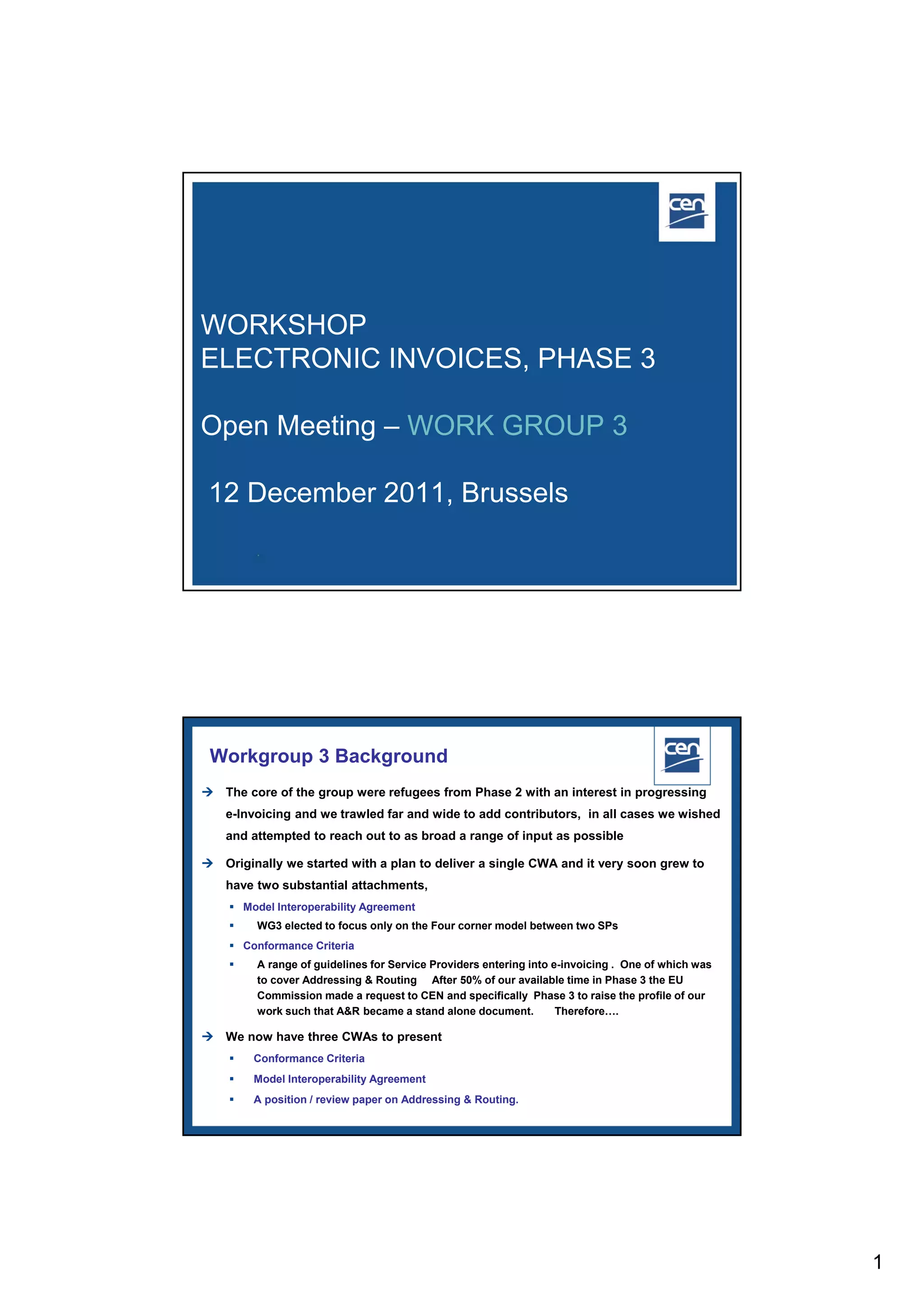
WORKSHOP
ELECTRONIC INVOICES, PHASE 3

Open Meeting – WORK GROUP 3

 12 December 2011, Brussels


 Workgroup 3 Background
 The core of the group were refugees from Phase 2 with an interest in progressing
    e-Invoicing and we trawled far and wide to add contributors, in all cases we wished
    and attempted to reach out to as broad a range of input as possible

 Originally we started with a plan to deliver a single CWA and it very soon grew to
    have two substantial attachments,
     Model Interoperability Agreement
        WG3 elected to focus only on the Four corner model between two SPs
     Conformance Criteria
        A range of guidelines for Service Providers entering into e-invoicing . One of which was
         to cover Addressing & Routing After 50% of our available time in Phase 3 the EU
         Commission made a request to CEN and specifically Phase 3 to raise the profile of our
         work such that A&R became a stand alone document.          Therefore….

 We now have three CWAs to present
       Conformance Criteria
       Model Interoperability Agreement
       A position / review paper on Addressing & Routing.
                                                                             2005 CEN – all rights reserved


                                                                                                               1
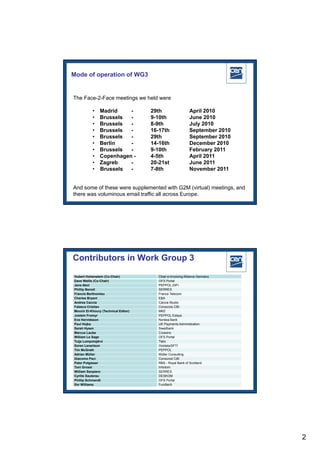
Mode of operation of WG3


The Face-2-Face meetings we held were

           •    Madrid    -           29th                  April 2010
           •    Brussels  -           9-10th                June 2010
           •    Brussels  -           8-9th                 July 2010
           •    Brussels  -           16-17th               September 2010
           •    Brussels  -           29th                  September 2010
           •    Berlin    -           14-16th               December 2010
           •    Brussels  -           9-10th                February 2011
           •    Copenhagen -          4-5th                 April 2011
           •    Zagreb    -           20-21st               June 2011
           •    Brussels  -           7-8th                 November 2011


And some of these were supplemented with G2M (virtual) meetings, and
there was voluminous email traffic all across Europe.
                                                                             2005 CEN – all rights reserved


Contributors in Work Group 3
Hubert Hohenstein (Co-Chair)            Chair e-Invoicing Alliance Germany
Dave Wallis (Co-Chair)                  OFS Portal
Jens Abol                               PEPPOL,DIFI
Phillip Benoit                          SERRES
Francis Berthomieu                      France Telecom
Charles Bryant                          EBA
Andrea Caccia                           Caccia Studio
Falasca Cristian                        Consorzio CBI
Mounir El-Khoury (Technical Editor)     MKE
Jostein Fromyr                          PEPPOL Edisys
Eva Hervidsson                          Nordea Bank
Paul Hojka                              UK Payments Administration
Sarah Hysen                             Swedbank
Marcus Laube                            Crossinx
William Le Sage                         OFS Portal
Tuija Lompolojärvi                      Tieto
Soren Lenartson                         Ooidata/SFTI
Tim McGrath                             PEPPOL
Adrian Müller                           Müller Consulting
Giacomo Paci                            Consorzio CBI
Peter Potgieser                         RBS - Royal Bank of Scotland
Toni Grossi                             Infodom
William Sanpiero                        SERRES
Cyrille Sauterau                        DESKOM
Phillip Schmandt                        OFS Portal
Ifor Williams                           Fundtech
                                                                             2005 CEN – all rights reserved


                                                                                                               2
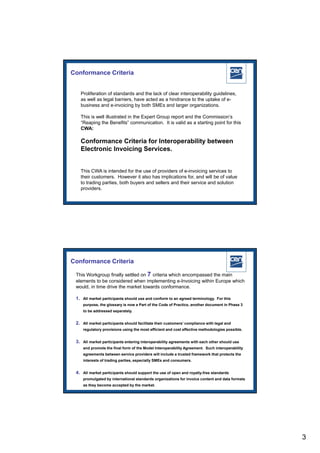
Conformance Criteria


   Proliferation of standards and the lack of clear interoperability guidelines,
   as well as legal barriers, have acted as a hindrance to the uptake of e-
   business and e-invoicing by both SMEs and larger organizations.

   This is well illustrated in the Expert Group report and the Commission’s
   “Reaping the Benefits” communication. It is valid as a starting point for this
   CWA:

   Conformance Criteria for Interoperability between
   Electronic Invoicing Services.


   This CWA is intended for the use of providers of e-invoicing services to
   their customers. However it also has implications for, and will be of value
   to trading parties, both buyers and sellers and their service and solution
   providers.

                                                                             2005 CEN – all rights reserved


Conformance Criteria

 This Workgroup finally settled on 7 criteria which encompassed the main
 elements to be considered when implementing e-Invoicing within Europe which
 would, in time drive the market towards conformance.

 1. All market participants should use and conform to an agreed terminology. For this
     purpose, the glossary is now a Part of the Code of Practice, another document in Phase 3
     to be addressed separately.


 2. All market participants should facilitate their customers’ compliance with legal and
     regulatory provisions using the most efficient and cost effective methodologies possible.


 3. All market participants entering interoperability agreements with each other should use
     and promote the final form of the Model Interoperability Agreement. Such interoperability
     agreements between service providers will include a trusted framework that protects the
     interests of trading parties, especially SMEs and consumers.


 4. All market participants should support the use of open and royalty-free standards
     promulgated by international standards organizations for invoice content and data formats
     as they become accepted by the market.
                                                                             2005 CEN – all rights reserved


                                                                                                               3
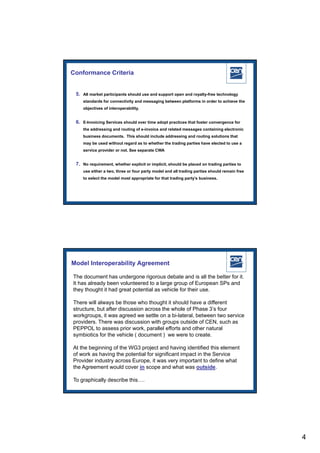
Conformance Criteria


 5. All market participants should use and support open and royalty-free technology
    standards for connectivity and messaging between platforms in order to achieve the
    objectives of interoperability.


 6. E-Invoicing Services should over time adopt practices that foster convergence for
    the addressing and routing of e-invoice and related messages containing electronic
    business documents. This should include addressing and routing solutions that
    may be used without regard as to whether the trading parties have elected to use a
    service provider or not. See separate CWA


 7. No requirement, whether explicit or implicit, should be placed on trading parties to
    use either a two, three or four party model and all trading parties should remain free
    to select the model most appropriate for that trading party’s business.


                                                                        2005 CEN – all rights reserved


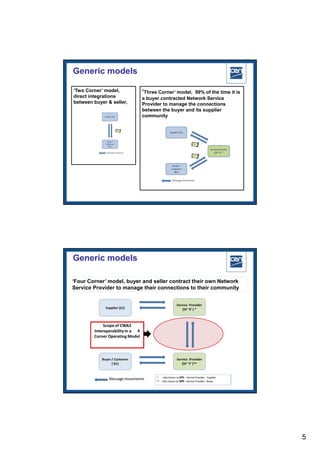
Model Interoperability Agreement

The document has undergone rigorous debate and is all the better for it.
It has already been volunteered to a large group of European SPs and
they thought it had great potential as vehicle for their use.

There will always be those who thought it should have a different
structure, but after discussion across the whole of Phase 3’s four
workgroups, it was agreed we settle on a bi-lateral, between two service
providers. There was discussion with groups outside of CEN, such as
PEPPOL to assess prior work, parallel efforts and other natural
symbiotics for the vehicle ( document ) we were to create.

At the beginning of the WG3 project and having identified this element
of work as having the potential for significant impact in the Service
Provider industry across Europe, it was very important to define what
the Agreement would cover in scope and what was outside.

To graphically describe this….
                                                                        2005 CEN – all rights reserved


                                                                                                          4
Generic models

‘Two Corner’ model,       ‘Three Corner’ model, 99% of the time it is
direct integrations       a buyer contracted Network Service
between buyer & seller,   Provider to manage the connections
                          between the buyer and its supplier
                          community


                                                        2005 CEN – all rights reserved


Generic models

‘Four Corner’ model, buyer and seller contract their own Network
Service Provider to manage their connections to their community


                                                        2005 CEN – all rights reserved


                                                                                          5
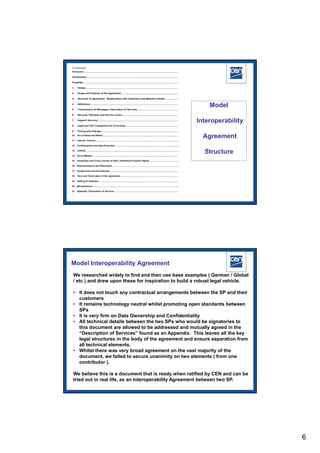
Model

                                                     Interoperability

                                                        Agreement

                                                        Structure


                                                            2005 CEN – all rights reserved


Model Interoperability Agreement
We researched widely to find and then use base examples ( German / Global
/ etc ) and drew upon these for inspiration to build a robust legal vehicle.

• It does not touch any contractual arrangements between the SP and their
  customers
• It remains technology neutral whilst promoting open standards between
  SPs
• It is very firm on Data Ownership and Confidentiality
• All technical details between the two SPs who would be signatories to
  this document are allowed to be addressed and mutually agreed in the
  “Description of Services” found as an Appendix. This leaves all the key
  legal structures in the body of the agreement and ensure separation from
  all technical elements.
• Whilst there was very broad agreement on the vast majority of the
  document, we failed to secure unanimity on two elements ( from one
  contributor ).

We believe this is a document that is ready when ratified by CEN and can be
tried out in real life, as an Interoperability Agreement between two SP.
                                                            2005 CEN – all rights reserved


                                                                                              6
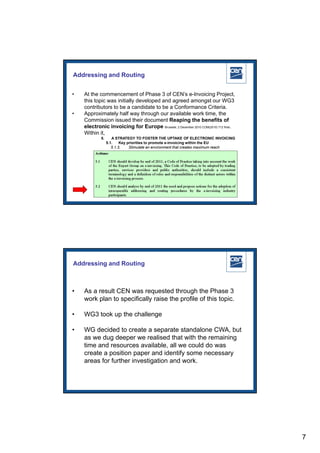
Addressing and Routing


•   At the commencement of Phase 3 of CEN’s e-Invoicing Project,
    this topic was initially developed and agreed amongst our WG3
    contributors to be a candidate to be a Conformance Criteria.
•   Approximately half way through our available work time, the
    Commission issued their document Reaping the benefits of
    electronic invoicing for Europe Brussels, 2 December 2010 COM(2010) 712 final.
    Within it,
            5.      A STRATEGY TO FOSTER THE UPTAKE OF ELECTRONIC INVOICING
                 5.1.    Key priorities to promote e-invoicing within the EU
                    5.1.3.    Stimulate an environment that creates maximum reach


                                                                      2005 CEN – all rights reserved


Addressing and Routing


•   As a result CEN was requested through the Phase 3
    work plan to specifically raise the profile of this topic.

•   WG3 took up the challenge

•   WG decided to create a separate standalone CWA, but
    as we dug deeper we realised that with the remaining
    time and resources available, all we could do was
    create a position paper and identify some necessary
    areas for further investigation and work.


                                                                      2005 CEN – all rights reserved


                                                                                                        7
Addressing and Routing


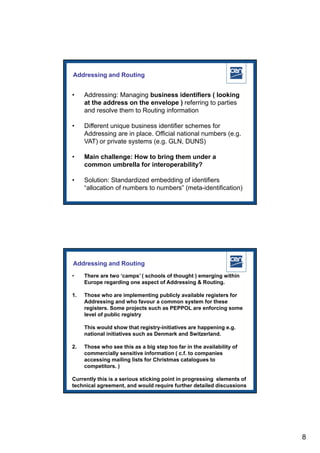
•     Addressing: Managing business identifiers ( looking
      at the address on the envelope ) referring to parties
      and resolve them to Routing information

•     Different unique business identifier schemes for
      Addressing are in place. Official national numbers (e.g.
      VAT) or private systems (e.g. GLN, DUNS)

•     Main challenge: How to bring them under a
      common umbrella for interoperability?

•     Solution: Standardized embedding of identifiers
      “allocation of numbers to numbers” (meta-identification)
                                                                      2005 CEN – all rights reserved


Addressing and Routing
•     There are two ‘camps’ ( schools of thought ) emerging within
      Europe regarding one aspect of Addressing & Routing.

1.    Those who are implementing publicly available registers for
      Addressing and who favour a common system for these
      registers. Some projects such as PEPPOL are enforcing some
      level of public registry

      This would show that registry-initiatives are happening e.g.
      national initiatives such as Denmark and Switzerland.

2.    Those who see this as a big step too far in the availability of
      commercially sensitive information ( c.f. to companies
      accessing mailing lists for Christmas catalogues to
      competitors. )

Currently this is a serious sticking point in progressing elements of
technical agreement, and would require further detailed discussions
                                                         2005 CEN – all rights reserved


                                                                                                        8
Work Group 3


      Thank you – Questions ?


                          2005 CEN – all rights reserved


                                                            9

Open meeting work group 3

  • 1.
    WORKSHOP ELECTRONIC INVOICES, PHASE3 Open Meeting – WORK GROUP 3 12 December 2011, Brussels Workgroup 3 Background  The core of the group were refugees from Phase 2 with an interest in progressing e-Invoicing and we trawled far and wide to add contributors, in all cases we wished and attempted to reach out to as broad a range of input as possible  Originally we started with a plan to deliver a single CWA and it very soon grew to have two substantial attachments,  Model Interoperability Agreement  WG3 elected to focus only on the Four corner model between two SPs  Conformance Criteria  A range of guidelines for Service Providers entering into e-invoicing . One of which was to cover Addressing & Routing After 50% of our available time in Phase 3 the EU Commission made a request to CEN and specifically Phase 3 to raise the profile of our work such that A&R became a stand alone document. Therefore….  We now have three CWAs to present  Conformance Criteria  Model Interoperability Agreement  A position / review paper on Addressing & Routing. 2005 CEN – all rights reserved 1
  • 2.
    Mode of operationof WG3 The Face-2-Face meetings we held were • Madrid - 29th April 2010 • Brussels - 9-10th June 2010 • Brussels - 8-9th July 2010 • Brussels - 16-17th September 2010 • Brussels - 29th September 2010 • Berlin - 14-16th December 2010 • Brussels - 9-10th February 2011 • Copenhagen - 4-5th April 2011 • Zagreb - 20-21st June 2011 • Brussels - 7-8th November 2011 And some of these were supplemented with G2M (virtual) meetings, and there was voluminous email traffic all across Europe. 2005 CEN – all rights reserved Contributors in Work Group 3 Hubert Hohenstein (Co-Chair) Chair e-Invoicing Alliance Germany Dave Wallis (Co-Chair) OFS Portal Jens Abol PEPPOL,DIFI Phillip Benoit SERRES Francis Berthomieu France Telecom Charles Bryant EBA Andrea Caccia Caccia Studio Falasca Cristian Consorzio CBI Mounir El-Khoury (Technical Editor) MKE Jostein Fromyr PEPPOL Edisys Eva Hervidsson Nordea Bank Paul Hojka UK Payments Administration Sarah Hysen Swedbank Marcus Laube Crossinx William Le Sage OFS Portal Tuija Lompolojärvi Tieto Soren Lenartson Ooidata/SFTI Tim McGrath PEPPOL Adrian Müller Müller Consulting Giacomo Paci Consorzio CBI Peter Potgieser RBS - Royal Bank of Scotland Toni Grossi Infodom William Sanpiero SERRES Cyrille Sauterau DESKOM Phillip Schmandt OFS Portal Ifor Williams Fundtech 2005 CEN – all rights reserved 2
  • 3.
    Conformance Criteria Proliferation of standards and the lack of clear interoperability guidelines, as well as legal barriers, have acted as a hindrance to the uptake of e- business and e-invoicing by both SMEs and larger organizations. This is well illustrated in the Expert Group report and the Commission’s “Reaping the Benefits” communication. It is valid as a starting point for this CWA: Conformance Criteria for Interoperability between Electronic Invoicing Services. This CWA is intended for the use of providers of e-invoicing services to their customers. However it also has implications for, and will be of value to trading parties, both buyers and sellers and their service and solution providers. 2005 CEN – all rights reserved Conformance Criteria This Workgroup finally settled on 7 criteria which encompassed the main elements to be considered when implementing e-Invoicing within Europe which would, in time drive the market towards conformance. 1. All market participants should use and conform to an agreed terminology. For this purpose, the glossary is now a Part of the Code of Practice, another document in Phase 3 to be addressed separately. 2. All market participants should facilitate their customers’ compliance with legal and regulatory provisions using the most efficient and cost effective methodologies possible. 3. All market participants entering interoperability agreements with each other should use and promote the final form of the Model Interoperability Agreement. Such interoperability agreements between service providers will include a trusted framework that protects the interests of trading parties, especially SMEs and consumers. 4. All market participants should support the use of open and royalty-free standards promulgated by international standards organizations for invoice content and data formats as they become accepted by the market. 2005 CEN – all rights reserved 3
  • 4.
    Conformance Criteria 5.All market participants should use and support open and royalty-free technology standards for connectivity and messaging between platforms in order to achieve the objectives of interoperability. 6. E-Invoicing Services should over time adopt practices that foster convergence for the addressing and routing of e-invoice and related messages containing electronic business documents. This should include addressing and routing solutions that may be used without regard as to whether the trading parties have elected to use a service provider or not. See separate CWA 7. No requirement, whether explicit or implicit, should be placed on trading parties to use either a two, three or four party model and all trading parties should remain free to select the model most appropriate for that trading party’s business. 2005 CEN – all rights reserved Model Interoperability Agreement The document has undergone rigorous debate and is all the better for it. It has already been volunteered to a large group of European SPs and they thought it had great potential as vehicle for their use. There will always be those who thought it should have a different structure, but after discussion across the whole of Phase 3’s four workgroups, it was agreed we settle on a bi-lateral, between two service providers. There was discussion with groups outside of CEN, such as PEPPOL to assess prior work, parallel efforts and other natural symbiotics for the vehicle ( document ) we were to create. At the beginning of the WG3 project and having identified this element of work as having the potential for significant impact in the Service Provider industry across Europe, it was very important to define what the Agreement would cover in scope and what was outside. To graphically describe this…. 2005 CEN – all rights reserved 4
  • 5.
    Generic models ‘Two Corner’model, ‘Three Corner’ model, 99% of the time it is direct integrations a buyer contracted Network Service between buyer & seller, Provider to manage the connections between the buyer and its supplier community 2005 CEN – all rights reserved Generic models ‘Four Corner’ model, buyer and seller contract their own Network Service Provider to manage their connections to their community 2005 CEN – all rights reserved 5
  • 6.
    Model Interoperability Agreement Structure 2005 CEN – all rights reserved Model Interoperability Agreement We researched widely to find and then use base examples ( German / Global / etc ) and drew upon these for inspiration to build a robust legal vehicle. • It does not touch any contractual arrangements between the SP and their customers • It remains technology neutral whilst promoting open standards between SPs • It is very firm on Data Ownership and Confidentiality • All technical details between the two SPs who would be signatories to this document are allowed to be addressed and mutually agreed in the “Description of Services” found as an Appendix. This leaves all the key legal structures in the body of the agreement and ensure separation from all technical elements. • Whilst there was very broad agreement on the vast majority of the document, we failed to secure unanimity on two elements ( from one contributor ). We believe this is a document that is ready when ratified by CEN and can be tried out in real life, as an Interoperability Agreement between two SP. 2005 CEN – all rights reserved 6
  • 7.
    Addressing and Routing • At the commencement of Phase 3 of CEN’s e-Invoicing Project, this topic was initially developed and agreed amongst our WG3 contributors to be a candidate to be a Conformance Criteria. • Approximately half way through our available work time, the Commission issued their document Reaping the benefits of electronic invoicing for Europe Brussels, 2 December 2010 COM(2010) 712 final. Within it, 5. A STRATEGY TO FOSTER THE UPTAKE OF ELECTRONIC INVOICING 5.1. Key priorities to promote e-invoicing within the EU 5.1.3. Stimulate an environment that creates maximum reach 2005 CEN – all rights reserved Addressing and Routing • As a result CEN was requested through the Phase 3 work plan to specifically raise the profile of this topic. • WG3 took up the challenge • WG decided to create a separate standalone CWA, but as we dug deeper we realised that with the remaining time and resources available, all we could do was create a position paper and identify some necessary areas for further investigation and work. 2005 CEN – all rights reserved 7
  • 8.
    Addressing and Routing • Addressing: Managing business identifiers ( looking at the address on the envelope ) referring to parties and resolve them to Routing information • Different unique business identifier schemes for Addressing are in place. Official national numbers (e.g. VAT) or private systems (e.g. GLN, DUNS) • Main challenge: How to bring them under a common umbrella for interoperability? • Solution: Standardized embedding of identifiers “allocation of numbers to numbers” (meta-identification) 2005 CEN – all rights reserved Addressing and Routing • There are two ‘camps’ ( schools of thought ) emerging within Europe regarding one aspect of Addressing & Routing. 1. Those who are implementing publicly available registers for Addressing and who favour a common system for these registers. Some projects such as PEPPOL are enforcing some level of public registry This would show that registry-initiatives are happening e.g. national initiatives such as Denmark and Switzerland. 2. Those who see this as a big step too far in the availability of commercially sensitive information ( c.f. to companies accessing mailing lists for Christmas catalogues to competitors. ) Currently this is a serious sticking point in progressing elements of technical agreement, and would require further detailed discussions 2005 CEN – all rights reserved 8
  • 9.
    Work Group 3 Thank you – Questions ? 2005 CEN – all rights reserved 9