


Six Sigma
E-DISCOVERY PROCESS IMPROVEMENT
Copyright © 2014 RainmakersVirtual College, All rights reserved.
Learning Objectives
• Overview of the Six Sigma Methodology
• Understanding the relationship between e-Discovery and technology
• The applicable rules regarding e-Discovery
• Understanding the e-Discovery Life Cycle
• Examination of how predictive coding improves efficiency
• Six Sigma and the elimination of errors during e-Discovery phases
• Six Sigma tools to improve flexibility and cycle time
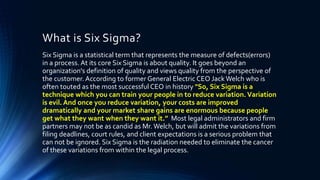
What is Six Sigma?
Six Sigma is a statistical term that represents the measure of defects(errors)
in a process. At its core Six Sigma is about quality. It goes beyond an
organization's definition of quality and views quality from the perspective of
the customer. According to former General Electric CEO JackWelch who is
often touted as the most successful CEO in history "So, Six Sigma is a
technique which you can train your people in to reduce variation. Variation
is evil. And once you reduce variation, your costs are improved
dramatically and your market share gains are enormous because people
get what they want when they want it.” Most legal administrators and firm
partners may not be as candid as Mr. Welch, but will admit the variations from
filing deadlines, court rules, and client expectations is a serious problem that
can not be ignored. Six Sigma is the radiation needed to eliminate the cancer
of these variations from within the legal process.
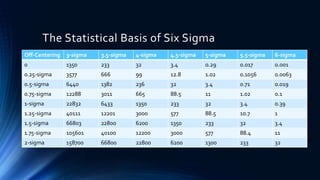
The Statistical Basis of Six Sigma
Off-Centering 3-sigma 3.5-sigma 4-sigma 4.5-sigma 5-sigma 5.5-sigma 6-sigma
0 1350 233 32 3.4 0.29 0.017 0.001
0.25-sigma 3577 666 99 12.8 1.02 0.1056 0.0063
0.5-sigma 6440 1382 236 32 3.4 0.71 0.019
0.75-sigma 12288 3011 665 88.5 11 1.02 0.1
1-sigma 22832 6433 1350 233 32 3.4 0.39
1.25-sigma 40111 12201 3000 577 88.5 10.7 1
1.5-sigma 66803 22800 6200 1350 233 32 3.4
1.75-sigma 105601 40100 12200 3000 577 88.4 11
2-sigma 158700 66800 22800 6200 1300 233 32
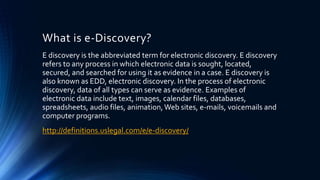
What is e-Discovery?
E discovery is the abbreviated term for electronic discovery. E discovery
refers to any process in which electronic data is sought, located,
secured, and searched for using it as evidence in a case. E discovery is
also known as EDD, electronic discovery. In the process of electronic
discovery, data of all types can serve as evidence. Examples of
electronic data include text, images, calendar files, databases,
spreadsheets, audio files, animation, Web sites, e-mails, voicemails and
computer programs.
http://definitions.uslegal.com/e/e-discovery/
Playing by the Rules
• Rule 16: Pretrial Conferences
• Rule 26: Duty to Disclose
• Rule 33: Interrogatories to Parties
• Rule 34: Electronically Stored Information
• Rule 37: Failure to Disclose/Cooperate
• Rule 45: Subpoena
• Form 35: Report of Parties Planning Meeting Pursuant to Fed. R Civ. P
26(f)
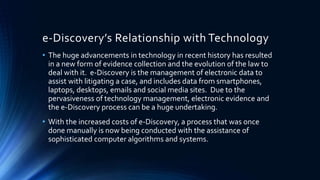
e-Discovery’s Relationship with Technology
• The huge advancements in technology in recent history has resulted
in a new form of evidence collection and the evolution of the law to
deal with it. e-Discovery is the management of electronic data to
assist with litigating a case, and includes data from smartphones,
laptops, desktops, emails and social media sites. Due to the
pervasiveness of technology management, electronic evidence and
the e-Discovery process can be a huge undertaking.
• With the increased costs of e-Discovery, a process that was once
done manually is now being conducted with the assistance of
sophisticated computer algorithms and systems.
e-Discovery and Statistical Sampling
Statistical sampling eliminates the review of evidence that is not
relevant by using confidence intervals to determine whether a certain
set of data is responsive to a pre-determined set of criteria.
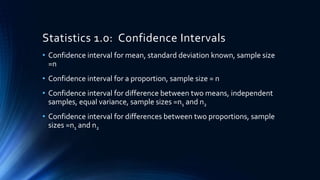
Statistics 1.0: Confidence Intervals
• Confidence interval for mean, standard deviation known, sample size
=n
• Confidence interval for a proportion, sample size = n
• Confidence interval for difference between two means, independent
samples, equal variance, sample sizes =n1 and n2
• Confidence interval for differences between two proportions, sample
sizes =n1 and n2
e-Discovery and Predictive Coding
A method that utilizes technology to digitize the human judgment that
goes into the review process of e-Discovery. This method often
incorporates statistical sampling and other algorithms to eliminate the
overreliance on personnel during certain stages of the review phase. Its
use can significantly reduce e-Discovery costs.
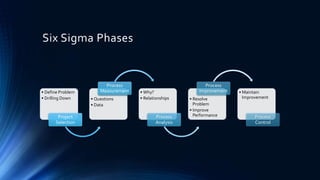
Six Sigma Phases
• Define Problem
• Drilling Down
Project
Selection
• Questions
• Data
Process
Measurement • Why?
• Relationships
Process
Analysis
• Resolve
Problem
• Improve
Performance
Process
Improvement • Maintain
Improvement
Process
Control
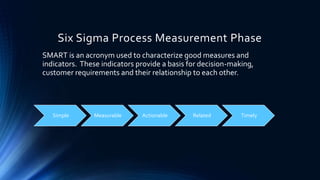
Six Sigma Process Measurement Phase
SMART is an acronym used to characterize good measures and
indicators. These indicators provide a basis for decision-making,
customer requirements and their relationship to each other.
Simple Measurable Actionable Related Timely
Six Sigma Process Analysis Phase
Analysis in Six Sigma is similar to analysis that is conducted in any other
area. Analysis is a method to determine the factors that contribute to
errors in a particular service or process.
Six Sigma Process Improvement Phase
The Six Sigma’s methodology uses the following approaches to
improve quality:
1. Flexibility-the ability to adapt quickly and effectively to changing
requirements. Many Six Sigma projects focus on improving
organizational flexibility.
2. Cycle time-The time it takes to accomplish one cycle of a process.
This approach forces improvements in quality by reducing the
potential for mistakes and errors.
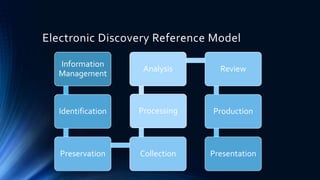
Electronic Discovery Reference Model
Information
Management
Identification
Preservation Collection
Processing
Analysis Review
Production
Presentation
e-Discovery Data Processing Phase
The processing phase includes formatting electronically stored
information that has been collected so that it can be drilled down and
searched in a review tool.
Examples of processing software include:
• Kroll Ontrack
• Recommind
• Concordance
• Kcura
e-Discovery Data Analysis Phase
During the analysis phase electronically stored information is evaluated
to determine relevant data that meets certain search criteria.
e-Discovery Data Review Phase
During this phase documents that met the search criteria determined
in the previous steps are reviewed in order to determine the documents
that will be produced. Any privileged or confidential information is
identified prior to production.
Tools to Improve Cycle Time and Flexibility
ANALYZING PROCESS MAPS
• What skills, equipment, and
tools are required at each step
of the process?
• At which points in the system
might errors occur, and how will
these errors be corrected?
• At which point(s) should quality
be measured?
KAIZEN BLITZ
• Intense and rapid improvement
• All resources thrown into an
improvement over a short time.
• Blitz teams are comprised of
employees from all areas
involved in the process.
Rainmakers On-line
Phone: 800-580-6068
Web: www.rainmakersonline.com

E discovery Process Improvement

  • 1.
    Six Sigma E-DISCOVERY PROCESSIMPROVEMENT Copyright © 2014 RainmakersVirtual College, All rights reserved.
  • 2.
    Learning Objectives • Overviewof the Six Sigma Methodology • Understanding the relationship between e-Discovery and technology • The applicable rules regarding e-Discovery • Understanding the e-Discovery Life Cycle • Examination of how predictive coding improves efficiency • Six Sigma and the elimination of errors during e-Discovery phases • Six Sigma tools to improve flexibility and cycle time
  • 3.
    What is SixSigma? Six Sigma is a statistical term that represents the measure of defects(errors) in a process. At its core Six Sigma is about quality. It goes beyond an organization's definition of quality and views quality from the perspective of the customer. According to former General Electric CEO JackWelch who is often touted as the most successful CEO in history "So, Six Sigma is a technique which you can train your people in to reduce variation. Variation is evil. And once you reduce variation, your costs are improved dramatically and your market share gains are enormous because people get what they want when they want it.” Most legal administrators and firm partners may not be as candid as Mr. Welch, but will admit the variations from filing deadlines, court rules, and client expectations is a serious problem that can not be ignored. Six Sigma is the radiation needed to eliminate the cancer of these variations from within the legal process.
  • 4.
    The Statistical Basisof Six Sigma Off-Centering 3-sigma 3.5-sigma 4-sigma 4.5-sigma 5-sigma 5.5-sigma 6-sigma 0 1350 233 32 3.4 0.29 0.017 0.001 0.25-sigma 3577 666 99 12.8 1.02 0.1056 0.0063 0.5-sigma 6440 1382 236 32 3.4 0.71 0.019 0.75-sigma 12288 3011 665 88.5 11 1.02 0.1 1-sigma 22832 6433 1350 233 32 3.4 0.39 1.25-sigma 40111 12201 3000 577 88.5 10.7 1 1.5-sigma 66803 22800 6200 1350 233 32 3.4 1.75-sigma 105601 40100 12200 3000 577 88.4 11 2-sigma 158700 66800 22800 6200 1300 233 32
  • 5.
    What is e-Discovery? Ediscovery is the abbreviated term for electronic discovery. E discovery refers to any process in which electronic data is sought, located, secured, and searched for using it as evidence in a case. E discovery is also known as EDD, electronic discovery. In the process of electronic discovery, data of all types can serve as evidence. Examples of electronic data include text, images, calendar files, databases, spreadsheets, audio files, animation, Web sites, e-mails, voicemails and computer programs. http://definitions.uslegal.com/e/e-discovery/
  • 6.
    Playing by theRules • Rule 16: Pretrial Conferences • Rule 26: Duty to Disclose • Rule 33: Interrogatories to Parties • Rule 34: Electronically Stored Information • Rule 37: Failure to Disclose/Cooperate • Rule 45: Subpoena • Form 35: Report of Parties Planning Meeting Pursuant to Fed. R Civ. P 26(f)
  • 7.
    e-Discovery’s Relationship withTechnology • The huge advancements in technology in recent history has resulted in a new form of evidence collection and the evolution of the law to deal with it. e-Discovery is the management of electronic data to assist with litigating a case, and includes data from smartphones, laptops, desktops, emails and social media sites. Due to the pervasiveness of technology management, electronic evidence and the e-Discovery process can be a huge undertaking. • With the increased costs of e-Discovery, a process that was once done manually is now being conducted with the assistance of sophisticated computer algorithms and systems.
  • 8.
    e-Discovery and StatisticalSampling Statistical sampling eliminates the review of evidence that is not relevant by using confidence intervals to determine whether a certain set of data is responsive to a pre-determined set of criteria.
  • 9.
    Statistics 1.0: ConfidenceIntervals • Confidence interval for mean, standard deviation known, sample size =n • Confidence interval for a proportion, sample size = n • Confidence interval for difference between two means, independent samples, equal variance, sample sizes =n1 and n2 • Confidence interval for differences between two proportions, sample sizes =n1 and n2
  • 10.
    e-Discovery and PredictiveCoding A method that utilizes technology to digitize the human judgment that goes into the review process of e-Discovery. This method often incorporates statistical sampling and other algorithms to eliminate the overreliance on personnel during certain stages of the review phase. Its use can significantly reduce e-Discovery costs.
  • 11.
    Six Sigma Phases •Define Problem • Drilling Down Project Selection • Questions • Data Process Measurement • Why? • Relationships Process Analysis • Resolve Problem • Improve Performance Process Improvement • Maintain Improvement Process Control
  • 12.
    Six Sigma ProcessMeasurement Phase SMART is an acronym used to characterize good measures and indicators. These indicators provide a basis for decision-making, customer requirements and their relationship to each other. Simple Measurable Actionable Related Timely
  • 13.
    Six Sigma ProcessAnalysis Phase Analysis in Six Sigma is similar to analysis that is conducted in any other area. Analysis is a method to determine the factors that contribute to errors in a particular service or process.
  • 14.
    Six Sigma ProcessImprovement Phase The Six Sigma’s methodology uses the following approaches to improve quality: 1. Flexibility-the ability to adapt quickly and effectively to changing requirements. Many Six Sigma projects focus on improving organizational flexibility. 2. Cycle time-The time it takes to accomplish one cycle of a process. This approach forces improvements in quality by reducing the potential for mistakes and errors.
  • 15.
    Electronic Discovery ReferenceModel Information Management Identification Preservation Collection Processing Analysis Review Production Presentation
  • 16.
    e-Discovery Data ProcessingPhase The processing phase includes formatting electronically stored information that has been collected so that it can be drilled down and searched in a review tool. Examples of processing software include: • Kroll Ontrack • Recommind • Concordance • Kcura
  • 17.
    e-Discovery Data AnalysisPhase During the analysis phase electronically stored information is evaluated to determine relevant data that meets certain search criteria.
  • 18.
    e-Discovery Data ReviewPhase During this phase documents that met the search criteria determined in the previous steps are reviewed in order to determine the documents that will be produced. Any privileged or confidential information is identified prior to production.
  • 19.
    Tools to ImproveCycle Time and Flexibility ANALYZING PROCESS MAPS • What skills, equipment, and tools are required at each step of the process? • At which points in the system might errors occur, and how will these errors be corrected? • At which point(s) should quality be measured? KAIZEN BLITZ • Intense and rapid improvement • All resources thrown into an improvement over a short time. • Blitz teams are comprised of employees from all areas involved in the process.
  • 20.