How to Use Print and Online Legal Resources To Your Best Advantage
West’s Instructional Aid Series
THE LEGAL RESEARCH PROCESS
CONTENTS
• Introduction
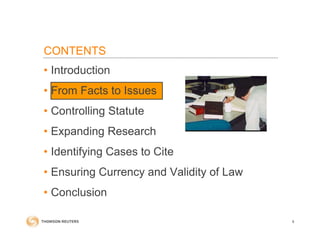
• From Facts to Issues
• Controlling Statute
• Expanding Research
• Identifying Cases to Cite
• Ensuring Currency and Validity of Law
• Conclusion
2
INTRODUCTION
“(R)esearch requires the poetic quality of the
imagination that sees significance and relation
where others are indifferent or find unrelatedness;
the synthetic quality of fusing items theretofore in
isolation; above all the prophetic quality of piercing
the future by knowing what questions to put and
what direction to give inquiry.”
Frankfurter, “The Conditions for, and the Aims and Methods
of, Legal Research,”: 15 Iowa L.Rev. 129, 134 (1930).
3
INTRODUCTION
• Legal research is an art as well as a skill. It calls for
judgment and creativity along with mastery of a set of tools
and techniques.
• Each research question will have a different starting point,
process, and conclusion.
• Every research project will include false starts, dead ends,
and revisions.
• There is never one “right” path. Researchers choosing
different paths for the same research question may be
equally successful.
• Legal research is never “finished,” but the experienced
researcher recognizes when to stop.
4
INTRODUCTION
• The starting point of research depends on the
nature of the issue, how it is presented to the
researcher, and the researcher’s experience.
• The starting point for research may be a fact
pattern, a subject, an issue, a case, or a statute.
• At the outset, determine if your research will be
exclusively in case law or if there are statutes or
regulations that should be explored.
• Determine whether your research will be primarily
in federal law or state law, or both.
5
INTRODUCTION
• Research often begins with a fact pattern. You
might be given an “on-point” case or statute, but
seldom will the facts of your research question fit
squarely with the facts of other cases or the
language of the statute.
• A client relates a narrative for which he feels
“wronged” but has no legal theory to justify or deny
compensation.
• This is when your paralegal training will come into
play. It is extremely difficult for someone untrained
in the law to translate a fact pattern into a legal
theory of recovery or defense.
6
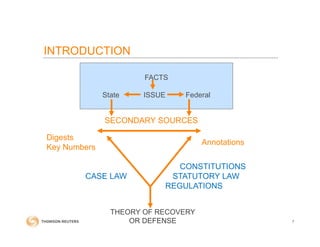
FACTS
State ISSUE Federal
FACTS
THEORY OF RECOVERY
OR DEFENSE
CASE LAW STATUTORY LAW
REGULATIONS
CONSTITUTIONS
SECONDARY SOURCES
Digests
Key Numbers
Annotations
THEORY OF RECOVERY
OR DEFENSE 7
INTRODUCTION
• Introduction
• From Facts to Issues
• Controlling Statute
• Expanding Research
• Identifying Cases to Cite
• Ensuring Currency and Validity of Law
• Conclusion
CONTENTS
8
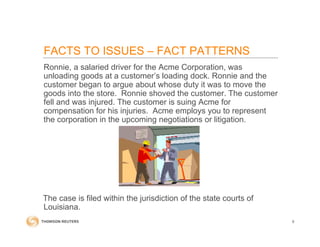
Ronnie, a salaried driver for the Acme Corporation, was
unloading goods at a customer’s loading dock. Ronnie and the
customer began to argue about whose duty it was to move the
goods into the store. Ronnie shoved the customer. The customer
fell and was injured. The customer is suing Acme for
compensation for his injuries. Acme employs you to represent
the corporation in the upcoming negotiations or litigation.
The case is filed within the jurisdiction of the state courts of
Louisiana.
9
FACTS TO ISSUES – FACT PATTERNS
• These facts must be translated into a legal issue(s).
• This is one of the hardest part of legal research for the
beginning researcher. Legal resources are seldom
organized by facts; they are organized by legal
theory.
• You will need to identify terms of art that might apply
to this situation.
• You will need to learn the “black letter” law –
statements of principles that govern the particular area
of the law. Black letter law will give shape and limits to
your research.
10
FACTS TO ISSUES – FACT PATTERNS
• The parameters of your research may later have to
be broadened, tightened, or shifted, but it is
reassuring to start out with a map of the area you
will be exploring.
• Your thinking about the legal issues presented by a
particular set of facts is likely to change as you
learn more about an area of the law. Remain
flexible.
• Once you are familiar with the relevant terms of art
and black letter law, you should be able to
articulate your issue more precisely.
11
FACTS TO ISSUES – FACT PATTERNS
• There is no right or wrong way to begin your research.
• In the past, researchers had no choice but to conduct
legal research in print resources. The last few years
have witnessed the tremendous growth of online legal
research.
• Neither is the “better” method. One might work better
than the other in this situation. You won’t know until
you get started.
• In all likelihood, you will move back and forth between
print and online resources during the research
process.
12
FACTS TO ISSUES – RESEARCHING IN
PRINT OR ONLINE?
• When confronted with an unfamiliar area of the law,
many researchers find it easier to use print resources
(such as legal encyclopedias, restatements, and
practice guides) to get an overview, set parameters,
learn the terms of art and black-letter law.
• Print materials have a satisfying way of organizing and
limiting research. They naturally set boundaries within
the law that the seemingly endless and seamless
materials of online legal materials cannot provide.
• Print materials can impart a sense of orientation, the
feeling that you have found what you need to get
started.
13
FACTS TO ISSUES – PRINT RESOURCES
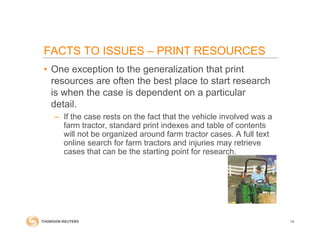
• One exception to the generalization that print
resources are often the best place to start research
is when the case is dependent on a particular
detail.
– If the case rests on the fact that the vehicle involved was a
farm tractor, standard print indexes and table of contents
will not be organized around farm tractor cases. A full text
online search for farm tractors and injuries may retrieve
cases that can be the starting point for research.
14
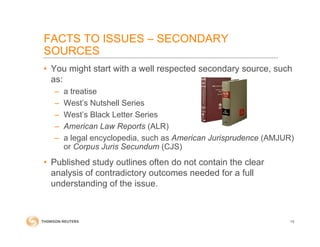
• You might start with a well respected secondary source, such
as:
– a treatise
– West’s Nutshell Series
– West’s Black Letter Series
– American Law Reports (ALR)
– a legal encyclopedia, such as American Jurisprudence (AMJUR)
or Corpus Juris Secundum (CJS)
• Published study outlines often do not contain the clear
analysis of contradictory outcomes needed for a full
understanding of the issue.
15
FACTS TO ISSUES – SECONDARY
SOURCES
FACTS TO ISSUES – SECONDARY
SOURCES
• All of the print products listed on the previous
screen are secondary sources.
• Secondary sources
– Are written by legal experts.
– Lay out general principles of law along with exceptions
and variations to that law.
– Are a source of citations to primary law (cases, statutes,
and regulations).
– May be cited to support a legal theory, especially in an
emerging or rapidly changing area of the law where there
is no primary law available.
16
FACTS TO ISSUES – SECONDARY
SOURCES
• Once you have found a secondary source or two that you
trust, check the index and table of contents.
– Many indices are designed with entry words that allow a
researcher unfamiliar with an area of the law to find the
appropriate sections.
– The hierarchy of the materials listed in the table of contents will
help you move from general to specific issues.
• What you are looking for:
– Terms of art that apply to the facts
– A statement of the generally accepted principles of law, often
called “black letter” law
– Enough understanding of the broader aspects of the issue to set
parameters for your research
17
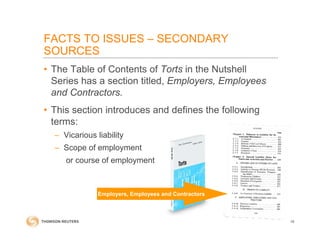
• The Table of Contents of Torts in the Nutshell
Series has a section titled, Employers, Employees
and Contractors.
• This section introduces and defines the following
terms:
– Vicarious liability
– Scope of employment
or course of employment
FACTS TO ISSUES – SECONDARY
SOURCES
18
Employers, Employees and Contractors
FACTS TO ISSUES – SECONDARY
SOURCES
19
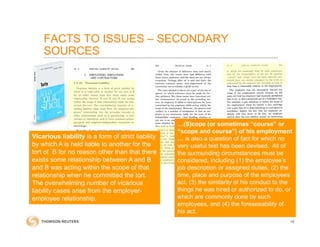
Vicarious liability is a form of strict liability
by which A is held liable to another for the
tort of B for no reason other than that there
exists some relationship between A and B
and B was acting within the scope of that
relationship when he committed the tort.
The overwhelming number of vicarious
liability cases arise from the employer-
employee relationship.
…(S)cope (or sometimes “course” or
“scope and course”) of his employment
… is also a question of fact for which no
very useful test has been devised. All of
the surrounding circumstances must be
considered, including (1) the employee’s
job description or assigned duties, (2) the
time, place and purpose of the employees
act, (3) the similarity of his conduct to the
things he was hired or authorized to do, or
which are commonly done by such
employees, and (4) the foreseeability of
his act.
FACTS TO ISSUES – SECONDARY
SOURCES
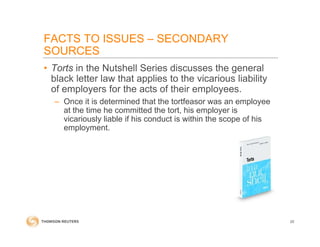
• Torts in the Nutshell Series discusses the general
black letter law that applies to the vicarious liability
of employers for the acts of their employees.
– Once it is determined that the tortfeasor was an employee
at the time he committed the tort, his employer is
vicariously liable if his conduct is within the scope of his
employment.
20
FACTS TO ISSUES
• You have found relevant terms of art and black letter
statements of the issue which enables you to determine
the focus of your research.
• The fact that the assault was an intentional act and
whether the act was in furtherance of Acme’s business
and foreseeable will be important considerations.
• You can now lay out the broad parameters of the issue
and state the issue using appropriate legal terminology.
• You must persuade the court that Ronnie’s intentional
act was outside the scope of his employment.
• You must also anticipate the arguments of your
opponent.
21
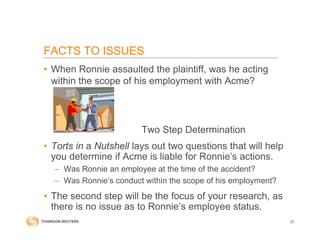
FACTS TO ISSUES
• When Ronnie assaulted the plaintiff, was he acting
within the scope of his employment with Acme?
Two Step Determination
• Torts in a Nutshell lays out two questions that will help
you determine if Acme is liable for Ronnie’s actions.
– Was Ronnie an employee at the time of the accident?
– Was Ronnie’s conduct within the scope of his employment?
• The second step will be the focus of your research, as
there is no issue as to Ronnie’s employee status.
22
• Introduction
• From Facts to Issues
• Controlling Statute
• Expanding Research
• Identifying Cases to Cite
• Ensuring Currency and Validity of Law
• Conclusion
CONTENTS
23
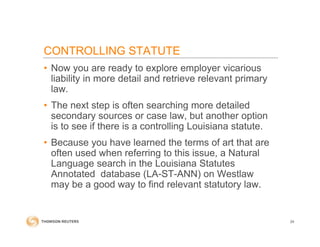
• Now you are ready to explore employer vicarious
liability in more detail and retrieve relevant primary
law.
• The next step is often searching more detailed
secondary sources or case law, but another option
is to see if there is a controlling Louisiana statute.
• Because you have learned the terms of art that are
often used when referring to this issue, a Natural
Language search in the Louisiana Statutes
Annotated database (LA-ST-ANN) on Westlaw
may be a good way to find relevant statutory law.
24
CONTROLLING STATUTE
CONTROLLING STATUTE
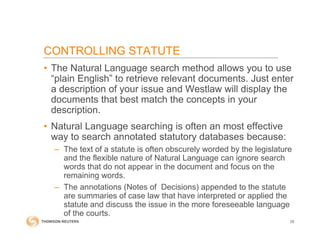
• The Natural Language search method allows you to use
“plain English” to retrieve relevant documents. Just enter
a description of your issue and Westlaw will display the
documents that best match the concepts in your
description.
• Natural Language searching is often an most effective
way to search annotated statutory databases because:
– The text of a statute is often obscurely worded by the legislature
and the flexible nature of Natural Language can ignore search
words that do not appear in the document and focus on the
remaining words.
– The annotations (Notes of Decisions) appended to the statute
are summaries of case law that have interpreted or applied the
statute and discuss the issue in the more foreseeable language
of the courts.
25
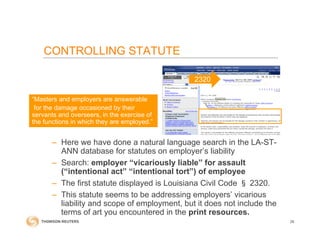
– Here we have done a natural language search in the LA-ST-
ANN database for statutes on employer’s liability
– Search: employer “vicariously liable” for assault
(“intentional act” “intentional tort”) of employee
– The first statute displayed is Louisiana Civil Code § 2320.
– This statute seems to be addressing employers’ vicarious
liability and scope of employment, but it does not include the
terms of art you encountered in the print resources.
“Masters and employers are answerable
for the damage occasioned by their
servants and overseers, in the exercise of
the functions in which they are employed.”
2320
26
CONTROLLING STATUTE
CONTROLLING STATUTE
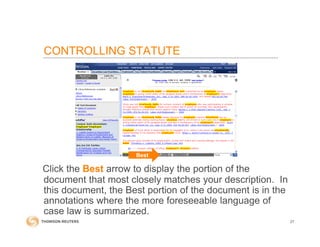
Click the Best arrow to display the portion of the
document that most closely matches your description. In
this document, the Best portion of the document is in the
annotations where the more foreseeable language of
case law is summarized.
27
Best
CONTROLLING STATUTE
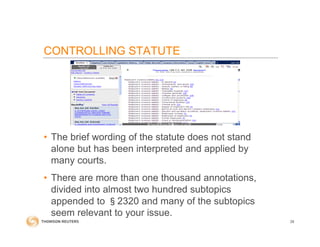
• The brief wording of the statute does not stand
alone but has been interpreted and applied by
many courts.
• There are more than one thousand annotations,
divided into almost two hundred subtopics
appended to §2320 and many of the subtopics
seem relevant to your issue.
28
CONTROLLING STATUTE
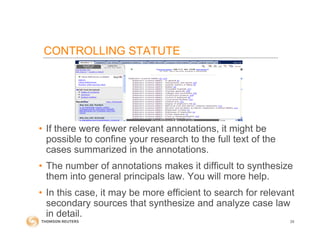
• If there were fewer relevant annotations, it might be
possible to confine your research to the full text of the
cases summarized in the annotations.
• The number of annotations makes it difficult to synthesize
them into general principals law. You will more help.
• In this case, it may be more efficient to search for relevant
secondary sources that synthesize and analyze case law
in detail.
29
CONTROLLING STATUTE
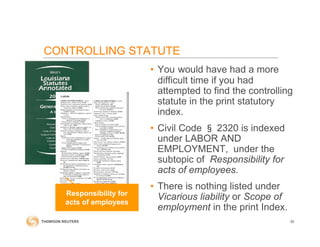
• You would have had a more
difficult time if you had
attempted to find the controlling
statute in the print statutory
index.
• Civil Code § 2320 is indexed
under LABOR AND
EMPLOYMENT, under the
subtopic of Responsibility for
acts of employees.
• There is nothing listed under
Vicarious liability or Scope of
employment in the print Index.
30
Responsibility for
acts of employees
CONTROLLING STATUTE
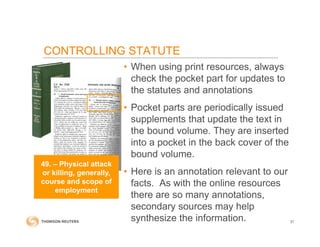
• When using print resources, always
check the pocket part for updates to
the statutes and annotations
• Pocket parts are periodically issued
supplements that update the text in
the bound volume. They are inserted
into a pocket in the back cover of the
bound volume.
• Here is an annotation relevant to our
facts. As with the online resources
there are so many annotations,
secondary sources may help
synthesize the information. 31
49. – Physical attack
or killing, generally,
course and scope of
employment
• Introduction
• From Facts to Issues
• Controlling Statute
• Expanding Research
• Identifying Cases to Cite
• Ensuring Currency and Validity of Law
• Conclusion
CONTENTS
32
• Having found the controlling statute, but being unable
to efficiently utilize the large number of annotations,
you might turn to a secondary source that will
analyze and synthesize your issue. At this point you
have two choices: you could use the terms of art and
language of the black letter law and:
– Go to a print secondary source and use the table of contents
and index to focus your research.
– Go online and search for documents containing the terms of
art.
33
EXPANDING RESEARCH
EXPANDING RESEARCH – PRINT
RESOURCES
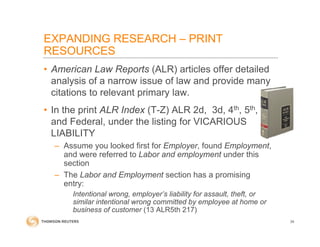
• American Law Reports (ALR) articles offer detailed
analysis of a narrow issue of law and provide many
citations to relevant primary law.
• In the print ALR Index (T-Z) ALR 2d, 3d, 4th, 5th,
and Federal, under the listing for VICARIOUS
LIABILITY
– Assume you looked first for Employer, found Employment,
and were referred to Labor and employment under this
section
– The Labor and Employment section has a promising
entry:
Intentional wrong, employer’s liability for assault, theft, or
similar intentional wrong committed by employee at home or
business of customer (13 ALR5th 217)
34
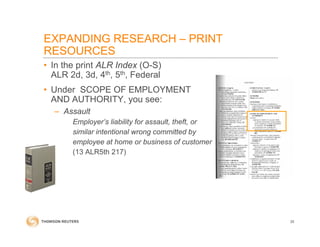
• In the print ALR Index (O-S)
ALR 2d, 3d, 4th, 5th, Federal
• Under SCOPE OF EMPLOYMENT
AND AUTHORITY, you see:
– Assault
Employer’s liability for assault, theft, or
similar intentional wrong committed by
employee at home or business of customer
(13 ALR5th 217)
EXPANDING RESEARCH – PRINT
RESOURCES
35
EXPANDING RESEARCH – PRINT
RESOURCES
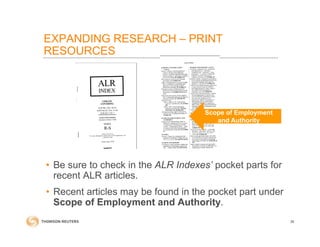
• Be sure to check in the ALR Indexes’ pocket parts for
recent ALR articles.
• Recent articles may be found in the pocket part under
Scope of Employment and Authority.
36
Scope of Employment
and Authority
EXPANDING RESEARCH – PRINT
RESOURCES
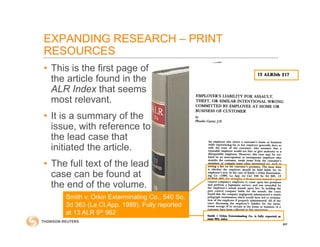
• This is the first page of
the article found in the
ALR Index that seems
most relevant.
• It is a summary of the
issue, with reference to
the lead case that
initiated the article.
• The full text of the lead
case can be found at
the end of the volume.
37
Smith v. Orkin Exterminating Co., 540 So.
2d 363 (La Ct.App. 1989). Fully reported
at 13 ALR 5th 962
EXPANDING RESEARCH – PRINT
RESOURCES
38
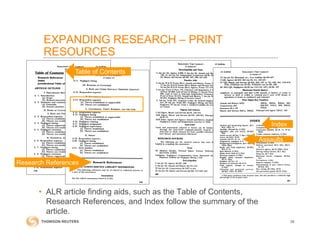
• ALR article finding aids, such as the Table of Contents,
Research References, and Index follow the summary of the
article.
Index
Assaults
Research References
Table of Contents
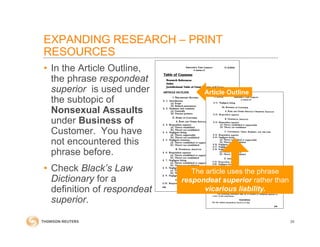
• In the Article Outline,
the phrase respondeat
superior is used under
the subtopic of
Nonsexual Assaults
under Business of
Customer. You have
not encountered this
phrase before.
• Check Black’s Law
Dictionary for a
definition of respondeat
superior.
39
Article Outline
The article uses the phrase
respondeat superior rather than
vicarious liability.
EXPANDING RESEARCH – PRINT
RESOURCES
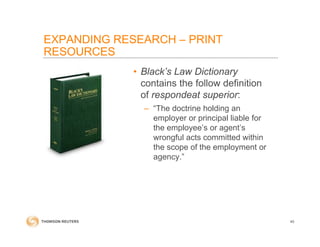
• Black’s Law Dictionary
contains the follow definition
of respondeat superior:
– “The doctrine holding an
employer or principal liable for
the employee’s or agent’s
wrongful acts committed within
the scope of the employment or
agency.”
40
EXPANDING RESEARCH – PRINT
RESOURCES
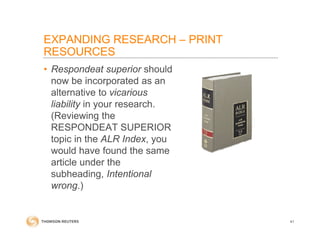
• Respondeat superior should
now be incorporated as an
alternative to vicarious
liability in your research.
(Reviewing the
RESPONDEAT SUPERIOR
topic in the ALR Index, you
would have found the same
article under the
subheading, Intentional
wrong.)
41
EXPANDING RESEARCH – PRINT
RESOURCES
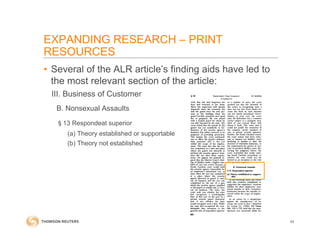
• Several of the ALR article’s finding aids have led to
the most relevant section of the article:
III. Business of Customer
B. Nonsexual Assaults
§13 Respondeat superior
(a) Theory established or supportable
(b) Theory not established
42
EXPANDING RESEARCH – PRINT
RESOURCES
43
• The article includes a Jurisdictional Table of Cited
Statutes and Cases.
• McDermott v. American Brewing is the only
Louisiana case in the table that deals with
nonsexual assault of a customer at the place of the
customer’s business.
Under Louisiana, McDermott v. American
Brewing Co - § 13 [b] (reference to
the section of the article where
McDermott is discussed).
EXPANDING RESEARCH – PRINT
RESOURCES
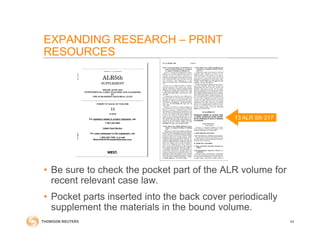
• Be sure to check the pocket part of the ALR volume for
recent relevant case law.
• Pocket parts inserted into the back cover periodically
supplement the materials in the bound volume.
44
13 ALR 5th 217
EXPANDING RESEARCH – PRINT
RESOURCES
• You could have searched first for the terms of art
on Westlaw.com.
• Many researchers use online research to update,
supplement, and confirm your print product
research.
• Whether you look for the relevant article(s) by
using the print ALR index or by searching Westlaw
is a matter of choice and economics.
45
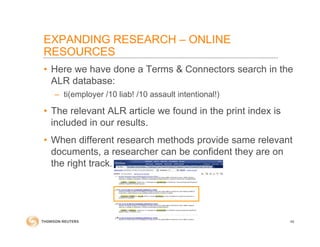
EXPANDING RESEARCH – ONLINE
RESOURCES
• Here we have done a Terms & Connectors search in the
ALR database:
– ti(employer /10 liab! /10 assault intentional!)
• The relevant ALR article we found in the print index is
included in our results.
• When different research methods provide same relevant
documents, a researcher can be confident they are on
the right track.
46
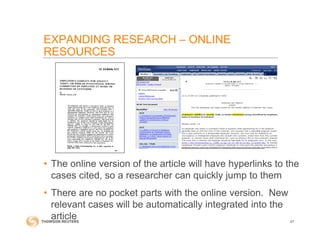
EXPANDING RESEARCH – ONLINE
RESOURCES
• The online version of the article will have hyperlinks to the
cases cited, so a researcher can quickly jump to them
• There are no pocket parts with the online version. New
relevant cases will be automatically integrated into the
article 47
EXPANDING RESEARCH – ONLINE
RESOURCES
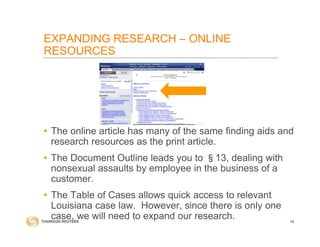
EXPANDING RESEARCH – ONLINE
RESOURCES
• The online article has many of the same finding aids and
research resources as the print article.
• The Document Outline leads you to §13, dealing with
nonsexual assaults by employee in the business of a
customer.
• The Table of Cases allows quick access to relevant
Louisiana case law. However, since there is only one
case, we will need to expand our research. 48
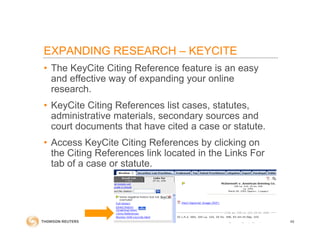
• The KeyCite Citing Reference feature is an easy
and effective way of expanding your online
research.
• KeyCite Citing References list cases, statutes,
administrative materials, secondary sources and
court documents that have cited a case or statute.
• Access KeyCite Citing References by clicking on
the Citing References link located in the Links For
tab of a case or statute.
49
EXPANDING RESEARCH – KEYCITE
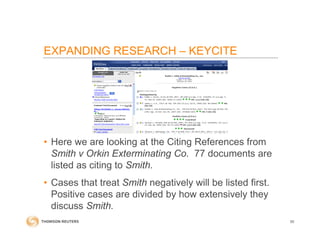
• Here we are looking at the Citing References from
Smith v Orkin Exterminating Co. 77 documents are
listed as citing to Smith.
• Cases that treat Smith negatively will be listed first.
Positive cases are divided by how extensively they
discuss Smith.
50
EXPANDING RESEARCH – KEYCITE
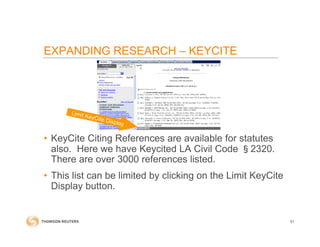
• KeyCite Citing References are available for statutes
also. Here we have Keycited LA Civil Code §2320.
There are over 3000 references listed.
• This list can be limited by clicking on the Limit KeyCite
Display button.
51
EXPANDING RESEARCH – KEYCITE
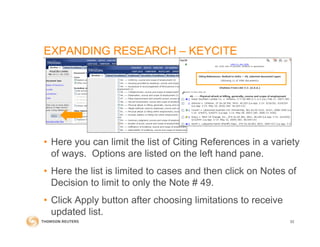
• Here you can limit the list of Citing References in a variety
of ways. Options are listed on the left hand pane.
• Here the list is limited to cases and then click on Notes of
Decision to limit to only the Note # 49.
• Click Apply button after choosing limitations to receive
updated list.
52
• Introduction
• From Facts to Issues
• Controlling Statute
• Expanding Research
• Identifying Cases to Cite
• Ensuring Currency and Validity of Law
• Conclusion
CONTENTS
53
• Section 13 of the ALR article analyzes some of the factors
that courts have considered when determining whether an
employee acted within the scope of his employment when
committing a nonsexual assault at the business of a
customer. They include:
– Did the act further the employer’s business in any way, even if not
in the manner or method authorized?
– Was the act related to employee’s duties and incident to the
performance of the employee’s duties?
– Had the business purpose of the interaction between the employee
and customer been completed?
– Did the action arise out of a job dispute, or was the assault in
pursuit of private purposes or grievance?
– Did the employee’s duties contemplate the use of force?
54
IDENTIFYING CASES
IDENTIFYING CASES
• You will need to align these factors with the
circumstances that surrounded Ronnie’s assault of the
customer.
• You could argue that Acme is not liable because
– Ronnie’s job did not contemplate assault.
– Ronnie’s job was over when he unloaded the goods on the loading
dock. It was not necessary for him to pursue the argument to complete
his delivery.
– Ronnie was pursuing a private grievance.
• But the plaintiff is likely to that Acme is liable because
– the assault arose out a job dispute and was not personal.
– Ronnie’s job was not over, as he remained on the customer’s loading
dock.
– the assault furthered Acme’s business in that its purpose was to
deliver the goods to a customer.
55
IDENTIFYING CASES – KEY NUMBERS
• You will want to identify relevant cases through sources
other than the ALR article to verify that you are using
the most relevant cases and the strongest arguments.
• Key Number Digests are one option of identifying cases
with similar issues. The digests organize the law into
approximately 400 broad topics divided into
approximately 100,000 narrow issues of law, each
assigned to a specific key number.
• The McDermott case that is cited in the ALR has only
one headnote. That headnote is assigned to
231Hk3056(2).
56
IDENTIFYING CASES – PRINT DIGEST
• If you were to find Louisiana cases by topic and
key number in the print Louisiana Digest you would
need to check the digest’s pocket part for the most
recent cases.
• Louisiana cases have the most precedential value,
but the reasoning of courts in other jurisdictions
may be persuasive. Topic and key numbers remain
constant across jurisdictions.
57
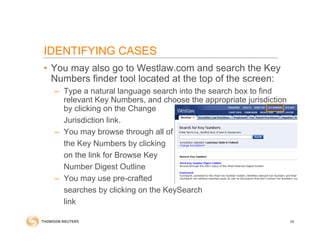
• You may also go to Westlaw.com and search the Key
Numbers finder tool located at the top of the screen:
– Type a natural language search into the search box to find
relevant Key Numbers, and choose the appropriate jurisdiction
by clicking on the Change
Jurisdiction link.
– You may browse through all of
the Key Numbers by clicking
on the link for Browse Key
Number Digest Outline
– You may use pre-crafted
searches by clicking on the KeySearch
link
58
IDENTIFYING CASES
IDENTIFYING CASES
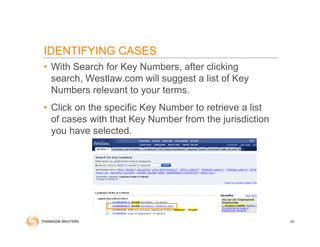
• With Search for Key Numbers, after clicking
search, Westlaw.com will suggest a list of Key
Numbers relevant to your terms.
• Click on the specific Key Number to retrieve a list
of cases with that Key Number from the jurisdiction
you have selected.
59
IDENTIFYING CASES
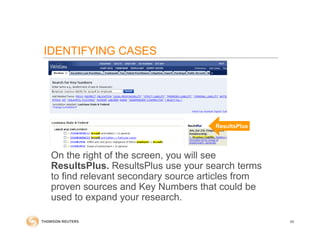
On the right of the screen, you will see
ResultsPlus. ResultsPlus use your search terms
to find relevant secondary source articles from
proven sources and Key Numbers that could be
used to expand your research.
60
ResultsPlus
IDENTIFYING CASES
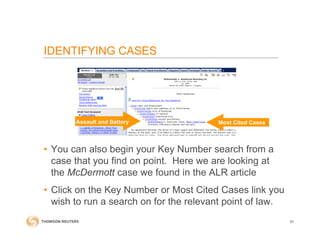
• You can also begin your Key Number search from a
case that you find on point. Here we are looking at
the McDermott case we found in the ALR article
• Click on the Key Number or Most Cited Cases link you
wish to run a search on for the relevant point of law.
61
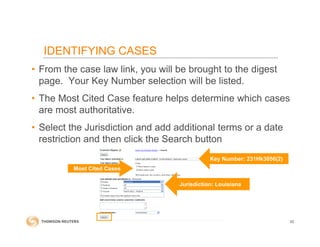
Assault and Battery Most Cited Cases
• From the case law link, you will be brought to the digest
page. Your Key Number selection will be listed.
• The Most Cited Case feature helps determine which cases
are most authoritative.
• Select the Jurisdiction and add additional terms or a date
restriction and then click the Search button
IDENTIFYING CASES
62
Most Cited Cases
Key Number: 231Hk3056(2)
Jurisdiction: Louisiana
IDENTIFYING CASES
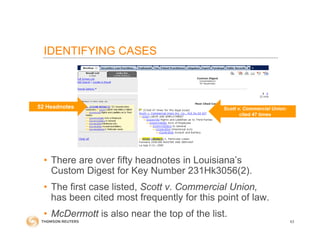
• There are over fifty headnotes in Louisiana’s
Custom Digest for Key Number 231Hk3056(2).
• The first case listed, Scott v. Commercial Union,
has been cited most frequently for this point of law.
• McDermott is also near the top of the list.
63
52 Headnotes Scott v. Commercial Union:
cited 47 times
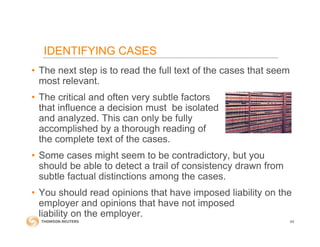
• The next step is to read the full text of the cases that seem
most relevant.
• The critical and often very subtle factors
that influence a decision must be isolated
and analyzed. This can only be fully
accomplished by a thorough reading of
the complete text of the cases.
• Some cases might seem to be contradictory, but you
should be able to detect a trail of consistency drawn from
subtle factual distinctions among the cases.
• You should read opinions that have imposed liability on the
employer and opinions that have not imposed
liability on the employer.
64
IDENTIFYING CASES
IDENTIFYING CASES
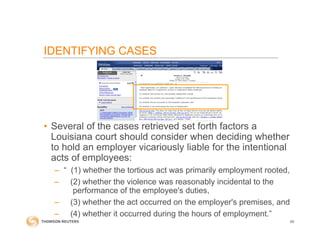
• Several of the cases retrieved set forth factors a
Louisiana court should consider when deciding whether
to hold an employer vicariously liable for the intentional
acts of employees:
– “ (1) whether the tortious act was primarily employment rooted,
– (2) whether the violence was reasonably incidental to the
performance of the employee's duties,
– (3) whether the act occurred on the employer's premises, and
– (4) whether it occurred during the hours of employment.”
65
• Introduction
• From Facts to Issues
• Controlling Statute
• Expanding Research
• Identifying Cases to Cite
• Ensuring Currency and Validity of Law
• Conclusion
CONTENTS
66
CURRENCY & VALIDITY
• Once you have found the relevant cases and
statutes, you must determine the current status of
the law.
• Check the validity of any relevant case or statute
before continuing your research.
• A case may be reversed, vacated, remanded or
overruled.
• A statute may be repealed, amended, declared
unconstitutional, or preempted.
67
CURRENCY & VALIDITY – KEYCITE
HISTORY
• Online citators have distinct advantages over print
citators:
– There is a single source of information.
• Checking the validity of a case in print citators involves
checking in multiple volumes and updating pamphlets.
– Online citators are extremely current.
• Print citators cannot be as current due to the necessity of
printing and mailing updating pamphlets.
• KeyCite is the citation research service available
on Westlaw.
68
CURRENCY & VALIDITY – KEYCITE
HISTORY
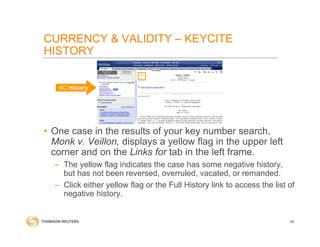
• One case in the results of your key number search,
Monk v. Veillon, displays a yellow flag in the upper left
corner and on the Links for tab in the left frame.
– The yellow flag indicates the case has some negative history,
but has not been reversed, overruled, vacated, or remanded.
– Click either yellow flag or the Full History link to access the list of
negative history.
69
KC History
CURRENCY & VALIDITY – KEYCITE
HISTORY
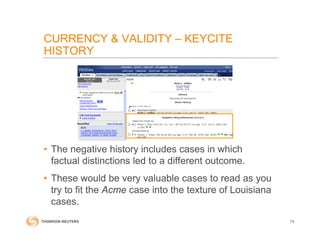
• The negative history includes cases in which
factual distinctions led to a different outcome.
• These would be very valuable cases to read as you
try to fit the Acme case into the texture of Louisiana
cases.
70
CURRENCY & VALIDITY – KEYCITE
HISTORY
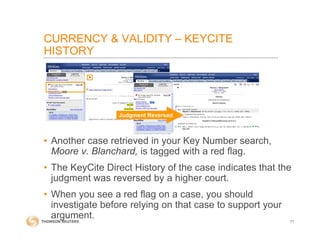
• Another case retrieved in your Key Number search,
Moore v. Blanchard, is tagged with a red flag.
• The KeyCite Direct History of the case indicates that the
judgment was reversed by a higher court.
• When you see a red flag on a case, you should
investigate before relying on that case to support your
argument. 71
Judgment Reversed
• Introduction
• From Facts to Issues
• Controlling Statute
• Expanding Research
• Identifying Cases to Cite
• Ensuring Currency and Validity of Law
• Conclusion
72
CONTENTS
CONCLUSION
• You have done the research and you feel confident of
your understanding of the issue.
• You have isolated the most relevant articles, cases,
statutes, and key numbers that were found by different
methods of research and which cross reference one
another.
• You have carefully read and analyzed relevant
Louisiana law.
• You have ensured the cases you are relying on are
good law.
• You can support your position with references to primary
law and secondary sources, and counter the arguments
likely to be presented by opposing counsel
73
• The Loop Rule
– When you start to see the same documents and citations
over and over, you should probably realize you are done,
especially if you have used the research products of more
than one publisher
• The Economic Analysis or Diminishing Return Rule
– When you are investing more in your research than you
are getting in return
• The Zen Rule
– When you have been working in an area of the law for a
long time, you will be so familiar with the primary and
secondary law you will have become an expert and will
know when to stop.
74
1JOHNSON, ET AL., WINNING RESEARCH SKILLS, West Group, 2002
CONCLUSION – KNOWING WHEN TO
STOP1
CONCLUSION
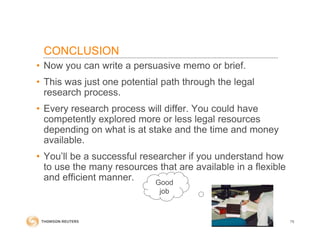
• Now you can write a persuasive memo or brief.
• This was just one potential path through the legal
research process.
• Every research process will differ. You could have
competently explored more or less legal resources
depending on what is at stake and the time and money
available.
• You’ll be a successful researcher if you understand how
to use the many resources that are available in a flexible
and efficient manner.
75
Good
job

Westlaw Research Strategies

  • 1.
    How to UsePrint and Online Legal Resources To Your Best Advantage West’s Instructional Aid Series THE LEGAL RESEARCH PROCESS
  • 2.
    CONTENTS • Introduction • FromFacts to Issues • Controlling Statute • Expanding Research • Identifying Cases to Cite • Ensuring Currency and Validity of Law • Conclusion 2
  • 3.
    INTRODUCTION “(R)esearch requires thepoetic quality of the imagination that sees significance and relation where others are indifferent or find unrelatedness; the synthetic quality of fusing items theretofore in isolation; above all the prophetic quality of piercing the future by knowing what questions to put and what direction to give inquiry.” Frankfurter, “The Conditions for, and the Aims and Methods of, Legal Research,”: 15 Iowa L.Rev. 129, 134 (1930). 3
  • 4.
    INTRODUCTION • Legal researchis an art as well as a skill. It calls for judgment and creativity along with mastery of a set of tools and techniques. • Each research question will have a different starting point, process, and conclusion. • Every research project will include false starts, dead ends, and revisions. • There is never one “right” path. Researchers choosing different paths for the same research question may be equally successful. • Legal research is never “finished,” but the experienced researcher recognizes when to stop. 4
  • 5.
    INTRODUCTION • The startingpoint of research depends on the nature of the issue, how it is presented to the researcher, and the researcher’s experience. • The starting point for research may be a fact pattern, a subject, an issue, a case, or a statute. • At the outset, determine if your research will be exclusively in case law or if there are statutes or regulations that should be explored. • Determine whether your research will be primarily in federal law or state law, or both. 5
  • 6.
    INTRODUCTION • Research oftenbegins with a fact pattern. You might be given an “on-point” case or statute, but seldom will the facts of your research question fit squarely with the facts of other cases or the language of the statute. • A client relates a narrative for which he feels “wronged” but has no legal theory to justify or deny compensation. • This is when your paralegal training will come into play. It is extremely difficult for someone untrained in the law to translate a fact pattern into a legal theory of recovery or defense. 6
  • 7.
    FACTS State ISSUE Federal FACTS THEORYOF RECOVERY OR DEFENSE CASE LAW STATUTORY LAW REGULATIONS CONSTITUTIONS SECONDARY SOURCES Digests Key Numbers Annotations THEORY OF RECOVERY OR DEFENSE 7 INTRODUCTION
  • 8.
    • Introduction • FromFacts to Issues • Controlling Statute • Expanding Research • Identifying Cases to Cite • Ensuring Currency and Validity of Law • Conclusion CONTENTS 8
  • 9.
    Ronnie, a salarieddriver for the Acme Corporation, was unloading goods at a customer’s loading dock. Ronnie and the customer began to argue about whose duty it was to move the goods into the store. Ronnie shoved the customer. The customer fell and was injured. The customer is suing Acme for compensation for his injuries. Acme employs you to represent the corporation in the upcoming negotiations or litigation. The case is filed within the jurisdiction of the state courts of Louisiana. 9 FACTS TO ISSUES – FACT PATTERNS
  • 10.
    • These factsmust be translated into a legal issue(s). • This is one of the hardest part of legal research for the beginning researcher. Legal resources are seldom organized by facts; they are organized by legal theory. • You will need to identify terms of art that might apply to this situation. • You will need to learn the “black letter” law – statements of principles that govern the particular area of the law. Black letter law will give shape and limits to your research. 10 FACTS TO ISSUES – FACT PATTERNS
  • 11.
    • The parametersof your research may later have to be broadened, tightened, or shifted, but it is reassuring to start out with a map of the area you will be exploring. • Your thinking about the legal issues presented by a particular set of facts is likely to change as you learn more about an area of the law. Remain flexible. • Once you are familiar with the relevant terms of art and black letter law, you should be able to articulate your issue more precisely. 11 FACTS TO ISSUES – FACT PATTERNS
  • 12.
    • There isno right or wrong way to begin your research. • In the past, researchers had no choice but to conduct legal research in print resources. The last few years have witnessed the tremendous growth of online legal research. • Neither is the “better” method. One might work better than the other in this situation. You won’t know until you get started. • In all likelihood, you will move back and forth between print and online resources during the research process. 12 FACTS TO ISSUES – RESEARCHING IN PRINT OR ONLINE?
  • 13.
    • When confrontedwith an unfamiliar area of the law, many researchers find it easier to use print resources (such as legal encyclopedias, restatements, and practice guides) to get an overview, set parameters, learn the terms of art and black-letter law. • Print materials have a satisfying way of organizing and limiting research. They naturally set boundaries within the law that the seemingly endless and seamless materials of online legal materials cannot provide. • Print materials can impart a sense of orientation, the feeling that you have found what you need to get started. 13 FACTS TO ISSUES – PRINT RESOURCES
  • 14.
    FACTS TO ISSUES– PRINT RESOURCES • One exception to the generalization that print resources are often the best place to start research is when the case is dependent on a particular detail. – If the case rests on the fact that the vehicle involved was a farm tractor, standard print indexes and table of contents will not be organized around farm tractor cases. A full text online search for farm tractors and injuries may retrieve cases that can be the starting point for research. 14
  • 15.
    • You mightstart with a well respected secondary source, such as: – a treatise – West’s Nutshell Series – West’s Black Letter Series – American Law Reports (ALR) – a legal encyclopedia, such as American Jurisprudence (AMJUR) or Corpus Juris Secundum (CJS) • Published study outlines often do not contain the clear analysis of contradictory outcomes needed for a full understanding of the issue. 15 FACTS TO ISSUES – SECONDARY SOURCES
  • 16.
    FACTS TO ISSUES– SECONDARY SOURCES • All of the print products listed on the previous screen are secondary sources. • Secondary sources – Are written by legal experts. – Lay out general principles of law along with exceptions and variations to that law. – Are a source of citations to primary law (cases, statutes, and regulations). – May be cited to support a legal theory, especially in an emerging or rapidly changing area of the law where there is no primary law available. 16
  • 17.
    FACTS TO ISSUES– SECONDARY SOURCES • Once you have found a secondary source or two that you trust, check the index and table of contents. – Many indices are designed with entry words that allow a researcher unfamiliar with an area of the law to find the appropriate sections. – The hierarchy of the materials listed in the table of contents will help you move from general to specific issues. • What you are looking for: – Terms of art that apply to the facts – A statement of the generally accepted principles of law, often called “black letter” law – Enough understanding of the broader aspects of the issue to set parameters for your research 17
  • 18.
    • The Tableof Contents of Torts in the Nutshell Series has a section titled, Employers, Employees and Contractors. • This section introduces and defines the following terms: – Vicarious liability – Scope of employment or course of employment FACTS TO ISSUES – SECONDARY SOURCES 18 Employers, Employees and Contractors
  • 19.
    FACTS TO ISSUES– SECONDARY SOURCES 19 Vicarious liability is a form of strict liability by which A is held liable to another for the tort of B for no reason other than that there exists some relationship between A and B and B was acting within the scope of that relationship when he committed the tort. The overwhelming number of vicarious liability cases arise from the employer- employee relationship. …(S)cope (or sometimes “course” or “scope and course”) of his employment … is also a question of fact for which no very useful test has been devised. All of the surrounding circumstances must be considered, including (1) the employee’s job description or assigned duties, (2) the time, place and purpose of the employees act, (3) the similarity of his conduct to the things he was hired or authorized to do, or which are commonly done by such employees, and (4) the foreseeability of his act.
  • 20.
    FACTS TO ISSUES– SECONDARY SOURCES • Torts in the Nutshell Series discusses the general black letter law that applies to the vicarious liability of employers for the acts of their employees. – Once it is determined that the tortfeasor was an employee at the time he committed the tort, his employer is vicariously liable if his conduct is within the scope of his employment. 20
  • 21.
    FACTS TO ISSUES •You have found relevant terms of art and black letter statements of the issue which enables you to determine the focus of your research. • The fact that the assault was an intentional act and whether the act was in furtherance of Acme’s business and foreseeable will be important considerations. • You can now lay out the broad parameters of the issue and state the issue using appropriate legal terminology. • You must persuade the court that Ronnie’s intentional act was outside the scope of his employment. • You must also anticipate the arguments of your opponent. 21
  • 22.
    FACTS TO ISSUES •When Ronnie assaulted the plaintiff, was he acting within the scope of his employment with Acme? Two Step Determination • Torts in a Nutshell lays out two questions that will help you determine if Acme is liable for Ronnie’s actions. – Was Ronnie an employee at the time of the accident? – Was Ronnie’s conduct within the scope of his employment? • The second step will be the focus of your research, as there is no issue as to Ronnie’s employee status. 22
  • 23.
    • Introduction • FromFacts to Issues • Controlling Statute • Expanding Research • Identifying Cases to Cite • Ensuring Currency and Validity of Law • Conclusion CONTENTS 23
  • 24.
    • Now youare ready to explore employer vicarious liability in more detail and retrieve relevant primary law. • The next step is often searching more detailed secondary sources or case law, but another option is to see if there is a controlling Louisiana statute. • Because you have learned the terms of art that are often used when referring to this issue, a Natural Language search in the Louisiana Statutes Annotated database (LA-ST-ANN) on Westlaw may be a good way to find relevant statutory law. 24 CONTROLLING STATUTE
  • 25.
    CONTROLLING STATUTE • TheNatural Language search method allows you to use “plain English” to retrieve relevant documents. Just enter a description of your issue and Westlaw will display the documents that best match the concepts in your description. • Natural Language searching is often an most effective way to search annotated statutory databases because: – The text of a statute is often obscurely worded by the legislature and the flexible nature of Natural Language can ignore search words that do not appear in the document and focus on the remaining words. – The annotations (Notes of Decisions) appended to the statute are summaries of case law that have interpreted or applied the statute and discuss the issue in the more foreseeable language of the courts. 25
  • 26.
    – Here wehave done a natural language search in the LA-ST- ANN database for statutes on employer’s liability – Search: employer “vicariously liable” for assault (“intentional act” “intentional tort”) of employee – The first statute displayed is Louisiana Civil Code § 2320. – This statute seems to be addressing employers’ vicarious liability and scope of employment, but it does not include the terms of art you encountered in the print resources. “Masters and employers are answerable for the damage occasioned by their servants and overseers, in the exercise of the functions in which they are employed.” 2320 26 CONTROLLING STATUTE
  • 27.
    CONTROLLING STATUTE Click theBest arrow to display the portion of the document that most closely matches your description. In this document, the Best portion of the document is in the annotations where the more foreseeable language of case law is summarized. 27 Best
  • 28.
    CONTROLLING STATUTE • Thebrief wording of the statute does not stand alone but has been interpreted and applied by many courts. • There are more than one thousand annotations, divided into almost two hundred subtopics appended to §2320 and many of the subtopics seem relevant to your issue. 28
  • 29.
    CONTROLLING STATUTE • Ifthere were fewer relevant annotations, it might be possible to confine your research to the full text of the cases summarized in the annotations. • The number of annotations makes it difficult to synthesize them into general principals law. You will more help. • In this case, it may be more efficient to search for relevant secondary sources that synthesize and analyze case law in detail. 29
  • 30.
    CONTROLLING STATUTE • Youwould have had a more difficult time if you had attempted to find the controlling statute in the print statutory index. • Civil Code § 2320 is indexed under LABOR AND EMPLOYMENT, under the subtopic of Responsibility for acts of employees. • There is nothing listed under Vicarious liability or Scope of employment in the print Index. 30 Responsibility for acts of employees
  • 31.
    CONTROLLING STATUTE • Whenusing print resources, always check the pocket part for updates to the statutes and annotations • Pocket parts are periodically issued supplements that update the text in the bound volume. They are inserted into a pocket in the back cover of the bound volume. • Here is an annotation relevant to our facts. As with the online resources there are so many annotations, secondary sources may help synthesize the information. 31 49. – Physical attack or killing, generally, course and scope of employment
  • 32.
    • Introduction • FromFacts to Issues • Controlling Statute • Expanding Research • Identifying Cases to Cite • Ensuring Currency and Validity of Law • Conclusion CONTENTS 32
  • 33.
    • Having foundthe controlling statute, but being unable to efficiently utilize the large number of annotations, you might turn to a secondary source that will analyze and synthesize your issue. At this point you have two choices: you could use the terms of art and language of the black letter law and: – Go to a print secondary source and use the table of contents and index to focus your research. – Go online and search for documents containing the terms of art. 33 EXPANDING RESEARCH
  • 34.
    EXPANDING RESEARCH –PRINT RESOURCES • American Law Reports (ALR) articles offer detailed analysis of a narrow issue of law and provide many citations to relevant primary law. • In the print ALR Index (T-Z) ALR 2d, 3d, 4th, 5th, and Federal, under the listing for VICARIOUS LIABILITY – Assume you looked first for Employer, found Employment, and were referred to Labor and employment under this section – The Labor and Employment section has a promising entry: Intentional wrong, employer’s liability for assault, theft, or similar intentional wrong committed by employee at home or business of customer (13 ALR5th 217) 34
  • 35.
    • In theprint ALR Index (O-S) ALR 2d, 3d, 4th, 5th, Federal • Under SCOPE OF EMPLOYMENT AND AUTHORITY, you see: – Assault Employer’s liability for assault, theft, or similar intentional wrong committed by employee at home or business of customer (13 ALR5th 217) EXPANDING RESEARCH – PRINT RESOURCES 35
  • 36.
    EXPANDING RESEARCH –PRINT RESOURCES • Be sure to check in the ALR Indexes’ pocket parts for recent ALR articles. • Recent articles may be found in the pocket part under Scope of Employment and Authority. 36 Scope of Employment and Authority
  • 37.
    EXPANDING RESEARCH –PRINT RESOURCES • This is the first page of the article found in the ALR Index that seems most relevant. • It is a summary of the issue, with reference to the lead case that initiated the article. • The full text of the lead case can be found at the end of the volume. 37 Smith v. Orkin Exterminating Co., 540 So. 2d 363 (La Ct.App. 1989). Fully reported at 13 ALR 5th 962
  • 38.
    EXPANDING RESEARCH –PRINT RESOURCES 38 • ALR article finding aids, such as the Table of Contents, Research References, and Index follow the summary of the article. Index Assaults Research References Table of Contents
  • 39.
    • In theArticle Outline, the phrase respondeat superior is used under the subtopic of Nonsexual Assaults under Business of Customer. You have not encountered this phrase before. • Check Black’s Law Dictionary for a definition of respondeat superior. 39 Article Outline The article uses the phrase respondeat superior rather than vicarious liability. EXPANDING RESEARCH – PRINT RESOURCES
  • 40.
    • Black’s LawDictionary contains the follow definition of respondeat superior: – “The doctrine holding an employer or principal liable for the employee’s or agent’s wrongful acts committed within the scope of the employment or agency.” 40 EXPANDING RESEARCH – PRINT RESOURCES
  • 41.
    • Respondeat superiorshould now be incorporated as an alternative to vicarious liability in your research. (Reviewing the RESPONDEAT SUPERIOR topic in the ALR Index, you would have found the same article under the subheading, Intentional wrong.) 41 EXPANDING RESEARCH – PRINT RESOURCES
  • 42.
    • Several ofthe ALR article’s finding aids have led to the most relevant section of the article: III. Business of Customer B. Nonsexual Assaults §13 Respondeat superior (a) Theory established or supportable (b) Theory not established 42 EXPANDING RESEARCH – PRINT RESOURCES
  • 43.
    43 • The articleincludes a Jurisdictional Table of Cited Statutes and Cases. • McDermott v. American Brewing is the only Louisiana case in the table that deals with nonsexual assault of a customer at the place of the customer’s business. Under Louisiana, McDermott v. American Brewing Co - § 13 [b] (reference to the section of the article where McDermott is discussed). EXPANDING RESEARCH – PRINT RESOURCES
  • 44.
    • Be sureto check the pocket part of the ALR volume for recent relevant case law. • Pocket parts inserted into the back cover periodically supplement the materials in the bound volume. 44 13 ALR 5th 217 EXPANDING RESEARCH – PRINT RESOURCES
  • 45.
    • You couldhave searched first for the terms of art on Westlaw.com. • Many researchers use online research to update, supplement, and confirm your print product research. • Whether you look for the relevant article(s) by using the print ALR index or by searching Westlaw is a matter of choice and economics. 45 EXPANDING RESEARCH – ONLINE RESOURCES
  • 46.
    • Here wehave done a Terms & Connectors search in the ALR database: – ti(employer /10 liab! /10 assault intentional!) • The relevant ALR article we found in the print index is included in our results. • When different research methods provide same relevant documents, a researcher can be confident they are on the right track. 46 EXPANDING RESEARCH – ONLINE RESOURCES
  • 47.
    • The onlineversion of the article will have hyperlinks to the cases cited, so a researcher can quickly jump to them • There are no pocket parts with the online version. New relevant cases will be automatically integrated into the article 47 EXPANDING RESEARCH – ONLINE RESOURCES
  • 48.
    EXPANDING RESEARCH –ONLINE RESOURCES • The online article has many of the same finding aids and research resources as the print article. • The Document Outline leads you to §13, dealing with nonsexual assaults by employee in the business of a customer. • The Table of Cases allows quick access to relevant Louisiana case law. However, since there is only one case, we will need to expand our research. 48
  • 49.
    • The KeyCiteCiting Reference feature is an easy and effective way of expanding your online research. • KeyCite Citing References list cases, statutes, administrative materials, secondary sources and court documents that have cited a case or statute. • Access KeyCite Citing References by clicking on the Citing References link located in the Links For tab of a case or statute. 49 EXPANDING RESEARCH – KEYCITE
  • 50.
    EXPANDING RESEARCH –KEYCITE • Here we are looking at the Citing References from Smith v Orkin Exterminating Co. 77 documents are listed as citing to Smith. • Cases that treat Smith negatively will be listed first. Positive cases are divided by how extensively they discuss Smith. 50
  • 51.
    EXPANDING RESEARCH –KEYCITE • KeyCite Citing References are available for statutes also. Here we have Keycited LA Civil Code §2320. There are over 3000 references listed. • This list can be limited by clicking on the Limit KeyCite Display button. 51
  • 52.
    EXPANDING RESEARCH –KEYCITE • Here you can limit the list of Citing References in a variety of ways. Options are listed on the left hand pane. • Here the list is limited to cases and then click on Notes of Decision to limit to only the Note # 49. • Click Apply button after choosing limitations to receive updated list. 52
  • 53.
    • Introduction • FromFacts to Issues • Controlling Statute • Expanding Research • Identifying Cases to Cite • Ensuring Currency and Validity of Law • Conclusion CONTENTS 53
  • 54.
    • Section 13of the ALR article analyzes some of the factors that courts have considered when determining whether an employee acted within the scope of his employment when committing a nonsexual assault at the business of a customer. They include: – Did the act further the employer’s business in any way, even if not in the manner or method authorized? – Was the act related to employee’s duties and incident to the performance of the employee’s duties? – Had the business purpose of the interaction between the employee and customer been completed? – Did the action arise out of a job dispute, or was the assault in pursuit of private purposes or grievance? – Did the employee’s duties contemplate the use of force? 54 IDENTIFYING CASES
  • 55.
    IDENTIFYING CASES • Youwill need to align these factors with the circumstances that surrounded Ronnie’s assault of the customer. • You could argue that Acme is not liable because – Ronnie’s job did not contemplate assault. – Ronnie’s job was over when he unloaded the goods on the loading dock. It was not necessary for him to pursue the argument to complete his delivery. – Ronnie was pursuing a private grievance. • But the plaintiff is likely to that Acme is liable because – the assault arose out a job dispute and was not personal. – Ronnie’s job was not over, as he remained on the customer’s loading dock. – the assault furthered Acme’s business in that its purpose was to deliver the goods to a customer. 55
  • 56.
    IDENTIFYING CASES –KEY NUMBERS • You will want to identify relevant cases through sources other than the ALR article to verify that you are using the most relevant cases and the strongest arguments. • Key Number Digests are one option of identifying cases with similar issues. The digests organize the law into approximately 400 broad topics divided into approximately 100,000 narrow issues of law, each assigned to a specific key number. • The McDermott case that is cited in the ALR has only one headnote. That headnote is assigned to 231Hk3056(2). 56
  • 57.
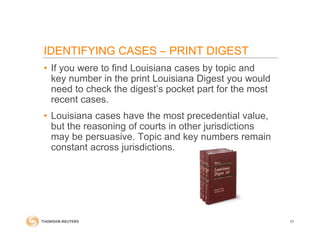
    IDENTIFYING CASES –PRINT DIGEST • If you were to find Louisiana cases by topic and key number in the print Louisiana Digest you would need to check the digest’s pocket part for the most recent cases. • Louisiana cases have the most precedential value, but the reasoning of courts in other jurisdictions may be persuasive. Topic and key numbers remain constant across jurisdictions. 57
  • 58.
    • You mayalso go to Westlaw.com and search the Key Numbers finder tool located at the top of the screen: – Type a natural language search into the search box to find relevant Key Numbers, and choose the appropriate jurisdiction by clicking on the Change Jurisdiction link. – You may browse through all of the Key Numbers by clicking on the link for Browse Key Number Digest Outline – You may use pre-crafted searches by clicking on the KeySearch link 58 IDENTIFYING CASES
  • 59.
    IDENTIFYING CASES • WithSearch for Key Numbers, after clicking search, Westlaw.com will suggest a list of Key Numbers relevant to your terms. • Click on the specific Key Number to retrieve a list of cases with that Key Number from the jurisdiction you have selected. 59
  • 60.
    IDENTIFYING CASES On theright of the screen, you will see ResultsPlus. ResultsPlus use your search terms to find relevant secondary source articles from proven sources and Key Numbers that could be used to expand your research. 60 ResultsPlus
  • 61.
    IDENTIFYING CASES • Youcan also begin your Key Number search from a case that you find on point. Here we are looking at the McDermott case we found in the ALR article • Click on the Key Number or Most Cited Cases link you wish to run a search on for the relevant point of law. 61 Assault and Battery Most Cited Cases
  • 62.
    • From thecase law link, you will be brought to the digest page. Your Key Number selection will be listed. • The Most Cited Case feature helps determine which cases are most authoritative. • Select the Jurisdiction and add additional terms or a date restriction and then click the Search button IDENTIFYING CASES 62 Most Cited Cases Key Number: 231Hk3056(2) Jurisdiction: Louisiana
  • 63.
    IDENTIFYING CASES • Thereare over fifty headnotes in Louisiana’s Custom Digest for Key Number 231Hk3056(2). • The first case listed, Scott v. Commercial Union, has been cited most frequently for this point of law. • McDermott is also near the top of the list. 63 52 Headnotes Scott v. Commercial Union: cited 47 times
  • 64.
    • The nextstep is to read the full text of the cases that seem most relevant. • The critical and often very subtle factors that influence a decision must be isolated and analyzed. This can only be fully accomplished by a thorough reading of the complete text of the cases. • Some cases might seem to be contradictory, but you should be able to detect a trail of consistency drawn from subtle factual distinctions among the cases. • You should read opinions that have imposed liability on the employer and opinions that have not imposed liability on the employer. 64 IDENTIFYING CASES
  • 65.
    IDENTIFYING CASES • Severalof the cases retrieved set forth factors a Louisiana court should consider when deciding whether to hold an employer vicariously liable for the intentional acts of employees: – “ (1) whether the tortious act was primarily employment rooted, – (2) whether the violence was reasonably incidental to the performance of the employee's duties, – (3) whether the act occurred on the employer's premises, and – (4) whether it occurred during the hours of employment.” 65
  • 66.
    • Introduction • FromFacts to Issues • Controlling Statute • Expanding Research • Identifying Cases to Cite • Ensuring Currency and Validity of Law • Conclusion CONTENTS 66
  • 67.
    CURRENCY & VALIDITY •Once you have found the relevant cases and statutes, you must determine the current status of the law. • Check the validity of any relevant case or statute before continuing your research. • A case may be reversed, vacated, remanded or overruled. • A statute may be repealed, amended, declared unconstitutional, or preempted. 67
  • 68.
    CURRENCY & VALIDITY– KEYCITE HISTORY • Online citators have distinct advantages over print citators: – There is a single source of information. • Checking the validity of a case in print citators involves checking in multiple volumes and updating pamphlets. – Online citators are extremely current. • Print citators cannot be as current due to the necessity of printing and mailing updating pamphlets. • KeyCite is the citation research service available on Westlaw. 68
  • 69.
    CURRENCY & VALIDITY– KEYCITE HISTORY • One case in the results of your key number search, Monk v. Veillon, displays a yellow flag in the upper left corner and on the Links for tab in the left frame. – The yellow flag indicates the case has some negative history, but has not been reversed, overruled, vacated, or remanded. – Click either yellow flag or the Full History link to access the list of negative history. 69 KC History
  • 70.
    CURRENCY & VALIDITY– KEYCITE HISTORY • The negative history includes cases in which factual distinctions led to a different outcome. • These would be very valuable cases to read as you try to fit the Acme case into the texture of Louisiana cases. 70
  • 71.
    CURRENCY & VALIDITY– KEYCITE HISTORY • Another case retrieved in your Key Number search, Moore v. Blanchard, is tagged with a red flag. • The KeyCite Direct History of the case indicates that the judgment was reversed by a higher court. • When you see a red flag on a case, you should investigate before relying on that case to support your argument. 71 Judgment Reversed
  • 72.
    • Introduction • FromFacts to Issues • Controlling Statute • Expanding Research • Identifying Cases to Cite • Ensuring Currency and Validity of Law • Conclusion 72 CONTENTS
  • 73.
    CONCLUSION • You havedone the research and you feel confident of your understanding of the issue. • You have isolated the most relevant articles, cases, statutes, and key numbers that were found by different methods of research and which cross reference one another. • You have carefully read and analyzed relevant Louisiana law. • You have ensured the cases you are relying on are good law. • You can support your position with references to primary law and secondary sources, and counter the arguments likely to be presented by opposing counsel 73
  • 74.
    • The LoopRule – When you start to see the same documents and citations over and over, you should probably realize you are done, especially if you have used the research products of more than one publisher • The Economic Analysis or Diminishing Return Rule – When you are investing more in your research than you are getting in return • The Zen Rule – When you have been working in an area of the law for a long time, you will be so familiar with the primary and secondary law you will have become an expert and will know when to stop. 74 1JOHNSON, ET AL., WINNING RESEARCH SKILLS, West Group, 2002 CONCLUSION – KNOWING WHEN TO STOP1
  • 75.
    CONCLUSION • Now youcan write a persuasive memo or brief. • This was just one potential path through the legal research process. • Every research process will differ. You could have competently explored more or less legal resources depending on what is at stake and the time and money available. • You’ll be a successful researcher if you understand how to use the many resources that are available in a flexible and efficient manner. 75 Good job