INTRODUCTION TO DATABASE
MANAGEMENT SYSTEM
STAFF-INCHARGE :
Mrs.S.SUBHASHINI MCA.,M.PHIL.,(SET)
INTRODUCTON :
• Data is a collection of facts such as numbers,
words, measurements, observations or just
descriptions of things.
* Information is processed data that put into
a meaningful and useful context to make best
decisions.
• It consists of data,images,text,documents,
voice,video etc.,
• It is a backbone of any organisation.
• It is a critical factor to gain competetive edge in
any organisation.
• It is most critical resource of an organisation.
Information cycle
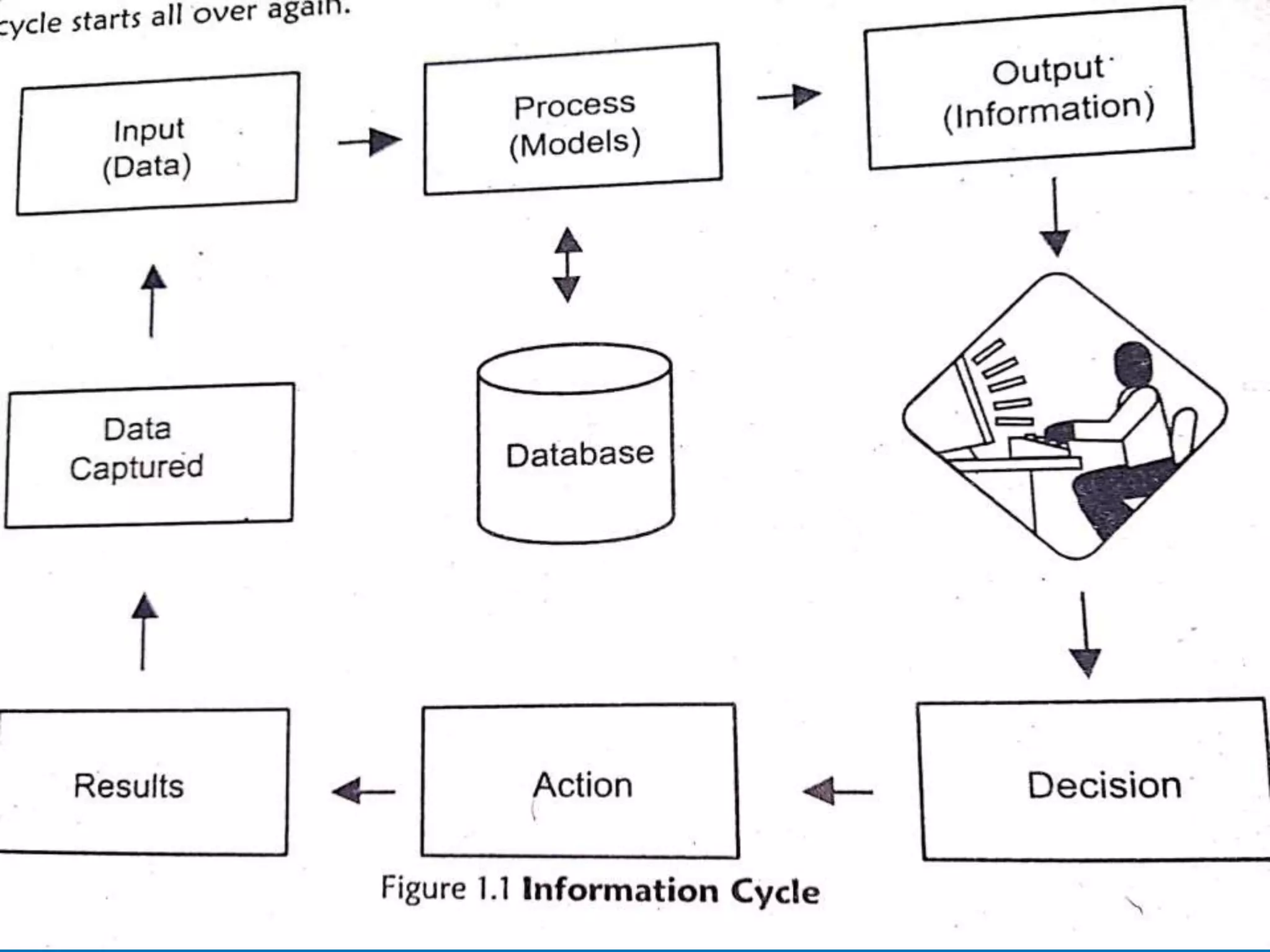
• Input data are processed through models to
create information .
• Recipients receives information, makes
decision and then takes an action.
• Action triggers other action or events to
provide results.
• Resultant data are captured and can be used
as input data for other cycles
HISTORY OF INFORMATION
• In 4500 B.C ,clay tablets are used to record data.
• Clay tablets were used to store information
about receipts,disbursements, loans, purchases ,
sales, leases, partnership formation, contracts
etc.
• 500 yearsago, Inca indians of south america
used accounting apparatus called quipus.
• It consists of thousands of knotted strings and
• Knots were made in cords to represent units,
tens,hundreds etc.
HISTORY OF INFORMATION
Cords were differently colored to represent
lands,economic productivity , matters relatingto war
etc.
* Quipus were created & Maintained by high
officials like judges,commanders,family heads,
village head etc.,
*Art of data processing was already existed from
early ages.
HISTORY OF INFORMATION
Quipuamayus : People who built these
information system with knots was called “
Quipuamayus “
• All successful civilization had some kind of data
storage & retrieval system remains .
• Lot of information needed for internal decisions
& for successfully running organisation.
Quality of Information
• Quality information is accurate , timely and
relevant information.
* 3 Key attributes of information are
1. Accuracy
2. Timeliness
3. Relevancy
1.Accuracy :
- It means that information is clear and
accurate that reflects meaning of data.
- It also means information with no mistakes
and Error , free from bias.
2.Timeliness :
• It means getting timely information with in
the needed time to the recipients.
. Recipients get timely information when they
want to use it at the very useful time.
3.Relevancy :
• It means use of a piece of information for a
particular person .
* Information relevant for one person might not
be relevant for another.
* Relevancy is a very subjective matter .
Information Processing
Definition :
Information Processing is the acquisition ,
storage, organisation, retrieval , display and
Dissemination of information .
* Few decades back , data processing was done
manually .
• Manual processing was good when amount of
data to be processed is less.
• punched cards ,magnetic tapes were used
( Initial Stage )
* Using punched cards, magnetic tapes only
batch processing of information was done .
• In this batch processing approach , individual
transaction is not managed .
• No possibility of giving answers quickly for
transactions in batch processing approach.
• Answers did not reflect current state of affairs
( might be a week (or) more out of date .
*In batch processing approach, relevancy of data
is maintained . But timeliness and accuracy of
information cannot be achieved .
*To overcome disadvantages of batch processing,
database approach can be used .
• Database approach is used to organise data in
an effective way than batch processing
approach .
• Database approach makes searching,
processing, retrieving of data very easy , quick
and effective.
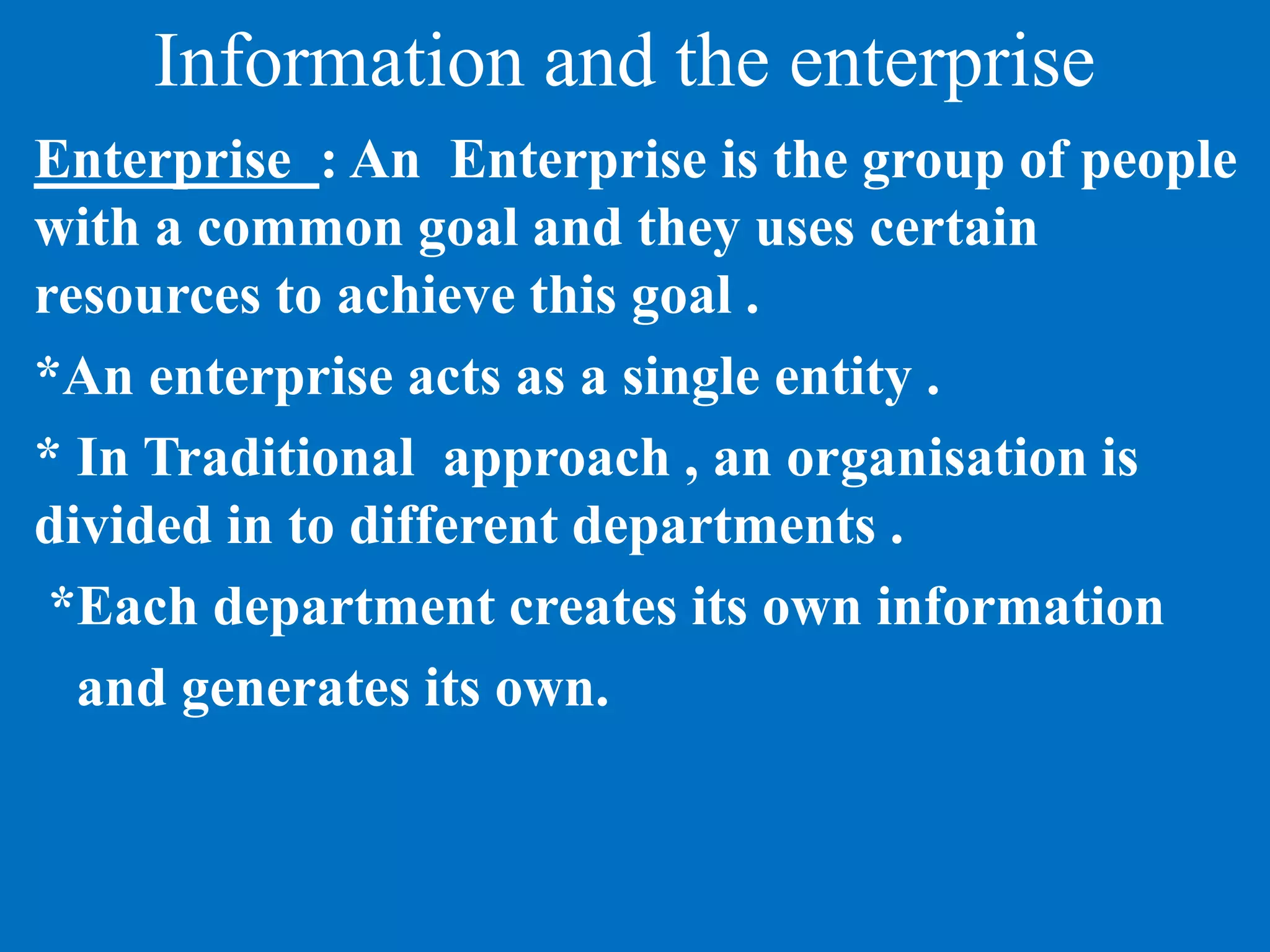
Information and the enterprise
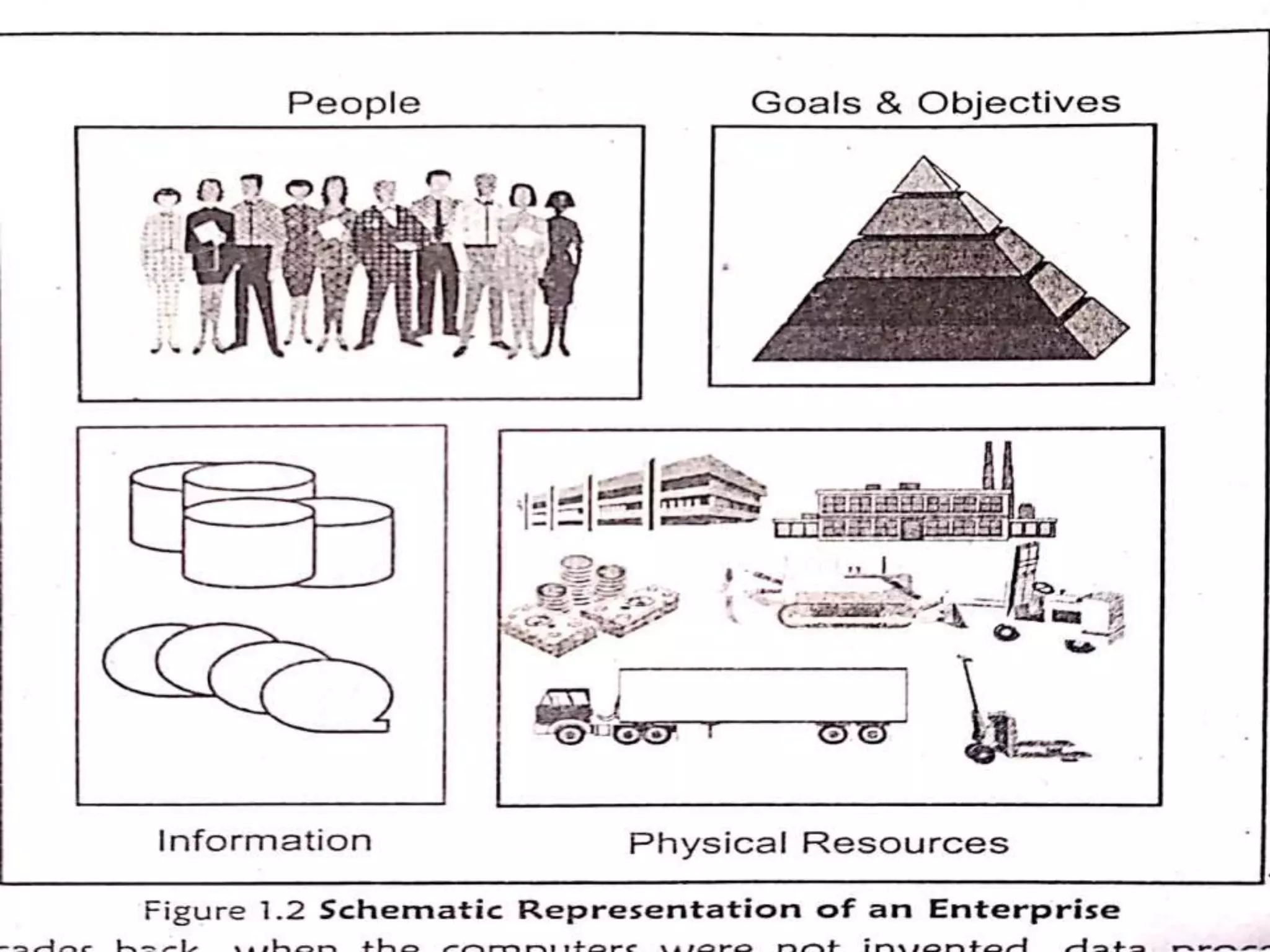
Enterprise : An Enterprise is the group of people
with a common goal and they uses certain
resources to achieve this goal .
*An enterprise acts as a single entity .
* In Traditional approach , an organisation is
divided in to different departments .
*Each department creates its own information
and generates its own.
*
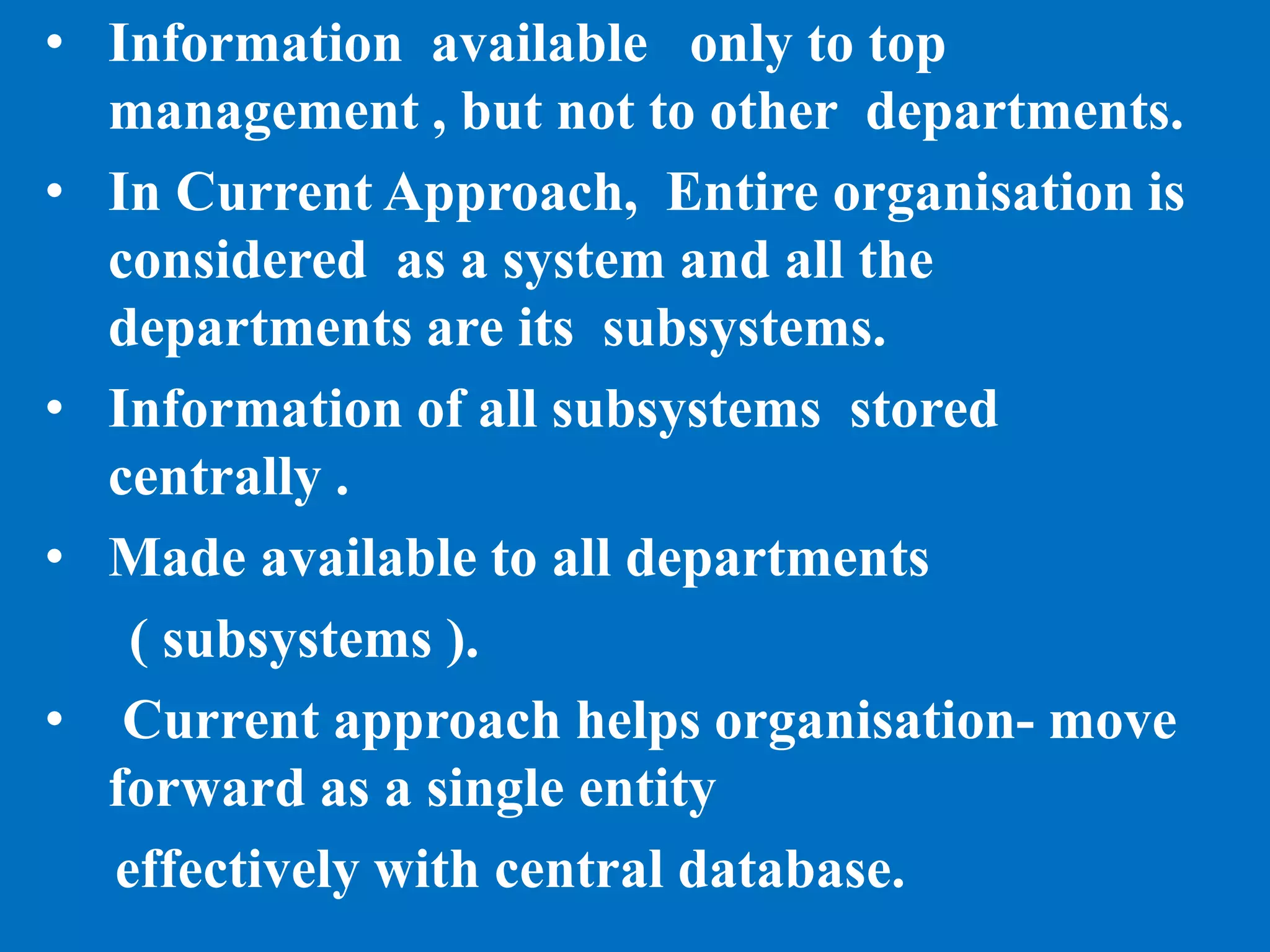
• Information available only to top
management , but not to other departments.
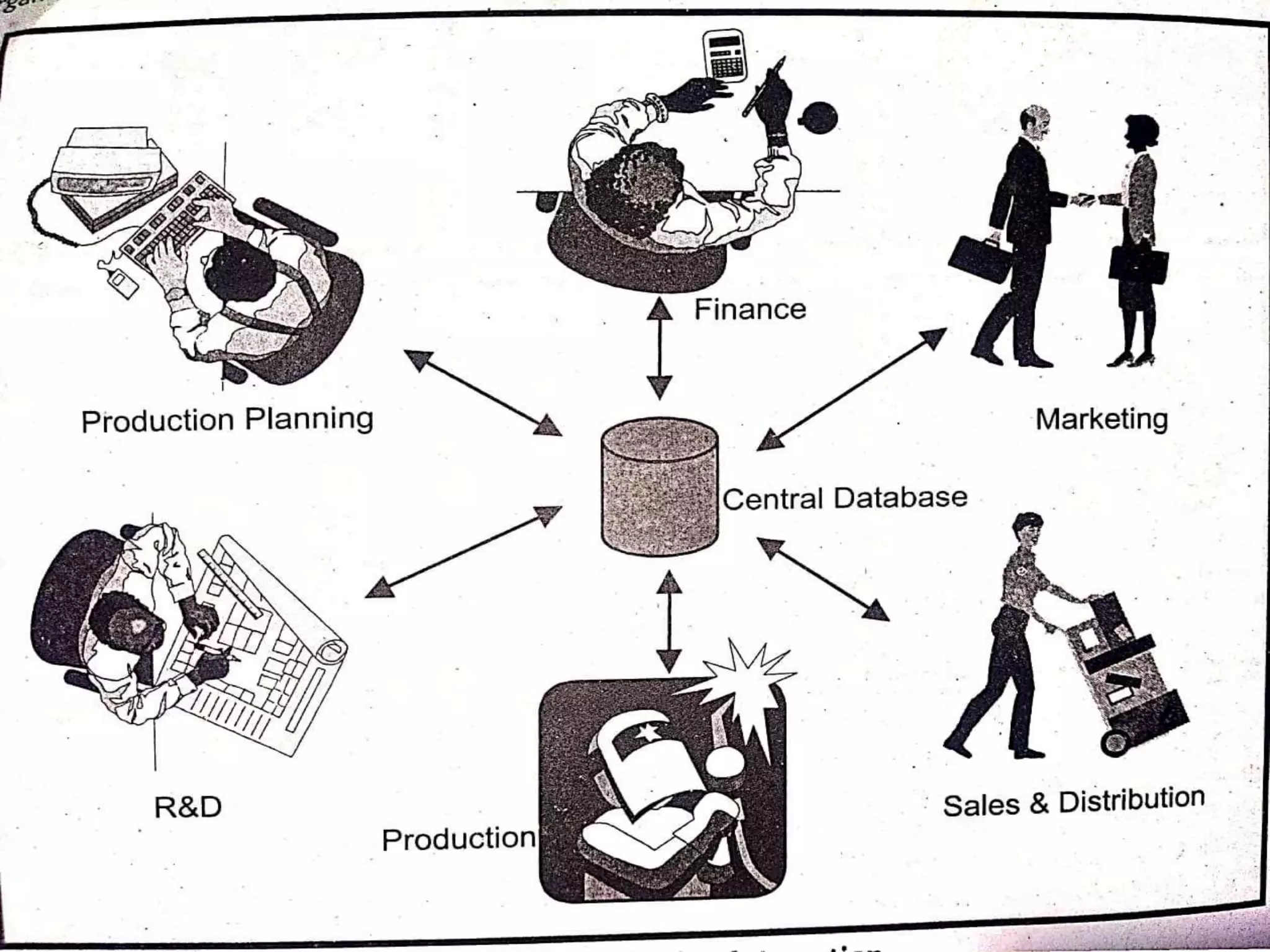
• In Current Approach, Entire organisation is
considered as a system and all the
departments are its subsystems.
• Information of all subsystems stored
centrally .
• Made available to all departments
( subsystems ).
• Current approach helps organisation- move
forward as a single entity
effectively with central database.
Database
Definition: Database is a collection of data
designed to be used by different people .
• It has a collection of interrelated data stored together.
• It provides controlled redundancy of data .
• It can serve one or more applications.
• Data stored in database are independent of the
user programs .
• Organised way -A computer program quickly select
desired pieces of data.
• Traditional databases are organised by fields,
records and files.
Components (or) Elements of
Database
• A database consists of four elements .
1.Data
2.Relationship
3.Constraints
4.Schema
1.Data:
* Data is a collection of facts such as numbers,
words, measurements, observations or just
descriptions of things.
• Data exist in various form such as numbers ,text , bits,
bytes, images etc.
• Stored in binary form in computer memory.
• Stored as bytes in electronic memory.
• Stored as facts in person’s mind .
• In DBMS,Data files are the files that store the
database information.
* Indexfile , data dictionaries store administrative
information known as metadata.
Metadata : Meta data is an administrative information
Stored in index file , data dictionaries etc.
* It is data about data .
2.Relationship:
* It represent a correspondance between the
various data elements.
3.Constraints :
* constraints are predicate that define correct database
states.
4. Schema : Describes organisation of data &
relationships with in the database .
*Defines various views of databases .
• Separates physical aspects of data storage from logical
aspects of data representation.
• Three schema are
a) Internal schema :
Defines how & where data are organised in physical
data storage .
b)Conceptual schema :
Defines stored data structure in terms of database
model used.
c)External schema :
Defines a view ( or) views of the database for
particular user.
E content-dbms

E content-dbms

  • 1.
    INTRODUCTION TO DATABASE MANAGEMENTSYSTEM STAFF-INCHARGE : Mrs.S.SUBHASHINI MCA.,M.PHIL.,(SET)
  • 2.
    INTRODUCTON : • Datais a collection of facts such as numbers, words, measurements, observations or just descriptions of things. * Information is processed data that put into a meaningful and useful context to make best decisions. • It consists of data,images,text,documents, voice,video etc., • It is a backbone of any organisation. • It is a critical factor to gain competetive edge in any organisation. • It is most critical resource of an organisation.
  • 3.
    Information cycle • Inputdata are processed through models to create information . • Recipients receives information, makes decision and then takes an action. • Action triggers other action or events to provide results. • Resultant data are captured and can be used as input data for other cycles
  • 5.
    HISTORY OF INFORMATION •In 4500 B.C ,clay tablets are used to record data. • Clay tablets were used to store information about receipts,disbursements, loans, purchases , sales, leases, partnership formation, contracts etc. • 500 yearsago, Inca indians of south america used accounting apparatus called quipus. • It consists of thousands of knotted strings and • Knots were made in cords to represent units, tens,hundreds etc.
  • 6.
    HISTORY OF INFORMATION Cordswere differently colored to represent lands,economic productivity , matters relatingto war etc. * Quipus were created & Maintained by high officials like judges,commanders,family heads, village head etc., *Art of data processing was already existed from early ages.
  • 7.
    HISTORY OF INFORMATION Quipuamayus: People who built these information system with knots was called “ Quipuamayus “ • All successful civilization had some kind of data storage & retrieval system remains . • Lot of information needed for internal decisions & for successfully running organisation.
  • 8.
    Quality of Information •Quality information is accurate , timely and relevant information. * 3 Key attributes of information are 1. Accuracy 2. Timeliness 3. Relevancy 1.Accuracy : - It means that information is clear and accurate that reflects meaning of data. - It also means information with no mistakes and Error , free from bias.
  • 9.
    2.Timeliness : • Itmeans getting timely information with in the needed time to the recipients. . Recipients get timely information when they want to use it at the very useful time. 3.Relevancy : • It means use of a piece of information for a particular person . * Information relevant for one person might not be relevant for another. * Relevancy is a very subjective matter .
  • 10.
    Information Processing Definition : InformationProcessing is the acquisition , storage, organisation, retrieval , display and Dissemination of information . * Few decades back , data processing was done manually . • Manual processing was good when amount of data to be processed is less. • punched cards ,magnetic tapes were used ( Initial Stage )
  • 11.
    * Using punchedcards, magnetic tapes only batch processing of information was done . • In this batch processing approach , individual transaction is not managed . • No possibility of giving answers quickly for transactions in batch processing approach. • Answers did not reflect current state of affairs ( might be a week (or) more out of date .
  • 12.
    *In batch processingapproach, relevancy of data is maintained . But timeliness and accuracy of information cannot be achieved . *To overcome disadvantages of batch processing, database approach can be used . • Database approach is used to organise data in an effective way than batch processing approach . • Database approach makes searching, processing, retrieving of data very easy , quick and effective.
  • 13.
    Information and theenterprise Enterprise : An Enterprise is the group of people with a common goal and they uses certain resources to achieve this goal . *An enterprise acts as a single entity . * In Traditional approach , an organisation is divided in to different departments . *Each department creates its own information and generates its own.
  • 14.
  • 15.
    • Information availableonly to top management , but not to other departments. • In Current Approach, Entire organisation is considered as a system and all the departments are its subsystems. • Information of all subsystems stored centrally . • Made available to all departments ( subsystems ). • Current approach helps organisation- move forward as a single entity effectively with central database.
  • 17.
    Database Definition: Database isa collection of data designed to be used by different people . • It has a collection of interrelated data stored together. • It provides controlled redundancy of data . • It can serve one or more applications. • Data stored in database are independent of the user programs . • Organised way -A computer program quickly select desired pieces of data. • Traditional databases are organised by fields, records and files.
  • 18.
    Components (or) Elementsof Database • A database consists of four elements . 1.Data 2.Relationship 3.Constraints 4.Schema 1.Data: * Data is a collection of facts such as numbers, words, measurements, observations or just descriptions of things.
  • 19.
    • Data existin various form such as numbers ,text , bits, bytes, images etc. • Stored in binary form in computer memory. • Stored as bytes in electronic memory. • Stored as facts in person’s mind . • In DBMS,Data files are the files that store the database information.
  • 20.
    * Indexfile ,data dictionaries store administrative information known as metadata. Metadata : Meta data is an administrative information Stored in index file , data dictionaries etc. * It is data about data . 2.Relationship: * It represent a correspondance between the various data elements. 3.Constraints : * constraints are predicate that define correct database states.
  • 21.
    4. Schema :Describes organisation of data & relationships with in the database . *Defines various views of databases . • Separates physical aspects of data storage from logical aspects of data representation. • Three schema are a) Internal schema : Defines how & where data are organised in physical data storage .
  • 22.
    b)Conceptual schema : Definesstored data structure in terms of database model used. c)External schema : Defines a view ( or) views of the database for particular user.