What is a System ?
  It is a collection of interrelated
   components that work together to
   perform specific task .


     Ex.
     Human body
     Business Organization
     A computer
 DATA

  Data is a collection of facts, figures
and statistics related to an object. Data
      can be processed to create
          useful information.
 INFORMATION

                 Information
  The manipulated and processed form of
    data is called information. It is more
    meaningful than data. It is used for
  making decisions. Data is used as input
   for processing and information is the
         output of this processing.
INFORMATION SYSTEM

   is a combination of people, hardware,
      software, communication devices,
       network and data resources that
    processes (can be storing, retrieving,
     transforming information) data and
      information for a specific purpose.
INFORMATION TECHNOLOGY


    is a branch of engineering dealing with
            the use of computers and
    telecommunications equipment to store,
     retrieve, transmit and manipulate data.
      set of methods or techniques for
          acquiring, organizing, storing,
          manipulating, and transmitting
                   information.
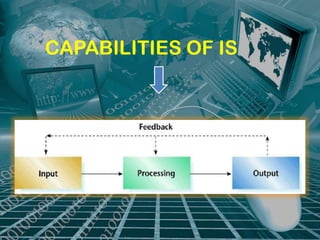
CAPABILITIES OF IS
INPUT,PROCESS,OUTPUT,
           FEEDBACK
 INPUT is the activity of gathering and
 capturing raw data
 PROCESSING converting or transforming
 useful data into outputs.
 OUTPUT producing useful information,
 usually in the form of documents and reports.
FEEDBACK is information from the system that
 is used to make changes to input or processing
 activities.
MANUAL BASED IS
A system which does not use any computer
     devices. Manual is using old method
    without the help of the technology or
maybe less to perform certain task or work.
File storage devices, manual procedures and
  papers are examples of components of a
         manual information system.
COMPUTER BASED IS
 an information system is an organized combination
 of people, hardware, software, communication
 networks and the data resources that collects,
 transforms and disseminates information in a
 organization
 Involves five interdependent components
  Hardware ( machines )
  Software ( instruction or program )
  People ( managers, programmers and users)
  Procedures ( Rules )
  Data & Information
function-based information system
        is           for the exclusive
support of a specific application area.
Integrated information systems share
a common database..
What are the benefits of using IS ?
  central access
  easy backup
  central distribution of information
  easy record-keeping
  easy tax preparation
  easy customer trait identification
TYPES OF IS
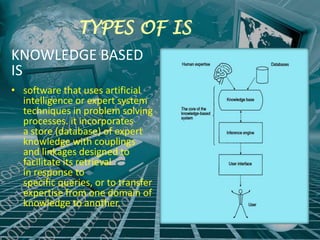
KNOWLEDGE BASED
IS
• software that uses artificial
  intelligence or expert system
  techniques in problem solving
  processes. it incorporates
  a store (database) of expert
  knowledge with couplings
  and linkages designed to
  facilitate its retrieval
  in response to
  specific queries, or to transfer
  expertise from one domain of
  knowledge to another.
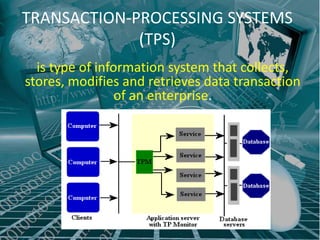
TRANSACTION-PROCESSING SYSTEMS
             (TPS)
  is type of information system that collects,
stores, modifies and retrieves data transaction
                 of an enterprise.
FEATURES :
• Rapid response – fast performance with rapid result.
• Reliability – well designed back up and recovery
  with a low failure rate
• Inflexibility – treat every transaction quality. It may
  be used many times each day which means iy has to
  be precise and flexible
• Controlled processing – maintain specific
  requirements for the roles and responsibilities of
  different employees.
What is information system

What is information system

  • 2.
    What is aSystem ?  It is a collection of interrelated components that work together to perform specific task . Ex. Human body Business Organization A computer
  • 3.
     DATA Data is a collection of facts, figures and statistics related to an object. Data can be processed to create useful information.
  • 4.
     INFORMATION Information The manipulated and processed form of data is called information. It is more meaningful than data. It is used for making decisions. Data is used as input for processing and information is the output of this processing.
  • 5.
    INFORMATION SYSTEM is a combination of people, hardware, software, communication devices, network and data resources that processes (can be storing, retrieving, transforming information) data and information for a specific purpose.
  • 6.
    INFORMATION TECHNOLOGY  is a branch of engineering dealing with the use of computers and telecommunications equipment to store, retrieve, transmit and manipulate data.  set of methods or techniques for acquiring, organizing, storing, manipulating, and transmitting information.
  • 7.
  • 8.
    INPUT,PROCESS,OUTPUT, FEEDBACK  INPUT is the activity of gathering and capturing raw data  PROCESSING converting or transforming useful data into outputs.  OUTPUT producing useful information, usually in the form of documents and reports. FEEDBACK is information from the system that is used to make changes to input or processing activities.
  • 9.
    MANUAL BASED IS Asystem which does not use any computer devices. Manual is using old method without the help of the technology or maybe less to perform certain task or work. File storage devices, manual procedures and papers are examples of components of a manual information system.
  • 10.
    COMPUTER BASED IS an information system is an organized combination of people, hardware, software, communication networks and the data resources that collects, transforms and disseminates information in a organization Involves five interdependent components  Hardware ( machines )  Software ( instruction or program )  People ( managers, programmers and users)  Procedures ( Rules )  Data & Information
  • 11.
    function-based information system is for the exclusive support of a specific application area. Integrated information systems share a common database..
  • 12.
    What are thebenefits of using IS ? central access easy backup central distribution of information easy record-keeping easy tax preparation easy customer trait identification
  • 13.
    TYPES OF IS KNOWLEDGEBASED IS • software that uses artificial intelligence or expert system techniques in problem solving processes. it incorporates a store (database) of expert knowledge with couplings and linkages designed to facilitate its retrieval in response to specific queries, or to transfer expertise from one domain of knowledge to another.
  • 14.
    TRANSACTION-PROCESSING SYSTEMS (TPS) is type of information system that collects, stores, modifies and retrieves data transaction of an enterprise.
  • 15.
    FEATURES : • Rapidresponse – fast performance with rapid result. • Reliability – well designed back up and recovery with a low failure rate • Inflexibility – treat every transaction quality. It may be used many times each day which means iy has to be precise and flexible • Controlled processing – maintain specific requirements for the roles and responsibilities of different employees.