Healthcare BI for Power Users
             September 13, 2012
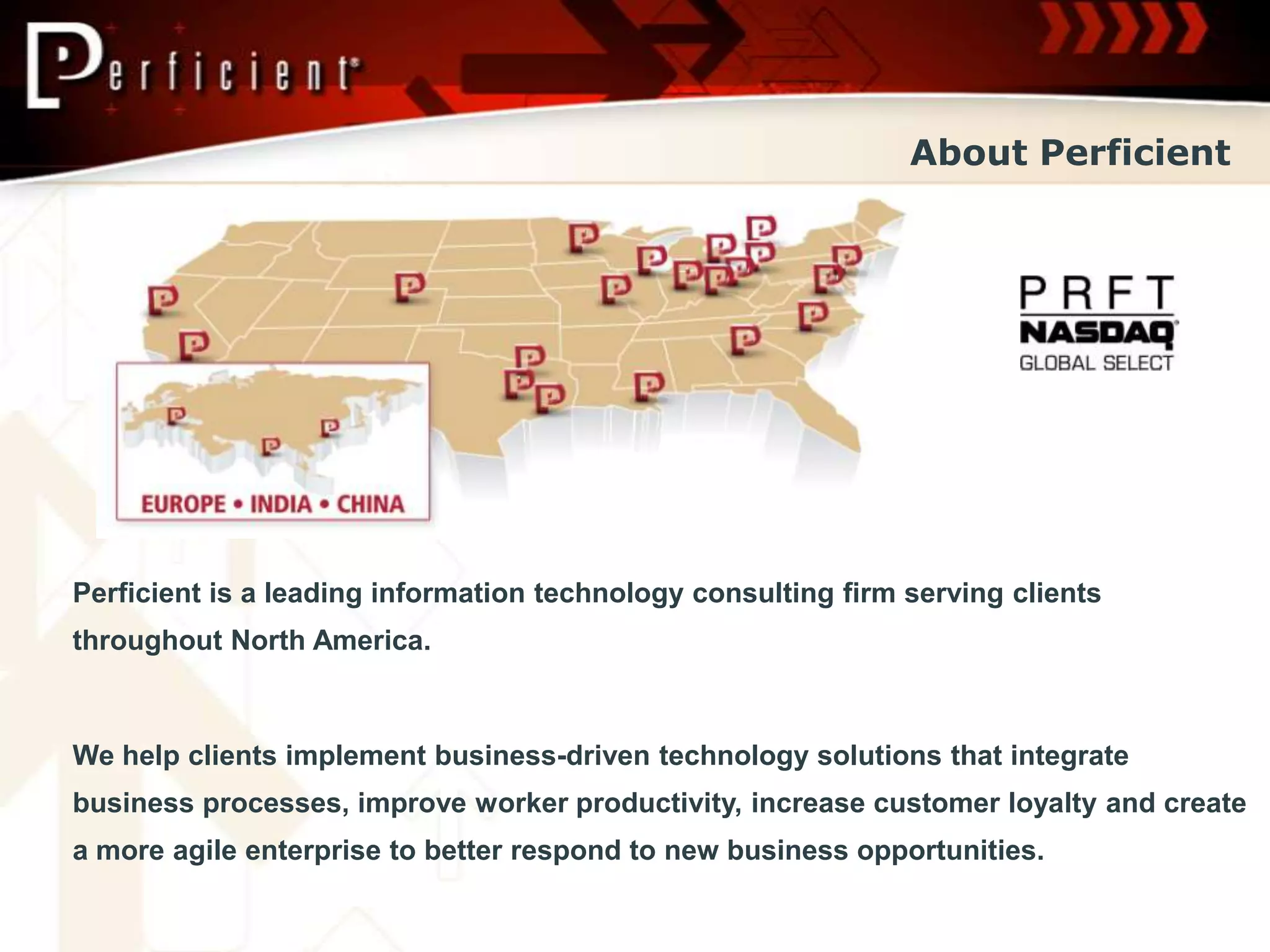
About Perficient


Perficient is a leading information technology consulting firm serving clients
throughout North America.


We help clients implement business-driven technology solutions that integrate
business processes, improve worker productivity, increase customer loyalty and create
a more agile enterprise to better respond to new business opportunities.
Perficient Profile
   Founded in 1997

   Public, NASDAQ: PRFT

   2011 Revenue of $260 million

   Major market locations throughout North America
     — Atlanta, Austin, Charlotte, Chicago, Cincinnati, Cleveland,
       Columbus, Dallas, Denver, Detroit, Fairfax, Houston,
       Indianapolis, Los Angeles, Minneapolis, New Orleans,
       Philadelphia, San Francisco, San Jose, Southern California,
       St. Louis and Toronto


   Global delivery centers in China, Europe and India

   2,000+ colleagues

   Dedicated solution practices

   87% repeat business rate

   Alliance partnerships with major technology vendors

   Multiple vendor/industry technology and growth awards
Our Solutions Expertise & Services

Business-Driven Solutions             Perficient Services
• Enterprise Portals                   End-to-End Solution Delivery
• SOA and Business Process Mgmt        IT Strategic Consulting
• Business Intelligence                IT Architecture Planning
• User-Centered Custom Applications    Business Process & Workflow
• Interactive Design                     Consulting
• CRM Solutions                        Usability and UI Consulting
• Enterprise Performance Management    Custom Application Development
• Customer Self-Service                Offshore Development
• eCommerce & Product Information      Package Selection, Implementation
  Management                             and Integration
• Enterprise Content Management        Architecture & Application Migrations
• Enterprise Resource Planning         Education
• Management Consulting                Interactive Design
• Industry-Specific Solutions
• Mobile Technology                   Perficient brings deep solutions expertise and offers a
                                      complete set of flexible services to help clients
• Security Assessments                implement business-driven IT solutions
Our Speakers

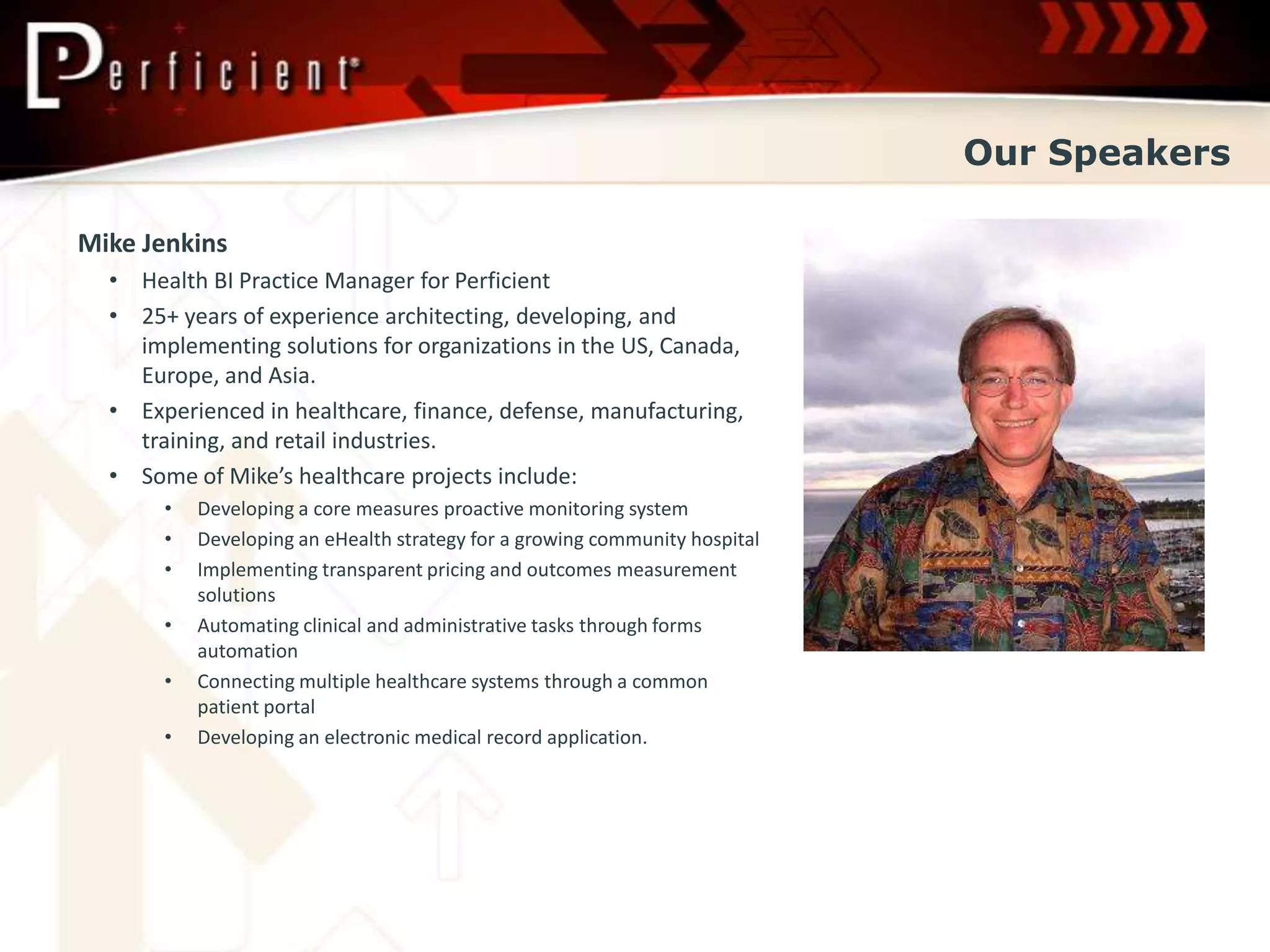
Mike Jenkins
  • Health BI Practice Manager for Perficient
  • 25+ years of experience architecting, developing, and
    implementing solutions for organizations in the US, Canada,
    Europe, and Asia.
  • Experienced in healthcare, finance, defense, manufacturing,
    training, and retail industries.
  • Some of Mike’s healthcare projects include:
       •   Developing a core measures proactive monitoring system
       •   Developing an eHealth strategy for a growing community hospital
       •   Implementing transparent pricing and outcomes measurement
           solutions
       •   Automating clinical and administrative tasks through forms
           automation
       •   Connecting multiple healthcare systems through a common
           patient portal
       •   Developing an electronic medical record application.
Our Speakers

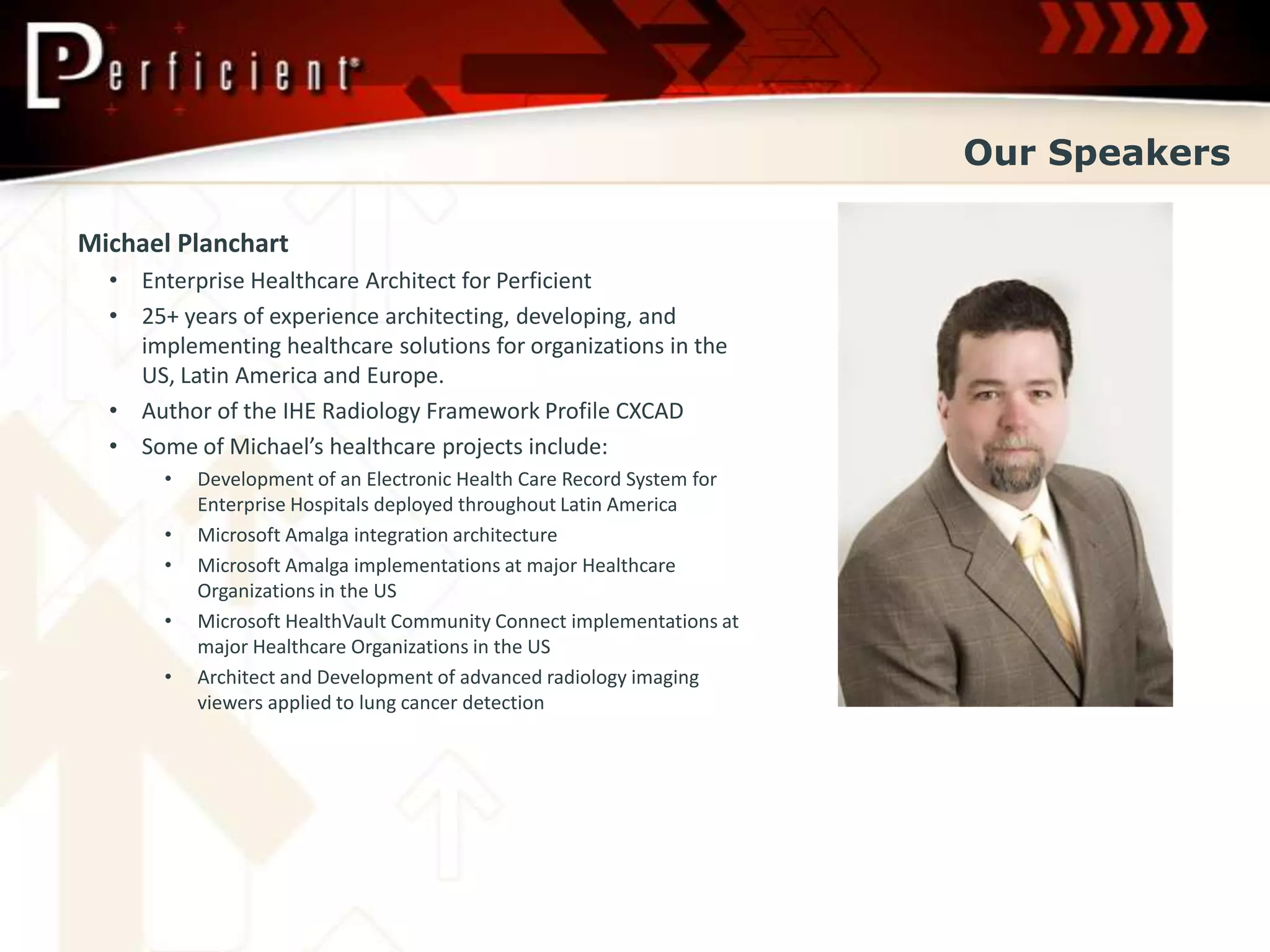
Michael Planchart
  • Enterprise Healthcare Architect for Perficient
  • 25+ years of experience architecting, developing, and
    implementing healthcare solutions for organizations in the
    US, Latin America and Europe.
  • Author of the IHE Radiology Framework Profile CXCAD
  • Some of Michael’s healthcare projects include:
       •   Development of an Electronic Health Care Record System for
           Enterprise Hospitals deployed throughout Latin America
       •   Microsoft Amalga integration architecture
       •   Microsoft Amalga implementations at major Healthcare
           Organizations in the US
       •   Microsoft HealthVault Community Connect implementations at
           major Healthcare Organizations in the US
       •   Architect and Development of advanced radiology imaging
           viewers applied to lung cancer detection
Today’s Agenda


•   Introduction
•   What is the BI Maturity Model
•   Maturity Model Levels
•   Walkthrough each Level:
    – Lacks, Wins and Uses
    – Data Sources
    – Case Studies or Examples


                                                 7
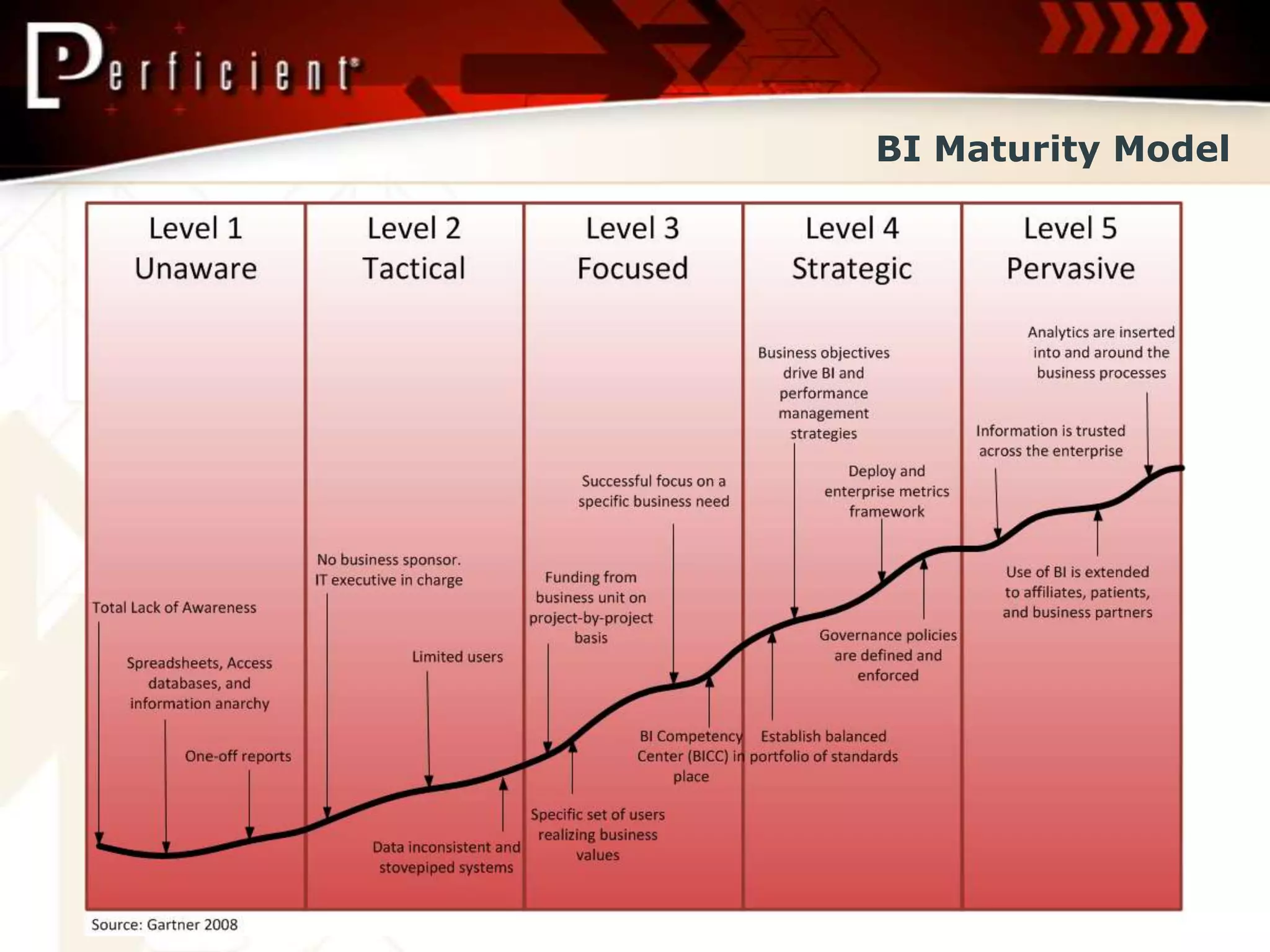
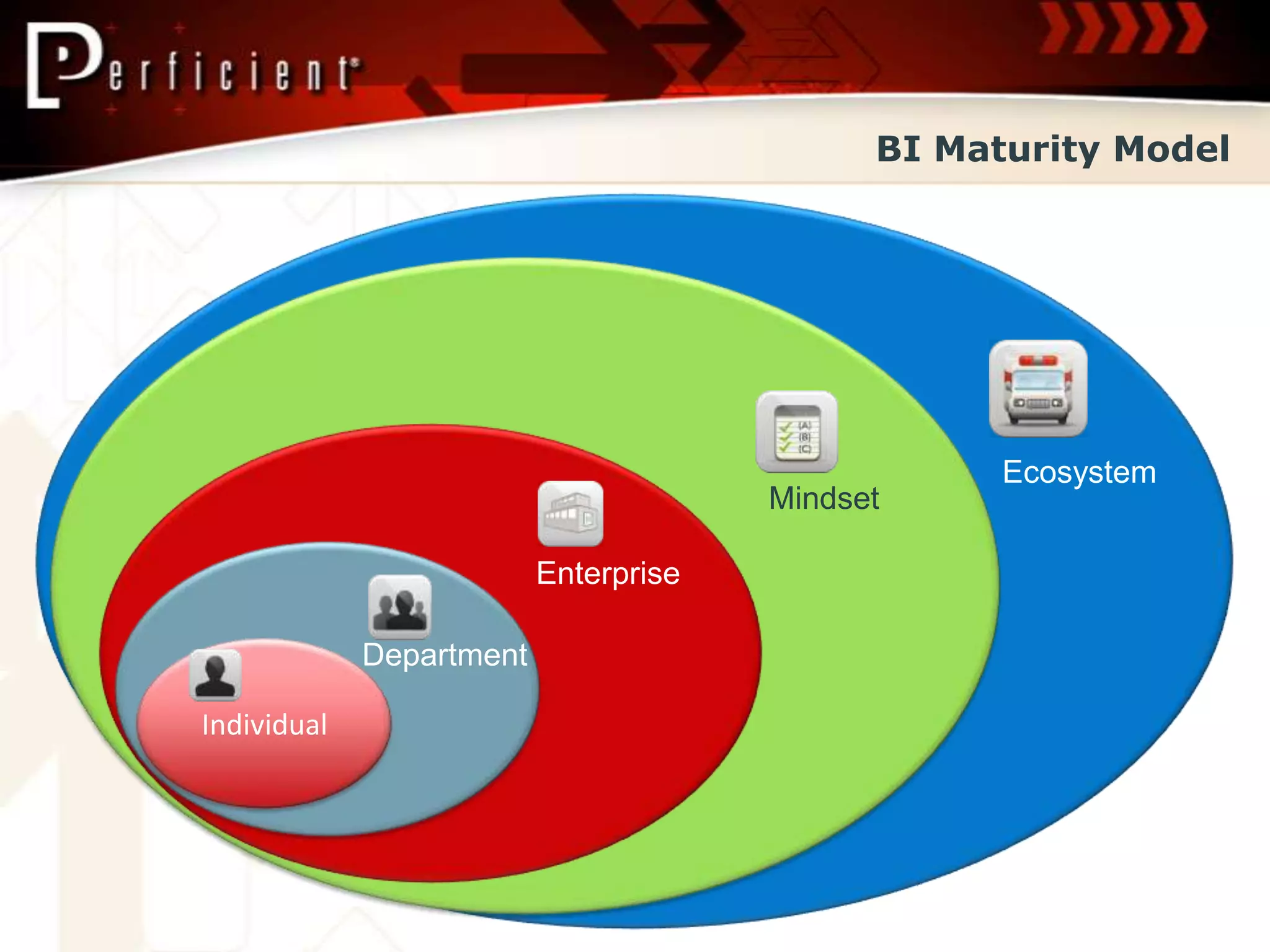
BI Maturity Model
BI Maturity Model


                                                   Ecosystem
                                       Mindset

                          Enterprise

             Department

Individual
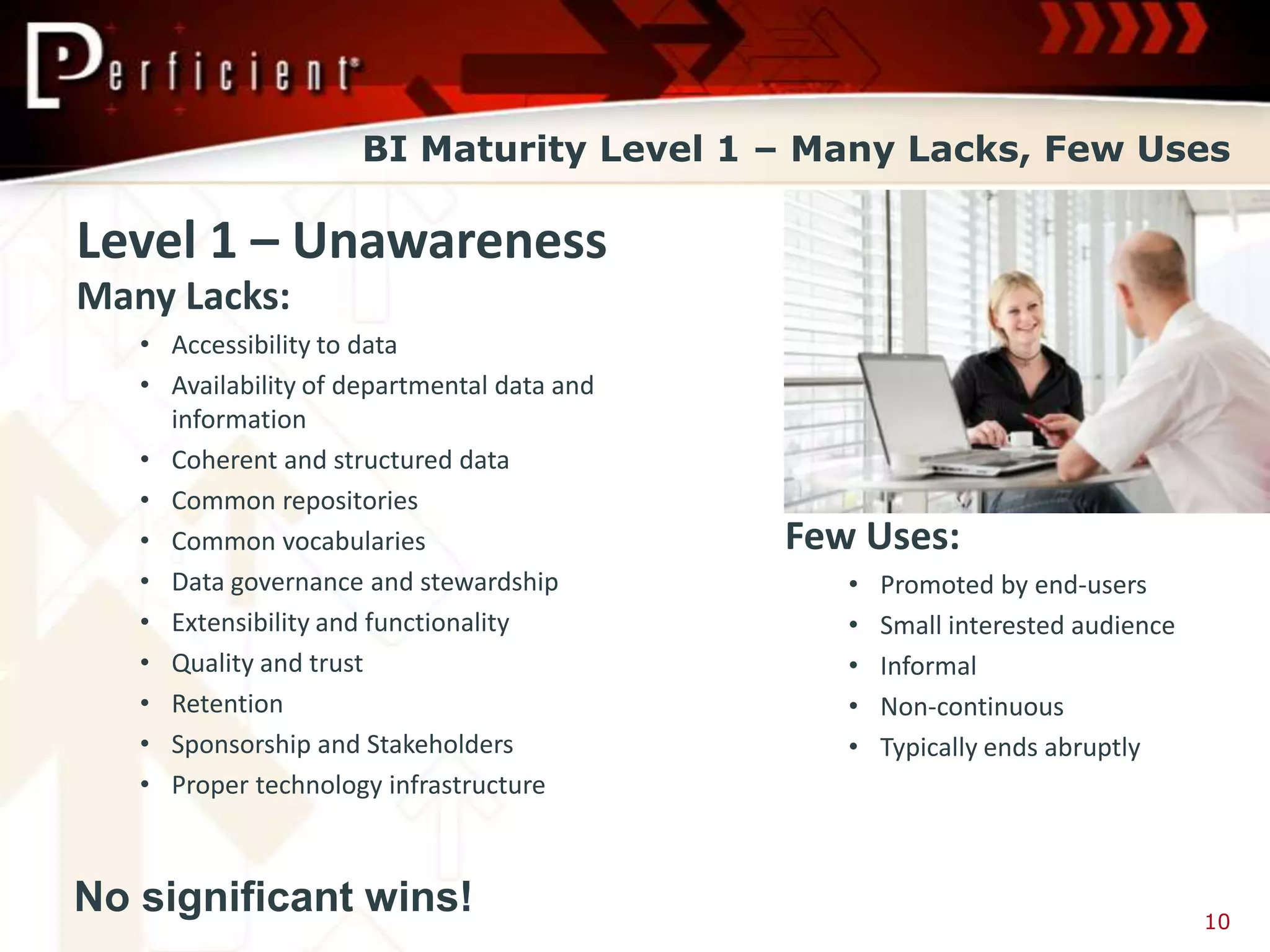
BI Maturity Level 1 – Many Lacks, Few Uses

Level 1 – Unawareness
Many Lacks:
   • Accessibility to data
   • Availability of departmental data and
     information
   • Coherent and structured data
   • Common repositories
   • Common vocabularies                     Few Uses:
   • Data governance and stewardship            •   Promoted by end-users
   • Extensibility and functionality            •   Small interested audience
   • Quality and trust                          •   Informal
   • Retention                                  •   Non-continuous
   • Sponsorship and Stakeholders               •   Typically ends abruptly
   • Proper technology infrastructure


No significant wins!                                                            10
BI Maturity Level 1 – Data Sources

Level 1 – Unawareness
  Data Sources:
     •   Application-based data
     •   Desktop databases (e.g., Access, FoxPro)
     •   Manual abstraction of documents
     •   External sources (e.g., CMS, payers)
     •   Reports from transactional systems         Common Tools:
     •   Spreadsheets (e.g., Excel, Visi-Calc)         •   Microsoft Excel
                                                       •   Microsoft Access
                                                       •   Crystal reports (basic)
                                                       •   Some OTS applications


                                                                                     11
BI Maturity Level 1 – Example

Level 1 – Unawareness
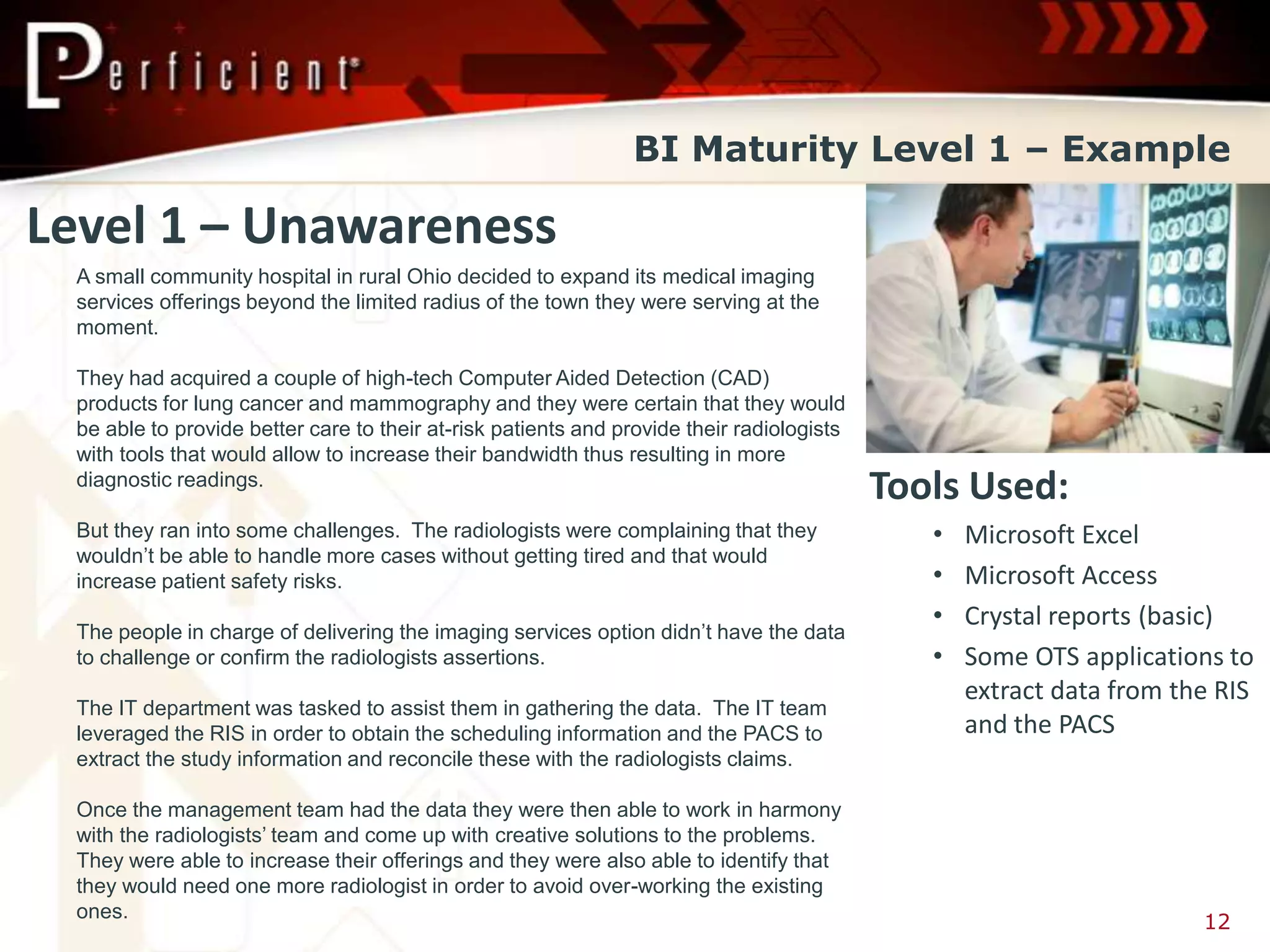
 A small community hospital in rural Ohio decided to expand its medical imaging
 services offerings beyond the limited radius of the town they were serving at the
 moment.

 They had acquired a couple of high-tech Computer Aided Detection (CAD)
 products for lung cancer and mammography and they were certain that they would
 be able to provide better care to their at-risk patients and provide their radiologists
 with tools that would allow to increase their bandwidth thus resulting in more
 diagnostic readings.
                                                                                           Tools Used:
 But they ran into some challenges. The radiologists were complaining that they               •   Microsoft Excel
 wouldn’t be able to handle more cases without getting tired and that would
 increase patient safety risks.                                                               •   Microsoft Access
                                                                                              •   Crystal reports (basic)
 The people in charge of delivering the imaging services option didn’t have the data
 to challenge or confirm the radiologists assertions.                                         •   Some OTS applications to
                                                                                                  extract data from the RIS
 The IT department was tasked to assist them in gathering the data. The IT team
 leveraged the RIS in order to obtain the scheduling information and the PACS to                  and the PACS
 extract the study information and reconcile these with the radiologists claims.

 Once the management team had the data they were then able to work in harmony
 with the radiologists’ team and come up with creative solutions to the problems.
 They were able to increase their offerings and they were also able to identify that
 they would need one more radiologist in order to avoid over-working the existing
 ones.
                                                                                                                      12
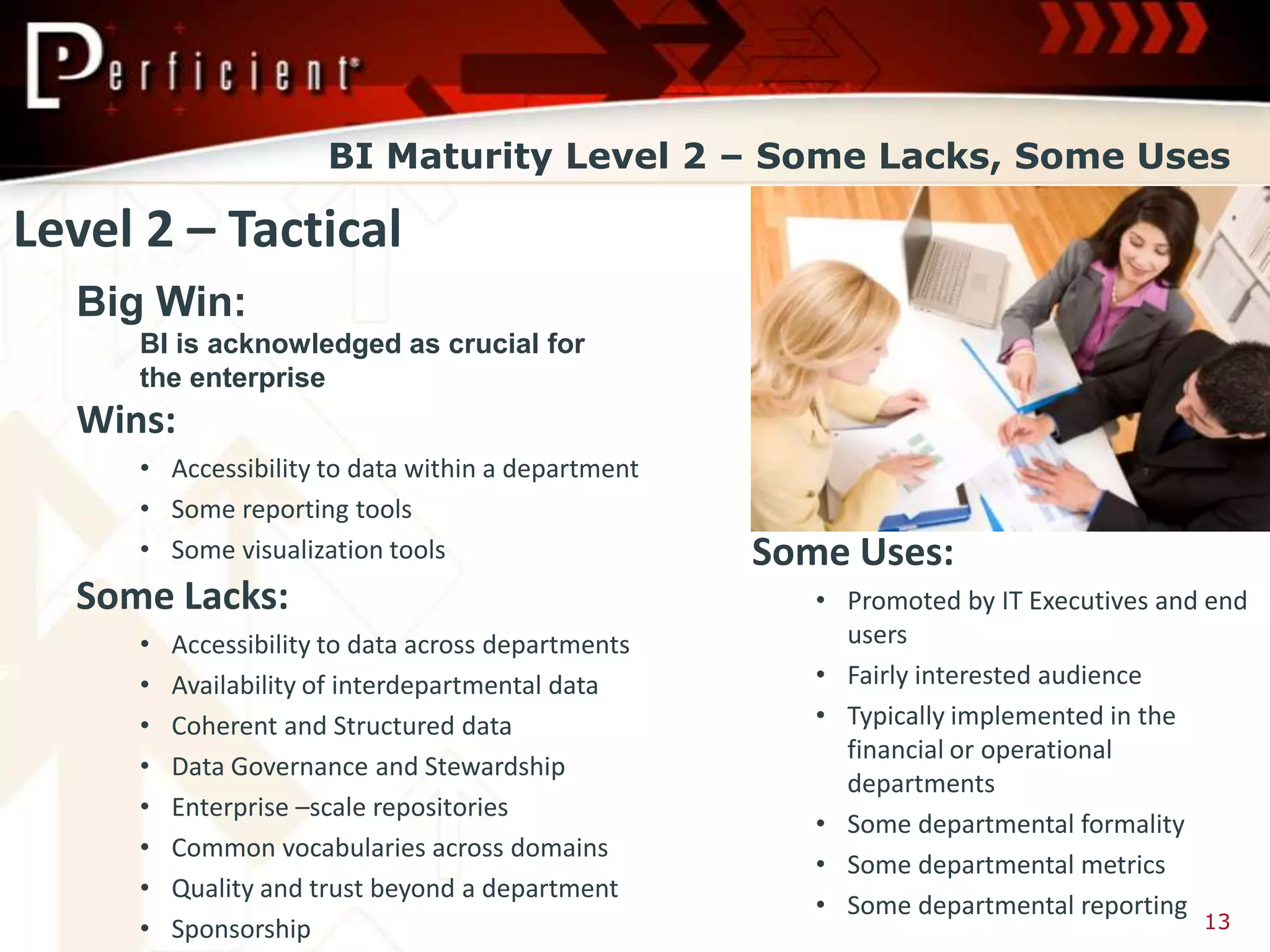
BI Maturity Level 2 – Some Lacks, Some Uses

Level 2 – Tactical
  Big Win:
     BI is acknowledged as crucial for
     the enterprise
  Wins:
     • Accessibility to data within a department
     • Some reporting tools
     • Some visualization tools                     Some Uses:
  Some Lacks:                                          • Promoted by IT Executives and end
     •   Accessibility to data across departments        users
     •   Availability of interdepartmental data        • Fairly interested audience
     •   Coherent and Structured data                  • Typically implemented in the
                                                         financial or operational
     •   Data Governance and Stewardship
                                                         departments
     •   Enterprise –scale repositories
                                                       • Some departmental formality
     •   Common vocabularies across domains
                                                       • Some departmental metrics
     •   Quality and trust beyond a department
                                                       • Some departmental reporting
     •   Sponsorship                                                                  13
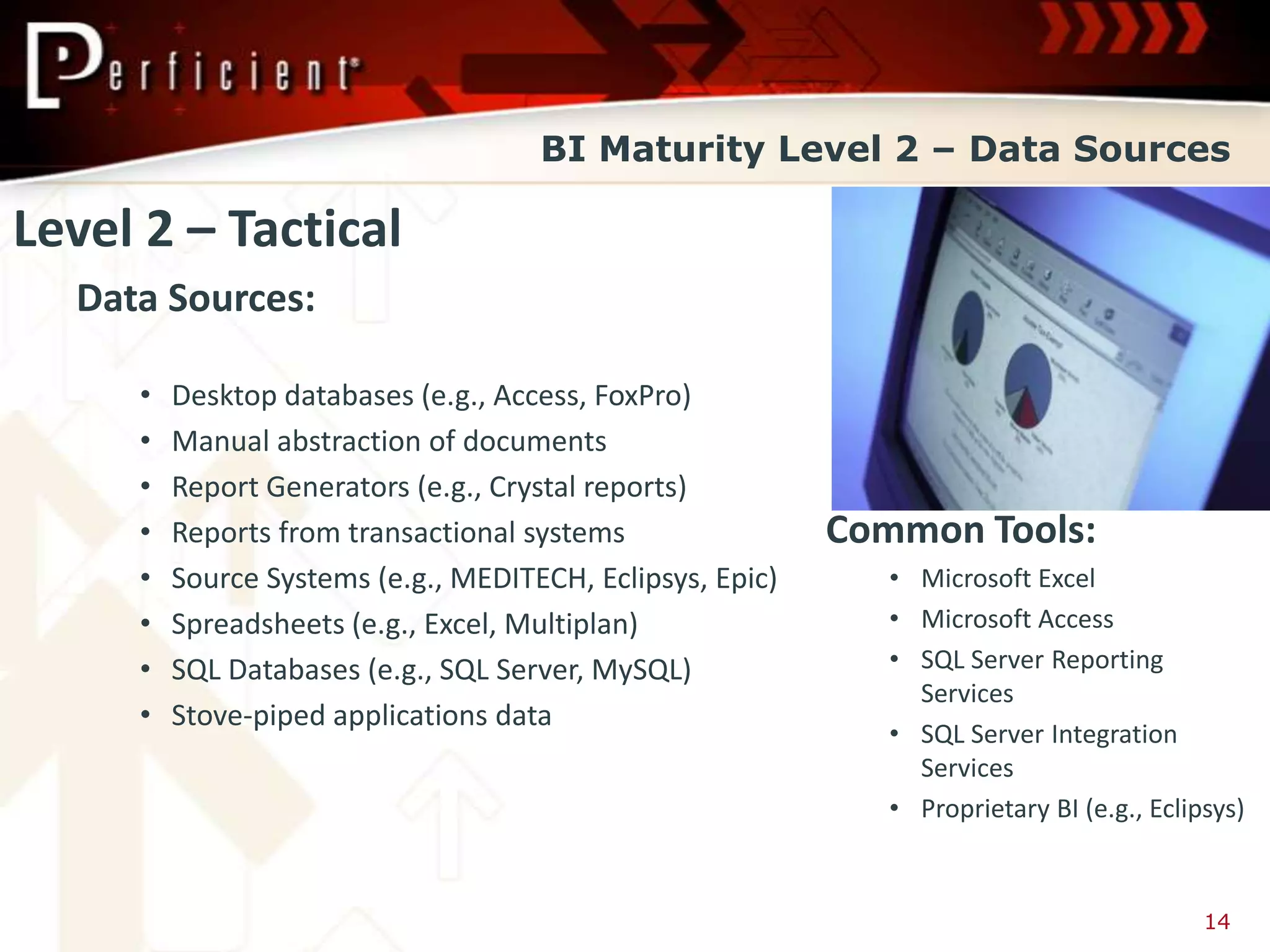
BI Maturity Level 2 – Data Sources

Level 2 – Tactical
  Data Sources:

     •   Desktop databases (e.g., Access, FoxPro)
     •   Manual abstraction of documents
     •   Report Generators (e.g., Crystal reports)
     •   Reports from transactional systems                Common Tools:
     •   Source Systems (e.g., MEDITECH, Eclipsys, Epic)      • Microsoft Excel
     •   Spreadsheets (e.g., Excel, Multiplan)                • Microsoft Access
     •   SQL Databases (e.g., SQL Server, MySQL)              • SQL Server Reporting
                                                                Services
     •   Stove-piped applications data
                                                              • SQL Server Integration
                                                                Services
                                                              • Proprietary BI (e.g., Eclipsys)


                                                                                           14
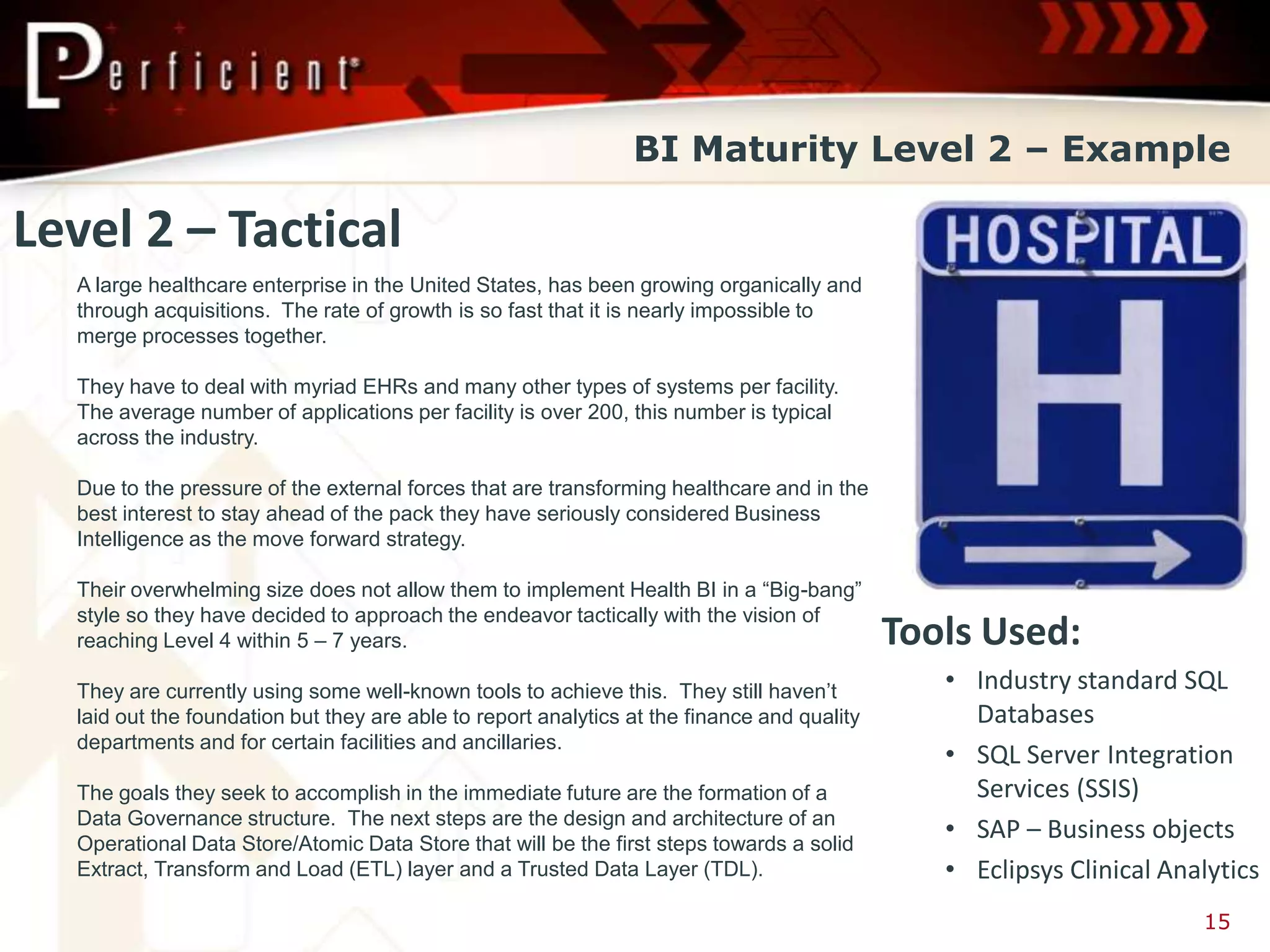
BI Maturity Level 2 – Example

Level 2 – Tactical
  A large healthcare enterprise in the United States, has been growing organically and
  through acquisitions. The rate of growth is so fast that it is nearly impossible to
  merge processes together.

  They have to deal with myriad EHRs and many other types of systems per facility.
  The average number of applications per facility is over 200, this number is typical
  across the industry.

  Due to the pressure of the external forces that are transforming healthcare and in the
  best interest to stay ahead of the pack they have seriously considered Business
  Intelligence as the move forward strategy.

  Their overwhelming size does not allow them to implement Health BI in a “Big-bang”
  style so they have decided to approach the endeavor tactically with the vision of
  reaching Level 4 within 5 – 7 years.                                                       Tools Used:
  They are currently using some well-known tools to achieve this. They still haven’t            • Industry standard SQL
  laid out the foundation but they are able to report analytics at the finance and quality        Databases
  departments and for certain facilities and ancillaries.
                                                                                                • SQL Server Integration
  The goals they seek to accomplish in the immediate future are the formation of a                Services (SSIS)
  Data Governance structure. The next steps are the design and architecture of an
  Operational Data Store/Atomic Data Store that will be the first steps towards a solid
                                                                                                • SAP – Business objects
  Extract, Transform and Load (ETL) layer and a Trusted Data Layer (TDL).                       • Eclipsys Clinical Analytics
                                                                                                                       15
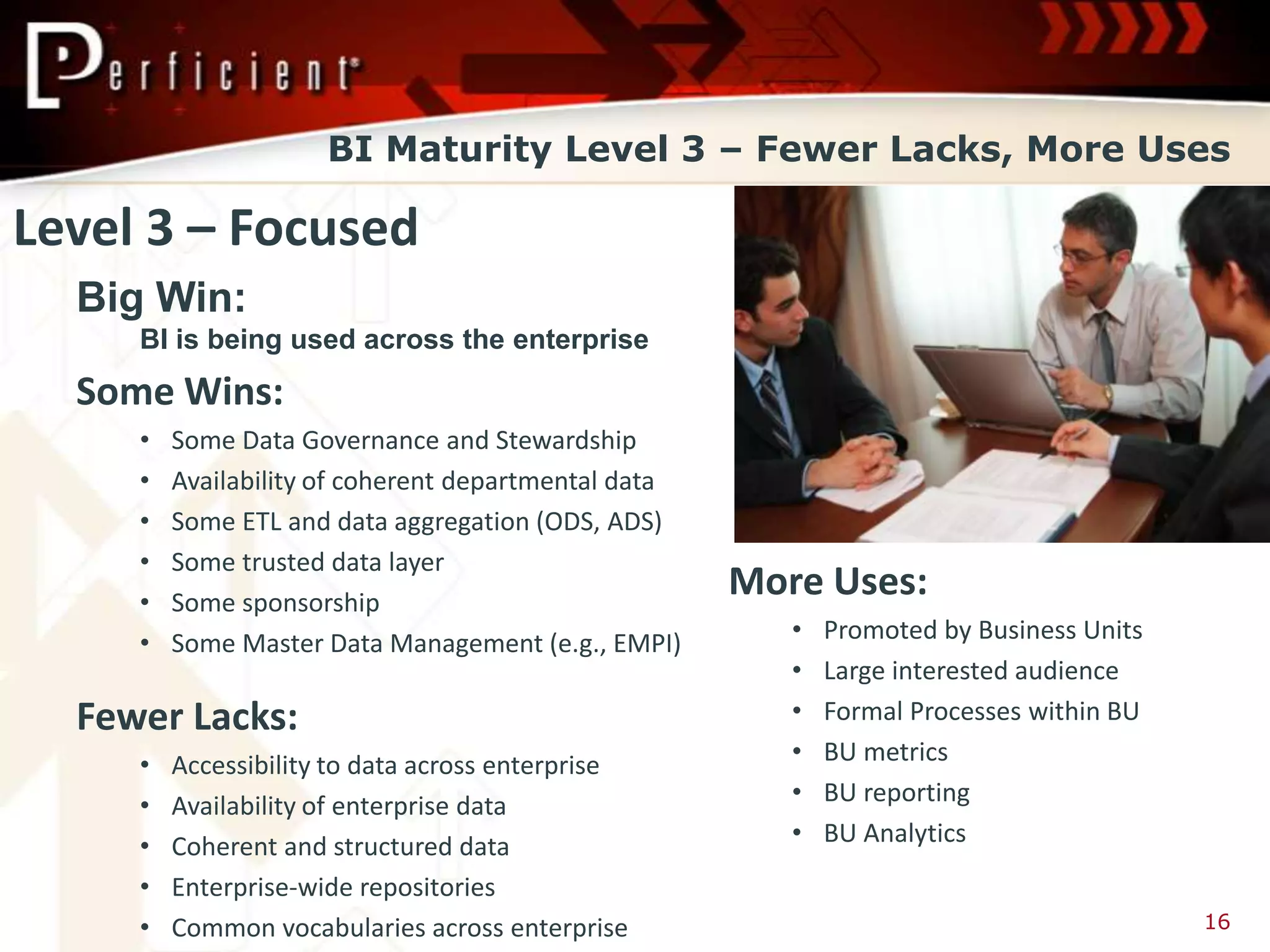
BI Maturity Level 3 – Fewer Lacks, More Uses

Level 3 – Focused
  Big Win:
     BI is being used across the enterprise
  Some Wins:
     •   Some Data Governance and Stewardship
     •   Availability of coherent departmental data
     •   Some ETL and data aggregation (ODS, ADS)
     •   Some trusted data layer
     •   Some sponsorship
                                                      More Uses:
     •   Some Master Data Management (e.g., EMPI)        •   Promoted by Business Units
                                                         •   Large interested audience
  Fewer Lacks:                                           •   Formal Processes within BU
     •   Accessibility to data across enterprise         •   BU metrics
     •   Availability of enterprise data                 •   BU reporting
     •   Coherent and structured data                    •   BU Analytics
     •   Enterprise-wide repositories
     •   Common vocabularies across enterprise                                            16
BI Maturity Level 3 – Focused

Level 3 – Focused
Data Sources:
   •   Integration Services (e.g., SSIS)
   •   Report Generators (e.g., SSRS)
   •   Reports from stove-piped systems
   •   Reports from transactional systems
   •   SQL Databases (e.g., Oracle, SQL Server)     Common Tools:
   •   Basic Enterprise Data Warehouse                 • SQL Server Reporting
   •   Enterprise Master Person Index                    Services
                                                       • SQL Server Integration
   •   Source Systems
                                                         Services
                                                       • Proprietary BI (e.g., Eclipsys)


                                                                                    17
BI Maturity Level 3 – Case Study

Level 3 - Focused
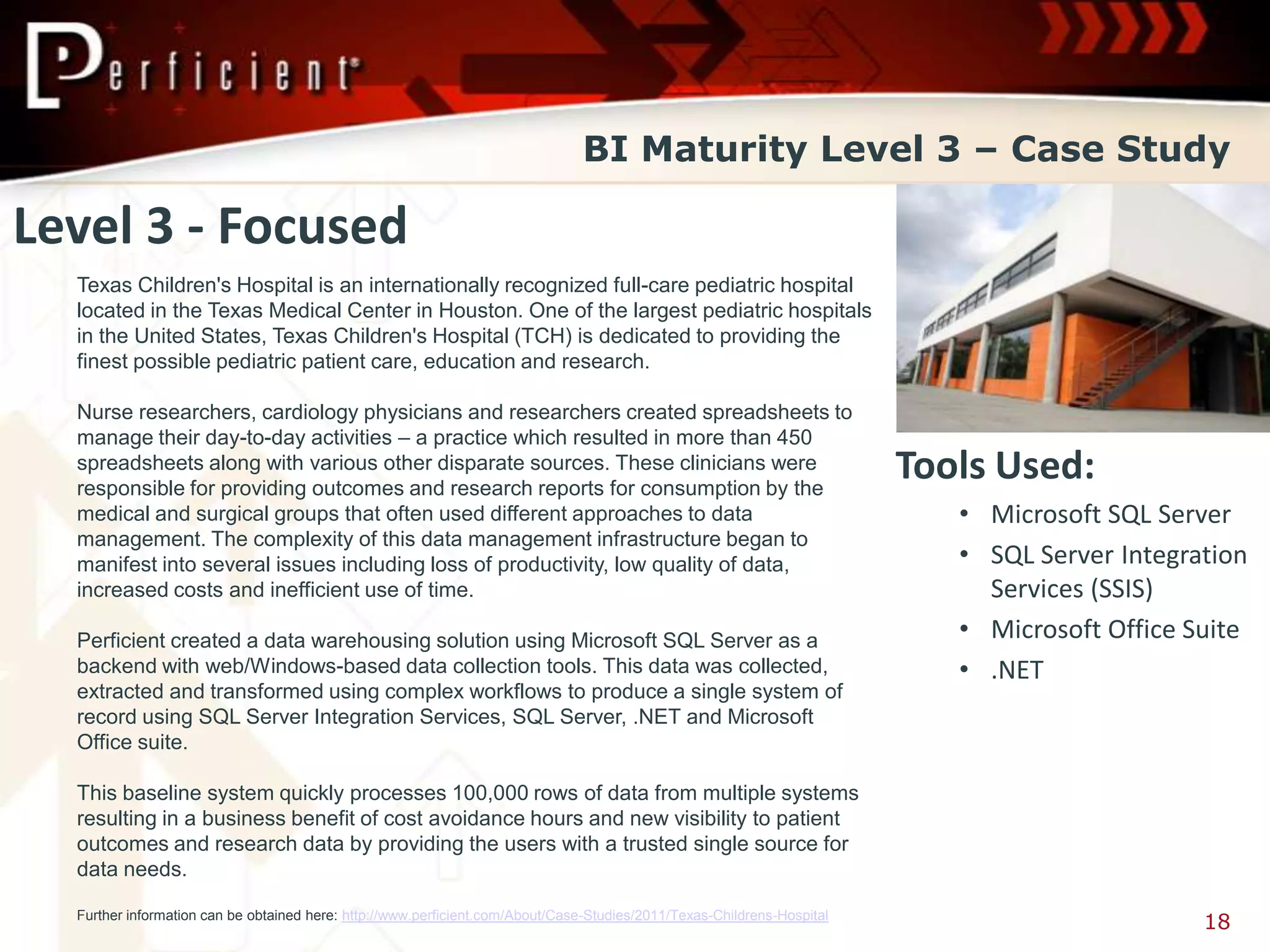
  Texas Children's Hospital is an internationally recognized full-care pediatric hospital
  located in the Texas Medical Center in Houston. One of the largest pediatric hospitals
  in the United States, Texas Children's Hospital (TCH) is dedicated to providing the
  finest possible pediatric patient care, education and research.

  Nurse researchers, cardiology physicians and researchers created spreadsheets to
  manage their day-to-day activities – a practice which resulted in more than 450
  spreadsheets along with various other disparate sources. These clinicians were
  responsible for providing outcomes and research reports for consumption by the
                                                                                                                         Tools Used:
  medical and surgical groups that often used different approaches to data                                                  • Microsoft SQL Server
  management. The complexity of this data management infrastructure began to
  manifest into several issues including loss of productivity, low quality of data,                                         • SQL Server Integration
  increased costs and inefficient use of time.                                                                                Services (SSIS)
  Perficient created a data warehousing solution using Microsoft SQL Server as a                                            • Microsoft Office Suite
  backend with web/Windows-based data collection tools. This data was collected,                                            • .NET
  extracted and transformed using complex workflows to produce a single system of
  record using SQL Server Integration Services, SQL Server, .NET and Microsoft
  Office suite.

  This baseline system quickly processes 100,000 rows of data from multiple systems
  resulting in a business benefit of cost avoidance hours and new visibility to patient
  outcomes and research data by providing the users with a trusted single source for
  data needs.

  Further information can be obtained here: http://www.perficient.com/About/Case-Studies/2011/Texas-Childrens-Hospital
                                                                                                                                                18
BI Maturity Level 4 – Few Lacks, Many Uses

Level 4 – Strategic
  Big Win:
     BI is a key part of the enterprise
  Wins:
     •   Enterprise Data Governance and Stewardship
     •   Master Data Management
     •   BI is used daily to manage the business
     •   Enterprise data aggregation (ODS, ADS)
     •   Enterprise Data Warehouse
                                                      Many Uses:
     •   Trusted Data Layer                              •   Promoted by C-Level
     •   Sponsorship                                     •   Very large interested audience
                                                         •   Very Formal
  Few Lacks:                                             •   Enterprise metrics
     •   Accessibility to data across departments
                                                         •   Predictive Analytics and Modeling
     •   Availability of interdepartmental data
     •   Coherent and structured data
     •   Enterprise-wide repositories
     •   Common vocabularies across enterprise                                               19
BI Maturity Level 4 – Strategic

Level 4 – Strategic
Data Sources:
   • Enterprise Data Warehouse
   • Information Delivery Applications
   • Enterprise SQL Databases (e.g., Oracle,
     IBM)
                                                  Common Tools:
                                                     • SAP – Business Objects
                                                     • IBM Cognos
                                                     • Oracle OBIEE
                                                     • SQL Server Reporting
                                                       Services
                                                     • SQL Server Integration
                                                       Services


                                                                                20
BI Maturity Level 4 – Example

Level 4 - Strategic
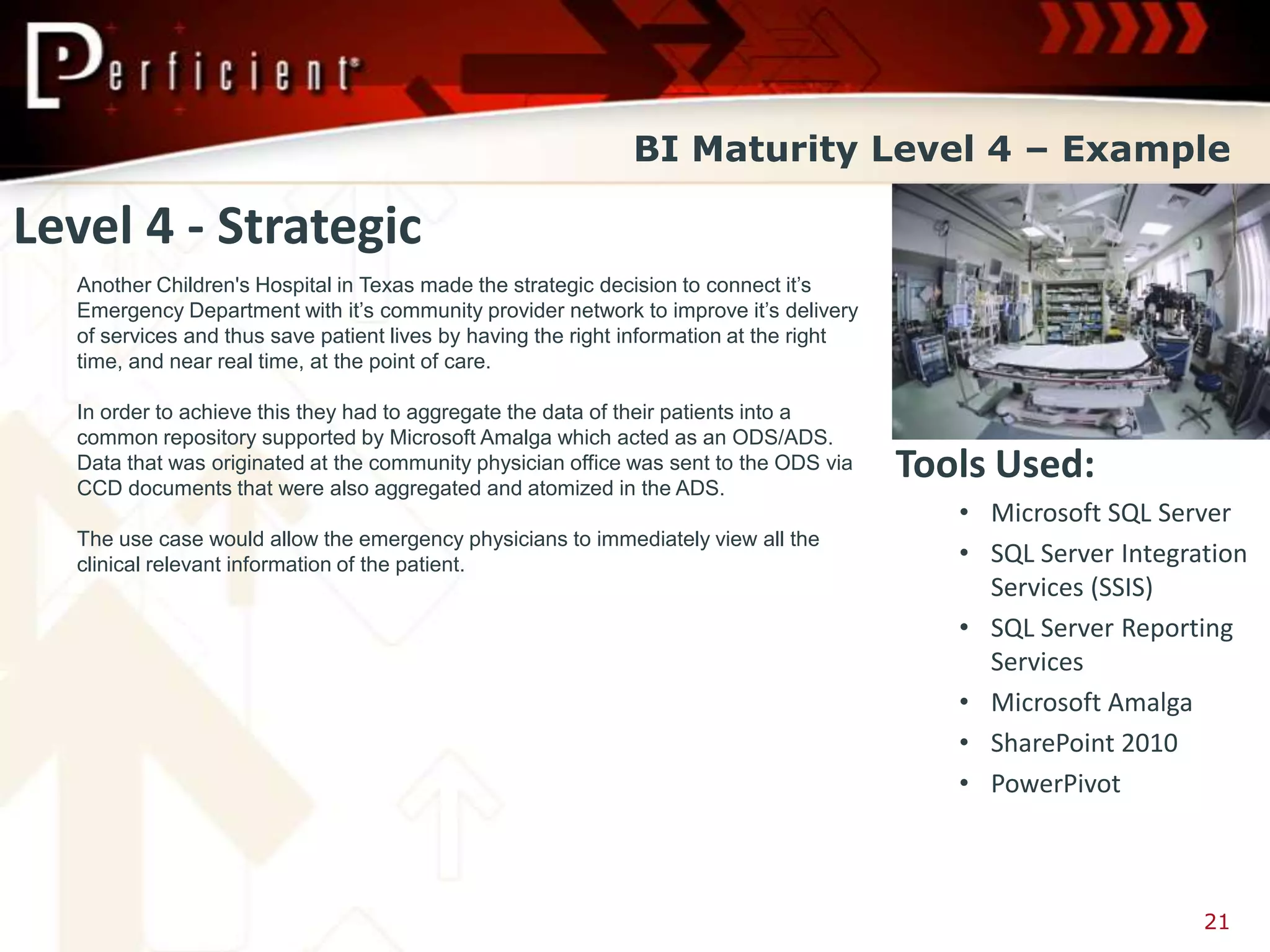
  Another Children's Hospital in Texas made the strategic decision to connect it’s
  Emergency Department with it’s community provider network to improve it’s delivery
  of services and thus save patient lives by having the right information at the right
  time, and near real time, at the point of care.

  In order to achieve this they had to aggregate the data of their patients into a
  common repository supported by Microsoft Amalga which acted as an ODS/ADS.
  Data that was originated at the community physician office was sent to the ODS via
  CCD documents that were also aggregated and atomized in the ADS.
                                                                                         Tools Used:
                                                                                            • Microsoft SQL Server
  The use case would allow the emergency physicians to immediately view all the
  clinical relevant information of the patient.                                             • SQL Server Integration
                                                                                              Services (SSIS)
                                                                                            • SQL Server Reporting
                                                                                              Services
                                                                                            • Microsoft Amalga
                                                                                            • SharePoint 2010
                                                                                            • PowerPivot


                                                                                                                21
BI Maturity Level 5–No Lacks, Infinite Possibilities

Level 5 – Pervasive
  Big Win:
     BI is shared outside the enterprise

  Wins:
     •   Pervasive access to enterprise data
     •   Availability of enterprise data
     •   Enterprise master data management
     •   Enterprise-wide repositories                Infinite Possibilities:
     •   Common vocabularies across enterprise
                                                         • Corporate sponsored
     •   Pervasive Data Governance and Stewardship
                                                         • Corporate audience
     •   Availability of coherent enterprise data
                                                         • Analytics Embedded in
     •   A very happy and healthy organization!            Processes
                                                         • Clinical Intelligence
  No Lacks!
                                                         • Decision Support Systems
                                                         • Population Health
                                                           Management
                                                                                      22
BI Maturity Level 5 – Pervasive

Level 5 – Pervasive
Data Sources:
   • Enterprise Data Warehouse
   • Information Delivery Applications
   • Enterprise SQL Databases (e.g., Oracle,
     IBM)
   • Artificial Intelligence processing of       Common Tools:
     unstructured data                              • SAP – Business Objects
                                                    • IBM Cognos
                                                    • IBM Watson
                                                    • Oracle OBIEE
                                                    • SQL Server Reporting
                                                      Services
                                                    • SQL Server Integration
                                                      Services

                                                                               23
BI Maturity Level 5 – Example

Level 5 - Pervasive
  Achieving level 5 is not an easy task. Although some payers have been able to
  initiate level 5 maturity most healthcare provider organizations fall below this level.

  Blue Cross / Blue Shield of Kansas City was able to create an enterprise business
  intelligence strategy and a data governance model in order to integrate 20 major
  mission critical source systems in order to better serve their member patients.

  They decided that information had to be enterprise-wide accessible, reliable and
  accurate. Their information was trapped in silos. They then created the Data
  Integrated Health Management Platform.

  They were able to bring in outsourced disease management applications and helping
  them save millions of dollars a year.

  With their Enterprise Data Warehouse they were also able to deploy a self-service
  business intelligence reporting application to large employer group customers and
  brokers with which they could access and perform their own online analytics. Data
  was exposed to almost 5000 physician offices.

  Other noteworthy organizations that have achieved high-levels of maturity are:

  • Kaiser Permanente
  • Mayo Clinic
  • Healthcare Partners

                                                                                            24
Questions and Answers


                   25
Questions


        Thank You!
          Mike Jenkins
  mike.jenkins@perficient.com
         On Twitter: @TechnologyChef

        Michael Planchart
michael.planchart@perficient.com
          On Twitter: @theEHRGuy
Get in Touch with Perficient


• On Twitter: @Perficient_HC
• Our Healthcare Blog:
  blogs.perficient.com/healthcare/
• To register for the second webinar:
  www.perficient.com/Webinars
• To download the Health BI White Paper:
  www.perficient.com/WhitePapers

Healthcare Business Intelligence for Power Users

  • 1.
    Healthcare BI forPower Users September 13, 2012
  • 2.
    About Perficient Perficient isa leading information technology consulting firm serving clients throughout North America. We help clients implement business-driven technology solutions that integrate business processes, improve worker productivity, increase customer loyalty and create a more agile enterprise to better respond to new business opportunities.
  • 3.
    Perficient Profile  Founded in 1997  Public, NASDAQ: PRFT  2011 Revenue of $260 million  Major market locations throughout North America — Atlanta, Austin, Charlotte, Chicago, Cincinnati, Cleveland, Columbus, Dallas, Denver, Detroit, Fairfax, Houston, Indianapolis, Los Angeles, Minneapolis, New Orleans, Philadelphia, San Francisco, San Jose, Southern California, St. Louis and Toronto  Global delivery centers in China, Europe and India  2,000+ colleagues  Dedicated solution practices  87% repeat business rate  Alliance partnerships with major technology vendors  Multiple vendor/industry technology and growth awards
  • 4.
    Our Solutions Expertise& Services Business-Driven Solutions Perficient Services • Enterprise Portals  End-to-End Solution Delivery • SOA and Business Process Mgmt  IT Strategic Consulting • Business Intelligence  IT Architecture Planning • User-Centered Custom Applications  Business Process & Workflow • Interactive Design Consulting • CRM Solutions  Usability and UI Consulting • Enterprise Performance Management  Custom Application Development • Customer Self-Service  Offshore Development • eCommerce & Product Information  Package Selection, Implementation Management and Integration • Enterprise Content Management  Architecture & Application Migrations • Enterprise Resource Planning  Education • Management Consulting  Interactive Design • Industry-Specific Solutions • Mobile Technology Perficient brings deep solutions expertise and offers a complete set of flexible services to help clients • Security Assessments implement business-driven IT solutions
  • 5.
    Our Speakers Mike Jenkins • Health BI Practice Manager for Perficient • 25+ years of experience architecting, developing, and implementing solutions for organizations in the US, Canada, Europe, and Asia. • Experienced in healthcare, finance, defense, manufacturing, training, and retail industries. • Some of Mike’s healthcare projects include: • Developing a core measures proactive monitoring system • Developing an eHealth strategy for a growing community hospital • Implementing transparent pricing and outcomes measurement solutions • Automating clinical and administrative tasks through forms automation • Connecting multiple healthcare systems through a common patient portal • Developing an electronic medical record application.
  • 6.
    Our Speakers Michael Planchart • Enterprise Healthcare Architect for Perficient • 25+ years of experience architecting, developing, and implementing healthcare solutions for organizations in the US, Latin America and Europe. • Author of the IHE Radiology Framework Profile CXCAD • Some of Michael’s healthcare projects include: • Development of an Electronic Health Care Record System for Enterprise Hospitals deployed throughout Latin America • Microsoft Amalga integration architecture • Microsoft Amalga implementations at major Healthcare Organizations in the US • Microsoft HealthVault Community Connect implementations at major Healthcare Organizations in the US • Architect and Development of advanced radiology imaging viewers applied to lung cancer detection
  • 7.
    Today’s Agenda • Introduction • What is the BI Maturity Model • Maturity Model Levels • Walkthrough each Level: – Lacks, Wins and Uses – Data Sources – Case Studies or Examples 7
  • 8.
  • 9.
    BI Maturity Model Ecosystem Mindset Enterprise Department Individual
  • 10.
    BI Maturity Level1 – Many Lacks, Few Uses Level 1 – Unawareness Many Lacks: • Accessibility to data • Availability of departmental data and information • Coherent and structured data • Common repositories • Common vocabularies Few Uses: • Data governance and stewardship • Promoted by end-users • Extensibility and functionality • Small interested audience • Quality and trust • Informal • Retention • Non-continuous • Sponsorship and Stakeholders • Typically ends abruptly • Proper technology infrastructure No significant wins! 10
  • 11.
    BI Maturity Level1 – Data Sources Level 1 – Unawareness Data Sources: • Application-based data • Desktop databases (e.g., Access, FoxPro) • Manual abstraction of documents • External sources (e.g., CMS, payers) • Reports from transactional systems Common Tools: • Spreadsheets (e.g., Excel, Visi-Calc) • Microsoft Excel • Microsoft Access • Crystal reports (basic) • Some OTS applications 11
  • 12.
    BI Maturity Level1 – Example Level 1 – Unawareness A small community hospital in rural Ohio decided to expand its medical imaging services offerings beyond the limited radius of the town they were serving at the moment. They had acquired a couple of high-tech Computer Aided Detection (CAD) products for lung cancer and mammography and they were certain that they would be able to provide better care to their at-risk patients and provide their radiologists with tools that would allow to increase their bandwidth thus resulting in more diagnostic readings. Tools Used: But they ran into some challenges. The radiologists were complaining that they • Microsoft Excel wouldn’t be able to handle more cases without getting tired and that would increase patient safety risks. • Microsoft Access • Crystal reports (basic) The people in charge of delivering the imaging services option didn’t have the data to challenge or confirm the radiologists assertions. • Some OTS applications to extract data from the RIS The IT department was tasked to assist them in gathering the data. The IT team leveraged the RIS in order to obtain the scheduling information and the PACS to and the PACS extract the study information and reconcile these with the radiologists claims. Once the management team had the data they were then able to work in harmony with the radiologists’ team and come up with creative solutions to the problems. They were able to increase their offerings and they were also able to identify that they would need one more radiologist in order to avoid over-working the existing ones. 12
  • 13.
    BI Maturity Level2 – Some Lacks, Some Uses Level 2 – Tactical Big Win: BI is acknowledged as crucial for the enterprise Wins: • Accessibility to data within a department • Some reporting tools • Some visualization tools Some Uses: Some Lacks: • Promoted by IT Executives and end • Accessibility to data across departments users • Availability of interdepartmental data • Fairly interested audience • Coherent and Structured data • Typically implemented in the financial or operational • Data Governance and Stewardship departments • Enterprise –scale repositories • Some departmental formality • Common vocabularies across domains • Some departmental metrics • Quality and trust beyond a department • Some departmental reporting • Sponsorship 13
  • 14.
    BI Maturity Level2 – Data Sources Level 2 – Tactical Data Sources: • Desktop databases (e.g., Access, FoxPro) • Manual abstraction of documents • Report Generators (e.g., Crystal reports) • Reports from transactional systems Common Tools: • Source Systems (e.g., MEDITECH, Eclipsys, Epic) • Microsoft Excel • Spreadsheets (e.g., Excel, Multiplan) • Microsoft Access • SQL Databases (e.g., SQL Server, MySQL) • SQL Server Reporting Services • Stove-piped applications data • SQL Server Integration Services • Proprietary BI (e.g., Eclipsys) 14
  • 15.
    BI Maturity Level2 – Example Level 2 – Tactical A large healthcare enterprise in the United States, has been growing organically and through acquisitions. The rate of growth is so fast that it is nearly impossible to merge processes together. They have to deal with myriad EHRs and many other types of systems per facility. The average number of applications per facility is over 200, this number is typical across the industry. Due to the pressure of the external forces that are transforming healthcare and in the best interest to stay ahead of the pack they have seriously considered Business Intelligence as the move forward strategy. Their overwhelming size does not allow them to implement Health BI in a “Big-bang” style so they have decided to approach the endeavor tactically with the vision of reaching Level 4 within 5 – 7 years. Tools Used: They are currently using some well-known tools to achieve this. They still haven’t • Industry standard SQL laid out the foundation but they are able to report analytics at the finance and quality Databases departments and for certain facilities and ancillaries. • SQL Server Integration The goals they seek to accomplish in the immediate future are the formation of a Services (SSIS) Data Governance structure. The next steps are the design and architecture of an Operational Data Store/Atomic Data Store that will be the first steps towards a solid • SAP – Business objects Extract, Transform and Load (ETL) layer and a Trusted Data Layer (TDL). • Eclipsys Clinical Analytics 15
  • 16.
    BI Maturity Level3 – Fewer Lacks, More Uses Level 3 – Focused Big Win: BI is being used across the enterprise Some Wins: • Some Data Governance and Stewardship • Availability of coherent departmental data • Some ETL and data aggregation (ODS, ADS) • Some trusted data layer • Some sponsorship More Uses: • Some Master Data Management (e.g., EMPI) • Promoted by Business Units • Large interested audience Fewer Lacks: • Formal Processes within BU • Accessibility to data across enterprise • BU metrics • Availability of enterprise data • BU reporting • Coherent and structured data • BU Analytics • Enterprise-wide repositories • Common vocabularies across enterprise 16
  • 17.
    BI Maturity Level3 – Focused Level 3 – Focused Data Sources: • Integration Services (e.g., SSIS) • Report Generators (e.g., SSRS) • Reports from stove-piped systems • Reports from transactional systems • SQL Databases (e.g., Oracle, SQL Server) Common Tools: • Basic Enterprise Data Warehouse • SQL Server Reporting • Enterprise Master Person Index Services • SQL Server Integration • Source Systems Services • Proprietary BI (e.g., Eclipsys) 17
  • 18.
    BI Maturity Level3 – Case Study Level 3 - Focused Texas Children's Hospital is an internationally recognized full-care pediatric hospital located in the Texas Medical Center in Houston. One of the largest pediatric hospitals in the United States, Texas Children's Hospital (TCH) is dedicated to providing the finest possible pediatric patient care, education and research. Nurse researchers, cardiology physicians and researchers created spreadsheets to manage their day-to-day activities – a practice which resulted in more than 450 spreadsheets along with various other disparate sources. These clinicians were responsible for providing outcomes and research reports for consumption by the Tools Used: medical and surgical groups that often used different approaches to data • Microsoft SQL Server management. The complexity of this data management infrastructure began to manifest into several issues including loss of productivity, low quality of data, • SQL Server Integration increased costs and inefficient use of time. Services (SSIS) Perficient created a data warehousing solution using Microsoft SQL Server as a • Microsoft Office Suite backend with web/Windows-based data collection tools. This data was collected, • .NET extracted and transformed using complex workflows to produce a single system of record using SQL Server Integration Services, SQL Server, .NET and Microsoft Office suite. This baseline system quickly processes 100,000 rows of data from multiple systems resulting in a business benefit of cost avoidance hours and new visibility to patient outcomes and research data by providing the users with a trusted single source for data needs. Further information can be obtained here: http://www.perficient.com/About/Case-Studies/2011/Texas-Childrens-Hospital 18
  • 19.
    BI Maturity Level4 – Few Lacks, Many Uses Level 4 – Strategic Big Win: BI is a key part of the enterprise Wins: • Enterprise Data Governance and Stewardship • Master Data Management • BI is used daily to manage the business • Enterprise data aggregation (ODS, ADS) • Enterprise Data Warehouse Many Uses: • Trusted Data Layer • Promoted by C-Level • Sponsorship • Very large interested audience • Very Formal Few Lacks: • Enterprise metrics • Accessibility to data across departments • Predictive Analytics and Modeling • Availability of interdepartmental data • Coherent and structured data • Enterprise-wide repositories • Common vocabularies across enterprise 19
  • 20.
    BI Maturity Level4 – Strategic Level 4 – Strategic Data Sources: • Enterprise Data Warehouse • Information Delivery Applications • Enterprise SQL Databases (e.g., Oracle, IBM) Common Tools: • SAP – Business Objects • IBM Cognos • Oracle OBIEE • SQL Server Reporting Services • SQL Server Integration Services 20
  • 21.
    BI Maturity Level4 – Example Level 4 - Strategic Another Children's Hospital in Texas made the strategic decision to connect it’s Emergency Department with it’s community provider network to improve it’s delivery of services and thus save patient lives by having the right information at the right time, and near real time, at the point of care. In order to achieve this they had to aggregate the data of their patients into a common repository supported by Microsoft Amalga which acted as an ODS/ADS. Data that was originated at the community physician office was sent to the ODS via CCD documents that were also aggregated and atomized in the ADS. Tools Used: • Microsoft SQL Server The use case would allow the emergency physicians to immediately view all the clinical relevant information of the patient. • SQL Server Integration Services (SSIS) • SQL Server Reporting Services • Microsoft Amalga • SharePoint 2010 • PowerPivot 21
  • 22.
    BI Maturity Level5–No Lacks, Infinite Possibilities Level 5 – Pervasive Big Win: BI is shared outside the enterprise Wins: • Pervasive access to enterprise data • Availability of enterprise data • Enterprise master data management • Enterprise-wide repositories Infinite Possibilities: • Common vocabularies across enterprise • Corporate sponsored • Pervasive Data Governance and Stewardship • Corporate audience • Availability of coherent enterprise data • Analytics Embedded in • A very happy and healthy organization! Processes • Clinical Intelligence No Lacks! • Decision Support Systems • Population Health Management 22
  • 23.
    BI Maturity Level5 – Pervasive Level 5 – Pervasive Data Sources: • Enterprise Data Warehouse • Information Delivery Applications • Enterprise SQL Databases (e.g., Oracle, IBM) • Artificial Intelligence processing of Common Tools: unstructured data • SAP – Business Objects • IBM Cognos • IBM Watson • Oracle OBIEE • SQL Server Reporting Services • SQL Server Integration Services 23
  • 24.
    BI Maturity Level5 – Example Level 5 - Pervasive Achieving level 5 is not an easy task. Although some payers have been able to initiate level 5 maturity most healthcare provider organizations fall below this level. Blue Cross / Blue Shield of Kansas City was able to create an enterprise business intelligence strategy and a data governance model in order to integrate 20 major mission critical source systems in order to better serve their member patients. They decided that information had to be enterprise-wide accessible, reliable and accurate. Their information was trapped in silos. They then created the Data Integrated Health Management Platform. They were able to bring in outsourced disease management applications and helping them save millions of dollars a year. With their Enterprise Data Warehouse they were also able to deploy a self-service business intelligence reporting application to large employer group customers and brokers with which they could access and perform their own online analytics. Data was exposed to almost 5000 physician offices. Other noteworthy organizations that have achieved high-levels of maturity are: • Kaiser Permanente • Mayo Clinic • Healthcare Partners 24
  • 25.
  • 26.
    Questions Thank You! Mike Jenkins mike.jenkins@perficient.com On Twitter: @TechnologyChef Michael Planchart michael.planchart@perficient.com On Twitter: @theEHRGuy
  • 27.
    Get in Touchwith Perficient • On Twitter: @Perficient_HC • Our Healthcare Blog: blogs.perficient.com/healthcare/ • To register for the second webinar: www.perficient.com/Webinars • To download the Health BI White Paper: www.perficient.com/WhitePapers