Congressional Budget Office
Dynamic Scoring at CBO
May 14, 2015
Wendy Edelberg
Assistant Director for Macroeconomic Analysis
Conference of Business Economists
Washington, D.C.
1C O N G R E S S I O N A L B U D G E T O F F I C E
Requirements Under 2016 Budget Resolution
■ To the greatest extent practicable, CBO and JCT shall
incorporate the budgetary effects of changes in
macroeconomic variables resulting from legislation that
– Has a gross budgetary effect of 0.25% of GDP in any year over the next
ten years (an amount equal to about $45 billion in 2015) or is
– Designated by one of the Chairmen of the Budget Committees
■ Estimates shall also include a qualitative assessment of the
budgetary effects (including macroeconomic effects) for the
subsequent 20-year period
■ Does not apply to appropriation acts
2C O N G R E S S I O N A L B U D G E T O F F I C E
What Behavioral Responses Are Addressed in
Conventional Cost Estimates?
■ If proposed policies would affect people’s behavior in ways
that would generate budgetary savings or costs, the effects
have been incorporated in CBO’s cost estimates.
– The change in production of various crops that would result from
adopting new farm policies
– The likelihood that people would take up certain government benefits
when policies pertaining to those benefits are changed
– The quantity of health care services that would be provided if
Medicare’s payment rates to providers were changed
■ By longstanding convention, CBO’s cost estimates generally
have not reflected changes in behavior that would affect total
output in the economy, such as any changes in labor supply or
private investment resulting from changes in fiscal policy.
3C O N G R E S S I O N A L B U D G E T O F F I C E
How the New Requirement Extends Previous Analysis by CBO
■ CBO has routinely produced estimates of the macroeconomic
effects of fiscal policies and of the feedback from those
macroeconomic changes to the federal budget.
– Analysis of the President’s budget
– Annual long-term budget outlook
– Analyses of illustrative fiscal policy scenarios
■ Generally not for specific legislation, with one particular
exception: S. 744, the Border Security, Economic Opportunity,
and Immigration Modernization Act.
– Because the bill would have significantly increased the size of the
U.S. labor force, CBO and JCT incorporated in this cost estimate their
projections of the direct effects of the act on the U.S. population,
employment, and taxable compensation
– CBO separately published analysis of additional economic effects and
their feedback to the budget
4C O N G R E S S I O N A L B U D G E T O F F I C E
CBO’s Approach to Analyzing Economic Effects of
Fiscal Policies
■ Short term: Changes in fiscal policies affect the overall
economy primarily by influencing the demand for goods and
services by consumers, businesses, and governments, which
leads to changes in output relative to potential (maximum
sustainable) output.
■ Long term: Changes in fiscal policies affect output primarily by
altering national saving, federal investment, and people’s
incentives to work and save, as well as businesses’ incentive to
invest, thereby changing potential output.
5C O N G R E S S I O N A L B U D G E T O F F I C E
Short-Term Effects from Changes in Demand
■ Direct contributions to aggregate demand from changes in
purchases by federal agencies and those who receive federal
payments and pay taxes
■ The change in output for each dollar of direct contribution to
demand (the “demand multiplier”) varies with the response
of monetary policy
■ In CBO’s estimates of indirect effects:
– When the monetary policy response is likely to be limited, demand
multiplier over four quarters ranges from 0.5 to 2.5, with a central
estimate of 1.5
– When the monetary policy response is likely to be stronger, demand
multiplier over four quarters ranges from 0.4 to 1.9, with a central
estimate of 1.2; over eight quarters, it ranges from 0.2 to 0.8, with a
central estimate of 0.5
6C O N G R E S S I O N A L B U D G E T O F F I C E
Short-Term Effects from Changes in Labor Supply
■ Effects on the supply of labor that lead to changes
in employment, depending on amount of slack in
labor market
7C O N G R E S S I O N A L B U D G E T O F F I C E
Long-Term Effects
■ Two models of potential output to estimate the effects of changes
in fiscal policies on the overall economy over the long term
– Solow-type growth model
– Life-cycle growth model
■ Potential output depends on
– Amount and quality of labor and capital (depend on work, saving, and
investment)
– Productivity of the labor and capital inputs (depends in part on federal
investment)
– Amount of national saving (depends in part on federal borrowing)
8C O N G R E S S I O N A L B U D G E T O F F I C E
The Role of Expectations About Fiscal Policy
■ Solow-type growth model
– People base their decisions about working and saving primarily on
current economic conditions, including government policies.
– Decisions reflect people’s anticipation of future policies in a general
way but not their responses to specific future developments.
■ Life-cycle growth model
– People make choices about working and saving in response to both
current economic conditions and their explicit expectations of future
economic conditions.
– The model requires specification of future fiscal policies that put
federal debt on a sustainable path over the long run because forward-
looking households would not hold government bonds if the
households expected that debt as a percentage of GDP would rise
without limit.
9C O N G R E S S I O N A L B U D G E T O F F I C E
How Labor Supply Responds to Changes in
Fiscal Policy in the Solow-Type Growth Model
■ The overall effects of a policy change on the labor supply can
be expressed as an elasticity, which is the percentage change
in the labor supply resulting from a 1 percent change in after-
tax income.
■ CBO’s estimates correspond to a total wage elasticity for all
earners of 0.19 (composed of a substitution elasticity of 0.24
and an income elasticity of -0.05).
– Substitution Effect: Increased after-tax compensation for an additional
hour of work makes work more valuable relative to other uses of a
person’s time.
– Income Effect: Increased after-tax income from a given amount of work
allows people to maintain the same standard of living while working
fewer hours.
10C O N G R E S S I O N A L B U D G E T O F F I C E
Other Key Aspects of Solow-Type Growth Model
■ When the deficit goes up by one dollar, private saving is
estimated to rise by 43 cents (national saving falls by
57 cents), and net capital inflows rise by 24 cents, ultimately
leaving a decline of 33 cents in investment.
■ Additional federal investment is estimated to yield half of the
typical return on investment completed by the private sector.
11C O N G R E S S I O N A L B U D G E T O F F I C E
Other Key Aspects of Life-Cycle Growth Model
■ Labor supply and private saving are influenced by the current
values and future anticipated values of the after-tax rate of
return on saving, the after-tax wage, and households’
disposable income, among other factors.
■ The elasticity with respect to a one-time temporary change in
wages (the so-called Frisch elasticity) is 0.40, according to
CBO’s central estimates.
■ Because of the uncertainty that households face about their
future income, households in the life-cycle model take the
precaution of holding additional savings as a buffer against
potential drops in income.
12C O N G R E S S I O N A L B U D G E T O F F I C E
Presentation of Macroeconomic Analysis in Cost Estimates
■ Presentation will probably evolve over time as CBO learns
what is most useful
■ Estimates will show all of the information that traditionally
would be included if macroeconomic effects were not
incorporated; will identify the macroeconomic effects
separately
■ Estimates will provide information related to the uncertainty
of the macroeconomic effects
13C O N G R E S S I O N A L B U D G E T O F F I C E
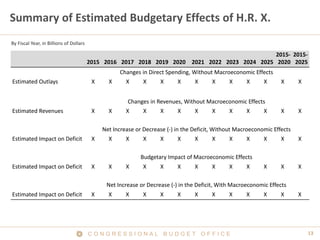
Summary of Estimated Budgetary Effects of H.R. X.
By Fiscal Year, in Billions of Dollars
2015 2016 2017 2018 2019 2020 2021 2022 2023 2024 2025
2015-
2020
2015-
2025
Changes in Direct Spending, Without Macroeconomic Effects
Estimated Outlays X X X X X X X X X X X X X
Changes in Revenues, Without Macroeconomic Effects
Estimated Revenues X X X X X X X X X X X X X
Net Increase or Decrease (-) in the Deficit, Without Macroeconomic Effects
Estimated Impact on Deficit X X X X X X X X X X X X X
Budgetary Impact of Macroeconomic Effects
Estimated Impact on Deficit X X X X X X X X X X X X X
Net Increase or Decrease (-) in the Deficit, With Macroeconomic Effects
Estimated Impact on Deficit X X X X X X X X X X X X X
14C O N G R E S S I O N A L B U D G E T O F F I C E
Notes
■ Answers to Questions for the Record Following a Hearing on the
Budget and Economic Outlook for 2015 to 2025 Conducted by the
Senate Committee on the Budget (March 2015),
www.cbo.gov/publication/49975.
■ Macroeconomic Analysis of Legislative Proposals (May 2013),
www.cbo.gov/publication/44165.
■ How CBO Analyzes the Effects of Changes in Federal Fiscal Policies on
the Economy (November 2014), www.cbo.gov/publication/49494.
■ Cost Estimate for S. 744, Border Security, Economic Opportunity, and
Immigration Modernization Act (June 2013),
www.cbo.gov/publication/44397.
■ The Economic Impact of S. 744, the Border Security, Economic
Opportunity, and Immigration Modernization Act (July 2013).
www.cbo.gov/publication/44346.

Dynamic Scoring at CBO

  • 1.
    Congressional Budget Office DynamicScoring at CBO May 14, 2015 Wendy Edelberg Assistant Director for Macroeconomic Analysis Conference of Business Economists Washington, D.C.
  • 2.
    1C O NG R E S S I O N A L B U D G E T O F F I C E Requirements Under 2016 Budget Resolution ■ To the greatest extent practicable, CBO and JCT shall incorporate the budgetary effects of changes in macroeconomic variables resulting from legislation that – Has a gross budgetary effect of 0.25% of GDP in any year over the next ten years (an amount equal to about $45 billion in 2015) or is – Designated by one of the Chairmen of the Budget Committees ■ Estimates shall also include a qualitative assessment of the budgetary effects (including macroeconomic effects) for the subsequent 20-year period ■ Does not apply to appropriation acts
  • 3.
    2C O NG R E S S I O N A L B U D G E T O F F I C E What Behavioral Responses Are Addressed in Conventional Cost Estimates? ■ If proposed policies would affect people’s behavior in ways that would generate budgetary savings or costs, the effects have been incorporated in CBO’s cost estimates. – The change in production of various crops that would result from adopting new farm policies – The likelihood that people would take up certain government benefits when policies pertaining to those benefits are changed – The quantity of health care services that would be provided if Medicare’s payment rates to providers were changed ■ By longstanding convention, CBO’s cost estimates generally have not reflected changes in behavior that would affect total output in the economy, such as any changes in labor supply or private investment resulting from changes in fiscal policy.
  • 4.
    3C O NG R E S S I O N A L B U D G E T O F F I C E How the New Requirement Extends Previous Analysis by CBO ■ CBO has routinely produced estimates of the macroeconomic effects of fiscal policies and of the feedback from those macroeconomic changes to the federal budget. – Analysis of the President’s budget – Annual long-term budget outlook – Analyses of illustrative fiscal policy scenarios ■ Generally not for specific legislation, with one particular exception: S. 744, the Border Security, Economic Opportunity, and Immigration Modernization Act. – Because the bill would have significantly increased the size of the U.S. labor force, CBO and JCT incorporated in this cost estimate their projections of the direct effects of the act on the U.S. population, employment, and taxable compensation – CBO separately published analysis of additional economic effects and their feedback to the budget
  • 5.
    4C O NG R E S S I O N A L B U D G E T O F F I C E CBO’s Approach to Analyzing Economic Effects of Fiscal Policies ■ Short term: Changes in fiscal policies affect the overall economy primarily by influencing the demand for goods and services by consumers, businesses, and governments, which leads to changes in output relative to potential (maximum sustainable) output. ■ Long term: Changes in fiscal policies affect output primarily by altering national saving, federal investment, and people’s incentives to work and save, as well as businesses’ incentive to invest, thereby changing potential output.
  • 6.
    5C O NG R E S S I O N A L B U D G E T O F F I C E Short-Term Effects from Changes in Demand ■ Direct contributions to aggregate demand from changes in purchases by federal agencies and those who receive federal payments and pay taxes ■ The change in output for each dollar of direct contribution to demand (the “demand multiplier”) varies with the response of monetary policy ■ In CBO’s estimates of indirect effects: – When the monetary policy response is likely to be limited, demand multiplier over four quarters ranges from 0.5 to 2.5, with a central estimate of 1.5 – When the monetary policy response is likely to be stronger, demand multiplier over four quarters ranges from 0.4 to 1.9, with a central estimate of 1.2; over eight quarters, it ranges from 0.2 to 0.8, with a central estimate of 0.5
  • 7.
    6C O NG R E S S I O N A L B U D G E T O F F I C E Short-Term Effects from Changes in Labor Supply ■ Effects on the supply of labor that lead to changes in employment, depending on amount of slack in labor market
  • 8.
    7C O NG R E S S I O N A L B U D G E T O F F I C E Long-Term Effects ■ Two models of potential output to estimate the effects of changes in fiscal policies on the overall economy over the long term – Solow-type growth model – Life-cycle growth model ■ Potential output depends on – Amount and quality of labor and capital (depend on work, saving, and investment) – Productivity of the labor and capital inputs (depends in part on federal investment) – Amount of national saving (depends in part on federal borrowing)
  • 9.
    8C O NG R E S S I O N A L B U D G E T O F F I C E The Role of Expectations About Fiscal Policy ■ Solow-type growth model – People base their decisions about working and saving primarily on current economic conditions, including government policies. – Decisions reflect people’s anticipation of future policies in a general way but not their responses to specific future developments. ■ Life-cycle growth model – People make choices about working and saving in response to both current economic conditions and their explicit expectations of future economic conditions. – The model requires specification of future fiscal policies that put federal debt on a sustainable path over the long run because forward- looking households would not hold government bonds if the households expected that debt as a percentage of GDP would rise without limit.
  • 10.
    9C O NG R E S S I O N A L B U D G E T O F F I C E How Labor Supply Responds to Changes in Fiscal Policy in the Solow-Type Growth Model ■ The overall effects of a policy change on the labor supply can be expressed as an elasticity, which is the percentage change in the labor supply resulting from a 1 percent change in after- tax income. ■ CBO’s estimates correspond to a total wage elasticity for all earners of 0.19 (composed of a substitution elasticity of 0.24 and an income elasticity of -0.05). – Substitution Effect: Increased after-tax compensation for an additional hour of work makes work more valuable relative to other uses of a person’s time. – Income Effect: Increased after-tax income from a given amount of work allows people to maintain the same standard of living while working fewer hours.
  • 11.
    10C O NG R E S S I O N A L B U D G E T O F F I C E Other Key Aspects of Solow-Type Growth Model ■ When the deficit goes up by one dollar, private saving is estimated to rise by 43 cents (national saving falls by 57 cents), and net capital inflows rise by 24 cents, ultimately leaving a decline of 33 cents in investment. ■ Additional federal investment is estimated to yield half of the typical return on investment completed by the private sector.
  • 12.
    11C O NG R E S S I O N A L B U D G E T O F F I C E Other Key Aspects of Life-Cycle Growth Model ■ Labor supply and private saving are influenced by the current values and future anticipated values of the after-tax rate of return on saving, the after-tax wage, and households’ disposable income, among other factors. ■ The elasticity with respect to a one-time temporary change in wages (the so-called Frisch elasticity) is 0.40, according to CBO’s central estimates. ■ Because of the uncertainty that households face about their future income, households in the life-cycle model take the precaution of holding additional savings as a buffer against potential drops in income.
  • 13.
    12C O NG R E S S I O N A L B U D G E T O F F I C E Presentation of Macroeconomic Analysis in Cost Estimates ■ Presentation will probably evolve over time as CBO learns what is most useful ■ Estimates will show all of the information that traditionally would be included if macroeconomic effects were not incorporated; will identify the macroeconomic effects separately ■ Estimates will provide information related to the uncertainty of the macroeconomic effects
  • 14.
    13C O NG R E S S I O N A L B U D G E T O F F I C E Summary of Estimated Budgetary Effects of H.R. X. By Fiscal Year, in Billions of Dollars 2015 2016 2017 2018 2019 2020 2021 2022 2023 2024 2025 2015- 2020 2015- 2025 Changes in Direct Spending, Without Macroeconomic Effects Estimated Outlays X X X X X X X X X X X X X Changes in Revenues, Without Macroeconomic Effects Estimated Revenues X X X X X X X X X X X X X Net Increase or Decrease (-) in the Deficit, Without Macroeconomic Effects Estimated Impact on Deficit X X X X X X X X X X X X X Budgetary Impact of Macroeconomic Effects Estimated Impact on Deficit X X X X X X X X X X X X X Net Increase or Decrease (-) in the Deficit, With Macroeconomic Effects Estimated Impact on Deficit X X X X X X X X X X X X X
  • 15.
    14C O NG R E S S I O N A L B U D G E T O F F I C E Notes ■ Answers to Questions for the Record Following a Hearing on the Budget and Economic Outlook for 2015 to 2025 Conducted by the Senate Committee on the Budget (March 2015), www.cbo.gov/publication/49975. ■ Macroeconomic Analysis of Legislative Proposals (May 2013), www.cbo.gov/publication/44165. ■ How CBO Analyzes the Effects of Changes in Federal Fiscal Policies on the Economy (November 2014), www.cbo.gov/publication/49494. ■ Cost Estimate for S. 744, Border Security, Economic Opportunity, and Immigration Modernization Act (June 2013), www.cbo.gov/publication/44397. ■ The Economic Impact of S. 744, the Border Security, Economic Opportunity, and Immigration Modernization Act (July 2013). www.cbo.gov/publication/44346.