Motivation
                                 HMAX Model
                                 Improvements
                                     Summary


                     Biological Inspired Systems
                     applied to Computer Vision

                             Federico Raue Rodriguez
                                 (raue@iupr.com)

                                                IUPR


                                       July 2, 2012


This work is licensed under the Creative Commons Attribution-NonCommercial-ShareAlike 3.0 License.
      Federico Raue Rodriguez (raue@iupr.com)       Biological Inspired Systems applied to Computer Vision
Motivation
                                   HMAX Model
                                   Improvements
                                       Summary


Contents


  1   Motivation

  2   HMAX Model

  3   Improvements
        Sparsity
        Pooling Mechanism
        Input

  4   Summary


         Federico Raue Rodriguez (raue@iupr.com)   Biological Inspired Systems applied to Computer Vision
Motivation
                                   HMAX Model
                                   Improvements
                                       Summary


Contents


  1   Motivation

  2   HMAX Model

  3   Improvements
        Sparsity
        Pooling Mechanism
        Input

  4   Summary


         Federico Raue Rodriguez (raue@iupr.com)   Biological Inspired Systems applied to Computer Vision
Motivation
                          HMAX Model
                          Improvements
                              Summary


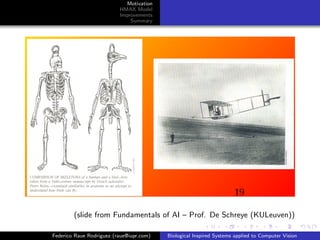
        (slide from Fundamentals of AI – Prof. De Schreye (KULeuven))

Federico Raue Rodriguez (raue@iupr.com)   Biological Inspired Systems applied to Computer Vision
Motivation
                          HMAX Model
                          Improvements
                              Summary


Federico Raue Rodriguez (raue@iupr.com)   Biological Inspired Systems applied to Computer Vision
Motivation
                            HMAX Model
                            Improvements
                                Summary


Neuroscience may begin to provide new ideas and approaches
to machine learning, AI and computer vision (Tomaso Poggio)
Interesting properties for visual recognition
  a Invariance
  b Specificity
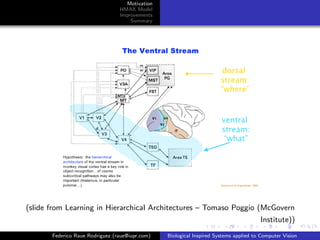
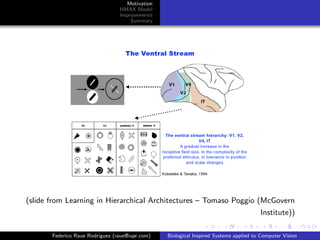
Visual processing in cortex is classically modeled as a hierarchy


  Federico Raue Rodriguez (raue@iupr.com)   Biological Inspired Systems applied to Computer Vision
Motivation
                                 HMAX Model
                                 Improvements
                                     Summary


(slide from Learning in Hierarchical Architectures – Tomaso Poggio (McGovern
                                                                                       Institute))
       Federico Raue Rodriguez (raue@iupr.com)   Biological Inspired Systems applied to Computer Vision
Motivation
                          HMAX Model
                          Improvements
                              Summary


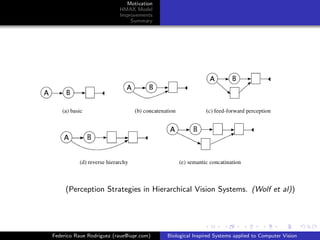
     (Perception Strategies in Hierarchical Vision Systems. (Wolf et al))


Federico Raue Rodriguez (raue@iupr.com)   Biological Inspired Systems applied to Computer Vision
Motivation
                                 HMAX Model
                                 Improvements
                                     Summary


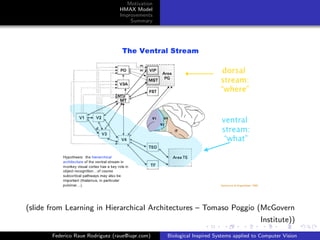
(slide from Learning in Hierarchical Architectures – Tomaso Poggio (McGovern
                                                                                       Institute))

       Federico Raue Rodriguez (raue@iupr.com)   Biological Inspired Systems applied to Computer Vision
Motivation
                                   HMAX Model
                                   Improvements
                                       Summary


Contents


  1   Motivation

  2   HMAX Model

  3   Improvements
        Sparsity
        Pooling Mechanism
        Input

  4   Summary


         Federico Raue Rodriguez (raue@iupr.com)   Biological Inspired Systems applied to Computer Vision
Motivation
                           HMAX Model
                           Improvements
                               Summary


Goal: Object categorization based on human visual system
Assumptions:
  a Invariance to position and scale
  b Feature specificity must be built up through separate
    mechanisms
  c Extending the model of simple and complex cells of Hubel and
    Wiesel
  d Hierarchical feedforward architecture
  e Pooling mechanism


 Federico Raue Rodriguez (raue@iupr.com)   Biological Inspired Systems applied to Computer Vision
Motivation
                                 HMAX Model
                                 Improvements
                                     Summary


(slide from Learning in Hierarchical Architectures – Tomaso Poggio (McGovern
                                                                                       Institute))
       Federico Raue Rodriguez (raue@iupr.com)   Biological Inspired Systems applied to Computer Vision
Motivation
                           HMAX Model
                           Improvements
                               Summary


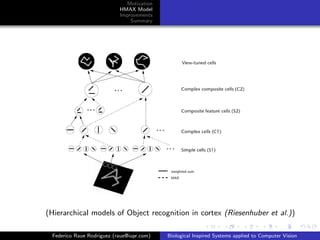
(Hierarchical models of Object recognition in cortex (Riesenhuber et al.))

 Federico Raue Rodriguez (raue@iupr.com)   Biological Inspired Systems applied to Computer Vision
Motivation
                                HMAX Model
                                Improvements
                                    Summary


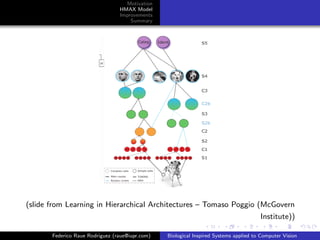
General Description of HMAX model
The standard model consists of four layers of computational units
where simple S units, which combine their inputs with Gaussian-like
tuning to increase object selectivity, alternate with complex C
units, which pool their inputs through maximum operation, thereby
introducing gradual invariance to scale and translation


      Federico Raue Rodriguez (raue@iupr.com)   Biological Inspired Systems applied to Computer Vision
Motivation
                                 HMAX Model
                                 Improvements
                                     Summary


(slide from Learning in Hierarchical Architectures – Tomaso Poggio (McGovern
                                                                                       Institute))

       Federico Raue Rodriguez (raue@iupr.com)   Biological Inspired Systems applied to Computer Vision
Motivation
                           HMAX Model
                           Improvements
                               Summary


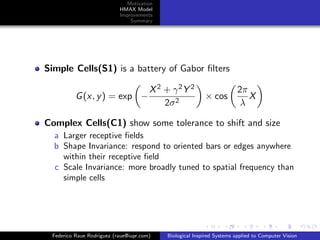
Simple Cells(S1) is a battery of Gabor filters

                                       X 2 + γ2Y 2                      2π
          G (x, y ) = exp −                               × cos            X
                                           2σ 2                          λ

Complex Cells(C1) show some tolerance to shift and size
  a Larger receptive fields
  b Shape Invariance: respond to oriented bars or edges anywhere
    within their receptive field
  c Scale Invariance: more broadly tuned to spatial frequency than
    simple cells


 Federico Raue Rodriguez (raue@iupr.com)   Biological Inspired Systems applied to Computer Vision
Motivation
                                 HMAX Model
                                 Improvements
                                     Summary


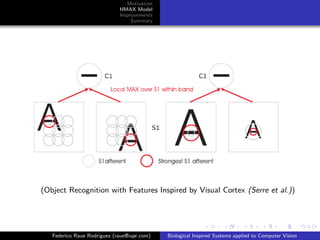
Pooling operation from S1 to C1


     S1 units: 16 scales arranged in 8 bands
     For each orientation, it contains two S1 maps, two filter size
     C1 responses: these maps are sub-sampled using a grid cell of
     size N Σ × N Σ (8x8)
     From each grid cell we obtain one measurement by taking the
     maximum of all 64 elements
     As a last stage we take a max over the two scales, by
     considering for each cell the maximum value from the two
     maps


       Federico Raue Rodriguez (raue@iupr.com)   Biological Inspired Systems applied to Computer Vision
Motivation
                             HMAX Model
                             Improvements
                                 Summary


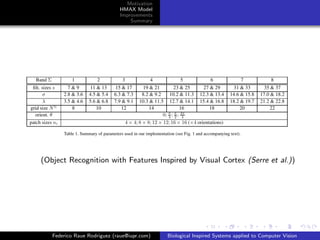
(Object Recognition with Features Inspired by Visual Cortex (Serre et al.))


   Federico Raue Rodriguez (raue@iupr.com)   Biological Inspired Systems applied to Computer Vision
Motivation
                             HMAX Model
                             Improvements
                                 Summary


(Object Recognition with Features Inspired by Visual Cortex (Serre et al.))


   Federico Raue Rodriguez (raue@iupr.com)   Biological Inspired Systems applied to Computer Vision
Motivation
                                 HMAX Model
                                 Improvements
                                     Summary


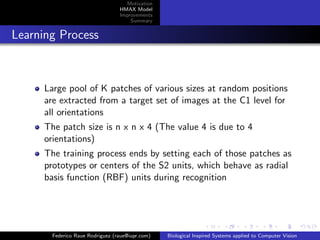
Learning Process


     Large pool of K patches of various sizes at random positions
     are extracted from a target set of images at the C1 level for
     all orientations
     The patch size is n x n x 4 (The value 4 is due to 4
     orientations)
     The training process ends by setting each of those patches as
     prototypes or centers of the S2 units, which behave as radial
     basis function (RBF) units during recognition


       Federico Raue Rodriguez (raue@iupr.com)   Biological Inspired Systems applied to Computer Vision
Motivation
                                 HMAX Model
                                 Improvements
                                     Summary


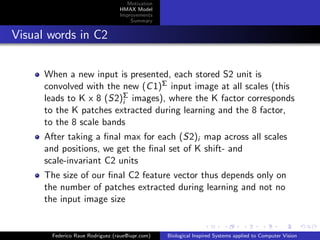
Visual words in C2


      When a new input is presented, each stored S2 unit is
      convolved with the new (C 1)Σ input image at all scales (this
      leads to K x 8 (S2)Σ images), where the K factor corresponds
                         i
      to the K patches extracted during learning and the 8 factor,
      to the 8 scale bands
      After taking a final max for each (S2)i map across all scales
      and positions, we get the final set of K shift- and
      scale-invariant C2 units
      The size of our final C2 feature vector thus depends only on
      the number of patches extracted during learning and not no
      the input image size


       Federico Raue Rodriguez (raue@iupr.com)   Biological Inspired Systems applied to Computer Vision
Motivation
                          HMAX Model
                          Improvements
                              Summary


Federico Raue Rodriguez (raue@iupr.com)   Biological Inspired Systems applied to Computer Vision
Motivation
                                                   Sparsity
                                   HMAX Model
                                                   Pooling Mechanism
                                   Improvements
                                                   Input
                                       Summary


Contents


  1   Motivation

  2   HMAX Model

  3   Improvements
        Sparsity
        Pooling Mechanism
        Input

  4   Summary


         Federico Raue Rodriguez (raue@iupr.com)   Biological Inspired Systems applied to Computer Vision
Motivation
                                               Sparsity
                               HMAX Model
                                               Pooling Mechanism
                               Improvements
                                               Input
                                   Summary


1   Extend the model using more biological information
         Saliency Models
         New Pooling mechanism
         Redefine the input image
2   Reduce the computational cost


     Federico Raue Rodriguez (raue@iupr.com)   Biological Inspired Systems applied to Computer Vision
Motivation
                                                Sparsity
                                HMAX Model
                                                Pooling Mechanism
                                Improvements
                                                Input
                                    Summary


Biological Motivation
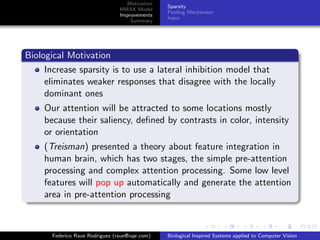
     Increase sparsity is to use a lateral inhibition model that
     eliminates weaker responses that disagree with the locally
     dominant ones
    Our attention will be attracted to some locations mostly
    because their saliency, defined by contrasts in color, intensity
    or orientation
    (Treisman) presented a theory about feature integration in
    human brain, which has two stages, the simple pre-attention
    processing and complex attention processing. Some low level
    features will pop up automatically and generate the attention
    area in pre-attention processing


      Federico Raue Rodriguez (raue@iupr.com)   Biological Inspired Systems applied to Computer Vision
Motivation
                                                Sparsity
                                HMAX Model
                                                Pooling Mechanism
                                Improvements
                                                Input
                                    Summary


Computational Motivation
   Simplifies structures and reduces computational costs
    Feature or variable selection
    Enhance the generalization ability of learning machines


      Federico Raue Rodriguez (raue@iupr.com)   Biological Inspired Systems applied to Computer Vision
Motivation
                                              Sparsity
                              HMAX Model
                                              Pooling Mechanism
                              Improvements
                                              Input
                                  Summary


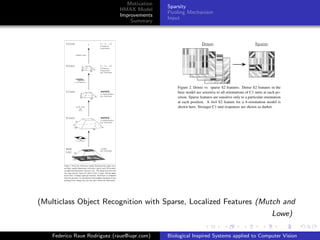
(Multiclass Object Recognition with Sparse, Localized Features (Mutch and
                                                                                         Lowe)

    Federico Raue Rodriguez (raue@iupr.com)   Biological Inspired Systems applied to Computer Vision
Motivation
                                           Sparsity
                          HMAX Model
                                           Pooling Mechanism
                          Improvements
                                           Input
                              Summary


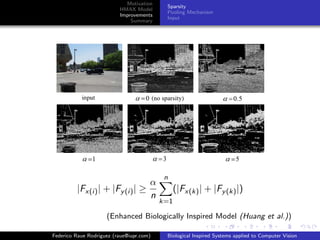
                                           n
                                α
         |Fx(i) | + |Fy (i) | ≥                 (|Fx(k) | + |Fy (k) |)
                                n
                                          k=1

                     (Enhanced Biologically Inspired Model (Huang et al.))

Federico Raue Rodriguez (raue@iupr.com)    Biological Inspired Systems applied to Computer Vision
Motivation
                                          Sparsity
                          HMAX Model
                                          Pooling Mechanism
                          Improvements
                                          Input
                              Summary


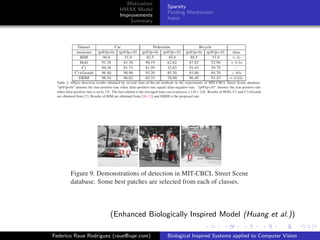
                       (Enhanced Biologically Inspired Model (Huang et al.))

Federico Raue Rodriguez (raue@iupr.com)   Biological Inspired Systems applied to Computer Vision
Motivation
                                          Sparsity
                          HMAX Model
                                          Pooling Mechanism
                          Improvements
                                          Input
                              Summary


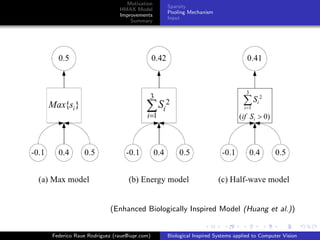
                       (Enhanced Biologically Inspired Model (Huang et al.))


Federico Raue Rodriguez (raue@iupr.com)   Biological Inspired Systems applied to Computer Vision
Motivation
                                                     Sparsity
                                HMAX Model
                                                     Pooling Mechanism
                                Improvements
                                                     Input
                                    Summary


1   Find the maximal response and its neighbors
2   Weak responses are removed due to inhibition effect
3   New pooling Mechanism
    a sum the energy of all responses remained by using different
      weights for S1 units
                                          1
                                  C=                         [wi S 2 (xi , yi )]
                                         NI 0
                                                xi ,yi ∈I0

      (Human age estimation using bio-inspired features (Guo et al.))
    b the STD operation is performed on the maximum map using a
      cell grid of size Ns x Ns

                                                             Ns ×Ns
                                              1                             ¯      2
                             std =                                     Fi − F
                                           Ns × Ns
                                                               i=1

      (Enhanced Biologically Inspired Model (Huang et al.))
      Federico Raue Rodriguez (raue@iupr.com)        Biological Inspired Systems applied to Computer Vision
Motivation
                                                 Sparsity
                          HMAX Model
                                                 Pooling Mechanism
                          Improvements
                                                 Input
                              Summary


                             1
                    C=                          [wi S 2 (xi , yi )]
                            NI 0
                                   xi ,yi ∈I0


Federico Raue Rodriguez (raue@iupr.com)          Biological Inspired Systems applied to Computer Vision
Motivation
                                          Sparsity
                          HMAX Model
                                          Pooling Mechanism
                          Improvements
                                          Input
                              Summary


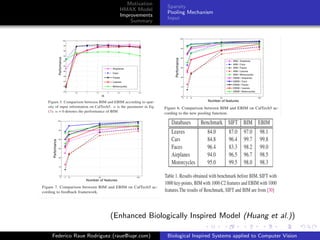
                       (Enhanced Biologically Inspired Model (Huang et al.))

Federico Raue Rodriguez (raue@iupr.com)   Biological Inspired Systems applied to Computer Vision
Motivation
                                                Sparsity
                                HMAX Model
                                                Pooling Mechanism
                                Improvements
                                                Input
                                    Summary


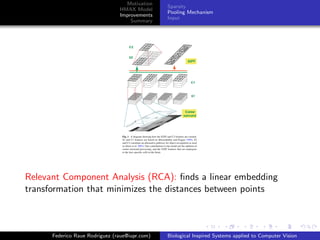
Relevant Component Analysis (RCA): finds a linear embedding
transformation that minimizes the distances between points


      Federico Raue Rodriguez (raue@iupr.com)   Biological Inspired Systems applied to Computer Vision
Motivation
                                            Sparsity
                            HMAX Model
                                            Pooling Mechanism
                            Improvements
                                            Input
                                Summary


Complement using dorsal stream (where)
Cells respond to colored stimuli more strongly than colorless
one in the Inferior Temporal (IT) and the visual areas V4 of
the visual cortex
Analogous to the ’center-on surround-off’ center surround
processing that occurs in the retina and in the lateral
geniculate nucleus (LGN)
Some region (in the brain) are more active for face images
when compared to images of other objects


  Federico Raue Rodriguez (raue@iupr.com)   Biological Inspired Systems applied to Computer Vision
Motivation
                                            Sparsity
                            HMAX Model
                                            Pooling Mechanism
                            Improvements
                                            Input
                                Summary


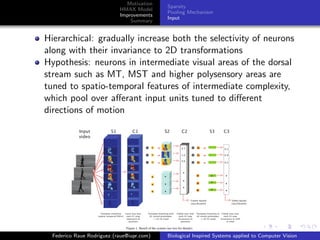
Hierarchical: gradually increase both the selectivity of neurons
along with their invariance to 2D transformations
Hypothesis: neurons in intermediate visual areas of the dorsal
stream such as MT, MST and higher polysensory areas are
tuned to spatio-temporal features of intermediate complexity,
which pool over afferant input units tuned to different
directions of motion


  Federico Raue Rodriguez (raue@iupr.com)   Biological Inspired Systems applied to Computer Vision
Motivation
                                                     Sparsity
                                 HMAX Model
                                                     Pooling Mechanism
                                 Improvements
                                                     Input
                                     Summary


S1 Units
     Gray-value video sequence at all position
     Three different types of S1
       a Space-time gradient-based: Space and time gradients
                                                    It     It
                                            |          | |     |
                                                 Ix + 1 Iy + 1
       b Optical flow based S1 units: Optical flow of the input using
         Lucas & Kanade’s alg.
                            1
               b(θ, θp ) = { [1 + cos(θ − θp )]}q × exp(−|v − vp |)
                            2
         4 directions and two speeds
       c Space-time oriented S1 units:
         Add a temporal dimension to their receptive fields
         3rd derivatives fo Gaussians
         8 space-time filters tuned to 4 directions and 2 speeds
         Size of receptive fields was 9(pixels)x9(pixels)x9(frames)
       Federico Raue Rodriguez (raue@iupr.com)       Biological Inspired Systems applied to Computer Vision
Motivation
                                                Sparsity
                                HMAX Model
                                                Pooling Mechanism
                                Improvements
                                                Input
                                    Summary


Proposed by Plebe et al
    Extract visual attribute for object recognition based on
    infant’s brain
    Children between 8 and 10 months old, their object
    categorization model is stable and flexible
    10-month-old infants ’are sensitive to social cues but cannot
    recruit them for word learning’
    Early vocabulary is made up of the objects infants most
    frequency see
    Connectionist model with backpropagation developed a
    general model based on similarities without taking into
    account physiological and cognitive constraints


      Federico Raue Rodriguez (raue@iupr.com)   Biological Inspired Systems applied to Computer Vision
Motivation
                                            Sparsity
                            HMAX Model
                                            Pooling Mechanism
                            Improvements
                                            Input
                                Summary


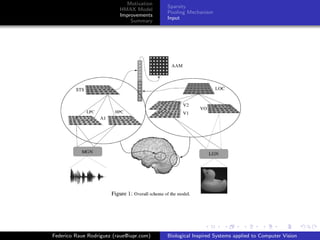
Implementation based on Laterally Interconnected
Synergetically Self Organizing Map architecture (LISSOM)
Hebbian Law: explains the adaptation of neurons in the brain
during the learning process
“. . . , that any two cells or systems of cells that are
repeatedly active at the same time will tend to become
associated, so that activity in one facilitates activity in the
other.”
Two paths: one for visual and the other for auditory channel


  Federico Raue Rodriguez (raue@iupr.com)   Biological Inspired Systems applied to Computer Vision
Motivation
                                          Sparsity
                          HMAX Model
                                          Pooling Mechanism
                          Improvements
                                          Input
                              Summary


Federico Raue Rodriguez (raue@iupr.com)   Biological Inspired Systems applied to Computer Vision
Motivation
                                                 Sparsity
                                 HMAX Model
                                                 Pooling Mechanism
                                 Improvements
                                                 Input
                                     Summary


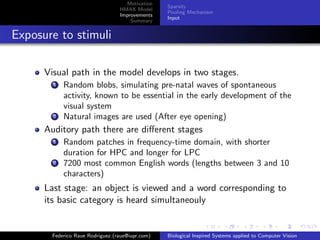
Exposure to stimuli

      Visual path in the model develops in two stages.
        1   Random blobs, simulating pre-natal waves of spontaneous
            activity, known to be essential in the early development of the
            visual system
        2   Natural images are used (After eye opening)
      Auditory path there are different stages
        1   Random patches in frequency-time domain, with shorter
            duration for HPC and longer for LPC
        2   7200 most common English words (lengths between 3 and 10
            characters)
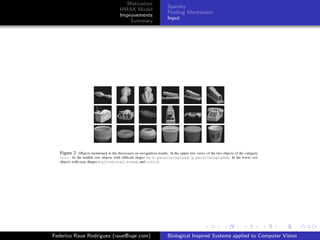
      Last stage: an object is viewed and a word corresponding to
      its basic category is heard simultaneouly


       Federico Raue Rodriguez (raue@iupr.com)   Biological Inspired Systems applied to Computer Vision
Motivation
                                          Sparsity
                          HMAX Model
                                          Pooling Mechanism
                          Improvements
                                          Input
                              Summary


Federico Raue Rodriguez (raue@iupr.com)   Biological Inspired Systems applied to Computer Vision
Motivation
                                          Sparsity
                          HMAX Model
                                          Pooling Mechanism
                          Improvements
                                          Input
                              Summary


Federico Raue Rodriguez (raue@iupr.com)   Biological Inspired Systems applied to Computer Vision
Motivation
                                   HMAX Model
                                   Improvements
                                       Summary


Contents


  1   Motivation

  2   HMAX Model

  3   Improvements
        Sparsity
        Pooling Mechanism
        Input

  4   Summary


         Federico Raue Rodriguez (raue@iupr.com)   Biological Inspired Systems applied to Computer Vision
Motivation
                            HMAX Model
                            Improvements
                                Summary


Biological models are suitable features for visual recognition
      Robust
      Invariance
Two Pathways
  1   Ventral stream (What?)
  2   Dorsal stream (Where?)
Depending on the task HMAX model changes
      Parameters (Aging Detection)
      Pooling function (Energy model, Standard Deviation)


  Federico Raue Rodriguez (raue@iupr.com)   Biological Inspired Systems applied to Computer Vision

Biological inspired system applied to Computer Vision

  • 1.
    Motivation HMAX Model Improvements Summary Biological Inspired Systems applied to Computer Vision Federico Raue Rodriguez (raue@iupr.com) IUPR July 2, 2012 This work is licensed under the Creative Commons Attribution-NonCommercial-ShareAlike 3.0 License. Federico Raue Rodriguez (raue@iupr.com) Biological Inspired Systems applied to Computer Vision
  • 2.
    Motivation HMAX Model Improvements Summary Contents 1 Motivation 2 HMAX Model 3 Improvements Sparsity Pooling Mechanism Input 4 Summary Federico Raue Rodriguez (raue@iupr.com) Biological Inspired Systems applied to Computer Vision
  • 3.
    Motivation HMAX Model Improvements Summary Contents 1 Motivation 2 HMAX Model 3 Improvements Sparsity Pooling Mechanism Input 4 Summary Federico Raue Rodriguez (raue@iupr.com) Biological Inspired Systems applied to Computer Vision
  • 4.
    Motivation HMAX Model Improvements Summary (slide from Fundamentals of AI – Prof. De Schreye (KULeuven)) Federico Raue Rodriguez (raue@iupr.com) Biological Inspired Systems applied to Computer Vision
  • 5.
    Motivation HMAX Model Improvements Summary Federico Raue Rodriguez (raue@iupr.com) Biological Inspired Systems applied to Computer Vision
  • 6.
    Motivation HMAX Model Improvements Summary Neuroscience may begin to provide new ideas and approaches to machine learning, AI and computer vision (Tomaso Poggio) Interesting properties for visual recognition a Invariance b Specificity Visual processing in cortex is classically modeled as a hierarchy Federico Raue Rodriguez (raue@iupr.com) Biological Inspired Systems applied to Computer Vision
  • 7.
    Motivation HMAX Model Improvements Summary (slide from Learning in Hierarchical Architectures – Tomaso Poggio (McGovern Institute)) Federico Raue Rodriguez (raue@iupr.com) Biological Inspired Systems applied to Computer Vision
  • 8.
    Motivation HMAX Model Improvements Summary (Perception Strategies in Hierarchical Vision Systems. (Wolf et al)) Federico Raue Rodriguez (raue@iupr.com) Biological Inspired Systems applied to Computer Vision
  • 9.
    Motivation HMAX Model Improvements Summary (slide from Learning in Hierarchical Architectures – Tomaso Poggio (McGovern Institute)) Federico Raue Rodriguez (raue@iupr.com) Biological Inspired Systems applied to Computer Vision
  • 10.
    Motivation HMAX Model Improvements Summary Contents 1 Motivation 2 HMAX Model 3 Improvements Sparsity Pooling Mechanism Input 4 Summary Federico Raue Rodriguez (raue@iupr.com) Biological Inspired Systems applied to Computer Vision
  • 11.
    Motivation HMAX Model Improvements Summary Goal: Object categorization based on human visual system Assumptions: a Invariance to position and scale b Feature specificity must be built up through separate mechanisms c Extending the model of simple and complex cells of Hubel and Wiesel d Hierarchical feedforward architecture e Pooling mechanism Federico Raue Rodriguez (raue@iupr.com) Biological Inspired Systems applied to Computer Vision
  • 12.
    Motivation HMAX Model Improvements Summary (slide from Learning in Hierarchical Architectures – Tomaso Poggio (McGovern Institute)) Federico Raue Rodriguez (raue@iupr.com) Biological Inspired Systems applied to Computer Vision
  • 13.
    Motivation HMAX Model Improvements Summary (Hierarchical models of Object recognition in cortex (Riesenhuber et al.)) Federico Raue Rodriguez (raue@iupr.com) Biological Inspired Systems applied to Computer Vision
  • 14.
    Motivation HMAX Model Improvements Summary General Description of HMAX model The standard model consists of four layers of computational units where simple S units, which combine their inputs with Gaussian-like tuning to increase object selectivity, alternate with complex C units, which pool their inputs through maximum operation, thereby introducing gradual invariance to scale and translation Federico Raue Rodriguez (raue@iupr.com) Biological Inspired Systems applied to Computer Vision
  • 15.
    Motivation HMAX Model Improvements Summary (slide from Learning in Hierarchical Architectures – Tomaso Poggio (McGovern Institute)) Federico Raue Rodriguez (raue@iupr.com) Biological Inspired Systems applied to Computer Vision
  • 16.
    Motivation HMAX Model Improvements Summary Simple Cells(S1) is a battery of Gabor filters X 2 + γ2Y 2 2π G (x, y ) = exp − × cos X 2σ 2 λ Complex Cells(C1) show some tolerance to shift and size a Larger receptive fields b Shape Invariance: respond to oriented bars or edges anywhere within their receptive field c Scale Invariance: more broadly tuned to spatial frequency than simple cells Federico Raue Rodriguez (raue@iupr.com) Biological Inspired Systems applied to Computer Vision
  • 17.
    Motivation HMAX Model Improvements Summary Pooling operation from S1 to C1 S1 units: 16 scales arranged in 8 bands For each orientation, it contains two S1 maps, two filter size C1 responses: these maps are sub-sampled using a grid cell of size N Σ × N Σ (8x8) From each grid cell we obtain one measurement by taking the maximum of all 64 elements As a last stage we take a max over the two scales, by considering for each cell the maximum value from the two maps Federico Raue Rodriguez (raue@iupr.com) Biological Inspired Systems applied to Computer Vision
  • 18.
    Motivation HMAX Model Improvements Summary (Object Recognition with Features Inspired by Visual Cortex (Serre et al.)) Federico Raue Rodriguez (raue@iupr.com) Biological Inspired Systems applied to Computer Vision
  • 19.
    Motivation HMAX Model Improvements Summary (Object Recognition with Features Inspired by Visual Cortex (Serre et al.)) Federico Raue Rodriguez (raue@iupr.com) Biological Inspired Systems applied to Computer Vision
  • 20.
    Motivation HMAX Model Improvements Summary Learning Process Large pool of K patches of various sizes at random positions are extracted from a target set of images at the C1 level for all orientations The patch size is n x n x 4 (The value 4 is due to 4 orientations) The training process ends by setting each of those patches as prototypes or centers of the S2 units, which behave as radial basis function (RBF) units during recognition Federico Raue Rodriguez (raue@iupr.com) Biological Inspired Systems applied to Computer Vision
  • 21.
    Motivation HMAX Model Improvements Summary Visual words in C2 When a new input is presented, each stored S2 unit is convolved with the new (C 1)Σ input image at all scales (this leads to K x 8 (S2)Σ images), where the K factor corresponds i to the K patches extracted during learning and the 8 factor, to the 8 scale bands After taking a final max for each (S2)i map across all scales and positions, we get the final set of K shift- and scale-invariant C2 units The size of our final C2 feature vector thus depends only on the number of patches extracted during learning and not no the input image size Federico Raue Rodriguez (raue@iupr.com) Biological Inspired Systems applied to Computer Vision
  • 22.
    Motivation HMAX Model Improvements Summary Federico Raue Rodriguez (raue@iupr.com) Biological Inspired Systems applied to Computer Vision
  • 23.
    Motivation Sparsity HMAX Model Pooling Mechanism Improvements Input Summary Contents 1 Motivation 2 HMAX Model 3 Improvements Sparsity Pooling Mechanism Input 4 Summary Federico Raue Rodriguez (raue@iupr.com) Biological Inspired Systems applied to Computer Vision
  • 24.
    Motivation Sparsity HMAX Model Pooling Mechanism Improvements Input Summary 1 Extend the model using more biological information Saliency Models New Pooling mechanism Redefine the input image 2 Reduce the computational cost Federico Raue Rodriguez (raue@iupr.com) Biological Inspired Systems applied to Computer Vision
  • 25.
    Motivation Sparsity HMAX Model Pooling Mechanism Improvements Input Summary Biological Motivation Increase sparsity is to use a lateral inhibition model that eliminates weaker responses that disagree with the locally dominant ones Our attention will be attracted to some locations mostly because their saliency, defined by contrasts in color, intensity or orientation (Treisman) presented a theory about feature integration in human brain, which has two stages, the simple pre-attention processing and complex attention processing. Some low level features will pop up automatically and generate the attention area in pre-attention processing Federico Raue Rodriguez (raue@iupr.com) Biological Inspired Systems applied to Computer Vision
  • 26.
    Motivation Sparsity HMAX Model Pooling Mechanism Improvements Input Summary Computational Motivation Simplifies structures and reduces computational costs Feature or variable selection Enhance the generalization ability of learning machines Federico Raue Rodriguez (raue@iupr.com) Biological Inspired Systems applied to Computer Vision
  • 27.
    Motivation Sparsity HMAX Model Pooling Mechanism Improvements Input Summary (Multiclass Object Recognition with Sparse, Localized Features (Mutch and Lowe) Federico Raue Rodriguez (raue@iupr.com) Biological Inspired Systems applied to Computer Vision
  • 28.
    Motivation Sparsity HMAX Model Pooling Mechanism Improvements Input Summary n α |Fx(i) | + |Fy (i) | ≥ (|Fx(k) | + |Fy (k) |) n k=1 (Enhanced Biologically Inspired Model (Huang et al.)) Federico Raue Rodriguez (raue@iupr.com) Biological Inspired Systems applied to Computer Vision
  • 29.
    Motivation Sparsity HMAX Model Pooling Mechanism Improvements Input Summary (Enhanced Biologically Inspired Model (Huang et al.)) Federico Raue Rodriguez (raue@iupr.com) Biological Inspired Systems applied to Computer Vision
  • 30.
    Motivation Sparsity HMAX Model Pooling Mechanism Improvements Input Summary (Enhanced Biologically Inspired Model (Huang et al.)) Federico Raue Rodriguez (raue@iupr.com) Biological Inspired Systems applied to Computer Vision
  • 31.
    Motivation Sparsity HMAX Model Pooling Mechanism Improvements Input Summary 1 Find the maximal response and its neighbors 2 Weak responses are removed due to inhibition effect 3 New pooling Mechanism a sum the energy of all responses remained by using different weights for S1 units 1 C= [wi S 2 (xi , yi )] NI 0 xi ,yi ∈I0 (Human age estimation using bio-inspired features (Guo et al.)) b the STD operation is performed on the maximum map using a cell grid of size Ns x Ns Ns ×Ns 1 ¯ 2 std = Fi − F Ns × Ns i=1 (Enhanced Biologically Inspired Model (Huang et al.)) Federico Raue Rodriguez (raue@iupr.com) Biological Inspired Systems applied to Computer Vision
  • 32.
    Motivation Sparsity HMAX Model Pooling Mechanism Improvements Input Summary 1 C= [wi S 2 (xi , yi )] NI 0 xi ,yi ∈I0 Federico Raue Rodriguez (raue@iupr.com) Biological Inspired Systems applied to Computer Vision
  • 33.
    Motivation Sparsity HMAX Model Pooling Mechanism Improvements Input Summary (Enhanced Biologically Inspired Model (Huang et al.)) Federico Raue Rodriguez (raue@iupr.com) Biological Inspired Systems applied to Computer Vision
  • 34.
    Motivation Sparsity HMAX Model Pooling Mechanism Improvements Input Summary Relevant Component Analysis (RCA): finds a linear embedding transformation that minimizes the distances between points Federico Raue Rodriguez (raue@iupr.com) Biological Inspired Systems applied to Computer Vision
  • 35.
    Motivation Sparsity HMAX Model Pooling Mechanism Improvements Input Summary Complement using dorsal stream (where) Cells respond to colored stimuli more strongly than colorless one in the Inferior Temporal (IT) and the visual areas V4 of the visual cortex Analogous to the ’center-on surround-off’ center surround processing that occurs in the retina and in the lateral geniculate nucleus (LGN) Some region (in the brain) are more active for face images when compared to images of other objects Federico Raue Rodriguez (raue@iupr.com) Biological Inspired Systems applied to Computer Vision
  • 36.
    Motivation Sparsity HMAX Model Pooling Mechanism Improvements Input Summary Hierarchical: gradually increase both the selectivity of neurons along with their invariance to 2D transformations Hypothesis: neurons in intermediate visual areas of the dorsal stream such as MT, MST and higher polysensory areas are tuned to spatio-temporal features of intermediate complexity, which pool over afferant input units tuned to different directions of motion Federico Raue Rodriguez (raue@iupr.com) Biological Inspired Systems applied to Computer Vision
  • 37.
    Motivation Sparsity HMAX Model Pooling Mechanism Improvements Input Summary S1 Units Gray-value video sequence at all position Three different types of S1 a Space-time gradient-based: Space and time gradients It It | | | | Ix + 1 Iy + 1 b Optical flow based S1 units: Optical flow of the input using Lucas & Kanade’s alg. 1 b(θ, θp ) = { [1 + cos(θ − θp )]}q × exp(−|v − vp |) 2 4 directions and two speeds c Space-time oriented S1 units: Add a temporal dimension to their receptive fields 3rd derivatives fo Gaussians 8 space-time filters tuned to 4 directions and 2 speeds Size of receptive fields was 9(pixels)x9(pixels)x9(frames) Federico Raue Rodriguez (raue@iupr.com) Biological Inspired Systems applied to Computer Vision
  • 38.
    Motivation Sparsity HMAX Model Pooling Mechanism Improvements Input Summary Proposed by Plebe et al Extract visual attribute for object recognition based on infant’s brain Children between 8 and 10 months old, their object categorization model is stable and flexible 10-month-old infants ’are sensitive to social cues but cannot recruit them for word learning’ Early vocabulary is made up of the objects infants most frequency see Connectionist model with backpropagation developed a general model based on similarities without taking into account physiological and cognitive constraints Federico Raue Rodriguez (raue@iupr.com) Biological Inspired Systems applied to Computer Vision
  • 39.
    Motivation Sparsity HMAX Model Pooling Mechanism Improvements Input Summary Implementation based on Laterally Interconnected Synergetically Self Organizing Map architecture (LISSOM) Hebbian Law: explains the adaptation of neurons in the brain during the learning process “. . . , that any two cells or systems of cells that are repeatedly active at the same time will tend to become associated, so that activity in one facilitates activity in the other.” Two paths: one for visual and the other for auditory channel Federico Raue Rodriguez (raue@iupr.com) Biological Inspired Systems applied to Computer Vision
  • 40.
    Motivation Sparsity HMAX Model Pooling Mechanism Improvements Input Summary Federico Raue Rodriguez (raue@iupr.com) Biological Inspired Systems applied to Computer Vision
  • 41.
    Motivation Sparsity HMAX Model Pooling Mechanism Improvements Input Summary Exposure to stimuli Visual path in the model develops in two stages. 1 Random blobs, simulating pre-natal waves of spontaneous activity, known to be essential in the early development of the visual system 2 Natural images are used (After eye opening) Auditory path there are different stages 1 Random patches in frequency-time domain, with shorter duration for HPC and longer for LPC 2 7200 most common English words (lengths between 3 and 10 characters) Last stage: an object is viewed and a word corresponding to its basic category is heard simultaneouly Federico Raue Rodriguez (raue@iupr.com) Biological Inspired Systems applied to Computer Vision
  • 42.
    Motivation Sparsity HMAX Model Pooling Mechanism Improvements Input Summary Federico Raue Rodriguez (raue@iupr.com) Biological Inspired Systems applied to Computer Vision
  • 43.
    Motivation Sparsity HMAX Model Pooling Mechanism Improvements Input Summary Federico Raue Rodriguez (raue@iupr.com) Biological Inspired Systems applied to Computer Vision
  • 44.
    Motivation HMAX Model Improvements Summary Contents 1 Motivation 2 HMAX Model 3 Improvements Sparsity Pooling Mechanism Input 4 Summary Federico Raue Rodriguez (raue@iupr.com) Biological Inspired Systems applied to Computer Vision
  • 45.
    Motivation HMAX Model Improvements Summary Biological models are suitable features for visual recognition Robust Invariance Two Pathways 1 Ventral stream (What?) 2 Dorsal stream (Where?) Depending on the task HMAX model changes Parameters (Aging Detection) Pooling function (Energy model, Standard Deviation) Federico Raue Rodriguez (raue@iupr.com) Biological Inspired Systems applied to Computer Vision