This document provides an overview of dynamic pricing and revenue management for a single resource with independent demands. It introduces static and dynamic models for allocating capacity among different fare classes to maximize expected revenues. Static models assume demands arrive in a fixed low-to-high order, while dynamic models explicitly consider time and allow more general demand patterns. Key concepts discussed include Littlewood's rule for optimal allocation in the two-class case, spill rates, callable products, and dynamic programming formulations. Both static and dynamic approaches are compared, finding dynamic policies better handle non-ordered demand arrivals.
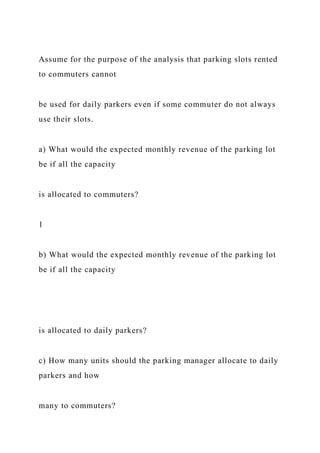
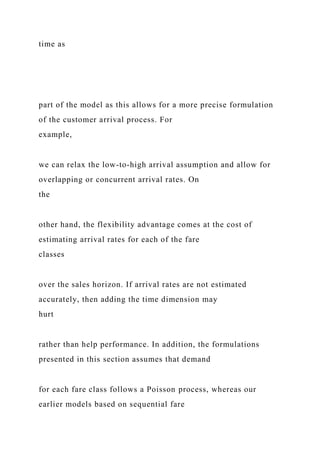
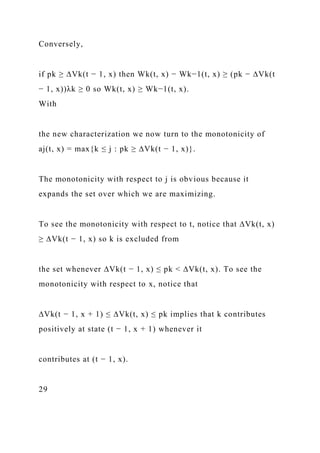
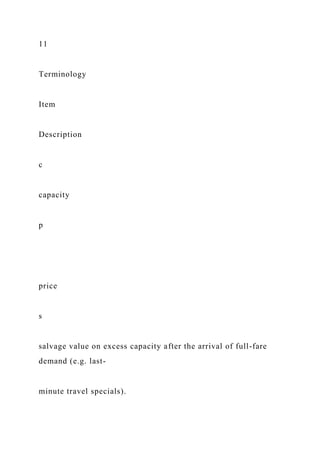
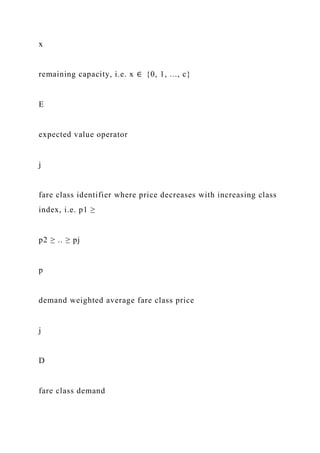
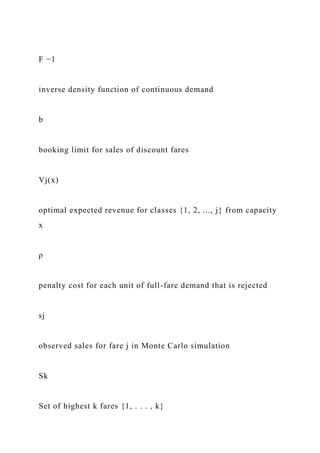
![Dynamic Pricing and
Revenue Management
IEOR 4601 Spring 2013
Professor Guillermo Gallego
Class: Monday and Wednesday 11:40-12:55pm
Office Hours: Wednesdays 3:30-4:30pm
Office Location: 820 CEPSR
E-mail: [email protected]
Why Study Dynamic Pricing and Revenue
Management?
¡� Revenue Management had its origins in the
airline industry and is one of the most
successful applications of Operations
Research to decision making
¡� Pricing and capacity allocation decisions
directly impact the bottom line
¡� Pricing transparency and competition make](https://image.slidesharecdn.com/dynamicpricingandrevenuemanagementieor4601spring-221026074120-68376053/85/Dynamic-Pricing-andRevenue-ManagementIEOR-4601-Spring-docx-1-320.jpg)
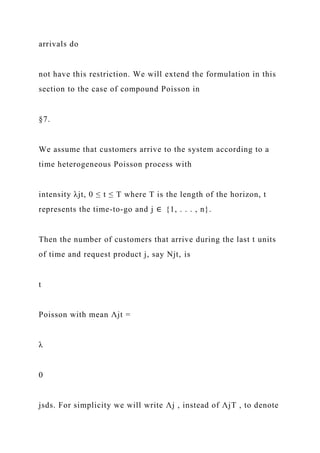
![Dynamic Pricing and
Revenue Management
IEOR 4601 Spring 2013
Professor Guillermo Gallego
Class: Monday and Wednesday 11:40-12:55pm
Office Hours: Wednesdays 3:30-4:30pm
Office Location: 820 CEPSR
E-mail: [email protected]
Why Study Dynamic Pricing and Revenue
Management?
¡� Revenue Management had its origins in the
airline industry and is one of the most
successful applications of Operations
Research to decision making
¡� Pricing and capacity allocation decisions
directly impact the bottom line
¡� Pricing transparency and competition make](https://image.slidesharecdn.com/dynamicpricingandrevenuemanagementieor4601spring-221026074120-68376053/75/Dynamic-Pricing-andRevenue-ManagementIEOR-4601-Spring-docx-1-2048.jpg)





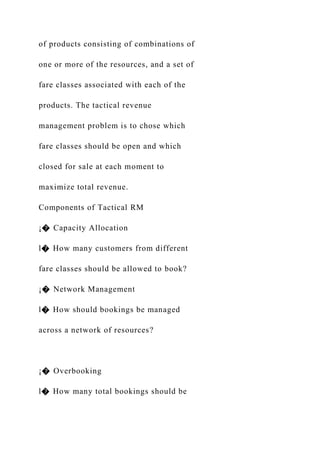
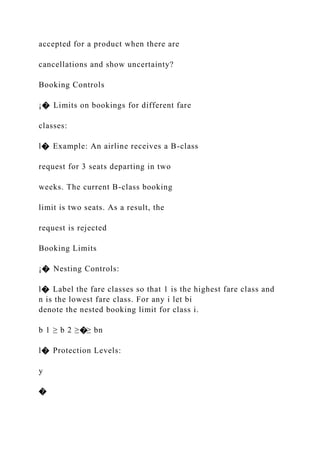
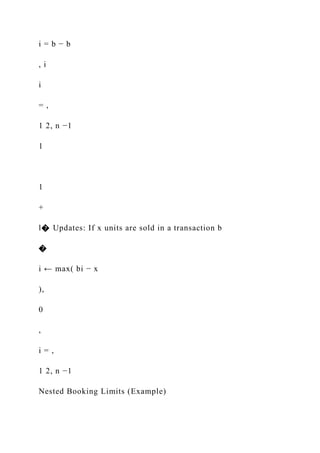

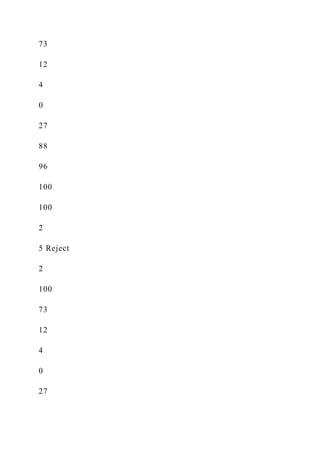



![very small then we would be inclined to protect more capacity
for the full-fare demand. If the ratio is
close
to one, we would be inclined to accept nearly all discount-fare
requests since we can get almost the same
revenue, per unit of capacity, without risk. The distribution of
full-fare demand is also important in
deciding
how many units to protect for that fare. If, P (D1 ≥ c) is very
large, then it makes sense to protect the
entire
capacity for full-fare sales as it is likely that the provider can
sell all of the capacity at the full-fare.
However,
if P (D1 ≥ c) is very low then it is unlikely that all the capacity
can be sold at the full-fare, so fewer units
should be protected. It turns out that the demand distribution of
the discount-fare D2 has no influence on
the
optimal protection level under our assumption that D2 and D1
are independent. A formula for the optimal
protection level, involving only P (D1 ≥ y) and r, was first
proposed by Littlewood [14] in 1972. His
arguments
were not formal; however, they were later justified by Bhatia
and Prakesh [1] in 1973, and Richter [17]
in 1982.](https://image.slidesharecdn.com/dynamicpricingandrevenuemanagementieor4601spring-221026074120-68376053/85/Dynamic-Pricing-andRevenue-ManagementIEOR-4601-Spring-docx-36-320.jpg)

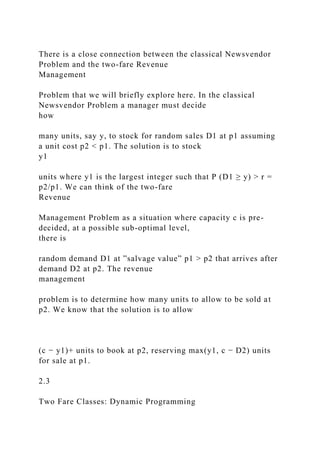
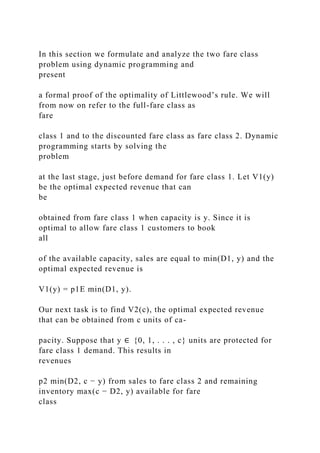
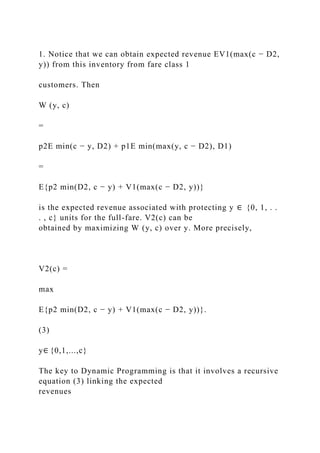
![V2(c), at stage 2, to the expected revenue function V1 at stage
1. To solve for V2(c) we first need to solve
for V1(y) for y ∈ {0, 1, . . . , c}. Before moving on to the
multi-fare formulation we will provide a formal
proof of Littlewood’s rule (1), and discuss the quality of service
implications of using Littlewood’s rule
under
competition.
4
2.4
Formal Proof of Littlewood’s Rule
For any function f (y) over the integers, let ∆f (y) = f (y) − f (y
− 1). The following result will help us to
determine ∆V (y) and ∆W (y, c) = W (y, c) − W (y − 1, c).
Lemma 1 Let g(y) = EG(min(X, y)) where X is an integer
valued random variable with E[X] < ∞ and G
is an arbitrary function defined over the integers. Then
∆g(y) = ∆G(y)P (X ≥ y).
Let r(y) = ER(max(X, y)) where X is an integer valued random
variable with E[X] < ∞ and R is an
arbitrary
function defined over the integers. Then](https://image.slidesharecdn.com/dynamicpricingandrevenuemanagementieor4601spring-221026074120-68376053/85/Dynamic-Pricing-andRevenue-ManagementIEOR-4601-Spring-docx-45-320.jpg)
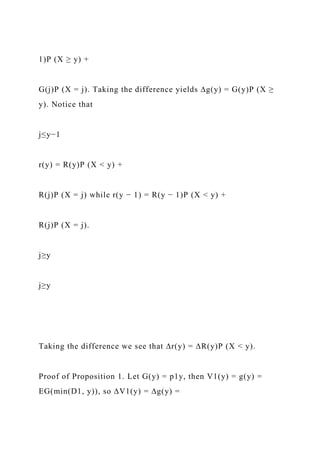
![∆r(y) = ∆R(y)P (X < y).
An application of the Lemma 1 yields the following proposition
that provides the desired formulas for
∆V1(y) and ∆W (y, c).
Proposition 1
∆V1(y) = p1P (D1 ≥ y)
y ∈ {1, . . . , }
∆W (y, c) = [∆V1(y) − p2]P (D2 > c − y)
y ∈ {1, . . . , c}.
The proof of the Lemma 1 and Proposition 1 are relegated to the
Appendix. With the help of Proposition 1
we can now formally establish the main result for the Two-Fare
Problem.
Theorem 1 The function W (y, c) is unimodal in y and is
maximized at y(c) = min(y1, c) where
y1 = max{y ∈ N : ∆V1(y) > p2}.
Moreover, V2(c) = W (y(c), c).
Proof: Consider the expression in brackets for ∆W (y, c) and
notice that the sign of ∆W (y, c) is
determined](https://image.slidesharecdn.com/dynamicpricingandrevenuemanagementieor4601spring-221026074120-68376053/85/Dynamic-Pricing-andRevenue-ManagementIEOR-4601-Spring-docx-46-320.jpg)
![by ∆V1(y) − p2 as P (D2 > c − y) ≥ 0.Thus W (y, c) ≥ W (y − 1,
c) as long as ∆V1(y) − p2 > 0 and W (y,
c) ≤
W (y − 1, c) as long as ∆V1(y) − p2 ≤ 0. Since ∆V1(y) = p1P
(D1 ≥ y) is decreasing1 in y, ∆V1(y) − p2
changes
signs from + to − since ∆V1(0) − p2 = p1P (D1 ≥ 0) − p2 = p1 −
p2 > 0 and limy→∞[∆V1(y) − p2] =
−p2.
This means that W (y, c) is unimodal in y. Then
y1 = max{y ∈ N : ∆V1(y) > p2}.
coincides with Littlewood’s rule (1).
When restricted to {0, 1, . . . , c}, W (y, c) is maximized at y(c)
=
min(c, y1). Consequently, V2(c) = maxy∈ {0,1,...,c} W (y, c) =
W (y(c), c), completing the proof.
2.5
Quality of Service, Spill Penalties, Callable Products and
Salvage Values
Since max(y1, c − D2) units of capacity are available for fare
class 1, at least one fare class 1 customer
will be
denied capacity when D1 > max(y1, c − D2). The probability of
this happening is a measure of the quality
of](https://image.slidesharecdn.com/dynamicpricingandrevenuemanagementieor4601spring-221026074120-68376053/85/Dynamic-Pricing-andRevenue-ManagementIEOR-4601-Spring-docx-47-320.jpg)
![service to fare class 1, known as the full-fare spill rate.
Brumelle et al. [4] have observed that
P (D1 > max(y1, c − D2)) ≤ P (D1 > y1) ≤ r < P (D1 ≥ y1).
(4)
They call P (D1 > y1) the maximal spill rate. Notice that if the
inequality y1 ≥ c − D2 holds with high
probability, as it typically does in practice when D2 is large
relative to c, then the spill rate approaches
the
1We use the term increasing and decreasing in the weak sense.
5
maximal flight spill rate which is, by design, close to the ratio
r. High spill rates may lead to the loss of
full-fare customers to competition. To see this, imagine two
airlines each offering a discount fare and a
full-
fare in the same market where the fare ratio r is high and
demand from fare class 2 is high. Suppose
Airline
A practices tactically optimal Revenue Management by applying
Littlewood’s rule with spill rates close
to](https://image.slidesharecdn.com/dynamicpricingandrevenuemanagementieor4601spring-221026074120-68376053/85/Dynamic-Pricing-andRevenue-ManagementIEOR-4601-Spring-docx-48-320.jpg)
![r. Airline B can protect more seats than recommended by
Littlewood’s rule. By doing this Airline B will
sacrifice revenues in the short run but will attract some of the
full-fare customers spilled by Airline A.
Over
time, Airline A may see a decrease in full-fare demand as a
secular change and protect even fewer seats
for
full-fare passengers. In the meantime, Airline B will see an
increase in full-fare demand at which time it
can
set tactically optimal protection levels and derive higher
revenues in the long-run. In essence, Airline B
has
(correctly) traded discount-fare customers for full-fare
customers with Airline A.
One way to cope with high spill rates and its adverse strategic
consequences is to impose a penalty cost
ρ for each unit of full-fare demand in excess of the protection
level. This penalty is suppose to measure
the
ill-will incurred when capacity is denied to a full-fare customer.
This results in a modified value function
V1(y) = p1E min(D1, y) − ρE[(D1 − y)+] = (p1 + ρ)E min(D1,
y) − ρED1. From this it is easy to see that](https://image.slidesharecdn.com/dynamicpricingandrevenuemanagementieor4601spring-221026074120-68376053/85/Dynamic-Pricing-andRevenue-ManagementIEOR-4601-Spring-docx-49-320.jpg)
![∆V1(y) = (p + ρ)P (D1 ≥ y), resulting in
∆W (y, c) = [(p1 + ρ)P (D1 ≥ y) − p2]P (D2 > c − y)
and
p2
y1 = max y ∈ N : P (D1 ≥ y) >
.
(5)
p1 + ρ
Notice that this is just Littlewood’s rule applied to fares p1 + ρ
and p2, resulting in fare ratio p2/(p1 + ρ)
and,
consequently, lower maximal spill rates. Obviously this
adjustment comes at the expense of having higher
protection levels and therefore lower sales at the discount-fare
and lower overall revenues.
Consequently, an
airline that wants to protect its full-fare market by imposing a
penalty on rejected full-fare demand does it
at
the expense of making less available capacity for the discount-
fare and less expected revenue. One way to
avoid](https://image.slidesharecdn.com/dynamicpricingandrevenuemanagementieor4601spring-221026074120-68376053/85/Dynamic-Pricing-andRevenue-ManagementIEOR-4601-Spring-docx-50-320.jpg)
![sacrificing sales at the discount-fare and improve the spill rate
at the same time is to modify the discount-
fare
by adding a restriction that allows the provider to recall or buy
back capacity when needed. This leads to
revenue management with callable products; see Gallego, Kou
and Phillips [12]. Callable products can
be
sold either by giving customers an upfront discount or by giving
them a compensation if and when
capacity
is recalled. If managed correctly, callable products can lead to
better capacity utilization, better service
to
full-fare customers and to demand induction from customers
who are attracted to either the upfront
discount
or to the compensation if their capacity is recalled.
The value function V1(y) may also be modified to account for
salvage values (also known as the
‘distressed
inventory problem’). Suppose there is a salvage value s < p2 on
excess capacity after the arrival of the
full-fare
demand (think of standby tickets or last-minute travel deals).](https://image.slidesharecdn.com/dynamicpricingandrevenuemanagementieor4601spring-221026074120-68376053/85/Dynamic-Pricing-andRevenue-ManagementIEOR-4601-Spring-docx-51-320.jpg)
![We can handle this case by modifying V1(y)
to
account for the salvaged units. Then V1(y) = p1E min(D1, y) +
sE(y − D1)+ = (p1 − s)E min(D1, y) + sy,
so
∆V1(y) = (p1 − s)P (D1 ≥ y) + s, resulting in
∆W (y, c) = [(p1 − s)P (D1 ≥ y) − (p2 − s)]P (D2 > c − y)
and
p2 − s
y1 = max y ∈ N : P (D1 ≥ y) >
.
(6)
p1 − s
Notice that this is just Littlewood’s rule applied to net fares p1
− s and p2 − s. This suggests that a
problem
with salvage values can be converted into a problem without
salvage values by using net fares pi ← pi −
s,
i = 1, 2 and then adding cs to the resulting optimal expected
revenue V2(c) in excess of salvage values.
3](https://image.slidesharecdn.com/dynamicpricingandrevenuemanagementieor4601spring-221026074120-68376053/85/Dynamic-Pricing-andRevenue-ManagementIEOR-4601-Spring-docx-52-320.jpg)
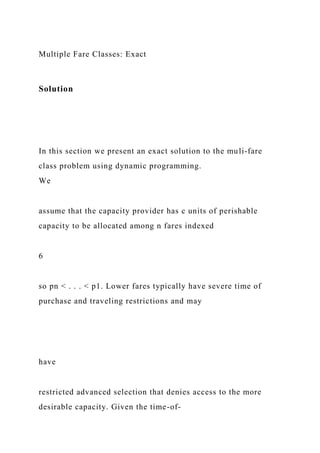
![purchase
restriction, it is natural to assume that demands for fare classes
arrive in n stages, with fare class n
arriving
first, followed by n − 1, with fare class 1 arriving last. Let Dj
denote the random demand for fare class
j ∈ N = {1, . . . , n}. We assume that, conditional on the given
fares, the demands D1, . . . , Dn are
independent
random variables with finite means µj = E[Dj] j ∈ N . The
independent assumption is approximately
valid
in situations where fares are well spread and there are
alternative sources of capacity. Indeed, a customer
who finds his preferred fare closed is more likely to buy the
same fare for an alternative flight (perhaps
with
a competing carrier) rather than buying up to the next fare class](https://image.slidesharecdn.com/dynamicpricingandrevenuemanagementieor4601spring-221026074120-68376053/85/Dynamic-Pricing-andRevenue-ManagementIEOR-4601-Spring-docx-54-320.jpg)
![if the difference in fare is high. The case
of
dependent demands, where fare closures may result in demand
recapture, will be treated in a different
chapter.
The use of Dynamic Programming for the multi-fare problem
with discrete demands is due to Wollmer
[22].
Curry [6] derives optimality conditions when demands are
assumed to follow a continuos distribution.
Brumelle
and McGill [5] allow for either discrete or continuous demand
distributions and makes a connection with
the
theory of optimal stopping.
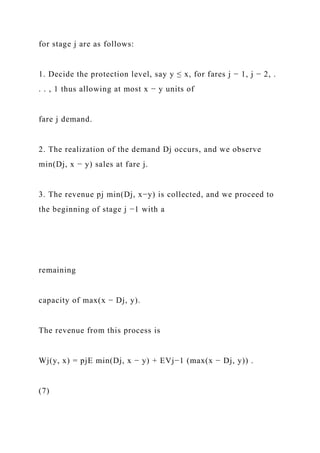
Let Vj(x) denote the maximum expected revenue that can be
obtained from x ∈ {0, 1, . . . , c} units of
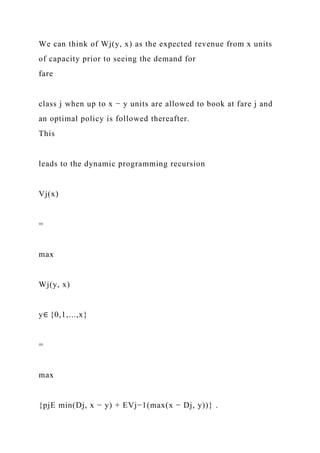
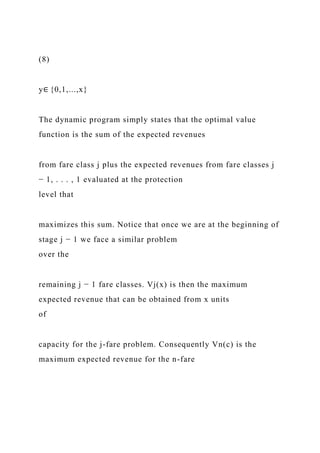
capacity from fare classes {j, . . . , 1}. The sequence of events](https://image.slidesharecdn.com/dynamicpricingandrevenuemanagementieor4601spring-221026074120-68376053/85/Dynamic-Pricing-andRevenue-ManagementIEOR-4601-Spring-docx-55-320.jpg)
![problem
with capacity c. The recursion can be started with V0(x) = 0 if
there are no salvage values or penalties
for
spill. Alternatively, the recursion can start with V1(x) = p1E
min(D1, x) + sE[(x − D1)+] − ρE[(D1 −
x)+] for
x ≥ 0 if there is a salvage value s per unit of excess capacity
and a penalty ρ per unit of fare class 1
demand
that is denied.
3.1
Structure of the Optimal Policy
In order to analyze the structure of the optimal policy, we begin
by describing a few properties of the
value
function.](https://image.slidesharecdn.com/dynamicpricingandrevenuemanagementieor4601spring-221026074120-68376053/85/Dynamic-Pricing-andRevenue-ManagementIEOR-4601-Spring-docx-59-320.jpg)

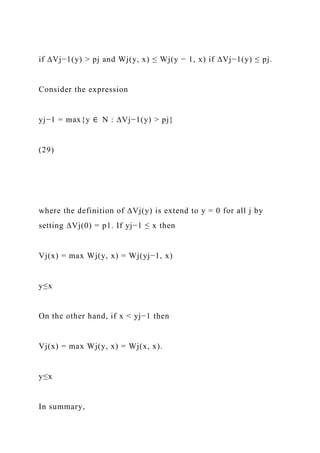
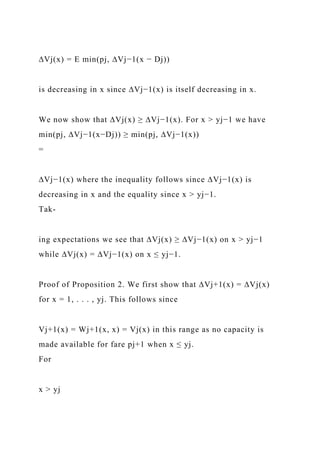
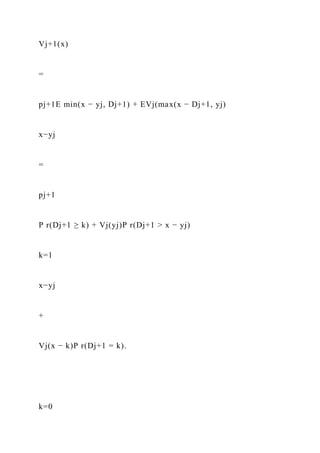
![y ∈ {1, . . . , x}
∆Wj(y, x) = Wj(y, x) − Wj(y − 1, x) = [∆Vj−1(y) − pj] P (Dj > x
− y).
Let yj−1 = max{y ∈ N : ∆Vj−1(y) > pj}. By part a) of Lemma 2,
∆Vj−1(y) is decreasing in y so ∆Vj−1(y)
−
pj > 0 for all y ≤ yj−1 and ∆Vj−1(y) − pj ≤ 0 for all y > yj−1.
Consequently, if x ≤ yj−1 then ∆Wj(y, x) ≥
0
for all y ∈ {1, . . . , x} implying that Vj(x) = Wj(x, x).
Alternatively, if x > yj−1 then ∆Wj(y, x) ≥ 0
for y ∈ {1, . . . , yj} and ∆Wj(y, x) ≤ 0 for y ∈ {yj−1 + 1, . . . ,
x} implying Vj(x) = Wj(yj−1, x). Since
∆Vj(x) = ∆Vj−1(x) on x ≤ yj−1, it follows that ∆Vj(yj−1) =
∆Vj−1(yj−1) > pj > pj+1, so yj ≥ yj−1. The
concavity of Vj(x) is is equivalent to ∆Vj(x) decreasing in x,
and this follows directly from part a) of
Lemma 2.](https://image.slidesharecdn.com/dynamicpricingandrevenuemanagementieor4601spring-221026074120-68376053/85/Dynamic-Pricing-andRevenue-ManagementIEOR-4601-Spring-docx-62-320.jpg)
![xn−1 = xn − min(Dn, (xn − yn−1)+). We protect yn−2(xn−1) =
min(xn−1, yn−2) units of capacity for
fares {n − 2, . . . , 1} and thus allow up to (xn−1 −yn−2)+ units
of capacity to be sold at pn−1. The
process
continues until we reach stage one with x1 units of capacity and
allow (x1 − y0)+ = (x1 − 0)+ = x1
to be sold at p1. Assuming discrete distributions, the
computational requirement to solve the dynamic
program for the n stages has been estimated by Talluri and van
Ryzin [20] to be of order O(nc2).
4. The concavity of Vn(c) is helpful if capacity can be procured
at a linear or convex cost because in this
case the problem of finding an optimal capacity level is a
concave problem in c.](https://image.slidesharecdn.com/dynamicpricingandrevenuemanagementieor4601spring-221026074120-68376053/85/Dynamic-Pricing-andRevenue-ManagementIEOR-4601-Spring-docx-64-320.jpg)








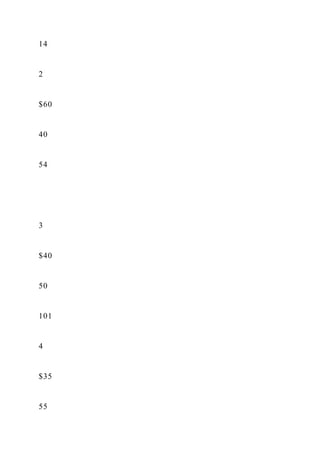
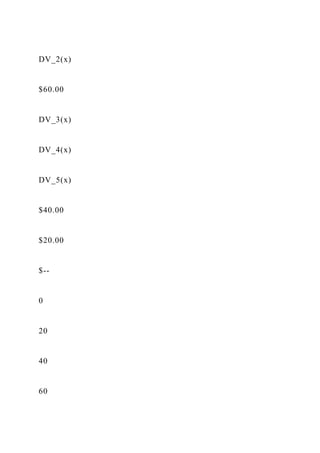
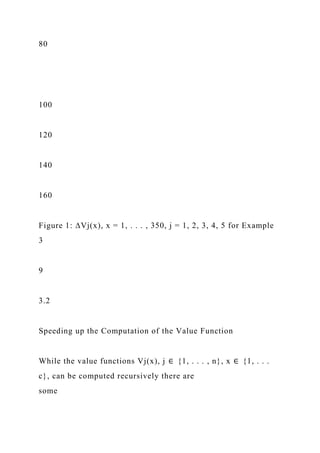
![Example 3. Suppose there are five different fare classes. We
assume the demand for each of the fares is
Poisson. The fares and the expected demands are given in the
first two columns of Table 2. The third
column
includes the optimal protection levels for fares 1, 2, 3 and 4.
j
pj
E[Dj]
yj
1
$100
15](https://image.slidesharecdn.com/dynamicpricingandrevenuemanagementieor4601spring-221026074120-68376053/85/Dynamic-Pricing-andRevenue-ManagementIEOR-4601-Spring-docx-73-320.jpg)
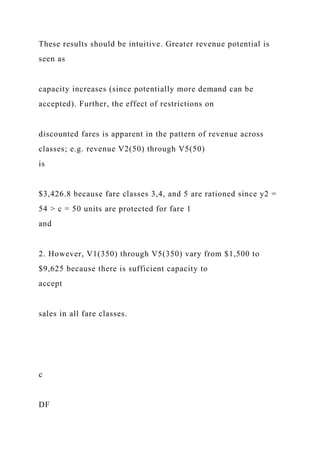
![169
5
$15
120
Table 2: Five Fare Example with Poisson Demands: Data and
Optimal Protection Levels
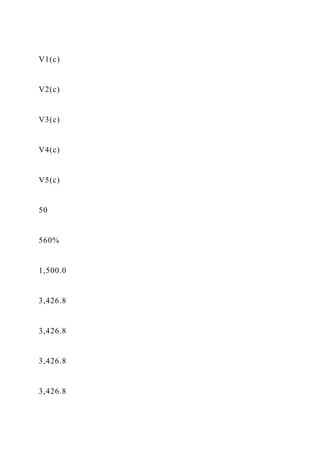
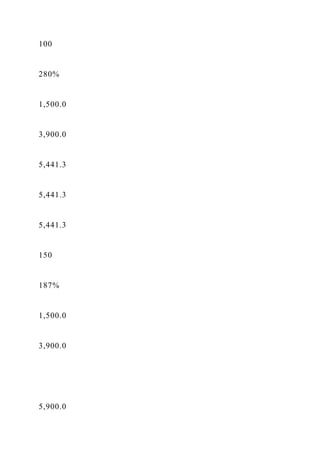
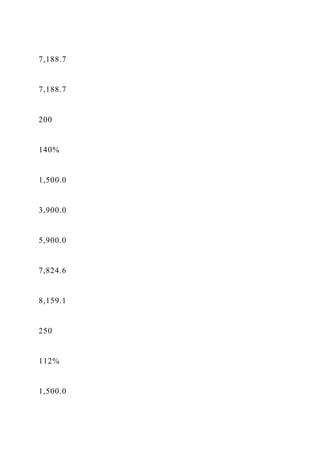
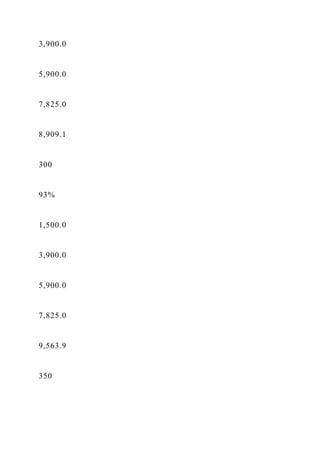
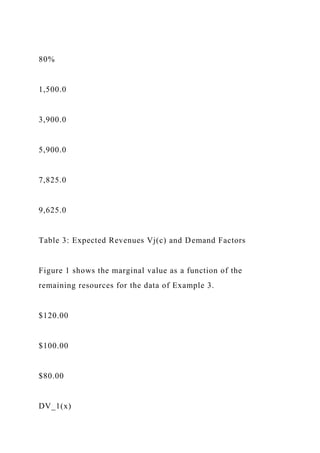
Table 3 provides the expected revenues for different capacity
levels as well as the corresponding demand
factors (
5
E[D
j=1
j ])/c = 280/c.](https://image.slidesharecdn.com/dynamicpricingandrevenuemanagementieor4601spring-221026074120-68376053/85/Dynamic-Pricing-andRevenue-ManagementIEOR-4601-Spring-docx-75-320.jpg)




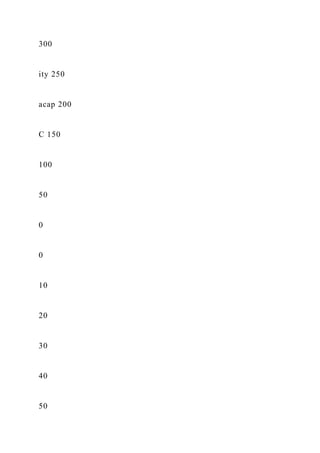
![60
70
80
90
100
cost
Figure 2: Optimal Capacity as a Function of Cost for the Data
of Example 3
steps as it is clear that yj−1 = 0 whenever pj > max(p1, . . . ,
pj−1) since it is optimal to allow all
bookings at
fare pj. The reader is referred to Robinson [18] for more details.
As an example, suppose that p3 < p2 >
p1.](https://image.slidesharecdn.com/dynamicpricingandrevenuemanagementieor4601spring-221026074120-68376053/85/Dynamic-Pricing-andRevenue-ManagementIEOR-4601-Spring-docx-90-320.jpg)
![Then V1(x) = p1E min(D1, x) and at stage 2 the decision is y1 =
0, so
V2(x) = p2E min(D2, x) + p1E min(D1, (x − D2)+).
Notice that
∆V2(x) = p2P (D2 ≥ x) + p1P (D2 < x ≤ D[1, 2])
so
y2 = max{y ∈ N : ∆V2(y) > p3}.
Notice that the capacity protected for fare 2 is higher than it
would be if there was no demand at fare 1.
4
Multiple Fare Classes: Commonly Used Heuristics
Several heuristics, essentially extensions of Littlewood’s rule,
were developed in the 1980’s. The most
important](https://image.slidesharecdn.com/dynamicpricingandrevenuemanagementieor4601spring-221026074120-68376053/85/Dynamic-Pricing-andRevenue-ManagementIEOR-4601-Spring-docx-91-320.jpg)
![heuristics are known as EMSR-a and EMSR-b, where EMSR
stands for expected marginal seat revenue.
Credit
for these heuristics is sometimes given to the American Airlines
team working on revenue management
problems
shortly after deregulation. The first published account of these
heuristics appear in Simpson [19] and
Belobaba
[2], [3]. For a while, some of these heuristics were even thought
to be optimal by their proponents until
optimal
policies based on dynamic programming were discovered in the
1990’s. By then heuristics were already
part of
implemented systems, and industry practitioners were reluctant
to replace them with the solutions
provided](https://image.slidesharecdn.com/dynamicpricingandrevenuemanagementieor4601spring-221026074120-68376053/85/Dynamic-Pricing-andRevenue-ManagementIEOR-4601-Spring-docx-92-320.jpg)
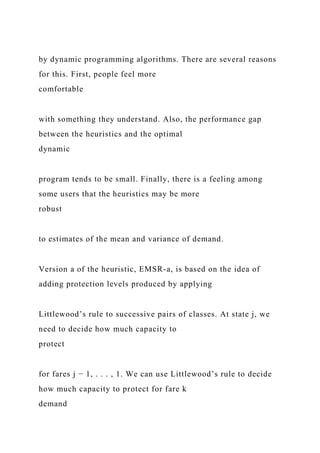

![units of capacity for fares j − 1, . . . , 1 against fare j.
In particular, if Dk is Normal with mean µk and standard
deviation σk, then
j−1
ya
= µ[1, j − 1] +
σ
j−1
k Φ−1(1 − rk,j ),
k=1
where for any j, µ[1, j − 1] =
j−1 µ](https://image.slidesharecdn.com/dynamicpricingandrevenuemanagementieor4601spring-221026074120-68376053/85/Dynamic-Pricing-andRevenue-ManagementIEOR-4601-Spring-docx-95-320.jpg)
![k=1
k and sums over empty sets are zero.
Notice that the EMSR-a heuristic involves j − 1 calls to
Littlewood’s rule to find the protection level for
fares j − 1, . . . , 1. In contrast, the EMSR-b heuristic is based
on a single call to Littlewood’s rule for
each
protection level. However, using the EMSR-b heuristic requires
the distribution of D[1, j − 1] =
j−1 D
k=1
k .
This typically requires computing a convolution but in some
cases, such as the Normal or the Poisson, the
distribution of D[1, j − 1] can be easily obtained (because sums
of independent Normal or Poisson](https://image.slidesharecdn.com/dynamicpricingandrevenuemanagementieor4601spring-221026074120-68376053/85/Dynamic-Pricing-andRevenue-ManagementIEOR-4601-Spring-docx-96-320.jpg)
![random
variables are, respectively, Normal or Poisson). The distribution
of D[1, j − 1] is used together with the
weighted average fare
j−1
µk
¯
pj−1 =
pk µ[1, j − 1]
k=1
and calls on Littlewood’s rule to obtain protection level
yb](https://image.slidesharecdn.com/dynamicpricingandrevenuemanagementieor4601spring-221026074120-68376053/85/Dynamic-Pricing-andRevenue-ManagementIEOR-4601-Spring-docx-97-320.jpg)
![= max{y ∈ N : P (D[1, j − 1] ≥ y) > rb
}
j−1
j−1,j
where rb
= p
j−1,j
j / ¯
pj−1. Notice that the weighted average fare assumes that a
proportion µk/µ[1, j − 1] of the
protected capacity will be sold at fare pk, k = 1, . . . , j − 1. In
the special case when demands are Normal
we
obtain](https://image.slidesharecdn.com/dynamicpricingandrevenuemanagementieor4601spring-221026074120-68376053/85/Dynamic-Pricing-andRevenue-ManagementIEOR-4601-Spring-docx-98-320.jpg)
![yb
= µ[1, j − 1] + σ[1, j − 1]Φ−1(1 − rb
).
j−1
j−1,j
Recall that for the Normal, variances are additive, so the
standard deviation σ[1, j − 1] =
j−1 σ2.
k=1
k
4.1
Evaluating the Performance of Heuristics](https://image.slidesharecdn.com/dynamicpricingandrevenuemanagementieor4601spring-221026074120-68376053/85/Dynamic-Pricing-andRevenue-ManagementIEOR-4601-Spring-docx-99-320.jpg)
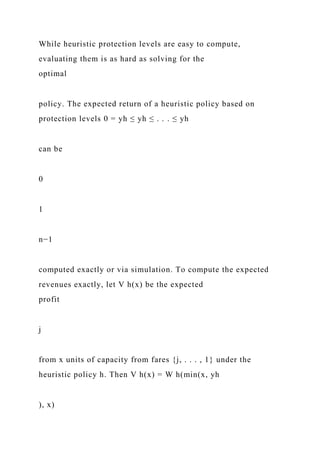
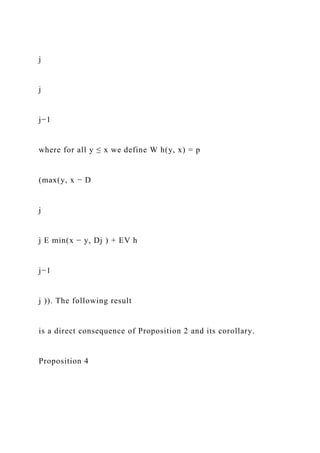
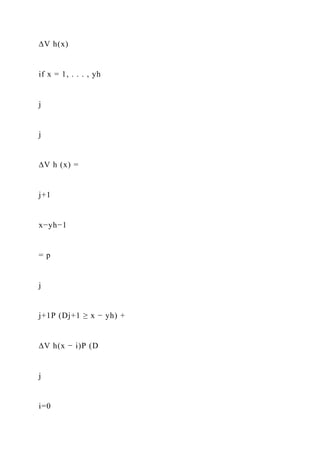

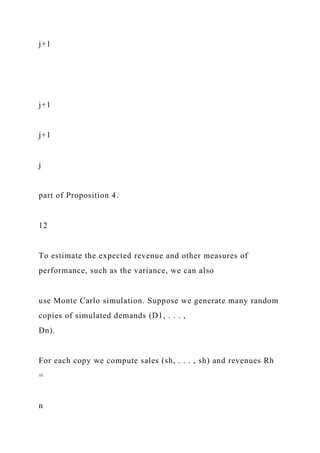

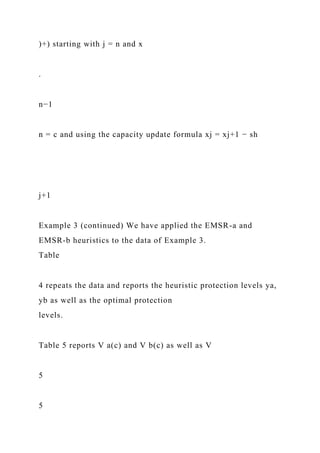
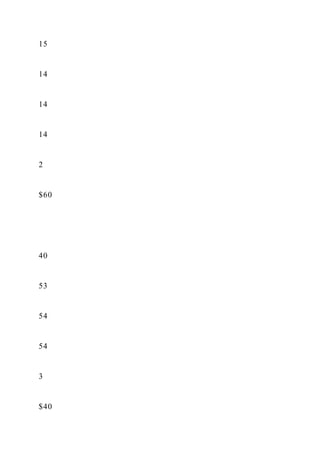
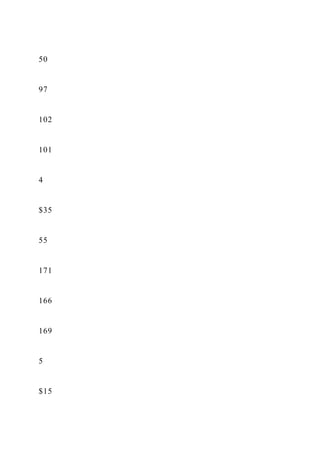
![5(c) for values of c ∈ {50, 100, 150, 200, 250, 300, 350}.
j
pj
E[Dj]
ya
yb
y
j
j
j
1
$100](https://image.slidesharecdn.com/dynamicpricingandrevenuemanagementieor4601spring-221026074120-68376053/85/Dynamic-Pricing-andRevenue-ManagementIEOR-4601-Spring-docx-107-320.jpg)

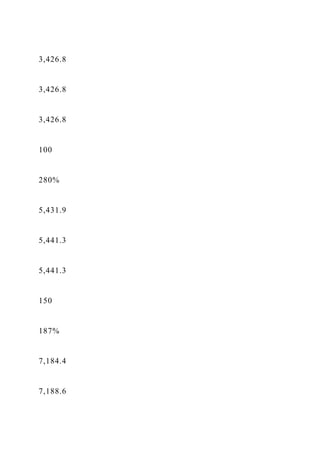
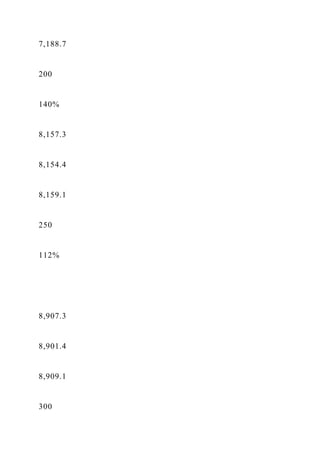
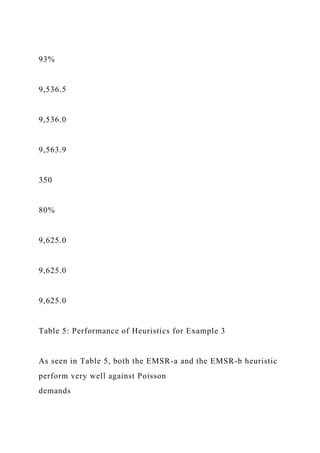
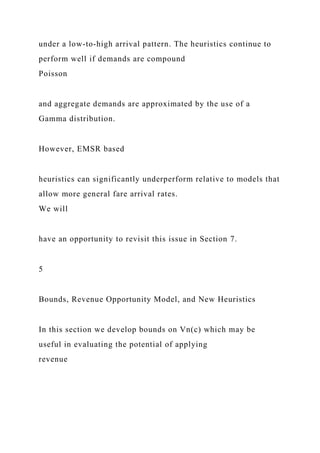


![n
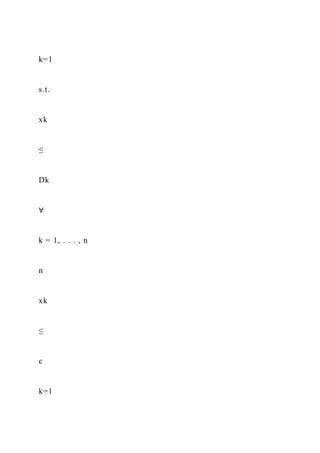
n
The solution to (11) can be written explicitly as xk = min(Dk, (c
− D[1, k − 1])+), k = 1, . . . , n where
for convenience we define D[1, 0] = 0. The intuition here is that
we give priority to higher fares so fare
k ∈ {1, . . . , n} gets the residual capacity (c − D[1, k − 1])+.
The expected revenue can be written more
succinctly after a few algebraic calculations:
n
V U (c)
=
p
n](https://image.slidesharecdn.com/dynamicpricingandrevenuemanagementieor4601spring-221026074120-68376053/85/Dynamic-Pricing-andRevenue-ManagementIEOR-4601-Spring-docx-118-320.jpg)
![k E min(Dk , (c − D[1, k − 1])+)
(12)
k=1
n
=
pk (E min(D[1, k], c) − E min(D[1, k − 1], c))
k=1
n
=
(pk − pk+1)E min(D[1, k], c)
(13)](https://image.slidesharecdn.com/dynamicpricingandrevenuemanagementieor4601spring-221026074120-68376053/85/Dynamic-Pricing-andRevenue-ManagementIEOR-4601-Spring-docx-119-320.jpg)
![k=1
where for convenience we define pn+1 = 0. Moreover, since V
U (c, D) is concave in D, it follows from
Jensen’s
n
inequality that V U (c) = EV U (c, D) ≤ V U (c, µ) where V U
(c, µ) is the solution to formulation (11)
with
n
n
n
n
µ = E[D] instead of D. More precisely,
n
V U (c, µ)](https://image.slidesharecdn.com/dynamicpricingandrevenuemanagementieor4601spring-221026074120-68376053/85/Dynamic-Pricing-andRevenue-ManagementIEOR-4601-Spring-docx-120-320.jpg)
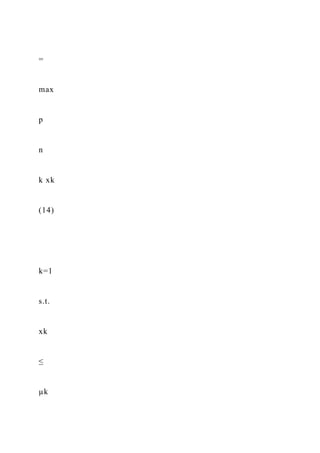
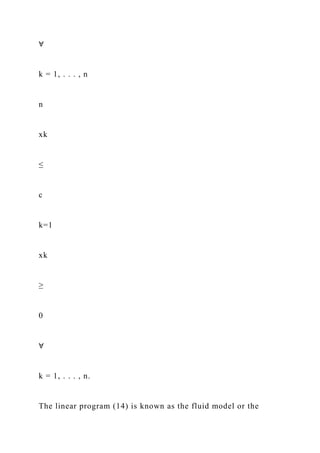
![deterministic capacity allocation problem. It
is
essentially a knapsack problem whose solution can be given in
closed form xk = min(µk, (c − µ[1, k −
1])+) for
all k = 1, . . . , n. Consequently, V U (c) ≤ V U (c, µ) =
n
(p
n
n
k=1
k − pk+1) min(µ[1, k], c).
A lower bound can be obtained by assuming a low to high
arrival pattern with zero protection levels.](https://image.slidesharecdn.com/dynamicpricingandrevenuemanagementieor4601spring-221026074120-68376053/85/Dynamic-Pricing-andRevenue-ManagementIEOR-4601-Spring-docx-123-320.jpg)
![This gives rise to sales min(Dk, (c − D[k + 1, n])+) at fare k =
1, . . . , n and revenue lower bound V L(c,
D) =
n
p
k=1
k E min(Dk , (c − D[k + 1, n])+).
Taking expectations we obtain
n
V L(c)
=
p
n](https://image.slidesharecdn.com/dynamicpricingandrevenuemanagementieor4601spring-221026074120-68376053/85/Dynamic-Pricing-andRevenue-ManagementIEOR-4601-Spring-docx-124-320.jpg)
![k E min(Dk , (c − D[k + 1, n])+)
(15)
k=1
n
=
pk (E min(D[k, n], c) − E min(D[k + 1, n], c))
k=1
n
=
(pk − pk−1)E min(D[k, n], c)
(16)
k=1](https://image.slidesharecdn.com/dynamicpricingandrevenuemanagementieor4601spring-221026074120-68376053/85/Dynamic-Pricing-andRevenue-ManagementIEOR-4601-Spring-docx-125-320.jpg)
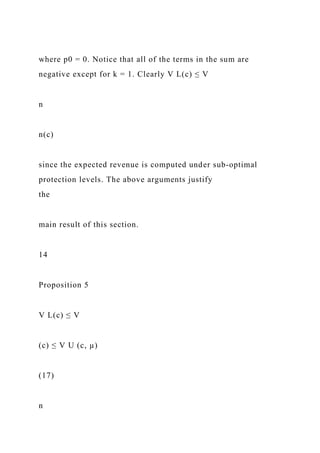
![n(c) ≤ V U
n
n
Of course, the bounds require the computation of E min(D[1, k],
c), k = 1, . . . , n. However, this is often
an easy computation. Indeed, if D[1, k] is any non-negative
integer random variable then E min(D[1, k], c)
=
c
P (D[1, k] ≥ j). If D[1, k] is Normal we can take advantage of
the fact that E min(Z, z) = z(1 − Φ(z)) −
j=1
φ(z) when Z is a standard Normal random variable and φ is the
standard Normal density function. If
follows](https://image.slidesharecdn.com/dynamicpricingandrevenuemanagementieor4601spring-221026074120-68376053/85/Dynamic-Pricing-andRevenue-ManagementIEOR-4601-Spring-docx-127-320.jpg)
![that if D[1, k] is Normal with mean µ and variance σ2, then
E min(D[1, k], c) = µ + σE min(Z, z) = µ + σ [z(1 − Φ(z)) −
φ(z)]
where z = (c − µ)/σ.
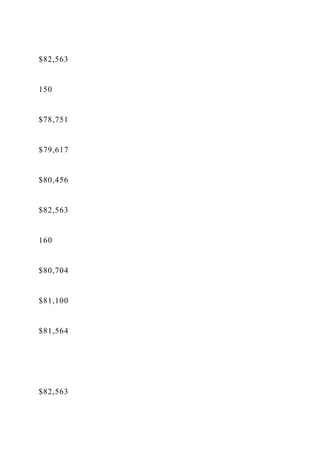
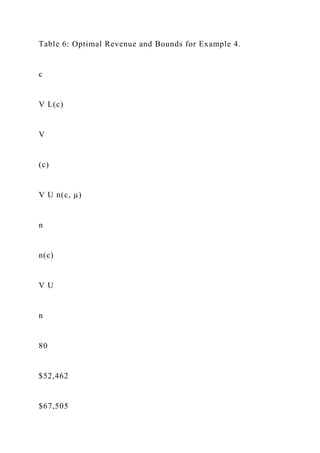
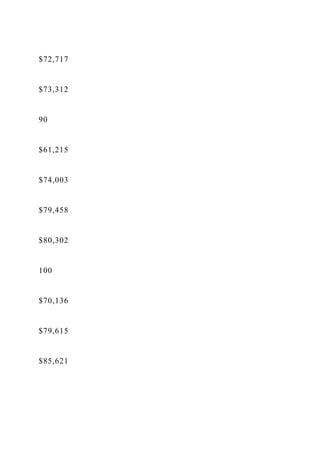
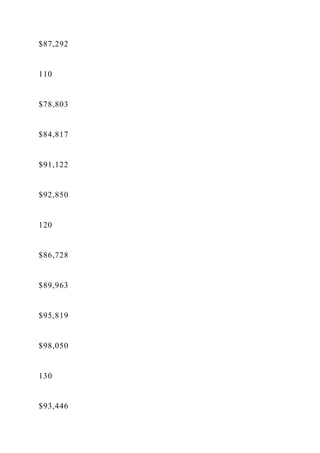
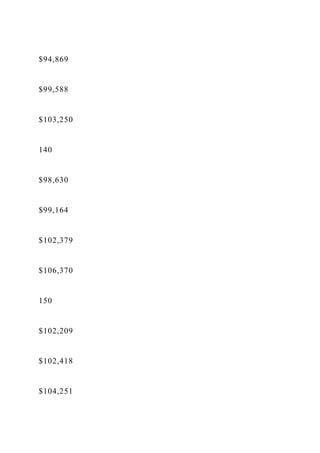
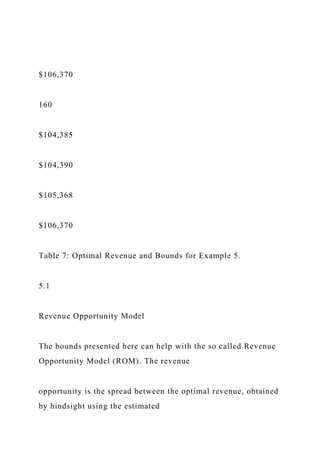
Tables 6 and 7 report V L(c), V
(c) and V
n
n(c), V U
n
n(c, µ) for the data of Examples 4 and 5, respectively.
Notice that V U (c) represents a significant improvement over
the better known bound V
n](https://image.slidesharecdn.com/dynamicpricingandrevenuemanagementieor4601spring-221026074120-68376053/85/Dynamic-Pricing-andRevenue-ManagementIEOR-4601-Spring-docx-128-320.jpg)
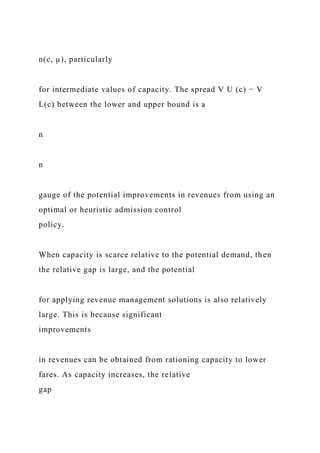

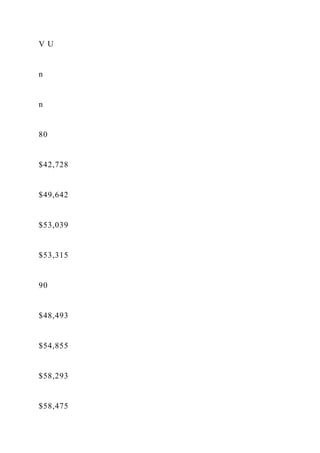
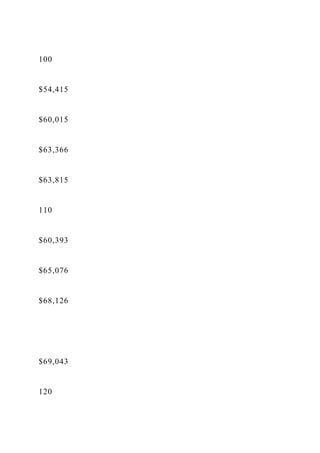
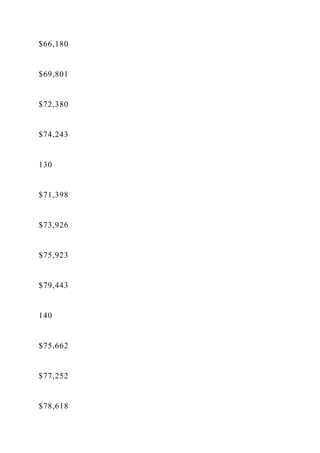
![n
n
n
Table 6 and 7 shows there is significant revenue opportunity,
particularly for c ≤ 140. Thus, one use for
the
ROM is to identify situations where RM has the most potential
so that more effort can be put where is
most
needed. The ROM has also been used to show the benefits of
using leg-based control versus network-
based
controls. The reader is refer to Chandler and Ja ([8]) and to
Temath et al. ([21]) for further information on
the uses of the ROM.
5.2](https://image.slidesharecdn.com/dynamicpricingandrevenuemanagementieor4601spring-221026074120-68376053/85/Dynamic-Pricing-andRevenue-ManagementIEOR-4601-Spring-docx-142-320.jpg)
![Bounds Based Heuristic
It is common to use an approximation to the value function as a
heuristic. To do this, suppose that ˜
Vj(x) is
an approximation to Vj(x). Then a heuristic admission control
rule can be obtained as follows:
˜
yj = max{y ∈ N : ∆ ˜
Vj(y) > pj+1} j = 1, . . . , n − 1.
(18)
Suppose we approximate the value function Vj(x) by ˜
Vj(x) = θV L(x) + (1 − θ)V U (x) for some θ ∈ [0, 1]](https://image.slidesharecdn.com/dynamicpricingandrevenuemanagementieor4601spring-221026074120-68376053/85/Dynamic-Pricing-andRevenue-ManagementIEOR-4601-Spring-docx-143-320.jpg)
![j
j
and V L(x) and V U (x) are the bounds obtained in this section
applied to n = j and c = x. Notice that
j
j
∆V L(x) = p
(p
(x) =
j−1 (p
j
1P (D[1, j] ≥ x) +
j](https://image.slidesharecdn.com/dynamicpricingandrevenuemanagementieor4601spring-221026074120-68376053/85/Dynamic-Pricing-andRevenue-ManagementIEOR-4601-Spring-docx-144-320.jpg)
![k=2
k − pk−1)P (D[k, j] ≥ x), while ∆V U
j
k=1
k − pk+1)P (D[1, k] ≥
x) + pjP (D[1, j] ≥ x).
6
Multiple Fare Classes with Arbitrary Fare Arrival Patterns
So far we have suppressed the time dimension; the order of the
arrivals has provided us with stages that
are
a proxy for time, with the advance purchase restriction for fare j
serving as a mechanism to end stage j. In
this section we consider models where time is considered
explicitly. There are advantages of including](https://image.slidesharecdn.com/dynamicpricingandrevenuemanagementieor4601spring-221026074120-68376053/85/Dynamic-Pricing-andRevenue-ManagementIEOR-4601-Spring-docx-145-320.jpg)
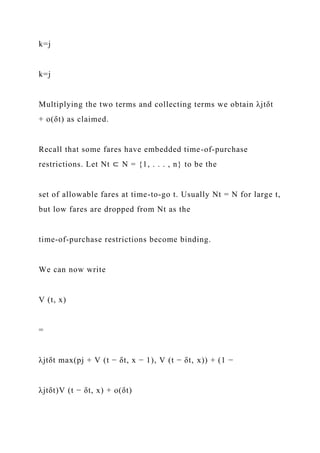
![the expected
number of requests for fare j over the entire horizon [0, T ]. The
low-to-high arrival pattern can be
embedded
into the time varying model by dividing the selling horizon into
n sub-intervals [tj−1, tj], j = 1, . . . , n with
tj = jT /n, and setting λjt = nΛj/T over t ∈ [tj−1, tj] and λjt = 0
otherwise.
Let V (t, x) denote the maximum expected revenue that can be
attained over the last t units of the sale
horizon with x units of capacity. We will develop both discrete
and continuous time dynamic programs to
compute V (t, x). To construct a dynamic program we will need
the notion of functions that go to zero
faster
16](https://image.slidesharecdn.com/dynamicpricingandrevenuemanagementieor4601spring-221026074120-68376053/85/Dynamic-Pricing-andRevenue-ManagementIEOR-4601-Spring-docx-148-320.jpg)
![than their argument. More precisely, we say that a function g(x)
is o(x) if limx↓0 g(x)/x = 0. We will show
that the probability that over the interval [t − δt, t] there is
exactly one request and the request is for
product
j is of the form λjtδt + o(δt). To see this notice that the
probability that a customer arrives and requests
one
unit of product j over the interval [t − δt, t]is
λjtδ exp(−λjtδt) + o(δt) = λjtδt[1 − λjtδt] + o(δt) = λjtδt + o(δt),
while the probability that there are no requests for the other
products over the same interval is
exp(−
λktδt) + o(δt) = 1 −
λktδt + o(δt).](https://image.slidesharecdn.com/dynamicpricingandrevenuemanagementieor4601spring-221026074120-68376053/85/Dynamic-Pricing-andRevenue-ManagementIEOR-4601-Spring-docx-149-320.jpg)
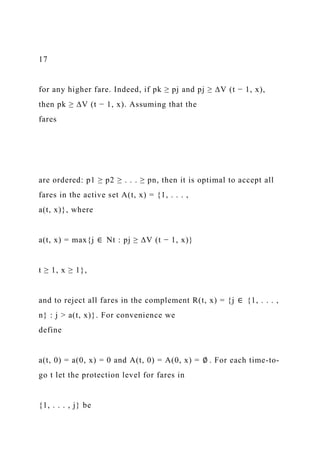
![j∈ Nt
j∈ Nt
=
V (t − δt, x) + δt
λjt[pj − ∆V (t − δt, x)]+ + o(δt)
(19)
j∈ Nt
with boundary conditions V (t, 0) = 0 and V (0, x) = 0 for all x
≥ 0, where ∆V (t, x) = V (t, x) − V (t, x −
1) for
x ≥ 1 and t ≥ 0.
Subtracting V (t − δt, x) from both sides of equation (19),
dividing by δt and taking the limit as δt ↓ 0, we](https://image.slidesharecdn.com/dynamicpricingandrevenuemanagementieor4601spring-221026074120-68376053/85/Dynamic-Pricing-andRevenue-ManagementIEOR-4601-Spring-docx-151-320.jpg)
![obtain the following equation, known as the Hamilton Jacobi
Bellman (HJB) equation:
∂V (t, x) =
λjt[pj − ∆V (t, x)]+
(20)
∂t
j∈ Nt
with the same boundary conditions. The equation tells us that
the rate at which V (t, x) grows with t is the
weighted sum of the positive part of the fares net of the
marginal value of capacity ∆V (t, x) at state (t, x).
While the value function can be computed by solving and
pasting the differential equation (20), in practice
it is easier to understand and compute V (t, x) using a discrete
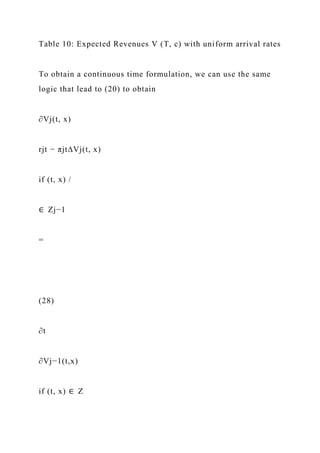
time dynamic programming formulation. A](https://image.slidesharecdn.com/dynamicpricingandrevenuemanagementieor4601spring-221026074120-68376053/85/Dynamic-Pricing-andRevenue-ManagementIEOR-4601-Spring-docx-152-320.jpg)
![discrete time dynamic programming formulation emerges from
(19) by rescaling time, setting δt = 1, and
dropping the o(δt) term. This can be done by selecting a > 1, so
that T ← aT is an integer, and setting
λjt ← 1 λ
λ
a
j,t/a, for t ∈ [0, aT ]. The scale factor a should be selected so
that, after scaling,
j∈ N
jt << 1,
t
e.g.,](https://image.slidesharecdn.com/dynamicpricingandrevenuemanagementieor4601spring-221026074120-68376053/85/Dynamic-Pricing-andRevenue-ManagementIEOR-4601-Spring-docx-153-320.jpg)
![λ
j∈ N
jt ≤ .01 for all t. The resulting dynamic program, after rescaling
time, is given by
t
V (t, x) = V (t − 1, x) +
λjt[pj − ∆V (t − 1, x)]+.
(21)
j∈ Nt
with the same boundary conditions. Computing V (t, x) via (21)
is quite easy and fairly accurate if time is
scaled appropriately. For each t, the complexity is order O(n)
for each x ∈ {1 . . . , c} so the complexity
per
period is O(nc), and the overall computational complexity is](https://image.slidesharecdn.com/dynamicpricingandrevenuemanagementieor4601spring-221026074120-68376053/85/Dynamic-Pricing-andRevenue-ManagementIEOR-4601-Spring-docx-154-320.jpg)
![O(ncT ).
A formulation equivalent to (21) was first proposed by Lee and
Hersh [13], who also show that ∆V (t, x)
is
increasing in t and decreasing in x. The intuition is that the
marginal value of capacity goes up if we have
more
time to sell and goes down when we have more units available
for sale. From the dynamic program (21),
it is
optimal to accept a request for product j when pj ≥ ∆V (t − 1, x)
or equivalently, when pj + V (t − 1, x −
1) ≥
V (t − 1, x), i.e., when the expecte revenue from accepting the
request exceeds the expected revenue of
denying
the request. Notice that if it is optimal to accept a request for
fare j, then it is also optimal to accept a
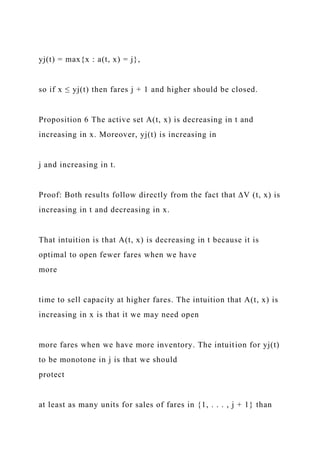
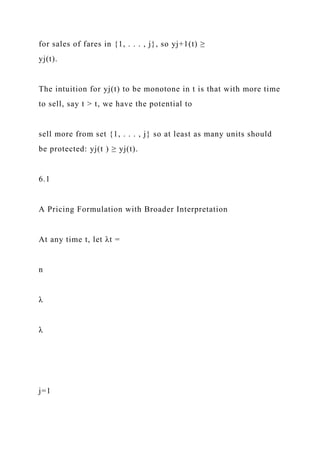
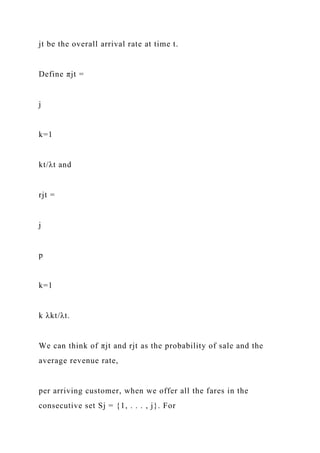
request](https://image.slidesharecdn.com/dynamicpricingandrevenuemanagementieor4601spring-221026074120-68376053/85/Dynamic-Pricing-andRevenue-ManagementIEOR-4601-Spring-docx-155-320.jpg)
![convenience,
let π0t = r0t = 0 denote, respectively, the sales rate and the
revenue rate associated with S0 = ∅ . Now let
qjt = rjt/πjt be the average fare per unit sold when the offer set
is Sj. If πjt = 0, we define qjt = 0. This
implies that πjt[qjt − ∆V (t − 1, x)] is zero whenever πjt = 0,
e.g., when j = 0.
Let N + = N
t
t ∪ {0}. With this notation, we can write formulation (21) as
V (t, x)
=
V (t − 1, x) + λt max [rjt − πjt∆V (t − 1, x)]
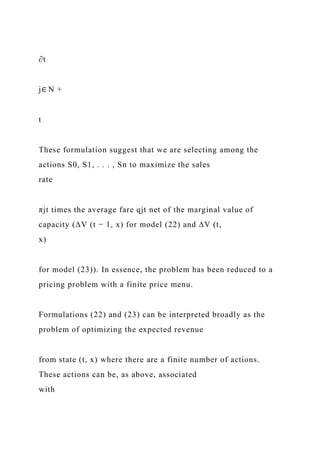
j∈ N +](https://image.slidesharecdn.com/dynamicpricingandrevenuemanagementieor4601spring-221026074120-68376053/85/Dynamic-Pricing-andRevenue-ManagementIEOR-4601-Spring-docx-160-320.jpg)
![t
=
V (t − 1, x) + λt max πjt[qjt − ∆V (t − 1, x)].
(22)
j∈ N +
t
The reason to include 0 as a choice is that for j = 0, the term
vanishes and this allow us to drop the
positive
part that was present in formulation (21). The equivalent
formulation for the continuous time model (20)
is
∂V (t, x) = λt max πjt[qjt − ∆V (t, x)].
(23)](https://image.slidesharecdn.com/dynamicpricingandrevenuemanagementieor4601spring-221026074120-68376053/85/Dynamic-Pricing-andRevenue-ManagementIEOR-4601-Spring-docx-161-320.jpg)
![to
accept a fare pj request of size Zj = z. The expected revenue
from accepting the request is zpj + V (t − 1, x
− z)
and the expected revenue from rejecting the request is V (t − 1,
x). Let ∆zV (t, x) = V (t, x) − V (t, x − z)
for
all z ≤ x and ∆zV (t, x) = ∞ if z > x. We can think of ∆zV (t, x)
as a the sum of the the z marginal values
∆V (t, x) + ∆V (t, x − 1) + . . . + ∆V (t, x − z + 1).
The dynamic program (20) with compound Poisson demands is
given by
∞
∂V (t, x) =
λjt
Pj(z)[zpj − ∆zV (t, x)]+,](https://image.slidesharecdn.com/dynamicpricingandrevenuemanagementieor4601spring-221026074120-68376053/85/Dynamic-Pricing-andRevenue-ManagementIEOR-4601-Spring-docx-165-320.jpg)
![(24)
∂t
j∈ Nt
z=1
while the dynamic program (21) with compound Poisson
demands is given by
∞
V (t, x) = V (t − 1, x) +
λjt
Pj(z)[zpj − ∆zV (t − 1, x)]+,
(25)
j∈ Nt](https://image.slidesharecdn.com/dynamicpricingandrevenuemanagementieor4601spring-221026074120-68376053/85/Dynamic-Pricing-andRevenue-ManagementIEOR-4601-Spring-docx-166-320.jpg)
![if zpj ≥ ∆zV (t, x), and to accept a z request fare pj, j ∈ Nt, if
zpj ≥ ∆zV (t − 1, x). The two policies
should
largely coincide time is scaled correctly so that
λ
j∈ N
jt << 1 for all t ∈ [0, T ].
t
For compound Poisson demands, we can no longer claim that
the marginal value of capacity ∆V (t, x) is
decreasing in x, although it is still true that ∆V (t, x) is
increasing in t. To see why ∆V (t, x) is not
monotone in
x, consider a problem where the majority of the requests are for
two units and request are seldom for one](https://image.slidesharecdn.com/dynamicpricingandrevenuemanagementieor4601spring-221026074120-68376053/85/Dynamic-Pricing-andRevenue-ManagementIEOR-4601-Spring-docx-168-320.jpg)
![= $100, p2 = $60, p3 = $40, p4 = $35
and
p5 = $15 with independent compound Poisson demands, with
uniform arrival rates λ1 = 15, λ2 = 40, λ3 =
50, λ4 = 55, λ5 = 120 over the horizon [0, 1]. We will assume
that Nt = N for all t ∈ [0, 1]. The aggregate
arrival rates are given by Λj = λjT = λj for all j. We will assume
that the distribution of the demand sizes
is
given by P (Z = 1) = 0.65, P (Z = 2) = 0.25, P (Z = 3) = 0.05
and P (Z = 4) = .05 for all fare classes.
Notice
that E[Z] = 1.5 and E[Z2] = 2.90, so the variance to mean ratio
is 1.933. We used the dynamic program
(25) with a rescaled time horizon T ← aT = 2, 800, and rescaled
arrival rates λj ← λj/a for all j. Table 8
provides the values V (T, c) for c ∈ {50, 100, 150, 200, 250,
300, 350}. Table 8 also provides the](https://image.slidesharecdn.com/dynamicpricingandrevenuemanagementieor4601spring-221026074120-68376053/85/Dynamic-Pricing-andRevenue-ManagementIEOR-4601-Spring-docx-170-320.jpg)
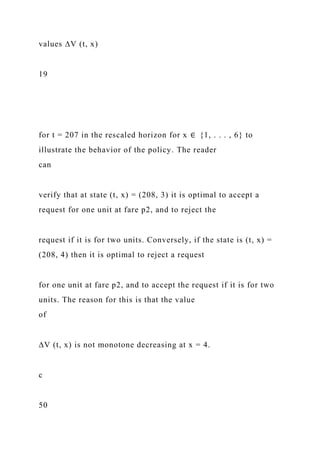
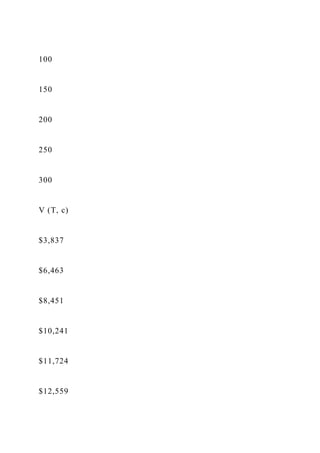
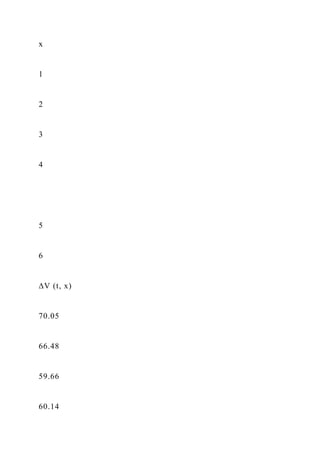
![54.62
50.41
Table 8: Value function V (T, c) and marginal revenues ∆V (t,
c) for Example 4: Compound Poisson
7.1
Static vs Dynamic Policies
Let Nj be the random number of request arrivals for fare j over
the horizon [0, T ], Then Nj is Poisson
with
T
parameter Λj =
λ
0
jtdt. Suppose each arrival is of random size Zj . Then the](https://image.slidesharecdn.com/dynamicpricingandrevenuemanagementieor4601spring-221026074120-68376053/85/Dynamic-Pricing-andRevenue-ManagementIEOR-4601-Spring-docx-174-320.jpg)
![aggregate demand, say Dj , for
fare j is equal to
Nj
Dj =
Zjk,
(26)
k=1
where Zjk is the size of the kth request. It is well known that
E[Dj] = E[Nj]E[Zj] = ΛjE[Zj] and that
Var[Dj] = E[Nj]E[Z2] = Λ
], where E[Z2] is the second moment of Z
j](https://image.slidesharecdn.com/dynamicpricingandrevenuemanagementieor4601spring-221026074120-68376053/85/Dynamic-Pricing-andRevenue-ManagementIEOR-4601-Spring-docx-175-320.jpg)
![j E[Z 2
j
j
j . Notice that Jensen’s inequality
implies that the the variance to mean ratio E[Z2]/E[Z
j
j ] ≥ E[Zj ] ≥ 1.
In practice, demands D1, . . . , Dn are fed, under the low-to-
high arrival assumption, into static policies to
compute Vj(c), j = 1, . . . , n and protection levels yj, j = 1, . . .
, n − 1 using the dynamic program (8), or
to
the EMSR-b heuristic to compute protection levels yb, . . . , yb
. Since the compound Poisson demands are](https://image.slidesharecdn.com/dynamicpricingandrevenuemanagementieor4601spring-221026074120-68376053/85/Dynamic-Pricing-andRevenue-ManagementIEOR-4601-Spring-docx-176-320.jpg)
![1
n−1
difficult to deal with numerically, practitioners often
approximate the aggregate demands Dj by a Gamma
distribution with parameters αj and βj, such that αjβj =
E[Nj]E[Zj] and αjβ2 = E[N
], yielding
j
j ]E[Z 2
j
αj = ΛjE[Zj]2/E[Z2], and β
]/E[Z
j](https://image.slidesharecdn.com/dynamicpricingandrevenuemanagementieor4601spring-221026074120-68376053/85/Dynamic-Pricing-andRevenue-ManagementIEOR-4601-Spring-docx-177-320.jpg)
![j = E[Z 2
j
j ].
We are interested in comparing the expected revenues obtained
from static policies to those of dynamic
policies. More precisely, suppose that that demands are
compound poisson and Dj is given by (26) for
every
j = 1, . . . , n. Suppose that protection levels y1, y2, . . . , yn−1
are computed using the low-to-high static
dynamic program (8) and let yb, yb, . . . , yb
be the protection levels computed using the EMSR-b heuristic.
Protection
1
2](https://image.slidesharecdn.com/dynamicpricingandrevenuemanagementieor4601spring-221026074120-68376053/85/Dynamic-Pricing-andRevenue-ManagementIEOR-4601-Spring-docx-178-320.jpg)
![n−1
levels like these are often used in practice in situations where
the arrival rates λjt, t ∈ [0, T ], j = 1, . . . ,
n, are not necessarily low-to-high. Two possible
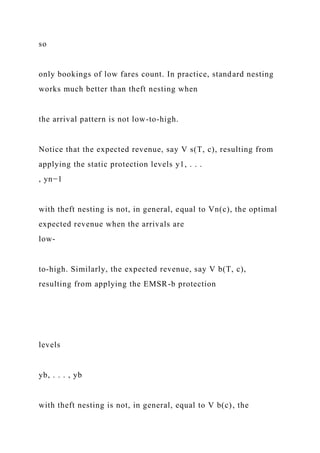
implementations are common. Under theft nesting a size
z request
for fare class j as state (t, x) is accepted if x − z ≥ yj−1. This
method is called theft nesting because the
remaining inventory x at time-to-go t is x = c − b[1, n] includes
all bookings up to time-to-go t, including
bookings b[1, j − 1]. Standard nesting counts only bookings for
lower fare classes and is implemented by
accepting a size z request for fare j at state (t, x) if x − z ≥
(yj−1 − b[1, j − 1])+, where b[1, j − 1] are the
observed bookings of fares [1, j − 1] up to state (t, x). When c >
yj−1 > b[1, j − 1], this is equivalent to
accepting a request for z units for fare j if c − b[j, n] − z ≥ yj−1,
or equivalently if b[j, n] + z ≤ c − yj−1,](https://image.slidesharecdn.com/dynamicpricingandrevenuemanagementieor4601spring-221026074120-68376053/85/Dynamic-Pricing-andRevenue-ManagementIEOR-4601-Spring-docx-179-320.jpg)
![V s(T, x) ≤ V (T, x) ∀ x ∈ {0, 1, . . . , c}.
Proof: Clearly for V s(0, x) = V (0, x) = 0 so the result holds for
t = 0, for all x ∈ {0, 1, . . . , c}. Suppose
the result holds for time-to-go t − 1, so V s(t − 1, x) ≤ V (t − 1,
x) for all x ∈ {0, 1, . . . , c}. We will show
that it also holds for time-to-go t. If a request of size z arrives
for fare class j, at state (t, x), the policy
based on
protection levels y1, . . . , yn−1 will accept the request if x − z
≥ (yj−1 − b[1, j − 1])+ and will rejected
otherwise.
In the following equations, we will use Qj(z) to denote P (Zj >
z). We have
x−(yj−1−b[1,j−1])+
V s(t, x)
=
λjt[](https://image.slidesharecdn.com/dynamicpricingandrevenuemanagementieor4601spring-221026074120-68376053/85/Dynamic-Pricing-andRevenue-ManagementIEOR-4601-Spring-docx-182-320.jpg)
![Pj(z)(zpj + V s(t − 1, x − z))
j∈ Nt
z=1
+
Qj(x − (yj−1 − b[1, j − 1])+)V s(t − 1, x)] + (1 −
λjt)V s(t − 1, x)
j∈ Nt
x−(yj−1−b[1,j−1])+
≤
λjt[
Pj(z)(zpj + V (t − 1, x − z))](https://image.slidesharecdn.com/dynamicpricingandrevenuemanagementieor4601spring-221026074120-68376053/85/Dynamic-Pricing-andRevenue-ManagementIEOR-4601-Spring-docx-183-320.jpg)
![j∈ Nt
z=1
+
Qj(x − (yj−1 − b[1, j − 1])+)V (t − 1, x)] + (1 −
λjt)V (t − 1, x)
j∈ Nt
x−(yj−1−b[1,j−1])+
=
V (t − 1, x) +
λjt
Pj(z)(zpj − ∆zV (t − 1, x))
j∈ Nt
z=1](https://image.slidesharecdn.com/dynamicpricingandrevenuemanagementieor4601spring-221026074120-68376053/85/Dynamic-Pricing-andRevenue-ManagementIEOR-4601-Spring-docx-184-320.jpg)
![from the inductive hypothesis V s(t − 1, x) ≤ V (t − 1, x). The
second equality collects terms, the second
inequality follows because we are taking positive parts, and the
last equality from the definition of V (t,
x).
While we have shown that V s(T, c) ≤ V (T, c), one may wonder
whether there are conditions where
equality
holds. The following results answers this question.
Corollary 2 If the Dj’s are independent Poisson random
variables and the arrivals are low-to-high then
Vn(c) = V s(T, c) = V (T, c).
Proof: Notice that if the Djs are Poisson and the arrivals are
low-to-high, then we can stage the arrivals
so that λjt = nE[Dj]/T over t ∈ (tj−1, tj] where tj = jT /n for j =
1, . . . , n. We will show by induction in
j that Vj(x) = V (tj, x). Clearly y0 = 0 and V1(x) = p1E min(D1,](https://image.slidesharecdn.com/dynamicpricingandrevenuemanagementieor4601spring-221026074120-68376053/85/Dynamic-Pricing-andRevenue-ManagementIEOR-4601-Spring-docx-186-320.jpg)
![x) = V (t1, x) assuming a sufficiently
large
rescale factor. Suppose, by induction, that Vj−1(x) = V (tj−1,
x). Consider now an arrival at state (t, x)
with
t ∈ (tj−1, tj]. This means that an arrival, if any, will be for one
unit of fare j. The static policy will accept
this
request if x − 1 ≥ yj−1, or equivalently if x > yj−1. However, if
x > yj−1, then ∆(t − 1, x) ≥ ∆V (tj−1, x) ≥
pj, because ∆V (t, x) is increasing in t and because yj−1 =
max{y : ∆Vj−1(y) > pj} = max{y : ∆V (tj−1, x)
> pj},
by the inductive hypothesis. Conversely, if the dynamic
program accepts a request, then pj ≥ ∆V (t, x) and
therefore x > yj−1 on account of ∆V (t, x) ≥ ∆V (tj−1, x).
We have come a long way in this chapter and have surveyed](https://image.slidesharecdn.com/dynamicpricingandrevenuemanagementieor4601spring-221026074120-68376053/85/Dynamic-Pricing-andRevenue-ManagementIEOR-4601-Spring-docx-187-320.jpg)
![most of the models for the independent
demand case. Practitioners and proponents of static models,
have numerically compared the performance
of
static vs dynamic policies. Diwan [7], for example, compares
the performance of the EMSR-b heuristic
against
the performance of the dynamic formulation for Poisson
demands (21) even for cases where the aggregate
21
demands Dj, j = 1, . . . , n are not Poisson. Not surprisingly, this
heuristic use of (21) can underperform
relative
to the EMSR-b heuristic. However, as seen in Proposition 7, the
expected revenue under the optimal
dynamic
program (25) is always at least as large as the expected revenue
generated by any heuristic, including the](https://image.slidesharecdn.com/dynamicpricingandrevenuemanagementieor4601spring-221026074120-68376053/85/Dynamic-Pricing-andRevenue-ManagementIEOR-4601-Spring-docx-188-320.jpg)
![n(c), developed in Section 5 for the static multi-fare
model is still valid for V (T, c). The random revenue associated
with the perfect foresight model is Vn(c,
D)
and can be obtained by solving the linear program (11). Notice
that for all sample paths, this revenue is
at least as large as the revenue for the dynamic policy. Taking
expectations we obtain V (T, c) ≤ V U (c) =
n
EVn(c, D) =
n
(p
k=1
k − pk+1)E min(D[1, k], c), where for convenience pn+1 = 0.
Moreover, since dynamic](https://image.slidesharecdn.com/dynamicpricingandrevenuemanagementieor4601spring-221026074120-68376053/85/Dynamic-Pricing-andRevenue-ManagementIEOR-4601-Spring-docx-193-320.jpg)

![k
Wk(t, x)
=
λit[pi + Vk(t − 1, x − 1)] + (1 −
λit)Vk(t − 1, x)
i=1
i=1
=
Vk(t − 1, x) + rkt − πkt∆Vk(t − 1, x)
=
Vk(t − 1, x) + πkt[pkt − ∆Vk(t − 1, x)],
where ∆Vk(t, x) = Vk(t, x) − Vk(t, x − 1), where πkt =](https://image.slidesharecdn.com/dynamicpricingandrevenuemanagementieor4601spring-221026074120-68376053/85/Dynamic-Pricing-andRevenue-ManagementIEOR-4601-Spring-docx-196-320.jpg)
![(27)
k≤j
with the boundary conditions Vj(t, 0) = Vj(0, x) = 0 for all t ≥ 0
and all x ∈ N for all j = 1, . . . , n. Notice
that the optimization is over consecutive subsets Sk = {1, . . . ,
k}, k ≤ j. It follows immediately that Vj(t,
x)
is monotone increasing in j. An equivalent version of (27) for
the case n = 2 can be found in Weng and
Zheng [23]. The complexity to compute Vj(t, x), x = 1, . . . , c
for each j is O(c) so the complexity to
compute
Vj(t, x), j = 1, . . . , n, x = 1, . . . , c is O(nc). Since there are T
time periods the overall complexity is
O(ncT ).
While computing Vj(t, x) numerically is fairly simple, it is
satisfying to know more about the structure of](https://image.slidesharecdn.com/dynamicpricingandrevenuemanagementieor4601spring-221026074120-68376053/85/Dynamic-Pricing-andRevenue-ManagementIEOR-4601-Spring-docx-198-320.jpg)
![optimal policies as this gives both managerial insights and can
simplify computations. The proof of the
structural results are intricate and subtle, but they parallel the
results for the dynamic program (8) and
(21).
The following Lemma is the counterpart to Lemma 2 and uses
sample path arguments based on ideas in
[23]
to extend their results from n = 2 to general n. The proof can be
found in the Appendix.
Lemma 3 For any j ≥ 1,
a) ∆Vj(t, x) is decreasing in x ∈ N+, so the marginal value of
capacity is diminishing.
b) ∆Vj(t, x) is increasing in j ∈ {1, . . . , n} so the marginal
value of capacity increases when we have](https://image.slidesharecdn.com/dynamicpricingandrevenuemanagementieor4601spring-221026074120-68376053/85/Dynamic-Pricing-andRevenue-ManagementIEOR-4601-Spring-docx-199-320.jpg)
![40, Λ3 = 50, Λ4 = 55 and Λ5 = 120 and
T = 1. The scaling factor was selected so that
5
Λ
i=1
i/a < .01 resulting in T ← aT = 2, 800.
We also
assume that the arrival rates are uniform over the horizon [0, T
], i.e., λj = Λj/T . In Table 10 we present
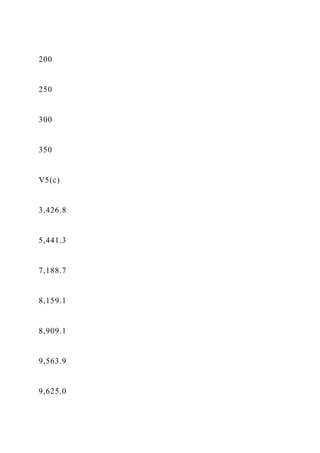
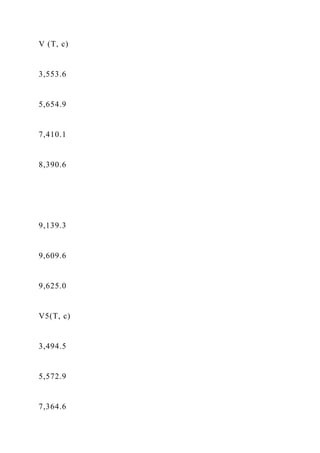
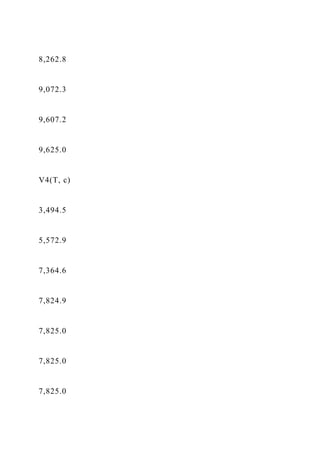
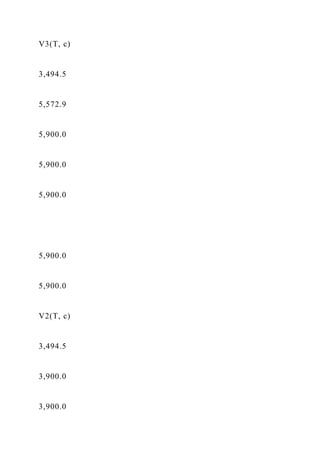
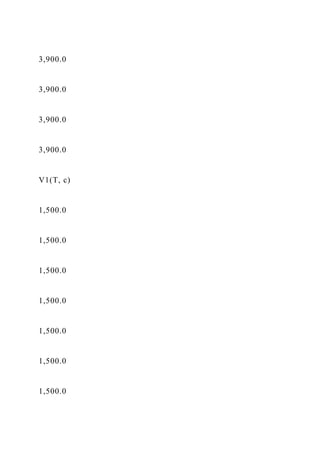
the expected revenues Vj(T, c), j = 1, . . . , 5 and V (T, c) for c
∈ {50, 100, 150, 200, 250}. The first row
is V5(c)
from Example 1. Notice that V5(c) ≤ V5(T, c). This is because
we here we are assuming uniform, rather
than](https://image.slidesharecdn.com/dynamicpricingandrevenuemanagementieor4601spring-221026074120-68376053/85/Dynamic-Pricing-andRevenue-ManagementIEOR-4601-Spring-docx-204-320.jpg)
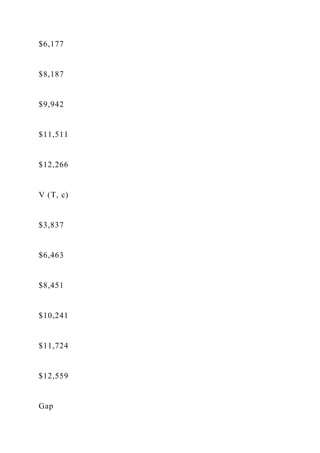
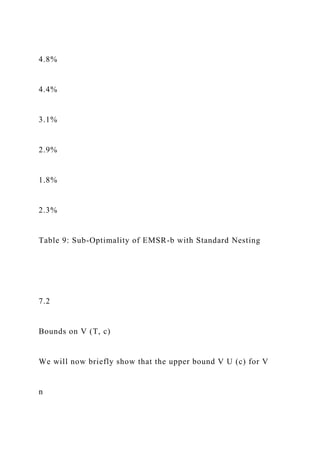
![low-to-high arrivals. V (T, c) is even higher because we have
the flexibility of opening and closing fares
at
will. While the increase in expected revenues [V (T, c) − V5(T,
c)] due to the flexibility of opening and
closing
fares may be significant for some small values of c (it is 1.7%
for c = 50), attempting to go for this extra
revenue may invite strategic customers or third parties to
arbitrage the system. As such, it is not generally
recommended in practice.
c
50
100
150](https://image.slidesharecdn.com/dynamicpricingandrevenuemanagementieor4601spring-221026074120-68376053/85/Dynamic-Pricing-andRevenue-ManagementIEOR-4601-Spring-docx-205-320.jpg)
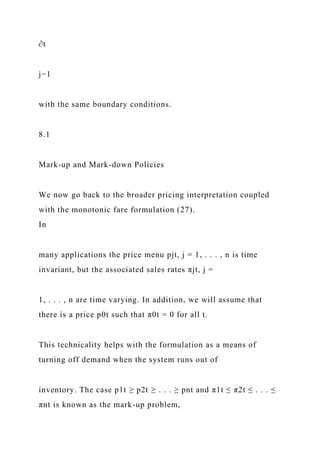
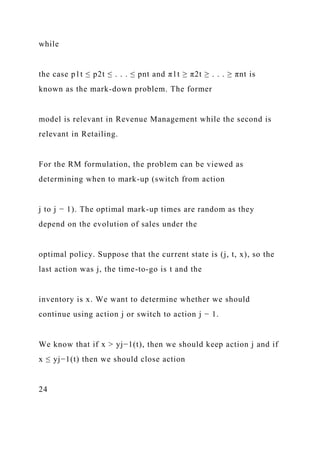
![j. Let Zj = {(t, x) : x ≤ yj−1(t)}, then it is optimal to stop action
j upon first entering set Zj. Notice
that a mark-up occurs when the current inventory falls below a
curve, so low inventories trigger mark-
ups,
and mark-ups are triggered by sales. The retailing formulation
also has a threshold structure, but this time
a
mark-down is triggered by inventories that are high relative to a
curve, so the optimal timing of a mark-
down
is triggered by the absence of sales. Both the mark-up and the
mark-down problems can be studied from
the
point of view of stopping times. We refer the reader to Feng and
Gallego [9], [10], and Feng and Xiao
[11] and](https://image.slidesharecdn.com/dynamicpricingandrevenuemanagementieor4601spring-221026074120-68376053/85/Dynamic-Pricing-andRevenue-ManagementIEOR-4601-Spring-docx-214-320.jpg)


![Proof of Lemma 2: We will prove the above result by induction
on j. The result is true for j = 1 since
∆V1(y) = p1P (D1 ≥ y) is decreasing in y and clearly ∆V1(y) =
p1P (D1 ≥ y) ≥ ∆V0(y) = 0. Assume that
the
result is true for Vj−1. It follows from the dynamic
programming equation (8) that
Vj(x) = max {Wj (y, x))} ,
y≤x
where for any y ≤ x,
Wj(y, x) = E [pj min {Dj, x − y}] + E [Vj−1 (max {x − Dj, y})]
A little work reveals that for y ∈ {1, . . . , x}
∆Wj(y, x) = Wj(y, x) − Wj(y − 1, x) = [∆Vj−1(y) − pj] P (Dj > x
− y).
Since ∆Vj−1(y) is decreasing in y (this is the inductive
hypothesis), we see that Wj(y, x) ≥ Wj(y − 1, x)](https://image.slidesharecdn.com/dynamicpricingandrevenuemanagementieor4601spring-221026074120-68376053/85/Dynamic-Pricing-andRevenue-ManagementIEOR-4601-Spring-docx-218-320.jpg)
![Vj(x)
=
Wj(min(x, yj−1), x)
V
=
j−1(x),
if x ≤ yj−1
E [pj min {Dj, x − yj−1}] + E [Vj−1 (max {x − Dj, yj−1})]
if x > yj−1
26
Computing ∆Vj(x) = Vj(x) − Vj(x − 1) for x ∈ N results in:
∆V](https://image.slidesharecdn.com/dynamicpricingandrevenuemanagementieor4601spring-221026074120-68376053/85/Dynamic-Pricing-andRevenue-ManagementIEOR-4601-Spring-docx-220-320.jpg)

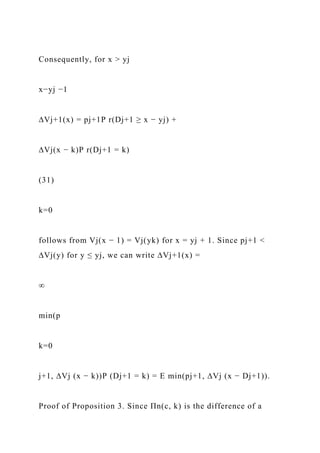
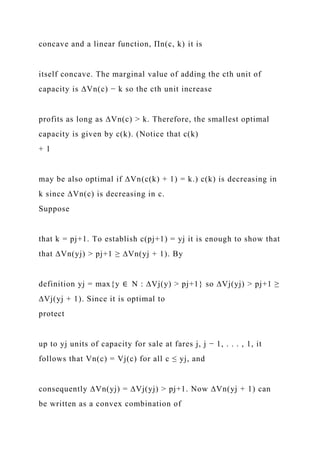
![pj+1
and ∆Vj(yj + 1) ≤ pj+1 which implies that ∆Vn(yj + 1) ≤ pj+1,
completing the proof.
Proof of Lemma 3: We will first show part that ∆Vj(t, x) is
decreasing in x which is equivalent to
showing
that 2Vj(t, x) ≥ Vj(t, x + 1) + Vj(t, x − 1)] for all x ≥ 1. Let A
be an optimal admission control rule starting
from state (t, x + 1) and let B be an optimal admission control
rule starting from (t, x − 1). These
admission
control rules are mappings from the state space to subsets Sk =
{1, . . . , k}, k = 0, 1, . . . , j where S0 = ∅
is
the optimal control whenever a system runs out of inventory.
Consider four systems: two starting from
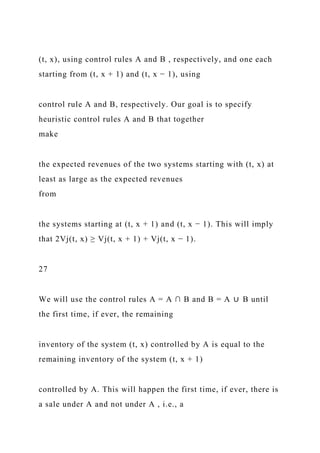
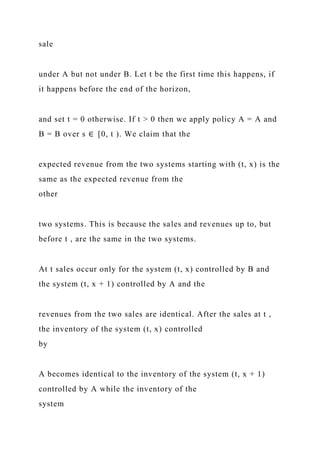
state](https://image.slidesharecdn.com/dynamicpricingandrevenuemanagementieor4601spring-221026074120-68376053/85/Dynamic-Pricing-andRevenue-ManagementIEOR-4601-Spring-docx-226-320.jpg)




![a(t, x)
highest opened fare class at state (t, x)
Zj
the stopping set for fare j (where it is optimal to close down
fare j upon entering
set Zj)
λjt
arrival rate of fare j demand at time-to-go t
Λjt
expected demand for fare j over [0, t].
Table 11: Summary of Terminology and Notation Used
References](https://image.slidesharecdn.com/dynamicpricingandrevenuemanagementieor4601spring-221026074120-68376053/85/Dynamic-Pricing-andRevenue-ManagementIEOR-4601-Spring-docx-241-320.jpg)
![[1] Bathia, A. V. and S. C. Prakesh (1973) “Optimal Allocation
of Seats by Fare,” Presentation by TWA
Airlines to AGIFORS Reservation Study Group.
[2] Belobaba, P. P. (1987) “Airline Yield Management An
Overview of Seat Inventory Control,”
Transporta-
tion Science, 21, 63–73.
[3] Belobaba, P. P. (1989) “Application of a Probabilistic
Decision Model to Airline Seat Inventory
Control,”
Operations Research, 37, 183–197.
[4] Brumelle, S. L., J. I. McGill, T. H. Oum, M. W. Tretheway
and K. Sawaki (1990) “Allocation of
Airline
Seats Between Stochastically Dependent Demands,”
Transporation Science, 24, 183-192.](https://image.slidesharecdn.com/dynamicpricingandrevenuemanagementieor4601spring-221026074120-68376053/85/Dynamic-Pricing-andRevenue-ManagementIEOR-4601-Spring-docx-242-320.jpg)
![[5] Brumelle, S. L. and J. I. McGill (1993) “Airline Seat
Allocation with Multiple Nested Fare Classes,”
Operations Research, 41, 127-137.
30
[6] Curry, R. E. (1990) “Optimal Airline Seat Allocation with
Fare Nested by Origins and Destinations,”
Transportation Science, 24, 193–204.
[7] Diwan, S. (2010) “Performance of Dynamic Programming
Methods in Airline Revenue Management.”
M.S. Dissertation MIT. Cambridge, MA.
[8] Chandler, S. and Ja, S. (2007) Revenue Opportunity
Modeling at American Airlines. AGIFORS
Reser-
vations and Yield Management Study Group Annual Meeting
Proceedings; Jeju, Korea.
[9] Feng, Y. and G. Gallego (1995) “Optimal Starting Times of](https://image.slidesharecdn.com/dynamicpricingandrevenuemanagementieor4601spring-221026074120-68376053/85/Dynamic-Pricing-andRevenue-ManagementIEOR-4601-Spring-docx-243-320.jpg)
![End-of-Season Sales and Optimal
Stopping
Times for Promotional Fares,” 41, 1371-1391.
[10] Feng, Y. and G. Gallego (2000) “Perishable asset revenue
management with Markovian time-
dependent
demand intensities,” Management Science, 46(7): 941-956.
[11] Feng, Y. and B. Xiao (2000) “Optimal policies of yield
management with multiple predetermined
prices,”
Operations Research, 48(2): 332-343.
[12] Gallego, G., S. Kou and Phillips, R. (2008) “Revenue
Management of Callable Products,”
Management
Science, 54(3): 550564.](https://image.slidesharecdn.com/dynamicpricingandrevenuemanagementieor4601spring-221026074120-68376053/85/Dynamic-Pricing-andRevenue-ManagementIEOR-4601-Spring-docx-244-320.jpg)
![[13] Lee. C. T. and M. Hersh. (1993) “A Model for Dynamic
Airline Seat Inventory Control with
Multiple
Seat Bookings,” Transportation Science, 27, 252–265.
[14] Littlewood, K. (1972) “Forecasting and Control of
Passenger Bookings.” 12th AGIFORS
Proceedings:
Nathanya, Israel, reprinted in Journal of Revenue and Pricing
Management, 4(2): 111-123.
[15] Pfeifer, P. E. (1989) “The Airline Discount Fare Allocation
Problem,” Decision Science, 20, 149–
157.
[16] Ratliff, R. (2005) “Revenue Management Demand
Distributions”, Presentation at AGIFORS
Reservations
and Yield Management Study Group Meeting, Cape Town,
South Africa, May 2005.
[17] Richter, H. (1982) “The Differential Revenue Method to](https://image.slidesharecdn.com/dynamicpricingandrevenuemanagementieor4601spring-221026074120-68376053/85/Dynamic-Pricing-andRevenue-ManagementIEOR-4601-Spring-docx-245-320.jpg)
![Determine Optimal Seat Allotments by Fare
Type,” In Proceedings 22nd AGIFORS Symposium 339-362.
[18] Robinson, L.W. (1995) “Optimal and Approximate Control
Policies for Airline Booking With
Sequential
Nonmonotonic Fare Classes,” Operations Research, 43, 252-
263.
[19] Simpson, R. (1985) “Theoretical Concepts for
Capacity/Yield Management,” In Proceedings 25th
AGI-
FORS Symposium 281-293.
[20] Talluri, K and G. van Ryzin (2004) “The Theory and
Practice of Revenue Management,” Springer
Sci-
ence+Business Media, New York, USA, pg. 42.
[21] Tematha, C., S. Polt, and and L. Suhi. (2010) “On the
robustness of the network-based revenue](https://image.slidesharecdn.com/dynamicpricingandrevenuemanagementieor4601spring-221026074120-68376053/85/Dynamic-Pricing-andRevenue-ManagementIEOR-4601-Spring-docx-246-320.jpg)
![oppor-
tunity model,” Journal of Revenue and Pricing Management ,
Vol. 9, 4, 341355.
[22] Wollmer, R. D. (1992) “An Airline Seat Management
Model for a Single Leg Route When Lower
Fare
Classes Book First,” Operations Research, 40, 26-37.
[23] Zhao, W. and Y-S Zheng (2001) “A Dynamic Model for
Airline Seat Allocation with Passenger
Diversion
and No-Shows,” Transportation Science,35: 80-98.
31
Probability](https://image.slidesharecdn.com/dynamicpricingandrevenuemanagementieor4601spring-221026074120-68376053/85/Dynamic-Pricing-andRevenue-ManagementIEOR-4601-Spring-docx-247-320.jpg)









![3. Problem 3 in the textbook (page 173)
[Hint: For problem 2 and 3, you might want to consider the
NORMINV() function in
Excel.]
4. Suppose capacity is 120 seats and there are four fares. The
demand distributions for
the different fares are given in the the following table.
Class
Fare
Demand Distribution
1
$200
Poisson(25)
2](https://image.slidesharecdn.com/dynamicpricingandrevenuemanagementieor4601spring-221026074120-68376053/85/Dynamic-Pricing-andRevenue-ManagementIEOR-4601-Spring-docx-272-320.jpg)
![If D is Poisson with parameter λ then P (D = k + 1) = P (D =
k)λ/(k + 1) for any non-
negative integer k. You might want to investigate the
POISSON() function in Excel.]
5. Consider a parking lot in a community near Manhattan. The
parking lot has 100 parking
spaces. The parking lot attracts both commuters and daily
parkers. The parking lot
manager knows that he can fill the lot with commuters at a
monthly fee of $180 each. The
parking lot manager has conducted a study and has found that
the expected monthly
revenue from x parking spaces dedicated to daily parkers is
approximated well by the
quadratic function R(x) = 300x − 1.5x2 over the range x ∈ {0,
1, . . . , 100}.
Note:](https://image.slidesharecdn.com/dynamicpricingandrevenuemanagementieor4601spring-221026074120-68376053/85/Dynamic-Pricing-andRevenue-ManagementIEOR-4601-Spring-docx-274-320.jpg)