Download to read offline
![Venkat Java Projects
Mobile:+91 9966499110 Visit:www.venkatjavaprojects.com
Email:venkatjavaprojects@gmail.com
Dynamic Network Slicing and Resource Allocation in Mobile Edge
Computing Systems
Abstract:
The applicationof networkslicingtomobile edge computing(MEC) systemshas aroused great interests
from both academia and industry. However, the optimization of network slicing and MEC in most
existingresearchworksonlyfocusesonresource slicing, energy scheduling, and power allocation from
the perspective of mobile devices, without considering the operator’s revenue. In this paper, we
propose a novel frameworkfornetworkslicinginMEC systems,including slice request admission and a
revenue model, to investigate the operator’s revenue escalation problem while considering traffic
variations.The revenue model ismainlycomposedof the longer-term revenue and shortterm revenue.
Particularly,we jointlyoptimizeslice requestadmission in the long-term and resource allocation in the
shortterm to maximize the operator’s average revenue. By employing the Lyapunov optimization
technique, we develop an algorithm without requiring any prior-knowledge of traffic distributions,
referred to as the DNSRA, to solve the problem. To reduce the computational complexity of directly
solvingthe DNSRA, we decouple the optimization variables for efficient algorithm design. By this, the
strategiesforuserassociationandCPUcycle frequencyare obtainedinclosedforms,respectively.Power
allocationandsubcarriersassignmentare obtainedbyemploying the successive convex approximation
approach.Meanwhile,we developa heuristic algorithm to obtain the dynamic slice request admission
decision. Simulation results show that the proposed DNSRA can strike a flexible balance between the
average revenue and the average delay, and can significantly increase the operator’s revenue against
existing schemes.
Index Terms—Mobile edge computing (MEC), network slicing, traffic variations, operator’s revenue,
resource allocation.
Existing System:
Most existing works on the application of network slicing to MEC systems have not considered the
dynamicdemandof services,e.g.,the frequencyof request[20].Since networkresources are limited, it
isnecessarytoproperlydetermineslice requestadmission,whichhasa significantimpactonthe quality
of service (QoS) of users. In addition, most existing works centre around resource slicing, energy
scheduling, and power allocation from the perspective of mobile users, regardless of the operator’s
revenue. Meanwhile, spatial and temporal traffic variations, both of which would dramatically affect
resource allocation and thus the operators revenue, have not been explicitly incorporated into the
formulation.](https://image.slidesharecdn.com/160-210304104826/85/dynamic-network-slicing-and-resource-allocation-in-mobile-edge-computing-systems-1-320.jpg)
![Venkat Java Projects
Mobile:+91 9966499110 Visit:www.venkatjavaprojects.com
Email:venkatjavaprojects@gmail.com
Proposed System:
we developaDynamicNetworkSlicingandResource Allocationalgorithm(DNSRA) tosolve the problem.
The proposed DNSRA does not require any prior knowledge of channel information or traffic
distributions. • To tackle the highly coupled and mixed combinational subproblem in the DNSRA, we
develop an efficient algorithm by decoupling optimization variables. By doing this, we develop
exceedinglysimple policiesforuserassociationandCPU-cycle frequencyallocation,where bothof them
are obtainedinclosedforms.Byusingthe successiveconvex approximationapproach,we obtain power
allocation and subcarrier assignment. Meanwhile, a heuristic algorithm is developed to acquire the
dynamic slice request admission decision
System Model:
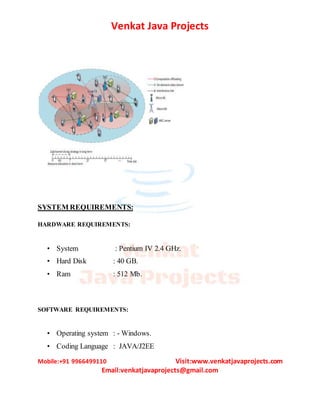
We considerascenariowhere RAN slicingisbuiltuponanMEC system, asshownin Fig.1. There are B
base stations(BS) inthe system,inwhicheachBS isintegratedwithanMEC server[21],[22]. Let B = {1,
2, ...B} denote the setof BSs. The systemisassumedtobe operatedinslots,andthe lengthof the time
slotis τ . Basedon the time-slottedsystem,we considertwotypesof time slots.One isalongtime slot
(LTS),and the otherisa shorttime slot(STS).Inthispaper,we considerthatthe systemcontains
multiple LTSs.The lengthof the LTSis T, and we assume thateach LTS containsp STSs,i.e.,T = pτ. At the
beginningof eachLTS,the networkoperatorcan decide whethertoacceptor rejectthe arrivednetwork
slice requests.Nevertheless,atthe beginningof eachSTS,resource allocationpoliciesare obtained.The
twotimescalessystemwill be discussedindetail inthe followingsectionsof thissection.Similarto[17],
we considertwotypesof networkslice requestsinthe MEC system, i.e.,lowlatencycomputation
offloadingslice (SI) andhigh-ratedatasharingslice (SII).Ourproposedalgorithmscanbe adaptedfor
multiple slice service requestswithminormodifications.](https://image.slidesharecdn.com/160-210304104826/85/dynamic-network-slicing-and-resource-allocation-in-mobile-edge-computing-systems-2-320.jpg)

The document proposes a framework for dynamic network slicing and resource allocation in mobile edge computing systems to maximize an operator's revenue while considering traffic variations. It develops the Dynamic Network Slicing and Resource Allocation (DNSRA) algorithm that jointly optimizes slice request admission and resource allocation without any prior knowledge of traffic. The DNSRA tackles the coupled optimization problem through variable decoupling and develops closed-form solutions for user association and CPU allocation along with approximation methods for power allocation and subcarrier assignment. A heuristic algorithm is also developed for dynamic slice request admission. Simulation results show the DNSRA can balance revenue and delay while increasing operator revenue over existing schemes.


