dw-tpain

Gordon Klok
Demonware, Inc
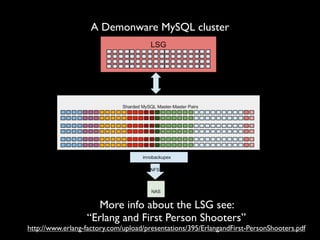
A Demonware MySQL cluster

More info about the LSG see:
“Erlang and First Person Shooters”

http://www.erlang-factory.com/upload/presentations/395/ErlangandFirst-PersonShooters.pdf
backup process
• innobackupex from Percona http://

www.percona.com/doc/percona-xtrabackup/
2.1/innobackupex/innobackupex_script.html

• Allows hot backup of database
• backups the underlying MySQL files

replays a transaction log for changes
occurring during the backup

• much faster to restore then SQL dumps.
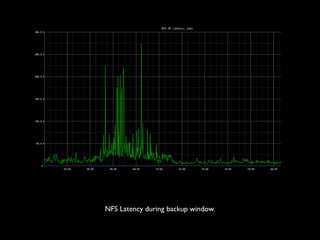
Not good
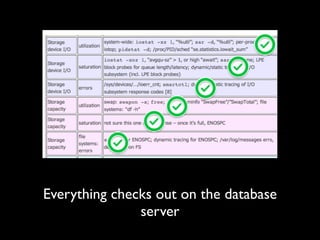
Everything checks out on the database
server
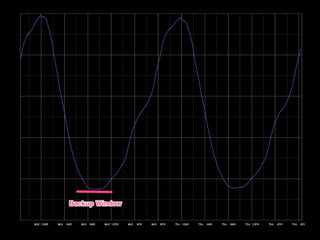
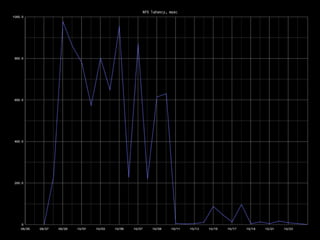
NFS Latency during backup window.
So whats the problem?
How is the slow performance of the
NAS affecting the client?

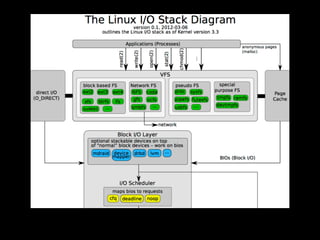
Paging...
pd_fush
•

/proc/sys/vm/dirty_background_ratio (default 10): Maximum percentage of active that can be filled
with dirty pages before pdflush begins to write them

•

/proc/sys/vm/dirty_expire_centiseconds (default 3000): In hundredths of a second, how long data can
be in the page cache before it's considered expired and must be written at the next opportunity. Note
that this default is very long: a full 30 seconds. That means that under normal circumstances, unless
you write enough to trigger the other pdflush method, Linux won't actually commit anything you
write until 30 seconds later.

• See “The Linux Page Cache and pdflush:

Theory of Operation and Tuning for WriteHeavy Loads” http://www.westnet.com/
~gsmith/content/linux-pdflush.htm
pd_flush continued
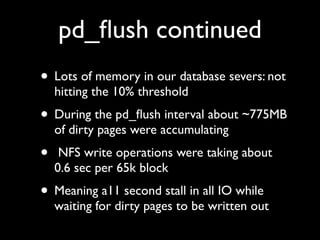
• Lots of memory in our database severs: not
hitting the 10% threshold

• During the pd_flush interval about ~775MB
of dirty pages were accumulating

•

NFS write operations were taking about
0.6 sec per 65k block

• Meaning a11 second stall in all IO while

waiting for dirty pages to be written out
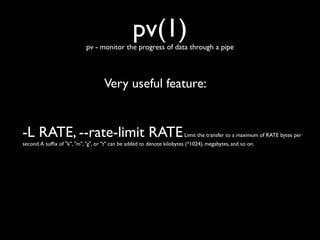
pv(1)

pv - monitor the progress of data through a pipe

Very useful feature:

-L RATE, --rate-limit RATE

Limit the transfer to a maximum of RATE bytes per

second. A suffix of "k", "m", "g", or "t" can be added to denote kilobytes (*1024), megabytes, and so on.
Fixed limit problem
• If the pv rate limit is set to high we still

interfere with MySQL by stealing IO to the
database servers attached storage

• if the pv rate limit is set lower then the

rate of incoming writes to mysql
innobackupex will not finish until it fills the
volume holding the xtrabackup logs.

• Need a dynamic rate limiter
pv(1)

pv - monitor the progress of data through a pipe

Making pv dynamic
-R PID, --remote PID If PID is an instance of pv that is already running, -R PID will cause that
instance to act as though it had been given this instance's command line instead. For example, if pv -L 123k is running with
process ID 9876, then running pv -R 9876 -L 321k will cause it to start using a rate limit of 321k instead of 123k. Note that
some options cannot be changed while running, such as -c, -l, -f, -E, and -S.
Metric for IO Health
iostat -x -d -m 5 /dev/sda
Device:

rrqm/s wrqm/s

r/s

w/s

rMB/s

wMB/s avgrq-sz

avgqu-sz

await svctm %util

sda

0.06

0.08

0.39

0.00

0.00

0.00

2.23 1.22 0.06

0.51

21.17

avgqu-sz - The average queue length of the
requests that were issued to the device.
Through a bit of experimentation we found when avgqu-sz hovered around 1.0 for the
device containing the mysql data files we achieved the most efficient backup with least
impact.
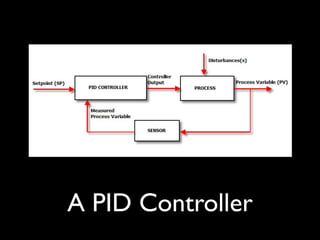
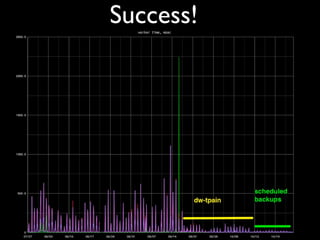
A PID Controller
Success!
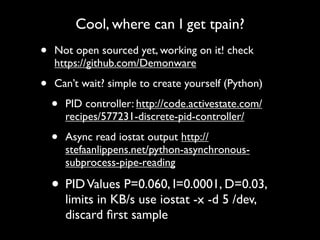
Cool, where can I get tpain?

•

Not open sourced yet, working on it! check
https://github.com/Demonware

•

Can’t wait? simple to create yourself (Python)

•

PID controller: http://code.activestate.com/
recipes/577231-discrete-pid-controller/

•

Async read iostat output http://
stefaanlippens.net/python-asynchronoussubprocess-pipe-reading

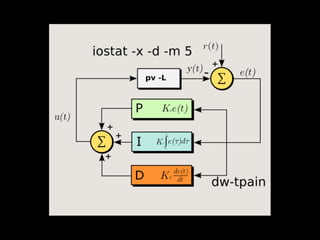
• PID Values P=0.060, I=0.0001, D=0.03,
limits in KB/s use iostat -x -d 5 /dev,
discard first sample

Dw tpain - Gordon Klok

  • 1.
  • 2.
    A Demonware MySQLcluster More info about the LSG see: “Erlang and First Person Shooters” http://www.erlang-factory.com/upload/presentations/395/ErlangandFirst-PersonShooters.pdf
  • 3.
    backup process • innobackupexfrom Percona http:// www.percona.com/doc/percona-xtrabackup/ 2.1/innobackupex/innobackupex_script.html • Allows hot backup of database • backups the underlying MySQL files replays a transaction log for changes occurring during the backup • much faster to restore then SQL dumps.
  • 5.
  • 6.
    Everything checks outon the database server
  • 7.
    NFS Latency duringbackup window.
  • 8.
    So whats theproblem? How is the slow performance of the NAS affecting the client? Paging...
  • 10.
    pd_fush • /proc/sys/vm/dirty_background_ratio (default 10):Maximum percentage of active that can be filled with dirty pages before pdflush begins to write them • /proc/sys/vm/dirty_expire_centiseconds (default 3000): In hundredths of a second, how long data can be in the page cache before it's considered expired and must be written at the next opportunity. Note that this default is very long: a full 30 seconds. That means that under normal circumstances, unless you write enough to trigger the other pdflush method, Linux won't actually commit anything you write until 30 seconds later. • See “The Linux Page Cache and pdflush: Theory of Operation and Tuning for WriteHeavy Loads” http://www.westnet.com/ ~gsmith/content/linux-pdflush.htm
  • 11.
    pd_flush continued • Lotsof memory in our database severs: not hitting the 10% threshold • During the pd_flush interval about ~775MB of dirty pages were accumulating • NFS write operations were taking about 0.6 sec per 65k block • Meaning a11 second stall in all IO while waiting for dirty pages to be written out
  • 12.
    pv(1) pv - monitorthe progress of data through a pipe Very useful feature: -L RATE, --rate-limit RATE Limit the transfer to a maximum of RATE bytes per second. A suffix of "k", "m", "g", or "t" can be added to denote kilobytes (*1024), megabytes, and so on.
  • 13.
    Fixed limit problem •If the pv rate limit is set to high we still interfere with MySQL by stealing IO to the database servers attached storage • if the pv rate limit is set lower then the rate of incoming writes to mysql innobackupex will not finish until it fills the volume holding the xtrabackup logs. • Need a dynamic rate limiter
  • 14.
    pv(1) pv - monitorthe progress of data through a pipe Making pv dynamic -R PID, --remote PID If PID is an instance of pv that is already running, -R PID will cause that instance to act as though it had been given this instance's command line instead. For example, if pv -L 123k is running with process ID 9876, then running pv -R 9876 -L 321k will cause it to start using a rate limit of 321k instead of 123k. Note that some options cannot be changed while running, such as -c, -l, -f, -E, and -S.
  • 15.
    Metric for IOHealth iostat -x -d -m 5 /dev/sda Device: rrqm/s wrqm/s r/s w/s rMB/s wMB/s avgrq-sz avgqu-sz await svctm %util sda 0.06 0.08 0.39 0.00 0.00 0.00 2.23 1.22 0.06 0.51 21.17 avgqu-sz - The average queue length of the requests that were issued to the device. Through a bit of experimentation we found when avgqu-sz hovered around 1.0 for the device containing the mysql data files we achieved the most efficient backup with least impact.
  • 16.
  • 18.
  • 20.
    Cool, where canI get tpain? • Not open sourced yet, working on it! check https://github.com/Demonware • Can’t wait? simple to create yourself (Python) • PID controller: http://code.activestate.com/ recipes/577231-discrete-pid-controller/ • Async read iostat output http:// stefaanlippens.net/python-asynchronoussubprocess-pipe-reading • PID Values P=0.060, I=0.0001, D=0.03, limits in KB/s use iostat -x -d 5 /dev, discard first sample