Managing MySQL with
                        Percona Toolkit


LOADAYS 2012 – April 1st
Who am I ?
Frédéric Descamps
@lefred
http://about.me/lefred
Percona Consultant
Managing mysql since 3.23 (as far as I
remember)
devops believer


                                         www.percona.com
Agenda

●   What is Percona
    Toolkit ?
●   What tools are
    included and what
    can they do ?
●   Quick intro to several
    tools
●   Resources


                                 www.percona.com
Percona Toolkit

●   Origin: Maatkit and Aspersa (both projects
    started by Baron Schwartz with Daniel Nichter's
    contribution)
●   Indispensable tools for MySQL administrators
●   Opensource GNU GPL v2
●   https://launchpad.net/percona-toolkit
●   http://www.percona.com/software/percona-toolkit/
●   Current version is 2.0.4

                                            www.percona.com
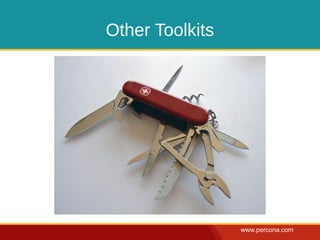
Other Toolkits


                 www.percona.com
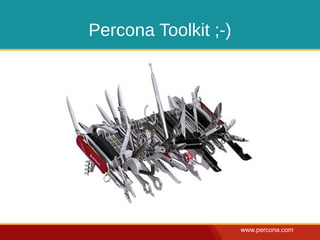
Percona Toolkit ;-)


                      www.percona.com
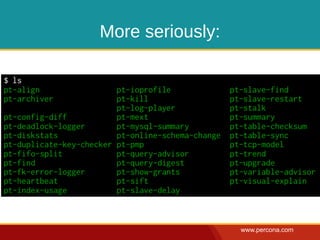
More seriously:


                  www.percona.com
Installation
●
    Requirements:
      ➢
          Perl, DBI, DBD::pgsql, Wine or Mono
      ➢
          Better performance with Wine
●
    Download zip:
      ➢
          http://megaupload.com/PTK204
      ➢
          It's in Percona's MSN repository
●
    We are working on a Java version
●
    Easy to run: wine pt-diskstats_win32.exe

                                                www.percona.com
Installation
●
    Requirements:
      ➢
          Perl, DBI, DBD::pgsql, Wine or Mono
      ➢
          Better performance with Wine
●
    Download zip:
      ➢
          http://megaupload.com/PTK204
      ➢
          It's in Percona's MSN repository
●
    We are working on a Java version
●
    Easy to run: wine pt-diskstats_win32.exe

                                                www.percona.com
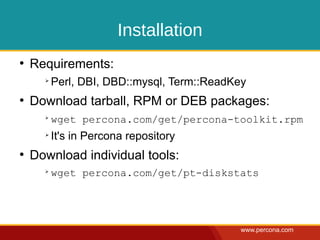
Installation
●
    Requirements:
      ➢
          Perl, DBI, DBD::mysql, Term::ReadKey
●
    Download tarball, RPM or DEB packages:
      ➢
          wget percona.com/get/percona-toolkit.rpm
      ➢
          It's in Percona repository
●
    Download individual tools:
      ➢
          wget percona.com/get/pt-diskstats


                                             www.percona.com
Know your environment:
Hardware & Operating System


                     www.percona.com   11
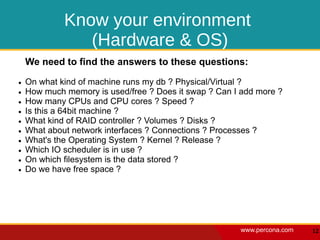
Know your environment
                (Hardware & OS)
    We need to find the answers to these questions:
●   On what kind of machine runs my db ? Physical/Virtual ?
●   How much memory is used/free ? Does it swap ? Can I add more ?
●   How many CPUs and CPU cores ? Speed ?
●   Is this a 64bit machine ?
●   What kind of RAID controller ? Volumes ? Disks ?
●   What about network interfaces ? Connections ? Processes ?
●   What's the Operating System ? Kernel ? Release ?
●   Which IO scheduler is in use ?
●   On which filesystem is the data stored ?
●   Do we have free space ?


                                                       www.percona.com   12
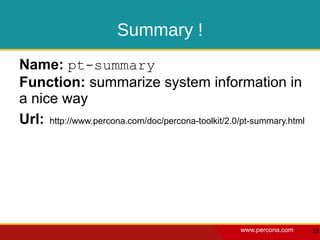
Summary !
Name: pt-summary
Function: summarize system information in
a nice way
Url: http://www.percona.com/doc/percona-toolkit/2.0/pt-summary.html


                                                   www.percona.com    13
Taking inventory
$ wget percona.com/get/pt-summary
$ chmod +x pt-summary
$ ./pt-summary
# Percona Toolkit System Summary Report ######################
        Date | 2012-02-02 12:25:18 UTC (local TZ: EET +0200)
    Hostname | db01
      Uptime | 42 days, 16:14, 1 user, load average: 1.15, 1.22, 1.08
      System | HP; ProLiant DL580 G7; vNot Specified (Rack Mount Chassis)
 Service Tag | FOSDEM2012
    Platform | Linux
     Release | CentOS release 6.1 (Final)
      Kernel | 2.6.32-131.21.1.el6.x86_64
Architecture | CPU = 64-bit, OS = 64-bit
   Threading | NPTL 2.12
    Compiler | GNU CC version 4.4.5 20110214 (Red Hat 4.4.5-6).
     SELinux | Disabled
 Virtualized | No virtualization detected
# Processor ##################################################
  Processors | physical = 4, cores = 40, virtual = 80, hyperthreading = yes
      Speeds | 80x2397.393
      Models | 80xIntel(R) Xeon(R) CPU E7- 4870 @ 2.40GHz

[ Further output omitted ]


                                                               www.percona.com   14
Know your environment:
       MySQL


                   www.percona.com   15
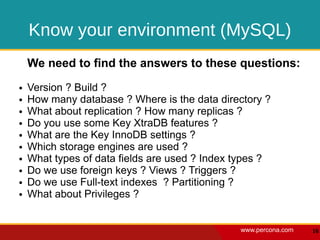
Know your environment (MySQL)
    We need to find the answers to these questions:
●   Version ? Build ?
●   How many database ? Where is the data directory ?
●   What about replication ? How many replicas ?
●   Do you use some Key XtraDB features ?
●   What are the Key InnoDB settings ?
●   Which storage engines are used ?
●   What types of data fields are used ? Index types ?
●   Do we use foreign keys ? Views ? Triggers ?
●   Do we use Full-text indexes ? Partitioning ?
●   What about Privileges ?


                                               www.percona.com   16
Summary... again !
Name: pt-mysql-summary
Function: Summarize MySQL information in
a nice way
Url: http://www.percona.com/doc/percona-toolkit/2.0/pt-mysql-summary.html


                                                        www.percona.com     17
Taking inventory (cont.)
$ wget percona.com/get/pt-mysql-summary
$ chmod +x pt-mysql-summary
$ ./pt-mysql-summary
# Percona Toolkit MySQL Summary Report #######################
         System time | 2012-02-02 12:24:37 UTC (local TZ: EET +0200)
# Instances ##################################################
  Port Data Directory              Socket
  ===== ========================== ======
        /mysql
# Report On Port 3306 ########################################
                User | root@localhost
                Time | 2012-02-02 14:24:38 (EET)
            Hostname | db01
             Version | 5.5.18-55-log Percona
            Built On | Linux x86_64
             Started | 2011-12-26 21:09 (up 37+17:15:35)
           Databases | 6
             Datadir | /mysql/
           Processes | 10 connected, 4 running
         Replication | Is a slave, has 1 slaves connected
             Pidfile | /mysql/mysqld.pid (exists)


[ Further output omitted ]


                                                                www.percona.com   18
Master ? Slave ?... both ?
Name: pt-slave-find
Function: find and print replication hierarchy
tree of MySQL slaves.
Url: http://www.percona.com/doc/percona-toolkit/2.0/pt-slave-find.html


                                                     www.percona.com     19
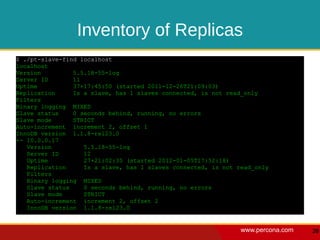
Inventory of Replicas
$ ./pt-slave-find localhost
localhost
Version         5.5.18-55-log
Server ID       11
Uptime          37+17:45:50 (started 2011-12-26T21:09:03)
Replication     Is a slave, has 1 slaves connected, is not read_only
Filters
Binary logging MIXED
Slave status    0 seconds behind, running, no errors
Slave mode      STRICT
Auto-increment increment 2, offset 1
InnoDB version 1.1.8-rel23.0
+- 10.0.0.17
   Version         5.5.18-55-log
   Server ID       12
   Uptime          27+21:02:35 (started 2012-01-05T17:52:18)
   Replication     Is a slave, has 1 slaves connected, is not read_only
   Filters
   Binary logging MIXED
   Slave status    0 seconds behind, running, no errors
   Slave mode      STRICT
   Auto-increment increment 2, offset 2
   InnoDB version 1.1.8-rel23.0


                                                               www.percona.com   20
Where's My Disk I/O Going ?
●   Use pt-diskstats as an improved iostat
     ➢ Interactively controllable, slice-and-dice
     ➢ Doesn't lump reads and writes together


     ➢ Meaningful, correct columns


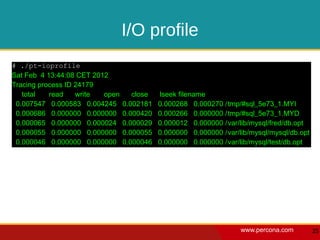
●   Use pt-ioprofile to measure & time your
    I/O
     ➢   Which files is MySQL using ? How much times does it
         spend reading, writing, syncing, etc? How many
         reads/writes? How large are they ?
            pt-ioprofile can be dangerous in production
                                                    www.percona.com   21
Disk I/O
Name: pt-diskstats
Function: Aggregate and summarize
/proc/diskstats
Url:   http://www.percona.com/doc/percona-toolkit/2.0/pt-diskstats.html


                                                       www.percona.com    22
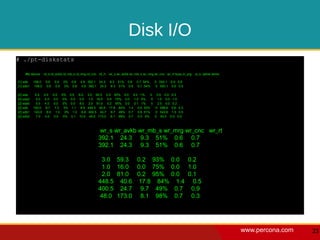
Disk I/O
# ./pt-diskstats

     #ts device     rd_s rd_avkb rd_mb_s rd_mrg rd_cnc rd_rt          wr_s wr_avkb wr_mb_s wr_mrg wr_cnc wr_rt busy in_prg   io_s qtime stime

{1} sdb    158.0     5.8      0.9      0% 0.8      4.9 392.1 24.3     9.3 51% 0.6      0.7 54%    0 550.1 0.9 0.6
{1} sdb1    158.0     5.8      0.9      0% 0.8      4.9 392.1 24.3     9.3 51% 0.6      0.7 54%   0 550.1 0.9 0.6

{2} sda     0.5     4.0      0.0      0% 0.0      8.0      3.0 59.3 0.2 93% 0.0 0.2 1%    0 3.5 0.0 0.3
{2} sda2     0.0     0.0      0.0      0% 0.0      0.0      1.0 16.0 0.0 75% 0.0 1.0 0%    0 1.0 0.0 1.0
{2} sda5     0.5     4.0      0.0      0% 0.0      8.0      2.0 81.0 0.2 95% 0.0 0.1 1%    0 2.5 0.0 0.2
{2} sdb    150.0      8.7      1.3      3% 1.1      6.9    448.5 40.6 17.8 84% 1.4 0.5 53%   0 598.6 0.6 0.2
{2} sdb1    143.0      8.9      1.2      3% 1.0      6.8    400.5 24.7 9.7 49% 0.7 0.9 51%   0 543.6 1.3 0.5
{2} sdb2     7.0     4.0      0.0      0% 0.1     10.0      48.0 173.0 8.1 98% 0.7 0.3 9%   0 55.0 0.3 0.0


                                                                 wr_s wr_avkb wr_mb_s wr_mrg wr_cnc wr_rt
                                                                392.1 24.3 9.3 51% 0.6 0.7
                                                                392.1 24.3 9.3 51% 0.6 0.7

                                                                  3.0     59.3 0.2 93% 0.0 0.2
                                                                  1.0     16.0 0.0 75% 0.0 1.0
                                                                  2.0     81.0 0.2 95% 0.0 0.1
                                                                448.5      40.6 17.8 84% 1.4 0.5
                                                                400.5      24.7 9.7 49% 0.7 0.9
                                                                 48.0     173.0 8.1 98% 0.7 0.3


                                                                                                                                                www.percona.com   23
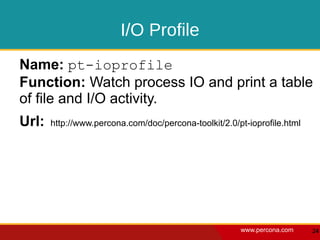
I/O Profile
Name: pt-ioprofile
Function: Watch process IO and print a table
of file and I/O activity.
Url:   http://www.percona.com/doc/percona-toolkit/2.0/pt-ioprofile.html


                                                       www.percona.com    24
I/O profile
# ./pt-ioprofile
Sat Feb 4 13:44:08 CET 2012
Tracing process ID 24179
   total   read    write  open      close   lseek filename
 0.007547 0.000583 0.004245      0.002181   0.000268 0.000270 /tmp/#sql_5e73_1.MYI
 0.000686 0.000000 0.000000      0.000420   0.000266 0.000000 /tmp/#sql_5e73_1.MYD
 0.000065 0.000000 0.000024      0.000029   0.000012 0.000000 /var/lib/mysql/fred/db.opt
 0.000055 0.000000 0.000000      0.000055   0.000000 0.000000 /var/lib/mysql/mysql/db.opt
 0.000046 0.000000 0.000000      0.000046   0.000000 0.000000 /var/lib/mysql/test/db.opt


                                                                    www.percona.com         25
Be intimate with your database


                        www.percona.com   26
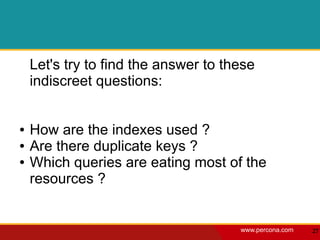
Let's try to find the answer to these
    indiscreet questions:


●   How are the indexes used ?
●   Are there duplicate keys ?
●   Which queries are eating most of the
    resources ?


                                      www.percona.com   27
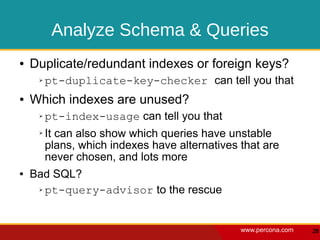
Analyze Schema & Queries
●   Duplicate/redundant indexes or foreign keys?
     ➢   pt-duplicate-key-checker can tell you that
●   Which indexes are unused?
     ➢   pt-index-usage can tell you that
     ➢   It can also show which queries have unstable
         plans, which indexes have alternatives that are
         never chosen, and lots more
●   Bad SQL?
     ➢ pt-query-advisor to the rescue


                                                www.percona.com   28
Analyze & Profile Your Workload
●   Use pt-query-digest to analyze the “slow
    query log” and show a profile of the workload
●   It does the Right Thing by default
●   Mostly used with slow query logs & tcpdumps


                                        www.percona.com   29
The Report
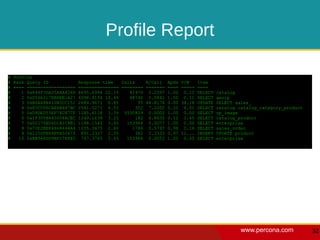
●   Each class of query is ranked by execution time
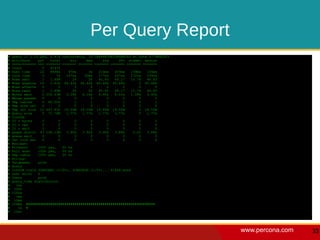
●   There is a report for each class of query
●   It's easy to use
●   It's a great way to start optimizing queries


                                        www.percona.com   30
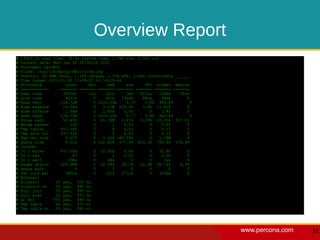
Overview Report
#   13903.5s user time, 39.9s system time, 1.78G rss, 1.92G vsz
#   Current date: Mon Jan 30 20:36:26 2012
#   Hostname: hp-db01
#   Files: /var/lib/mysql/db01-slow.log
#   Overall: 32.98M total, 1.32k unique, 1.73k QPS, 2.06x concurrency ______
#   Time range: 2012-01-30 11:08:22 to 16:25:40
#   Attribute          total     min     max     avg     95% stddev median
#   ============     ======= ======= ======= ======= ======= ======= =======
#   Exec time         39309s     1us    161s     1ms   515us   109ms    30us
#   Lock time          4471s       0    161s   135us    89us    90ms       0
#   Rows sent        118.72M       0 1010.29k    3.77    1.96 963.89         0
#   Rows examine      15.54G       0   3.51M 505.92     1.96 11.61k        0
#   Rows affecte       1.64M       0   2.85k    0.05       0    1.82       0
#   Rows read        118.72M       0 1010.29k    3.77    1.96 963.89         0
#   Bytes sent        52.40G       0 45.18M    1.67k   5.20k 20.30k 537.02
#   Merge passes         128       0       1    0.00       0    0.00       0
#   Tmp tables       957.76k       0       4    0.03       0    0.17       0
#   Tmp disk tbl     297.92k       0       2    0.01       0    0.10       0
#   Tmp tbl size       5.21T       0   2.22G 169.59k       0   1.78M       0
#   Query size         8.52G       6 130.40k 277.38 833.10 709.99 174.84
#   InnoDB:
#   IO r bytes       672.00k       0 32.00k     0.06       0   35.90       0
#   IO r ops              42       0       2    0.00       0    0.00       0
#   IO r wait           19ms       0     2ms       0       0     1us       0
#   pages distin     329.98M       0 32.08k    28.18   42.48 307.62     4.96
#   queue wait             0       0       0       0       0       0       0
#   rec lock wai       3402s       0    161s   277us       0   147ms       0
#   Boolean:
#   Filesort       2% yes, 97% no
#   Filesort on    0% yes, 99% no
#   Full join      0% yes, 99% no
#   Full scan      2% yes, 97% no
#   QC Hit        55% yes, 44% no
#   Tmp table      2% yes, 97% no
#   Tmp table on   0% yes, 99% no


                                                                                 www.percona.com   31
Profile Report

# Profile
# Rank Query ID             Response time   Calls     R/Call    Apdx   V/M     Item
# ==== ==================   =============== ======== =======    ====   =====   ====
#    1 0x844F3DA35A4A426D   8695.6994 22.1%    41470 0.2097     1.00    0.12   SELECT   catalog
#    2 0xD566217EB8EB1A27   4098.9154 10.4%    48740 0.0841     1.00    0.11   SELECT   geoip
#    3 0xB0A48B410B3CC151   2684.9671 6.8%         55 48.8176   0.00   34.18   UPDATE   SELECT sales_
#    4 0x60CDD6CAE6B487BC   2541.5271 6.5%        352 7.2202    0.20    4.01   SELECT   catalog catalog_category_product
#    5 0xD9DED53EF74C877F   1285.6118 3.3% 5530829 0.0002       1.00    0.00   SELECT   op_image
#    6 0x1F3D58843008ACEC   1249.1639 3.2%        182 6.8635    0.12    1.65   SELECT   catalog_product
#    7 0x50175ED6D1B1C8B1   1188.1541 3.0%    153964 0.0077     1.00    0.00   SELECT   enterprise
#    8 0x70E2BE84868444A4   1035.3475 2.6%      1786 0.5797     0.98    0.16   SELECT   sales_order
#    9 0x125DFE84FFA50675    891.3327 2.3%        382 2.3333    0.97   11...   INSERT   UPDATE product
#   10 0xBB968DD9BF27E8E5    797.3765 2.0%    153964 0.0052     1.00    0.00   SELECT   enterprise


                                                                                                 www.percona.com           32
Per Query Report
#   Query 1: 2.25 QPS, 0.47x concurrency, ID 0x844F3DA35A4A426D at byte 4779840203
#   Attribute    pct    total     min    max     avg     95% stddev median
#   ============ === ======= ======= ======= ======= ======= ======= =======
#   Count           0   41470
#   Exec time      22   8696s    97ms     3s   210ms   455ms    159ms  155ms
#   Lock time       0      7s   107us   50ms   177us   247us    272us  159us
#   Rows sent       1   1.60M       26    50   40.45   49.17    10.74  46.83
#   Rows examine 16     2.63G 66.43k 66.60k 66.49k 65.68k           0 65.68k
#   Rows affecte    0       0        0     0       0       0        0      0
#   Rows read       1   1.60M       26    50   40.45   49.17    10.74  46.83
#   Bytes sent      0 200.43M   3.39k  6.14k   4.95k   6.01k    1.08k  5.45k
#   Merge passes    0       0        0     0       0       0        0      0
#   Tmp tables      4 40.50k         1     1       1       1        0      1
#   Tmp disk tbl    0       0        0     0       0       0        0      0
#   Tmp tbl size 12 647.83G 16.00M 16.00M 16.00M 16.00M             0 16.00M
#   Query size      0 71.78M    1.77k  1.77k   1.77k   1.77k        0  1.77k
#   InnoDB:
#   IO r bytes      0       0        0     0       0       0        0      0
#   IO r ops        0       0        0     0       0       0        0      0
#   IO r wait       0       0        0     0       0       0        0      0
#   pages distin 47 158.13M     3.90k  3.92k   3.90k   3.88k     0.00  3.88k
#   queue wait      0       0        0     0       0       0        0      0
#   rec lock wai    0       0        0     0       0       0        0      0
#   Boolean:
#   Filesort     100% yes,    0% no
#   Full scan    100% yes,    0% no
#   Tmp table    100% yes,    0% no
#   String:
#   Databases    prod
#   Hosts
#   InnoDB trxID 3CB60AED (1/0%), 3CB60B3E (1/0%)... 41468 more
#   Last errno   0
#   Users        prod
#   Query_time distribution
#     1us
#    10us
#   100us
#     1ms
#    10ms
#   100ms ################################################################
#      1s #
#    10s+


                                                                                     www.percona.com   33
Maintain your environment


                     www.percona.com   34
Log & Analyze Errors ?
●   Use pt-deadlock-logger to capture
    deadlocks
●   Use pt-fk-error-logger for foreign key
    errors
●   The tools give you the possibility to log the
    results to a database table for analysis


                                         www.percona.com   35
Monitor dead locks
Name: pt-deadlock-logger
Function: extract and log MySQL deadlock
information
Url: http://www.percona.com/doc/percona-toolkit/2.0/pt-deadlock-logger.html
●   SHOW ENGINE INNODB STATUS reports only the most
    recent deadlock
●   Information in status output lacks details about user, client
    host, other locks in the deadlock cycle.
●   pt-deadlock-logger formats the needed information
    nicely and saves it
                                                         www.percona.com      36
Monitor Foreign Key Errors
Name: pt-fk-error-logger
Function: extract and log MySQL foreign key
errors.
Url: http://www.percona.com/doc/percona-toolkit/2.0/pt-fk-error-logger.html
●   Like pt-deadlock-logger, this tool collects more useful
    information, formats it nicely and saves it.


                                                        www.percona.com       37
Non-Blocking ALTER TABLE
●   Use pt-online-schema-change to alter
    tables
      ➢ It makes a “shadow copy” and swaps them


      ➢ Extremely useful for large, long-running

        ALTER
      ➢ Facebook uses the same technique


                                       www.percona.com   38
Validate Upgrades
●   Upgrades are a leading cause of downtime
     ➢ Are any queries using different indexes ? Is QEP
       different ?
     ➢ Are there new errors or warnings ?


     ➢ Do queries return the same results ?


     ➢ Are there significant response time differences ?


●   Validate the results before you upgrade!
     ➢ Capture a snapshot of the data
     ➢ Capture a log of queries


     ➢ Compare the queries on two test servers running the

       old and the new version
                                                 www.percona.com   39
Validate upgrades
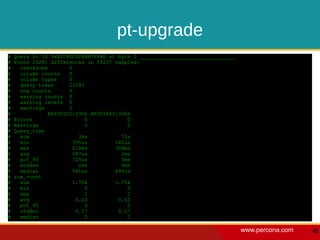
Name: pt-upgrade
Function: Execute queries on multiple
servers and check for differences.
Url: http://www.percona.com/doc/percona-toolkit/2.0/pt-upgrade.html


                                                         www.percona.com   40
pt-upgrade
#   Query 2: ID 0xE2C8DC0286B7F44E at byte 0 _______________________________
#   Found 23281 differences in 58207 samples:
#     checksums       0
#     column counts   0
#     column types    0
#     query times     23281
#     row counts      0
#     warning counts 0
#     warning levels 0
#     warnings        0
#              AF002020:3306 AF001885:3306
#   Errors                  0            0
#   Warnings                0            0
#   Query_time
#     sum                 34s          70s
#     min               395us        342us
#     max               218ms        308ms
#     avg               587us          1ms
#     pct_95            725us          3ms
#     stddev              2ms          4ms
#     median            541us        690us
#   row_count
#     sum               1.75k        1.75k
#     min                   0            0
#     max                   1            1
#     avg                0.03         0.03
#     pct_95                0            0
#     stddev             0.17         0.17
#     median                0            0

                                                                               www.percona.com   41
Tools for Replication
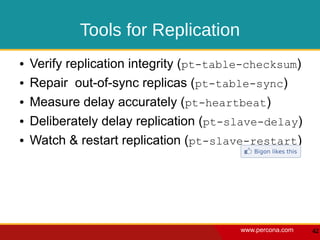
●   Verify replication integrity (pt-table-checksum)
●   Repair out-of-sync replicas (pt-table-sync)
●   Measure delay accurately (pt-heartbeat)
●   Deliberately delay replication (pt-slave-delay)
●   Watch & restart replication (pt-slave-restart)


                                         www.percona.com   42
Verify replication Integrity
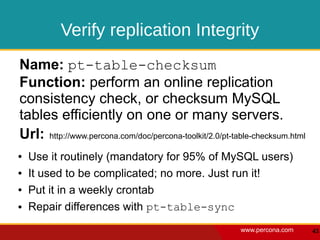
Name: pt-table-checksum
Function: perform an online replication
consistency check, or checksum MySQL
tables efficiently on one or many servers.
Url: http://www.percona.com/doc/percona-toolkit/2.0/pt-table-checksum.html
●   Use it routinely (mandatory for 95% of MySQL users)
●   It used to be complicated; no more. Just run it!
●   Put it in a weekly crontab
●   Repair differences with pt-table-sync
                                                         www.percona.com     43
I feel bad...


                www.percona.com   44
Find problems
●   What do you advise me doctor ?
●   Get the symptoms when it hurts !


                                   www.percona.com   45
Get the symptoms when it hurts !
    To perform this action, do a check-up when
    you feel bad:

●   pt-stalk
●   pt-sift


                                   www.percona.com   46
Does it hurt ?
Name: pt-stalk
Function: wait for a condition to occur then
begin collecting data.
Url: http://www.percona.com/doc/percona-toolkit/2.0/pt-stalk.html


                                                 www.percona.com    47
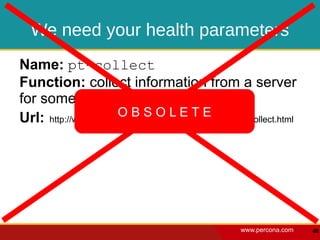
We need your health parameters
Name: pt-collect
Function: collect information from a server
for some period of time.
                      OBSOLETE
Url: http://www.percona.com/doc/percona-toolkit/2.0/pt-collect.html


                                                     www.percona.com   48
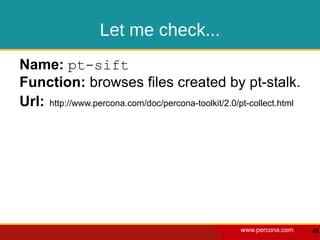
Let me check...
Name: pt-sift
Function: browses files created by pt-stalk.
Url: http://www.percona.com/doc/percona-toolkit/2.0/pt-collect.html


                                                    www.percona.com   49
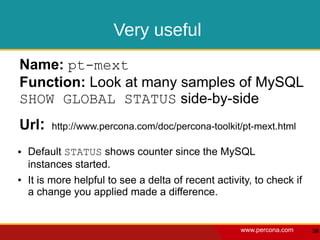
Very useful
Name: pt-mext
Function: Look at many samples of MySQL
SHOW GLOBAL STATUS side-by-side
Url:     http://www.percona.com/doc/percona-toolkit/pt-mext.html

●   Default STATUS shows counter since the MySQL
    instances started.
●   It is more helpful to see a delta of recent activity, to check if
    a change you applied made a difference.


                                                      www.percona.com   50
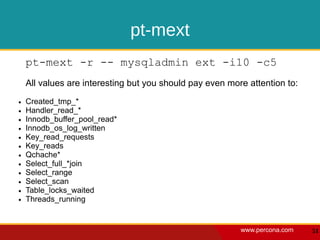
pt-mext
    pt-mext -r -- mysqladmin ext -i10 -c5
    All values are interesting but you should pay even more attention to:
●   Created_tmp_*
●   Handler_read_*
●   Innodb_buffer_pool_read*
●   Innodb_os_log_written
●   Key_read_requests
●   Key_reads
●   Qchache*
●   Select_full_*join
●   Select_range
●   Select_scan
●   Table_locks_waited
●   Threads_running


                                                          www.percona.com   51
Stop Bad Queries
●   Use pt-kill to watch for long-running queries
    and optionally kill them
●   Prevent long-running idle transactions too.


                                      www.percona.com   52
Percona Toolkit's Future
●   Rapid development & improvement of tools
●   Fully supported via Percona Support contract
●   Upcoming:
     ➢ pt-*summary redesigned


     ➢ pt-stalk “magical fault detection algorithm”


     ➢ Redesign of pt-online-schema-change (see

         http://www.percona.com/docs/wiki/ptdev:blueprints:redesign-pt-
         online-schema-change)
     ➢   more goodies
            •https://blueprints.launchpad.net/percona-toolkit


                                                          www.percona.com   53
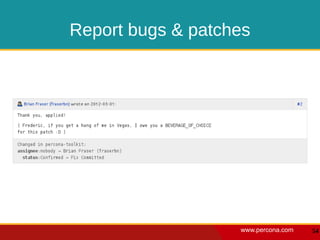
Report bugs & patches


                   www.percona.com   54
Report bugs & patches


Belgian Beers ....... what else !?
                              www.percona.com   55
Thank you for your participation to
                        LOADAYS
Due to time I was not able to present
two new Percona projects related to
                    High Availability.

     If you want to discuss PRM and
      XtraDB Cluster... I am available
PRM
●   Percona Replication Manager
●   Uses Corosync / Pacemaker
●   Distributed architecture, no SPOF
●   One master multiple slaves
●   Slaves maintain a master score attribute
    based on replication state
●   Full stonith/fencing stack
●   Flexible logic, score based


                                    www.percona.com   58
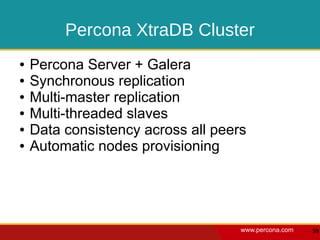
Percona XtraDB Cluster
●   Percona Server + Galera
●   Synchronous replication
●   Multi-master replication
●   Multi-threaded slaves
●   Data consistency across all peers
●   Automatic nodes provisioning


                                    www.percona.com   59
lefred@percona.com
                               @lefred


We're Hiring! www.percona.com/about-us/careers/

Loadays managing my sql with percona toolkit

  • 1.
    Managing MySQL with Percona Toolkit LOADAYS 2012 – April 1st
  • 2.
    Who am I? Frédéric Descamps @lefred http://about.me/lefred Percona Consultant Managing mysql since 3.23 (as far as I remember) devops believer www.percona.com
  • 3.
    Agenda ● What is Percona Toolkit ? ● What tools are included and what can they do ? ● Quick intro to several tools ● Resources www.percona.com
  • 4.
    Percona Toolkit ● Origin: Maatkit and Aspersa (both projects started by Baron Schwartz with Daniel Nichter's contribution) ● Indispensable tools for MySQL administrators ● Opensource GNU GPL v2 ● https://launchpad.net/percona-toolkit ● http://www.percona.com/software/percona-toolkit/ ● Current version is 2.0.4 www.percona.com
  • 5.
    Other Toolkits www.percona.com
  • 6.
    Percona Toolkit ;-) www.percona.com
  • 7.
    More seriously: www.percona.com
  • 8.
    Installation ● Requirements: ➢ Perl, DBI, DBD::pgsql, Wine or Mono ➢ Better performance with Wine ● Download zip: ➢ http://megaupload.com/PTK204 ➢ It's in Percona's MSN repository ● We are working on a Java version ● Easy to run: wine pt-diskstats_win32.exe www.percona.com
  • 9.
    Installation ● Requirements: ➢ Perl, DBI, DBD::pgsql, Wine or Mono ➢ Better performance with Wine ● Download zip: ➢ http://megaupload.com/PTK204 ➢ It's in Percona's MSN repository ● We are working on a Java version ● Easy to run: wine pt-diskstats_win32.exe www.percona.com
  • 10.
    Installation ● Requirements: ➢ Perl, DBI, DBD::mysql, Term::ReadKey ● Download tarball, RPM or DEB packages: ➢ wget percona.com/get/percona-toolkit.rpm ➢ It's in Percona repository ● Download individual tools: ➢ wget percona.com/get/pt-diskstats www.percona.com
  • 11.
    Know your environment: Hardware& Operating System www.percona.com 11
  • 12.
    Know your environment (Hardware & OS) We need to find the answers to these questions: ● On what kind of machine runs my db ? Physical/Virtual ? ● How much memory is used/free ? Does it swap ? Can I add more ? ● How many CPUs and CPU cores ? Speed ? ● Is this a 64bit machine ? ● What kind of RAID controller ? Volumes ? Disks ? ● What about network interfaces ? Connections ? Processes ? ● What's the Operating System ? Kernel ? Release ? ● Which IO scheduler is in use ? ● On which filesystem is the data stored ? ● Do we have free space ? www.percona.com 12
  • 13.
    Summary ! Name: pt-summary Function:summarize system information in a nice way Url: http://www.percona.com/doc/percona-toolkit/2.0/pt-summary.html www.percona.com 13
  • 14.
    Taking inventory $ wgetpercona.com/get/pt-summary $ chmod +x pt-summary $ ./pt-summary # Percona Toolkit System Summary Report ###################### Date | 2012-02-02 12:25:18 UTC (local TZ: EET +0200) Hostname | db01 Uptime | 42 days, 16:14, 1 user, load average: 1.15, 1.22, 1.08 System | HP; ProLiant DL580 G7; vNot Specified (Rack Mount Chassis) Service Tag | FOSDEM2012 Platform | Linux Release | CentOS release 6.1 (Final) Kernel | 2.6.32-131.21.1.el6.x86_64 Architecture | CPU = 64-bit, OS = 64-bit Threading | NPTL 2.12 Compiler | GNU CC version 4.4.5 20110214 (Red Hat 4.4.5-6). SELinux | Disabled Virtualized | No virtualization detected # Processor ################################################## Processors | physical = 4, cores = 40, virtual = 80, hyperthreading = yes Speeds | 80x2397.393 Models | 80xIntel(R) Xeon(R) CPU E7- 4870 @ 2.40GHz [ Further output omitted ] www.percona.com 14
  • 15.
    Know your environment: MySQL www.percona.com 15
  • 16.
    Know your environment(MySQL) We need to find the answers to these questions: ● Version ? Build ? ● How many database ? Where is the data directory ? ● What about replication ? How many replicas ? ● Do you use some Key XtraDB features ? ● What are the Key InnoDB settings ? ● Which storage engines are used ? ● What types of data fields are used ? Index types ? ● Do we use foreign keys ? Views ? Triggers ? ● Do we use Full-text indexes ? Partitioning ? ● What about Privileges ? www.percona.com 16
  • 17.
    Summary... again ! Name:pt-mysql-summary Function: Summarize MySQL information in a nice way Url: http://www.percona.com/doc/percona-toolkit/2.0/pt-mysql-summary.html www.percona.com 17
  • 18.
    Taking inventory (cont.) $wget percona.com/get/pt-mysql-summary $ chmod +x pt-mysql-summary $ ./pt-mysql-summary # Percona Toolkit MySQL Summary Report ####################### System time | 2012-02-02 12:24:37 UTC (local TZ: EET +0200) # Instances ################################################## Port Data Directory Socket ===== ========================== ====== /mysql # Report On Port 3306 ######################################## User | root@localhost Time | 2012-02-02 14:24:38 (EET) Hostname | db01 Version | 5.5.18-55-log Percona Built On | Linux x86_64 Started | 2011-12-26 21:09 (up 37+17:15:35) Databases | 6 Datadir | /mysql/ Processes | 10 connected, 4 running Replication | Is a slave, has 1 slaves connected Pidfile | /mysql/mysqld.pid (exists) [ Further output omitted ] www.percona.com 18
  • 19.
    Master ? Slave?... both ? Name: pt-slave-find Function: find and print replication hierarchy tree of MySQL slaves. Url: http://www.percona.com/doc/percona-toolkit/2.0/pt-slave-find.html www.percona.com 19
  • 20.
    Inventory of Replicas $./pt-slave-find localhost localhost Version 5.5.18-55-log Server ID 11 Uptime 37+17:45:50 (started 2011-12-26T21:09:03) Replication Is a slave, has 1 slaves connected, is not read_only Filters Binary logging MIXED Slave status 0 seconds behind, running, no errors Slave mode STRICT Auto-increment increment 2, offset 1 InnoDB version 1.1.8-rel23.0 +- 10.0.0.17 Version 5.5.18-55-log Server ID 12 Uptime 27+21:02:35 (started 2012-01-05T17:52:18) Replication Is a slave, has 1 slaves connected, is not read_only Filters Binary logging MIXED Slave status 0 seconds behind, running, no errors Slave mode STRICT Auto-increment increment 2, offset 2 InnoDB version 1.1.8-rel23.0 www.percona.com 20
  • 21.
    Where's My DiskI/O Going ? ● Use pt-diskstats as an improved iostat ➢ Interactively controllable, slice-and-dice ➢ Doesn't lump reads and writes together ➢ Meaningful, correct columns ● Use pt-ioprofile to measure & time your I/O ➢ Which files is MySQL using ? How much times does it spend reading, writing, syncing, etc? How many reads/writes? How large are they ? pt-ioprofile can be dangerous in production www.percona.com 21
  • 22.
    Disk I/O Name: pt-diskstats Function:Aggregate and summarize /proc/diskstats Url: http://www.percona.com/doc/percona-toolkit/2.0/pt-diskstats.html www.percona.com 22
  • 23.
    Disk I/O # ./pt-diskstats #ts device rd_s rd_avkb rd_mb_s rd_mrg rd_cnc rd_rt wr_s wr_avkb wr_mb_s wr_mrg wr_cnc wr_rt busy in_prg io_s qtime stime {1} sdb 158.0 5.8 0.9 0% 0.8 4.9 392.1 24.3 9.3 51% 0.6 0.7 54% 0 550.1 0.9 0.6 {1} sdb1 158.0 5.8 0.9 0% 0.8 4.9 392.1 24.3 9.3 51% 0.6 0.7 54% 0 550.1 0.9 0.6 {2} sda 0.5 4.0 0.0 0% 0.0 8.0 3.0 59.3 0.2 93% 0.0 0.2 1% 0 3.5 0.0 0.3 {2} sda2 0.0 0.0 0.0 0% 0.0 0.0 1.0 16.0 0.0 75% 0.0 1.0 0% 0 1.0 0.0 1.0 {2} sda5 0.5 4.0 0.0 0% 0.0 8.0 2.0 81.0 0.2 95% 0.0 0.1 1% 0 2.5 0.0 0.2 {2} sdb 150.0 8.7 1.3 3% 1.1 6.9 448.5 40.6 17.8 84% 1.4 0.5 53% 0 598.6 0.6 0.2 {2} sdb1 143.0 8.9 1.2 3% 1.0 6.8 400.5 24.7 9.7 49% 0.7 0.9 51% 0 543.6 1.3 0.5 {2} sdb2 7.0 4.0 0.0 0% 0.1 10.0 48.0 173.0 8.1 98% 0.7 0.3 9% 0 55.0 0.3 0.0 wr_s wr_avkb wr_mb_s wr_mrg wr_cnc wr_rt 392.1 24.3 9.3 51% 0.6 0.7 392.1 24.3 9.3 51% 0.6 0.7 3.0 59.3 0.2 93% 0.0 0.2 1.0 16.0 0.0 75% 0.0 1.0 2.0 81.0 0.2 95% 0.0 0.1 448.5 40.6 17.8 84% 1.4 0.5 400.5 24.7 9.7 49% 0.7 0.9 48.0 173.0 8.1 98% 0.7 0.3 www.percona.com 23
  • 24.
    I/O Profile Name: pt-ioprofile Function:Watch process IO and print a table of file and I/O activity. Url: http://www.percona.com/doc/percona-toolkit/2.0/pt-ioprofile.html www.percona.com 24
  • 25.
    I/O profile # ./pt-ioprofile SatFeb 4 13:44:08 CET 2012 Tracing process ID 24179 total read write open close lseek filename 0.007547 0.000583 0.004245 0.002181 0.000268 0.000270 /tmp/#sql_5e73_1.MYI 0.000686 0.000000 0.000000 0.000420 0.000266 0.000000 /tmp/#sql_5e73_1.MYD 0.000065 0.000000 0.000024 0.000029 0.000012 0.000000 /var/lib/mysql/fred/db.opt 0.000055 0.000000 0.000000 0.000055 0.000000 0.000000 /var/lib/mysql/mysql/db.opt 0.000046 0.000000 0.000000 0.000046 0.000000 0.000000 /var/lib/mysql/test/db.opt www.percona.com 25
  • 26.
    Be intimate withyour database www.percona.com 26
  • 27.
    Let's try tofind the answer to these indiscreet questions: ● How are the indexes used ? ● Are there duplicate keys ? ● Which queries are eating most of the resources ? www.percona.com 27
  • 28.
    Analyze Schema &Queries ● Duplicate/redundant indexes or foreign keys? ➢ pt-duplicate-key-checker can tell you that ● Which indexes are unused? ➢ pt-index-usage can tell you that ➢ It can also show which queries have unstable plans, which indexes have alternatives that are never chosen, and lots more ● Bad SQL? ➢ pt-query-advisor to the rescue www.percona.com 28
  • 29.
    Analyze & ProfileYour Workload ● Use pt-query-digest to analyze the “slow query log” and show a profile of the workload ● It does the Right Thing by default ● Mostly used with slow query logs & tcpdumps www.percona.com 29
  • 30.
    The Report ● Each class of query is ranked by execution time ● There is a report for each class of query ● It's easy to use ● It's a great way to start optimizing queries www.percona.com 30
  • 31.
    Overview Report # 13903.5s user time, 39.9s system time, 1.78G rss, 1.92G vsz # Current date: Mon Jan 30 20:36:26 2012 # Hostname: hp-db01 # Files: /var/lib/mysql/db01-slow.log # Overall: 32.98M total, 1.32k unique, 1.73k QPS, 2.06x concurrency ______ # Time range: 2012-01-30 11:08:22 to 16:25:40 # Attribute total min max avg 95% stddev median # ============ ======= ======= ======= ======= ======= ======= ======= # Exec time 39309s 1us 161s 1ms 515us 109ms 30us # Lock time 4471s 0 161s 135us 89us 90ms 0 # Rows sent 118.72M 0 1010.29k 3.77 1.96 963.89 0 # Rows examine 15.54G 0 3.51M 505.92 1.96 11.61k 0 # Rows affecte 1.64M 0 2.85k 0.05 0 1.82 0 # Rows read 118.72M 0 1010.29k 3.77 1.96 963.89 0 # Bytes sent 52.40G 0 45.18M 1.67k 5.20k 20.30k 537.02 # Merge passes 128 0 1 0.00 0 0.00 0 # Tmp tables 957.76k 0 4 0.03 0 0.17 0 # Tmp disk tbl 297.92k 0 2 0.01 0 0.10 0 # Tmp tbl size 5.21T 0 2.22G 169.59k 0 1.78M 0 # Query size 8.52G 6 130.40k 277.38 833.10 709.99 174.84 # InnoDB: # IO r bytes 672.00k 0 32.00k 0.06 0 35.90 0 # IO r ops 42 0 2 0.00 0 0.00 0 # IO r wait 19ms 0 2ms 0 0 1us 0 # pages distin 329.98M 0 32.08k 28.18 42.48 307.62 4.96 # queue wait 0 0 0 0 0 0 0 # rec lock wai 3402s 0 161s 277us 0 147ms 0 # Boolean: # Filesort 2% yes, 97% no # Filesort on 0% yes, 99% no # Full join 0% yes, 99% no # Full scan 2% yes, 97% no # QC Hit 55% yes, 44% no # Tmp table 2% yes, 97% no # Tmp table on 0% yes, 99% no www.percona.com 31
  • 32.
    Profile Report # Profile #Rank Query ID Response time Calls R/Call Apdx V/M Item # ==== ================== =============== ======== ======= ==== ===== ==== # 1 0x844F3DA35A4A426D 8695.6994 22.1% 41470 0.2097 1.00 0.12 SELECT catalog # 2 0xD566217EB8EB1A27 4098.9154 10.4% 48740 0.0841 1.00 0.11 SELECT geoip # 3 0xB0A48B410B3CC151 2684.9671 6.8% 55 48.8176 0.00 34.18 UPDATE SELECT sales_ # 4 0x60CDD6CAE6B487BC 2541.5271 6.5% 352 7.2202 0.20 4.01 SELECT catalog catalog_category_product # 5 0xD9DED53EF74C877F 1285.6118 3.3% 5530829 0.0002 1.00 0.00 SELECT op_image # 6 0x1F3D58843008ACEC 1249.1639 3.2% 182 6.8635 0.12 1.65 SELECT catalog_product # 7 0x50175ED6D1B1C8B1 1188.1541 3.0% 153964 0.0077 1.00 0.00 SELECT enterprise # 8 0x70E2BE84868444A4 1035.3475 2.6% 1786 0.5797 0.98 0.16 SELECT sales_order # 9 0x125DFE84FFA50675 891.3327 2.3% 382 2.3333 0.97 11... INSERT UPDATE product # 10 0xBB968DD9BF27E8E5 797.3765 2.0% 153964 0.0052 1.00 0.00 SELECT enterprise www.percona.com 32
  • 33.
    Per Query Report # Query 1: 2.25 QPS, 0.47x concurrency, ID 0x844F3DA35A4A426D at byte 4779840203 # Attribute pct total min max avg 95% stddev median # ============ === ======= ======= ======= ======= ======= ======= ======= # Count 0 41470 # Exec time 22 8696s 97ms 3s 210ms 455ms 159ms 155ms # Lock time 0 7s 107us 50ms 177us 247us 272us 159us # Rows sent 1 1.60M 26 50 40.45 49.17 10.74 46.83 # Rows examine 16 2.63G 66.43k 66.60k 66.49k 65.68k 0 65.68k # Rows affecte 0 0 0 0 0 0 0 0 # Rows read 1 1.60M 26 50 40.45 49.17 10.74 46.83 # Bytes sent 0 200.43M 3.39k 6.14k 4.95k 6.01k 1.08k 5.45k # Merge passes 0 0 0 0 0 0 0 0 # Tmp tables 4 40.50k 1 1 1 1 0 1 # Tmp disk tbl 0 0 0 0 0 0 0 0 # Tmp tbl size 12 647.83G 16.00M 16.00M 16.00M 16.00M 0 16.00M # Query size 0 71.78M 1.77k 1.77k 1.77k 1.77k 0 1.77k # InnoDB: # IO r bytes 0 0 0 0 0 0 0 0 # IO r ops 0 0 0 0 0 0 0 0 # IO r wait 0 0 0 0 0 0 0 0 # pages distin 47 158.13M 3.90k 3.92k 3.90k 3.88k 0.00 3.88k # queue wait 0 0 0 0 0 0 0 0 # rec lock wai 0 0 0 0 0 0 0 0 # Boolean: # Filesort 100% yes, 0% no # Full scan 100% yes, 0% no # Tmp table 100% yes, 0% no # String: # Databases prod # Hosts # InnoDB trxID 3CB60AED (1/0%), 3CB60B3E (1/0%)... 41468 more # Last errno 0 # Users prod # Query_time distribution # 1us # 10us # 100us # 1ms # 10ms # 100ms ################################################################ # 1s # # 10s+ www.percona.com 33
  • 34.
    Maintain your environment www.percona.com 34
  • 35.
    Log & AnalyzeErrors ? ● Use pt-deadlock-logger to capture deadlocks ● Use pt-fk-error-logger for foreign key errors ● The tools give you the possibility to log the results to a database table for analysis www.percona.com 35
  • 36.
    Monitor dead locks Name:pt-deadlock-logger Function: extract and log MySQL deadlock information Url: http://www.percona.com/doc/percona-toolkit/2.0/pt-deadlock-logger.html ● SHOW ENGINE INNODB STATUS reports only the most recent deadlock ● Information in status output lacks details about user, client host, other locks in the deadlock cycle. ● pt-deadlock-logger formats the needed information nicely and saves it www.percona.com 36
  • 37.
    Monitor Foreign KeyErrors Name: pt-fk-error-logger Function: extract and log MySQL foreign key errors. Url: http://www.percona.com/doc/percona-toolkit/2.0/pt-fk-error-logger.html ● Like pt-deadlock-logger, this tool collects more useful information, formats it nicely and saves it. www.percona.com 37
  • 38.
    Non-Blocking ALTER TABLE ● Use pt-online-schema-change to alter tables ➢ It makes a “shadow copy” and swaps them ➢ Extremely useful for large, long-running ALTER ➢ Facebook uses the same technique www.percona.com 38
  • 39.
    Validate Upgrades ● Upgrades are a leading cause of downtime ➢ Are any queries using different indexes ? Is QEP different ? ➢ Are there new errors or warnings ? ➢ Do queries return the same results ? ➢ Are there significant response time differences ? ● Validate the results before you upgrade! ➢ Capture a snapshot of the data ➢ Capture a log of queries ➢ Compare the queries on two test servers running the old and the new version www.percona.com 39
  • 40.
    Validate upgrades Name: pt-upgrade Function:Execute queries on multiple servers and check for differences. Url: http://www.percona.com/doc/percona-toolkit/2.0/pt-upgrade.html www.percona.com 40
  • 41.
    pt-upgrade # Query 2: ID 0xE2C8DC0286B7F44E at byte 0 _______________________________ # Found 23281 differences in 58207 samples: # checksums 0 # column counts 0 # column types 0 # query times 23281 # row counts 0 # warning counts 0 # warning levels 0 # warnings 0 # AF002020:3306 AF001885:3306 # Errors 0 0 # Warnings 0 0 # Query_time # sum 34s 70s # min 395us 342us # max 218ms 308ms # avg 587us 1ms # pct_95 725us 3ms # stddev 2ms 4ms # median 541us 690us # row_count # sum 1.75k 1.75k # min 0 0 # max 1 1 # avg 0.03 0.03 # pct_95 0 0 # stddev 0.17 0.17 # median 0 0 www.percona.com 41
  • 42.
    Tools for Replication ● Verify replication integrity (pt-table-checksum) ● Repair out-of-sync replicas (pt-table-sync) ● Measure delay accurately (pt-heartbeat) ● Deliberately delay replication (pt-slave-delay) ● Watch & restart replication (pt-slave-restart) www.percona.com 42
  • 43.
    Verify replication Integrity Name:pt-table-checksum Function: perform an online replication consistency check, or checksum MySQL tables efficiently on one or many servers. Url: http://www.percona.com/doc/percona-toolkit/2.0/pt-table-checksum.html ● Use it routinely (mandatory for 95% of MySQL users) ● It used to be complicated; no more. Just run it! ● Put it in a weekly crontab ● Repair differences with pt-table-sync www.percona.com 43
  • 44.
    I feel bad... www.percona.com 44
  • 45.
    Find problems ● What do you advise me doctor ? ● Get the symptoms when it hurts ! www.percona.com 45
  • 46.
    Get the symptomswhen it hurts ! To perform this action, do a check-up when you feel bad: ● pt-stalk ● pt-sift www.percona.com 46
  • 47.
    Does it hurt? Name: pt-stalk Function: wait for a condition to occur then begin collecting data. Url: http://www.percona.com/doc/percona-toolkit/2.0/pt-stalk.html www.percona.com 47
  • 48.
    We need yourhealth parameters Name: pt-collect Function: collect information from a server for some period of time. OBSOLETE Url: http://www.percona.com/doc/percona-toolkit/2.0/pt-collect.html www.percona.com 48
  • 49.
    Let me check... Name:pt-sift Function: browses files created by pt-stalk. Url: http://www.percona.com/doc/percona-toolkit/2.0/pt-collect.html www.percona.com 49
  • 50.
    Very useful Name: pt-mext Function:Look at many samples of MySQL SHOW GLOBAL STATUS side-by-side Url: http://www.percona.com/doc/percona-toolkit/pt-mext.html ● Default STATUS shows counter since the MySQL instances started. ● It is more helpful to see a delta of recent activity, to check if a change you applied made a difference. www.percona.com 50
  • 51.
    pt-mext pt-mext -r -- mysqladmin ext -i10 -c5 All values are interesting but you should pay even more attention to: ● Created_tmp_* ● Handler_read_* ● Innodb_buffer_pool_read* ● Innodb_os_log_written ● Key_read_requests ● Key_reads ● Qchache* ● Select_full_*join ● Select_range ● Select_scan ● Table_locks_waited ● Threads_running www.percona.com 51
  • 52.
    Stop Bad Queries ● Use pt-kill to watch for long-running queries and optionally kill them ● Prevent long-running idle transactions too. www.percona.com 52
  • 53.
    Percona Toolkit's Future ● Rapid development & improvement of tools ● Fully supported via Percona Support contract ● Upcoming: ➢ pt-*summary redesigned ➢ pt-stalk “magical fault detection algorithm” ➢ Redesign of pt-online-schema-change (see http://www.percona.com/docs/wiki/ptdev:blueprints:redesign-pt- online-schema-change) ➢ more goodies •https://blueprints.launchpad.net/percona-toolkit www.percona.com 53
  • 54.
    Report bugs &patches www.percona.com 54
  • 55.
    Report bugs &patches Belgian Beers ....... what else !? www.percona.com 55
  • 56.
    Thank you foryour participation to LOADAYS
  • 57.
    Due to timeI was not able to present two new Percona projects related to High Availability. If you want to discuss PRM and XtraDB Cluster... I am available
  • 58.
    PRM ● Percona Replication Manager ● Uses Corosync / Pacemaker ● Distributed architecture, no SPOF ● One master multiple slaves ● Slaves maintain a master score attribute based on replication state ● Full stonith/fencing stack ● Flexible logic, score based www.percona.com 58
  • 59.
    Percona XtraDB Cluster ● Percona Server + Galera ● Synchronous replication ● Multi-master replication ● Multi-threaded slaves ● Data consistency across all peers ● Automatic nodes provisioning www.percona.com 59
  • 60.
    lefred@percona.com @lefred We're Hiring! www.percona.com/about-us/careers/