
T
The Partners for Change Outcome
Management System
Barry Duncan1
and Jacqueline Sparks2
1
The Heart and Soul of Change Project, Jensen
Beach, FL, USA
2
Department of Human Development and Family
Studies, University of Rhode Island, Kingston,
RI, USA
Introduction
Despite overall couple and family therapy effi-
cacy, many clients do not benefit from treatment,
dropouts are a problem, and therapists vary sig-
nificantly in success rates, are poor judges of
negative outcomes, and grossly overestimate
their effectiveness (Duncan 2014). Progress Feed-
back (sometimes called “client feedback”) offers
one solution. It refers to the continuous monitor-
ing of client perceptions of benefit throughout
therapy and a real-time comparison with an
expected treatment response to gauge client pro-
gress and signal when change is not occurring as
predicted. With this alert, clinicians and clients
have an opportunity to shift focus, revisit goals,
or alter interventions before deterioration or
dropout.
One of the two progress feedback interventions
included in Substance Abuse and Mental Health
Administration’s (SAMHSA) National Registry
of Evidence-based Programs and Practices is the
Partners for Change Outcome Management Sys-
tem (Duncan 2012). Only the Partners for Change
Outcome Management System (PCOMS) has
demonstrated significant improvement in out-
comes with couples and families. Emerging from
clinical practice and designed with the front-line
clinician in mind, PCOMS employs two, four
item, reliable and valid scales, one focusing on
outcome (the Outcome Rating Scale; Miller et al.
2003) and the other assessing the therapeutic alli-
ance (the Session Rating Scale; Duncan et al.
2003). PCOMS directly involves clinicians and
clients, including youth, in an ongoing process
of measuring and discussing both progress and
the alliance – the first system to do so. PCOMS
assesses the client’s response to service and feeds
that information back to both the therapist and
client to enhance the possibility of success via
identification of clients at risk for a negative out-
come. Widespread implementation of PCOMS
has enabled the development of algorithms for
expected treatment response based on extensive
databases as well as an electronic system for data
collection, analyses, and real-time feedback.
Studies report that clients receiving PCOMS
have 3.5 times higher odds of experiencing reli-
able change and less than half the chance of dete-
rioration, making a strong case for clinician use of
progress feedback in general and PCOMS specif-
ically. PCOMS evolved from a clinical, relational,
and value-driven starting place in its developer’s
practice (Duncan 2014) to an empirically
# Springer International Publishing AG 2017
J.L. Lebow et al. (eds.), Encyclopedia of Couple and Family Therapy,
DOI 10.1007/978-3-319-15877-8_896-1
validated methodology for improving outcomes
and a viable quality improvement strategy.
Theoretical Framework
PCOMS is an evidenced based practice, but it is
not what typically comes to mind – it is not a
specific treatment model or intervention for a spe-
cific client diagnosis or problem. Rather, PCOMS
is a-theoretical and not diagnostically based.
PCOMS has demonstrated significant improve-
ments for both clients and therapists regardless
of the theoretical orientations of therapists or the
diagnoses of the clients. More importantly,
PCOMS is evidence based at the individual
client-therapist level, promoting a partnership
that monitors whether this approach provided by
this therapist is benefiting this client or family. In
other words, it is evidence-based practice one
client at a time.
Rationale for the Strategy or
Intervention
The purpose of PCOMS is to partner with clients
to identify those who are not responding and
address the lack of progress to keep clients
engaged while new directions are collaboratively
sought. There are six rationales for PCOMS. First,
PCOMS is supported by five randomized clinical
trials (RCT) conducted by the Heart and Soul of
Change Project that demonstrate that client pro-
gress and alliance feedback significantly improves
outcomes across modalities and therapies
(Duncan and Reese 2015). These RCTs led to
the SAMHSA designation of PCOMS as an
evidence-based practice, distinguishing it from
other couple and family progress feedback sys-
tems. Second, PCOMS has demonstrated that it is
a viable quality improvement strategy in real
world settings and may be more cost effective
and feasible than transporting evidence-based
treatments for specific disorders (Reese et al.
2014). Agencies implementing PCOMS have
enjoyed outcomes comparable to those achieved
in RCTs. Third, PCOMS addresses the problems
of the field by reducing dropouts, cancelations, no
shows, length of stay, and therapist variability
while providing objective information about cli-
nician and agency effectiveness (Duncan and
Reese 2015).
Fourth, PCOMS incorporates two known pre-
dictors of ultimate treatment outcome, early
change (Baldwin et al. 2009), and the therapeutic
alliance (Horvath et al. 2011). Studies reveal that
the majority of clients experience the majority of
change in the first eight visits. Couples and fam-
ilies who report little or no progress early on will
likely show no improvement over the entire
course of therapy. A second robust predictor of
change solidly demonstrated by a large body of
studies is the therapeutic alliance. Clients who
highly rate their partnership with their therapists
are more apt to remain in therapy and benefit from
it. Monitoring progress and the alliance provides a
tangible way to identify nonresponding clients
and relationship problems before clients drop out
or achieve a negative outcome. Fifth, PCOMS
directly applies the research about what matters
in therapeutic change, the common factors
(Duncan et al. 2010). Collaborative monitoring
of outcome engages the most potent source of
change, clients, heightening hope for improve-
ment, and tailors services to client preferences
thereby maximizing the alliance and participation
(Duncan 2014).
Finally, a sixth rationale speaks to consumer
rights and the foundations of couple and family
therapy practice. Despite well-intentioned efforts,
the infrastructure of couple and family therapy
(paperwork, procedures, and professional lan-
guage) can reify noncontextualized descriptions
of client problems and silence their views, goals,
and preferences. Routinely requesting,
documenting, and responding to client feedback
has the potential to transform power relations by
privileging client beliefs and goals over poten-
tially culturally biased and insensitive practices.
Valuing clients as credible sources of their own
experiences of progress and relationship allows
consumers to teach clinicians how to be the most
effective with them and reverse the hierarchy of
expert-delivered services. PCOMS provides a
readymade structure for collaboration with
2 The Partners for Change Outcome Management System
consumers and promotes a more egalitarian ther-
apeutic process.
Outside the therapy dyad, client-generated data
help overcome inequities built into everyday ser-
vice delivery by redefining whose voice counts.
Without the data, client views do not stand a
chance to be part of the real record – that is, critical
information that guides decisions or evaluates
eventual outcomes at larger programmatic or
organizational levels. The data, as concrete repre-
sentations of client perspectives, offer a direct way
to describe benefit at clinician and agency levels
as well as keep client voice primary to how ser-
vices are delivered and funded.
Description of the Strategy or
Intervention
PCOMS is a light-touch, checking-in process that
usually takes about 5 min but never over ten for
administering, scoring, and integrating into the
therapy. PCOMS gently guides models and tech-
niques toward the client’s perspective, with a
focus on outcome. Besides the brevity of its mea-
sures, PCOMS also differs from most systems in
that client involvement is routine and expected;
client scores on the progress and alliance instru-
ments are openly shared and discussed at each
administration. Client views of progress serve as
a basis for beginning therapeutic conversations,
and their assessments of the alliance mark an
endpoint to the same. With this transparency, the
measures provide a mutually understood refer-
ence point for reasons for seeking service, pro-
gress, and engagement.
PCOMS and the session start with the Out-
come Rating Scale for adolescents and adults
and the Child Outcome Rating Scale (CORS:
Duncan et al. 2006) for children ages 6–12,
which provide client-reported ratings of progress.
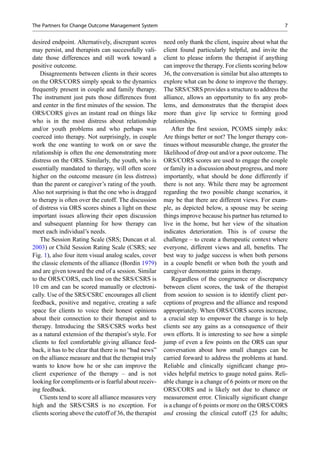
As Fig. 1 reveals, rather than a symptom
checklist on a Likert Scale, the ORS and CORS
are visual analog scales consisting of four 10 cen-
timeter lines, corresponding to four domains
(individual, interpersonal, social, and overall),
allowing for the client’s idiosyncratic rendering
of his or her life circumstance. Clients place a
mark on each line to represent their perception of
their functioning in each domain if using a paper
and pencil version or touch or click an iPad or
other device if using the web based application of
PCOMS. In the case of a family entering services
because of a problem related to a child or adoles-
cent, the parent or caregiver scores only the CORS
(for a child) or ORS (for an adolescent) based on
his or her perception of how the child or adoles-
cent is doing. Asking the parent or caregiver to
score his or her own ORS sends the message that
the therapist is interested in their functioning,
even though that is not the reason for service.
This could risk the alliance as parents or care-
givers may believe that the therapist is not aligned
with their view of the problem but, instead, has a
covert belief that the parent or caregiver them-
selves are the problem. The primary point is to
ensure that the therapist accepts the reason for
seeking help and communicates that as clearly as
possible through both verbal and nonverbal
means to clients.
Parental and caregiver scores of a youth pre-
sented as the reason for service provide crucial
perspectives of how therapy is going. Parent/care-
giver change scores are significantly correlated
with children’s and adolescent’s scores. In other
words, when youth record change, caregivers typ-
ically report similar amounts and directions of
change and vice versa. In some circumstances, it
is also useful to get others who are significantly
involved with a child, or so-called collateral
raters, to score their views using the CORS/
ORS. For example, a teacher instrumental in refer-
ring a child for counseling or a probation officer
assigned by a court to monitor a youth charged
with a delinquency offense are good candidates to
bring into the process. People who play pivotal
roles in the child’s life can become witnesses to
and advocates for positive change. Periodic meet-
ings with these individuals, the youth, and family
can facilitate support for the child or adolescent’s
efforts and collaboratively contribute to goal set-
ting and strategies for problem resolution.
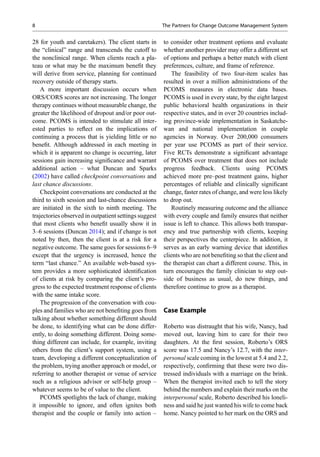
Therapists use a centimeter ruler to sum the
client’s total score, or the web version automati-
cally totals and graphs the score, with a maximum
score of 40 (see Fig. 2). Lower scores reflect more
The Partners for Change Outcome Management System 3
distress. The paper and pencil PCOMS family of
instruments are free for individual use at heartand
soulofchange.com which also contains free
resources regarding implementing PCOMS at cli-
nician and agency levels. The web version is a
commercial product available at betterout
comesnow.com
Given that at its heart, PCOMS is a collabora-
tive intervention, it is important that couples and
families understand two points at the start: (1) the
The Partners for Change Outcome Management System, Fig. 1. The Outcome Rating Scale (ORS), Session
Rating Scale (SRS), Child ORS, and Child SRS (Copyright 2000, 2002, 2003, and 2003 by B. L. Duncan and S.D. Miller.
For examination only. Download free working copies in 24 languages at https://heartandsoulofchange.com)
4 The Partners for Change Outcome Management System
ORS and CORS will be used to track outcome in
every session and (2) the ORS and the CORS
provide a way to make sure that the client’s
voice about progress is not only heard but remains
central. Introducing the ORS to families requires
tailoring the talk to the age, understanding capa-
bility, and level of attention of multiple family or
couple members. In the first meeting, the
ORS/CORS pinpoints where the client sees him
or herself, allowing for an ongoing comparison in
later sessions.
The task after the score is totaled is to make
sense of it with the final authority – the client.
Everyone needs to understand what their score
means and have a shared understanding of how
the scores reflect their reason for seeking therapy.
It helps to put the forms (or laptop or other device)
out on an open surface (e.g., coffee table) where
The Partners for Change Outcome Management System, Fig. 2. The web-based Child Outcome Rating Scale
(CORS) (top) and graph with CORS scores and expected treatment response (ETR) (bottom)
The Partners for Change Outcome Management System 5
everyone can see. This is a powerful gesture com-
municating that the work is collaborative, the
therapist will not be the private keeper of special
information, and everyone’s point of view will be
known and valued. It is not unusual for children to
flock around a set of scores with a natural curiosity
for who scored what. Couples are often similarly
curious about their partners’ scores and will read-
ily make comments about similarities or differ-
ences with their own. The PCOMS outcome
scales allow everything to be literally on the
table right from the beginning – the agreements
and disagreements that everyone knows about,
except the therapist, until now. The ORS/CORS
bring an understanding of the couple and family’s
experience to the opening minutes of a session.
The “clinical cutoff” facilitates a shared under-
standing of the ORS/SRS and is often a step
toward connecting the scores to the reason for
seeking or receiving services. Twenty-five (out
of 40) is the cutoff for adults, meaning that, on
average, persons seeking clinical services will fall
below that, and those not typically seeking
counseling will score above. Although adoles-
cents use the ORS, their cutoff is slightly higher,
28. Children’s cutoff on the CORS is also 28 as
well as when parents/caregivers are scoring the
CORS for children and the ORS for an adolescent.
The therapist lets each person know, in everyday
language that is understandable to them, whether
they are above or below the cutoff. For those
showing below cutoff scores, the therapist assures
them that they made a good decision to come
in. For those scoring above the cutoff, clinicians
simply validate their score by saying that it looks
like things are going pretty well, which leads to
the next logical question – what are the reasons for
meeting at this time?
Clients usually score the scale that reflects the
reason for service lower than the rest. Of note,
when a child or adolescent scores above the cut-
off, they will often still provide a clue to what is
troubling them by placing one mark lower than
others. Finally, the domain scores offer a glimpse
of what is going well in a person’s life. It is
worthwhile to briefly mention this when
reviewing the ORS/CORS scores, or, at least,
make a mental note to inquire more about these
areas at some point later in the interview.
The next vehicle for connecting the ORS and
CORS to the reasons for service relates to the
specific domains. The ORS/CORS is individually
tailored by design, requiring the practitioner to
ensure that the measure represents both the cli-
ent’s experience and the reasons for service. Sim-
ply seeing which domain or domains are scored
lower allows the therapist to hone in on the most
distressed dimension. The therapist can comment
on this area and to ask if the score on that domain
represents the reason for seeking counseling or
being referred for counseling. Or the therapist
can allow the conversation to reveal the reason
for service and then make the connection to the
lowest domain. Once that is established, there is a
shared understanding regarding which domain is
the focal point for tracking change. For example,
typically couples will come in with the interper-
sonal domain scoring lower than others. It is not
hard to confirm that this is what they want to
address through counseling. It also reveals who
is more distressed about the relationship and who
likely set up the appointment – and perhaps who
was dragged in by their partner. At the moment
clients connect the marks on the ORS/CORS with
the situations that prompt their seeking help, the
ORS becomes a meaningful measure of progress
and a potent clinical tool. And that moment facil-
itates the next question: “What do you think it will
take to move your mark just one cm to the right;
what needs to happen out there and in here?” The
ORS sets the stage and focuses the work at hand.
Couples and families either agree about their
views of the level and areas (domains) of distress
or they do not. When they agree, therapists can
comment on it as a strength, highlight the com-
monality, and use it as a stepping stone to establish
mutual goals. Different scores are to be expected
and simply represent the reality and complexity of
working therapeutically with more than two in the
room. For starters, different scores are concrete
and visible, allowing therapists to inquire early on
about everyone’s unique perceptions and beliefs.
The sooner this is done, the quicker goals for each
person can be identified and efforts made to link
these into a common strategy and mutually
6 The Partners for Change Outcome Management System
desired endpoint. Alternatively, discrepant scores
may persist, and therapists can successfully vali-
date those differences and still work toward a
positive outcome.
Disagreements between clients in their scores
on the ORS/CORS simply speak to the dynamics
frequently present in couple and family therapy.
The instrument just puts those differences front
and center in the first minutes of the session. The
ORS/CORS gives an instant read on things like
who is in the most distress about relationship
and/or youth problems and who perhaps was
coerced into therapy. Not surprisingly, in couple
work the one wanting to work on or save the
relationship is often the one demonstrating more
distress on the ORS. Similarly, the youth, who is
essentially mandated to therapy, will often score
higher on the outcome measure (in less distress)
than the parent or caregiver’s rating of the youth.
Also not surprising is that the one who is dragged
to therapy is often over the cutoff. The discussion
of distress via ORS scores shines a light on these
important issues allowing their open discussion
and subsequent planning for how therapy can
meet each individual’s needs.
The Session Rating Scale (SRS; Duncan et al.
2003) or Child Session Rating Scale (CSRS; see
Fig. 1), also four item visual analog scales, cover
the classic elements of the alliance (Bordin 1979)
and are given toward the end of a session. Similar
to the ORS/CORS, each line on the SRS/CSRS is
10 cm and can be scored manually or electroni-
cally. Use of the SRS/CSRC encourages all client
feedback, positive and negative, creating a safe
space for clients to voice their honest opinions
about their connection to their therapist and to
therapy. Introducing the SRS/CSRS works best
as a natural extension of the therapist’s style. For
clients to feel comfortable giving alliance feed-
back, it has to be clear that there is no “bad news”
on the alliance measure and that the therapist truly
wants to know how he or she can improve the
client experience of the therapy – and is not
looking for compliments or is fearful about receiv-
ing feedback.
Clients tend to score all alliance measures very
high and the SRS/CSRS is no exception. For
clients scoring above the cutoff of 36, the therapist
need only thank the client, inquire about what the
client found particularly helpful, and invite the
client to please inform the therapist if anything
can improve the therapy. For clients scoring below
36, the conversation is similar but also attempts to
explore what can be done to improve the therapy.
The SRS/CSRS provides a structure to address the
alliance, allows an opportunity to fix any prob-
lems, and demonstrates that the therapist does
more than give lip service to forming good
relationships.
After the first session, PCOMS simply asks:
Are things better or not? The longer therapy con-
tinues without measurable change, the greater the
likelihood of drop out and/or a poor outcome. The
ORS/CORS scores are used to engage the couple
or family in a discussion about progress, and more
importantly, what should be done differently if
there is not any. While there may be agreement
regarding the two possible change scenarios, it
may be that there are different views. For exam-
ple, as depicted below, a spouse may be seeing
things improve because his partner has returned to
live in the home, but her view of the situation
indicates deterioration. This is of course the
challenge – to create a therapeutic context where
everyone, different views and all, benefits. The
best way to judge success is when both persons
in a couple benefit or when both the youth and
caregiver demonstrate gains in therapy.
Regardless of the congruence or discrepancy
between client scores, the task of the therapist
from session to session is to identify client per-
ceptions of progress and the alliance and respond
appropriately. When ORS/CORS scores increase,
a crucial step to empower the change is to help
clients see any gains as a consequence of their
own efforts. It is interesting to see how a simple
jump of even a few points on the ORS can spur
conversation about how small changes can be
carried forward to address the problems at hand.
Reliable and clinically significant change pro-
vides helpful metrics to gauge noted gains. Reli-
able change is a change of 6 points or more on the
ORS/CORS and is likely not due to chance or
measurement error. Clinically significant change
is a change of 6 points or more on the ORS/CORS
and crossing the clinical cutoff (25 for adults;
The Partners for Change Outcome Management System 7
28 for youth and caretakers). The client starts in
the “clinical” range and transcends the cutoff to
the nonclinical range. When clients reach a pla-
teau or what may be the maximum benefit they
will derive from service, planning for continued
recovery outside of therapy starts.
A more important discussion occurs when
ORS/CORS scores are not increasing. The longer
therapy continues without measurable change, the
greater the likelihood of dropout and/or poor out-
come. PCOMS is intended to stimulate all inter-
ested parties to reflect on the implications of
continuing a process that is yielding little or no
benefit. Although addressed in each meeting in
which it is apparent no change is occurring, later
sessions gain increasing significance and warrant
additional action – what Duncan and Sparks
(2002) have called checkpoint conversations and
last chance discussions.
Checkpoint conversations are conducted at the
third to sixth session and last-chance discussions
are initiated in the sixth to ninth meeting. The
trajectories observed in outpatient settings suggest
that most clients who benefit usually show it in
3–6 sessions (Duncan 2014); and if change is not
noted by then, then the client is at a risk for a
negative outcome. The same goes for sessions 6–9
except that the urgency is increased, hence the
term “last chance.” An available web-based sys-
tem provides a more sophisticated identification
of clients at risk by comparing the client’s pro-
gress to the expected treatment response of clients
with the same intake score.
The progression of the conversation with cou-
ples and families who are not benefiting goes from
talking about whether something different should
be done, to identifying what can be done differ-
ently, to doing something different. Doing some-
thing different can include, for example, inviting
others from the client’s support system, using a
team, developing a different conceptualization of
the problem, trying another approach or model, or
referring to another therapist or venue of service
such as a religious advisor or self-help group –
whatever seems to be of value to the client.
PCOMS spotlights the lack of change, making
it impossible to ignore, and often ignites both
therapist and the couple or family into action –
to consider other treatment options and evaluate
whether another provider may offer a different set
of options and perhaps a better match with client
preferences, culture, and frame of reference.
The feasibility of two four-item scales has
resulted in over a million administrations of the
PCOMS measures in electronic data bases.
PCOMS is used in every state, by the eight largest
public behavioral health organizations in their
respective states, and in over 20 countries includ-
ing province-wide implementation in Saskatche-
wan and national implementation in couple
agencies in Norway. Over 200,000 consumers
per year use PCOMS as part of their service.
Five RCTs demonstrate a significant advantage
of PCOMS over treatment that does not include
progress feedback. Clients using PCOMS
achieved more pre–post treatment gains, higher
percentages of reliable and clinically significant
change, faster rates of change, and were less likely
to drop out.
Routinely measuring outcome and the alliance
with every couple and family ensures that neither
issue is left to chance. This allows both transpar-
ency and true partnership with clients, keeping
their perspectives the centerpiece. In addition, it
serves as an early warning device that identifies
clients who are not benefiting so that the client and
the therapist can chart a different course. This, in
turn encourages the family clinician to step out-
side of business as usual, do new things, and
therefore continue to grow as a therapist.
Case Example
Roberto was distraught that his wife, Nancy, had
moved out, leaving him to care for their two
daughters. At the first session, Roberto’s ORS
score was 17.5 and Nancy’s 12.7, with the inter-
personal scale coming in the lowest at 5.4 and 2.2,
respectively, confirming that these were two dis-
tressed individuals with a marriage on the brink.
When the therapist invited each to tell the story
behind the numbers and explain their marks on the
interpersonal scale, Roberto described his loneli-
ness and said he just wanted his wife to come back
home. Nancy pointed to her mark on the ORS and
8 The Partners for Change Outcome Management System
recounted his late nights at work and indifference
to her needs. SRS scores reflected a rocky start.
When the therapist asked about what was needed
to move the SRS in a more positive direction,
Roberto said he wanted the therapist to focus
more on Nancy moving back home. Nancy said
she wanted the therapist to help them talk together
so that Roberto would hear her.
At the next session, Roberto’s ORS indicated
nearly a four-point jump, as he felt more hopeful
that Nancy would return given that she attended
therapy; by session three, his ORS surpassed the
cutoff, because Nancy, perhaps succumbing to
Roberto’s pleas, moved back. With a note of
relief, Roberto described their home life as more
or less “back to normal.” His SRS scores for
sessions two and three increased, indicating a
strengthening therapeutic alliance. Meanwhile,
despite a similar rise in SRS scores for Nancy,
her third session ORS score was a paltry 13.
Clearly, something was gravely amiss in her life
and therapy was failing to help.
In session four, Nancy’s ORS plummeted to a
dismal 9.2 while Roberto’s ORS at session four
continued to increase to 27.8. The therapist
showed the couple a graph of their two change
trajectories, reflecting in sharp relief the dramatic
difference. The two ORS paths provided a com-
pelling rationale to inquire about Nancy’s decline
corresponding with her return home. With encour-
agement, Nancy opened up about her dreams to
pursue a meaningful career and to have time away
from household responsibilities. Though these
were not new themes, there was an urgency and
clarity absent from previous sessions. The thera-
pist supported Nancy’s dreams and encouraged
Roberto to respond to his wife in a way that
showed that he took her seriously. At the same
time, Roberto was asked to talk about his needs to
manage the demands of his job, the primary finan-
cial support for the household, and his limited
ability to share equally in home tasks. This time
the conversation was real, significantly different
than their usual stalemated communication.
Nancy’s ORS scores significantly increased over
the next three sessions as the couple continued to
make necessary adjustments in their relationship.
This therapy may have reached this point with-
out PCOMS but the chances of dropout were high,
particularly after the first session without prompt
alliance feedback and the fourth session without
concrete evidence of their disparate views. Differ-
ent scores on the ORS in couple or family work
may be interpreted as cause for concern when, in
truth, they are cause to rejoice; therapists and their
clients are given the opportunity to unambigu-
ously face the reality of their different views and
then to gauge and celebrate convergences when
they occur. In the case of Roberto and Nancy,
session four proved a turning point for strategies
to meet their conflictual needs.
Cross-References
▶ Alliance Scales in Couple and Family Therapy
▶ Progress Research in Couple and Family
Therapy
▶ SCORE
▶ Systemic Therapy Inventory of Change
References
Baldwin, S., Berkeljon, A., Atkins, D., Olsen, J., & Niel-
sen, S. (2009). Rates of change in naturalistic psycho-
therapy: Contrasting dose-effect and good-enough
level models of change. Journal of Consulting and
Clinical Psychology, 77, 203–211.
Bordin, E. (1979). The generalizability of the psychoana-
lytic concept of the working alliance. Psychotherapy,
16, 252–260. doi:10.1037/h0085885.
Duncan, B. (2012). The partners for change outcome man-
agement system (PCOMS): The heart and soul of
change project. Canadian Psychology, 53, 93–104.
doi:10.1037/a0027762.
Duncan, B. (2014). On becoming a better therapist: Evi-
dence based practice one client at a time (2nd ed.).
Washington, DC: American Psychological
Association.
Duncan, B. L., & Reese, R. J. (2015). The partners for
change outcome management system (PCOMS):
Revisiting the client’s frame of reference. Psychother-
apy, 52, 391–401.
Duncan, B., & Sparks, J. (2002). Heroic clients, heroic
agencies: Partners for change. Jensen Beach FL:
Author.
Duncan, B., Miller, S., Sparks, J., Claud, D., Reynolds, L.,
Brown, J., & Johnson, L. (2003). The session rating
scale: Preliminary psychometric properties of a
The Partners for Change Outcome Management System 9
“working” alliance measure. Journal of Brief Therapy,
3, 3–12.
Duncan, B., Sparks, J., Miller, S., Bohanske, R., & Claud,
D. (2006). Giving youth a voice: A preliminary study of
the reliability and validity of a brief outcome measure
for children. Journal of Brief Therapy, 5(1), 5–22.
Duncan, B., Miller, S., Wampold, B., & Hubble, M. (Eds.).
(2010). The heart and soul of change: Delivering what
works (2nd ed.). Washington, DC: American Psycho-
logical Association.
Horvath, A. O., Del Re, A. C., Flückiger, C., & Symonds,
D. (2011). Alliance in individual psychotherapy. Psy-
chotherapy, 48, 9–16. doi:10.1037/a0022186.
Miller, S., Duncan, B., Brown, J., Sparks, J., & Claud,
D. (2003). The outcome rating scale: A preliminary
study of the reliability, validity, and feasibility of a
brief visual analog measure. Journal of Brief Therapy,
2, 91–100.
Reese, R. J., Duncan, B., Bohanske, R., Owen, J., &
Minami, T. (2014). Benchmarking outcomes in a public
behavioral health setting: Feedback as a quality
improvement strategy. Journal of Consulting and Clin-
ical Psychology. doi:10.1037/a0036915.
10 The Partners for Change Outcome Management System

Duncan & Sparks, 2017

  • 1.
    T The Partners forChange Outcome Management System Barry Duncan1 and Jacqueline Sparks2 1 The Heart and Soul of Change Project, Jensen Beach, FL, USA 2 Department of Human Development and Family Studies, University of Rhode Island, Kingston, RI, USA Introduction Despite overall couple and family therapy effi- cacy, many clients do not benefit from treatment, dropouts are a problem, and therapists vary sig- nificantly in success rates, are poor judges of negative outcomes, and grossly overestimate their effectiveness (Duncan 2014). Progress Feed- back (sometimes called “client feedback”) offers one solution. It refers to the continuous monitor- ing of client perceptions of benefit throughout therapy and a real-time comparison with an expected treatment response to gauge client pro- gress and signal when change is not occurring as predicted. With this alert, clinicians and clients have an opportunity to shift focus, revisit goals, or alter interventions before deterioration or dropout. One of the two progress feedback interventions included in Substance Abuse and Mental Health Administration’s (SAMHSA) National Registry of Evidence-based Programs and Practices is the Partners for Change Outcome Management Sys- tem (Duncan 2012). Only the Partners for Change Outcome Management System (PCOMS) has demonstrated significant improvement in out- comes with couples and families. Emerging from clinical practice and designed with the front-line clinician in mind, PCOMS employs two, four item, reliable and valid scales, one focusing on outcome (the Outcome Rating Scale; Miller et al. 2003) and the other assessing the therapeutic alli- ance (the Session Rating Scale; Duncan et al. 2003). PCOMS directly involves clinicians and clients, including youth, in an ongoing process of measuring and discussing both progress and the alliance – the first system to do so. PCOMS assesses the client’s response to service and feeds that information back to both the therapist and client to enhance the possibility of success via identification of clients at risk for a negative out- come. Widespread implementation of PCOMS has enabled the development of algorithms for expected treatment response based on extensive databases as well as an electronic system for data collection, analyses, and real-time feedback. Studies report that clients receiving PCOMS have 3.5 times higher odds of experiencing reli- able change and less than half the chance of dete- rioration, making a strong case for clinician use of progress feedback in general and PCOMS specif- ically. PCOMS evolved from a clinical, relational, and value-driven starting place in its developer’s practice (Duncan 2014) to an empirically # Springer International Publishing AG 2017 J.L. Lebow et al. (eds.), Encyclopedia of Couple and Family Therapy, DOI 10.1007/978-3-319-15877-8_896-1
  • 2.
    validated methodology forimproving outcomes and a viable quality improvement strategy. Theoretical Framework PCOMS is an evidenced based practice, but it is not what typically comes to mind – it is not a specific treatment model or intervention for a spe- cific client diagnosis or problem. Rather, PCOMS is a-theoretical and not diagnostically based. PCOMS has demonstrated significant improve- ments for both clients and therapists regardless of the theoretical orientations of therapists or the diagnoses of the clients. More importantly, PCOMS is evidence based at the individual client-therapist level, promoting a partnership that monitors whether this approach provided by this therapist is benefiting this client or family. In other words, it is evidence-based practice one client at a time. Rationale for the Strategy or Intervention The purpose of PCOMS is to partner with clients to identify those who are not responding and address the lack of progress to keep clients engaged while new directions are collaboratively sought. There are six rationales for PCOMS. First, PCOMS is supported by five randomized clinical trials (RCT) conducted by the Heart and Soul of Change Project that demonstrate that client pro- gress and alliance feedback significantly improves outcomes across modalities and therapies (Duncan and Reese 2015). These RCTs led to the SAMHSA designation of PCOMS as an evidence-based practice, distinguishing it from other couple and family progress feedback sys- tems. Second, PCOMS has demonstrated that it is a viable quality improvement strategy in real world settings and may be more cost effective and feasible than transporting evidence-based treatments for specific disorders (Reese et al. 2014). Agencies implementing PCOMS have enjoyed outcomes comparable to those achieved in RCTs. Third, PCOMS addresses the problems of the field by reducing dropouts, cancelations, no shows, length of stay, and therapist variability while providing objective information about cli- nician and agency effectiveness (Duncan and Reese 2015). Fourth, PCOMS incorporates two known pre- dictors of ultimate treatment outcome, early change (Baldwin et al. 2009), and the therapeutic alliance (Horvath et al. 2011). Studies reveal that the majority of clients experience the majority of change in the first eight visits. Couples and fam- ilies who report little or no progress early on will likely show no improvement over the entire course of therapy. A second robust predictor of change solidly demonstrated by a large body of studies is the therapeutic alliance. Clients who highly rate their partnership with their therapists are more apt to remain in therapy and benefit from it. Monitoring progress and the alliance provides a tangible way to identify nonresponding clients and relationship problems before clients drop out or achieve a negative outcome. Fifth, PCOMS directly applies the research about what matters in therapeutic change, the common factors (Duncan et al. 2010). Collaborative monitoring of outcome engages the most potent source of change, clients, heightening hope for improve- ment, and tailors services to client preferences thereby maximizing the alliance and participation (Duncan 2014). Finally, a sixth rationale speaks to consumer rights and the foundations of couple and family therapy practice. Despite well-intentioned efforts, the infrastructure of couple and family therapy (paperwork, procedures, and professional lan- guage) can reify noncontextualized descriptions of client problems and silence their views, goals, and preferences. Routinely requesting, documenting, and responding to client feedback has the potential to transform power relations by privileging client beliefs and goals over poten- tially culturally biased and insensitive practices. Valuing clients as credible sources of their own experiences of progress and relationship allows consumers to teach clinicians how to be the most effective with them and reverse the hierarchy of expert-delivered services. PCOMS provides a readymade structure for collaboration with 2 The Partners for Change Outcome Management System
  • 3.
    consumers and promotesa more egalitarian ther- apeutic process. Outside the therapy dyad, client-generated data help overcome inequities built into everyday ser- vice delivery by redefining whose voice counts. Without the data, client views do not stand a chance to be part of the real record – that is, critical information that guides decisions or evaluates eventual outcomes at larger programmatic or organizational levels. The data, as concrete repre- sentations of client perspectives, offer a direct way to describe benefit at clinician and agency levels as well as keep client voice primary to how ser- vices are delivered and funded. Description of the Strategy or Intervention PCOMS is a light-touch, checking-in process that usually takes about 5 min but never over ten for administering, scoring, and integrating into the therapy. PCOMS gently guides models and tech- niques toward the client’s perspective, with a focus on outcome. Besides the brevity of its mea- sures, PCOMS also differs from most systems in that client involvement is routine and expected; client scores on the progress and alliance instru- ments are openly shared and discussed at each administration. Client views of progress serve as a basis for beginning therapeutic conversations, and their assessments of the alliance mark an endpoint to the same. With this transparency, the measures provide a mutually understood refer- ence point for reasons for seeking service, pro- gress, and engagement. PCOMS and the session start with the Out- come Rating Scale for adolescents and adults and the Child Outcome Rating Scale (CORS: Duncan et al. 2006) for children ages 6–12, which provide client-reported ratings of progress. As Fig. 1 reveals, rather than a symptom checklist on a Likert Scale, the ORS and CORS are visual analog scales consisting of four 10 cen- timeter lines, corresponding to four domains (individual, interpersonal, social, and overall), allowing for the client’s idiosyncratic rendering of his or her life circumstance. Clients place a mark on each line to represent their perception of their functioning in each domain if using a paper and pencil version or touch or click an iPad or other device if using the web based application of PCOMS. In the case of a family entering services because of a problem related to a child or adoles- cent, the parent or caregiver scores only the CORS (for a child) or ORS (for an adolescent) based on his or her perception of how the child or adoles- cent is doing. Asking the parent or caregiver to score his or her own ORS sends the message that the therapist is interested in their functioning, even though that is not the reason for service. This could risk the alliance as parents or care- givers may believe that the therapist is not aligned with their view of the problem but, instead, has a covert belief that the parent or caregiver them- selves are the problem. The primary point is to ensure that the therapist accepts the reason for seeking help and communicates that as clearly as possible through both verbal and nonverbal means to clients. Parental and caregiver scores of a youth pre- sented as the reason for service provide crucial perspectives of how therapy is going. Parent/care- giver change scores are significantly correlated with children’s and adolescent’s scores. In other words, when youth record change, caregivers typ- ically report similar amounts and directions of change and vice versa. In some circumstances, it is also useful to get others who are significantly involved with a child, or so-called collateral raters, to score their views using the CORS/ ORS. For example, a teacher instrumental in refer- ring a child for counseling or a probation officer assigned by a court to monitor a youth charged with a delinquency offense are good candidates to bring into the process. People who play pivotal roles in the child’s life can become witnesses to and advocates for positive change. Periodic meet- ings with these individuals, the youth, and family can facilitate support for the child or adolescent’s efforts and collaboratively contribute to goal set- ting and strategies for problem resolution. Therapists use a centimeter ruler to sum the client’s total score, or the web version automati- cally totals and graphs the score, with a maximum score of 40 (see Fig. 2). Lower scores reflect more The Partners for Change Outcome Management System 3
  • 4.
    distress. The paperand pencil PCOMS family of instruments are free for individual use at heartand soulofchange.com which also contains free resources regarding implementing PCOMS at cli- nician and agency levels. The web version is a commercial product available at betterout comesnow.com Given that at its heart, PCOMS is a collabora- tive intervention, it is important that couples and families understand two points at the start: (1) the The Partners for Change Outcome Management System, Fig. 1. The Outcome Rating Scale (ORS), Session Rating Scale (SRS), Child ORS, and Child SRS (Copyright 2000, 2002, 2003, and 2003 by B. L. Duncan and S.D. Miller. For examination only. Download free working copies in 24 languages at https://heartandsoulofchange.com) 4 The Partners for Change Outcome Management System
  • 5.
    ORS and CORSwill be used to track outcome in every session and (2) the ORS and the CORS provide a way to make sure that the client’s voice about progress is not only heard but remains central. Introducing the ORS to families requires tailoring the talk to the age, understanding capa- bility, and level of attention of multiple family or couple members. In the first meeting, the ORS/CORS pinpoints where the client sees him or herself, allowing for an ongoing comparison in later sessions. The task after the score is totaled is to make sense of it with the final authority – the client. Everyone needs to understand what their score means and have a shared understanding of how the scores reflect their reason for seeking therapy. It helps to put the forms (or laptop or other device) out on an open surface (e.g., coffee table) where The Partners for Change Outcome Management System, Fig. 2. The web-based Child Outcome Rating Scale (CORS) (top) and graph with CORS scores and expected treatment response (ETR) (bottom) The Partners for Change Outcome Management System 5
  • 6.
    everyone can see.This is a powerful gesture com- municating that the work is collaborative, the therapist will not be the private keeper of special information, and everyone’s point of view will be known and valued. It is not unusual for children to flock around a set of scores with a natural curiosity for who scored what. Couples are often similarly curious about their partners’ scores and will read- ily make comments about similarities or differ- ences with their own. The PCOMS outcome scales allow everything to be literally on the table right from the beginning – the agreements and disagreements that everyone knows about, except the therapist, until now. The ORS/CORS bring an understanding of the couple and family’s experience to the opening minutes of a session. The “clinical cutoff” facilitates a shared under- standing of the ORS/SRS and is often a step toward connecting the scores to the reason for seeking or receiving services. Twenty-five (out of 40) is the cutoff for adults, meaning that, on average, persons seeking clinical services will fall below that, and those not typically seeking counseling will score above. Although adoles- cents use the ORS, their cutoff is slightly higher, 28. Children’s cutoff on the CORS is also 28 as well as when parents/caregivers are scoring the CORS for children and the ORS for an adolescent. The therapist lets each person know, in everyday language that is understandable to them, whether they are above or below the cutoff. For those showing below cutoff scores, the therapist assures them that they made a good decision to come in. For those scoring above the cutoff, clinicians simply validate their score by saying that it looks like things are going pretty well, which leads to the next logical question – what are the reasons for meeting at this time? Clients usually score the scale that reflects the reason for service lower than the rest. Of note, when a child or adolescent scores above the cut- off, they will often still provide a clue to what is troubling them by placing one mark lower than others. Finally, the domain scores offer a glimpse of what is going well in a person’s life. It is worthwhile to briefly mention this when reviewing the ORS/CORS scores, or, at least, make a mental note to inquire more about these areas at some point later in the interview. The next vehicle for connecting the ORS and CORS to the reasons for service relates to the specific domains. The ORS/CORS is individually tailored by design, requiring the practitioner to ensure that the measure represents both the cli- ent’s experience and the reasons for service. Sim- ply seeing which domain or domains are scored lower allows the therapist to hone in on the most distressed dimension. The therapist can comment on this area and to ask if the score on that domain represents the reason for seeking counseling or being referred for counseling. Or the therapist can allow the conversation to reveal the reason for service and then make the connection to the lowest domain. Once that is established, there is a shared understanding regarding which domain is the focal point for tracking change. For example, typically couples will come in with the interper- sonal domain scoring lower than others. It is not hard to confirm that this is what they want to address through counseling. It also reveals who is more distressed about the relationship and who likely set up the appointment – and perhaps who was dragged in by their partner. At the moment clients connect the marks on the ORS/CORS with the situations that prompt their seeking help, the ORS becomes a meaningful measure of progress and a potent clinical tool. And that moment facil- itates the next question: “What do you think it will take to move your mark just one cm to the right; what needs to happen out there and in here?” The ORS sets the stage and focuses the work at hand. Couples and families either agree about their views of the level and areas (domains) of distress or they do not. When they agree, therapists can comment on it as a strength, highlight the com- monality, and use it as a stepping stone to establish mutual goals. Different scores are to be expected and simply represent the reality and complexity of working therapeutically with more than two in the room. For starters, different scores are concrete and visible, allowing therapists to inquire early on about everyone’s unique perceptions and beliefs. The sooner this is done, the quicker goals for each person can be identified and efforts made to link these into a common strategy and mutually 6 The Partners for Change Outcome Management System
  • 7.
    desired endpoint. Alternatively,discrepant scores may persist, and therapists can successfully vali- date those differences and still work toward a positive outcome. Disagreements between clients in their scores on the ORS/CORS simply speak to the dynamics frequently present in couple and family therapy. The instrument just puts those differences front and center in the first minutes of the session. The ORS/CORS gives an instant read on things like who is in the most distress about relationship and/or youth problems and who perhaps was coerced into therapy. Not surprisingly, in couple work the one wanting to work on or save the relationship is often the one demonstrating more distress on the ORS. Similarly, the youth, who is essentially mandated to therapy, will often score higher on the outcome measure (in less distress) than the parent or caregiver’s rating of the youth. Also not surprising is that the one who is dragged to therapy is often over the cutoff. The discussion of distress via ORS scores shines a light on these important issues allowing their open discussion and subsequent planning for how therapy can meet each individual’s needs. The Session Rating Scale (SRS; Duncan et al. 2003) or Child Session Rating Scale (CSRS; see Fig. 1), also four item visual analog scales, cover the classic elements of the alliance (Bordin 1979) and are given toward the end of a session. Similar to the ORS/CORS, each line on the SRS/CSRS is 10 cm and can be scored manually or electroni- cally. Use of the SRS/CSRC encourages all client feedback, positive and negative, creating a safe space for clients to voice their honest opinions about their connection to their therapist and to therapy. Introducing the SRS/CSRS works best as a natural extension of the therapist’s style. For clients to feel comfortable giving alliance feed- back, it has to be clear that there is no “bad news” on the alliance measure and that the therapist truly wants to know how he or she can improve the client experience of the therapy – and is not looking for compliments or is fearful about receiv- ing feedback. Clients tend to score all alliance measures very high and the SRS/CSRS is no exception. For clients scoring above the cutoff of 36, the therapist need only thank the client, inquire about what the client found particularly helpful, and invite the client to please inform the therapist if anything can improve the therapy. For clients scoring below 36, the conversation is similar but also attempts to explore what can be done to improve the therapy. The SRS/CSRS provides a structure to address the alliance, allows an opportunity to fix any prob- lems, and demonstrates that the therapist does more than give lip service to forming good relationships. After the first session, PCOMS simply asks: Are things better or not? The longer therapy con- tinues without measurable change, the greater the likelihood of drop out and/or a poor outcome. The ORS/CORS scores are used to engage the couple or family in a discussion about progress, and more importantly, what should be done differently if there is not any. While there may be agreement regarding the two possible change scenarios, it may be that there are different views. For exam- ple, as depicted below, a spouse may be seeing things improve because his partner has returned to live in the home, but her view of the situation indicates deterioration. This is of course the challenge – to create a therapeutic context where everyone, different views and all, benefits. The best way to judge success is when both persons in a couple benefit or when both the youth and caregiver demonstrate gains in therapy. Regardless of the congruence or discrepancy between client scores, the task of the therapist from session to session is to identify client per- ceptions of progress and the alliance and respond appropriately. When ORS/CORS scores increase, a crucial step to empower the change is to help clients see any gains as a consequence of their own efforts. It is interesting to see how a simple jump of even a few points on the ORS can spur conversation about how small changes can be carried forward to address the problems at hand. Reliable and clinically significant change pro- vides helpful metrics to gauge noted gains. Reli- able change is a change of 6 points or more on the ORS/CORS and is likely not due to chance or measurement error. Clinically significant change is a change of 6 points or more on the ORS/CORS and crossing the clinical cutoff (25 for adults; The Partners for Change Outcome Management System 7
  • 8.
    28 for youthand caretakers). The client starts in the “clinical” range and transcends the cutoff to the nonclinical range. When clients reach a pla- teau or what may be the maximum benefit they will derive from service, planning for continued recovery outside of therapy starts. A more important discussion occurs when ORS/CORS scores are not increasing. The longer therapy continues without measurable change, the greater the likelihood of dropout and/or poor out- come. PCOMS is intended to stimulate all inter- ested parties to reflect on the implications of continuing a process that is yielding little or no benefit. Although addressed in each meeting in which it is apparent no change is occurring, later sessions gain increasing significance and warrant additional action – what Duncan and Sparks (2002) have called checkpoint conversations and last chance discussions. Checkpoint conversations are conducted at the third to sixth session and last-chance discussions are initiated in the sixth to ninth meeting. The trajectories observed in outpatient settings suggest that most clients who benefit usually show it in 3–6 sessions (Duncan 2014); and if change is not noted by then, then the client is at a risk for a negative outcome. The same goes for sessions 6–9 except that the urgency is increased, hence the term “last chance.” An available web-based sys- tem provides a more sophisticated identification of clients at risk by comparing the client’s pro- gress to the expected treatment response of clients with the same intake score. The progression of the conversation with cou- ples and families who are not benefiting goes from talking about whether something different should be done, to identifying what can be done differ- ently, to doing something different. Doing some- thing different can include, for example, inviting others from the client’s support system, using a team, developing a different conceptualization of the problem, trying another approach or model, or referring to another therapist or venue of service such as a religious advisor or self-help group – whatever seems to be of value to the client. PCOMS spotlights the lack of change, making it impossible to ignore, and often ignites both therapist and the couple or family into action – to consider other treatment options and evaluate whether another provider may offer a different set of options and perhaps a better match with client preferences, culture, and frame of reference. The feasibility of two four-item scales has resulted in over a million administrations of the PCOMS measures in electronic data bases. PCOMS is used in every state, by the eight largest public behavioral health organizations in their respective states, and in over 20 countries includ- ing province-wide implementation in Saskatche- wan and national implementation in couple agencies in Norway. Over 200,000 consumers per year use PCOMS as part of their service. Five RCTs demonstrate a significant advantage of PCOMS over treatment that does not include progress feedback. Clients using PCOMS achieved more pre–post treatment gains, higher percentages of reliable and clinically significant change, faster rates of change, and were less likely to drop out. Routinely measuring outcome and the alliance with every couple and family ensures that neither issue is left to chance. This allows both transpar- ency and true partnership with clients, keeping their perspectives the centerpiece. In addition, it serves as an early warning device that identifies clients who are not benefiting so that the client and the therapist can chart a different course. This, in turn encourages the family clinician to step out- side of business as usual, do new things, and therefore continue to grow as a therapist. Case Example Roberto was distraught that his wife, Nancy, had moved out, leaving him to care for their two daughters. At the first session, Roberto’s ORS score was 17.5 and Nancy’s 12.7, with the inter- personal scale coming in the lowest at 5.4 and 2.2, respectively, confirming that these were two dis- tressed individuals with a marriage on the brink. When the therapist invited each to tell the story behind the numbers and explain their marks on the interpersonal scale, Roberto described his loneli- ness and said he just wanted his wife to come back home. Nancy pointed to her mark on the ORS and 8 The Partners for Change Outcome Management System
  • 9.
    recounted his latenights at work and indifference to her needs. SRS scores reflected a rocky start. When the therapist asked about what was needed to move the SRS in a more positive direction, Roberto said he wanted the therapist to focus more on Nancy moving back home. Nancy said she wanted the therapist to help them talk together so that Roberto would hear her. At the next session, Roberto’s ORS indicated nearly a four-point jump, as he felt more hopeful that Nancy would return given that she attended therapy; by session three, his ORS surpassed the cutoff, because Nancy, perhaps succumbing to Roberto’s pleas, moved back. With a note of relief, Roberto described their home life as more or less “back to normal.” His SRS scores for sessions two and three increased, indicating a strengthening therapeutic alliance. Meanwhile, despite a similar rise in SRS scores for Nancy, her third session ORS score was a paltry 13. Clearly, something was gravely amiss in her life and therapy was failing to help. In session four, Nancy’s ORS plummeted to a dismal 9.2 while Roberto’s ORS at session four continued to increase to 27.8. The therapist showed the couple a graph of their two change trajectories, reflecting in sharp relief the dramatic difference. The two ORS paths provided a com- pelling rationale to inquire about Nancy’s decline corresponding with her return home. With encour- agement, Nancy opened up about her dreams to pursue a meaningful career and to have time away from household responsibilities. Though these were not new themes, there was an urgency and clarity absent from previous sessions. The thera- pist supported Nancy’s dreams and encouraged Roberto to respond to his wife in a way that showed that he took her seriously. At the same time, Roberto was asked to talk about his needs to manage the demands of his job, the primary finan- cial support for the household, and his limited ability to share equally in home tasks. This time the conversation was real, significantly different than their usual stalemated communication. Nancy’s ORS scores significantly increased over the next three sessions as the couple continued to make necessary adjustments in their relationship. This therapy may have reached this point with- out PCOMS but the chances of dropout were high, particularly after the first session without prompt alliance feedback and the fourth session without concrete evidence of their disparate views. Differ- ent scores on the ORS in couple or family work may be interpreted as cause for concern when, in truth, they are cause to rejoice; therapists and their clients are given the opportunity to unambigu- ously face the reality of their different views and then to gauge and celebrate convergences when they occur. In the case of Roberto and Nancy, session four proved a turning point for strategies to meet their conflictual needs. Cross-References ▶ Alliance Scales in Couple and Family Therapy ▶ Progress Research in Couple and Family Therapy ▶ SCORE ▶ Systemic Therapy Inventory of Change References Baldwin, S., Berkeljon, A., Atkins, D., Olsen, J., & Niel- sen, S. (2009). Rates of change in naturalistic psycho- therapy: Contrasting dose-effect and good-enough level models of change. Journal of Consulting and Clinical Psychology, 77, 203–211. Bordin, E. (1979). The generalizability of the psychoana- lytic concept of the working alliance. Psychotherapy, 16, 252–260. doi:10.1037/h0085885. Duncan, B. (2012). The partners for change outcome man- agement system (PCOMS): The heart and soul of change project. Canadian Psychology, 53, 93–104. doi:10.1037/a0027762. Duncan, B. (2014). On becoming a better therapist: Evi- dence based practice one client at a time (2nd ed.). Washington, DC: American Psychological Association. Duncan, B. L., & Reese, R. J. (2015). The partners for change outcome management system (PCOMS): Revisiting the client’s frame of reference. Psychother- apy, 52, 391–401. Duncan, B., & Sparks, J. (2002). Heroic clients, heroic agencies: Partners for change. Jensen Beach FL: Author. Duncan, B., Miller, S., Sparks, J., Claud, D., Reynolds, L., Brown, J., & Johnson, L. (2003). The session rating scale: Preliminary psychometric properties of a The Partners for Change Outcome Management System 9
  • 10.
    “working” alliance measure.Journal of Brief Therapy, 3, 3–12. Duncan, B., Sparks, J., Miller, S., Bohanske, R., & Claud, D. (2006). Giving youth a voice: A preliminary study of the reliability and validity of a brief outcome measure for children. Journal of Brief Therapy, 5(1), 5–22. Duncan, B., Miller, S., Wampold, B., & Hubble, M. (Eds.). (2010). The heart and soul of change: Delivering what works (2nd ed.). Washington, DC: American Psycho- logical Association. Horvath, A. O., Del Re, A. C., Flückiger, C., & Symonds, D. (2011). Alliance in individual psychotherapy. Psy- chotherapy, 48, 9–16. doi:10.1037/a0022186. Miller, S., Duncan, B., Brown, J., Sparks, J., & Claud, D. (2003). The outcome rating scale: A preliminary study of the reliability, validity, and feasibility of a brief visual analog measure. Journal of Brief Therapy, 2, 91–100. Reese, R. J., Duncan, B., Bohanske, R., Owen, J., & Minami, T. (2014). Benchmarking outcomes in a public behavioral health setting: Feedback as a quality improvement strategy. Journal of Consulting and Clin- ical Psychology. doi:10.1037/a0036915. 10 The Partners for Change Outcome Management System