Journal of Marital and Family Therapy
doi: 10.1111/j.1752-0606.2011.00224.x
October 2011, Vol. 37, No. 4, 452–467

    TEACHING ACCOUNTABILITY: USING CLIENT
FEEDBACK TO TRAIN EFFECTIVE FAMILY THERAPISTS
       Jacqueline A. Sparks, Tiffani S. Kisler, Jerome F. Adams, and Dale G. Blumen
                                         University of Rhode Island

      The AAMFT Task Force on Core Competencies (Nelson et al., 2007) proposed that
      marriage and family therapy (MFT) educators teach and provide evidence of trainee
      competence beyond coursework and accrued clinical hours. This article describes the
      integration of a systematic client feedback protocol into an MFT-accredited program’s
      curricula to address the call for outcome-based learning. Outcome management (OM)
      provides a framework for teaching and assessing trainee effectiveness. Continuous
      incorporation of client feedback embodies collaborative, strengths-based, integrative, and
      diversity-centered program values. Students learn a system for being accountable to
      clients, the profession, and service communities.

     Within the past decade, calls have been made for the provision of ‘‘safe, effective, patient-
centered, timely, efficient, and equitable’’ health care for all persons (Committee on Quality of
Health Care in America, 2001, pp. 7–8). This call has extended to mental health services (Presi-
dent’s New Freedom Commission on Mental Health, 2003). Moreover, consumers have
demanded evidence of treatment effectiveness. In response, mental and behavioral health orga-
nizations have taken steps to define effective, safe care (e.g., see APA Presidential Task Force
on Evidence-Based Practice; Hoge et al., 2005; Nelson et al., 2007). Despite varying definitions
of best practice, mental health disciplines appear united in the ethics of providing evidence of
effectiveness. Indeed, a current focus on outcome, the sine qua non of effectiveness evidence,
prompted Leigh et al. (2007) to call this the ‘‘era of accountability’’ (p. 463).
     The AAMFT Task Force on Core Competencies responded to the demand for accountabil-
ity by first defining six domains of knowledge and skills required for entry-level independent
practice as a marriage and family therapist (Nelson et al., 2007).1 These domains encompass all
aspects of care and presumably define competent practice as a couple and family therapist. The
Task Force invited further discussion regarding how best to teach and assess competence and
suggested that training models shift from an input-oriented to outcome-based education. This
entails less reliance on coursework and accrual of clinical hours as proof that trainees can pro-
vide effective care (Nelson et al., 2007). Instead, trainees would be required to demonstrate that
their educational experiences have translated into core skills.
     That training of clinical practitioners should include teaching demonstrable skills seems
obvious. However, some have questioned whether therapist skill development leads to better cli-
ent outcomes. According to Lambert and Hawkins (2001), the degree to which skills generalize
to practice is inconclusive. For example, students may succeed in learning a particular skill set,
yet have difficulty transporting that into the therapy room. Moreover, there is evidence that
therapist mastery of specific interventions may actually interfere with client and therapist
engagement, resulting in suboptimal outcomes (Beutler et al., 2004; Lambert & Ogles, 2004).


     Jacqueline A. Sparks, PhD, Associate Professor, Department of Human Development and Family Studies,
Couple and Family Therapy Program, University of Rhode Island, Director of the Couple and Family Therapy
Clinic, University of Rhode Island; Tiffani S. Kisler, PhD, Assistant Professor, Department of Human
Development and Family Studies, Couple and Family Therapy Program, University of Rhode Island; Jerome F.
Adams, PhD, Chair of the Department of Human Development and Family Studies, Director of the Couple and
Family Therapy Program, University of Rhode Island; Dale G. Blumen, MS, Coordinator of the Couple and
Family Therapy Clinic, University of Rhode Island.
     The authors wish to thank Barry Duncan for his generous assistance in the preparation of this article.
     Address correspondence to Jacqueline A. Sparks, 2 Lower College Rd., Kingston, Rhode Island 02881; E-mail:
jsparks@uri.edu

452                      JOURNAL OF MARITAL AND FAMILY THERAPY                                  October 2011
Furthermore, means of evaluating knowledge may be readily available, while methods assessing
skills present greater challenges (Leigh et al., 2007). Lichtenberg et al. (2007) claimed that tradi-
tional paper and pencil testing lacks ecological validity in evaluating practice skills. These con-
siderations present practical and conceptual challenges in evaluating competence.
     One response to addressing these difficulties is the incorporation of information derived
directly from the trainee’s clinical practice. Psychology educators have asserted that assessment
methods that do not involve direct observation of the person in actual situations, do not include
feedback from clients, and do not assess clinical outcomes cannot adequately evaluate a trainee’s
ability to help clients (Leigh et al., 2007; Lichtenberg et al., 2007). Kaslow, Celano, and Stanton
(2005) described a competencies-based approach in family psychology as one emphasizing ‘‘the
ability to apply knowledge and skills in the real world and [one that] uses performance outcome
as criteria for evaluating learners and training programs’’ (p. 338). The APA’s Task Force on
the Assessment of Competence has endorsed assessments that evaluate the trainee’s intervention
with clients (Kaslow et al., 2007). Similarly, the Annapolis Coalition recommended the use of
multiple data sources for assessment, including client surveys (Hoge et al., 2005).
     Family therapy educators have proposed the use of evaluative tools in supervision as one
framework for assessing competence (Nelson et al., 2007). Supervision has long been a mainstay
of quality assurance in therapist training (Falender et al., 2004) and particularly for MFTs
(Liddle, Breunlin, & Schwartz, 1988; Nichols, Nichols, & Hardy, 1990; Todd & Storm, 1997;
White & Russell, 1995). Supervision ultimately should serve client welfare (e.g., Avis & Sprenkle,
1990; Holloway & Carroll, 1996; Worthen & Lambert, 2007). However, decades of research have
produced very little regarding its actual impact on outcome (Ellis & Ladany, 1997; Freitas, 2002;
Lambert & Hawkins, 2001; Lambert & Ogles, 1997; Storm, Todd, Sprenkle, & Morgan, 2001).
One recent study, addressing methodological concerns of earlier studies, found that supervision
exerted a moderate effect on outcome, accounting for approximately 16% of the outcome vari-
ance beyond that accounted for by the client’s initial severity and therapist attributes (Callahan,
Almstrom, Swift, Borja, & Heath, 2009). Nevertheless, with so few studies, it is still reasonable
to state, as Storm et al. did, that ‘‘it would not be overstating the case to assert that the field’s
belief in the importance of supervision rests mostly on faith’’ (p. 227).
     Similarly, therapists in training are most often supervised without any objective informa-
tion about clients’ responses to the therapy (Sapyta, Reimer, & Bickman, 2005). As ‘‘support-
ive consultation,’’ supervision may be considered satisfactory by both supervisor and
supervisee, yet remain disconnected to whether or not clients improve (Worthen & Lambert,
2007, p. 4). In other words, supervision as a benefit for therapist development is separated
from client benefit. This disconnect has prompted recommendations for routinely incorporating
client outcome information into the supervision process (Lambert & Hawkins, 2001; Worthen
& Lambert, 2007). This would require trainees to systematically track and discuss progress of
their cases in supervision. Supervisors can then provide targeted oversight in addressing cases
not proceeding satisfactorily while supervisees learn the value of flexible, informed clinical
practice.
     To date, agreed-upon guidelines for assisting couple and family therapy educators to
train a competent, accountable workforce have not been devised. Realignment of educational
curricula in MFT training programs with identified competencies is likely to take a decade
(Nelson et al., 2007). Moreover, the field has yet to offer guidance regarding the integration
of practice-based research into all aspects of clinical training, including supervision. Further-
more, the cogent critiques of training methods that do not include client outcomes appear
underrepresented in MFT literature and practice. This article discusses one MFT-accredited
program’s efforts to integrate a systematic client feedback protocol into its training, super-
vision, and educational curricula in an effort to develop procedures consistent with the
transition to outcome-based learning recommended by the AAMFT and address the call for
accountability in delivering measurably effective treatment. We begin by describing the evolu-
tion of an OM system at our family therapy program at the University of Rhode Island and
its integration into coursework, clinical training, and supervision. We report students’ views
of their experiences with this method and conclude with discussion and future directions for
the field.


October 2011                    JOURNAL OF MARITAL AND FAMILY THERAPY                            453
CLIENT FEEDBACK AND OUTCOME

     A relatively new research paradigm offers a potential training model to bridge research and
practice and teach trainees the ethical and practical value of being accountable to their clients.
Howard, Moras, Brill, Martinovich, and Lutz (1996) advocated for the systematic evaluation of
client response to treatment during the course of therapy and recommended such information be
used to ‘‘determine the appropriateness of the current treatment . . . the need for further treat-
ment . . . [and] prompt a clinical consultation for patients who [were] not progressing at expected
rates’’ (p. 1063). The development of new statistical techniques has allowed researchers and clini-
cians to generate trajectories of change using session-by-session data and to compare client pro-
gress with similar clients utilizing large databases of client change scores. These comparisons
generate probabilistic predictions about the client’s posttreatment outcome (see Lambert, 2010).
Computerized predictions provide a basis for identifying clients who are not responding as
expected and a chance for clinicians to respond accordingly. Computerized predictions, in fact,
have proven superior to therapists. Hannan et al. (2005), comparing therapist predictions of client
deterioration to actuarial methods, found that therapists identified only one of the 40 clients who
deteriorated, even though they were aware of the study’s purpose and informed that the base rate
was likely to be 8%. In contrast, the actuarial method correctly predicted 36 of the 40.
     Investigations into client feedback methods have revealed consistently positive findings. In a
meta-analysis of five major randomized trials, Lambert (2010) reported that as many as 45% of
feedback groups, supplemented with clinical support tools (alliance measures, motivation assess-
ment, and discussion of client support systems) reached reliable improvement and clinically
significant change (Jacobson & Truax, 1991) compared with 22% of treatment as usual (TAU)
at-risk cases. Miller, Duncan, Brown, Sorrell, and Chalk (2006) used continuous feedback and
brief outcome instruments to explore the impact of feedback in a large, culturally diverse sample
(n = 6,424) utilizing telephonic employee assistance services. The use of outcome feedback
doubled the effect size (ES) from 0.37 to 0.79 and significantly increased retention.
     Couple and family feedback research lags behind individual studies, perhaps in part because
of the complexity of obtaining frequent measurements from multiple persons in a given couple or
family unit. A small recent study of feedback in wraparound services for youth and families (Ogles
et al., 2006) found that provision of feedback at four intervals using the 48-item Ohio Scales (Ogles,
Melendez, Davis, & Lunnen, 2001) did not contribute to improved youth outcomes or family func-
tioning in comparison with a no-feedback group. Sparks and Duncan (2010) suggest that lack of
separation between feedback and no-feedback conditions in this study can be explained by the
collection of feedback at only four intervals during the course of treatment. Moreover, Lambert
(2010) cautions that lack of continuous monitoring limits findings as effects of dropout or pre-
mature termination are unknown. Reese et al. (2009), using briefer instruments, found that MFT
and counseling trainees (N = 28) assigned to the continuous feedback condition and who shared
feedback with their supervisors were approximately twice as effective as those in the no-feedback
condition over the course of an academic year. Trainees in both feedback and no-feedback groups
increased their sense of self-efficacy over the year, but only feedback trainees’ self-efficacy correlated
with client outcome. A strong effect of feedback also was found in a recent couples study (Anker,
Duncan, & Sparks, 2009), the largest clinical trial with couples to date. Couples (N = 205) at a
community-based family counseling clinic were randomly assigned to either TAU or feedback.
Feedback couples demonstrated significantly greater improvement at termination than those in the
TAU condition and achieved over four times the rate of clinically significant change. This superior-
ity carried over at follow-up—divorce and separation rates for feedback couples were 46.2% less
than for couples who received therapy as usual 6 months after termination. In sum, there are, to
date, eight trials supporting the use of client feedback to monitor treatment and improve outcomes.

                         OUTCOME MANAGEMENT ADOPTION

    Our adoption of a client feedback system, or OM (Duncan, Miller, & Sparks, 2004),2 grew
out of a consensus regarding the value of OM as a research-informed method for training
therapists to work effectively with families and couples. Outcome management refers to the


454                    JOURNAL OF MARITAL AND FAMILY THERAPY                            October 2011
systematic collection of client feedback regarding progress and the alliance during treatment to
facilitate management of the therapy toward the best possible outcome. We believed that clients
had largely been overlooked as teachers for those in training. Instituting a formal client feed-
back system could bring clients to the front of the class, so to speak, to impart valuable lessons
in how to be of assistance to those seeking change in therapy.
     Research is clear regarding the significance of therapist variability in relation to outcome.
Some therapists clearly are better than others in helping clients reach optimal benefit (Beutler
et al., 2004; Wampold & Brown, 2005). Depending on the study, therapist effects range from
6% to 9% of the overall variance of change, or about 6–9 times more than that of model
differences. Differences in therapist ability are often apparent early in the training process.
However, there is evidence that therapists performing poorly can improve when they routinely
integrate client feedback into their work. For example, Anker et al. (2009) found that 9 of 10
therapists improved their outcomes with feedback. Moreover, less-effective therapists benefited
more from feedback than the most effective therapists. Feedback, therefore, seems to act as a
leveler. In another study, the number of below-average counselors dropped by 80% after feed-
back was implemented (Bohanske & Franczak, 2010). A feedback system, then, would give us
a field-tested method for helping trainees with poorer outcomes improve.
     In light of current research, we also speculated that OM could serve as a vehicle for
improving the effectiveness of our clinic services. Dropouts are a significant problem in the
delivery of mental health services, averaging at least 47% (Wierzbicki & Pekarik, 1993). More-
over, there is evidence that training clinics have more premature terminations and fewer suc-
cessful outcomes than other outpatient settings (Callahan et al., 2009). Training clinics often
provide services to financially disadvantaged clients, making the mandate for the provision of
quality care of particular concern. Our family therapy clinic serves a predominantly low-income
outpatient population. Approximately 90% of clients meet federal poverty guidelines. Providing
the best care possible for the population we serve is particularly critical.
     In addition to enhanced service to clients and improved training, implementing an OM
system would provide students with opportunities to engage in practice-based research. MFT
research and practice historically have been disconnected, if not viewed as in opposition (Hodg-
son, Johnson, Ketring, Wampler, & Lamson, 2005). Ironically, the immediate practice environ-
ments characteristic of most MFT programs are prime locales for the integration of research
and clinical work. Without protocols for evaluative research, clinics operate ‘‘in the dark,’’ and
students absorb the message that continuous assessment of services is not important. We could
not think of a more powerful way to instill in students a sense of the ethics and utility of a
client-service system loop than through the requirement that they systematically elicit and be
informed by client feedback. Further, OM would supplement our ongoing research and client
satisfaction protocols. As data are collected at each session, pre- and posttherapy data are
available for each client, even those who drop out or do not respond to follow-up.
     Outcome management additionally appeared to be an opportunity for us to put into prac-
tice assumptions that underpin our program. Our students are expected to collaborate with
their colleagues as well as their clients. Further, they are taught to support clients’ unique
strengths and resources. We felt that teaching students to routinely ask for and respond to
client feedback would embody core values related to collaboration and a strengths focus. Addi-
tionally, our program is integrative, exposing students to many different theories and models.
We encourage students to utilize those approaches that resonate for them. We speculated that
routine client feedback could provide a safety net to ensure that a favored approach was, in
fact, working and prompt a shift to a different one when it was not. In this way, OM would
serve as a centerpiece for student integration of diverse treatment models.
     We further considered that OM would give life to our program’s commitment to diversity;
students could put into practice what they were learning about diversity in the classroom. Gov-
ernment reports have concluded that nondominant groups often face treatments that fail to
consider their unique contexts and are, therefore, ineffective (Sue & Zane, 2006). Furthermore,
training in cultural competency, particularly in a stand-alone course, may inadvertently margin-
alize diversity and reinforce blindness to privilege disparities between White, heterosexual,
middle-class mental health professionals and their diverse clientele (Levant & Silverstein, 2006).


October 2011                   JOURNAL OF MARITAL AND FAMILY THERAPY                          455
With client voices guiding clinical work, trainees could learn from and better assist persons
whose social and cultural locations differed from their own. The outcome assessment measures
chosen consist of content-free dimensions, requiring therapists to invite clients to clarify their
views regarding their unique journeys of change. We hoped that a process of respectful inquiry,
embodied in this collaborative feedback system, would help students step outside their own
worlds and understand more fully those of their clients.
    As educators in an accredited MFT training program, we were interested in how to move
from an input-oriented to outcome-based education model (see Nelson et al., 2007). With this
in mind, we considered how OM might help us assess learning outcomes not measured by test
scores or standard numbers of accrued clinical hours. In the broadest sense, we grasped the
obvious link between utilization of an OM system and the important objective of training
students to effectively help clients. More specifically, we began to recognize that OM could
provide a means for teaching and evaluating particular MFT core competencies.
    Based on a preliminary mapping of OM onto a core competencies framework, we identified
numerous areas of congruence. For example, within the primary domain ‘‘Admission to Treat-
ment,’’ OM directly addresses the following executive functions:
      • Establish and maintain appropriate and productive therapeutic alliances with the clients.
      • Solicit and use client feedback throughout the therapeutic process.
      Pertaining to ‘‘Clinical Assessment and Diagnosis,’’ OM procedures support the following:
      • Assess each client’s engagement in the change process.
      • Identify clients’ strengths, resilience, and resources.
      • Assess the therapist–client agreement of therapeutic goals and diagnosis.
   Similarly, specific therapist activities listed for ‘‘Treatment Planning and Case Manage-
ment’’ are consistent with OM procedures:
      • Integrate client feedback, assessment, contextual information, and diagnosis with treat-
        ment goals and plan.
      • Evaluate progress of sessions toward treatment goals.
      • Recognize when treatment goals and plan require modification.
      OM is especially pertinent to the domain ‘‘Therapeutic Interventions’’:
      • Match treatment modalities and techniques to clients’ needs, goals, and values.
      • Modify interventions that are not working to better fit treatment goals.
      • Evaluate ability to deliver interventions effectively.
      • Evaluate treatment outcomes as treatment progresses.
      • Evaluate clients’ reactions or responses to interventions.
      • Evaluate clients’ outcomes for the need to continue, refer, or terminate therapy.
     The overlap between OM and MFT core competencies that emerged after our analysis con-
vinced us that use of the system could provide a bridge between traditional learning assessment
and more objective and meaningful evaluations of student outcomes.
     Finally, OM had additional appeal for our program based on broader contextual elements
in the University and community environments. The University of Rhode Island, in which our
program is located, had moved to an outcome-based model of learning evaluation. Including
measurable outcomes generated by client report would be one way of providing evidence of stu-
dent progress. Larger systems of care serving children and families in our state with whom our
students interact in internships were similarly moving toward developing models that would
measurably identify treatment success or failure. We believed that it was important that our
program be accountable to the University and that students appreciate the context of systems
of care in which they are likely to spend a good portion of their professional careers.

                         OUTCOME MANAGEMENT PROTOCOL

    Despite its fit with our program, the road to implementation of an OM system has
required a shift in all aspects of how our students learn and how we teach. Our first step was

456                    JOURNAL OF MARITAL AND FAMILY THERAPY                         October 2011
choosing the measures students would use in session with clients. We selected the Outcome
Rating Scale (ORS; Miller, Duncan, Brown, Sparks, & Claud, 2003) and Child Outcome
Rating Scale (CORS; Duncan, Sparks, Miller, Bohanske, & Claud, 2006) as outcome measures,
and the Session Rating Scale (SRS; Duncan et al., 2003) and Child Session Rating Scale
(CSRS) as alliance measures.3 The ORS and SRS are validated for use with adults and adoles-
cents aged 13–17 and the CORS for children between the ages of 6 and 12. The instruments
collapse multiple items into a few broad domains, minimizing disruption of the session when
administered. This is especially important because OM protocols recommend tracking client
progress and alliance at each meeting. At our clinic, children, their caretakers, and extended
family are often seen together in session. Feasibility, therefore, is critical. The brevity and face
validity of the instruments facilitate administration within this context. In addition, the
measures selected had been translated into many languages. Many areas of our small state are
ethnically diverse. We wanted to be sure that all our clients could participate comfortably.
     Most importantly, the measures met our standards of practicality for everyday clinical use
without sacrificing validity and reliability. Miller et al. (2003) reported that the internal consistency
of the ORS was 0.93 and test–retest reliability was 0.66. The ORS has demonstrated adequate con-
current validity through correlates with the Outcome Questionnaire 45.2 (Lambert et al., 1996;
r = .74; Campbell & Hemsley, 2009; r = .59; Miller et al., 2003). The ORS and CORS have
displayed strong evidence of reliability for adolescent and 6–12 age groups, with coefficient alpha
estimates of 0.93 and 0.84, respectively (Duncan et al., 2006). The CORS ⁄ ORS and Youth
Outcome Questionnaire 30 (YOQ; Burlingame et al., 2001) caretaker scores have shown correla-
tions of 0.61; the ORS and YOQ completed by adolescents resulted in a 0.53 correlation. These
correlations provide evidence of the concurrent validity of the CORS ⁄ ORS as brief alternatives for
assessing global individual well-being similar to that measured by the full-scale YOQ.
     Our decision to measure the therapeutic alliance was based on consistent findings of the
association between the alliance and outcome across treatment modalities (Horvath & Bedi,
2002; Martin, Garske, & Davis, 2000). Accurate assessment of the alliance, especially early in
treatment, alerts therapists to potential ruptures and permits corrective efforts to be undertaken
when necessary. We selected client–report alliance measures based on evidence of superior pre-
dictive capacity of this source over therapist or observational ratings (Horvath & Bedi, 2002).
The SRS offered a short, reliable, and valid client–report form for alliance measurement. Initial
research has shown that the SRS generates reliable, valid scores. Duncan et al. (2003) found
that the SRS had a coefficient alpha of 0.88 and a correlation coefficient of 0.48 with the Help-
ing Alliance Questionnaire–II (HAQ-II; Luborsky et al., 1996) and 0.63 with the Working Alli-
ance Inventory (Campbell & Hemsley, 2009). Test–retest reliabilities averaged 0.74 across the
first six sessions with the SRS compared to 0.69 for the HAQ-II. The SRS has been used to
measure the alliance in couple therapy (Anker et al., 2009) and family therapy (Reese et al.,
2009), and the alliance as measured by the SRS has correlated with outcome in couple therapy
(Anker, Owen, Duncan, & Sparks, 2010).
     The ORS is a visual analog scale consisting of four lines, three representing major life
domains—subjective distress, interpersonal relationships, social role functioning—and a fourth,
overall. Clients rate their status by placing a mark on each line, with marks to the left repre-
senting greater distress and to the right, less distress. The ORS score provides an anchor for
understanding and discussing the client’s current situation and allows a comparison point for
later sessions. Further, it involves the client in a joint effort to observe progress toward goals.
Unlike traditional assessment, the mark on the ORS is most relevant when the client bestows
meaning on it in dialogue with a helping collaborator.
     The SRS, like the ORS, is a paper-pencil measure using four visual analog scales. The SRS
measures the client’s perceptions of a meeting with a helper on a continuum of three dimen-
sions of the alliance as defined by Bordin (1979): the relationship; goals and topics; and
approach or method. The fourth line elicits the client’s perception of the meeting in total. Clini-
cians ask clients to provide feedback at the end of each point of service, leaving enough time
for discussion of their responses. The SRS allows all to react immediately to the client’s view of
the alliance. The SRS is most helpful in the early identification of alliance problems, allowing
changes to be made before clients disengage.


October 2011                     JOURNAL OF MARITAL AND FAMILY THERAPY                              457
The CORS is similar in format to the ORS but contains child-friendly language and graph-
ics to aid the child’s understanding. To our knowledge, it is the only valid and reliable measure
that allows persons under the age of 13 to provide formal feedback to helpers about their views
of therapy progress. Similarly, the CSRS offers a visual component as well as language oriented
toward children to assess a child’s perception of the alliance. Parents or caretakers also use
these measures to give their perspective of their child’s progress.
     Our OM protocol requires data collection from the first session and at every session there-
after. This requirement is based on substantial evidence that change in psychotherapy occurs
early (Baldwin, Berkeljon, Atkins, Olsen, & Neilsen, 2009; Howard et al., 1996). Clients score
the ORS or CORS in the reception area prior to being seen or in the room at the beginning of
each session. Alliance measures are filled out at the end-of-session break. The data are entered
into a computer software program (either in the room on a laptop or after the session) that
automatically calculates and graphically depicts a trajectory of change. Composite graphs show
multiple trajectories on a page to display how different members of a family or couple are
changing in relation to each other. These composite graphs capture a systemic snapshot of
change. Graphs are routinely shared and discussed with clients. Therapists are trained to enter
these conversations with a respectful curiosity. Clients teach trainees their interpretations of
what the scores mean in relation to their lived experience.

                  INTEGRATION AND LEARNING PERSPECTIVES

      Students are exposed to research supporting client-directed, outcome-informed practice in
two primary theory courses through reading, lecture, and discussion. Training includes the
rationale for continuous assessment, in particular, findings that client subjective experience of
early change and the alliance are reliable predictors of ultimate treatment outcome (Haas,
Hill, Lambert, & Morrell, 2002; Martin, Garske, & Davis, 2000). However, we felt that
actual clinical practice was the best way for students to fully appreciate what they were
learning in the classroom. OM is now integrated continuously into student training experi-
ences. From pre-practicum through on-site clinical practice and, in some instances, off-site
internships, students learn to routinely collect client-generated data to inform treatment
decisions.
      As a way of bringing to life some of our experiences integrating an OM protocol into our
curriculum, the first author solicited examples from coauthors that illustrate its use in therapist
training. The first author’s own supervisory experience with a practicum student was the source
of an additional example. Finally, students were invited to contribute their perspectives. The
collected illustrations represent self-selected instances that each of us believed captured some
particularly compelling aspect of early OM adoption and would be instructive of how an OM
system serves as a training tool.
      To construct the first example, the pre-practicum instructor reviewed a videotape of one
role-play of a first-semester therapist’s use of the SRS. This provided her a chance to reflect on
differences in therapist learning since adopting OM. In the practicum example, the supervisor
selected a session that described use of the ORS to note and celebrate progress with a young
girl. An additional example from the same family at a different session describes the therapist’s
use of the SRS to identify and repair an alliance rupture. Both practicum sessions were
observed by the supervisor and team behind a one-way mirror, recorded, and transcribed. Key
dialogue was selected that offered a snapshot of how OM assisted the supervisor and therapist
to focus on change and secure the therapist’s connection with the client. The final example was
derived from a videotaped supervision session. In this example, the supervisor discussed one
client’s tracking graph to expand the therapist’s view, create a more optimistic frame, and
generate strategies consistent with client feedback.
      Finally, students were invited to be part of an informal gathering in which two supervisors
asked several open-ended questions designed to elicit student perspectives about using system-
atic client feedback in learning how to conduct couple and family therapy. This discussion was
recorded and transcribed. The supervisors selected segments of the conversation they believed
were particularly illustrative of students’ views.


458                   JOURNAL OF MARITAL AND FAMILY THERAPY                          October 2011
Pre-practicum
     In pre-practicum, first-semester students role-play therapist and family members in simu-
lated sessions, with a supervisor and team behind the one-way mirror. The following story illus-
trates the evolution of the use of OM as a training tool in this early learning experience:
    In teaching pre-practicum over the years, I (D. B.) have noticed that students generally
    have a rough time having to remember so many things while dealing with the anxiety
    of being observed [behind a one-way mirror] by their team and supervisor. There
    would be awkward pauses, and students would visibly falter getting sessions underway.
    As a result, I would call into the room with numerous reminders. Unfortunately, these
    only seemed to increase everyone’s discomfort. Since teaching OM in pre-practicum,
    I’ve noticed a marked change. For example, one student, in her first attempt as thera-
    pist, incorporated everyone’s ideas of the family’s story by asking role-played family
    members to help her understand the meaning of their ORS scores. She then com-
    mented on family strengths and resources, as reflected in their scores. This process
    allowed her to confidently structure the session and collaboratively engage her ‘‘cli-
    ents.’’ One of the most beneficial moments occurred at the end of the session when the
    trainee reviewed each person’s alliance ratings. Contrary to our initial expectations,
    one of the adults in the role-played family gave the therapist mid-range SRS scores.
    The therapist, without hesitation, asked what she could do differently to make it a
    better experience at the next meeting. A lively post-session discussion followed in which
    the ‘‘client’’ commented on how she easily could have ‘‘voted with her feet’’ instead of
    sharing her concerns via the SRS. This experience was a powerful demonstration of the
    need to elicit and respond to clients’ assessments instead of our own speculations.

Practicum
     Once trainees move into actual practice, OM allows students a ready-made structure. More
significantly, students learn from their clients whether or not they are being effective before
clients drop out. This gives the therapist-in-training a second chance, even if errors have been
made. The following is an example of a student’s use of OM with a client family to track
change and flexibly tailor her involvement:
    The Johnson family presented for therapy due to the parents’ recent separation. The
    family was made up of father, mother, son (Sam, age 14), and daughter (Sarah, age 10).
    The mother had left the household and was living with her parents. Sam had aligned
    with his father and was refusing to see or speak to his mother. The stated family goal
    was to improve the home environment. By the fourth session, Sarah had moved from
    well below the clinical cutoff (the dividing line on the CORS that distinguishes dis-
    tressed and non-distressed children) to above the cutoff. Noting this, the therapist
    engaged her in a discussion of what this meant—for herself and for the family.
    Therapist: Okay, this looks good. This looks much better than last time I saw you.
    What’s changed? What’s happening?
    Sarah: Um, well I like school. Um, ’cause the people I have as teachers and I have, like,
    boys that, like go really crazy and they are obnoxious, but um, not all the time so. . .
    Therapist: Not all the time, okay.
    Sarah: Um, me, I’m doing good, and um my friend is still on the bus. Um, school’s good.
    Therapist: Good. I noticed this marks a lot higher (points to Family dimension).
    What’s happening that made that mark so much higher?
    Sarah: Well, I mean, it’s not like it’s perfect, but . . .
    Therapist: No, I can see that, but it’s pretty good, right? ’Cause perfect would be like
    all the way over here (points to the end of the continuum).
    Father and daughter nod and laugh.


October 2011                     JOURNAL OF MARITAL AND FAMILY THERAPY                          459
Therapist: What’s making it pretty good?
      Sarah explained that her older brother still argues with her but things are a little
      calmer and not as depressing. Further, she said it’s more relaxing at home, and that
      her brother finally wants to talk to his mother on the phone—he is happier now and it
      makes the family environment calmer.

     In this instance, the therapist used CORS feedback to identify change pertinent to the goal
of therapy. A similar strategy was used with this same family to track the alliance.
      In a first mother and son meeting, the son’s alliance score at the end of the session
      dropped significantly from his previous high ratings. The therapist commented on this
      change. At the suggestion of her supervisor, she decided to begin the next session with
      further clarification to repair any alliance rupture that might still remain.
      Therapist: So after the last time we met, in thinking about that session, what could’ve
      been more helpful to you last time? What could’ve gone better for you?
      Sam: You mean last session?
      Therapist: Yeah.
      Sam: Um I don’t know.
      Therapist: Because I really rely on your feedback to know how to best help the both
      of you, to know how best to work with you.
      Sam: Well, last session wasn’t the best I ever had but, so . . .
      Therapist: What would make it you know, a little better? What would be one thing
      that would make the next session a little better, like this session a little better than last
      session?
      Sam: Uh, well I don’t know I guess just, I don’t know I kinda felt like I was, every-
      thing I say I kinda felt like everyone else was against me, like you didn’t, you know,
      just in general.
      Therapist: You know I felt that way a little bit too. You know, and in one perspective,
      in one view I was trying to give you both a different perspective (to the mother: I was
      trying to help you look at it from Sam’s point of view and have Sam look at it from
      your point of view). But I felt like that a little bit too. And I don’t want you to feel
      that way. Okay? I’m supposed to be right in the middle working on things for both of
      you. So that’s how we need to make these sessions work. And I need to pay better
      attention to that because if you felt that way then I missed the mark somewhere. You
      know, so I don’t want you to feel that you can’t speak your mind freely in thinking
      that I’m going to give you another view or try to change the way you feel because I’m
      not going to do that. Okay? Thank you for sharing that with me, that really helps me.

     At the end of this session, Sam’s SRS score rebounded and remained high in following
sessions.
     The above examples illustrate how students learn to respectfully, yet persistently, request and
respond to client feedback. That is, they create a ‘‘feedback culture’’ (Duncan et al., 2004, p. 97).
The sincerity of this effort translates into clients coming to trust not only their therapist’s desire to
learn their views, but also the significance of their own perspectives to treatment success.

Supervision
    Live supervision (supervisor behind a one-way mirror) has been a prime training venue for
OM. The supervisor has immediate access to the therapist’s facility with the instruments and
can provide remedial instruction as needed. More importantly, information from the instru-
ments gives the supervisor timely information regarding the progress of therapy. In this
way, the supervisor can suggest targeted directions for the in-session interview or post-session

460                      JOURNAL OF MARITAL AND FAMILY THERAPY                            October 2011
homework. It has been our experience that live supervision using an OM protocol has resulted
in more productive supervisory focus and ultimately more efficient and successful sessions.
     Supervisees in our program are required to bring raw data from the measures into every
supervisory meeting. Supervisors use information from the measures to structure the supervi-
sory conversation, including requests for specific video data. In other words, there are no dis-
cussion of cases that are not informed by clients’ own assessments of their progress and
connection to their therapist. This has been a shift for faculty supervisors accustomed to relying
on video observation and therapists’ assessments. We have noticed that supervisees have shifted
their supervision focus in a similar fashion. Supervisees often spontaneously offer their views of
client experiences based on the information obtained from the forms and their conversations
with clients triggered from the use of the forms. Supervisee stories are frequently colored by
a curiosity about how clients are experiencing therapy. In other words, supervisee and client
stories are now more intimately connected in a continuous information feedback loop.
     Bringing clients’ voices into the supervisory conversation has assisted supervisors and train-
ees to make data-informed decisions regarding treatment planning (Duncan & Sparks, 2010).
Specifically, all now have concrete, graphic information that identifies at-risk cases. The OM
software program flags cases that are not proceeding according to the expected trajectory and
prompts the therapist to discuss the situation in supervision and to have a conversation with
clients about ways to make more progress. OM supervision has helped to generate conversa-
tions about different approaches that may better fit a given client’s preferences and expecta-
tions.
     In addition, the systematic incorporation of client-generated data into every supervision
meeting has provided a tool for identifying and capitalizing on change. Prior to OM supervi-
sion, knowing when clients are changing has been somewhat an educated guess. Now, trajecto-
ries provide a visual estimation of meaningful change that can assist therapists, clients, and
supervisors in demarcating change and planning for termination. The following relates how
formal client feedback via graphed client outcome scores aided a supervisor and supervisee to
recognize change and plan for termination:
    I (J. S.) began supervising a team of second-year students in the fall semester. At our first
    supervision meeting prior to the evening’s practicum, one student discussed her client
    who was scheduled for that night. The client was a young man (aged 25) who had begun
    therapy to gain better control of his life, particularly in the areas of organization and
    keeping a job. He had, as the therapist described it, a drinking and substance use prob-
    lem. According to the therapist’s report, the young man experienced a repetitive pattern
    of holding a job for several months, then binging, resulting in loss of the job.
    The therapist reported that her client, over the course of 3 months of treatment, con-
    tinued to drink and use other substances. However, there had been considerable
    success in implementing new strategies for making sure this behavior did not interfere
    with his current job which he had held for the longest time of any job in the past
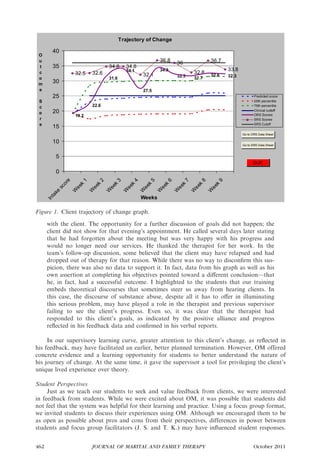
    5 years. I requested to see a chart of his ORS and SRS scores. In reviewing the graph,
    I noticed and discussed with the therapist and team that the client appeared connected
    to the therapist as evidenced by moderately high SRS scores. I also noted that he had
    achieved reliable change early in treatment and had maintained change, with fluctua-
    tions typical of everyday life circumstances. Figure 1 indicates the client’s early change
    and change maintenance during the course of treatment.
    The client exceeded the expected treatment response4 (ETR) (dashed line) and the clini-
    cal cutoff (solid line) by the third visit. In spite of the graph’s evidence of client
    change, the therapist insisted that she felt ‘‘stuck.’’ In her view, the client was at risk
    of relapse due to his substance use and possible loss of his current job, even though he
    had reported success toward his goals in their last session. I suggested that the meeting
    scheduled for that evening review the client’s goals, using his graph as a backdrop for
    this conversation. If new data indicated that he was maintaining positive change, it
    would be appropriate to discuss termination. I reframed being stuck as being stuck in
    seeing change. Nevertheless, these speculations needed to be confirmed in dialogue

October 2011                   JOURNAL OF MARITAL AND FAMILY THERAPY                               461
Trajectory of Change

          40
 O
 u                                                            36.8    36              36.7
 t        35                          34.8     34.8
                                               34.1           34.3                            33.8
 c                    32.5    32.6                    32.1                    32.8    32.6
                                                                      32.3    31.7            32.3
 o                                    31.6
 m
          30
 e                                                    27.5
          25                                                                                                Predicted score
 S                                                                                                          25th percentile
 c                            22.6                                                                          75th percentile

 o        20                                                                                                Clinical cuttoff
                                                                                                            ORS Scores
                      19.2
 r                                                                                                          SRS Scores
 e                                                                                                          SRS Cutoff
          15
                                                                                                     Go to ORS Data Sheet
                                                                                                     Go to ORS Data Sheet

          10                                                                                         Go to SRS Data Sheet
                                                                                                     Go to SRS Data Sheet


           5
                                                                                                           QUIT
                                                                                                           QUIT
           0
                 re


                          1


                                  2


                                          3


                                                  4


                                                          5


                                                                  6


                                                                          7


                                                                                  8


                                                                                          9
                        k


                                k


                                        k


                                                 k


                                                        k


                                                                k


                                                                        k


                                                                                k


                                                                                        k
               o

                      ee


                                      ee
                              ee


                                               ee


                                                      ee


                                                              ee


                                                                      ee


                                                                              ee


                                                                                      ee
            sc

                      W


                              W


                                      W


                                              W


                                                      W


                                                              W


                                                                      W


                                                                              W


                                                                                      W
            ke
         ta


                                                      Weeks
      In


Figure 1. Client trajectory of change graph.

      with the client. The opportunity for a further discussion of goals did not happen; the
      client did not show for that evening’s appointment. He called several days later stating
      that he had forgotten about the meeting but was very happy with his progress and
      would no longer need our services. He thanked the therapist for her work. In the
      team’s follow-up discussion, some believed that the client may have relapsed and had
      dropped out of therapy for that reason. While there was no way to disconfirm this sus-
      picion, there was also no data to support it. In fact, data from his graph as well as his
      own assertion at completing his objectives pointed toward a different conclusion—that
      he, in fact, had a successful outcome. I highlighted to the students that our training
      embeds theoretical discourses that sometimes steer us away from hearing clients. In
      this case, the discourse of substance abuse, despite all it has to offer in illuminating
      this serious problem, may have played a role in the therapist and previous supervisor
      failing to see the client’s progress. Even so, it was clear that the therapist had
      responded to this client’s goals, as indicated by the positive alliance and progress
      reflected in his feedback data and confirmed in his verbal reports.

     In our supervisory learning curve, greater attention to this client’s change, as reflected in
his feedback, may have facilitated an earlier, better planned termination. However, OM offered
concrete evidence and a learning opportunity for students to better understand the nature of
his journey of change. At the same time, it gave the supervisor a tool for privileging the client’s
unique lived experience over theory.

Student Perspectives
     Just as we teach our students to seek and value feedback from clients, we were interested
in feedback from students. While we were excited about OM, it was possible that students did
not feel that the system was helpful for their learning and practice. Using a focus group format,
we invited students to discuss their experiences using OM. Although we encouraged them to be
as open as possible about pros and cons from their perspectives, differences in power between
students and focus group facilitators (J. S. and T. K.) may have influenced student responses.


462                           JOURNAL OF MARITAL AND FAMILY THERAPY                                         October 2011
However, the consistency among comments, both in the formal focus group and in other
contact settings, gives credence to students’ observations. The following are some of the themes
that emerged from the focus group, with exemplars:
• Gives a conceptual and practical framework to establish early comfort and confidence
    I think for the first time I was a little relieved because I wasn’t sure how to approach
    working with a client right away. It was a good way to start a conversation with
    somebody.

• Provides practical guidance for structuring the session
    It definitely makes it easier to start . . . it just allows that opening to know where to
    go right from the beginning of a session and not to miss certain areas.

• Provides a format for clients to guide treatment
    [To client] as far as last time when we talked after the session you had said [we] hadn’t
    quite been on goals so I wanted to start out this next session talking about some of
    the goals that you had.

• Provides an incentive for expanding beyond one’s comfort zone and for learning new skills
    I got a low score. . . . I asked why, what can make this a little bit better and he’s like
    well, you can be a bit more direct. . . . I was like ok, you want me to be more direct,
    I’m gonna take it and run with it.. That’s hard for me, like ok you know we are get-
    ting a little bit off topic. So that was a way for me to say that and be comfortable with
    it because he had told me to do it.

• Helps to minimize guesswork regarding whether progress is being made or a case may be at risk
    I think I was more anxious than nervous because I wanted to know even if it was bad.
    I still wanted to know because if it’s bad then you can ask how you can fix it. But if
    you never know, then you never know.

• Provides a format for learning about children’s views
    I think it’s great to use these forms with kids. Especially because it’s really hard to get
    into their emotional level . . . they can actually mark where they are and let you know
    why and give examples. . . . Without using the forms, it’s real hard to identify for a
    kid where he or she is right now.

     Many of our students’ comments were similar to those expressed by trainee participants in
Reese et al. (2009). In that study, novice therapists in the feedback condition were pleased to
see how they were doing with their clients—they felt that client feedback gave them more struc-
ture and a good place to start in difficult cases.

                       DISCUSSION AND FUTURE DIRECTIONS

     In the current era of accountability, the call to devise outcome-based protocols for train-
ing competent, effective family and couple practitioners is timely. To date, MFT training has
not sufficiently incorporated robust findings regarding the efficacy of routine utilization of
client feedback. Adopting an OM system into our training curricula has enhanced our ability
to teach and assess trainee effectiveness. Moreover, we have realized a merging of practice
and program philosophy, an energizing of students and faculty around an innovative method,
enhanced research opportunities, and greater accountability to clients and the University.
Data collected over the past 3 years indicate that students are achieving outcomes that exceed
what would be expected. According to our storage and interpretation software, clients


October 2011                   JOURNAL OF MARITAL AND FAMILY THERAPY                              463
receiving family and couple therapy (n = 159) from first- and second-year students trained
and regularly entering data (n = 18) reached target benchmark 69% of the time. This is
remarkable given research indicating that as few as 32.7% of clients served by university
counseling centers either improve or recover (Hansen, Lambert, & Forman, 2002). The aver-
age length of stay for clients for the sample of trained therapists was 2.7 months, with an
average number of sessions just over 7. While a statistical comparison of these findings with
outcomes prior to OM implementation is in process, anecdotal evidence suggests that clients
are dropping out less frequently and fewer cases are extending beyond 4 months when no
measurable change has occurred.
     As educators, we are able to respond more effectively to immediate in-session and session-
to-session clinical process. Additionally, we are better able to identify student learning needs
and collaborate with them in developing specific learning objectives. Knowing that feedback
has a positive impact on poorer-performing therapists has provided a hopeful learning context
for all students, particularly those experiencing difficulty engaging clients. Teaching and learn-
ing now take place within a climate of optimism. It was always our aim to say that we train
effective couple and family therapists. We are now confident that we have a method for accom-
plishing this goal. Furthermore, students leaving us have evidence, and the confidence that goes
with it, of their own ability to help others. We cannot take full credit for this achievement. In a
very real sense, clients have become our best trainers.
     Steps remain for fuller integration of OM into our program. First, we need to better train
students to attend to computer-generated alerts and respond immediately by seeking super-
vision. Second, faculty needs greater facility with the software capabilities for monitoring
student progress to offer timely and targeted assistance for each student. Third, the use of OM
as an evaluative tool requires further articulation. Currently, we are developing a training struc-
ture that will serve as a guide for assessing student progress in becoming a competent and effec-
tive couple and family therapist. We are interested in the trainee’s ability to conceptually grasp
the implications of the empirical case for feedback, utilize the OM feedback system, and
respond to assessment of their effectiveness with each client and their accumulated caseload
data over time. Essentially, we believe that students who value learning from client feedback
and integrate it into their ongoing practice, with the assistance of faculty and supervisors, will
improve their outcomes. Similarly, data from OM can provide objective indices of particular
core competencies. We envision the continuous collection of student practice outcomes across
training venues, including off-site internships.
     We believe strongly that student caseload ratings of outcome and alliance not be sources of
grading or promotion. In our opinion, this would have the unfortunate consequence of shifting
student, and perhaps client, attention away from the true purpose of gathering client data (cli-
ent welfare and student learning) toward a competitive reward and punishment process.
Instead, grading should reflect students’ engagement in the process and willingness to learn
from clients. Based on available research, we have confidence that students who want to
improve will improve using client feedback. We have witnessed some students struggle early,
but rapidly make measurable progress because of a persistent willingness to learn from their
clients. While there may be some initial trepidation students have in holding up the mirror of
feedback and taking a hard look, our mantra is ‘‘There is no negative feedback, only negative
responses to it.’’
     Finally, we have yet to fully exploit the research possibilities now available by virtue of
systematic data collection and storage. As data accumulate, we will be in a position to provide
objective evidence of service efficiency, overall site ES, average lengths of stay, and other
important practice data that will help us not only train students better but also improve service
to the community. We currently are developing a project that will more formally evaluate,
using quantitative and qualitative analyses, the impact of adoption of OM on our student
learning outcomes and service delivery. This project will include perspectives of key stakehold-
ers—clients, students, faculty, and members of the University and larger communities con-
cerned with the evaluation of learning and practice outcomes.
     Based on the research to date and our own experience, we agree with Michael Lambert
that, yes, it is time for clinicians to routinely monitor outcome (Lambert, 2010). As Worthen


464                   JOURNAL OF MARITAL AND FAMILY THERAPY                           October 2011
and Lambert (2007) suggest, trainees and their supervisors can utilize ongoing outcome assess-
ment to focus learning and skill development. The gap between student development and client
outcome can be bridged. In sum, feedback monitoring provides a viable means for addressing
the requirements that clinical programs develop and implement research-based training methods
and provide quality care to all clients. Students, learning from clients, learn to be accountable
from their very first training experiences and throughout their professional careers as marriage
and family therapists.

                                               REFERENCES

Anker, M. G., Duncan, B. L., Owen, J., & Sparks, J. A. (2010). The alliance in couple therapy: Partner influence,
      early change, and alliance patterns in a naturalistic sample. Journal of Consulting and Clinical Psychology,
      78, 635–645.
Anker, M. G., Duncan, B. L., & Sparks, J. A. (2009). Using client feedback to improve couple therapy outcomes:
      A randomized clinical trial in a naturalistic setting. Journal of Consulting and Clinical Psychology, 77, 693–
      704.
APA Presidential Task Force on Evidence-Based Practice. (2006). Evidence-based practice in psychology. Ameri-
      can Psychologist, 61, 271–285.
Avis, J. M., & Sprenkle, D. H. (1990). Outcome research on family therapy training: A substantive and methodo-
      logical review. Journal of Marital and Family Therapy, 16, 241–264.
Baldwin, S. A., Berkeljon, A., Atkins, D. C., Olsen, J. A., & Neilsen, S. L. (2009). Rates of change in naturalistic
      psychotherapy: Contrasting dose–effect and good-enough level models of change. Journal of Consulting and
      Clinical Psychology, 77, 203–211.
Beutler, L. E., Malik, M., Alimohamed, S., Harwood, T. M., Talebi, H., Noble, S., et al. (2004). Therapist
      effects. In M. J. Lambert (Ed.), Bergin & Garfield’s handbook of psychotherapy and behavior change (5th ed.,
      pp. 227–306). New York: Wiley.
Bohanske, R. T., & Franczak, M. (2010). Transforming public behavioral health care: A case example of con-
      sumer-directed services, recovery, and the common factors. In B. L. Duncan, S. D. Miller, B. E. Wampold,
      & M. A. Hubble (Eds.), The heart and soul of change: Delivering what works (2nd ed., pp. 299–322).
      Washington, DC: American Psychological Association.
Bordin, E. S. (1979). The generalizability of the psychoanalytic concept of the working alliance. Psychotherapy,
      16, 252–260.
Burlingame, G. M., Jasper, B. W., Peterson, G., Wells, M. G., Lambert, M. J., Reisinger, C. W., et al. (2001).
      Administration and scoring manual for the Y-LSQ. Stevenson, MD: American Professional Credentialing
      Services and Pacificare Behavioral Health.
Callahan, J. L., Almstrom, C. M., Swift, J. K., Borja, S. E., & Heath, C. J. (2009). Exploring the contribution of
      supervisors to intervention outcomes. Training and Education in Professional Psychology, 3(2), 72–77.
Campbell, A., & Hemsley, S. (2009). Outcome Rating Scale and Session Rating Scale in psychological practice:
      Clinical utility of ultra-brief measures. Clinical Psychologist, 13(1), 1–9.
Committee on Quality of Health Care in America. (2001). Crossing the quality chasm: A new health system for the
      21st century. Washington, DC: Institute of Medicine, National Academies Press. Retrieved May 8, 2009,
      from http://www.nap.edu/books/0309072808/html/
Duncan, B., Miller, S., & Sparks, J. (2004). The heroic client: A revolutionary way to improve effectiveness through
      client-directed, outcome-informed therapy. San Francisco: Jossey-Bass.
Duncan, B. L., Miller, S. D., Sparks, J. A., Claud, D. A., Reynolds, L. R., Brown, J., et al. (2003). The Session
      Rating Scale: Preliminary psychometric properties of a ‘‘working’’ alliance measure. Journal of Brief Ther-
      apy, 3(1), 3–12.
Duncan, B., & Sparks, J. (2010). Heroic clients, heroic agencies: Partners for change (Rev. ed.). Retrieved from
      http://www.heartandsoulofchange.com.
Duncan, B., Sparks, J., Miller, S., Bohanske, R., & Claud, D. (2006). Giving youth a voice: A preliminary study
      of the reliability and validity of a brief outcome measure for children. Journal of Brief Therapy, 3, 3–12.
Ellis, M. V., & Ladany, N. (1997). Inferences concerning supervisees and clients in clinical supervision: An inte-
      grative review. In C. E. Watkins (Ed.), Handbook of psychotherapy supervision (pp. 447–507). New York:
      Wiley.
Falender, C. A., Cornish, J. A. E., Goodyear, R., Hatcher, R., Kaslow, N. J., Leventhal, G., et al. (2004).
      Defining competencies in psychology supervision: A consensus statement. Journal of Clinical Psychology, 60,
      771–785.
Freitas, G. J. (2002). The impact of psychotherapy supervision on client outcome: A critical examination of 2
      decades of research. Psychotherapy: Theory, Research, Practice, Training, 39, 354–367.


October 2011                         JOURNAL OF MARITAL AND FAMILY THERAPY                                     465
Haas, E., Hill, R. D., Lambert, M. J., & Morrell, B. (2002). Do early responders to psychotherapy maintain
     treatment gains? Journal of Clinical Psychology, 58, 1157–1172.
Hannan, C., Lambert, M. J., Harmon, C., Nielsen, S. L., Smart, D. W., Shimokawa, K., et al. (2005). A lab test
     and algorithms for identifying clients at risk for treatment failure. Journal of Clinical Psychology: In Session,
     61, 155–163.
Hansen, N. B., Lambert, M. J., & Forman, E. M. (2002). The psychotherapy dose-response effect and its implica-
     tions for treatment delivery services. Clinical Psychology, 9, 329–343.
Hodgson, J. L., Johnson, L. N., Ketring, S. A., Wampler, R. S., & Lamson, A. L. (2005). Integrating research
     and clinical training in marriage and family therapy training programs. Journal of Marital and Family Ther-
     apy, 31, 75–88.
Hoge, M. A., Morris, J. A., Daniels, A. S., Huey, L. Y., Stuart, G. W., Adams, N., et al. (2005). Report of rec-
     ommendations: The Annapolis Coalition Conference on Behavioral Health Work Force Competencies.
     Administration and Policy in Mental Health, 32, 651–663.
Holloway, E., & Carroll, M. (1996). Reaction to the special section on supervision research: Comment on Ellis
     et al. (1996), Ladany et al. (1996), and Worthen and McNeill (1996). Journal of Counseling Psychology, 43,
     51–55.
Horvath, A. O., & Bedi, R. P. (2002). The alliance. In J. C. Norcross (Ed.), Psychotherapy relationships that work
     (pp. 37–69). New York: Oxford University Press.
Howard, K. I., Moras, K., Brill, P. L., Martinovich, Z., & Lutz, W. (1996). Evaluation of psychotherapy: Effi-
     cacy, effectiveness, and patient progress. American Psychologist, 51, 1059–1064.
Jacobson, N. S., & Truax, P. (1991). Clinical significance: A statistical approach to defining meaningful change in
     psychotherapy research. Journal of Consulting and Clinical Psychology, 59, 12–19.
Kaslow, N. J., Celano, M. P., & Stanton, M. (2005). Training in family psychology: A competencies-based
     approach. Family Process, 44, 337–353.
Kaslow, N. J., Rubin, N. J., Bebeau, M. J., Leigh, I. W., Lichtenberg, J. W., Nelson, P. D., et al. (2007). Guid-
     ing principles and recommendations for the assessment of competence. Professional Psychology: Research
     and Practice, 38, 441–451.
Lambert, M. J. (2010). Yes, it is time for clinicians to routinely monitor treatment outcome. In B. L. Duncan,
     S. D. Miller, B. E. Wampold, & M. A. Hubble (Eds.), The heart and soul of change. Delivering what works
     (2nd ed., pp. 239–266). Washington, DC: American Psychological Association Press.
Lambert, M. J., Hansen, N. B., Umphress, V., Lunnen, K., Okiishi, J., Burlingame, G. M., et al. (1996). Adminis-
     tration and scoring manual for the OQ 45.2. Stevenson, MD: American Professional Credentialing Services.
Lambert, M. J., & Hawkins, E. J. (2001). Using information about patient progress in supervision: Are outcomes
     enhanced? Australian Psychologist, 36, 131–138.
Lambert, M. J., & Ogles, B. M. (1997). The effectiveness of psychotherapy supervision. In C. E. Watkins (Ed.),
     Handbook of psychotherapy supervision (pp. 421–446). New York: Wiley.
Lambert, M. J., & Ogles, B. (2004). The efficacy and effectiveness of psychotherapy. In M. J. Lambert (Ed.), Ber-
     gin and Garfield’s handbook of psychotherapy and behavioral change (5th ed., pp. 139–193). New York: Wiley.
Leigh, I. W., Smith, I. L., Bebeau, M. J., Lichtenberg, J. W., Nelson, P. D., Portnoy, S., et al. (2007). Compe-
     tency assessment models. Professional Psychology: Research and Practice, 38, 463–473.
Levant, R. F., & Silverstein, L. B. (2006). Gender is neglected by both evidence-based practices and treatment as
     usual. In J. C. Norcross, L. E. Beutler, & R. L. Levant (Eds.), Evidence-based practices in mental health:
     Debate and dialogue on the fundamental questions (pp. 338–345). Washington, DC: American Psychological
     Association.
Lichtenberg, J. W., Portnoy, S. M., Bebeau, M. J., Leigh, I. W., Nelson, P. D., Rubin, N. J., et al. (2007). Chal-
     lenges to the assessment of competence and competencies. Professional Psychology: Research and Practice,
     38, 474–478.
Liddle, H. A., Breunlin, D. C., & Schwartz, R. C. (1988). Family therapy training and supervision: An introduc-
     tion. In H. A. Breunlin & R. C. Schwartz (Eds.), Handbook of family therapy training and supervision (pp. 3–
     9). New York: Guilford Press.
Luborsky, L., Barber, J., Siqueland, L., Johnson, S., Najavits, L., Frank, A., et al. (1996). The Revised Helping
     Alliance Questionnaire (HAQ-II): Psychometric properties. The Journal of Psychotherapy Practice and
     Research, 5, 260–271.
Martin, D. J., Garske, J. P., & Davis, M. K. (2000). Relation of the therapeutic alliance with outcome and other
     variables: A meta-analytic review. Journal of Consulting and Clinical Psychology, 68, 438–450.
Miller, S. D., Duncan, B. L., Brown, J., Sorrell, R., & Chalk, B. (2006). Using outcome to inform and improve
     treatment outcomes. Journal of Brief Therapy, 5, 5–22.
Miller, S. D., Duncan, B. L., Brown, J., Sparks, J., & Claud, D. (2003). The Outcome Rating Scale: A pre-
     liminary study of the reliability, validity, and feasibility of a brief visual analog measure. Journal of Brief
     Therapy, 2, 91–100.


466                       JOURNAL OF MARITAL AND FAMILY THERAPY                                       October 2011
Nelson, T. S., Chenail, R. J., Alexander, J. F., Crane, D. R., Johnson, S. M., & Schwallie, L. (2007). The devel-
     opment of core competencies for the practice of marriage and family therapy. Journal of Marital and Family
     Therapy, 33, 417–438.
Nichols, W. C., Nichols, D. P., & Hardy, K. V. (1990). Supervision in family therapy: A decade restudy. Journal
     of Marital and Family Therapy, 16, 275–285.
Ogles, B. M., Melendez, G., Davis, D. C., & Lunnen, K. M. (2001). The Ohio scales: Practical outcome assess-
     ment. Journal of Child and Family Studies, 10, 199–212.
Ogles, M. O., Carlston, D., Hatfield, D., Melendez, G., Dowell, K., & Fields, S. A. (2006). The role of fidelity
     and feedback in the wraparound approach. Journal of Child and Family Studies, 15, 115–129.
President’s New Freedom Commission on Mental Health. (2003). Achieving the promise: Transforming mental health
     in America. Final report. Rockville, MD: U.S. Department of Health and Human Services. Retrieved May 8,
     2009, from http://www.mentalhealthcommission.gov/reports/FinalReport/downloads/FinalReport.pdf
Reese, R. J., Usher, E. L., Bowman, D., Norsworthy, L., Halstead, J., Rowlands, S., et al. (2009). Using client
     feedback in psychotherapy training: An analysis of its influence on supervision and counselor self-efficacy.
     Training and Education in Professional Psychology, 3(3), 157–168.
Sapyta, J., Reimer, M., & Bickman, L. (2005). Feedback to clinicians: Theory, research, and practice. Journal of
     Clinical Psychology, 61, 145–153.
Sparks, J. A., & Duncan, B. L. (2010). Couple and family therapy and the common factors: Have all won prizes?
     In B. Duncan, S. Miller, B. Wampold, & M. Hubble (Eds.), The heart and soul of change: Delivering what
     works (2nd ed., pp. 357–392). Washington, DC: American Psychological Association.
Storm, C. L., Todd, T. C., Sprenkle, D. H., & Morgan, M. M. (2001). Gaps between MFT supervision assump-
     tions and common practice: Suggested best practices. Journal of Marital and Family Therapy, 27, 227–239.
Sue, S., & Zane, N. (2006). Ethnic minority populations have been neglected by evidence-based practices. In J. C.
     Norcross, L. E. Beutler, & R. L. Levant (Eds.), Evidence-based practices in mental health: Debate and dia-
     logue on the fundamental questions (pp. 329–337). Washington, DC: American Psychological Association.
Todd, T. C., & Storm, C. L. (Eds.). (1997). The complete systemic supervisor: Context, philosophy, and pragmatics.
     Boston: Allyn and Bacon.
Wampold, B. E., & Brown, G. (2005). Estimating therapist variability in outcomes attributable to therapists: A
     naturalistic study of outcomes in managed care. Journal of Consulting and Clinical Psychology, 73, 914–923.
White, M. B., & Russell, C. S. (1995). The essential elements of supervisory systems: A modified delphi study.
     Journal of Marital and Family Therapy, 21, 33–53.
Wierzbicki, M., & Pekarik, G. (1993). A meta-analysis of psychotherapy dropout. Professional Psychology:
     Research and Practice, 24, 190–195.
Worthen, V. E., & Lambert, M. J. (2007). Outcome oriented supervision: Advantages of adding systematic client
     tracking to supportive consultations. Counseling and Psychotherapy Research, 7(1), 48–53.

                                                   NOTES
          1
          The terms marriage and family therapy and couple and family therapy will be used
interchangeably, with an understanding that marriage and family therapy may not convey the
same inclusiveness of same-sex and unmarried couples as couple and family therapy.
         2
          The systematic use of client feedback has been called patient-focused research (How-
ard et al., 1996), client-directed, outcome-informed work (Duncan et al., 2004), and Partners
for Change Outcome Management System (PCOMS; Anker et al., 2009). We have chosen the
term OM as it fits our aim to describe the use of systematic feedback in managing both client
and student learning outcomes.
         3
          Measures can be downloaded from http://www.heartandsoulofchange.com.
         4
          The expected treatment response (ETR) refers to the computerized trajectory gener-
ated by the software based on the client’s initial intake ORS score. The ETR includes a bench-
mark score that is the maximum score at the 50th percentile trajectory based on all other client
trajectories with the same intake score in the database. Reaching the benchmark score is one
indicator of successful treatment.


October 2011                        JOURNAL OF MARITAL AND FAMILY THERAPY                                     467

TeachingAccountability

  • 1.
    Journal of Maritaland Family Therapy doi: 10.1111/j.1752-0606.2011.00224.x October 2011, Vol. 37, No. 4, 452–467 TEACHING ACCOUNTABILITY: USING CLIENT FEEDBACK TO TRAIN EFFECTIVE FAMILY THERAPISTS Jacqueline A. Sparks, Tiffani S. Kisler, Jerome F. Adams, and Dale G. Blumen University of Rhode Island The AAMFT Task Force on Core Competencies (Nelson et al., 2007) proposed that marriage and family therapy (MFT) educators teach and provide evidence of trainee competence beyond coursework and accrued clinical hours. This article describes the integration of a systematic client feedback protocol into an MFT-accredited program’s curricula to address the call for outcome-based learning. Outcome management (OM) provides a framework for teaching and assessing trainee effectiveness. Continuous incorporation of client feedback embodies collaborative, strengths-based, integrative, and diversity-centered program values. Students learn a system for being accountable to clients, the profession, and service communities. Within the past decade, calls have been made for the provision of ‘‘safe, effective, patient- centered, timely, efficient, and equitable’’ health care for all persons (Committee on Quality of Health Care in America, 2001, pp. 7–8). This call has extended to mental health services (Presi- dent’s New Freedom Commission on Mental Health, 2003). Moreover, consumers have demanded evidence of treatment effectiveness. In response, mental and behavioral health orga- nizations have taken steps to define effective, safe care (e.g., see APA Presidential Task Force on Evidence-Based Practice; Hoge et al., 2005; Nelson et al., 2007). Despite varying definitions of best practice, mental health disciplines appear united in the ethics of providing evidence of effectiveness. Indeed, a current focus on outcome, the sine qua non of effectiveness evidence, prompted Leigh et al. (2007) to call this the ‘‘era of accountability’’ (p. 463). The AAMFT Task Force on Core Competencies responded to the demand for accountabil- ity by first defining six domains of knowledge and skills required for entry-level independent practice as a marriage and family therapist (Nelson et al., 2007).1 These domains encompass all aspects of care and presumably define competent practice as a couple and family therapist. The Task Force invited further discussion regarding how best to teach and assess competence and suggested that training models shift from an input-oriented to outcome-based education. This entails less reliance on coursework and accrual of clinical hours as proof that trainees can pro- vide effective care (Nelson et al., 2007). Instead, trainees would be required to demonstrate that their educational experiences have translated into core skills. That training of clinical practitioners should include teaching demonstrable skills seems obvious. However, some have questioned whether therapist skill development leads to better cli- ent outcomes. According to Lambert and Hawkins (2001), the degree to which skills generalize to practice is inconclusive. For example, students may succeed in learning a particular skill set, yet have difficulty transporting that into the therapy room. Moreover, there is evidence that therapist mastery of specific interventions may actually interfere with client and therapist engagement, resulting in suboptimal outcomes (Beutler et al., 2004; Lambert & Ogles, 2004). Jacqueline A. Sparks, PhD, Associate Professor, Department of Human Development and Family Studies, Couple and Family Therapy Program, University of Rhode Island, Director of the Couple and Family Therapy Clinic, University of Rhode Island; Tiffani S. Kisler, PhD, Assistant Professor, Department of Human Development and Family Studies, Couple and Family Therapy Program, University of Rhode Island; Jerome F. Adams, PhD, Chair of the Department of Human Development and Family Studies, Director of the Couple and Family Therapy Program, University of Rhode Island; Dale G. Blumen, MS, Coordinator of the Couple and Family Therapy Clinic, University of Rhode Island. The authors wish to thank Barry Duncan for his generous assistance in the preparation of this article. Address correspondence to Jacqueline A. Sparks, 2 Lower College Rd., Kingston, Rhode Island 02881; E-mail: jsparks@uri.edu 452 JOURNAL OF MARITAL AND FAMILY THERAPY October 2011
  • 2.
    Furthermore, means ofevaluating knowledge may be readily available, while methods assessing skills present greater challenges (Leigh et al., 2007). Lichtenberg et al. (2007) claimed that tradi- tional paper and pencil testing lacks ecological validity in evaluating practice skills. These con- siderations present practical and conceptual challenges in evaluating competence. One response to addressing these difficulties is the incorporation of information derived directly from the trainee’s clinical practice. Psychology educators have asserted that assessment methods that do not involve direct observation of the person in actual situations, do not include feedback from clients, and do not assess clinical outcomes cannot adequately evaluate a trainee’s ability to help clients (Leigh et al., 2007; Lichtenberg et al., 2007). Kaslow, Celano, and Stanton (2005) described a competencies-based approach in family psychology as one emphasizing ‘‘the ability to apply knowledge and skills in the real world and [one that] uses performance outcome as criteria for evaluating learners and training programs’’ (p. 338). The APA’s Task Force on the Assessment of Competence has endorsed assessments that evaluate the trainee’s intervention with clients (Kaslow et al., 2007). Similarly, the Annapolis Coalition recommended the use of multiple data sources for assessment, including client surveys (Hoge et al., 2005). Family therapy educators have proposed the use of evaluative tools in supervision as one framework for assessing competence (Nelson et al., 2007). Supervision has long been a mainstay of quality assurance in therapist training (Falender et al., 2004) and particularly for MFTs (Liddle, Breunlin, & Schwartz, 1988; Nichols, Nichols, & Hardy, 1990; Todd & Storm, 1997; White & Russell, 1995). Supervision ultimately should serve client welfare (e.g., Avis & Sprenkle, 1990; Holloway & Carroll, 1996; Worthen & Lambert, 2007). However, decades of research have produced very little regarding its actual impact on outcome (Ellis & Ladany, 1997; Freitas, 2002; Lambert & Hawkins, 2001; Lambert & Ogles, 1997; Storm, Todd, Sprenkle, & Morgan, 2001). One recent study, addressing methodological concerns of earlier studies, found that supervision exerted a moderate effect on outcome, accounting for approximately 16% of the outcome vari- ance beyond that accounted for by the client’s initial severity and therapist attributes (Callahan, Almstrom, Swift, Borja, & Heath, 2009). Nevertheless, with so few studies, it is still reasonable to state, as Storm et al. did, that ‘‘it would not be overstating the case to assert that the field’s belief in the importance of supervision rests mostly on faith’’ (p. 227). Similarly, therapists in training are most often supervised without any objective informa- tion about clients’ responses to the therapy (Sapyta, Reimer, & Bickman, 2005). As ‘‘support- ive consultation,’’ supervision may be considered satisfactory by both supervisor and supervisee, yet remain disconnected to whether or not clients improve (Worthen & Lambert, 2007, p. 4). In other words, supervision as a benefit for therapist development is separated from client benefit. This disconnect has prompted recommendations for routinely incorporating client outcome information into the supervision process (Lambert & Hawkins, 2001; Worthen & Lambert, 2007). This would require trainees to systematically track and discuss progress of their cases in supervision. Supervisors can then provide targeted oversight in addressing cases not proceeding satisfactorily while supervisees learn the value of flexible, informed clinical practice. To date, agreed-upon guidelines for assisting couple and family therapy educators to train a competent, accountable workforce have not been devised. Realignment of educational curricula in MFT training programs with identified competencies is likely to take a decade (Nelson et al., 2007). Moreover, the field has yet to offer guidance regarding the integration of practice-based research into all aspects of clinical training, including supervision. Further- more, the cogent critiques of training methods that do not include client outcomes appear underrepresented in MFT literature and practice. This article discusses one MFT-accredited program’s efforts to integrate a systematic client feedback protocol into its training, super- vision, and educational curricula in an effort to develop procedures consistent with the transition to outcome-based learning recommended by the AAMFT and address the call for accountability in delivering measurably effective treatment. We begin by describing the evolu- tion of an OM system at our family therapy program at the University of Rhode Island and its integration into coursework, clinical training, and supervision. We report students’ views of their experiences with this method and conclude with discussion and future directions for the field. October 2011 JOURNAL OF MARITAL AND FAMILY THERAPY 453
  • 3.
    CLIENT FEEDBACK ANDOUTCOME A relatively new research paradigm offers a potential training model to bridge research and practice and teach trainees the ethical and practical value of being accountable to their clients. Howard, Moras, Brill, Martinovich, and Lutz (1996) advocated for the systematic evaluation of client response to treatment during the course of therapy and recommended such information be used to ‘‘determine the appropriateness of the current treatment . . . the need for further treat- ment . . . [and] prompt a clinical consultation for patients who [were] not progressing at expected rates’’ (p. 1063). The development of new statistical techniques has allowed researchers and clini- cians to generate trajectories of change using session-by-session data and to compare client pro- gress with similar clients utilizing large databases of client change scores. These comparisons generate probabilistic predictions about the client’s posttreatment outcome (see Lambert, 2010). Computerized predictions provide a basis for identifying clients who are not responding as expected and a chance for clinicians to respond accordingly. Computerized predictions, in fact, have proven superior to therapists. Hannan et al. (2005), comparing therapist predictions of client deterioration to actuarial methods, found that therapists identified only one of the 40 clients who deteriorated, even though they were aware of the study’s purpose and informed that the base rate was likely to be 8%. In contrast, the actuarial method correctly predicted 36 of the 40. Investigations into client feedback methods have revealed consistently positive findings. In a meta-analysis of five major randomized trials, Lambert (2010) reported that as many as 45% of feedback groups, supplemented with clinical support tools (alliance measures, motivation assess- ment, and discussion of client support systems) reached reliable improvement and clinically significant change (Jacobson & Truax, 1991) compared with 22% of treatment as usual (TAU) at-risk cases. Miller, Duncan, Brown, Sorrell, and Chalk (2006) used continuous feedback and brief outcome instruments to explore the impact of feedback in a large, culturally diverse sample (n = 6,424) utilizing telephonic employee assistance services. The use of outcome feedback doubled the effect size (ES) from 0.37 to 0.79 and significantly increased retention. Couple and family feedback research lags behind individual studies, perhaps in part because of the complexity of obtaining frequent measurements from multiple persons in a given couple or family unit. A small recent study of feedback in wraparound services for youth and families (Ogles et al., 2006) found that provision of feedback at four intervals using the 48-item Ohio Scales (Ogles, Melendez, Davis, & Lunnen, 2001) did not contribute to improved youth outcomes or family func- tioning in comparison with a no-feedback group. Sparks and Duncan (2010) suggest that lack of separation between feedback and no-feedback conditions in this study can be explained by the collection of feedback at only four intervals during the course of treatment. Moreover, Lambert (2010) cautions that lack of continuous monitoring limits findings as effects of dropout or pre- mature termination are unknown. Reese et al. (2009), using briefer instruments, found that MFT and counseling trainees (N = 28) assigned to the continuous feedback condition and who shared feedback with their supervisors were approximately twice as effective as those in the no-feedback condition over the course of an academic year. Trainees in both feedback and no-feedback groups increased their sense of self-efficacy over the year, but only feedback trainees’ self-efficacy correlated with client outcome. A strong effect of feedback also was found in a recent couples study (Anker, Duncan, & Sparks, 2009), the largest clinical trial with couples to date. Couples (N = 205) at a community-based family counseling clinic were randomly assigned to either TAU or feedback. Feedback couples demonstrated significantly greater improvement at termination than those in the TAU condition and achieved over four times the rate of clinically significant change. This superior- ity carried over at follow-up—divorce and separation rates for feedback couples were 46.2% less than for couples who received therapy as usual 6 months after termination. In sum, there are, to date, eight trials supporting the use of client feedback to monitor treatment and improve outcomes. OUTCOME MANAGEMENT ADOPTION Our adoption of a client feedback system, or OM (Duncan, Miller, & Sparks, 2004),2 grew out of a consensus regarding the value of OM as a research-informed method for training therapists to work effectively with families and couples. Outcome management refers to the 454 JOURNAL OF MARITAL AND FAMILY THERAPY October 2011
  • 4.
    systematic collection ofclient feedback regarding progress and the alliance during treatment to facilitate management of the therapy toward the best possible outcome. We believed that clients had largely been overlooked as teachers for those in training. Instituting a formal client feed- back system could bring clients to the front of the class, so to speak, to impart valuable lessons in how to be of assistance to those seeking change in therapy. Research is clear regarding the significance of therapist variability in relation to outcome. Some therapists clearly are better than others in helping clients reach optimal benefit (Beutler et al., 2004; Wampold & Brown, 2005). Depending on the study, therapist effects range from 6% to 9% of the overall variance of change, or about 6–9 times more than that of model differences. Differences in therapist ability are often apparent early in the training process. However, there is evidence that therapists performing poorly can improve when they routinely integrate client feedback into their work. For example, Anker et al. (2009) found that 9 of 10 therapists improved their outcomes with feedback. Moreover, less-effective therapists benefited more from feedback than the most effective therapists. Feedback, therefore, seems to act as a leveler. In another study, the number of below-average counselors dropped by 80% after feed- back was implemented (Bohanske & Franczak, 2010). A feedback system, then, would give us a field-tested method for helping trainees with poorer outcomes improve. In light of current research, we also speculated that OM could serve as a vehicle for improving the effectiveness of our clinic services. Dropouts are a significant problem in the delivery of mental health services, averaging at least 47% (Wierzbicki & Pekarik, 1993). More- over, there is evidence that training clinics have more premature terminations and fewer suc- cessful outcomes than other outpatient settings (Callahan et al., 2009). Training clinics often provide services to financially disadvantaged clients, making the mandate for the provision of quality care of particular concern. Our family therapy clinic serves a predominantly low-income outpatient population. Approximately 90% of clients meet federal poverty guidelines. Providing the best care possible for the population we serve is particularly critical. In addition to enhanced service to clients and improved training, implementing an OM system would provide students with opportunities to engage in practice-based research. MFT research and practice historically have been disconnected, if not viewed as in opposition (Hodg- son, Johnson, Ketring, Wampler, & Lamson, 2005). Ironically, the immediate practice environ- ments characteristic of most MFT programs are prime locales for the integration of research and clinical work. Without protocols for evaluative research, clinics operate ‘‘in the dark,’’ and students absorb the message that continuous assessment of services is not important. We could not think of a more powerful way to instill in students a sense of the ethics and utility of a client-service system loop than through the requirement that they systematically elicit and be informed by client feedback. Further, OM would supplement our ongoing research and client satisfaction protocols. As data are collected at each session, pre- and posttherapy data are available for each client, even those who drop out or do not respond to follow-up. Outcome management additionally appeared to be an opportunity for us to put into prac- tice assumptions that underpin our program. Our students are expected to collaborate with their colleagues as well as their clients. Further, they are taught to support clients’ unique strengths and resources. We felt that teaching students to routinely ask for and respond to client feedback would embody core values related to collaboration and a strengths focus. Addi- tionally, our program is integrative, exposing students to many different theories and models. We encourage students to utilize those approaches that resonate for them. We speculated that routine client feedback could provide a safety net to ensure that a favored approach was, in fact, working and prompt a shift to a different one when it was not. In this way, OM would serve as a centerpiece for student integration of diverse treatment models. We further considered that OM would give life to our program’s commitment to diversity; students could put into practice what they were learning about diversity in the classroom. Gov- ernment reports have concluded that nondominant groups often face treatments that fail to consider their unique contexts and are, therefore, ineffective (Sue & Zane, 2006). Furthermore, training in cultural competency, particularly in a stand-alone course, may inadvertently margin- alize diversity and reinforce blindness to privilege disparities between White, heterosexual, middle-class mental health professionals and their diverse clientele (Levant & Silverstein, 2006). October 2011 JOURNAL OF MARITAL AND FAMILY THERAPY 455
  • 5.
    With client voicesguiding clinical work, trainees could learn from and better assist persons whose social and cultural locations differed from their own. The outcome assessment measures chosen consist of content-free dimensions, requiring therapists to invite clients to clarify their views regarding their unique journeys of change. We hoped that a process of respectful inquiry, embodied in this collaborative feedback system, would help students step outside their own worlds and understand more fully those of their clients. As educators in an accredited MFT training program, we were interested in how to move from an input-oriented to outcome-based education model (see Nelson et al., 2007). With this in mind, we considered how OM might help us assess learning outcomes not measured by test scores or standard numbers of accrued clinical hours. In the broadest sense, we grasped the obvious link between utilization of an OM system and the important objective of training students to effectively help clients. More specifically, we began to recognize that OM could provide a means for teaching and evaluating particular MFT core competencies. Based on a preliminary mapping of OM onto a core competencies framework, we identified numerous areas of congruence. For example, within the primary domain ‘‘Admission to Treat- ment,’’ OM directly addresses the following executive functions: • Establish and maintain appropriate and productive therapeutic alliances with the clients. • Solicit and use client feedback throughout the therapeutic process. Pertaining to ‘‘Clinical Assessment and Diagnosis,’’ OM procedures support the following: • Assess each client’s engagement in the change process. • Identify clients’ strengths, resilience, and resources. • Assess the therapist–client agreement of therapeutic goals and diagnosis. Similarly, specific therapist activities listed for ‘‘Treatment Planning and Case Manage- ment’’ are consistent with OM procedures: • Integrate client feedback, assessment, contextual information, and diagnosis with treat- ment goals and plan. • Evaluate progress of sessions toward treatment goals. • Recognize when treatment goals and plan require modification. OM is especially pertinent to the domain ‘‘Therapeutic Interventions’’: • Match treatment modalities and techniques to clients’ needs, goals, and values. • Modify interventions that are not working to better fit treatment goals. • Evaluate ability to deliver interventions effectively. • Evaluate treatment outcomes as treatment progresses. • Evaluate clients’ reactions or responses to interventions. • Evaluate clients’ outcomes for the need to continue, refer, or terminate therapy. The overlap between OM and MFT core competencies that emerged after our analysis con- vinced us that use of the system could provide a bridge between traditional learning assessment and more objective and meaningful evaluations of student outcomes. Finally, OM had additional appeal for our program based on broader contextual elements in the University and community environments. The University of Rhode Island, in which our program is located, had moved to an outcome-based model of learning evaluation. Including measurable outcomes generated by client report would be one way of providing evidence of stu- dent progress. Larger systems of care serving children and families in our state with whom our students interact in internships were similarly moving toward developing models that would measurably identify treatment success or failure. We believed that it was important that our program be accountable to the University and that students appreciate the context of systems of care in which they are likely to spend a good portion of their professional careers. OUTCOME MANAGEMENT PROTOCOL Despite its fit with our program, the road to implementation of an OM system has required a shift in all aspects of how our students learn and how we teach. Our first step was 456 JOURNAL OF MARITAL AND FAMILY THERAPY October 2011
  • 6.
    choosing the measuresstudents would use in session with clients. We selected the Outcome Rating Scale (ORS; Miller, Duncan, Brown, Sparks, & Claud, 2003) and Child Outcome Rating Scale (CORS; Duncan, Sparks, Miller, Bohanske, & Claud, 2006) as outcome measures, and the Session Rating Scale (SRS; Duncan et al., 2003) and Child Session Rating Scale (CSRS) as alliance measures.3 The ORS and SRS are validated for use with adults and adoles- cents aged 13–17 and the CORS for children between the ages of 6 and 12. The instruments collapse multiple items into a few broad domains, minimizing disruption of the session when administered. This is especially important because OM protocols recommend tracking client progress and alliance at each meeting. At our clinic, children, their caretakers, and extended family are often seen together in session. Feasibility, therefore, is critical. The brevity and face validity of the instruments facilitate administration within this context. In addition, the measures selected had been translated into many languages. Many areas of our small state are ethnically diverse. We wanted to be sure that all our clients could participate comfortably. Most importantly, the measures met our standards of practicality for everyday clinical use without sacrificing validity and reliability. Miller et al. (2003) reported that the internal consistency of the ORS was 0.93 and test–retest reliability was 0.66. The ORS has demonstrated adequate con- current validity through correlates with the Outcome Questionnaire 45.2 (Lambert et al., 1996; r = .74; Campbell & Hemsley, 2009; r = .59; Miller et al., 2003). The ORS and CORS have displayed strong evidence of reliability for adolescent and 6–12 age groups, with coefficient alpha estimates of 0.93 and 0.84, respectively (Duncan et al., 2006). The CORS ⁄ ORS and Youth Outcome Questionnaire 30 (YOQ; Burlingame et al., 2001) caretaker scores have shown correla- tions of 0.61; the ORS and YOQ completed by adolescents resulted in a 0.53 correlation. These correlations provide evidence of the concurrent validity of the CORS ⁄ ORS as brief alternatives for assessing global individual well-being similar to that measured by the full-scale YOQ. Our decision to measure the therapeutic alliance was based on consistent findings of the association between the alliance and outcome across treatment modalities (Horvath & Bedi, 2002; Martin, Garske, & Davis, 2000). Accurate assessment of the alliance, especially early in treatment, alerts therapists to potential ruptures and permits corrective efforts to be undertaken when necessary. We selected client–report alliance measures based on evidence of superior pre- dictive capacity of this source over therapist or observational ratings (Horvath & Bedi, 2002). The SRS offered a short, reliable, and valid client–report form for alliance measurement. Initial research has shown that the SRS generates reliable, valid scores. Duncan et al. (2003) found that the SRS had a coefficient alpha of 0.88 and a correlation coefficient of 0.48 with the Help- ing Alliance Questionnaire–II (HAQ-II; Luborsky et al., 1996) and 0.63 with the Working Alli- ance Inventory (Campbell & Hemsley, 2009). Test–retest reliabilities averaged 0.74 across the first six sessions with the SRS compared to 0.69 for the HAQ-II. The SRS has been used to measure the alliance in couple therapy (Anker et al., 2009) and family therapy (Reese et al., 2009), and the alliance as measured by the SRS has correlated with outcome in couple therapy (Anker, Owen, Duncan, & Sparks, 2010). The ORS is a visual analog scale consisting of four lines, three representing major life domains—subjective distress, interpersonal relationships, social role functioning—and a fourth, overall. Clients rate their status by placing a mark on each line, with marks to the left repre- senting greater distress and to the right, less distress. The ORS score provides an anchor for understanding and discussing the client’s current situation and allows a comparison point for later sessions. Further, it involves the client in a joint effort to observe progress toward goals. Unlike traditional assessment, the mark on the ORS is most relevant when the client bestows meaning on it in dialogue with a helping collaborator. The SRS, like the ORS, is a paper-pencil measure using four visual analog scales. The SRS measures the client’s perceptions of a meeting with a helper on a continuum of three dimen- sions of the alliance as defined by Bordin (1979): the relationship; goals and topics; and approach or method. The fourth line elicits the client’s perception of the meeting in total. Clini- cians ask clients to provide feedback at the end of each point of service, leaving enough time for discussion of their responses. The SRS allows all to react immediately to the client’s view of the alliance. The SRS is most helpful in the early identification of alliance problems, allowing changes to be made before clients disengage. October 2011 JOURNAL OF MARITAL AND FAMILY THERAPY 457
  • 7.
    The CORS issimilar in format to the ORS but contains child-friendly language and graph- ics to aid the child’s understanding. To our knowledge, it is the only valid and reliable measure that allows persons under the age of 13 to provide formal feedback to helpers about their views of therapy progress. Similarly, the CSRS offers a visual component as well as language oriented toward children to assess a child’s perception of the alliance. Parents or caretakers also use these measures to give their perspective of their child’s progress. Our OM protocol requires data collection from the first session and at every session there- after. This requirement is based on substantial evidence that change in psychotherapy occurs early (Baldwin, Berkeljon, Atkins, Olsen, & Neilsen, 2009; Howard et al., 1996). Clients score the ORS or CORS in the reception area prior to being seen or in the room at the beginning of each session. Alliance measures are filled out at the end-of-session break. The data are entered into a computer software program (either in the room on a laptop or after the session) that automatically calculates and graphically depicts a trajectory of change. Composite graphs show multiple trajectories on a page to display how different members of a family or couple are changing in relation to each other. These composite graphs capture a systemic snapshot of change. Graphs are routinely shared and discussed with clients. Therapists are trained to enter these conversations with a respectful curiosity. Clients teach trainees their interpretations of what the scores mean in relation to their lived experience. INTEGRATION AND LEARNING PERSPECTIVES Students are exposed to research supporting client-directed, outcome-informed practice in two primary theory courses through reading, lecture, and discussion. Training includes the rationale for continuous assessment, in particular, findings that client subjective experience of early change and the alliance are reliable predictors of ultimate treatment outcome (Haas, Hill, Lambert, & Morrell, 2002; Martin, Garske, & Davis, 2000). However, we felt that actual clinical practice was the best way for students to fully appreciate what they were learning in the classroom. OM is now integrated continuously into student training experi- ences. From pre-practicum through on-site clinical practice and, in some instances, off-site internships, students learn to routinely collect client-generated data to inform treatment decisions. As a way of bringing to life some of our experiences integrating an OM protocol into our curriculum, the first author solicited examples from coauthors that illustrate its use in therapist training. The first author’s own supervisory experience with a practicum student was the source of an additional example. Finally, students were invited to contribute their perspectives. The collected illustrations represent self-selected instances that each of us believed captured some particularly compelling aspect of early OM adoption and would be instructive of how an OM system serves as a training tool. To construct the first example, the pre-practicum instructor reviewed a videotape of one role-play of a first-semester therapist’s use of the SRS. This provided her a chance to reflect on differences in therapist learning since adopting OM. In the practicum example, the supervisor selected a session that described use of the ORS to note and celebrate progress with a young girl. An additional example from the same family at a different session describes the therapist’s use of the SRS to identify and repair an alliance rupture. Both practicum sessions were observed by the supervisor and team behind a one-way mirror, recorded, and transcribed. Key dialogue was selected that offered a snapshot of how OM assisted the supervisor and therapist to focus on change and secure the therapist’s connection with the client. The final example was derived from a videotaped supervision session. In this example, the supervisor discussed one client’s tracking graph to expand the therapist’s view, create a more optimistic frame, and generate strategies consistent with client feedback. Finally, students were invited to be part of an informal gathering in which two supervisors asked several open-ended questions designed to elicit student perspectives about using system- atic client feedback in learning how to conduct couple and family therapy. This discussion was recorded and transcribed. The supervisors selected segments of the conversation they believed were particularly illustrative of students’ views. 458 JOURNAL OF MARITAL AND FAMILY THERAPY October 2011
  • 8.
    Pre-practicum In pre-practicum, first-semester students role-play therapist and family members in simu- lated sessions, with a supervisor and team behind the one-way mirror. The following story illus- trates the evolution of the use of OM as a training tool in this early learning experience: In teaching pre-practicum over the years, I (D. B.) have noticed that students generally have a rough time having to remember so many things while dealing with the anxiety of being observed [behind a one-way mirror] by their team and supervisor. There would be awkward pauses, and students would visibly falter getting sessions underway. As a result, I would call into the room with numerous reminders. Unfortunately, these only seemed to increase everyone’s discomfort. Since teaching OM in pre-practicum, I’ve noticed a marked change. For example, one student, in her first attempt as thera- pist, incorporated everyone’s ideas of the family’s story by asking role-played family members to help her understand the meaning of their ORS scores. She then com- mented on family strengths and resources, as reflected in their scores. This process allowed her to confidently structure the session and collaboratively engage her ‘‘cli- ents.’’ One of the most beneficial moments occurred at the end of the session when the trainee reviewed each person’s alliance ratings. Contrary to our initial expectations, one of the adults in the role-played family gave the therapist mid-range SRS scores. The therapist, without hesitation, asked what she could do differently to make it a better experience at the next meeting. A lively post-session discussion followed in which the ‘‘client’’ commented on how she easily could have ‘‘voted with her feet’’ instead of sharing her concerns via the SRS. This experience was a powerful demonstration of the need to elicit and respond to clients’ assessments instead of our own speculations. Practicum Once trainees move into actual practice, OM allows students a ready-made structure. More significantly, students learn from their clients whether or not they are being effective before clients drop out. This gives the therapist-in-training a second chance, even if errors have been made. The following is an example of a student’s use of OM with a client family to track change and flexibly tailor her involvement: The Johnson family presented for therapy due to the parents’ recent separation. The family was made up of father, mother, son (Sam, age 14), and daughter (Sarah, age 10). The mother had left the household and was living with her parents. Sam had aligned with his father and was refusing to see or speak to his mother. The stated family goal was to improve the home environment. By the fourth session, Sarah had moved from well below the clinical cutoff (the dividing line on the CORS that distinguishes dis- tressed and non-distressed children) to above the cutoff. Noting this, the therapist engaged her in a discussion of what this meant—for herself and for the family. Therapist: Okay, this looks good. This looks much better than last time I saw you. What’s changed? What’s happening? Sarah: Um, well I like school. Um, ’cause the people I have as teachers and I have, like, boys that, like go really crazy and they are obnoxious, but um, not all the time so. . . Therapist: Not all the time, okay. Sarah: Um, me, I’m doing good, and um my friend is still on the bus. Um, school’s good. Therapist: Good. I noticed this marks a lot higher (points to Family dimension). What’s happening that made that mark so much higher? Sarah: Well, I mean, it’s not like it’s perfect, but . . . Therapist: No, I can see that, but it’s pretty good, right? ’Cause perfect would be like all the way over here (points to the end of the continuum). Father and daughter nod and laugh. October 2011 JOURNAL OF MARITAL AND FAMILY THERAPY 459
  • 9.
    Therapist: What’s makingit pretty good? Sarah explained that her older brother still argues with her but things are a little calmer and not as depressing. Further, she said it’s more relaxing at home, and that her brother finally wants to talk to his mother on the phone—he is happier now and it makes the family environment calmer. In this instance, the therapist used CORS feedback to identify change pertinent to the goal of therapy. A similar strategy was used with this same family to track the alliance. In a first mother and son meeting, the son’s alliance score at the end of the session dropped significantly from his previous high ratings. The therapist commented on this change. At the suggestion of her supervisor, she decided to begin the next session with further clarification to repair any alliance rupture that might still remain. Therapist: So after the last time we met, in thinking about that session, what could’ve been more helpful to you last time? What could’ve gone better for you? Sam: You mean last session? Therapist: Yeah. Sam: Um I don’t know. Therapist: Because I really rely on your feedback to know how to best help the both of you, to know how best to work with you. Sam: Well, last session wasn’t the best I ever had but, so . . . Therapist: What would make it you know, a little better? What would be one thing that would make the next session a little better, like this session a little better than last session? Sam: Uh, well I don’t know I guess just, I don’t know I kinda felt like I was, every- thing I say I kinda felt like everyone else was against me, like you didn’t, you know, just in general. Therapist: You know I felt that way a little bit too. You know, and in one perspective, in one view I was trying to give you both a different perspective (to the mother: I was trying to help you look at it from Sam’s point of view and have Sam look at it from your point of view). But I felt like that a little bit too. And I don’t want you to feel that way. Okay? I’m supposed to be right in the middle working on things for both of you. So that’s how we need to make these sessions work. And I need to pay better attention to that because if you felt that way then I missed the mark somewhere. You know, so I don’t want you to feel that you can’t speak your mind freely in thinking that I’m going to give you another view or try to change the way you feel because I’m not going to do that. Okay? Thank you for sharing that with me, that really helps me. At the end of this session, Sam’s SRS score rebounded and remained high in following sessions. The above examples illustrate how students learn to respectfully, yet persistently, request and respond to client feedback. That is, they create a ‘‘feedback culture’’ (Duncan et al., 2004, p. 97). The sincerity of this effort translates into clients coming to trust not only their therapist’s desire to learn their views, but also the significance of their own perspectives to treatment success. Supervision Live supervision (supervisor behind a one-way mirror) has been a prime training venue for OM. The supervisor has immediate access to the therapist’s facility with the instruments and can provide remedial instruction as needed. More importantly, information from the instru- ments gives the supervisor timely information regarding the progress of therapy. In this way, the supervisor can suggest targeted directions for the in-session interview or post-session 460 JOURNAL OF MARITAL AND FAMILY THERAPY October 2011
  • 10.
    homework. It hasbeen our experience that live supervision using an OM protocol has resulted in more productive supervisory focus and ultimately more efficient and successful sessions. Supervisees in our program are required to bring raw data from the measures into every supervisory meeting. Supervisors use information from the measures to structure the supervi- sory conversation, including requests for specific video data. In other words, there are no dis- cussion of cases that are not informed by clients’ own assessments of their progress and connection to their therapist. This has been a shift for faculty supervisors accustomed to relying on video observation and therapists’ assessments. We have noticed that supervisees have shifted their supervision focus in a similar fashion. Supervisees often spontaneously offer their views of client experiences based on the information obtained from the forms and their conversations with clients triggered from the use of the forms. Supervisee stories are frequently colored by a curiosity about how clients are experiencing therapy. In other words, supervisee and client stories are now more intimately connected in a continuous information feedback loop. Bringing clients’ voices into the supervisory conversation has assisted supervisors and train- ees to make data-informed decisions regarding treatment planning (Duncan & Sparks, 2010). Specifically, all now have concrete, graphic information that identifies at-risk cases. The OM software program flags cases that are not proceeding according to the expected trajectory and prompts the therapist to discuss the situation in supervision and to have a conversation with clients about ways to make more progress. OM supervision has helped to generate conversa- tions about different approaches that may better fit a given client’s preferences and expecta- tions. In addition, the systematic incorporation of client-generated data into every supervision meeting has provided a tool for identifying and capitalizing on change. Prior to OM supervi- sion, knowing when clients are changing has been somewhat an educated guess. Now, trajecto- ries provide a visual estimation of meaningful change that can assist therapists, clients, and supervisors in demarcating change and planning for termination. The following relates how formal client feedback via graphed client outcome scores aided a supervisor and supervisee to recognize change and plan for termination: I (J. S.) began supervising a team of second-year students in the fall semester. At our first supervision meeting prior to the evening’s practicum, one student discussed her client who was scheduled for that night. The client was a young man (aged 25) who had begun therapy to gain better control of his life, particularly in the areas of organization and keeping a job. He had, as the therapist described it, a drinking and substance use prob- lem. According to the therapist’s report, the young man experienced a repetitive pattern of holding a job for several months, then binging, resulting in loss of the job. The therapist reported that her client, over the course of 3 months of treatment, con- tinued to drink and use other substances. However, there had been considerable success in implementing new strategies for making sure this behavior did not interfere with his current job which he had held for the longest time of any job in the past 5 years. I requested to see a chart of his ORS and SRS scores. In reviewing the graph, I noticed and discussed with the therapist and team that the client appeared connected to the therapist as evidenced by moderately high SRS scores. I also noted that he had achieved reliable change early in treatment and had maintained change, with fluctua- tions typical of everyday life circumstances. Figure 1 indicates the client’s early change and change maintenance during the course of treatment. The client exceeded the expected treatment response4 (ETR) (dashed line) and the clini- cal cutoff (solid line) by the third visit. In spite of the graph’s evidence of client change, the therapist insisted that she felt ‘‘stuck.’’ In her view, the client was at risk of relapse due to his substance use and possible loss of his current job, even though he had reported success toward his goals in their last session. I suggested that the meeting scheduled for that evening review the client’s goals, using his graph as a backdrop for this conversation. If new data indicated that he was maintaining positive change, it would be appropriate to discuss termination. I reframed being stuck as being stuck in seeing change. Nevertheless, these speculations needed to be confirmed in dialogue October 2011 JOURNAL OF MARITAL AND FAMILY THERAPY 461
  • 11.
    Trajectory of Change 40 O u 36.8 36 36.7 t 35 34.8 34.8 34.1 34.3 33.8 c 32.5 32.6 32.1 32.8 32.6 32.3 31.7 32.3 o 31.6 m 30 e 27.5 25 Predicted score S 25th percentile c 22.6 75th percentile o 20 Clinical cuttoff ORS Scores 19.2 r SRS Scores e SRS Cutoff 15 Go to ORS Data Sheet Go to ORS Data Sheet 10 Go to SRS Data Sheet Go to SRS Data Sheet 5 QUIT QUIT 0 re 1 2 3 4 5 6 7 8 9 k k k k k k k k k o ee ee ee ee ee ee ee ee ee sc W W W W W W W W W ke ta Weeks In Figure 1. Client trajectory of change graph. with the client. The opportunity for a further discussion of goals did not happen; the client did not show for that evening’s appointment. He called several days later stating that he had forgotten about the meeting but was very happy with his progress and would no longer need our services. He thanked the therapist for her work. In the team’s follow-up discussion, some believed that the client may have relapsed and had dropped out of therapy for that reason. While there was no way to disconfirm this sus- picion, there was also no data to support it. In fact, data from his graph as well as his own assertion at completing his objectives pointed toward a different conclusion—that he, in fact, had a successful outcome. I highlighted to the students that our training embeds theoretical discourses that sometimes steer us away from hearing clients. In this case, the discourse of substance abuse, despite all it has to offer in illuminating this serious problem, may have played a role in the therapist and previous supervisor failing to see the client’s progress. Even so, it was clear that the therapist had responded to this client’s goals, as indicated by the positive alliance and progress reflected in his feedback data and confirmed in his verbal reports. In our supervisory learning curve, greater attention to this client’s change, as reflected in his feedback, may have facilitated an earlier, better planned termination. However, OM offered concrete evidence and a learning opportunity for students to better understand the nature of his journey of change. At the same time, it gave the supervisor a tool for privileging the client’s unique lived experience over theory. Student Perspectives Just as we teach our students to seek and value feedback from clients, we were interested in feedback from students. While we were excited about OM, it was possible that students did not feel that the system was helpful for their learning and practice. Using a focus group format, we invited students to discuss their experiences using OM. Although we encouraged them to be as open as possible about pros and cons from their perspectives, differences in power between students and focus group facilitators (J. S. and T. K.) may have influenced student responses. 462 JOURNAL OF MARITAL AND FAMILY THERAPY October 2011
  • 12.
    However, the consistencyamong comments, both in the formal focus group and in other contact settings, gives credence to students’ observations. The following are some of the themes that emerged from the focus group, with exemplars: • Gives a conceptual and practical framework to establish early comfort and confidence I think for the first time I was a little relieved because I wasn’t sure how to approach working with a client right away. It was a good way to start a conversation with somebody. • Provides practical guidance for structuring the session It definitely makes it easier to start . . . it just allows that opening to know where to go right from the beginning of a session and not to miss certain areas. • Provides a format for clients to guide treatment [To client] as far as last time when we talked after the session you had said [we] hadn’t quite been on goals so I wanted to start out this next session talking about some of the goals that you had. • Provides an incentive for expanding beyond one’s comfort zone and for learning new skills I got a low score. . . . I asked why, what can make this a little bit better and he’s like well, you can be a bit more direct. . . . I was like ok, you want me to be more direct, I’m gonna take it and run with it.. That’s hard for me, like ok you know we are get- ting a little bit off topic. So that was a way for me to say that and be comfortable with it because he had told me to do it. • Helps to minimize guesswork regarding whether progress is being made or a case may be at risk I think I was more anxious than nervous because I wanted to know even if it was bad. I still wanted to know because if it’s bad then you can ask how you can fix it. But if you never know, then you never know. • Provides a format for learning about children’s views I think it’s great to use these forms with kids. Especially because it’s really hard to get into their emotional level . . . they can actually mark where they are and let you know why and give examples. . . . Without using the forms, it’s real hard to identify for a kid where he or she is right now. Many of our students’ comments were similar to those expressed by trainee participants in Reese et al. (2009). In that study, novice therapists in the feedback condition were pleased to see how they were doing with their clients—they felt that client feedback gave them more struc- ture and a good place to start in difficult cases. DISCUSSION AND FUTURE DIRECTIONS In the current era of accountability, the call to devise outcome-based protocols for train- ing competent, effective family and couple practitioners is timely. To date, MFT training has not sufficiently incorporated robust findings regarding the efficacy of routine utilization of client feedback. Adopting an OM system into our training curricula has enhanced our ability to teach and assess trainee effectiveness. Moreover, we have realized a merging of practice and program philosophy, an energizing of students and faculty around an innovative method, enhanced research opportunities, and greater accountability to clients and the University. Data collected over the past 3 years indicate that students are achieving outcomes that exceed what would be expected. According to our storage and interpretation software, clients October 2011 JOURNAL OF MARITAL AND FAMILY THERAPY 463
  • 13.
    receiving family andcouple therapy (n = 159) from first- and second-year students trained and regularly entering data (n = 18) reached target benchmark 69% of the time. This is remarkable given research indicating that as few as 32.7% of clients served by university counseling centers either improve or recover (Hansen, Lambert, & Forman, 2002). The aver- age length of stay for clients for the sample of trained therapists was 2.7 months, with an average number of sessions just over 7. While a statistical comparison of these findings with outcomes prior to OM implementation is in process, anecdotal evidence suggests that clients are dropping out less frequently and fewer cases are extending beyond 4 months when no measurable change has occurred. As educators, we are able to respond more effectively to immediate in-session and session- to-session clinical process. Additionally, we are better able to identify student learning needs and collaborate with them in developing specific learning objectives. Knowing that feedback has a positive impact on poorer-performing therapists has provided a hopeful learning context for all students, particularly those experiencing difficulty engaging clients. Teaching and learn- ing now take place within a climate of optimism. It was always our aim to say that we train effective couple and family therapists. We are now confident that we have a method for accom- plishing this goal. Furthermore, students leaving us have evidence, and the confidence that goes with it, of their own ability to help others. We cannot take full credit for this achievement. In a very real sense, clients have become our best trainers. Steps remain for fuller integration of OM into our program. First, we need to better train students to attend to computer-generated alerts and respond immediately by seeking super- vision. Second, faculty needs greater facility with the software capabilities for monitoring student progress to offer timely and targeted assistance for each student. Third, the use of OM as an evaluative tool requires further articulation. Currently, we are developing a training struc- ture that will serve as a guide for assessing student progress in becoming a competent and effec- tive couple and family therapist. We are interested in the trainee’s ability to conceptually grasp the implications of the empirical case for feedback, utilize the OM feedback system, and respond to assessment of their effectiveness with each client and their accumulated caseload data over time. Essentially, we believe that students who value learning from client feedback and integrate it into their ongoing practice, with the assistance of faculty and supervisors, will improve their outcomes. Similarly, data from OM can provide objective indices of particular core competencies. We envision the continuous collection of student practice outcomes across training venues, including off-site internships. We believe strongly that student caseload ratings of outcome and alliance not be sources of grading or promotion. In our opinion, this would have the unfortunate consequence of shifting student, and perhaps client, attention away from the true purpose of gathering client data (cli- ent welfare and student learning) toward a competitive reward and punishment process. Instead, grading should reflect students’ engagement in the process and willingness to learn from clients. Based on available research, we have confidence that students who want to improve will improve using client feedback. We have witnessed some students struggle early, but rapidly make measurable progress because of a persistent willingness to learn from their clients. While there may be some initial trepidation students have in holding up the mirror of feedback and taking a hard look, our mantra is ‘‘There is no negative feedback, only negative responses to it.’’ Finally, we have yet to fully exploit the research possibilities now available by virtue of systematic data collection and storage. As data accumulate, we will be in a position to provide objective evidence of service efficiency, overall site ES, average lengths of stay, and other important practice data that will help us not only train students better but also improve service to the community. We currently are developing a project that will more formally evaluate, using quantitative and qualitative analyses, the impact of adoption of OM on our student learning outcomes and service delivery. This project will include perspectives of key stakehold- ers—clients, students, faculty, and members of the University and larger communities con- cerned with the evaluation of learning and practice outcomes. Based on the research to date and our own experience, we agree with Michael Lambert that, yes, it is time for clinicians to routinely monitor outcome (Lambert, 2010). As Worthen 464 JOURNAL OF MARITAL AND FAMILY THERAPY October 2011
  • 14.
    and Lambert (2007)suggest, trainees and their supervisors can utilize ongoing outcome assess- ment to focus learning and skill development. The gap between student development and client outcome can be bridged. In sum, feedback monitoring provides a viable means for addressing the requirements that clinical programs develop and implement research-based training methods and provide quality care to all clients. Students, learning from clients, learn to be accountable from their very first training experiences and throughout their professional careers as marriage and family therapists. REFERENCES Anker, M. G., Duncan, B. L., Owen, J., & Sparks, J. A. (2010). The alliance in couple therapy: Partner influence, early change, and alliance patterns in a naturalistic sample. Journal of Consulting and Clinical Psychology, 78, 635–645. Anker, M. G., Duncan, B. L., & Sparks, J. A. (2009). Using client feedback to improve couple therapy outcomes: A randomized clinical trial in a naturalistic setting. Journal of Consulting and Clinical Psychology, 77, 693– 704. APA Presidential Task Force on Evidence-Based Practice. (2006). Evidence-based practice in psychology. Ameri- can Psychologist, 61, 271–285. Avis, J. M., & Sprenkle, D. H. (1990). Outcome research on family therapy training: A substantive and methodo- logical review. Journal of Marital and Family Therapy, 16, 241–264. Baldwin, S. A., Berkeljon, A., Atkins, D. C., Olsen, J. A., & Neilsen, S. L. (2009). Rates of change in naturalistic psychotherapy: Contrasting dose–effect and good-enough level models of change. Journal of Consulting and Clinical Psychology, 77, 203–211. Beutler, L. E., Malik, M., Alimohamed, S., Harwood, T. M., Talebi, H., Noble, S., et al. (2004). Therapist effects. In M. J. Lambert (Ed.), Bergin & Garfield’s handbook of psychotherapy and behavior change (5th ed., pp. 227–306). New York: Wiley. Bohanske, R. T., & Franczak, M. (2010). Transforming public behavioral health care: A case example of con- sumer-directed services, recovery, and the common factors. In B. L. Duncan, S. D. Miller, B. E. Wampold, & M. A. Hubble (Eds.), The heart and soul of change: Delivering what works (2nd ed., pp. 299–322). Washington, DC: American Psychological Association. Bordin, E. S. (1979). The generalizability of the psychoanalytic concept of the working alliance. Psychotherapy, 16, 252–260. Burlingame, G. M., Jasper, B. W., Peterson, G., Wells, M. G., Lambert, M. J., Reisinger, C. W., et al. (2001). Administration and scoring manual for the Y-LSQ. Stevenson, MD: American Professional Credentialing Services and Pacificare Behavioral Health. Callahan, J. L., Almstrom, C. M., Swift, J. K., Borja, S. E., & Heath, C. J. (2009). Exploring the contribution of supervisors to intervention outcomes. Training and Education in Professional Psychology, 3(2), 72–77. Campbell, A., & Hemsley, S. (2009). Outcome Rating Scale and Session Rating Scale in psychological practice: Clinical utility of ultra-brief measures. Clinical Psychologist, 13(1), 1–9. Committee on Quality of Health Care in America. (2001). Crossing the quality chasm: A new health system for the 21st century. Washington, DC: Institute of Medicine, National Academies Press. Retrieved May 8, 2009, from http://www.nap.edu/books/0309072808/html/ Duncan, B., Miller, S., & Sparks, J. (2004). The heroic client: A revolutionary way to improve effectiveness through client-directed, outcome-informed therapy. San Francisco: Jossey-Bass. Duncan, B. L., Miller, S. D., Sparks, J. A., Claud, D. A., Reynolds, L. R., Brown, J., et al. (2003). The Session Rating Scale: Preliminary psychometric properties of a ‘‘working’’ alliance measure. Journal of Brief Ther- apy, 3(1), 3–12. Duncan, B., & Sparks, J. (2010). Heroic clients, heroic agencies: Partners for change (Rev. ed.). Retrieved from http://www.heartandsoulofchange.com. Duncan, B., Sparks, J., Miller, S., Bohanske, R., & Claud, D. (2006). Giving youth a voice: A preliminary study of the reliability and validity of a brief outcome measure for children. Journal of Brief Therapy, 3, 3–12. Ellis, M. V., & Ladany, N. (1997). Inferences concerning supervisees and clients in clinical supervision: An inte- grative review. In C. E. Watkins (Ed.), Handbook of psychotherapy supervision (pp. 447–507). New York: Wiley. Falender, C. A., Cornish, J. A. E., Goodyear, R., Hatcher, R., Kaslow, N. J., Leventhal, G., et al. (2004). Defining competencies in psychology supervision: A consensus statement. Journal of Clinical Psychology, 60, 771–785. Freitas, G. J. (2002). The impact of psychotherapy supervision on client outcome: A critical examination of 2 decades of research. Psychotherapy: Theory, Research, Practice, Training, 39, 354–367. October 2011 JOURNAL OF MARITAL AND FAMILY THERAPY 465
  • 15.
    Haas, E., Hill,R. D., Lambert, M. J., & Morrell, B. (2002). Do early responders to psychotherapy maintain treatment gains? Journal of Clinical Psychology, 58, 1157–1172. Hannan, C., Lambert, M. J., Harmon, C., Nielsen, S. L., Smart, D. W., Shimokawa, K., et al. (2005). A lab test and algorithms for identifying clients at risk for treatment failure. Journal of Clinical Psychology: In Session, 61, 155–163. Hansen, N. B., Lambert, M. J., & Forman, E. M. (2002). The psychotherapy dose-response effect and its implica- tions for treatment delivery services. Clinical Psychology, 9, 329–343. Hodgson, J. L., Johnson, L. N., Ketring, S. A., Wampler, R. S., & Lamson, A. L. (2005). Integrating research and clinical training in marriage and family therapy training programs. Journal of Marital and Family Ther- apy, 31, 75–88. Hoge, M. A., Morris, J. A., Daniels, A. S., Huey, L. Y., Stuart, G. W., Adams, N., et al. (2005). Report of rec- ommendations: The Annapolis Coalition Conference on Behavioral Health Work Force Competencies. Administration and Policy in Mental Health, 32, 651–663. Holloway, E., & Carroll, M. (1996). Reaction to the special section on supervision research: Comment on Ellis et al. (1996), Ladany et al. (1996), and Worthen and McNeill (1996). Journal of Counseling Psychology, 43, 51–55. Horvath, A. O., & Bedi, R. P. (2002). The alliance. In J. C. Norcross (Ed.), Psychotherapy relationships that work (pp. 37–69). New York: Oxford University Press. Howard, K. I., Moras, K., Brill, P. L., Martinovich, Z., & Lutz, W. (1996). Evaluation of psychotherapy: Effi- cacy, effectiveness, and patient progress. American Psychologist, 51, 1059–1064. Jacobson, N. S., & Truax, P. (1991). Clinical significance: A statistical approach to defining meaningful change in psychotherapy research. Journal of Consulting and Clinical Psychology, 59, 12–19. Kaslow, N. J., Celano, M. P., & Stanton, M. (2005). Training in family psychology: A competencies-based approach. Family Process, 44, 337–353. Kaslow, N. J., Rubin, N. J., Bebeau, M. J., Leigh, I. W., Lichtenberg, J. W., Nelson, P. D., et al. (2007). Guid- ing principles and recommendations for the assessment of competence. Professional Psychology: Research and Practice, 38, 441–451. Lambert, M. J. (2010). Yes, it is time for clinicians to routinely monitor treatment outcome. In B. L. Duncan, S. D. Miller, B. E. Wampold, & M. A. Hubble (Eds.), The heart and soul of change. Delivering what works (2nd ed., pp. 239–266). Washington, DC: American Psychological Association Press. Lambert, M. J., Hansen, N. B., Umphress, V., Lunnen, K., Okiishi, J., Burlingame, G. M., et al. (1996). Adminis- tration and scoring manual for the OQ 45.2. Stevenson, MD: American Professional Credentialing Services. Lambert, M. J., & Hawkins, E. J. (2001). Using information about patient progress in supervision: Are outcomes enhanced? Australian Psychologist, 36, 131–138. Lambert, M. J., & Ogles, B. M. (1997). The effectiveness of psychotherapy supervision. In C. E. Watkins (Ed.), Handbook of psychotherapy supervision (pp. 421–446). New York: Wiley. Lambert, M. J., & Ogles, B. (2004). The efficacy and effectiveness of psychotherapy. In M. J. Lambert (Ed.), Ber- gin and Garfield’s handbook of psychotherapy and behavioral change (5th ed., pp. 139–193). New York: Wiley. Leigh, I. W., Smith, I. L., Bebeau, M. J., Lichtenberg, J. W., Nelson, P. D., Portnoy, S., et al. (2007). Compe- tency assessment models. Professional Psychology: Research and Practice, 38, 463–473. Levant, R. F., & Silverstein, L. B. (2006). Gender is neglected by both evidence-based practices and treatment as usual. In J. C. Norcross, L. E. Beutler, & R. L. Levant (Eds.), Evidence-based practices in mental health: Debate and dialogue on the fundamental questions (pp. 338–345). Washington, DC: American Psychological Association. Lichtenberg, J. W., Portnoy, S. M., Bebeau, M. J., Leigh, I. W., Nelson, P. D., Rubin, N. J., et al. (2007). Chal- lenges to the assessment of competence and competencies. Professional Psychology: Research and Practice, 38, 474–478. Liddle, H. A., Breunlin, D. C., & Schwartz, R. C. (1988). Family therapy training and supervision: An introduc- tion. In H. A. Breunlin & R. C. Schwartz (Eds.), Handbook of family therapy training and supervision (pp. 3– 9). New York: Guilford Press. Luborsky, L., Barber, J., Siqueland, L., Johnson, S., Najavits, L., Frank, A., et al. (1996). The Revised Helping Alliance Questionnaire (HAQ-II): Psychometric properties. The Journal of Psychotherapy Practice and Research, 5, 260–271. Martin, D. J., Garske, J. P., & Davis, M. K. (2000). Relation of the therapeutic alliance with outcome and other variables: A meta-analytic review. Journal of Consulting and Clinical Psychology, 68, 438–450. Miller, S. D., Duncan, B. L., Brown, J., Sorrell, R., & Chalk, B. (2006). Using outcome to inform and improve treatment outcomes. Journal of Brief Therapy, 5, 5–22. Miller, S. D., Duncan, B. L., Brown, J., Sparks, J., & Claud, D. (2003). The Outcome Rating Scale: A pre- liminary study of the reliability, validity, and feasibility of a brief visual analog measure. Journal of Brief Therapy, 2, 91–100. 466 JOURNAL OF MARITAL AND FAMILY THERAPY October 2011
  • 16.
    Nelson, T. S.,Chenail, R. J., Alexander, J. F., Crane, D. R., Johnson, S. M., & Schwallie, L. (2007). The devel- opment of core competencies for the practice of marriage and family therapy. Journal of Marital and Family Therapy, 33, 417–438. Nichols, W. C., Nichols, D. P., & Hardy, K. V. (1990). Supervision in family therapy: A decade restudy. Journal of Marital and Family Therapy, 16, 275–285. Ogles, B. M., Melendez, G., Davis, D. C., & Lunnen, K. M. (2001). The Ohio scales: Practical outcome assess- ment. Journal of Child and Family Studies, 10, 199–212. Ogles, M. O., Carlston, D., Hatfield, D., Melendez, G., Dowell, K., & Fields, S. A. (2006). The role of fidelity and feedback in the wraparound approach. Journal of Child and Family Studies, 15, 115–129. President’s New Freedom Commission on Mental Health. (2003). Achieving the promise: Transforming mental health in America. Final report. Rockville, MD: U.S. Department of Health and Human Services. Retrieved May 8, 2009, from http://www.mentalhealthcommission.gov/reports/FinalReport/downloads/FinalReport.pdf Reese, R. J., Usher, E. L., Bowman, D., Norsworthy, L., Halstead, J., Rowlands, S., et al. (2009). Using client feedback in psychotherapy training: An analysis of its influence on supervision and counselor self-efficacy. Training and Education in Professional Psychology, 3(3), 157–168. Sapyta, J., Reimer, M., & Bickman, L. (2005). Feedback to clinicians: Theory, research, and practice. Journal of Clinical Psychology, 61, 145–153. Sparks, J. A., & Duncan, B. L. (2010). Couple and family therapy and the common factors: Have all won prizes? In B. Duncan, S. Miller, B. Wampold, & M. Hubble (Eds.), The heart and soul of change: Delivering what works (2nd ed., pp. 357–392). Washington, DC: American Psychological Association. Storm, C. L., Todd, T. C., Sprenkle, D. H., & Morgan, M. M. (2001). Gaps between MFT supervision assump- tions and common practice: Suggested best practices. Journal of Marital and Family Therapy, 27, 227–239. Sue, S., & Zane, N. (2006). Ethnic minority populations have been neglected by evidence-based practices. In J. C. Norcross, L. E. Beutler, & R. L. Levant (Eds.), Evidence-based practices in mental health: Debate and dia- logue on the fundamental questions (pp. 329–337). Washington, DC: American Psychological Association. Todd, T. C., & Storm, C. L. (Eds.). (1997). The complete systemic supervisor: Context, philosophy, and pragmatics. Boston: Allyn and Bacon. Wampold, B. E., & Brown, G. (2005). Estimating therapist variability in outcomes attributable to therapists: A naturalistic study of outcomes in managed care. Journal of Consulting and Clinical Psychology, 73, 914–923. White, M. B., & Russell, C. S. (1995). The essential elements of supervisory systems: A modified delphi study. Journal of Marital and Family Therapy, 21, 33–53. Wierzbicki, M., & Pekarik, G. (1993). A meta-analysis of psychotherapy dropout. Professional Psychology: Research and Practice, 24, 190–195. Worthen, V. E., & Lambert, M. J. (2007). Outcome oriented supervision: Advantages of adding systematic client tracking to supportive consultations. Counseling and Psychotherapy Research, 7(1), 48–53. NOTES 1 The terms marriage and family therapy and couple and family therapy will be used interchangeably, with an understanding that marriage and family therapy may not convey the same inclusiveness of same-sex and unmarried couples as couple and family therapy. 2 The systematic use of client feedback has been called patient-focused research (How- ard et al., 1996), client-directed, outcome-informed work (Duncan et al., 2004), and Partners for Change Outcome Management System (PCOMS; Anker et al., 2009). We have chosen the term OM as it fits our aim to describe the use of systematic feedback in managing both client and student learning outcomes. 3 Measures can be downloaded from http://www.heartandsoulofchange.com. 4 The expected treatment response (ETR) refers to the computerized trajectory gener- ated by the software based on the client’s initial intake ORS score. The ETR includes a bench- mark score that is the maximum score at the 50th percentile trajectory based on all other client trajectories with the same intake score in the database. Reaching the benchmark score is one indicator of successful treatment. October 2011 JOURNAL OF MARITAL AND FAMILY THERAPY 467