The Partners for Change Outcome Management System
Introduction
Despite overall efficacy, many clients do not
benefit, dropouts are a problem, and
providers vary significantly in success rates,
are poor judges of negative outcomes, and
don’t have a clue about their effectiveness.
The Partners for Change Outcome
Management System (PCOMS), a
systematic client feedback intervention,
offers a solution.
Partners for Change Outcome
Management System (PCOMS)
PCOMS uses two, four item scales to solicit
consumer feedback regarding factors
proven to predict success regardless of
treatment model or presenting problem:
early progress (using the Outcome Rating
Scale) and the quality of the alliance (using
the Session Rating Scale). PCOMS:
• Identifies clients at risk for
negative outcome before dropout
or treatment failure;
• Provides objective, quantifiable
data on the effectiveness of
providers and systems of care;
• Uses measures that are reliable
and valid, but feasible for each
clinical encounter; and
• Provides a formalized
mechanism for consumer
preferences to guide choice of
intervention.
Consequently, unlike other methods of
measuring outcome, this system truly
Involves consumers in all decisions that
affect their care while honoring the time
demands of front-line clinical work and
documenting proof of value.
Five randomized clinical trials (RCT)
conducted by the clinical developer, Dr.
Barry Duncan, and researchers at the Heart
and Soul of Change Project have shown
PCOMS to significantly improve
effectiveness in real clinical settings as well
as substantially reduce costs related to
length of treatment and provider
productivity. Because of these RCTs,
PCOMS is recognized in the Substance
Abuse Mental Health Services
Administration’s (SAMHSA) National
Registry of Evidence-based Programs and
Practices (NREPP). PCOMS has been
implemented by hundreds of organizations
in all 50 states and in 20 countries.
Conclusions
PCOMS has been shown to be consumer-
friendly, highly feasible for clinicians, and
importantly, repeatedly demonstrated to
improve the quality and efficiency of
services in peer-reviewed, published
studies conducted across a range of
settings, including public behavioral health.
To move consumer-driven services beyond
wishful thinking and enable improvements
in the quality of behavioral health services
while ensuring return on investment,
policymakers and administrators should
explore implementation of systematic client
feedback.
Heart and Soul of Change Project (heartandsoulofchange.com); Better Outcomes Now (betteroutcomesnow.com); Partners for
Change Outcome Management System (pcoms.com); Dr. Barry Duncan, Director and CEO (barrylduncan@comcast.net)
Top Ten Things to Know
1. PCOMS is a SAMHSA designated
evidence based practice.
2. PCOMS is a-theoretical and can be
integrated into any treatment model,
and applies to all diagnostic
categories. PCOMS provides a cost-
effective way to be evidence based
across all services and clients.
3. Proof of Value: Five RCTs have
been conducted by researchers (B.
Duncan, J. Reese, B. Bohanske, J.
Sparks, M. Anker) at the Heart and
Soul of Change Project
demonstrating that PCOMS
dramatically improves outcomes
while increasing efficiency. An RCT
in integrated care is underway.
4. An independent meta-analysis
revealed that individuals using
PCOMS had a 3.5 times more
chance of achieving reliable change
and a 50% less likelihood of
deterioration.
5. The largest benchmarking studies
ever conducted in public behavioral
health found that PCOMS delivered
comparable outcomes to RCTs of
depression for both adults and youth,
proving it to be a viable quality
improvement strategy. In addition, a
study of inpatient psychiatric
services found similar results as well
as reduced readmission rates.
6. Return on Investment: Studies have
shown that PCOMS reduced length
of stay by 40% to 50%; and
cancellation and no show rates by
40% and 25%, respectively.
7. The PCOMS measures were co-
developed by the director of the
Heart and Soul of Change Project,
and CEO of Better Outcomes Now
(BON), Dr. Barry Duncan, who also
developed the clinical process of
PCOMS.
8. Long before research validated its
benefits, PCOMS was designed to
privilege the consumer in all facets of
service delivery. While client-driven,
recovery-oriented, and individually
tailored services are often given lip
service, PCOMS operationalizes
these central values in every
encounter.
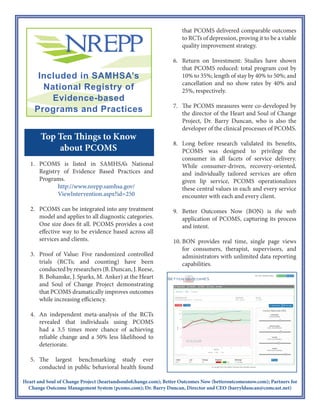
9. BON is the web application of
PCOMS, capturing its spirit, process,
and intent.
10. BON provides real time, single page
views for consumers, therapists,
supervisors, and administrators with
unlimited data reporting capabilities.

PCOMS at a Glance

  • 1.
    The Partners forChange Outcome Management System Introduction Despite overall efficacy, many clients do not benefit, dropouts are a problem, and providers vary significantly in success rates, are poor judges of negative outcomes, and don’t have a clue about their effectiveness. The Partners for Change Outcome Management System (PCOMS), a systematic client feedback intervention, offers a solution. Partners for Change Outcome Management System (PCOMS) PCOMS uses two, four item scales to solicit consumer feedback regarding factors proven to predict success regardless of treatment model or presenting problem: early progress (using the Outcome Rating Scale) and the quality of the alliance (using the Session Rating Scale). PCOMS: • Identifies clients at risk for negative outcome before dropout or treatment failure; • Provides objective, quantifiable data on the effectiveness of providers and systems of care; • Uses measures that are reliable and valid, but feasible for each clinical encounter; and • Provides a formalized mechanism for consumer preferences to guide choice of intervention. Consequently, unlike other methods of measuring outcome, this system truly Involves consumers in all decisions that affect their care while honoring the time demands of front-line clinical work and documenting proof of value. Five randomized clinical trials (RCT) conducted by the clinical developer, Dr. Barry Duncan, and researchers at the Heart and Soul of Change Project have shown PCOMS to significantly improve effectiveness in real clinical settings as well as substantially reduce costs related to length of treatment and provider productivity. Because of these RCTs, PCOMS is recognized in the Substance Abuse Mental Health Services Administration’s (SAMHSA) National Registry of Evidence-based Programs and Practices (NREPP). PCOMS has been implemented by hundreds of organizations in all 50 states and in 20 countries. Conclusions PCOMS has been shown to be consumer- friendly, highly feasible for clinicians, and importantly, repeatedly demonstrated to improve the quality and efficiency of services in peer-reviewed, published studies conducted across a range of settings, including public behavioral health. To move consumer-driven services beyond wishful thinking and enable improvements in the quality of behavioral health services while ensuring return on investment, policymakers and administrators should explore implementation of systematic client feedback.
  • 2.
    Heart and Soulof Change Project (heartandsoulofchange.com); Better Outcomes Now (betteroutcomesnow.com); Partners for Change Outcome Management System (pcoms.com); Dr. Barry Duncan, Director and CEO (barrylduncan@comcast.net) Top Ten Things to Know 1. PCOMS is a SAMHSA designated evidence based practice. 2. PCOMS is a-theoretical and can be integrated into any treatment model, and applies to all diagnostic categories. PCOMS provides a cost- effective way to be evidence based across all services and clients. 3. Proof of Value: Five RCTs have been conducted by researchers (B. Duncan, J. Reese, B. Bohanske, J. Sparks, M. Anker) at the Heart and Soul of Change Project demonstrating that PCOMS dramatically improves outcomes while increasing efficiency. An RCT in integrated care is underway. 4. An independent meta-analysis revealed that individuals using PCOMS had a 3.5 times more chance of achieving reliable change and a 50% less likelihood of deterioration. 5. The largest benchmarking studies ever conducted in public behavioral health found that PCOMS delivered comparable outcomes to RCTs of depression for both adults and youth, proving it to be a viable quality improvement strategy. In addition, a study of inpatient psychiatric services found similar results as well as reduced readmission rates. 6. Return on Investment: Studies have shown that PCOMS reduced length of stay by 40% to 50%; and cancellation and no show rates by 40% and 25%, respectively. 7. The PCOMS measures were co- developed by the director of the Heart and Soul of Change Project, and CEO of Better Outcomes Now (BON), Dr. Barry Duncan, who also developed the clinical process of PCOMS. 8. Long before research validated its benefits, PCOMS was designed to privilege the consumer in all facets of service delivery. While client-driven, recovery-oriented, and individually tailored services are often given lip service, PCOMS operationalizes these central values in every encounter. 9. BON is the web application of PCOMS, capturing its spirit, process, and intent. 10. BON provides real time, single page views for consumers, therapists, supervisors, and administrators with unlimited data reporting capabilities.