OvercomingScalingChallengesinMongoDBwithSSD
James Myers
Director, SSD Solutions Architecture
@DoeboizMyers
Intel Non-Volatile Memory Solutions Group
Legal Disclaimer
INFORMATION IN THIS DOCUMENT IS PROVIDED IN CONNECTION WITH INTEL PRODUCTS. NO LICENSE, EXPRESS OR IMPLIED, BY ESTOPPEL OR OTHERWISE, TO ANY INTELLECTUAL PROPERTY
RIGHTS IS GRANTED BY THIS DOCUMENT. EXCEPT AS PROVIDED IN INTEL'S TERMS AND CONDITIONS OF SALE FOR SUCH PRODUCTS, INTEL ASSUMES NO LIABILITY WHATSOEVER AND INTEL
DISCLAIMS ANY EXPRESS OR IMPLIED WARRANTY, RELATING TO SALE AND/OR USE OF INTEL PRODUCTS INCLUDING LIABILITY OR WARRANTIES RELATING TO FITNESS FOR A PARTICULAR
PURPOSE, MERCHANTABILITY, OR INFRINGEMENT OF ANY PATENT, COPYRIGHT OR OTHER INTELLECTUAL PROPERTY RIGHT.
A "Mission Critical Application" is any application in which failure of the Intel Product could result, directly or indirectly, in personal injury or death. SHOULD YOU PURCHASE OR USE INTEL'S PRODUCTS
FOR ANY SUCH MISSION CRITICAL APPLICATION, YOU SHALL INDEMNIFY AND HOLD INTEL AND ITS SUBSIDIARIES, SUBCONTRACTORS AND AFFILIATES, AND THE DIRECTORS, OFFICERS, AND
EMPLOYEES OF EACH, HARMLESS AGAINST ALL CLAIMS COSTS, DAMAGES, AND EXPENSES AND REASONABLE ATTORNEYS' FEES ARISING OUT OF, DIRECTLY OR INDIRECTLY, ANY CLAIM OF
PRODUCT LIABILITY, PERSONAL INJURY, OR DEATH ARISING IN ANY WAY OUT OF SUCH MISSION CRITICAL APPLICATION, WHETHER OR NOT INTEL OR ITS SUBCONTRACTOR WAS NEGLIGENT IN THE
DESIGN, MANUFACTURE, OR WARNING OF THE INTEL PRODUCT OR ANY OF ITS PARTS.
Intel may make changes to specifications and product descriptions at any time, without notice. Designers must not rely on the absence or characteristics of any features or instructions marked "reserved"
or "undefined". Intel reserves these for future definition and shall have no responsibility whatsoever for conflicts or incompatibilities arising from future changes to them. The information here is subject to
change without notice. Do not finalize a design with this information.
The products described in this document may contain design defects or errors known as errata which may cause the product to deviate from published specifications. Current characterized errata are
available on request.
Contact your local Intel sales office or your distributor to obtain the latest specifications and before placing your product order.
All products, computer systems, dates, and figures specified are preliminary based on current expectations, and are subject to change without notice.
Intel product plans in this presentation do not constitute Intel plan of record product roadmaps. Please contact your Intel representative to obtain Intel’s current plan of record product roadmaps.
Software and workloads used in performance tests may have been optimized for performance only on Intel microprocessors. Performance tests, are measured using specific computer systems,
components, software, operations and functions. Any change to any of those factors may cause the results to vary. You should consult other information and performance tests to assist you in fully
evaluating your contemplated purchases, including the performance of that product when combined with other products.
Results have been estimated based on internal Intel analysis and are provided for informational purposes only. Any difference in system hardware or software design or configuration may affect actual
performance.
Results have been simulated and are provided for informational purposes only. Results were derived using simulations run on an architecture simulator or model. Any difference in system hardware or
software design or configuration may affect actual performance.
Intel and the Intel logo are trademarks of Intel Corporation in the U.S. and/or other countries.
*Other names and brands may be claimed as the property of others.
Not all source may be listed.
Copyright © 2015 Intel Corporation. All rights reserved.
Intel Non-Volatile Memory Solutions Group
Agenda
What’s happening in the storage device market?
I thought you said this session is about scaling MongoDB*?!
What’s Next?
Intel Non-Volatile Memory Solutions Group
Storage …
Intel Non-Volatile Memory Solutions Group
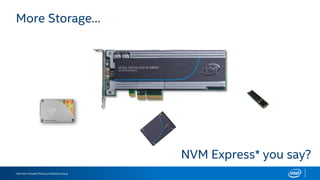
More Storage …
Intel Non-Volatile Memory Solutions Group
More Storage…
NVM Express* you say?
Intel Non-Volatile Memory Solutions Group
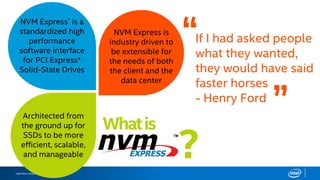
Whatis
NVM Express* is a
standardized high
performance
software interface
for PCI Express*
Solid-State Drives
Architected from
the ground up for
SSDs to be more
efficient, scalable,
and manageable
NVM Express is
industry driven to
be extensible for
the needs of both
the client and the
data center
?
If I had asked people
what they wanted,
they would have said
faster horses
- Henry Ford
“
”
Intel Non-Volatile Memory Solutions Group
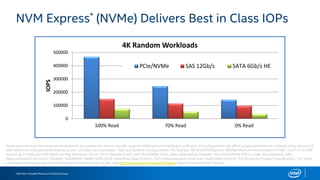
NVM Express* (NVMe) Delivers Best in Class IOPs
0
100000
200000
300000
400000
500000
100% Read 70% Read 0% Read
IOPS 4K Random Workloads
PCIe/NVMe SAS 12Gb/s SATA 6Gb/s HE
Tests document performance of components on a particular test, in specific systems. Differences in hardware, software, or configuration will affect actual performance. Consult other sources of
information to evaluate performance as you consider your purchase. Test and System Configurations: PCI Express* (PCIe*)/NVM Express* (NVMe) Measurements made on Intel® Core™ i7-3770S
system @ 3.1GHz and 4GB Mem running Windows* Server 2012 Standard O/S, Intel PCIe/NVMe SSDs, data collected by IOmeter* tool. PCIe/NVMe SSD is under development. SAS
Measurements from HGST Ultrastar* SSD800M/1000M (SAS) Solid State Drive Specification. SATA Measurements from Intel Solid State Drive DC P3700 Series Product Specification. For more
complete information about performance and benchmark results, visit http://www.intel.com/performance. Source: Intel Internal Testing.
Intel Non-Volatile Memory Solutions Group
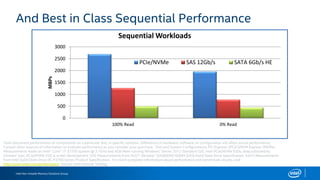
And Best in Class Sequential Performance
0
500
1000
1500
2000
2500
3000
100% Read 0% Read
MBPs
Sequential Workloads
PCIe/NVMe SAS 12Gb/s SATA 6Gb/s HE
Tests document performance of components on a particular test, in specific systems. Differences in hardware, software, or configuration will affect actual performance.
Consult other sources of information to evaluate performance as you consider your purchase. Test and System Configurations: PCI Express* (PCIe*)/NVM Express* (NVMe)
Measurements made on Intel® Core™ i7-3770S system @ 3.1GHz and 4GB Mem running Windows* Server 2012 Standard O/S, Intel PCIe/NVMe SSDs, data collected by
IOmeter* tool. PCIe/NVMe SSD is under development. SAS Measurements from HGST Ultrastar* SSD800M/1000M (SAS) Solid State Drive Specification. SATA Measurements
from Intel Solid State Drive DC P3700 Series Product Specification. For more complete information about performance and benchmark results, visit
http://www.intel.com/performance. Source: Intel Internal Testing.
Intel Non-Volatile Memory Solutions Group
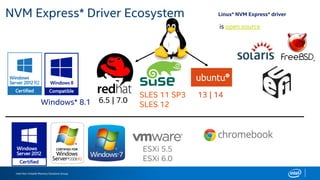
NVM Express* Driver Ecosystem
6.5 | 7.0
SLES 11 SP3
SLES 12
ESXi 5.5
ESXi 6.0
13 | 14
Windows* 8.1
Linux* NVM Express* driver
is open source
Intel Non-Volatile Memory Solutions Group
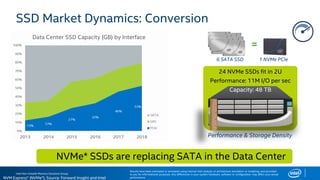
SSD Market Dynamics: Conversion
NVM Express* (NVMe*), Source: Forward Insight and Intel
24 NVMe SSDs fit in 2U
Performance: 11M I/O per sec
Capacity: 48 TB
6 SATA SSD 1 NVMe PCIe
=
Performance & Storage Density
NVMe* SSDs are replacing SATA in the Data Center
Results have been estimated or simulated using internal Intel analysis or architecture simulation or modeling, and provided
to you for informational purposes. Any differences in your system hardware, software or configuration may affect your actual
performance.
Intel Non-Volatile Memory Solutions Group
P3700 P3600 P3500
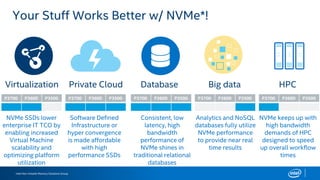
Your Stuff Works Better w/ NVMe*!
Private Cloud DatabaseVirtualization Big data
NVMe SSDs lower
enterprise IT TCO by
enabling increased
Virtual Machine
scalability and
optimizing platform
utilization
P3700 P3600 P3500 P3700 P3600 P3500 P3700 P3600 P3500 P3700 P3600 P3500
Software Defined
Infrastructure or
hyper convergence
is made affordable
with high
performance SSDs
Consistent, low
latency, high
bandwidth
performance of
NVMe shines in
traditional relational
databases
Analytics and NoSQL
databases fully utilize
NVMe performance
to provide near real
time results
NVMe keeps up with
high bandwidth
demands of HPC
designed to speed
up overall workflow
times
HPC
Intel Non-Volatile Memory Solutions Group
Agenda
What’s happening in the storage device market?
I thought you said this session is about scaling MongoDB*?!
What’s Next?
Intel Non-Volatile Memory Solutions Group
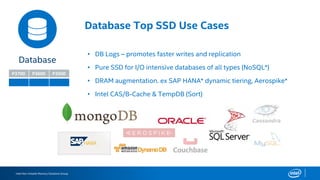
Database Top SSD Use Cases
• DB Logs – promotes faster writes and replication
• Pure SSD for I/O intensive databases of all types (NoSQL*)
• DRAM augmentation. ex SAP HANA* dynamic tiering, Aerospike*
• Intel CAS/B-Cache & TempDB (Sort)
Database
P3700 P3600 P3500
Intel Non-Volatile Memory Solutions Group 15
You are outgrowing your fishtank? What now?
What I want… What they are selling me…
Intel Non-Volatile Memory Solutions Group 16
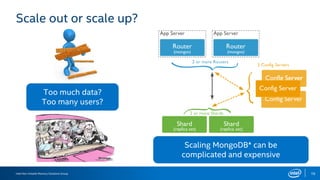
Scale out or scale up?
Scaling MongoDB* can be
complicated and expensive
Too much data?
Too many users?
Intel Non-Volatile Memory Solutions Group 17
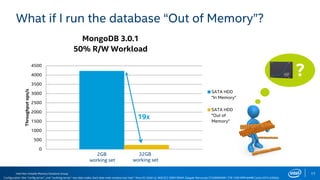
What if I run the database “Out of Memory”?
0
500
1000
1500
2000
2500
3000
3500
4000
4500
Throughputops/s
MongoDB 3.0.1
50% R/W Workload
SATA HDD
"In Memory"
SATA HDD
"Out of
Memory"
19x
Configuration: One “config server”, one “routhing server”, two data nodes. Each data node contains two Intel ® Xeon E5 2640 v2, 8GB ECC DDR3 DRAM, Seagate Barracuda ST2000DM001 2TB 7200 RPM 64MB Cache SATA 6.0Gb/s
2GB
working set
32GB
working set
?
Intel Non-Volatile Memory Solutions Group
0
2000
4000
6000
8000
10000
12000
14000
16000
Throughputops/s
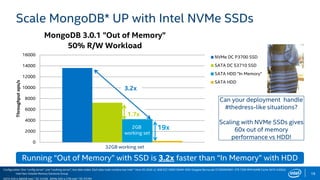
MongoDB 3.0.1 "Out of Memory"
50% R/W Workload
NVMe DC P3700 SSD
SATA DC S3710 SSD
SATA HDD "In Memory"
SATA HDD
3.2x
1.7x
18
Scale MongoDB* UP with Intel NVMe SSDs
Configuration: One “config server”, one “routhing server”, two data nodes. Each data node contains two Intel ® Xeon E5 2640 v2, 8GB ECC DDR3 DRAM. HDD=Seagate Barracuda ST2000DM001 2TB 7200 RPM 64MB Cache SATA 6.0Gb/s
SATA SSD is 800GB Intel ® DC S3700. NVMe SSD is 2TB Intel ® DC P3700
32GB working set
2GB
working set
Running “Out of Memory” with SSD is 3.2x faster than “In Memory” with HDD
Can your deployment handle
#thedress-like situations?
Scaling with NVMe SSDs gives
60x out of memory
performance vs HDD!
19x
Intel Non-Volatile Memory Solutions Group
0
5000
10000
15000
20000
25000
Throughputops/s
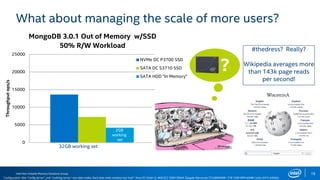
MongoDB 3.0.1 Out of Memory w/SSD
50% R/W Workload
NVMe DC P3700 SSD
SATA DC S3710 SSD
SATA HDD "In Memory"
19
What about managing the scale of more users?
Configuration: One “config server”, one “routhing server”, two data nodes. Each data node contains two Intel ® Xeon E5 2640 v2, 8GB ECC DDR3 DRAM, Seagate Barracuda ST2000DM001 2TB 7200 RPM 64MB Cache SATA 6.0Gb/s
?
32GB working set
2GB
working
set
#thedress? Really?
Wikipedia averages more
than 143k page reads
per second!
Intel Non-Volatile Memory Solutions Group 20
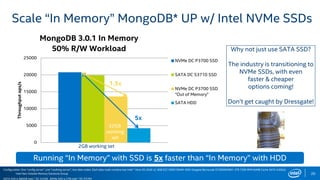
Scale “In Memory” MongoDB* UP w/ Intel NVMe SSDs
Configuration: One “config server”, one “routhing server”, two data nodes. Each data node contains two Intel ® Xeon E5 2640 v2, 8GB ECC DDR3 DRAM. HDD=Seagate Barracuda ST2000DM001 2TB 7200 RPM 64MB Cache SATA 6.0Gb/s
SATA SSD is 800GB Intel ® DC S3700. NVMe SSD is 2TB Intel ® DC P3700
Running “In Memory” with SSD is 5x faster than “In Memory” with HDD
Why not just use SATA SSD?
The industry is transitioning to
NVMe SSDs, with even
faster & cheaper
options coming!
Don’t get caught by Dressgate!
0
5000
10000
15000
20000
25000
Throughputops/s
MongoDB 3.0.1 In Memory
50% R/W Workload
NVMe DC P3700 SSD
SATA DC S3710 SSD
NVMe DC P3700 SSD
"Out of Memory"
SATA HDD
5x
1.5x
32GB
working
set
2GB working set
Intel Non-Volatile Memory Solutions Group
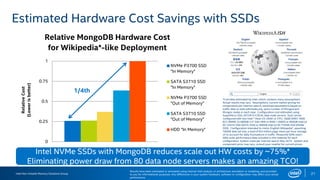
0
0.25
0.5
0.75
1
RelativeCost
(Lowerisbetter)
Relative MongoDB Hardware Cost
for Wikipedia*-like Deployment
NVMe P3700 SSD
"In Memory"
SATA S3710 SSD
"In Memory"
NVMe P3700 SSD
"Out of Memory"
SATA S3710 SSD
"Out of Memory"
HDD "In Memory"
1/4th
21
Estimated Hardware Cost Savings with SSDs
Intel NVMe SSDs with MongoDB reduces scale out HW costs by ~75%*
Eliminating power draw from 80 data node servers makes an amazing TCO!
ISH
*Cost data estimated by Intel, which contains many assumptions.
Actual results may vary. Assumptions: current market pricing for
components per internet search, workload assumptions based on
traffic data at stats.wikimedia.org, same number of Mongod and
Mongoc nodes in each case. Configuration cost estimated using
SuperMicro SSG-2072R-E1CR24L data node servers. Each server
configured with two Intel ® Xeon E5-2640 v2 CPU, 16GB DDR3 1600
ECC DRAM; 2x 600GB 2.5" SAS HDD in RAID 1 (HDD) or 400GB Intel (r)
DC S3510 SSD (SATA SSD) or 400GB Intel (r) DC P3500 SSD (NVMe
SSD). Configuration intended to mimic Engilish Wikipedia*, assuming
160GB data set size, a load of 8.6 million page views per hour average
x3 to account for daily fluctuations in traffic. Measured 50% read /
50% write performance data included in this material for each
configuration. System costs per internet search May 2015. System and
component price may vary, consult your reseller for current prices.
Results have been estimated or simulated using internal Intel analysis or architecture simulation or modeling, and provided
to you for informational purposes. Any differences in your system hardware, software or configuration may affect your actual
performance.
Intel Non-Volatile Memory Solutions Group
Agenda
22
What’s happening in the storage device market?
I thought you said this session is about scaling MongoDB*?!
What’s Next?
Intel Non-Volatile Memory Solutions Group
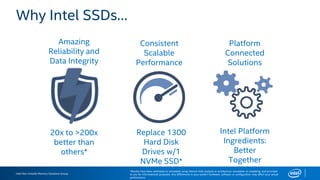
20x to >200x
better than
others*
Replace 1300
Hard Disk
Drives w/1
NVMe SSD*
Intel Platform
Ingredients:
Better
Together
Why Intel SSDs…
Amazing
Reliability and
Data Integrity
Consistent
Scalable
Performance
Platform
Connected
Solutions
*Results have been estimated or simulated using internal Intel analysis or architecture simulation or modeling, and provided
to you for informational purposes. Any differences in your system hardware, software or configuration may affect your actual
performance.
Intel Non-Volatile Memory Solutions Group
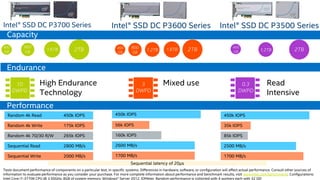
Intel® SSD DC P3700 Series
Capacity
Performance
Intel® SSD DC P3600 Series Intel® SSD DC P3500 Series
800
GB
400
GB
1.6TB 2TB 800
GB
400
GB
1.6TB 2TB1.2TB
400
GB 2TB1.2TB
Endurance
10
DWPD
3
DWPD
0.3
DWPD
High Endurance
Technology
Mixed use Read
Intensive
Random 4k Read 450k IOPS
Random 4k Write 175k IOPS
Random 4k 70/30 R/W 265k IOPS
Sequential Read 2800 MB/s
Sequential Write 2000 MB/s
450k IOPS
56k IOPS
160k IOPS
2600 MB/s
1700 MB/s
450k IOPS
35k IOPS
85k IOPS
2500 MB/s
1700 MB/s
Sequential latency of 20µs
Tests document performance of components on a particular test, in specific systems. Differences in hardware, software, or configuration will affect actual performance. Consult other sources of
information to evaluate performance as you consider your purchase. For more complete information about performance and benchmark results, visit www.intel.com/benchmarks. Configurations:
Intel Core i7-3770K CPU @ 3.50GHz, 8GB of system memory, Windows* Server 2012, IOMeter. Random performance is collected with 4 workers each with 32 QD
Intel Non-Volatile Memory Solutions Group
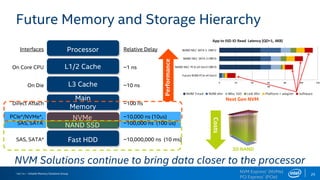
Future Memory and Storage Hierarchy
NVM Solutions continue to bring data closer to the processor
Processor
L1/2 Cache
L3 Cache
Main
Memory
Fast HDD
~1 ns
~10 ns
~100 ns
~10,000,000 ns (10 ms)
On Core CPU
On Die
Direct Attach
SAS, SATA*
Interfaces Relative Delay
Costs
NAND SSD ~100,000 ns (100 us)SAS, SATA
NAND SSD
~10,000 ns (10us)
~100,000 ns (100 us)
PCIe*/NVMe*,
SAS, SATA
NVMe
25Source: Intel
NVM Express* (NVMe)
PCI Express* (PCIe)
Performance
Next Gen NVM
3D NAND
Intel Non-Volatile Memory Solutions Group
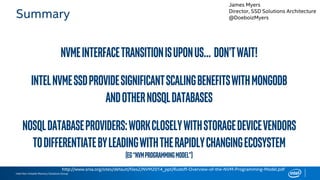
Summary
NVMeInterfacetransitionisuponus… Don’twait!
IntelNVMeSSDprovidesignificantscalingbenefitswithMongoDB
andotherNoSQLdatabases
NoSQLdatabaseproviders:workcloselywithstoragedevicevendors
todifferentiatebyleadingwiththerapidlychangingecosystem
(eg“NVMProgrammingModel”)
http://www.snia.org/sites/default/files2/NVM2014_ppt/Rudoff-Overview-of-the-NVM-Programming-Model.pdf
James Myers
Director, SSD Solutions Architecture
@DoeboizMyers
James Myers
Director, SSD Solutions Architecture
@DoeboizMyers

Overcoming Scaling Challenges in MongoDB Deployments with SSD

  • 1.
  • 2.
    Intel Non-Volatile MemorySolutions Group Legal Disclaimer INFORMATION IN THIS DOCUMENT IS PROVIDED IN CONNECTION WITH INTEL PRODUCTS. NO LICENSE, EXPRESS OR IMPLIED, BY ESTOPPEL OR OTHERWISE, TO ANY INTELLECTUAL PROPERTY RIGHTS IS GRANTED BY THIS DOCUMENT. EXCEPT AS PROVIDED IN INTEL'S TERMS AND CONDITIONS OF SALE FOR SUCH PRODUCTS, INTEL ASSUMES NO LIABILITY WHATSOEVER AND INTEL DISCLAIMS ANY EXPRESS OR IMPLIED WARRANTY, RELATING TO SALE AND/OR USE OF INTEL PRODUCTS INCLUDING LIABILITY OR WARRANTIES RELATING TO FITNESS FOR A PARTICULAR PURPOSE, MERCHANTABILITY, OR INFRINGEMENT OF ANY PATENT, COPYRIGHT OR OTHER INTELLECTUAL PROPERTY RIGHT. A "Mission Critical Application" is any application in which failure of the Intel Product could result, directly or indirectly, in personal injury or death. SHOULD YOU PURCHASE OR USE INTEL'S PRODUCTS FOR ANY SUCH MISSION CRITICAL APPLICATION, YOU SHALL INDEMNIFY AND HOLD INTEL AND ITS SUBSIDIARIES, SUBCONTRACTORS AND AFFILIATES, AND THE DIRECTORS, OFFICERS, AND EMPLOYEES OF EACH, HARMLESS AGAINST ALL CLAIMS COSTS, DAMAGES, AND EXPENSES AND REASONABLE ATTORNEYS' FEES ARISING OUT OF, DIRECTLY OR INDIRECTLY, ANY CLAIM OF PRODUCT LIABILITY, PERSONAL INJURY, OR DEATH ARISING IN ANY WAY OUT OF SUCH MISSION CRITICAL APPLICATION, WHETHER OR NOT INTEL OR ITS SUBCONTRACTOR WAS NEGLIGENT IN THE DESIGN, MANUFACTURE, OR WARNING OF THE INTEL PRODUCT OR ANY OF ITS PARTS. Intel may make changes to specifications and product descriptions at any time, without notice. Designers must not rely on the absence or characteristics of any features or instructions marked "reserved" or "undefined". Intel reserves these for future definition and shall have no responsibility whatsoever for conflicts or incompatibilities arising from future changes to them. The information here is subject to change without notice. Do not finalize a design with this information. The products described in this document may contain design defects or errors known as errata which may cause the product to deviate from published specifications. Current characterized errata are available on request. Contact your local Intel sales office or your distributor to obtain the latest specifications and before placing your product order. All products, computer systems, dates, and figures specified are preliminary based on current expectations, and are subject to change without notice. Intel product plans in this presentation do not constitute Intel plan of record product roadmaps. Please contact your Intel representative to obtain Intel’s current plan of record product roadmaps. Software and workloads used in performance tests may have been optimized for performance only on Intel microprocessors. Performance tests, are measured using specific computer systems, components, software, operations and functions. Any change to any of those factors may cause the results to vary. You should consult other information and performance tests to assist you in fully evaluating your contemplated purchases, including the performance of that product when combined with other products. Results have been estimated based on internal Intel analysis and are provided for informational purposes only. Any difference in system hardware or software design or configuration may affect actual performance. Results have been simulated and are provided for informational purposes only. Results were derived using simulations run on an architecture simulator or model. Any difference in system hardware or software design or configuration may affect actual performance. Intel and the Intel logo are trademarks of Intel Corporation in the U.S. and/or other countries. *Other names and brands may be claimed as the property of others. Not all source may be listed. Copyright © 2015 Intel Corporation. All rights reserved.
  • 3.
    Intel Non-Volatile MemorySolutions Group Agenda What’s happening in the storage device market? I thought you said this session is about scaling MongoDB*?! What’s Next?
  • 4.
    Intel Non-Volatile MemorySolutions Group Storage …
  • 5.
    Intel Non-Volatile MemorySolutions Group More Storage …
  • 6.
    Intel Non-Volatile MemorySolutions Group More Storage… NVM Express* you say?
  • 7.
    Intel Non-Volatile MemorySolutions Group Whatis NVM Express* is a standardized high performance software interface for PCI Express* Solid-State Drives Architected from the ground up for SSDs to be more efficient, scalable, and manageable NVM Express is industry driven to be extensible for the needs of both the client and the data center ? If I had asked people what they wanted, they would have said faster horses - Henry Ford “ ”
  • 8.
    Intel Non-Volatile MemorySolutions Group NVM Express* (NVMe) Delivers Best in Class IOPs 0 100000 200000 300000 400000 500000 100% Read 70% Read 0% Read IOPS 4K Random Workloads PCIe/NVMe SAS 12Gb/s SATA 6Gb/s HE Tests document performance of components on a particular test, in specific systems. Differences in hardware, software, or configuration will affect actual performance. Consult other sources of information to evaluate performance as you consider your purchase. Test and System Configurations: PCI Express* (PCIe*)/NVM Express* (NVMe) Measurements made on Intel® Core™ i7-3770S system @ 3.1GHz and 4GB Mem running Windows* Server 2012 Standard O/S, Intel PCIe/NVMe SSDs, data collected by IOmeter* tool. PCIe/NVMe SSD is under development. SAS Measurements from HGST Ultrastar* SSD800M/1000M (SAS) Solid State Drive Specification. SATA Measurements from Intel Solid State Drive DC P3700 Series Product Specification. For more complete information about performance and benchmark results, visit http://www.intel.com/performance. Source: Intel Internal Testing.
  • 9.
    Intel Non-Volatile MemorySolutions Group And Best in Class Sequential Performance 0 500 1000 1500 2000 2500 3000 100% Read 0% Read MBPs Sequential Workloads PCIe/NVMe SAS 12Gb/s SATA 6Gb/s HE Tests document performance of components on a particular test, in specific systems. Differences in hardware, software, or configuration will affect actual performance. Consult other sources of information to evaluate performance as you consider your purchase. Test and System Configurations: PCI Express* (PCIe*)/NVM Express* (NVMe) Measurements made on Intel® Core™ i7-3770S system @ 3.1GHz and 4GB Mem running Windows* Server 2012 Standard O/S, Intel PCIe/NVMe SSDs, data collected by IOmeter* tool. PCIe/NVMe SSD is under development. SAS Measurements from HGST Ultrastar* SSD800M/1000M (SAS) Solid State Drive Specification. SATA Measurements from Intel Solid State Drive DC P3700 Series Product Specification. For more complete information about performance and benchmark results, visit http://www.intel.com/performance. Source: Intel Internal Testing.
  • 10.
    Intel Non-Volatile MemorySolutions Group NVM Express* Driver Ecosystem 6.5 | 7.0 SLES 11 SP3 SLES 12 ESXi 5.5 ESXi 6.0 13 | 14 Windows* 8.1 Linux* NVM Express* driver is open source
  • 11.
    Intel Non-Volatile MemorySolutions Group SSD Market Dynamics: Conversion NVM Express* (NVMe*), Source: Forward Insight and Intel 24 NVMe SSDs fit in 2U Performance: 11M I/O per sec Capacity: 48 TB 6 SATA SSD 1 NVMe PCIe = Performance & Storage Density NVMe* SSDs are replacing SATA in the Data Center Results have been estimated or simulated using internal Intel analysis or architecture simulation or modeling, and provided to you for informational purposes. Any differences in your system hardware, software or configuration may affect your actual performance.
  • 12.
    Intel Non-Volatile MemorySolutions Group P3700 P3600 P3500 Your Stuff Works Better w/ NVMe*! Private Cloud DatabaseVirtualization Big data NVMe SSDs lower enterprise IT TCO by enabling increased Virtual Machine scalability and optimizing platform utilization P3700 P3600 P3500 P3700 P3600 P3500 P3700 P3600 P3500 P3700 P3600 P3500 Software Defined Infrastructure or hyper convergence is made affordable with high performance SSDs Consistent, low latency, high bandwidth performance of NVMe shines in traditional relational databases Analytics and NoSQL databases fully utilize NVMe performance to provide near real time results NVMe keeps up with high bandwidth demands of HPC designed to speed up overall workflow times HPC
  • 13.
    Intel Non-Volatile MemorySolutions Group Agenda What’s happening in the storage device market? I thought you said this session is about scaling MongoDB*?! What’s Next?
  • 14.
    Intel Non-Volatile MemorySolutions Group Database Top SSD Use Cases • DB Logs – promotes faster writes and replication • Pure SSD for I/O intensive databases of all types (NoSQL*) • DRAM augmentation. ex SAP HANA* dynamic tiering, Aerospike* • Intel CAS/B-Cache & TempDB (Sort) Database P3700 P3600 P3500
  • 15.
    Intel Non-Volatile MemorySolutions Group 15 You are outgrowing your fishtank? What now? What I want… What they are selling me…
  • 16.
    Intel Non-Volatile MemorySolutions Group 16 Scale out or scale up? Scaling MongoDB* can be complicated and expensive Too much data? Too many users?
  • 17.
    Intel Non-Volatile MemorySolutions Group 17 What if I run the database “Out of Memory”? 0 500 1000 1500 2000 2500 3000 3500 4000 4500 Throughputops/s MongoDB 3.0.1 50% R/W Workload SATA HDD "In Memory" SATA HDD "Out of Memory" 19x Configuration: One “config server”, one “routhing server”, two data nodes. Each data node contains two Intel ® Xeon E5 2640 v2, 8GB ECC DDR3 DRAM, Seagate Barracuda ST2000DM001 2TB 7200 RPM 64MB Cache SATA 6.0Gb/s 2GB working set 32GB working set ?
  • 18.
    Intel Non-Volatile MemorySolutions Group 0 2000 4000 6000 8000 10000 12000 14000 16000 Throughputops/s MongoDB 3.0.1 "Out of Memory" 50% R/W Workload NVMe DC P3700 SSD SATA DC S3710 SSD SATA HDD "In Memory" SATA HDD 3.2x 1.7x 18 Scale MongoDB* UP with Intel NVMe SSDs Configuration: One “config server”, one “routhing server”, two data nodes. Each data node contains two Intel ® Xeon E5 2640 v2, 8GB ECC DDR3 DRAM. HDD=Seagate Barracuda ST2000DM001 2TB 7200 RPM 64MB Cache SATA 6.0Gb/s SATA SSD is 800GB Intel ® DC S3700. NVMe SSD is 2TB Intel ® DC P3700 32GB working set 2GB working set Running “Out of Memory” with SSD is 3.2x faster than “In Memory” with HDD Can your deployment handle #thedress-like situations? Scaling with NVMe SSDs gives 60x out of memory performance vs HDD! 19x
  • 19.
    Intel Non-Volatile MemorySolutions Group 0 5000 10000 15000 20000 25000 Throughputops/s MongoDB 3.0.1 Out of Memory w/SSD 50% R/W Workload NVMe DC P3700 SSD SATA DC S3710 SSD SATA HDD "In Memory" 19 What about managing the scale of more users? Configuration: One “config server”, one “routhing server”, two data nodes. Each data node contains two Intel ® Xeon E5 2640 v2, 8GB ECC DDR3 DRAM, Seagate Barracuda ST2000DM001 2TB 7200 RPM 64MB Cache SATA 6.0Gb/s ? 32GB working set 2GB working set #thedress? Really? Wikipedia averages more than 143k page reads per second!
  • 20.
    Intel Non-Volatile MemorySolutions Group 20 Scale “In Memory” MongoDB* UP w/ Intel NVMe SSDs Configuration: One “config server”, one “routhing server”, two data nodes. Each data node contains two Intel ® Xeon E5 2640 v2, 8GB ECC DDR3 DRAM. HDD=Seagate Barracuda ST2000DM001 2TB 7200 RPM 64MB Cache SATA 6.0Gb/s SATA SSD is 800GB Intel ® DC S3700. NVMe SSD is 2TB Intel ® DC P3700 Running “In Memory” with SSD is 5x faster than “In Memory” with HDD Why not just use SATA SSD? The industry is transitioning to NVMe SSDs, with even faster & cheaper options coming! Don’t get caught by Dressgate! 0 5000 10000 15000 20000 25000 Throughputops/s MongoDB 3.0.1 In Memory 50% R/W Workload NVMe DC P3700 SSD SATA DC S3710 SSD NVMe DC P3700 SSD "Out of Memory" SATA HDD 5x 1.5x 32GB working set 2GB working set
  • 21.
    Intel Non-Volatile MemorySolutions Group 0 0.25 0.5 0.75 1 RelativeCost (Lowerisbetter) Relative MongoDB Hardware Cost for Wikipedia*-like Deployment NVMe P3700 SSD "In Memory" SATA S3710 SSD "In Memory" NVMe P3700 SSD "Out of Memory" SATA S3710 SSD "Out of Memory" HDD "In Memory" 1/4th 21 Estimated Hardware Cost Savings with SSDs Intel NVMe SSDs with MongoDB reduces scale out HW costs by ~75%* Eliminating power draw from 80 data node servers makes an amazing TCO! ISH *Cost data estimated by Intel, which contains many assumptions. Actual results may vary. Assumptions: current market pricing for components per internet search, workload assumptions based on traffic data at stats.wikimedia.org, same number of Mongod and Mongoc nodes in each case. Configuration cost estimated using SuperMicro SSG-2072R-E1CR24L data node servers. Each server configured with two Intel ® Xeon E5-2640 v2 CPU, 16GB DDR3 1600 ECC DRAM; 2x 600GB 2.5" SAS HDD in RAID 1 (HDD) or 400GB Intel (r) DC S3510 SSD (SATA SSD) or 400GB Intel (r) DC P3500 SSD (NVMe SSD). Configuration intended to mimic Engilish Wikipedia*, assuming 160GB data set size, a load of 8.6 million page views per hour average x3 to account for daily fluctuations in traffic. Measured 50% read / 50% write performance data included in this material for each configuration. System costs per internet search May 2015. System and component price may vary, consult your reseller for current prices. Results have been estimated or simulated using internal Intel analysis or architecture simulation or modeling, and provided to you for informational purposes. Any differences in your system hardware, software or configuration may affect your actual performance.
  • 22.
    Intel Non-Volatile MemorySolutions Group Agenda 22 What’s happening in the storage device market? I thought you said this session is about scaling MongoDB*?! What’s Next?
  • 23.
    Intel Non-Volatile MemorySolutions Group 20x to >200x better than others* Replace 1300 Hard Disk Drives w/1 NVMe SSD* Intel Platform Ingredients: Better Together Why Intel SSDs… Amazing Reliability and Data Integrity Consistent Scalable Performance Platform Connected Solutions *Results have been estimated or simulated using internal Intel analysis or architecture simulation or modeling, and provided to you for informational purposes. Any differences in your system hardware, software or configuration may affect your actual performance.
  • 24.
    Intel Non-Volatile MemorySolutions Group Intel® SSD DC P3700 Series Capacity Performance Intel® SSD DC P3600 Series Intel® SSD DC P3500 Series 800 GB 400 GB 1.6TB 2TB 800 GB 400 GB 1.6TB 2TB1.2TB 400 GB 2TB1.2TB Endurance 10 DWPD 3 DWPD 0.3 DWPD High Endurance Technology Mixed use Read Intensive Random 4k Read 450k IOPS Random 4k Write 175k IOPS Random 4k 70/30 R/W 265k IOPS Sequential Read 2800 MB/s Sequential Write 2000 MB/s 450k IOPS 56k IOPS 160k IOPS 2600 MB/s 1700 MB/s 450k IOPS 35k IOPS 85k IOPS 2500 MB/s 1700 MB/s Sequential latency of 20µs Tests document performance of components on a particular test, in specific systems. Differences in hardware, software, or configuration will affect actual performance. Consult other sources of information to evaluate performance as you consider your purchase. For more complete information about performance and benchmark results, visit www.intel.com/benchmarks. Configurations: Intel Core i7-3770K CPU @ 3.50GHz, 8GB of system memory, Windows* Server 2012, IOMeter. Random performance is collected with 4 workers each with 32 QD
  • 25.
    Intel Non-Volatile MemorySolutions Group Future Memory and Storage Hierarchy NVM Solutions continue to bring data closer to the processor Processor L1/2 Cache L3 Cache Main Memory Fast HDD ~1 ns ~10 ns ~100 ns ~10,000,000 ns (10 ms) On Core CPU On Die Direct Attach SAS, SATA* Interfaces Relative Delay Costs NAND SSD ~100,000 ns (100 us)SAS, SATA NAND SSD ~10,000 ns (10us) ~100,000 ns (100 us) PCIe*/NVMe*, SAS, SATA NVMe 25Source: Intel NVM Express* (NVMe) PCI Express* (PCIe) Performance Next Gen NVM 3D NAND
  • 26.
    Intel Non-Volatile MemorySolutions Group Summary NVMeInterfacetransitionisuponus… Don’twait! IntelNVMeSSDprovidesignificantscalingbenefitswithMongoDB andotherNoSQLdatabases NoSQLdatabaseproviders:workcloselywithstoragedevicevendors todifferentiatebyleadingwiththerapidlychangingecosystem (eg“NVMProgrammingModel”) http://www.snia.org/sites/default/files2/NVM2014_ppt/Rudoff-Overview-of-the-NVM-Programming-Model.pdf James Myers Director, SSD Solutions Architecture @DoeboizMyers
  • 27.
    James Myers Director, SSDSolutions Architecture @DoeboizMyers