HR Leaders Forum and Awards

                                     Dubai, March 05 & 06, 2012

                                   Global Growth Strategies:
                         Winning the race for talent in emerging markets


                                                        (facilitated by Celine Heinrich)


Copyright © 2005 Deloitte Development LLC. All rights reserved.                            0
Global Growth Strategies:
Winning the race for talent in emerging
markets

1. Anticipating and proactively working with Business Leaders
   to support & accelerate Growth in Emerging Markets

2. Expanding your understanding of Emerging Markets &
   developing Talent Management Strategies

3. Importance of HR’s active participation & involvement in
   market entry and expansion
DUFRY PROCESS AND PROCEDURES WORKSHOP


Part 1;

Anticipating and proactively working with
Business Leaders to support & accelerate
Growth in Emerging Markets
Role of the Business Leader is Essential

Evolving role of “Management”:

• From jobs, to skills and outcomes – rethinking the nature of work, adapt to the local and cultural
  environment

• Implement ―Best Places to Work‖ highly correlated to management practices

          P&L management or P&L-like work
          Executive talent management focused on replicating high-quality leaders

•     Develop Employee engagement and attitudes key to performance through top management.

      Employee engagement drivers are :
       1. Challenging and exciting work
       2. Career growth
       3. Learning and development opportunities
       4. Good boss

• From ―30 years at hard labor‖, to using flexibility as a business advantage: Creates genuine
  opportunities and exhibits desirable cultural conditions

    Create a company culture from the top down:

    A company’s culture will play a vital role in emerging markets.

        1. Brand promise has to feel authentic.
        2. Employees must be rewarded for reasons of merit;
        3. Although employees want to be recognized for individual achievements, they also want to
           feel a connection with their teams.
        4. The culture has to be truly ―talent-centric,‖ so that people know they’re critical to the
            company’s success.
Copyright © 2005 Deloitte Development LLC. All rights reserved.                                        3
DUFRY PROCESS AND PROCEDURES WORKSHOP


Part 2:

Expanding your understanding of Emerging Markets
& Developing Talent Management Strategies

a) Booming markets in China, India, Russia
   with shortage of talent

b) Developing talent strategies that leverage
   skills and capabilities across markets
a. The Talent Market in Emerging Markets

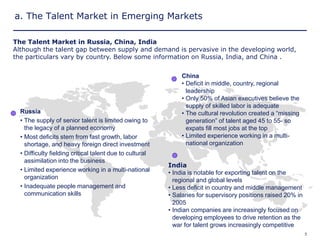
The Talent Market in Russia, China, India
Although the talent gap between supply and demand is pervasive in the developing world,
the particulars vary by country. Below some information on Russia, India, and China .


                                                                       China
                                                                       • Deficit in middle, country, regional
                                                                         leadership
                                                                       • Only 50% of Asian executives believe the
                                                                         supply of skilled labor is adequate
   Russia                                                              • The cultural revolution created a “missing
   • The supply of senior talent is limited owing to                     generation” of talent aged 45 to 55- so
     the legacy of a planned economy                                     expats fill most jobs at the top
   • Most deficits stem from fast growth, labor                        • Limited experience working in a multi-
     shortage, and heavy foreign direct investment                       national organization
   • Difficulty fielding critical talent due to cultural
     assimilation into the business
                                                                  India
   • Limited experience working in a multi-national               • India is notable for exporting talent on the
     organization                                                   regional and global levels
   • Inadequate people management and                             • Less deficit in country and middle management
     communication skills                                         • Salaries for supervisory positions raised 20% in
                                                                    2005
                                                                  • Indian companies are increasingly focused on
                                                                    developing employees to drive retention as the
                                                                    war for talent grows increasingly competitive
Copyright © 2005 Deloitte Development LLC. All rights reserved.                                                        5
b. A new model focuses on develop, deploy, connect


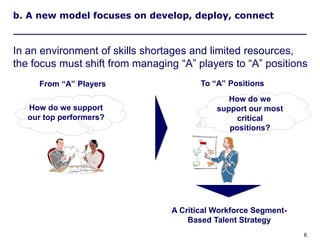
In an environment of skills shortages and limited resources,
the focus must shift from managing “A” players to “A” positions
              From “A” Players                                           To “A” Positions
                                                                                How do we
        How do we support                                                    support our most
        our top performers?                                                       critical
                                                                                positions?


                                                                  A Critical Workforce Segment-
                                                                      Based Talent Strategy
Copyright © 2006 Deloitte Development LLC. All rights reserved.                                   6
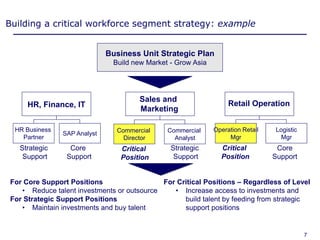
Building a critical workforce segment strategy: example


                                                    Business Unit Strategic Plan
                                                        Build new Market - Grow Asia


                                                                   Sales and
        HR, Finance, IT                                                                     Retail Operation
                                                                   Marketing

  HR Business                                             Commercial     Commercial    Operation Retail   Logistic
                            SAP Analyst
    Partner                                                 Director       Analyst          Mgr             Mgr
    Strategic                  Core                         Critical      Strategic      Critical          Core
     Support                  Support                       Position       Support       Position         Support


 For Core Support Positions                  For Critical Positions – Regardless of Level
    • Reduce talent investments or outsource    • Increase access to investments and
 For Strategic Support Positions                   build talent by feeding from strategic
    • Maintain investments and buy talent          support positions


 Copyright © 2006 Deloitte Development LLC. All rights reserved.                                                     7
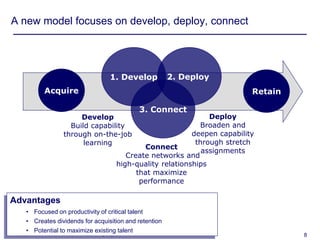
A new model focuses on develop, deploy, connect


                                         1. Develop               2. Deploy
             Acquire                                                             Retain

                                                     3. Connect
                          Develop                                     Deploy
                       Build capability                            Broaden and
                     through on-the-job                          deepen capability
                           learning                               through stretch
                                                   Connect
                                                                    assignments
                                              Create networks and
                                           high-quality relationships
                                                 that maximize
                                                  performance

Advantages
       • Focused on productivity of critical talent
       • Creates dividends for acquisition and retention
       • Potential to maximize existing talent
Copyright © 2006 Deloitte Development LLC. All rights reserved.                           8
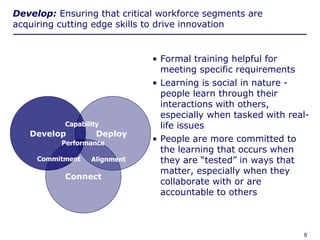
Develop: Ensuring that critical workforce segments are
acquiring cutting edge skills to drive innovation


                                                                  • Formal training helpful for
                                                                    meeting specific requirements
                                                                  • Learning is social in nature -
                                                                    people learn through their
                                                                    interactions with others,
                                                                    especially when tasked with real-
                            Capability                              life issues
         Develop                             Deploy
                          Performance
                                                                  • People are more committed to
                                                                    the learning that occurs when
             Commitment                    Alignment                they are ―tested‖ in ways that
                                                                    matter, especially when they
                            Connect
                                                                    collaborate with or are
                                                                    accountable to others


Copyright © 2006 Deloitte Development LLC. All rights reserved.                                    9
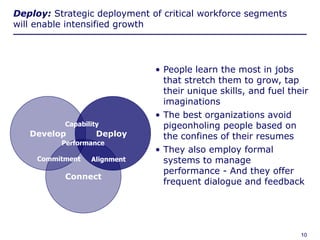
Deploy: Strategic deployment of critical workforce segments
will enable intensified growth


                                                                  • People learn the most in jobs
                                                                    that stretch them to grow, tap
                                                                    their unique skills, and fuel their
                                                                    imaginations
                                                                  • The best organizations avoid
                            Capability                              pigeonholing people based on
         Develop                             Deploy                 the confines of their resumes
                          Performance
                                                                  • They also employ formal
             Commitment                    Alignment                systems to manage
                                                                    performance - And they offer
                            Connect
                                                                    frequent dialogue and feedback


Copyright © 2006 Deloitte Development LLC. All rights reserved.                                      10
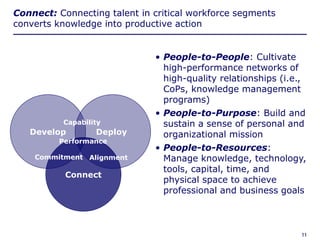
Connect: Connecting talent in critical workforce segments
converts knowledge into productive action


                                                                  • People-to-People: Cultivate
                                                                    high-performance networks of
                                                                    high-quality relationships (i.e.,
                                                                    CoPs, knowledge management
                                                                    programs)
                                                                  • People-to-Purpose: Build and
                           Capability                               sustain a sense of personal and
         Develop                             Deploy                 organizational mission
                         Performance
                                                                  • People-to-Resources:
           Commitment Alignment                                     Manage knowledge, technology,
                                                                    tools, capital, time, and
                            Connect
                                                                    physical space to achieve
                                                                    professional and business goals


Copyright © 2006 Deloitte Development LLC. All rights reserved.                                    11
DUFRY PROCESS AND PROCEDURES WORKSHOP


Part 3:

Importance of HR’s active participation &
involvement in market entry and expansion
HR plays a vital role in Emerging Markets


Organization looking to expand into emerging markets need an HR strategy that reconciles
differences in Economic Structure, labor laws and staffing expectations

Many emerging countries are seeing both business expansion and strong merger and
acquisition activity on the local level. When dealing in these markets, the skill and
aggressiveness of a company’s human resources team can make the difference between
success and failure, as each market has unique operational challenges in terms of economic
structure, access to capital, consumption patterns, educational achievement
and cultural expectations.

Bringing HR to the table as early as possible can help avoid potential missteps and produce
better long-term results, as HR can address specific issues at every step of the startup or
acquisition process, from site selection to recruitment and retention.

Involving HR professional with specialties in local labor law

Low-wage countries generally present a consistent human capital challenge. Only a small
percentage of university graduates with general degrees are equipped to work in a
multinational company, and graduates with technical degrees can be similarly unprepared


Copyright © 2005 Deloitte Development LLC. All rights reserved.                          13
HR involvement in market entry and expansion


HR steps to expand in emerging markets:

1.    Site Selection (evaluating the Talent Pool)
2.    Labor laws and regulations (visa/work permit; employment conditions)
3.    Staffing determination (Expat vs Local / cost on PEX)
4.    Recruitment & retention. (Salary & Benefits)

Site Selection

• How large is the potential pool of talent? Does the education system consistently replenish
  that pool?
• How much flexibility is there for future growth? how easy is it to shut down operations in
  the future, if it is necessary?
• Are there special country-unique considerations that may come into play?

Labor Law

• Labor laws in many emerging markets are protective of employees and, as a result, pose a
  potentially significant strain on a company’s budget. (i.e wrong assumption on social Tax in
  china is 45% ). Organizations may not be permitted to terminate employees, for example,
  without incurring government-mandated costs.
• Health care, pension benefits and unemployment compensation must all be considered in
  light of the eventual possibility of terminating individual employees or shutting down or
  downsizing an entire operation

Copyright © 2005 Deloitte Development LLC. All rights reserved.                             14
HR involvement in market entry and expansion


Staffing Determination
• The local talent pool in an emerging market often lacks the experience to meet startup
  staffing needs or plans for future growth.
• Expatriate employees are costly, both in terms of direct compensation and infrastructure.
  They will inevitably have higher salaries than local talent, a discrepancy that should be
  properly managed in order to avoid disgruntled local employees.
• One method that works well in bringing local employees up to speed involves selecting
  potential local managerial talent at the outset and sending that team abroad —often to
  headquarters — for six to nine months. There the local talent learns global business norms
  in preparation for return to the home country. Then, when it is time for the startup
  expatriates to leave, there is a local team
• Be flexible, allow for early ―non-obvious‖ moves. Dow also enables employees to move
  freely between functions and businesses, specifically allowing—and encouraging—non-
  traditional and ―non-obvious‖ moves.

Recruitment & Selection
• In order to recruit and retain good professionals, organizations should develop an
  attractive and well-designed remuneration package for each category of employee.
• HR will also have responsibility for developing local HR and benefits policy documents,
  producing a mandatory staff handbook and documenting disciplinary procedures.
• Makes plans to support operational growth in emerging markets. Growth won’t support
  itself


Copyright © 2005 Deloitte Development LLC. All rights reserved.                             15
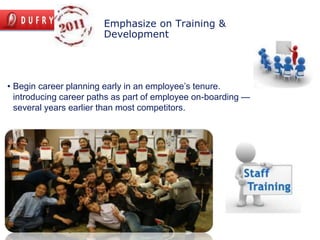
Emphasize on Training &
                       Development


• Begin career planning early in an employee’s tenure.
  introducing career paths as part of employee on-boarding —
  several years earlier than most competitors.

Dufry1

  • 1.
    HR Leaders Forumand Awards Dubai, March 05 & 06, 2012 Global Growth Strategies: Winning the race for talent in emerging markets (facilitated by Celine Heinrich) Copyright © 2005 Deloitte Development LLC. All rights reserved. 0
  • 2.
    Global Growth Strategies: Winningthe race for talent in emerging markets 1. Anticipating and proactively working with Business Leaders to support & accelerate Growth in Emerging Markets 2. Expanding your understanding of Emerging Markets & developing Talent Management Strategies 3. Importance of HR’s active participation & involvement in market entry and expansion
  • 3.
    DUFRY PROCESS ANDPROCEDURES WORKSHOP Part 1; Anticipating and proactively working with Business Leaders to support & accelerate Growth in Emerging Markets
  • 4.
    Role of theBusiness Leader is Essential Evolving role of “Management”: • From jobs, to skills and outcomes – rethinking the nature of work, adapt to the local and cultural environment • Implement ―Best Places to Work‖ highly correlated to management practices  P&L management or P&L-like work  Executive talent management focused on replicating high-quality leaders • Develop Employee engagement and attitudes key to performance through top management. Employee engagement drivers are : 1. Challenging and exciting work 2. Career growth 3. Learning and development opportunities 4. Good boss • From ―30 years at hard labor‖, to using flexibility as a business advantage: Creates genuine opportunities and exhibits desirable cultural conditions Create a company culture from the top down: A company’s culture will play a vital role in emerging markets. 1. Brand promise has to feel authentic. 2. Employees must be rewarded for reasons of merit; 3. Although employees want to be recognized for individual achievements, they also want to feel a connection with their teams. 4. The culture has to be truly ―talent-centric,‖ so that people know they’re critical to the company’s success. Copyright © 2005 Deloitte Development LLC. All rights reserved. 3
  • 5.
    DUFRY PROCESS ANDPROCEDURES WORKSHOP Part 2: Expanding your understanding of Emerging Markets & Developing Talent Management Strategies a) Booming markets in China, India, Russia with shortage of talent b) Developing talent strategies that leverage skills and capabilities across markets
  • 6.
    a. The TalentMarket in Emerging Markets The Talent Market in Russia, China, India Although the talent gap between supply and demand is pervasive in the developing world, the particulars vary by country. Below some information on Russia, India, and China . China • Deficit in middle, country, regional leadership • Only 50% of Asian executives believe the supply of skilled labor is adequate Russia • The cultural revolution created a “missing • The supply of senior talent is limited owing to generation” of talent aged 45 to 55- so the legacy of a planned economy expats fill most jobs at the top • Most deficits stem from fast growth, labor • Limited experience working in a multi- shortage, and heavy foreign direct investment national organization • Difficulty fielding critical talent due to cultural assimilation into the business India • Limited experience working in a multi-national • India is notable for exporting talent on the organization regional and global levels • Inadequate people management and • Less deficit in country and middle management communication skills • Salaries for supervisory positions raised 20% in 2005 • Indian companies are increasingly focused on developing employees to drive retention as the war for talent grows increasingly competitive Copyright © 2005 Deloitte Development LLC. All rights reserved. 5
  • 7.
    b. A newmodel focuses on develop, deploy, connect In an environment of skills shortages and limited resources, the focus must shift from managing “A” players to “A” positions From “A” Players To “A” Positions How do we How do we support support our most our top performers? critical positions? A Critical Workforce Segment- Based Talent Strategy Copyright © 2006 Deloitte Development LLC. All rights reserved. 6
  • 8.
    Building a criticalworkforce segment strategy: example Business Unit Strategic Plan Build new Market - Grow Asia Sales and HR, Finance, IT Retail Operation Marketing HR Business Commercial Commercial Operation Retail Logistic SAP Analyst Partner Director Analyst Mgr Mgr Strategic Core Critical Strategic Critical Core Support Support Position Support Position Support For Core Support Positions For Critical Positions – Regardless of Level • Reduce talent investments or outsource • Increase access to investments and For Strategic Support Positions build talent by feeding from strategic • Maintain investments and buy talent support positions Copyright © 2006 Deloitte Development LLC. All rights reserved. 7
  • 9.
    A new modelfocuses on develop, deploy, connect 1. Develop 2. Deploy Acquire Retain 3. Connect Develop Deploy Build capability Broaden and through on-the-job deepen capability learning through stretch Connect assignments Create networks and high-quality relationships that maximize performance Advantages • Focused on productivity of critical talent • Creates dividends for acquisition and retention • Potential to maximize existing talent Copyright © 2006 Deloitte Development LLC. All rights reserved. 8
  • 10.
    Develop: Ensuring thatcritical workforce segments are acquiring cutting edge skills to drive innovation • Formal training helpful for meeting specific requirements • Learning is social in nature - people learn through their interactions with others, especially when tasked with real- Capability life issues Develop Deploy Performance • People are more committed to the learning that occurs when Commitment Alignment they are ―tested‖ in ways that matter, especially when they Connect collaborate with or are accountable to others Copyright © 2006 Deloitte Development LLC. All rights reserved. 9
  • 11.
    Deploy: Strategic deploymentof critical workforce segments will enable intensified growth • People learn the most in jobs that stretch them to grow, tap their unique skills, and fuel their imaginations • The best organizations avoid Capability pigeonholing people based on Develop Deploy the confines of their resumes Performance • They also employ formal Commitment Alignment systems to manage performance - And they offer Connect frequent dialogue and feedback Copyright © 2006 Deloitte Development LLC. All rights reserved. 10
  • 12.
    Connect: Connecting talentin critical workforce segments converts knowledge into productive action • People-to-People: Cultivate high-performance networks of high-quality relationships (i.e., CoPs, knowledge management programs) • People-to-Purpose: Build and Capability sustain a sense of personal and Develop Deploy organizational mission Performance • People-to-Resources: Commitment Alignment Manage knowledge, technology, tools, capital, time, and Connect physical space to achieve professional and business goals Copyright © 2006 Deloitte Development LLC. All rights reserved. 11
  • 13.
    DUFRY PROCESS ANDPROCEDURES WORKSHOP Part 3: Importance of HR’s active participation & involvement in market entry and expansion
  • 14.
    HR plays avital role in Emerging Markets Organization looking to expand into emerging markets need an HR strategy that reconciles differences in Economic Structure, labor laws and staffing expectations Many emerging countries are seeing both business expansion and strong merger and acquisition activity on the local level. When dealing in these markets, the skill and aggressiveness of a company’s human resources team can make the difference between success and failure, as each market has unique operational challenges in terms of economic structure, access to capital, consumption patterns, educational achievement and cultural expectations. Bringing HR to the table as early as possible can help avoid potential missteps and produce better long-term results, as HR can address specific issues at every step of the startup or acquisition process, from site selection to recruitment and retention. Involving HR professional with specialties in local labor law Low-wage countries generally present a consistent human capital challenge. Only a small percentage of university graduates with general degrees are equipped to work in a multinational company, and graduates with technical degrees can be similarly unprepared Copyright © 2005 Deloitte Development LLC. All rights reserved. 13
  • 15.
    HR involvement inmarket entry and expansion HR steps to expand in emerging markets: 1. Site Selection (evaluating the Talent Pool) 2. Labor laws and regulations (visa/work permit; employment conditions) 3. Staffing determination (Expat vs Local / cost on PEX) 4. Recruitment & retention. (Salary & Benefits) Site Selection • How large is the potential pool of talent? Does the education system consistently replenish that pool? • How much flexibility is there for future growth? how easy is it to shut down operations in the future, if it is necessary? • Are there special country-unique considerations that may come into play? Labor Law • Labor laws in many emerging markets are protective of employees and, as a result, pose a potentially significant strain on a company’s budget. (i.e wrong assumption on social Tax in china is 45% ). Organizations may not be permitted to terminate employees, for example, without incurring government-mandated costs. • Health care, pension benefits and unemployment compensation must all be considered in light of the eventual possibility of terminating individual employees or shutting down or downsizing an entire operation Copyright © 2005 Deloitte Development LLC. All rights reserved. 14
  • 16.
    HR involvement inmarket entry and expansion Staffing Determination • The local talent pool in an emerging market often lacks the experience to meet startup staffing needs or plans for future growth. • Expatriate employees are costly, both in terms of direct compensation and infrastructure. They will inevitably have higher salaries than local talent, a discrepancy that should be properly managed in order to avoid disgruntled local employees. • One method that works well in bringing local employees up to speed involves selecting potential local managerial talent at the outset and sending that team abroad —often to headquarters — for six to nine months. There the local talent learns global business norms in preparation for return to the home country. Then, when it is time for the startup expatriates to leave, there is a local team • Be flexible, allow for early ―non-obvious‖ moves. Dow also enables employees to move freely between functions and businesses, specifically allowing—and encouraging—non- traditional and ―non-obvious‖ moves. Recruitment & Selection • In order to recruit and retain good professionals, organizations should develop an attractive and well-designed remuneration package for each category of employee. • HR will also have responsibility for developing local HR and benefits policy documents, producing a mandatory staff handbook and documenting disciplinary procedures. • Makes plans to support operational growth in emerging markets. Growth won’t support itself Copyright © 2005 Deloitte Development LLC. All rights reserved. 15
  • 17.
    Emphasize on Training& Development • Begin career planning early in an employee’s tenure. introducing career paths as part of employee on-boarding — several years earlier than most competitors.