VOCABULARY THEORETICAL ASPECTS TEFL Methodology Min-Hsun Chiang, Ph. D.
How important is vocabulary? Your vocabulary is like an iceberg. You can only see 20% of an iceberg above the water, but most of it is below the surface   A writer’s vocabulary is like a chef’s pantry, and words are like ingredients. The more ingredients there are in the pantry, the wider the variety of culinary possibilities   Not knowing the vocabulary is like living in a foreign country without knowing the language   A greater vocabulary to describe the sensations we get from our minds and body more precisely. Having a small vocabulary is like trying to paint a fine portrait with a set of 6" house-painting brushes;   A vocabulary is like a mirror into a person's world view: words express meaning, meaning expresses reality
How important is vocabulary? Learning extensive grammar before improving  vocabulary  is like putting the cart before the horse. Or it is like learning different styles of swimming by moving hands in the air inside a swimming pool without water. Vocabulary is like a savings-account; as you add words you build compound interest Poor vocabulary is like being partially blind. You see the world through a narrow hole. Vocabulary is like your wardrobe - it's the first thing everyone sees and the last thing they'll remember.
How important is vocabulary? Learning vocabulary is like football practice: if you don’t regularly build up your muscles and skills (i.e. words and memory), you will be dramatically handicapped.  A writer who doesn't know how to use the vocabulary is like a driver who doesn't know how to control his car.  A large vocabulary is like a hammer to a master carpenter. It helps you hit the nail on the head every time. Grammar is like skeleton and vocabulary is like flesh. As the strong skeleton makes the strong body, confidence in grammar will enable to speak sound.
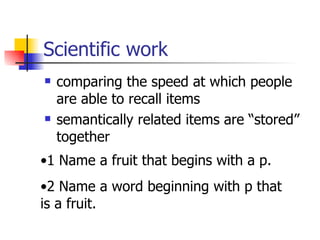
Scientific work comparing the speed at which people are able to recall items   semantically related items are “stored” together   1 Name a fruit that begins with a p. 2 Name a word beginning with p that  is a fruit.
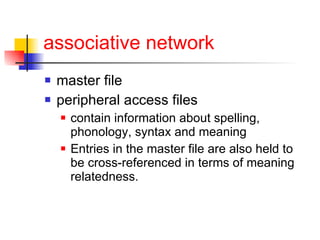
associative network master file peripheral access files contain information about spelling, phonology, syntax and meaning   Entries in the master file are also held to be cross-referenced in terms of meaning relatedness.
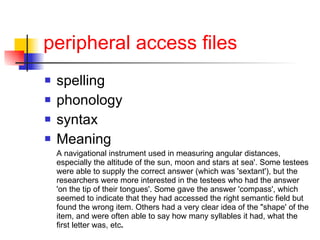
peripheral access files spelling phonology syntax  Meaning A navigational instrument used in measuring angular distances, especially the altitude of the sun, moon and stars at sea'. Some testees were able to supply the correct answer (which was 'sextant'), but the researchers were more interested in the testees who had the answer 'on the tip of their tongues'. Some gave the answer 'compass', which seemed to indicate that they had accessed the right semantic field but found the wrong item. Others had a very clear idea of the "shape' of the item, and were often able to say how many syllables it had, what the first letter was, etc .
DUAL CODING THEORY Clark and Paivio Network of verbal and imaginatible representatives for words
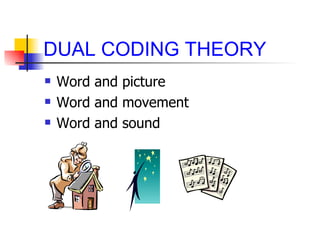
DUAL CODING THEORY Word and picture Word and movement Word and sound
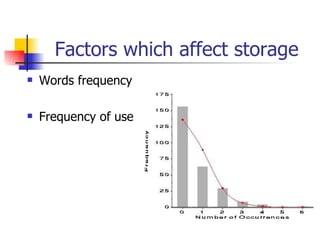
Factors which affect storage Words frequency Fr e qu ency of use
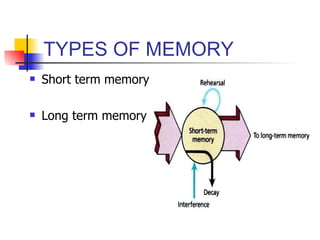
TYPES OF MEMORY Short term memory Long term memory
short term 30 seconds up to seven chunks limited in  capacity repetition

Vocabulary Theory

  • 1.
    VOCABULARY THEORETICAL ASPECTSTEFL Methodology Min-Hsun Chiang, Ph. D.
  • 2.
    How important isvocabulary? Your vocabulary is like an iceberg. You can only see 20% of an iceberg above the water, but most of it is below the surface   A writer’s vocabulary is like a chef’s pantry, and words are like ingredients. The more ingredients there are in the pantry, the wider the variety of culinary possibilities   Not knowing the vocabulary is like living in a foreign country without knowing the language   A greater vocabulary to describe the sensations we get from our minds and body more precisely. Having a small vocabulary is like trying to paint a fine portrait with a set of 6" house-painting brushes;   A vocabulary is like a mirror into a person's world view: words express meaning, meaning expresses reality
  • 3.
    How important isvocabulary? Learning extensive grammar before improving vocabulary is like putting the cart before the horse. Or it is like learning different styles of swimming by moving hands in the air inside a swimming pool without water. Vocabulary is like a savings-account; as you add words you build compound interest Poor vocabulary is like being partially blind. You see the world through a narrow hole. Vocabulary is like your wardrobe - it's the first thing everyone sees and the last thing they'll remember.
  • 4.
    How important isvocabulary? Learning vocabulary is like football practice: if you don’t regularly build up your muscles and skills (i.e. words and memory), you will be dramatically handicapped.  A writer who doesn't know how to use the vocabulary is like a driver who doesn't know how to control his car.  A large vocabulary is like a hammer to a master carpenter. It helps you hit the nail on the head every time. Grammar is like skeleton and vocabulary is like flesh. As the strong skeleton makes the strong body, confidence in grammar will enable to speak sound.
  • 5.
    Scientific work comparingthe speed at which people are able to recall items semantically related items are “stored” together 1 Name a fruit that begins with a p. 2 Name a word beginning with p that is a fruit.
  • 6.
    associative network masterfile peripheral access files contain information about spelling, phonology, syntax and meaning Entries in the master file are also held to be cross-referenced in terms of meaning relatedness.
  • 7.
    peripheral access filesspelling phonology syntax Meaning A navigational instrument used in measuring angular distances, especially the altitude of the sun, moon and stars at sea'. Some testees were able to supply the correct answer (which was 'sextant'), but the researchers were more interested in the testees who had the answer 'on the tip of their tongues'. Some gave the answer 'compass', which seemed to indicate that they had accessed the right semantic field but found the wrong item. Others had a very clear idea of the "shape' of the item, and were often able to say how many syllables it had, what the first letter was, etc .
  • 8.
    DUAL CODING THEORYClark and Paivio Network of verbal and imaginatible representatives for words
  • 9.
    DUAL CODING THEORYWord and picture Word and movement Word and sound
  • 10.
    Factors which affectstorage Words frequency Fr e qu ency of use
  • 11.
    TYPES OF MEMORYShort term memory Long term memory
  • 12.
    short term 30seconds up to seven chunks limited in capacity repetition