1
Melan’oWhite
Technical file
ID bio - ESTER Technopole - 6 allée Skylab - 87068 LIMOGES Cedex - FRANCE
Tel +33 5 55 35 05 35 - Fax +33 5 55 35 95 44 - E-mail : info@idbio.eu - Web : www.idbio.eu
Lightening activity
2
Melan’oWhite
:
Melan’oWhite
… and naturally rich in lightening substances …
 LACTIC ACID
It is one of the smallest AHA (Alpha Hydroxy Acid) well appreciated in
cosmetics for its beneficial virtues. Naturally present in various botanicals, this
acid helps to enhance skin aspect and to improve dead cells removal so as to
have a brighter complexion.
 VITAMIN C
Also called ascorbic acid, this vitamin is present in various plants and fruits. It is
renowned for its anti-radical proprieties but also for its action on tyrosinase
activity. It helps to lower it and thus, to reduce uneven pigmentation to obtain
a uniform, light and radiant skin.
Organic, preservative free …
Melan’oWhite
is an active ingredient, objectivated in vitro, ex vivo and in vivo, made
with 98,9 % organic raw materials.
At the same time, this active ingredient is filtered in sterile conditions and is without
preservative. Then, Melan’oWhite
is an ingredient certified by ECOCERT Greenlife
according to the ECOCERT Standards for Natural and Organic Cosmetics available on
http://cosmetics.ecocert.com
Custom-made product: we can adjust some parameters according to your formulation
needs.
… Melan’oWhite
helps to answer all the
skin tone concerns
 From Thai to Brazilian, from Chinese to African, skin lightening is a global and
significant trend.
 It exists more than 66 skin colors and most of them have one thing in common : a
non uniform complexion.
 Melan’oWhite is the ideal answer thanks to its high natural content in lactic acid and
vitamin C that directly acts on the tyrosinase activity and the cell renewal, to make
skin clearer and more uniform.
3

a natural active ingredient
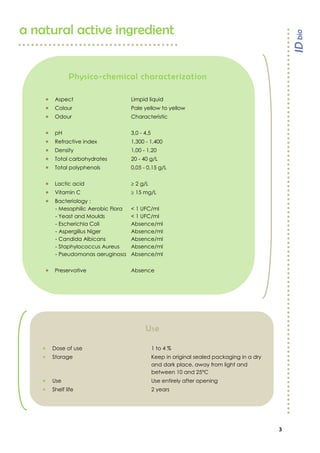
Physico-chemical characterization
 Aspect Limpid liquid
 Colour Pale yellow to yellow
 Odour Characteristic
 pH 3,0 - 4,5
 Refractive index 1,300 - 1,400
 Density 1,00 - 1,20
 Total carbohydrates 20 - 40 g/L
 Total polyphenols 0,05 - 0,15 g/L
 Lactic acid  2 g/L
 Vitamin C  15 mg/L
 Bacteriology :
- Mesophilic Aerobic Flora < 1 UFC/ml
- Yeast and Moulds < 1 UFC/ml
- Escherichia Coli Absence/ml
- Aspergillus Niger Absence/ml
- Candida Albicans Absence/ml
- Staphylococcus Aureus Absence/ml
- Pseudomonas aeruginosa Absence/ml
 Preservative Absence
Use
 Dose of use 1 to 4 %
 Storage Keep in original sealed packaging in a dry
and dark place, away from light and
between 10 and 25°C
 Use Use entirely after opening
 Shelf life 2 years
4
IN VITRO
Melan’oWhite
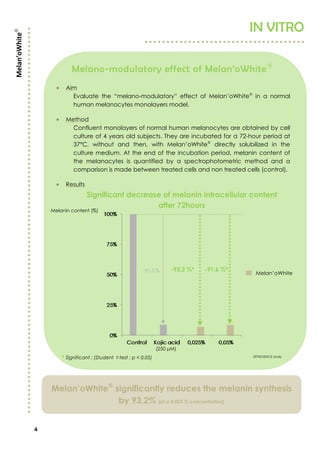
Melano-modulatory effect of Melan’oWhite
 Aim
Evaluate the “melano-modulatory” effect of Melan’oWhite
in a normal
human melanocytes monolayers model.
 Method
Confluent monolayers of normal human melanocytes are obtained by cell
culture of 4 years old subjects. They are incubated for a 72-hour period at
37°C, without and then, with Melan’oWhite
directly solubilized in the
culture medium. At the end of the incubation period, melanin content of
the melanocytes is quantified by a spectrophotometric method and a
comparison is made between treated cells and non treated cells (control).
 Results
Significant decrease of melanin intracellular content
after 72hours
* Significant ; (Student t-test ; p < 0,05) EFFISCIENCE study
Melan’oWhite
significantly reduces the melanin synthesis
by 93,2% (at a 0,025 % concentration)
Melan’oWhite
Melanin content (%)
-91,3 % -93,2 %* -91,6 %*
(250 μM)
5
& EX VIVO testing
Melan’oWhite
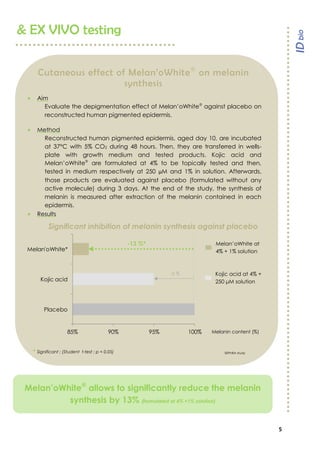
allows to significantly reduce the melanin
synthesis by 13% (formulated at 4% +1% solution)
Cutaneous effect of Melan’oWhite
on melanin
synthesis
 Aim
Evaluate the depigmentation effect of Melan’oWhite
against placebo on
reconstructed human pigmented epidermis.
 Method
Reconstructed human pigmented epidermis, aged day 10, are incubated
at 37°C with 5% CO2 during 48 hours. Then, they are transferred in wells-
plate with growth medium and tested products. Kojic acid and
Melan’oWhite
are formulated at 4% to be topically tested and then,
tested in medium respectively at 250 μM and 1% in solution. Afterwards,
those products are evaluated against placebo (formulated without any
active molecule) during 3 days. At the end of the study, the synthesis of
melanin is measured after extraction of the melanin contained in each
epidermis.
 Results
Significant inhibition of melanin synthesis against placebo
* Significant ; (Student t-test ; p < 0,05) SEPhRA study
Melanin content (%)
Melan’oWhite at
4% + 1% solution
Kojic acid at 4% +
250 μM solution
85% 90% 95% 100%
Placebo
Kojic acid
Melan'oWhite*
-5 %
-13 %*
6
Some words about EX VIVO method
An innovative method
Melan’oWhite
Skin explants
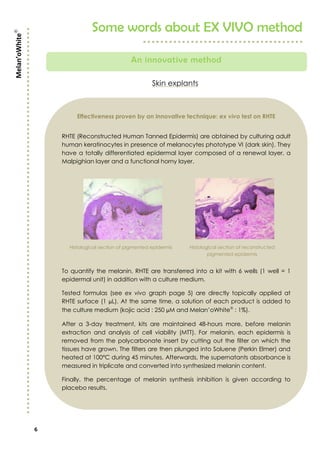
Effectiveness proven by an innovative technique: ex vivo test on RHTE
RHTE (Reconstructed Human Tanned Epidermis) are obtained by culturing adult
human keratinocytes in presence of melanocytes phototype VI (dark skin). They
have a totally differentiated epidermal layer composed of a renewal layer, a
Malpighian layer and a functional horny layer.
To quantify the melanin, RHTE are transferred into a kit with 6 wells (1 well = 1
epidermal unit) in addition with a culture medium.
Tested formulas (see ex vivo graph page 5) are directly topically applied at
RHTE surface (1 μL). At the same time, a solution of each product is added to
the culture medium (kojic acid : 250 μM and Melan’oWhite
: 1%).
After a 3-day treatment, kits are maintained 48-hours more, before melanin
extraction and analysis of cell viability (MTT). For melanin, each epidermis is
removed from the polycarbonate insert by cutting out the filter on which the
tissues have grown. The filters are then plunged into Soluene (Perkin Elmer) and
heated at 100°C during 45 minutes. Afterwards, the supernatants absorbance is
measured in triplicate and converted into synthesized melanin content.
Finally, the percentage of melanin synthesis inhibition is given according to
placebo results.
Histological section of pigmented epidermis Histological section of reconstructed
pigmented epidermis
7
Placebo Melan’oWhite
a*
Δ Compared to T0 a* T28 a* T56 b* T28 b* T56
Placebo -1,2% -2,6% +0,5% +1,3%
Melan’oWhite -4,3% -2,6% +0,7% +1,0%
Efficacy measurement on lightening effect
 Aim
Evaluate and compare Melan’oWhite
lightening efficiency against
placebo.
 Population
23 Asian female volunteers, aged from 18 to 60 years old, with all skin types.
 Method
One daily application (in the evening) of a 4% Melan’oWhite
emulsion
and placebo emulsion, on randomized inner forearm during 28 and 56
days. At the end of both periods, parameters L*a*b and ITA° are measured
by chromametry. Results are given for L* and ITA° which give the best
description of a lightening effect.
L* = Luminance which represent the relative brightness from total darkness (L*=0) to absolute
white (L*100)
ITA° = Individual Typological Angle  Pigmentation degree calculated with ITA° = Arctg [(L*-
50)/b*].(180/π) - Tanned skin ITA° < 27° whereas very light skin ITA° > 55°.
 Results
Significant ITA° and L* increase vs placebo at T28 and T56 days
* Significant ; (Student t-test ; p < 0,01) SPINCONTROL study
& IN VIVO results
Melan’oWhite
enables a significant lightening improvement
after 28 days (+4,6% for ITA°/+0,9% for L*) and 56 days (+6,7% for ITA°/+1,4% for L*)
with only 1 daily application
+6,7 %*
+1,2 %
+4,6 %*
-1,3 %
Variation compared
to T0 (%)
T28 T56
+1,4 %
+0,3 %
+0,9 %
-0,2%
-2%
0%
2%
4%
6%
8%
Placebo
Melan'oWhite
Variation compared
to T0 (%)
T28 T56
-1%
1%
2%
Placebo
Melan'oWhite
ITA° L*
-1,3%
+1,2%
+1,4 %*
+0,9 %*
8
IN VIVO picture
Melan’oWhite
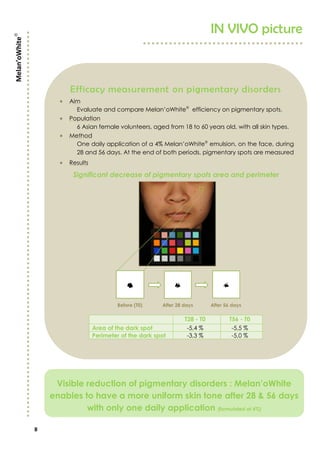
Efficacy measurement on pigmentary disorders
 Aim
Evaluate and compare Melan’oWhite
efficiency on pigmentary spots.
 Population
6 Asian female volunteers, aged from 18 to 60 years old, with all skin types.
 Method
One daily application of a 4% Melan’oWhite
emulsion, on the face, during
28 and 56 days. At the end of both periods, pigmentary spots are measured
 Results
Significant decrease of pigmentary spots area and perimeter
Before (T0) After 28 days After 56 days
T28 - T0 T56 - T0
Area of the dark spot -5,4 % -5,5 %
Perimeter of the dark spot -3,3 % -5,0 %
Visible reduction of pigmentary disorders : Melan’oWhite
enables to have a more uniform skin tone after 28 & 56 days
with only one daily application (formulated at 4%)
9
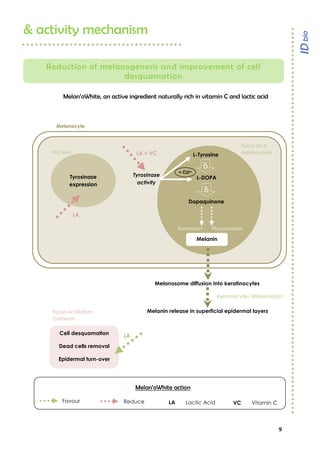
Melan’oWhite, an active ingredient naturally rich in vitamin C and lactic acid
Tyrosinase
expression
Melanocyte
Nucleus
Melanosome diffusion into keratinocytes
Melanin release in superficial epidermal layers
Focus on a
melanosomeL-Tyrosine
L-DOPA
Dopaquinone
Eumelanin Pheomelanin
Melanin
Keratinocytes differentiation
Favour
Melan’oWhite action
Reduce
LA
LA + VC
LA
Tyrosinase
activity
O2
O2
+ CU2+
LA Lactic Acid VC Vitamin C
Cell desquamation
Dead cells removal
Epidermal turn-over
Focus on Stratum
Corneum
Reduction of melanogenesis and improvement of cell
desquamation
& activity mechanism
10
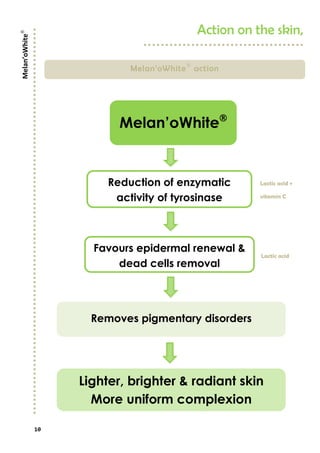
Action on the skin,
Melan’oWhite
action
Melan’oWhite
Lighter, brighter & radiant skin
More uniform complexion
Reduction of enzymatic
activity of tyrosinase
Favours epidermal renewal &
dead cells removal
Removes pigmentary disorders
Lactic acid +
vitamin C
Lactic acid
Melan’oWhite
11
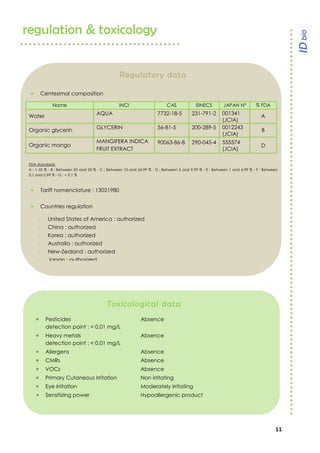
regulation & toxicology
Regulatory data
 Centesimal composition
Name INCI CAS EINECS JAPAN N° % FDA
Water
AQUA 7732-18-5 231-791-2 001341
(JCIA)
A
Organic glycerin
GLYCERIN 56-81-5 200-289-5 0012243
(JCIA)
B
Organic mango
MANGIFERA INDICA
FRUIT EXTRACT
90063-86-8 290-045-4 555574
(JCIA)
D
FDA standards
A : > 50 % - B : Between 25 and 50 % - C : Between 10 and 24,99 % - D : Between 5 and 9,99 % - E : Between 1 and 4,99 % - F : Between
0,1 and 0,99 % - G : < 0,1 %
 Tariff nomenclature : 13021980
 Countries regulation
- United States of America : authorized
- China : authorized
- Korea : authorized
- Australia : authorized
- New-Zealand : authorized
- Japan : authorized
Toxicological data
 Pesticides Absence
detection point : < 0,01 mg/L
 Heavy metals Absence
detection point : < 0,01 mg/L
 Allergens Absence
 CMRs Absence
 VOCs Absence
 Primary Cutaneous Irritation Non irritating
 Eye Irritation Moderately irritating
 Sensitizing power Hypoallergenic product
12
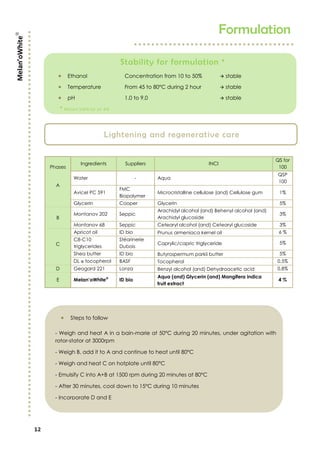
Phases
Ingredients Suppliers INCI
QS for
100
A
Water - Aqua
QSP
100
Avicel PC 591
FMC
Biopolymer
Microcristalline cellulose (and) Cellulose gum 1%
Glycerin Cooper Glycerin 5%
B
Montanov 202 Seppic
Arachidyl alcohol (and) Behenyl alcohol (and)
Arachidyl glucoside
3%
Montanov 68 Seppic Cetearyl alcohol (and) Cetearyl glucoside 3%
C
Apricot oil ID bio Prunus armeniaca kernel oil 6 %
C8-C10
triglycerides
Stéarinerie
Dubois
Caprylic/capric triglyceride 5%
Shea butter ID bio Butyrospermum parkii butter 5%
DL α tocopherol BASF Tocopherol 0,5%
D Geogard 221 Lonza Benzyl alcohol (and) Dehydroacetic acid 0,8%
E Melan’oWhite
ID bio
Aqua (and) Glycerin (and) Mangifera indica
fruit extract
4 %
Formulation
Stability for formulation *
 Ethanol Concentration from 10 to 50%  stable
 Temperature From 45 to 80°C during 2 hour  stable
 pH 1,0 to 9,0  stable
* Melan’oWhite at 4%
Lightening and regenerative care
 Ingrédients
Melan’oWhite
 Steps to follow
- Weigh and heat A in a bain-marie at 50°C during 20 minutes, under agitation with
rotor-stator at 3000rpm
- Weigh B, add it to A and continue to heat until 80°C
- Weigh and heat C on hotplate until 80°C
- Emulsify C into A+B at 1500 rpm during 20 minutes at 80°C
- After 30 minutes, cool down to 15°C during 10 minutes
- Incorporate D and E
13
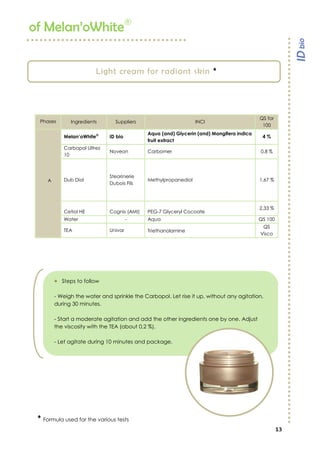
Phases Ingredients Suppliers INCI
QS for
100
A
Melan’oWhite
ID bio
Aqua (and) Glycerin (and) Mangifera indica
fruit extract
4 %
Carbopol Ultrez
10
Noveon Carbomer 0,8 %
Dub Diol
Stearinerie
Dubois Fils
Methylpropanediol 1,67 %
Cetiol HE Cognis (AMI) PEG-7 Glyceryl Cocoate
2,33 %
Water - Aqua QS 100
TEA Univar Triethanolamine
QS
Visco
of Melan’oWhite
Light cream for radiant skin *
 Ingrédients
 Steps to follow
- Weigh the water and sprinkle the Carbopol. Let rise it up, without any agitation,
during 30 minutes.
- Start a moderate agitation and add the other ingredients one by one. Adjust
the viscosity with the TEA (about 0,2 %).
- Let agitate during 10 minutes and package.
* Formula used for the various tests
14
The bibliography
Desquamation and cell renewal
Yuki YAMAMOTO, Koji UEDE, Nozomi YONEI, Akiko KISHIOKA, Toshio HTANI, Fukumi
FURUKAWA - 2006 - Effects of alpha-hydroxy acids on the human skin ofJapanese
subjects: The rationale for chemical peeling - Journal of Dermatology, 1 : 16-22
Yu-Ping Hsiao, Hsin-Lien Huang, Wan-Wen Lai, Jing-Gung Chung, Jen-Hung Yang - 2009 -
Antiproliferative effects of lactic acid via the induction of apoptosis and cell cycle arrest
in a human keratinocyte cell line (HaCaT) - Journal of Dermatological Science, 54 : 175-
184
Lightening action
WALTER P . SMITH*, P h . D . - 1999 - The effects of topical L(+) lactic acid and ascorbic
acid on skin whitening - International Journal of Cosmetic Science, 21: 33-40
J. M. Gillbro and M. J. Olsson - 2011 - The melanogenesis and mechanisms of skin-
lightening agents – existing and new approaches - International Journal of Cosmetic
Science, 33 : 210-221
Inhibition of melanin synthesis
Akiko Usuki, Akiko Ohashi, Hirofumi Sato, Yasunobu Ochiai, Masamitsu Ichihashi and Yoko
Funasaka - 2003 - The inhibitory effect of glycolic acid and lactic acid on melanin
synthesis in melanoma cells - Experimental Dermatology, 12 (Suppl. 2): 43-50
Shunsaku Ando, Osamu Ando, Yasuo Suemoto, and Yutaka Mishima - 1993 - Tyrosinase
gene transcription and its control by melanogenic inhibitors - The Society for Investigative
Dermatology, VOL 100, NO.2 : 150S-155S
Melan’oWhite

Melan’oWhite

  • 1.
    1 Melan’oWhite Technical file ID bio- ESTER Technopole - 6 allée Skylab - 87068 LIMOGES Cedex - FRANCE Tel +33 5 55 35 05 35 - Fax +33 5 55 35 95 44 - E-mail : info@idbio.eu - Web : www.idbio.eu Lightening activity
  • 2.
    2 Melan’oWhite : Melan’oWhite … and naturallyrich in lightening substances …  LACTIC ACID It is one of the smallest AHA (Alpha Hydroxy Acid) well appreciated in cosmetics for its beneficial virtues. Naturally present in various botanicals, this acid helps to enhance skin aspect and to improve dead cells removal so as to have a brighter complexion.  VITAMIN C Also called ascorbic acid, this vitamin is present in various plants and fruits. It is renowned for its anti-radical proprieties but also for its action on tyrosinase activity. It helps to lower it and thus, to reduce uneven pigmentation to obtain a uniform, light and radiant skin. Organic, preservative free … Melan’oWhite is an active ingredient, objectivated in vitro, ex vivo and in vivo, made with 98,9 % organic raw materials. At the same time, this active ingredient is filtered in sterile conditions and is without preservative. Then, Melan’oWhite is an ingredient certified by ECOCERT Greenlife according to the ECOCERT Standards for Natural and Organic Cosmetics available on http://cosmetics.ecocert.com Custom-made product: we can adjust some parameters according to your formulation needs. … Melan’oWhite helps to answer all the skin tone concerns  From Thai to Brazilian, from Chinese to African, skin lightening is a global and significant trend.  It exists more than 66 skin colors and most of them have one thing in common : a non uniform complexion.  Melan’oWhite is the ideal answer thanks to its high natural content in lactic acid and vitamin C that directly acts on the tyrosinase activity and the cell renewal, to make skin clearer and more uniform.
  • 3.
    3  a natural activeingredient Physico-chemical characterization  Aspect Limpid liquid  Colour Pale yellow to yellow  Odour Characteristic  pH 3,0 - 4,5  Refractive index 1,300 - 1,400  Density 1,00 - 1,20  Total carbohydrates 20 - 40 g/L  Total polyphenols 0,05 - 0,15 g/L  Lactic acid  2 g/L  Vitamin C  15 mg/L  Bacteriology : - Mesophilic Aerobic Flora < 1 UFC/ml - Yeast and Moulds < 1 UFC/ml - Escherichia Coli Absence/ml - Aspergillus Niger Absence/ml - Candida Albicans Absence/ml - Staphylococcus Aureus Absence/ml - Pseudomonas aeruginosa Absence/ml  Preservative Absence Use  Dose of use 1 to 4 %  Storage Keep in original sealed packaging in a dry and dark place, away from light and between 10 and 25°C  Use Use entirely after opening  Shelf life 2 years
  • 4.
    4 IN VITRO Melan’oWhite Melano-modulatory effectof Melan’oWhite  Aim Evaluate the “melano-modulatory” effect of Melan’oWhite in a normal human melanocytes monolayers model.  Method Confluent monolayers of normal human melanocytes are obtained by cell culture of 4 years old subjects. They are incubated for a 72-hour period at 37°C, without and then, with Melan’oWhite directly solubilized in the culture medium. At the end of the incubation period, melanin content of the melanocytes is quantified by a spectrophotometric method and a comparison is made between treated cells and non treated cells (control).  Results Significant decrease of melanin intracellular content after 72hours * Significant ; (Student t-test ; p < 0,05) EFFISCIENCE study Melan’oWhite significantly reduces the melanin synthesis by 93,2% (at a 0,025 % concentration) Melan’oWhite Melanin content (%) -91,3 % -93,2 %* -91,6 %* (250 μM)
  • 5.
    5 & EX VIVOtesting Melan’oWhite allows to significantly reduce the melanin synthesis by 13% (formulated at 4% +1% solution) Cutaneous effect of Melan’oWhite on melanin synthesis  Aim Evaluate the depigmentation effect of Melan’oWhite against placebo on reconstructed human pigmented epidermis.  Method Reconstructed human pigmented epidermis, aged day 10, are incubated at 37°C with 5% CO2 during 48 hours. Then, they are transferred in wells- plate with growth medium and tested products. Kojic acid and Melan’oWhite are formulated at 4% to be topically tested and then, tested in medium respectively at 250 μM and 1% in solution. Afterwards, those products are evaluated against placebo (formulated without any active molecule) during 3 days. At the end of the study, the synthesis of melanin is measured after extraction of the melanin contained in each epidermis.  Results Significant inhibition of melanin synthesis against placebo * Significant ; (Student t-test ; p < 0,05) SEPhRA study Melanin content (%) Melan’oWhite at 4% + 1% solution Kojic acid at 4% + 250 μM solution 85% 90% 95% 100% Placebo Kojic acid Melan'oWhite* -5 % -13 %*
  • 6.
    6 Some words aboutEX VIVO method An innovative method Melan’oWhite Skin explants Effectiveness proven by an innovative technique: ex vivo test on RHTE RHTE (Reconstructed Human Tanned Epidermis) are obtained by culturing adult human keratinocytes in presence of melanocytes phototype VI (dark skin). They have a totally differentiated epidermal layer composed of a renewal layer, a Malpighian layer and a functional horny layer. To quantify the melanin, RHTE are transferred into a kit with 6 wells (1 well = 1 epidermal unit) in addition with a culture medium. Tested formulas (see ex vivo graph page 5) are directly topically applied at RHTE surface (1 μL). At the same time, a solution of each product is added to the culture medium (kojic acid : 250 μM and Melan’oWhite : 1%). After a 3-day treatment, kits are maintained 48-hours more, before melanin extraction and analysis of cell viability (MTT). For melanin, each epidermis is removed from the polycarbonate insert by cutting out the filter on which the tissues have grown. The filters are then plunged into Soluene (Perkin Elmer) and heated at 100°C during 45 minutes. Afterwards, the supernatants absorbance is measured in triplicate and converted into synthesized melanin content. Finally, the percentage of melanin synthesis inhibition is given according to placebo results. Histological section of pigmented epidermis Histological section of reconstructed pigmented epidermis
  • 7.
    7 Placebo Melan’oWhite a* Δ Comparedto T0 a* T28 a* T56 b* T28 b* T56 Placebo -1,2% -2,6% +0,5% +1,3% Melan’oWhite -4,3% -2,6% +0,7% +1,0% Efficacy measurement on lightening effect  Aim Evaluate and compare Melan’oWhite lightening efficiency against placebo.  Population 23 Asian female volunteers, aged from 18 to 60 years old, with all skin types.  Method One daily application (in the evening) of a 4% Melan’oWhite emulsion and placebo emulsion, on randomized inner forearm during 28 and 56 days. At the end of both periods, parameters L*a*b and ITA° are measured by chromametry. Results are given for L* and ITA° which give the best description of a lightening effect. L* = Luminance which represent the relative brightness from total darkness (L*=0) to absolute white (L*100) ITA° = Individual Typological Angle  Pigmentation degree calculated with ITA° = Arctg [(L*- 50)/b*].(180/π) - Tanned skin ITA° < 27° whereas very light skin ITA° > 55°.  Results Significant ITA° and L* increase vs placebo at T28 and T56 days * Significant ; (Student t-test ; p < 0,01) SPINCONTROL study & IN VIVO results Melan’oWhite enables a significant lightening improvement after 28 days (+4,6% for ITA°/+0,9% for L*) and 56 days (+6,7% for ITA°/+1,4% for L*) with only 1 daily application +6,7 %* +1,2 % +4,6 %* -1,3 % Variation compared to T0 (%) T28 T56 +1,4 % +0,3 % +0,9 % -0,2% -2% 0% 2% 4% 6% 8% Placebo Melan'oWhite Variation compared to T0 (%) T28 T56 -1% 1% 2% Placebo Melan'oWhite ITA° L* -1,3% +1,2% +1,4 %* +0,9 %*
  • 8.
    8 IN VIVO picture Melan’oWhite Efficacymeasurement on pigmentary disorders  Aim Evaluate and compare Melan’oWhite efficiency on pigmentary spots.  Population 6 Asian female volunteers, aged from 18 to 60 years old, with all skin types.  Method One daily application of a 4% Melan’oWhite emulsion, on the face, during 28 and 56 days. At the end of both periods, pigmentary spots are measured  Results Significant decrease of pigmentary spots area and perimeter Before (T0) After 28 days After 56 days T28 - T0 T56 - T0 Area of the dark spot -5,4 % -5,5 % Perimeter of the dark spot -3,3 % -5,0 % Visible reduction of pigmentary disorders : Melan’oWhite enables to have a more uniform skin tone after 28 & 56 days with only one daily application (formulated at 4%)
  • 9.
    9 Melan’oWhite, an activeingredient naturally rich in vitamin C and lactic acid Tyrosinase expression Melanocyte Nucleus Melanosome diffusion into keratinocytes Melanin release in superficial epidermal layers Focus on a melanosomeL-Tyrosine L-DOPA Dopaquinone Eumelanin Pheomelanin Melanin Keratinocytes differentiation Favour Melan’oWhite action Reduce LA LA + VC LA Tyrosinase activity O2 O2 + CU2+ LA Lactic Acid VC Vitamin C Cell desquamation Dead cells removal Epidermal turn-over Focus on Stratum Corneum Reduction of melanogenesis and improvement of cell desquamation & activity mechanism
  • 10.
    10 Action on theskin, Melan’oWhite action Melan’oWhite Lighter, brighter & radiant skin More uniform complexion Reduction of enzymatic activity of tyrosinase Favours epidermal renewal & dead cells removal Removes pigmentary disorders Lactic acid + vitamin C Lactic acid Melan’oWhite
  • 11.
    11 regulation & toxicology Regulatorydata  Centesimal composition Name INCI CAS EINECS JAPAN N° % FDA Water AQUA 7732-18-5 231-791-2 001341 (JCIA) A Organic glycerin GLYCERIN 56-81-5 200-289-5 0012243 (JCIA) B Organic mango MANGIFERA INDICA FRUIT EXTRACT 90063-86-8 290-045-4 555574 (JCIA) D FDA standards A : > 50 % - B : Between 25 and 50 % - C : Between 10 and 24,99 % - D : Between 5 and 9,99 % - E : Between 1 and 4,99 % - F : Between 0,1 and 0,99 % - G : < 0,1 %  Tariff nomenclature : 13021980  Countries regulation - United States of America : authorized - China : authorized - Korea : authorized - Australia : authorized - New-Zealand : authorized - Japan : authorized Toxicological data  Pesticides Absence detection point : < 0,01 mg/L  Heavy metals Absence detection point : < 0,01 mg/L  Allergens Absence  CMRs Absence  VOCs Absence  Primary Cutaneous Irritation Non irritating  Eye Irritation Moderately irritating  Sensitizing power Hypoallergenic product
  • 12.
    12 Phases Ingredients Suppliers INCI QSfor 100 A Water - Aqua QSP 100 Avicel PC 591 FMC Biopolymer Microcristalline cellulose (and) Cellulose gum 1% Glycerin Cooper Glycerin 5% B Montanov 202 Seppic Arachidyl alcohol (and) Behenyl alcohol (and) Arachidyl glucoside 3% Montanov 68 Seppic Cetearyl alcohol (and) Cetearyl glucoside 3% C Apricot oil ID bio Prunus armeniaca kernel oil 6 % C8-C10 triglycerides Stéarinerie Dubois Caprylic/capric triglyceride 5% Shea butter ID bio Butyrospermum parkii butter 5% DL α tocopherol BASF Tocopherol 0,5% D Geogard 221 Lonza Benzyl alcohol (and) Dehydroacetic acid 0,8% E Melan’oWhite ID bio Aqua (and) Glycerin (and) Mangifera indica fruit extract 4 % Formulation Stability for formulation *  Ethanol Concentration from 10 to 50%  stable  Temperature From 45 to 80°C during 2 hour  stable  pH 1,0 to 9,0  stable * Melan’oWhite at 4% Lightening and regenerative care  Ingrédients Melan’oWhite  Steps to follow - Weigh and heat A in a bain-marie at 50°C during 20 minutes, under agitation with rotor-stator at 3000rpm - Weigh B, add it to A and continue to heat until 80°C - Weigh and heat C on hotplate until 80°C - Emulsify C into A+B at 1500 rpm during 20 minutes at 80°C - After 30 minutes, cool down to 15°C during 10 minutes - Incorporate D and E
  • 13.
    13 Phases Ingredients SuppliersINCI QS for 100 A Melan’oWhite ID bio Aqua (and) Glycerin (and) Mangifera indica fruit extract 4 % Carbopol Ultrez 10 Noveon Carbomer 0,8 % Dub Diol Stearinerie Dubois Fils Methylpropanediol 1,67 % Cetiol HE Cognis (AMI) PEG-7 Glyceryl Cocoate 2,33 % Water - Aqua QS 100 TEA Univar Triethanolamine QS Visco of Melan’oWhite Light cream for radiant skin *  Ingrédients  Steps to follow - Weigh the water and sprinkle the Carbopol. Let rise it up, without any agitation, during 30 minutes. - Start a moderate agitation and add the other ingredients one by one. Adjust the viscosity with the TEA (about 0,2 %). - Let agitate during 10 minutes and package. * Formula used for the various tests
  • 14.
    14 The bibliography Desquamation andcell renewal Yuki YAMAMOTO, Koji UEDE, Nozomi YONEI, Akiko KISHIOKA, Toshio HTANI, Fukumi FURUKAWA - 2006 - Effects of alpha-hydroxy acids on the human skin ofJapanese subjects: The rationale for chemical peeling - Journal of Dermatology, 1 : 16-22 Yu-Ping Hsiao, Hsin-Lien Huang, Wan-Wen Lai, Jing-Gung Chung, Jen-Hung Yang - 2009 - Antiproliferative effects of lactic acid via the induction of apoptosis and cell cycle arrest in a human keratinocyte cell line (HaCaT) - Journal of Dermatological Science, 54 : 175- 184 Lightening action WALTER P . SMITH*, P h . D . - 1999 - The effects of topical L(+) lactic acid and ascorbic acid on skin whitening - International Journal of Cosmetic Science, 21: 33-40 J. M. Gillbro and M. J. Olsson - 2011 - The melanogenesis and mechanisms of skin- lightening agents – existing and new approaches - International Journal of Cosmetic Science, 33 : 210-221 Inhibition of melanin synthesis Akiko Usuki, Akiko Ohashi, Hirofumi Sato, Yasunobu Ochiai, Masamitsu Ichihashi and Yoko Funasaka - 2003 - The inhibitory effect of glycolic acid and lactic acid on melanin synthesis in melanoma cells - Experimental Dermatology, 12 (Suppl. 2): 43-50 Shunsaku Ando, Osamu Ando, Yasuo Suemoto, and Yutaka Mishima - 1993 - Tyrosinase gene transcription and its control by melanogenic inhibitors - The Society for Investigative Dermatology, VOL 100, NO.2 : 150S-155S Melan’oWhite