
DSpace-CRIS: the free open-source
Research Information Management System
fully integrated with ORCID
Andrea Bollini www.4science.it
ORCID Webinar, Better together
19 September 2019
DSpace-CRIS
DSpace-CRIS is an “extended” version of DSpace, the
most adopted repository platform in the world.
It has a powerful and flexible data model to describe
not just publications, but all the entities that populate
the research environment and their meaningful
relationships.
https://wiki.duraspace.org/display/DSPACECRIS/DSpace-CRIS+Home
(documentation)
https://dspace-cris.4science.it/ (demo)
Open solution for research information management
DSpace-CRIS is free, open source, compliant with open
standards, open protocols, open technologies.
It provides institutions with a sustainable and effective
tool to manage research information such as:
researchers’ profiles, department pages, project grants
& awards, research outputs, patents, theses, metrics,
reports, statistics, etc.
Now adopted in 6 continents:
https://wiki.duraspace.org/display/DSPACECRIS/DSpace-CRIS+Users
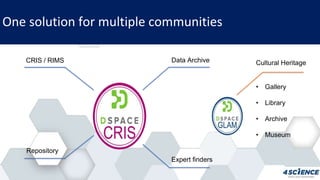
One solution for multiple communities
CRIS / RIMS Data Archive
Repository
Cultural Heritage
• Gallery
• Library
• Archive
• Museum
Expert finders
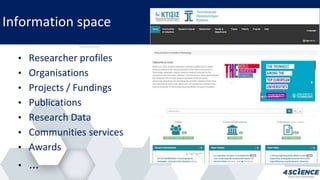
Information space
• Researcher profiles
• Organisations
• Projects / Fundings
• Publications
• Research Data
• Communities services
• Awards
• …
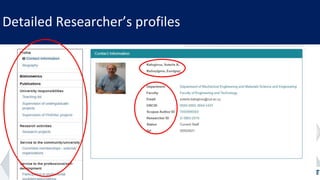
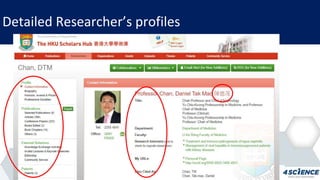
Detailed Researcher’s profiles
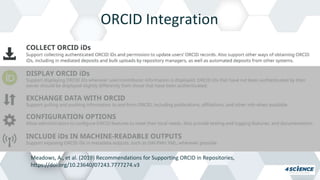
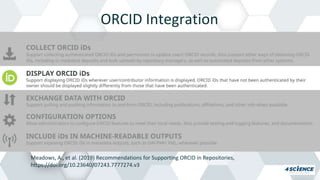
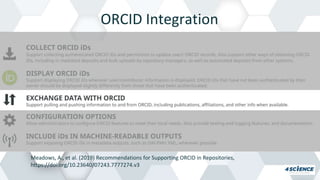
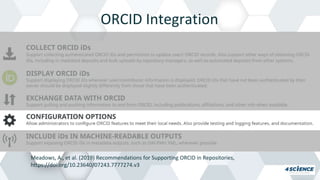
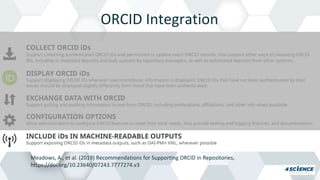
ORCID Integration
Meadows, A., et al. (2019) Recommendations for Supporting ORCID in Repositories,
https://doi.org/10.23640/07243.7777274.v3
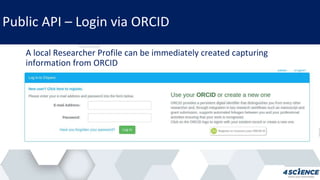
Public API – Login via ORCID
A local Researcher Profile can be immediately created capturing
information from ORCID
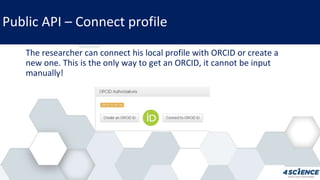
Public API – Connect profile
The researcher can connect his local profile with ORCID or create a
new one. This is the only way to get an ORCID, it cannot be input
manually!
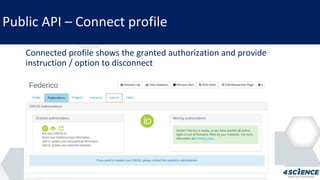
Public API – Connect profile
Connected profile shows the granted authorization and provide
instruction / option to disconnect
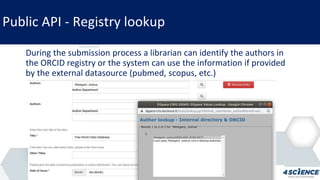
Public API - Registry lookup
During the submission process a librarian can identify the authors in
the ORCID registry or the system can use the information if provided
by the external datasource (pubmed, scopus, etc.)
ORCID Integration
Meadows, A., et al. (2019) Recommendations for Supporting ORCID in Repositories,
https://doi.org/10.23640/07243.7777274.v3
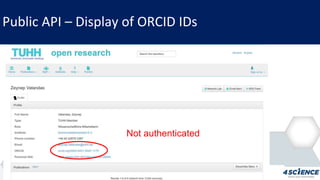
Public API – Display of ORCID IDs
Not authenticated
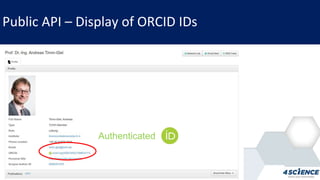
Public API – Display of ORCID IDs
Authenticated
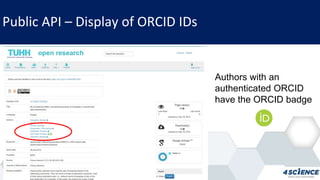
Public API – Display of ORCID IDs
Authors with an
authenticated ORCID
have the ORCID badge
ORCID Integration
Meadows, A., et al. (2019) Recommendations for Supporting ORCID in Repositories,
https://doi.org/10.23640/07243.7777274.v3
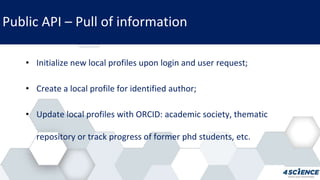
Public API – Pull of information
• Initialize new local profiles upon login and user request;
• Create a local profile for identified author;
• Update local profiles with ORCID: academic society, thematic
repository or track progress of former phd students, etc.
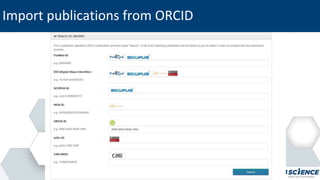
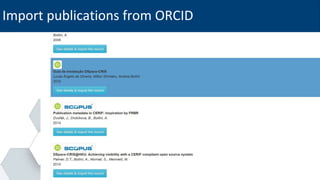
Import publications from ORCID
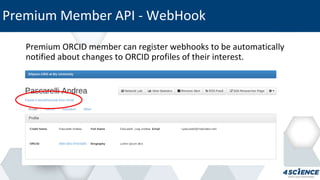
Premium ORCID member can register webhooks to be automatically
notified about changes to ORCID profiles of their interest.
Premium Member API - WebHook
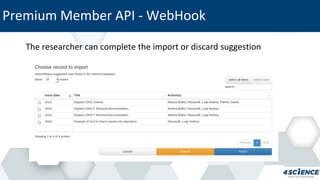
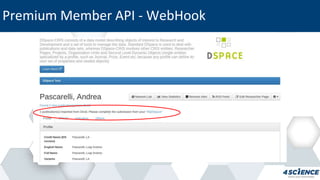
The researcher can complete the import or discard suggestion
Premium Member API - WebHook
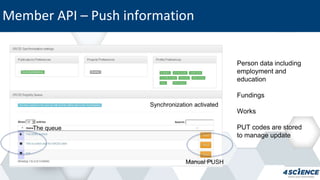
Member API – Push information
The queue
Synchronization activated
Manual PUSH
Person data including
employment and
education
Fundings
Works
PUT codes are stored
to manage update
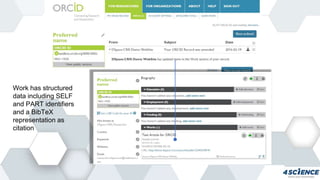
Work has structured
data including SELF
and PART identifiers
and a BibTeX
representation as
citation
ORCID Integration
Meadows, A., et al. (2019) Recommendations for Supporting ORCID in Repositories,
https://doi.org/10.23640/07243.7777274.v3
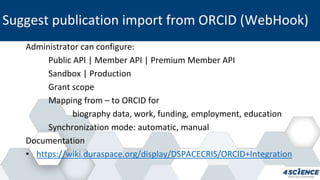
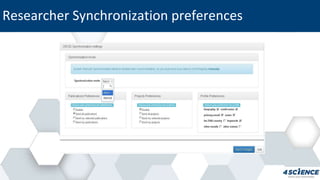
Administrator can configure:
Public API | Member API | Premium Member API
Sandbox | Production
Grant scope
Mapping from – to ORCID for
biography data, work, funding, employment, education
Synchronization mode: automatic, manual
Documentation
• https://wiki.duraspace.org/display/DSPACECRIS/ORCID+Integration
Suggest publication import from ORCID (WebHook)
Researcher Synchronization preferences
ORCID Integration
Meadows, A., et al. (2019) Recommendations for Supporting ORCID in Repositories,
https://doi.org/10.23640/07243.7777274.v3
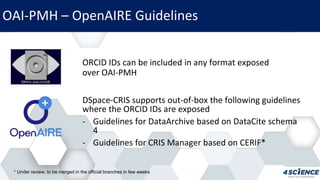
ORCID IDs can be included in any format exposed
over OAI-PMH
OAI-PMH – OpenAIRE Guidelines
DSpace-CRIS supports out-of-box the following guidelines
where the ORCID IDs are exposed
- Guidelines for DataArchive based on DataCite schema
4
- Guidelines for CRIS Manager based on CERIF*
* Under review, to be merged in the official branches in few weeks
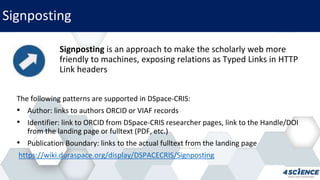
Signposting is an approach to make the scholarly web more
friendly to machines, exposing relations as Typed Links in HTTP
Link headers
Signposting
The following patterns are supported in DSpace-CRIS:
• Author: links to authors ORCID or VIAF records
• Identifier: link to ORCID from DSpace-CRIS researcher pages, link to the Handle/DOI
from the landing page or fulltext (PDF, etc.)
• Publication Boundary: links to the actual fulltext from the landing page
https://wiki.duraspace.org/display/DSPACECRIS/Signposting
Thanks for your attention!
Andrea Bollini
andrea.bollini@4science.it
skype: a.bollini
linkedin: andreabollini
orcid: 0000-0002-9029-1854
www.4science.it

DSpace-CRIS ORCID Integration

  • 1.
    DSpace-CRIS: the freeopen-source Research Information Management System fully integrated with ORCID Andrea Bollini www.4science.it ORCID Webinar, Better together 19 September 2019
  • 2.
    DSpace-CRIS DSpace-CRIS is an“extended” version of DSpace, the most adopted repository platform in the world. It has a powerful and flexible data model to describe not just publications, but all the entities that populate the research environment and their meaningful relationships. https://wiki.duraspace.org/display/DSPACECRIS/DSpace-CRIS+Home (documentation) https://dspace-cris.4science.it/ (demo)
  • 3.
    Open solution forresearch information management DSpace-CRIS is free, open source, compliant with open standards, open protocols, open technologies. It provides institutions with a sustainable and effective tool to manage research information such as: researchers’ profiles, department pages, project grants & awards, research outputs, patents, theses, metrics, reports, statistics, etc. Now adopted in 6 continents: https://wiki.duraspace.org/display/DSPACECRIS/DSpace-CRIS+Users
  • 4.
    One solution formultiple communities CRIS / RIMS Data Archive Repository Cultural Heritage • Gallery • Library • Archive • Museum Expert finders
  • 5.
    Information space • Researcherprofiles • Organisations • Projects / Fundings • Publications • Research Data • Communities services • Awards • …
  • 6.
  • 7.
  • 8.
    ORCID Integration Meadows, A.,et al. (2019) Recommendations for Supporting ORCID in Repositories, https://doi.org/10.23640/07243.7777274.v3
  • 9.
    Public API –Login via ORCID A local Researcher Profile can be immediately created capturing information from ORCID
  • 10.
    Public API –Connect profile The researcher can connect his local profile with ORCID or create a new one. This is the only way to get an ORCID, it cannot be input manually!
  • 11.
    Public API –Connect profile Connected profile shows the granted authorization and provide instruction / option to disconnect
  • 12.
    Public API -Registry lookup During the submission process a librarian can identify the authors in the ORCID registry or the system can use the information if provided by the external datasource (pubmed, scopus, etc.)
  • 13.
    ORCID Integration Meadows, A.,et al. (2019) Recommendations for Supporting ORCID in Repositories, https://doi.org/10.23640/07243.7777274.v3
  • 14.
    Public API –Display of ORCID IDs Not authenticated
  • 15.
    Public API –Display of ORCID IDs Authenticated
  • 16.
    Public API –Display of ORCID IDs Authors with an authenticated ORCID have the ORCID badge
  • 17.
    ORCID Integration Meadows, A.,et al. (2019) Recommendations for Supporting ORCID in Repositories, https://doi.org/10.23640/07243.7777274.v3
  • 18.
    Public API –Pull of information • Initialize new local profiles upon login and user request; • Create a local profile for identified author; • Update local profiles with ORCID: academic society, thematic repository or track progress of former phd students, etc.
  • 19.
  • 20.
  • 21.
    Premium ORCID membercan register webhooks to be automatically notified about changes to ORCID profiles of their interest. Premium Member API - WebHook
  • 22.
    Premium Member API- WebHook The researcher can complete the import or discard suggestion
  • 23.
  • 24.
    Member API –Push information The queue Synchronization activated Manual PUSH Person data including employment and education Fundings Works PUT codes are stored to manage update
  • 25.
    Work has structured dataincluding SELF and PART identifiers and a BibTeX representation as citation
  • 26.
    ORCID Integration Meadows, A.,et al. (2019) Recommendations for Supporting ORCID in Repositories, https://doi.org/10.23640/07243.7777274.v3
  • 27.
    Administrator can configure: PublicAPI | Member API | Premium Member API Sandbox | Production Grant scope Mapping from – to ORCID for biography data, work, funding, employment, education Synchronization mode: automatic, manual Documentation • https://wiki.duraspace.org/display/DSPACECRIS/ORCID+Integration Suggest publication import from ORCID (WebHook)
  • 28.
  • 29.
    ORCID Integration Meadows, A.,et al. (2019) Recommendations for Supporting ORCID in Repositories, https://doi.org/10.23640/07243.7777274.v3
  • 30.
    ORCID IDs canbe included in any format exposed over OAI-PMH OAI-PMH – OpenAIRE Guidelines DSpace-CRIS supports out-of-box the following guidelines where the ORCID IDs are exposed - Guidelines for DataArchive based on DataCite schema 4 - Guidelines for CRIS Manager based on CERIF* * Under review, to be merged in the official branches in few weeks
  • 31.
    Signposting is anapproach to make the scholarly web more friendly to machines, exposing relations as Typed Links in HTTP Link headers Signposting The following patterns are supported in DSpace-CRIS: • Author: links to authors ORCID or VIAF records • Identifier: link to ORCID from DSpace-CRIS researcher pages, link to the Handle/DOI from the landing page or fulltext (PDF, etc.) • Publication Boundary: links to the actual fulltext from the landing page https://wiki.duraspace.org/display/DSPACECRIS/Signposting
  • 32.
    Thanks for yourattention! Andrea Bollini andrea.bollini@4science.it skype: a.bollini linkedin: andreabollini orcid: 0000-0002-9029-1854 www.4science.it