DSpace-CRIS: a CRIS enhanced repository platform
Inconecss, Berlin 19th April 2016
Andrea Bollini ( orcid:0000-0002-9029-1854 )
Head of Open Source and Open Standards Strategy
• The DSpace-CRIS project history
• A rich & customisable data model
• Main features
• ORCID integration
• Next steps
Agenda
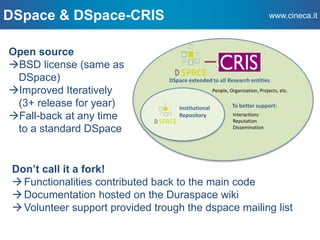
DSpace & DSpace-CRIS
DSpace extended to all Research entities
To better support:
People, Organization, Projects, etc.
Interactions
Reputation
Dissemination
Institutional
Repository
www.cineca.it
Open source
BSD license (same as
DSpace)
Improved Iteratively
(3+ release for year)
Fall-back at any time
to a standard DSpace
Don’t call it a fork!
Functionalities contributed back to the main code
Documentation hosted on the Duraspace wiki
Volunteer support provided trough the dspace mailing list
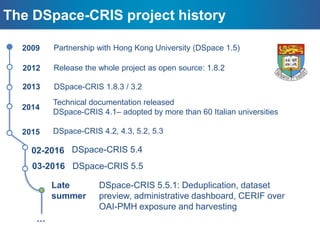
The DSpace-CRIS project history
Partnership with Hong Kong University (DSpace 1.5)2009
2012
2013
2014
Release the whole project as open source: 1.8.2
DSpace-CRIS 1.8.3 / 3.2
Technical documentation released
DSpace-CRIS 4.1– adopted by more than 60 Italian universities
DSpace-CRIS 5.402-2016
03-2016
2015 DSpace-CRIS 4.2, 4.3, 5.2, 5.3
DSpace-CRIS 5.5
DSpace-CRIS 5.5.1: Deduplication, dataset
preview, administrative dashboard, CERIF over
OAI-PMH exposure and harvesting
Late
summer
…
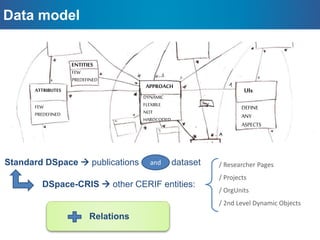
Data model
Standard DSpace  publications or dataset
DSpace-CRIS  other CERIF entities:
/ Researcher Pages
/ Projects
/ OrgUnits
/ 2nd Level Dynamic Objects
APPROACH
DYNAMIC
FLEXIBLE
NOT
HARDCODED
UIs
FEW
PREDEFINED
ATTRIBUTES
ENTITIES
FEW
PREDEFINED
DEFINE
ANY
ASPECTS
Relations
and
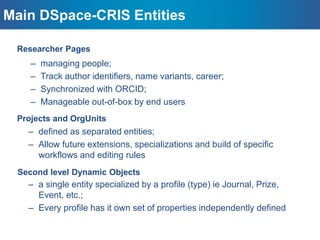
Main DSpace-CRIS Entities
– a single entity specialized by a profile (type) ie Journal, Prize,
Event, etc.;
– Every profile has it own set of properties independently defined
– managing people;
– Track author identifiers, name variants, career;
– Synchronized with ORCID;
– Manageable out-of-box by end users
– defined as separated entities;
– Allow future extensions, specializations and build of specific
workflows and editing rules
Researcher Pages
Projects and OrgUnits
Second level Dynamic Objects
Which is the value
proposition?
www.cineca.it
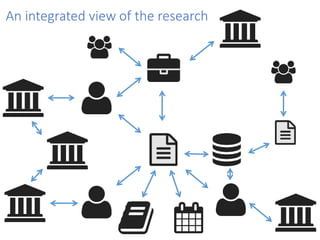
An integrated view of the research www.cineca.it
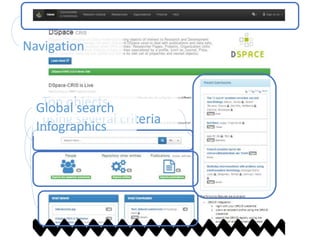
Top objects
using several criteria
Navigation
Global search
Infographics
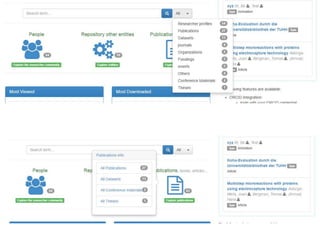
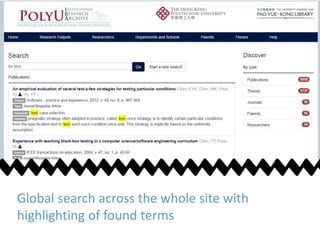
Global search across the whole site with
highlighting of found terms
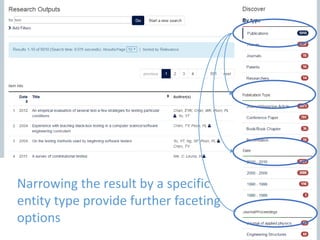
Narrowing the result by a specific
entity type provide further faceting
options
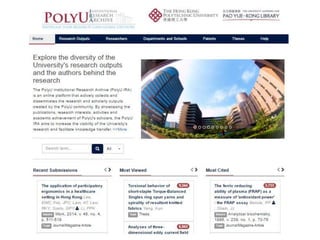
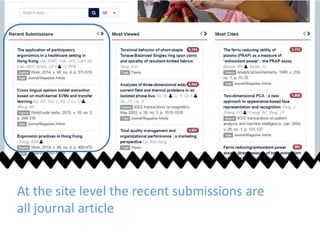
At the site level the recent submissions are
all journal article
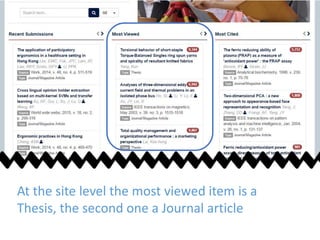
At the site level the most viewed item is a
Thesis, the second one a Journal article
At the site level all the most cited
publications are journal articles
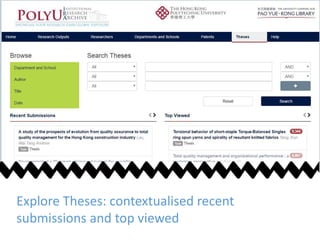
Explore Theses: contextualised recent
submissions and top viewed
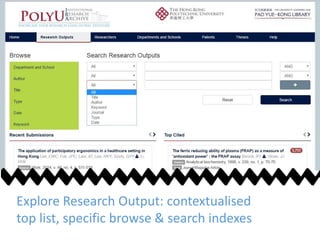
Explore Research Output: contextualised
top list, specific browse & search indexes
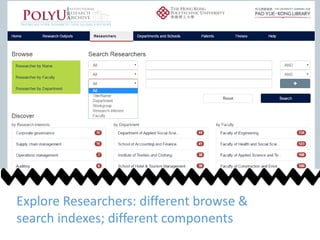
Explore Researchers: different browse &
search indexes; different components
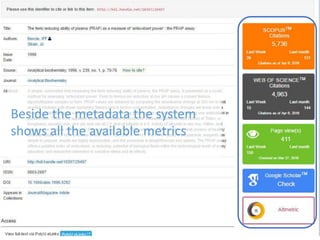
Beside the metadata the system
shows all the available metrics
5
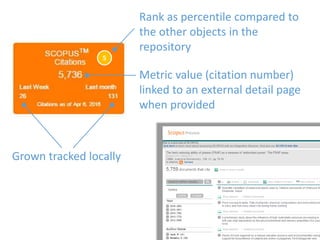
Rank as percentile compared to
the other objects in the
repository
Grown tracked locally
Metric value (citation number)
linked to an external detail page
when provided
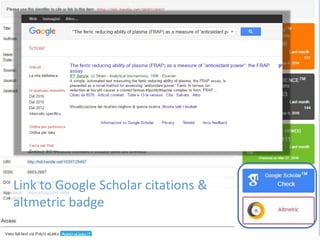
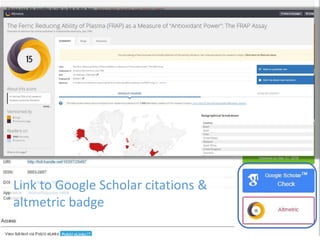
Link to Google Scholar citations &
altmetric badge
Link to Google Scholar citations &
altmetric badge
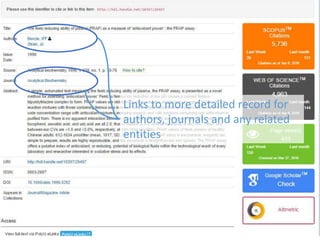
Links to more detailed record for
authors, journals and any related
entities
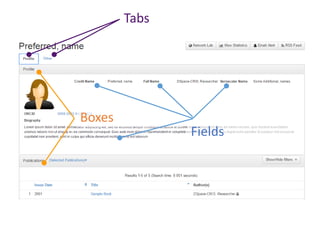
Data are organized in
several pages (tabs)
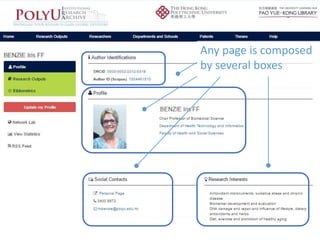
Any page is composed
by several boxes
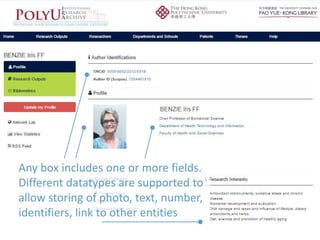
Any box includes one or more fields.
Different datatypes are supported to
allow storing of photo, text, number,
identifiers, link to other entities
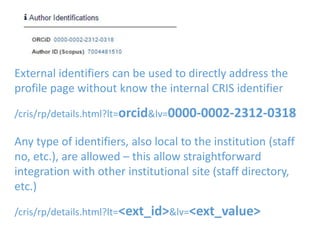
External identifiers can be used to directly address the
profile page without know the internal CRIS identifier
/cris/rp/details.html?lt=orcid&lv=0000-0002-2312-0318
Any type of identifiers, also local to the institution (staff
no, etc.), are allowed – this allow straightforward
integration with other institutional site (staff directory,
etc.)
/cris/rp/details.html?lt=<ext_id>&lv=<ext_value>
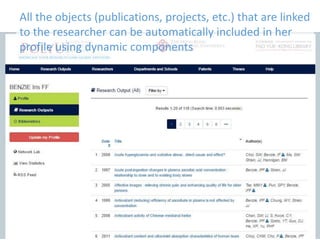
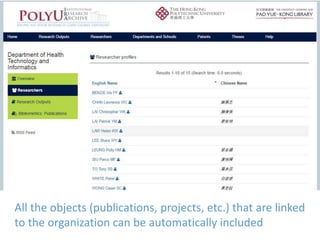
All the objects (publications, projects, etc.) that are linked
to the researcher can be automatically included in her
profile using dynamic components
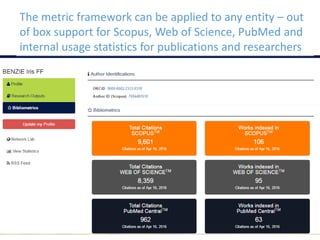
The metric framework can be applied to any entity – out
of box support for Scopus, Web of Science, PubMed and
internal usage statistics for publications and researchers
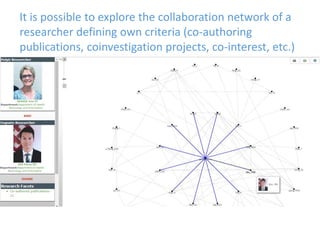
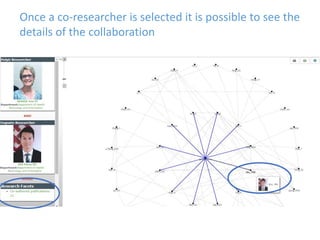
It is possible to explore the collaboration network of a
researcher defining own criteria (co-authoring
publications, coinvestigation projects, co-interest, etc.)
Once a co-researcher is selected it is possible to see the
details of the collaboration
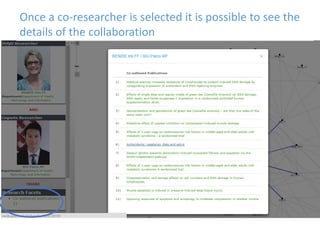
Once a co-researcher is selected it is possible to see the
details of the collaboration
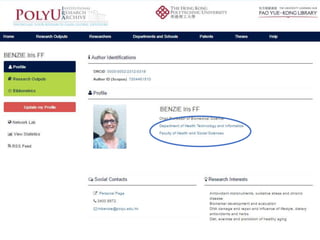
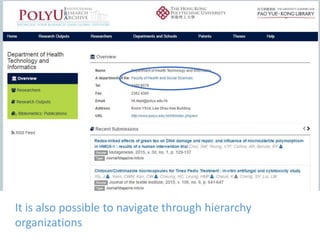
It is also possible to navigate through hierarchy
organizations
All the objects (publications, projects, etc.) that are linked
to the organization can be automatically included
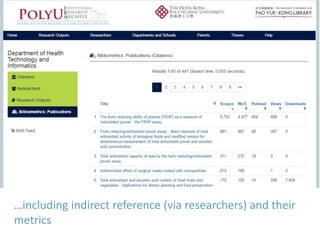
…including indirect reference (via researchers) and their
metrics
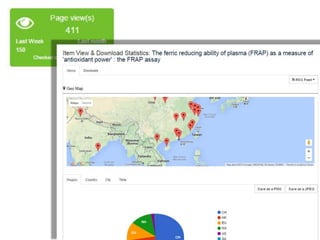
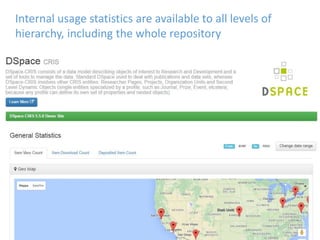
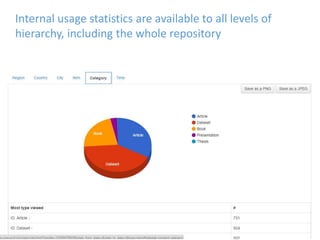
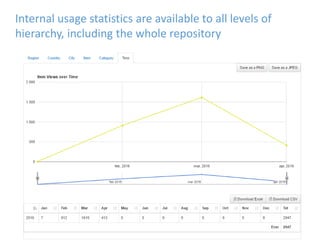
Internal usage statistics are available to all levels of
hierarchy, including the whole repository
Internal usage statistics are available to all levels of
hierarchy, including the whole repository
Internal usage statistics are available to all levels of
hierarchy, including the whole repository
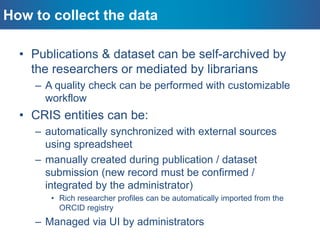
How to collect the data
• Publications & dataset can be self-archived by
the researchers or mediated by librarians
– A quality check can be performed with customizable
workflow
• CRIS entities can be:
– automatically synchronized with external sources
using spreadsheet
– manually created during publication / dataset
submission (new record must be confirmed /
integrated by the administrator)
• Rich researcher profiles can be automatically imported from the
ORCID registry
– Managed via UI by administrators
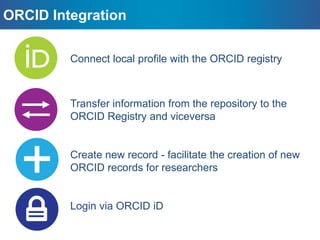
ORCID Integration
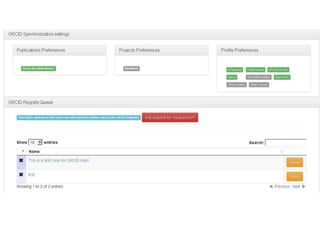
Connect local profile with the ORCID registry
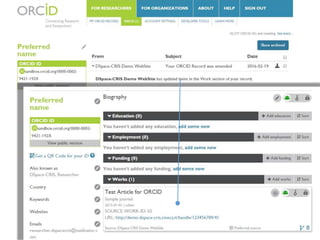
Transfer information from the repository to the
ORCID Registry and viceversa
Create new record - facilitate the creation of new
ORCID records for researchers
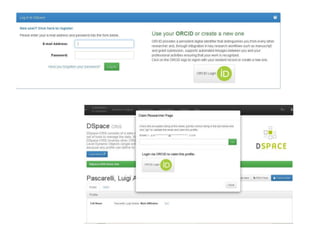
Login via ORCID iD
• Login and claim your profile using ORCID
• Use the ORCID registry as authority for
people extending the local directory
• Initialize profiles with data from the ORCID
registry
• Create ORCID profiles for researcher with
opt-in (require member api)
• Push local information about biography,
publications, projects to ORCID (require
member api)
ORCID Integration
• Deduplication tools: warn about potential
duplicate during submission and
administrative dashboard to compare &
merge
• CERIF over OAI-PMH:
– Exposure: compliance with the OpenAIRE
guidelines for CRIS system
– Harvesting of rich data using CERIF over OAI-
PMH to create regional, national or disciplinary
portal
• More tools for dataset: quota management,
data streaming, preview and manipulation
tools
What’s next?
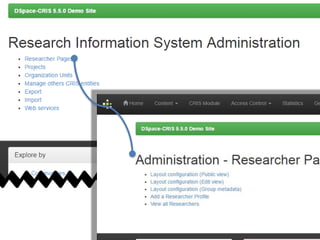
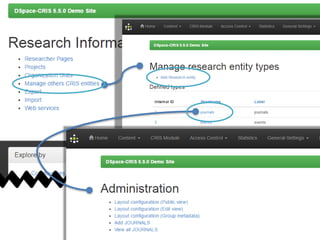
The data model configuration
doesn’t require coding!
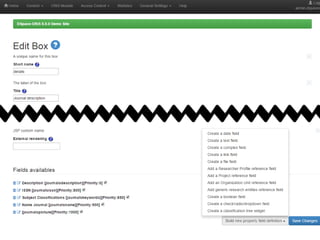
• It can be performed via UI and exported to xls
• It can be imported from XLS files
Data model configuration
Tabs
Boxes
Fields
Thanks for your attention!
https://wiki.duraspace.org/display/DSPACECRIS
Andrea Bollini ( orcid:0000-0002-9029-1854 )
Head of Open Source and Open Standards Strategy
a.bollini@cineca.it
http://www.slideshare.net/AndreaBollini2

DSpace-CRIS: a CRIS enhanced repository platform

  • 1.
    DSpace-CRIS: a CRISenhanced repository platform Inconecss, Berlin 19th April 2016 Andrea Bollini ( orcid:0000-0002-9029-1854 ) Head of Open Source and Open Standards Strategy
  • 2.
    • The DSpace-CRISproject history • A rich & customisable data model • Main features • ORCID integration • Next steps Agenda
  • 3.
    DSpace & DSpace-CRIS DSpaceextended to all Research entities To better support: People, Organization, Projects, etc. Interactions Reputation Dissemination Institutional Repository www.cineca.it Open source BSD license (same as DSpace) Improved Iteratively (3+ release for year) Fall-back at any time to a standard DSpace Don’t call it a fork! Functionalities contributed back to the main code Documentation hosted on the Duraspace wiki Volunteer support provided trough the dspace mailing list
  • 4.
    The DSpace-CRIS projecthistory Partnership with Hong Kong University (DSpace 1.5)2009 2012 2013 2014 Release the whole project as open source: 1.8.2 DSpace-CRIS 1.8.3 / 3.2 Technical documentation released DSpace-CRIS 4.1– adopted by more than 60 Italian universities DSpace-CRIS 5.402-2016 03-2016 2015 DSpace-CRIS 4.2, 4.3, 5.2, 5.3 DSpace-CRIS 5.5 DSpace-CRIS 5.5.1: Deduplication, dataset preview, administrative dashboard, CERIF over OAI-PMH exposure and harvesting Late summer …
  • 5.
    Data model Standard DSpace publications or dataset DSpace-CRIS  other CERIF entities: / Researcher Pages / Projects / OrgUnits / 2nd Level Dynamic Objects APPROACH DYNAMIC FLEXIBLE NOT HARDCODED UIs FEW PREDEFINED ATTRIBUTES ENTITIES FEW PREDEFINED DEFINE ANY ASPECTS Relations and
  • 6.
    Main DSpace-CRIS Entities –a single entity specialized by a profile (type) ie Journal, Prize, Event, etc.; – Every profile has it own set of properties independently defined – managing people; – Track author identifiers, name variants, career; – Synchronized with ORCID; – Manageable out-of-box by end users – defined as separated entities; – Allow future extensions, specializations and build of specific workflows and editing rules Researcher Pages Projects and OrgUnits Second level Dynamic Objects
  • 7.
    Which is thevalue proposition? www.cineca.it
  • 8.
    An integrated viewof the research www.cineca.it
  • 9.
    Top objects using severalcriteria Navigation Global search Infographics
  • 12.
    Global search acrossthe whole site with highlighting of found terms
  • 13.
    Narrowing the resultby a specific entity type provide further faceting options
  • 15.
    At the sitelevel the recent submissions are all journal article
  • 16.
    At the sitelevel the most viewed item is a Thesis, the second one a Journal article
  • 17.
    At the sitelevel all the most cited publications are journal articles
  • 18.
    Explore Theses: contextualisedrecent submissions and top viewed
  • 19.
    Explore Research Output:contextualised top list, specific browse & search indexes
  • 20.
    Explore Researchers: differentbrowse & search indexes; different components
  • 21.
    Beside the metadatathe system shows all the available metrics
  • 22.
    5 Rank as percentilecompared to the other objects in the repository Grown tracked locally Metric value (citation number) linked to an external detail page when provided
  • 24.
    Link to GoogleScholar citations & altmetric badge
  • 25.
    Link to GoogleScholar citations & altmetric badge
  • 26.
    Links to moredetailed record for authors, journals and any related entities
  • 27.
    Data are organizedin several pages (tabs)
  • 28.
    Any page iscomposed by several boxes
  • 29.
    Any box includesone or more fields. Different datatypes are supported to allow storing of photo, text, number, identifiers, link to other entities
  • 30.
    External identifiers canbe used to directly address the profile page without know the internal CRIS identifier /cris/rp/details.html?lt=orcid&lv=0000-0002-2312-0318 Any type of identifiers, also local to the institution (staff no, etc.), are allowed – this allow straightforward integration with other institutional site (staff directory, etc.) /cris/rp/details.html?lt=<ext_id>&lv=<ext_value>
  • 31.
    All the objects(publications, projects, etc.) that are linked to the researcher can be automatically included in her profile using dynamic components
  • 32.
    The metric frameworkcan be applied to any entity – out of box support for Scopus, Web of Science, PubMed and internal usage statistics for publications and researchers
  • 33.
    It is possibleto explore the collaboration network of a researcher defining own criteria (co-authoring publications, coinvestigation projects, co-interest, etc.)
  • 34.
    Once a co-researcheris selected it is possible to see the details of the collaboration
  • 35.
    Once a co-researcheris selected it is possible to see the details of the collaboration
  • 37.
    It is alsopossible to navigate through hierarchy organizations
  • 38.
    All the objects(publications, projects, etc.) that are linked to the organization can be automatically included
  • 39.
    …including indirect reference(via researchers) and their metrics
  • 40.
    Internal usage statisticsare available to all levels of hierarchy, including the whole repository
  • 41.
    Internal usage statisticsare available to all levels of hierarchy, including the whole repository
  • 42.
    Internal usage statisticsare available to all levels of hierarchy, including the whole repository
  • 43.
    How to collectthe data • Publications & dataset can be self-archived by the researchers or mediated by librarians – A quality check can be performed with customizable workflow • CRIS entities can be: – automatically synchronized with external sources using spreadsheet – manually created during publication / dataset submission (new record must be confirmed / integrated by the administrator) • Rich researcher profiles can be automatically imported from the ORCID registry – Managed via UI by administrators
  • 44.
    ORCID Integration Connect localprofile with the ORCID registry Transfer information from the repository to the ORCID Registry and viceversa Create new record - facilitate the creation of new ORCID records for researchers Login via ORCID iD
  • 45.
    • Login andclaim your profile using ORCID • Use the ORCID registry as authority for people extending the local directory • Initialize profiles with data from the ORCID registry • Create ORCID profiles for researcher with opt-in (require member api) • Push local information about biography, publications, projects to ORCID (require member api) ORCID Integration
  • 49.
    • Deduplication tools:warn about potential duplicate during submission and administrative dashboard to compare & merge • CERIF over OAI-PMH: – Exposure: compliance with the OpenAIRE guidelines for CRIS system – Harvesting of rich data using CERIF over OAI- PMH to create regional, national or disciplinary portal • More tools for dataset: quota management, data streaming, preview and manipulation tools What’s next?
  • 50.
    The data modelconfiguration doesn’t require coding!
  • 54.
    • It canbe performed via UI and exported to xls • It can be imported from XLS files Data model configuration
  • 55.
  • 56.
    Thanks for yourattention! https://wiki.duraspace.org/display/DSPACECRIS Andrea Bollini ( orcid:0000-0002-9029-1854 ) Head of Open Source and Open Standards Strategy a.bollini@cineca.it http://www.slideshare.net/AndreaBollini2

Editor's Notes

  • #32 Link inverso alle pubblicazioni