Stem Cell research & Ethics Workshop An overview of Debating Science Issues An introduction to the Science of Stem Cells Hope or Hype? You decide….
What is Debating Science Issues? All-Ireland Secondary School  Debate competition Open to senior cycle students All debates are on biomedical science Sponsored by the Wellcome Trust
Why Debating Science Issues? Encourage you to take an active interest in biomedical science research and its ethical implications for all of society Encourage you to consider the many diverse career options available in science   Debate topics include: stem cell research, GM foods, vaccinations, nanotechnology and health and self-testing kits
Organization of DSI Small groups take part in round table ethical workshops to prepare for first round of debates Students work as a team under teacher supervision to prepare debates 3-4 provincial heats (if successful!) before Semi-final and Final Follow progress on the 2010- 2011 competition on Twitter @DebatingScience
Independent research-funding  charity Largest charity in the U.K. Established in 1936 Founder of company that  developed AZT and Rubella vaccines Interests range from science to  history of medicine
Science Foundation Ireland REMEDI is one of ten centres of excellence in Ireland funded by the Science Foundation Ireland and dedicated to advancing Ireland’s smart economy through cutting-edge research and development.  Forging innovative partnerships with industry, government and academia, the centres add value to Ireland through job creation, inward investment and international excellence in science, engineering and technology. 
Stem Cell science- What are stem cells? Unspecialised cells lacking any tissue-specific structure Can give rise to specialised cells through the process of differentiation
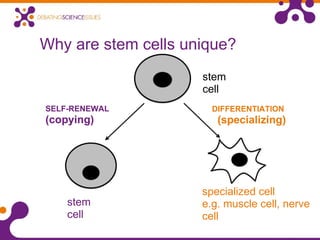
Why are stem cells unique? stem cell stem cell SELF-RENEWAL (copying) specialized cell e.g. muscle cell, nerve cell DIFFERENTIATION (specializing)
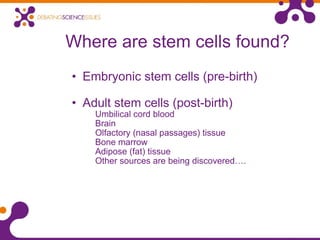
Where are stem cells found? Embryonic stem cells (pre-birth) Adult stem cells (post-birth) Umbilical cord blood Brain Olfactory (nasal passages) tissue Bone marrow Adipose (fat) tissue Other sources are being discovered….
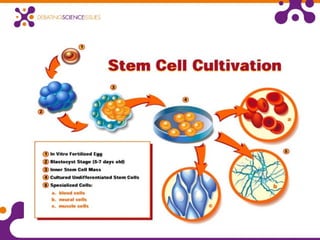
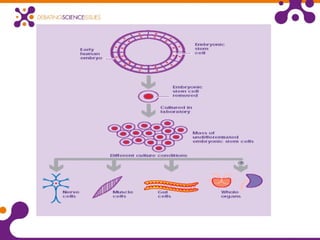
Sources of embryonic stem cells Spare or surplus embryos from  in vitro  fertilisation (IVF) Embryos created for scientific research using donated eggs and sperm  Embryos created for scientific research using therapeutic cloning


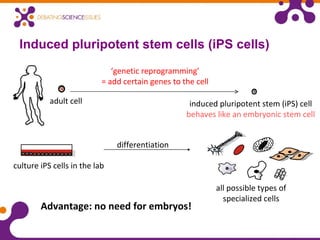
Induced pluripotent stem cells (iPS cells) Advantage: no need for embryos! adult cell ‘ genetic reprogramming’ = add certain genes to the cell induced pluripotent stem (iPS) cell behaves like an embryonic stem cell all possible types of specialized cells culture iPS cells in the lab differentiation
THE DEBATE -Currently there is no international consensus on embryo research or therapeutic cloning.  -European nations vary in their legislation.   -In some countries, the debate over whether we allow embryonic stem cell research is in its infancy. -This requires mutual respect for opposing positions and continued dialogue. -We need a proper understanding of the scientific facts about development of the embryo and what is involved in embryonic stem cell research. -We must think through our ethical principles and their implications.
Thank You

DSI 2011 Connachta

  • 1.
    Stem Cell research& Ethics Workshop An overview of Debating Science Issues An introduction to the Science of Stem Cells Hope or Hype? You decide….
  • 2.
    What is DebatingScience Issues? All-Ireland Secondary School Debate competition Open to senior cycle students All debates are on biomedical science Sponsored by the Wellcome Trust
  • 3.
    Why Debating ScienceIssues? Encourage you to take an active interest in biomedical science research and its ethical implications for all of society Encourage you to consider the many diverse career options available in science  Debate topics include: stem cell research, GM foods, vaccinations, nanotechnology and health and self-testing kits
  • 4.
    Organization of DSISmall groups take part in round table ethical workshops to prepare for first round of debates Students work as a team under teacher supervision to prepare debates 3-4 provincial heats (if successful!) before Semi-final and Final Follow progress on the 2010- 2011 competition on Twitter @DebatingScience
  • 5.
    Independent research-funding charity Largest charity in the U.K. Established in 1936 Founder of company that developed AZT and Rubella vaccines Interests range from science to history of medicine
  • 6.
    Science Foundation IrelandREMEDI is one of ten centres of excellence in Ireland funded by the Science Foundation Ireland and dedicated to advancing Ireland’s smart economy through cutting-edge research and development.  Forging innovative partnerships with industry, government and academia, the centres add value to Ireland through job creation, inward investment and international excellence in science, engineering and technology. 
  • 7.
    Stem Cell science-What are stem cells? Unspecialised cells lacking any tissue-specific structure Can give rise to specialised cells through the process of differentiation
  • 8.
    Why are stemcells unique? stem cell stem cell SELF-RENEWAL (copying) specialized cell e.g. muscle cell, nerve cell DIFFERENTIATION (specializing)
  • 9.
    Where are stemcells found? Embryonic stem cells (pre-birth) Adult stem cells (post-birth) Umbilical cord blood Brain Olfactory (nasal passages) tissue Bone marrow Adipose (fat) tissue Other sources are being discovered….
  • 10.
    Sources of embryonicstem cells Spare or surplus embryos from in vitro fertilisation (IVF) Embryos created for scientific research using donated eggs and sperm Embryos created for scientific research using therapeutic cloning
  • 11.
  • 12.
  • 13.
  • 14.
    Induced pluripotent stemcells (iPS cells) Advantage: no need for embryos! adult cell ‘ genetic reprogramming’ = add certain genes to the cell induced pluripotent stem (iPS) cell behaves like an embryonic stem cell all possible types of specialized cells culture iPS cells in the lab differentiation
  • 15.
    THE DEBATE -Currentlythere is no international consensus on embryo research or therapeutic cloning. -European nations vary in their legislation. -In some countries, the debate over whether we allow embryonic stem cell research is in its infancy. -This requires mutual respect for opposing positions and continued dialogue. -We need a proper understanding of the scientific facts about development of the embryo and what is involved in embryonic stem cell research. -We must think through our ethical principles and their implications.
  • 16.

Editor's Notes

  • #15 Induced pluripotent stem cells (iPS cells) Note: This slide contains a lot of information and may be too complex for some audiences unless there is plenty of time for explanations and discussions. What are iPS cells? In 2006, scientists discovered that it is possible to make a new kind of stem cell in the laboratory. They found that they could transform adult skin cells from a mouse into cells that behave just like embryonic stem cells. In 2007, researchers did this with human cells too. The new stem cells that are made in the lab are called induced pluripotent stem cells . Just like embryonic stem cells, they can make all the different types of cell in the body – so we say they are pluripotent . Making induced pluripotent stem (iPS) cells is a bit like turning back time. Scientists add particular genes to adult cells to make them behave like embryonic stem cells. Genes give cells instructions about how to behave. So, this process is a bit like changing the instructions in a computer programme to make the computer do a new task. Scientists call the process they use to make iPS cells ‘genetic reprogramming’. Why are they exciting? Researchers hope that one day they might be able to use iPS cells to help treat diseases like Parkinson’s or Alzheimer’s. They hope to: Take adult cells like skin cells from a patient Make iPS cells Use those iPS cells to grow the specialized cells the patient needs to recover from the disease, e.g. certain brain cells. These cells would be made from the patient’s own skin cells so the body would not reject them. There is a long way to go before scientists can do this, but iPS cells are an exciting discovery.