



Building Bridges: Developing and
  Maintaining Positive Parent-
      Teacher Relationships

         Prepared for DSAWM
           January 11, 2011
 Learn what we need to know to be the best advocate.
 Identify methods of building relationships between
  educational team members
 List roles and responsibilities of educational team
  members
 Set a measurable goal to enhance communication
  between team members
What do we KNOW?


What do we WANT to learn?
 Anxiety- for parents and teachers


 Frustration- which can define your
 contact

 Limited   Time-demands are different
 but add up to the same result
“Begin with the end in Mind”

               ~Stephen
Covey
 DREAM BIG and plan annually
 Planning for Efficiency
 Know the disability, how it effect his/her learning
 Consider Strengths and needs
 Include the Child
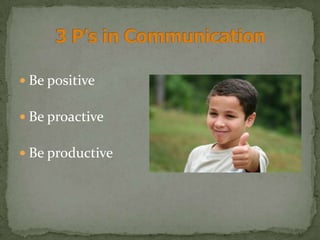
 Be positive

 Be proactive

 Be productive
Before……
           During……

                      After…..
Introducing …MY CHILD
Using the 3 P’s send a quick note and then set up
 a face to face meeting ( avoid an email at this
 time)
 Medical information
 Child’s strengths and needs
 Summary of goals
 Contact information and best time to communicate
 Emergency information
 Day to Day communication
   home to school notebook
   Notes in planner
   Check in/out sheet
   If phone call is required set up a consistent call time
    and keep it short
 Conferences
 IEP meetings
 “Reviews and Snafus”
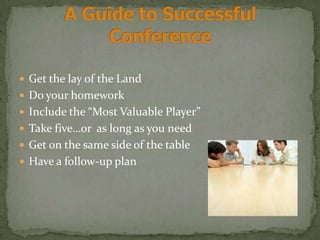
 Get the lay of the Land
 Do your homework
 Include the “Most Valuable Player”
 Take five…or as long as you need
 Get on the same side of the table
 Have a follow-up plan
 Is it TRUE?
 Is it HELPFUL?
 Is it IMPORTANT?
 Is it NECESSARY?
 Is it KIND?
 What are people saying…without saying anything at
  all?

 What are YOU saying?


 Posture, facial expressions, fidgeting…..
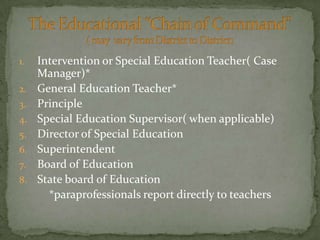
1.   Intervention or Special Education Teacher( Case
     Manager)*
2.   General Education Teacher*
3.   Principle
4.   Special Education Supervisor( when applicable)
5.   Director of Special Education
6.   Superintendent
7.   Board of Education
8.   State board of Education
       *paraprofessionals report directly to teachers
 “He’s an equal opportunity low-achiever”
 “ADHD? That’s a cop out”
 “You’ve probably been bending the rules for her since
    she’s been so sick”
   “I don’t see the OCD. He just keeps going back to his
    locker all the time”
   “We can’t afford to just give every kid intervention”
   “ your child isn’t failing enough”
   “He is just lazy”
 “ What I want you to do is spend quality time with my
    son”
   “Either you do what we want, or we’ll get a lawyer who
    will say you have to”
   “I don’t care if the kid gets F’s. But you can’t fail him…”
   “ I know you are giving 8 weeks of ESY to Mrs. Jones’s
    kid . I want that , too..”
   “ What degree do you have that qualifies you to work
    with my child?”
 Be sure to Have your paperwork
   Copy of IEP, all assessments and progress reports


 Get recommendations for the summer


                     Create templates for record keeping


                          Write genuine thank you notes
Building Bridges: Developing and Maintaining Positive Parent - Teacher Relationships

Building Bridges: Developing and Maintaining Positive Parent - Teacher Relationships

  • 1.
    Building Bridges: Developingand Maintaining Positive Parent- Teacher Relationships Prepared for DSAWM January 11, 2011
  • 2.
     Learn whatwe need to know to be the best advocate.  Identify methods of building relationships between educational team members  List roles and responsibilities of educational team members  Set a measurable goal to enhance communication between team members
  • 3.
    What do weKNOW? What do we WANT to learn?
  • 4.
     Anxiety- forparents and teachers  Frustration- which can define your contact  Limited Time-demands are different but add up to the same result
  • 5.
    “Begin with theend in Mind” ~Stephen Covey
  • 6.
     DREAM BIGand plan annually  Planning for Efficiency  Know the disability, how it effect his/her learning  Consider Strengths and needs  Include the Child
  • 7.
     Be positive Be proactive  Be productive
  • 8.
    Before…… During…… After…..
  • 9.
    Introducing …MY CHILD Usingthe 3 P’s send a quick note and then set up a face to face meeting ( avoid an email at this time)  Medical information  Child’s strengths and needs  Summary of goals  Contact information and best time to communicate  Emergency information
  • 10.
     Day toDay communication  home to school notebook  Notes in planner  Check in/out sheet  If phone call is required set up a consistent call time and keep it short  Conferences  IEP meetings  “Reviews and Snafus”
  • 11.
     Get thelay of the Land  Do your homework  Include the “Most Valuable Player”  Take five…or as long as you need  Get on the same side of the table  Have a follow-up plan
  • 12.
     Is itTRUE?  Is it HELPFUL?  Is it IMPORTANT?  Is it NECESSARY?  Is it KIND?
  • 13.
     What arepeople saying…without saying anything at all?  What are YOU saying?  Posture, facial expressions, fidgeting…..
  • 14.
    1. Intervention or Special Education Teacher( Case Manager)* 2. General Education Teacher* 3. Principle 4. Special Education Supervisor( when applicable) 5. Director of Special Education 6. Superintendent 7. Board of Education 8. State board of Education *paraprofessionals report directly to teachers
  • 15.
     “He’s anequal opportunity low-achiever”  “ADHD? That’s a cop out”  “You’ve probably been bending the rules for her since she’s been so sick”  “I don’t see the OCD. He just keeps going back to his locker all the time”  “We can’t afford to just give every kid intervention”  “ your child isn’t failing enough”  “He is just lazy”
  • 16.
     “ WhatI want you to do is spend quality time with my son”  “Either you do what we want, or we’ll get a lawyer who will say you have to”  “I don’t care if the kid gets F’s. But you can’t fail him…”  “ I know you are giving 8 weeks of ESY to Mrs. Jones’s kid . I want that , too..”  “ What degree do you have that qualifies you to work with my child?”
  • 17.
     Be sureto Have your paperwork  Copy of IEP, all assessments and progress reports  Get recommendations for the summer  Create templates for record keeping  Write genuine thank you notes