DRYING
BY MR-KASHISH WILSON
ASSISTANT PROFESSOR
MM COLLEGE OF PHARMACY
MM(DU) MULLANA AMBALA
INTRODUCTION
• Drying involves removal of water or another solvent by
evaporation from a solid, semi-solid or liquid by application of
heat and finally a liquid free solid product is obtained. In
general, drying is accomplished by thermal techniques but
non-thermal drying processes such as squeezing wetted
sponge, adsorption by desiccant (desiccation) and extraction
are also used. In bioproducts like food, grains, and
pharmaceuticals like vaccines, the solvent to be removed is
almost invariably water [1]
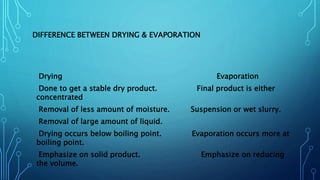
DIFFERENCE BETWEEN DRYING & EVAPORATION
Drying Evaporation
Done to get a stable dry product. Final product is either
concentrated
Removal of less amount of moisture. Suspension or wet slurry.
Removal of large amount of liquid.
Drying occurs below boiling point. Evaporation occurs more at
boiling point.
Emphasize on solid product. Emphasize on reducing
the volume.
OBJECTIVE OF DRYING
• The main objectives of drying include to preserve foods and increase their
shelf life by
reducing the water content and water activity; avoid the need for use of
refrigeration systems for transport and storage (expensive); reduce space
requirements for storage and transport.
In pharmaceutical technology, drying is carried out for one or more of the
following
reasons: 1. To avoid or eliminate moisture which may lead to corrosion and
decrease the
product or drug stability. 2. To improve or keep the good properties of a
material like
APPLICATION OF DRYING
• In pharmaceutical technology, drying is carried out for one or more of the following reasons:
• 1. Preparation of bulk drugs: In the preparation of bulk drugs, drying is the final stage of processing.
A few examples are – dried aluminium hydroxide, spray dried lactose and powdered extracts.
• 2. Preservation of drug products: Drying is necessary in order to avoid deterioration. For examples
protection of blood products, skin, tissues and crude drugs from microbial growth.
• 3. Improved characteristics: Drying produces materials of spherical shape, uniform size, free flowing
and enhanced solubility.
• 4. Improved handling: To reduce the cost of transportation of large volume materials.To make the
materials easy or more stable for handling. Drying reduces moisture content [3].
• 5. Drying as final step: Drying is the final step in evaporation, filtration, and
• crystallization.
THANKS.....

DRYING.pptx

  • 1.
    DRYING BY MR-KASHISH WILSON ASSISTANTPROFESSOR MM COLLEGE OF PHARMACY MM(DU) MULLANA AMBALA
  • 2.
    INTRODUCTION • Drying involvesremoval of water or another solvent by evaporation from a solid, semi-solid or liquid by application of heat and finally a liquid free solid product is obtained. In general, drying is accomplished by thermal techniques but non-thermal drying processes such as squeezing wetted sponge, adsorption by desiccant (desiccation) and extraction are also used. In bioproducts like food, grains, and pharmaceuticals like vaccines, the solvent to be removed is almost invariably water [1]
  • 3.
    DIFFERENCE BETWEEN DRYING& EVAPORATION Drying Evaporation Done to get a stable dry product. Final product is either concentrated Removal of less amount of moisture. Suspension or wet slurry. Removal of large amount of liquid. Drying occurs below boiling point. Evaporation occurs more at boiling point. Emphasize on solid product. Emphasize on reducing the volume.
  • 4.
    OBJECTIVE OF DRYING •The main objectives of drying include to preserve foods and increase their shelf life by reducing the water content and water activity; avoid the need for use of refrigeration systems for transport and storage (expensive); reduce space requirements for storage and transport. In pharmaceutical technology, drying is carried out for one or more of the following reasons: 1. To avoid or eliminate moisture which may lead to corrosion and decrease the product or drug stability. 2. To improve or keep the good properties of a material like
  • 5.
    APPLICATION OF DRYING •In pharmaceutical technology, drying is carried out for one or more of the following reasons: • 1. Preparation of bulk drugs: In the preparation of bulk drugs, drying is the final stage of processing. A few examples are – dried aluminium hydroxide, spray dried lactose and powdered extracts. • 2. Preservation of drug products: Drying is necessary in order to avoid deterioration. For examples protection of blood products, skin, tissues and crude drugs from microbial growth. • 3. Improved characteristics: Drying produces materials of spherical shape, uniform size, free flowing and enhanced solubility. • 4. Improved handling: To reduce the cost of transportation of large volume materials.To make the materials easy or more stable for handling. Drying reduces moisture content [3]. • 5. Drying as final step: Drying is the final step in evaporation, filtration, and • crystallization.
  • 6.