ANTI-AMOEBIC
AGENTS
By P. J. Okoth
Introduction
 Antiamoebic agents are drugs useful in
treating infections caused by the protozoa
Entamoeba hitolytica.
 Amoebiasis occurs by fecal contamination
of food and water.
 Amoebic cysts reaching the intestine
transform into trophozoites.
Introduction
 Trophozoites either:-
Live on the surface of colonic mucosa
as commensals - form cysts that pass
into the stools (luminal cycle) and serve
to propagate the disease, or
Invade the mucosa – form amoebic
ulcers and cause acute dysentery (with
blood and mucus in stools) or chronic
intestinal amoebiasis (with vague
abdominal symptoms, amoeboma).
Introduction
 Occasionally the trophozoites pass into
the bloodstream, reach the liver via portal
vein and cause amoebic liver abscess.
 Such infection is termed extraintestinal
amoebiasis, and only trophozoites are
present; cyst formation does not occur.
 Other organs may rarely be involved:
lungs, spleen, brain, and kidneys.
Classification of anti-amoebic
drugs
1. Tissue
amoebicides
a) For both
intestinal and
extraintestinal
amoebiasis:
 Nitroimidazoles
 Metronidazole
 Tinidazole
 Secnidazole
 Ornidazole
 Satranidazole
 Alkaloids
Emetine
Dehydroemetine
b) For
extraintestinal
amoebiasis only
 chloroquine
Classification of anti-amoebic
drugs
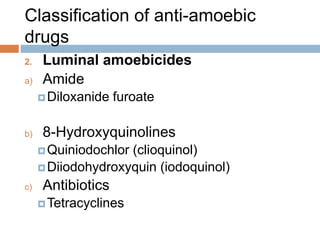
2. Luminal amoebicides
a) Amide
Diloxanide furoate
b) 8-Hydroxyquinolines
Quiniodochlor (clioquinol)
Diiodohydroxyquin (iodoquinol)
c) Antibiotics
Tetracyclines
Antibacterial and anti-protozoal drugs
NITROIMIDAZOLES
Is the prototype nitroimidazole
Metronidazole
Metronidazole
Is the prototype nitroimidazole
Spectrum of activity:
 It has a broad spectrum cidal activity
against protozoa:
Entamoeba histolytica
Trichomonas vaginalis
Giardia lamblia
 Many anaerobic bacteria are sensitive to it.
Metronidazole
Mechanism of action:
 Metronidazole is selectively toxic to
anaerobic microorganisms.
 After entering the cell by diffusion, its nitro
group is reduced by certain redox proteins
operative only in anaerobic microbes, to
highly reactive nitro radical, which exerts
cytotoxicity by damaging DNA and other
critical biomolecules.
Metronidazole
Pharmacokinetics:
 Metronidazole is well absorbed from the small
intestines
 It is widely distributed in the body, attaining
therapeutic concentration in the liver, gut wall,
pelvic tissues, vaginal secretion, semen, saliva
and CSF.
 It is metabolized in the liver primarily by
oxidation and glucuronide conjugation.
 It is excreted in urine partly unchanged and
partly as metabolites.
 The plasma half-life is 8 hours.
Metronidazole
Adverse effects:
 Are relatively frequent but mostly non-serious.
 They include:
 Nausea
 Vomiting
 Anorexia
 An unpleasant metallic taste in the mouth
 Abdominal cramps
 Loose stool
Metronidazole
 Other adverse effects include:
 Headache
 Glossitis
 Dryness of the mouth
 Dizziness
 Rashes, urticaria and angioedema
 Peripheral neuropathy if treatment is prolonged
 Epileptiform seizures in very high doses
Metronidazole
Contraindications:
 In neurological disease
 Blood dyscrasias
 First trimester pregnancy
 Chronic alcoholism
Metronidazole
Interactions:
 A disulfirum-like intolerance to alcohol occurs
because metronidazole inhibits alcohol and
aldehyde dehydrogenase.
 Patients should be told to avoid alcohol
 Enzyme inducers (phenobarbitone, rifampicin)
may reduce its therapeutic effect.
 Cimetidine can reduce metronidazole
metabolism. Its dose may need to be
decreased.
Metronidazole
Preparations:
 Available as:
Tablets 200mg, 400mg
Suspension 200mg/5ml
Intravenous infusion 500mg/100ml
Metronidazole
Uses and dosage:
 Metronidazole is active against a wide range of
anaerobic bacteria and also protozoa.
Metronidazole: uses and dosage
1. Amoebiasis (Entamoeba histolytica)
 Metronidazole is a first-line drug for all forms of
amoebic infection- both intestinal and extra-
intestinal infection.
 For invasive dysentery and liver abscess:
 800mg TDS for 5-10 days [children 30-50mg/kg/day]
 In serious cases of liver abscess:
 1g may be infused I.V. slowly, followed by 0.5g every 12
hours till oral therapy is instituted.
 For mild intestinal disease:
 400mg TDS for 5-7 days.
Metronidazole
Uses and dosage …
2. Giardiasis (Giardia lamblia)
 200mg TDS x 7 days or 2g daily for 3 days
3. Trichomoniasis (Trichomonas vaginalis) of
urogenital tract in both sexes: e.g.
trichomonas vaginitis
 400mg TDS X 7days
4. Anaerobic vaginosis (Gardnerella vaginalis)
 400mg TDS x 7 days
Metronidazole
Uses and dosage…
5. Anaerobic bacterial infections:
 Metronidazole is an effective drug for
treatment of sepsis due to anaerobic
organisms e.g. Bacteroides fragilis, and
anaerobic cocci.
 Such infections occur mostly after colorectal or
pelvic surgery, appendicectomy, etc. leading
to:
 Intraabdominal infection
 Septicaemia
 Pelvic infection
Metronidazole
Uses and dosage…
 Metronidazole is generally used in
combination with gentamicin and
cephalosporins.
 Dose: for serious infections intravenous
administration is recommended:
 15mg/kg infused over 1 hour followed by
7.5mg/kg every 6 hours till oral therapy can be
instituted with 400-800mg TDS.
Metronidazole
Uses and dosage…
6. Pseudomembranous enterocolitis ( due to
clostridium difficile)
 Usually associated with use of antibiotics
 Oral metronidazole is used at a dose of:
800mg TDS X 5-7/7
7. Acute ulcerative gingivitis and dental infections
(Fusobacterium species)
200-400mg TDS X 5-7/7
 Combine with a penicillin or tetracycline
8. Helicobacter pylori gastritis/peptic ulcer
 400mg TDS x 1-2 weeks in combination with
Amoxycillin/clarithromycin and a proton pump inhibitor.
Tinidazole
 Is similar to metronidazole but has a longer
plasma half-life of 12 hours
 Has slower metabolism, duration of action is
longer and thus more suited for single dose or
once daily therapy.
 It is better tolerated than metronidazole; the
incidence of side effects is lower
Tinidazole
Uses and dosage
 Recommended schedules are:
 Amoebiasis: 2g OD X 3/7 [children 30-
50mg/kg/day]
 Trichomoniasis and Giardiasis: 2g single
dose
 Avoid alcohol
Secnidazole
 Has the same spectrum of activity and potency
as metronidazole
 Absorption after oral administration is rapid
and complete
 Metabolism is slower resulting in a plasma
half-life of 17-29 hours
 A single dose yields cure rates equal to
multiple doses of metronidazole and tinidazole
 Side effects profile is similar to metronidazole
Secnidazole
Dosage:
 2g single dose (children 30mg/kg) for
intestinal amoebiasis, giardiasis,
trichomoniasis and non-specific bacterial
vaginosis
 1.5g/day for 5 days in hepatic amoebiasis.
 Available as 500mg and 1g tablets.
Ornidazole
 Activity similar to metronidazole, but it is slowly
metabolized.
 Has longer half-life of 12-14 hours
 Dose and duration of regimens for amoebiasis,
giardiasis, trichomoniasis, anaerobic infections
and bacterial vaginosis resemble those for
tinidazole.
 Side effect profile is also similar
 Available as 500mg tablets and 500mg/100ml vial
for I.V. infusion.
 Amoebiasis: 2g OD x 3/7
Satranidazole
 Has longer plasma half-life than metronidazole [14
hrs]
 Advantages claimed are:
 Better tolerability
 No nausea, vomiting or metallic taste
 Absence of neurological and disulfirum like reactions
 It does not produce the acetamide metabolite which is
a weak carcinogen
 Dose:
 Amoebiasis 300mg BD for 3-5 days
 Giardiasis and trichomoniasis 600mg single dose
 Available as 300mg tablet [satrogyl]
Diloxanide furoate
Luminal amoebicides
Diloxanide furoate
 Is a highly effective luminal amoebicide.
 It directly kills trophozoites responsible for
production of cysts.
 The furoate ester is hydrolysed in the
intestine and the released diloxanide is
largely absorbed, but produces no systemic
antiamoebic activity. It is metabolized by
glucuronidation and excreted in urine.
 Diloxanide is a weaker amoebicide than its
furoate ester.
Diloxanide furoate
 Diloxanide furoate is less effective in
invasive amoebic dysentery, because of
poor tissue amoebicidal action.
 However, it produces high cure rates in
mild intestinal amoebiasis and in
asymptomatic cyst passers.
Diloxanide furoate
Dose:
 500mg TDS X 5-10 days
 Children 20mg/kg/day
 Available as 500mg tablets
 Combination tablets are available:
 Diloxanide furoate 250mg + metronidazole
200mg (e.g. Dirade-M or Entamizole 2 tds x 5-
10 days)
 Diloxanide furoate 250mg + tinidazole 150mg
(e.g. TINIBA-DF 2 TDS X 5 days)
Diloxanide furoate
 Diloxanide furoate is very well tolerated;
the only side effects are flatulence,
occasional nausea, itching and rarely
urticaria.
 It is the drug of choice for mild intestinal
and asymptomatic amoebiasis.
 It is given after tissue amoebicide to
eradicate cysts.
Thank you.
The end.

ANTIAMOEBIC AGENTS.pptx

  • 1.
  • 2.
    Introduction  Antiamoebic agentsare drugs useful in treating infections caused by the protozoa Entamoeba hitolytica.  Amoebiasis occurs by fecal contamination of food and water.  Amoebic cysts reaching the intestine transform into trophozoites.
  • 3.
    Introduction  Trophozoites either:- Liveon the surface of colonic mucosa as commensals - form cysts that pass into the stools (luminal cycle) and serve to propagate the disease, or Invade the mucosa – form amoebic ulcers and cause acute dysentery (with blood and mucus in stools) or chronic intestinal amoebiasis (with vague abdominal symptoms, amoeboma).
  • 4.
    Introduction  Occasionally thetrophozoites pass into the bloodstream, reach the liver via portal vein and cause amoebic liver abscess.  Such infection is termed extraintestinal amoebiasis, and only trophozoites are present; cyst formation does not occur.  Other organs may rarely be involved: lungs, spleen, brain, and kidneys.
  • 5.
    Classification of anti-amoebic drugs 1.Tissue amoebicides a) For both intestinal and extraintestinal amoebiasis:  Nitroimidazoles  Metronidazole  Tinidazole  Secnidazole  Ornidazole  Satranidazole  Alkaloids Emetine Dehydroemetine b) For extraintestinal amoebiasis only  chloroquine
  • 6.
    Classification of anti-amoebic drugs 2.Luminal amoebicides a) Amide Diloxanide furoate b) 8-Hydroxyquinolines Quiniodochlor (clioquinol) Diiodohydroxyquin (iodoquinol) c) Antibiotics Tetracyclines
  • 7.
    Antibacterial and anti-protozoaldrugs NITROIMIDAZOLES
  • 8.
    Is the prototypenitroimidazole Metronidazole
  • 9.
    Metronidazole Is the prototypenitroimidazole Spectrum of activity:  It has a broad spectrum cidal activity against protozoa: Entamoeba histolytica Trichomonas vaginalis Giardia lamblia  Many anaerobic bacteria are sensitive to it.
  • 10.
    Metronidazole Mechanism of action: Metronidazole is selectively toxic to anaerobic microorganisms.  After entering the cell by diffusion, its nitro group is reduced by certain redox proteins operative only in anaerobic microbes, to highly reactive nitro radical, which exerts cytotoxicity by damaging DNA and other critical biomolecules.
  • 11.
    Metronidazole Pharmacokinetics:  Metronidazole iswell absorbed from the small intestines  It is widely distributed in the body, attaining therapeutic concentration in the liver, gut wall, pelvic tissues, vaginal secretion, semen, saliva and CSF.  It is metabolized in the liver primarily by oxidation and glucuronide conjugation.  It is excreted in urine partly unchanged and partly as metabolites.  The plasma half-life is 8 hours.
  • 12.
    Metronidazole Adverse effects:  Arerelatively frequent but mostly non-serious.  They include:  Nausea  Vomiting  Anorexia  An unpleasant metallic taste in the mouth  Abdominal cramps  Loose stool
  • 13.
    Metronidazole  Other adverseeffects include:  Headache  Glossitis  Dryness of the mouth  Dizziness  Rashes, urticaria and angioedema  Peripheral neuropathy if treatment is prolonged  Epileptiform seizures in very high doses
  • 14.
    Metronidazole Contraindications:  In neurologicaldisease  Blood dyscrasias  First trimester pregnancy  Chronic alcoholism
  • 15.
    Metronidazole Interactions:  A disulfirum-likeintolerance to alcohol occurs because metronidazole inhibits alcohol and aldehyde dehydrogenase.  Patients should be told to avoid alcohol  Enzyme inducers (phenobarbitone, rifampicin) may reduce its therapeutic effect.  Cimetidine can reduce metronidazole metabolism. Its dose may need to be decreased.
  • 16.
    Metronidazole Preparations:  Available as: Tablets200mg, 400mg Suspension 200mg/5ml Intravenous infusion 500mg/100ml
  • 17.
    Metronidazole Uses and dosage: Metronidazole is active against a wide range of anaerobic bacteria and also protozoa.
  • 18.
    Metronidazole: uses anddosage 1. Amoebiasis (Entamoeba histolytica)  Metronidazole is a first-line drug for all forms of amoebic infection- both intestinal and extra- intestinal infection.  For invasive dysentery and liver abscess:  800mg TDS for 5-10 days [children 30-50mg/kg/day]  In serious cases of liver abscess:  1g may be infused I.V. slowly, followed by 0.5g every 12 hours till oral therapy is instituted.  For mild intestinal disease:  400mg TDS for 5-7 days.
  • 19.
    Metronidazole Uses and dosage… 2. Giardiasis (Giardia lamblia)  200mg TDS x 7 days or 2g daily for 3 days 3. Trichomoniasis (Trichomonas vaginalis) of urogenital tract in both sexes: e.g. trichomonas vaginitis  400mg TDS X 7days 4. Anaerobic vaginosis (Gardnerella vaginalis)  400mg TDS x 7 days
  • 20.
    Metronidazole Uses and dosage… 5.Anaerobic bacterial infections:  Metronidazole is an effective drug for treatment of sepsis due to anaerobic organisms e.g. Bacteroides fragilis, and anaerobic cocci.  Such infections occur mostly after colorectal or pelvic surgery, appendicectomy, etc. leading to:  Intraabdominal infection  Septicaemia  Pelvic infection
  • 21.
    Metronidazole Uses and dosage… Metronidazole is generally used in combination with gentamicin and cephalosporins.  Dose: for serious infections intravenous administration is recommended:  15mg/kg infused over 1 hour followed by 7.5mg/kg every 6 hours till oral therapy can be instituted with 400-800mg TDS.
  • 22.
    Metronidazole Uses and dosage… 6.Pseudomembranous enterocolitis ( due to clostridium difficile)  Usually associated with use of antibiotics  Oral metronidazole is used at a dose of: 800mg TDS X 5-7/7 7. Acute ulcerative gingivitis and dental infections (Fusobacterium species) 200-400mg TDS X 5-7/7  Combine with a penicillin or tetracycline 8. Helicobacter pylori gastritis/peptic ulcer  400mg TDS x 1-2 weeks in combination with Amoxycillin/clarithromycin and a proton pump inhibitor.
  • 23.
    Tinidazole  Is similarto metronidazole but has a longer plasma half-life of 12 hours  Has slower metabolism, duration of action is longer and thus more suited for single dose or once daily therapy.  It is better tolerated than metronidazole; the incidence of side effects is lower
  • 24.
    Tinidazole Uses and dosage Recommended schedules are:  Amoebiasis: 2g OD X 3/7 [children 30- 50mg/kg/day]  Trichomoniasis and Giardiasis: 2g single dose  Avoid alcohol
  • 25.
    Secnidazole  Has thesame spectrum of activity and potency as metronidazole  Absorption after oral administration is rapid and complete  Metabolism is slower resulting in a plasma half-life of 17-29 hours  A single dose yields cure rates equal to multiple doses of metronidazole and tinidazole  Side effects profile is similar to metronidazole
  • 26.
    Secnidazole Dosage:  2g singledose (children 30mg/kg) for intestinal amoebiasis, giardiasis, trichomoniasis and non-specific bacterial vaginosis  1.5g/day for 5 days in hepatic amoebiasis.  Available as 500mg and 1g tablets.
  • 27.
    Ornidazole  Activity similarto metronidazole, but it is slowly metabolized.  Has longer half-life of 12-14 hours  Dose and duration of regimens for amoebiasis, giardiasis, trichomoniasis, anaerobic infections and bacterial vaginosis resemble those for tinidazole.  Side effect profile is also similar  Available as 500mg tablets and 500mg/100ml vial for I.V. infusion.  Amoebiasis: 2g OD x 3/7
  • 28.
    Satranidazole  Has longerplasma half-life than metronidazole [14 hrs]  Advantages claimed are:  Better tolerability  No nausea, vomiting or metallic taste  Absence of neurological and disulfirum like reactions  It does not produce the acetamide metabolite which is a weak carcinogen  Dose:  Amoebiasis 300mg BD for 3-5 days  Giardiasis and trichomoniasis 600mg single dose  Available as 300mg tablet [satrogyl]
  • 29.
  • 30.
    Diloxanide furoate  Isa highly effective luminal amoebicide.  It directly kills trophozoites responsible for production of cysts.  The furoate ester is hydrolysed in the intestine and the released diloxanide is largely absorbed, but produces no systemic antiamoebic activity. It is metabolized by glucuronidation and excreted in urine.  Diloxanide is a weaker amoebicide than its furoate ester.
  • 31.
    Diloxanide furoate  Diloxanidefuroate is less effective in invasive amoebic dysentery, because of poor tissue amoebicidal action.  However, it produces high cure rates in mild intestinal amoebiasis and in asymptomatic cyst passers.
  • 32.
    Diloxanide furoate Dose:  500mgTDS X 5-10 days  Children 20mg/kg/day  Available as 500mg tablets  Combination tablets are available:  Diloxanide furoate 250mg + metronidazole 200mg (e.g. Dirade-M or Entamizole 2 tds x 5- 10 days)  Diloxanide furoate 250mg + tinidazole 150mg (e.g. TINIBA-DF 2 TDS X 5 days)
  • 33.
    Diloxanide furoate  Diloxanidefuroate is very well tolerated; the only side effects are flatulence, occasional nausea, itching and rarely urticaria.  It is the drug of choice for mild intestinal and asymptomatic amoebiasis.  It is given after tissue amoebicide to eradicate cysts.
  • 34.