

DUE & DUR
Prepared by
Pooja Anothra
Asst. Professor
IEC group of institution
It is a system of ongoing, systematic, criteria-based
evaluation of drug use that will help ensure that
medicines are used appropriately (at the individual
patient level). If therapy is deemed to be
inappropriate, interventions with providers or
patients will be necessary to optimize drug therapy
A DUE is drug or disease-specific and can be
structured so that it will assess the actual process of
prescribing, dispensing or administrating a drug.
DUE is same as drug utilization review.
2
Drug utilization evaluation
(DUE)
Goals
• The goal of DUE is to promote optimal
medication therapy and ensure that drug
therapy meets current standards of care.
Additional objectives may includes;
• Creating guidelines for appropriate drug
utilization
• Evaluating the effectiveness of medication
therapy
3
• Enhancing responsibility in the medicine use
process
• Controlling medicine cost
• Preventing medication related problems. E.g-
ADR
• Identifying areas in which further
information and education may be needed by
health care providers
4
Cont...
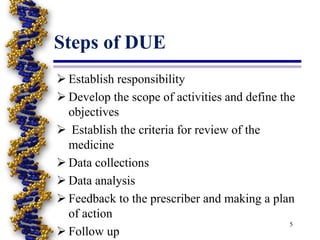
Steps of DUE
 Establish responsibility
 Develop the scope of activities and define the
objectives
 Establish the criteria for review of the
medicine
 Data collections
 Data analysis
 Feedback to the prescriber and making a plan
of action
 Follow up
5
Drug utilization review
(DUR)
Drug utilization review (DUR) is defined as an
authorized, structured, ongoing review of prescribing,
dispensing and use of medication. DUR encompasses a
drug review against predetermined criteria that results
in changes to drug therapy when these criteria are not
met. It involves a comprehensive review of patients'
prescription and medication data before, during and
after dispensing to ensure appropriate medication
decision-making and positive patient outcomes. As a
quality assurance measure, DUR programs provide
corrective action, prescriber feedback and further
evaluations.
6
WHY DUR IS IMPORTANT
DUR programs play a key role in helping managed health
care systems understand, interpret, evaluate and improve
the prescribing, administration and use of medications.
Employers and health plans find DUR programs valuable
since the results are used to foster more efficient use of
scarce health care resources. Pharmacists play a key role
in this process because of their expertise in the area of
medication therapy management.
7
Cont….
DUR affords the managed care pharmacist the
opportunity to identify trends in prescribing within
groups of patients whether by disease-state such as
those with asthma, diabetes or high blood pressure,
or by drugspecific criteria. Pharmacists can then, in
collaboration with prescribers and other members of
the health care team, initiate action to improve drug
therapy for patients.
8
Cont….
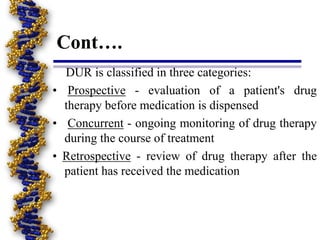
DUR is classified in three categories:
• Prospective - evaluation of a patient's drug
therapy before medication is dispensed
• Concurrent - ongoing monitoring of drug therapy
during the course of treatment
• Retrospective - review of drug therapy after the
patient has received the medication
Cont…
Prospective DUR: Prospective review involves evaluating
a patient's planned drug therapy before a medication is
dispensed. This process allows the pharmacist to identify
and resolve problems before the patient has received the
medication. Pharmacists routinely perform prospective
reviews in their daily practice by assessing a prescription
medications dosage and directions while reviewing patient
information for possible drug interactions or duplicate
therapy. When part of an online claims adjudication
process, prospective DUR often relies on computerized
algorithms to perform key checks including drug
interactions, duplications or contraindications with the
patient’s disease state or condition.
10
Cont….
Example: Identification of drug-drug interactions are a
common outcome of a prospective DUR. For example, a
patient being treated with warfarin to prevent blood clots may
be prescribed a new drug by another specialist to treat
arthritis. If taken together, the patient could experience
internal bleeding. Upon reviewing the patient's prescriptions,
the pharmacist would note the potential drug interaction and
contact the prescriber to alert him/her to the problem. 11
Cont...
Concurrent DUR: Concurrent review is performed
during the course of treatment and involves the ongoing
monitoring of drug therapy to foster positive patient
outcomes. It presents pharmacists with the opportunity to
alert prescribers to potential problems and intervene in
areas such as drug-drug interactions, duplicate therapy,
over or underutilization and excessive or insufficient
dosing. This type of review allows therapy for a patient
to be altered if necessary. As electronic prescribing
becomes more widely adopted, the concurrent DUR
process may be performed by the prescriber at the time
of prescription transmission to the pharmacy, allowing
interventions before the drug is dispensed.
12
Example: Concurrent DUR often occurs in institutional
settings, where patients often receive multiple medications.
Periodic review of patient records can detect actual or
potential drug drug interactions or duplicate therapy. It can
also alert the pharmacist to the need for changes in
medications, such as antibiotics, or the need for dosage
adjustments based on laboratory test results. The key
prescriber(s) must then be alerted to the situation so
corrective action can be taken.
13
Cont...
Cont...
Retrospective DUR: A retrospective DUR reviews
drug therapy after the patient has received the medication. A
retrospective review aims to detect patterns in prescribing,
dispensing or administering drugs. Based on current patterns
of medication use, prospective standards and target
interventions can be developed to prevent recurrence of
inappropriate medication use or abuse. Outcomes of this
review may aid prescribers in improving the care of their
patients, either individually or within a certain target
population (e.g., patients with diabetes, asthma, or high
blood pressure).
14
15

Drug utilization evaluation(DUE) & Drug utilization review)

  • 1.
    DUE & DUR Preparedby Pooja Anothra Asst. Professor IEC group of institution
  • 2.
    It is asystem of ongoing, systematic, criteria-based evaluation of drug use that will help ensure that medicines are used appropriately (at the individual patient level). If therapy is deemed to be inappropriate, interventions with providers or patients will be necessary to optimize drug therapy A DUE is drug or disease-specific and can be structured so that it will assess the actual process of prescribing, dispensing or administrating a drug. DUE is same as drug utilization review. 2 Drug utilization evaluation (DUE)
  • 3.
    Goals • The goalof DUE is to promote optimal medication therapy and ensure that drug therapy meets current standards of care. Additional objectives may includes; • Creating guidelines for appropriate drug utilization • Evaluating the effectiveness of medication therapy 3
  • 4.
    • Enhancing responsibilityin the medicine use process • Controlling medicine cost • Preventing medication related problems. E.g- ADR • Identifying areas in which further information and education may be needed by health care providers 4 Cont...
  • 5.
    Steps of DUE Establish responsibility  Develop the scope of activities and define the objectives  Establish the criteria for review of the medicine  Data collections  Data analysis  Feedback to the prescriber and making a plan of action  Follow up 5
  • 6.
    Drug utilization review (DUR) Drugutilization review (DUR) is defined as an authorized, structured, ongoing review of prescribing, dispensing and use of medication. DUR encompasses a drug review against predetermined criteria that results in changes to drug therapy when these criteria are not met. It involves a comprehensive review of patients' prescription and medication data before, during and after dispensing to ensure appropriate medication decision-making and positive patient outcomes. As a quality assurance measure, DUR programs provide corrective action, prescriber feedback and further evaluations. 6
  • 7.
    WHY DUR ISIMPORTANT DUR programs play a key role in helping managed health care systems understand, interpret, evaluate and improve the prescribing, administration and use of medications. Employers and health plans find DUR programs valuable since the results are used to foster more efficient use of scarce health care resources. Pharmacists play a key role in this process because of their expertise in the area of medication therapy management. 7
  • 8.
    Cont…. DUR affords themanaged care pharmacist the opportunity to identify trends in prescribing within groups of patients whether by disease-state such as those with asthma, diabetes or high blood pressure, or by drugspecific criteria. Pharmacists can then, in collaboration with prescribers and other members of the health care team, initiate action to improve drug therapy for patients. 8
  • 9.
    Cont…. DUR is classifiedin three categories: • Prospective - evaluation of a patient's drug therapy before medication is dispensed • Concurrent - ongoing monitoring of drug therapy during the course of treatment • Retrospective - review of drug therapy after the patient has received the medication
  • 10.
    Cont… Prospective DUR: Prospectivereview involves evaluating a patient's planned drug therapy before a medication is dispensed. This process allows the pharmacist to identify and resolve problems before the patient has received the medication. Pharmacists routinely perform prospective reviews in their daily practice by assessing a prescription medications dosage and directions while reviewing patient information for possible drug interactions or duplicate therapy. When part of an online claims adjudication process, prospective DUR often relies on computerized algorithms to perform key checks including drug interactions, duplications or contraindications with the patient’s disease state or condition. 10
  • 11.
    Cont…. Example: Identification ofdrug-drug interactions are a common outcome of a prospective DUR. For example, a patient being treated with warfarin to prevent blood clots may be prescribed a new drug by another specialist to treat arthritis. If taken together, the patient could experience internal bleeding. Upon reviewing the patient's prescriptions, the pharmacist would note the potential drug interaction and contact the prescriber to alert him/her to the problem. 11
  • 12.
    Cont... Concurrent DUR: Concurrentreview is performed during the course of treatment and involves the ongoing monitoring of drug therapy to foster positive patient outcomes. It presents pharmacists with the opportunity to alert prescribers to potential problems and intervene in areas such as drug-drug interactions, duplicate therapy, over or underutilization and excessive or insufficient dosing. This type of review allows therapy for a patient to be altered if necessary. As electronic prescribing becomes more widely adopted, the concurrent DUR process may be performed by the prescriber at the time of prescription transmission to the pharmacy, allowing interventions before the drug is dispensed. 12
  • 13.
    Example: Concurrent DURoften occurs in institutional settings, where patients often receive multiple medications. Periodic review of patient records can detect actual or potential drug drug interactions or duplicate therapy. It can also alert the pharmacist to the need for changes in medications, such as antibiotics, or the need for dosage adjustments based on laboratory test results. The key prescriber(s) must then be alerted to the situation so corrective action can be taken. 13 Cont...
  • 14.
    Cont... Retrospective DUR: Aretrospective DUR reviews drug therapy after the patient has received the medication. A retrospective review aims to detect patterns in prescribing, dispensing or administering drugs. Based on current patterns of medication use, prospective standards and target interventions can be developed to prevent recurrence of inappropriate medication use or abuse. Outcomes of this review may aid prescribers in improving the care of their patients, either individually or within a certain target population (e.g., patients with diabetes, asthma, or high blood pressure). 14
  • 15.